June 28, 2004
Strong quake jolts coast
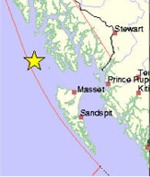
VANCOUVER - A powerful earthquake shook and rattled homes in the Queen Charlotte Islands, parts of northwestern B.C. and the Alaska Panhandle early Monday.
The quake, with a magnitude of 6.7, was centred beneath the ocean about 112-kilometres northwest of Dixon Entrance – which is at the north end of the Charlottes.
LINK: Map showing quake location
Masset resident Linda Smerychynski says a low rumble woke her up just before 3 a.m. PDT. But the quake didn't frighten her.
"I've already lived through two six-point-plus earthquakes in the last six years that we've lived here. It seemed normal almost. It's basically what we live with."
"Normally the big ones you notice, but the little one's you don't notice because they happen so frequently," she says.
INDEPTH: Earthquakes
No significant damage was reported in the Queen Charlottes nor on the Alaska Panhandle, although some items fell from walls and shelves in Craig, Alaska.
Scientists say a quake with a magnitude of 6.7 could have caused significant damage if it had occurred closer to a built-up area on land.
June 15, 2004
Hydro still wants rate hike
Michael Kane
CanWest News Service
Times Colonist
Tuesday, June 15, 2004
B.C. Hydro released much improved financial results Monday but said the stronger bottom line won't stop it asking for an 8.9 per cent rate increase despite protests from customers.
Nor has recent wet weather eased the Crown corporation's concerns about low reservoir levels forcing more electricity imports to meet domestic demand.
"We'd need a lot more rain throughout the summer to make a difference," said Elisha Moreno, Hydro's media relations manager.
British Columbia relies on electricity imports from Alberta and the U.S. to provide about 10 per cent of its annual needs.
Hydro reported a consolidated net income of $98 million for the year ended March 31 -- $146 million better than the $48 million loss originally projected but $320 million lower than net income of $418 million for the previous year.
"Here we have a profitable company asking for a rate increase and we have to wonder why," said Mark Veerkamp, executive director of B.C. Citizens for Public Power. "What I have seen recently is Hydro consistently under-budgeting their returns and that money is transferred to the province."
Jay Grewal, Hydro's acting chief financial officer, said the results are much improved from the original forecast due to wetter than normal conditions in the spring of 2003 and a decrease in the prices of electricity and natural gas purchases at the same time.
He said lower than normal water inflows later in the fiscal year, which reduced the availability of low-cost generation and increased import demand, contributed to the decline from last year's results. Another factor is a $120-million "provision" to reflect money spent on a gas pipeline and a Vancouver Island power plant that are unlikely to be built.
Veerkamp complains the B.C. government has directed B.C. Hydro to purchase power from private energy sources and is banning any new power plants.
In fiscal year 2003, private power purchases cost 10 times what it cost for B.C. Hydro to produce its own power. Over the past 10 years, private electricity prices have increased 77 per cent while B.C. Hydro prices have increased only a fraction of one per cent.
"They are paying a huge amount of money to purchase private energy," Veerkamp said. "As well there are millions being spent on one-time restructuring costs but there are no benefits from these deals booked anywhere in this fiscal year or in the future.
"The government is making bad decisions that are hurting consumer and the economy. It's time to take a step back before it is too late."
The year-end numbers were submitted to the B.C. Utilities Commission prior to the public release of the B.C. Hydro annual report at the end of June.
The commission is wrapping up hearings on the rate increase application and is expected to announce its decision in fall.
Hydro has not received a rate increase for 10 years and the 8.9-per-cent hike it is proposing will yield $480 million over two years.
While the increase would work out to about $5 a month for an average homeowner, Veerkamp says prices will rise across the board because electricity is used in everything produced and sold in B.C.
Moreno said the improved financial results would not affect Hydro's request for more money but "may bode well for any future rate increases we have after this one."
Hydro's largest customers have told the commission a rate increase would be unnecessary if the Crown corporation kept a closer grip on costs, including bonuses to senior managers.
A preliminary examination of Hydro's books identified 13 initial ways in which reduced costs and other measures could save more than Hydro is seeking in its rate increase, says Dan Potts, executive director of the Joint Industry Electrical Steering Committee.
The financial results highlight the need for Hydro to buy more domestic electricity from independent producers, said David Austin, counsel for the Independent Power Producers Association of B.C.
"Over the long term they could make more money doing it, but their appetite for independent power is very, very low compared to the size of the import tab," Austin said.
Hydro also restated its third quarter income Monday to $102 million, down from $117 million, after finding that revenues were overstated by $15 million due to misinterpretation of weather data used in residential revenue calculations.
© Times Colonist (Victoria) 2004
BC Sustainable Energy Association launches June 21!

New Association Launches a Sustainable Energy Vision for BC
Currently when the wind blows in British Columbia, no wind turbines collect its energy. When the sun shines on homes and buildings, few solar panels or water heaters collect its heat. When the tides roll through B.C.'s coastal inlets, no tidal turbines capture their awesome power.
All this is about to change. The British Columbia Sustainable Energy Association (BC SEA) is being launched this week in Victoria, promoting much greater use of renewable energy in B.C.
"We see many jobs and business opportunities in renewable energy," said BC SEA President Guy Dauncey. "We want to help the province become a world leader in the generation and use of sustainable energy, and to promote its use for electricity, transport, industry, and hydrogen."
The BC SEA has hit the ground running, with nearly 100 members signed up. To become a member, click here.
PUBLIC LAUNCH: On Monday, June 21st, the BC SEA will be holding its Public Launch in Victoria. Click here for details!
Click here for more of this introductory message.
BC-SEA website www.bcsea.org
The GSX Concerned Citizens Coalition is proud to be a founding member of the BC-SEA.
June 11, 2004
Bellingham says "Never again"

HEALING SMILES: Peggy Lohse (left) shares a laugh with longtime friend Mary King at Bellingham City Hall on Thursday afternoon. King, whose son died in the 1999 Whatcom Falls Park disaster, said support from the community helped bring joy back into her life. PETE KENDALL HERALD PHOTO
Ericka Pizzillo
The Bellingham Herald
Officials praised Bellingham residents Thursday for being the catalyst for better oversight of the nation's pipelines in the aftermath of the Olympic pipeline explosion five years ago.
"Your involvement makes it far less likely that this event will ever be repeated," said Alan Rathburn, pipeline safety director at the state Utilities and Transportation Commission.
Rathburn and others came to Bellingham City Hall for a public remembrance of the deadly June 10, 1999, disaster when the underground line operated by Olympic Pipe Line Co. ruptured in Whatcom Falls Park, spilling 237,000 gallons of gasoline.
The rupture and resulting explosion killed Wade King and Stephen Tsiorvas, both 10, and Liam Wood, 18, and charred 1Þ miles along Whatcom Creek.
After the explosion, people simply could have trusted Olympic and the federal government to make repairs and restart the line, said Carl Weimer, director of the Pipeline Safety Trust, a Bellingham-based group created to lobby for pipeline safety across the country. But the community and the families of the three victims didn't sit back.
"We said 'no,' " Weimer said.
People demanded to know not only why the line burst, but how similar disasters could be prevented in other parts of the country, Weimer said. As a result of the public pressure, a 37-mile section of Olympic's pipeline was closed for inspections and repairs for 1Þ years, longer than any other pipeline in the country after a rupture.
Communities throughout the country, including many in Washington, are now aware of the pipeline companies that operate around them, Weimer said.
And changes in federal laws have increased public safety, U.S. Sen. Patty Murray, D-Wash. said at the event.
"Children in every corner of America are safer today because this community stood up and said 'We can't ever let this happen again,'" she said.
Murray sponsored federal legislation that increased inspections, required new safety plans for pipelines and raised penalties for safety violations and fuel spills. After three years of effort, the bill was signed into law in December 2002.
Murray said the new law and other federal changes have improved safety several ways, including:
• Pipeline inspections are tougher and more frequent. Before the new law, one federal employee would spend about 20 hours inspecting a single pipeline. Now, six inspectors spend about 240 hours on each line.
• Pipeline defects are being repaired at twice the rate as before the law.
• Fewer pipeline incidents, including spills, are occurring. The average number of incidents for every one million miles of pipeline has dropped from 12 to seven since the new law.
The Bellingham disaster emphasized how laws and the federal government failed to protect the public, said Chris Hoidal, western regional director for the federal Office of Pipeline Safety.
"There isn't a day that goes by that I don't think about what happened on June 10, 1999," he said.
Mary King, whose son Wade died in the disaster, said the people of Bellingham helped her through the five longest years of her life.
"There isn't a day that someone doesn't smile at me," she said. "It lets me know we're all in this together."
Although King said people often see her crying at events connected to the disaster, she wanted to let people know that "I do have joy again. I thank all of you for giving me my joy back."
Murray said her sister, Peggy Zehnder, a teacher at Kulshan Middle School, recently asked her eighth-grade class to write about their remembrances. Many noted the day the pipeline exploded.
"For me, this five-year anniversary is a reminder of a very dark day for our state, a day of pain and a day that we must never forget," Murray said. "And it's also a reminder that we can't just assume someone else is taking care of things."
PIPELINE TRUST
The Bellingham pipeline memorial event was sponsored by the Pipeline Safety Trust, created by the families of pipeline explosion victims Liam Wood and Stephen Tsiorvas to increase awareness and safety on pipelines throughout the country. The trust was created with $4 million in criminal fines paid by Shell Oil Co. last year in connection with the 1999 Bellingham disaster. To reach the trust, call 676-4600.
Reach Ericka Pizzillo at ericka.pizzillo@bellinghamherald.com or call 715-2266.
June 10, 2004
Lessons from Bellingham
On June 10, 1999, a gas pipeline in Bellingham's Whatcom Falls Park exploded, killing three young people. The legacy of that event is shared grief and sense of loss in the community that the city feels to this day, five years later. (See Bellingham says "Never again" and Whatcom Falls pipeline disaster)
The explosion and deaths also launched a series of lawsuits, and resulted in a pipeline safety trust being set up, in memory of the deceased, funded by $4 million in criminal fines paid by Shell. (See Weimer takes pipeline trust helm

The Bellingham tragedy happened only a short drive from Vancouver, and could be seen from the ferry sailing from Tsawassen to Swartz Bay. It received almost no attention in British Columbia, however.
We should ask why. If a pipeline killed three kids in Squamish or Abbotsford, Vancouver media would howl. Why, when three kids are killed in Bellingham, will our media see no evil, hear no cries of woe, and remain silent? Shame.

There are a number of pipelines from British Columbia connecting to pipelines in the United States. Pipelines in BC are regulated by either the National Energy Board or the BC Oil and Gas Commission. Pipeline incident data is generally available in the US, nationally in Canada, and in Alberta. But obtaining incident data in British Columbia took a year, including formal requests under the Freedom Of Information Act, and an appeal to the Office of Information and Privacy Commissioner.
The GSX Concerned Citizens Coalition and supporting pipeline activists on Vancouver Island were aware of Bellingham, met with activists in Bellingham, and continue to be concerned with pipeline safety. Our website contains a number of postings and essays related to pipeline safety and Bellingham.
After the Bellingham explosion, the Office of Pipeline Safety (OPS) and Washington Utilities and Transportation Commission (WUTC) published results of an investigation into pipeline operators in the state, looking at inspection and testing records. One of the worst records belongs to Williams - BC Hydro's partner in the GSX Pipeline project.

The Bellingham Herald maintains a photo archive of the Bellingham tragedy.
 Safe Bellingham is an organization created to work for improved pipeline regulation and oversight.
In British Columbia, we are farther today from a regulatory regime that can ensure pipelines that won't leak, explode, and kill, than we have been since the Bellingham incident. Recent legislation gutting environmental assessments, and implementing "streamlined" regulatory processes, puts the lives of British Columbians at risk.
Our politicians, our regulators, and our news media have been remiss. We in British Columbia have learned nothing from Bellingham.
Whatcom Falls pipeline disaster - 5 years later
A BELLINGHAM HERALD SPECIAL REPORT:
Deadly fire turned families into activists, and put national focus on pipeline safety
Ericka Pizzillo and John Stark
The Bellingham Herald
June 10, 2004

THEN AND NOW: Carl Weimer looks at a photograph of destruction in Whatcom Falls Park shot the day after the pipeline fire on June 10, 1999. He is standing in the same location where Hannah Creek enters Whatcom Creek. Weimer is the new executive director of the Pipeline Safety Trust, which was created with a $4 million endowment from criminal fines paid by Shell Oil Company. MAME BURNS HERALD PHOTO
The gasoline pipeline explosion in Whatcom Falls Park five years ago changed the way pipelines are regulated across the country, turned three families into safety advocates and created better emergency plans for city police and fire crews.
On June 10, 1999, a pipeline running underneath the park ruptured, spilling 277,000 gallons of gasoline into Whatcom Creek. The gas exploded into a fireball, incinerating 1 1/2 miles of the creek bed. Three youths who were in the park died.
"It was ugly," Bellingham Fire Chief Bill Boyd, then a captain, said at the time. "I've never seen anything like it. It was like Mount St. Helens," the Washington volcano that erupted in 1980.
Since the disaster, Olympic Pipe Line Co. has spent more than $15 million in environmental work to restore Whatcom Creek, and another $30 million on inspections and repairs aimed at heading off future problems, spokesman Mike Abendhoff said.
In March 2003, Olympic filed for bankruptcy, citing "damages sought from Olympic (and others) on criminal and civil claims totaled over $700 million," according to the court document.
The company has paid $79.3 million to settle 11 personal injury and property loss lawsuits, the court record shows.
The court could approve that bankruptcy settlement as soon as October, according to Department of Ecology spokeswoman Sheryl Hutchison.
Ecology Department officials met Tuesday with Olympic representatives to discuss when pipeline improvements and safety measures might be complete. The company has completed about one-third of the structures agreed to in earlier discussions.
City officials plan to meet with Olympic officials next week to discuss the bankruptcy proposal.
The industry
The interstate pipeline industry now faces tougher regulations and stiffer penalties because of the Bellingham disaster.
Since 1999, Congress has amended pipeline safety law, requiring more inspections, a reduction in the size of spills that must be reported to the federal government and whistleblower protections for employees who disclose problems within pipeline companies, among other changes.
BP Amoco took over operation of Olympic Pipe Line Co. in 2000 after becoming a majority shareholder in Equilon Enterprises, which was the majority shareholder in Olympic. Since then, Abendhoff said, 228 repairs have been made on the pipeline from Cherry Point to Portland.
"I really believe that all the work and time we're spending on this pipeline make it one of the safer pipelines in the country," Abendhoff said, adding that the company's safety program goes beyond what state and federal law requires.
As recently as May 23, however, a leak in an Olympic branch line in Renton spilled thousands of gallons of gasoline and touched off a fire in which nobody was hurt. Abendhoff said that incident demonstrated that no system is perfect.
"Unfortunately, it's the nature of the business," he said. "We can never say never ... but we're doing everything we can."
The nation's 2 million miles of pipelines are operated much differently than five years ago - before both the Bellingham disaster and a Carlsbad, N.M., accident in 2001, in which 12 people were killed when a natural gas pipeline exploded in a campground.
Industry representatives still talk about those accidents today, said Stacey Gerard, associate administrator for the federal Office of Pipeline Safety.
"The pipeline industry overall is more willing to come to the table," Gerard said. "It's easier for us to work with the industry today as a result of the public interest in pipelines."
National Transportation Safety Board officials were highly critical of the Office of Pipeline Safety before and after the Bellingham rupture. NTSB officials called the agency the least responsive of all agencies to which it issues recommendations.
Gerard said the Office of Pipeline Safety has made significant progress, responding not only to the NTSB's recommendations, but also to requirements from Congress. The Office of Pipeline Safety also has increased the use of orders against pipeline companies to compel action, including repairs, shutdowns or changes in their safety plans.
In the last two years, the agency has issued 30 orders against pipeline companies, compared to just five orders from 1995 to 1999.
In addition, the numbers and amounts of pipeline fines collected by the agency have steadily increased during the past five years - from zero dollars in 1999 to $831,400 last year. But many initial fines are lowered by the agency through negotiations and appeals by companies.
Federal Inspector General and General Accounting Office reports evaluating the agency's rulemaking and fine collections are due for release this summer.
The families
The families of the three youths who died in 1999 continue to lobby for tougher laws and penalties.
The families of Liam Wood and Stephen Tsiorvas now operate the Pipeline Safety Trust, created last year after a federal judge ordered that $4 million of the $15 million in criminal fines paid by Shell Oil Co. in connection with the disaster would go to the trust.
Frank and Mary King, meanwhile, have testified before Congress and at industry conferences, consistently lobbying for heavy fines, and have pledged money to build a student recreation center at Western Washington University and ballfields at Squalicum Parkway to honor their son, Wade, who died in the disaster.
Despite improvements in pipeline safety since 1999, there are still gaps in the law restricting the public's right to know about pipeline operations and safety plans, said outgoing trust director Greg Winter.
For example, a new law requires pipeline companies to identify "high-consequence areas" where large numbers of people could be in danger or creeks, lakes and drinking water sources could be threatened if a fuel spill occurred. Although the details are available to local emergency officials, the public can only find information by asking about specific locations, Gerard said.
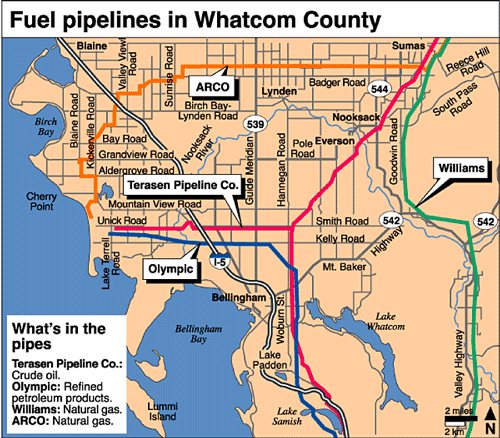
In Whatcom County, the high-consequence areas for Olympic pipeline include the section of Bellingham and Ferndale where the pipeline runs, as well as where it crosses the Nooksack River, just south of Ferndale.
Members of the trust also want to put together report cards on pipeline companies so the public can have easy access to information about companies that might be operating in their back yard or neighborhood park.
The employees
Two former Olympic officials were sentenced to prison for their part in the disaster.
Frank Hopf, former vice president and manager of Olympic Pipe Line Co., was released from prison last February.
Hopf served six months in the minimum-security Bastrop Federal Correctional Institution in central Texas, northeast of San Antonio, according to the U.S. Bureau of Prisons. He received that sentence last year after pleading guilty to a felony violation of pipeline employee training laws in connection with the 1999 disaster in Whatcom Falls Park.
A second former employee of Olympic, Ron Brentson, has yet to serve his 30-day sentence.
Assistant U.S. Attorney Lawrence Lincoln said Brentson was seriously injured in a traffic accident after he was sentenced along with Hopf, after a guilty plea to the same charge. He will still be expected to serve the sentence after he recovers and completes physical therapy, and the court gets periodic updates on his progress, Lincoln said.
Kevin Dyvig, the employee at the controls of the pipeline when the blast occurred, pleaded guilty to a misdemeanor charge and was given a year's probation.
The city
Getting information to the public is now recognized as a critical task when disaster strikes, Bellingham Fire Chief Bill Boyd said. On June 10, 1999, the pipeline explosion took out a cell tower, land-based phone systems were overloaded and police and firefighters didn't have enough two-way radio frequencies to manage the crisis.
The city now has a dedicated radio channel to get emergency information to KGMI-AM, a Bellingham radio station, and the city's Web site and public access cable Channel 10 are also available in an emergency.
On Sept. 11, 2001, when the televised collapse of the stricken World Trade Center towers touched off a nationwide sense of danger, Bellingham's improved communications system was ready to provide reassurance to the public.
"We learned the lessons of 9-11 early," Boyd said.
The pipeline disaster also heightened awareness of the need for disaster planning among both the citizenry and public officials, said Neil Clement, Whatcom County's deputy director of emergency management.
Today, Clement said, local officials are more willing to provide funding for emergency response needs, and citizens pay more attention when they are given advice about what to do in an emergency. More people have signed up for classes in emergency response to prepare themselves to serve as volunteers in the next crisis, Clement added.
Carroll said being prepared means more than buying hardware and installing communications systems. Emergency personnel need to be trained and regularly drilled.
"There is no fail-safe system," he said. "We need to practice, practice, practice, and prepare, and be ready."
Reach Ericka Pizzillo at ericka.pizzillo@bellinghamherald.com or call 715-2266. Reach John Stark at 715-2274 or john.stark@bellinghamherald.com.
HOW IT HAPPENED
The Olympic Pipe Line Co. pipeline disaster on June 10, 1999 was created by a series of problems that began years earlier, according to the final report by the National Transportation Safety Board.
Here are its findings:
• In 1994, a contractor installing a new water line for the city of Bellingham in Whatcom Falls Park likely damaged the gasoline pipeline, which was located below the water line.
• In the five years after the water line project, Olympic failed to identify or repair any of the damage and failed to properly interpret results of internal tests on the gas pipeline.
• Olympic also failed to correct repeated, unintended valve closures in the line that originated at the pipeline's Bayview terminal in Skagit County. On June 10, 1999, a computerized monitoring system shut down a pump in Skagit County after a pressure surge burst the line in Bellingham. Olympic operators at a remote station in Renton restarted the system, allowing additional fuel to spill out of the pipeline.
• Download the complete NTSB report (PDF format, 1.1MB.)
• View photos of the pipeline disaster in the pipeline photo gallery.
MEMORIAL CEREMONY CHANGED
A public remembrance of Bellingham's 1999 pipeline disaster has been changed to 2 p.m. today on the steps of Bellingham City Hall, 210 Lottie St.
Organizers have added U.S. Sen. Patty Murray, D-Wash., to the slate of speakers.
World Oil Demand Growth at 21-Year High
Washington Post
Reuters
Thursday, June 10, 2004; 4:25 AM
LONDON (Reuters) - Economic expansion is fueling the biggest increase in world oil demand for 23 years, fired by accelerating growth in China, the International Energy Agency (IEA) said on Thursday.
In its monthly Oil Market Report, the agency raised its projection for incremental oil demand in 2004 by 360,000 barrels a day to 2.3 million, or 2.9 percent, on the 81.1 million bpd world market.
It said demand had proved stronger than expected in North America, Brazil and India, despite high oil prices.
The agency welcomed last week's decision by the Organization of the Petroleum Exporting Countries to raise oil output, saying that economic growth could not be sustained for the long term at high prices.
"While the pace of economic growth remains strong, it has been driven by a number of one-off factors," said the IEA, adviser on energy to 26 industrialized nations.
It cited low interest rate policies, tax cuts, major infrastructure projects in China, depleted industrial inventories and expenditures associated with the war on terror.
"In this respect, price effects have been overwhelmed by wealth effects," it said.
China continues to provide the lion's share of world oil demand growth.
The IEA said it expects year-on-year Chinese growth of 1.2 million bpd, 23 percent, in the second quarter, accelerating from growth of one million bpd or 19 percent in the first quarter.
But it is forecasting growth in China will slow to 8.2 percent in the second half of 2004.
It said China's imports of crude and petroleum products hit a record 3.391 million bpd in April, up 744,000 bpd from March and 1.438 million bpd higher than in April last year.
© 2004 Reuters
[Read and despair. We know global oil reserves, and production rates, are at a peak. We know the global warming consequences of continuing, not to mention accelerated, use of fossil fuels. We are in the middle of an ongoing saga of global oil politics, violence and tragedy in Afghanistan and Iraq. We have alternatives - conservation, efficiencies, and sustainable generation technologies - that we could move to. And we chose not to. Except, perhaps, at the local level, where the benefits to the environment, local economies, and people are immediate and meaningful. If the required energy pardigm shift is going to take place, it will happen at the local level, with global impact. If.]
June 02, 2004
Power plants top Canada-US air polluters
Reuters, 06.02.04, 12:00 AM ET
By Robert Melnbardis
MONTREAL, June 2 (Reuters) - Coal and oil-fired power plants are the top air polluters in the United States and Canada according to most recent data, the Commission for Environmental Cooperation said on Wednesday.
In its 8th annual survey, the Montreal-based agency, created 10 years ago under the North American Free Trade Agreement, said power plants accounted for almost half of all industrial air emissions in 2001.
In addition, 46 of the top 50 polluters were coal and oil-fired power plants. The survey did not include gas or hydro-electric power plants.
"A big part of it is simply the appetite for energy, but a big part of it is just fuel," William Kennedy, executive director of the commission, told Reuters.
"We need to do a better job of working with industry, government and the public for cleaner fuels, better conservation, more renewable energy than what we have now."
The survey of chemical pollution from industrial facilities shows that power plants burning coal and oil produced 45 percent of the 755,502 tonnes of toxic air releases in 2001. Hydrochloric and sulfuric acids were the most common chemicals released as coal and oil was burned to make electricity.
Power plants, mainly those using coal, were also responsible for 64 percent of all mercury air emissions. Mercury occurs naturally in coal and is released when the fossil fuel is burned to produce electricity.
Mercury can build up in a highly toxic form as it moves up the food chain. Those exposed, especially children, can suffer neurological and developmental damage.
Total releases of mercury fell 48 percent in 2001 from 2000.
"Even though you might be reducing it, it's still building up in lakes and streams and coming into the food chain," Kennedy said.
In the United States, three coal-fired power plants reported the largest toxic air releases.
They were: Progress Energy's (nyse: PGN - news - people) CP&L Roxboro in Semora, North Carolina; Reliant Energy's (nyse: RRI - news - people)' Keystone in Shelocta, Pennsylvania; and Georgia Power's
In Canada, Ontario Power Generation's Nanticoke Generating Station was responsible for the 10 percent increase in air emission of all toxics in the country from 1998 to 2001, the commission said.
Nanticoke followed TransAlta Corp.'s
Overall, Texas was the top polluter in 2001, followed by Ohio, Michigan and Ontario, the commission said. Together, the four reported 28 percent of total releases and transfers of toxic chemicals for the year.
Copyright 2004, Reuters News Service
Power plants top Canada-US air polluters
Reuters, 06.02.04, 12:00 AM ET
By Robert Melnbardis
MONTREAL, June 2 (Reuters) - Coal and oil-fired power plants are the top air polluters in the United States and Canada according to most recent data, the Commission for Environmental Cooperation said on Wednesday.
In its 8th annual survey, the Montreal-based agency, created 10 years ago under the North American Free Trade Agreement, said power plants accounted for almost half of all industrial air emissions in 2001.
In addition, 46 of the top 50 polluters were coal and oil-fired power plants. The survey did not include gas or hydro-electric power plants.
"A big part of it is simply the appetite for energy, but a big part of it is just fuel," William Kennedy, executive director of the commission, told Reuters.
"We need to do a better job of working with industry, government and the public for cleaner fuels, better conservation, more renewable energy than what we have now."
The survey of chemical pollution from industrial facilities shows that power plants burning coal and oil produced 45 percent of the 755,502 tonnes of toxic air releases in 2001. Hydrochloric and sulfuric acids were the most common chemicals released as coal and oil was burned to make electricity.
Power plants, mainly those using coal, were also responsible for 64 percent of all mercury air emissions. Mercury occurs naturally in coal and is released when the fossil fuel is burned to produce electricity.
Mercury can build up in a highly toxic form as it moves up the food chain. Those exposed, especially children, can suffer neurological and developmental damage.
Total releases of mercury fell 48 percent in 2001 from 2000.
"Even though you might be reducing it, it's still building up in lakes and streams and coming into the food chain," Kennedy said.
In the United States, three coal-fired power plants reported the largest toxic air releases.
They were: Progress Energy's (nyse: PGN - news - people) CP&L Roxboro in Semora, North Carolina; Reliant Energy's (nyse: RRI - news - people)' Keystone in Shelocta, Pennsylvania; and Georgia Power's
In Canada, Ontario Power Generation's Nanticoke Generating Station was responsible for the 10 percent increase in air emission of all toxics in the country from 1998 to 2001, the commission said.
Nanticoke followed TransAlta Corp.'s
Overall, Texas was the top polluter in 2001, followed by Ohio, Michigan and Ontario, the commission said. Together, the four reported 28 percent of total releases and transfers of toxic chemicals for the year.
Copyright 2004, Reuters News Service