December 25, 2007
Liquefied natural gas poised to surpass oil as energy source
By Leah Bower, Special to Gulf News (Dubai)
http://archive.gulfnews.com/articles/07/12/25/10177107.html
December 24, 2007
Oil may be the energy source on everyone's mind right now, but there is a good chance that liquefied natural gas (LNG) will surpass it as oil prices remain astronomical.
Once a bit of a backwater in the energy field, demand for LNG has been on a steady rise because it is relatively clean burning and because its liquefied state allows for transport to remote locations without construction of elaborate and expensive pipeline networks.
And while it can't hold a candle to oil's price, quite a few analysts seem to see it as the bandwagon of choice to jump on to.
Worldwide demand for LNG during the first half of 2007 was pegged at roughly 115 billion cubic metres (bcm), roughly nine per cent growth over the same period in 2006, and demand in East Asia has been growing even faster.
Calgary-based Ziff Energy says it expects demand for natural gas in North America will rise by 1.8 per cent a year through 2015, and US Energy Department data backs up that claim, reporting that they expect imported LNG to increase from three per cent of total gas consumption to 14 per cent by 2020.
Currently, Japan is the world's largest LNG consumer, importing 81.86 bcm of natural gas as LNG in 2006. South Korea is second and the US currently ranks as the fourth-largest consumer.
LNG is natural gas, but it is reduced to a liquid state by cooling it to about minus 160° Centigrade, which reduces the volume of the gas by about 600:1 and makes transportation far simpler. Before it can be used, LNG must be returned to its gaseous state at a regasification plant. For countries like Qatar, which is sitting on the world's largest natural gas reserves - 25 trillion cubic metres - the renewed interest in LNG is a boon, since there is no need for pesky pipelines that travel through neighbouring countries before reaching their destinations.
Just ask the Europeans, who saw their natural gas get cut off in early 2006. Russia, where the pipeline originated, and Ukraine, which hosted part of the pipeline, had a price dispute. The two countries disagreed and so did the Europe's energy supply. The dispute even resurfaced in 2007, although the gas continued to flow this time.
So LNG, with its ability to be shipped by sea or land, is slowly building a power base. And people like Qatar's Energy Minister, who once said it was "bad news" that the country only had gas reserves and no oil, are starting to change their tune.
The International Energy Agency (IEA) reported that by 2010 Qatar could own 20 per cent of the global LNG market.
Other countries with reserves are hopping on board as well.
The Australian government expects energy production growth down under will be led by LNG, with exports of the fuel set to grow by more than seven per cent yearly, through 2030. That would have LNG output rise from less than 16 million metric tonnes in 2007, to 24 million by 2012, and possibly reaching as high as 76 million by 2030 as new projects come online.
Without the ability to ship liquefied natural gas, this type of growth would have been almost inconceivable. Already the $16 billion) North West Shelf venture is expanding LNG capacity, while Perth-based Woodside is building the Pluto project, also in Western Australia.
Chevron is planning to expand its $10 billion liquefied natural gas project known as Gorgon, which now calls for three liquefaction production lines, instead of two. Inpex Holdings and BHP Billiton are also proposing new plants.
Get on board while the year is new.
The writer is a freelance journalist based in Alaska, USA.
Russia’s Big Energy Secret
Putin wields gas as a weapon. But the reality is that Russia can barely meet its own growing demand.
By Owen Matthews
NEWSWEEK
Dec 22, 2007
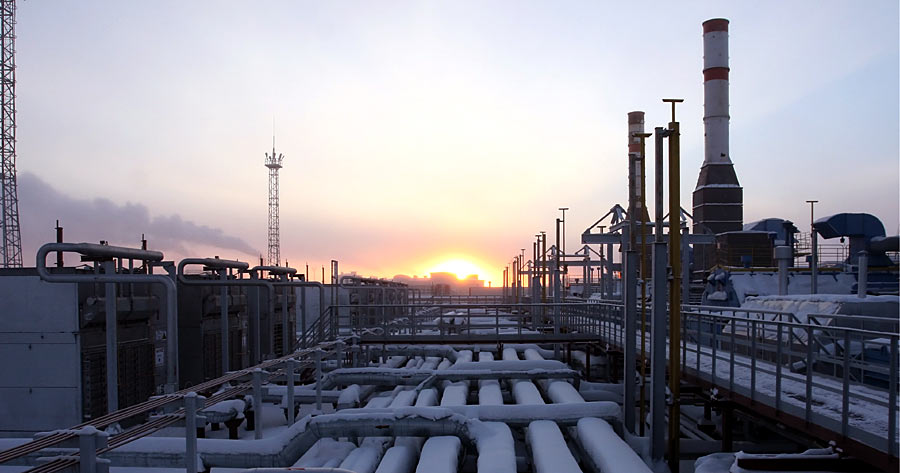
Not Enough in the Pipeline: An oil and gas plant in Novy Urengoy, Russia. EPA-Corbis
Gazprom, the Russian natural-gas giant, is often portrayed as the 1,000-pound gorilla of the energy world. Over the past few years, the company has had huge success in locking in lucrative European markets. It has also been ruthless about making consumers in the former Soviet Union pay something close to world prices for their gas—cutting off supplies, if necessary, to force reluctant customers like Ukraine to pay up. But problems are brewing. Gazprom, it turns out, has too many customers, and too little gas.
The surprising Achilles' heel of Gazprom is that it produces only about 550 billion cubic meters (bcm) of gas—just enough to supply its own domestic market. It relies on cheap imports from Central Asia to meet the majority of its other commitments to customers in Europe, amounting to nearly 80bcm. And since only Gazprom's foreign customers pay full market value, it's the company's exports which make up the bulk of Gazprom's revenues—$21 billion for the second quarter of 2007 alone. Now those nations on which Gazprom's profits rely—including Turkmenistan, Uzbekistan and Kazakhstan—are beginning to cut their own deals with big new customers like China. The deals are in turn becoming an existential threat to Gazprom, one of Russia's most valuable strategic levers of power.
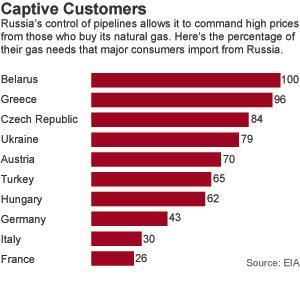
Russian control of a quarter of Europe's gas supplies is a key plank of its foreign policy and renewed national pride; supply of cheap electricity and heat to Russian homes is a touchstone of the Russian government's credibility. Central Asia is now undermining both those fundamentals—and could threaten Vladmir Putin's petro-politics.
Gazprom hasn't opened up a new gas field since 1991, and its existing fields are dwindling. A recent report by the Russian Industry and Energy Ministry warned that if the decline continued, Russia may be unable to service even its own domestic gas needs by 2010, and recommended doubling prices, a conservation move that has upset business and could also put a damper on economic growth.
Meanwhile, Gazprom chairman Dmitry Medvedev—also first deputy prime minister and Vladimir Putin's anointed successor for the next presidential elections in March 2008—has announced a radical plan to revive the company's domestic production, investing $420 billion in exploration and new gas-production facilities.
Relying on cheap imports to supply foreign customers is nothing new for Gazprom; for years the company's been buying gas from the Central Asians for knockdown prices. Until earlier this year, Gazprom was paying just $65 per 1,000 cubic meters to the Turkmens—then selling the same gas to customers in Western Europe who pay up to $250 (possibly only because of Russia's pipeline monopoly). Now ''Russia's monopoly is under attack," says Steve Levine, author of "The Oil and the Glory," a study of Central Asia's energy politics. ''Other neighbors are starting to build pipelines, and local producers are getting smarter, too."
No threat is more potent than that of China's move into Turkmenistan. Last year China's President Hu Jintao signed a deal with the late Turkmen leader Sapurmurat Niyazov to buy 30bcm of Turkmen gas each year for the next 30 years, and finance a giant new gas pipeline to China's Xinjiang province. That's in addition to a deal signed with Iran in March, which promises 14bcm a year of Turkmen gas to Tehran. At the same time, the Turkmens have also signed a deal with Russia for 50bcm a year until 2009. ''There's no doubt that Turkmenistan has promised to sell more gas than it can feasibly pump," says one top U.S. diplomat in the region not authorized to speak on the record. ''The question is, which customer will they choose?"
A lot rides on that choice: no less, in fact, than the future of Russia as an energy superpower. But Gazprom insists there's no problem. ''We do not consider China to be a threat or a competitor in Central Asia," says Gazprom spokesman Igor Volobuyev. ''We have a 25-year, long-term contract with the Turkmen government; they are obliged to fulfil their responsibilities. Our contract with the Turkmens is longer than any of our contracts with our European customers." Putin earlier this year assured Gazprom customers that ''there is complete certainty that Russia will fulfill all its contracts."
Europeans now fret about possible shortages, even as Americans are gleeful. It's no secret that the United States would like to put a dent in Russia's stranglehold over the region's energy resources—as well as shake Putin's ''complete certainty" a little. The diplomatic code word is "encouraging diversity of supply"; deciphered, that means encouraging any and every other pipeline project that bypasses Russia. ''It's one of those areas where we and Beijing see pretty much eye to eye," says the U.S. official in the region. ''The more export routes there are, the happier we'll be."
To that end, the United States is encouraging a number of pipeline projects that cut Russia out of the loop; only one has been built so far, connecting Baku, Azerbaijan, to the energy-rich Caspian direct to the Mediterranean—but the United States hopes that others will follow. Needless to say, Moscow is working hard to keep its monopoly from being undermined. It most recently signed a new deal with Kazakhstan this past September to build a pipeline on the Caspian coast to Russia.
For the Central Asians themselves, selling energy is more than a matter of dollars and cents; it's about winning real independence from an old colonial master. One Kazakh government minister—who didn't wish to have his name used while criticizing Russia—recalls a recent incident when a Russian ministry didn't bother to send a car to pick up visiting Kazakh officials in Moscow. "Kazakhstan is constantly being treated like a kid brother by our Russian neighbors," he complains. Another slight was the banning of all Lufthansa planes from Russian airspace last month after the German company prepared to switch its Asian cargo hub from Krasnoyarsk in Russia to Astana in Kazakhstan. "The Russian government thought they would frighten us by flexing their muscles, the same way they did with Georgia and Ukraine," says the minister. "But we have others we can turn to."
It looks like China, rather than the United States, is best positioned to be the big winner in Central Asia's search for new friends. Though Washington has gone out of its way to turn a blind eye to the region's undemocratic practices, local despots are still irritated by even low-key criticism from the U.S. American insistence that the Central Asians forgo business with Iran also rankles. Kyrgyzstan, America's closest ally in the region, has been racked by instability and economic underperformance.
Kazakhstan, meanwhile, is booming, and plans to nearly double oil production to 150 million tons a year by 2015. A large chunk of that will be exported to China, through new Beijing-funded routes, or to other markets through the Baku-Ceyhan pipeline, bypassing Russia."Pretty soon the Chinese are going to exchange their bicycles for cars, so their oil needs will boom. We're happy to have such as a big, stable neighbor just on our border," says Kamal Burkhanov, a Kazakh parliamentarian. "How long should Central Asian countries be locked in by Gazprom's prices? The transit fees they pay us are kopecks."
True enough. For all its pretensions to being Europe's dominant energy supplier, Gazprom has stood on feet of clay. Now that Russia's former vassals are discovering their power, Moscow may have to ditch its trademark energy strong-arm tactics, and adopt a new gas diplomacy.
URL: http://www.newsweek.com/id/81557
See also Last Major Russian Field Goes Online
December 24, 2007
Big Oil lets sun set on renewables
by Terry Macalister
Guardian
December 11th, 2007
Shell, the oil company that recently trumpeted its commitment to a low carbon future by signing a pre-Bali conference communique, has quietly sold off most of its solar business.
The move, taken with rival BP's decision last week to invest in the world's dirtiest oil production in Canada's tar sands, indicates that Big Oil might be giving up its flirtation with renewables and going back to its roots.
Shell and BP are among the biggest producers of greenhouse gases in the world, but both have been keen to paint themselves green through a series of clean fuel initiatives.
BP, under its former chief executive, John Browne, promised to go "beyond petroleum" while Shell has spent millions advertising its serious interest in the future of the environment.
But at a time when interest in solar power is greater than ever, with the world's first "solar city" being built at Phoenix, Arizona, a small announcement from Environ Energy Global of Singapore revealed that it had bought Shell's photovoltaic operations in India and Sri Lanka, with more than 260 staff and 28 offices, for an undisclosed sum.
The sell-off, to be followed by similar ones in the Philippines and Indonesia, comes after another major disposal executed in a low-key way last year, when Shell hived off its solar module production business.
The division, with 600 staff and manufacturing plants in the US, Canada and Germany, went to Munich-based SolarWorld. Shell has however formed a manufacturing link, with Saint-Gobain, and promised to build one plant in Germany.
The Anglo-Dutch oil group confirmed yesterday that it had pulled out of its rural business in India and Sri Lanka, saying it was not making enough money.
"It was not bringing in any profit for us there so we transferred it to another operator. The buyer will be able to take it to the next level," said a spokeswoman at Shell headquarters in London.
The oil group said it was continuing to move its renewables interests into a mainstream business and hoped to find one new power source that would "achieve materiality" for it. Shell continues to invest in a number of wind farm schemes, such as the London Array offshore scheme, which has government approval. Shell has also been concentrating its efforts on biofuels, but declined to say whether it had given up on solar power even though many smaller rivals continue to believe the technology has a bright future.
Environmental groups have always accused Shell of using clean energy initiatives as "greenwash" to deflect criticism from its core carbon operations, especially tar sands. The latest pull-out has annoyed rival business leaders at London-based Solar Century and local Indian operation, Orb Energy, who fear the impact of a high-profile company selling off solar business. Jeremy Leggett, chief executive of Solarcentury and a leading voice in renewable energy circles, said Shell was undermining the credibility of the business world in its fight against global warming.
"Shell and Solar Century were among the 150 companies that recently signed up to the hard-hitting Bali Declaration. It is vital that companies act consistently with the rhetoric in such declarations, and as I have told Shell senior management on several occasions, an all-out assault on the Canadian tar sands and extracting oil from coal is completely inconsistent with climate protection.
"This latest evidence of half-heartedness or worse in Shell's renewables activities leaves me even more disappointed. Unless fossil-fuel energy companies evolve their core activities meaningfully, we are in deep trouble," he said.
Damian Miller, former director of Shell Solar's rural operations and now chief executive of Orb Energy, said Shell was missing an opportunity by pulling out at a time when renewables markets were starting to mature in the developing world. He alleged some customers were complaining of being abandoned by Shell and worried about the servicing of equipment they could expect from Environ. "We see former Shell customers who are highly disappointed not to be receiving proper service for the solar systems they have invested in. These customers have often invested 20-30% of their annual income in a system to ensure they have some minimum amount of lighting and access to radio, TV, or a fan," said Miller.
He added that the oil majors, including Shell, had invested time and energy in promoting their plans for renewable energy in the press and on TV, but were not able to lead the transformation the world needs towards renewable energy and energy efficient solutions.
Shell declined to comment on these criticisms or talk about where its priorities lay. But the chief executive, Jeroen van der Veer, did make a number of comments last summer which could have paved the way for a change in policy. Alternative energy sources such as renewables will not fill the gap, he argued, forecasting that even with technological breakthroughs they could give supply only 30% of global energy by the middle of the century. "Contrary to public perceptions, renewable energy is not the silver bullet that will soon solve all our problems," he said.
Meanwhile, BP has been accused by Greenpeace Canada of lining itself up to help commit "the biggest environmental crime in history". This follows its decision to swap assets with Husky Oil, giving it an entrance ticket to the Alberta tar sands, which are said to be five times more energy-intensive to extract compared to traditional oil.
John Browne, the group's former chief executive, had said BP would not follow Shell into tar sands as he established an alternative energy division and pledged to take the group "beyond petroleum." The new boss, Tony Hayward, has pointed the corporate supertanker in a new direction although his public relations minders insist BP remains committed to exploring the potential of renewables.
"Tony Hayward has been part of the management team at BP for many years and has endorsed the low-carbon strategy that involved BP creating its alternative energy business late in 2005. We are spending $8bn (£4bn) over ten years and are pressing ahead with 450 megawatts of wind production capacity in the US," said a spokesman. "The tar sands deal in Canada does not represent a change in direction, it was just a very good opportunity which represents a broadening of the portfolio."
Greenpeace climate campaigner Joss Garman said: "If Shell is to survive the climate change age... it needs to become not just an oil company but an energy company. One wonders if Shell's executives have noticed what's happening in Bali or if we'll see slick adverts on TV boasting about their retreat from renewables. Probably not."
December 21, 2007
Petrocan's Libyan dream
COMMENT: Note that in Libya, Petro-Canada is agreeable to terms that "may seem steep" - it pays 50% of the development costs for only 12% of the profit, considerable up-front costs, AND it shares the play with Libya's national oil company, AND political stability and certainty in Libya ain't quite the same as Alberta.
Yet listen to these guys whine about a bigger royalty bite in Alberta.
It would appear that just about EVERYWHERE in the world, except Canada and the US, oil and gas companies are accepting terms that would precipitate a capital exodus here.
But an exodus to where? Libya? Russia?
Alberta is still the biggest and best deal going for oil companies. And BC is the sweetest show in the world for gas producers.
For the legacy in those resources? For the people in these jurisdictions? Well, gee, we don't want to upset the companies, do we? Don't want to lose the golden goose.
NORVAL SCOTT
Globe and Mail
December 14, 2007
CALGARY — Petro-Canada already once had a dream of creating a huge business empire in North Africa, in which it would supply energy to Europe after developing vast natural gas projects in Algeria and Tunisia. What happened?
It went up in smoke; Petrocan and Algeria couldn't come to terms over the proposed developments and the company's interest in the countries dwindled. Now the company hopes its second time in North Africa works out better.
Mind you, Petrocan is not running back to Algeria any time soon. From being a major player in the country in the late 1990s, Petrocan now has no production left there, and the firm shut down its Tunisian office last year.
Instead, Petrocan's dream has been shifted one country to the east, to Libya, and all of a sudden it's become reality. This week, the company said it is to ramp up output in the country after successfully arranging new development terms, now intending to spend $3.5-billion (U.S.) on existing fields in the Sirte basin. The investment is expected to double Petrocan's Libyan production by 2014 to 100,000 barrels a day.
“We've been looking at this for some time, and it's a very logical spot for us to be in,” says Petrocan chief executive officer Ron Brenneman, who signed the deal in Tripoli this week. “[Libya] is recognized as one of the most prospective regions in the world. It has huge potential.”
The Gadhafi factor
However, investors haven't always been convinced that the country could deliver on its promise. After the 2001 attack on New York's World Trade Center, Libya was perceived as a risky investment destination for firms; leader Moammar Gadhafi was linked to international terrorism in the 1980s and 1990s and the U.S. only lifted economic sanctions against the country in 2004, although Libya's international standing was improving after the country made conciliatory steps to the West in the late 1990s.
Nevertheless, Petrocan's stock sold off immediately after its acquisition of Germany's Veba Oil & Gas GmbH in 2002 for $3.2-billion (Canadian), the deal in which Petrocan accumulated most of its current Libyan holdings.
The deal was curiously timed, not only due to Petrocan's travails elsewhere in North Africa, but also because other Canadian firms were fleeing the region in droves. PanCanadian Petroleum, the company that became EnCana Corp., was withdrawing from Libya in 2002 in order to concentrate on North America, while Talisman Energy sold up its holdings in Sudan that same year after a hugely controversial dispute over the extent of its involvement in that country's civil conflict.
While Mr. Gadhafi's history may still cast a shadow over some perceptions of Libya, energy companies have found the country an infinitely more stable investment destination than, say, Venezuela, where oil firms have essentially seen their contracts ripped up.
Petrocan itself hasn't encountered any regulatory or governmental difficulties in Libya, which has never been anything but professional to deal with, Mr. Brenneman says. “The national oil company is a very sophisticated organization that's very business-like in its approach,” he said. “We've had a very good working relationship with them – it's a wonderful place to do business.”
Better timing
A more significant problem for Petrocan that stymied development until now was that it wasn't certain of its position in Libya. The rights to develop oil at the fields it bought from Veba were set to expire in 2015, at which time they would revert to Libyan control.
While the clause is a normal one in oil and gas contracts, – as it forces companies to develop the leases acquired from countries, instead of just sitting on the acreage – the relatively close deadline made it difficult for Petrocan to consider ramping up its Libyan plans, as it wasn't sure if any large-scale investment would be worthwhile.
“As you get closer and closer to that date, the time to recover your investment starts to run out, and we weren't prepared to put a lot of capital in if we didn't have that time,” Mr. Brenneman said.
The problem was recognized both by Petrocan and the Libyan National Oil Co. (NOC), which was also keen to renegotiate its contracts with oil companies operating in Libya so it could benefit more from higher prices. Consequently, Petrocan came to a deal under which it will now receive 12 per cent of the profit from its Libyan production, while paying 50 per cent of the development costs.
Barrels ‘to die for'
Petrocan and NOC will jointly invest $7-billion in developing existing fields, while Petrocan will pay a $1-billion signature bonus in three stages, as well as $460-million over the next seven years to explore new opportunities in Sirte. While the price may seem steep, it extends Petrocan's rights to the Sirte fields, effectively securing the company's position in Libya for the next 30 years.
“Now we've got lots of time to exploit these resources, recover our capital and generate good returns,” Mr. Brenneman said.
Petrocan has had a long wait to get the certainty in North Africa that it's needed to start developing a major project. However, the reason that the company has been so patient is clear; Sirte is seen as being one of the most prospective oil blocks in the world. Of the last nine wells Petrocan has drilled in the region, its had seven successes – a high strike rate in the oil exploration game.
“This is a large, large field that will be producing for some length of time,” Mr. Brenneman said. “If you ask anyone who's in the international oil business, they'll tell you that the Sirte basin is to die for.”
December 18, 2007
Last Major Russian Gas Field Goes Online
How Long Will Siberia's Gas Last?
By Christian Wüst
Der Spiegel
18-Dec-2007
Europe depends on Russia for its natural gas, but, as Gazprom begins production at the last major field, it is unclear how much gas is left in Siberia. Developed fields are almost exhausted, and tapping new reserves involves huge technical difficulties.

The Gazprom pipeline under construction near Novy Urengoy. Gazprom is developing the Siberian Yuzhno-Russkoye gas field in the region. REUTERS
The Russian gas industry was celebrating on Tuesday. At a ceremony in Moscow, Gazprom board chairman Dmitry Medvedev, who is widely expected to be the next president of Russia and the German foreign minister, Frank-Walter Steinmeier, pressed a ceremonial button and the last major natural gas field in the world's most productive region went on line. A live video link showed footage from northwestern Siberia where the actual event was taking place, namely valves being opened.
The process, prosaic as it was, prompted executives in the energy industry to wax poetic. Burckhard Bergmann, the head of German energy conglomerate E.on-Ruhrgas, calls the site "Siberia's last pearl."
The new field, which is called Yuzhno-Russkoye, lies about 900 meters (2,953 feet) below the surface and contains more than 800 billion cubic meters (28.6 trillion cubic feet) of natural gas -- a number that seems inconceivably large and yet is ultimately very small. Yuzhno-Russkoye's entire reserves hardly amount to more than one year's worth of production for the entire Russian natural gas industry.
Demand for energy is growing, both domestically and abroad, and Russian energy forecasters predict Siberia will satisfy that demand. Alexander Grizenko, an advisor to the board of directors of Russian energy giant Gazprom, expects production volume to increase until 2030 when, according to his predictions, a peak level of well over 800 billion cubic meters a year will have been reached. Grizenko also emphasizes that the country will be able to maintain a very high level of production for another 30 years after that.
But Jean Laherrere, chief statistician at the Swedish-based Association for the Study of Peak Oil and Gas, paints a completely different scenario. He believes that production will peak in only eight years and decline rapidly after that. According to Laherrere's prognosis, in 2060 -- when Russian visionaries predict that production levels will still be higher than they are today -- it will in fact be close to zero.
Who is right? The answer to this question will be critical to energy supply in Europe, which already buys close to half of its natural gas from Russia today -- a share that is expected to increase now that the North Sea gas fields are almost exhausted.
Russia's future is also closely linked to the future of its gas reserves. Natural gas is the central currency of the new economic miracle that has blessed this vast country stretching from the Baltic Sea to the Pacific Ocean. Russia's gas reserves lie north of the Ural Mountains, in one of the world's most inhospitable regions. It's a flat wasteland, icebound in the winter and a swamp in the summer, where temperatures can drop to as low as -60° Celsius (-76° Fahrenheit) and climb as high as 40° Celsius (104° Fahrenheit).
Geologists estimate that about 150 million years ago, when the region was a warm ocean inlet, the bodies of dead creatures turned into dark sediments rich in organic matter. Over the course of the ensuing millions of years, the organic matter then turned into oil and natural gas reserves stored between layers of sandstone.
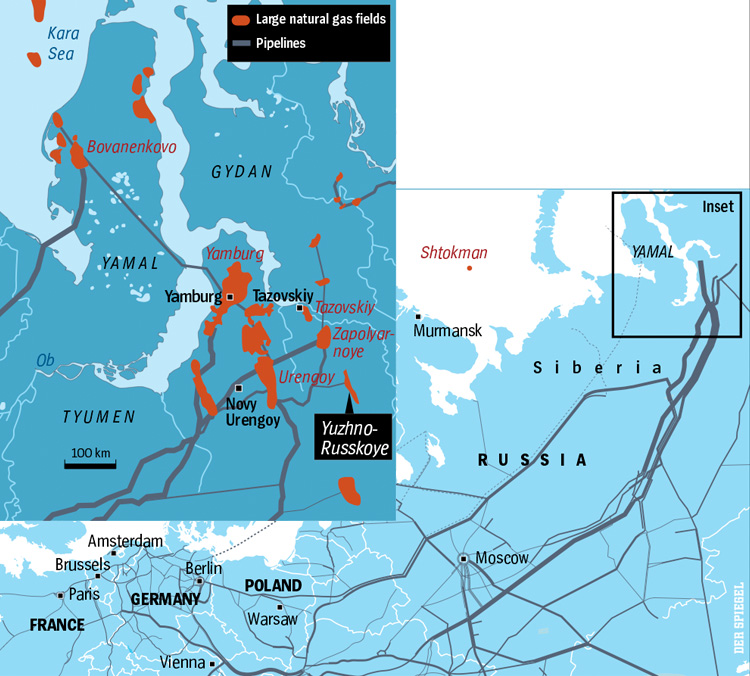
Siberia's gas fields supply much of Europe's energy. DER SPIEGEL
More than 50 years ago, when the first drilling teams arrived in what was then a virtually uninhabited region, the ground was so saturated with fossil fuels that some of the Soviet mining pioneers, along with their equipment, were blown up in explosions.
Sergei Chernezky, a spokesman for the Russian gas industry in the Siberian city of Yamburg, talks about one of these accidents as if it were the big bang that set off the region's energy bonanza. An explosion occurred near a town called "Little Birch Village," just as a drilling supervisor was about to enter his hut to document the fact that his team had found nothing. "All of a sudden it was clear that there was gas here," says Chernezky. "A lot of gas."
In 1966, scientists working near the Arctic Circle discovered what was then the largest-known natural gas field on earth: Urengoy. The field, 120 kilometers (75 miles) long, contained at least 10 trillion cubic meters (357 trillion cubic feet) of natural gas in the upper sediment layers alone. Father north, the Yamburg field was discovered a few years later, a hydrocarbon giant almost the size of Urengoy and containing vast reserves of methane and liquid condensed gas.
The first shipment was sent to Austria in 1968, and soon afterwards other Western countries began appearing on the Soviets' list of customers. The Soviet Union, still the West's political nemesis at the time, gradually became Europe's most important supplier of natural gas.
An energy highway unparalleled worldwide extends for 5,000 kilometers (3,108 miles) from western Siberia to European Russia and on to Western Europe. It consists of a dozen steel pipes, each up to one and a half meters (5 feet) in diameter and capable of handling an operating pressure of 70 to 90 bar. It takes about a week for a gas molecule to make the journey from Yamburg to Hamburg. Compressor stations placed at roughly 200-kilometer (124-mile) intervals maintain flow pressure.

Natural gas flares at a Gazprom facility in the town of Novy Urengoy. AFP
The abundance of natural gas acts as a tremendous incentive for consumption. Russians are wasteful when it comes to natural gas, the cheapest fossil fuel and the one that is least harmful to the climate, says E.on-Ruhrgas CEO Bergmann. But Western Europeans aren't exactly parsimonious in their use of the highly refined fuel, either. Russia exports roughly one-third of its natural gas, and Germany is its biggest customer.
According to official Russian figures, the country still has viable natural gas reserves of 48 trillion cubic meters (1.7 quadrillion cubic feet). At constant production levels, this would be enough to last almost to the end of the century. But where is this natural gas? Can it even be extracted? A skeptical Laherrere estimates existing reserves to be around 43 trillion cubic meters (1.5 quadrillion cubic feet), but believes that only a fraction of these reserves are in fact extractable.
"The days of easy gas production are gone," says Bernhard Schmidt, the head of exploration for the Wintershall Group. A subsidiary of chemical giant BASF, Kassel-based Wintershall is the only German company currently involved in the development of Gazprom fields.
To date, gas fields in western Siberia have only been tapped to depths of little more than 1,500 meters (4,921 feet). Developing these reserves dating from the mid-Cretaceous period is relatively easy for mining experts. Schmidt, a native Austrian, calls the process "skimming the sugar off the top."
Urengoy and Yamburg were precisely the kinds of sweet finds Schmidt is referring to -- enormous and easily exploited -- and they have been drained at rates corresponding to their accessibility. Both fields are already more than halfway depleted. If they were oil reserves, production would already have been discontinued. However, because gas is lighter than petroleum, up to 80 percent of the underground treasure can be extracted. But once that point is reached, little else can be done. Siberia's largest natural gas reserves are close to this point. Satellite fields like Zapolyarnoye and Yuzhno-Russkoye are still full, but much smaller.

Opinions differ as to how much gas is left. DER SPIEGEL
There is more gas to be found, but only at far greater depths. The gas content is especially high in Lower Cretaceous sediments in the region, but they are located at 3,500 meters (11,480 feet) beneath the Earth's surface.
Gazprom, in a joint venture with Wintershall, is currently tapping the so-called Achimov Formation in the Urengoy field. Five wells have already been drilled, and production is expected to begin next year. The German partner's experience is apparently in high demand, because gas is extremely difficult to extract at this level.
Contrary to what some people might imagine, oil and gas fields do not consist of underground caverns. The fuel is found in porous rock formations (the word petroleum is derived from the Latin terms for rock, "petra," and oil, "oleum"), and must travel through the pores into the drilling pipe. In the deep Urengoy sediments, the rock is extremely solid and fine-pored. In addition, the gas has a high content of liquid condensate that can clog the pores. To overcome these difficulties, Wintershall plans to use a high-pressure technology known as "fracturing." In this process, the rock is fractured and sand is forced into the cracks.
Despite all of these efforts, deep drilling will never be as productive as extraction from upper layers of rock. The Achimov Formation of the Urengoy field will yield 2 trillion cubic meters (71 trillion cubic feet) at best, or barely a fifth of the upper-level reserves. Clearly these sorts of finds will not be sufficient to meet Russia's production targets.
These limitations have prompted Gazprom to explore potential new reserves. On the opposite end of the Ob River delta, northwest of the current drilling areas, lies the Yamal Peninsula. Geologists have already explored the peninsula and have discovered formations indicating the presence of fields containing more than 10 trillion cubic meters (355 trillion cubic feet) of natural gas -- potentially another Urengoy.
But the gas exploration teams are operating in highly challenging terrain. "Yamal is probably the world's most difficult extraction region," says Roland Götz, an expert on Russia at the Berlin-based German Institute for International and Security Affairs. The peninsula is covered with countless rivers and lakes, completely impassible in the summer, and its coastlines are surrounded by shifting masses of pack ice that sometimes tear meter-deep gashes into the ocean floor, making it difficult, if not impossible, to lay pipelines.
Dashed lines representing the pipeline through the Kara Sea that the Russians hope to install within the next few years -- despite doubts from within the industry -- have been shown on maps for some time. But at a meeting on July 19, 2005, the Russian union of oil and gas pipeline builders argued that there are no known "engineering solutions" for the problems associated with building the pipeline.
Another danger, according to Götz, is that the peninsula, which is barely above sea level today, could "sink during the course of gas production and become completely submerged." Gazprom's prospecting creed of preserving the untouched natural environment on the Yamal Peninsula "for future generations" would sink along with it.
But the energy giant brushes off environmental and technological concerns. Within four years, says Gazprom spokesman Sergei Kupriyanov, the company will be pumping natural gas from the Bovanenkovo field on the Yamal Peninsula and shipping it through pipelines. Two years later, the company plans to follow suit in the offshore Shtokman field in the Barents Sea northeast of Murmansk.
Gazprom is also convinced that other reserves in the ice-covered sea off Yamal can be tapped. "Gazprom has such technologies and we don't expect any surprises," Kupriyanov says tersely.
Skeptics are not welcome in the natural gas emirates along the Arctic Circle. The region's wealth of natural resources has created a standard of living well above the national average: A mechanic working in a gas field makes a better living than many a university professor in Moscow.
Within three decades, a medium-sized city developed out of nothing in this icy wasteland. Today more than 100,000 people live in Novy Urengoy, a collection of drab tower blocks. One in two residents owns a car. Supermarkets sell tropical fruit and California wine, and the city boasts recreation centers, cinemas and theaters -- and almost everything belongs to the benevolent Gazprom.
Officials proudly take visitors on a tour of the company-owned luxury kindergarten -- complete with a swimming pool and an assembly hall. Well-behaved children in native dress sing songs that sound disconcerting coming from the mouths of five-year-olds, songs about full tanks of gasoline, warm living rooms and the many blessings of an invisible fuel: "The cold is bitter, it bites us on the nose -- but we are not afraid, because we have natural gas."
Elsewhere, economists specializing in natural resources are already conjuring up scenarios of potential shortages. Russia expert Götz, for example, analyzed what would happen if the start of production at the Shtokman and Yamal fields was delayed by a mere five years.
The consequences of this small delay, says Götz, would already be significant. "The natural gas supply in the regions that supply Europe would stagnate at 2005 levels until 2025 at least," he says. But who will have to do without gas in a world in which everyone wants economic growth?
For Götz, the answer is obvious. "A supply bottleneck will affect Russia first," he says. "Export is much more lucrative for Gazprom."
Translated from the German by Christopher Sultan
More Bali-hoo
UN CLIMATE CHANGE CONVENTION: BALI ROAD MAP
Geoffrey York, Globe and Mail, 17-Dec-2007
Disappointments on Climate
Editorial, New York Times, 17-Dec-2007
Stalling in Bali
Editorial, Washington Post, 18-Dec-2007
Bully for Bali
Editorial, The Sunday Times, 16-Dec-2007
Canada, U.S. back off Bali deal
Mike De Souza, National Post, 17-Dec-2007
Willingness to talk climate change what counts
Richard Gwyn, Toronto Star, 18-Dec-2007
The Day After..
Walden Bello, Focus on the Global South, 16-Dec-2007
HAPPY ENDING ON BALI
Markus Becker, Der Spiegel, 15-Dec-2007
We've been suckered again by the US.
George Monbiot, The Guardian, 17-Dec-2007
UN CLIMATE CHANGE CONVENTION: BALI ROAD MAP
Accord fails to set targets, but activists still optimistic
Shift in global mood sees growing number of countries agree on need for deep reductions in greenhouse-gas emissions
By GEOFFREY YORK
Globe and Mail
Monday, December 17, 2007
NUSA DUA, INDONESIA -- In the end, the much-anticipated "Bali Road Map" was disappointingly vague and unenforceable, weakened by politics and self-interest. Yet beyond the words of its compromised text, the Bali agreement could still herald a new era of tougher action against global warming.
Most of the world's biggest emitters of greenhouse gases - including the United States, China and India - were unwilling to accept any limits on their growth. Even after 15 days of intense negotiations, the conference failed to reach any global accord on targets for emission cuts by 2020 or even 2050, despite strong pressure from Europe and others.
The scientific consensus on the need for deep cuts - the best research of the world's top scientists, endorsed by this year's Nobel Peace Prize -- was relegated to a mere footnote to a preamble to the main agreement.
But now begins a crucial two years of negotiations on a stronger deal to replace the pledges of the Kyoto accord, which expire in 2012. And the mood of the Bali conference, swinging strongly against the United States on its final day, offered hope to those who seek a more ambitious deal.
"What we have seen disappear is the Berlin Wall of climate change," said Yvo de Boer, chief of the United Nations climate agency. "This is a real breakthrough, a real opportunity for the international community to successfully fight climate change."
The optimism of the environmentalists is based on the clear evidence of a shifting global mood. A growing number of countries agree on the need for deep cuts in emissions by 2020. The small band of skeptics - including the United States, Canada and Japan - were able to remove the emission targets from the final accord, but they did not dare to kill the conference's other achievements, including crucial agreements on fighting deforestation, transferring clean technology to developing countries, and achieving bigger emission cuts among the wealthy Kyoto nations.
"Now the hard work begins - getting the science back into this agreement, the science that had been stripped out, and getting meaningful commitments by the U.S. onto the table to do our responsible share of dealing with this urgent problem," said Alden Meyer, director of strategy and policy at the Union of Concerned Scientists, a U.S.-based group.
"The hardest work is ahead of us, but we averted the disaster that would have been the collapse of these talks. Once the United States saw that it would be seen as the one bringing down the talks, they thought twice. And to their credit they stepped back from the brink."
Environmentalists are pleased that the Bush administration finally signed onto the Bali agreement, no matter how weak it is, because it brings the U.S. directly into the climate process for the first time in years.
Their optimism is further fuelled by the U.S. presidential election next year, which is widely expected to produce a new president with a more aggressive position on tackling climate change. The new administration will take office at a critical time, in early 2009, with a year remaining until the deadline for a new climate deal.
"We hope to inject some new energy into this process in 12 months with a new administration that can build on the momentum here and join the European Union in providing real leadership in the second half of the negotiations," Mr. Meyer said. "I think we can do this in the time we have available, building on the spirit we saw in Bali."
Liberal Leader Stéphane Dion said he is confident an agreement will be possible by 2009. "It will require a lot of goodwill and a lot of determination, and some countries must change their attitudes," he said. "We will have an election in the United States, and I'm sure that will help, and we may have an election in Canada, and I hope that will help too."
Environment Minister John Baird, the subject of much criticism at Bali, pledged to work for a new agreement by 2009. "We're going to work tremendously hard over the next two years, and see if we can get the very best deal for the environment and the planet," he said.
Business leaders, too, promised to join the campaign for a post-2012 deal in the wake of the Bali agreements. "This is an historic decision and a turning point for mankind," said Guy Sebban, secretary-general of the International Chamber of Commerce.
"All the players - governments, business, non-governmental organizations and intergovernmental organizations - are finally banding together to confront what is perhaps the most important and urgent issue of our age."
The Bali agreement on deforestation, in particular, is considered a huge step forward, since 20 per cent of the world's carbon emissions are produced by deforestation - almost as much as the entire amount of U.S. emissions from all sources.
Canadian environmentalists will try to use the Bali agreement to force Ottawa to work harder on climate change. "The government's current targets and policies fall far short of the standard set in Bali," said Matthew Bramley of the Pembina Institute. "Nothing less than a massive scale-up of federal efforts on climate change is required for Canada to play a responsible part in the next two years of negotiations."
Disappointments on Climate
Editorial
New York Times
December 17, 2007
A week that could have brought important progress on climate change ended in disappointment.
In Bali, where delegates from 187 countries met to begin framing a new global warming treaty, America’s negotiators were in full foot-dragging mode, acting as spoilers rather than providing the leadership the world needs.
In Washington, caving to pressures from the White House, the utilities and the oil companies, the Senate settled for a merely decent energy bill instead of a very good one that would have set the country on a clear path to a cleaner energy future.
The news from Bali was particularly disheartening. The delegates agreed to negotiate by 2009 a new and more comprehensive global treaty to replace the Kyoto Protocol. (Kyoto expires in 2012 and requires that only industrialized nations reduce their production of greenhouse gases.) They pledged for the first time to address deforestation, which accounts for one-fifth of the world’s carbon dioxide emissions. And they received vague assurances from China — which will soon overtake the United States as the biggest emitter of greenhouse gases — and other emerging powers that they would seek “measurable, reportable and verifiable” emissions cuts.
From the United States the delegates got nothing, except a promise to participate in the forthcoming negotiations. Even prying that out of the Bush administration required enormous effort.
Despite pleas from their European allies, the Americans flatly rejected the idea of setting even provisional targets for reductions in greenhouse gases. And they refused to give what the rest of the world wanted most: an unambiguous commitment to reducing America’s own emissions. Without that, there is little hope that other large emitters, including China, will change their ways.
There is some consolation in knowing that the energy bill approved last week included several provisions — among them the first significant improvement in automobile mileage standards in more than 30 years — that over time should begin to reduce the United States’ dependency on foreign oil and its output of greenhouse gases. The bill would have had much greater impact if the Senate had not killed two important provisions opposed by the White House and its big industrial contributors.
One would have required utilities to generate an increasing share of their power from renewable sources like wind. The other would have rolled back about $12 billion in tax breaks granted to the oil companies in the last energy bill and used the proceeds to help develop cleaner fuels and new energy technologies.
The decision to maintain the tax breaks was particularly shameful. Blessed by $90-a-barrel oil, the companies are rolling in profits, and there is no evidence to support the claim that they need these breaks to be able to explore for new resources. Yet the White House had the gall to argue that the breaks are necessary to protect consumers at the pump, and the Senate was craven enough to go along.
This Senate will have another chance to provide the American leadership the world needs on climate change. An ambitious bipartisan bill aimed at cutting America’s greenhouse gas emissions by 70 percent by midcentury has been approved by a Senate committee and may come to the floor next year. Though the bill is far from perfect and will provoke intense debate, it could offer a measure of redemption for the administration’s embarrassing failure in Bali.
Stalling in Bali
The Bush administration continues to say one thing and do another on climate change.
Editorial
Washington Post
Tuesday, December 18, 2007
THE BUSH administration wants everyone to believe that all along it has taken the threat of global warming as seriously as the rest of the world has. Advisers point to Mr. Bush's comments on climate change made as early as 2001 and to the nibbling-at-the-edges actions he has taken on research, regulation and funding. Then rhetoric meets reality, as it did at the climate talks in Bali.
Representatives of 187 nations were in the Indonesian resort destination for almost two weeks this month trying to plot a road map to a successor treaty to the Kyoto Protocol, which mandated reductions in greenhouse gas emissions by 36 industrialized countries and which expires in 2012. The European Union and other countries wanted binding emissions reductions of 25 to 40 percent by 2020. As he has consistently, Mr. Bush said no.
That's not to say something good didn't come out of Bali. The new framework agreement calls on developing nations, such as India and China, to consider adopting national policies to address their respective greenhouse gas emissions that are "measurable, reportable and verifiable." But the heavy lifting for both developed and developing countries will be done in treaty negotiations over the next two years.
The administration's resistance to mandatory cuts led U.N. Secretary General Ban Ki-moon to declare last week that the proposed reductions may be "too ambitious." He added: "Practically speaking, this will have to be negotiated down the road." Practically speaking, down the road means when there is a new American president. Palming off the leadership and the tough decisions that go with it to his successor seems to be fine with Mr. Bush.
Congress and the states shouldn't wait. The Senate will take up the Lieberman-Warner Climate Security Act next month. Sponsored by Sens. Joseph I. Lieberman (I-Conn.) and John W. Warner (R-Va.), the bill would put a price on carbon through a declining cap in greenhouse gas emissions for each year between 2012 and 2050. In this cap-and-trade system, companies in the transportation, electric power and manufacturing sectors would purchase and trade allowances for the right to pollute the air. Meanwhile, governors are so fed up with federal inaction on the environment that they're forming their own binding regional compacts for reducing greenhouse gases. This is the kind of leadership the world and many in this country are looking for.
ad_icon
The last report from the U.N. Intergovernmental Panel on Climate Change warned that if action is not taken within the next decade, the effects of global warming may be irreversible. Waiting for the next president shouldn't be an option.
Bully for Bali
Editorial
The Sunday Times
December 16, 2007
It was always likely that the Bali climate change conference would cobble together some kind of deal. Sure enough, in the early hours of yesterday morning after tears, tantrums, boos and recriminations, a “Bali road map” was agreed setting out what the United Nations described as a clear agenda for two years of talks aimed at negotiating a successor to the Kyoto framework. “This is a historic breakthrough and a huge step forward,” said Hilary Benn, environment secretary. “For the first time ever all the world’s nations have agreed to negotiate on a deal to tackle dangerous climate change concluding in 2009.”
It is easy to dismiss such claims as hyperbole and the Bali deal as yet another fudge from governments, particularly the US government, unwilling to face up to the hard decisions on global warming. The price of getting the United States to sign up was the removal of hard numbers from the road map. Friends of the Earth dismissed it as a “weak outcome” and accused rich countries of letting the developing world down.
Yet Bali was always going to be a holding operation. There was pressure for specific targets to be included in the text. The European Union wanted a commitment to emissions reductions by advanced countries of 25% to 40% by 2020, as well as references to a peak in global emissions over the next 10 to 15 years and a halving by 2050. It is reasonable to argue, however, as America did, that such targets should emerge during the negotiations of the next two years, not be imposed at the outset. America also made important concessions.
Al Gore said it outright in Bali but the unspoken message of yesterday’s deal is that things will change over the next two years, most importantly in the White House. Attitudes are moving in America. Politically this has been led at state level by the likes of Arnold Schwarzenegger and at city level by the mayors of most US cities. George W Bush has looked increasingly out of step with public opinion. Next November’s presidential election should see a new era in the White House on climate policy. The Democratic frontrunners, Hillary Clinton and Barack Obama, are both seemingly green. Mr Obama wants to introduce an economy-wide “cap-and-trade” programme to cut US greenhouse gas emissions and to invest heavily in energy efficiency.
Mrs Clinton, running a “carbon neutral” campaign, has a similar plan for cutting emissions but also wants a windfall tax on oil companies to be invested in an energy fund to provide one-fifth of US electricity from renewables by 2020. On the Republican side, Senator John McCain was the first to highlight global warming and, while he has little chance of securing the nomination, his rivals have jumped on the band-wagon. Oil at $90 a barrel and a determination to reduce dependence on the Middle East are enough to convince even the sceptics.
Political change is important but so is technology. Developing countries suffer from the effects of climate change but often cannot afford the equipment needed to limit their own pollution and greenhouse gas emissions. Even China, growing at a breakneck pace, is still building dirty coal-fired power stations rather than using the clean coal technology available in the West. One significant breakthrough in Bali was an agreement to step up the rate of technology transfer and provide the private sector with more incentives to give poor countries access to the latest innovations.
Bali should not be dismissed. It is not long since Tony Blair said there would never be a successor deal to Kyoto. Now a deal looks distinctly possible, if only after some hard negotiations over the next two years. And it will have America, China and India on board. It is easy to be gloomy but political will and technological change are powerful allies. If these bleary-eyed declarations are followed up with action, there is every reason to be hopeful.
Continue reading "More Bali-hoo"
December 17, 2007
Proponents hope to get pipeline flowing
COMMENT: It may be pointless to note that in 2001, when the Mackenzie Gas Pipeline made its first appearances on this website, the project was going to cost a mere $3 billion. Now it's $16 billion and climbing. But it's undeniably interesting.
Not once have the MGP proponents (led by Imperial Oil) stopped clamouring for a reduced regulatory burden and a greater public subsidy.
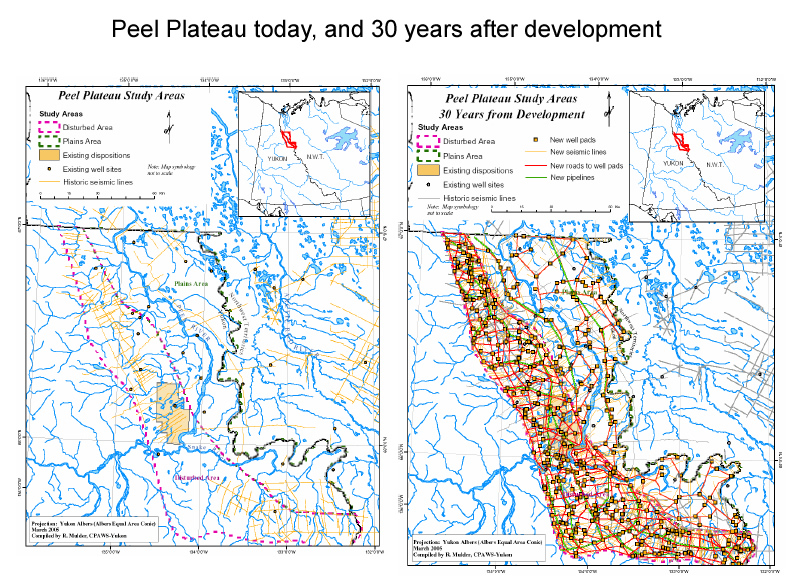
But in the 1970s with the Mackenzie pipeline proposal at that time, and in 2001 with this version of it, and today, the big concerns remain the environmental and social impacts on the land and communities of the north. Construction of the Mackenzie Gas Pipeline will unleash immediate and extensive gas production all along the pipeline route.
In 2005, the Canadian Parks and Wilderness Society undertook a mapping exercise designed to illustrate these impacts at various stages to full build-out. Small versions of these maps are copied below. They are published in higher resolution in a Pembina Institute publication entitled A Peak into the Future.
Infrastructure - pipelines, roads, transit - begets construction and development. Building this pipeline will have the same consequences in the north as did Clark Griswold (Chevy Chase) on his house in Christmas Vacation, when he finally connected the power to the lights. (and if you don't know the reference, don't be a Grinch - it's a modern Christmas classic; go rent it now.)
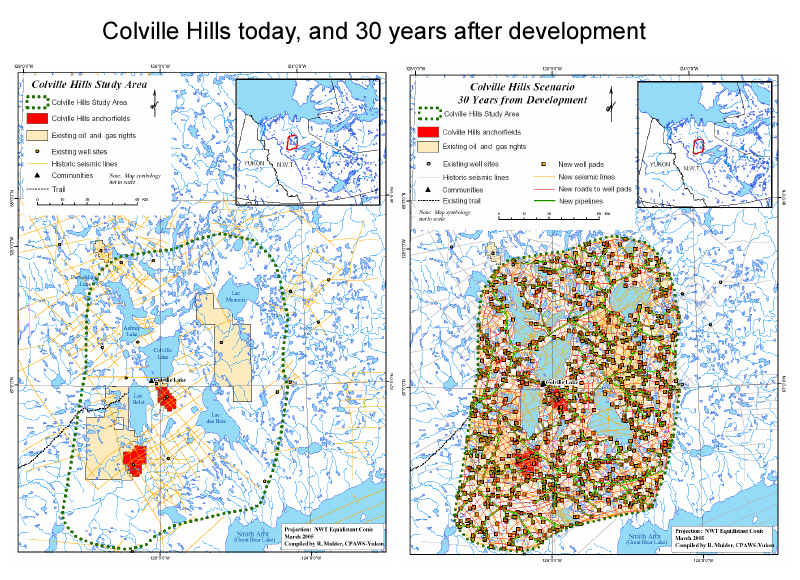
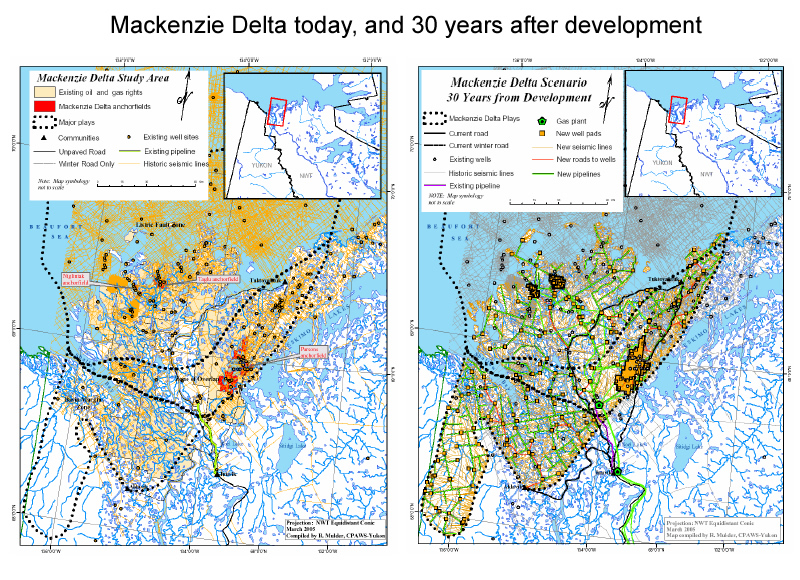
SHAWN MCCARTHY
Globe and Mail
December 14, 2007
Proponents of the $16-billion Mackenzie Valley Pipeline have presented a new financial plan to the federal government in hopes of kick-starting the long-stalled gas pipeline from the Arctic, Industry Minister Jim Prentice said yesterday.
Mr. Prentice met in Calgary yesterday with executives from Imperial Oil Ltd. and TransCanada Corp., who have fashioned a new partnership to finance the proposed main pipeline and natural gas gathering system in the Mackenzie Delta.
"I intend to analyze and review their proposal as expeditiously as possible," Mr. Prentice said in the statement.
It is believed that TransCanada, an energy infrastructure company, would take a majority stake in the mainline pipeline project, which would cover half the estimated $16-billion cost, while the producers, which include Imperial, ConocoPhillips and Royal Dutch Shell, would finance the gathering system and the development of the gas fields.
The Aboriginal Pipelines Group - representing native groups in the north - would have a large minority stake in the pipeline, perhaps as much as 40 per cent.
TransCanada chief executive Hal Kvisle said in an interview this week that the pipeline project is essential if Canada is to have the gas it will need in the coming years, and that some federal assistance would be required.
Imperial Oil Ltd. had been leading the consortium of producers that intended to finance and build the project. However, last winter, Imperial announced that the projected cost had mushroomed to $16.2-billion from $7-billion, and indicated it would be impossible to proceed without significant federal assistance.
TransCanada, which also has submitted a proposal to build an Alaska natural gas pipeline, has long been waiting in the wings to assume control of the Mackenzie project. It stepped in when it was clear Ottawa and Imperial Oil had reached an impasse earlier this year.
Mr. Prentice - who has responsibility for the northern pipeline - said last summer the pipeline project would have to be "reinvented."
Still, a spokesman for Imperial Oil said this week that the company remained committed to the pipeline project.
David MacInnis, of the Canadian Energy Pipeline Association, said yesterday that his group has long advocated that Ottawa and the oil companies move to a "Plan B" that would see a pipeline operator build the main leg of the Mackenzie project, while the producers focused on field development and the gathering system.
He said TransCanada and APG would be able to finance the pipeline themselves if they could get long-term commitments of sufficient quantities from the big four producers, plus a host of small operators who have been exploring for gas in the Arctic.
While he stressed that he was not privy to details of the plan, Mr. MacInnis said the federal government would likely be called upon to streamline the regulatory process to protect against costly delays, and to provide accelerated tax write-offs of capital expenditures.
Prentice reviewing Mackenzie Valley pipeline financial plan
CanWest News Service
Monday, December 17, 2007
Canada's Industry Minister Jim Prentice is reviewing a financial plan submitted to him Friday by the backers of the $16.2-billion Mackenzie Gas Project.
Following meetings in Calgary with the project's key participants, Prentice would not detail the fiscal package but said it would be reviewed and analyzed as expeditiously as possible.
Projects proponents led by Imperial Oil Ltd. have been in talks with Ottawa for a year to try to hammer out fiscal terms for the giant, 1,220-kilometre pipeline and gathering system that could deliver as much as 1.9-billion cubic feet of natural gas per day from fields in the Mackenzie Delta of the Northwest Territories to the Alberta hub and onwards into the North American market.
While regulatory hearings have wrapped up, the project has stalled as a result of cost increases and a failure to reach a fiscal deal with the government.
Imperial has at times in the past looked for financial help from Ottawa to help make the project economic.
In recent weeks, the Financial Post reported the producer partnership of Imperial, Imperial's parent Exxon Mobil Corp., Conoco Phillips and Royal Dutch Shell would be prepared to hand control of the pipeline over to TransCanada Corp., Canada's largest pipeline company, which has financially backed the project's fifth partner, the Aboriginal Pipeline Group (APG), an aboriginal enterprise.
TransCanada would take the lead with 60-per-cent ownership, with the rest going to the APG, sources close to the project said.
That structure, under which the project and its tolling system would be regulated by the National Energy Board, was preferred in the eyes of Ottawa based on comments made by Prentice last summer.
Under that project structure, sources said Ottawa would be asked to assist via loan guarantees, guaranteed shipping commitments or other breaks.
Prentice's statement Friday said the government of Canada has no interest in owning any portion of the project or "in subsidizing petroleum companies."
"It must be a private sector investment, driven by commercial considerations," he said.
"It must result in tangible benefits for northerners and Canadians in general. Participation of the Aboriginal Pipeline Group must remain an important aspect of the project."
TransCanada Corp. chief executive Hal Kvisle told reporters last week that his company taking the lead role is just one in a range of options that had been discussed.
© CanWest News Service
December 15, 2007
No opposition to Chevron plan to sell Aitken
Facility is B.C.'s main storage venue for natural gas
Scott Simpson
Vancouver Sun
Saturday, December 15, 2007
Chevron Canada's application to turn B.C.'s main natural gas storage facility into a saleable asset is meeting virtually no opposition, according to documents on file with the B.C. Utilities Commission.
Earlier this year the BCUC granted Chevron's Aitken Creek facility, the only world-class gas storage venue in the province, exemption from regulation on the price it charges producers to store gas coming out of northeastern B.C.'s gas patch.
The BCUC ruled that Aitken Creek was a public utility -- but lacked market power to unduly influence gas pricing in B.C.
The approximate value of the facility, which has no counterpart in B.C., is $1 billion, and one potential buyer estimated Friday that about $420 million worth of gas will annually move through Aitken Creek. The facility holds gas for pipeline delivery to southern B.C. and to United States markets as far east as Chicago.
Chevron acquired Aitken Creek, which includes an underground storage cavern that originally held a gigantic natural gas deposit, as part of a larger purchase of Unocal Corp. in 2005. It has since decided the asset does not conform to its Canadian business model.
In preparation for sale, Chevron is asking BCUC permission to create a separate company to operate Aitken Creek -- a move that would then allow it to sell the facility to a new owner.
They are asking the BCUC to approve its proposals "at its earliest convenience."
In a final submission this week to the BCUC, Chevron notes that only two parties, Terasen Gas and the B.C. Old Age Pensioners took the time to provide written comment on the proposed transaction -- and documents on file with the BCUC show that neither party oppose the proposed arrangements.
The facility has a working capacity of 71 billion cubic feet and could be expanded by about 40 per cent.
The National Energy Board has noted that gas storage is "extremely limited in B.C." -- consisting of Aitken and a small liquefied natural gas (LNG) facility on Tilbury Island near the mouth of the Fraser River.
Several companies have been proposed as potential buyers but only one -- a new Alberta-based venture -- has publicly announced its intentions.
Chevron officials did not respond to The Vancouver Sun's request for an interview.
"There is no question that it is a world-class facility," said Rex Kary, founder of prospective Aitken buyer Moneta Energy. "The volume of gas handled there is substantial."
Kary said Moneta was formed a few months ago with the specific intention of acquiring gas storage assets as long-term investments.
"It comes from a fundamental belief that North America is depleting its natural gas reserves," Kary said. "There is not as much gas that can be delivered as easily as several years ago yet the demand is still increasing. What's starting to happen is that the volatility in the price, the price difference between summer and winter, is becoming greater."
© The Vancouver Sun 2007
UNOCAL - Aitken Creek - Exemption Application
UNOCAL - Disposition of Aitken Creek Gas Storage
Moneta Targets Gas Storage Opportunities
Nickel's Energy Analects
12-Dec-2007
Recently formed Moneta Energy Services says it intends to focus on developing natural gas storage opportunities.
Led by Rex Kary, a gas marketing services veteran, Moneta is focused on developing and/or acquiring infrastructure within the Canadian energy sector to extract additional value by trading the commodities that it stores and ships in its own assets.
Moneta is backed by Yorktown Energy Partners LLP, a $2.7-billion private equity fund solely devoted to investment in energy assets, and E&C Capital, the energy and commodities private equity group of BNP Paribas, a global bank that is a leading financial institution.
Moneta intends to use this capital to acquire and build infrastructure including storage facilities and pipelines to facilitate trading in gas futures.
“We have been given a mandate to develop a Canadian energy infrastructure organization,” Kary said in a statement. “Our partners, who are in the business of investing significant sums of money with known management teams, want us to become a significant natural gas storage player in Canada.”
One component of the company’s business plan is to partner with producing companies by purchasing their output as well as depleted gas fields for further development into underground storage.
The company will also work with utility companies to build storage in underground salt caverns and manage gas price exposure by optimizing the risk associated with futures trading.
Moneta said its strategy would eliminate environmental risk of abandonment for producers, while also monetizing remaining reserves to accelerate returns from a particular field.
Besides Kary, who has as president and chief executive officer, was a founder of Continental Energy Marketing in 1989, Moneta’s executive team includes: Bob Tomes as chief financial officer, with over 25 years of experience working on finances, strategy, treasury management, budget modeling and business development; Brad Johns as vice-president of operations, who has been involved in the technology sector for over 17 years, including focusing the last few years exclusively in the oil and gas sector; Glen Gill, vice-president of business development, with over 26 years of energy industry experience, including founding the first producer-owned and unregulated gas storage facility in Canada; Linda Wiebe, with five years experience at Continental Energy; Chris Richards as vice-president of trading optimization, with over 12 years of marketing, operations management and business development, including handling gas trading at AltaGas Income Trust; and Bob Stepan as vice-president of corporate development, with over 22 years of business experience in the energy sector, including positions with BC Gas Inc. and Union Gas Limited, the latter working in the storage planning group.
Moneta Energy Services Will Be Taking Producers Old Reservoirs and Turning Them Into New Natural Gas Storage
Moneta News Release
Marketwire
14-Dec-2007
CALGARY, ALBERTA--(Marketwire - Dec. 14, 2007) - Recently-formed Moneta Energy Services has entered the dynamic fast pace natural gas marketplace to capture value embedded in the commodity by helping producers shed depleted oil and gas fields and better deal with natural gas prices that have recently seen wild fluctuations. The new Canadian-based company, founded by gas marketing services veteran Rex Kary, is focused on developing and/or acquiring infrastructure within the Canadian energy sector to extract additional value by trading the commodities that it stores and ships in its own assets.
Moneta is backed by the financial strength of its partners - Yorktown Energy Partners LLP, a $2.7 billion private equity fund solely devoted to investment in energy assets, and E&C Capital, the energy and commodities private equity group of BNP Paribas, a global bank that is a leading financial institution in the energy and commodity sectors. Moneta will use this capital to acquire and build infrastructure including natural gas storage facilities and pipelines to facilitate trading in gas futures.
"We have been given a mandate to develop a Canadian energy infrastructure organization," says Rex Kary, who leads Moneta's hand-picked management team. "Our partners, who are in the business of investing significant sums of money with known management teams, want us to become a significant natural gas storage player in Canada."
One component of the company's business plan is to partner with producing companies through the purchase of their gas production as well as their depleted gas fields, further developing them into underground storage. The company will also work with utility companies to build storage in underground salt caverns and manage their gas price exposure by optimizing the risk associated with trading in gas futures.
Moneta plans to use underground reservoirs to store gas by putting it back into the ground in order to sell the gas in a period of greater demand and higher prices.
When Moneta takes over these underground reservoirs, it eliminates the producer's environmental risk of abandonment and, more importantly, monetizes the last remaining reserves, accelerating the producer's return from a particular gas field. "Their dollars are best spent drilling and finding new reserves, not trying to squeeze the last ounce of gas from the ground," Kary says. "We, on the other hand, need the gas in the ground to operate the storage field. It is a win-win relationship."
Alberta is an international hub for gas production, exporting 13 billion cubic feet of natural gas daily, with more physical gas traded in Alberta than any other location in North America. A simple example of gas storage utilization for trading in the commodity market is purchasing lower priced gas in summer months and selling during peak winter months.
Moneta Energy Services also offers producers and industrial users much needed assistance in managing gas prices at a time of very low or very high prices in the marketplace. "We offer producers and large industrial/commercial users energy management solutions so they aren't exposed to wide price fluctuations and can manage their business much better," says Kary
"The price of gas in the last few months has been very low and some wells can no longer produce economically, creating a financial hardship for many natural gas producers," Kary says. "With our financial strength, we can structure a variety of arrangements with producers to help ease the pain of the current low natural gas prices."
Moneta Energy Services Ltd. has combined industry knowledge and expertise with patient and persistent financial depth with a goal to become one of the leading asset-backed energy services companies in North America.
For more information, please contact
Moneta Energy Services Ltd.
Alyn Edwards
(604) 689-5559 or Cell: (604) 908-7231
or
Moneta Energy Services Ltd.
Rex H. Kary
(403) 770-4156
Email: Posted by Arthur Caldicott at 01:28 PM
Bali climate delegates eke out `weak' deal
a collection of news articles and news releases following the close of the Bail UN climate conference, where a surprise turnaround by the US and Canada resulted in a consensus, albeit in a watered-down agreement among the 188 nations present…
Gateway to the UN System's Work on Climate Change
Proceedings and Documents from the Bali Conference
Canada Bows to Pressure at Bali's 11th Hour
Canadian Action Network on Climate Change, 15-Dec-2007
Climate delegates eke out `weak' deal
Peter Gorrie, The Star, 15-Dec-2007
Bali breakthrough launches climate talks
David Fogarty, Reuters, 15-Dec-2007
FACTBOX: Achievements at Bali climate talks
Reuters, 15-Dec-2007
Isolated Canada grudgingly accepts Bali deal
Geoffrey York, Globe and Mail, 15-Dec-2007
U.S., Canada agree to framework at climate conference
Mike De Souza, CanWest News Service, 15-Dec-2007
Canada's environment minister says he regrets watered-down climate deal
Alexander Panetta, The Canadian Press, 15-Dec-2007
A Look at the Bali Climate Change Plan
The Associated Press, 15-Dec-2007
WWF says Bali Roadmap "weak on substance"
China View, 15-Dec-2007
PRESS RELEASE - CLIMATE ACTION NETWORK CANADA - RESEAU ACTION CLIMAT CANADA
December 15, 2007
Canada Bows to Pressure at Bali's 11th Hour
Environmental Groups Give Deal a Qualified Welcome
Bali - Nations agreed today on a "Bali roadmap" to launch negotiations for a post-2012 global climate agreement that will be guided by scientific analysis of the emission cuts needed to avoid dangerous climate change.
Key developing countries signalled a willingness to take on new commitments at the two-week-long UN climate conference. However, Canada worked with the United States for most of the meeting to oppose crucial elements of the Bali roadmap. As a result, parts of the deal are too vague to assure a successful outcome of the next round of UN negotiations, due to be completed in 2009.
"The world moved forward in Bali today, but we had the opportunity to do much more," said Steven Guilbeault, Équiterre. "The good news is that the Bali deal recognizes that rich nations need to cut their greenhouse gas pollution by 25 to 40 per cent below 1990 levels by 2020, and nations will negotiate the next phase of Kyoto on that basis."
Canada initially opposed this emissions reduction range in the final negotiating session, but agreed not to block the consensus position when it found itself virtually isolated.
"Canada worked against the key elements of this deal for most of the two weeks in Bali, and was singled out by other countries and high-ranking UN officials for its obstructive behaviour," said Dale Marshall, David Suzuki Foundation. "In the end, the government responded to public pressure and allowed this deal to go through."
The first phase of the Kyoto Protocol ends in 2012, and today's deal launches a two-year negotiation process for the post-2012 "Kyoto phase 2". In addition to setting a range of emission reduction targets for industrialized countries, the Bali roadmap contains commitments to negotiate actions to control emissions in developing countries; financial agreements for adaptation and the transfer of climate-friendly technology; and an agreement to tackle the problem of deforestation in developing countries.
"Now is when the real work begins," said Matthew Bramley, Pembina Institute. "The government's current targets and policies fall far short of the standard set in Bali. Nothing less than a massive scale-up of federal efforts on climate change is required for Canada to play a responsible part in the next two years of negotiations."
"Canada came to Bali demanding unfair commitments from developing countries, and was roundly criticized for it," said Emilie Moorhouse, Sierra Club of Canada. "In the end, the only bridge that Canada built in Bali was one that led to the U.S."
"The agreement to develop approaches to reduce deforestation and forest degradation is a key outcome of this meeting," said Chris Henschel, Canadian Parks and Wilderness Society. "Protecting carbon stored in forests and other ecosystems is an important complement to deep cuts in fossil fuel emissions."
-30-
Contacts:
Jean-Francois Nolet, Equiterre, +62-81-338-969139
Dale Marshall, David Suzuki Foundation, 613-302-9913
Matthew Bramley, Pembina Institute, +62-81-338-969113
Emilie Moorhouse, Sierra Club of Canada, +62-81-338-969125
Claire Stockwell, Greenpeace, +62-81-337-949709
Climate delegates eke out `weak' deal
Peter Gorrie
The Star
December 15, 2007
After hours of chaotic, sometimes angry haggling, the United Nations conference on climate change last night appeared set to approve what critics describe as a weak deal on cutting greenhouse gas emissions.
Nerves were frayed as sleep-deprived delegates from nearly 190 countries repeatedly edged to the brink of agreement, then pulled back into more acrimonious debate. Each move further diluted a compromise that, from the outset, was, "a lot of structure with not a lot of content," said Dale Marshall of the David Suzuki Foundation.
Public opinion forced delegates to find a way to agree, UN climate chief Yvo de Boer told reporters. "I don't think any politician can afford to walk away from here."
But after one nasty exchange, de Boer left the conference stage in tears, an observer said.
As expected, the conference - on the Indonesian tourist island of Bali - did agree to a December 2009 deadline for talks aimed at creating a plan to cut global emissions after the current Kyoto Protocol expires in 2012. Beyond that, the main points are vague.
The agreement would set up two tracks for the talks.
Canada and the 36 other nations that accepted emissions reduction targets under Kyoto's first phase will continue their negotiations - which have achieved little since they began two years ago - on tougher targets.
On the second track, those countries, along with the 150 or so others that agreed 15 years ago climate change must be tackled, but which don't have targets, will engage in more general discussions on how emissions could be cut.
The frantic talks at the end of the two-week conference focused on what seem to be arcane matters. But observers said they could have a big impact, because the expected outcome means the "Bali road map" has no real destination.
Faced with strong objections from the United States and Canada, other rich nations backed down on whether the second track should have as a suggested goal that emissions be cut by 25 to 40 per cent below 1990 levels by 2020.
That goal, which international scientists said this year is essential to avoid the worst impacts of climate change, has been relegated to a footnote from a more prominent position in the agreement's preamble. Even there, it's presented as just one of several possible aims.
Instead, the preamble merely states, "deep cuts in global emissions will be required" to avoid dangerous climate change.
In this set of talks, the deal says, countries should aim for "measurable, reportable and verifiable" measures to reduce emissions that are "appropriate" for each of them.
Although Canada, the United States and other developed nations are supposed to meet a slightly tougher standard than those in the developing world, the agreement does represent movement by those poorer countries.
The agreement to discuss emission-cutting measures would be a first for China, India and others in this group that have booming economies and pollution, and reject any impediments to their growth. Still, they're committing only to talk, not to actual emissions cuts or targets.
That's also the case, though, for the United States.
"It starts a negotiation that allows but doesn't require an outcome where the U.S. takes a cap," or limit on greenhouse gases, said David Doniger, climate policy director at the Washington-based Natural Resources Defence Council.
Even so, "we can live with this," said German Environment Minister Sigmar Gabriel, who had pushed for a stronger agreement.
"We must not forget that it's only a couple of years ago that (U.S. President George W.) Bush opposed any negotiations," said Norway's environment minister, Erik Solheim. "Now we are talking about commitments involving the United States."
But a spokesperson for nations forecast to be hardest hit by climate change, which includes islands likely to be inundated if sea level rises, said he was disappointed.
"People are negotiating, they are posturing, and not rising above entrenched national positions," said Angus Friday, Grenada's Ambassador to the UN and chair of the Alliance of Small Island states.
"We are ending up with something so watered down there was no need for 12,000 people to gather here in Bali to have a watered-down text. We could have done that by email."
The new deal also says the talks should include how developed nations can transfer "clean" emissions-cutting technologies to the developing world, and to consider how tropical nations might be compensated for preserving their rainforests - a major storehouse of carbon, the source of the major greenhouse gas, carbon dioxide.
Late last night, it wasn't clear whether the other track of negotiations, for the 37 countries with Kyoto targets, would include the 2020 goal of a 25 to 40 per cent emissions cut for rich nations.
Canada, on the sidelines during most of the talks, was said to be urging its removal, arguing the target would be impossible to attain.
The federal government's plan, proposed this year by Environment Minister John Baird, would reduce emissions by 20 per cent below 2006 levels by 2020. If that were achieved, Canada would still be slightly above its 1990 emissions total and far off the scientists' target.
This track, however, will aim at a 50 per cent cut in global greenhouse gas emissions by 2050.
Critics say that's too remote to be meaningful, and tough medium-term steps are required.
But de Boer defended it. Setting the long-term target makes the 2020 goal implicit - "an inevitable stop on that road," he said.
With files from Star wire services
Bali breakthrough launches climate talks
David Fogarty
Reuters
Sat Dec 15, 2007
NUSA DUA, Indonesia (Reuters) - Nearly 200 nations agreed at U.N.-led talks in Bali on Saturday to launch negotiations on a new pact to fight global warming after a reversal by the United States allowed a breakthrough.
Washington said the agreement marked a new chapter in climate diplomacy after six years of disputes with major allies since President George W. Bush pulled out of the Kyoto Protocol, the main existing plan for combating warming.
"This is the defining moment for me and my mandate as secretary-general," U.N. Secretary-General Ban Ki-moon said after making a return trip to Bali to implore delegates to overcome deadlock after the talks ran a day into overtime.
Ban had been on a visit to East Timor. "I am deeply grateful to many member states for their spirit of flexibility and compromise," Ban told Reuters.
The Bali meeting approved a "roadmap" for two years of talks to adopt a new treaty to succeed Kyoto beyond 2012, widening it to the United States and developing nations such as China and India. Under the deal, a successor pact will be agreed at a meeting in Copenhagen in late 2009.
The deal after two weeks of talks came when the United States dramatically dropped opposition to a proposal by the main developing-nation bloc, the G77, for rich nations to do more to help the developing world fight rising greenhouse emissions.
The United States is the leading greenhouse gas emitter, ahead of China, Russia and India.
Indonesian Environment Minister Rachmat Witoelar, the host of the talks, banged down the gavel on the deal to rapturous applause from weary delegates.
"All three things I wanted have come out of these talks -- launch, agenda, end date," Yvo de Boer, head of the U.N. Climate Change Secretariat, told reporters.
The accord marks a step towards slowing global warming that the U.N. climate panel says is caused by human activities led by burning fossil fuels that produce carbon dioxide, the main greenhouse gas.
Scientists say rising temperatures could cause seas to rise sharply, glaciers to melt, storms and droughts to become more intense and mass migration of climate refugees.
"U.S. HUMBLED"
"The U.S. has been humbled by the overwhelming message by developing countries that they are ready to be engaged with the problem, and it's been humiliated by the world community. I've never seen such a flip-flop in an environmental treaty context ever," said Bill Hare of Greenpeace.
The European Union, which dropped earlier objections to the draft text, was pleased with the deal.
"It was exactly what we wanted. We are indeed very pleased," said Humberto Rosa, head of the European Union delegation.
German Environment Minister Sigmar Gabriel was cautiously optimistic.
"Bali has laid the foundations ...it was hard work and exhausting. But the real work starts now," he said in Bali.
But a leading Indian environmentalist was disappointed.
"At the end of the day, we got an extremely weak agreement," said Sunita Narain, head of the Centre for Science and the Environment in New Delhi. "It's obvious the U.S. is not learning to be alive to world opinion."
Agreement by 2009 would give governments time to ratify the pact and give certainty to markets and investors wanting to switch to cleaner energy technologies, such as wind turbines and solar panels.
Kyoto binds all industrial countries except the United States to cut emissions of greenhouse gases between 2008 and 2012. Developing nations are exempt and the new negotiations will seek to bind all countries to emission curbs from 2013.
DAY OF DRAMA
In a day of drama and emotional speeches, nations had berated and booed the U.S. representatives for holding out. A wave of relief swept the room when the United States relented.
"The United States is very committed to this effort and just wants to really ensure we all act together," said Paula Dobriansky, head of the U.S. delegation.
"With that, Mr Chairman, let me say to you we will go forward and join consensus," she said to cheers and claps.
James Connaughton, chairman of the White House Council on Environmental Quality, said: "This is not a step taken alone by America. This is a step taken by all the countries that the time had come to open a new chapter."
(Reporting by Adhityani Arga, Sugita Katyal, Alister Doyle, Emma Graham-Harrison, Ed Davies, Gde Anugrah Arka and Gerard Wynn; Editing by Alister Doyle)
FACTBOX: Achievements at Bali climate talks
Reuters
Sat Dec 15, 2007
(Reuters) - Climate talks in Bali, Indonesia, agreed on Saturday to start two years of negotiations to seal a broader pact to fight global warming.
As part of the meeting among 188 nations, a range of other pressing issues to aid the developing world were discussed. Following is what has been agreed, or not agreed, at the talks.
TWO-YEAR DIALOGUE
Negotiators agreed to start two years of talks on a new climate deal to succeed the Kyoto Protocol, the main deal for fighting climate change until 2012, to bind outsiders led by the United States, China and India.
The talks will start with a first meeting by April 2008 and end with adoption of a new treaty in Copenhagen in late 2009.
A U.S. U-turn allowed the deal to go ahead after a dramatic session in which Washington was booed for opposing demands by poor nations for the rich to do more to help them fight warming.
AMBITION TO FIGHT CLIMATE CHANGE
The Bali talks were never expected to set firm greenhouse gas emissions targets but the Bali agreement did set a global aim for "deep cuts in global emissions" to avoid dangerous climate change
The final text distinguished between rich and poor countries, calling on developed nations to consider "quantified" emissions cuts and developing countries to consider "mitigation actions".
ADAPTATION FUND
The Bali meeting agreed to launch a U.N. fund to help poor nations cope with damage from climate change such as droughts or rising seas. The Adaptation Fund now comprises only about $36 million but might rise to $1-$5 billion a year by 2030 if investments in green technology in developing nations surges.
The accord, enabling the fund to start in 2008, broke deadlock on management by splitting responsibility between the Global Environment Facility, which funds clean energy projects, and the World Bank. The fund would have a 16-member board with strong representation from developing nations.
PRESERVING TROPICAL FORESTS
A pay-and-preserve scheme known as reducing emissions from deforestation in developing countries (REDD) aims to allow poorer nations from 2013 to sell carbon offsets to rich countries in return for not burning their tropical forests.
The 189 nations recognized the urgent need to take further action to cut carbon and methane emissions from tropical forests. The draft decision encourages parties to undertake pilot projects to address the main causes of deforestation.
CARBON CAPTURE AND STORAGE
The meeting postponed until next year any consideration of a plan to fund an untested technology which captures and buries the greenhouse gas carbon dioxide, emitted from power plants that burn fossil fuels. Some countries want capture and storage to qualify for carbon offsets for slowing global warming.
HFCs
Bali failed to agree whether or not to allow companies to sell carbon offsets from destroying new production of powerful greenhouse gases called hydrofluorocarbons (HFCs). Benefiting factories have been the biggest winners under a U.N. scheme to reward companies which cut greenhouse gas emissions.
TECHNOLOGY TRANSFER
The final draft called for more financial resources and investment for developing countries on adaptation, mitigation and technology cooperation, especially for the most vulnerable.
Technology transfer is a key demand of developing nations. They say they should not have to sacrifice growth to fight warming, but cannot afford the clean technologies that would allow them to expand their economies while curbing emissions.
(Editing by David Fogarty)
© Reuters 2007. All Rights Reserved
Continue reading "Bali climate delegates eke out `weak' deal"
November 16, 2007
LNG Knocking On Canada's Door, Energy Policy Needed
By Richard Macedo
Nickle's Analytics
Nickle's Daily Oil Bulletin
16 November 2007
Liquefied natural gas will become a more important player in the continent's commodity mix over the next decade helping to maintain a relatively balanced supply and demand situation and steady North American prices, the National Energy Board predicts in its long term energy outlook released Thursday.
NEB Media Release: NEB report says future energy supply ample and will challenge Canadians to make smart energy choicesNEB Report: Canada's Energy Future - Reference Case and Scenarios to 2030
An Energy Market Assessment November 2007
The board also says a long term energy vision and strategy is needed in Canada to balance the multiple objectives on the table. "This plan must be well-integrated at the regional level, consider environmental issues and economic growth, and be developed with input from Canadians," the NEB says. "Only then will be able to overcome challenges ahead and take advantage of the opportunities available."
Despite relatively flat natural gas prices in its reference case scenario, the NEB expects gas drilling in Canada to recover to roughly 18,000 wells per year by 2009. (There was no attempt to incorporate the impact of Alberta's recent decision to increase royalties starting in 2009).
The board report outlines a reference case scenario, one of four hypothetical models used for its Energy Future through the year 2030 analysis. The reference case is the NEB's view of the most likely development of energy demand and supply over 10 years (2005-2015).
"That (scenario) definitely sees more LNG coming in," Paul Mortensen, the NEB's technical leader of natural gas, said in an interview. "There's pretty significant expansion in U.S. capacity coming in next year."
Three LNG import terminals in Canada are expected to be operational by 2015 with annual import volumes around 1.4 bcf per day.
Demand for natural gas increases steadily in the reference case, led by gas use in expanding oilsands operations and greater use as a fuel to generate electricity, the NEB forecasts.
The arrival of LNG on Canadian shores isn't too far off as the Canaport regasification terminal in New Brunswick continues construction and should be operational by the fourth quarter of next year.
Any reduction in net Canadian gas exports over the period is likely to be offset by increased LNG imports into the U.S. and by growing American unconventional gas production. As a result, relatively balanced supply and demand conditions are expected to persist in North American natural gas markets over the reference case period and maintain an average gas price of $6.65 per gigajoule ($7 U.S. per mmBtu).
"I think in the continuing trends case, the middle case, LNG would continue to be a price taker and so the domestic gas price is setting the stage there," Mortensen said. "In that sense it would have no effect on Canadian competitiveness but in the low price case, we are seeing that as an LNG abundant scenario and in that case, there's no incentive for Canadian producers to go looking for higher cost unconventional or frontier gas."
Western Canada is expected to continue to be the primary source of gas production in the reference case.
"The mid-range prices of the reference case and continuing trends encourage some northern development and some continued development of unconventional gas sources," noted John McCarthy, commodities business unit leader. "However, at these prices, it's not high enough to prevent the decline of natural gas production."
High prices in the fortified islands scenario results in an increase in production from northern, offshore and unconventional gas sources, leading to an overall boost in Canadian production.
"The production ... in the triple E scenario declines steeply and this is primarily driven by low...prices for natural gas. Given that this is a collaborative environment with access to global energy, there is an influx of (LNG) imports in this scenario which compensates for the reductions from Canadian basins," he added. "In fact in this scenario, LNG contributes to over half of the Canadian requirements by 2030. This is a scenario where Canada becomes a net importer of natural gas, in effect."
The Triple E scenario is one in which there is a balancing of economic, environment and energy objectives and has the most rigorous environmental policies of the three scenarios.
Despite the resumption of strong drilling activity, a continued downward trend in new well productivity leads to a gradual decline in production over the reference case period. Coalbed methane production in Western Canada increases steadily, reaching 1.4 bcf per day by 2015. Conventional natural gas production from the east coast contributes an average of 430 mmcf per day over the reference case period and includes the Sable project offshore Nova Scotia, the onshore McCully field in New Brunswick and CBM production in Nova Scotia.
Also included is the Deep Panuke project starting in 2010, subject to the necessary approvals.
In the reference case on the oil side, oilsands production rises to 2.8 million bbls per day by 2015, down from three million bbls from the NEB's June 2006 report, due to rapidly escalating costs.
Upgraded bitumen levels expand to 1.82 million bbls per day by 2015 and represents 65% of total bitumen supply. Non-upgraded bitumen levels expand to 970,000 bbls per day by 2015.
The reference case assumes that real crude prices will decrease from the high of recent years to $50 (U.S.) per bbl and remain at this level until the end of the reference period.
"We've learned that energy prices are expected to remain high - higher than historical levels due to primarily international supply and demand issues," McCarthy noted.
Declining Western Canadian Sedimentary Basin conventional oil production is more than offset by increasing oilsands and east coast production.
By 2015, the reference case production levels increase by 61% above 2005 levels, reaching 4.05 million bbls per day which in today's terms would rank Canada as the world's fourth largest producer.
The high oil-to-gas price ratio has resulted in a shift to more oil-directed drilling, the NEB noted. As well, recent success in exploiting the Bakken oil deposits of the Williston Basin in southeast Saskatchewan and in southwestern Manitoba has led to increased light crude oil production. The effect is a softening of the production decline in the WCSB for several years, after which historical decline trends are expected to resume.
Due to the WCSB being a mature supply basin, exploration efforts yield increasingly smaller pools, but development drilling and improved oil recovery (IOR), primarily waterflooding, make up a larger portion of reserves additions.
Following the success of IOR through carbon dioxide (CO2) flooding at the Weyburn and Midale fields in Saskatchewan, it's expected that CO2 flooding in mature oil reservoirs will increase across the WCSB.
In the reference case, production of conventional crude oil and equivalent from the WCSB is projected to resume its decline in the 2009-2010 timeframe, for both light and heavy crude oil, with 2015 production levels of 328,000 bbls per day for conventional light crude oil and 399,000 bbls per day for conventional heavy crude oil. By 2015, conventional crude oil from the WCSB has declined by about 30% compared to 2005 production levels.
Projections for eastern Canada oil production are dominated by the east coast offshore, with only minor amounts of production expected from Ontario. The White Rose field offshore Newfoundland and Labrador became the third producing field in 2005, after Hibernia and Terra Nova. Total production levels are predicted to reach 416,000 bbls per day in 2007 as White Rose expands and Terra Nova returns to full capacity after maintenance work in 2006. The Hebron field begins production in 2013. Contributions from smaller satellite pools in the Jeanne d'Arc Basin are also included, beginning in 2010.
It's also assumed that a new field is found in the relatively unexplored regions of the East Coast, potentially in the Flemish Pass region or in the Deepwater Scotian Shelf. The pool should come onstream in 2015, increasing production levels to 473,000 bbls per day.
http://www.nickles.com/brn.html
November 08, 2007
Natural gas exports take a hit
Scott Simpson
Vancouver Sun
Thursday, November 08, 2007
Increasing dollar hurts producers, provincial and federal governments
One of British Columbia's biggest cash generators, its natural gas exports, are taking a substantial hit from the increasing value of the Canadian dollar.
Greg Stringham, vice-president of markets and fiscal policy at the Canadian Association of Petroleum Producers, said in an interview Wednesday that the declining U.S. dollar hurts gas producers as well as provincial governments and the federal government in Canada, with "billions" of dollars lost across the country.
The situation is exacerbated by declining gas prices -- Stringham noted a recent National Energy Board report that said the average market price for Canadian natural gas was actually lower than the production cost in 2006.
Email to a friendEmail to a friendPrinter friendlyPrinter friendly
Font:
* *
* *
* *
* *
AddThis Social Bookmark Button
Oil, by contrast, is providing strong returns because increasing prices are offsetting the lower value of U.S. dollar-valued oil sale revenues.
"Natural gas probably gets hit the hardest out of all of them. Oil has gone up from $68 to $96 and the rise of the Canadian dollar has pretty well offset that. We're getting about the same amount of Canadian dollars back as we did when there were lower oil prices," Stringham said.
"But in natural gas we've had the opposite thing happening."
In October it got down as low as $4 US -- compared to spot prices that reached above $15 just two years ago in the wake of hurricanes in the U.S. Gulf of Mexico gas-production region.
Mild summer and winter weather since those events has cut into demand to the point that North American gas in storage is at a near-record volume.
"The rising exchange rate nails that even harder. Canadian natural gas essentially becomes more expensive for the Americans because they are now paying in $1.07-dollars versus 88-cent dollars.
"The people that take the brunt of that [Canadian dollar] rise are the ones who are converting that U.S. dollar sale back into Canadian dollars, and that happens to be the Canadian companies and the governments -- all the producers -- and the governments because of course they realize their royalties in U.S. dollars as well.
"You are getting less Canadian dollars back."
Stringham noted the effects are already being felt in northeast British Columbia, the province's natural-gas production hub.
"Activity in northeast B.C. has just plummeted. It has already been happening because of the lower price, but if you throw on top of that the exchange rate it just makes it even harder to get back out of that hole.
"Even gas produced and consumed in Canada is affected because it's priced in U.S. dollars."
The best scenario for Canada would see demand go up -- but even if it did, it could be six months before the volume of gas in storage drops enough to push prices up, Stringham said.
But in another energy sector, hydroelectricity, the impact of the rising Canadian dollar is much harder to measure.
BC Hydro says there is no simple way to calculate the impact changing currency values have on its bottom line, but overall the situation is working to Canada's benefit.
British Columbia has a natural hedge against a stronger Canadian dollar in the electricity realm due to its position as a net importer of electricity from the U.S.
The stronger our dollar versus U.S. currency, the fewer dollars Hydro dispenses in order to buy power from U.S. producers.
© The Vancouver Sun 2007
November 06, 2007
Oil firms need a new game plan
Claudia Cattaneo
Financial Post
November 06, 2007
PetroChina's remarkable ascendancy yesterday to the world's first trillion-dollar company is an important event for energy consumers and private sector energy companies.
It highlights that state-controlled companies (also known as National Oil Companies or NOC), such as PetroChina, are eating their private counterparts' lunch; it points to greater NOC control of the world's energy resources, which can only mean higher energy prices and lower energy security for the West; and it shows to private sector companies (also known as International Oil Companies or IOC) that if they want to stay in business, they need to rethink their views of energy security and their recent strategies of re-patriating their cash to North America, in plays such as Alberta's oilsands, that are supposedly more stable.
Justified or not, PetroChina's huge stock market value makes it a stronger company and gives it greater access to capital to make acquisitions. It builds on PetroChina's advantage relative to IOCs in places such as Africa, where it is ready to spend on infrastructure to complement its energy investments. With a strong stock price, it can afford to pay up, if it chooses, for Husky Energy Inc.
China's largest oil company isn't alone as a state-controlled company becoming a force in the stock market. Russia's Gazprom, already worth nearly US$300-billion, said it wants to be the world's largest company by market value. Saudi Aramco, the national oil company of Saudi Arabia and the world's largest oil company by output, yesterday announced plans to sell shares to the public for the first time by offering to investors 25% of the shares of a joint venture refinery with Sumitomo Chemical Co.
"[NOCs] are becoming much more sophisticated in every way -- financially, technically," said Peter Tertzakian, chief energy economist at ARC Financial Corp. and author of A Thousand Barrels a Second. "They have a boldness and a confidence that they didn't have before."
NOCs are already sitting on huge resources. Robert Skinner, a former director of the Oxford Institute for Energy Studies, said more than 75% of the world's oil and gas resources are vested in, owned or controlled by NOCs.
Further concentration of the world's energy riches in the hands of national oil companies is bad news for consumers. Many NOCs are owned by governments that rely on oil revenues to fund their budgets, hardly an incentive to keep prices low. Meanwhile, consuming nations are increasingly dependent "on a group of nations that are manifestly undemocratic, in many cases led by despotic leaders, some ravaged by civil wars fought over petroleum rents, and by regimes whose hold onto power, given demographics, largely depends on ever-increasing the production and export of their resources," Mr. Skinner said.
This changing environment calls for a new way of thinking by the IOCs about energy security. In the past few years, IOCs have sold off their international assets to concentrate in politically secure regions, sparking the torrent of funds into the oilsands. The Alberta government's new royalty strategy has demonstrated Alberta is as politically risky as other oil producing jurisdictions.
Future energy security will depend on private oil companies' return to the international arena through co-operation, said Lou Gagliardi, oil analyst at investment advisor John S. Herold Inc. in Norwalk, Conn.
"Industry and companies have to evolve with the times," he said. "You can dig in your heels or say, OK fine, I'll try to adapt. If you want to be a player, you got to be there."
November 04, 2007
Alaska Debate Over Tax On Oil Cos Reflects Global Changes
By Steve Quinn
Wall Street Journal
November 3, 2007
JUNEAU, Alaska (AP)--If oil companies want to continue taking Alaska's oil, state officials say they need to up the ante.
In fact, Gov. Sarah Palin wants 25% off the top of all profits the companies make in Alaska, up from 22.5% and the second hike in as many years. In a special legislative session, oil giants are warning lawmakers that another increase will make the business climate look unstable.
But after Western oil companies have been effectively kicked out of Venezuela and Russia, these could just be hollow arguments.
"The financial impact pales in comparison to what's going on overseas," said Greg Priddy, analyst with New York based Eurasia Group. "In the end, with these oil prices, it will be something the industry is willing to absorb."
Already beset by federal corruption probes into last year's oil tax changes, Alaska is hardly alone in pursuing a greater state share.
Battles between governments and the industry are being played out worldwide. And with oil prices inching toward $100 a barrel - having already surged 20% in one month - the tension between the two is not likely to ease.
"It's a concern for us," said Kevin J. Mitchell, vice president of finance for ConocoPhillips' (COP) Alaska operations. "This global phenomena of increased government take continues to increase the cost of doing business"
Throughout the year, governments have aggressively gone after some of the oil companies staggering multibillion dollar profits.
- In April, Royal Dutch Shell PLC (RDSA) was forced to cede control of a project in Russia's Sakhalin island to state-controlled OAO Gazprom (GAZP.RS) at the behest of the government. Shell sold Gazprom 27.5% of its stake, leaving it with 27.5%.
- In May, President Hugo Chavez's government took over Venezuela's last privately run oil field, squeezing out major producers including BP PLC (BP), ConocoPhillips, Exxon Mobil Corp. (XOM), and Chevron Corp. (CVX)
- In June, BP agreed to sell its stake in a giant Siberian gas field project to Gazprom. This essentially meant the end of an era when foreign oil companies could control Russia's largest hydrocarbon deposits without a strong state-controlled partner.
And in a less severe blow to the industry in Canada, Alberta's provincial government just last month announced it would bump up its take from the industry by $1.45 billion starting in 2009.
"What you're seeing is a global pattern of governments trying to recoup more of the windfall," Priddy said. "What's happening in Alaska is a really mild form but a clear reflection of that."
In Juneau, the industry is balking at Palin's push to boost the tax rate for the second straight year. Last year the industry pushed for a 20% net profits tax or lower; it was the first rate change in 17 years. Exxon Mobil still is pushing for a tax lower than 20%.
Today, the stakes remain high for both sides, especially on the North Slope which accounts for close to 14% of the nation's domestic production, but is also in a 6% annual decline.
Annual net income in Alaska has reached the $2 billion mark for companies like ConocoPhillips and BP; Exxon Mobil doesn't disclose financial information for its Alaska operations.
A second new tax in as many years could create an unstable investment climate in Alaska, industry executives warn.
Companies cite rising costs and harsh arctic conditions in Alaska as inherent risks not found in other regions such as the Gulf of Mexico.
"I do all my investments on an after tax basis, said Claire Fitzpatrick, senior vice president for London-based BP's Alaska operations. "I have to be able to demonstrate that it's a better investment for London to give me the money rather than the Gulf of Mexico or the Rockies, and the tax is part of it."
BP, ConocoPhillips and Exxon Mobil stressed to lawmakers how there are no plans to leave the North Slope, but must still heed their warning at a time when production wanes.
In one case, ConocoPhillips said changing the tax structure could affect six projects currently being evaluated; first production would begin in three years.
Kevin Book, an energy policy analyst with Friedman, Billings, Ramsey & Co., said the impasse often lies with how elected officials whose term expires in two, four or six years, think differently from oil executives who evaluate projects on a 20- and 30-year cycle.
"It leads to self-deflating policy choices," Book said. "It deters production that brings you income, or at least it delays it."
The legislative debate enters its third week of a special session, which has been driven by much more than the need to bulk up the state's coffers. Four members of the state Legislature that passed that law have been indicted on federal bribery charges, and the federal corruption probe has stretched to the state's congressional delegation.
U.S. Sen. Ted Stevens and Rep. Don Young, both Alaska Republicans, have come under scrutiny for their ties to VECO Corp., which last year lobbied heavily for the new tax.
The measure, promoted as a way to provide a stable tax climate in Alaska, was sought by major petroleum producers before they would consider building a multibillion dollar natural gas pipeline tapping vast reserves on the North Slope.
VECO, whose top executives pleaded guilty to federal bribery charges, would have been in line to bid on lucrative construction and maintenance contracts if that project had been built.
The tax passed, but the pipeline deal never moved forward.
The issue of public trust hangs over both the industry as well as the legislature this time, said Republican John Coghill, chairman of the state's House Rules Committee.
"Because of the court action that's going on with those who were involved of the last go around, it's going to be very important," he said. "We have to look at it from a stewardship position and those bring some of the credibility issues."
November 03, 2007
Enbridge to build oil pipeline
The project will handle output from the oilsands region
Vancouver Sun
November 03, 2007
CALGARY -- Enbridge Inc. said Friday it will build a $2-billion oil pipeline to handle tar-like bitumen from Petro-Canada's planned Fort Hills oilsands project.
Enbridge, the country's second-largest pipeline firm, said the 480-km line will be capable of carrying 250,000 barrels of diluted bitumen a day from the project site near Fort McMurray, Alta., southwest to an upgrader near Edmonton.
The project, to be complete by 2011, includes storage facilities and a second line to carry 70,000 barrels of diluent, an ultra-light form of oil that is blended with the heavy bitumen so it can flow in pipelines.
The line will run for part of its length along the right-of-way for Enbridge's Waupisoo pipeline, which is to be completed next year and will initially carry 350,000 barrels of oilsands crude from the Fort McMurray region to Edmonton.
The planned pipeline is one of a number in the works to handle the burgeoning output from the oilsands region, where production is expected to triple to three million barrels a day by 2015 as companies rush to exploit the largest oil reserves outside the Middle East.
Petro-Canada's $26-billion Fort Hills project is expected to produce 140,000 barrels a day of synthetic crude when its first phase is completed in 2011, rising to 280,000 barrels a day by 2015, when all phases are done.
Petro-Canada, which operates the project, has a 60-per-cent stake, with the the remaining 40 per cent split between UTS Energy Corp. and miner Teck Cominco.
© The Vancouver Sun 2007
October 30, 2007
Assess climate risk, firms urged
SHAWN MCCARTHY
Globe and Mail
October 30, 2007
Corporate executives and directors face a growing threat of investor lawsuits if they fail to assess and mitigate the risk their companies face from climate change, accounting experts warned Tuesday.
The business of climate change is booming – major utilities are investing in efficiency; retailers are demanding energy-saving lighting; and exchanges are launching emissions-trading systems.
But while some companies are leading the charge in anticipation of regulatory and market pressure to act, several chartered accountants warned that too many companies still regard global warming as a mere annoyance, if they think of it at all.
“This is not a social responsibility issue but a business problem,” said Johanne Gelinas, a partner at Deloitte & Touche and a former federal environmental auditor.
Julie Desjardins, a consultant and adviser to the Canadian Institute of Chartered Accountants, said corporate executives have a heightened duty – as a result of the Sarbanes-Oxley Act in the United States and similar rules in Canada – to report all material issues facing the company.
And increasingly, investors such as the Canada Pension Plan Investment Board (CPPIB) or the California Public Employees Retirement System are demanding assessments of companies' exposure to climate change risk – including cost pressures from expected regulatory changes or weather-related issues.
“You have a responsibility to report the information that your investors want,” Ms. Desjardins said of corporate management. “And you have a responsibility to surround that information you are providing to investors with appropriate governance.”
Failure to do so could lead to civil lawsuits against the company, its senior management and directors, she added.
Suppliers to Wal-Mart, for example, need to spell out how they will respond to the retailer's commitment to cut greenhouse gas emissions throughout its supply chain.
Brigid Barnett of the CPPIB said the $120-billion pension fund is now routinely demanding assessment of climate change risk when it makes a big investment in a company.
Ms. Barnett said the board has a mandate to maximize return, and is not looking to make a political statement with its demand for climate change information. It considers such data “only as it affects the potential risk and return of investments,” she said.
The CPPIB recently spent $1.1-billion to purchase a major stake in British utility Anglian Water Group. Before closing the deal, the investment board reviewed the company's statement that it faced potential risks from climate change, including changing rainfall patterns, flooding, competition for resources, and the need to monitor greenhouse gas emissions.
In a speech Tuesday, Duke Energy Corp.'s chief strategist, Keith Trent, said his North Carolina-based company has determined it has a duty to its shareholders to spend more than $15-billion (U.S.) over the next decade to drive down its greenhouse gas emissions.
“Taking action on climate change is good for our business, good for our customers and good for the environment,” he told a conference on business and climate change.
Mr. Trent said his company – one of the major coal users in North America – has recognized that climate change regulations are going to become more onerous over the longer term. And as one of the largest emitters on the continent, Duke had to plan its response.
He said the company will invest $1.5-billion a year in energy efficiency – so long as regulators allow it to recoup a return on that investment from ratepayers. It is also a leader in research for cleaner-burning coal, and is set to seek a licence to build a nuclear reactor in South Carolina.
“We are a big part of the problem,” Mr. Trent said. “It makes sense for our business to be involved in the solution.”
Oil sands seen as 'threat No. 1,' as U.S. may target dirtier fuels
SHAWN MCCARTHY
Globe and Mail
October 30, 2007
Canadian oil sands producers should brace for further bad news - this time from south of the border, as the U.S. government moves toward a national climate change policy that could target dirtier fossil fuels such as the oil sands bitumen, a former U.S. energy official said yesterday.
His warning was issued yesterday at a conference on Canada as an energy superpower, and came as a new poll suggests Canadians want to protect the country's natural resources from voracious U.S. demand for energy.
David Pumphrey, a former official in the Department of Energy and now a senior fellow at the Centre for Strategic and International Studies, said that prominent U.S. environmental groups have identified the oil sands as "threat No. 1" in North America's growing battle against greenhouse gas emissions.
There are more than a half-dozen bills before Congress that would introduce a national system to cap greenhouse gas emissions and establish a market for emissions credits.
Mr. Pumphrey said he does not expect President George W. Bush to sign such legislation, but added the next administration mostly likely will.
Several of those bills would "penalize" energy sources like Alberta's oil sands, which produce far more carbon dioxide emissions than conventional, lighter crude, he said. (California has already announced a "low-carbon fuel standard" that would penalize refiners for using tar sands and other heavy oil.) Mr. Pumphrey said the Canada and U.S. governments should ensure that their climate-change strategies are complementary and that emissions trading can be carried on across borders in order to reflect the continental nature of energy markets.
Oil sands producers have recently faced new federal and provincial regulations that require them to manage their greenhouse gas emissions, but new projects face no set limit and existing ones only have to reduce their emissions per barrel of oil produced.
The climate change challenge is only one of several "above ground risks" facing the oil sands projects, which nonetheless represent a promising source of additional crude oil for North American markets, the conference heard.
Panelists pointed to Alberta Premier Ed Stelmach's decision last week to raise the royalty rates on oil sands and on conventional oil and gas production, and to federal and provincial tax changes that eliminated the lucrative tax incentive, the accelerated capital cost allowance.
Matthew McManus, an energy official in the State Department, said the U.S. perceives the Canadian oil and gas sector as one of "near zero political risk" and enormous investment opportunity.
He said the two governments are working to remove barriers that impede the efficient operation of the marketplace.
But 20 years after the Canada-U.S. free-trade agreement enshrined that market approach, Canadians remain leery of the growing U.S. dependence on natural resources from its northern neighbour, pollster Greg Lyle said.
In a poll released yesterday, Mr. Lyle found that two-thirds of respondents agreed that Canada should use its vast oil and natural gas resources to protect consumers from world markets and keep domestic prices as low as possible.
More than three-quarters agreed with the statement that Canada must "protect its natural resources from the insatiable energy appetite of American consumers."
October 19, 2007
Power Plant Rejected Over Carbon Dioxide For First Time
By Steven Mufson
Washington Post
Friday, October 19, 2007
The Kansas Department of Health and Environment yesterday became the first government agency in the United States to cite carbon dioxide emissions as the reason for rejecting an air permit for a proposed coal-fired electricity generating plant, saying that the greenhouse gas threatens public health and the environment.
The decision marks a victory for environmental groups that are fighting proposals for new coal-fired plants around the country. It may be the first of a series of similar state actions inspired by a Supreme Court decision in April that asserted that greenhouse gases such as carbon dioxide should be considered pollutants under the Clean Air Act.
In the past, air permits, which are required before construction of combustion facilities, have been denied over emissions such as sulfur dioxide, nitrogen oxides and mercury. But Roderick L. Bremby, secretary of the Kansas Department of Health and Environment, said yesterday that "it would be irresponsible to ignore emerging information about the contribution of carbon dioxide and other greenhouse gases to climate change and the potential harm to our environment and health if we do nothing."
The Kansas agency's decision caps a controversy over a proposal by Sunflower Electric Power, a rural electrical cooperative, to build a pair of big, 700-megawatt, coal-fired plants in Holcomb, a town in the western part of the state, at a cost of about $3.6 billion. One unit would have supplied power to parts of Kansas; the other, to be owned by another rural co-op, Tri-State Generation and Transmission Association, would have provided electricity to fast-growing eastern Colorado.
Together the plants would have produced 11 million tons of carbon dioxide annually, nearly as much as a group of eight Northeastern states hope to save by 2020 through a mandatory cap-and-trade program they plan to impose. The attorneys general from those states had written a letter opposing the permit.
The proposed Holcomb plants had become the center of a political dispute in Kansas, inflaming traditional tensions between the eastern and western parts of the state, dividing labor unions and posing a test for the energy policies of Gov. Kathleen Sebelius, who is head of the Democratic Governors Association and is believed to harbor aspirations for federal office.
Kansas, long a conservative Republican stronghold, is not generally considered to be on the leading edge of environmental causes. The GOP leadership in both the state Senate and House of Representatives endorsed the project. Although the regional United Steelworkers union opposed the plant, the state AFL-CIO supported it.
"Now the Sebelius administration rockets to the forefront of the states [working] to solve the global warming crisis," said Bruce Nilles, a Sierra Club lawyer.
Like many governors, Sebelius has been promoting the expanded use of renewable energy, especially wind. In her state of the state address this year, she said: "The question of where we get our energy is . . . no longer just an economic issue, nor solely an issue of national security. Quite simply, we have a moral obligation to be good stewards of this state."
But she said she was leaving the air permit decision on the Holcomb plants to Bremby, her close political ally.
Tri-State and Sunflower spokesmen sharply criticized the decision and said they were examining their legal options. Bremby's decision "has no basis in law or regulation," said Steve Miller, a Sunflower spokesman. "We still believe fiercely that this is the right project, that this is the right thing to do for customers and that the secretary has made a horrible error."
Miller said that Sebelius had pledged not to oppose the plants but that her position was clear after her "moral steward" remark. "That implies that we're not moral stewards of the land, which we don't appreciate one bit," he said.
Lee Boughey, a spokesman for Tri-State, said Bremby had disregarded his own staff, which had recommended issuing the permit.
The plants' powerful supporters included the speaker of the state House, Melvin Neufeld, who had earlier gathered the signatures of 46 GOP members, including key committee chairmen, for a letter to Bremby. The letter said, "Without your approval of the permit as proposed by Sunflower, our state and its citizens will lose access to the low-cost energy source and millions in economic development." Thirty-one Republican House members declined to sign the letter.
Neufeld said the plants would bring in new tax revenue, create hundreds of jobs, prompt the expansion of transmission lines that could also be used for wind power and keep energy costs low for Kansans by producing enough power to export to other states.
But the plants had aroused strong opposition, especially in the half-dozen eastern counties from Topeka to Kansas City, which have enough voters to carry statewide elections.
Bob Eye, a former state legislator, said of yesterday's decision: "Is it without precedent? Yes, as far as I know, in this state or any other." But he argued that "CO{-2} . . . is a pollutant, not just because the Sierra Club says it, but because the Supreme Court said it."
Holcomb's previous claim to fame had been the savage murders that Truman Capote described in his book "In Cold Blood." Holcomb was a place, Capote wrote, that stood "on the high wheat plains of western Kansas, a lonesome area that other Kansans call 'out there.' "
But Eye argued that wind projects were building a new constituency for renewable energy resources even "out there" among the people who were supposed to be the biggest backers of Sunflower's plans. FPL Group, a Florida power firm with a wind farm in Kansas, said it is making payments to about 30 landowners there.
Sunflower, which already has a smaller coal-fired plant in Holcomb, has portrayed the proposed plants as part of a "bio-energy center" that would include an ethanol plant and an $86 million facility that would use a still-experimental algae process to capture carbon dioxide emissions from the proposed generating units. But one investor in the center had pulled out before yesterday's decision.
Even without yesterday's permit denial, the Holcomb project faced economic challenges. A proposal to build a third new unit there was dropped earlier. Tri-State must also meet a renewable portfolio standard adopted recently by Colorado. (Tri-State supported the measure.) That requires utilities to use renewable energy sources to meet 10 percent of their sales. Because Tri-State's purchases of hydropower do not count, it uses less than 1 percent renewable resources. Two-thirds of its power comes from coal. It is negotiating to acquire some wind power.
© 2007 The Washington Post Company
Little Green Lies
By Ben Elgin
Business Week
October 29, 2007
The sweet notion that making a company environmentally friendly can be not just cost-effective but profitable is going up in smoke. Meet the man wielding the torch.
Auden Schendler learned about corporate environmentalism directly from the prophet of the movement. In the late 1990s, Schendler was working as a junior researcher at the Rocky Mountain Institute, a think tank in Aspen led by Amory Lovins, legendary author of the idea that by "going green," companies can increase profits while saving the planet. As Lovins often told Schendler and others at the institute, boosting energy efficiency and reducing harmful emissions constitute not just a free lunch but "a lunch you're paid to eat."
Inspired by this marvelous promise, Schendler took a job in 1999 at Aspen Skiing Co., becoming one of the first of a new breed: the in-house "corporate sustainability" advocate. Eight years later, it takes him six hours crisscrossing the Aspen region by car and foot to show a visitor some of the ways he has helped the posh, 800-employee resort blunt its contribution to global warming. Schendler, 37, a tanned and muscular mountain climber, clambers atop a storage shed to point out sleek solar panels on an employee-housing rooftop. He hikes down a stony slope for a view of the resort's miniature power plant, fueled by the rushing waters of a mountain creek. The company features its environmental credentials in its marketing and has decorated its headquarters with green trophies and plaques. Last year Time honored Schendler as a "Climate Crusader" in an article accompanied by a half-page photo of the jut-jawed executive standing amid snow-covered evergreens.
But at the end of this arid late-summer afternoon, Schendler is feeling anything but triumphant. He pulls a company sedan to the side of a dirt road and turns off the motor. "Who are we kidding?" he says, finally. Despite all his exertions, the resort's greenhouse-gas emissions continue to creep up year after year. More vacationers mean larger lodgings burning more power. Warmer winters require tons of additional artificial snow, another energy drain. "I've succeeded in doing a lot of sexy projects yet utterly failed in what I set out to do," Schendler says. "How do you really green your company? It's almost f------ impossible."
Barely a day goes by without a prominent corporation loudly announcing its latest green accomplishments: retailers retrofitting stores to cut energy consumption, utilities developing pristine wind power, major banks investing billions in clean energy. No matter what Al Gore's critics might say, there's no denying that the Nobel Prize winner's message has hit home. With rising consumer anxiety over global warming, businesses want to show that they're part of the solution, says Chris Hunter, a former energy manager at Johnson & Johnson (JNJ ) who works for the environmental consulting firm GreenOrder. "Ten years ago, companies would call up and say I need a digital strategy.' Now, it's I need a green strategy.'"
Environmental stewardship has become a centerpiece of corporate image-crafting. General Electric (GE ) says it is spending nearly all of its multimillion-dollar corporate advertising budget on "Ecomagination," its collection of environmentally friendly products, even though they make up only 8% of the conglomerate's sales. Yahoo! (YHOO ) and Google (GOOG ) have proclaimed that by 2008 their offices and computer centers will become "carbon neutral." Fueling the public relations frenzy is the notion that preserving the climate is better than cost-effective. But Schendler, who only a few years ago considered himself a leading proponent of this theory, now offers a searing refutation of the belief that green corporate practices beget green of the pecuniary variety.
EMPTY BOASTING
Charismatic and well-connected among environmental executives, he has begun saying out loud what some whisper in private: Companies continue to assess most green initiatives with the same return-on-investment analysis they would use with any other capital project. And while some environmental advances pay for themselves in time, returns often aren't as swift or large as competing uses of corporate cash. That leads to green projects quietly withering on the vine. More important, and contrary to the alluring Lovins thesis, many major initiatives simply aren't money-savers. They come with daunting price tags that undercut the conviction that environmental salvation can be had on the cheap.
Schendler explains his confessional mood as the result of cumulative frustration: with foot-dragging colleagues, with himself for compromising, and with the entire green movement frothily sweeping through corporations in America and Europe. So far his candor hasn't cost him his job, though rival resorts have groused about Schendler to his bosses. His colleagues tolerate him with a combination of personal affection and periodic annoyance. "We have a very self-critical culture," says Mike Kaplan, Aspen Skiing's chief executive. "We wouldn't have Auden any other way." The company, Kaplan adds, has led its industry on the environmental front.
Schendler grits his teeth over the failure of modest proposals, such as his plan last year to refurbish one of the resort's oldest lodges to use less energy. He estimated the $100,000 project would have paid for itself in seven years through lower utility bills. But the money went for new ski lifts, snowmobiles, and other conventional purchases. "The availability of capital is not infinite," says Donald Schuster, vice-president for real estate.
Beaten back frequently, the environmental executive concedes that he made a mistake last year when he pushed the resort to make audacious green claims based on the purchase of "renewable energy credits." RECs are a type of financial arrangement that companies increasingly use to justify assertions that they have reduced their net contribution to global warming. But the most commonly used RECs, which are supposed to result in a third party's developing pollution-free power, turn out to be highly dubious (BW—Mar. 26). Aspen Skiing relied on RECs in declaring it had "offset 100% of our electricity use." Schendler now concedes the boast was empty.
Aspen Skiing is far from alone in making suspect claims of green virtue. Setting aside questionable renewable energy credits would wipe out the climate-saving assertions of dozens of major corporations celebrated for their environmental leadership. Office products retailer Staples (SPLS ) has used RECs to turn a 19% spike in emissions since 2001 into what it claims to be a 15% decline, the company's sustainability reports show. PepsiCo (PEP ) and Whole Foods Market have employed the credits to make declarations that every bit of pollution from electricity they use is negated. Johnson & Johnson has proclaimed a 17% reduction in carbon emissions since 1990, based largely on RECs. Without the credits, the pharmaceutical giant has seen a 24% increase, J&J executives acknowledge. "Recent corporate moves by J&J and others are pushing in the right direction, but it is still window dressing compared to the problem at hand," says Hunter, the former J&J manager.
Amid the overheated claims, some corporations have made legitimate environmental gains. Wal-Mart Stores (WMT ) helped spark the market for energy-saving fluorescent bulbs by giving them top billing, even though incandescent bulbs are more profitable. Office Depot overhauled lighting and energy in more than 600 stores, contributing to the company's real 10% decline in releases of heat-trapping gases. Dow Chemical (DOW ) and DuPont (DD ) have significantly trimmed their actual emission levels. But there is still reason to worry about long-term commitment. Dow says it invested $1 billion to help achieve reductions of 19% between 1994 and 2005. Because of technological challenges and costs, however, Dow predicts that additional cuts won't occur until 2025, 18 years from now.
Much corporate environmentalism boils down to misleading statistics and hype. To make real progress, genuine accomplishments will have to be sorted out from feel-good gestures. Schendler no longer views business as capable of the dramatic change he thought possible eight years ago, the sort of change that corporations have grown accustomed to boasting about. His own employer is "a perfect example of why this won't work," he says. "We've had a chance to cherry-pick 50 projects and get them done. But even if every ski company could do what we did, we'd still be nowhere."
`TRENCH WARFARE'
Auden Schendler felt nature's pull at the age of 14, when his uncle took him on a backpacking trip through the rugged Bob Marshall Wilderness in northwest Montana. Growing up in the scruffy New Jersey city of Hackensack, he always felt cramped and out of place. He escaped up the Atlantic coast to Maine, where he majored in environmental studies at Bowdoin College. "I became the person I wanted to be: a mountaineer, an outdoorsman." During this period he scaled Alaska's 20,300-foot Mount McKinley and made several trips up treacherous Mount Rainier in central Washington. On another adventure, he trekked alone on skis for nine days across a wintry Yosemite, sleeping in hand-carved snow caves. "I am at my happiest on a fall morning, in a high-mountain campsite, maybe 12,000 feet," he says. "The air is crisp and chilly, and some coffee is brewing on the campfire. What is better than that?"
After college he moved to Aspen and taught skiing and high school math. The state of Colorado provided his first paid environmental job, weatherizing the trailers of poor families to help them save energy. This involved crawling beneath flimsy homes, where he sometimes encountered the decomposing carcasses of raccoons. "It was gritty work," he says, "the trench warfare of climate change."
In 1997, he took a job at the Rocky Mountain Institute (RMI) just outside Aspen, which Lovins had co-founded 15 years earlier. Lovins, a physicist by training, was collaborating with his then-wife, L. Hunter Lovins, and businessman Paul Hawken on a book called Natural Capitalism, which became a best-seller. By rethinking their operations and choosing materials wisely, the book argued, companies could produce far less pollution and earn more. "Auden is terrific," Lovins recalls of his "vigorous, smart, and dedicated" former employee, who did research for Natural Capitalism. An obsession with efficiency pervaded the institute: Schendler recalls being chastised for boiling water in the kitchen without a lid on the kettle. He idolized Lovins and went jogging with Hawken. "Instead of going to graduate school, I went to RMI," he says.
He heard in 1999 that Aspen Skiing, a complex of hotels and ski runs popular with wealthy vacationers, was looking for an environmental director. The job seemed a perfect fit. "When I left RMI, I felt that government was powerful but businesses were nimble enough and motivated enough by profit to make changes that we need," he says. "I was indoctrinated." The ski industry, which gorges on energy to create a fantasy of always-plentiful powdered snow and cozy alpine hideaways, offered an ideal place to put these abstractions into practice.
RESISTANCE FROM WITHIN
Aspen Skiing, privately owned by the Crown family of Chicago, which made billions on its stake in military contractor General Dynamics (GD ) and other enterprises, exudes an earnest concern about nature—not least because its business would melt away if temperatures rose just a few degrees. "My kids say: God, Dad, are we going to ski when we're your age?'" says Kaplan, the CEO. "I have to tell them: I don't know.'"
Then 29, Schendler received a genial welcome at Aspen Skiing's wood-paneled headquarters near the county airport. "Auden came with some great athletic credentials," recalls John Norton, then the chief operating officer. "He's a terrific kayaker and skier, and that's a guaranteed ice-breaker in a ski company." But when it came to spending the company's money, things became complicated.
He first took aim at the 90-room Little Nell Hotel. The luxurious lodge nestled at the base of Aspen Mountain devours so much electricity that Schendler assumed it would be simple to find efficiencies. He told its then-manager, Eric Calderon, he wanted to put fluorescent lightbulbs in all guest rooms. The new bulbs would last 10 times as long, use 75% less power, and pay for themselves in only two years. The answer was no. Calderon, who favors dapper blue blazers and chinos, worried that fluorescent light would suggest a waiting-room ambience, jeopardizing the establishment's five-star rating. "There's always a question of balance between environmental concerns and satisfying expectations of the clientele," he says.
Thwarted on guest rooms, Schendler switched to Little Nell's underground garage. Guests never saw it because valets park all cars. For $20,000, Schendler said he could replace energy-gobbling 175-watt incandescent light fixtures with fluorescent bulbs and save $10,000 a year. Unimpressed, Calderon again balked. If he had $20,000 extra, he would rather spend it on items guests would notice: fine Corinthian leather furniture or shiny new bathroom fixtures.
At the company's next senior management meeting, Schendler brought an unusual display to make his case for new garage lights. He had wired a stationary bicycle to show how much less energy fluorescent bulbs consume. Thirty managers watched as Schendler challenged a burly executive to hop on the bike. Sure enough, it took much more sweat to make several incandescent bulbs glow. But Schuster, the real estate chief, didn't believe the new lights would save money. "I was skeptical on the ROI [return on investment] calculations Auden had presented for the retrofit," Schuster recalls. "One of my concerns was that we were committing capital based on theoretical returns without any real opportunity for a look back on the actual returns."
It took Schendler two years to overcome resistance to the garage-light replacement, and then only after he secured a $5,000 grant from a local nonprofit. He acknowledges the strangeness of a corporation with annual revenue of about $200 million, according to industry veterans (the company declines to provide a figure), seeking charity to reduce its electricity use. With a hint of sarcasm, he notes: "This is the sort of radical action that's needed to get people over ROI thresholds."
WHEN BREAK-EVEN WON'T DO
Larger-scale versions of his lightbulb struggle are playing out at numerous other companies. Hailed as an environmental pioneer, FedEx (FDX ) says on its Web site that it is "committed to the use of innovations and technologies to minimize greenhouse gases." With 70,000 ground vehicles and 670 planes burning fuel, the world's largest shipper is a huge producer of heat-trapping gases. Back in 2003, FedEx announced that it would soon begin deploying clean-burning hybrid trucks at a rate of 3,000 a year, eventually sparing the atmosphere 250,000 tons of greenhouse gases annually from diesel-engine vehicles. "This program has the potential to replace the company's 30,000 medium-duty trucks over the next 10 years," FedEx announced at the time. The U.S. Environmental Protection Agency awarded the effort a Clean Air Excellence prize in 2004.
Four years later, FedEx has purchased fewer than 100 hybrid trucks, or less than one-third of one percent of its fleet. At $70,000 and up, the hybrids cost at least 75% more than conventional trucks, although fuel savings should pay for the difference over the 10-year lifespan of the vehicles. FedEx, which reported record profits of $2 billion for the fiscal year that ended May 31, decided that breaking even over a decade wasn't the best use of company capital. "We do have a fiduciary responsibility to our shareholders," says environmental director Mitch Jackson. "We can't subsidize the development of this technology for our competitors."
Schendler faces the return-on-investment challenge on almost every proposal he makes. Earlier this year, he pushed his employer to bankroll a $1 million solar-energy farm on the outskirts of Aspen. Like most electricity consumers in the Rockies, Aspen Skiing's power comes primarily from coal-fired plants, which emit large amounts of carbon dioxide. With federal tax breaks aimed at encouraging clean energy, the football-field-size solar array might generate a paltry 6.5% return, meaning it would pay for itself in 15 years. It barely got approved, says Chief Financial Officer Matt Jones. "We put this together with duct tape and chewing gum."
Schendler's persistence eventually won him admirers even among executives who didn't agree with his entire agenda. "We were trying to run a very complex set of businesses—four ski areas, three hotels, two athletic complexes, and a golf course—but Auden never let us forget that he belonged in the family portrait," says Norton, the former COO and the man Schendler recruited for the bike-powered lightbulb demonstration. "Usually he elbowed in with good humor, but also sometimes with the grim single-mindedness that's the mantle of a true believer."
`I WAS GETTING KILLED'
Schendler, who is married and has two young children, ranks below top managers at Aspen Skiing but attends most of their important meetings. The company zealously guards salary amounts, and he won't reveal his, but a person familiar with Aspen Skiing estimates that he earns about $100,000 a year. Perpetually on the move, Schendler gets his hands into everything, fiddling with a boiler knob and inquiring why a building's lights were on the previous night. He sometimes seems self-conscious about his East Coast, elite-college pedigree, compensating with gestures like helping rewire a lodge's electrical circuits. Teasing follows him everywhere, he says. "I can't tell you how many times I've heard, Hey, Auden, I recycled a can today.'"
One of his proudest victories is the small hydro-power plant the company spent $150,000 in 2003 to install on one of its ski slopes. It's fed two months of the year by a stream that turns into a roaring creek when the snow melts. The other 10 months it's dormant. Inside the small hut containing the plant's steel turbine, he animatedly describes the hurdles overcome during construction: "We hit an underground gas line. I was over budget. I was getting killed." But it got done.
For all his hard work, however, Schendler began to feel a creeping disappointment. Combined, the hydro and solar projects eventually will generate less than 1% of the company's power needs. His colleagues felt they were stretching to accommodate him, but Schendler knew he was coming up short. Seeking to make an industry-leading gesture, he decided in 2005 to explore renewable energy credits.
Introduced at the beginning of the decade, RECs are supposed to marshal market forces behind wind and solar power. Developers of clean energy sell RECs, usually measured in megawatt hours of electricity, to buyers that want to counterbalance their pollution by funding environmentally friendly power. But often the REC trade seems like little more than the buying and selling of bragging rights, rather than incentives that lead to the construction of wind turbines or solar panels.
Schendler knew that RECs and similar financial transactions were swiftly growing in popularity, as more companies sought green credibility and REC brokers proliferated. He persuaded his superiors in 2006 to spend $42,000 a year, a 2% premium on the company's energy costs, to buy RECs at roughly $2 a megawatt hour. According to commonly accepted REC principles, this investment, less than a third of what it took to build the hydro plant, permitted Aspen Skiing to claim that it had offset all of its use of coal-burning energy.
Colleagues heaped praise on Schendler. In a press release, Pat O'Donnell, then the company's CEO, said: "This purchase represents our guiding principles in action." Accolades arrived from the EPA; local newspapers reported the feat. "It was seen as one of my biggest wins ever," Schendler says.
He spent hours thinking about how to describe the purchase of RECs for marketing purposes. The formulation he came up with was that Aspen Skiing had offset "100% of our electricity use with wind energy credits, keeping a million pounds of pollution out of the air." This wording was plastered on ski lifts, advertising brochures, and countless company e-mails.
But even as he helped launch this campaign, Schendler had a queasy feeling. At some level, he suspected the credits weren't causing any new windmills to be built. They weren't literally offsetting anything. He felt torn. "I'm well aware of what is right and what works and what matters," he says. "I'm also aware of brand positioning. Part of my job is to maintain [Aspen Skiing's] leadership." His industry "was going to do this in a big way. One small resort in California already had, and we needed to move. My solace was the educational value of the move. The discussions it would cause would be valuable, even if the RECs were not."
His prediction proved accurate. In the year and a half since his RECs purchase, more than 50 other ski resorts have made similar buys. No fewer than 28 claim to be "100% wind powered." Enticed by inexpensive green claims, companies in other industries have been equally enthusiastic. The top 25 REC purchasers have bought the equivalent of 6 million megawatt hours this year, nearly quadruple the volume from 2005, the EPA says.
Rather than enjoying his role as an REC pioneer, Schendler felt increasingly anxious. In private, he pushed REC brokers for hard evidence that new wind capacity was being built. Their evasiveness gnawed at him. He asked veterans in the renewable energy field whether his marketing message was legitimate. "They laughed at me," he says.
The trouble stems from the basic economics of RECs. Credits purchased at $2 a megawatt hour, the price Aspen Skiing and many other corporations pay, logically can't have much effect. Wind developers receive about $51 per megawatt hour for the electricity they sell to utilities. They get another $20 in federal tax breaks, and the equivalent of up to $20 more in accelerated depreciation of their capital equipment. Even many wind-power developers that stand to profit from RECs concede that producers making $91 a megawatt hour aren't going to expand production for another $2. "At this price, they're not very meaningful for the developer," says John Calaway, chief development officer for U.S. wind power at Babcock & Brown, an investment bank that funds new wind projects. "It doesn't support building something that wouldn't otherwise be built."
BAFFLEMENT AND IRRITATION
Schendler isn't the only environmental executive aware of the problem. In 2006, Johnson & Johnson spent $1 million on credits it says are equivalent to 400,000 tons of emissions. Based on this purchase, the company claimed to have shrunk its contribution to global warming by 17% since 1990. The World Wildlife Fund and other environmental groups have praised J&J, and the EPA gave the company a Green Power award in 2006. Asked about the doubts surrounding RECs, Dennis Canavan, the company's senior director of global energy, concedes that the credits "aren't ideal." They don't really reduce J&J's pollution, he says, and he hopes the company eventually abandons them. Still, he insists that "somewhere along the line, RECs do encourage new projects." He adds: "For the time being, this is the system available to us to offset CO2."
However, some companies employ more direct methods, like building substantial clean energy capacity themselves. In August, Jiminy Peak Mountain Resort in Hancock, Mass., turned on a new wind turbine standing 386 feet tall and capable of providing half of the resort's electricity. The project took three years to complete and cost $4 million.
Many larger corporations, however, defend their lower-cost approach. Mark Buckley, vice-president of environmental affairs at Staples, defends RECs, saying they "have clearly sent the right signal to the market." His counterpart at PepsiCo (PEP ), Rob Schasel, agrees, adding, "Absolutely, we're changing what's going into the atmosphere." Whole Foods Market (WFMI ) declined to comment.
This spring Schendler concluded that he had to reverse course, persuade his employer to back away from the renewable energy credits he had endorsed just months earlier, and favor more meaningful green projects. His colleagues reacted with bafflement and irritation. "Auden, you are the most confusing human being I have ever encountered," senior marketing manager Steve Metcalf wrote in an e-mail in April. "You have placed on us the responsibility of getting the environment message out—your message—as a company-wide endeavor. We have responded to your bidding and environmental passion with a gusto on the verge of maniacal. As mentioned, you are confusing to the point of complete exhaustion."
Schendler replied: "Relax, brah. I enormously appreciate all the support.... We're on the edge of this thing, figuring it out. If it were simple and easy, someone would have done it already."
THE CONFLICTED CRITIC
The company will continue to buy RECs through at least 2008, when its current contract expires. Executives say they're reluctant to stop any sooner, because they don't want to appear to be backsliding on the environment when competitors claim to be entirely wind powered. The company still touts its RECs purchases in some marketing material.
Schendler, meanwhile, has become a prominent critic of RECs, a potentially confusing role, since his employer buys them. In an April letter to the Center for Resource Solutions, a nonprofit group in San Francisco that certifies credits, he said that RECs have as much effect on the development of new renewable-energy projects as would trading "rocks, IOUs, or pinecones." That statement, which inevitably whizzed around the Internet, stung some in the ski industry who interpreted it as an attack. Schendler's immediate boss, General Counsel Dave Bellack, has heard from competitors asking that he stifle Schendler. Bellack has declined.
Now simultaneously an insider and an outsider in corporate environmental circles, Schendler relishes the notoriety. "I don't think I'm seen as a team player in this industry," he says, "but I don't care. This issue is so much bigger than just the ski industry." In March he told the U.S. House Subcommittee on Energy and Mineral Resources that companies won't make serious progress without regulation of carbon emissions—a departure from his earlier faith that abundant, profitable green projects will transform the way business operate.
His former mentor Lovins says Schendler could find further cost-saving energy efficiencies with more support from his superiors. But this mind-set, Schendler warns, could influence companies to pursue exclusively projects with quick payoffs: "The idea that green is fun, it's easy, and it's profitable is dangerous. This is hard work. It's messy. It's not always profitable. And companies have to get off the mark and start actually doing stuff."
Elgin is a correspondent in Business Week's Silicon Valley bureau
Copyright 2007, by The McGraw-Hill Companies Inc. All rights reserved.
See also:
Another inconvenient truth
Another Inconvenient Truth
By Ben Elgin
Business Week
March 26,2007
Behind the feel-good hype of carbon offsets, some of the deals don't deliver
The organizers of the Academy Awards declare all their celebrity presenters to be "carbon-neutral." Vail Resorts Inc. (MTN ) in Colorado boasts that its chairlifts and lodges are "100% powered by wind." Seattle's municipal utility claims that its net contribution to global warming is zero.
A growing number of organizations, corporations, cities, and individuals are seeking to protect the climate—or at least claim bragging rights for protecting the climate. Rather than take the arduous step of significantly cutting their own emissions of carbon dioxide, many in the ranks of the environmentally concerned are paying to have someone else curtail air pollution or develop "renewable" energy sources (see BusinessWeek.com, 2/1/07, "Ethanol: Too Much Hype—and Corn"). Carbon offsets, as the most common variety of these deals is known, have become one of the most widely promoted products marketed to checkbook environmentalists.
Done carefully, offsets can have a positive effect and raise ecological awareness. But a close look at several transactions—including those involving the Oscar presenters, Vail Resorts, and the Seattle power company—reveals that some deals amount to little more than feel-good hype. When traced to their source, these dubious offsets often encourage climate protection that would have happened regardless of the buying and selling of paper certificates. One danger of largely symbolic deals is that they may divert attention and resources from more expensive and effective measures.
The market for carbon offsets in the U.S. could be as high as $100 million, according to researchers' best guesses. That's up from next to nothing just a couple of years ago. One reason for this growth is that the U.S. remains one of the few industrialized countries that hasn't ratified the Kyoto Protocol, a global agreement setting emission limits by nation. In the absence of a mandatory national cap, some Americans have begun taking action on their own, but without widely recognized standards as to what constitutes a valid offset. As long as there are willing buyers and sellers, almost anything goes. "Right now it's a no-man's land out there," says Jennifer Martin of the nonprofit Center for Resource Solutions in San Francisco.

Hollywood celebrated environmental activism at this year's Academy Awards, and not just by giving an Oscar to the Al Gore documentary An Inconvenient Truth. The Academy of Motion Picture Arts & Sciences promoted the show itself having "gone green," by means of a variety of initiatives. One element: Each performer and presenter received a glass statue representing the elimination of the amount of greenhouse gas associated with a celebrity lifestyle over the course of a year. The offsets were issued by TerraPass Inc., a two-year-old for-profit company in San Francisco that identifies climate-protection efforts and, for a fee, gives its customers the opportunity to buy a piece of the environmental action. Each Oscar favor represented 100,000 pounds of emission reductions drawn from TerraPass' portfolio of offset projects.

One of the largest in its portfolio is a sprawling garbage dump outside of Springdale, Ark., from which TerraPass has purchased thousands of tons of gas reductions. The vast sloping mound of the Tontitown landfill rises near stands of bare-limbed hickory and oak trees, with the blue Ozark foothills in the background. The decomposing trash generates methane, a gas 23 times as potent as carbon dioxide in trapping heat in the earth's atmosphere, melting glaciers and raising ocean levels.
Waste Management Inc., (WMI ) the huge garbage processor that operates the facility, tends nearly 90 wells dotting the trash mountain, each giving off a barely audible hiss as it sucks methane from the depths of the landfill and delivers the gas to a single towering flare. Once torched, the gas is released into the atmosphere as less-damaging co2. But company officials and Arkansas environmental regulators say Waste Management began to burn methane, and continues to do so, for reasons having nothing to do with TerraPass' offsets.
'ICING ON THE CAKE'
Concerned that methane might be contaminating groundwater beneath the landfill, Waste Management first floated the idea for a gas-collection system in early 1999. Arkansas regulators urged the company to pursue this remedy. In 2001 the state increased its pressure by imposing a requirement for "corrective action" at the Tontitown facility. Waste Management promised to make the methane flare operational by late 2001. After probes subsequently detected methane levels exceeding allowable levels, Dennis John Burks, then chief of the Solid Waste Management Div. of the Arkansas Environmental Quality Dept., wrote to Waste Management on June 27, 2001, saying that the state "strongly urges WM to bring the newly installed Tontitown Landfill gas extraction system online as soon as possible."
Asked about Waste Management's response, Gerald Delavan, a supervisor at the Arkansas environmental agency, says: "It started out as a voluntary effort" by the company. "But it ended up being guided by corrective action,'" imposed by the state. Wes Muir, a Waste Management spokesman, says: "We felt a gas collection system was the most effective way to deal with this.... It was a voluntary process."
Regardless of who deserves credit for taking the initiative, one thing is clear: The methane system was launched long before any promise of carbon-offset sales. In other words, it appears that the main effects of the TerraPass offsets in this instance are to salve guilty celebrity consciences and provide Waste Management, a $13 billion company based in Houston, with some extra revenue.
All six other project developers selling offsets to TerraPass that BusinessWeek was able to contact said they were pleased with the extra cash. But five of the six said the offsets hadn't played a significant role in their decision to cut emissions. "It's just icing on the cake," says Barry Edwards, director of utilities and engineering at Catawba County, N.C., which installed a system in 1998 to turn landfill gas into electricity to power 944 homes. "We would have done this project anyway."
A big player in the growing industry of brokers and retailers marketing offsets, TerraPass was the brainchild of Karl Ulrich, a professor at the Wharton School. Ulrich, an environmentalist who bikes to work, became concerned several years ago about the carbon dioxide emitted when he drove to his cabin in Vermont. In the fall of 2004 he gave one of his classes $5,000 and challenged students to create an affordable carbon-offset program.
TerraPass, with a number of Wharton graduates as shareholders, has soared since then. The company now claims 42,500 customers. Tom Arnold, the 30-year-old former Ulrich student who runs the business, says TerraPass has already had a major impact by offsetting more than 117,000 tons of greenhouse gases. Ford Motor Co. (F ) and the travel Web site Expedia.com (EXPE ) collaborate with the offset-retailer to offer customers the option of neutralizing travel-related emissions for an added cost.
TRICKLE DOWN
Arnold concedes that TerraPass hadn't known until approached by BusinessWeek that concerns about groundwater contamination had led to the Tontitown methane project. TerraPass, he says, will now rethink how it evaluates such landfill gas-reduction efforts. But Arnold stands behind the legitimacy of offsets related to the Tontitown dump. He emphasizes that Waste Management acted voluntarily, and he praises an $800,000 upgrade to the methane system last year: "That's behavior consistent with somebody trying to enhance methane capture." He also warns against getting too bogged down in the intricacies of how particular offset projects were conceived. "Let's get the market working well," he says. "That will do a lot of greater good."
As the offset market now works, intermediaries typically pocket a big portion of the money coming in. Consider two projects in the TerraPass portfolio that are run by dairy farmers in Princeton, Minn., and Lynden, Wash. Several years ago, the farmers had installed expensive equipment that uses methane from cow manure to generate electricity. In theory, the promise of offset income encourages farmers to invest in such equipment. TerraPass typically sells offsets for about $9 per ton of carbon dioxide, or the corresponding amount of methane. The company takes a cut of that $9, but won't say what the percentage is. A broker that introduced TerraPass to the dairy farmers also took a cut. In the end, the farmers say they each received less than $2 a ton out of the original $9. Darryl Vander Haak, the farmer in Washington, says he's happy with the $16,000 he earned last year from offset sales. But offsets didn't factor into his decision to start the methane venture, he adds.
TerraPass' Arnold nevertheless maintains that "the [offset] prices out in the market now are changing behavior." The fees intermediaries collect cover costs such as auditing projects and marketing to buyers. "It's much like Starbucks (SBUX )," Arnold says. "What do you think Starbucks pays for a pound of coffee, and how does that translate into a $3.50 latte?"
Seattle, the home of Starbucks, made an astounding announcement in 2005: Its municipal utility, Seattle City Light, had eliminated its contribution to global warming. The power company still annually spewed some 200,000 tons of greenhouse gases. But Seattle said it had negated every last ton by paying other organizations around the country to curtail their emissions. "We can power our city without toasting our planet," Seattle Mayor Greg Nickels declared.
But as in the case of the Oscar presenters, the bulk of the pollution reductions for which Seattle paid would have happened regardless of its offset deal. The city's experience illustrates the difference between more expensive methods of cutting greenhouse gases close to home, vs. more far-flung deals with third parties.
In 2000 the Seattle City Council imposed the long-term goal of Seattle City Light becoming carbon-neutral. At first the utility pursued local projects, such as one in 2003 with Seattle's municipal trucking department. The strategy was to convert 900 diesel vehicles to a more climate-friendly blend of fuel containing 20% biodiesel. The blend was expected to cost an additional 25 cents a gallon, so Seattle City Light agreed to chip in half of the difference. In exchange, the utility has taken credit for the relatively modest 700 to 1,400 tons of annual greenhouse-gas reduction the cleaner fuel allowed. This arrangement, which improved air quality in Seattle, wouldn't have occurred without the financial incentive provided by Seattle City Light.
"Our approach initially was very strict," says Corinne Grande, a strategic adviser to the utility. "The project would only happen if the check came in the mail from us." But Seattle sought to offset hundreds of thousands of tons of gas a year. "We wanted offsets quickly, not offsets coming 10 or 20 years in the future," Grande says.
City officials culled dozens of offers from various middlemen. Several factors drew attention to a DuPont (DD )project reducing emissions at a Louisville (Ky.) plant that manufactures the refrigerant Freon, Grande recalls. DuPont enjoyed a strong reputation for reducing greenhouse gases, and the Louisville plant provided the chance to buy in bulk. Seattle City Light purchased its largest block of offsets in 2005 from DuPont, for nearly $600,000. The 300,000 tons of co2 reductions were enough for Seattle to claim "net zero" emissions for its utility, with plenty left over for 2006. The price, at only $1.95 per ton, was tiny compared with that of the biodiesel venture, which ran as high as $220.
NO DETAILS
DuPont deserved to be rewarded for its climate efforts, says Grande, the adviser to Seattle City Light. The chemical company "took a chance on doing more than they needed to do," she adds. "We'd like to encourage the continued destruction of greenhouse gases."
But Seattle's offset purchase didn't prompt the cleanup of the once-dirty Louisville plant. DuPont had begun researching improvements all the way back in 1995 and installed a more environmentally friendly system in 2000, five years before Seattle began paying DuPont. "We would have continued with these emissions reductions anyway," says Stephanie Jacobson, a DuPont spokeswoman.
In a legal twist, Washington's state Supreme Court ruled earlier this year that the Seattle utility lacks authority to use ratepayer money to fight global warming. The state legislature could counteract that decision, but meanwhile the future of Seattle's offset program is uncertain.
The growing green marketplace offers an alternative to carbon offsets known as renewable energy certificates, or RECs. When RECs work properly, producers of wind-generated power and other "renewable" energy sell the certificates as a way of promoting the creation of additional renewable energy sources.
One RECs buyer is Vail Resorts, which runs ski and vacation destinations in the West. Vail Resorts declares in marketing material that it is now "100% powered by wind." But this claim isn't literally correct. Vail Resorts contemplated building expensive mountaintop wind turbines to power its ski lifts and other operations. But instead it decided last year to enter a multiyear agreement to buy, for a fraction of the cost, RECs representing 152,000 megawatt hours of wind-generated electricity each year, equivalent to its annual use. "We're in the travel business," says Rob Katz, chief executive of Vail Resorts. "We're not in the electricity-generation business." He adds that even if his business obtains its power from a standard utility, which in the Rocky Mountains means relying mostly on coal, "we're helping to push forward development of new wind projects."
Which new wind projects? Katz says he relies on a broker to select appropriate recipients. His broker, Renewable Choice Energy of Boulder, Colo., declines to identify any of the investments it makes on behalf of Vail Resorts or its scores of other clients. Neither party will discuss the price of the RECs. What Renewable Choice will say is that the RECs it buys and sells are confirmed by the Center for Resource Solutions, the San Francisco nonprofit, as representing power not counting toward any government mandate and coming from projects built since 1997. RECs related to more recently built projects are thought more likely to spark development of new projects.
Still, this kind of secretiveness provokes skepticism. "If neither a seller of RECs nor the buyer will provide any details of how, exactly, their transaction is reducing carbon emissions, I would suspect it's vaporware," says Randy Udall, director of the Community Office for Resource Efficiency, an Aspen (Colo.) nonprofit that promotes renewable energy.
Some developers go further, scoffing at the basic economics of RECs, most of which sell for $1 to $3 per megawatt hour—a small fraction of what wind projects can attract in federal tax incentives. Voluntary REC purchases "are pure corporate marketing and image management" for buyers, says Mike O'Sullivan, senior vice-president for development at Juno Beach (Fla.)-based fpl Energy (FPL ), the nation's largest developer of wind power. "The economics of our wind investments have to work without the green credits."
More broadly, the proliferation of suspect RECs and offsets may persuade consumers and businesses that preventing climate change comes cheap, says Anja S. Kollmuss, outreach coordinator of the Tufts Climate Initiative, an advocacy group affiliated with Tufts University. "We cannot solve the climate crisis by buying offsets and claiming to be climate-neutral," she adds. "Nature does not fall for accounting schemes."
Copyright 2007, by The McGraw-Hill Companies Inc. All rights reserved.
See also:
BC Hydro buys and sells Green Power Certificates in much the same way as Renewable Energy Certificates are traded as described in this article.

October 18, 2007
The Peace Prize - Who are the real Winners?
COMMENT: GLOBE-Net provides information about the environmental business market in Canada and around the world. It is an initiative of the GLOBE Foundation of Canada, “a Vancouver-based, not-for-profit organization dedicated to finding practical business-oriented solutions to the world's environmental problems.” John Wiebe (a lower profile Maurice Strong?) runs the operation, and Michael Phelps, formerly of Westcoast Energy, is chairman of the board.
www.globe.ca
The GLOBE Foundation led development of “The Endless Energy Project,” published in January 2007. It describes “a roadmap to energy self-sufficiency” by 2025 for British Columbia primarily from renewables. The scope of this report includes transportation, not just electricity generation.
www.globe.ca/pdfs/GLOBE_EndlessEnReport.pdf
GLOBE-Net appears to recognize the moral imperative – the need to act in response to climate change – and the incredible business opportunities it affords.
Editorial
GLOBE-Net
www.globe-net.ca
17-Oct-2007
The Peace Prize - Who are the real Winners?
VANCOUVER, October 17, 2007 (GLOBE-Net) - The award to former US Vice President Al Gore and the U.N. Climate Panel of the 2007 Nobel Peace Prize last week for their efforts to galvanize international action against global warming signals not only a quantum shift in thinking about the focus of the Peace Prize Award, but also about the seriousness of the crisis facing mankind.
Gore and the United Nations' Intergovernmental Panel on Climate Change (IPCC) won "for their efforts to build up and disseminate greater knowledge about man-made climate change, and to lay the foundations for the measures that are needed to counteract such change", stated the Nobel Committee.
With respect to Gore, the Committee stated "He is probably the single individual who has done most to create greater worldwide understanding of the measures that need to be adopted." With respect to the IPCC "it has created an ever-broader informed consensus about the connection between human activities and global warming".
The Nobel Committee's choice generally has been celebrated, though some have commented on the political dimensions of the award and the scientific validity of the causes of global warming. These debates are as relevant to the situation at hand as would have been discussions on the after deck of the Titanic as to what really was at the root of the problem.
What stands out about the Award itself is the shift in focus away from efforts to quell real or threatened conflict between warring states to the need for global action to deal with an enemy that affects all of mankind, an enemy that knows no national boundaries; that does not discriminate between political ideologies or religions; that assails both rich and poor alike, though clearly the poor will suffer more from its onslaught.
And unlike the mission to secure a 'Peace' that led to award of the same prize to Canada's Lester B. Pearson many years ago, the Peace that must be won today deals more with coming to terms with the realities of climate change and working in common cause to deal with it. This is a mission that of necessity must unite business and governments at all levels, and which must mobilize the efforts of civil societies everywhere.
No one can deny that there will be winners and losers in this campaign; but that should simply strengthen our resolve to ensure that those who are disadvantaged by reason of location, or wealth or by lack of alternative options, do not suffer unnecessarily. If there is one common message that both the IPCC and Al Gore have stressed repeatedly it is that collectively we have the technological capacity, the ingenuity and the resources to make a difference before it is beyond our control.
There can be no finer calling for those engaged in the business of the environment, and our prize will be far more significant than that which will be given to these two winners in December. That prize will be our continued survival as a species on this all too fragile planet.
John D. Wiebe
President & CEO
GLOBE Foundation
October 17, 2007
U.S. LNG imports take bite out of Canada's natural gas sales
Shawn McCarthy
Global Energy Reporter
Globe and Mail
October 16, 2007
Canadian natural gas producers are suddenly finding themselves in competition for lucrative U.S. markets with counterparts in places like Nigeria and Egypt, as imports of liquefied natural gas displaced Canadian exports earlier this year.
In the first eight months of the year, LNG imports rose 56 per cent by dollar value, by $1.8-billion to $5-billion (U.S.). In that same period, Canadian exports declined 9.6 per cent, or $1.8-billion to $17.4-billion, according to figures from the U.S. International Trade Commission.
Greg Stringham, vice-president with the Canadian Association of Petroleum Producers, said the surge in LNG imports was a temporary phenomenon, resulting from price disparity between North American markets and European ones that encouraged producers to ship to the U.S.
But he said the increase in natural gas imports from overseas contributed to a glut of natural gas in storage in the United States, which led to lower prices and fewer exports for traditional Canadian suppliers.
"This is the first inkling we've seen of international competition in natural gas coming in and filling up storage and backing Canadian gas into storage here, and causing the depressed prices to be in place," he said.
Until recently, natural gas was strictly a regional commodity - there was virtually no competition for North American producers except within the continental market itself. But growing volumes of LNG are transforming the clean-burning energy source into a global commodity, though the tanker volumes are relatively modest over all.
The three largest suppliers to the U.S. are Trinidad and Tobago, Egypt and Nigeria, with the gas-rich Caribbean island providing more than the two largest African suppliers combined, the U.S. International Trade Commission figures show.
The U.S. has seen the expansion of three of five existing terminals that take liquefied natural gas off tankers and re-gasify it to be shipped to markets by pipeline. And construction is under way for four other terminals, with more planned, including several in Canada.
Robert Ineson, an analyst with Cambridge Energy Research Associates, said the decline in exports had more to do with falling production north of the border than the availability of LNG imports.
"Production will continue to fall because of the slowdown in drilling activity" that has been seen in Western Canada in the past two years, he said. "We also expect more gas produced in the region to stay home to be consumed in some of the oil sands projects."
Mr. Ineson said North American consumers will increasingly have to turn to LNG suppliers to compensate for falling production. "In North America as a whole, there's a growing need for additional supply beyond what we can produce in the U.S. and Canada," he said.
Ed Kelly, vice-president for gas and power for Scottish-based consulting firm Wood Mackenzie, said it is still early days for the development of LNG in North America. But he said volumes could double to 4.7 billion cubic feet a day over the next two years, and then double again by 2015.
October 11, 2007
Canada maintains LNG tanker stance despite study
Ottawa unmoved by positive LNG study
Shawn McCarthy, Globe and Mail, 06-Oct-2007
Canada maintains LNG tanker stance despite study
Energy Current, 09-Oct-2007
Unstable Mix: Politics and Liquefied Natural Gas
Rob Annandale, The Tyee.ca, 11-Oct-2007
The proponents:
Downeast LNG Inc.
Quoddy Bay LNG Inc.
Calais LNG
WestPac LNG LLC
The opponents:
Save Passamaquoddy Bay
Texada Action Now
www.texadalng.com


Ottawa unmoved by positive LNG study
Shawn McCarthy
Globe and Mail
October 6, 2007
A federal study has concluded that LNG tankers could navigate Head Harbour Passage off the Bay of Fundy with little risk of accident, but Ottawa continued to insist yesterday that it will bar U.S. tankers from the disputed waters.
Proponents of the competing LNG plants proposed for northern Maine have seized on the study - which was released on an obscure federal website - to argue that the Canadian government has exaggerated the safety concerns in order to favour domestic producers.
The federal government has refused to co-operate with U.S. regulators who are reviewing three separate plans for terminals that will regasify imported liquefied natural gas and pipe it to markets in the U.S. Northeast.
Earlier this year, Canada's Ambassador in Washington, Michael Wilson, wrote to U.S. Secretary of State Condoleezza Rice that the projects "present risks to the region of southwest New Brunswick and its inhabitants that the government of Canada cannot accept."
However, the report by Toronto-based Senes Consultants Ltd. said there have been no serious accidents involving LNG tankers in the nearly 50 years they have been in use.
"While large accidents involving the shipping and handling of LNG are possible, the probability of occurrence is small, especially with Canadian and U.S. regulation in place and enforced," it said.
It added the risk of incidents involving the uncontrolled release of liquefied natural gas is "very small."
Still, the Senes report noted the tricky waters of Head Harbour Passage require extremely careful navigation and that the surrounding eco-system could be severely affected by the discharge of fuel or LNG from tankers.
Dean Girdis, president of Downeast LNG Inc., said the report will be helpful as the U.S. Coast Guard and Federal Energy Regulatory Commission prepare their environmental impact statement, a process that should be completed by early 2008.
"I don't see how the study supports the conclusion that it is unsafe for ships to navigate Head Harbour Passage," Mr. Girdis said in an interview yesterday. "There is nothing in the study that concludes our project should not proceed."
Mr. Girdis said he believes - with backing for some Canadian academics and the U.S. state department - that tankers heading for a northern Maine terminal would have the right to traverse Canadian waters.
"They may maintain their position on no transit but there is no law or regulation which restricts LNG traffic going through Head Harbour Passage," he said. "And according to our lawyers, it's clear that it is Canadian waters, but that you have right of passage through it."
But Veteran Affairs Minister Greg Thompson, the government's senior New Brunswick minister - said the proponents face other hurdles - including opposition to their pipeline routing and lack of sources of LNG. But should they proceed, Canada will oppose all LNG tanker traffic through head Harbour Passage, he said.
"This particular location is not a smart location, it's not a safe location," Mr. Thompson said. "And we consider those internal Canadian waters so we have a responsibility to protect our citizens, protect the environment and protect the economy."
Canada maintains LNG tanker stance despite study
10/9/2007
CANADA: The Canadian government will continue to insist that it would ban U.S. liquefied natural gas (LNG) tankers from traversing Canadian waters despite the results of a consultants' report that concludes that LNG tanker travel in the Bay of Fundy to the proposed Quoddy Bay and Downeast LNG projects in the U.S. could be done, The Globe and Mail reports.
The Canadian government has refused to cooperate with U.S. regulators, including the Federal Energy Regulatory Commission, who are reviewing the Quoddy Bay and Downeast projects proposed for construction in Maine.
Earlier this year, Michael Wilson, Canada's ambassador in Washington, D.C., wrote to U.S. Secretary of State Condoleezza Rice that the projects "present risks to the region of southwest New Brunswick and its inhabitants that the government of Canada cannot accept."
However, LNG plant proponents say the Canadian government is exaggerating safety concerns in order to favor domestic gas producers.
The report by Toronto-based Senes Consultants Ltd. noted that no serious accidents involving LNG tankers have occurred in the almost 50 years in which they have been used.
However, the report notes that traveling the waters of the Head Harbour Passage will require careful navigation. During the study, Senes found that the navigating the Old Sow whirlpool when moving from the Head Harbour Passage to the Western Passage, which requires a 102-degree turn, will be difficult at manoeuvring speed.
Use of the market software "National Manoeuvring Guidelines" supported Senes' concerns by clearly showing that the waterway at its narrowest point near the elbow is barely wide enough to support safe passage of this type of vessel in an autonomous way at normal manoeuvrability speed in light currents and mild winds."
"Given these findings, the transit of an LNG tanker similar to the sample vessel involves a considerable level of risk."
Senes said in the report that it is possible adopt an approach that will allow for risk management and for the application of a number of measures to mitigate risk. However, these measures give rise to additional costs in the implementation and operation of the transportation system. The measures also generate "considerable operational limitations."
Bathymetry indicates that the water depth is suitable for the type of vessel that is expected in this area and does not pose any problems. The topography of the shore and the islands, which provide good reference points for radar navigation, and the Differential Global Positioning System (DGPS) can be used with the DGPS coverage available.
Senes also noted that the surrounding eco-system could be severely affected by the discharge of fuel of LNG from tankers.
Unstable Mix: Politics and Liquefied Natural Gas
Rob Annandale
The Tyee.ca
11-Oct-2007
PM Harper: Opposes LNG shipments through New Brunswick waters. Citing 'safety concerns,' feds fight LNG project back east -- but not along BC's coast.
Chuck Childress moved to "paradise" over 40 years ago. He enjoys nature, but this veteran of the mining, construction and pulp and paper industries is no enviro-fundamentalist.
Read the rest of this article at theTyee.ca:
http://thetyee.ca/News/2007/10/11/LiquifiedNatGas/
October 06, 2007
Paying for No
COMMENT: At the beginning of October, Rainforest Action Network launched its No New Coal campaign against the rush to new coal-fired generation facilities in the United States. As well as targeting the coal companies and the electricity generation utilities and merchant power companies, RAN is aiming its criticism at big banks – the corporations which lend the money, reap profits, but in the main stay outside of the line of fire.
http://tinyurl.com/2vbflh
Following RAN’s announcement, Brett Harvey, CEO of Consol Energy, a major US coal producer, whined about his industry being the whipping boy for environmentalists. Awww.
http://www.sqwalk.com/blog2007/001133.html
Join the dots from projects to the money: you could be standing on a deposit containing all the gold (or oil or uranium or whatever) in the world, but if you couldn’t get financing, you wouldn’t scratch the ground. Track investment dollars back to source and as RAN observes, you often end up at a bank. That’s not always true – sometimes private investment capital is involved, and in the case of the petroleum multinationals, they have so much cash these days that they are beholden to no-one.
Money exerts its influence in a number of ways.
When an industry feels threatened by tax increases or policy changes that might interfere with profitability and shareholder return, its first reaction is the tiresome “investment withdrawal” threat which it brandishes at whomever is proposing the change. We see this happening right now in Alberta.
A royalty review panel in Alberta has recommended increases to the royalties that affect Alberta’s big three commodities – conventional natural gas, conventional oil, and the oilsands. Whining was to be expected, and at the moment the volume is deafening. Just this week Diane Francis of the National Post joined the melee: “oil companies also have the right to not do business in Alberta either.” The oil companies themselves have put numbers on how much investment they’re not going to make: EnCana, $1 billion; Talisman another billion, and just this week, Conoco Phillips: $8.5 billion. Awww.
http://www.sqwalk.com/blog2007/001131.html
http://www.sqwalk.com/blog2007/001120.html
http://www.sqwalk.com/blog2007/001116.html
Let ‘em go. Alberta already has a grossly overheated economy, is skewing labour markets across the country, and is siphoning billions of dollars of common property into the pockets of shareholders and lenders to these companies. Leave the stuff in the ground and get out. A cooling earth might thank you for it.
Except they're not going anywhere. Even if it implements the new royalties (doubtful), Alberta is still too good to leave.
Two interesting related debates are taking place in Oregon right now over two measures to be voted on in a special election on November 6 in the state.
Measure 49, if passed, corrects shortcomings in an earlier Measure 37, and would result in protection of farm and forest land, primarily by limiting the number of homes that can be built on such lands. There’s more to the measure than this, but this appears to be where the line in the sand has been drawn. Providing funds on the No side are the forest companies who, (much like Western Forest Products and others forest companies on Vancouver Island,) are looking at real estate sales and development of private forest lands as an easy revenue source.
Measure 50 calls for an increase in tobacco taxes. No surprise who is opposing this one.
http://www.sos.state.or.us/elections/nov62007/
Here’s a great article from the Oregonian about these measures
Paying for No
David Sarasohn
The Oregonian
Wednesday, October 03, 2007
The old political rule to "follow the money" never makes more sense than in ballot measure campaigns, since ballot measures never grant interviews.
And it's never easier than in this year's campaigns against Measures 49 and 50, where the money is coming from very clear places: timber companies against Measure 49 and tobacco companies against Measure 50.
Of course, you do have to follow the money a little distance. That way, you get to what the campaigns are about, instead of what the ads say the campaigns are about.
Monday's campaign finance reports show tobacco companies spending $6.6 million to fight Measure 50 and Stimson Lumber of Portland chipping in $200,000 to the campaign against Measure 49, the Legislature's rewriting of the land-use rollback Measure 37. Stimson, it turns out, is also the state's largest claimant under Measure 37, to drop land-use rules on at least 57,000 acres of its holdings.
As Eric Mortenson reported in The Oregonian Tuesday, two other timber and wood products companies came up with $100,000 apiece for the campaign, with a forest's worth of other timber and wood products companies contributing. As the ads declare their support of the principles of private property, there's a faint whir of chain saws humming in the background.
For the No on 49 campaign, there's a connection between cutting trees and cutting the checks.
In this case, it's not likely to dominate the debate; supporters of Measure 49, environmentalists and environmental organizations, are up to now outspending the opponents. But there's still a big difference between what No on 49 sounds like and what No on 49 spends like.
Out front, this is an effort of small oppressed property owners, wanting only to build a couple of houses on property they've owned for decades. The Web site for stop49.com shows a tormented young couple, not a frustrated timber company.
But apparently, from the campaign's contribution reports, the tormented young couple are agonizing about the status of their 57,000 acres.
Opposing Measure 50, a cigarette tax increase to extend health coverage for Oregon kids, the campaign is ostensibly led by a group called Oregonians Against a Blank Check. No one has actually met an Oregonian against a blank check; the organization is organized and funded by Reynolds American, a group that might more accurately be called North Carolinians Against Making It More Expensive to Smoke.
The campaign, of course, doesn't feature those folks. Instead, its inescapable TV ad shows another tormented couple -- a little older than the couple tormented by Measure 49 -- who are stunned that Measure 50 amends the Oregon Constitution.
Overcome by this, the tormented male finally growls that he's not going to let people mess with the Constitution, and his helpmate nods sorrowfully.
It's touching to find North Carolinians so committed to the timeless permanence of the Oregon Constitution. It means that they, like most Oregonians, have never actually looked at it.
The Oregon Constitution, which goes on for 50 closely printed pages and includes anything the people of the state have thought about and changed their mind about in the last 150 years, has been amended 24 times just since 1999.
Fortunately, when it was proposed in 2004 to remove motor homes from the provisions dealing with taxes and fees on motor vehicles, nobody growled that we shouldn't mess with our constitution.
But of course, that's not Reynolds American's concern about Measure 50 at all, any more than Stimson Lumber is worried about Oregonians' rights to build a second house on 40 acres.
Following the money consistently leads you to what campaigns are actually about, going behind the terribly concerned-looking hired models to the goal that the people financing the campaigns actually have in mind.
Sometimes, following the money leads you to thousands of acres of rural Oregon being legally prepared for subdivision.
And sometimes, it leads you to North Carolina.
David Sarasohn, associate editor, can be reached at 503-221-8523 or davidsarasohn@news.oregonian.com.
Coal "whipping boy" for greens
Last week, Brett Harvey, CEO of coal mining giant Consol Energy, whimpered in a media statement that environmentalists were picking on his industry.
Consol CEO says coal "whipping boy" for greens
Steve James, Reuters, 03-Oct-2007
Harvey was reacting to the introduction by Rainforest Action Network of its No New Coal campaign. More about the campaign, here
Consol CEO says coal "whipping boy" for greens
By Steve James
Reuters
Wed Oct 3, 2007
NEW YORK (Reuters) - The coal industry has become the "whipping boy" of environmentalists who fail to come up with realistic alternatives for energy, the head of one of America's biggest coal producers said.
Brett Harvey, chief executive of Consol Energy Inc also suggested a surcharge on electricity use to help pay for development of technology that makes coal burn off less carbon dioxide and converts the fossil fuel into liquids and gas.
"If you're not going to use coal anymore what are you going to use?" he said he asks anti-coal advocates. "Well, they respond to you: new technology, solar and wind.
"My response is: 'Well, how does that work? and they say: 'I don't know but we need to study it,"' Harvey said in an interview during this week's Reuters Environment Summit.
"Well if it was really that easy, don't you think we'd have already done this? Do you think we would already have avoided the Clean Air Act and everything we've done to clean up coal over the years and gone automatically to that?" said Harvey, whose Pittsburgh-based company produces approximately 70 million tons of coal per year.
"There is a direct relationship between the use of coal and a healthy economy," he said. "When you quit using 50 percent of your electricity then we can talk. If you throttle back the use of coal and drive your base power costs up, you make all the products we make more expensive."
Asked how the industry viewed environmentalists' efforts to stop construction of new coal-fired power plants, which they blame for increasing greenhouse gas emissions, Harvey said: "Well, it's the whipping boy.
"I think the whole mantra of the environmental groups is: don't waste energy and if you make everything more expensive the theory is you use less. That's the underlying basis of their argument, but it's not the nature of the American public or probably anyone in the world," Harvey said.
Coal fuels approximately 50 percent of America's electricity generation, but environmentalists want to replace it with alternative sources, such as wind or solar, to meet future increased power demand.
Harvey said the problem lies also with the public's perception of coal as an outdated, dirty, 19th Century fuel.
"People have disconnected the use of coal from what they do in their everyday lives. They think that's what their grandparents used to do. They don't realize when they hit the light switch they hit Consol Energy."
Harvey said in the 1990's America decided it wasn't going to use coal any more. "The administration said coal would be done in 2005.
"Everybody believed it and natural gas went from a buck and a half a million (BTU) to $10 a million based on throttling back coal and, guess what, now we're on short supply of natural gas, we overbuilt gas generation and you can't replace it with limited fuel sources."
Asked about clean-coal technology, he said: "Should we do something more with coal? Yes. Can we make it cleaner? Yes. But it's going to cost us and it's going to take time.
"This is no different from landing somebody on the moon, if the focus is there and the attitude is there, we'll get it done. What we need is people to agree to solve the problem, not just throw the baby out with the bathwater and say there's an alternative that nobody can describe."
Coal-to-liquid (CTL) technology would require $2 billion to $3 billion in research per year over 10 years, he estimates.
"Probably the best thing to do is take and bill the people who use the coal for power. Tack that as a fee on the use of power for coal and put it in a research institute. It costs the average family about $5 a year and you will have funded the research," he said.
"If you take coal out of the equation and you try to eliminate coal, based on the environment, the people you hurt the most will be poor people," he added.
© Reuters2007All rights reserved
No New Coal
Rainforest Action Network
02-Oct-2007
RAN’s Global Finance team finished up a press conference announcing to the world that we are formally launching a campaign against the world’s two largest banks - Citi and Bank of America. Why? Because they are the top funders of the dirty coal industry - and the crucial link supplying billions of dollars to companies and projects that are destroying communities, our environment and our climate. These two banks account for around $4 trillion in assets - and it’s time we held them accountable for their investments. They hold the necessary capital to transform our economy away from destructive fossil fuels like coal, and towards one based on sustainable, equitable, clean energy.
You can read all about the campaign at the Global Finance homepage, see our press release announcing the campaign, and read our latest report: Banks, Climate Change, and the New Coal Rush. If you missed out on the great conference this morning [02-Oct-2007] - you can listen to the recording here.
The call featured:
* Becky Tarbotton (Director of RAN’s Global Finance Campaign)
* Bill McKibben (Author and founder of Step It Up!)
* Judy Bonds (West Virginia coal-field resident, and founder of Coal River Mountain Watch)
* Leslie Lowe (energy and environment program director at the Interfaith Center on Corporate Responsibility)
Join us in an ambitious campaign targetting the two largest banks in the world to address the world’s largest problem: climate change. Get involved!
Royalty advice: don't act, talk...
Only threat to Alberta is onset of world peace
David L. Yager, National Post, 18-Sep-2007
Beyond royalty hysteria
Diane Francis, Financial Post, 06-Oct-2007
Wall Street to Alberta: Don't be ‘so stupid'
Shawn McCarthy, Globe and Mail, 05-Oct-2007
Energy giant rages against plan to hike Alberta royalties
CBC News, 05-Oct-2007
Only threat to Alberta is onset of world peace
David L. Yager
National Post
Tuesday, September 18, 2007
An outbreak of world peace and respect for human rights would be disastrous for Alberta. Global happiness would bankrupt this province.
It's not obvious how Alberta prospers by the world's misery. Let's connect the dots.
Alberta has earned the dubious distinction of being one of the most expensive places to develop and produce oil and gas. It's a combination of geology and public policy.
Because of our long history in the conventional-oil business, the cheap stuff is increasingly hard to find. All the big fields have been discovered and largely drained. What conventional-oil explorers do find today is heavy, wet, sour or small.
Sadly, our oilpatch is also over the hill for natural gas. Increasingly, we're drilling "resource plays" (a complimentary term for very tight reservoirs that cost a bundle to stimulate) or "non-conventional" supplies like coal-bed methane. The current rig count illustrates that $5.25 per thousand cubic feet for methane is way too low for this basin.
The future of hydrocarbon production is oil so heavy that is must be mined and separated or heated so it will move. High oil prices and massive reserves have made Alberta's non-conventional oil attractive, but right now this is surely the most expensive petroleum to develop in the world.
Politics don't help. While the public debate about whether Alberta charges enough economic rent through the lease and royalty system will go on forever, there are significant but seldom discussed soft costs that continue to drive up finding and development costs.
As people and production get closer together, the inherent conflict of public ownership of subsurface resources and private ownership on top continues to pressure costs. Expenses for public hearings, environmental protection and surface access continue to rise.
As drilling in Alberta remains flat while activity in the United States is flat out, we can't ignore much lower costs stateside for mineral rights and surface access.
What is saving Alberta's bacon right now is surprisingly high oil prices. Although speculation about whether "peak oil" has arrived continues, this subject cannot be fairly studied without factoring in politics. A look around the world leads me to conclude that current crude prices have nothing to do with geology.
There is no shortage of geologically promising places to drill for oil. What our industry is lacking is oil reserves to develop in places where private companies are welcome and our workers are safe.
There's a long list of awful countries with oil. They all suffer from one ore more of the following negative attributes: dictatorships, insurrection, state ownership, civil war, corruption or repressive governments. Not one of them would be classified as a nice place to live.
Alphabetically they include Azerbaijan, Bolivia, China, Columbia, Ecuador, Iran, Iraq, Kazakhstan, Kuwait, Mexico, Nigeria, Russia, Saudi Arabia, Sudan, Turkmenistan, Uzbekistan and Venezuela. I'm sure this list is not complete.
Each of these countries have two things in common: oil that costs less to develop than Alberta's, and one or more political reasons why Western oil companies aren't actively drilling there.
Everyone professes to support global peace and democracy and an end to human suffering and political corruption. Suppose for a moment these noble improvements to mankind were to miraculously occur.
The start of the world's unprecedented happiness would be accompanied by the end of Alberta's petroleum industry. Multinational oil companies would dump our province in a flash and flock back to Mexico, Russia, Venezuela, Saudi Arabia, Iran or Iraq. The other countries would be close behind.
As Alberta's political leaders discuss public and energy policies, you're not likely to hear them praying for more state ownership of petroleum abroad, or a continuation of the civil wars in places like Sudan, Iraq and Nigeria.
But it's pretty clear what would happen if the world changed. Alberta's oilsands are attractive not because of what they are, but where they are. Oil companies are investing billions in an attempt to make a buck recovering this awful goop simply because there's no place else to go.
Alberta's alleged political stability is brought up frequently by critics of the oil industry. It is used primarily as a reason to further impair development economics by increasing taxes or royalties or introducing more stringent environmental regulations and controls.
Nobody ever acknowledges that much of the so-called "Alberta advantage" is by default. It's not that this province is good, but that the rest of the world is so awful.
Luckily for all of us, an outbreak of world peace and tranquility is highly unlikely.
High oil prices tend to increase the urge to tax or nationalize. Islamic fundamentalist governments in oil-producing countries are on the rise. These regimes have agendas that rarely include producing more oil. Fortunately, both trends decrease investment and depress production.
But all this unhappiness is a questionable foundation for Alberta's energy industry.
David L. Yager is chairman and chief executive of HSE Integrated Ltd. in Calgary and a columnist with Oilweek. © 2007, Oilweek
© National Post 2007
Beyond royalty hysteria
Diane Francis
Financial Post
October 06, 2007
The best suggestion during the Alberta royalty debate has come from Houston-based ConocoPhillips Co. -- that the province not throw its weight around, but rather create a commission of government and oil experts to examine the issues carefully.
On the table is a proposal by a government panel to raise royalties collectively by 20%, and there's screaming and threats from the industry.
But the crux of the royalty issue is whether Alberta is getting as much for its non-renewable resources as oil companies are willing to pay elsewhere.
The panel relied on Pedro van Meurs, a Dutch-born expert who ran an oil company and was a consultant with Alaska. I interviewed him this week.
"What governments around the world do is try to be competitive with one another, taking into consideration cost. They watch each other carefully," he said. "What's important all the time is to make sure a government doesn't overplay its hand. If it does, activity significantly declines. If governments get too greedy, they are punished by the market of course."
He said 20 governments have raised royalties.
"Alaska increased 10% overall and Ireland last week increased the government take by 25%, along with Denmark. The U.S. Gulf of Mexico increased by 10%," he said. "The panel is not being too aggressive."
Here is Van Meurs' comparisons with other jurisdictions: - Alberta versus Texas conventional natural gas: Small wells in Alberta now pay 12% (based on current low prices); medium-sized wells producing 650,000 cubic feet a day pay 24% and big wells of several million feet day are at 29%. In Texas, royalties vary depending upon the landowner, but Dallas experts hired to consult said the average was 25%.
"The proposal would match 25% for smaller wells and raise it to 34% for big ones," he said.
Deep gas, expensive to produce, will still get a royalty holiday of $500,000. "The proposal was silent on this, but I assume it's going to continue, which should protect these wells." - Alberta oilsands versus Alaska heavy oil: "The panel is proposing 64% for the oilsands after they get all their money out, which matches what Alaska gets. The big difference is that oil companies in Alberta pay only 1% until they get all their investment out, plus a good rate of return. In Alaska, oil companies pay a royalty right from the start," he said. "This is important to understand and makes the oil sands is far more favourable than the Alaska jurisdiction. I negotiated the Alaska terms with the oil industry, so I'm extremely familiar with them."
Van Meurs also addressed the hysteria in the United States and elsewhere over raising royalties.
"What Americans don't understand is that the two systems are very different. In the U.S. system, the royalty rate is written in your lease; it's a contractual agreement. In Alberta, that is not the case. An Alberta lease says you shall pay whatever royalty the government decides from time to time."
"Statoil, Shell, Total have good lawyers and know perfectly well that Alberta's royalties can change," he said. "Leases are loud and clear. The province doesn't even have to consult."
Of course, that's all very well and good, but the oil companies also have the right to not do business in Alberta either. That's why an industry-government commission must arbitrate a fair deal.
© National Post 2007
Wall Street to Alberta: Don't be ‘so stupid'
SHAWN MCCARTHY
Globe and Mail
October 5, 2007
After years of carefully cultivating an image as an investors' paradise, the Alberta government is getting a rough ride on Wall Street over proposed royalty changes that would significantly reduce profits for oil companies that invest in the province.
Accustomed to dealing with political risk in places like Russia and Venezuela, investors and analysts are stunned that Alberta – which has sold itself as Texas North – has apparently taken such an aggressive approach to the industry that has spawned so much wealth there.
“The Alberta government is doing a classic ‘shoot yourself in the foot' strategy,” said Fadel Gheit, an influential New York-based analyst with Oppenheimer & Co.
“It's tried and true: If you really want to hurt your economy, start raising taxes on industries that are really basic to the lifeblood of your economy … It's so stupid – I thought these people were more sophisticated than that.”
Mr. Gheit said energy investors will be wary about Alberta, at least until there is some reassurance that the province is not looking to drive down expected returns on investment through higher taxes.
“They should attract investors, not repel investors. They should put out the welcome mat to bring more money into the province, and market themselves as the friendly, open-for-business place.”
That's exactly the message the provincial government has tried to convey over the years, as former premier Ralph Klein and a parade of ministers visited the North American financial capital to prospect for investment in the oil sands.
Two years ago, Mr. Klein and representatives from several Alberta-based companies brought horses and riders from the Calgary Stampede to perform in front of the New York Stock Exchange.
Mr. Klein met with The Wall Street Journal and BusinessWeek and Forbes magazines to tout the potential of the oil sands and the welcoming investment climate in Alberta. He also participated in a conference call with clients and investors at JPMorgan investment bank in which he promoted the “very attractive investment opportunity” that existed in Alberta.
This past May, provincial Finance Minister Lyle Oberg returned to the city to assure analysts and investors that the new government of Premier Ed Stelmach was equally committed to a business-friendly investment climate. “There was never any indication there would be a move like this,” said one American Canada-watcher who was at the lunch.
In an effort to reassure investors, Alberta Energy Minister Mel Knight is scheduled to visit New York and Boston early next month – after the government has responded to the royalty report.
At a Lehman Brothers' energy conference last month, Canadian companies like EnCana Corp., Petro-Canada and Canadian Natural Resources Ltd. presented their rosy prospects to a room full of investors at the Sheraton Hotel in mid-town Manhattan. They gave no indication of the bombshell that would be dropped less than three weeks later.
Several money managers said in interviews that they are re-evaluating their view of Alberta in light of the proposed royalty changes, which comes a year after investors were hammered by the federal government's decision to end tax advantages for income trusts.
“Any time somebody changes the tax regime or the regulatory regime in a meaningful way, it's a negative,” said one fund manager, who spoke on the condition he not be named. “They have pitched themselves as investor friendly, and have sought out investment, and this isn't really the best way to do it.”
The province has yet to decide on a course of action following the review committee's recommendations. And the committee insists the industry will remain highly profitable under the recommended changes, that Alberta is now out of sync with other major jurisdictions on the tax take from its resources sector.
Energy giant rages against plan to hike Alberta royalties
CBC News
Friday, October 5, 2007
Another oil and gas giant has joined the parade of companies warning the Alberta government not to raise royalty rates for gas and oil.
ConocoPhillips President Kevin Meyers said he has written to Premier Ed Stelmach warning that boosting royalties by 20 per cent, as recommended in a recent report, would cost his company an oilsands project worth $500 million next year.
He also said a further $8 billion in projects planned for the next three years would have to be postponed.
A panel appointed by the Alberta government released a report in September that said Albertans are not getting their fair share of energy revenues, and it recommended raising royalty rates by 20 per cent, or $2 billion a year.
A series of oil and gas companies have been coming forward to criticize the suggestion, saying an increase would hurt the province's investment and growth potential.
Last week, EnCana threatened to cut $1 billion from its 2008 investments if recommendations in the report are adopted.
Continue Article
The company said it will cut 30 to 40 per cent of the $2.5 billion to $3 billion it plans to spend next year on Alberta-based activity.
On Tuesday, Crescent Point Energy Trust said it would shift about $150 million in investment from Alberta to Saskatchewan if royalties are raised.
Then, on Wednesday, the former chief executive of Talisman Energy warned Alberta that the company would likely cut around $500 million from its capital program if the proposed royalty hike is approved.
"At current gas prices, I believe it will be difficult for anyone to grow their natural gas production in Alberta, and if you implement these proposals we will see a significant loss of investment, jobs, taxes and the loss of world-class technical expertise," Jim Buckee wrote in an open letter to Stelmach.
The cut would be on top of Talisman's current plan to trim $500 million from its spending in the province due to low prices for natural gas.
Also on Wednesday, Petro-Canada weighed in, saying that royalty rates should increase only for oil and gas prices that rise above current levels. The company also said any royalty changes should be phased in, so producers and investors have time to adjust.
"We want to continue to invest here, so it's important that we find a solution that works for everyone," said Ron Brenneman, Petro-Canada's CEO and president.
Stelmach has promised to consult with the oil and gas companies before making his decision, which is expected later in October.
"No one should be surprised that firms are making noises that they will invest less or build less if royalties increase," energy policy expert Joseph Doucet said Thursday.
"The real question for the government to look at is by how much that might change, in order to make the best decision."
Doucet said the government should be able to strike a balance between increasing rates and maintaining the industry.
"Although there will be a hit on the industrial sector, it won't necessarily be as large as people are predicting," he said.
September 30, 2007
Alaska: Image problem plagues gas line
PORK: Official says corruption probes aren't the big obstacles.
By STEVE QUINN
Anchorage Daily News
September 29, 2007
Recent federal corruption convictions, pending trials and ongoing political corruption investigations won't hurt the state's efforts to get a gas pipeline built, said Drue Pearce, the federal coordinator for Alaska's gas line project.
Pearce spoke to The Associated Press this week while former House Speaker Pete Kott was convicted on bribery charges, the second former state lawmaker to be found guilty of corruption this year.
Pearce is a former president of the state Senate. She said the hurdle is letting the rest of North America know that shipping North Slope natural gas means heating for Lower 48 homes and business, not simply a lining of the state's pockets.
This means overcoming an image of Alaska as the national symbol for pork barrel spending, which happened when the state received two multimillion-dollar earmarks for projects dubbed "bridges to nowhere." The governor scrapped one of those projects last week.
"There is a sentiment widely held throughout the Lower 48 that Alaska is spoiled and not worthy of largess from the federal government," Pearce said. "They think, 'Gee, they just want a gas pipeline for themselves,' " she said.
"That's why it's so important that people understand that this is a North American project, not an Alaskan project."
Congress ordered the creation of Pearce's job in 2004 to help speed federal review of the proposed pipeline.
Her role is that of a facilitator, even a mediator if necessary, but she is not a policymaker.
She cannot overturn certain orders from the Federal Energy Regulatory Commission, and she cannot impose her own terms and conditions on the project.
WHICH PIPELINE?
So far there is no concrete project, just a proposal.
State lawmakers passed Gov. Sarah Palin's Alaska Gasline Inducement Act last spring and the administration is awaiting applications to pursue a pipeline project.
Former Gov. Frank Murkowski had a deal last year with North Slope leaseholders BP, Exxon Mobil Corp. and Conoco Phillips to set tax and royalty terms should a pipeline get built.
But there was no guarantee construction would happen. The Legislature did not like the terms and never voted on it, so Palin started over with a more inclusive plan.
Pearce said progress has been made since the Murkowski deal fell through last year.
"The governor is certainly moving the ball," Pearce said. "On Nov. 30, she is going to have some number of conforming applications to commit to moving forward a project. That is movement we didn't see with the contract negotiations between Gov. Murkowski and the producers."
No pipeline route has been established. That will be part of the proposal in the applications submitted to the state.
Most discussions have surrounded the prospects of a line going from the North Slope into Canada and eventually to the Midwest markets in the Lower 48.
Also, under consideration would be a line that could ship gas to a liquefied natural gas plant in Cook Inlet, then delivered it to West Coast markets.
"We will deal with any project that comes into the door," Pearce said.
The Palin plan would issue one official license to pursue a pipeline, with perks to the winner such as $500 million to help cover startup costs. But companies not winning the license could still seek federal certification to build a pipeline.
It's an issue not widely discussed in the Capitol, but more than one application to federal regulators could be a problem, Pearce said.
"It would be a nightmare to have two federal applications, and that's a concern," she said. "No one has to have a state license to come to the feds with an application."
THE CORRUPTION INVESTIGATION
The specter of political corruption in Alaska won't go away soon.
That's because one former lawmaker, Rep. Vic Kohring of Wasilla, awaits trial Oct. 22.
Two former state legislators were convicted in recent months of taking bribes. And the probe into other state and federal officials continues.
"I have some concerns about it, but that's because I'm an Alaskan," she said. "None of us know how long this is going to play out or what affect it's going to have.
"But, I can honestly say I haven't had anyone link them and ask me if I thought it was going to have a major impact on the gas line."
See also
In Alaska, scandal flows like crude
Role of major north slope producers unclear with signing of AGIA
Alaska legislators (22 of them) still stumping for VECO
September 27, 2007
Simulations highlight risk of oil disaster
New computer model tracks spread of potential spills, impact on salmon and wildlife

Try the animations and read more at the Living Oceans Society website:www.livingoceans.org.
Mark Hume
Globe and Mail
September 27, 2007
VANCOUVER -- A computer model developed in the United States to track oil spills shows what will happen if tankers go down, or an offshore well starts to leak, on British Columbia's rugged and beautiful coastline.
It's not a pretty sight. The animated program illustrates spills drifting out like dark clouds through salmon, seabird and mammal habitats to engulf the Queen Charlotte Islands and spread along mainland beaches of the Great Bear rain forest.
"It will be devastating," said Oonagh O'Connor, energy campaign manager for the Living Oceans Society, a non-profit group that contracted a private environmental consulting firm to develop the model for specific scenarios in B.C.
The model used data from the federal government's Institute of Ocean Sciences on winds, tides, water depths and lunar and solar influences. It identified possible accident sites using Transport Canada studies that plotted shipping hazards on possible tanker routes.
Ms. O'Connor said the model makes it clear that widespread damage will occur on some of the most important areas on B.C.'s coast.
An oil spill could hit the United Nations World Heritage site at Ninstints, or foul the shoreline of Princess Royal Island, which is home to populations of rare, white-coated black bears.
Herring spawning beds, seabird nesting areas, whale feeding grounds and salmon migration routes would all be tainted by drifting slicks of oil.
"The spills that occur on our coast are going ashore," Ms. O'Connor said. "They are going to hit precious places. They are going to hit culturally significant areas. They are going to hit places our communities depend on for sustenance, for cultural reasons, for economic reasons.
"That's what's going to happen on our coast. It's not going to get washed out into the great ocean."
She said a statistical analysis of international shipping figures shows that an oil spill of 10,000 barrels or greater will occur every 9.2 years on B.C.'s coast if tanker routes open up to serve even one of the six pipelines that have been proposed for ports in Kitimat and Prince Rupert.
"We would say that based on statistics of occurrences throughout the world in terms of tanker accidents, if we allow tankers onto our coast, oil spills are inevitable," she said.
"It's a matter of when the spill will happen and how large it will be. It's not a question of if a spill will happen."
Ms. O'Connor said the Living Oceans Society undertook the project because of the flurry of new proposals for oil tanker routes to serve pipelines linked to the continued expansion of Alberta's tar sands.
"Over the last two years there have been about six different projects come forward. And then there is a continued push by the Premier of B.C. to lift the moratorium on offshore oil and gas exploration ... so we wanted to know the details of what would actually happen if there was a spill."
Ms. O'Connor said three of the four scenarios modelled were based on the Exxon Valdez accident, in which a tanker hit a reef off the Alaska coast in 1989, spilling 250,000 barrels. It was one of the worst environmental disasters in North American history.
"We thought the Exxon Valdez was a huge spill, and it was, but in the last few years it has moved from the 35th-largest spill to the 50th largest, so there have been lots of tanker spills way larger than the Exxon Valdez," she said.
In the scenarios, the oil tankers only spill a portion of their loads and the oil leaks out over several days, mimicking what happens in most shipping accidents.
Ms. O'Connor said that if oil spills occur there is little chance they will be contained by response teams, which could take several days to reach remote locations.
She added that even with modern technology, the industry definition of a successful cleanup is when 15 per cent of the oil is recovered.
"To us that's not a success. That's a disaster," she said.
Ms. O'Connor said Living Oceans wants to present the program to B.C. Premier Gordon Campbell and Prime Minister Stephen Harper in the hope of convincing them to ban oil tankers and offshore petroleum development.
Try the animations and read more at the Living Oceans Society website:www.livingoceans.org.
September 20, 2007
More whining about Alberta's royalty report
See Alberta Royalties Report Released for the first package of coverage and commentary about Alberta's Royalty Review, released this week.
Royalty Review Panel Final Report
The whining continues, Stelmach says government is going to crunch its own numbers, suggesting the report may be heading for the round file.
No, Ed, don't give in so quickly!
Parts of royalty report called 'Draconian'
David Ebner, Globe and Mail, 20-Sep_2007
We'll listen to oilpatch, Stelmach says
Tony Seskus, Calgary Herald, 20-Sep-2007
More room to manoeuvre
Editorial, Calgary Herald, 20-Sep-2007
Good direction on environment
Editorial, Edmonton Journal, 20-Sep-2007
Scare tactics too predictable
Graham Thomson, The Edmonton Journal, 25-Sep-2007
Parts of royalty report called 'Draconian'
DAVID EBNER
Globe and Mail
September 20, 2007
BANFF, Alta. — — Alberta could raise oil and natural gas royalties but this week's recommendations for major increases are “Draconian,” according to Murray Edwards, vice-chairman of Canadian Natural Resources Ltd. [CNQ-T], the country's No. 2 producer in the oil patch.
“To get into the particular details, it's probably premature, but I think there was a recognition [among industry leaders] that there maybe could be some increases on royalties as you move to higher [commodity] price environments. But to go the magnitude of the increases [in this week's Alberta royalty report] just goes far beyond the economic capability of the basin,” Mr. Edwards told reporters in Banff on Thursday at an annual business conference.
On Tuesday, a landmark report produced by an independent expert panel concluded that Alberta has been missing out on billions of dollars of energy money, issuing broad recommendations led by a call to hike Alberta's take in the oil sands to 64 per cent from 47 per cent, including royalties, taxes and other levies.
The six-person panel said Alberta would still be attractive for investments even with such an increase. It said Alberta could have collected $11.4-billion in 2006, 20 per cent more than the $9.5-billion actually taken in during a year when oil companies all booked record profits.
Mr. Edwards, and others in the energy business, are criticizing economic figures in the royalty report, suggesting that assumptions on development and production costs, as well as industry profits, are wrong.
Alberta Premier Ed Stelmach has promised a final answer from government by mid-October and Thursday said he is ready for an open discussion, inviting industry to meet with the finance and energy ministers.
“This is an opportunity for industry to look at the numbers and say, ‘You know what? We don't agree with this portion of the report,'” Mr. Stelmach told reporters in Banff. “And that's why in the next few weeks we'll see that discussion.”
Mr. Edwards—who owns $830-million of Canadian Natural stock—said the report didn't strike the right balance between government take and industry profits, suggesting that its recommendations could hurt Alberta's economy.
“The fear is that some of the proposals in the report are so Draconian and so drastic it may end resulting in less economic activity and less revenue overall for Albertans over the long term,” Mr. Edwards said.
Canadian Natural is close to completing the first $7.6-billion phase of its Horizon oil sands project, which would be the fourth mine north of Fort McMurray and produce 110,000 barrels of synthetic oil a day when its starts operation next year.
The company has outlined expansion plans worth more than $20-billion beyond phase one of Horizon. Mr. Edwards said every plan would now need to be reviewed The price of oil closed at a record $83.32 (U.S.) a barrel Thursday, up $1.39.
We'll listen to oilpatch, Stelmach says
Tony Seskus
Calgary Herald
Thursday, September 20, 2007
BANFF - Premier Ed Stelmach hinted today there might be room to move on the controversial recommendations in a major royalty report, saying industry will have a chance to meet with key ministers to discuss concerns.
The new study found Albertans are not getting their "fair share" from oil and gas development in the province, recommending changes to the royalty and tax system that would boost the government's take by $2 billion annually.
After addressing a blue-chip business crowd in Banff, Stelmach suggested that while the six-member panel did their calculations for the study, the government will also take time to crunch the numbers.
"The calculations were done by the panel and they took a position. It's now our report - it's also in the hands of the public - and it will be based now on good, solid evidence," Stelmach told reporters.
"If there's an issue there (with the report), I'm sure industry will be sitting down with our finance minister and our minister of energy, and then the two ministers will bring that forward to caucus."
Stelmach rejected the suggestion that industry might be getting special access to discuss the report. He said this week that he wouldn't be intimidated by anyone - including the oilpatch - in deciding how to respond to the report's recommendations.
"All Albertans can submit their comments to government," Stelmach said.
"This is a major report that was made immediately public. So, there's no private component to this."
The government is expected to respond in mid-October to the study.
Stelmach ordered the review in response to public concerns that Albertans were not getting enough in royalties and taxes from energy development.
tseskus@theherald.canwest.com
© Calgary Herald 2007
More room to manoeuvre
Royalty report allows Stelmach chance to fine-tune new terms
Editorial
Calgary Herald
Thursday, September 20, 2007
Premier Ed Stelmach's government cannot ignore the royalty review it asked for, but neither should it adopt it paragraph by paragraph, as review-panel chairman Bill Hunter demanded last week, saying it should not be "cherry-picked."
The report is a radical document, here and there recommending arbitrary measures over market solutions, that old contracts not be grandfathered, and treating consultation with industry as a barely necessary inconvenience.
Yet, strangely that all works to Stelmach's advantage.
For, change is in the offing, and the energy industry, especially that part of it working in the oil sands, knows it. The 1997 agreement that coaxed today's extraction complexes into existence, has more than done its job. It makes sense to rewrite the rules so that future projects yield a higher return to the taxpayers.
The problem for any Alberta government would be the howls emanating from the industry.
Enter Hunter, with "Our Fair Share." By presenting such an extreme solution, it gives Stelmach room to come back with less onerous terms, that would still extend the province's total take -- even if not by the $2 billion that Hunter says would have come its way, had his principles been applied to 2006 production at 2006 prices.
Where Stelmach can easily give is in dropping such recommendations of the Hunter panel, as that old contracts not be grandfathered.
Alberta's energy industry has been built on trust, and the expectation that a deal made with government, would stay made. Yet, this report effectively proposes the province unilaterally terminate contracts entered into in good faith between former governments and investors, and arbitrarily establish new ones.
It was a surprising, even offensive, recommendation. One wonders how rich last year's $2.1 billion bonus bids would have been, had the Hunter review's proposals governed the market.
Nor is it conducive to investment that consultation with industry be for appearances sake only. Speaking of a new regimen to establish a market price for bitumen, for example, the report first dismisses market forces as "unlikely to resolve this issue in the best interests of Albertans," then continues, "Consultation for this purpose, as a point of clarification, would not entail or imply negotiation nor is it intended to introduce any sense of veto power or consent requirement on the part of the oilsands industry."
Stelmach should be able to give that away with little fuss, as well. Then, he may start to pick cherries.
While high oil prices do not translate directly into surplus profits -- exporters lose on the Canadian dollar's galloping value much of what they make on oil's galloping price denominated in US dollars -- industry has this ace: An insatiable market, just across the border, in a tense world, with the ability to pay. A government that acknowledges its higher costs, and defers to Alberta's tradition of honest dealing, can reach a satisfactory arrangement with industry.
Above all, Stelmach is as entitled as the Hunter panel -- as leader of an elected government, more so, perhaps -- to decide what is, in fact, fair.
It is an unfortunate hole in the Our Fair Share report, that nowhere does it define "fair."
What is fair? An agreed rate of return on investment, or revenue? A 50-50 split between Alberta and the producer? Two thirds-one third, as Hunter suggests for oilsands and natural gas? To the extent the report answers the question, it infers that Alberta should be in the middle of a pack that includes countries with vastly differing geologies and recovery costs, and not a few political systems.
To that point, it is hardly an argument for Alberta being shortchanged, that it squeezes less from producers than Angola, or Venezuela. Fair, then, becomes what Hunter thinks is fair.
And, that's fair enough, as long as everybody knows there's no objective standard in use here, and that Hunter appears at home with arbitrary dictums.
He presents his report as a whole prescription for Alberta's royalty future, but it would be better treated as the opening bid in a process to recalibrate the province's royalty structure.
Stelmach and his cabinet must examine it carefully. Then, they must decide what they think is fair to both Albertans and the industry, and act accordingly. But make no mistake, there is no question industry will pay more: The question is: What is really fair?
© The Calgary Herald 2007
Good direction on environment
Editorial
The Edmonton Journal
Thursday, September 20, 2007
As the royalty review panel discovered, a fair share of royalties isn't the only issue on the minds of Albertans. So is the environment.
Though it wasn't their mandate to deal with the green file, the panel members decided they couldn't ignore a growing concern they heard at public hearings.
"Now, at the end of this task and looking back," writes chairman Bill Hunter, "I am struck by how much of our discussions revolved around exploring appropriate ways to respond to the many concerns voiced for the environment resulting from the pace of development ...
"We on the panel became convinced that the environment is a critical component in the planning of our future."
This is a refreshing and candid message.
Premier Ed Stelmach should take a close look at the panel's suggestion of a conservation tax as a way to move forward. This special Crown Land Conservation Tax would be paid by all sectors -- oil and gas, forestry, mining and agriculture -- that have leave a footprint on Crown land, the panel suggests.
The energy industry would pay a 10-cent-per-barrel levy, the forest industry 25 cents per cubic metre of timber logged, agriculture a $10-per-acre fee for Crown land, and mining a 10-cent levy per tonne.
At the suggested levels, the tax would raise $75 million. The money could be used to set up a multi-stakeholder body to "analyze, assess and plan strategies to protect the environment for future generations."
Such a tax is common in other countries with oil and gas development, the report notes, and it would ensure that of the billions of dollars made, "a portion would be set aside; directed to a cause many Albertans think is vital for obtaining our continued consent for resource development."
The panel members recommend against using the royalty regime as a mechanism for paying for environmental protection, and they're right.
The share of economic rent paid to the owners should not be reduced by a company's environmental footprint.
Alberta took a step down the road to a tax on pollution this year in province's plan to reduce greenhouse gas emissions.
Companies that cannot meet the government-mandated target -- a 12-per-cent reduction in emissions intensity -- will be required to pay a carbon tax of $15 a tonne.
That is expected to raise $175 million in the next two years. Those funds will be put back into new technology that reduces carbon emissions.
The panel didn't spend much time looking at how the conservation tax might be spent.
What's desperately needed, environmentalists will tell you, is not cash for another multi-stakeholder committee (we've go plenty of those), but rather cash to carry out wildlife and forest protection plans.
In 2004, for instance, a multi-stakeholder committee came up with a plan to protect the dwindling population of Woodland caribou.
So far, there's been no money on the table to carry it out, says Glen Semenchuk of the Federation of Alberta Naturalists.
"After we come up with a plan, the government has to go back to industry for the funding to implement," says Semenchuk.
"If you just added a bit to the price we could pay for these things," he said.
It's no secret that land reclamation in the oilsands is years behind. The environment department has yet to issue a single certificate for reclamation.
Is that because the department has no financial leverage?
The panel has done Stelmach's government a favour in opening this door, providing "a talking point for how the world of money and of the environment might come together in Alberta's future," as Hunter puts it.
Stelmach should take advantage of the opportunity to have that long-overdue conversation.
© The Edmonton Journal 2007
Scare tactics too predictable
If royalty review headlines seem hauntingly familiar, it's because they are
Graham Thomson
The Edmonton Journal
Tuesday, September 25, 2007
After carrying it around like a security blanket for the past week, I have finally put down my well-worn copy of the royalty review panel's report.
Well, it actually put itself down, falling apart at the seams like a $5 suit. I apparently wore the poor thing out rereading the bits about government incompetence and the need to raise energy royalties.
So, to give it, and me, a break, I picked up some newspaper articles instead.
One had the headline: Oil industry says Alberta may kill the golden goose.
Another said, Higher oil tax called 'unjustified.'
A third article explained how energy companies predict "the government proposal would cripple the oil industry and hobble the provincial economy."
Old news, you say? You saw all that reaction last week?
Well, yes, it is old news -- but not from last week. These are all stories from 1972, retrieved from the archives of the legislature library.
Step into my time machine and we'll take a journey back 35 years to an era when American Pie was the name of an epic song, not a teen movie, and Watergate was the name of a hotel, not a political scandal. Richard Nixon was still godfather of the United States and Marlon Brando was godfather of the movie theatres.
In Alberta, the rookie Conservative government of Premier Peter Lougheed had deliberately picked a fight with the energy industry over royalties and taxation, saying Albertans as owners of the resources deserved a higher rate of return that would provide about $70 million more a year in revenue to the provincial treasury.
The oil companies reacted with outrage. The Canadian Petroleum Association said the government's plan was not "practical and equitable." According to the association's brief to the government, Lougheed's proposed tax was "a serious breach of faith with the industry."
The Calgary Albertan reported on May 24, 1972, Husky Oil had delivered its own presentation against Lougheed's taxation proposal, saying, "the net effect of the plan will be to reduce exploration in the province and to discourage the development of reserves once they are found."
The Independent Petroleum Association of Canada issued a dire warning that 50,000 jobs would be lost and one colourful oil executive, John Rudolph, threatened to pack up his drilling rigs and move back to the United States rather than pay the new royalties.
In a retrospective interview last year, Lougheed said he told irate oil executives at the time: "What you don't understand is you don't own the resources."
Lougheed's comment was echoed in last week's review panel report that said: "Albertans own the resource."
Any student of history would not be surprised by the energy companies' heated response to the panel's report, just as Lougheed wasn't surprised back in 1972. He had done his homework and understood the kind of fight he had started 35 years ago. Oil companies will initially resist higher royalties, then learn to live with them.
Lougheed knew, for example, when the previous Social Credit government introduced a new royalty regime in 1962, the oil companies had fought back, warning of a slump in investor confidence.
Same thing in 1951, when the Socred government introduced a royalty regime energy companies said would shake investor confidence, reduce exploration and cause unemployment.
The reaction is as foreseeable as the changing seasons. Introduce new royalties and watch the energy companies erupt. Old Faithful isn't this predictable.
It's not their fault, I suppose. Their first responsibility is to their shareholders, not to the people who own the resources -- which would be us Albertans.
Now, let's return to September 2007. We're still waiting for Premier Ed Stelmach to decide whether he'll adopt the review panel's recommendations and increase royalties. He'll give his answer the middle of next month -- but an increasing number of government sources say Stelmach will likely adopt the bulk of the report's recommendations.
So far, the only political voice raised against the report comes from the fledgling Wildrose Party which issued a news release with a less-than-subtle headline that could have been written by an energy company executive: Leave oil royalties alone!
The Wildrose Party has subsequently discovered an internal split over the royalty issue, however, and is inviting the public to a debate tonight at the Old Timers Cabin in Edmonton.
Party founder Link Byfield will argue against new royalties.
As I write this, nobody had been named to argue in favour of higher royalties, not that it should be a problem.
There are plenty of Albertans who want royalties increased.
As an editorial in The Journal said: "In the matter of royalties, as with anything else, the first duty of the government and the legislature is to do the best for the people of Alberta."
The editorial was written in 1972 -- but could have just as easily been written today.
gthomson@thejournal.canwest.com
© The Edmonton Journal 2007
Pipeline worries landowners' group
COMMENT: One surprising bit of information in this article: that Alberta Clipper is the first project in 55 years to require new right-of-way in Saskatchewan or Manitoba. It's not like they haven't been building pipelines in all those years. How much ROW did the companies stake out 55 years ago?
The message in this article for Enbridge? The landowners want to negotiate a deal, and are using intervention in the hearing as a bargaining ploy. It's pretty conventional foreplay in the pipeline-landowner dance. But Enbridge has been playing it tough, and so far is unwilling to meet with the landowners.
Alberta Clipper at the NEB The hearing date is set for November 5, 2007.
A more interesting debate took place over at the Trans-Canada Pipelines Keystone Pipeline proceeding. It's between the Communication, Energy and Paperworkers Union, Alberta Federation of Labour, and the Parkland Institute, on the one side, and TCPL/Keystone on the other. CEP/AFL/Parkland argue that exporting heavy crude is exporting jobs and economic opportunities from Alberta and Canada, to the U.S. They argue that the refining and value-added investment and work should take place in Canada, not in the U.S. They further argue that Canada's energy security should be a consideration in the project review. They will be making similar arguments in the Alberta Clipper proceeding.
TCPL/Keystone said in its reply argument after the hearing in June that the CEP et al arguments were out of scope, had no merit, and should be ignored. The NEB decision on the project is, well, taking a long time.
Keystone Pipeline at the NEB
Stefan Schussler
Regina Leader-Post
Wednesday, September 19, 2007
REGINA -- Oil spills, soil erosion, soil contamination and crop loss top the list of concerns of an organization of landowners about a proposed oil pipeline.
The Saskatchewan and Manitoba Associations of Pipeline Landowners and the Canadian Alliance of Pipeline Landowners Association met in Regina on Tuesday to discuss Enbridge Inc.'s proposed Alberta Clipper pipeline project that will cross members' properties.
The proposed pipeline would transport heavy crude oil from Hardisty, Alta., straight through the properties of several Saskatchewan and Manitoba residents, then travel south to Superior, Wis.
The proposed $2-billion project would create a pipeline capable of carrying 450,000 barrels of crude daily, but could be expanded to 800,000 barrels as demand increases.
Both the SAPL and MAPL represent people who own land that pipelines pass through. The SAPL represents 187 landowners, and was formed earlier this year as a response to the landowners' concerns about the pipeline project.
According to Ken Habermehl, president of the SAPL, this is the first purchase of easement by a pipeline company in 55 years. "This is the only real chance in our lifetime to negotiate," said Habermehl. "This is the only time we can get them to do things in a way that is better for the environment and the public."
Environmental concerns are chief among a list of concerns issued by the organizations in a letter to Enbridge in January, specifically the condition of aging pipelines currently beneath their land and the environmental liabilities when the pipelines fall into disuse.
"When all is said and done and the companies are gone we, the landowners, are left with the bill," said Habermehl.
However, documents obtained from the National Energy Board (NEB), the federal energy regulatory body in Canada, read that the abandonment of federally regulated pipelines requires approval. A public meeting takes place to determine if abandonment is in the best interest of everyone involved. The board then conducts "an environmental assessment of the proposed abandonment or decommissioning and will determine what restoration work is required. A restoration plan is approved before work begins to ensure that land disturbed by the removal or sealing of a pipeline is restored," according to the NEB.
Habermehl is also concerned about what he believes is an increase in so-called "integrity digs" -- done by the company to inspect and repair sections of pipe -- that spot the land along current pipeline routes.
"There's more spills and leaks and more and more digs," said Habermehl.
In April, a leaky pipeline in the Glenavon area of southeast Saskatchewan led to the spill of thousands of barrels of crude on private land. Habermehl is concerned that the leaks may become commonplace as pipelines, some over 50 years old, continue to age.
According to Habermehl, integrity digs are basically a temporary patch.
"They put collars around the pipes (to reinforce them). They're going to end up collaring the whole pipeline."
Habermehl and the three organizations have filed for intervenor status at Enbridge's NEB approval hearings for the Alberta Clipper.
The Nov. 5 hearings are part of the lengthy process involved in getting approval for the construction of the pipeline, slated for completion by 2010.
Habermehl hopes that it won't have to go that far. The groups plan to raise their concerns in negotiations with Enbridge in Regina that begin today.
September 19, 2007
Energy CEOs call for national policy
COMMENT: We want to cheer when we see a headline like this. We've called repeatedly for development of a national energy policy. But reading past the headline, it's apparent what the CEOs are hoping to get - federal aid, big time:
- R&D and training, ponied up by the feds
- infrastructure investments and immigration and education policies
- a strong federal role will ease cost burdens
- overcome the patchwork of provincial and federal laws with a unified national program
- Ottawa has failed to put a price on future carbon emissions
- a federal push for vastly increased immigration of both skilled and unskilled workers
- federal money for education for oil workers
- more federal involvement in infrastructure, especially in the development of supplies of water, which is a vital resource in oil sands extraction
See also:
Why Canada Needs a National Energy Plan
DOUG SAUNDERS
Globe and Mail
September 19, 2007
LONDON — In Alberta's oil patch, the words “national energy program” are usually uttered as a curse, a reference to the ill-fated 1980s program of oil nationalization and price controls.
But in a possible sign of changing times, several senior Canadian energy executives have used a gathering in London this week to make an unprecedented call for an increased federal role in their industry – some even daring to call for Ottawa to develop a comprehensive national energy policy.
“I firmly believe that developing and implementing a national energy strategy would help resolve many of the issues” facing the oil and gas industries, said Patrick Daniel, chief executive officer of the petroleum pipeline and distribution firm Enbridge Inc. “A national strategy would help in mapping our energy development agenda and serve to prioritize our initiatives, including R&D and training.”
Leaders in the oil, gas, pipeline, energy retail and electricity industries – and especially those involved in the high-stakes oil sands sector – came together at an annual meeting of Canadian and European CEOs to call on Ottawa to deliver regulations, infrastructure investments and immigration and education policies.
While such federal roles have been actively opposed in the recent past, the CEOs now believe that only a strong federal role will ease the cost burdens faced by the companies and the uncertainties faced by their shareholders, and also overcome the patchwork of provincial and federal laws with a unified national program.
“Neither Canada nor the USA seems to have any national policy on energy,” said Deryk King, the CEO of the energy retailer Direct Energy (a division of Britain-based Centrica PLC). “We have a need for a national energy policy with federal-provincial co-operation.”
Exploration firms have complained that some of their oil sands initiatives are stalled because Ottawa has failed to put a price on future carbon emissions. Without either a carbon-trading system, as the European Union has attempted to develop, or a carbon-tax regime, they have no way of knowing the full cost of proposed projects.
Since oil sands extraction produces enormous amounts of CO{-2}, this is a major hindrance.
“The first thing we can do is find out what that number is, and therefore what volume of carbon we can effectively sequester and put away,” said William Roach, CEO of the emerging oil sands firm UTS Energy Corp. “Only then can we look at the commercial proposition.”
While the CEOs were divided on the precise response to global warming policy, they were united in their call for a federal push for vastly increased immigration of both skilled and unskilled workers.
“It's very difficult to get the people we need to get the jobs done. The McDonald's franchise in Fort McMurray has been offering $3,000 signing bonuses to get kids to come sling hamburgers – that tells you how competitive it is to get people … we need new immigrants in this country in order to address the shortfall that we've got in the work force. Canada's a very attractive place for people to come, but we don't do a very good job attracting people, in my view.”
More federal money for education for oil workers is another key demand.
Several of the oil firms are spending large sums funding trade schools in their operating areas, but still are short of skilled workers.
Mainly, though, they said Canada needs a larger population.
“For 50 years, we've had the whole government apparatus designed to create employment. Well, now we don't lack for employment, we lack for people to do the jobs,” said Steve Snyder, CEO of the electrical generation firm TransAlta Corp. “We actually need a department now to create people. We don't lack jobs in Canada, we lack people. We've got 30-year civil servants who've spent their whole lives saying ‘how do I create a job?' And now they should be asking ‘how do I create a skilled worker?' – and, quite frankly, an unskilled worker.”
The executives also called for more federal involvement in infrastructure, especially in the development of supplies of water, which is a vital resource in oil sands extraction.
Take Action on Climate Change by Sept 20!
On June 26, 2007, the Kyoto Protocol Implementation Act became law. Simply put, this law requires the federal government to meet Canada's Kyoto target, first by producing a plan to honour Canada's obligations under the Kyoto Protocol and then by putting that plan into effect through regulations and other measures. The federal government has opposed this bill from the beginning, voting against it at every stage in Parliament.
Under the terms of the law, the government had 60 days to produce a plan to meet Kyoto. The result, quietly released on August 21, is a document entitled “A Climate Change Plan for the Purposes of the Kyoto Protocol Implementation Act 2007”
Sadly, this 37 page report merely re-iterates the flawed proposal the government announced in April - a proposal that would not reach Canada's 2008-2012 Kyoto target until sometime after 2020. The government is required to produce a plan to honour Canada's Kyoto obligations. It didn't even try.
You can do something about the government's inaction
A number of environmental organizations plan to ask the federal courts to rule that the government has failed to comply with the law. The courts have the power to order the federal government to live up to the requirements of the Kyoto Protocol Implementation Act.
In the meantime, you can help a great deal. The courts often take note of the level of public concern for an issue in their consideration of environmental cases.
Climate Action Network Canada - Reseau action climat Canada has made it quick and easy for you to file your comments. You can complete CAN Canada's form (start by entering your name below) and the government will receive a copy of our sample letter with your name on it. If you prefer, you can customize the letter to make your own particular points.
Please take action as soon as possible. The deadline for public comments is September 20, 2007.
Learn more and then click here to fill in the form at Take Real Action.
Environmentalists file lawsuit over Kyoto law
Mike De Souza
National Post
Wednesday, September 19, 2007
OTTAWA -- Environmentalists have recruited a high-profile Toronto business lawyer to take the Harper government to court for allegedly breaking a new law that requires it to honour Canada's international commitments to slash the heat-trapping gases linked to global warming.
The lawsuit challenges Environment Minister John Baird's response to the Kyoto Protocol Implementation Act, a Liberal-sponsored piece of legislation that was adopted in the Commons through the united backing of the three opposition parties. Environmentalists are also seeking a court order to require the minority government to comply with the legislation.
Chris Paliare, who is listed in several guides ranking top Canadian and international lawyers, said he agreed to take on the case for free because he was offended by the attitude of Prime Minister Stephen Harper, who recently touted himself as an environmental champion at a summit of Pacific Rim leaders in Australia.
"I just say it's the height of arrogance and [Harper] has got to answer for it, in my respectful view," said Paliare. On Wednesday, he filed a notice of application in the Federal Court of Canada, along with Ecojustice, a non-profit Canadian environmental law organization, and on behalf of Friends of the Earth Canada.
At issue is the new law that, among other things, obliges the government to table a report detailing how it will honour Canada's international Kyoto obligations to lower, between 2008 and 2012, Canada's greenhouse gas emissions by an average of 6% below 1990 levels.
However, Baird's response was to issue a report saying it is impossible to honour the commitment because emissions are now more more than 30% above that target. Instead, Baird has stuck with his own environmental plan, which calls for Canada to meet its Kyoto Protocol target by around 2025.
"Having looked at [the government plan] carefully, it doesn't come close," Paliare said. "The [law] says the government is required to run a marathon. Mr. Harper and his government haven't even done a five-kilometre run."
While he will work for free, Paliare estimated the case could wind up costing tens of thousands of dollars in court costs, depending on whether the government tries to delay the proceedings. But Friends of the Earth said it will cover the court costs, based on its principles.
"Deadbeat dads are unacceptable in Canadian society," said Friends CEO Beatrice Olivastri. "Non-compliance with this act, and the Kyoto Protocol, is also, we believe, unacceptable."
But Paliare challenged Harper to speed up the proceedings and prove that his concern for the environment is genuine.
"If you say that what you've done complies, we should be able to get into court in a month and do it in one day," he said. "If, in fact, the environment is as important as Mr. Harper says it is, and has said it is in Australia and everywhere else, every day that this isn't being adhered to, is a day, I say, of infamy for this country."
A spokesperson for Baird refused to comment on the specifics of the case, but insisted the government is not breaking the law.
"This government has respected the will of Parliament and out of respect for the law, we will meet the report-filing requirements of Bill C-288, while continuing to push forward with what Canadians want: real and concrete actions to fight climate change," Garry Keller said.
Alberta Royalties Report Released
COMMENT: Alberta's royalty review report is in and it's saying what we've been saying for a long time: royalties are too low, in the oil sands especially, and it's time to stop the giveaway.
British Columbia's government, for whom all things Albertan are to be emulated, it's also time to rein in the public largesse. Well, it has been for some time, but now that Alberta has this report, BC can mimic new Albertan royalty policy without fear that all the drills in BC will stop overnight.
The sounds you'll be hearing in the next months? That will be the pathetic whining coming from all those Calgary head offices. Plug your ears and grin. It's about time. Don't grin too much though, because whatever increase is applied in the new royalty regimes, it won't be enough.
19-Sep-2007 Update: Have you read the National Post's "Golden Goose" article? Whine, whine, whine. Told you so."
Royalty Review Framework
The independent panel asked to review Alberta's royalty and tax regime delivered its final report and recommendations to the Government of Alberta on September 18, 2007.
Alberta Royalty Review
News release (September 18, 2007)
Royalty Review Panel Final Report
* Sensitivity Analysis Appendix
* Data Appendix
Royalty Review Panel final report released to public
News Release, Province of Alberta, 18-Sep-2007
Alberta royalties report made public today
David Ebner, Globe and Mail, 18-Sep-2007
Royalties hit would kill 'golden goose'
Claudia Cattaneo and Jon Harding, National Post, 19-Sep-2007
Energy stocks plunge after call to raise royalties
David Ebner and Norval Scott, Globe and Mail, 19-Sep-2007
Royalty Review Panel final report released to public
Government to respond by mid-October
News Release
Province of Alberta
September 18, 2007
EDMONTON - The Government of Alberta has publicly released the final report of an expert panel asked to examine the province’s energy royalty and tax regime, following through on a commitment to make the royalty review process open and transparent.
Entitled Our Fair Share, the 104-page report provides recommendations about how the government can modify the existing provincial royalty structure.
“Albertans made it clear that examining the province’s royalty regime was a priority to ensure they are receiving their fair share from energy resource development,” said Premier Ed Stelmach. “Albertans, as owners of the resource, now have the opportunity to examine the details of this report as government thoroughly reviews the recommendations.”
The government will provide a formal response to the report by mid-October.
The royalty review process began in February with the appointment of a six-member panel by Dr. Lyle Oberg, Minister of Finance. Chaired by Bill Hunter, former president of Al-Pac with more than 30 years experience in the natural resource sector, the panel included experts in resource taxation and the royalty system. Members of the panel included Evan Chrapko, Judith Dwarkin, Kenneth McKenzie, Andre Plourde and Sam Spanglet.
As part of the review, the panel hosted a series of five public meetings across the province and accepted over 300 submissions from Alberta residents, municipal leaders, and stakeholders in the oil and gas industry.
“Thanks to the panel’s hard work over the past eight months, government has a thorough report and valuable information to consider when making a final decision,” said Oberg. “Our goal is to ensure the royalty framework strikes the right balance, providing Albertans with a fair return while maintaining an internationally competitive system that allows the provincial economy to continue to prosper.”
The complete report and recommendations are available on the Government of Alberta website at www.finance.gov.ab.ca.
This News release (September 18, 2007)
Alberta royalties report made public today
DAVID EBNER
Globe and Mail
September 18, 2007
Alberta's government is today publishing a report it commissioned earlier this year on royalties, taxes and other levies paid by oil and natural gas producers. The report is authored by a public panel that toured the province, seeking out views of citizens and industry. The key issue is whether the province is getting its fair share from the oil sands. A final decision on what to do with the report will come in several weeks, the government has said, and the publication has been described as most important economic report in a generation for the province
Alberta should hike oil sands royalties
KATHERINE HARDING AND DAVID EBNER
Globe and Mail
September 18, 2007
Edmonton — Albertans are not receiving “their fair share” from the province's energy industry and the government must significantly hike royalties in the oil sands, according to a much-anticipated report released Tuesday afternoon.
“Albertans do not receive their fair share from energy development and they have not, in fact, been receiving their fair share for some time,” said Bill Hunter, chair of the six-person expert panel that wrote the surprisingly blunt report that investigated whether the debt-free province was receiving adequate oil and natural gas revenues.
The panel found that the government's royalty tax take “ranks very low” against competing jurisdictions, especially in the oil sands arena. It recommended that royalties and taxes be raised by around $2-billion a year, a 20 per cent increase.
In recent weeks, various warnings have been issued from oil patch executives against the provincial government tinkering with the royalty restructure, which hasn't been updated since the mid-1990's.
The Progressive Conservative government is expected to provide a formal response to the 104-page report by mid-October. In 2006-07, Alberta collected $10-billion in energy royalties.
“Albertans made it clear that examining the province's royalty regime was a priority to ensure they are receiving their fair share from energy resource development,” said Premier Ed Stelmach. “Albertans, as owners of the resource, now have the opportunity to examine the details of this report as government thoroughly reviews the recommendations.”
The royalty review process started in February when Mr. Stelmach's government appointed the panel, which included experts in resource taxation and the royalty system. The panel held five public meetings across the province and received 300 submissions.
The panel concluded that it's fair to hike royalties for oil sands projects because the area is a “production powerhouse.” It is also recommending businesses operating in the oil sands pay a new tax.
It rejected essential industry arguments that higher costs, which have plagued all oil sands projects, are a reason to keep royalties the same.
Mr. Hunter has urged the government against grand-fathering in any hikes “on the grounds of fair treatment for all participants.”
The panel has asked the government not to increase more than half of convention oil and gas royalties on the grounds that this sector of the industry is on the decline.
Mr. Hunter said that during the review process, the panel found the province's royalty regime was complex and “almost impossible to follow.” The panel also discovered that government bureaucrats couldn't answer many questions because “useful information is not adequately collected in the first place.”
The panel is recommending in the “strongest possible terms” an accountability package that forces both industry and government to regularly publish data about the energy industry.
Mr. Hunter estimated that the Alberta government has been missing out on more than $1-billion annually from royalties they were entitled to.
The report is being released at a time when the Progressive Conservatives and its new leader, Mr. Stelmach, are struggling in the public opinion polls.
Political observers are closely watching how the 36-year-old government handles this delicate file.
Faron Ellis, political scientist at Lethbridge College, said it's unlikely that Mr. Stelmach will do anything dramatic because it's not his political style. “He does his homework. He's not Ralph Klein…The ‘Steady Eddie' approach demonstrates that he has no intention of being Ralph Klein.”
Prof. Ellis also said he hasn't seen a huge public appetite in Alberta to dramatically reform the royalty regime to get a lot more money from the oil patch.
Alberta Liberal Leader Kevin Taft disagrees.
“There's a genuine interest at street level amongst citizens about this issue,” he said in an interview. “There's a mood out there as the owners of the resource that they aren't getting a fair share.” The Liberals want the government to collect up to 25 per cent of total value in royalties.
He said this is a “big issue” for Alberta and a major moment for the Stelmach government, which has “struggled to be decisive on virtually everything it has faced.
“It's very, very important for the government to handle this one effectively,” Mr. Taft said. “It's much more important to them than us in a way. You've seen their [polling] numbers.”
A quick look at Alberta's current energy royalty system:
History: Concept of royalties dates back centuries. They are a way for the owner of a resource to exact a payment from the person developing that resource. What the specific rate should be is the tricky part.
Government Revenues: Energy sector paid Alberta government about $10-billion in royalties in fiscal 2005-06, not including lease sales. Industry says royalty-related revenues account for 40 per cent of total provincial revenues.
Lease sales: Companies bid against competitors for right to explore and develop oil and gas on parcels of land. These fees, paid whether energy reserves are found or not, generated a further $2.4-billion in provincial revenues last year.
Provincial royalty goal: Fluctuated over the years, but currently sits between 20-25 per cent of total energy industry revenues. Critics charge current take is below 20 per cent and far less than other producing jurisdictions, including Texas and Norway.
Conventional oil and gas: Production-based royalty paid on a sliding scale based on price and productivity per well. Formula enables government to get a higher take if well is more prolific than expected or if price rises significantly. Industry says producers are left to shoulder any unexpected higher costs.
Oilsands: Companies pay just 1 per cent of gross revenues until all project construction costs are recouped, then the rate climbs to 25 per cent of revenues, minus costs. Industry says that when federal and provincial income taxes added, the share of revenues between government and industry is close to 50-50.
Other provinces: In Saskatchewan, oil and gas royalties and taxes are forecast to top more than $1.2-billion, or about 17 per cent of total provincial revenues. Like Alberta, royalties are collected on a sliding scale based on the age of the wells, quality of oil, etc. In Newfoundland, royalty rates differ on the three producing offshore oil projects. The province also recently announced small equity stakes in the latest offshore project, Hebron, as well as the White Rose expansion.
Continue reading "Alberta Royalties Report Released"
September 18, 2007
Montana accuses B.C. of breaking green pact
BAUCUS TO BP EXECS: HALT COALBED METHANE PLANS
Press Release, Max Baucus, 10-Sep-2007
Montana accuses B.C. of breaking green pact
Montana accuses B.C. of breaking green pact
Governor, senators decry coal projects
DON WHITELEY
Globe and Mail
September 14, 2007
VANCOUVER — Montana Governor Brian Schweitzer is accusing Premier Gordon Campbell of breaching a four-year-old pact to protect environmentally sensitive areas that straddle the border.
Mr. Schweitzer, in a three-page letter sent Aug. 22, says the province's decision to allow two projects - a coal mine and a coal bed methane development - to proceed through the early stages of permission is of "continued concern" to the state and a breach of the 2003 Environmental Cooperation Arrangement between Montana and British Columbia.
"Since the signing of the Environmental Cooperation Arrangement there have been five separate proposals for exploratory and industrial fossil fuel development in the British Columbia Flathead," the letter states. "I believe the intent [of the arrangement] is not being met and the proposed fossil fuel developments over the past five years run contrary to the language of the arrangement ..."
The governor's letter - combined with combative language on Monday from Montana's two U.S. senators, Max Baucus and Jon Tester - points to an escalation of the cross-border war of words over potential resource development in southeastern B.C.
"I've been fighting to protect water quality and wildlife in the Flathead Valley for 30 years," Mr. Baucus says in a news release posted on his website. "I'm not about to give up now. We're going to do whatever it takes to stop energy development north of our border. We're pulling out all the stops. The gloves are off."
Montana's concerns over the two current projects - BP Canada Energy Company's coal bed methane project and Sudbury-based Cline Mining Corporation's proposed coal mine - revolve around potential impacts on water quality in the Flathead River, which flows south from British Columbia into Montana along the western boundary of Glacier National Park.
Mr. Schweitzer makes it clear in his letter that British Columbia's environmental review process does not adequately deal with Montana's concerns, and that discussions between the two jurisdictions have not yet resolved the differences.
Mr. Schweitzer takes the province to task for encouraging the coal bed methane project: "It is my understanding that British Columbia solicited bids for the development of this resource. Once again, I ask that British Columbia honour the intent of the 2003 arrangement."
He also points out that none of the resource proposals now under consideration in B.C. would be allowed in the Montana portion of the Flathead River.
"South of the 49th parallel, the Flathead watershed is one of the most protected ecosystems in the continental United States," his letter states.
However, elsewhere in the state, Mr. Schweitzer is actively promoting the development of coal-liquefaction plants, coal-fired generating stations and coal bed methane projects.
B.C. government officials in the past have refused to rule out resource development, and argue that the province's environmental-review processes provide an appropriate level of scrutiny. For the Cline proposal, Montana officials have been invited to participate in the process.
Mike Morton, press secretary to Mr. Campbell, confirmed that Mr. Schweitzer's letter had been received, and that a reply would be made by the end of this week.
He declined any further comment.
Meanwhile, senators Baucus and Tester last Monday threatened to give BP Canada a major battle if it proceeds with its Canadian plans.
The two senators met separately in Montana with BP America president Bob Malone and BP Canada president Randy McLeod.
In a press release posted on his website after the meeting, Mr. Baucus said the company can expect "a massive and unpleasant fight from Montana that will end badly" should BP seek permits for its Mist Mountain coal bed methane project in British Columbia.
The two senators timed their meetings and subsequent comments to coincide with September celebrations marking the 75th anniversary of the establishment of the U.S.-Canada International Peace Park, comprising Waterton Lakes National Park in Alberta and Glacier National Park in Montana.
Anita Perry, BP Canada's vice-president of government and public affairs, said the meetings on Monday, which she described as open and direct, were at the request of the two senators.
Mr. Schweitzer and the two senators, with some help from U.S. Secretary of State Condoleezza Rice, persuaded Ottawa to launch its own environmental review of the Cline coal mine proposal through the Canadian Environmental Assessment Agency.
In an effort to kick-start further dialogue between B.C. and Montana, Mr. Schweitzer proposes at the end of his letter that the two jurisdictions co-sponsor a government-to-government summit in mid-December, in Kalispell, Mont.
Special to The Globe and Mail
BAUCUS TO BP EXECS: HALT COALBED METHANE PLANS
Senator Tells Energy Chiefs To Expect Fight; Wants Public Meetings in Kalispell
Max Baucus
United States Senator from Montana
September 10, 2007
(Washington, D.C.) – The British Petroleum Company can expect “a knock-down, drag-out fight” if it advances a proposal to tap coalbed methane seems in the Canadian Flathead, Montana’s senior U.S. Senator Max Baucus said today.
Baucus issued the warning during a face-to-face meeting in his Washington, D.C., office with BP America Chairman and President Bob Malone and BP Canada chief Randy McLeod.
Baucus said BP can expect “a massive and unpleasant fight from Montana that will end badly” for the company should it file an exploratory permit for its Mist Mountain coalbed methane extraction project in British Columbia -- near North Fork of the Flathead River, which borders Glacier National Park and runs into Montana’s Flathead Lake.
Baucus, who successfully blocked a coal mining project in the same area in 1988, says coalbed methane development there could have devastating consequences to fish, wildlife, and the recreation industry downstream in Montana.
“I’ve been fighting to protect water quality and wildlife in the Flathead Valley for 30 years,” Baucus said after the meeting. “I’m not about to give up now. We’re going to do whatever it takes to stop energy development north of our border. We’re pulling out all the stops. The gloves are off.”
Baucus also asked the company to conduct public meetings in Kalispell as soon as possible to allow Montanans to weigh in on the proposal.
The most significant byproduct of coalbed methane extraction is wastewater that can contain high levels of harmful contaminants such as barium, copper, iron, and ammonium. Canada has no law requiring that coalbed methane wastewater be re-injected back into the ground. Even so, the Flathead Lake Biological Station in Montana says that re-injection would be technically impossible given the hydrology and rugged terrain in the region.
BP is expected to file for an exploratory permit to dig test wells in what’s called the Crowsnest Coal Field, an area that spans 190 square miles, covering much of the B.C. portions of the North Fork of the Flathead as well as the adjacent Elk River Valley, which drains into Lake Koocanusa near Libby.
At the same time he’s fighting the BP proposal, Baucus is also working to stop a separate coal mining project proposed by the Cline Mining Co., in the same area.
“Some places should be off limits,” Baucus said. “It’s that simple. Some places are too important to hunting, fishing, and outdoor recreation.”
Baucus is also making good on his promise to secure dollars to gauge the environmental threats posed by energy development in the Canadian Flathead. He’s working with Sen. Jon Tester to shepherd $1.25 million through Congress to collect baseline environmental data in the area.
-30-
September 13, 2007
EUB's private eyes ruled illegal
EUB's private eyes ruled illegal
Geoffrey Scotton, Calgary Herald, 13-Sep-2007
Alberta's spy games
Editorial, Globe and Mail, 17-Sep-2007
Knight fumbles on EUB stage
Graham Thomson, The Edmonton Journal, 18-Sep-2007
See also And then there were six!
http://www.sqwalk.com/blog2007/001079.html
EUB's private eyes ruled illegal
Geoffrey ScottonCalgary Herald
September 13, 2007
Frank Work
CREDIT: Herald Archive Photo
Alberta Premier Ed Stelmach would not rule out firing the Energy and Utilities Board, after a damning report was issued today finding the organization had violated provincial law when it hired private eyes to spy on them at EUB hearings.
Stelmach said he will wait until next week for the results of a judicial review of the matter - ordered by the government - before he takes any action. But the premier did not rule out firing the EUB's board.
"The minsiter will brief me on the findings. And I've instructed him once we're totally briefed a full picure of what has happened then we'll make the appropriate decision," Stelmach told reporters in Edmonton.
"We will be making decisions based on what the judge has said and also what our privacy commissioner has brought forward."
Alberta's Privacy Commissioner Frank Work Thursday ruled the Energy and Utilities Board had violated provincial law when it hired private eyes to spy on them at hearings. A citizens' group is fighting to stop a $600-million transmission project from going through their backyards,
Joe Anglin, co-chair of the Lavesta Area Group of landowners in the Rimbey, Alberta area said the report didn't go far enough to expose the EUB's actions in what he described as a "fabricated security threat" used to rationalize the hiring of undercover operatives to monitor opponents to a project at a hearing the EUB was adjudicating.
"(We) are disappointed in the report due to the amount of inaccurate information conveyed to the investigators about what Lavesta maintains is a fabricated security threat," said Anglin. "There was no security threat to any person or persons. We acknowledge that one elderly lady was emotionally distraught and at no time was she a threat in any way to EUB personnel. "
Work's report, completed by Privacy director Marilyn Mun, found the EUB had violated provincial legislation by collecting information on the landowners it was not authorized to collect, that the EUB had no policies or rules around its use of PIs and that their roles and expectations were not set by the regulator.
At the time the breach of the Freedom of Information and Protection of Privacy Act occured the EUB was holding hearings in Rimbey to determine whether a proposal by Alta Link LP to build a 500 kilovolt transmission line was appropriate and in the public interest.
The landowners have opposed the line, charging that it is ultimately designed to facilitate the export of power to the United States and represents a $1 billion gift to Alberta's generating industry on the backs of provincial taxpayers and ratepayers.
The Rimbey hearings were the second stage in a regulatory process that saw the EUB compeled to revisit its first decision on the proposal, a needs assessment that was reopened after the regulator conceded consultation with some interested parties had not been as fulsome as possible.
The EUB said it will adopt the recommendations from Work's report and defended it actions as necessary in the face of violence at some hearing locales.
"We take these recommendations very seriously and the EUB has already taken steps to ensure that similar situations never happen again," said acting EUB chairman Brad McManus.
"It is important that Albertans understand that the security measures at Rimbey were taken solely because of serious incidents where our staff were physically attacked and other threats and actions led to an atmosphere of intimidation at the hearing," McManus added.
with files from Tony Seskus
gscotton@theherald.canwest.com
© 2007 Calgary Herald
Alberta's spy games
EditorialGlobe and Mail
September 17, 2007
Alberta's Conservative government initially shrugged off reports that its energy regulator had illegally spied on private citizens - until its privacy commissioner launched an investigation. Then Premier Ed Stelmach belatedly ordered an independent probe of the regulator's decision to hire private detectives who gathered personal information on individuals who objected to a proposed power transmission line. Now, although Privacy Commissioner Frank Work has issued a stern report criticizing the Alberta Energy and Utilities Board's behaviour, Mr. Stelmach has delayed his response until that second inquiry also reports, perhaps as early as this week.
That delay may be justified, as long as the Premier acts quickly after its publication to discipline the offenders and prevent such zealous prying in the future. But so far, his government's response to this remarkable three-month scandal has been lackadaisical and far from reassuring. In fact, Mr. Stelmach initially claimed the utility's tactics to infiltrate the landowners were necessary to prevent violence; his energy minister essentially declared that he had settled the issue after a frank discussion with the regulator's chairman.
The trouble began when landowners at public hearings in Red Deer into a proposed 500-kilovolt line between Calgary and Edmonton disrupted the proceedings, demanding the utility broaden the scope of its examination. One 70-year-old woman took an ineffective swing at an employee. Emotions ran high. Another landowner threatened violence at future hearings.
In response, the utility moved its hearings to a provincial courthouse in Rimbey, where admittance was restricted. At the courthouse were two sheriffs, including one at the front door, and two security staffers from the utility. The landowners were restricted to a nearby community centre where they watched the proceedings on closed-circuit television. Sheriffs escorted panel members outside the courthouse. Still, the utility opted to put private investigators in the centre rather than settle for a visible security presence.
The issue emerged in mid-June when the Edmonton Journal reported that the utility board had hired detectives to spy on those landowners. As the privacy commission confirmed last week, detectives gathered the names of some individuals, their organizational affiliation, their contact information and personal descriptions. One of those detectives later participated in at least one conference call between aggrieved landowners and their Toronto lawyer. He also collected documents related to a seminar on peaceful protest and a planned press release from landowners' groups, including more personal information.
The Privacy Commissioner's report rejected the necessity for that action, concluding that this was not an occasion where private investigators were required for safety. Visible security personnel could have maintained order. The utility did not need to collect personal information in order to provide a safe environment. Finally, the commission determined that the regulator failed to meet its legal obligation to protect that personal information because there were no safeguards against such risks as unauthorized access.
Those are serious findings that required more than the government's initial apathy. The regulator, in effect, has collected information on landowners who object to an application that it is considering. That prompts questions about the impartiality of those hearings. Worse, it casts doubt on the judgment of the Premier and his energy minister. When a public body is hiring private detectives to spy on the citizens that it is supposed to serve, something is very wrong.
Continue reading "EUB's private eyes ruled illegal"
Reactor-maker backs Alberta project
COMMENT: The "mystery buyer" for this project's power has failed to materialize. But, but, less than two weeks, Energy Alberta Corp's CEO stated it had an agreement that is "as solid as it gets." Gotta love the promises.
The scary thing for Canada's taxpayers is that AECL is reaffirming its commitment to a project that doesn't have a customer.
See Firm to build $6.2B nuclear plant in Alberta and our comments about Mary Poppins Umbrella:
http://www.sqwalk.com/blog2007/001099.html
Calgary Herald
September 13, 2007
The maker of Canada's Candu nuclear power plants remains committed to a partnership with proponents of a plant in Alberta despite the absence of a buyer for most of the electricity, an official at Atomic Energy of Canada Ltd. said Wednesday.
Energy Alberta Corp., a private firm promoting a $6.2-billion nuclear plant in northern Alberta, said this week that contrary to a previous assertion, it has no agreement with an "offtaker" that would buy 70 per cent of the plant's output.
Government-owned AECL would build the plant in the province's northwest and Energy Alberta would own and operate it.
"It's great. They're moving ahead in the process and (the partnership) is very much together," AECL spokesman Dale Coffin said.
"We knew all along that Energy Alberta has been in discussions with many potential offtakers, but they do not at this point have any firm commitment," he said.
© The Calgary Herald 2007
Royalty review muddle hands Stelmach options
Don Braid
Calgary Herald
September 13, 2007
Before the royalty review panel even reports, its chairman has managed to annoy both the industry and the government, and thoroughly confuse the rest of us.
On Tuesday, and again Wednesday, Bill Hunter said this is a take-it-or-leave-it report. None of it will work unless the whole thing is accepted. This isn't a "Chinese menu" -- no steamed rice on the side.
At the same moment, though, Hunter was asking for a four-day delay in presenting the report, in order to get the numbers right. Huh? This panel is telling everyone it has the answer to royalty rates, but still isn't sure about numbers it used to find the answer?
Is Hunter saying the most important economic report in a generation is already written, but on a foundation of shaky numbers? That's certainly the implication. The timing is also so wildly peculiar that it creates the suspicion something bigger is up.
This week Hunter said the report would be presented to the government on Friday; then he urged the government not to cherry-pick; then he asked for the delay.
Government strategists were immediately terrified they'd be accused of last-minute meddling because of Hunter's insistence that the report be swallowed whole. To avoid this impression, the politicos urged Hunter to explain himself publicly. That's why he and Finance Minister Lyle Oberg held that testy little newser.
Industry players were deeply spooked by the strange delay. Everyone was expecting this report on Friday, including investors in New York, London and points far beyond.
As the tension rises, Premier Ed Stelmach has put out word that he will take total control over the political reaction to the report, as well as the policies that result. Any loose cannons in cabinet or caucus will be unbolted and shoved overboard.
Stelmach does not want a repeat of the housing fiasco, when caucus refused to accept rent controls, a key recommendation of the task force set up to deal with the housing crisis.
The Tories looked weak and uncertain for weeks, even though they ended up spending nearly $400 million on housing.
The stakes in the royalty review are far bigger -- nothing less than Alberta's economic future -- and the political omens are more troubling.
The government could quickly find itself in dangerous conflict with a volunteer citizen panel that consulted people all over the province.
But the premier's handling of this is also a huge opportunity. If he acts wisely and firmly, he can erase his early reputation as a ditherer.
So Stelmach is aiming for what the strategists call a clean kill. He'll make a clear policy decision very quickly -- within a few weeks -- and stick with it.
In a weird way, and surely without guile, Bill Hunter is also giving the government an out. By saying the report should be accepted whole or not at all, the government can say, OK, this is not reasonable, so we choose not at all.
The Tories could then bring in a sensible new royalty policy and put the issue to bed.
Oberg seemed to keep this option open Wednesday when he said the government will make its own decisions. Muttering in private, they've probably already made another decision -- never to create another damned inconvenient advisory panel.
© The Calgary Herald 2007
[commment by jess: you should have heard me howl w laugher when i read the terrified bit ... HA!]
Tories have right to pick over royalty proposals, Oberg says
Archie McLean and Tony Seskus, with files from Jason Fekete and Shaun Polczer, Calgary Herald Calgary Herald
Thursday, September 13, 2007
Despite warnings from the chairman of Alberta's oil and gas royalty review panel that the government shouldn't pluck recommendations from its report, Finance Minister Lyle Oberg said Wednesday that the province may do just that.
"I haven't seen the report, I don't know what's in it and I do reserve the right, as government, to be able to pick and choose," Oberg said in Edmonton.
[? by jess: what if the panel sums up what the people want, but it is opposite to what industry and the govt want?]
The panel's chairman, Bill Hunter, told the Herald this week the report's recommendations shouldn't be treated like a "Chinese menu," with the government picking and choosing which ones it adopts.
He reiterated Wednesday that the landmark report is designed to be taken as a whole and accepting only parts of it may affect the entire thing.
"It's a package," Hunter explained. "The specific outcome we were shooting for is affected by at least a dozen different inputs. If you change one or extract one it has an impact on all the rest, so it doesn't work."
The highly anticipated report will be released on Tuesday, four days later than was originally planned. It's the second time the review has been pushed back; it was originally slated for release in August.
Hunter said the latest delay is simply to make sure the numbers are correct and he brushed aside the suggestion that it was politically motivated.
Premier Ed Stelmach pledged during the PC leadership race to review the province's take from oil and gas extraction, which netted government coffers $12.3 billion last year. The six-person panel was convened early this year.
Political observers see the government's response to the review as a major test of the rookie premier's leadership skills, which were criticized this spring when he refused to implement rent controls as recommended by a housing task force.
Adding to Stelmach's headaches is the fact Newfoundland and Labrador Premier Danny Williams -- who has a reputation for standing up to multinational oil companies -- unveiled this week a new energy regime that will see it take 10 per cent of future oil and gas developments on the East Coast.
"It's an incredible test of his leadership simply because (Stelmach) has to satisfy a lot of different constituencies," said political analyst David Taras of the University of Calgary. "He does have to appear strong."
Taras said the challenge will be to meet public expectations without scaring off investment, something oil executives have warned could happen if royalty changes harm their multibillion-dollar projects.
But the head of Europe's largest oil company, which has a huge stake in the Athabasca oilsands, said while consistency is important it doesn't mean alterations can't be made.
"I don't say consistency of fiscal regimes does not mean you can never change anything -- that's nonsense," Royal Dutch Shell CEO Jeroen van der Veer said in Calgary on Wednesday.
Stelmach said the panel's report would be made public as soon as the government received it, but Oberg added he doesn't know how soon the province will respond to it because he is unaware of its contents.
As for acting on the report, Oberg said he is "leaving the options open," explaining it would have to proceed through caucus and cabinet. "And I can't hazard a guess as to what caucus will or will not accept."
Hunter later said he doubts the government will cherry-pick parts of the report when the outcomes are dependent on it being accepted as a package.
Hunter said he has no concerns "whatsoever" that the panel's desired outcomes could be rejected.
"I'm trying to bring an integrated, holistic package with some very defined recommendations -- not a hell of a lot of them -- and am hoping they'll look at it as an integrated package."
Michael Percy, dean of the University of Alberta's school of business, said tension between such panels and government often happen.
"The panel, and its chair, is doing what you'd expect them to do -- they've spent a lot of time, a lot effort, on this. Government, on the other hand, has been elected to make decisions and . . . they have to make the calls that they think are best."
tseskus@theherald.canwest.com © The Calgary Herald 2007
APEC sidesteps climate change urgency James McNulty, CanWest News Service Published: Thursday, September 13, 2007 As a global-warming fighter, the latest APEC declaration has less power than the peep of a doomed canary heading down a Chinese coal shaft.
The world's four greatest emitters of greenhouse gases -- the United States, China, Russia and Japan -- were among those joining Canada at a summit farrago that ended with calls for a non-binding, no-target "long-term aspirational goal" to slow fossil-fuel carbon growth.
Tellingly, the declaration fails to even mention the Kyoto greenhouse gas reduction pact, which remains unsigned by the U.S. and APEC summit host Australia.
It was absurd, but not unexpected, to hear host Prime Minister John Howard laud the declaration as "highly significant." The Kyoto denier and conservative crony of George W. Bush and Stephen Harper is looking for anything to burnish his environment credentials as he hurtles toward a likely election loss this fall.
Also laughable was the singling out of Canada and Japan for their great work in forging the meaningless APEC aspiration.
Between 1990 and 2004, Japan's greenhouse gas emissions rose 14.8 per cent, while Canada's rose by more than 30 per cent.
In the same period, European Union emissions barely nudged up by 1.6 per cent. Sadly, there were no EU surgeons in Sydney to stitch new backbone into their dreaming APEC cousins.
Team Tory touted Harper as an important broker in promoting the monumental consensus to aspire.
In fact, Harper spent the week falsely pitching Canada, under his watch, as a global leader in the urgent battle to reverse man-made climate change.
This is nonsense. If Harper were a true world leader on climate change, he would have flown to Australia fully endorsing the Kyoto process and announced that his government was about to pass his much-vaunted Clean Air Act.
Instead, the Clean Air Act is dead, abandoned by Harper after it was toughened by the opposition and now one of many bills killed when he prorogued Parliament to bring in a new throne speech.
A year ago, Harper promoted "action for clean air" with the gusto of Rona Ambrose's hairdresser, claiming "Canada's first Clean Air Act will set hard targets to reduce air pollution and bring down (greenhouse gas) emissions."
So much for that promise. Harper is now down to a lame regulatory agenda that will see Canadian greenhouse gas emissions continue to rise.
Harper and Howard weren't the only guilty parties in Sydney.
Chinese President Hu Jintao sternly lectured the rest on their need to meet Kyoto targets, blithely ignoring the fact that his nation -- a Kyoto signatory -- has no targets and is about to overtake the U.S. as the world's worst greenhouse gas emitter.
Collectively, APEC may have agreed to aspire, but its climate-change cup doesn't carry enough seed to feed a coal-mine canary.
James McNulty is a columnist with the Vancouver Province. © The Calgary Herald 2007
Privacy commissioner rules against EUB Private eyes working for board breached privacy of power-line protesters, says report Charles Rusnell, Edmonton Journal Published: 11:06 am EDMONTON - Private investigators working for the Alberta Energy and Utilities Board breached the privacy of power-line protesters in Rimbey by collecting their personal information, says an investigation by the provincial privacy commissioner.
Commissioner Frank Work also found the EUB's response to an assumed security threat was inappropriate, and there was no need to hire the investigators to spy on the public.
"It seems to me that uniformed security personnel would also be able to observe and report any incidents to the EUB security team leader, the RCMP or the community centre proprietor," Work wrote in his decision released today.
"It seems to me that the EUB wanted to ensure that Rimbey proceedings were able to be conducted in an orderly manner, without disruptions from observers and groups, and that panel members, hearing staff and participants would be protected from confrontations. I find the security arrangements that were taken at the Rimbey Court House demonstrate that this objective could be met without the need to collect personal information."
Work rejected the EUB's contention that it needed to collect the personal information for the purpose of carrying out its hearing peacefully. He said he found no evidence to support this EUB's claim that it needed to conduct an ongoing "threat assessment." An earlier threat assessment and the security measures taken at that time were sufficient to protect the panelists, staff and public, he said.
"There was no evidence before me that any staff or hearing participants feared for their safety at the Court House and as stated earlier, the EUB staff based at the Community Centre said they did not feel threatened."
The EUB said in a release that it accepts Work's recommendations.
"We take these recommendations very seriously and the EUB has already taken steps to ensure that similar situations never happen again," said EUB acting chairman Brad McManus.
The four private investigators hired by the EUB mingled for almost a month among landowners and their lawyers as they gathered in Rimbey's recreation centre to watch closed-circuit TV coverage of an EUB hearing being conducted in a nearby courthouse. Members of the public were barred from those hearings because of disruptions at earlier hearings in Red Deer.
To blend into the Rimbey crowd, the investigators pretended to be landowners concerned about the construction of power lines through their property. Eventually, a private investigator obtained the password to a conference call system organized by the Alberta Environmental Network which allowed him to participate in those calls.
"It is important that Albertans understand that the security measures at Rimbey were taken solely because of serious incidents where our staff were physically attacked and other threats and actions led to an atmosphere of intimidation at the hearing," McManus said in the EUB release. "The report clearly indicates that the security arrangements taken at the Court House minimized the potential risk of disruptions to the proceedings and the confrontations between hearing participants and protestors."
Watch edmontonjournal.com for updates throughout the day, and see Friday's Journal for more.
© Edmonton Journal 2007 EUB delays permit for transmission line Legal hurdles must be cleared, says regulator
Geoffrey Scotton Calgary Herald
Thursday, September 13, 2007
Opponents of a controversial $600-million proposed transmission line won at least a temporary victory Wednesday when the Alberta Energy and Utilities Board agreed not to move forward with permitting the line until legal challenges before it or the Alberta Court of Appeal have been completed.
"What this is all about today is safeguarding our right to due process. All we want is our day in court," said Joe Anglin, co-chairman of the Lavesta Area Group of landowners in the Rimbey area, after lawyers for landowners, the EUB and AltaLink LP were able to reach agreement. "The compromise . . . is acceptable," Anglin added.
"The board will engage a process to allow parties to come before it and request a stay," said EUB lawyer Richard McKee, who told the court an EUB decision on an application by AltaLink LP, completed Aug. 24, to build the line is now unlikely before November. "Work is progressing. It's a difficult decision with voluminous evidence," said McKee.
Landowners had been seeking a legal stay of the yet-to-be rendered decision by the EUB on a 500-kilovolt line from west of Edmonton to east of Calgary, but were able to negotiate the same effect as the stay they sought. Their motion was adjourned, but the EUB has committed to ensuring opponents will have a chance to appeal a permit order to the EUB before it takes effect, and if that is unsuccessful, pending the outcome of an Court of Appeal case slated to get underway Nov. 14.
"Our fear here today is that if the EUB issues the licence one day, the bulldozers will be rolling the next," Anglin noted.
The agreement, brokered by Alberta Court of Appeal Justice Peter Martin, came ahead of today's release by Alberta Privacy Commissioner Frank Work of a report into private investigators hired by the EUB to monitor and report on landowners and their activities during EUB hearings. Landowners have alleged the private investigators breached client-lawyer confidentiality by listening in on conference calls and conversations and that their hiring and actions are adequate evidence of a reasonable apprehension of bias against line opponents by the EUB.
"Our investigation focused on the collection, use and disclosure of people's personal information by either the EUB or the private investigators that had been hired by the EUB," Wayne Wood, a spokesman for Work, said Wednesday.
"If we find there has been a contravention, then generally we make recommendations . . . and then we would ask that they implement those recommendations. We don't have the power to issue fines or any of that kind of thing," he added.
Wood could not say whether the private investigators involved had been questioned as part of the investigation and noted this latest examination is the second time this year the EUB has been investigated for contravening privacy guidelines. In March, the EUB was cited for posting on its website sensitive personal information -- health information, whereabouts of children and when homes would be vacant -- about residents in the Drayton Valley area.
Work's report is just the first into the controversial transmission project, which opponents have charged is a $1-billion gift to private industry to allow them to export power on the backs of ratepayers and taxpayers.
Alberta Liberal Leader Kevin Taft said Wednesday the EUB is clearly in trouble.
"We have very serious concerns," Taft said. "It is hemorrhaging credibility."
Next week, Alberta Energy Minister Mel Knight is set to release a report by former Alberta Court of Queen's Bench justice Del Perras, ordered by Premier Ed Stelmach, that also examines the actions of the EUB and its private investigators. A spokesman for Knight said this week the report's release had been pushed back to give more time for the government to formulate a response.
A third investigation by Alberta Ombudsman Gord Button was suspended pending the outcome of court actions. Landowners are also calling for criminal charges.
gscotton@theherald.canwest.com © The Calgary Herald 2007
Albertans 'depend on coal' to meet energy security
Calgary Herald
Thursday, September 13, 2007
Re: "Still waiting for democracy," David Swann, Letter, Sept. 5.
It was interesting to read Dr. Swann note that "governing requires hard work, good scientific advice and honest listening to the value of citizens," then make reference to the strip mine proposed for Dodds-Roundhill as being a free-for-all project that only favours the private interests of the developers.
What Swann overlooks is that supporting communities, mitigating the environmental footprint and a strong commitment to research and advancement of new technologies is an important part of the mining process.
Long before any mining begins, industry plans for a process that will have minimal long-term impact. Mining companies employ environmental engineers, geologists, biologists and other scientific and environmental professionals to aid in the planning process.
Reclamation involves studying the current state of the land and developing strategies to ensure the area is returned to a state of productivity that is equal to or, as is the case with many projects already, better than before the development of the mine. It is a process that is very public and very transparent, also requiring mining companies to report on their reclamation plan and progress to the government.
For the coal industry, being responsible and listening to the value of citizens is about removing barriers between itself and the communities in which it operates. Discussions with stakeholders, such as local residents, First Nations, environmental groups and all levels of government begin long before any mining commences. Consultation continues throughout the life of the mine and information is collected to ensure that development meets the needs and priorities of the local communities while limiting impacts on the environment.
On the technology side, by processing coal to produce synthesis gas (syngas) and hydrogen, the Dodds-Roundhill Coal Gasification Project is designed to provide Alberta with a new source of economic and environmentally sustainable energy. The Dodds-Roundhill Coal Gasification Project represents a key step towards Alberta's future as a global centre of excellence in innovative "clean coal technology." Such technology can lead to a critical mass of jobs and intellectual capital with tremendous export potential. This new technology will help preserve natural gas resources for higher-value uses and unlock the full energy potential of low-grade coal. This new energy source can support the development of Alberta's vast oilsands resources in an environmentally sustainable manner.
The public demands less development but still expects the economic benefits associated with growing industry -- expanded health care, improved infrastructure and more money for education.
The energy sector directly contributes more than one-third of provincial revenues. In addition, jobs are created, taxes are collected and consumer spending increases, all of which contributes significantly more to the provincial economy. Without this economic activity, the wealth for these necessities is not created and cannot be provided.
Our society is dependent on the availability of inexpensive and plentiful resources -- including electricity. Coal is an abundant, affordable and reliable source of power, currently accounting for nearly 70 per cent of electricity generation in Alberta. Coal is meeting the needs of our energy security.
Albertans rely on coal as part of a balanced energy mix. Coal, complemented by other energy sources like oil, natural gas, nuclear and alternative/renewable energy sources, plays a significant role in providing Albertans with electricity, heat and other essential services and products.
Sustainability will mean managing a balance on economic activity and creating a mix of sources that can meet growing energy needs with minimal impacts on the environment that can be developed responsibly - in the interest of all.
Allen Wright
Allen Wright is executive director and CEO of The Coal Association of Canada. © The Calgary Herald 2007
EUB controversy overshadows fact that power line not needed The Edmonton Journal Published: 2:06 am The current brouhaha over the miscues at the Alberta Energy and Utilities Board's hearings into a proposed $500-million-plus power line between Wabamun and Calgary is obscuring the real issue, which is that this power line is not required. It is an example of what is wrong with the deregulated power industry in this province.
To minimize losses, new powerplants should be built close to growing demand areas like Calgary. Unfortunately, the Alberta Electric System Operator is interpreting the government's guidelines on preference for transmission upgrades over things like peaking generators, to mean that all new capacity will be built at Wabamun and that "someone" must build the transmission to get it to Calgary. The first stage of the approval process should allow the public and EUB a chance to question the rationale for this "need."
Unfortunately, consumers are not informed about what will drive their power costs, and the EUB's mission seems to be to ensure the continued profitability of the likes of Epcor, TransAlta, Enmax, and the hordes of traders that now have their hands in our pockets.
The long-suffering power purchasers may not know that in the last decade, to address the not-so-new problem of high demand in Calgary, this same AESO threw out tonnes of our money to encourage construction of several gas-fired powerplants in that area. One notable example is the Calpine Calgary Energy Centre, an efficient and low-polluting 250 MW combined-cycle plant. That is, it would be efficient if it actually produced power. The owners are making more money off us, again courtesy of AESO, for just being there than they would if they had to burn that expensive natural gas to make electricity! Why can't the AESO dispatch on these plants to meet Calgary's demand if the north-south transmission is constrained? Sure, their clean gas fuel costs more than dirty coal, but if Rising Star Oil wants to build its new office tower in Calgary instead of Edmonton, it should be prepared to pay more for the lights. (It should be pointed out that in the first half of the past century the shoe was on the other foot, with abundant cheap hydro power available in Calgary's back0yard).
What is so holy about the Wabamun area that the regulators have decreed that this is where coal will be burned? (There is coal in the south, as Enmax is aware.)
The smell I'm getting is not just from coal combustion!
Charles J. Jennissen,
Sherwood Park
© The Edmonton Journal 2007
Move EUB to Edmonton The Edmonton Journal Published: 2:06 am It is hard to maintain the EUB is not in the pocket of industry, when part of its yearly business is to collect funding for both the Canadian Association of Petroleum Producers (CAPP) and the Small Explorers and Producers Association of Canada (SEPAC). Both of the aforementioned are industry advocates, and having the regulator collect their funding is successful no doubt, however, it smacks of inappropriateness. How this is in the public interest will need explaining.
Also the direct payment of part of the EUB's budget by industry should not be allowed under any circumstances. The industry is very much the EUB's paymaster!
Supervision of the EUB has been lacking by government energy ministers, as events in the recent past plainly points out. Location plays a part in the government's ability to keep a reign on EUB endeavours.
Placing the EUB under everyday supervision by the provincial energy minister would give the minister a reason to show up for work, and put a different atmosphere around EUB staff. A move to Edmonton to become, in reality, a full government entity would place some confidence in energy regulation, that is very badly needed! The EUB set up "synergy groups" throughout the province. This caused some to note the duty of industry regulation had fallen to the general public! These "company owned" community groups prevented the EUB from being properly staffed in field locations.
A cursory review of the Caroline cover-up of March 12, 2003, will indicate the danger these company owned groups pose to the public! I have seen nothing that suggests, if indeed the EUB is a provincial entity, that it should not like other government bodies be headquartered in Edmonton under direct supervision of the minister of energy!
Stewart Shields,
Lacombe
© The Edmonton Journal 2007
Federal Tories see limited role for alternative fuels Lisa Schmidt, Calgary Herald Published: Thursday, September 13, 2007 Fossil fuels will continue to be Canada's main energy source for decades to come, even as Ottawa ramps up spending on developing cleaner biofuels, the federal energy minister said Wednesday.
Gary Lunn, in Calgary to launch a $500-million fund to support the development of cellulose-based biofuels, said renewable energy sources have made great strides, but still make a small part of the country's total needs.
"I think you have to look at the energy sources out there and they all will play a role in Canada's energy mix," Lunn said after making the announcement in a luncheon speech to the Calgary Chamber of Commerce.
"Renewable is still a relatively small part of the supply side in our total production of energy. Although it's important -- we want to continue to push these technologies -- we mustn't forget how important fossil fuels are to our energy mix and we need to continue to invest in those technologies as well." The fund, first announced in the federal budget in March, will be spent over eight years and be administered by Sustainable Development Technology Canada. Ottawa has mandated a five per cent renewable fuel content for transportation fuels by 2010 and a two per cent content mandate for diesel and heating oil by 2012.
Investments will go toward the so-called "next generation" of biofuels to produce alternatives to gasoline from feedstocks ranging from wood fibre to wheat stocks, as well as diesel alternatives made from waste oils and animal fats.
These types of biofuels will deliver even greater greenhouse gas reductions, and use less energy in the production process than current biofuels such as ethanol, said the Canadian Renewable Fuels Association.
"Canada is now seriously joining the 'NextGen' biofuels race," said spokesman Robin Speer.
"This fund will ensure that Canadian companies can innovate and compete on a level playing field with our international competitors."
Large-scale projects involving the newer technologies are expensive and developers have had trouble raising funds to get new plants up and running, said Vicky Sharpe, chief executive of the organization that will oversee the fund.
"That creates a funding gap because there is a fair degree of technology risk still in undertaking these large-scale demonstrations," she said.
In addition to economic benefits, the biofuels would also offer alternative sources of income for other sectors such as agriculture or forestry by turning waste products into revenue generators, she said.
lschmidt@theherald.canwest.com
© The Calgary Herald 2007
[comment by jess: if we continue to give most of it away, there wont be any left to keep us warm or worry about]
Alberta has one of world's highest rates of colitis Chris Zdeb, Edmonton Journal Published: Thursday, September 13, 2007 Edmonton Oiler winger Fernando Pisani may be the most famous Albertan diagnosed with ulcerative colitis, but he's not the only resident of the province with the disease, which causes an open sore to develop on the large intestine.
In fact, Alberta has one of the highest incidences in the world, particularly around Edmonton, Fort McMurray and Grande Prairie.
It's a condition prevalent in northern developed countries and is more common the further north you go, says Dr. Richard Fedorak, professor of gastroenterology at the University of Alberta, a leading research centre studying the disease.
This is common with a lot of autoimmune diseases like multiple sclerosis, he adds. No one knows what the geographical tie-in is yet, but two things need to be present for a person to develop the condition, Fedorak says: you have to be born with a specific genetic mutation and you have to have a type of bacteria growing in your intestines common to people living in northern developed countries. A popular theory suggests ulcerative colitis may be connected to bacteria on food and in the environment that a person ingests as a child, because bacteria here is, for example, different than bacteria ingested in Mexico or a warm tropical climate where there is no ulcerative colitis, Fedorak says.
The good news is that the majority of people with the disease -- more than 90 per cent -- can manage their condition with medications and lead normal, productive lives. So while Pisani, 30, has been temporarily iced, he's expected to be back in the lineup by the end of October or start of November once his condition is under control.
Here's what else Fedorak had to say about ulcerative colitis:
- Over time the condition wears away the lining of the large intestine, similar to skinning a knee when you fall off a bike. It leaves the surface red, raw and bleeding. This leads to pain in the form of cramping and diarrhea with blood.
- Patients tend to have five to 15 bowel movements a day which are quite urgent, and because the lining is worn away it feels like vinegar poured over a cut.
- Because the large bowel or intestine is irritable and can't hold any material, you get diarrhea, which means you have to always be near a washroom, which starts to negatively affect quality of life and the ability to concentrate.
- The onset of ulcerative colitis is most frequent between the ages of 15 and 25.
- The condition is easily diagnosed with a colonoscopy.
- Treatment involves a series of medications that become more potent when simpler ones don't work. This is determined by how severe the problem is.
- Mesalamine is the first simple medication prescribed. If the person is still having symptoms, a steroid medication is introduced, and, if needed, a number of immune suppressant medications.
- In some cases the large intestine must be removed and a new rectum created out of the small intestine to solve the problem, but this is rare. Some people have been able to avoid this drastic surgery since the introduction of two new medications, infliximab and adalimumab, to Alberta a couple of months ago. The medications heal the ulcerated walls of the large intestine, but must continue to be taken or the condition comes back.
- There is no cure for ulcerative colitis so sufferers must stay on medication all their lives. © The Calgary Herald 2007
[comments by jess: sour gas exposure adversely affects digestive system within hours. when i am in alberta, i cannot eat oats (my favourite), wheat, bread, cookies, etc without severe pain consequences re digestive system. when i am out of province, even in super polluted european cities, i can eat all these to the level of gluttony, without any discomfort - except being too full. sour gas also advserely affects sinus, and many other systems. when i am in alberta, my sinuses pound with pain. when i am out of province, bingo, problem gone. i have been tracking this for years]
Privacy rights loss alarms Canada's civil libertarians Gov't opens hearings on website data access Carly Weeks, CanWest News Service Published: 2:05 am OTTAWA - In an unexpected about-face, the federal government revealed Wednesday it will open up previously closed-door consultations it has been holding on plans to force Internet service providers to turn customers' personal information over to police without a court order.
The decision was made as privacy and civil liberties organizations voiced serious concerns Wednesday they were being deliberately excluded from providing input into the contentious proposal, which they have criticized for several years over concerns it would jeopardize privacy rights and could lay the groundwork for giving police power to eavesdrop on wireless and Internet communications.
"There's clearly been a conscious decision not to consult with us this time around," said Philippa Lawson, director of the University of Ottawa's Canadian Internet Policy and Public Interest Clinic.
"They know full well that my organization and a number of other civil liberties groups are very concerned about and interested in these initiatives." The Public Safety and Industry Departments have been conducting a limited consultation, which was scheduled to end Sept. 25, on potential changes that would make it easier for police to get customers' personal information from Internet providers without a court order or other legal justification. Those invited to participate in the consultation process received a letter and no information was made public on any government website.
Now, Public Safety Minister Stockwell Day's office said it has decided to post information on the department's website and lengthen the consultation process to allow the public and privacy and civil liberties groups to have a say.
Spokeswoman Melissa Leclerc said the decision was made after the office received numerous calls Wednesday, but privacy associations and other groups have always been allowed to participate in these discussions.
"The minister was clear when he asked his officials to work on this. He asked for a thorough consultation as possible approach," Leclerc said. "He wants to hear from these groups on every element of this process."
However, numerous privacy and civil liberties organizations across Canada were not even aware the federal government was in the midst of a consultation on the issue until well-known privacy expert Michael Geist, who was included in the discussion, posted information on his blog this week.
"We have never been informed or approached or invited to be consulted," said Roch Tasse, co-ordinator of the
Ottawa-based International Civil Liberties Monitoring Group, which represents nearly 40 of the country's civil liberties organizations.
"None of our members to our knowledge have been invited to participate."
The secretive nature of the consultation prompted the federal privacy commissioner's office to voice concerns and urge the government to open up the process to include the opinions of privacy and civil liberties groups.
"From what I understand, they've asked people not to make it public," spokesman Colin McKay said.
"I do think there are a lot of people who would have an opinion about the lawful access proposal in general. We would hope they would open up the process to more people and wider points of view to feed into their policy development process."
The RCMP and other police organizations have been pressuring the federal government to make it easier for them to access the customer's personal information.
© The Edmonton Journal 2007
September 12, 2007
Explosive interlude on a summer weekend
Andrew Mitrovica
The Star (Toronto)
Sep 11, 2007
On Saturday Sept. 1, Toronto averted a catastrophe. You can search in vain for news reports about the near tragedy.
Politicians and city officials have not commented on the incident that threatened to engulf a neighbourhood. But it did happen.
How do I know? I was among the many adults, children and homes that could have been blown up.
I usually write on this page about the scourge of terrorism and how ill-prepared our security services are to address that danger. But terrorists had nothing to do with this traumatic event; a building contractor did.
And now, it seems, he will escape with little more than a dent in his pocket book and a letter from the regulatory body that is supposed to protect us from such dangerous irresponsibility.
This is a cautionary tale that every Torontonian should heed.
Late that morning I was writing in my modest semi-detached home in north Toronto when there was a thunderous knocking at the front door.
At first, I thought an overzealous pair of religious pamphleteers was making yet another impromptu visit. Instead, I found a short, balding fireman racing from door to door. "Get out of the house. Now!" he shouted. "There's a major gas leak." (Thankfully, my two young daughters and wife were out of town.)
It turned out that a contractor - who was building a fence - had ruptured a gas line metres from my home. As I scampered down the street I heard the roar of the natural gas spewing from the earth.
The scene was unnerving not just for me, but for my neighbours. We anxiously watched as a once languid day quickly turned into a nightmare. Police cordoned off several streets and evacuated a neighbourhood brimming with children. An ambulance bus and paramedics arrived and several large trucks carrying repair equipment rumbled in to repair the pipeline.
As we waited, my neighbours and I traded stories about our harried escape. A young couple living next door to the ruptured gas line had been enjoying lunch in their backyard while their 18-month-old son slept inside their new home, blissfully unaware (they thought the roar was a power washer). Indeed, the couple reckoned they waited close to 40 minutes before being alerted to the danger.
The trauma and threat to property and, more importantly, lives, was, of course, avoidable. Ontario law requires home owners, contractors and excavators to call gas utilities to locate and mark the gas lines before they dig. The service is free and only takes a few days to be done.
A spokesperson for the utility that services my street confirmed to me that the contractor didn't call. So, presumably in order to save a little time and money, the fence builder chose to guess, putting a community at risk.
That afternoon, good work by the utility and police and fire departments prevented a potentially catastrophic explosion. Others, regrettably, have not been so fortunate.
Pipeline ruptures remain disturbingly routine in Ontario. Last year, there were 3,500 such incidents. In most cases, human error is the cause. And these errors can have deadly consequences. In one incident in Toronto in 2003, for example, seven people were killed and scores injured apparently after a construction worker inadvertently hit a gas line.
That same year, this newspaper's crack investigative reporter Robert Cribb raised the alarm. Cribb revealed that few of the incidents were investigated and only a handful of cases resulted in prosecutions by the Technical Standards and Safety Authority (TSSA) which regulates pipelines in Ontario. Cribb wrote that the TSSA had a "hands off" approach to regulation. Four years later, that disquieting attitude and record have not changed.
In its mind-numbing logic, the TSSA has decided against prosecuting or even fining the fence builder. Rather, the regulator told me in an email, it has "deemed the most appropriate action was to issue orders to the contractor to address the non-compliances found."
Translation: no charges and no fines, just a letter asking him to do what he should have done before he stuck a shovel into the ground. All this, despite the fact that the TSSA acknowledged in the same email that its so-called "investigation" had "determined that failure to obtain locates was the root cause of the incident." The regulator added, laughably, that "as an educational component, the contractor was also made aware of his requirements and responsibilities."
I'm not reassured.
I take little solace knowing that the utility intends to charge the contractor for the lost gas and costs associated with the repair. Pipelines can be replaced; people can't. This lesson still appears lost on the TSSA. By the way, the TSSA's motto is: "Putting Public Safety First."
http://www.thestar.com/comment/article/255033
September 10, 2007
Methane from the oceans could power the world
GLOBE-Net
September 6, 2007
The Economist Magazine recently reported on the effort that is quietly going into the pursuit of what is probably the world's greatest store of fossil fuel - caches of methane, the primary component of natural gas, stored in structures called methane hydrates found in cold Arctic regions and in the marine sediment near continental shelves. Looking just like ice, clathrates (a general term for gas molecules trapped by water molecules) are methane molecules trapped within tiny cages of water molecules. They form where temperatures are low and pressures are high, which is to say, on the sea-floor at the continental shelves, and within the permafrost at the Earth's poles.
Gas hydrates are formed at low temperature and high pressure when sufficient amounts of water and gases such as carbon dioxide or methane are present. This methane has its origins in ancient sea-floor bacteria, which fed on plant and animal remains. As the sediments subsided, the pressure increased and the methane and water froze to form gas hydrates. Gas hydrates are found wherever water gas and water are present at moderately low temperatures and moderately high pressure. As with all fossil-fuel resources, it is hard to estimate just how much methane is trapped in clathrates worldwide.
Numerous deposits have been identified off the coasts of all of the continents and a few of the lakes in Central Asia are just frosty enough to support clathrate formation. Many energy experts agree that clathrate methane reserves could equal twice the rest of the world's fossil fuel supplies combined.
Several countries see gas hydrates as a potential source of energy, because if the methane can be economically produced from these hydrate deposits, the world's natural gas energy supply could be extended for many years to come.
The vast deposits of methane hydrates found in deeper oceanic areas offer considerable hope for future economical recovery and production.
A key driver of the interest in exploiting these potential sources of energy stems from rising energy prices as oil shortages and rising demand increase the costs of conventional energy supplies.
As well, an increasing proportion of the world's oil supplies are being sourced from politically unstable areas. Security of energy supplies for many countries is driving new investments in biomass technologies.
The technological challenges are daunting as are the risks. Soil instability induced by offshore drilling and production operations represent a potential geohazard adjacent to offshore structures, where hydrate occurrence may result in foundation problems. Such vast unstable deposits are prone to underwater landslides, such as a landslide estimated to have taken place 8000 years ago in the North Sea that created a tsunami that flooded much of coastal Scotland and Norway.
As well, methane hydrate deposits in the ocean and tundra regions contain three times more methane than what occurs naturally in the atmosphere. "Methane is the cleanest of the fossil fuels when burned; but released directly into the atmosphere, it is a 'greenhouse gas' significantly more potent than carbon dioxide," notes The Economist.
Methane is a powerful greenhouse gas with a greenhouse warming potential (GWP) 23 times that of CO2 on a per-molecule basis. The sudden release of methane from gas hydrate therefore has the potential to affect global climate.
When the sea level dropped during the last ice age, the destabilization of hydrate and the release of methane may have been sufficient to heat the atmosphere via greenhouse effects and turn back the ice age.
As well, many clathrate deposits sit atop large reservoirs of free gas. Drilling into the clathrate deposits could unleash an enormous 'methane burp' of size, with devastating environmental impacts.
However, if gas hydrates can be harnessed as an energy source, the increased use of clean-burning methane (in relation to sulfurous coal, for example) would contribute to reductions in greenhouse gas emissions worldwide.
The strong potential of gas hydrates has motivated national research programs in the United States, Canada, Japan, Korea, and India to investigate methods to quantify the amount of hydrate present in the subsurface through geological and geophysical remote sensing methods.
While Canada and India have invested heavily in hydrate research, the largest effort has been in Japan. Japan imports roughly most of its fossil fuels, and would like to find a domestic energy resource.
As noted by The Economist, a Japanese collaboration has drilled about 30 wells, with a timeline to start production and distribution of methane from hydrates by 2016. In June, China reported having pulled up some first methane-bearing samples from the South China Sea. A US-based consortium of government agencies and petroleum companies has been drilling for clathrates in the Gulf of Mexico with some success.
In Canada, an international consortium including Canada, United States, Japan and Germany has been formed to establish a world research site for the study of continental natural gas hydrates in the Mackenzie Delta of northwestern Canadian Arctic. This site, the Mallik gas hydrate field, was discovered through an exploration well drilled by Imperial Oil Ltd. in 1971-1972.
Scientists acknowledge that methane hydrate commercialization is 20 to 30 years away. Given that the lion's share of known methane hydrate deposits is found in the Pacific Ocean and neighbouring permafrost environments, it is a subject of great interest to Canada in general and British Columbia in particular.
The bottom line is that these methane deposits represent a huge potential source of new hydrocarbon energy - one that cannot be ignored.
An excellent Backgrounder on Methane Gas Hydrates is a report prepared by Kenneth White of Acton White Associates Inc. This report is available exclusively from GLOBE-Net.
http://www.globe-net.ca/news/index.cfm?type=2&newsID=3097
Details on the Mallik project are available here
http://gsc.nrcan.gc.ca/gashydrates/mallik2002/index_e.php
Source: GLOBE-Net www.globe-net.ca
Green ambition
Susan Riley
The Ottawa Citizen
Monday, September 10, 2007
The most astonishing news from the recent APEC summit in Australia is that Prime Minister Stephen Harper's rhetoric on climate change has almost caught up to Paul Martin's.
This is not unalloyed good news, of course, given Martin's tendency to become so intoxicated by the wonders of his imaginary world that he never got around to doing much about climate change, or anything else. Harper, a more deliberate man, tends to avoid over-promising - with one Martinesque exception. Canada, he told a business audience in Sydney last week, wants to become "a world leader in the fight against global warming and the development of clean energy."
Uh, too late. While our politicians dithered over climate change, or - not naming names - fiercely rejected the science and the urgency of the problem, other countries went about inventing, marketing and selling green technologies. Most of the giant windmills that increasingly dot our countryside come from Germany. A majority of the fuel-efficient, or hybrid, cars nosing their way onto Canadian streets are Japanese. California companies are pioneering solar technology, green building codes and sustainable farming methods. And, while we continue to experiment with carbon capture and storage, as Harper mentioned, so do other countries.
In fact, the world leader in green technology will probably be California and the U.S. private sector - driven to innovate by the strictest greenhouse gas emissions caps on the continent. We, an "energy superpower," have been too busy making money on fossil fuels to care much about alternatives.
Nor are innovation, or the changes required to make our economy sustainable, likely to accelerate on Harper's watch, despite his change in tone. His government's regulations for large emitters have been widely described as timid -- a leisurely stroll toward an unverifiable 60-per-cent reduction in real emissions by 2050, when Harper is long gone, and with him, perhaps, the polar bears. This is the model he recommended to his fellow APEC members, who had the courtesy not to smirk.
Yet for them, for anyone befuddled by a complex topic, Harper may sound plausible. What he is doing, along with retooling Liberal notions, is trying to reframe the climate debate, implying that the Kyoto accord is some wildly impractical, job-crushing monster on one side, while fossilized climate-deniers and corporate polluters occupy the other extreme. He positions himself in the middle, the champion of "balance" - of "realistic benchmarks," market-driven solutions, a global gentlemen's voluntary agreement to behave sustainably, rather than crude arbitrary targets.
Of course, it is easier to look progressive in the company of Kyoto dissenters George W. Bush, Australia's John Howard, and other members of the business-oriented, trade-driven APEC fraternity who prefer "aspirational" targets even to Canada's feeble efforts. But Harper's real audience is at home: he is trying to neutralize the environment as an issue in the next election, by inching away from Bush and counting on our short attention span.
The old Harper doubted the science of climate change. He saw Kyoto as a socialist scheme. Meeting its targets, he said, would mean economic armageddon. Hardly anyone believed him, so he has changed course. The new Harper recognizes climate change as a real and threatening phenomenon. "The physical evidence is there for all to see," he said in Sydney. He cited the retreat of ice in the Northwest Passage and the pine beetle infestation in British Columbia as byproducts.
As for Kyoto, he was called upon to clarify his views after he was praised by Prime Minister Howard for saying that "Kyoto divided the world into two groups: those who would have no targets, and those that would reach no targets."
That was a little world-leader inside joke, apparently, although Harper had trouble mustering much enthusiasm for the accord when he explained. "I don't think (Kyoto) is irrelevant, in the sense that, in fairness, the UN established a process that gave us the Kyoto protocol and that process is still under way," he said. The targets that Canada undertook are legally binding, too, although he didn't mention that inconvenient truth.
But will Harper get away with what amounts to an unapologetic, poll-driven conversion in rhetoric if not policy? That depends on whether the other parties, particularly the Liberals, can sell credible and tough measures to curb emissions. It also depends on how dramatically emissions continue to grow, how visible the impact, and, above all, it depends on the weather. It is hard to downplay the urgency of the issue when entire cities are flooded and too many forests are on fire.
"For more than a decade, most governments, including Canada's, paid what can be charitably called lip-service to the issue of climate change," the prime minister said in Sydney.
Same service. Different lips.
Susan Riley's column runs Monday, Wednesday and Friday. E-mail: sriley@thecitizen.canwest.com
© The Ottawa Citizen 2007
U.S. Draws Map of Rich Arctic Floor ahead of Big Melt
COMMENT: We have long argued that the Arctic should be protected by international agreement. See The Polar Dash for Oil, http://www.sqwalk.com/blog2007/000936.html.
Instead, this article tells us that "In an era of climate change, these frozen assets are up for grabs, as melting ice allows detailed mapping and, one day perhaps, drilling."
Somewhat surprisingly, it is not the US that is leading the Arctic assault. It is Canada, Russia, Norway, and Denmark. Perhaps the US intends to assert its dominance later, extending "its undersea zone of military and economic authority" by military and economic means.
The tragedy is seeing this place jumped all over by would-be exploiters and imperialists. Nothing about global warming has changed these human, national and corporate impulses to control and exploit.
ROBERT LEE HOTZ
SCIENCE JOURNAL
Wall Street Journal
August 31, 2007
In the Arctic this week, researchers aboard the U.S. Coast Guard icebreaker Healy are mapping claims to the spoils of global warming.
North of Alaska, the 23 scientists of the Healy are gathering the data legally required to extend national territories across vast reaches of the mineral-rich seafloor usually blocked by Arctic ice. Fathom by fathom, multibeam sonar sensors mounted on the Healy's hull chart a submerged plateau called the Chukchi Cap, in a region that may contain 25% of the world's reserves of oil and natural gas.
North of Alaska, researchers aboard the U.S. Coast Guard icebreaker Healy are gathering the data legally required to extend national territories across vast reaches of the mineral-rich seafloor usually blocked by Arctic ice.
In an era of climate change, these frozen assets are up for grabs, as melting ice allows detailed mapping and, one day perhaps, drilling.
Rising temperatures thinned the ice pack to a record low this month. If current trends continue, the Arctic could become ice-free in summer months by 2040, polar researchers say.
Indeed, the Healy is finding easy passage this week through the Arctic Ocean's archipelagos of ice. "We have had a remarkable amount of open water -- good for mapping, sad for the Arctic," said expedition chief scientist Larry Mayer, reached aboard the Healy, the head of the University of New Hampshire's Center for Coastal and Ocean Mapping.
The $1 million Healy expedition is the third U.S. seafloor-mapping venture into the Arctic since 2003, prompted by provisions of the 1982 U.N. Convention on the Law of the Sea. The U.S. has never ratified the treaty but commissioned new seabed maps in case it ever is adopted. The U.S. Senate Foreign Relations Committee has set a hearing on the treaty next month.
Framed decades before the politics of the greenhouse effect permeated international relations, the U.N. treaty is taking on added importance in the Arctic as an arbiter for countries determined to come out ahead in a world transformed by rising temperatures. No country actually owns the North Pole. But with growing boldness this past summer, Russia, Denmark, Norway and Canada jockeyed for control of the Arctic seabed, galvanized by the prospect of open waterways there.
"A little bit of global warming and a little bit of adventurism and now we are really starting to explore the Arctic," said marine geophysicist Stephen P. Miller, head of the geological data center at the Scripps Institution of Oceanography at the University of California, San Diego.
STAKING OUT THE NORTH POLE
As the polar ice cap melts, it seems like every nation wants a piece of the Arctic's mineral-rich seafloor. What do you think?2
The United Nations Commission on the Limits of the Continental Shelf7 lays out agreements and research about this aspect of the Law of the Sea.The U.N. treaty allows countries to extend their coastal economic zone up to 350 nautical miles offshore, depending on detailed technical evidence of undersea geology and topography. Under this provision, all four countries claim an underwater mountain called the Lomonosov Ridge that runs underneath the North Pole. They are depending on seafloor data to bolster their cases before the U.N. Commission on the Limits of the Continental Shelf, meeting this week in closed session to consider claims.
The Healy's voyage is part of a broader U.S. effort to extend its undersea zone of military and economic authority should it adopt the 25-year-old U.N. accord.
For five years, the university's mapping teams, commissioned by the U.S. State Department, have been charting in unprecedented detail the deep ocean bottom of the Arctic, the Aleutian Islands, the Bering Sea, the Mariana Islands in the Pacific, the Gulf of Mexico and the U.S. Atlantic coast. "The better data you have, the better case you can make," said hydrographer Steven R. Barnum, director of the Office of Coast Survey at the National Oceanic and Atmospheric Administration, which manages the effort.
Overall, maps of Mars are about 250 times better than maps of earth's ocean floor.
Until recently, the best global seafloor maps were based on altimeter readings by military satellites and submarine depth soundings gathered during the Cold War. Those miss anything smaller than six miles across. Two years ago, a Navy nuclear submarine rammed an undersea mountain that didn't appear on its charts, killing one sailor and wounding 23. The Healy's sonar sensors produce maps accurate to within about 20 yards.
Each new seafloor map is a revelation. "Every cruise turns up new discoveries," said NOAA scientist Andy Armstrong, reached aboard the Healy. The sonar sensors detected unsuspected seamounts, vast sea-slides and canyons. The data are freely available online.
All told, the undersea territories being mapped by the U.S. encompass an area larger than France. "It holds potential riches beyond your imagination" through sea-floor mining and drilling, said UNH marine geologist James Gardner, who has mapped 347,000 square miles of ocean bottom as part of the U.S. Law of the Sea project. In all, maps are being prepared for eight major extensions of U.S. seafloor authority, including several areas in the Arctic also claimed by Russia and, perhaps, Canada.
"It is a little overheated to say this is now a race to the Arctic," said John Bellinger, legal adviser to the U.S. secretary of state. "At the same time, we are very much aware that other countries, most particularly Russia, have been exercising their rights under the Law of the Sea Convention."
For now, the U.S. has no standing to protest.
Email me at ScienceJournal@wsj.com8.
STAKING OUT THE NORTH POLE
RELATED READING
Learn more about ice in the Arctic at the NSIDC web site for ice conditions http://www.nsidc.org/news/press/2007_seaiceminimum/20070810_index.html
The home page of the University of New Hampshire center for Coastal & Ocean Mapping Joint Hydrographic Center has an interactive map as part of its U.S. Law of the Sea survey program. http://ccom.unh.edu/index.php?page=image_gallery/photos.php&p=26|27|31|34|35|39|46|47|51|52|79|94|95&page=law_of_the_sea.php
See the daily position of the USS Healy during its mapping cruise in the Arctic, via SailWX. http://www.sailwx.info/shiptrack/shipposition.phtml?call=NEPP
Read more about the USS Healy and its current and past missions from the Coast Guard's Icefloe site. http://www.icefloe.net/reports_healy.html
The United Nations Commission on the Limits of the Continental Shelf lays out agreements and research about this aspect of the Law of the Sea. http://www.un.org/Depts/los/clcs_new/clcs_home.htm
http://online.wsj.com/article/SB118848493718613526.html
September 09, 2007
ExxonMobil CEO: Mackenzie Pipeline Costs Could Top C$16.2 Bln
COMMENT: ExxonMobil has been pretty clear all along with the Mackenzie Gas Pipeline project: it isn't going to get built without a significant federal subsidy. That's assuming the regulatory process ever ends.
Hyun Young Lee
Wall Street Journal
September 8, 2007
CALGARY (Dow Jones)--Costs for the troubled Mackenzie gas pipeline could top the last cost estimate of C$16.2 billion, ExxonMobil Corp.'s (XOM) chief executive warned Friday.
Speaking to reporters at a Calgary industry event, Rex Tillerson said the length of the regulatory process made cost estimates for the pipeline little more than guesses based on other projects.
"It could be C$16 billion or C$14 billion or C$20 billion," Tillerson said. "All we can say is that it's large, it's larger than we previously thought."
Meanwhile, rapid cost inflation has been hiking up project costs while the pipeline has been in regulatory limbo, he added.
"We're seeing what happens on other projects...(there's) a bit of extrapolation from those more detailed cost estimates," he said.
The project, first discussed in the 1970s, aims to bring gas from the Mackenzie delta at the northern tip of the Northwest Territories to Alberta, where it would connect to existing pipelines. The push to revive the project started gathering support in 2004, but public hearings only began in January 2006, while the startup date has been pushed back three years to 2014.
Imperial Oil (IMO) is the project operator, and the other partners are Royal Dutch Shell PLC (RDSB.LN), ConocoPhillips (COP) and the Aboriginal Pipeline Group.
The proposed route crosses several First Nations territories, and complaints from several groups that they haven't been consulted properly have also slowed proceedings.
Tillerson has been one of the more vocal critics of the project's costs - which were previously estimated around C$7.5 billion - questioning the pipeline's viability without some sort of federal intervention.
After the regulatory proceedings, the Mackenzie consortium will have to do a "thorough update" of costs and "see how we are from an economic standpoint," he said.
He denied, however, that ExxonMobil was shelving the project.
The company is also involved in a US$25 billion pipeline project to bring 4.5 billion cubic feet a day of natural gas from Alaska to the lower 48 states.
Tillerson said: "You tell me what [the cost] might be today but it's not US$25 billion anymore."
-By Hyun Young Lee, Dow Jones Newswires; 613-237-0669; hyunyoung.lee@dowjones.com
September 07, 2007
Chevron's Great Game

Stanley Florek
Seattle Times
6 September 2007
By creating an on-line simulation along the lines of SimCity, Chevron is trying to prove that figuring out how to provide civilization with enough energy is not an easy game.
Energyville, created by Chevron in conjunction with The Economist Intelligence Unit, lets you name your own power-hungry city and pick different options to feed it with energy. You can choose among biomass, hydro-power, natural gas, hydrogen, solar and others; every choice has some economic, environmental and security impact. The impact of your choices can change following events like terrorist attacks and technology breakthroughs.
No matter how green-minded you are, you won't be able to power your cities with solely biomass or solar sources. If you forget to add an offshore petroleum platform, the game will kindly remind you that airplanes and cars need fossil fuels to run.
The game, posted at a website Chevron created to foster energy debate, is "an engaging way of looking at the real-world decisions that have to be made in meeting rising global energy needs," said Chevron vice president Rhonda Zygocki in a statement. "Sponsoring Energyville supports our efforts to encourage a global debate of the critical energy issues. Energyville gives people an opportunity to test their energy literacy and learn for themselves the challenges in powering their own city."
In Energyville, your final score depends on how well you balance your energy needs with the cost, security issues and environmental effects of your choices. In my third attempt at being Seattle's energy czar, my score ranked 2,359th among 20,735 players -- after heavily betting on wind power.
The site offers a tool to engage in some amateur sociology. It computes the average energy preferences of players by location, gender or profession. Wind and solar proved a major preference of the average U.S. player, according to the Chevron site. Players from Qatar - a major hub for gas-to-liquids projects - saw a future dominated by coal. Vatican City players gave petroleum the largest share of the pie. Budding policymakers in Saudi Arabia, the world's largest oil power, also bet heavily on wind, solar and biomass solutions.
Big Oil has been increasingly vocal in the alternative energy debate, as skyrocketing costs and environmental and security concerns have made fossil fuels the target of both environmentalists and politicians. Many expect Congress to enact legislature regulating carbon emissions in the near future, and the State Department is hosting an environmental summit in Washington D.C. in late September. Oil companies like Chevron want to make sure they have a seat at the table as new measures are discussed.
Game: http://willyoujoinus.com/
This Article: http://blog.seattletimes.nwsource.com/techtracks/archives/2007/09/energys_great_game_1.html
September 06, 2007
Palin offers oil tax plan for session in Juneau
Palin offers oil tax plan for session in Juneau
Tom Kizzia & Sean Cockerham, Anchorage Daily News, 05-Sep-2007
BP dislikes call for higher taxes in Alaska
Steve Quinn, Anchorage Daily News, 04-Sep-2007
Build trust on oil taxes
Editorial, Anchorage Daily News, 05-Sep-2007
BP Alaska President Doug Suttles talks taxes
John Tracy, KTUU News, 05-Sep-2007
Oil companies, associations express displeasure with tax proposal
Stefan Milkowski, Fairbanks News Miner, 06-Sep-2007
COMMENT: Alaska's Governor Palin wants to revisit new tax legislation, to ensure that Alaska gets a fair share of revenues from its oil. Industry throws up the "scare away investment" bogeyman. It's the same debate in Alberta, where royalties are under review. In BC, it's still the giveaway royalty regime.
Palin offers oil tax plan for session in Juneau
By TOM KIZZIA and SEAN COCKERHAM
Anchorage Daily News
September 5, 2007
Gov. Sarah Palin will call lawmakers to Juneau for a special session next month, where she will ask them to increase oil taxes by adopting a new hybrid system combining gross-production and net-profits taxes.
The tax proposal, announced in Anchorage on Tuesday, would raise the current tax on oil field profits from 22.5 percent to 25 percent. It would also create a floor of a 10 percent tax on gross production that would kick in on the state's oldest "legacy" fields if future profits shrink.
The special session begins Oct. 18 and can last up to 30 days.
Other changes, if adopted by the Legislature, would do away with retroactive deductions on investments from previous years and investments made to catch up on deferred maintenance. Credits would be available to encourage investment in new fields.
Palin also called for changing job classifications for state tax auditors, raising salaries to bring more expertise to the state.
A simple tax on gross oil production, which Palin favored at first, would "risk the viability of future fields," the governor said in announcing her hybrid plan.
"We want to make sure the golden goose is fed and not killed," she said.
State officials have dubbed the new plan Alaska's Clear and Equitable Share, or ACES.
MIXED REACTIONS
Palin originally wanted to hold the session somewhere on the road system. In agreeing to go to Juneau, she said she wants to see committee hearings outside the capital. Legislative leaders would have to agree to such hearings.
The governor's plan got a favorable reception from House Speaker John Harris, R-Valdez, who attended Tuesday's event. He said legislators would probably feel compelled to make some changes, given the cloud of corruption over the original tax. Palin's plan seems to offer change but not a huge overhaul, he said.
Harris said he hopes to begin committee hearings on the road system at the start of October, after a specific bill has been drawn up.
But Senate President Lyda Green, R-Wasilla, was less enthusiastic. She said it seems too soon to reconsider last year's tax changes. She also didn't like the idea of splitting the special session between Juneau and the road system.
Rep. Harry Crawford, D-Anchorage, said he was disappointed, calling the plan not much more than a warmed-over version of the existing net-profits tax. Democrats called last week for a simple, predictable tax like a gross-production tax.
Oil industry reaction was negative.
Increasing tax rates will reduce investment here, said BP Alaska president Doug Suttles. The state should be focused on offsetting the decline of oil production, he said. "We have to call on every Alaskan to think really hard about the future."
Both the increased tax and the notion of changing taxes for a third time in three years -- former Gov. Frank Murkowski imposed a smaller tax increase through regulation before the PPT was passed -- make for "a pretty jittery investment climate" in Alaska, said Marilyn Crockett, executive director of the Alaska Oil and Gas Association.
PALIN GIVES IN
The Legislature passed the latest oil-profits tax in August 2006. It was designed to allow oil companies to deduct operating and capital expenses before calculating taxes. That plan was presented by Murkowski as a way to promote investment. The Petroleum Profits Tax, or PPT, replaced the discredited "ELF" tax on production that was riddled with exceptions.
Legislators argued over what percentage of net profits should be taxed. After much wrangling, they settled on a 22.5 percent tax rate.
Some legislators, including many Democrats, had argued for a tax on gross production instead of net profits. Palin herself favored a gross tax during her 2006 election campaign.
In recent weeks, Palin said, analysis by state officials showed that a simple gross system would either mean less revenue for the state or hurt the oil industry's investment climate.
"I was dragged kicking and screaming, with a little bit of gnashing of teeth, even, away from the pure simple gross system," Palin said Tuesday.
Palin said the tax has to be revisited because the original version was tainted by corruption. Several legislators have been accused by federal prosecutors of selling their votes on the oil tax in 2006. Two of them, former Reps. Pete Kott of Eagle River and Bruce Weyhrauch of Juneau, are scheduled to stand trial in federal court starting today.
Palin also said the tax is not performing as predicted because industry expense deductions are coming in much higher than expected.
Administration officials said that, in fiscal year 2007, the new PPT brought in $1 billion more than the old tax -- but $200 million less than was predicted when the PPT was passed. Unless the tax is changed, rising deductions from the industry will bring $800 million less than predicted for the next fiscal year, said Revenue Commissioner Pat Galvin.
"I'm not sure how disappointed we should be with getting a billion dollars more," Green said after the governor's announcement. "We really need to kind of hold on and review it some more."
TIME TO MAKE A MOVE
But Palin said it is important to act now to make sure Alaska gets an equitable share of the oil's value.
"There are those who would say we should do nothing and that we should continue the PPT experiment. Doing nothing is not an option," Palin said.
The proposed new tax would bring in $700 million more this year than the PPT tax, according to state officials. But Democrats complained that's still $100 million less than was promised by a tax that was passed with undue pressure being exerted by lawmakers now accused of corruption.
Palin's earlier statement about holding the special oil tax session on the road system met resistance. Many legislators said they preferred to work in Juneau, where their offices and staff could be at close hand.
"It's kind of a hybrid plan there, also," Palin said of her call for hearings away from Juneau.
Contact reporter Tom Kizzia at tkizzia@adn.com and Sean Cockerham at scockerham@adn.com.
The tax and the session
Palin's "hybrid" proposal for new oil tax:
Alaska's Clear and Equitable Share
• Establishes minimum gross production tax for major "legacy" fields.
• Raises net profit tax on North Slope fields from 22.5 percent to 25 percent.
• Eliminates some deductions, such as catching up on deferred maintenance.
Plan for legislative session is a hybrid too
• Special session begins in Juneau on Oct. 18, lasts up to 30 days.
• Commitee hearings on new bill to be held outside Juneau, probably before session.
BP dislikes call for higher taxes in Alaska
By STEVE QUINN
Anchorage Daily News
September 4, 2007
JUNEAU, Alaska (AP) - The oil industry never liked the 22.5 percent net profits tax the state passed last year, and now Gov. Sarah Palin wants that raised to 25 percent.
It's part of a restructuring plan of the state's oil production tax Palin announced Tuesday, but one that doesn't sit well with the state's largest operator, London-based BP PLC.
Doug Suttles, president for BP Exploration (Alaska) Inc., said the state needs to be mindful that too much change would discourage multimillion dollar investments.
Those investments are crucial to extending the life of North Slope production - already in a 6 percent annual decline - by several decades.
"The big enemy in Alaska is production decline," he said. "The only way to offset it is investment, not just for exploration of new fields but existing fields and new technology."
Palin stressed she is not anti-oil - indeed, her husband Todd just returned to his blue-collar production job for BP on the North Slope after a year's leave- but believes the year-old tax needs to be restructured.
She wants lawmakers during a special session to start Oct. 18 in Juneau to fix a system she has called a failure and tainted by the federal corruption charges against former lawmakers in connection with the tax.
Palin's announcement comes as two former lawmakers begin their federal trial Wednesday on corruption charges.
These bribery and extortion trials are linked to the passage of the oil tax and they have helped thrust the state's political credibility into the national spotlight.
Palin noted the upcoming trial during her Tuesday news conference in Anchorage, but still stressed the need to fix a tax that she said "isn't working as promised."
Recent projections for the current Petroleum Profits Tax have the state falling $800 million short of what was predicted by former Gov. Frank Murkowski's administration last year.
That's nearly enough to fund the state's entire public education budget for the current school year.
Palin says she wants a tax that is fair to the state, but also provides the industry with the right incentives for future the exploration and production.
"We must receive appropriate value for our oil," she said. "It must be a clear and equitable share."
But some lawmakers and industry leaders are skeptical, saying it's too soon revisit the tax lawmakers passed just last year.
Senate President Lyda Green, R-Wasilla, stood firm on her long-standing belief that a special session is not necessary to rewrite the state's Petroleum Profits Tax.
"There is nothing that we are going to be doing that can't wait until the regular session next year," she said. "It's way too early right now to say whether (PPT) is right or whether it isn't right."
Nevertheless, lawmakers will report next month to the capital. Palin earlier announced the special session, but on Tuesday explained the scope of what she wants lawmakers to consider and the venue for the session, which can last up to a month.
The current tax has a base rate of 22.5 percent on oil company profits, but also affords the companies various deductions and credits.
Palin said she wants lawmakers to replace the current net profits tax plan with what she calls a hybrid of a net and gross profits tax.
She is calling it Alaska's Clear and Equitable Share, or ACES. Some of those changes include:
- Raising the tax rate from 22.5 percent to 25 percent on net profits, a figure some lawmakers pushed for last year.
- Not allowing deductions on facility repairs deemed to be from poor or negligent maintenance.
- A 10 percent gross-based floor tax on some of the older or "legacy" fields such as those in the North Slope.
- Eliminate some deductions, including those for retroactive investments, known as "claw backs."
"What the governor is trying to do here is get a better return for the state and create an environment that encourages more investment, and for that I applaud her," said House Speaker John Harris, R-Valdez.
"I do believe once we get the bill in a few weeks, we will want some expert advice as to what the effects of the bill will be on the budget, on revenue and on investment," he said.
But House Minority Leader Beth Kerttula, D-Juneau, isn't convinced that Palin's plan will achieve the stated mission.
Kerttula said the changes don't go far enough to keep the tax laws simple and understandable.
"Right off the bat, I've got some grave concerns," she said. "We still don't have much of a picture as to what deductions are going to be allowed."
Senate Minority Leader Gene Therriault, R-North Pole, said he would like to see more details of Palin's plan.
"This is more than rounding off the edges," Therriault said. "There is a lot of detail we have yet to see.
"If they are true to their word and have run the numbers with good data, then what they proposed could ultimately result in a fair take for the state."
Palin has not formally proposed the changes in a bill just yet; she expects to do that in a few weeks.
Palin had earlier said she wanted the special session to be held on the state's road system, in places like Anchorage or Fairbanks, to allow the public greater access than in Juneau, the state capital that is only accessible by boat or airplane.
However, she deferred to the wishes of lawmakers to keep the session in Juneau, but has asked legislative leaders to consider holding committee hearings elsewhere.
Build trust on oil taxes
Editorial
Anchorage Daily News
September 5, 2007
* Lawmakers should heed call for hearings on road system
* Take it on the road, lawmakers. Share a little, Juneau.
Gov. Sarah Palin has called the special session on oil taxes for Juneau, despite being inclined to meet closer to where most Alaskans live.
She also has urged lawmakers to hold committee hearings and take public testimony on the road system.
That's a good idea, especially given the context of this special session.
This session aims to make sure that Alaska gets a fair return on the oil wealth that Alaskans own. This session is necessary to restore Alaskans' faith that their government can do that job with honesty and competence. The current tax regime carries the baggage of the current corruption scandal. This session must clear the air.
Tuesday, Gov. Palin stressed the message that the oil is ours. So is the government. That's why as many Alaskans as possible should have as good a look as possible at the work of the administration and lawmakers. While the Legislature will convene in Juneau, there's no reason that committee meetings can't be held in Anchorage, Fairbanks, Kenai, Wasilla and/or Palmer.
Yes, there are logistical problems. But those are well worth the trouble for the governor and lawmakers to come to the people. Lawmakers needn't wait for the governor's plan to hold hearings; oil tax bills already in various committees can provide vehicles for debate and testimony.
Gov. Palin's proposal will no doubt drive the session, and her tax bill likely won't be ready until early October. But she and Revenue Commissioner Pat Galvin on Tuesday outlined the highlights of their proposal. There's substance to debate now, and to compare with the other tax revisions in the works.
Gov. Palin knows that her first job is not an oil tax proposal, as important as that is. Her first job is to restore Alaskans' trust in their government. That's the first job of lawmakers too. And that's better done face to face.
BOTTOM LINE: Lawmakers, governor need to take special session to wider audience of Alaskans before they take it to Juneau.
BP Alaska President Doug Suttles talks taxes
by John Tracy
KTUU News
September 5, 2007
*Channel 2 News interview with BP Alaska President Doug Suttles
ANCHORAGE, Alaska -- BP Exploration (Alaska) Inc. President Doug Suttles answered questions from Channel 2 News about Gov. Sarah Palin's proposal of a new oil tax regime that would effectively be a hybrid tax on net production and gross profits.
Channel 2 News: How is this hybrid net and gross profits tax proposal going to sit with the industry do you think?
BP Alaska President Suttles: I think what we all need to be worried about just now is the future for Alaska. I mean, the big issue we all face is decline, and what we need is a structure here that is going to focus investment.
I think the biggest concern at the moment is the net structure did encourage investment but the [tax] rate was already too high, and this looks like an increase - and the issue is competitiveness. We need to attract capital in all the areas of the industry.
Channel 2 News: Do you think the state's current Petroleum Profits Tax at 22.5 percent is a fair tax, and do you plan on encouraging lawmakers to keep it?
BP Alaska President Suttles: Well, I think that's right. I think our job in this is to get our view of the story out and make sure people understand the decision they face, and that we have a good and thoughtful debate.
Just to put this in perspective, the tax rate, I think, with this new structure, would have us almost 50 percent higher than places like the Gulf of Mexico or Alberta, Canada; and at least 25 percent higher than places like Texas, Oklahoma and Louisiana. So, Alaska needs to attract new dollars to offset decline.
Channel 2 News: One reason the governor stated for taking another look at the state's tax structure is the cloud of corruption under which the original vote was taken.
Clearly, two VECO Corp. executives were exerting influence on the vote, admitting to bribing lawmakers.
Isn't going back and at least re-affirming with a majority of the Legislature that the original bill is truly their intent a responsible thing to do?
BP Alaska President Suttles: I think we have to respect the governor's wishes here if she wants the Legislature to readdress [the PPT] and I respect her right to ask that.
I think what's important now is that we have a good and thoughtful debate. This is going to be about Alaska's future. Like I said before, we've got to encourage investment in this state and we need to make sure the tax structure will do that.
Channel 2 News: Another concern for critics of the PPT was the types of deductions the industry might take, including deductions for the repair and replacement of poorly-maintained pipelines, including the corroded feeder lines BP replaced at Prudhoe Bay. Alaska Department of Revenue Commissioner Patrick Galvin today said the state has yet to determine exactly how much BP deducted from its tax bill for replacing those lines, and that is part of the problem with the PPT.
Can you tell us how much BP deducted for replacing those lines, and how the company justifies those deductions?
BP Alaska President Doug Suttles: Of course, all we can speak to now is last year's tax filing. Last year, our severance taxes went from $180 million to over $500 million, so almost tripling, and that was inside of $2 billion in total government payments BP made. I think there are ways to solve questions around what deductions are fair and reasonable. There are good opportunities to do that through things like the joint interest billings that occur between the various owners of [Prudhoe Bay oil field].
I think there are ways to address those concerns that the state has enough transparency into what deductions are being taken.
Channel 2 News: Can you tell us, though; do you have a figure that you know that BP did deduct from its taxes for those repairs?
BP Alaska President Doug Suttles: You know, I don't have that on the tip of my tongue. Last year, the deductions were all predominantly in response to the spill in making sure we got production back on. Most of the expense for replacing those lines has been incurred this year and will be incurred next year, and those filings have yet to occur. So I just don't have that number in front of me.
Channel 2 News: BP and the other producers have said they won't be submitting a gas pipeline proposal under the requirements of the Alaska Gasline Inducement Act, but will you submit a plan anyway, so the public and lawmakers will have something to measure against whatever plan the state adopts under AGIA?
BP Alaska President Doug Suttles: Well, I think that's a really good question, and I think what we're doing right now is try to find a way to get this gas moving. We're completely aligned with the state and the governor wanting to find a way.
We had certain issues with AGIA and right now we are working with our partners to see if there is some way we can put a proposal forward so that the state can get it moving.
So, it's a little early to say but I can tell you we're working hard looking for opportunities to do that.
Contact John Tracy at jtracy@ktuu.com
Continue reading "Palin offers oil tax plan for session in Juneau"
August 29, 2007
Speakers Urge Debate On Hydro-Quebec Privatization
Nickle's Energy Analects
29 August 2007
A conference today in Montreal was told that partial or full privatization of Hydro-Quebec would produce greater value for the Quebec's water resources.
Such a move would also enhance Quebec's energy efficiency and improve the health of its public finances, according to Marcel Boyer, vice president of the Montreal Economic Institute, and Claude Garcia, former president of Standard Life.
Deregulation of the North American energy market and a wider opening of the electricity sector on a continental scale have broadened the debate on new options for reform that could benefit all Quebecers, they suggested.
In Garcia's view, selling Hydro-Quebec would enable Quebec to eliminate its public debt, evaluated at $122.6 billion. A debt-free Quebec would save a total of $5.5 billion annually in interest charges, allowing for a 33% cut in income tax, he said. It would also create a highly competitive tax environment, stimulating economic growth, according to Garcia.
In the last few years, electricity rates have risen far more slowly than prices for oil products, and Quebecers are paying well below market value for their electric energy, he said. Electricity rates in Toronto are 75% higher than in Quebec and in New York electricity costs three times as much. Raising rates to market prices would result in energy savings and the kilowatt hours left unused in Quebec following a rate hike would easily find buyers in export markets, said Garcia.
Boyer would not go as far, suggesting that another option would be to consider a partial privatization of Hydro-Quebec. Selling 25% of the company, for example, would suffice in obtaining greater value for the province's energy resources, he said. This could be done by issuing shares and amassing a large quantity of new funds to finance future investments. Some of this could also be used to reduce taxes or repay part of the debt.
With the new shareholders represented on the board of directors, maximizing the value of shareholders' equity and selling electricity at market prices would lie at the core of Hydro-Quebec's mission, said Boyer. This change in mandate "would deny governments the right to reach into Quebecers' collective inheritance and squander their energy resources," he said.
Hydro-Quebec would have incentives to invest in any money-making project and to guarantee sound management of operations.
A rate increase could be spread over several years and if the government wishes to protect or subsidize certain groups of citizens or businesses, such as low-income households or aluminum producers, it would have to do so through direct subsidies rather than by manipulating electricity prices, according to Boyer.
August 28, 2007
Firm to build $6.2B nuclear plant in Alberta
Nuclear plant plan draws fire
Jamie Hall, The Edmonton Journal, 28-Aug-2007
Company seeks approval to build Alberta's first nuclear reactor
Jon Harding, Financial Post, 28-Aug-2007
Firm to build $6.2B nuclear plant in Alberta
Canadian Press, 27-Aug-2007
Alberta nuclear proponent has mystery power buyer
Jeffrey Jones, Reuters, 28-Aug-2007
COMMENT: Mary Poppins' Umbrella
Energy Alberta Corporation (EAC) and Atomic Energy Canada Ltd. (AECL) have entered into a partnership. EAC says with respect to project funding:
"Energy Alberta Corporation is a privately held corporation and will fund the entire project in conjunction with third party investors. Energy Alberta Corporation is not seeking, nor plans to seek any government subsidies.
"Energy Alberta Corporation has an exclusive agreement with Atomic Energy Canada Ltd (AECL) to build the CANDU® reactors. They are comfortable with AECL's excellent track record of building Nuclear plants, using Canadian technology and Canadian expertise, around the world (Romania, Korea, etc.) on time and on budget.
"Energy Alberta Corporation will be looking to fixed price guarantees from AECL before proceeding with the plant."
The trick here is that Atomic Energy of Canada is going to build the project, with a fixed price guarantee. AECL is a federal crown corporation. It exists only because of government subsidies. $160 million in direct parliamentary appropriations. Another $137 million in Canadian revenues, mostly from Ontario nuclear facilities and all of them highly underwritten by the federal and provincial governments.
In effect the full AECL involvement in the project is a public subsidy. Possibly the scariest economic thing with this project is that AECL is taking on the full risk for cost-overruns. In an industry best known for overruns that never stop and projects gone bad, the roof on Montreal's Olympic Stadium will look like Mary Poppins umbrella before this thing is done.
(Can't remember the Big Owe? In 1970, it was going to cost $134 million. In 1976, when it was opened, only half done, for the Olympics, it had already cost $264 million. By 2006, total expenditures came in at $1.61 billion. The stadium project has never really ended. The first roof went on ten years after the Olympics; it's now on its third roof; the stadium is closed during winter months; and through its history parts of it regularly collapse.)
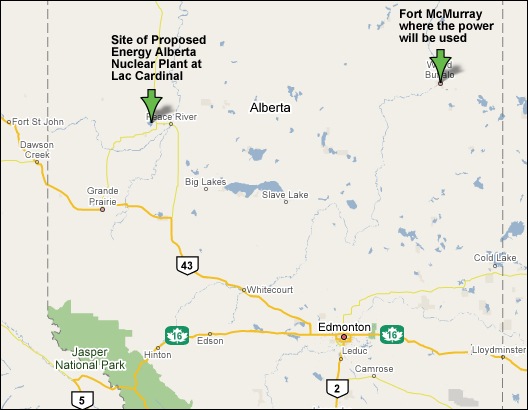
Nuclear plant plan draws fire
Environmentalists question impact on area land and water; company touts 'clean, safe, reliable' power
Jamie Hall
The Edmonton Journal;
With files from the Calgary Herald
Tuesday, August 28, 2007
The Bruce A and Bruce B nuclear generating stations
on Lake Huron, about 250 kilometres southwest of Toronto,
are one of five operating Candu nuclear power sites in Canada.
CREDIT: Courtesy of Bruce Power, file
EDMONTON - Energy Alberta Corporation has chosen Peace River as the site of a proposed nuclear power plant.
The Calgary-based company Monday filed an application with the Canadian Nuclear Safety Commission to build a pair of twin-unit Candu reactors on private land adjacent to Lac Cardinal, 30 kilometres west of the town.
The move ends months of speculation about the intended site of the corporation's $6.2-billion nuclear power plant, which was said to be between Peace River and Whitecourt.
Energy Alberta president and co-chair Wayne Henuset says the decision marks "a historic moment for Canada, for Alberta and for the nuclear power industry" and touted the benefits of "clean, safe, reliable nuclear power."
Ontario currently operates five of the Candu 6 reactors, which AECL said were some of the top-performing units in the world last year, with greater than 95 per cent capacity factor rankings.
But environmentalists gave short shrift to the claims, expressing worries over impacts a reactor might have on the area's land and water.
"The nuclear power industry has a long history of over-promising and under-delivering, so I'm skeptical," said Marlo Reynolds, executive director of the Drayton Valley-based Pembina Institute.
"I'm still not convinced there's a need for nuclear power given all the other resources we have here in Alberta."
The institute won't support any form of government financial support for the project and Reynolds said all environmental impacts must be fully accounted for in the final cost of the facility.
"That business case has never been made clear... once you factor in the full environmental cost I don't believe nuclear power competes."
David Schindler has serious concerns, too.
"There are huge issues involved in building this," says Schindler, a professor of ecology at the University of
Alberta who teaches environmental decision-making, "and one of them is reactor safety.
"I would want to know where the waste is going to be stored, how it's going to get there and what the use of the power is supposed to be for.
"(Nuclear power plants) use a lot of cooling water, so I guess this is one reason for putting it in Peace River, so they can get water from the Peace. The needs are around a cubic metre a second, so it's like a small oilsands plant."
Elena Schacherl insists the proposed plant is "a far different beast" than the existing Candu reactors currently in Canada, which are located in Ontario, New Brunswick and Quebec.
"They're approximately half the size of just one of the (twin reactors) that are being proposed," says Schacherl, who represents Concerned Citizens Advocating Use of Sustainable Energy.
"What's being proposed has never been built before."
She fears the plant will get "fast-tracked" before "the other side" can fully air its arguments in front of an environmental assessment panel.
Henuset said the Peace River region was chosen because of its demonstrated support from the community, the existence of essential infrastructure and support services, and technical feasibility.
Lorne Mann, the mayor of the Town of Peace River, says the plant would bring economic stability to the region.
"Today's announcement ... has given our region an opportunity for a more vibrant, exciting and sustainable future," said Mann.
The corporation has partnered with Atomic Energy of Canada Limited, the federal Crown corporation and maker of Candu reactors.
Initially, Energy Alberta plans to build one twin-unit ACR-1000 that will produce 2,200 megawatts of electricity with a targeted in-service date of early 2017.
"Building a nuclear power facility is a long and rigorous process," said Henuset. "This is the beginning of a public and regulatory process that will include environmental, health and safety assessments."
Press conferences will be held in Calgary, Peace River and Whitecourt today to provide more details about the project.
jhall@thejournal.canwest.com
© The Edmonton Journal 2007
Company seeks approval to build Alberta's first nuclear reactor
Jon Harding
Financial Post
Tuesday, August 28, 2007
CALGARY -- A private Calgary-based company aiming to build Alberta's first nuclear reactor took a step in that direction when it filed an application late Monday with the Canadian Nuclear Safety Commission for a licence to prepare a site for the facility.
Energy Alberta Corp., whose backers include Hank Swartout, founder of the country's largest oil and gas driller, Precison Drilling Trust, said in a release it has teamed with Atomic Energy of Canada Ltd. to build up to two twin-unit ACR-1000 Advanced CANDU Reactors, with the first slated for a site 30 kilometres west of the town of Peace River in the province's northwest Peace Country.
The facility would be in service by 2017, according to the company statement.
"This is an historic moment for Canada, for Alberta and for the nuclear power industry," said Wayne Henuset, president and co-chairman of Energy Alberta.
The first unit would ultimately produce a total net 2,200 megawatts of electricity.
© Financial Post 2007
Firm to build $6.2B nuclear plant in Alberta
Canadian Press
Mon. Aug. 27 2007
CALGARY -- Energy Alberta Corporation has chosen Peace River, Alta., as the site for its proposed $6.2 billion nuclear power plant.
The site is on private land next to Lac Cardinal, about 30 kilometres west of Peace River, the company said in a release Monday night.
"We are proud to be pioneers in bringing the benefits of clean, safe, reliable nuclear power to Alberta,'' said Wayne Henuset, president and chairman of Energy Alberta.
The company had also looked at Whitecourt, Alta., as its possible site. But it delayed its decision three weeks ago when Woodlands County withdrew its letter of support for the facility after 300 residents signed a petition saying they wanted more information. Last week, Woodlands County said it would also hold a plebiscite for residents to vote on the proposed plant.
"Energy Alberta has chosen the Peace River region as its preferred site because of the demonstrated support from the community, existence of essential infrastructure and support services and technical feasibility,'' the release said.
The privately owned company has filed an application for a licence to prepare the site with the Canadian Nuclear Safety Commission.
The application is for siting up two, twin-unit Candu reactors. The company has partnered with Atomic Energy of Canada Ltd., the federal Crown corporation that makes Candu reactors, and says it has lined up financing and clients.
Energy Alberta says it plans to start with one twin unit that will produce 2,200 megawatts of electricity with a target start date in early 2017.
Henuset said the application is just one of many steps required to get the licences to build the plant.
He said there will also be environmental, health and safety assessments and public consultations.
Peace River Mayor Lorne Mann said in the release the announcement has "given our region an opportunity for a more vibrant, exciting and sustainable future.''
"We understand that this is just the beginning of a lengthy process and we welcome the chance to become more informed on nuclear energy.''
Alberta nuclear proponent has mystery power buyer
By Jeffrey Jones
Reuters
28-Aug-2007
CALGARY, Alberta (Reuters) - Backers of the first nuclear power plant proposed for the western Canadian province Alberta sketched out their plans on Tuesday, but left questions unanswered including the identity of a mystery buyer for most of the electricity.
Privately held Energy Alberta has agreed to supply a company with 70 percent of the 2,200 megawatt plant's output, but President Wayne Henuset declined to name the firm, its business or describe the stage of the deal, citing confidentiality agreements.
"(The agreement is) as solid as it gets, I guess, five years out," Henuset said at a news conference. He was referring to his goal of starting construction around 2012.
The C$6.2 billion (US$5.8 billion) plant had first been proposed to provide both electricity and steam for the booming oil sands industry in northeastern Alberta.
But Energy Alberta applied to Canada's nuclear safety authority on Monday to build it further west in the Peace River area and to provide just the power.
Since the company first floated the idea two years ago, it has sparked debate among residents and politicians in Alberta, an oil- and coal-producing province that had officially rejected the notion of nuclear energy.
Under the proposal, the debt-financed plant would start up in 2017. Government-owned Atomic Energy of Canada Ltd would build a twin-unit ACR-1000 Candu reactor and Energy Alberta would own and operate it.
Henuset said it could help solve a power supply crunch in Alberta, where he projected to jump by 400 MW annually. The capacity is about 20 percent of the province's current peak load.
"There are no doubts Alberta needs a large, reliable, clean power source to meet its current future needs and there is no doubt in our minds Albertans are ready for nuclear power," he said.
Radioactive waste would initially be stored near the plant, 30 km (19 miles) west of Peace River, but long-term storage is still being studied, said Stella Swanson, an environmental consultant to the project with Golder Associates.
She pointed out Canadian Energy Minister Gary Lunn recently approved the idea of burying waste deep underground at a single location. Environmentalists have condemned the idea as too risky.
Also attending the news conference were representatives of Citizens Advocating Use of Sustainable Energy, a group formed to oppose the plan.
Among its many criticisms is that the Peace River region is susceptible to seismic activity, said CAUSE member Jack Century, a geologist and consultant to the oil industry.
"Just to the west of the Peace River faulted area is Fort St. John (British Columbia), where oil fields have been inducing earthquakes as a result of conventional water-flooding. This is known to all seismologists, but sort of hidden in the oil patch," Century said.
Swanson said the backers have done geological and engineering studies "at a regional level in a preliminary nature" and plan to keep studying such risks.
"You're right, there have been earthquakes in the area, but it was not what we would call a fatal flaw for choosing this area," she said.
Henuset, a Calgary-based businessman, has run a series of oil field service businesses and car dealerships and has also established a chain of liquor stores.
His partner in Energy Alberta, Hank Swartout, founded Canada's biggest oil field service company, Precision Drilling, and is on the boards of a handful of other firms.
August 26, 2007
Exxon seeks legal sympathy over Valdez
COMMENT: This column may appear to be about the unending legal whining that Exxon is committed to instead of forking over the fines it has been assigned by US courts.
But it is also about coalbed methane activity in British Columbia and the contradiction for provincial policy of pushing that agenda whilst having just "joined six U.S. states and Manitoba in the Western Climate Initiative, a partnership to reduce carbon emissions."
And it is also about the inevitability of catastrophe as risky energy programs are embarked upon - whether it's opening the coast to more tanker traffic, or opening the land to coalbed methane development.
By JOEL CONNELLY
Seattle Post-Intelligencer
August 23, 2007
In his Savile Row threads, the senior partner from a distinguished Los Angeles law firm rose in a Seattle courtroom and argued a case that made the blood leave my face: The Exxon Corp. had suffered enough.
Eighteen years have passed, and Exxon is still imploring judges to feel its pain. On Tuesday, it asked the U.S. Supreme Court to review an appellate ruling that it owes $2.5 billion in punitive damages from the 1989 Exxon Valdez oil spill.
The big "E" has been appealing since 1994, when an Anchorage, Alaska, jury awarded $5 billion to class-action plaintiffs. Fishermen, cannery workers and Alaska natives claimed lasting economic damage from the fouling of Prince William Sound and 400 miles of Alaska coastline.
The case has bounced up and down like a Cordova fishing boat in a Gulf of Alaska storm.
The 9th U.S. Circuit Court of Appeals sent it back to District Court, which affirmed the $5 billion judgment. Exxon took it back to the '9ers, who cut the award in half.
An estimated 20 percent of the plaintiffs (some of them Seattle fishermen) have died since Exxon started appealing. One of the appellate judges who heard the Seattle argument, Charles Wiggins, is no longer with us.
Exxon soldiers on: It hopes Antonin Scalia, Clarence Thomas and other Supremes will prove a sympathetic audience.
While acknowledging the spill was "a very emotional event," the world's biggest oil company argues: "The ongoing case is whether further punishment is warranted."
Exxon-Mobil has lately sought to lower its profile. It has cut money to front groups formed to fuel public confusion on causes of global warming.
Other oil companies busily greenwashed themselves.
ConocoPhillips used shots of breaching whales and Beethoven's music to herald the arrival of double-hulled tankers. British Petroleum has run ads claiming its initials stand for "Beyond Petroleum." Shell has aired profiles of a groovy solar scientist and a gorgeous cultural anthropologist who advises indigenous peoples on how to coexist with oil development.
If you put aside the TV spots, however, big oil is giving us the same old gas.
British Petroleum used the cover of a post-Hurricane Katrina refinery bill in Congress for a sneak attack on legal protections against supertankers in Puget Sound. Reps. Jay Inslee and Dave Reichert thwarted it.
As the Senate marked up energy legislation, Sen. Maria Cantwell, D-Wash., tried to shift subsidies from big oil to renewable energy development.
The industry successfully resisted under guidance of lobbyist and ex-Louisiana Sen. John Breaux, a man famous for saying that while his vote was not for sale, it could be rented.
The anthropologist babe was absent this week as Royal Dutch Shell resumed its attempt to drill exploratory wells for a coal-bed methane project in one of British Columbia's most beautiful alpine basins.
A band of protesters from the Tahltan and Iskut Indian bands blocked Shell crews. The company is considering a court injunction, which would likely lead to arrests.
The land at issue is called the Sacred Headwaters: It forms the headwaters of the Nass, Stikine and Skeena river systems: All are major salmon streams. The Nass is a rare case in Canada of a well-managed fishery. The Sacred Headwaters is a major hunting and fishing ground for native peoples.
"Three years ago, with tenure to drill in hand, Shell Canada didn't waste any time: While most Tahltan were attending a funeral, Shell's contractors unceremoniously bulldozed an access road through a Tahltan trapper's camp and quickly drilled three exploratory wells," thetyee.ca, a Vancouver online newspaper, recently reported.
Shell picked a curious week to bulldoze its way back into the Sacred Headwaters. With great fanfare, British Columbia joined six U.S. states and Manitoba in the Western Climate Initiative, a partnership to reduce carbon emissions.
Who cares about a few dozen Indians in ceremonial costumes blocking a road 600 miles north of Vancouver? Isn't it "old news" that fishermen and tribes are still seeking damages 18 years after the Exxon Valdez spill?
Answer: We ought to extend our attention spans and renew a basic sense of social justice.
During four trips to the Sacred Headwaters country, the Iskuts have impressed me as spiritual, sensible, down-to-earth people who don't want the global economy to roll over their gorgeous corner of the world.
They are willing to accept mines, but one at a time, so the region isn't hit by a boom-then-bust economy. And they want hands off the Sacred Headwaters. They're willing to endure stiff contempt sentences that Canadian judges impose on those who defy corporate power.
The Exxon Valdez plaintiffs have a powerful argument in or out of court: We told you what was going to happen.
As Capt. Joseph Hazelwood was drinking at the Petroleum Club in Valdez, a Cordova biologist-fisherwoman, Dr. Riki Ott, was talking by phone to a meeting elsewhere in town.
She forecast that Prince William Sound was due for a catastrophic oil spill, the question was not whether but when, and that it would not be contained.
The prediction came true a few hours later. If only the Exxon Valdez had shown its corporate parent's skill at maneuver and evasion.
P-I columnist Joel Connelly can be reached at 206-448-8160 or joelconnelly@seattlepi.com.
August 23, 2007
Looking to the sun
Revolutionary solar power from Israel

Remarkable solar amplification development in Israel. Could well imagine offsetting any future need to go with traditional generation plants, and even fossil fuel propulsion conversion of the large vessels of the international shipping sector. (Tom Parry/CBC)
Tom Parry's Notebook
CBC
Aug. 15, 2007
The Ben-Gurion National Solar Energy Research Center has a name more impressive than its actual appearance. The centre is a collection of trailers and mobile homes clustered behind a fence in Israel's Negev Desert. Despite the humble surroundings, the work going on behind its doors is at the cutting edge of solar technology. It could change the way we produce energy — in theory, at least.

Prof. David Faiman of Israel's Ben-Gurion National Solar Energy Research Center. (Tom Parry/CBC)
The head of the centre is Prof. David Faiman. When I met him, he looked like a cross between a college lecturer, Santa Claus and Roy Rogers. Faiman sports a thick white beard, a straw cowboy hat to guard against the desert sun and sunglasses, perched slightly askew on his nose.
From the moment we shook hands, he began speaking about his work. And the focus of his work is "The Dish." The Dish appears at first glance to be a giant satellite ground station. In fact, it is a giant mirror. And what this mirror does is focus the sun's rays onto one single super-heated point.
Like an angry child with a magnifying glass incinerating ants, Professor Faiman can concentrate the sunbeams to an intensity a thousand times their strength. But Faiman isn't using this enormous power for something as mundane as zapping bugs, of course. He's using it to create incredible amounts of electricity.
"By concentrating the light a thousand times, we were able to produce 1,500 watts from a cell that normally gives only one watt," Faiman explains.
The breakthrough solar technology?
Faiman and his team have been experimenting with using concentrated sunlight and a very durable solar panel to produce more electricity than ever thought possible. In theory, this is the breakthrough that solar energy has been waiting for — the one that makes it more practical, reduces the price of production and makes it cheaper than coal-fired, nuclear or even hydro-electric plants. But Faiman isn't popping the champagne cork just yet.
"It will feel wonderful when I see the first solar power plant using this technology in use. Until I see that, it's just another theoretical paper."

Prof. Faiman's solar dish in Israel's Negev Desert. (Tom Parry/CBC)
It could be a while before Faiman's experiments pay off with real world results. But he does envision dishes like his dotting the Israeli desert in the not too distant future.
"Take 120 kilometres of highway," he says, "and take 50 metres on each side of the road. That's twelve square kilometres. That's enough for building 1,000 megawatts of generating capacity. So, you can simply have these dishes in a line, hooked up to the overhead power line, and you've basically used land that's not used for anything else."
California Dreamin'

A solar collector made by Solel Solar Systems. (Tom Parry/CBC)
It would be easy to write off Faiman as a dreamer. But the fact is, Israeli solar technology is already producing power, not in Israel but in the United States. In California's Mojave Desert, huge swaths of land are covered in mirrors soaking up the sun's rays and producing formidable amounts of electricity. The mirrors are the work of another Israeli company, Solel Solar Systems Ltd. Its head office is in Beit Shemesh, west of Jerusalem. Beit Shemesh, as you might expect, is Hebrew for "House of the Sun".
On the day I visited, I was greeted by Solel's President Avi Brenmiller. Brenmiller is an advocate, more of an evangelist, for solar power. A tall, imposing man with a voice like Arnold Schwarzenegger, Brenmiller's every word seems to say, "I told you so" to anyone who doubts the potential of solar energy.
"I think it's the beginning of a peak," says Brenmiller, when asked about the current state of the solar power business.
"A couple years ago, I was very busy trying to convince people that they should do it. Right now, everybody is telling me, okay we are convinced. Let's see if you can deliver."
Sounding like The Terminator at times, it makes sense that Brenmiller's biggest business success is in Gov. Schwarzenegger's California. Solel has nine fields of solar collectors soaking up the sun's energy in the state. And just recently, it signed a contract to build another massive expanse of mirrors that will be the world's largest solar generating plant.
New plant will use more than one million mirrors
"That's the largest solar plant ever built in the world. It will be supplying power to 400,000 families. And we plan to build more plants of that size," Brenmiller says.
"The problem was always, 'When can you become really competitive with other sources of energy?' and we calculated that at that size of a plant, we could really compete with other sources of power," he adds.

Close-up of some of the glass tubes used in Solel's collectors. (Tom Parry/CBC)
The new Solel plant in the Mojave will use more than a million mirrors and cover more than 6,000 acres of ground. The technology developed by the company uses curved mirrors to focus sunlight to heat glass tubes filled with oil. The heated oil is used to boil water. The steam drives turbines that produce electricity.
"This is the only working proven [solar] technology in the world which works at commercially supplying power to the grid," boasts Brenmiller.
While California is its biggest customer, Solel has sold its mirrors in Spain and is eyeing India and China as potential markets. As for Canada, the Great White North may not have enough sunshine to make this kind of solar project viable. The technologies developed by Solel and under development at the Solar Energy Center in the Negev are more suitable to desert climates.
Brenmiller, however, says they are working on solar panels that could be used in northern regions. And, Prof. Faiman adds, even if Canada doesn't end up with fields of mirrors and solar dishes, it may one day buy electrical power produced from solar fields in the southern U.S.
A world leader but not in Israel
What disappoints both Faiman and Brenmiller is that while Israel is quickly becoming a world leader in solar technology, Israel has been slow to embrace solar energy on a wide scale. Most Israeli homes are equipped with solar water heaters, but the bulk of Israel's electricity is produced at coal-fired generating stations. Faiman attributes Israel's reluctance to go solar to nervous politicians.
"There is a reluctance of governments to do anything new," he says, "That is a fundamental problem of governments all over the world. No politician wants to risk doing something that nobody's ever done before. Because if it doesn't work, it's the end of his political career."
The Israeli government has expressed interest in building at least one solar generating station like the ones in California. But Brenmiller is waiting to see a signature on a contract before he starts celebrating.
Both Faiman and Brenmiller admit solar power may never replace the electricity produced in hydroelectric, nuclear and fossil fuel plants. But they firmly believe the world can reduce its reliance on these other technologies simply by looking toward the sun.
August 22, 2007
Offshore deal worth $16-billion to Newfoundland
COMMENT: "The agreement to develop the Hebron-Ben Nevis offshore oilfield gives the province an equity stake of 4.9% in the project."
CanWest News Service
August 22, 2007

Danny Williams
CREDIT: Tyler Anderson/National Post
Newfoundland and Labrador Premier Danny Williams said Wednesday that an offshore deal reached with four major oil companies represents an unprecedented gain for the province.
The agreement to develop the Hebron-Ben Nevis offshore oilfield gives the province an equity stake of 4.9% in the project, estimated to contain 731 million barrels of recoverable oil.
The equity stake came at a cost of $110-million, but the deal will mean total revenue of $16-billion over the 25-year life of the project for the province. The federal government will earn $7-billion in the same period, Mr. Williams said.
The combative premier and the oil companies broke off negotiations on the project -- Newfoundland's fourth major oil development -- in April, 2006, when they couldn't agree to fiscal terms.
The premier came under severe criticism, both in his home province and in the oil community, for refusing to back down on his demands, which involve heavy provincial involvement and for which he was likened to Venezuela strongman Hugo Chavez.
The premier was in a triumphant mood Wednesday, proclaiming the memo of understanding was "historic" and the first step toward Newfoundland and Labrador "Taking real and meaningful ownership of our resources."
There is also an improved royalty regime tied to the price of oil. When oil rises above US$50 a barrel, the province will receive a super royalty of 6.5% of net revenue.
Construction could begin by 2010.
The Hebron negotiations were suspended by the oil companies in April 2006, but resumed last month. One of the main stumbling blocks had been the province's demand for an equity stake in the heavy oil project.
"Our goal was to surpass benefits of previous agreements," said Mr. Williams, who touted the investment in his province's workforce, including the local construction of the new oil platform. "Determination and strength of conviction has been our government's guide."
The partners in Hebron are Chevron, ExxonMobil Canada, Petro-Canada and Norsk Hydro Canada.
Nfld. strikes Hebron deal
SHAWN MCCARTHY
Globe and Mail
August 22, 2007
The province of Newfoundland and Labrador will pay $110-million to get a 4.9-per-cent stake in the Hebron offshore project, Premier Danny Williams said in announcing a deal with oil companies to proceed with the $5-billion development.
Some 16 months after talks broke down — and six weeks for a provincial election — Mr. Williams on Wednesday released details of the agreement, which includes a heightened royalty regime and guarantees for local content in the construction of the offshore platform.
“Today marks a historic day in Newfoundland and Labrador, as we enter into a new era of offshore oil development with unprecedented benefits to the people of our province including taking real and meaningful ownership of our resources,” the premier told a news conference in St. John's.
Under the agreement signed with the consortium led by Chevron Corp., the province will pay $110-million in cash for its equity stake, and contribute 4.9-per-cent of the estimated $5-billion in construction costs.
With a provincial election less than two months away, Newfoundland and Labrador Premier Danny Williams has clinched a deal with a consortium of oil companies to proceed with the $6-billion Hebron offshore oil project.
With a provincial election less than two months away, Newfoundland and Labrador Premier Danny Williams has clinched a deal with a consortium of oil companies to proceed with the $6-billion Hebron offshore oil project. (CP)
Mr. Williams acknowledged there was some risk involved in taking a direct stake in the project, but said the province would benefit from payout of profits, as well as super royalty scheme that will remain in effect so long as the price of oil remains above $50 (U.S.) per barrel.
James Bates, vice-president at Chevron Canada Ltd., said the deal was a good one, both for the people of Newfoundland, and for the shareholders of the oil companies.
"We dealt with the net expectations in the context of the entire agreement," Mr. Bates said. "When you at it from that perspective, we were able to meet the expectations of the government and our companies."
Mr. Bates would not discuss the details of the agreement, including which partners would sell equity. He said more work needs to be done to hammer out a binding contract. In addition to Chevron with 25 per cent, ExxonMobil Corp owns 37.5 per cent of the Hebron project. Petro-Canada and Norway's state-owned Norsk Hydro ASA are also partners.
The province's equity will be managed by energy arm of Newfoundland and Labrador Hydro, which has been charged with developing the province's oil and gas, as well as electric power assets.
The premier thanked the people of Newfoundland and Labrador for supporting him when critics — in the business community in St. John's and around the country — slammed him for insisting on an equity stake and accused him of driving investment away from the province.
Talks between the government and the oil companies broke down in April 2006 over a number of issues, including Mr. Williams' demand for an ownership stake in Hebron and the companies' insistence on a package of tax credits.
In his news conference this morning, the premier said his government had increased its offer for the equity by $10-million, agreed to reduce its royalty claim by $20-million to $30-million, and extended the royalty payout period.
For its part, the consortium dropped demands for tax credits, and agreed to accept the government as a partner in the project.
Mr. Williams said that, given current oil price projections, the Hebron project — with reserves of up to 700-million barrels — should generate more revenue for the province, and more jobs than the two previous projects combined.
Hebron will be the fourth offshore oil project for the province since the industry got its start with the Hibernia development in the 1980s. It is located some 340 kilometres from St. John's and will use a similar concrete gravity-based structure (GBS) as a drilling platform. That GBS will be fabricated in the province.
Squeezing oil from stones
There are vast reserves of oil trapped within Alberta's rockbed - the trick is getting it out
NORVAL SCOTT
Globe and Mail
August 22, 2007
CALGARY -- OSUM Oil Sands Corp. believes it might have the answer to one of the oil patch's most perplexing problems - extracting the billions of barrels of crude trapped in Alberta's limestone deposits.
To date, energy companies have largely concentrated on producing crude from Alberta's oil sands, where tar-like bitumen is extracted from sandstone and dirt using either mining or steam-assisted extraction. While the province's limestone deposits - or carbonates - also hold vast amounts of crude, the reserves are too deep for mining and are frequently perceived as being incompatible with steam-assisted extraction, preventing easy recovery.
Nevertheless, the uncertainty over extraction hasn't stopped some enterprising firms from snapping up leases in regions such as Alberta's Grosmont formation. Last year, Royal Dutch Shell PLC paid $465-million for 10 parcels of land in the carbonate region, by far the biggest outlay for staking any exploration claim anywhere in the oil sands, while Husky Energy Inc. also holds substantial acreage in the area.
The only other company to own holdings in the region is the far smaller, privately held OSUM, which used to offer technological and service solutions to other firms before deciding to acquire a slice of the oil sands itself, paying just over $20-million last August for leases that could hold 840 million barrels of recoverable crude.
Not only does the Calgary-based company believe the land can support a project ultimately capable of producing 75,000 barrels of crude a day, it believes the carbonates could be the way forward for Canada's oil patch.
"The carbonates are a stupendous resource, and when they are cracked at a commercial level, that's a material step-change for the industry," OSUM chief operating officer Peter Putnam said in a recent interview.
"Shell didn't spend all that money in the region to get hold of a big science experiment - they're looking for a major project."
So far, Shell and Husky have been tightlipped about exactly how they will produce crude from the carbonates, although Husky has tentatively outlined plans for a 200,000-barrel-a-day project at its Saleski holdings. Industry observers have speculated that the companies could use electrical wires to heat the limestone resource, although such a process would likely be expensive and need a large energy source.
While OSUM isn't giving away its technical secrets either, it says the answer to extracting the crude is far less esoteric than the industry seems to believe, with experiments carried out in Alberta in the 1970s already proving that crude can be extracted from the limestone reservoirs with thermal recovery methods.
"Producing barrels out of the carbonates is not an issue, and we actually think these reservoirs are better than those in Fort McMurray," Mr. Putnam said.
"Most people who work in the oil sands only know about sand - they don't understand these reservoirs and they don't have experience with them."
In conjunction with privately held partner Laricina Energy, OSUM is now pressing ahead with plans for a 10,000-b/d pilot project at Saleski - recently securing $56-million of financing - and expects to file a regulatory application next year.
As well as the carbonate plans, OSUM is also moving forward another project that appears technically challenging - extracting crude from under Marie Lake, in eastern Alberta.
That project will use so-called shaft and tunnel technology to reach the region's crude, with wells drilled from below the reservoir, rather than from above.
While planning for the 30,000-b/d project is in an early stage, OSUM believes the shaft and tunnel system, which requires less drilling and less steam, will lead to substantial cost savings and a smaller environmental footprint.
Alberta regulators gave approval to OSUM to conduct seismic testing at the site earlier this month, despite objections from residents concerned about how the project might affect Marie Lake.
OSUM chief executive officer Richard Todd said seismic testing carried out on lakes elsewhere in Alberta hadn't caused any problems, and that the company was determined to address any community concerns and carry out its program with sensitivity.
"Hopefully, at the end the residents will applaud our approach," he said. "I think people will come to see the whole package as a step forward [from conventional oil sands operations]."
August 21, 2007
Alberta Energy loses gas decision
National Energy Board approves new LNG terminal to be built in Quebec
Gordon Jaremko
Vancouver Sun,
21-Aug-2007
EDMONTON -- Alberta Energy has lost a quiet but hard-fought national duel with importers and consumers over the future of the province's top money-earner: natural gas.
In a July ruling described as "a signal to the global market," the National Energy Board rolled out the welcome mat to tanker cargoes of liquefied natural gas from overseas by approving a controversial cost-sharing scheme for a new LNG terminal to be built in Quebec.
On the heels of the decision, Andrew Pelletier, spokesman for Cacouna Energy -- a major player in the terminal project -- said, "Right now it's a green light. We're working towards a project announcement."
The company's statement -- expected by the end of the year -- will set out a final cost estimate and construction schedule for the Quebec import terminal that is to be developed by the Cacouna partnership of Trans-Canada Corp. and Petro-Canada.
The NEB's technical but far-reaching landmark ruling decided a fight over who will pay for a cornerstone of the project -- and possibly more like it -- over the next 20 years.
The contested item is a $738-million set of additions to Trans-Canada's national gas pipeline, including a 240-kilometre extension and other adjustments needed for markets to use the new tanker terminal at Gros Cacouna, on the south shore of the St. Lawrence River east of Quebec City.
Over vigorous resistance by Alberta Energy lawyer Brent Prenevost, the NEB sided with the Cacouna partners and their supporters, which include the Quebec government, Canadian Industrial Gas Users Association and Montreal distributor Gaz Metropolitain Inc.
The board ruled that the remote terminal is a "receipt point" for gas to enter TransCanada's pipeline, akin to conventional Alberta and Saskatchewan inlets along the main shipping route for gas to central Canada and the United States.
That status qualifies the Cacouna pipeline extension for a utility cost-sharing system known as the "rolled-in toll methodology." The $738-million bill for the LNG import terminal will become, in effect, an added mortgage to be paid off with tolls charged to all shippers, including Alberta gas producers and merchants.
TransCanada estimated the extra bill will be as little as two-tenths of a penny and no more than three cents a gigajoule by the time it is spread out over many years and all the traffic on the national pipeline system.
Alberta Energy argued the scheme creates a big subsidy for LNG imports by saving the terminal the expense of paying for its own pipeline link to Quebec, Ontario and U.S. markets.
In a strongly worded final argument before the NEB, Alberta Energy lawyer Prenevost predicted the rolled-in system will give LNG imports a competitive advantage of $1.10 per gigajoule against Alberta gas in Quebec.
He acknowledged the Alberta government was alone in resisting the scheme, but suggested it was no accident the gas production industry stayed conspicuously silent.
Gros Cancouna documents at NEB registry
Proposed plant in Cowlitz County to test pollution law
Craig Welch
Seattle Times
20 August 2007
When Gov. Christine Gregoire signed a new law in May to reduce greenhouse-gas emissions, she called it a "testament to the unique, broad-based coalition that came together - utilities and environmentalists, faith communities and business leaders."
Four months later, that coalition is already splintering over one of the first real tests of the new law: a fight about whether developers of a proposed power plant in Cowlitz County are trying hard enough to limit its climate-changing pollution.
The dispute highlights how efforts to reduce carbon emissions increasingly run up against a growing region that needs more and more electricity.
Energy Northwest has proposed a plant at the Port of Kalama that would burn gas made from coal. That process is cleaner than simply burning coal, but it still would emit millions of tons of carbon dioxide into the atmosphere each year.
At issue is whether Energy Northwest has made a sincere effort to find ways to trap the excess greenhouse gases in the earth - a process known as "carbon sequestration" - instead of spewing them into the sky.
The state Attorney General's Office and the Department of Ecology, environmentalists and some lawmakers insist the electricity suppliers behind the new plant are trying to bypass the intent of the law.
Those suppliers - including Seattle City Light and more than a dozen public-utility districts represented by Energy Northwest - say that's not true.
Under the new law, signed with great fanfare at the end of the last legislative session, new power plants have to trap their carbon emissions unless the utilities demonstrate, after a "good-faith effort," that it's impossible.
Only then can plant operators instead offset emissions, by buying rights to another utility's unused pollution capacity, for example. Lawmakers and Ecology officials have said such offsets should be a last resort.
When it submitted pollution-control plans to the state for the Kalama plant, Energy Northwest simply professed that sequestration remains unworkable in real-world practice. So until it is, the utility wants to pay to offset emissions.
"We represent openly and honestly the current state of technology for sequestration, and it's just not available yet," said Brad Peck, a spokesman for Energy Northwest.
State officials and environmentalists heatedly objected.
"This document is not a sequestration plan, it is merely a plan to have a sequestration plan," Assistant Attorney General Michael Tribble wrote. The Ecology Department said Energy Northwest's proposal was too deficient to even consider.
Both agencies urged a third state agency that reviews power-plant proposals, the Energy Facility Site Evaluation Council (EFSEC), to reject the plan as inadequate.
Instead, EFSEC agreed to move forward with a review. The panel plans to hear arguments about the issue next month.
"There's no good reason not to proceed," said Jim Luce, chair of EFSEC. "The first thing we're going to do is debate compliance with the law."
Now environmentalists worry that EFSEC will give utilities the benefit of the doubt and that if the utilities are allowed to move ahead without concrete sequestration plans, they may never develop such plans.
"I find it incredible that EFSEC rejected the rather explicit advice from the attorney general," said Marc Krasnowsky, spokesman for NW Energy Coalition, a Seattle-based environmental group that promotes renewable energy and conservation. "Once it's built, does anybody really believe politicians will demand the plant shut down?"
Energy Northwest's Peck responded that lawmakers knew sequestration was experimental when they passed the law, hence the provision for other options such as offsets.
"If anyone knows a sequestration technique that's available and viable, we'd appreciate them letting us know," Peck said.
Equally important, Peck said, is that the state needs more power. Even if economic growth slows, he said, utilities expect an increase in demand of 1,200 to 2,400 megawatts over the next six years - about how long it takes to get a new plant built and operating. The Kalama plant would produce about 680 megawatts.
"We don't see better options, and this one meets our criteria: reliable, affordable and environmentally responsible," Peck said.
But state Sen. Erik Poulsen, D-West Seattle, who chairs the Senate's energy committee, said the Legislature "had every expectation" that Energy Northwest would try to resolve technical issues with sequestration before pushing ahead.
"In winning the battle, they may lose the war," Poulsen added. "If they succeed in avoiding sequestration this easily, you can be sure the Legislature will put tighter restrictions on coal plants.
"As chair of the energy committee, I can virtually guarantee it."
August 19, 2007
The new dirty energy
It's big, it's growing -- and it's bad for the environment. Inside the other alternative-energy movement.
By Drake Bennett
Boston Globe
August 19, 2007
FOR THOSE WHO dream that high oil prices will help drive America toward a brave new world of clean energy, the MacKay River project in Alberta, Canada, offers a glimpse of the future.
The complex is a showpiece of cutting-edge engineering, wresting energy from beneath a swath of boreal forest. Under an unobtrusive spread of buildings, holes drilled at oblique angles free unprocessed fuel from the earth with jets of steam.
Thanks to government and private investment, the complex is providing more energy every year, and by 2020, Alberta as a whole is predicted to generate enough to replace a quarter of the United States's current daily oil usage. And as oil prices rise, projects like MacKay River become more and more cost-effective, and more popular.
The only problem: The thick, tarry petroleum that the Alberta project pulls from beneath that forest is far dirtier than oil.
Alternative energy wasn't supposed to look like this. For years, leading environmental thinkers have argued that high fossil fuel prices are good for the planet, driving investors and customers toward biofuels, solar power, and a host of new energy sources that will quickly become cost-effective.
But as oil prices stay high, the real beneficiary often turns out to be a very different alternative-energy industry, one focused on dirty fuel sources such as oil sands, oil shale, and coal. Environmentally speaking, the oil-sand plants of Alberta are no better than petroleum drilling, and in some ways decidedly worse. In North America, in terms of energy output, this so-called "unconventional oil" sector already dwarfs clean and renewable-energy technologies, and is poised to grow even faster in the next decade.
"To assume that high energy prices mean we'll switch to wind or solar or other renewables is simply unrealistic," says Amy Myers Jaffe, an energy expert at the James A. Baker III Institute for Public Policy at Rice University. "It only means that if we make that a concerted policy."
For the past two years, oil prices have been fluctuating around historic highs. Although $3-per-galllon gasoline may be frustrating to drivers, it has been welcomed by environmentalists and many economists, who see expensive oil as a crucial spur to the clean-energy business. In announcing last fall that he was dedicating $3 billion to fight global warming, the British billionaire entrepreneur Richard Branson said of high oil prices, "Thank God it's happened. . . .A high oil price is what we needed to actually wake up the world" to deal with climate change.
When oil is expensive, biofuels start to look more affordable by comparison, and investors start seeking ways to make them more affordable still. When natural gas -- used primarily for generating electricity -- is expensive, it adds to the appeal of wind and solar-generated electricity. The best-selling author and New York Times columnist Thomas Friedman, among others, has gone so far as to advocate an oil price floor to ensure that oil never gets cheap enough to undercut alternative energy sources.
In part, the expectations of Branson, Friedman, and others are starting to come true. Investments in renewable energy by governments, corporations, and venture capitalists have surged in recent years, driven in part by the cost of oil. A United Nations Environment Programme study released in June reported that, worldwide, $70.9 billion was invested last year in clean energy generation, about a third of that in the United States.
But these renewable sources still supply just a fraction of the world's energy needs, and many of them remain high-tech speculations. The best-known, like wind and solar, are for electricity generation, not vehicle fuel, the role oil currently plays. And according to Department of Energy figures, ethanol, the only widely available biofuel, currently meets only 1.6 percent of American vehicle fuel needs.
Meanwhile, the high price of oil has given a dramatic boost to a very different set of energy sources -- one of which is now generating fuel on a huge scale. These "unconventional oil" sources pull carbon out of the ground in forms that were once too expensive, or too technically difficult, to compete with cheap oil.
By far the most developed of these are the oil sands of Canada. A thick slurry of sand, water, and a hydrocarbon tar called bitumen, oil sands -- also called tar sands -- can, with enough processing, be refined into something very similar to the petroleum pumped out of the Saudi Arabian desert.
The discovery of tar sands in what would become northeastern Alberta long predates the internal combustion engine: Native Americans found the tar seeping from the ground and used it to caulk their canoes. Efforts to mine the sands for oil go back to the 1960s, but were never economically competitive with oil drilling, and the early mines struggled. No longer.
"With higher prices there's a terrific interest up there," says David Pommer, a spokesman for Chevron Canada, co-owner of one of Alberta's largest oil-sands mines.
Geologists estimate that Alberta's oil sands contain 1.7 to 2.5 trillion barrels of oil -- more than Saudi Arabia -- a few hundred billion of which are recoverable using current technology. (A similarly vast oil-sands reserve lies beneath Venezuela, but remains mostly undeveloped.) Already today, Alberta's oil-sands industry produces a million barrels of oil a day, most of which comes to the United States.
Environmentalists see this as a growing disaster. The oil in oil sands is not easily separated out, and the immense amounts of heat required are usually generated with natural gas, giving the oil-sands industry a greenhouse gas footprint much larger than the traditional oil business -- estimates range from 40 percent more to five times the emissions. The process also uses enormous amounts of water: a study by the Pembina Insitute, a Canadian environmental watchdog organization, found that, depending on the method of extraction, every barrel of oil produced requires 2.5 to 4 barrels of water, all of which is then rendered too polluted to return to the water supply. And most oil-sands operations are mines, not steam wells like the MacKay project, making them very disruptive to surrounding ecosystems.
Behind oil sands, two other "unconventional oil" technologies, at this point far less developed, wait in the wings.
One of them is oil shale, a sedimentary rock impregnated with solid bitumen. Three-quarters of the world's known oil shale deposits lie in the western United States, concentrated in Colorado, Utah, and Wyoming, giving the country an immense hidden oil reserve of around 1.8 trillion barrels. To extract the bitumen and turn it into oil, however, requires a massive amount of heat. Either the rock is mined, then crushed and cooked in huge pressurized caldrons, or the bitumen is melted out by physically heating the earth that holds it to temperatures above 600 degrees Fahrenheit.
Energy and emissions estimates for oil shale are hard to come by, since there are no large-scale production facilities, but the energy expenditure to cook the oil shale is likely to be considerable. Terry O'Connor, a vice president of Shell Unconventional Resources, insists that the company is looking at ways to cut down on both energy and emissions. "That's the reason we're still years away from making a commercial decision," he says.
An even bigger wild card is liquid fuel made from coal. The United States and China, the countries with the world's largest energy appetites, also contain the world's largest deposits of coal. While the basic technology to turn coal into fuel is nearly 90 years old, in the past it was too expensive to be anything but a last resort for fuel-starved countries such as Nazi Germany and apartheid South Africa.
A few firms in the United States and China are trying to use new technology to make the process economically competitive with oil, but again, the environmental costs are high. The favored coal liquefaction method today requires first turning solid coal into a gas at very high temperatures; combined, the production and consumption of coal-derived diesel releases roughly twice as much carbon into the atmosphere as traditional oil -- though various research efforts are underway to capture these emissions. It also uses more than a dozen barrels of water per barrel of fuel produced, according to a recent Department of Energy study. And coal mining takes a toll on landscapes and animal habitats.
The lesson for policy makers is that economics alone won't help solve the world's greenhouse-gas problems. The markets care about money, not the environment, so the most important alternatives to oil will be the biggest and cheapest, not the greenest.
What's needed, say many clean energy advocates, isn't just high oil prices, but high carbon prices. If fuels were taxed on their carbon content, climate change would be priced into the economics of energy production.
"If you have a carbon tax, or some other concerted carbon policy," says Mike Jackson, an energy analyst with Stanford University's Freeman Spogli Institute for International Studies, "then high oil prices drive industry toward clean technologies."
Otherwise, he says, "you're just going to see more people building these wacky projects that are a disaster for the environment."
Drake Bennett is the staff writer for Ideas. E-mail drbennett@globe.com.
© Copyright 2007 The New York Times Company
August 18, 2007
Royalties: As Big Oil pumps Alberta
COMMENT: This is an excellent essay on Alberta’s royalty review, with a bad sub-heading. Too bad you can’t read it from the bottom up, because many of the reasons why royalties should be increased, appear later in the report.
Don Gunderson, speaking to the royalty review panel summed up thus: “I think the most solid evidence that the current royalties are too low is the fact that the oil companies are happy with the current rates.” He continued, “We don't want a fair price; we want the best price.”
Industry is quick to whine about how tough things are, and an increase in royalties will surely lead to investment going elsewhere. But investment is flooding into Canada, and more specifically to the oil sands, irrespective of royalties, high exchange rates, and everything else industry might complain of. It is coming because US investors see safety and stability in Canada, and they see a huge secure supply of oil. The oil industry is engorged on profit in recent years. So enough of the whining and the empty threats.
Some of the things that are wrong with royalties:
- as oil (and gas) prices rise to unprecedented levels, royalty rates don’t rise with them. They’re capped. Free lunch for shareholders. Bag lunch for citizens.
- a vast and generous array of allowable costs, which are deducted from the nominal royalty payable, are another free lunch for shareholders.
- North America is already the most profitable jurisdiction in the world for oil producers
Meanwhile, in Newfoundland, Premier Danny Williams “is close to introducing new legislation that would require state participation in all developments.”
And what of British Columbia? Still looking to Alberta for guidance in all things with oil and gas, BC is probably going to follow whatever lead Alberta takes. For the record:
- in fiscal 2006, BC produced 12.69 million barrels of oil and took in $127 million in royalties. The nominal price of oil was US$66.06 per barrel. That’s a net royalty of US$10 per barrel and a net royalty rate of 15.15%
- in fiscal 2006, BC produced 1,095 petajoules of gas and took in $1,392,000,000 in royalties. The nominal price of gas was $5.65/gigajoule. That’s a net royalty of $1.27 per gigajoule and a net royalty rate of 22.50%.
Most of this is from the 2007 Budget, Table A10
http://www.bcbudget.gov.bc.ca/2007/pdf/2007_Budget_Fiscal_Plan.pdf
The 2006/07 forecast oil production is from MEMPR’s 2005/2006 Annual Service Plan Report
http://www.em.gov.bc.ca/DL/GSBPubs/AnnualReports/AR2005-2006.pdf
As Big Oil pumps Alberta for profit, the province's royalty take is shrinking.
Is it time to get greedy?
DAVID EBNER
Globe and Mail
August 18, 2007
Royalties have existed as long as humans have spun wealth from the world's underground riches, digging and drilling to produce personal and collective fortunes. The first royalty believed to have been collected occurred in ancient Greece, creating great wealth for Callias, a top aristocrat whose home was the finest in Athens and was the setting for one of Plato's dialogues.
Callias owned silver mines at Laurion, which is now a suburb of Athens but was once the chief source of revenue for the Athenian city state, where slaves mined the ore. Callias received royalties on the production and the mine operators took their slice. This division of wealth became the foundation of a fiscal system for the sharing of dollars generated from the extraction of natural resources that is generally unchanged more than two millennia later.

The owner of a resource, be it silver in Greece or oil and natural gas in Alberta, receives a royalty as a right of ownership from the person producing the resource and aiming for their own profits. But what the rate should be is a difficult debate, as the arguments are relative in the absence of absolutes – reflected in the fact that there are a thousand or so royalty systems for energy around the world. The question is also clouded and confused by the word at the heart of the argument: Fair.
Royalties paid on oil and natural gas production in Alberta are one of Canada's most crucial economic calculations. Within two weeks, the provincial government receives an extensive report from a six-member panel that conducted a public review of royalties, taxes and other fees paid by energy producers – with a core mandate to determine if citizens are getting their fair share. The report, and what rookie Premier Ed Stelmach's government does with it, could have significant repercussions across the Canadian economy.
“This is a critical issue,” said Frank Atkins, an economist at the University of Calgary.
Hitting the right note on royalties helps spur development, bringing wealth to Alberta and to all Canadians. But getting it wrong means kicking over an economic domino with countrywide repercussions. The energy business obviously has enriched Alberta but it has also very much made the nation wealthier, starting with federal taxes that get shared east, centre, west and north, to things such as auto sales, with Alberta recently underpinning record domestic vehicle sales, an engine of the Ontario economy. The oil sands, in fact, pay more corporate income taxes to Ottawa than Edmonton.
In sleepy sessions from Grande Prairie to Medicine Hat, the unprecedented public review started in late April and ended mid-June but occurred beyond the attention of many Albertans and most Canadians. The panel heard more than 100 public presentations, with roughly half of those made by industry players. Another 224 submissions were made on paper.
Greg Stringham, a vice-president at the Canadian Association of Petroleum Producers, was one of the people near the heart of the debate helping lead the industry lobby, but he made his points without thumping his chest or threatening impending doom, as was the case with so many other Alberta oilmen. Mr. Stringham knows there isn't one easy answer.
“Our answer to the question of whether it is fair, we'd say yes,” Mr. Stringham said in an interview. “But fair is a nebulous word, it's hard to define.”
Figuring out fair is critical for Alberta because royalties aren't just one little thing in a much bigger picture: They are the thing. Resource revenues are the province's No. 1 source of income, ahead of corporate and personal income tax. In 2006-07, Alberta collected $9.8-billion in oil, natural gas and oil sands royalties, as well as $2.5-billion from the sale of new exploration rights – accounting for one-third of the province's income.
Without energy, Alberta's gross domestic product would be about half the size, according to economists Robert Mansell and Ron Schlenker of the University of Calgary, who added that without royalties, a provincial sales tax of 16 per cent would be needed to make up the revenue. And they said the calculations were probably understated, alluding to the fact that without energy, there'd be hardly any economy at all in Alberta, with no need for all the engineers, lawyers and accountants, never mind all the restaurants and Canadian Tires.
It is this dependence that backstopped the don't-choke-the-golden-goose argument issued by industry, which is powerful in sound bites, because who dares ruin a good thing? It was these comments that gained the most attention in the local media. Jim Buckee, the gruff retiring chief executive officer of Talisman Energy Inc., employed rhetoric when he sat before the panel in May in Calgary, saying a zero per cent royalty generates zero dollars and a 100 per cent royalty also produces zero, as it drives all activity elsewhere. “The current regime has worked and it's best left alone,” Mr. Buckee declared.
Also in Calgary, Steve Laut, president of Canadian Natural Resources Ltd., the country's No. 2 producer, said: “What we have to be very cognizant of is any significant change – or any change – to the royalty system could [produce] a drastic – I mean drastic – reduction in activity in Alberta.”
The review looked at all aspects of oil and gas in the province but the focus was clearly on the oil sands. The giant resource, concentrated in the remote boreal forest of northeastern Alberta, has commanded the energy world's attention after being recognized several years ago as the second-largest reserve of oil after Saudi Arabia.

It is a huge change from a decade ago when the oil sands languished unloved, considered a fringe resource with the price of crude at a quarter of today's level.
Industry, hoping to jump-start the near-dead business, sponsored a national task force to find ways to overcome development challenges to seize the alluring promise of enormous long-term potential. A key idea, proposed in 1995, was an enticing royalty regime, quickly adopted by Alberta. The province takes just 1 per cent of gross revenues until an oil sands plant has recovered the billions of dollars it took to build the operation, a rate that then rises to 25 per cent of revenues minus costs.
The system, then and now, is among the world's most generous regimes.
And it worked: Oil sands production reached one million barrels a day in 2004 – a milestone that had been forecast for 2020. According to current projections, by 2020 the oil sands could produce four million barrels a day, which would make Canada the No. 4 oil producer in the world behind Saudi Arabia, Russia and Iran.
While the royalty regime was a spark for the boom, it is one of several important factors that attracted billions of dollars of investments. The most important element was the price of oil, which has surged fourfold. Among the other important changes is markedly improved oil sands technology, as well as fewer opportunities for large projects elsewhere.
For global oil companies, royalties are one component in a complicated equation with the key variable – oil prices – in constant and often extreme flux. Given this, even with Alberta looking at royalties, some of the world's biggest oil companies have made major moves since the review began. Statoil ASA of Norway, looking to expand beyond the North Sea, an oil region in decline, spent $2.2-billion in April for an undeveloped oil sands project, making Alberta its top international expansion priority. Royal Dutch Shell PLC has pinned much of its future growth on the oil sands, spending $8.7-billion this year to buy the part of Shell Canada it didn't already own, and this month it announced it is looking to spend an additional $27-billion to build a giant new upgrader to process raw oil sands output.
In May, Brian Straub, Shell's senior vice-president of oil sands, added his voice to the chorus of industry warnings but conceded higher royalties won't stop Shell. “They're not going to drive us out of the province,” he said to reporters after presenting to the review panel, “but certainly our ability to invest is put in jeopardy.”
CHAPTER ONE
FROM BUST TO BOOM … TO BUST TO BOOM
When Alberta became a province in 1905, natural gas had already been discovered around Medicine Hat, in the southeastern corner of the young jurisdiction. There was also an oil strike near Calgary in 1914 that sparked a mini-boom, but the frenzy fizzled quickly. However, for the fledgling province, most of the resources were still owned by Ottawa, as well as a small portion held by private hands.
It was not until 1930 that the federal government relinquished its ownership of regional natural resources to Alberta and the other western provinces.
At the onset of the Depression, Alberta was sparsely populated, mostly poor and dependent on agriculture. The initial royalty rate was set at a flat 5 per cent, not that it particularly mattered, as the province produced little oil and gas. The birth of the province's modern industry, and its launch to “have” province from long-time “have not,” came in the late 1940s, when a gusher of crude, and then another, were discovered near Edmonton.
The royalty rate was tinkered with several times and by the 1960s, the province had used its newfound status as a significant oil producer to demand more from energy companies, which at the time were mostly American. Royalties had been raised but the high end was capped at 16.7 per cent of gross revenues – which was undone in the early 1970s by then-premier Peter Lougheed as the price of oil jumped far higher after the Middle East flexed its new muscle.
Having unseated a government that ruled for more than three decades, Mr. Lougheed, a left-leaning Conservative who began the dynasty that still exists today, tied royalties more closely to the price of the commodities and jacked up the maximum rates past 30 per cent. Ron Ghitter represented downtown Calgary in those days and recently recalled the reception from oilmen in a radio interview. “They cried bitter tears,” he said, half-joking that he had to use back alleys to avoid confrontations.
But higher royalties didn't deter industry from chasing growth and riding soaring commodity prices. In the six years after royalties were raised, before the global energy boom of the '70s peaked, oil and gas production in Alberta remained strong, the number of wells drilled each year doubled and money spent to acquire new exploration rights exploded tenfold. The industry only came undone when commodity prices collapsed.

During the 1980s bust, the royalties scale began to tilt back, with programs created to encourage activity as the price of oil and natural gas remained low. In the early 1990s, desperate to spur new exploration, the government of then-premier Ralph Klein cut royalties, charging less than 10 per cent when prices were low or, significantly, when a well's output was modest.
Even with the last overhaul, a goal of taking 20 to 30 per cent for royalties was in place, and the province's take bounced around the low end of the range, averaging 22.4 per cent from 1995 through 2003. In 2002, seeing that 30 per cent was out of reach with the system as is, the province reduced its ambitions, cutting the range to 20 to 25 per cent.
The take continued to fall, slipping below the bottom end of the goal to 19 per cent in 2004, where it remains three years later. A senior Alberta Finance official warned in April that the figure could fall further. Industry says Alberta needs to recalibrate the goal, lowering it to align with what it says is the reality of a changing business.
This year's provincial budget acknowledged that the system as it stands will return citizens less each year, warning royalties could fall by a third to $6.6-billion in 2009-10 from the $9.8-billion received in 2006-07.
Part of the story behind the numbers is the fact that explorers have carefully combed over the Western Canada Sedimentary Basin since Leduc No. 1, the first big oil discovery in February, 1947. All of the easy oil and natural gas and most of the big hits have been uncovered, leaving each new find smaller than those in years past. Even just a decade ago, the typical oil or gas well was relatively prolific and many generated a high rate of royalties. But as the years passed, the average well's output fell. Initial production of a natural gas well today, for instance, is less than half of what it was in the mid-1990s.
So as the system Mr. Klein's government put in place sees more oil and gas wells paying citizens less, energy companies are still chasing profits furiously, emboldened by high commodity prices and testified by the more than 17,000 or so wells drilled in Alberta last year.
Even this year, during a slump, almost 13,000 holes are expected to be cranked into the earth. This slowdown, due to low natural gas prices and high drilling costs, is much less brutal than crashes of the past – and record oil prices has ensured the search for crude remains robust.
Compounding the money situation for the province is that royalties were capped at prices that are far lower than current market rates, though the cap was well above the market when the system was drawn up. Further exacerbating Alberta's new reality is the emergence of the oil sands and the low royalties paid there, steadily replacing higher royalties previously paid on conventional crude and natural gas.
CHAPTER TWO
THE MYTH OF PROFITABILITY?
While Alberta's royalties take sits at 19 per cent now, energy companies are making the biggest profits they have ever enjoyed, led by EnCana Corp., the sector's No. 1 player, which in 2006 made $6.4-billion, the largest profit in Canadian corporate history. Add on Suncor Energy Inc.'s $3-billion profit, and two large oil and gas companies made about as much in profit as the entire industry paid the province in royalties last year.
All in, the five most profitable energy companies in Canada saw their bottom lines shoot up more than 50 per cent in 2006 from 2005. And despite rising costs and other challenges, the trend is still very much intact.
PricewaterhouseCoopers, in its annual Canadian energy survey in June, said the positive trend is one that “we don't see changing any time soon.” EnCana's operating profit this year is up about 50 per cent from a year earlier and cash flow has climbed more than 20 per cent.
Canadian Natural in early August said its cash flow has surged 35 per cent higher to a record of $3.1-billion.
These results contrast with the main argument of industry, that energy companies are hardly as profitable as they appear to be and are in fact struggling with soaring costs and worried about eroding profit margins – so they simply can't afford an increase of royalties, adding that such a change would ruin Alberta's reputation as a dependable place to do business.
“It's a myth out there that this is a hugely profitable business,” Mr. Laut of Canadian Natural told the royalty review panel.

Mr. Laut routinely presents a different picture to investors. Canadian Natural next year will begin production at a $7.6-billion oil sands mine. In every presentation marketing the company, Mr. Laut said its Horizon project will produce a “wall of cash flow” of nearly $1-billion annually (with oil at $45 [U.S.] a barrel) that will be “sustainable for decades.”
Mr. Lougheed, whose blue eyes still sparkle, remains a champion of the people. At a luncheon at Rouge, a restaurant housed in the home of one of Calgary's founders, Mr. Lougheed – who as a boy watched his family lose his grandfather's home due to debts in the Depression – worried about the average person: “People are not having an easy time in this province that aren't tied into the oil industry.” Over a meal, he gave a primer to a group of British journalists visiting to tour the oil sands. Mr. Lougheed began with 1930, stressing that Albertans are the owners and oil companies lease rights to do their work.
He was specifically skeptical about the many costs deducted from gross oil sands revenues to produce the net number from which royalties are calculated. “My instinct,” he said, “tells me they've been allowing a system where the operators, the lessees, have been deducting too aggressively – and that has been hurting the royalty flow to the people of Alberta.”
Suncor Energy, the second-largest oil sands miner, estimates that with oil at $60 a barrel, it will pay as little as 6 per cent in royalties on its gross oil sands revenue in the coming years.
Sensing widespread skepticism, the Canadian Association of Petroleum Producers midway through the review tried to bolster public support, issuing two short books outlining the benefits of the oil sands and conventional production, and the message was simple: Without us, there is nothing – don't dare touching the goose at all.
The association also put out the results of two poll questions conducted for it by Ipsos Reid, one of which asked whether the billions of dollars collected from the energy industry was too low, about right or too high. The question, posed to 800 Albertans, did not mention that the province's percentage take was in decline. Half of those surveyed said the money collected seemed to be “about right.”
Asked whether the lack of context in the question was unfair to those surveyed, Pierre Alvarez, president of the industry association, was aggrieved and invited The Globe and Mail to conduct its own poll, asserting the results would be the same, concluding: “Is any poll perfect? No.”
The second question was about the oil sands, where by industry and government calculations, about 50 per cent of revenues, after costs, goes to governments, a figure that includes royalties, taxes, cash to get mineral rights for exploration, and other levies. Asked whether the 50 per cent number was fair, but without any further context, more than half of those surveyed said “about right.”
However, the oil sands question did not mention that the industry-led national task force on the oil sands in the 1990s that created the 1 per cent/25 per cent royalty regime envisaged the overall take, royalties, taxes, et cetera, at 60 per cent, not 50. The take has been whittled lower because of corporate tax cuts in Edmonton and Ottawa.
Pedro van Meurs, a top consultant on fiscal matters in energy, considers government takes of less than 60 per cent to be low, though in a report to the Alberta government in April he added that low doesn't necessarily mean unfair. Industry argues that a lesser take from the oil sands is necessary because it is expensive to build and operate projects around Fort McMurray.
Mr. van Meurs, however, noted that an important issue underlying the oil sands royalty is that it doesn't generate a higher percentage for the state when prices are high, that the take is essentially “flat” regardless of high or low oil prices. The price of oil is at about $70 a barrel currently and has been at more than $60 for most of the past several years.
“At $60 a barrel or higher, oil sands projects generate unusually high total profits for investors,” Mr. van Meurs wrote. “This makes these projects very valuable. There are few projects in the world creating such attractive total values to investors at these price levels.”
Because of the corporate tax cuts, Canada is the only major energy jurisdiction in the world to actually reduce its take from oil and gas in the past five years, according to Wood Mackenzie, another leading energy consultancy.
A similar picture was inadvertently painted by Mark Nelson, head of Chevron Corp.'s Canadian arm, when he spoke at the review's stop in Edmonton. One presentation slide showed a list of 16 countries, including the United States and the United Kingdom, and all 16 had increased their take since 2002.

His point was that Alberta has to be careful to position itself competitively but also showed that all other jurisdictions have capitalized on high energy prices while only Alberta hasn't.
Afterwards, while Mr. Nelson said he would like to see the existing system unchanged, he said higher royalties would not deter Chevron's expansion plans in Canada, though he did say it could slow the influx of money.
“We are committed regardless of the outcome of the royalty review. We have to be. We have to get our customers oil and energy.”
CHAPTER THREE
ALL THE MAKINGS OF A CASH MACHINE
In Russia, where the Kremlin late last year seized control of a large development from Royal Dutch Shell for a pittance, the state takes 90 cents of every dollar when oil is above $29 a barrel.
In Venezuela, which produces less oil than Canada, President Hugo Chavez in June officially seized control of several developments similar to those in the oil sands. Multinational companies, such as Statoil and France's Total SA, acquiesced, deciding it was a better to stay in an onerous situation rather than depart altogether. Others, including Exxon Mobil Corp., said forget it: And by doing so will take billions of dollars in income statement writedowns as they walk away from their investments.
In Alberta, where the state takes less and less and energy corporations make more and more, the Finance Minister of less than a year, small-town doctor Lyle Oberg, adopted the arguments of industry in May, telling The Globe and Mail that he worried that the time was not right to ask oil companies to pay more given various stresses, higher costs and such (which in fact are seen around the world).
Mr. Oberg is the arbiter of the question of fair in Alberta, as the panel's report goes to him at the end of August, with a fast decision expected in the fall – to limit the amount of “uncertainty” industry frets over. Mr. Oberg has been skeptical about the need for a review. At a speech to investors last month in Calgary, he apologized for the uncertainty created by the review, saying he had to do it because of political pressure.
Watching Venezuela and Russia, Fadel Gheit, a leading energy analyst on Wall Street at Oppenheimer & Co., said the world's energy producers will have to reassess their futures as the political skies darken almost everywhere.
Mr. Gheit said the oil sands are obviously one of the best opportunities in North America, offering big reserves and long-term sustainable production – in short, a cash flow machine.
“North America, the world's largest energy market, is also the most profitable,” Mr. Gheit told his clients in a report after Mr. Chavez waved goodbye to Exxon (which has stakes in two of the oldest oil sands operations and is developing a new $8-billion [Canadian] oil sands mine).
“We expect [that] restricted access to large energy resources and unstable fiscal and political regimes to force major oil companies to reshape their business strategies with increased focus on North America,” Mr. Gheit said in a report.
This dynamic, for many Albertans, is clear. “In Alberta, we have safe oil. Industry should be paying for that,” said Carolyn Kolebaba, an official with the Alberta Association of Municipal Districts and Counties, representing all the small towns that see energy companies use their civic resources but wonder where the riches go as roads are worn down from the heavy truck traffic and hospitals strain to serve under the severe demands of the boom.
The oil companies all urged Alberta to maintain its reputation for fiscal stability. The argument was made straight-faced, as though the rest of the world was a peaceful and predictable place where stability is the defining theme, and industry presentations often were underpinned by quiet threats: Should Alberta dare to raise royalties, it would be Alberta that would become the planet's black sheep.
Lino Ramirez rejected this view.
Mr. Ramirez, a computer science graduate student, came to Alberta from Venezuela eight years ago, leaving as Mr. Chavez became president, watching from afar as his home country exercised its power. Mr. Ramirez, a quiet man with a big smile who doesn't endorse the expropriation of Mr. Chavez, wants his adopted home, where he hopes to start an energy services firm, to start “speaking up.”
“Where are these companies going to go? We have the opportunity here and when we know what's happening in the world, we have to use it for our benefit,” Mr. Ramirez said in an interview after a thoughtful presentation making the same, strong point to the panel in Edmonton.
CHAPTER FOUR
EVEN IF IT'S FAIR, IS IT FAIR ENOUGH?
The public review visited six Alberta cities and the six-member panel works through the summer to produce its report. Chaired by a retired forestry executive, the panel also included two university economists, one industry economist, a technology entrepreneur and a former oil executive. The group has been alternately praised and criticized. Some say it is too much in the pocket of industry; others say the members have the right mix of smarts and experience, as this is not easy territory to navigate.

Throughout the review, the sextet has mostly appeared as impartial as could be, asking the same probing and skeptical questions of all that came before them. And spending a summer sifting through thousands of pages of information is an unenviable task, attempting to quantify fair. Their pay was not disclosed by the government but it is likely not the most profitable way to spend one's time – they are doing duty as citizens, as Albertans, as Canadians.
“The Premier's mandate is he wants to find out what Albertans think,” Bill Hunter, the panel chair and self-described “simple logger,” said in an interview as the review began. “We're going to put a lot of effort to make darn sure we collect that.”
Mr. Hunter is a man with a warm, bearded face, carrying a happy girth, never in a tie, a man who sincerely thanked every presenter and reserved particularly warm thanks for the average Albertan. But how to mull the mix of opinions, as the panel sits for the summer to calculate a conclusion? Every piece of information would be weighed seriously, he promised, from the numbers of industry experts to the evocations of those that spoke from the soul.
In Newfoundland, the state is wrestling with fair, too, but does so with more boldness than Alberta, where politicians since Mr. Lougheed have been leery of offending industry. Newfoundland Premier Danny Williams, knowing of the riches off the shores, last year refused to sign a deal with Exxon, Chevron and others on the proposed Hebron project when the corporations wouldn't agree to allow the province to take a small equity stake – and Big Oil walked.
At the time, Mr. Williams, a Conservative in the tradition of Mr. Lougheed, was lambasted by all corners, unflatteringly compared with Mr. Chavez, a socialist, and accused of a disastrously aggressive negotiation strategy that would forever drive away companies with so many great opportunities elsewhere.
A year later, Exxon and Chevron are back, ready to restart negotiations. Mr. Williams' government, meanwhile, is close to introducing new legislation that would require state participation in all developments, fairly sharing in the ups, and downs, of oil and gas.
A local Newfoundland economist, Wade Locke of Memorial University in St. John's, this year published a paper trying to answer whether his province is getting its fair share. “At best,” he wrote, “it is a value judgment or opinion that can neither be refuted nor proven.”
Thus, on his main question, whether his home is getting what it deserves, in a presentation he said: “That is not a question an economist can answer. It would simply be an opinion.”
In the nebulous world of relatives and no absolutes – where just about the only absolute is that Russia and Venezuela are rougher places to do business than Alberta – Don Gunderson may have had the most incisive observations among the Albertans who made public presentations.
Mr. Gunderson, an auditor with no energy industry experience, sat down in Edmonton, beginning by saying: “I'm here just as an ordinary citizen. … What you're going to get here is just opinion and impressions.”
He settled in, growing more confident, made a wry joke before delivering the best assessment of fair heard during the public review in its two months and six stops.
“I think the most solid evidence that the current royalties are too low is the fact that the oil companies are happy with the current rates,” Mr. Gunderson said with a quiet smile.
“[This] may be simplistic but I think [it's] accurate,” he continued.
“We don't want a fair price; we want the best price.”
In Alaska, scandal flows like crude
In Alaska, scandal flows like crude
Scott Martell, Los Angeles Times, 17-Aug-2007
Stevens and Alaska, a Longtime Partnership
William Yardley, New York Times, 17-Aug-2007
Ex-legislator asks for separate trial from co-defendant
Lisa Demer, Anchorage Daily News, 17-Aug-2007
Kott: "I had to get 'er done. So, I had to come back and face this man right here," pointing to Allen. "I had to cheat, steal, beg, borrow and lie."Allen: "I own your ass."
Also, check out this earlier posting, in which we dare to wonder how far BC is from its neighbours: Alberta, where government agencies hire spies to watch energy project opponents; and Alaska, where legislators take money to support industry-accommodating legislation.
Alaska legislators still stumping for Veco
In Alaska, scandal flows like crude
Many of the investigations lead to oilman Bill J. Allen. The scope of corruption threatens to reshape the state's political landscape and touch Sen. Stevens.
Scott Martell
Los Angeles Times
August 17, 2007
There are generally two views here about the career trajectory of Bill J. Allen, an oilman and political wheeler-dealer who over four decades built his VECO Corp. into one of the state's largest and most influential companies.
He was driven by greed, or by a thirst for political power.
How Allen wielded his considerable influence is a major strand in a knot of political scandals that have touched both of Alaska's U.S. senators -- including longtime powerhouse Republican Ted Stevens -- its sole congressman and at least six members of the Legislature.
And the scandals -- some overlapping, some stand-alone -- have shaken the state's small political world to its core.
Allen's relationship with Stevens is key to some of the inquiries. The VECO executive oversaw the 2000 renovation of Stevens' home in Girdwood, a picturesque enclave about 40 miles south of Anchorage. Federal agents searched the house in late July. Stevens has declined to discuss the investigation other than to say that he has done nothing wrong.
But in a sign that the investigations are broadening, National Science Foundation spokesman Dana W. Cruikshank confirmed Anchorage Daily News reports Thursday that the FBI was looking into $170 million in contracts VECO won beginning in 1999 to support foundation polar research programs. When the first contract was awarded, Stevens was an influential member of the Senate Commerce Committee, which oversees the foundation.
Cruikshank referred questions on the investigation to the FBI. Officials there did not respond to a request for comment.
Stevens' success in steering federal money to Alaska projects is legendary.
So is Allen's reputation for getting his way with state political leaders.
The power that the two men wield across this vast state is demonstrable.
Former state Rep. Jim Whitaker visited Stevens' Senate office in Washington about four years ago and noticed a framed newspaper page that ranked Alaska's most powerful men. Stevens was No. 1.
Right behind him: Bill Allen.
"I doubt that paper's still there," said Whitaker, a Republican who is now mayor of the Fairbanks North Star Borough.
The scope of the scandals is staggering in a state with fewer than 700,000 residents -- smaller than San Francisco.
Allen and VECO Vice President Richard L. Smith have pleaded guilty to bribing or attempting to bribe five state representatives, three of whom have been indicted.
Allen and Smith said in court documents that they illegally funneled more than $400,000 to political candidates, including about $243,000 to an unidentified politician believed to be Ben Stevens, Ted Stevens' son and the former head of the state Senate. He has not been charged.
Search warrants have been executed on several businesses and homes -- including those of Ben Stevens -- as investigators try to untangle connections among Allen, the Stevenses, Rep. Don Young (R-Alaska) and state politicians.
In another unrelated controversy, Alaska's other U.S. senator, Republican Lisa Murkowski, recently announced she was returning 1.27 acres she had bought along the Kenai River for $179,000, or about $100,000 less than what local real estate experts reported it might be worth, according to an overview in a complaint filed July 24 with a Senate ethics panel.
Of all the scandals and investigations, the one that has drawn the most attention here -- and that could lead to a watershed change in Alaska politics -- centers on Allen, a high school dropout from Socorro, N.M., who arrived in Alaska in the 1960s as a welder.
When oil was discovered in Prudhoe Bay in 1968, Allen formed the VECO oil-services company with a partner who later left, and then rode the roller-coaster economy of the Alaska oil fields.
"For whatever reason, probably because he was around in the early days, [Allen] had a good relationship with the major oil companies," said Robert C. Ely, an Anchorage lawyer who did work for VECO until 1983. "He provided what the oil companies wanted in terms of service. You know: 'No problem,' 'Right away sir,' 'We'll get right on it.' They liked that responsiveness."
Still, VECO tumbled into bankruptcy protection in the early 1980s after the price of oil dropped and expansion attempts failed.
VECO held on, though, and when the Exxon Valdez ran aground in 1989, spilling millions of gallons of oil into Prince William Sound, Exxon tapped VECO as the main contractor to clean it up.
By then, Allen had become a political player, though Ely said Allen was more interested in pro-development policies than partisan politics.
"His politics was essentially his relationships with the people who made the decisions about the projects in the North Slope," Ely said.
"That wasn't political politics, that was good-customer- relations politics."
But the "political politics" was there too.
In 1983 Allen collected $41,080 in political donations from 415 VECO employees and doled the money out to five candidates selected by VECO, an action that the Alaska Public Offices Commission ruled illegal. Allen paid a $28,000 fine.
His pro-development philosophy toward the North Slope in particular came out during his deposition in that case. "If there's not any work up there, people can't work up there," Allen said. "If there's not a market, they sure can't work for me or anybody else."
Allen's biggest effect has been through political fundraising and the access that buys. Allen used his wealth to become the oil industry's chief lobbyist, and was so entrenched in Juneau that when he ran afoul of state lobbying regulations, he got them changed.
"To me he was one of those tall, gruff cowboy types who I always thought lived by a code," said former state Rep. Ethan Berkowitz, a Democrat. "It was his own code."
And Allen was the face of Big Oil in Juneau, even if the companies maintained their own lobbyists.
"They knew what he was doing and they could have reined him in," Berkowitz said. "There's no question that his business was dependent on their good graces."
Allen's guilty plea to bribery charges came as a shock even to politicians who had seen Allen at work.
"Everybody knew that VECO had an inordinate amount of weight in the Legislature, but very few of us knew that they were actually putting out anything other than campaign contributions," said former state Rep. Harry Crawford, a Democrat. "Rick Smith, he was good for buying drinks any time in Juneau, that sort of thing. You knew that was there but didn't know that he was providing actual money."
Court records paint a sordid picture of bribes big and small. Allen and Smith regularly booked Suite 604 of the Westmark Baranof hotel in Juneau, where they talked over deals both legal and illegal.
Both men admitted to handing out bribes of a few hundred to several thousand dollars to unidentified legislators, promising jobs and agreeing to fraudulent schemes to hide the flow of cash.
At times, it seemed as though Allen was a member of the Legislature himself. Crawford recalled a showdown over an oil-tax measure near the end of the 2006 legislative session. Crawford offered an amendment establishing an oil tax at a higher rate than Allen and the oil industry wanted, a measure that Crawford's colleague, Rep. Bruce Weyhrauch, a Republican, had just voted for.
"The minute we got that amendment passed the speaker slammed down his gavel" and called for a brief recess, Crawford said.
"Weyhrauch went back and talked to Bill Allen and talked to other legislators."
Crawford said Allen was also passing notes to legislators on the floor, using GOP Rep. Tom Anderson as a courier -- a practice barred by House rules. Anderson has since been convicted of accepting bribesin an unrelated scandal.
"A few minutes after Bill Allen had passed the notes, they called us back into session again and Weyhrauch stood up and moved to rescind our action," Crawford said.
"There was very little I could do, but I could tell who was in charge of the floor that night."
Weyhrauch has been indicted on charges he accepted Allen's bribes. The indictment includes allegations that Weyhrauch cast his first vote mistakenly, then maneuvered to get the amendment squelched.
Observers suggest no one was forced to take Allen's bribes.
"It was easy to avoid Bill Allen, and Rick Smith, and the oil industry in general," said Whitaker, the former legislator. "It was clear they were there to protect their own interests first, at the expense of the state. For me it wasn't a difficult thing" to maintain distance. "For others, it was."
The repercussions from the scandals are wide, and deep.
Republican Sarah Palin won the governor's seat in November largely based on agenda of reform, and has been pushing for tougher ethics policies.
Stevens, 83, was appointed to his Senate seat in 1968 and won it on his own two years later. Young has been the state's sole House representative since winning a special election in 1973.
Both had been considered shoo-ins for reelection in 2008.
But with the stain of corruption spreading, other Alaskan politicians are beginning to talk of challenging Stevens and Young for their seats. Berkowitz is mulling a run, though he is not certain whom he would challenge.
And Ray Metcalfe, a former Republican state representative who has been one of Stevens' loudest critics, said he would probably challenge Stevens in next year's Republican primary.
"The landscape has changed markedly," said Metcalfe. "I would be crazy not to."
Stevens and Alaska, a Longtime Partnership
By WILLIAM YARDLEY
New York Times
August 17, 2007
ANCHORAGE Senator Ted Stevens, 83 years old, 39 years in office and all but eternal in the minds of many Alaskans, notwithstanding a couple of prickly months in the spotlight, is home again.
Congress is in recess. Summer rules. And so does "Uncle Ted."
"I think they are making a big thing out of nothing," John Fields, 81, a retired construction worker said of questions of corruption surrounding the senator.
"Without him," Mr. Fields said, "I don't know what Alaska would be."
Mr. Stevens is the longest-serving Republican in the history of the Senate. His former interns are now executives, lobbyists and community leaders. The airport here is named for Mr. Stevens. Runways and windmills and septic systems in remote Alaska Native villages were built with money he helped push through Congress.
In the more than six years that he was chairman of the Senate Appropriations Committee, the money that Alaska received from the federal government doubled. The state still receives more money per capita than any other.
Yet fears of the unknown have been stirring in the outsize soul of the Last Frontier. Last month, federal agents searched Mr. Stevens's house in Girdwood for clues to his relationship with a businessman who recently pleaded guilty to bribing state lawmakers. The senator's son Ben has been accused of accepting bribes when he was president of the State Senate. Neither senator nor son has been charged with a crime, but indictments in Alaska politics suddenly seem to come as often as earmarks, the pork-barrel federal spending and state security blanket that the senator has long made a specialty.
Still, set aside those noisy protesters outside the annual pig roast fund-raiser Senator Stevens attended the other day for Representative Don Young, and it almost seems like old times.
"It was just a bunch of crazies," Bill Sheffield, a former governor and the host of the pig roast, said of the approximately 70 protesters. "Look, nobody's guilty until they're convicted."
Speak to the rotary club? Standing ovation for Mr. Stevens. Visit Elmendorf Air Force Base to celebrate the arrival of the new F-22 Raptor fighter jet? This would not be possible without you, Senator. Meet old friends and political contributors for that regular fund-raiser out at the fish camp? Bait will be provided.
Democrats are talking boldly, and even some Republicans suggest, that all the public taint has pushed Alaska politics to a turning point for the better. "Maturity" and "transparency" are the words often used. But no well-known candidate has announced plans to challenge the senator as he seeks his seventh full term in 2008.
"It's not just a political calculation," said Ethan Berkowitz, a Democrat considering a challenge to Mr. Young. "There's a real genuine respect for his ability. He's good at what he does."
The senator has long played on state worries that, without his loud, powerful voice in the Senate, Alaska would be an afterthought in Washington.
In his remarks to the Anchorage Downtown Rotary Club this month, the senator defended his use of earmarks and ran off a long list of projects he said he had helped make possible, including modernizing Alaska Native villages and fisheries restoration. A day after the rotary meeting, Mr. Stevens was the only elected official on a small stage with military leaders at the Elmendorf base when six of the new F-22 jets rumbled into the blue overhead, marking their formal arrival at the base. The senator noted that plans for a precursor to the plane first gained momentum in 1981, "my first year as chairman of the Defense Appropriations Subcommittee in the Senate."
The senator has made clear that he thinks little of the investigation and the news media's coverage of it. At the rotary club luncheon, he said he was proud of his work in the Senate, "regardless of the slings and arrows I've faced attacking what I've tried to do for Alaskans in Alaska."
All three members of Alaska's Congressional delegation are under scrutiny. Mr. Young is under federal investigation for his ties to VECO, the oil services company that until recently was headed by Bill J. Allen. Mr. Allen, who oversaw renovations to Senator Stevens's house in Girdwood, a ski resort outside Anchorage, is one of two VECO executives to enter plea deals. Lisa Murkowski, the state's junior senator, is the focus of an ethics complaint for her purchase of a house on the Kenai River from a longtime friend at what critics say was a below-market rate. Ms. Murkowski, a Republican, has since said she will sell the house back.
Gov. Sarah Palin, a Republican elected last fall in part for her promise to make ethics reforms, has steered clear of the problems and distanced herself from the party establishment.
Asked about fears that the state would be at risk without Mr. Stevens in the Senate, Governor Palin, sitting in her Anchorage office on a sofa draped with the skin and skull of a grizzly bear her father shot, said: "I will never be that pessimistic to think that the state's future hinges on one individual or on government dollars to sustain us. We should not be afraid of change."
One place where Senator Stevens has apparently not been seen during his August homecoming is at his home in Girdwood, a modest two-story dwelling that had been one story before the renovations. Mr. Stevens has told friends that he was given notice that investigators were going to conduct a search and that he offered them a key. They declined and found their own way inside.
On a recent afternoon, a white van from Action Locksmith was parked outside the house in a light rain. The man driving the van said he had come to change the locks on the house.
Continue reading "In Alaska, scandal flows like crude"
August 17, 2007
And then there were six!
Joe Anglin, Vice-Chair
Lavesta Area Group
16-Aug-2007
On June 8, 2007 landowners opposing the AltaLink’s 500 KV export transmission line uncovered four private investigators spying on their group. The Alberta Energy Utilities Board (EUB) subsequently admitted on Monday June 11, 2007 to hiring four private investigators for security purposes and denied the private investigators were spying or collecting information..
Now landowners have identified the names of six private investigators. The Alberta Electric Systems Operator (AESO) admits to hiring a private investigator but, (similar to the EUB), denies they were spying on the landowners. AltaLink has denied under oath ever hiring any private investigators.
Recently obtained documents, under the Freedom of Information and Protection of Privacy Act (the FOIP Act) now shows the EUB, AESO, and AltaLink may not be telling the truth. A copy of an E-mail dated may 9, 2007 from Ray Ambler, head of EUB Security, advises the EUB Board panel that an undercover private investigator was retained to covertly provide intelligence gathering about the landowners opposing the AltaLink export line. The E-Mail also informs the Board members that AltaLink and AESO have retained personnel for security too.
Landowners now question AltaLink’s testimony and want to know - did AltaLink executives commit perjury when they denied hiring any private investigators? The EUB security personnel were definitely under the impression AltaLink had hired private investigators just as the EUB and AESO did.
Landowners maintain the security concerns of the EUB were fabricated and exaggerated, and used as an excuse to violate their rights. Copies of E-Mails, now confirm the head of EUB security, Ray Ambler, obtained access to the password protected conference calls between landowners and their lawyers. This revelation contradicts Mr. Ambler’s and the Board’s earlier statements denying any knowledge of landowner conference calls. Additional E-mails confirm the EUB collected information on a Global Warming Activist Camp, held west of Edmonton in June and they collected information on the Alberta Environmental Network’s efforts to call for a public inquiry. None of these events had anything to do with security in Rimbey and landowners want to know why the EUB engaged in these activities? Landowners also maintain undercover personnel were in attendance at the July hearing in 2006 and at the pre-hearing last November. The EUB, AESO and AltaLink currently refuse to answer questions surrounding these events.
The hiring of private investigators by the EUB violates the basic principles of due process of law. By proactively investigating landowners, the EUB undermined the entire process in what appears to be, to the advantage of the industry.
Landowners are calling for the dismissal of all the EUB Board members and they want to know what role the Alberta Department of Energy has played in the use of Private Investigators. Evidence has now surfaced the Ministry of Energy may have utilized or engaged the services of a private investigator. Landowners want a complete and full public inquiry in to this matter.
Joe Anglin
Vice-Chair Lavesta Area Group
Landowners want police to look into spying accusations
CBC News
July 10, 2007
A central Alberta landowners' group is calling for a criminal investigation into accusations that Alberta's Energy and Utilities Board hired private investigators to spy on them during recent hearings.
On Monday, Energy Minister Mel Knight ordered an independent review of the allegations. Alberta's information and privacy commissioner, Frank Work, as well as the Office of the Ombudsman are also investigating.
Jason Chance, a spokesman for Alberta Energy, said former Court of Queen's Bench justice Del Perras will take on the independent review and complete his investigation by September.
Joe Anglin, a spokesman for the Lavesta Area Group, said his group doesn't believe any of the investigations will be truly independent, and are demanding a fourth investigation.
"[If] we get to the point where maybe we get the RCMP involved, or some real serious judicial body that will open this up, then we might have a level of trust that might be restored."
He said the hearings should also be restarted. Continue Article
Alberta's Energy and Utilities Board is considering a controversial proposal from AltaLink to build a 500-kilovolt power line between Calgary and Edmonton.
Landowners living near the proposed site of the power line are concerned about possible health effects and have complained that the board has already decided to approve it.
In April, board staff alleged they were physically threatened in three incidents at a public hearing into the project. Afterward, the board decided to accept only written submissions and close the courtroom in the central Alberta town of Rimbey.
Landowners were moved into a nearby recreation centre to watch the proceedings on TV.
In June, board spokesman Davis Sheremata admitted the energy regulator had hired "security personnel" to keep an eye on the landowners watching the hearings in the recreation centre.
August 02, 2007
Will Electric Utilities Be the Fueling Stations of the Future?
Bulletin of the Northwest Public Power Association
http://www.evworld.com/news.cfm?newsid=15786
June 2007
What if you could buy a car that got over 100 miles per gallon (100+ MPG), emitted almost no greenhouse gases, and helped free America from its addiction to foreign oil? Instead of paying $3.50 a gallon to fill up your car, you could pay the equivalent of about 50 cents a gallon? Instead of foreign oil, what if your car ran on clean northwest electricity and biofuels? What if electric utilities become the gas stations of the future?
A year ago that car was just a concept when Professor Andrew Frank of UC Davis, Mark Duvall of the Electric Power Research Institute, Felix Kramer of CalCars, and a few others made prototypes of plug-in hybrid electric vehicles (PHEVs). For example, Kramer took an existing Toyota Prius and added a larger rechargeable battery and got a 100+ MPG car. It was a Prius on steroids! That was last year.
This year everything has changed. It’s now time to buckle your seat belts and drive into the future.
According to Buzz Rodland, president of Rodland Toyota Inc. in Everett, Wash., “We are going to witness the electrification of the automobile.
These cars are real and they are coming faster than most people think.” And that may be faster than the typical planning horizon for electric utilities.
The 2007 Cascadia- Microsoft Conference on Transportation, Technology, and Energy, “Jump Start to a Secure, Clean Energy Future,” held at Microsoft’s Redmond campus on May 7, not only featured Prof. Frank, Duvall, and Kramer, but it also featured Nick Zielinski, the chief engineer for the GM Chevy Volt, and Bill Reinert, Toyota’s chief U.S. engineer. Toyota and GM have announced that they both will be making PHEVs. As soon as 2009, GM may make a plug-in version of its Saturn Vue and in the following year will roll out its hot Chevy Volt. GM has said that most drivers of the Chevy Volt may never have to fill up their gas tanks again.
At the Cascadia-Microsoft Conference, Rodland said, “Year to date, the Toyota Prius is the number one selling car in the Northwest. Not just hybrid cars, but all cars. People are coming into Toyota showrooms and asking for a Prius they can recharge at night in their garages.” Reinert showed that the competition for world oil from China and India along with the decline in production from existing oil fields means the price of oil will continue to rise. “It is clear we need to displace petroleum by tapping into diverse energy sources with affordable technology,” said Zielinski. “That is GM’s going-forward strategy.” Toyota is betting that the company’s future will no longer be oil driven. Currently 25 percent of Toyota passenger car sales in the Northwest are hybrids; Toyota has committed to offering a hybrid drive system as an option on all future redesigned models.
That’s a big commitment.
PHEV technology converges with political reality In the U.S., 97 percent of all transportation is based on oil consumption – a dependency that we can no longer afford. We import 60 percent of that oil from some of the least stable places in the world. Burning oil for transportation creates 40 percent of all greenhouse gases in the U.S.
The U.S. Supreme Court, Congress, the White House, and the governors in most of the western states have all in their own way said that we must end our addiction to oil. There is a growing political recognition that the most promising way to do this is with flexible-fueled PHEVs.
The move from oil to electricity in transportation has strong and growing bipartisan support. Sen. Orrin Hatch (R–Utah) spoke at the Cascadia- Microsoft Conference to discuss a PHEV incentives bill that he is working on with Sens. Maria Cantwell (D–Wash.) and Barack Obama. (D–Ill.) Reps. Dave Reichert (R–Wash.) and Jay Inslee (D–Wash.) have introduced legislation that would help set up a northwest pilot project for PHEVs. Officials from the U.S. Department of Transportation and the U.S. Department of Energy spoke of pilot projects as did Bill Rogers of the Idaho National Laboratory and Michael Kintner-Myers of the Pacific Northwest National Laboratory.
It’s not hard to imagine the consumer demand for an extreme gas mileage car. Some makers of all electric plug-in cars such as the Tesla Roadster and cars from Hybrid Technologies can be purchased now. Hymotion also now sells battery conversion kits that can turn a regular Prius into a plug-in hybrid in two hours. New York State announced last summer that it will convert 600 of their state-owned Prius cars into PHEVs. But the tipping point will occur when one or several manufacturers offer PHEVs in volume. How will PHEVs be recharged? Most manufacturers suggest that they can be recharged using a standard 120- volt home outlet. It is expected that these batteries will power vehicles 20 to 40 miles on a single charge. Since half of the cars on the road are driven 25 miles or less each day, this would eliminate the need for gasoline for most Americans. And at today’s northwest electric rates, the cost of electric fuel vehicles is equivalent to about 50 cents a gallon compared to $3.50 a gallon for gasoline. This means that an owner of two cars (one a PHEV and the other a conventional gas-engine vehicle) will probably drive the plug-in significantly more. Once you buy a plug-in, the operating costs are 1 to 2 cents a mile compared to 12 cents or more for a gas engine car.
How much load might PHEVs place on northwest utilities? According to U.S. Department of Transportation data, there are about 9.2 million lightduty vehicles in operation in the states of Washington, Oregon, and Idaho.
PHEVs could place nearly 7,000 megawatts of load on northwest utilities in the first hour of charging. This assumes that half of the 9.2 million light-duty vehicles were PHEVs that had randomly traveled between 0 and 20 miles before plugging into a common household 120-volt, 15- ampere outlet with a timer that delays charging until 10 p.m., which is about the latest that charging can start with the assurance that each PHEV is fully charged prior to the next morning’s commute. After 10 p.m., charging load diminishes as PHEV batteries reach their full charge.
Graphic 1 shows actual northwest regional loads as provided by the Northwest Power and Conservation Council for February 20-21, 2002, (a typical winter day) overlaid with PHEV charging loads. The chart illustrates that PHEVs could significantly increase our region’s peak load which could require new power plant and transmission line construction. This 7,000-megawatt peak could be four times higher (that’s 28,000 megawatts) if, as some have suggested, PHEVs are charged using 240-volt, 30-ampere outlets like those that are commonly used for clothes dryers and ovens.
However, if the PHEV charging load is actively managed, the same amount of energy can be delivered to each PHEV without exceeding the native load’s peak demand, thus not requiring additional new power plants to meet peak loads. It is important to start active load management when commercial sales of PHEVs first begin so vehicle owners understand that management of PHEV charging is part of the deal when purchasing these vehicles. If managed properly, the load could look as it does in Graphic 2.
What to do next?
Northwest electric utilities should prepare for a new class of customer: the mobile customer driving PHEVs. These mobile customers have different needs than utility static customers. It is important that electric utilities be prepared to serve them and make it easy for PHEV owners to plug in anywhere: at home, at work, when shopping, and when visiting friends and family across town, across the state, or across the nation.
There are plans being prepared for a Northwest PHEV Pilot Project to explore the ways in which this load can be optimally managed. The Northwest Power Planning and Conservation Council has requested a more detailed briefing in the next few months on what would be included in such a project.
In general, the pilot project will study how best to integrate PHEVs with the power grid and with the transportation system. It will help create a roadmap to maximize the benefits and reduce the costs of electrifying transportation. Thoughtful integration into the electric power grid will produce the most benefits for customers, the environment, and our nation’s electric utilities. To minimize new infrastructure demands, such as new power plants and T&D lines, the daily charging of large numbers of plug-in vehicles will require active management and coordination between vehicles and the utilities supplying the charging energy.
The question is no longer whether we will replace most of our imported oil with domestic electricity and biofuels in transportation; it is now a question of how best to do it. The Northwest with its clean sustainable electric power grid and its history of cooperation among its electric utilities can be a leader in making this transformation creating a model for the rest of the nation to follow. We can look forward to electric utilities becoming the gas stations of the future and to a future that is cleaner, greener, and more secure. And that future is not far away.
August 01, 2007
Juxtaposition in the oil sands
Western Oil Sands directors approve $6.6-billion Marathon dealCanWest News Service Wednesday, August 01, 2007CALGARY -- Calgary-based Western Oil Sands Inc. announced on Tuesday that its board of directors has approved a plan under which Marathon Oil Corp., the fifth-largest refiner in the U.S., will acquire all its outstanding shares for $6.6 billion. The offer, a mix of cash and stock options, includes a $736.1-million debt accrued by Western. Under the deal, shareholders of the Calgary-based junior will receive $3.8 billion in cash -- $35.20 per share -- and 34.3 million shares of Marathon's common stock and securities valued at $2.0 billion. In addition, each shareholder will also receive one share and one-tenth of a warrant to purchase shares of WesternZagros Ltd. WesternZagros is 100-per-cent owned by Western Oil Sands and has exploration rights to an oil concession in Kurdistan, Iraq. "The transaction is the result of a rigorous and thorough process conducted with the oversight of an independent committee of the board," said Western president Jim Houck. "It accomplishes the key objective of capturing an integrated downstream and upstream opportunity." "The Athabasca Oil Sands Project [in which Western has 20-per-cent interest] is a world-class asset with multi-billion barrel, long-life potential," said Clarence Cazalot, Marathon's president. "Our strategically-advantaged U.S.-Midwest downstream business is well positioned to provide both near and long-term solutions to maximize bitumen resources. We are joining an ongoing and expanding project with strong partners." The Royal Dutch/Shell Group, leader of AOSP with 60-per-cent interest, aims to increase bitumen production from its oilsands assets in Athabasca to 770,000 barrels per day from a previous target of 500,000 bpd. © The Vancouver Sun 2007 Suncor ramps up oil sands plansCompany files application for $4.4-billion expansion that is expected to use new mining technology NORVAL SCOTT CALGARY -- Suncor Energy Inc. has become the latest company to advance its oil sands plans, filing an application with regulators yesterday to build an expansion to its mining operations in northern Alberta that could cost $4.4-billion. The proposed Voyageur South mine not only would be the next step in Suncor's plans to increase its crude output to 550,000 barrels a day by 2012, but could change the way that bitumen is mined from the oil sands. The new project is expected to utilize mobile ore preparation equipment, instead of current truck and shovel systems, an advance that could reduce noise pollution, air emissions and require fewer workers. "We believe the project has firm benefits for Suncor and for the regional, Alberta and Canadian economies," said Rick George, president and chief executive officer. "As we work to manage the impacts of industrial development, we're also working to mitigate environmental and social impacts of the project through new technologies." According to the filing, construction of Suncor's 120,000 b/d Voyageur South mine would begin in either 2009 or 2010, with the project being brought on stream between 2011 and 2013, subject to regulatory approval and a final investment decision from Suncor. The announcement follows Royal Dutch Shell PLC saying on Monday that it plans to construct a 400,000 b/d upgrader in the oil sands that could cost up to $27-billion. Suncor, which currently produces around 260,000 b/d of crude from the oil sands, is already expanding its oil sands operations in order to produce 350,000 b/d in 2008, and has also previously proposed the construction of a new upgrader to process its extra future output. Approximately 20 per cent of the accessible bitumen in Alberta's oil sands can be produced through surface mining, and companies like Suncor and Syncrude already use truck and shovel systems to extract the crude, digging the granite-like bitumen out of the earth with giant power shovels, which load the product into gigantic trucks that haul it away for processing. The system is labour-intensive, so any technological improvements could produce substantial cost savings. Suncor is keeping its cards close to its chest about how exactly its new mobile ore preparation equipment technology will improve operations, in part because other oil sands mining companies are believed to be developing similar advancements. However, according to documents on the company's website, shovels at Voyageur South will feed ore to a mobile ore-preparation system - pictures of which bring to mind enormous movable factory conveyer belts - that will first crush and then slurry ore for transport to the extraction plant. As a result, the company will require a smaller trucking fleet, producing fewer emissions and less noise, while it also hopes to make improvements with how it deals with waste products like tailings, said spokeswoman Patti Lewis. About 1,800 contractors are expected to be hired during the construction of Voyageur South, which will create a permanent work force of 650 once completed. Although the mobile ore technology is expected to reduce the number of new workers the company will need at the oil sands, it won't result in reductions in the company's existing work force, Suncor has said. | Greenpeace comes to EdmontonNicki Thomas Sehgal said the tarsands create 40 million tons of carbon dioxide emissions every year, ensuring Canada can’t meet its commitments to the Kyoto Protocol. “The tarsands are also taking their toll on Albertans,” said Mike Hudema, Sehgal’s colleague. “Increased homelessness rates, urban construction shortages, skyrocketing housing prices and pollution-related health problems can all be attributed to the development of the tarsands.” Sehgal said Greenpeace would like to see an end to tarsand development immediately. But the industry shows no signs of slowing. Tuesday, Suncor announced it has filed a regulatory application to expand the company’s oilsands mining operations. Suncor, the first company to commercially develop the oilsands, claims their new plan includes “detailed environmental and socio-economic impact analyses.” They say the project will use new technology that will reduce air emissions and requires a smaller workforce, “which mitigates the social impact on the community.” Suncor spokesman Patti Lewis said Suncor has a vision for oilsands development that includes reducing the environmental impact. “(Suncor and Greenpeace) don’t necessarily have to be opposing forces,” she said, adding that they’ve worked together in the past and will again in the future. The new Greenpeace office opens at Calgary Trail and Argyll Road on Thursday. |
July 23, 2007
Canada, U.S., Mexico sign trilateral energy accord
CBC News
Monday, July 23, 2007
Canada, the United States and Mexico signed what officials are calling a historic energy accord on Monday, sharing information about the science and technology of energy.
Natural Resources Minister Gary Lunn, U.S. Secretary of Energy Samuel Bodman and Secretary of Energy for Mexico Georgina Kessel signed the trilateral accord in Victoria.
Lunn said the accord — a framework designed to stimulate innovation and to share and help build capacity in all three countries — will encourage the countries to develop clean energy.
'We need to break through to an era of low, even zero, emission fossil fuel production and use.'— Natural Resources Minister Gary Lunn
One of the first goals is to draft common standards for energy-efficient appliances, such as refrigerators and air conditioners, he said.
"We need to break through to an era of low, even zero, emission fossil fuel production and use," Lunn said.
Continue Article
Bodman said the U.S. government recognizes the challenge posed by global warming, but cautions: "Whatever happens, you will damage economic growth because it will cost something to remove carbon dioxide, so the question is how do you balance that."
The three energy ministers made it clear they plan to continue developing oil and natural gas and to keep them flowing in a single North American market.
But Lunn said they took no position on developing petroleum off the B.C. coast, and didn't endorse the idea of banning tankers from northern waters — a proposal the federal New Democrats and environmentalists are demanding.
Lunn said a voluntary agreement remains in place to prevent tanker traffic from Alaska from using the northern B.C. coastal waters.
Investigation, Oversight of Refinery Operations and Profits Is Urgent, Says Group
PRNewswire-USNewswire
July 23, 2007
SANTA MONICA -- Oil refineries' deliberate failure to boost gasoline inventories, in combination with unusual maintenance and accident shutdowns, drove this spring's record pump price spike, concludes a study conducted for OilWatchdog.org and The Foundation for Taxpayer and Consumer Rights. The nonprofit, nonpartisan FTCR called for investigation and oversight of refinery operations, costs and profits to prevent continuation of a two-year pattern of price spikes. (See the full study at http://www.consumerwatchdog.org/resources/KatrinaLessons2007.pdf).
"This study tells us that the entire refining industry learned a vile lesson from Hurricane Katrina: Refiners can neglect infrastructure, make too little gasoline, suppress inventories and still haul in record profits," said Judy Dugan, research director of OilWatchdog. "It's the opposite of what U.S. drivers and the economy need, but it serves oil companies' bottom line."
The study, "The Katrina Syndrome: Low Supplies=High Prices," was conducted by independent oil industry analyst Tim Hamilton for the nonprofit, nonpartisan FTCR and its OilWatchdog.org project, which reports on and critiques oil industry political influence and misdeeds. FTCR had asked Hamilton to explain how gasoline prices spiked so high this year when crude oil prices were lower than last year even as pump prices broke records in May and June.
"This study shows that the principles of free enterprise no longer apply to motor fuel refiners," said Hamilton. "Instead of being financially penalized for failing to meet the needs of their customers, the oil companies are rewarded by price spikes at the pump. This creates a financial incentive to short the supply of gasoline and diesel each spring."
The study was released as a week of oil company profit reports began. It found:
Gasoline prices spiked upward in the spring, disconnected from crude oil
"If gas prices had followed the crude oil trend into the spring, drivers across the country might have seen pump prices increase from $2.28/gallon in February to $2.44/gallon in May [2007]. Instead, national pump prices skyrocketed to $3.15 in May, a staggering 87 cents per gallon, or 38% increase, during a period when crude prices rose only 7%."

Chart 1 http://www.consumerwatchdog.org/images/1-GasAboveCrude.gif
Low inventories pushed prices
"Since regulatory decontrol of the refining industry in the 1980s, the industry has basically set fuel production rates and inventory levels at its discretion. ... Historically, the industry refined more gasoline and diesel during the winter than was sold at the pump ... in the spring and summer, the predictable increase in demand was served without a price spike. ... Inventory was also adequate to largely compensate for unexpected disruptions, mechanical or weather-related, at refineries.
"In April of 2007, inventories of gasoline controlled by the industry were dramatically lower than in either of the two previous years. The drop from 2005 to 2007 was 9.6% [nationally]. With the supply of gasoline provided by the industry dropping below the level needed to fulfill demand, prices spiked to another record high."

Chart 2 http://www.consumerwatchdog.org/images/2-GasInvenDropSpring.gif
In California, gasoline inventory dropped 13.5% from April 2005 to April 2007, pushing an even more severe price spike

Chart 3, http://www.consumerwatchdog.org/images/3-WestGasDropSpring.gif
The industry utilizes refinery production to control inventory levels
"In recent years, unplanned refinery outages that would have gone unnoticed in earlier years are blamed as the causes of gasoline price spikes. However, the underlying cause is the companies' decision not to maintain supplies sufficient to compensate for refinery downtime. ...
"The companies owning refineries have significant discretionary control over how much gasoline is refined each year. In the long term, companies decide whether to build or upgrade production capacity. In the short term, they decide how and when to conduct planned maintenance or "turnarounds" that limit production. Finally, during periods of normal operation, companies use their discretion to limit or increase the flow of crude into the refinery and the volume of gasoline and other refined products coming out to storage terminals. Pipeline breaks, fires and nature-related problems also occur, and their effect is related to the age and maintenance of refineries, both of which are under the companies' control."

Chart 4, http://www.consumerwatchdog.org/images/4-ProdSlowCutInven.gif
The study also found that diesel fuel prices, unlike gasoline, did not spike this spring in large part because inventories entering the period of the price spike were larger than in previous years, not smaller. They are proof of the dramatic effects of inventory on price.

Chart 5, http://www.consumerwatchdog.org/images/5-DieselInvenOppoGas.gif

Chart 6, http://www.consumerwatchdog.org/images/6-DifPricePatGasDiesel.gif

Chart 7 http://www.consumerwatchdog.org/images/7-DiesFlatGastSpike07.gif
"This spring's gasoline price spike was a foregone conclusion when refiners restricted gasoline inventories instead of boosting them over the winter and early spring, then planned long maintenance shutdowns," said Dugan. "Even this spring's unplanned refinery outages were not just acts of fate, since they are directly related to lack of modernization and quality of maintenance on aging equipment."
FTCR concludes that only state or federal regulation is likely to change the price-spike pattern.
"Without new state or federal investigation and oversight of oil industry refining practices and the regulation of gasoline supplies, consumers can expect dramatic price spikes to be an annual event, with higher prices lingering through summer," said Dugan.
SOURCE Foundation for Taxpayer and Consumer Rights
Lots of energy, shortage of policy
National Petroleum Council
An Oil and Natural Gas Advisory Committee to the US Secretary of Energy
Facing the Hard Truths about Energy
A comprehensive view to 2030 of global oil and natural gas
Terence Corcoran
Financial Post
July 21, 2007
The U.S. National Petroleum Council's new report on global energy markets, believed to be one of the most extensive studies of its kind, received mixed reviews this week from greens and others whose policy ideas depend on an ever-present looming catastrophe. Especially put out by the 470-page report, titled Facing the Hard Truths About Energy, were the peak-oil theorists, who believe disaster is imminent as the world supply of conventional oil is set to peak, triggering a catastrophic decline.
There isn't much disasterism in Facing the Hard Truths. It certainly aims to send an alert to the effect that "total global demand for energy is projected to grow from today's huge base by 50% to 60% to 2030 -- the result of rising incomes around the world and population growth." Looking forward, it says that even 25 years from now oil, coal and gas will still account for 80% of world energy consumption
But such an increase in demand does not portend doom; it simply means making sure policymakers in the United States and around the world don't turn this increase in energy demand into a crisis, a crash or worse. "The world is not running out of energy resources," says the report.
One reason the report received lukewarm receptions is that it was produced by a committee headed by Lee Raymond, the former chairman and CEO of Evvil-Mobil, the world's largest oil company and a pariah among climate activists. They've been trying to get Mr. Raymond removed from the study since he was appointed by U.S. Energy Secretary Samuel Bodman. "Mr. Raymond is unquestionably the worst choice for leading a study on resolving America's energy crisis," said one activist group.
Au contraire. Thanks to Hard Truths, Mr. Bodman and U.S. politicians -- and the rest of the world -- have a comprehensive energy report at hand that doesn't slavishly track the Gorey hysterics and peak-oil fetishisms that dominate the media and much of the political landscape.
Just for starters, the report's forecast of an increase of up to 60% in energy demand by 2030 obviously doesn't give any serious credence to United Nations Kyoto-style calls for a 50% reduction in carbon emissions. What the report does acknowledge is that increasing CO2 emissions controls "could restrict fossil fuel use, which currently provides more than 80% of the world's energy." In other words, if politicians are going to try to cut emissions, they should do so in ways that don't destroy the energy supply system. The report pointedly sidesteps climate change altogether. "The NPC did not examine the science of climate change."
The main theme of Hard Truths, in fact, is that policymakers pose the greatest risk to energy supplies. There is plenty of fossil-fuel energy in the world, plus new renewable sources. The problem isn't supply, it's political. "Over the next 25 years, risks above ground -- geopolitical, technical, and infrastructure -- are more likely to affect oil and natural gas production rates than are limitations on the below-ground endowment."
If we have a national or global energy crisis, it will have been created by policy. The report estimates 40 billion barrels of oil and 250 trillion cubic feet of gas of reserves exist in areas of the United States currently off limits to exploration and development.
The report's optimistic outlook, especially regarding the United States, assumes that political obstacles to essential infrastructure will eventually give way to sensible policy.
Globally, the energy markets are increasingly at the mercy of national governments that "are likely to be influenced by geopolitical considerations and less by the free play of open markets and traditional commercial interactions among international energy companies." The objective, says the report, is to shape international energy policy to keep markets open. Getting all major energy-dependent nations -- the United States, China, India, Canada, Mexico, Russia, Saudi Arabia -- to adopt co-operative, market-expanding policies is essential to avoid risks that could severely curtail energy supply by 2030 and turn a world of plenty into a world of shortages.
The report goes out of its way to highlight a key policy issue for the United States. It needs to distinguish between calls for energy independence and energy security. As a report press release puts it, "the concept of energy independence is not realistic in the foreseeable future, whereas U.S. energy security can be enhanced by moderating demand, expanding and diversifying domestic energy supplies, and strengthening global energy trade and investment. There can be no U.S. energy security without global energy security."
When it comes to prescriptions, Hard Truths often promotes its own set of bad ideas. "Free and open markets should be relied upon wherever possible to produce efficient solutions," it says before trotting out a batch of not-so-free-market subsidies and regulations. Aid for shale oil, help for clean-coal technology, programs to "moderate demand," R&D funding, and support for carbon sequestration are among the proposals.
These are really sops to pacify political interests. While they pose some risks, governments could do a lot worse.
The value of the U.S. National Petroleum Council Hard Truths report on global energy is that it might help save the United States, and Canada and the rest of the world, from hard times.
July 16, 2007
SaskPower eyes clean-coal facility
$2-billion plant would be first in North America to utilize carbon-capture and storage technology
SHAWN MCCARTHY
Globe and Mail
July 16, 2007
Saskatchewan's provincially owned utility is set to deliver a reality check for the notion that the world can increasingly rely on coal-fired electricity, while aggressively battling climate change.
At a board meeting later this month, SaskPower directors will decide whether to proceed with a $2-billion clean-coal plant, one of the world's first commercial-scale, coal-fired power plants that would produce virtually no greenhouse gas emissions.
Instead, the carbon dioxide emissions would be captured and piped to the nearby oil fields in southeastern Saskatchewan, where companies would inject the gas to enhance oil recovery and, in the process, leave it permanently stored underground.
The proposed project would be the first coal-fired power plant in North America to utilize carbon-capture and storage technology. But it is just one of several competing projects the utility is considering as it looks to add 300 megawatts to its power supply by 2012.
"It certainly is a real test" for clean-coal technology, Bob Page, a University of Calgary professor and former vice-president of Calgary-based TransAlta Corp., said in an interview.
"It's about the credibility of the technology - you need to test it out in Canadian weather conditions to make sure it can operate efficiently. And secondly, we're all going to be very interested in terms of what the costs are for capture and storage. These are all things that are germane to the whole field."
Coal is the fuel of choice for many utilities around the world - especially in the United States, China and India.
It is cheap and plentiful, but it is also the worst offender among fossil fuels in terms of release of carbon dioxide, a key greenhouse gas.
The Ontario Liberal government, for example, has promised to phase out the use of coal in its electricity mix as part of its effort to reduce such emissions. Its Nanticoke coal-fired plant is the largest single emitter of greenhouse gases in the country.
But Saskatchewan - along with Alberta and Nova Scotia - relies heavily on coal for electricity and all three provinces are involved in research to develop commercially viable, clean-coal technology. Similar developments are occurring in the United States and Europe, though to date no utility has proceeded with a commercial plant that includes capture and storage of carbon.
But the SaskPower board won't support the current project if it is too costly. Among other alternatives, the board will consider building a high-efficiency coal-fired plant, which would reduce CO{-2} emissions by roughly 25 per cent compared to the current technology. It is also looking at natural gas-fired projects that could be combined with wind or biomass generators, and is considering imports from hydroelectric sources in Manitoba.
SaskPower officials would not comment on the impending decision. But industry officials said the Saskatchewan project could mark a watershed in the effort to commercialize carbon-capture and storage technology and persuade a skeptical public that coal has a robust future in a carbon-constrained world.
On the face of it, SaskPower could not be better positioned to take a leadership role on the technology:
The province has coal deposits that should last some 300 years;
It has oil fields where CO{-2} injection has been used to improve oil recovery, providing a market for emissions from the proposed coal plant and an additional revenue stream from the sale of the carbon dioxide;
It is a Crown corporation, with a far greater ability to flow through additional costs to ratepayers than the privately owned utilities in neighbouring Alberta, which are also examining the feasibility of clean coal.
Still, the provincial utility has a responsibility to deliver the lowest-cost electricity to its customers, and observers say it wants to ensure it does not get saddled with a white elephant that would unnecessarily drive up power costs.
"The hurdle they've got, of course, is cost," said Malcolm Wilson, director of the energy and environment program at the University of Regina.
SaskPower has indicated that it could get the same output of electricity from a high-efficiency coal plant for half the capital cost, not including revenues from the oil companies. It must decide whether the potential revenue stream and the possible cost of reducing emissions in the future justify the additional cost now.
Mr. Wilson said it is not clear that the oil fields of southeastern Saskatchewan can handle the 8,000 tonnes per day of CO{-2} that a coal-fired power plant would produce.
Even with enhanced recovery methods, those fields are expected to decline rapidly in a few years, and the region's major operator, Calgary-based EnCana Corp., is already purchasing a supply of CO{-2} from a heavily subsidized coal gasification plant in North Dakota.
SaskPower's plan to clean up coal
Clean-coal technology is expected to virtually eliminate emissions of carbon dioxide, a major cause of climate change, while removing pollutants such as sulphur dioxide and nitrous oxide that cause smog and acid rain.
Coal's dark side
Coal-fired power plants currently use chemical scrubbers to remove sulphur dioxide, nitrous oxide and particulate matter from flue gas - the remaining emissions are mostly harmless nitrogen but also contain up to 15 per cent carbon dioxide. There is no economical way to separate the nitrogen and carbon dioxide.
How it's cleaned up
SaskPower would use an "oxyfuel" technology, in which the coal is burned in oxygen, rather than air, which is 79 per cent nitrogen. The resulting exhaust is more than 80 per cent carbon dioxide, plus water vapour and small amounts of other components. Another clean-coal technology, known as integrated Gasification Combined Cycle process, pre-treats the coal and transforms it into synthetic gas before burning it to make electricity.
Utilizing CO2
SaskPower would capture the carbon dioxide before it is released into the atmosphere, then compress it and pipe it to oil industry customers. The plant would be located in southern saskatchewan, near mature oil fields where companies can inject CO2 underground to enhance oil recovery. Recent studies of EnCana Corp.'s CO2 injection project near Weyburn suggest the greenhouse gas will remain trapped underground for thousands of years.
July 15, 2007
PetroChina walks away from Gateway
COMMENT: This is egg in the face for Canada's trade diplomats and the government of Stephen Harper. But it's probably okay with Enbridge, which announced it was backing away from the Gateway Pipeline project (oil sands oil to Kitimat and then to Asia) when it became painfully obvious that the competition was getting ahead of Enbridge by advancing new pipelines to move oil sands product into the continental US. That, and Enbridge wasn't able to cut a deal with PetroChina. So, cut the losses.
Meanwhile, Enbridge has filed an application with the NEB for its Clipper pipeline to Superior Wisconsin, and is moving ahead with connected expansions in the US, including and extension to the US Gulf Coast, in partnership with ExxonMobil.
Meanwhile, the leader of the pack to the US midwest is Trans Canada Pipelines Keystone project. And TCPL is sounding the market with its own Gulf Coast entry.
And growing capacity on the west side of the continent is Kinder Morgan's Trans Mountain Pipeline which has planned a set of increments to BC's urban lower mainland, refineries in northwest Washington State, and tanker delivery to California or other Pacific ports.
Gateway could have been Enbridge's Edsel. Many of BC's First Nations and environmentalists and opponents of oil tankers in Hecate Strait and Dixon Entrance, are taking some comfort from this news from China, delivered in Calgary.
NORVAL SCOTT
Globe and Mail
July 12, 2007
CALGARY - - PetroChina [PTR-N], one of China's national oil firms, has withdrawn its support for Enbridge Inc.'s Gateway pipeline, citing a lack of progress in the $4-billion project that it says is the result of a lack of support from both Canadian companies and the federal government.
Speaking on the sidelines of a TD Securities conference in Calgary, Yiwu Song, vice-president at China National Petroleum Corp., PetroChina's parent company, said the company is fed up with waiting for support for the project from the Canadian side, and consequently is walking away.
"The environment is not comfortable. We tried to come here and we can't," said Mr. Song. "We sincerely wanted to do something and open up a new market for Canadian crude . but Canada doesn't want to open up its own markets to us. So we cannot co-operate, and I really don't know how to help."
PetroChina had agreed a memorandum of understanding with Calgary-based pipeline firm Enbridge to take half of the crude from the 400,000 barrels a day Gateway pipeline, which would take oil from Alberta's oil sands to the Canadian West Coast. From there, the crude would be exported to markets currently out of reach for Canadian producers, such as California and Asia. PetroChina
The pipeline was originally intended to come on stream in 2009, with the prospect of opening up new markets for Canadian crude initially exciting producers. However, support from Canadian shippers began to dwindle as domestic North American prices for crude rose as a result of pipeline reversals that opened up a larger market in the U.S., and the pipeline was delayed until 2012-14. Consequently, Mr. Song said PetroChina refused to make firmer commitments to the project when recently asked to by Enbridge, and the company's involvement is therefore over for now.
Mr. Song criticized the lack of commitment from Canadian producers to doing business with China, saying they weren't willing to open up their domestic market to Chinese firms, and that they weren't used to doing business with China, believing the country was "a hundred years behind."
He also singled out the Conservative federal government as being less than supportive of Gateway, saying, "In my country, for a project this big, the government has to support it." He added that the First Nations and regulatory issues that Gateway would have had to overcome to be brought on stream were a factor in the company's decision.
Upon being asked whether the previous government of Paul Martin was more supportive, Mr. Song replied, "That's for sure. They were more positive and understood our business."
Mr. Song added that while PetroChina has no interest in pursuing its interest in Gateway for now, the company did "still carry some hope that this might happen [in the future]."
He also said that he had no complaints about working with Enbridge, noting that Enbridge chief executive officer Pat Daniel, "Tried very hard to get us set up with Canadian producers, but it didn't work. This was an opportunity for Enbridge and us to do business, but we couldn't do anything."
PetroChina dropping $3B pipeline, Enbridge still online
The Canadian Press
Friday, July 13, 2007
Enbridge Inc. was taken by surprise Thursday by comments PetroChina International, its major partner in an ambitious Alberta to British Columbia pipeline, was pulling out of the $3-billion project.
At an oilsands conference in Calgary, Yiwu Song, vice-president of China National Petroleum Corp., PetroChina's parent company, told media the company was tired of the lack of government and producer support for their business, and was dropping the project.
"We have not discussed CNPC's comments with them," said spokesman Glenn Herchak. "so it would not be appropriate to comment."
The withdrawal of China, which had tentatively committed to 50 per cent of the pipeline's capacity, could spell the end of the already endangered project.
The proposed Gateway pipeline was designed to ship about 400,000 barrels per day of crude from Alberta's oil sands to Asian markets and California via a new marine terminal in Kitimat, B.C.
Enbridge announced last November it was slowing the pace of the project to focus on its more advanced Alberta Clipper pipeline project to markets in eastern Canada and the U.S. Midwest.
The Alberta Clipper would eventually reach the Gulf Coast and the large number of refineries in the region, a crucial component for Canadian producers to access oil-hungry U.S. markets.
According to Enbridge, details on the memorandum of understanding signed with PetroChina on Gateway were confidential. But reports indicate the state-run corporation had committed to half the crude throughput on the line.
Herchak said other potential customers still are interested in Gateway, and the company is keeping to a 2012/2014 start-up date.
"While China could be a market for Gateway production, Asia Pacific and California are also potential markets," he said.
Enbridge currently is in discussion with oilsands producers, refiners in California and offshore, as well as potential customers in Japan and Korea, Herchak said.
July 10, 2007
Costs Surge for Building Power Plants
By MATTHEW L. WALD
NY Times Online
July 10, 2007
General Electric called in reporters yesterday for a briefing on a nuclear plant it is trying to sell in partnership with Hitachi, a plant it said can be built faster than before, operated reliably and have a vanishingly small chance of an accident.
But what will it cost? After some hemming and hawing, company executives gave figures by the standard industry metric, dollars per kilowatt of capacity, but in a huge range: $2,000 to $3,000.
"There's massive inflation in copper and nickel and stainless steel and concrete," said John Krenecki, president and chief executive of GE Energy. The uncertainty is not just in nuclear plants, he said; coal plant prices are now similarly unstable.
As talk of building new power plants rises sharply, so does the cost. A new fleet of coal-fired power plants and a revival of nuclear construction after three decades are both looking tougher lately.
For example, in late 2004, Duke Energy, one of the country's largest utilities and most experienced builders, started planning a pair of coal-fired power plants to replace several built around the middle of the last century, at Cliffside, in western North Carolina. In May 2005, the company told regulators it wanted to spend $2 billion to build twin 800-megawatt units. But 18 months later, in November 2006, Duke said it would cost $3 billion. Then the state utility commission said to build only one of the plants, and in May of this year Duke said that would cost $1.83 billion, an increase of more than 80 percent from the original estimate.
Duke's experience may be extreme but it is hardly isolated.
"There's real sticker shock out there," Randy H. Zwirn, president of the Siemens Power Generation Group, said in an interview. He estimated that in the last 18 months, the price of a coal-fired power plant has risen 25 percent to 30 percent.
Part of the problem is huge price increases for the raw materials that plants are made from, including copper and nickel, which is what makes steel stainless. But the cost of finishing those commodities into components is also rising.
"There's a lack of production and manufacturing facilities in this country, and that may be partly to blame," said Jason Makansi, a consultant with Pearl Street, a consulting firm in St. Louis that specializes in electric utilities. But, he said, "the bigger culprit is the incredible demand in China and the rest of Asia."
"Basically everything is being sent over that way."
A result of demand in China and India, he said, is that "Duke and others want to build a new power plant based on inexpensive coal, but the capital cost to build that plant is doubling before they even put a shovel in the ground."
And other kinds of projects that use similar materials, everything from oil refineries to natural gas terminals, are competing for the same materials and labor, experts said. "So many industries are at cyclical peaks at the same time," Mr. Krenecki of G.E. said. "We can't forecast how long that will continue."
Mr. Makansi and others say a result is that consumers, already paying more for electricity because the price of coal and especially natural gas is up, will pay even more for new generating stations.
Duke was not surprised that prices were up, but realized when it actually took in bids from suppliers that the situation was worse than expected. Analysts say that the companies that make major plant components will gear up to meet new demand and eventually price increases will moderate. But James L. Turner, president and chief operating officer of Duke's United States electric and gas system, said the company could not wait for prices to reverse.
"Given customer needs and demand growth on our system, we don't have the luxury of waiting to see if it all settles down in a decade," he said, although the company says it would like to undertake more vigorous steps to cut demand through higher energy efficiency.
Duke was reluctant to discuss exactly what it was paying for major components. But Siemens, a supplier, gave some examples for a typical combined-cycle natural gas power plant, one that burns the fuel in a gas turbine to drive one generator, then makes steam from the exhaust to drive a second generator. The high-pressure piping for steam, used on a 293-megawatt plant, is up about 60 percent in the last two years, to about $1.12 million, according to the company. The equipment that uses exhaust heat to make steam, used at a 590-megawatt plant, is up about 40 percent in the last two years, $15.1 million in April of this year vs. $10.7 million in May 2005, according to Siemens.
Simply moving a 435,000-pound turbine for a 198-megawatt plant from factory to the plant site now runs about $100,000, according to Siemens, up from about $50,000 two years ago.
Nuclear plants still on the drawing board are also affected.
"For nuclear and for coal, we pretty much figure it's going to be about the same effect," said Revis James, an economist at the Electric Power Research Institute, a nonprofit consortium in Palo Alto, Calif. No matter what the technology, he said, "there's been a huge amount of change in the baseline estimates people are using."
Renewable energy is not immune. "Costs have increased for wind as they have for other technologies," said Christine Real de Azua, a spokeswoman for the American Wind Energy Association. "While wind farm operations are not hit by fuel price volatility, steep increases in the cost of raw materials like copper and steel and other factors have driven up the price of wind turbines," she said in an e-mail statement.
Her association recently republished data from a utility that buys large amounts of wind power, Puget Sound Energy, showing that prices in 2006 ranged from about 8 cents to 10.5 cents a kilowatt-hour, up from 2004, when it was 4.5 to 6 cents. A recent study by the National Renewable Energy Laboratory, part of the Department of Energy, showed a steadily declining price from 1999 to 2005, but an increase in 2006. The study said that wind power was generally competitive with other sources of energy but that rising costs were "starting to erode that value."
But the wind energy association said that competing technologies show even steeper increases.
All of this is bad news for efforts to slow climate change, experts say. Equipment to capture carbon dioxide from the smokestacks of power plants would be made of all the things that are rising in price: concrete, structural steel, steel vessels, valves and pipes. That equipment would require somewhat less of the most expensive components, the ones on the generation side that are meant to resist the highest temperatures, pressures and corrosive materials. But it would all be assembled by the same types of workers who are in short supply for building conventional power plants.
Preston Manning's market based approach to the environment inspires coalition
COMMENT: It's the market that demands the goods, and the market is part of the solution. "Manning argues for something called full-cost accounting, or integrating the environmental costs of producing a good into its market price." And for appropriate regulatory and fiscal regimes to make it happen. Hot damn, this APPEARS exciting.
And this is being said in Alberta where it's all pickup trucks and vast over-consumption of energy? Well, the article says that's "only partly true." Where full-cost accounting in the oil sands might be a bit tricky. Like, would a barrel of oil cost a million dollars? It SOUNDS like a great start.
But what's this about implementing a price for water, even if it's just "nominal"? How does putting a price on water get to full-cost accounting for those pickup trucks and overconsumption of energy?
When we put a price on something, doesn't the model change from common wealth to private wealth? Privatized water - that's a whole different spin to full-cost accounting.
What's the appropriate degree of skepticsm? After all, Stephen Harper and Gordon Campbell have come around on climate change, haven't they? Well, haven't they?
Oilweek Magazine
31-May-2007
Preston Manning's market based approach to the environment inspires coalition
The suburbs of Calgary sprawl beyond the reach of the city‘s public transportation system, swallowing up what were once tiny communities like Okotoks and Airdrie and putting pressure on water resources.
To the north, the factories in Edmonton‘s so-called refinery row belch pollutants day and night, their lights casting an eerie glow that can be seen from kilometres away.
Further north still is the moonscape of the oil sands.
That image of Alberta hardly casts the province at the centre of a burgeoning environmental movement, but Preston Manning wants to challenge that perception.
Last winter, just a short distance from Calgary in the town of High River, the former Reform Party leader gave a speech that observers say pushed an already rich environmental movement in the province to new heights _ a push that‘s coming from the right.
Manning calls his vision of a greener, yet even more economically prosperous Alberta, “balancing the ecological budget,‘‘ and says the most important thing the environmental movement can do is bring big business on board.
“It‘s the market that produces the vast majority of goods and services which produce environmental stress and pollutants as a byproduct,‘‘ Manning said in a telephone interview.
“I don‘t think you‘re going to alleviate that stress, or treat the pollutants in a way that returns them harmlessly to nature, unless the market‘s part of the solution.‘‘
Manning argues for something called full-cost accounting, or integrating the environmental costs of producing a good into its market price.
A shift to a mindset in which people commit to buying only environmentally friendly products, and are willing to pay a premium for them, is key, said Manning.
“That force would have greater impact on the market than all the speechifying or policy declarations by governments put together,‘‘ he said.
Still, that won‘t happen unless the government is willing to step in and provide incentives to encourage consumers to make environmentally conscious choices, Manning added.
“If Alberta started pricing water, even if it just establishes some nominal price to get people used to the idea that it isn‘t free, anybody that‘s using water would have to take that into account,‘‘ he said.
Manning acknowledges that this approach would have its problems, but “at least we‘d be starting down the right road.‘‘
During his speech in High River last winter, Manning called for a grassroots conversation, or a “stewardship coalition,‘‘ between the public, business and government to identify common objectives and concerns.
Manning‘s concept of an environmental stewardship coalition was just that _ a concept _ until a group of five young politicos decided to get together and act on his suggestions.
Nick Gafuik was one of the architects of the Alberta Environmental Stewardship Coalition, and is now chairman of its steering committee.
“We decided very quickly that there was an opportunity to start bridging the gap between the intense public interest in this issue and the political discourse,‘‘ Gafuik said.
The primary objective of the coalition is to initiate a discussion between individuals from all walks of life, and interest groups from all points on the political spectrum, he said.
“We look back at the debates that have occurred in the political sphere in recent times, on things like health care, as a cautionary tale,‘‘ Gafuik said.
“The health-care debate has settled into very divided camps where no real discussion actually happens. ... My fear is that the environment question has the potential to emerge as that kind of debate too.‘‘
Gafuik said the aim of the coalition is to “step over that polarization and agree that environmental stewardship _ that is, understanding and caring for the relationship between our prosperity and our environment _ is a worthwhile endeavour.‘‘
Manning says the only way to bridge the gap between industry, government and the public is through a populist approach to environmental decision making _ an approach he says has a rich and storied history in Alberta politics.
“It‘s part of the DNA of Alberta to take grassroots political action,‘‘ Manning said.
“Some historians say that‘s a frontier phenomenon: It doesn‘t matter what family you come from, everybody‘s equal and there‘s not a lot of structure so you‘ve got to create your own. That‘s part of the political tradition here.‘‘
Political scientist Allan Tupper agrees that Canadians shouldn‘t be surprised to find Alberta at the forefront of the nation‘s newfound interest in environmentalism.
“People think Alberta is all pickup trucks and vast over-consumption of energy, and that‘s partly true, but it‘s just as true in Ontario,‘‘ said Tupper, who worked at the University of Calgary for 20 years but will soon assume a post at the University of British Columbia.
“People should take note of what Preston Manning‘s been saying. This is the leading voice of the environmental movement right now, and it really is rooted in the nature of Alberta‘s society, which really isn‘t understood in all its riches.‘‘
Even if the stewardship coalition seems like a made-in-Alberta approach to environmentalism, Manning hopes its tactics will resonate outside the province.
“I think it‘s got potential in other parts of the country,‘‘ he said.
“It‘s the people who burn the hydrocarbons that create as many problems as the people who produce them.‘‘
Manning notes that Ontario‘s transportation industry is a “huge burner of hydrocarbons.‘‘
“These same issues are relevant in other jurisdictions, and hopefully our democratic approach to the environment will find appeal there too.‘‘
July 09, 2007
IEA sees oil supply crunch looming
SHAWN MCCARTHY
Globe and Mail
July 9, 2007
OTTAWA — Global oil companies will reap the windfall from growing demand and constrained supply for years to come – and consumers should expect higher fuel prices for the foreseeable future, the International Energy Agency says in a report released Monday.
In its medium-term outlook, the agency warns that higher crude prices over the last several years have failed to trigger the typical market response of slowing demand and additional supplies.
Instead, while demand growth has slowed in the developed world, booming economies in Asia and Middle East have taken up the slack. The emerging economies and developing world will soon account for nearly half the crude oil demand in the world, according to the IEA, which is the energy monitoring arm of the developed world.
At the same time, the agency is forecasting only modest growth in crude oil supplies, as the producers struggle to offset declines from existing fields.
This file photo shows the Seadrill 3 being unveiled at its christening ceremony in Singapore in May, 2006.
 This file photo shows the Seadrill 3 being unveiled at its christening ceremony in Singapore in May, 2006.
On Monday, the International Energy Agency said it expects demand to rise faster than expected from now until 2012 while production lags, leading to a supply crunch. (Reuters) |
“Despite four years of high oil prices, this report sees increasing market tightness beyond 2010,” it concluded.
While there will be some spare capacity among members of the Organization of Petroleum Exporting Countries in the next few years, that cushion will drop to “minimal levels” by 2012.
As a result, the energy agency is forecasting “substantially higher cash returns to shareholders” of global oil companies, whether those owners are governments or private investors.
The IEA does not include a specific price forecast in its outlook, but with crude prices hovering above $70 (U.S.) a barrel, it provides little hope for a significant easing. And it predicts even tighter markets for natural gas at the turn of the decade.
The only potential silver lining for hard-press motorists: investment in refining capacity has picked up, meaning the North America gasoline markets will be better supplied. As a result, refiners' margins, which have driven pump prices higher this year, should ease somewhat.
Globally, the IEA forecasts that demand for crude oil products will grow by 2.2 per cent a year on average to 95.8 million barrels a day in 2012. It expects 1.3 per cent average annual growth in North America, and 0.7 per cent in Europe, but forecasts 3.6 per cent yearly growth in demand in emerging economies and developing world.
But while prices remain high, the agency said supply growth will remain under pressure, partly due to the high cost of production and the delay of major projects. The increasing assertiveness of governments in producing regions will also be a growing factors.
“Supply side uncertainty is further exacerbated by resource nationalism and geopolitical risk, constraining the ability of the industry to produce the 3-million barrels per day of production needed each year to offset the effects of decline,” it said.
July 06, 2007
(Coal fired) Power plant would bury greenhouse gas
By Warren Cornwall
Seattle Times environment reporter
6 July 2007

For people worried about global warming, it's one of the Holy Grails: Figuring out how to affordably take greenhouse gases and permanently store them underground.
Now, a small Northwest company says it will do just that in a coal-fueled power plant it wants to build near the banks of the Columbia River in Southeast Washington.
If successful, the plant near Wallula, Walla Walla County, would be among the first power plants in the nation to curb its impact on the climate by keeping some of its carbon dioxide from floating into the atmosphere.
The use of thick volcanic rock known as basalt to trap the carbon could also have repercussions in places such as India - a country with extensive basalt fields, lots of coal and a growing appetite for electricity.
"The implications of this new technology could have a real impact not just here but around the world," said Tim Killian, spokesman for the Wallula Energy Resource Center, the name of the proposed $2.2 billion plant.
But success is still uncertain. It hinges partly on whether the power plant really can get the carbon dioxide to stay deep underground and whether it can be done while producing affordable power.
Power plants today don't capture carbon-dioxide emissions to store underground, said Sean Plasynski of the U.S. Department of Energy's National Energy Technology Laboratory.
That's partly because using current technology, it would dramatically increase the cost of producing the electricity, he said. There are also technical challenges, such as ensuring the carbon dioxide remains buried instead of leaking into the air.
But concerns about global warming and continued reliance on coal for power have spurred interest in siphoning the greenhouse gases from power plants underground - a strategy known as sequestration.
The Washington Legislature put its weight behind the approach this year, with a law that says new power plants supplying power to Washington must be as clean as modern, natural-gas-fueled power plants, or they must sequester the excess greenhouse gases. That rules out a standard coal-fired plant.
The proposed Wallula power plant would produce enough power to meet roughly a third of Seattle's power needs by converting coal into a liquid fuel and burning it. During the conversion, the company said, the carbon dioxide could be filtered off, converted into a liquid and pumped deep underground into the tiny cracks and bubbles in the basalt.
Overall, the process could cut carbon-dioxide emissions by 65 percent, Killian said. The company hopes to have the plant running by 2013.
The project is being pursued by a private Gig Harbor-based firm, Wallula Resource Recovery. It has initial financial backing from an arm of Edison International, a major U.S. energy company. The state agency overseeing power-plant construction still must review the project, with an eye toward carbon-dioxide emissions; and the governor must approve it.
The plant offers a testing ground for U.S. Department of Energy scientists who think basalt could be an ideal geologic formation for sequestering carbon.
Pete McGrail, a scientist at the Pacific Northwest National Laboratory in Richland, said basalt could trap the carbon dioxide and react with it to make calcium carbonate - the same mineral that forms the white deposits on bathtubs.
Starting this winter, he plans to drill wells as deep as three-quarters of a mile into the ground where the power plant would be built, then pump several thousand tons of liquid carbon dioxide down the holes. Then he will watch to see if the carbon dioxide stays put and starts turning into calcium carbonate. Scientists from India will take part in the tests to see if the process could work in their country as well, McGrail said.
"This would be a potential solution or at least part of a solution for greenhouse-gas problems," he said.
But Marc Krasnowsky of the NW Energy Coalition, a Seattle-based environmental group, urged caution.
"What's positive about Wallula's proposal is that it puts sequestration up front," he said. But "effective sequestration at commercial scale remains a somewhat distant possibility."
Wallula Energy Resource Center
Integrated Gasification Combined Cycle (IGCC)

IGCC Schematic
Click image for larger view
The Wallula Energy Resource Center (WERC) will showcase world changing power technology to help meet the Northwest's growing need for electric power. See our June 14, 2007 Statement.
The Wallula Energy Resource Center will use "gasification" technology developed by Mitsubishi Heavy Industries, Ltd. (MHI) to convert coal into a synthetic gas. This "syngas" will run Mitsubishi turbines to generate electricity for use by regional utilities. By gasifying the coal WERC will capture approximately 65% of the coal's embedded carbon dioxide (CO2) and safely - and permanently - sequester the greenhouse gas into deep subterranean basalt formations.
The Wallula Energy Resource Center will use Integrated Gasification Combined Cycle (IGCC) technology (see Video Introduction) to generate at between 600-700 megawatts of electricity, an amount equal to half of Seattle's total power requirements. IGCC, coupled with sequestration, will enable WERC to fully comply with the CO2 emission performance standards recently adopted by Washington State.
WERC will cost approximately $2.0 billion, which would make it the largest proposed private investment ever made in Eastern Washington. During the three-year construction period, WERC will employ an average of 530 workers. More than 100 permanent employees will be needed to operate the plant.
July 03, 2007
25 Coalbed Methane development wells in Peace River
COMMENT: GeoMet and Canada Energy Partners announced the intention to drill 25 wells in the Peace River Project. In the government’s “3-Phase process” for coalbed methane (evaluation/exploration, feasibility/development, production) , this project is the first in BC to move to the feasibility stage.
Canada Energy Partners is a company formed by Ben Jones of Louisiana whose Peace River Corporation acquired the original coalbed methane rights in and around Hudson’s Hope. Both Gilbert L Dozier and Gilbert H Dozier were investors in Peace River Corp. Both Doziers also have an association with Hillsborough Resources in its coalbed methane project on Vancouver Island, through Cornerstone Gas of which Gilbert H is a director, and Gilbert L was a director of Cornerstone’s predecessor company, Texas Canadian Ventures.
Seven wells have already been drilled, plus one water disposal well, plus five wells earlier by Peace River Corp.
In both the evaluation and feasibility phases, the three-year confidentiality period applies with respect to public disclosure of technical findings at the wells – gas, water, etc.
3-Phase process: http://tinyurl.com/2zvs9z
www.geometinc.com
www.canadaenergypartners.com
GeoMet, Inc. Announces Planning for Initial 25 Development Wells at Peace River Project.
Houston, Texas – July 3, 2007 - GeoMet, Inc. (NASDAQ: GMET) (“GeoMet” or the “Company”) announced today the decision to move its Peace River exploration and evaluation project (the “Project”) into the next phase of activity. GeoMet’s wholly-owned Canadian operating subsidiary, Hudson’s Hope Gas, Ltd., will immediately begin the necessary steps to drill approximately 25 wells. The Project consists of approximately 44,468 gross acres (22,334 acres, net to the Company) in the Peace River area near Hudson’s Hope, British Columbia. GeoMet is the operator and owns a 50% working interest in the Project. Canada Energy Partners Inc. (TSV-X: CE) owns the remaining interest.
During the last three years, the Company has drilled or recompleted seven production test wells, one produced water disposal well and conducted gas desorption tests on all the targeted coal seams. The Company has recently completed an extensive economic evaluation based on the test well program and projected development and operating costs, which yielded attractive results.
Hudson’s Hope Gas, Ltd. will begin consultations with affected communities and First Nations (Canadian indigenous populations). GeoMet will begin the design of the initial drilling plan which will include at least one produced water disposal well and the necessary project infrastructure and gas treating and sales facilities. Thereafter, GeoMet will finalize permitting and, after final approval by the Company’s Board of Directors, initiate construction of drilling locations and infrastructure. Drilling would commence sometime thereafter depending upon seasonal operating restrictions and/or conditions.
About GeoMet, Inc.
GeoMet, Inc. is an independent energy company engaged in the exploration for and development and production of natural gas from coal seams (“coalbed methane” or “CBM”). Our principal operations and producing properties are located in the Cahaba Basin in Alabama and the Central Appalachian Basin in West Virginia and Virginia. We also control additional coalbed methane development rights, principally in Alabama, British Columbia, Colorado, Louisiana, Virginia, and West Virginia.
For more information please contact Stephen M. Smith at (713) 287-2251 or ssmith@geometcbm.com or visit our website at www.geometinc.com.
July 02, 2007
Is This the Beginning of the End for Damming America's Big Rivers?
Tara Lohan
AlterNet
July 2, 2007
Usually shareholders meetings don't include traditional Native American salmon bakes and intertribal healing dances. But at the recent shareholders meeting for Berkshire Hathaway -- owned by investment icon Warren Buffett -- Omaha, Neb., got a taste of native culture -- all the way from the Pacific Northwest.
Yet the tribes -- the Karuk, Yurok, and Hoopa of California, and the Klamath Tribes of Oregon -- weren't there to sing Buffett's praises like most of the attendees. They were there to introduce people to threatened native cultures and let Buffett know he made a really bad investment a few years back when his subsidiary Mid-American Energy Holdings bought power company PacifiCorp.
By doing so, Buffett, who is known as one of the world's savviest investors, landed himself in the middle of a social justice and environmental conflagration. While Buffett's investments are making many millionaires, his company is impoverishing the people of the Klamath Basin in Southern Oregon and Northern California who depend on a now ailing Klamath River for their livelihoods and cultural traditions.
The tribal members, who are part of a coalition of native tribes, environmentalists and fishermen, were at the shareholders meeting to pressure PacifiCorp to help save near endangered salmon populations by removing four hydropower dams on the Klamath River, which snakes from the central Oregon-California border, out to the Pacific Ocean, 20 miles south of Crescent City.
The dams are blocking fish passage to necessary spawning grounds and water trapped behind them creates a bath tub affect, heating up the river and causing toxic algae blooms that threaten the health of salmon populations, which tribal members depend on for food and fishermen depend on to make a living. Today 90 percent of the members of the once resource-rich tribes like the Karuk are living below the poverty line, and downstream fishermen have seen their income fall by up to 90 percent in recent years.
If the dams come down, it would be the biggest dam removal project in U.S. history and would revitalize one of the country's best salmon rivers and one of the region's last subsistence economies.
The prospect used to be a big "if," but lately the coalition has been gaining momentum and is backed by local, state and federal agencies. They even have environmental advocate Robert Kennedy Jr. and top lawyer Joe Cotchett (who is currently representing Valerie Plame in her suit against the Bush administration).
The coalition believes they are solidly in the right in terms of environmental concerns, social justice and even economics. All they really need is for the power company to see the light -- and they are hoping Warren Buffett can be the spark.
"We have been hoping Warren will realize these dams are a bad investment and realize that they are causing disease and poverty all over the north coast and southern Oregon," said Regina Chichizola of the organization Klamath River Keeper. "We are hoping that he will realize that if he is going to be a philanthropist, trying to solve issues of disease and poverty in third-world countries that these dams are causing the same issues that he is trying to fight in other places."
A river, a culture threatened
As a massive Omaha arena was filled with 27,000 shareholders, Warren Buffett took questions from the crowd -- an adoring crowd -- of people made wealthy by his business decisions. "Everyone basically stood up and talked about how wonderful he was and how they were going to name their first born son Warren," said Craig Tucker who works for the Karuk Tribe and attended the shareholders meeting.
But then Ronnie Pellegrini of Eureka, Calif., stood up and told Buffett how her family, who fish for Pacific salmon, lost 90 percent of their income last year because the fishery was virtually closed for 700 miles of coast line.
And Windy George of the Hoopa Tribe stood up with five girls dressed in Brush Dance regalia, a traditional healing dance, and asked Buffett to meet with the tribes to understand what the loss of salmon means to the native people.
"We felt like it would be inappropriate to show up and lay all the blame at the feet of Warren Buffett, because he has this massive empire and this is a tiny piece of it," said Tucker. "Our intent was for him to know about the Klamath River, know where it was, and that the dams that he owns are having a devastating impact on people's lives, and it is in his own self-interest to do the right thing."
For the last two years, a group of 28 different parties consisting of state agencies, farmers, fishermen, environmentalists and tribal members have been trying to reach a settlement in the basin over water.
The Upper Basin of the Klamath watershed that feeds the headwaters of the Klamath River is one of the country's largest irrigation projects. In the early 1900s the Bureau of Reclamation began draining the wetlands and lakes in the area to entice settlers to farm. For the last hundred years, the high desert has been transformed into farmland -- at a large environmental cost.
But, in recent years, increasing water shortages have caused conflict between farmers and fishermen. As farmers remove water from the river for irrigation, less is left for salmon populations. The conflict erupted in 2002 when a massive fish die-off occurred, killing 70,000 adult salmon on their way to the spawning ground and devastating the fishing industry.
Four dams on the river have exacerbated these water shortages. "The dams are the single biggest impediment to having a healthy, sustainable, harvestable fishery on the Klamath River," said Tucker.
The dams block over 300 miles of spawning habitat for salmon -- cutting off some of the best areas for the fish, as well as denying fishing access entirely to the Klamath Tribes of Oregon, who live above the dams and who have a federally mandated treaty right to be able to take salmon for subsistence.
Downstream, where the Karuk, Hoopa, and Yurok -- the three biggest tribes in California -- as well as thousands of commercial fishermen live, things are even worse.
"The lower river suffers from all the water quality problems that the dams create," said Glen Spain of Pacific Coast Federation of Fishermen's Associations, the largest trade association of commercial fishermen. "The water behind Iron Gate Dam is just a giant hot water bathtub. That creates massive algae blooms including some of the worst toxic algae blooms in the world." A survey last year by the U.S. EPA and the Karuk Tribe found the toxicity was 3,900 times the World Health Organization's standards.
The effect on fishermen has been severe. When salmon populations are below a certain level on the Klamath, it impacts the entire coast's fishery. "It affects thousands -- all the way down to Monterey and all the way up to the Columbia River," said Spain. "It affects the whole chain of commerce -- if ports can't deliver the fish, then warehouses don't have fees, the moorage fees don't get paid, people lose their boats, people's mortgages don't get paid, they can't shop, the processors don't have fish, they can't deliver product to restaurants, they can't export. It is a massive problem. Right now Congress has earmarked $60.4 million in disaster assistance to those communities. We estimate that the total economic coast was nearly $100 million -- and that is just for the loss of one year's fishery."
It's about the money
Although the dams have caused problems, including treaty violations since they were first built beginning in 1917, the effort to remove them has gained traction recently because the dams are up for relicensing. The Federal Energy Regulatory Commission (FERC) is a federal agency that issues 50-year licenses for private companies to operate power dams.
This is the first time that these dams will be reviewed in the modern era of environmental law and policy. They will be subjected to the standards of the Endangered Species Act, the National Environmental Protection Act, the Clean Water Act and other state regulatory measures.
"A lot has changed since the last relicensing. The power grid has expanded, we have multiple other sources of energy and options for replacing the dams we didn't have before," said Spain. "We have stronger environmental regulation, and we now are acutely aware of the impact the dams have on an incredibly valuable salmon run. The Klamath typically generated the third largest salmon run in the nation. To extinguish those runs to generate a few megawatts of power is not a cost-effective solution."
But PacifiCorp is not as quick to dismiss their facility. According to Tom Gauntt of PacifiCorp, the four dams generate 169 megawatts for about 70,000 residences and he said the company intends to keep working with parties to come to a settlement but would not comment on whether the company was considering removing the dams.
Those opposed to the dams believe PacifiCorp will run into problems trying to have the dams relicensed. The Department of Interior and Commerce ruled in January that PacifiCorp must include ladders for fish passage. But the cost of doing so would be even greater than removing the dams altogether and getting replacement power -- about $100 million more, according to a report from the California Energy Commission and the Department of the Interior.
But the economics are not an easy issue. Installing fish ladders, while expensive, is something the company can pass off as an improvement and put the burden of the expense on customers.
"They don't want the precedent coming out that they are going to remove dams," said Chichizola. "That is the thing that will hurt them. They don't want to have to deal with dam removal, and they don't want to have to deal with fish populations, and they don't want to have to deal with Native American tribes. It is way easier for them to put the cost on the ratepayers."
Environmental groups argue that the turbines on the dams produce only 2 percent of the company's overall power and could be replaced using alternative energy, although PacifiCorp denies that wind or solar could replace "steady hydropower."
But pressure is now coming from many different sides. The fisheries department of the National Oceanic and Atmospheric Administration (NOAA), a federal agency run by appointees from the Bush administration also recommended that the best way to achieve fish passage in the Klamath River was to remove the four dams.
However, only FERC can mandate that the dams come down, and the commission is composed of five presidentially appointed officials "who all have ties to the energy industry," said Tucker. "It is a classic example of the fox guarding the hen house."
FERC will likely be releasing their decision on the fate of the dams sometime soon. The commission filed a draft Environmental Impact State last year. "They concluded that dam removal was probably the best option," said Spain. "And at least two dams should come down. You never hear FERC say that. They are an agency that has never seen a dam they didn't like."
The final EIS is due in a month and PacifiCorp also faces tests by state water quality certification processes, which may be a serious problem for the company.
The backup plan
Despite the overwhelming evidence against the dams, opponents aren't counting on FERC to resolve the measure.
Two lawsuits are currently being filed that may be needed if FERC doesn't mandate the dam removal. One involves a fish hatchery that the company was required to build to replace salmon populations but now fails to meet the standards of the Clean Water Act. Another is a lawsuit that alleges the dams constitute a public nuisance because of the threat of toxic algae -- a serious health risk to wildlife and humans.
A separate settlement process that involves larger basin water issues and includes the farmers is also under way. Opponents hope to influence company shareholders and Buffett himself by attending shareholder meetings every year until the dams come down, said Chichizola.
"People in the basin now see that the basin is interconnected. We have been tied together for generations by this umbilical cord called the Klamath River," said Spain. "All the politicking in the world -- all the protests and marches and congressmen in the world aren't going to create more rain. We have to live within our means. We have been lurching for the last two decades from crisis to crisis in the basin."
If the dams are removed it will be not only a huge environmental victory, but it would be a significant achievement for coalition building -- bringing together industry, farmers, fishermen, and native tribes -- parties who have historically been pitted against each other.
"I think the Klamath River is a prototypical example of all that has gone wrong with Western water law and water policy," said Spain. "But it is also one of the few rivers where all the pieces are there for restoration. People will need to change and many communities are afraid of change. There have to be compromises along the way, and many people don't want to compromise. But the status quo is no longer viable."
And the Klamath may set the stage for dam removal in other areas. Currently there are 75,000 dams in the United States blocking 600,000 miles of river. In the West, over 100 salmon runs have gone extinct and 25 are listed as endangered. Residents in areas like the Klamath have been questioning the worth of many dams. and their voices are finally beginning to be heard.
"PacifiCorp and Warren Buffett do not own the Klamath River," said Tucker. "The federal government has given them permission to use the river to make electricity, and every 50 years the question is asked, 'What is the public benefit?' We are arguing that if you answer that question honestly, these dams do more harm than good."
Tara Lohan is a managing editor at AlterNet.
© 2007 Independent Media Institute. All rights reserved.
View this story online at: http://www.alternet.org/story/55587/
June 28, 2007
Nuclear power too expensive
Think-tank also fears weapons proliferation
Reuters
June 28, 2007
Note: The report, Too Hot To Handle -- The Future of Civil Nuclear Power
will be published on July 3. (www.oxfordresearchgroup.org.uk)
LONDON -- The world must start building nuclear power plants at the unprecedented rate of four a month from now on if nuclear energy is to play a serious part in fighting global warming, a leading think-tank said yesterday.
Not only is this impossible for logistical reasons, but it has major implications for world security because of nuclear-weapons proliferation, the Oxford Research Group said in its report Too Hot To Handle -- The Future of Civil Nuclear Power.
The report fired a series of broadsides against the growing momentum for more nuclear-generated electricity to help cut climate-warming carbon emissions from burning fossil fuels.
"A world-wide nuclear renaissance is beyond the capacity of the nuclear industry to deliver and would stretch to breaking point the capacity of the IAEA [International Atomic Energy Agency] to monitor and safeguard civil nuclear power," it said.
The report comes less than a week after the World Energy Council -- the global organization of electricity generators -- said nuclear power had to be a significant part of the new energy mix both to beat global warming and guarantee security.
Nuclear power now provides about 16 per cent of a world electricity demand that is set to at least keep pace with the growth in population -- predicted to rise by more than half to 10 billion people by 2075.
The report said that if it was to play a significant part in curbing carbon emissions, nuclear power would have to provide one-third of electricity by 2075.
That, it said, meant building four new nuclear plants a month, every month, globally for the next 70 years.
Not only had top civil nuclear power France, which gets 78 per cent of its electricity from 59 nuclear reactors, never got remotely near that rate of construction, but the implications for wholesale weapons proliferation were overwhelming, it said.
"Unless it can be demonstrated with certainty that nuclear power can make a major contribution to global CO2 mitigation, nuclear power should be taken out of the mix," the report said.
The report said there were 429 reactors in operation, ranging from 103 in the U.S. to one in Armenia, with 25 more under construction, 76 planned and 162 proposed.
June 25, 2007
MPs call for Northern B.C. oil-tanker ban
Fear of spills could shut down shipping and drilling in 'voluntary exclusion zone'
SCOTT SUTHERLAND
Globe and Mail
June 25, 2007
VICTORIA -- Growing interest in routing new oil and gas pipelines to British Columbia's northern coast has some decades-old fears about oil spills bubbling to the surface again.
Natural Resources Minister Gary Lunn is fuelling those fears with comments that there is no moratorium on oil-tanker traffic on the West Coast because nothing was ever written down in the 1970s.
The minister said that doesn't mean an increase in such traffic would be allowed without oversight.
However, federal and provincial politicians want Ottawa to institute a full, formal ban on oil tankers in B.C. coastal waters, a move that is being backed by environmentalists and some first nations.
"There actually is no moratorium for [oil tanker] traffic coming into the West Coast," Mr. Lunn said.
There is what he called "a voluntary exclusion zone" that historically has applied to U.S. tankers carrying Alaska oil to terminals in Washington State through the Strait of Juan de Fuca
The strait separates the United States and the southern tip of Vancouver Island.
"This is something that was brought in quite a long time ago and is being respected."
But while denying there is any tanker moratorium, the Vancouver Island Tory MP said there is a ban on offshore oil and gas development "that's absolutely clear."
That was not good enough for Denise Savoie, the New Democrat MP for Victoria.
She presented a motion in the House of Commons calling on Parliament to reaffirm the moratorium on coastal drilling and to affirm a formal moratorium on international tanker traffic.
Ms. Savoie's motion seeks to ban international tanker traffic in the northern B.C. waters of Dixon Entrance, Hecate Strait and Queen Charlotte Sound.
Ms. Savoie said she wants parliamentary hearings with public participation on the issue when MPs return to Ottawa in the fall.
Such a ban would not affect the current shipping of oil and gasoline, mostly by barge and small tankers, to Vancouver Island and other parts of the coast.
"British Columbians feel the same way about it today as they did in the 1970s," said provincial New Democrat Rob Fleming. "They are opposed."
Mr. Fleming said a ban on both tankers and offshore development has survived eight prime ministers and nine B.C. premiers.
"What's changed in 30 years? Has the risk to our coastal waters been reduced?" he asked. "No, the science has not changed. The risk has not been reduced."
The issue has gained prominence mainly because of several proposals to construct pipelines linking Alberta with the coast at Prince Rupert or Kitimat. Crude oil from the oil sands would be pumped west for export, while "condensate" used to thin the thick crude in the pipeline would be removed and sent back eastward along a parallel pipe.
There is also a proposal that could see a liquefied natural-gas terminal built in Kitimat to accept cheap gas from Asia for distribution to North American markets.
"There's lots of talk and people trying to raise an issue, but there is nothing on the table at this point in time," said Mr. Lunn, reiterating that the Canadian government has not even been asked to consider any project so far.
If a proposal should come forward, he said, it would have to involve a comprehensive environmental evaluation, an assessment by Transport Canada and public consultation.
Environmentalists and first nations say any one of these schemes would inevitably lead to a high volume of tanker traffic through extremely sensitive coastal waters, including the channel where B.C. Ferries' Queen of the North sank.
Mr. Lunn's denial of the existence of a tanker moratorium exasperates long time anti-tanker crusader and former federal environment minister David Anderson.
"It doesn't make logical sense to say we did not commit to keeping tankers off the coast," said Mr. Anderson, the retired Victoria Liberal MP. "That is basically wrong. We did!"
The United States went to great lengths, and great expense, to route tankers bound from Alaska well away from Canadian waters, he said.
"Why would they have done all that to protect the Canadian shore unless Canadians were willing to do the same to protect their own coast? I mean, it just doesn't make sense."
He warned that if Canada were to permit tankers to enter B.C.'s northern waters, there would be an immediate call to increase oil exports though Vancouver.
Mr. Anderson, who fought the tanker issue in U.S. federal court in the 70s and won, is worried about the message Mr. Lunn and the Harper government would be sending to the Americans if Canada does anything that deviates from a policy that for decades has kept tanker traffic to a minimum.
"I don't think it's good news to give Americans cause to say Canada acts in bad faith," he warned. "If you are dealing with Americans, you should be pretty straight forward and honour your agreements."
Ironically, Mr. Anderson said, it was the tanker ban that was the catalyst for the companion moratorium on offshore oil development that is still being acknowledged by the federal Conservatives.
"If they succeed in allowing oil tankers along the coast, it brings us much closer to lifting the moratorium on oil and gas exploration and drilling once the means of transporting oil is established," said Ken Wu of the Western Canada Wilderness Committee, a group that has campaigned to keep the ban in place since the B.C. Liberals came to power.
June 22, 2007
Flathead: Fish odyssey may help sink energy development plan
The impact of the potential mine on downstream could be devastating
Randy Boswell
CanWest News Service
Thursday, June 21, 2007
The cross-border sexual odyssey of six fish from northern Montana to southern B.C. could help sink a planned multi-billion-dollar Canadian energy development that has spawned years of conflict between the U.S. and Canada.
A half-dozen cutthroat trout captured on the Flathead River south of the B.C.-Montana border and fitted with radio transmitters were tracked by researchers as they swam to spawning beds in Canada, giving hope to both American and Canadian critics of a proposed B.C. coal mine that efforts to protect the trout's trans-boundary travels will help scuttle the controversial project.
"The potential downstream impacts of mining development in the Canadian Flathead can be difficult to comprehend in terms of long-term water quality degradation," one Montana newspaper has editorialized.
"But the impact of mining on fish is a more tangible matter. And that's why it's so gripping to look at recent findings about the relationship between Montana fisheries and Canadian waters . . . Make no mistake: Montana fish will bear the brunt of mining development in the Canadian Flathead."
WILDLIFE STUDY
As part of a Montana Wildlife Department study aimed at gathering evidence of possible downstream damage from the proposed mine, state scientists surgically implanted transmitters in 14 fish captured near Kalispell, about 100 kilometres south of the border.
The monitoring revealed that six of the adult cutthroats moved up the Flathead's north branch and into Canadian territory to reproduce at sites not far from Cline Mining Corp.'s proposed open-pit coal mine.
"The fish don't know these political boundaries," Clint Muhlfeld, a fisheries biologist with Montana Fish, Wildlife and Parks, told CanWest News Service Wednesday.
"They've evolved here since the last glaciers melted 13,000 years ago. This research shows they need the entire watershed to complete their life history."
The Flathead River -- which has its headwaters in southeast B.C. near the Alberta border but flows south through northwest Montana before spilling into Flathead Lake -- has for decades been a source of conflict between environmentalists determined to preserve its "pristine" upper valley and energy companies hoping to exploit the drainage basin's rich supply of coal and methane.
A coal mine proposal in the 1980s was rejected after a panel under the International Joint Commission responsible for shared U.S.-Canadian waterways ruled the development could adversely affect fish populations.
Cline's proposed Lodgepole mine, located about 50 kilometres south of Fernie in the Flathead Valley, would produce an estimated two million tonnes of coal per year over the mine's 20-year lifespan, generate hundreds of jobs and some $3 billion.
Although the company has tried to reassure critics that its economic objectives would be carefully balanced by measures to protect the Flathead ecosystem, the proposal has sparked opposition on both sides of the border.
Currently under environmental review in B.C., the planned mine has been denounced by Canadian and American nature groups as ecologically ruinous and has drawn fire from Montana officials who say there's a risk to water quality along the U.S. stretch of the river.
A separate proposal from the energy conglomerate British Petroleum to extract coal-bed methane from the area has added to concerns in Montana about the Flathead's future.
Meanwhile, B.C. and Montana water resource management officials have been struggling to work out a contentious trans-boundary agreement that would eventually govern development and conservation plans within the river's drainage area.
"This most recent study pretty much confirms the movement of fish across the border," Mark Angelo, rivers chairman of the B.C. Outdoor Recreation Council, said Wednesday.
"It's one more piece of evidence to support the position that so many people have. You can go all along the Canada-U.S. border and there is no other region that sustains such a diversity of wildlife."
Angelo added: "The public response to the proposed mine has been overwhelmingly negative.
We don't need to industrialize another landscape."
ENDANGERED RIVER
In March, the council ranked the Flathead No. 1 on its annual list of B.C.'s most endangered rivers because of the proposed Cline development.
At the time, Cline vice-president Gordon Gormley insisted that no one should prejudge the mine application at such an early stage of its environmental assessment.
"The B.C. standards for mine development . . . are more than adequate and strenuous in terms of the objectives we must meet," he said. "We have a system that works in B.C."
Muhlfeld said he and other Montana wildlife officials -- in co-operation with first nations representatives on the Canadian side of the border -- will continue studying the Flathead watershed to gather more information about both the cutthroat and bull trout, a vulnerable species in the U.S. that is also thought to spawn regularly in B.C. waters.
Muhlfeld said he believes the cutthroat trout "are moving across the border because they're from there; they were born in Canada" and the Flathead's north branch offers "the best intact habitat areas for spawning."
© The Vancouver Sun 2007
Flathead River trout spawn north of the border
Associated Press
The Missoulian
18-Jun-2007
KALISPELL - Some westslope cutthroat trout that live in the Flathead River spawn in Canada, state wildlife officials say, meaning protecting fisheries will be a central issue in an effort to prevent Canadian companies from mining coal or drilling for coal-bed methane north of Glacier National Park.
Montana Fish, Wildlife and Parks researchers captured 14 westslope cutthroat trout on the Flathead River between Kalispell and Columbia Falls and fitted them with radio transmitters.
Two weeks ago, there were six adult cutthroats spawning north of the border in British Columbia. Last week, two remained.
“Four have moved out and are back in the river” near Polebridge, said research specialist Durae Belcer, who has been flying the North Fork Flathead drainage, tracking the cutthroats.
There have been similar results in three previous years of tracking tagged cutthroat, said Clint Muhlfeld, a state fisheries biologist who is leading the research.
“Every year that we’ve tagged cutthroat in four years we’ve had cutthroat spawning in B.C.,” Muhlfeld said.
The tracking results are part of an increased effort to gather biological information in the Canadian Flathead because of a looming potential for energy development.
Concerns about mining impacts have been heightened recently by news that the energy conglomerate British Petroleum is seeking a permit to pursue coal-bed methane exploration in the Canadian Flathead.
The fisheries research also shows bull trout use the Canadian Flathead extensively, Muhlfeld said.
FWP research also has involved bull trout spawning-bed counts in the upper tributaries of the Canadian Flathead.
Last fall’s count came up with 75 bull trout “redds” in a two-mile stretch just below the Flathead River’s convergence with Foisey Creek, the drainage where the Cline Mining Corp. is proposing an open-pit coal mine.
“That tells us that a lot of fish that are spawning in British Columbia are spawning right below Foisey Creek,” Muhlfeld said.
Muhlfeld’s crew also undertook electrofishing surveys in Foisey Creek and two converging tributaries. The survey found 74 cutthroat, 18 bull trout and 93 sculpin in Foisey Creek.
“We did these intensive surveys to document what was there,” Muhlfeld said.
That is the main goal behind a broader ongoing baseline data study aimed at determining existing ecological conditions in the transboundary Flathead. The work, focusing on water chemistry, sediment measurements, fisheries and wildlife, will enable Montana to demonstrate impacts should energy development proceed in the Canadian Flathead.
See also:
Flathead Wild
Citizens Concerned about Coalbed Methane
The Flathead Coalition
June 21, 2007
Customers, 1; fish, 0
A mad scramble to meet Northwest energy demands forces the BPA to make a tough -- and illegal -- call to put salmon protections second
MICHAEL MILSTEIN
The Oregonian
Thursday, June 21, 2007
The crisis grew clear after midnight when the display in front of Cathy Schaufelberger showed her that power could soon run out for untold numbers of people.
She was halfway through a 12-hour shift April 3 at the Bonneville Power Administration, managing electricity pulsing from Columbia River hydroelectric dams.
Just two choices loomed: Adjust dam turbines to boost power, thrashing and possibly killing federally protected salmon; or cut off people's power just as they turned on heaters and furnaces amid a cold snap.
The BPA, in a series of faulty calculations days earlier, had sold power companies more electricity than it could draw from the dams.
And its marketers couldn't buy enough back to cover the shortfall.
Schaufelberger, in urgent phone calls as dawn approached and power demand rose, learned the BPA had no procedure for what to do. So she and co-workers finally made the call -- for people.
"That is, unfortunately, an issue we have been dodging for about five years," supervisor Steve Kerns had told her at 4:21 a.m.
The BPA action violated federal commitments to operate the dams with minimum harm to young fish headed for the ocean.Transcripts of the anxious phone calls emerged recently in a landmark federal court case weighing the fate of threatened Columbia River salmon against the region's rising need for hydroelectric power.
U.S. District Judge James Redden, who is overseeing the case, learned what happened only through an anonymous phone message left at his Portland chambers. He was upset, having already lost patience with repeated federal failures to address the damage dams do to salmon.
"Apparently, BPA's sales commitments to customers always trump its obligation to protect (Endangered Species Act)-listed species,"
Redden wrote in a stern order afterward. "This was a marketing error and ESA-listed fish paid the price. This, the law does not permit.
"Under the circumstances here, threatened and endangered species must come before power generation," he wrote, ordering that from now on dams be operated with full salmon safeguards and he be notified of any deviations.
He directed the BPA to distribute his order to all employees with duties involving the dams.
The April episode highlights the delicate balance within the region's energy supply, where one miscalculation means either harming salmon or blacking people out. It's a hard reality hidden from a public that depends on power from dams, but all too obvious to the people dealing with it April 3.
Running out of ideas
"I don't have any more rabbits to pull out of the hat,"
Schaufelberger told supervisor Cindy Hutchison after waking Hutchison up at 3:55 a.m.
A half hour later, Schaufelberger told BPA dispatchers there was no power to buy from other utilities. Coal and natural gas power plants that might otherwise provide backup energy were shut down while their owners used cheap hydropower instead.
"We've tried everything everywhere to purchase and at any price -- no one has anything to sell us," she said.
"I am desperate for generation," Schaufelberger pleaded with an operator at John Day Dam at 4:46 a.m.
The dam operator laughed, according to a transcript.
"If I had more, I'd give it to you," he said. "But I've got no more."
Dams on the Willamette River, in Idaho and even Montana were maxed out on power. Finally the BPA persuaded operators at Bonneville, The Dalles and McNary dams to adjust their turbines to produce more energy -- though it harms fish drawn through them.
After getting the anonymous message a week later, Redden demanded that federal officials explain what happened.
Too much power sold
They told him the BPA had been selling lots of surplus power as Grand Coulee Dam released extra water to bring lake levels down for fish.
But an analyst overestimated the BPA's April 3 power supply and the BPA sold more energy than it would actually generate, officials explained in court documents.
On top of that, colder temperatures suddenly forced power demands higher.
Once BPA marketers realized the problem, they spent $1.1 million buying back power to make up for $382,253 worth of energy they sold earlier, court documents say. But that still wasn't enough.
The BPA did not want to cut off power to utility companies because they might then have to black out customers -- a threat to public health and safety, BPA Vice President Steve Oliver said in a court filing.
So instead, the BPA overrode fish protections for two hours at McNary Dam, four hours at The Dalles and one hour at Bonneville. The move produced about $50,000 worth of extra energy, Oliver wrote.
"What happened April 3 was a rare, unplanned and unexpected event that occurred during a narrow window of time due to a series of unfortunate circumstances," BPA spokesman Michael Hansen said this week. A BPA team is examining how to better handle emergency situations such as the one April 3, he said.
That could involve finding ways to halt power deliveries from dams in critical conditions, he said.
Federal officials said injury to salmon April 3 was likely minimal because few fish move past the dams so early in the season, and many of those go around the turbines, not through them.
Judge unconvinced
But Redden didn't buy it, saying the already "dangerously low rate of returning adult fish" makes each one that much more important.
The judge said there's no reason to think the BPA would have handled the situation differently even if salmon numbers had been at their peak. He cited Oliver's statement that if the BPA did not find extra power to meet its sales obligations, an automatic control system would increase energy output from dams to meet demands.
If fewer salmon were hurt thanks to the season, he wrote, "that result is more likely a product of good fortune rather than reasoned decision-making or planning."
June 10, 2007
Role of major north slope producers unclear with signing of AGIA
COMMENT: Interesting comments about the waning popularity of the oil and gas industry in Alaska, corruption, Mackenzie Gas Pipeline, and nosing at the question as to how much subsidy and bribery it takes to get a major pipeline project built.
See also these somewhat related articles, Pipeline Canada and Stumping for VECO
There is more than you will ever want to read about the Alaska Gasline Inducement Act (AGIA) at Governor Sarah Palin's AGIA website (www.gov.state.ak.us/agia/)
AGIA is a set of inducements to companies to build a pipeline to move natural gas from Alaska's North Slope to "markets" - either LNG shipping to the continental US or through Canada to Alberta pipeline connections, with at least five delivery points in Alaska itself. The economic analysis used to build the AGIA is 4.5 billion cubic feet per day and a cost of US$20.5 billion (ahem). There are 35 trillion cubic feet of proven reserves in the North Slope and many more waiting to be discovered.
Here are a couple of charts showing Alaska's forecast decline in oil revenues and where the US expects to get its gas from in the next 23 years. 23 years - that's not a very long period of time, is it?
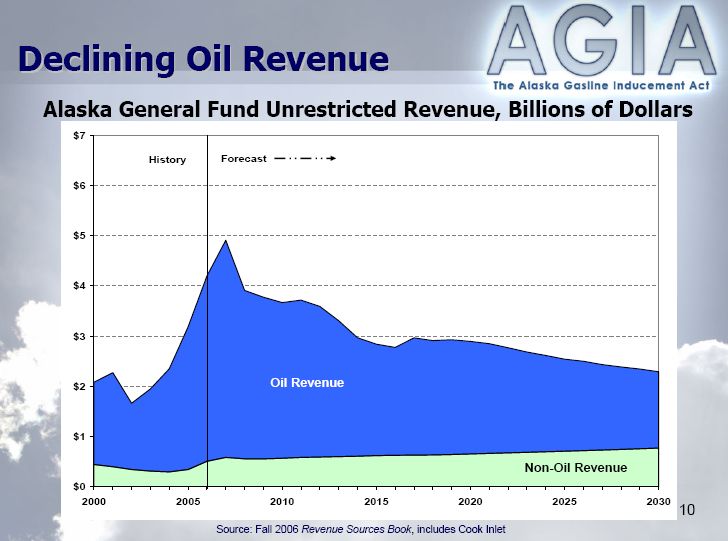
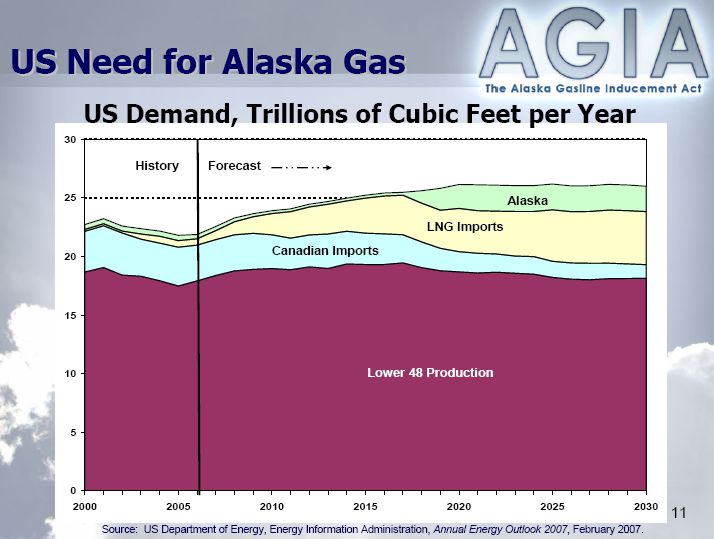
Role of major north slope producers unclear with signing of AGIA
Bill McAllister
KTUU Television
June 9, 2007
ANCHORAGE, Alaska -- The Alaska Gasline Inducement Act is now law. Gov. Sarah Palin signed the potentially historic legislation last night, setting up a competition to build the natural gas pipeline. But as Alaska moves into uncharted territory, the role of major north slope producers remains a big question mark.
The oil industry as a whole has fallen from the lofty perch it once enjoyed in public opinion polls in Alaska. One prominent public official says the recent corruption scandal involving oilfield services company VECO has tainted the producers as well. The producers have said they will not submit a bid under AGIA, but if they change their minds, they can expect to be under a strong spotlight.
"We cannot move the project forward if it is not commercially viable. AGIA, as written, does not provide for a commercially viable project," said Marty Massey, Exxon Mobil.
Before AGIA became law last night, all three of the major north slope producers testified before the Legislature that they would not compete for the rights to build the natural gas pipeline.
No one from BP, Exxon or Conoco Phillips would comment today, but one legislator says he expects them to change their minds.
"I'll be greatly surprised if they do not bid. They know this is an enormously profitable project. This is a project that will take their gas to market. I don't think they're going to stand on the sidelines and let someone else build that pipeline," said Sen. Hollis French, D-Senate Judiciary Chair.
But if the producers do compete, it will be in a climate in which they face new negative feelings and suspicions in the public.
Last month Ivan Moore Research found that public sentiment was barely in favor of the oil industry, with a positive rating of 44.8 percent compared to 43.1 percent negative. That's a drop from a positive of 53.3 percent in July 2005 and 76.4 percent in October 2001. Pollster Moore says that a slight recent drop in the numbers might be the result of the public corruption scandal involving guilty pleas by former executives of oilfield services company VECO.
"Clearly I think you've got the perception out there in the public that there's a degree of complicitness in the whole affair, which is driving down the popularity of the industry as a whole," said Ivan Moore.
A longtime critic of the industry, former legislator Jim Whitaker, who heads up the Alaska Gasline Port Authority, says the suspicion is warranted.
"If you've got a crooked politician, run his fanny down the road. Get rid of him. If they take money from the oil industry, it's tainted money. That money comes with a price tag associated with it. I've seen it. If you took money from the oil industry or from VECO or from contractors who work for the oil industry, it's clear, they expect you to respond to their requests for favorable legislation," said Whitaker.
But Sen. Hollis French, a former prosecutor, says there's no evidence to implicate the producers.
"It's a bit like blaming the Sierra Club for something that Greenpeace did. Obviously BP and Exxon and VECO have the same objectives and the same goals, but without some evidence, without an e-mail, without a document, without a wired phone call to show collusion, I think it's a stretch to say that BP and Exxon are responsible for what VECO did," said French.
The producers have no comment on any of that, either, and now Alaskans will have to wait for their next move.
During the ceremonial signing of AGIA on Wednesday, Fairbanks Rep. Jay Ramras noted the recent statement by the CEO of Exxon that neither the Mackenzie Pipeline in Canada nor the Alaska project is economic. Ramras says that indicates that Alaskans are in for a period of struggle with the producers.
Sen. French added his name to the list of politicians calling on Rep. Vic Kohring to resign.
Kohring himself put out a news release today saying he would announce his decision to the Wasilla Chamber of Commerce on June 19. In the news release Kohring acknowledged the increasing pressure for him to step down, but he said if he does so, it will not be an admission of guilt.
Contact Bill McAllister at
www.ktuu.com
A delicate balance between Slope's gas, oil
When Slope's gas is tapped, its oil must be protected, commissioner warns
By WESLEY LOY
Anchorage Daily News
Published: June 10, 2007
Over the Memorial Day weekend, Cathy Foerster and her husband flew to St. Paul Island, in the middle of the Bering Sea, and saw an abundance of Lapland longspurs, gray-crowned rosy-finches, rock sandpipers and even a great knot blown in from Asia.
"I confess -- Jane Hathaway and I are birders," said Foerster, a Texas-raised oil engineer and a fan of that old TV show "The Beverly Hillbillies."
Lately, Foerster has a bird of a different kind on her mind -- the North Slope oil reserves, or what she calls our "bird in the hand."
Her message is that Alaskans need to take great care not to kill that bird by rushing to produce our "bird in the bush" -- the natural gas that sits in the same fields as the oil.
Foerster, 52, a member of a state agency called the Alaska Oil and Gas Conservation Commission, has been on the speaking circuit lately, talking with considerable urgency to the Legislature, industry groups, even a local Lions Club.
Ignoring for a moment some complex technical details, her message is pretty simple: If we build a multibillion-dollar natural gas pipeline and start shipping gobs of gas, as many Alaskans have so long desired, we risk stranding millions upon millions of barrels of valuable crude oil deep underground. Forever.
And that could cost Alaska dearly.
The good news is Foerster and other experts see ways to avoid this costly tradeoff -- in short, a way to enjoy our bird in the hand and catch the bird in the bush too.
Foerster and her fellow members on the oil and gas commission -- lawyer John Norman and geologist Dan Seamount -- are key state decision-makers in planning for a gas pipeline to the Lower 48.
One of the agency's main jobs is to prevent waste -- that is, it aims to make sure every possible drop of oil and molecule of natural gas are wrenched from the rocks.
Two fields hold the bulk of the North Slope's estimated 35 trillion cubic feet of gas: Prudhoe Bay, the nation's largest oil field, with about 24 trillion cubic feet, and the undeveloped Point Thomson field to the east with perhaps 8 trillion.
At Prudhoe, gas plays a huge role in producing oil -- and that's why state regulators and the oil industry must think carefully before piping away the gas, Foerster said.
UNDER PRESSURE
The geologic structure that holds Prudhoe reserves is built kind of like a layer cake -- a layer of water on the bottom, a layer of oil next, topped by what is called the gas cap.
Over its nearly 30-year history, drillers have pierced those layers with some 2,600 holes. Production wells send a mixture of oil, gas and water to the surface, where they are separated.
Now here's the most important thing, the point Foerster wants you to hear: Most of that gas is shot back down into the ground, where it serves to keep pressure in the oil field and to keep the oil from migrating upward into "dry" rock, where it tends to stick like glue.
The pressurizing gas forces out more oil. It's like the aerosol in the can, Foerster said. The fizz in your soda pop.
To impatient Alaskans, Prudhoe's gas isn't going to market and thus isn't generating tax dollars and worker paychecks. But it's indirectly creating great wealth.
"That gas up there, it's doing all the heavy lifting to get the oil out," Foerster said.
STRANDING AN OIL FORTUNE
With Gov. Sarah Palin courting companies to build a gas line, the oil and gas commissioners are taking steps to determine how much natural gas can be siphoned off without significantly harming oil production.
Prudhoe, which is entering old age, still holds an oil fortune -- an estimated 2 billion barrels. The commission wants to make sure as much of that as possible is produced before significant gas is removed, Foerster said.
The agency recently hired an engineering consultant, Blaskovich Services Inc. of Aptos, Calif., to help study the impact of major gas sales on Prudhoe.
The commission in 1977 set a limit on how much gas producers could withdraw -- 2.7 billion cubic feet per day. The thinking then was that a gas pipeline would be built right away, and nobody expected Prudhoe would still be producing oil today, Foerster said.
Commissioners believe they might have to adjust this limit in light of the significant oil remaining in Prudhoe, the need for gas to help push it out, and the fact that builders want a pipeline capable of carrying as much as 4.3 billion cubic feet a day.
Commissioners have scheduled a June 19 hearing to discuss the consultant's report.
A decision on how much gas can leave Prudhoe is years away. First, the commissioners need to know when a gas pipeline will start operating, what volume of gas it will carry and how much oil is left in the field.
Gordon Pospisil, technology and resource manager for BP Exploration (Alaska) Inc., which runs the Prudhoe field, said he doesn't see a big oil sacrifice coming.
"We're very well-positioned to maximize oil recovery and produce the gas," he said.
AN ACE IN THE HOLE
One major recommendation from consultant Blaskovich is for oil companies to produce as much oil as possible from Prudhoe before a gas pipeline comes online. That's not expected for at least eight years.
The consultant also said it's important to avoid oil field breakdowns, such as last year's corrosion-related pipeline leaks, which can interrupt oil production.
The equation is simple: The more oil that's produced now, the less left stranded once major gas shipment begins.
Pospisil said his company has done many things to juice oil production now. These include drilling more wells to tap the oil, installing bigger compressors to force gas back underground, and flooding the field with billions of gallons of seawater to flush out oil.
An important thing to remember, he said, is that Prudhoe engineers already have achieved "a world-class production level" from the field, recovering 11.5 billion barrels, or about 50 percent of all the oil originally trapped in Prudhoe's porous rocks.
Once gas production begins, field engineers will have a potential ace in the hole -- carbon dioxide, which will be separated from the natural gas coming out of the ground. Engineers believe they can shoot this waste gas underground to force out oil, Pospisil said.
While some tradeoff in oil production is almost certain, Foerster agrees Prudhoe likely will be ready for a gas pipeline, so long as oil is produced steadily before gas line startup.
THE POINT THOMSON PUZZLE
When it comes to Point Thomson, Foerster is worried.
State officials and industry players agree the gas in Point Thomson -- about a quarter of the North Slope total -- is vital to make a pipeline project costing $20 billion or more pencil out.
But the Point Thomson field is different from Prudhoe, and not as well understood. Much technical analysis is needed to determine the effect of producing its gas, Foerster said.
Most people regard Point Thomson as a gas field, but what concerns the oil and gas commissioners is the fate of its sizable reserves of liquid hydrocarbons -- estimated at several hundred million barrels.
"We're talking about an Alpine field or two," said Foerster, referring to Alaska's third-largest oil field.
The question has been complicated by legal wrangling in which the state is trying to revoke leases Exxon Mobil Corp. and other companies hold for failure to develop Point Thomson since its discovery 30 years ago.
Daily News reporter Wesley Loy can be reached at wloy@adn.com or 257-4590.
June 03, 2007
Alcan bid prepared by Norsk Hydro
Takeover battle involving Montreal aluminum producer said to widen
By Robert Daniel
MarketWatch
May 28, 2007
TEL AVIV (MarketWatch) - Norsk Hydro, the Oslo energy, power and metals company, is preparing a more than $30 billion bid for Montreal aluminum producer Alcan Inc., the online edition of Canada's Globe and Mail reported on Monday.
The bid would compete with a $27 billion hostile bid for Alcan disclosed by Alcoa on May 7. And it would heat up and widen an already busy fray surrounding Alcan.
A number of companies have been mentioned as possible suitors for the Montreal aluminum producer.
And analysts have raised the prospect that Alcan could execute what's known as a Pac-Man defense, in which it turns around and bids for Alcoa, its bigger rival.
Alcan has rejected Alcoa's $73.25-a-share cash-and-stock proposal as inadequate and uncertain. The bid price was a 20% premium to Alcan's closing price at the close of the prior trading day.
Alcoa has said it acted after pursuing a friendly merger for two years. And it said on Wednesday that its bid price was "full and fair."
On Friday, Alcan said in a Securities and Exchange Commission filing that management and the board "have not foreclosed any options." Alcan said the board would consider a new Alcoa proposal "that made sense for our shareholders" but "certainly not under the currently proposed terms and price."
Alcan also has said it's in talks with third parties on its alternatives.
Norsk Hydro is owned 43% by the Norwegian government, and it can look for support to the government's $292 billion pension fund, which it built with North Sea oil revenue, the Globe and Mail reported. Norsk Hydro's current aluminum division accounts for 4% of world output of the metal, the paper reported.
Other mining giants, including Australia's BHP Billiton, are considering competing for control of Alcan, the Globe and Mail said. On Monday, shares of Rio Tinto and BHP Billiton were up in Sydney trading amid speculation that the mining groups could be preparing separate bids for Alcan.
The Sydney Morning Herald and the Age reported Monday that Rio Tinto, the world's No. 3 miner by sales, hired Deutsche Bank AG to advise it on a possible takeover bid for Alcan. A Rio Tinto spokesman declined to comment on the issue.
Last week, the Globe and Mail reported that BHP had initiated talks with Alcan. The bid is believed to be still in the early stages, or roughly on par with other companies that have made preliminary expressions of interest in the aluminum giant, the Sydney Morning Herald report said.
In addition to bids by Rio Tinto and BHP Billiton, Australian media reports said other potential suitors for Alcan also include Brazil's Co. Vale do Rio Doce, the U.K.'s Anglo American, of Switzerland and Russia's Rusal. The reports also said Chinese companies and private-equity groups could emerge as potential bidders.
Alcoa and Alcan together would have revenue of more than $54 billion and would easily hold the rank of the world's No. 1 aluminum producer.
End of Story
Robert Daniel is MarketWatch's Middle East bureau chief, based in Tel Aviv.
May 23, 2007
Backlash against a whistle-blower
Andrew Nikiforuk
The Globe and Mail
May 19/07
For years, Dr. John O'Connor has made headlines by continually asking why natives near the oil sands have so much cancer.
But that's not the only reason he's in such hot water now.
FORT CHIPEWYAN, ALTA. - When John O'Connor, a diminutive and soft-spoken Irish-born family physician, began his weekly visits to Fort Chipewyan, a picturesque community on the shores of Lake Athabasca, he never expected that eight years later he would be fighting for his professional life.
Located near Wood Buffalo National Park and once Canada's richest fur-trading post, Fort Chipewyan looks like an idyllic place. But the elders soon started to tell their new doctor stories of deformed fish and bleeding muskrats and how an unusually high number of local people had been "taken with cancer." Dr. O'Connor says he couldn't help but wonder what was happening in the settlement of 1,000 that sits near the mouth of the Athabasca River about 300 kilometres downstream from the largest capital project in the world: the northern Alberta oil sands. In 2005 alone, half the community's 14 deaths were due to various cancers.
"Is it genetics, lifestyle, the environment or just bad luck?" he recalls asking himself. "What's going on? Where could the origin be?" He had practised medicine in Fort McMurray, at the heart of the oil sands, since 1993, and had never seen such problems in the city. "I can't explain it." Since then, his concern for the health of his native patients has led to many sleepless nights as well as an open battle with the Alberta government over the lack of medical resources in the service-challenged Northern Lights Health Region, where 14 family doctors care for 80,000 people. Now, he finds himself the subject of an unusual investigation by the College of Physicians and Surgeons of Alberta that could compromise his future. A ruling could come down at any moment, and he feels that he's in such dire straits that he has decided to pack up and leave the province altogether.
The hunters, trappers, fishermen and oil-sand workers of "Fort Chip" seem flummoxed by what's happening to their doctor, who works 80 hours a week, but his colleagues feel the case is politically motivated. "This is not about shutting up John; this is about shutting him down," charges Dr. Michel Sauve, a respected Fort McMurray internist.
"There should be whistle-blowing protection for doctors." And that seems to be the root of the problem. As well as asking pointed questions about cancer causes, Dr. O'Connor, the region's chief of family medicine, has spent much of the past few years criticizing the shortage of medical resources as well as the carnage on the road to Fort McMurray, a stretch so deadly it has become known as Hell's Highway.
Yet he didn't start to speak up in earnest about his patients in Fort Chip until 2004, when he diagnosed a middle-aged patient with a very rare bile-duct cancer known as cholangiocarcinoma. He knew it well because his father had died of the same disease in Ireland. "It's vicious and fast." It's also strongly associated with chemical pollution, including arsenic and polycyclic aromatic hydrocarbons or PAHs, a group of carcinogens discharged by oil-sand mining, which now produces a million barrels of oil a day - half the nation's gasoline supply - and gives Ottawa more than $6-billion a year in taxes.
Normally, this form of cancer occurs in one in 100,000 people.
So, when Dr. O'Connor found another case the following year, as well as clusters of immune-system disorders, in a community of just 1,000 people, he called for an independent study. "Am I seeing a problem, or am I not?" he asked officials.
He wasn't the first to ask for a study. The fact that uranium mines, now abandoned, pulp mills and the oil sands have flushed chemicals into Lake Athabasca for decades prompted scientists to seek a survey of health in the region in 1999. Three years later, two Fort McMurray doctors asked again for a comprehensive health study on behalf of several first nations.
Finally, in 2004, Alberta's oil regulator, the Energy and Utility Board, recommended a study. But Alberta Health and Health Canada started working on one only after a CBC reporter asked Dr. O'Connor early last year why there were so many cases of cancer in Fort Chip.
The story made The National , and five months later the agencies released a statistical analysis, albeit one that had not undergone a peer review, which kept it from being deemed first-rate research.
The report found that, from 1995 to 2005, the community's cancer rates "were comparable to the provincial average," although officials agreed the incidence of bile-duct cancers -- by this point, five cases in the North Lights alone -- was "provocative." Dr. O'Connor challenged the thoroughness of the analysis while people in Fort Chipewyan expressed deep skepticism. In response, Alberta Health accused him of having withheld cancer reports. "Either there is no evidence, or he has decided to ignore the law," charged provincial spokesman Howard May.
Expressing disbelief at the charge, Dr. O'Connor said: "I haven't received any requests for information. I don't know what they are talking about." In an independent analysis, well-known Alberta ecologist and statistician Kevin Timoney also found the provincial study to be deeply flawed.
"It's difficult to find a significant result in a small sample size," he explained. Because missing just one case would skew the results, "statistics offer a blunt tool for detection of elevated cancer rates" in such a small community.
Mr. Timoney also found widespread evidence of chemical contamination in the Athabasca River. According to data collected by a government and industry group known as the Regional Aquatics Monitoring Program (RAMP), the levels of PAHs in the river's sediment now resemble those found at highly contaminated sites in the United States.
A RAMP report last year also found that 7.4 per cent of fish from the river had growth abnormalities. "That's high," says Mr. Timoney, who is now conducting an extensive water-quality study for the community's local health board.
Frustrated by government unwillingness to conduct a proper health study, Dr. O'Connor announced in December that he plans to leave Fort McMurray this summer and move to Nova Scotia. Then he caused an even bigger sensation by writing in an emotional letter to Halifax's Chronicle Herald newspaper that life in Fort McMurray is "intolerable." He also warned Atlantic Canada workers not to expect to come west and find a family doctor or affordable housing when they get here.
"The quality of life," he said, "is extremely low." Because of the letter, Dr. O'Connor admits, "a lot of people in administration thought I was the worst thing that had happened to the town." After all, the provincial government was in the middle of a campaign to recruit more health-care workers to a region that it says has "the most severe" gaps in care.
Within weeks, three employees of Health Canada, one from Alberta Health and another from Environment Canada had filed a complaint against Dr. O'Connor with the College of Physicians and Surgeons.
According to one source, the bureaucrats have accused him of "irresponsible actions" and "raising undue alarm among the public." His concerns about contamination, they said, have left the people of Fort Chipewyan "fearful of the places they live in and their traditional foods." Asked why government employees would take such a drastic step, a Health Canada spokesperson stated via an e-mail simply that health professionals of all sorts are obliged to report on "professional practice issues." However, the timing of the complaint has led Dr. Sauve and other local doctors and nurses to conclude that the federal and provincial governments wanted to silence an outspoken critic of the area's industrial growth. The college normally reviews complaints made by patients, Dr. Sauve explains, and shouldn't be used as "a state tool for censoring doctors." The "fearful" people of Fort Chipewyan, meanwhile, contend that they have voiced concerns about cancer rates and water pollution for years. When the wind is right, they can smell the oil-sands plants, and now carry filtered water into the bush when hunting.
Margaret Simpson, a 60-year-old Dene and Catholic lay priest, says that in 2005 she often buried two people a week. "What is happening here? It drove me nuts," she says, describing Dr. O'Connor as her friend as well as her physician.
"It's not fair what's happening to him. Maybe they are trying to keep him quiet about something they don't want known." Raymond Ladouceur, a 65-year-old commercial fisherman who says he routinely pulls deformed fish from the lake, echoes her sentiment.
"These guys who accuse him of agitating the community should apologize.
Let O'Connor do his job. He is concerned about life and we support him. The whole community does." Five years ago, Mr. Ladouceur says, he sent 200 pounds of pickerel riddled with tumours, bulging eyes, crooked tails and pushed-in faces to Fort McMurray for testing he hoped would determine what has been going wrong.
But provincial officials didn't pick up the fish, he says, and they were left to rot in a truck.
Andrew Nikiforuk is an award-winning Calgary journalist. Next month, he will be among the speakers at an Alberta Environmental Network conference on water in the Athabasca Basin, as will Dr. John O'Connor.
May 21, 2007
A cowboy with a cause
Rancher riding along the highway to Victoria to raise awareness of student health concerns
By Sage Birchwater
Tribune Staff Writer
May 17 2007
 Sage Birchwater photo
Tony White, horse Suzie-Q and dog Doug at the side of Highway 97
on the way to Victoria, just south of McLeese Lake. White should
arrive in Williams Lake today.
Butte Creek cowboy Tony White, is no stranger to travelling long distances by horseback. A few years ago he rode his palomino Suzie-Q, up to Butte Creek in the Fort St. John area from Camrose, Alberta to do a little cowboying. Now he’s riding south 863 kilometres from Prince George to Victoria, to raise some issues with the provincial government.
“It’s for the kids,” White says. “The oil and gas industry and the provincial government are getting too greedy. They’re endangering the health and safety of the students in Fort St. John elementary schools.”
The problem, he says, is gas flare and pipeline emissions letting poisonous gases into the environment that is affecting the youth.
“The kids are sick all the time. The North Pine School had to be evacuated four times and the Butte Creek School twice.”
He says that’s not right.
“The main compressor for the Alaskan Pipeline is old and is only half a kilometre behind the Butte Creek School.”
He says he talked to the Oil and Gas Commission that regulates the companies.
“They told us there was nothing they could do about it. They told us the government had given the companies a grandfather clause to pollute.”
He says the attitude from the MLAs and oil companies is that nobody is going to do anything about it, and nobody cares.
“So I’m taking it upon myself to be a voice for the kids.”
White insists he’s not a tree hugger.
“I’m a rancher and a cowboy who depends on technology. I feed 1,500 animals. They’ve got clean-burning systems out there, but they don’t have to use them.”
White says last year the oil patch didn’t shut down during a critical migration of the caribou and it wiped out 18,000 animals.
“Our newest generation coming up has nothing to look forward to unless some serious changes are made. I’m going down to Victoria as a voice for them.”
White, the father of a nine-year-old daughter, says other parents share his concerns.
“We have to work together. I’m going to our elders with the voices of the children. We can’t fix it. All we can do is prevent it from getting worse.”
Up north he says he lost three friends to cancer in the past two years.
“We’re not trying to shut down the industry, we just want the government to take action.”
The Tribune found White, Suzie-Q and his Australian shepherd dog Doug, resting in a little meadow beside Highway 97, south of McLeese Lake on Tuesday. He says he plans to stay on the main highway to draw attention to his cause.
“Everybody I’ve talked to agrees what I’m doing needs to be done.”
He says he’s done his homework and knows the technology is out there that can make a difference.
“The car companies can shut down your vehicle from space if you don’t make your payments. So why can’t the oil companies clean up their act.”
White and his horse and dog will likely reach Williams Lake today.
He plans to arrive in Victoria by mid-June.
“Hopefully the MLAs will still be in session.”
White says he’s making the journey on his own hook and any donations of grain for his horse along the way would be appreciated. He travels 20 to 25 kilometres a day and stops and camps in grassy areas over night.
© Copyright 2007 Williams Lake Tribune
Hydroelectric power's dirty secret revealed
Duncan Graham-Row
New Scientist
24 February 2005
Contrary to popular belief, hydroelectric power can seriously damage the climate. Proposed changes to the way countries' climate budgets are calculated aim to take greenhouse gas emissions from hydropower reservoirs into account, but some experts worry that they will not go far enough.
The green image of hydro power as a benign alternative to fossil fuels is false, says Éric Duchemin, a consultant for the Intergovernmental Panel on Climate Change (IPCC). "Everyone thinks hydro is very clean, but this is not the case," he says.
Hydroelectric dams produce significant amounts of carbon dioxide and methane, and in some cases produce more of these greenhouse gases than power plants running on fossil fuels. Carbon emissions vary from dam to dam, says Philip Fearnside from Brazil's National Institute for Research in the Amazon in Manaus. "But we do know that there are enough emissions to worry about."
In a study to be published in Mitigation and Adaptation Strategies for Global Change, Fearnside estimates that in 1990 the greenhouse effect of emissions from the Curuá-Una dam in Pará, Brazil, was more than three-and-a-half times what would have been produced by generating the same amount of electricity from oil.
This is because large amounts of carbon tied up in trees and other plants are released when the reservoir is initially flooded and the plants rot. Then after this first pulse of decay, plant matter settling on the reservoir's bottom decomposes without oxygen, resulting in a build-up of dissolved methane. This is released into the atmosphere when water passes through the dam's turbines.
"Drawdown" regions Seasonal changes in water depth mean there is a continuous supply of decaying material. In the dry season plants colonise the banks of the reservoir only to be engulfed when the water level rises. For shallow-shelving reservoirs these "drawdown" regions can account for several thousand square kilometres.
In effect man-made reservoirs convert carbon dioxide in the atmosphere into methane. This is significant because methane's effect on global warming is 21 times stronger than carbon dioxide's.
Claiming that hydro projects are net producers of greenhouse gases is not new (New Scientist print edition, 3 June 2000) but the issue now appears to be climbing up the political agenda. In the next round of IPCC discussions in 2006, the proposed National Greenhouse Gas Inventory Programme, which calculates each country's carbon budget, will include emissions from artificially flooded regions.
But these guidelines will only take account of the first 10 years of a dam's operation and only include surface emissions. Methane production will go unchecked because climate scientists cannot agree on how significant this is; it will also vary between dams. But if Fearnside gets his way these full emissions would be included.
With the proposed IPCC guidelines, tropical countries that rely heavily on hydroelectricity, such as Brazil, could see their national greenhouse emissions inventories increased by as much as 7% (see map). Colder countries are less affected, he says, because cold conditions will be less favourable for producing greenhouse gases.
Despite a decade of research documenting the carbon emissions from man-made reservoirs, hydroelectric power still has an undeserved reputation for mitigating global warming. "I think it is important these emissions are counted," says Fearnside.
Warming up to nuclear power
Kate Riley
Seattle Times
20 May 2007
Craig Pridemore was a University of Washington student when he started his career influencing public policy. He and his friends made a road trip to Richland in the early 1980s to protest planned construction of five nuclear-power plants.
Now, the Vancouver state senator, who remains an environmentalist and successfully sponsored legislation this session to curb greenhouse-gas emissions, reluctantly concedes nuclear power might need to play a role in the monumental task of reducing greenhouse-gas emissions in the United States - he said so in testimony before a state House committee.
He's not the only one. U.S. Rep. Jay Inslee, D-Bainbridge Island, who has been driving a Prius and talking about global climate change since before it was fashionable, also agrees that nuclear power might need to be part of the solution to curb greenhouse-gas emissions while managing new demand.
"Global warming is such a titanic challenge, all of us have to check our prejudices at the door," said Inslee. He has just finished a book, "Apollo's Fire: Igniting America's Clean Energy Revolution," that will be published by Island Press this fall.
Neither Pridemore nor Inslee is enthusiastic about the prospect of an expansion of nuclear power - which accounts for about 20 percent of U.S. electricity - because it has other problems. Though nuclear plants don't emit greenhouse gases, disposal of the radioactive waste stream is a challenge.
But the challenge of climate change is so daunting that it is already causing major policy reprioritization, whether federal, state or household. Gov. Chris Gregoire recently set ambitious goals, starting with reducing the state's greenhouse-gas emissions to 1990 levels within 13 years. A high-powered stakeholders group, including utility representatives, industry executives and environmentalists, has begun meeting to figure out how the state will get there.
So far, the governor has taken a cautiously open-minded tack on a Tri-City Industrial Development Council (TRIDEC) proposal that, if successful, could expand nuclear activities in the state.
The community in southeastern Washington is among 13 candidates for the Department of Energy's Global Nuclear Energy Partnership program. TRIDEC, along with other community organizations, including the operator of the state's lone nuclear-power reactor in Richland, has proposed the community be part of a program to reprocess spent commercial nuclear fuel and recycle it, and also be the site of a new research reactor. Sens. Patty Murray and Maria Cantwell also are in a wait-and-see mode.
Such open-mindedness about nuclear power borders on heresy among many environmental organizations, especially in the Northwest, which has plenty of negative nuclear baggage.
First, there was the notoriety of the Washington Public Power Supply System default on $2.25 billion in bonds in 1983. Hugely overestimated need for power and the large capital cost of five planned nuclear-power reactors contributed to the breathtaking default - a record for any public agency at the time. Though Washington state was not involved in the project, its bond rating fell by association. Only one reactor was completed - in Richland - and is still operated by the agency, since renamed Energy Northwest.
Second, there is the wince-evoking legacy of five decades worth of nuclear defense production - and inept disposal of waste - at the Hanford Nuclear Reservation on the elbow of the Columbia River. The last defense-production reactor was shut down in 1989, but the costly cleanup is expected to take decades.
Then there is the muscle of the Northwest environmental community, which has tended to use both the former and the latter episodes to argue against anything nuclear.
"Political feeling may be more raw in the Northwest because of the failure to build those four nuclear plants," says Rudi Bertschi, who also actively opposed nuclear construction in the early 1980s. He later served as chairman of the Energy Northwest board and helped play a role in the agency's turnaround. "That was very traumatic for a lot of people."
An economist and energy consultant, Bertschi says he's "agnostic" about whether new nuclear plants should be built, saying it will depend on the costs government associates with carbon emissions. "A carbon tax would definitely change the economic formula," he said.
Nuclear technology fell so out of favor locally, the University of Washington terminated its nuclear-engineering department in 1992 for lack of student interest.
But now the conversation is changing. Environmentalists acknowledging nuclear might have a role in combating climate change are becoming, if not common, much less rare.
Greenpeace founder Patrick Moore has been the most vocal. The organization was founded to oppose nuclear weapons and warfare.
"... I think we made the mistake early on of lumping the peaceful use of nuclear in with the war-like use of nuclear," Moore said in a recent interview with E&ETV. "And I've come to realize that it doesn't make sense to ban the beneficial use of technology just because that technology can be used for evil."
Greenpeace remains fervently anti-nuclear, promoting instead an expansion of renewable energy and energy conservation. From its Web page: "Greenpeace has always fought - and will continue to fight - vigorously against nuclear power because it is an unacceptable risk to the environment and to humanity. The only solution is to halt the expansion of all nuclear power, and for the shutdown of existing plants."
Moore and former Environmental Protection Agency chief Christine Todd Whitman are co-chairs of the Clean and Safe Energy Coalition, which supports nuclear as a clean-emissions energy source. Although some environmentalists denounce Moore, others with respectable environmental credentials are joining him in pushing nuclear to be considered as part of the solution. Among them are James Lovelock, creator of the Gaia hypothesis, which suggests Earth is a superorganism, and a member of Environmentalists for Nuclear Power; and Jared Diamond, Pulitzer Prize-winning author of "Guns, Germs and Steel."
Worldwide, more countries are embracing nuclear. France gets 78 percent of its power from nuclear - and never has had an accident; all of Europe gets about 32 percent.
The United Nation's Intergovernmental Panel on Climate Change, in its fourth assessment report released May 4, included nuclear as a potential part of reducing greenhouse-gas emissions. Last month, finance ministers from the Group of Seven industrialized countries, including Britain, Japan, Canada, France, Germany, Italy and the United States, announced their support for nuclear power as a partial solution to global warming and easing dependence on fossil fuels. Also in April, the United States and Japan signed an agreement to conduct joint research on nuclear power, which includes the Global Nuclear Energy Partnership (GNEP) proposal.
The one serious U.S. nuclear accident, at Three Mile Island in 1979 (causing no injuries or death), triggered a safety revolution that led in 2006 to a median plant safety record of only 0.12 industrial accidents per 200,000 worker-hours, a record low, according to the Nuclear Energy Institute.
Back in the Northwest, it will be interesting to see how this debate plays out, especially given the crunch between energy demand growing with population and the legal challenges to the Northwest's electricity mainstay - hydropower.
About 60 percent of Washington's energy comes from the 31-dam federal hydro system, but four dams on the lower Snake River in southeastern Washington are under the jurisdiction of a federal judge. Environmentalists have prevailed in federal courts to press U.S. agencies to do more to restore endangered salmon runs affected by the Snake dams. Federal District Court Judge James Redden has said if the agencies don't satisfy his concerns, he might order the dams breached. Together, the four represent about 1,000 megawatts of power - enough to keep the lights on in Seattle.
The same organizations that support dam breaching, including the Northwest Energy Coalition, successfully proposed Initiative 937, which requires most utilities to have at least 15 percent of their energy portfolio be produced by non-hydro renewable sources, such as wind and solar power. Also backed passionately by Inslee, the new law encourages energy conservation to lessen the need for new polluting power sources, which will help buy some time.
But many in the Northwest are skeptical of the changes going forward. Hydropower, which is created by letting water run through turbines, is particularly suited to "shape" - or balance - the ups and downs of wind power. The wind doesn't always blow, after all.
That will mean, eventually, power plants with more-controllable energy production will be needed to fill in the power need when the wind doesn't blow. And given passage of Sen. Pridemore's bill that essentially eliminates the possibility of any new coal plants, that means new natural gas plants or something that burns cleaner - like, possibly, nuclear power.
Nuclear power has some major drawbacks. It is expensive and what to do with the waste stream remains an open, politically charged question. Energy Northwest, like other commercial reactor operators across the nation, has years worth of spent nuclear fuel intended for permanent disposal at the U.S. Department of Energy Yucca Mountain Repository that is years past opening. U.S. Sen. Harry Reid, D-Nev., intends to kill the repository in his state and, with his clout as Senate majority leader, just might be successful.
Bush's Global Nuclear Energy Partnership proposal would reverse a more than 30-year-old U.S. policy decision and begin recycling spent nuclear fuels with "proliferation-resistant" technologies. The plan could entail spent nuclear fuel being shipped to Hanford from sites around the country for reprocessing and recycling, as well as a new power reactor.
At a public Energy Department siting hearing in Pasco in March, there was a lot of activist muscle memory in the room that drew more than 300 people. Many of the old guard in the community of Cold Warriors argued they had the expertise to help the nation reduce existing waste through the recycling mission and advance a new generation of safe nuclear power. Anti-nuclear activists, including Heart of America Northwest, raised the specter of Energy Department's indisputably atrocious record of defense-waste disposal from years ago. Clean up the mess before you add more, they argue.
There is some truth and reason on both sides. But GNEP might not even survive the next presidential election.
Inslee, who says he hasn't yet studied GNEP enough to have a position, has an important message for everyone, including polluters and environmentalists like himself: "We are all going to have to get rid of our knee jerks."
This is a shrewder world where climate change is a reality and humans are considering how to minimize their role in it. The solutions need to be more carefully pragmatic and less reflexively ideological.
http://seattletimes.nwsource.com/text/2003713025_sundayriley200.html
May 18, 2007
Do we want Pipeline Canada?
By Terence Corcoran
National Post
18-May-2007
The Mackenzie Valley gas pipeline, for decades a glimmering mirage on the horizon of Canada's northern economic future, may soon become the nightmare of Canadian energy policy.
Having just sold off Petro- Canada, ending that particularly disastrous episode in national energy history, the Harper Conservatives are floating the idea of taking control of a new national project, Pipeline-Canada. As a Crown corporation, Pipeline- Canada would contract out construction of the $16.2-billion project to Trans-Canada Pipeline.
If this were to happen, rest assured that it would not really be an energy policy. It would be, above all, a native buy-off policy, a job-creation policy, a make-work program and a political strategy to secure votes and seats in Parliament.
But as an energy policy, the benefits are far from obvious. A government-funded pipeline megaproject would do nothing to help establish Canada as an "Energy Superpower." But it could set Canada up as an Energy Superloser. With a $16-billion construction cost, the latest estimate, it poses a monumental risk to the government.
Even if work started today, completion wouldn't happen until 2014 at the earliest, and by then the gas might not be needed in the United States, the primary market.
Gas is a major potential source of electric power, and 10 or 15 years from now Mackenzie gas is unlikely to have any advantages. By 2014 and after, other sources of energy are expected to be on the market, driving the price of gas down and rendering Pipeline- Canada uneconomic. Liquified natural gas (LNG) could be landing in massive quantities in the United States, coal gasification is under intense development, as is another coal technology, thermo-energy coal burning. And who knows what chaos climate regulation will bring?
If the private sector doesn't want to bear the risk, as it clearly doesn't, why should the government? Jim Prentice, the Minister of Indian Affairs, is playing a key role in the pipeline rescue, and northern jobs and native issues are said to be the main driving force behind the mounting pressure on Ottawa to rescue the pipeline from reluctant oil companies.
It would be a sad day for Canada if Ottawa were doing this to buy off native groups that have long stood in the way of the pipeline. One hopes, as well, that Mr. Prentice is not responding to First Nation leaders who are threatening economic disorder and a National Day of Action if aboriginal discontents and land claims are not soon on track for settlement.
Caving into blackmail is hardly the road to civil peace. It could also involve turning over Mackenzie gas royalties to local aboriginal groups.
If Pipeline-Canada were to build the Mackenzie line, it implies a fat settlement as Ottawa then assigns cash flow from gas sales to aboriginal groups. That removes some of Ottawa's native support costs and transfers the burden to the oil industry and gas consumers.
Also likely to play a public role in any Ottawa rationale will be northern economic development. Back when he was in opposition and hounding the Liberals to get the Mackenzie pipeline built, Mr. Prentice liked to talk up and circulate studies showing the major benefits that would flow from its construction.
Numbers reached the sky: $52-billion in total revenue, $57- billion in new GDP, 157,000 person years in direct and indirect jobs, and up to 400,000 in additional person years of employment.
That was when the cost of the pipeline was estimated at only $7-billion. At $16.2-billion, all those numbers can be blown up to double the original estimates. The more Ottawa sinks into a pipeline, whatever its merits as an investment, the bigger it can make the benefits look on paper.
All such calculations, however, are economic fabrications designed to generate political support. They are no reason to spend the money if the project itself is too much of a risk and a potential economic disaster.
Spending $16.2-billion would certainly set the Tories up for comparison with the Liberals. Former Calgary Liberal MP and deputy prime minister Anne Mc- Lellan still boasts on her Web site that the Liberals had "committed nearly $800-million to facilitate construction of the [Mackenzie] project by private sector sources."
If Ottawa does take up control and funding of the Mackenzie Valley project, Mr. Prentice, if he dares, will be able to claim that the Conservatives out-spent the Liberals by 20 times -- adding another winning claim to the growing Conservative list of Liberal firsts, and dragging the Tories into another dangerous national energy program.
May 15, 2007
Russia to Build Underwater Tunnel to Alaska
COMMENT: No, it's not April 1 and apparently this is, if not real, at least not an intentional joke. And some think SeaBreeze is ambitious!
Russia to Build Underwater Tunnel to Alaska
MOSNEWS.com, 19-Apr-2007
Russia-Alaska link: A Bering Strait tunnel
Sabra Ayres, Anchorage Daily News, 21-Apr-2007
Tunnel dream: Undersea project would link Alaska, Russia
CNN.com, 25-Apr-2007
Russia to Build Underwater Tunnel to Alaska
MOSNEWS.com
Created: 19.04.2007 11:59 MSK (GMT +3)

Official from the Russian Economy Ministry told reporters on Wednesday, April 18, that Russia plans to build the world’s longest tunnel, a transport and pipeline link under the Bering Strait to Alaska, as part of a $65 billion project to supply the U.S. with oil, natural gas and electricity from Siberia.
The project, which Russia is coordinating with the U.S. and Canada, would take 10 to 15 years to complete, Viktor Razbegin, deputy head of industrial research at the Russian Economy Ministry, said. State organizations and private companies in partnership would build and control the route, known as TKM-World Link, he added.
A 6,000-kilometer (3,700-mile) transport corridor from Siberia into the U.S. will feed into the tunnel, which at 64 miles will be more than twice as long as the underwater section of the Channel Tunnel between the U.K. and France, according to the plan. The tunnel would run in three sections to link the two islands in the Bering Strait between Russia and the U.S.
“This will be a business project, not a political one,” Maxim Bystrov, deputy head of Russia’s agency for special economic zones, was quoted by Bloomberg as telling a media briefing. Russian officials will formally present the plan to the U.S. and Canadian governments next week, Razbegin said.
The Bering Strait tunnel will cost $10 billion to $12 billion, and the rest of the investment will be spent on the entire transport corridor, the plan estimates.
“The project is a monster,” Yevgeny Nadorshin, chief economist with Trust Investment Bank in Moscow, said in an interview with Bloomberg. “The Chinese are crying out for our commodities and willing to finance the transport links, and we’re sending oil to Alaska.”
The planned undersea tunnel would contain a high-speed railway, highway and pipelines, as well as power and fiber-optic cables, according to TKM-World Link. Investors in the so-called public-private partnership include Russian Railways, national power utility Unified Energy System and state-controlled pipeline operator Transneft. This information was contained in the press release which was handed out at the media briefing and bore the companies’ logos.
Russia and the U.S. may each eventually take 25 percent stakes, with private investors and international finance agencies as other shareholders, Razbegin said. “The governments will act as guarantors for private money,” he said.
The World Link will save North America and Far East Russia $20 billion a year on electricity costs, said Vasily Zubakin, deputy chief executive officer of HydroOGK, Unified Energy’s hydropower unit and a potential investor.
“It’s cheaper to transport electricity east, and with our unique tidal resources, the potential is real,” Zubakin said. By 2020 HydroOGK plans to build the Tugurskaya and Pendzhinskaya tidal plants, each with capacity of as much as 10 gigawatts, in the Okhotsk Sea, close to Sakhalin Island.
The project envisions building high-voltage power lines with a capacity of up to 15 gigawatts to supply the new rail links and also export to North America.
Russian Railways is working on the rail route from Pravaya Lena, south of Yakutsk in the Sakha republic, to Uelen on the Bering Strait, a 3,500 kilometer stretch.
The link could carry commodities from Eastern Siberia and Sakha to North American export markets, said Artur Alexeyev, Sakha’s vice president.
The two regions hold most of Russia’s metal and mineral reserves “and yet only 1.5 percent of it is developed due to lack of infrastructure and tough conditions”, Alexeyev said.
Japan, China and Korea have expressed interest in the project, with Japanese companies offering to burrow the tunnel under the Bering Strait for $60 million a kilometer, half the price set down in the project, Razbegin said.
“This will certainly help to develop Siberia and the Far East, but better port infrastructure would do that too and not cost $65 billion,” Trust’s Nadorshin said. “For all we know, the U.S. doesn’t want to make Alaska a transport hub.”
The figures for the project come from a preliminary feasibility study. A full study could be funded from Russia’s investment fund, set aside for large infrastructure projects, Bystrov said.
http://mosnews.com/money/2007/04/19/alaskatunnel.shtml
Russia-Alaska link: A Bering Strait tunnel
By SABRA AYRES
Anchorage Daily News
Published: April 21, 2007
JUNEAU -- A proposal for another big construction project is gathering headlines across the world.
No, we're not talking about a $30 billion pipeline to send natural gas to the Lower 48.
This is bigger:
A $10 billion to $12 billion tunnel under the Bering Strait linking Alaska and Russia. And another $50 billion to lay railways to make the tunnel usable.

The proponents of the 64-mile tunnel are not working off an original idea.
Over the past 150 years, at least one Russian czar and several American entrepreneurs have devised plans for linking the continents.
The latest Russian concept is a tunnel tying Russia's Chukotka to Alaska's Cape Prince of Wales as part of a hoped-for continuous railway from London to New York. More than 6,000 miles of new rail lines -- about half laid in Siberia and the remainder in Alaska and Canada -- would connect the railheads on both sides. Siberian oil, gas, hydroelectric power and fiber optic cable could be exported through pipes built beside the high-speed rail service, they said.
But something is different about this current proposal, backers of the plan say, and it's not just modern technology.
Some say it's the tolerant nod of approval the Russian government has given to hosting a conference next week on the tunnel project.
Others say it's the momentum the idea has gained from media attention this week.
Maybe it's just timing: Russia's economy is booming, thanks to high world oil prices that have poured billions into the Russia treasury after 15 years of a difficult, post-Soviet transition.
In Alaska, a new governor promising to get the state a profitable natural gas pipeline has spurred some to think about fresh starts.
But it could just be kindred spirits finding common ground on dreaming big. Russia, the largest country in the world, once tried to reverse river flows to better irrigate crops.
Alaskans have seen their fair share of mega projects, too, including the trans-Alaska oil pipeline.
Former Gov. Wally Hickel has long been a champion of big, transforming projects.
Hickel is one of the Bering Strait tunnel project's most serious supporters. He said he plans to attend the conference next week in Moscow to watch a plan he has been behind for some 25 years finally find the support it deserves.
"You know how to build a gas line? Just build it," Hickel said. "Big projects are what civilizations need. Just to let the world know you can do it."
The tunnel idea resurfaced last week when a long-time advocate of the project, Viktor Razbegin, a deputy at the Ministry of Economic Development and Trade, announced the Moscow conference and invited several American and Canadian enthusiasts.
Razbegin, Hickel and members of the aptly named Interhemispheric Bering Strait Tunnel & Railroad Group have been coordinating on the project since the late 1990s.
Enthusiasm aside, the current idea, like those in the past, is meeting skepticism.
Experts have said construction in the icy Bering Strait is possible, but finding funding will be difficult.
The Russians will need to complete a huge amount of rail lines to reach the remote Chukotka region, currently only accessible by plane or boat.
"I don't mean to diminish this, but a connection to Russia through Alaska any time soon is probably no more valid than the idea that we are going to send a manned mission to Mars," said Bruce Carr, the Alaska Railroad's strategic planning director.
The state-owned Alaska Railroad has been studying the possibility of connecting to Canada's rails for more than 60 years, Carr added.
The U.S. government has shown little interest in the project.
"It would be safe to say that no one here has ever heard of this thing," said Janelle Hironimus, a spokeswoman for the State Department.
Several of Russia's deputy ministers are scheduled to attend the conference, but Kremlin officials, including President Vladimir Putin, have been reluctant to throw their full weight behind it.
Still, the Russian side of the project has put on a remarkable un-Russian PR campaign ahead of the conference, said Joe Henri, an Anchorage developer and a member of the Interhemispheric Bering Strait Tunnel group
Russian organizers said the tunnel would help develop the remote Far East, where there are untapped stores of natural resources.
The state-owned electricity, railway and energy pipeline companies are listed as conference sponsors.
By late this week, stories from London to Ottawa popped up in the media and on the Internet.
Bloggers began having a field day. "Bering Strait Tunnel Project: OMG! Ultimate Road Trip!" one headlined.
Henri said the interest is a big change for a plan that has been called crazy.
But will attention and the Moscow conference move the project along?
"Biggest thing now is to form a corporation, get some Russian money, sell some stock and raise money for a feasibility study," he said.
Daily News reporter Sabra Ayres can be reached at sayres@adn.com or 1-907-586-1531.
Tunnel dream: Undersea project would link Alaska, Russia
CNN.com
April 25, 2007
Story Highlights
• $65 billion project would go under Bering Strait
• Proposed tunnel would be 68 miles long, in waters up to 180 feet deep
• Chunnel, linking Britain and France is only 30 miles long
• Project would take 20 years to build
MOSCOW, Russia (AP) -- For more than a century, entrepreneurs and engineers have dreamed of building a tunnel connecting the eastern and western hemispheres under the Bering Strait -- only to be brought up short by war, revolution and politics.
Now die-hard supporters are renewing their push for the audacious plan -- a $65 billion highway project that would link two of the world's most inhospitable regions by burrowing under a stretch of water connecting the Pacific with the Arctic Ocean.
Russians and Americans alike made their pitch for the project at a conference titled "Megaprojects of Russia's East," held Tuesday in Moscow.
"It's time to the rewrite the old slogan 'Workers of the world unite!"' said Walter Hickel, a former Alaska governor and interior secretary under President Richard Nixon. "It's time to proclaim, 'Workers -- Unite the world!"'
A Russian Economics Ministry official tossed cold water on the idea, saying he wanted to know who planned to pay the mammoth bill for the project before seriously discussing it. But Hickel was unfazed in his speech, saying the route would unlock hitherto untapped natural resources -- and bolster the economies of both Alaska and Russia's Far East.
The proposed 68-mile tunnel would be the longest in the world. It would also be the linchpin for a 3,700-mile railroad line stretching from Yakutsk -- the capital of a gold- and mineral-rich Siberian region roughly the size of India -- through extreme northeastern Russia, in waters up to 180 feet deep and into the western coast of Alaska. Winter temperatures there routinely hit minus 94 F.

A group of Russians and Americans pitched a $65 billion project Tuesday that would link their two countries by a highway under the Bering Strait, the stretch of water that connects the Arctic and Pacific oceans. The tunnel would start at approximately Wales, Alaska, and connect to approximately Uelen, Russia, according to the Interhemispheric Bering Strait Tunnel & Railroad Group.
By comparison, the undersea tunnel that is now the world's longest -- the Chunnel, linking Britain and France -- is only 30 miles long.
That raises the prospect of some tantalizingly exotic routes -- train riders could catch the London-Moscow-Washington express, conference organizers suggested.
Lobbyists claimed the project is guaranteed to turn a profit after 30 years. As crews construct the road and rail link, they said, the workers would also build oil and gas pipelines and lay electricity and fiber-optic cables. Trains would whisk cargos at up to 60 mph 260 feet beneath the seabed.
Eventually, 3 percent of the world's cargo could move along the route, organizers hope.
Private investment called for
Maxim Bystrov, deputy head of the federal agency for managing Special Economic Zones, injected a note of sobriety to the heady talk of linking East and West by road and rail. He said his ministry would invest in the project only when private investors said they were committed to building it.
"As a ministry employee I am used to working with figures and used to working with projects that have an economic and financial base," Bystrov said. "The word 'prozhekt' has a negative meaning in Russian. I want this 'prozhekt' to turn into a 'project."'
The idea has a long history. Russia's last czar, Nicholas II, twice approved the implementation of a similar plan, perhaps eying the gold- and oil-rich territory that the Russian Imperial government had sold to the United States just before the turn of the 20th century.
The First World War and the Bolshevik Revolution doomed both attempts.
Despite the allure, there were signs Tuesday that there is no light at the end of this particular tunnel. A top economic adviser to President Vladimir Putin, as well as the Russian railway minister, who had been billed to speak, pulled out at the last minute.
$120 million in study costs alone
The feasibility study alone would cost $120 million and would take two years to complete, organizers said. Actual construction of the road-rail-pipeline-cable effort could take up to 20 years.
Still, Vladimir Brezhnev, president of Russian construction conglomerate Transstroi, said that the technology to tackle the construction work existed.
"Perhaps not all of us will be involved in this," he told conference participants. "But as an engineer I wish I could be."
A statement adopted at the conference Tuesday called on the governments of Russia, the United States, Japan, China and the European Union to endorse the tunnel as part of their economic development strategies. It urged government officials to raise the issue at the G-8 summit in Germany in June.
George Koumal, president of the Interhemispheric Bering Strait Tunnel and Railroad Group -- the noncommercial organization pushing for the project -- said that while many have seen England from France and vice versa across the Channel, there is little communication between the people living on either side of the Bering Strait.
"There are very few people who have stood on the beach in Alaska," he said. "Seemingly you can stretch out your hand and touch Mother Russia."
Copyright 2007 The Associated Press. All rights reserved. This material may not be published, broadcast, rewritten, or redistributed.
How Creative Mass Non-Violence Beat a Nuke and Launched the Global Green Power Movement
By Harvey Wasserman
CommonDreams.org
Sunday 13 May 2007
Thirty years ago this month, in the small seacoast town of Seabrook, New Hampshire, a force of mass non-violent green advocacy collided with the nuke establishment.
A definitive victory over corporate power was won. And the global grassroots "No Nukes" movement emerged as one of the most important and effective in human history.
It still writes the bottom line on atomic energy and global warming. All today's green energy battles can be dated to May, 13, 1977, when 550 Clamshell Alliance protestors walked victoriously free after thirteen days of media-saturated imprisonment. Not a single US reactor ordered since that day has been completed.
In the classic tradition of New England democracy, it all started when the tiny town of Seabrook voted four times against the construction of a mammoth twin reactor complex aimed at the salt marshes along its seashore. The site is at the very southeast corner of New Hampshire, where the Granite State meets Massachusetts and the Atlantic. All other towns within a ten-mile radius of the proposed plant joined the opposition, including those in Massachusetts.
The absurdly mis-named Public Service Company of New Hampshire offered the cash-strapped communities major economic bribes. But local stalwarts feared disruption of their lives, destruction of the local fishing industry, ecological desolation of the marshes and the dangers of radiation.
So a de facto coalition rose up that joined extremely conservative locals with the very peace activists they had bitterly denounced for marching against the Vietnam War, which was just ending. Many were new to the environmental cause, having moved to communal farms in rural areas where they became acquainted for the first time with trees, grass and gardens.
The coalition was joined by Quaker stalwarts from Boston who helped introduce many of the youthful demonstrators to the art and politics of creative non-violence. Forming the Clamshell Alliance, they began small-scale civil disobedience at the Seabrook site, which was just then being bulldozed.
On August 1, 1976, 18 New Hampshirites were arrested there. On August 22, 180 from around New England were dragged away.
In October, at a nearby seaside park, the Alliance staged an Alternative Energy Fair. They drew on the experiences of the Toward Tomorrow Fair, recently held at the University of Massachusetts in Amherst. The conference's godfather was William Heronemus, who pioneered a vision of huge windmill arrays off-shore and in the Great Plains, which he dubbed "the Saudi Arabia of Wind." Also speaking was a young Oxford don named Amory Lovins, who helped conceive an ultra-efficient world powered by renewable energy.
From these gatherings came a "Solartopian" vision of a fossil/nuke-free economy, powered by green energy, that the Clamshell demonstrators carried with them onto the Seabrook site. They were battling not just nuclear power, but an obsolete "King CONG" paradigm centered on coal, oil, nukes and gas. Once the immense resources being wasted on nukes and unclean fossil fuels were shifted to renewables and efficiency, they said, a green-powered Earth would come.
On April 30, 1977, about 2,000 Clams poured onto the Seabrook site from numerous directions. Key to the months of prior planning was the requirement that all who came to occupy the site be trained in small "affinity groups." The sessions included discussions of the theory of non-violence, and active role playing in which demonstrators would take turns practicing the rituals of both arresting and being arrested. (These sessions are documented in the Green Mountain Post film "Training for Non-Violence" available via www.gmpfilms.com.)
Technically, the Clams' commitment was to shut construction altogether. The theoretical model came from Wyhl, West Germany, where a mass grassroots occupation stopped a proposed nuclear facility. The Wyhl campaign helped birth a social movement that's led to Germany's renunciation of nuke power, a multi-billion-dollar boom in green power and what may be the world's most efficient industrial economy.
New Hampshire's extreme right-wing Gov. Meldrim Thomson wanted none of it. He demanded that the state police bar the demonstrators from the site altogether.
But the patrol was worried about chaos on local highways, especially the nearby Interstate 95. They preferred to let the Clams march onto the bulldozed construction site, where they could be easily herded onto buses and hauled to local courts for arraignment.
The 1414 arrests proceeded deep into the night. No instances of violence were reported, and no one was seriously injured.
The Clams' expectation was to be booked and freed on personal recognizance, as in the previous actions. They had volunteered to be arrested. They had come to state their case that stopping nuke power served a higher good.
But early in the evening, a livid Gov. Thomson helicoptered into the seacoast. He demanded that the detainees from out of state pay bail.
Most refused. In solidarity, so did most of the New Hampshirites.
Next morning, the nation awoke to read that more than a thousand non-violent protestors were being held in five National Guard armories spread around the state of New Hampshire.
At the crucial moment, Thomson's attorney general (none other than David Souter, now a "liberal" associate of the U.S. Supreme Court) swooped into the seacoast and browbeat a local judge into requiring bail. The Clams stiffened. The epic confrontation was on.
The global media had a field day. The Guard in Manchester, the biggest of the armories, was forced to visit a local McDonalds to buy hundreds of hamburgers for their unexpected "guests" (many were vegetarians and would eat only the buns). Gov. Thomson, who constantly railed at neighboring Massachusetts, advocated arming the New Hampshire National Guard with nuclear weapons.
But for the first time ever, the world's print and electronic journalists gave serious focus to nuke power's fatal flaws. The question of whether to build more reactors got the kind of thoughtful, responsive coverage that left the American mainstream with the coming of Ronald Reagan.
Thomson wouldn't budge on bail. Beckoned by jobs and families, a steady flow did exit the armories.
But a hard core stayed. Charles Matthei refused to eat or drink at all. Edgy officers finally put him (gently, and unindicted) out on the street.
Staunch New Hampshire conservatives cringed in embarrassment. The mass imprisonment cost the state's notoriously thrifty taxpayers tens of thousands of dollars per day.
Finally, on Friday, May 13, Thomson caved. Some 550 Clams walked free, pledging to return for their trials (which they did) with no bail posted.
The standoff sparked a global movement against atomic power and for green energy. Dozens of alliances sprouted up at US reactor sites. California's Abalone Alliance led thousands of arrests at Diablo Canyon, perched perilously close to a major earthquake fault. The Trojan Decommissioning Alliance eventually shut Oregon's only nuke. At Pennsylvania's Three Mile Island, protestors demanded - unsuccessfully - that Unit Two not open.
TMI all but undid Jimmy Carter. Carter campaigned in New Hampshire in August, 1976, as the Clamshell staged its first protests. For a documentary crew from Green Mountain Post Films he outlined a series of requirements he pledged to enforce before any new reactor could open. Neither Seabrook nor TMI could meet them. But construction continued at Seabrook anyway. TMI went critical in December, 1978, then melted three months later.
Carter did fund pioneer green energy work at the Solar Energy Research Institute (now the National Renewable Energy Lab) in Golden, Colorado. But the reactor battles proved politically disastrous.
The ultimate blow came when TMI-2 melted in the wee hours of March 28, 1979. Had it not been for the demonstrations at Seabrook and elsewhere, the accident might have garnered a few paragraphs in the local papers.
But inspired in part by the protests, Jane Fonda and Michael Douglas's China Syndrome, happened to open in theaters just as TMI went to the brink. The industry took the double body blow of a terrifying disaster and a Hollywood blockbuster.
Ironically, Carter's greatest triumph, the signing of the Camp David accords, had just been consummated at the White House on March 26. For thirty-six hours the president basked in an afterglow that might have helped him coast to re-election.
But, suddenly, there he was in the TMI control room, dressed in protective booties, desperately doing damage control. Had the public and Jimmy Carter's career been spared the openings of Seabrook and TMI, the world might be a very different place.
The grassroots alliances helped drive the nuke industry into dormancy. Seabrook Unit I was eventually finished. But Unit 2 is a rotting hulk, every bit as useless (but not quite as radioactive) as TMI-2.
Richard Nixon had pledged to build 1000 nukes in the US by the year 2000. But the industry peaked at less than 120. Today, just over a hundred operate. No US reactor ordered since 1974 has been completed. The Seabrook demonstrations - which extended to civil disobedience actions on Wall Street - were key to keeping nearly 880 US reactors unbuilt.
Nixon's nuke backers thought they could solve the Arab oil embargo. But rising oil prices helped doom reactor construction. In construction and in fuel enrichment, nukes depend on fossil fuels that emit greenhouse gases and are in increasingly short supply. Another round of rising oil prices could easily doom another round of proposed reactors, as could impending shortages of raw uranium.
As in the 1970s, the cost calculations for new reactors that are fictional wish lists. Despite millions in PR hype, there is no core Wall Street funding for new nukes or reliable private insurance for liability in case of a major accident. There is also no solution to the problems of waste storage or terror attacks. Whatever economic case there might have been for atomic energy thirty years ago has long since disappeared.
The global grassroots movement that emerged from those New Hampshire armories was savvy, well-organized and passionate. It defined the Solartopian paradigm of an energy-efficient, fossil/nuke-free world powered by renewables.
Tens of thousands of arrests have followed at hundreds of No Nukes demonstrations. But no non-violent reactor opponent or arresting officer has been seriously injured. It is an epic monument to the evolution of peaceful civil disobedience as an effective agent of social change.
Thirty years since construction began at Seabrook, it is a given that any new reactor construction will be accompanied by mass arrests, huge cost overruns, and profound political and financial instability.
By contrast, the prices for renewables and efficiency have plummeted. While reactor construction has gone nowhere, wind, solar and bio-fuels have become reliable multi-billion-dollar money-makers enjoying double-digit growth rates. The revolution in green power is poised to do for emerging Solartopian economies of the next quarter-century what the computer revolution did for the last.
Those 550 Clamshell activists who held fast in Mel Thomson's armories thirty years ago opened the door for a brave renewable world. Their astonishing victory on May 13, 1977, still testifies to the power of mass non-violence - and to the coming reality of a green-powered planet.
Harvey Wasserman helped co-ordinate media for the Clamshell Alliance, 1976-8. He was arrested at Diablo Canyon in 1984 and at Seabrook in 1989, and is author of "SOLARTOPIA! OUR GREEN-POWERED EARTH, A.D. 2030" (http://www.solartopia.org/). He is senior editor of http://www.freepress.org/, where this article first appeared.
May 11, 2007
Tory MPs storm out of meeting on energy sharing
Canada left short to aid U.S., says professor
Ottawa Citizen
Fri 11 May 2007
OTTAWA - Amid heated charges of a coverup, Tory MPs on Thursday abruptly shut down parliamentary hearings on a controversial plan to further integrate Canada and the U.S.
The firestorm erupted within minutes of testimony by University of Alberta professor Gordon Laxer that Canadians will be left "to freeze in the dark" if the government forges ahead with plans to integrate energy supplies across North America.
He was testifying on behalf of the Alberta-based Parkland Institute about concerns with the Security and Prosperity Partnership (SPP), a 2005 accord by the U.S., Canada and Mexico to streamline economic and security rules across the continent.
The deal, which calls North American "energy security" a priority, commits Canada to ensuring American energy supplies even though Canada itself -- unlike most industrialized nations -- has no national plan or reserves to protect its own supplies, he argued.
At that point, Tory MP Leon Benoit, chair of the Commons Standing Committee on International Trade which was holding the SPP hearings, ordered Laxer to halt his testimony, saying it was not relevant.
Opposition MPs called for, and won, a vote to overrule Benoit's ruling.
Benoit then threw down his pen, declaring, "This meeting is adjourned," and stormed out, followed by three of the panel's four Conservative members.
The remaining members voted to finish the meeting, with the Liberal vice-chair presiding.
Benoit's actions are virtually unprecedented, observers say; at press time, parliamentary procedure experts still hadn't figured out whether he had the right to adjourn the meeting unilaterally. Benoit did not respond to calls for comment.
It's "reckless and irresponsible" of the government not to discuss protecting Canada's energy
supply, says Laxer.
Atlantic Canada and Quebec already have to import 90 per cent of their supply -- 45 per cent of it from potentially unstable sources such as Saudi Arabia, Iraq and Algeria, Laxer said.
Meanwhile, Canada is exporting 63 per cent of its oil and 56 per cent of its gas production, mostly to the U.S., he says.
"It's shocking the extent to which the Conservative party will go to cover up information about the SPP," says NDP MP Peter Julian, who also sits on the committee.
Other MPs raised concerns about recently revealed plans under the SPP to raise Canadian limits on pesticide residues to match American rules.
Questions were also raised about whether the effort will open the door to bulk water exports.
Representatives from the departments of Industry and International Trade defended the SPP as an effort to protect Canadian jobs in a competitive global market, without sacrificing standards. They denied charges SPP negotiations have been secretive, saying civil-society groups are welcome to offer their input, and referred MPs to the government website.
May 07, 2007
Alaska legislators (22 of them) still stumping for VECO
COMMENT: This article from Alaska follows the arrest of Vic Kohring, chairman (well, former chairman) of the Alaska Special Committee on Oil and Gas. Kohring was charged with selling his vote on oil taxes last year to oil field services company Veco. Two other former legislators were also charged. It's just the tip of an iceberg, says the writer.
(Update, May 8: VECO Corp.'s chairman and chief executive officer, as well as one of his top lieutenants, pleaded guilty to providing more than $400,000 in illegal payments to five Alaskan state legislators and other officials in the state.)
There are two cultures at play here. One is national - does the national character of the US and Alaska lend itself to this sort of deal making? The other culture is sectoral - is the modus operandi of the corporate and specifically of the oil and gas sector, open or even conducive to such arrangements? And how do you suppose this plays out with BC, Alberta or Canada's legislators? Just askin'
But apart from my tasteless question, what I found really interesting in this article is the discussion about the corporate and state split of the value of oil and gas production. In Qatar, Exxon recently cut a deal for a split of 30% (to Exxon) : 70% (to Qatar) for natural gas. In Libya, Gazprom outbid Exxon's 75% : 25% offer with a winning 90:10 split.
In BC, the provincial government settles for a net 12% royalty on oil, an estimated net 13% for coalbed methane, and a net 17% for natural gas, as well as provincial and federal corporate taxes.
We're so smart. Giving away the farm. Qui bono?
Alaska legislators (22 of them) still stumping for VECO
By Ray Metcalfe
Alaska Report
May 6, 2007
Even though the FBI's indictments of dirty politicians and those who bribe them has begun, (just the tip of the iceberg) House Majority Leader Ralph Samuels, Senate President Lyda Green, and about 20 other members of our Legislature who owe their elections to VECO are still stumping for the oilfield services company that is at the center of the ongoing FBI investigation.
Why would any legislator trust those who say the governor's Alaska Gasline Inducement Act is bad for Alaska, when they know those detractors are directly or indirectly associated with those who bribed our legislators.
They are pushing an ethics bill that does nothing, and - for those who haven't already figured it out - our state treasury is now funded by a tax scheme that brings in about half of what it should. It's the same tax scheme referenced in the indictments that VECO bribed our legislators to pass.
To put into perspective what legislators who take bribes have cost Alaska: In March 2005, Exxon Mobil signed an agreement with Qatar to spend $13 billion developing the infrastructure to extract, liquefy, and export, 17.2 million tons of liquefied natural gas to the UK annually. In exchange, Exxon keeps 30 percent of the profits, and Qatar takes the other 70 percent.
Since that deal was made, the competitive market has changed. Exxon Mobil's more recent bid for similar development rights in a Libyan oilfield was outbid by Gazprom. Exxon offered to share the profits - 25 percent to Exxon, 75 percent to Libya. But Gazprom agreed to develop Libya's oilfield for 10 percent of the profits, giving Libya 90 percent.
Alaska now gets a 12.5 percent royalty, plus a 22.5 percent net profits tax, and the feds take about 10 percent, for a total of about 45 percent. In other words, the rest of the world has let the competitive market work to get oil companies like Exxon to develop their oilfields for between 10 percent and 30 percent of the profits. Meanwhile Alaskans are misled to believe they must give up between three and five times as much of their profits, or Exxon and others will leave us for greener pastures.
Allowing three major oil companies absolute control of both the production and the transportation of Alaska's oil has given BP, Exxon Mobil and ConocoPhillips a monopoly and kept competing oil companies out of Alaska's oil patch.
The current 45-55 split of the proceeds from this state's oil makes Alaska the lowest taxing major oil producer in the world by a wide margin. The difference between what we get and what we could get if we simply allowed the competitive process to work is about $2 billion per year. That's enough to eliminate all property taxes plus add an additional $1,500 dollars to your dividend check.
If BP, Exxon Mobil and ConocoPhillips move on to greener pastures, other companies will step in and offer us just as much as they offer other countries. What could be better?
Ray Metcalfe is a former Republican legislator from Anchorage and longtime government watchdog. He is chairman of the Republican Moderate Party. Contact him at RayinAK@aol.com.
http://www.alaskareport.com/z45863.htm
Veco executives plead guilty to bribing officials
By RICHARD MAUER and LISA DEMER
Anchorage Daily News
May 7, 2007
Bill Allen, a welder who took the Veco Corp. from a small Kenai oil-field company to a billion-dollar international contractor and a major political force, pleaded guilty Monday to bribing at least four Alaska legislators, including former Senate President Ben Stevens.
In a plea bargain with the U.S.Justice Department’s Public Integrity Section, Allen and Rick Smith, Veco’s vice president for community and government affairs, each pleaded guilty to three identical felony charges - bribery and two counts of conspiracy.
Both men accepted responsibility for making more than $400,000 in illegal payments and benefits to public officials or their families. More than half the money went to Stevens in the form of phony “consulting” fees, the government charged.
Stevens, son of U.S. Sen. Ted Stevens, has not been charged. He was named in the plea documents as “State Senator B,” but his identity was unmistakable.
In return for special consideration at sentencing, Allen, 70, and Smith, 62, agreed to cooperate in the ongoing federal investigation. The government also promised to not seek charges against Allen’s son Mark, a Veco official, his daughter Tammy Kerrigan, or any other relative.
The federal plea bargain doesn’t bar state prosecutors from seeking additional charges against Allen and Smith. Both men acknowledged violating state campaign finance laws in their plea.
The plea deals were formalized in secret last week and opened in U.S. District Court Monday morning in unannounced back-to-back hearings before Judge John Sedwick, each lasting about 40 minutes.
Allen, in a gray suit, white shirt, red tie and black cowboy boots, sat hunched over the defense table beside his lawyer, former U.S. Attorney Bob Bundy. Allen is hard of hearing and asked Sedwick to repeat several of his questions, but not the questions about how he would plea.
“Guilty,” he repeated three times in a gravely voice to each of the charges.
Taking prosecutors’ recommendations, Sedwick released the men on $10,000 unsecured bond and ordered them to report weekly to federal probation officers. They were allowed to keep their passports and may travel freely pending sentencing, which was held off indefinitely. They could face about 10 years in prison and up to $750,000 in fines, but cooperation could substantially reduce the penalties.
On Friday, federal authorities acting on bribery and conspiracy indictments arrested Rep. Vic Kohring, R-Wasilla, and former Reps. Pete Kott, R-Eagle River, and Bruce Weyhrauch, R-Juneau.
Veco, Allen and Smith showed up in those indictments as “Company A,” “Company CEO” and “Company VP.”
It appeared from those charges that the FBI used electronic surveillance of Veco’s suite in Juneau’s Baranof Hotel to capture incriminating dialogue and images. The indictments spoke of payments by Allen and Smith of several thousand dollars and promises of jobs to the legislators. In return, the legislators agreed last year to vote for the oil production tax favored by the oil industry, the government alleged.
Those indictments referred to an unnamed state senator who allegedly played a role in one part of the conspiracy - a plan by Veco to farm out legal work to Weyhrauch, an attorney, in return for his vote on oil legislation. The description of that unnamed senator was ambiguous - Stevens was one of three senators it could have been.
But one of two unnamed state senators in Monday’s charges against Allen and Smith is clearly Stevens. The Veco “consulting” payments of $243,250 between 2002 and 2006 documented in the charges precisely match the amount Stevens reported on his financial disclosures as consulting income to his firm, Ben Stevens and Associates.
Over the years, Stevens has refused to disclose what work he did for that money or for any of the other consulting jobs he has listed, mostly for fishing industry clients. Former state representative Ray Metcalfe, in complaints to the Alaska Public Offices Commission and to federal authorities, challenged Stevens, saying the payments were thinly disguised bribes.
Nothing came of Metcalfe’s APOC complaints - the state agency said that Stevens adequately described his work. It refused Metcalfe’s demands to look deeper and investigate whether Stevens actually worked for his money.
But in their admissions to federal prosecutors, Allen and Smith appeared to vindicate Metcalfe.
“Although Allen and Veco characterized these payments … as being for consulting services, Allen acknowledges that in actuality the payments … were in exchange for giving advice, lobbying colleagues, and taking official acts in matters before the legislature,” prosecutors said.
Only once in five years did Stevens consult for Veco on a matter not involving his legislative job - a task involving a sunken boat at an unidentified location where Veco wanted to build a dock. Stevens worked less than 20 hours on that project, the prosecutors said.
Allen also promised an executive job to Stevens when he left office. On June 25, 2006, Stevens said he’d take that job, the charges said.
Stevens’s attorney, John Wolfe of Seattle, declined to respond to specifics in the charges, but said his client did nothing wrong.
“Ben Stevens denies engaging in any criminal conduct and maintains that he is innocent,” Wolfe said. “Mr. Stevens is surprised to learn that Bill Allen has pled guilty to various federal crimes and hopes that Mr. Allen is not falsely accusing former and current members of the Alaska Legislature in order to mitigate his admitted criminality.”
One other unnamed state senator, a “state elected official,” and two unnamed Veco executives also show up in the charging documents against Allen and Smith.
The senator in question was not accused of taking illegal payments but was listed as a member of the conspiracy to bribe and extort. That senator attempted to enlist the support for Veco-backed legislation of the “state elected official” through an illegal campaign contribution scheme.
Four state senators match the description of that person, two of whom had their offices searched by the FBI in August: John Cowdery, R-Anchorage, and Donald Olson, D-Nome.
The unnamed senator is likely Cowdery, said Kevin Fitzgerald, his defense attorney. As to what that means for Cowdery, Fitzgerald said he’s investigating the allegations laid out in the case against Allen.
Cowdery is in poor health. He’s been hospitalized in Juneau with pneumonia and a lung infection, Senate majority spokesman Jeff Turner said on Monday.
The “state elected official” was impossible to identify from the information in the charges, although he or she never received Veco’s campaign contributions. It’s possible the official was helping the government in the investigation.
The two unnamed Veco executives were accused of participating in a scheme to use corporate money to reimburse political campaign contributions by Veco officials - crimes under federal and state law. Allen and Smith admitted violating federal tax laws by taking deductions for illegal activity.
Veco executives routinely donate to political campaigns, giving tens of thousands of dollars to candidates in last year’s primary races alone.
Allen, in his plea, admitted reimbursing Rep. Kott for a $1,000 donation Kott made in the governor’s race. The contribution wasn’t further described in the charges, but APOC records show that Kott donated $1,000 to former Gov. Frank Murkowski’s re-election bid on May 31.
Many of the allegations listed in the indictments Friday against Kott, Kohring and Weyhrauch show up in the Allen and Smith admissions as well. But there are also new allegations, such as from May 7, 2006, when Kott was on the floor of the House and his cell phone rang. Allen and Smith were calling to give Kott “instructions on how to vote on the particular pice of legislation,” prosecutors said.
Some time later, Kott called them back with a report on the status of the vote “and the projected outcome,” the charges said.
Veco, meanwhile, is continuing to conduct its business, the company said in a statement.
Allen is listed as an owner of 5 percent of Veco’s stock in the company’s 2006 biennial report to the state. But the company’s attorney in the criminal case, Amy Menard, said he no longer has an ownership interest.
Allen is also the publisher of the Voice of Times, a half-page opinion section in the Anchorage Daily News. It is what remains of the Anchorage Times, which Allen owned for two years before it lost the newspaper war to the Daily News.
Asked whether the Daily News will continue to publish the Voice of the Times, Publisher Mike Sexton said, “We are troubled by recent developments and are reviewing the entire situation.”
As to the status of Allen and Smith at Veco, they still held their titles on Monday, Menard said. But that could change.
“I can tell you that in light of today’s events, we expect the board of directors to be meeting this week and making decisions about appropriate actions,” Menard said.
http://www.adn.com/news/politics/fbi/story/8863305p-8765669c.html
April 28, 2007
Fighting to uphold a 35-year moratorium
Tankers on the B.C. coast are getting too close for comfort
DAVID BEERS
The Globe and Mail
28-Apr-2007
People on British Columbia's north coast have come to rely on a couple of assumptions.
One, oil tankers are forbidden to sail close to their jagged shore. Too risky.
Two, Albertans and their oil schemes are a safe, comfortable distance away.
Wrong on both counts, it seems, because Prime Minister Stephen Harper has shrugged off a 35-year practice to ban oil tankers plying B.C.'s inside passage. His stance is sure to raise a ruckus and cost him support in B.C.
Mr. Harper apparently figures the risk to the environment and his political standing is worth it given the stakes. The stakes being the melding of Alberta and B.C. into one seamless infrastructure designed to extract, move and profit from petroleum-based energy.
More about that vision in a minute, but first a brief history of the moratorium the PM says never really existed.
Former Liberal environment minister David Anderson was there when it came into being. Actually, he was instrumental. In 1971, he and others successfully sued the U.S. government to prevent tankers laden with Alaskan oil from endangering the Canadian coastline. Congress then took it up and the two countries entered into an understanding that U.S. oil vessels would stay 70 nautical miles offshore. It's a fact reflected on nautical charts still.
Mr. Anderson says he convinced the prime minister at the time, Pierre Trudeau, to go a step further and ban offshore oil drilling along B.C.'s coast, and to apply the U.S. tanker ban to other oil carriers as well, a practice that has been maintained by every federal government, until now.
The offshore drilling moratorium is still in place (for now). As is the diplomatic understanding concerning the Alaska tankers. So why is Mr. Harper turning a blind eye to other carriers?
Perhaps it would be helpful here to pull back for an aerial view. Down there are Alberta's tar sands. Between them and the B.C. coast, a lattice of proposed pipelines pumping crude from tar sands to coast, and pumping back the imported kerosene-like condensate needed to process the tar sands. This would require beefing up the northern B.C. ports of Kitimat and Prince Rupert to handle tanker traffic.
Megaprojects, megabucks. It's an intoxicating vision for some. The B.C. Liberal government as well as Mr. Harper's Conservatives are working hard on it. One who is leading the charge is Minister of Natural Resources Gary Lunn, MP for Saanich-Gulf Islands, a riding at the southern end of the BC coast.
Their enthusiasm isn't shared by most British Columbians, including many Harper voters. Last year, Ipsos Reid asked Conservatives in B.C. their top priority for finding new energy; 53 per cent supported wind and solar, 30 per cent said pursue more efficiency and only 11 per cent chose going after new oil sources, like the tar sands.
The same poll found 71.7 per cent of Conservative voters wanted a ban on oil tankers close to shore.
Justification for such concern is available on a website of the Dogwood Initiative, the Victoria-based sustainability think tank that sponsored the poll.
Consider that "tankers would be travelling along the labyrinthine coastline of B.C., through grey whale migratory routes, past approximately 650 salmon spawning rivers . . . over 20 threatened and endangered species would be negatively impacted by a spill."
Consider that a spill would devastate local fishing and tourism. That a "major" spill of 10,000 or more barrels is bound to happen every seven years by industry average. And that cleanup would be futile given the terrain.
Then there's the special case of liquefied natural gas (LNG), super-chilled in bulbous tankers that, should one explode, could wipe out a large city according to U.S. terrorism expert Richard C. Clarke. For security reasons, the U.S. would prefer to have LNG terminals located beyond its borders. Kitimat has been proposed to fill the bill.
Back in 1977, when it looked like the tanker ban might be lifted, a Greenpeace zodiac crossed Hartley Bay to confront an oil industry cruise boat full of politicos -- which ran over and nearly killed the activists. The bad publicity helped reinforce the ban.
A dozen years later, friends of oil tankers in B.C. again began to get traction -- just in time to be scuppered by the Exxon Valdez disaster.
This time, Will Horter of Dogwood is among a broad swath of citizens preparing to do battle.
"With no transparency, the Prime Minister has reversed a 35-year-old policy that's deeply felt by British Columbians, hoping nobody will notice," says Mr. Horter. "He's trying to position himself as a decisive leader. If he thinks this is a top priority, don't slide it through the back door."
A forthright energy plan is what Mr. Horter, and a lot of Canadians, would welcome in this season of political greenspeak. In the meantime, British Columbians are in no mood to sacrifice their coast for Alberta's further oil enrichment.
DAVID BEERS
Founding editor of The Tyee, an online source of news and views in British Columbia.
April 27, 2007
COMMENT: There have been repeated calls for a Canadian energy policy (Gordon Laxer, Parkland Institute; Marlo Raynolds, Pembina Institute) for a variety of economic, supply and environmental reasons. One of the first is to ensure that Canada's oil is available to Canadians first, that sufficient oil has been reserved for long term Canadian demand, and only then can foreign customers get their hands on it.
Frequently cited are similar policies in Norway. Meanwhile, it's Norway's state-owned (70.9%) oil corporation, Statoil, produces 60% of Norway's oil, and has global interests which is joining the global acquisition binge in Alberta. I believe this will be the company's first acquisition in Canada.
A couple of weeks ago, the Japan Canada Oil Company announced its foray into the oilsands. (Described in the Calgary Herald as the "first foreign oil company to gain a foothold in the oilsands." Are the English, Dutch and myriad of US corporations in the oilsands all domestic now, because they've been there so long we don't even notice?)
Canada's Energy Insecurity
Norway's Statoil buying Calgary's North American Oil Sands
Canadian Press and Associated Press
in Globe and Mail
April 27, 2007
CALGARY — North American Oil Sands Corp. said Friday it intends to sell all of its outstanding common shares to Norway's Statoil ASA in a transaction worth $2.2-billion.
North American Oil Sands' board of directors unanimously approved Statoil's $20 per share offer, the Calgary-based company said in a statement.
The offer is expected to close in June.
The company's major shareholders, directors and officers, have agreed to tender their shares.
North American Oil Sands is a privately traded company founded in 2001.
Its major shareholders include Paramount Resources Ltd., funds managed by affiliates of ARC Financial Corp. and the Ontario Teachers' Pension Plan.
North American Oil Sands operates 1,110 square kilometres of oil sands leases in the Athabasca region northeast of Edmonton.
“Today's acquisition is an important strategic move which supports our global growth ambition and increases our reserve bookings in the long term,” said Helge Lund, chief executive of Statoil.
North American Oil Sands produces extra heavy oil from oil sands deposits in what Statoil described as unconventional sources of crude that are becoming increasingly important.
“We are developing our global heavy oil portfolio and strengthening our marketing position in North America,” said Lund.
State-controlled Statoil has experience producing heavy oil from sand in projects in Venezuela. Statoil said North American Oil Sands holds leases with estimated reserves of 2.2 billion barrels of oil, which the Norwegian company hopes will eventually yield 200,000 barrels per day of oil.
Earlier this month, Royal Dutch Shell bought out Shell Canada. The international oil giant already owned 78 per cent of the Canadian company prior to the buyout bid launched last year for $45 per share.
Shell Canada will be delisted from the Toronto Stock Exchange by the end of next month.
April 26, 2007
Ottawa to cut emissions 20 per cent by 2020
Videos

John Baird unveils his green plan
Ottawa to cut emissions 18 per cent by 2010
Oil sands startups get break under climate plan
Green plan highlights
Oil sands hit by climate change politics
Canada to ban traditional light bulbs
The simple fax: Baird's remarks were leaked in error
Text of speech by Environment Minister John Baird
Ottawa to cut emissions 20 per cent by 2020
Kyoto commitments abandoned as Tories target reduced greenhouse gas emissions, improved air quality
GLORIA GALLOWAY
Globe and Mail
April 26, 2007
TORONTO — The federal Conservatives have reworked their much criticized environmental plan to significantly cut the time frame for reducing the gases linked to climate change.
The strategy unveiled Thursday by Environment Minister John Baird requires Canada to begin cutting the total emissions of the gases as early as 2010. A 20-per-cent reduction from today's levels is forecast by 2020.
COMMENT:
BC's 2007 Throne Speech: 33 per cent below current levels by 2020, placing British Columbia's greenhouse gas emissions at 10 per cent under 1990 levels by 2020.
Kyoto target: 5% below 1990 level by 2012.
California: 1900 level by 2020.
Europe: 8% below 1990 level by 2012.
That is much sooner than the dates set under the Clean Air Act introduced by the government last year. That legislation, which has essentially been shelved after it was eviscerated by environmentalists and opposition members, would not have stabilized those emissions for another 14 years.
But the new plan, which is estimated to cost the Canadian economy as much as $7 billion to $8 billion per year, does not address all of the complaints lobbed at its predecessor.

Environment Minister John Baird announces
Ottawa's plan for the environment during a news
conference in Toronto on Thurs., April 26, 2007.
(Adrian Wyld/CP)
It relies on the intensity-based targets that allow industries to increase their greenhouse gas outputs as they increase production. Those types on controls have been repeatedly panned by environmental experts who have demanded absolute reductions.
Under Mr. Baird's strategy, Canada would not meet its targets under the Kyoto Protocol on greenhouse gas until 2025 — 13 years late.
And, while the major industrial emitters account for half of the country's output of greenhouse gas, they will be required to find just 40 per cent of the expected reductions. The rest will come from better fuel efficiency standards for cars and trucks, other federal initiatives such as the program that will help Canadians retrofit their homes, and provincial efforts to increase energy efficiency.
On the other hand, industry is likely to be unhappy with the new plan because those companies that do not meet stringent reduction targets will have to pay their excess emissions. While there will be flexibility in the way those payments can be made, critics will characterize the penalties as a carbon tax.
"The prices for consumer products like vehicles, natural gas, electricity and household appliances could go up. But it's a small price to pay to ensure a lasting environmental legacy for future generations," Mr. Baird told a press conference yesterday afternoon.
"Our plan strikes a plan between the perfection that some environmentalists may be seeking and the status quo that some in the industry seek to protect."
The new plan also takes aim at air pollution, setting fixed caps on the emission of four gases that cause smog and acid rain. And it promises to regulate products and commercial activities that reduce the quality of indoor air.
The environment was not one of the original five priorities of the Conservatives government, and it wasn't long ago that Prime Minister Stephen Harper was rejecting the notion of manmade climate change. But, as the issue became a concern for mainstream Canada and as the Liberals threatened to make political gains by raising the spectre of climate change, the Conservatives have revised their position.
After years of angrily rejecting Liberal plans to write greenhouse gases into the Canadian Environmental Act — effectively declaring that greenhouse gases are pollutants — Mr. Harper's government has done just that.
Mr. Baird, who repeatedly blamed the previous Liberal government for inaction on the environmental file, recently estimated that meeting Kyoto targets would cost the Canadian economy $51 billion annually — an amount rejected as inflated by many environmentalists.
His plan will give industry a much longer window to make the changes necessary to cut their emissions.
Companies not in existence today will have three years to meet greenhouse gas targets. The grace period has been instituted because the government says it takes a few years to get a plant running efficiently.
All other industries will have to begin reducing their greenhouse gas emissions by 18 per cent, per unit of production, by 2010 and then by an additional 2 per cent in each subsequent year. Terms from today's levels by 150 megatonnes per year by 2020 — climbing substantially and then falling in the intervening years.
Of that 150-tonne drop, industry is expected to account for 60 megatonnes, fuel efficiency for cars and trucks is expected to account for 40 megatonnes, improvements in home fuel efficiency and other measures for 10 megatonnes, and the provinces will be responsible for eliminating the final 40 megatonnes.
Companies that have already made strikes to reduce greenhouse gases will be given a credit for their efforts. Those that don't meet the targets by 2010 will be penalized, but they will be given will be given several options for payment.
They will be permitted to buy carbon credits from other Canadians companies that exceed their targets or invest in other measures that will reduce greenhouse gas emissions.
Mr. Baird says they will be able to trade certain credits through the Kyoto Protocol's Clean Development Mechanism even though the accord stipulates that countries that do not meet Kyoto targets cannot participate.
Or they will be able to invest in a technology fund that will finance investments in technology that could lead to reductions in greenhouse gas.
Oil sands startups get break under climate plan
SHAWN MCCARTHY
Globe and Mail Update
April 26, 2007
TORONTO — The Conservative government has signalled that it won't let its climate change plan derail aggressive oil sands expansion, exempting new projects from greenhouse gas emission targets until they are up and running.
Under regulations announced Thursday by Environment Minister John Baird, large industrial emitters will have to reduce their emissions per unit of production at existing facilities by 18 per cent in the first three years, and then a further 2 per cent per year.
However, companies that can't meet those so-called intensity targets will be able to purchase credits from more efficient ones or contribute to a technology fund, at an initial cost of $15 a tonne, rising to $20 in 2013.
Companies that build new plants will have to pass an environmental assessment process, which includes climate change impacts, and will then have three years before they must begin reducing their emissions.
Calgary-based petroleum companies had worried that Prime Minister Stephen Harper was prepared to get tough on the oil sands, the fastest growing component of Canada's greenhouse gas emissions.
Mr. Baird said the new plan seeks to balance the environmental goals with the needs of a growing economy. The industrial targets are “concrete, challenging, yet realistic,” he said.
He said the government felt it was necessary not to impose initial emission limits on new plants in order to allow for economic growth.
Mr. Baird also announced new air pollution regulations that will force companies to reduce their emissions of smog-causing sulphur dioxide, nitrous oxide, volatile organic chemicals and particulate matter.
Industry will have to reduce its air pollutants by 55 per cent by 2012.
Mr. Baird said the government is also working on new fuel efficiency measures for the automobile industry in an effort to reduce tailpipe emissions of carbon dioxide and other pollutants. The new regulations would take effect when a voluntary industry agreement expires in 2011.
The minister said the federal government is prepared to go it alone if the U.S. fails to adopt tougher fuel standards, but is hoping to harmonize standards with stricter U.S. regulations.
Environment Canada officials said the new plan will result in the stabilization of Canada's greenhouse gas emissions by as early as 2010, and reduce them by 20 per cent of 2006 levels by 2020, or a decrease of 150 megatonnes.
The Pembina Institute has forecast that the expansion of the oil sands – where production is expected to triple in the next 10 years – could increase greenhouse gas emissions by as much as 142 megatonnes by 2020.
And while the overall targets are tougher than the ones the Conservatives had first issued last fall, there are a number of measures that will ease the pain on the industry.
Companies will initially be able to meet 70 per cent of their target by paying into the technology fund, which will in turn finance research and development into new technologies, including the capture and underground storage of carbon dioxide.
By 2017, they would be able to meet only 10 per cent of their regulatory obligation through contributions to the fund.
The government also indicated that companies could buy and sell emission credits among themselves, though initially that market will be domestic only. Mr. Baird said the government will explore developing an emissions-credit trading market with the U.S. and Mexico.
Large industrial emitters include utilities oil producers, refineries, cement plants, and pulp and paper mills, and metals smelting. Those sectors account for 40 per cent of Canada's emissions. And they will be required to make 40 per cent of the cuts, when the financial compliance methods are included.
The government forecasts that its plan will shave 0.5 per cent of gross domestic product by 2020 – roughly $7-billion in today's economy – but says the impact on employment will be “negligible.”
The cost is “significant, it's real but we had to come up with a balanced approach,” he said. “The cost of doing nothing was no longer an option for Canada.”
Mr. Baird has claimed that Canada would lose 270,000 jobs if the country moved to meet its commitments under the Kyoto Protocol to reduce emissions to 6 per cent below 1990 levels by 2012. Environmentalists and opposition MPs dispute that figure, saying the dismal forecast does not take into account growth potential from green technologies.
Green plan highlights
Canadian Press
Globe and Mail
April 26, 2007
TORONTO — Highlights of the Conservative government's plan to reduce greenhouse gas emissions and air pollutants:
— Short-term emission reduction target of 18 per cent for existing industry by 2010, based on 2006 emission levels.
— A 26 per cent reduction target rate for industry by 2015.
— Canada's total emissions, including industry and other sources, reduced by 20 per cent by 2020.
— Industry can meet targets through reducing emissions, contributing to a technology fund, through domestic emissions trading and one-time credit for emission reduction action between 1992 and 2006.
— Plan predicts “real” but “manageable” price increases for cars, home appliances, electricity and fuel.
— National emission caps by 2012 for air pollutants such as nitrogen oxides, sulphur oxides, volatile organic compounds and particulate matter.
— Plan predicts $6.4 billion in annual health benefits by 2015 from reduced risk of death and illness.
— Mandatory fuel-efficiency standard for auto industry, yet to be determined, to take effect beginning with 2011 model year.
— Economy expected to a hit of $8 billion in “worst” year of plan.
Oil sands hit by climate change politics
Industry fears impact of emission targets
SHAWN MCCARTHY
Globe and Mail
April 26, 2007
Alberta's oil producers are finding themselves squarely in the cross-hairs of the government's new climate change regulations, which aim to reduce greenhouse gas emissions by 20 per cent by 2020, even as industry plans to triple oil sands production.
Environment Minister John Baird is due to release targets for large industrial emitters today in Toronto, and the Conservative government is clearly pursuing a tougher line than it announced last fall.
The booming oil sands development represents the fastest growing source of greenhouse gas emissions, and industry analysts suggested the government will be hard-pressed to meet its targets without significant reductions in expected emissions there - either through a reduction in planned growth or through expensive technological solutions.
The Calgary-based Pembina Institute has calculated that greenhouse gas emissions from the oil sands amounted to 25 megatonnes in 2003, and forecasts that figure will jump to as much as 94 megatonnes in 2012, and 142 megatonnes in 2020 under a business-as-usual scenario.
Yesterday, Mr. Baird said the government plan would stabilize the country's greenhouse gas emissions by 2012, then reduce them by 20 per cent - or 150 megatonnes - by 2020.
One industry official said the Conservatives' emission target appears to be politically driven - aiming to be slightly tougher than the original Liberal plan, but not as aggressively as the one proposed by Liberal Leader Stephane Dion. "It is not clear that governments have reconciled their economic growth goals with their greenhouse gas emissions targets," the executive said.
EnCana Corp. chief executive Randy Eresman said he fears oil sands producers are facing several government actions that will spur higher costs, including a provincial royalty review, the phasing out of a federal tax break and the climate change regulations.
"The oil sands development, although they're very large in magnitude, the returns associated with them are very skinny," Mr. Eresman said.
He said EnCana is a low-cost producer and he doesn't see a threat to its projects. However, "if we add on all these burdens - and those burdens are significant - they could start shutting down [proposed] projects," he added.
Peter Tertzakian, energy economist with ARC Financial Corp., said it is difficult to quantify the impact of the government's targets on the oil sands, and that the various projects have dramatically different emissions per barrel of oil, and underlying economics.
"If you are a high-cost producer at the margin, you probably will be hurt," he said.
But the economist said the Conservatives' tougher stand on climate change is only part of a broader, societal dilemma - a tradeoff between access to secure and cheap energy and environmental sustainability.
Industry is expected to invest some $125-billion to expand oil sands production from just over one million barrels per day to 3.5 million barrels by 2015. That additional supply could be critical in keeping world oil prices from spiking higher, Mr. Tertzakian said.
Marlo Raynolds, executive director of the Pembina Institute, rejected the industry complaints. Industry could virtually eliminate oil sands greenhouse gas emissions at a reasonable cost if it embraced technologies to capture carbon dioxide emissions and store the gas underground, he said.
Mr. Raynolds slammed Ottawa's target, noting that it will leave Canada with emissions 11 per cent higher than 1990 levels, when the commitment under the Kyoto Protocol was to reduce them 6 per cent below 1990 levels by 2012.
"Now is the time to get it right and then let business do what it does best - it makes investments in the right places and faces challenges like this."
Canada to ban traditional light bulbs
By 2012, retailers will be required to stock more efficient lighting such as compact fluorescent and halogen bulbs
BILL CURRY
Globe and Mail
April 26, 2007
OTTAWA -- Canada will be among the first countries in the world to ban the purchase of traditional light bulbs as part of the government's plan to reduce greenhouse-gas emissions.
The government's announcement yesterday follows the lead of Australia and Ontario and will take effect in 2012. Canadian retailers will be required to stock more efficient light bulbs such as compact fluorescents and halogen bulbs.
The new generation of light bulbs cost a bit more but last about seven years and use much less energy. The downside is that many of them contain mercury and need to be disposed of like paint and chemicals at special toxic-waste centres.
Natural Resources Minister Gary Lunn said the ban will get Canadians thinking more about the energy they use.
"This is more than just about light bulbs," he said. "The light bulb is only the gateway to broad public engagement on energy efficiency and action on climate change."
Opposition critics and environmentalists offered reluctant praise for the ban but condemned the government's overall plan for fighting climate change, which was outlined yesterday by Environment Minister John Baird.
Today, the Conservative government will provide details of an environmental plan for Canada's industrial heavyweights that will seek links with the United States rather than the European countries that champion the Kyoto accord, Mr. Baird said.
The plan will mark a clear separation from Liberal Leader Stéphane Dion, who has repeatedly claimed that Canadian firms could make "megatonnes of money" by taking part in Europe's market for trading carbon credits.
European countries have set up a cap and trade system, meaning countries dictate maximum levels of greenhouse-gas emissions for industry. To comply with the law, companies that are over the limit can buy credits from companies that are under the limit.
Mr. Baird said the Conservatives' plan will create a cap and trade system, but Canadian companies will be able to trade domestically only, or eventually with the United States and Mexico if the governments can reach an agreement.
"We have concerns about the European market," said Mr. Baird, repeating his claim that participation could allow Canadian firms to buy credits from Russia and other countries that do not reduce greenhouse gases.
Mr. Baird noted that Ontario has four coal-fired power stations, but receives pollution from 160 U.S. coal plants.
"If we want to reduce greenhouse gases and get the twin benefits of reducing air pollutants, we're better off to do it this side of the pond," he said.
Environmentalists express concern that the rejection of Europe in favour of the United States - which is not part of the Kyoto Protocol and has no national trading system - is another step away from Kyoto.
"I see it as an end-run around the United Nations system," Beatrice Olivastri of Friends of the Earth Canada said. "Anything that is a U.S.-related program is clearly outside of Kyoto, so that to me is very worrisome."
She also said Mr. Baird's announcement that Canada will still be above the Kyoto target eight years after the 2012 deadline shows a lack of urgency.
"It's putting a Band-Aid on cancer," she said.
Canada committed to reducing its emissions of heat-trapping greenhouse gas to 6 per cent below 1990 levels in the years 2008 to 2012. However, emissions are currently more than 30 per cent above 1990 levels.
Mr. Baird said the Conservative plan would stop the rise of emissions by 2012, and that by 2020 emissions would be 20 per cent below 2006 levels.
The Conservatives' decision not to base their plan on Kyoto targets follows last week's release of a government study warning of severe job losses and economic upheaval should Ottawa force the Kyoto targets on industry and consumers.
Although the government obtained independent verification of its dire forecast, a new survey by the Strategic Counsel shows that Canadians are not convinced.
Only 30 per cent of Canadians surveyed said the Kyoto commitments are unachievable and that a "made-in-Canada" plan is now required. Instead, 63 per cent said Canada should continue to try to achieve Kyoto targets and keep the commitments.
*****
How many light bulbs does it take to change the environment?
The government announced plans yesterday to cut greenhouse-gas emissions by more than 6 million tonnes per year. Here's how it could be achieved:
If each of the 12 million households across Canada were to replace 16 light bulbs (the 60-watt incandescent type), with 15-watt compact fluorescent lights...(That's 192-million light bulbs in total). we could cut the country's annual greenhouse-gas emissions by up to 6.3 million tonnes (The same as taking more than 1 million cars off the road).
*****
Kyoto and the crunch
Support for Kyoto commitments, April 21-24, 2007
Which one of these best represents your own view?
We should continue to try to achieve targets and keep our Kyoto commitments: 61%
Do not know: 7%
The goals are unachievable and we now need our own "made-in-Canada" plan: 32%
Do you find that keeping our Kyoto commitments would cost 275,000 jobs and take the country into a recession?
Not believable: 60%
Do not know: 4%
Believable: 36%
SOURCE: THE STRATEGIC COUNSEL
The simple fax: Baird's remarks were leaked in error
Canadian Press
Globe and Mail
April 26, 2007
OTTAWA -- It was supposed to be a dramatic conclusion of the government's environmental plot line, after months of cliffhanger-like buildup.
But the release of the Conservative government's revised plan to reduce greenhouse-gas emissions, scheduled for today, fell victim to anticlimax by way of a simple fax machine. Remarks that Environment Minister John Baird was supposed to deliver in advance of the announcement were mistakenly sent to the Opposition, forcing his office to publish them early.
The result was that a day before the big announcement, environmentalists and industry groups were already parsing Mr. Baird's words and picking apart a plan that was to be painstakingly rolled out with a series of briefings and a major news conference.
Mr. Baird passed off the fax as human error, and tried to explain why the inadvertent recipient -- Liberal MP David McGuinty -- was threatened with legal sanctions if he made Mr. Baird's remarks public.
"My staff did that, I think it was probably a good thing to do. It was just an abundance of caution," Mr. Baird told reporters.
He added: "Humans make mistakes. I'm the minister and I take responsibility for it. We're going to move forward; we have a great plan to reduce greenhouse gases."
Representatives from organizations such as the Sierra Club and the David Suzuki Foundation came out yesterday to criticize his plan to reduce Canada's emissions from last year's levels by 2020. That was a very loud admission, they said, that Canada has effectively abandoned its commitments under the Kyoto Protocol.
The stumble was just another in a series that have bedevilled the Conservatives on the file since they formed government in January of 2006.
Former minister Rona Ambrose was lambasted for her handling of the environmental file, leading Prime Minister Stephen Harper to replace her and to rework a previous plan that was severely ridiculed.
Still, the government is promising a plan for Canada's major industrial emitters that takes action against climate change while mitigating the impact on the economy.
Text of speech by Environment Minister John Baird
John Baird
Globe and Mail
April 25, 2007
REMARKS
Regulatory Framework
Environment Minister John Baird, P.C. M.P.
April 25, 2007
Introduction
Good afternoon
Greenhouse gases are rising.
The climate is changing.
Winter is disappearing as we know it.
Air pollution is getting worse.
The air we breathe is dirtier than ever before.
We need to Turn the Corner.
After 13 years of inaction by the Liberal government, Canada is going in the wrong on the environment.
Since the Liberals promised to reduce greenhouse gases in 1997, they have only gone up.
They promised to meet Kyoto, but went in the opposite direction.
This is how we find ourselves today with one of the worst environmental records among industrialized countries.
Now, we need to turn things around.
We need to do a U-Turn.
On behalf of all Canadians, particular our youngest citizens, we need to find a better way.
Instead of greenhouse gases going up, we believe they should go down.
Instead of putting more carbon into the air, we believe we should put less.
Instead of our air getting dirtier, we think it should get cleaner.
Instead of childhood asthma rates rising, we think they should be declining.
Canada's New Government's Turning the Corner plan will stop the rise in greenhouse gases in 3-5 years.
The previous government was never able to put on the brakes. We will do that beginning today.
Once greenhouse gases have stopped rising, we will begin to reduce them, so that by 2020, Canada will have cut its greenhouse gas emissions by 150 million tonnes. This is 20% of our total emissions today.
If the Liberal government had instituted this plan in 1998 when they signed Kyoto, Canada would have achieved its emissions target.
Canada would be at Kyoto today.
Sadly, the real international commitments were only followed by empty rhetoric.
The same story is true for air pollution.
The Liberals did nothing to fight air pollution, but watch our air get dirtier.
We will impose stringent targets on industry so that air pollution is cut in half by 2015.
We will accomplish our goals with a concrete and realistic plan to regulate industrial air emissions.
Greenhouse Gas Emissions
Canadian industry is today served notice that it will have [to] become more efficient in order to reduce greenhouse gases and air pollution.
We will do this by mandating strict targets for industry.
Firms will have access to a few tools to meet their targets. They will be able to:
- make in-house reductions,
- take advantage of domestic emissions trading,
- purchase offsets,
- use the Clean Development Mechanism under the Kyoto Protocol, and,
- invest in a technology fund.
The design of this plan will give industry several tools to achieve real reductions.
We believe the market can help play a role. We will explore domestic trading as well as future linkages with emissions trading systems in the U.S., and possibly Mexico. Our one test for any emissions trading system will be that it is first and foremost in the best interest of Canada.
We want the Canadian industrial sector to be making real contributions here at home, now and in the future.
To achieve medium and long term reductions, industry will need to find some new solutions that don't exist today – such as a way to capture carbon and store it in the ground.
Our capped technology fund will help industry develop the solutions to produce deep reductions in greenhouse gases over time. This is true especially for electricity generation and oil sands development.
The fund is capped to ensure that it doesn't become a tax on industry and to ensure it isn't used by industry to pay its way out of achieving real reductions.
The development of new technologies will benefit the global effort to reduce greenhouse gas emissions. It will allow Canada to become a leader in new green technologies, with potential export markets around the world.
We will not allow good actors to go unrecognized. Companies who reduced their greenhouse gas emissions prior to 2006 will also be rewarded with a one-time credit for early action.
Our Turning the Corner plan will achieve real reductions in greenhouse gases, while helping make Canadian industry more efficient and more competitive on the global stage.
Air pollution
Air pollution is also a real concern for Canadians.
With our plan, we will begin to turn back the hands of time on a record of rising air pollution over the last 13 years.
Our plan sets overall national fixed emissions caps for industrial pollutants that cause smog and acid rain.
We will target:
- Nitrogen oxides (NOx),
- Sulphur oxides (SOx),
- Volatile organic compounds (VOCs), and
- Particulate matter (PM)
The plan will produce real results that Canadians will be able to see – a cut in half of air pollution by 2015.
We will also take action to help make common consumer and commercial products -- such as dishwashers, refrigerators and air conditioners – more energy more efficient.
Yesterday, along with Gary Lunn, the Minister of Natural Resources, our government announced the banning of inefficient light bulbs.
Improved energy efficiency, means less wasted energy and less air pollution.
With our real plan, we also recognize that Canadians spend 90 percent of their time indoors, where they are exposed to various pollutants..
Therefore, we will take action to improve the quality of the air we breathe indoors starting with the identification of the most harmful pollutants in our homes and our offices.
The benefits of this plan are real — cleaner communities, healthier children, fewer premature deaths, and more sustainable natural resources.
Significant health benefits linked to air improvement are expected to lead every year to:
- 920 less cases of chronic bronchitis;
- 1,260 fewer hospital admissions and emergency room visits;
- 5,600 fewer cases of child acute bronchitis;
- 170,000 fewer asthma incidences; and,
- 1,200 fewer premature deaths related to air pollution;
Our plan includes an aggressive strategy on air pollution because it is critical to the health of each and every Canadian. It's too important to ignore.
Maintaining our economic growth
This is an ambitious plan — one that will require resolve, and one that comes with some costs. Part of these costs will be paid by individual Canadians and their families. The costs are real but they are manageable.
When fully mature, by 2020, total costs will be in the range of $XX per Canadian in today's dollars. This could include price increases for consumer products like vehicles, natural gas, electricity, household appliances and even groceries. We need to be prepared for this extra responsibility if we are going to get the job done.
All Canadians have a key role to play — by taking action as consumers, as employees, as business people, as parents, and as responsible citizens, we will turn the corner.
Conclusion
Some people will be critical of our plan, saying that it doesn't go far enough, while others will say that we are going too far.
Some environmentalists may want perfection. Some in industry may want nothing.
Our government recognizes that we were going in the wrong direction and we need to correct course.
We will not spin the wheel so hard as to put the Canadian economy in the ditch to deliver environmental plan asked for in some quarters.
We will also not keep going in the same direction, as some others wish us to do.
We will turn the corner, with a balanced plan that recognizes the urgent need to act on the environment, while also respecting our responsibility to keep Canadian families working
Thank-you.
- END -
Canada's water supplies up for grabs in closed-door talks
Harper government participating in corporate takeover of public resource
Maude Barlow
Edmonton Journal
April 26, 2007
Earlier this month, one of our biggest fears about the Security and Prosperity Partnership of North America was confirmed. The leaked document of a prominent Washington-based think-tank obtained by the Council of Canadians revealed that government officials and business leaders from Canada, Mexico and the United States are scheduled to discuss bulk water exports in a closed-door meeting in Calgary on Friday. This would be part of a larger discussion on North American integration.
Titled the "North American Future 2025 Project," the initiative is led by the U.S.-based Center for Strategic and International Studies (CSIS), the Conference Board of Canada and the Mexican Centro de Investigacion y Docencia Economicas (CIDE).
The project envisions a joint security perimeter, a continental resource pact (read energy and water) and explicitly calls for trilateral co-ordination of energy policy -- all within the context of North American integration.
This is the latest round of private meetings taking place within the context of the Security and Prosperity Partnership of North America (SPP). Corporate lobby groups like the Canadian Council of Chief Executives and the U.S. Council of the Americas, and now think-tanks like CSIS, CIDE and the Conference Board of Canada, have been granted executive-level access to the integration process. No equivalent role has been granted to labour groups, civil society or even Parliament in Canada.
Most alarming is the fact that the April 27 roundtable on the "Future of the North American Environment" will discuss "water consumption, water transfers and artificial diversion of bulk water" with the aim of achieving "joint optimum utilization of the available water."
In response to the media coverage earlier this month, Environment Minister John Baird's office issued a statement claiming that Canada had restrictions in place to protect it from bulk water removal and diversions. His statement was full of holes.
Our legislation does not provide adequate protection against water diversions and bulk water exports. The provincial accords Baird referred to in his statement are voluntary and can be broken at any time. The so-called prohibition on bulk water exports contained in the 1909 International Boundary Waters Treaty Act (IBWTA) only applies to waters that are shared with the U.S. and does not apply to what the U.S. is really after -- water from Canada's north. Last October, the Global Water and Energy Strategy Team, another Washington-based group, put forward a proposal to export water from northern Manitoba to Texas through a pipeline. Nothing in Canada's existing legislation would prevent this type of scheme from being implemented.
Even the restrictions on shared waters outlined by the IBWTA are weak and have been ignored in the past, allowing for water diversions from the Great Lakes.
Canada does not, as the North American Future 2025 Project reports, hold 20 per cent of the world's fresh water. According to Environment Canada, we hold seven per cent of the world's freshwater supplies -- water that can be used without damaging the ecosystem or the overall water stock.
There is no spare water in the Great Lakes and the Prairies are already experiencing major water shortages.
Most of the rivers coveted by the U.S. flow north. Using them to supply the U.S. would require monumental feats of engineering that would inevitably lead to ecological devastation by reversing the natural flow of water. It would also lead to Canada losing complete control over its water. Under NAFTA, water is described as a "good." Since under the free trade deal, no party may adopt or maintain any prohibition or restriction on the exportation or sale for export of any good destined for the territory of another party, once Canada starts exporting fresh water to the U.S., we would not be able to turn off the tap.
I have been conveniently called anti-American for sounding the alarm over what is clearly the corporate takeover of a precious public resource.
It is not only that Canada would suffer from water scarcity through these ill-conceived projects. It is that the planet would suffer from such massive transfers of water. Displacing water from one place to another spreads desertification. We need to address drought through sustainable conservation strategies administered by the public sector.
The North American Future 2025 Project cannot be dismissed as the abstract musings of a group of intellectuals either.
We know from previous meetings of this nature that they have led to the development of policies. It was the controversial Conference Board of Canada study that led to the signing of the Trade, Investment and Labour Mobility Agreement (TILMA) in Alberta and British Columbia. This too happened without parliamentary or public debate.
After being exposed by the Council of Canadians, the organizers of the Future 2025 meeting scrambled to invite us to what would remain a "closed-door" session. The Council of Canadians has declined. This process is flawed and ideologically biased from the start. Parliament cannot be bypassed and bulk water exports should not be a topic of discussion at a closed-door meeting.
Maude Barlow is national chairwoman of the Council of Canadians and author of Too Close for Comfort: Canada's future within Fortress North America
© The Edmonton Journal 2007
http://www.canada.com/components/print.aspx?id=04d565fc-af50-4a41-a336-7a238a23faec
Canada's energy insecurity
We have no plan if shortages hit, yet we're talking about selling more of our oil to U.S.
Gordon Laxer
Toronto Star
April 26, 2007
Today and tomorrow, a prominent right-wing think-tank based in Washington is the lead host to two closed-door meetings in Calgary. The meetings are to discuss ways to enhance American energy security by getting more Canadian oil and gas.
Why are Canadians involved in discussing American energy security when Canada has no energy policy, and no plans for ensuring oil for Eastern Canadians during a supply crisis?
The roundtables, two of seven planned meetings led by the Center for Strategic and International Studies (CSIS), are part of the "North American Future 2025 Project."
It is intended to feed into the Security and Prosperity Partnership, begun in Waco, Texas, by the "three amigo" governments of North America in 2005.
The stated goal is to enhance the security and competitiveness of North America. The real goal is more about integrating Canada and Mexico into the American way of doing things. It's also about getting our energy and water and Canadian participation in U.S.-led, pre-emptive wars.
The CSIS roundtables are funded by the U.S. and Mexican governments, but not by Canada.
CSIS bills itself as being launched "at the height of the Cold War, dedicated to the simple but urgent goal of finding ways for America to survive as a nation and prosper as a people."
The Conference Board of Canada, and CIDE, a Mexican think-tank, are co-hosts.
These roundtables are part of a broader, largely subterranean process to pull this country deeper into the U.S. orbit. There is buy-in from elites in invitation-only meetings, but the public is left in the dark, because most would be opposed.
Why isn't Parliament debating this initiative and the government holding public hearings?
While rising Canadian oil exports are helping to wean America off Middle Eastern oil, the Canadian government is shirking its responsibility to protect Canadians. Rising Canadian oil exports are, perversely, leading Canadians to rely more on Middle Eastern imports.
The National Energy Board, whose mandate is to "promote safety and security ... in the Canadian public interest," admitted to me in an email: "Unfortunately, the NEB has not undertaken any studies on security of supply."
This is shocking.
In reference to my question on whether Canada is considering setting up a Strategic Petroleum Reserve under its membership in the International Energy Agency, the NEB stated that Canada "was specifically exempted from establishing a reserve, on the grounds that Canada is a net exporting country whereas the other members are net importers."
But it is not safe to assume that Canada is immune to oil shortages because we produce more oil than we consume.
Last year, Canada imported 850,000 barrels of oil per day, to meet 90 per cent of Atlantic Canada's and Quebec's oil needs, and 40 per cent of Ontario's. A rising share, 45 per cent last year, came from OPEC countries, primarily Algeria, Saudi Arabia and Iraq. Meanwhile, a falling proportion (37 per cent) of Canadian imports come from safe North Sea countries – Norway and Britain.
Thus Canada neither supplies its own market, nor has a Strategic Oil Reserve like the United States and 21 other countries in the International Energy Agency (IEA).
The U.S. is doubling its reserves to withstand an international oil crisis beyond the 67 days supply it currently has.
Of the 24 countries in the International Energy Agency, only Norway and Canada have no reserve. Norway doesn't need one. Sensibly, it supplies its own needs, before exporting surpluses.
Canada then, is the most exposed member of the IEA, established by industrial countries in 1974 to counter the boycott power of OPEC, the Organization of Petroleum Exporting Countries.
What would Canada do in a supply crunch during an Arctic cold front?
We do not have enough pipeline capacity to bring Western oil to meet Eastern Canadian needs.
Strategic petroleum reserves are good for short-term energy crunches, but not long-term shortages. The best insurance for Eastern Canadians is to bring back the rule of no energy exports unless there are 25 years of proven supply, and build another oil pipeline on Canadian soil.
Rather than pledging allegiance to U.S. energy security in secret Calgary meetings, Canada should look after the security needs of Canadians.
Canada had a National Energy Program, flawed as it was, but buried it in the Free Trade Agreement. Now, we have a new NEP – "no energy policy."
Ironically, Canada's current position was eloquently expressed in a popular, Alberta bumper sticker in the early 1980s – "Let the Eastern Bastards Freeze in the Dark."
Is this what is meant by a security partnership?
Gordon Laxer is a political economist and the director of Parkland Institute, a research policy network at the University of Alberta. He is writing a book on energy security and climate change.
See also:
Will federal parties secure Canada's energy future?
Gordon Laxer, Parkland Institute, 06-Jan-2006
April 20, 2007
Canadians want leadership on climate change
Press Release
April 20th 2007
Climate Action Network/Réseau action climat (CAN-RAC)
Minister Baird: Canadians want leadership on climate change, not a ‘can’t do’ attitude
Unrealistic models border on the comical
OTTAWA --- Minister Baird’s dire predictions of the costs of meeting Kyoto targets are not based in reality, CAN-RAC concluded today. By relying on unrealistic assumptions, Baird’s study massively inflates the costs of action on climate change and fails to recognize the environmental benefits of taking action.
“Canadians expect our Environment Minister and Prime Minister to take a leadership role and meet our international obligations, and instead he’s paying for incomplete studies to rationalize insufficient action,” said Matthew Bramley, Pembina Institute. “By rejecting Canada’s Kyoto target, Minister Baird advocates breaking international law. That is not an acceptable position for a Minister to take.”
The Minister’s dire predictions of economic collapse are the result of a contrived study seemingly produced for the express purpose of misleading Canadians. “The consequences that Minister Baird predicted are fantastical and fictional – it’s like watching a Hollywood doomsday movie,” said David Coon, President, CAN-RAC.
"The only thing missing in this study is that all our children will contract smallpox and a can of maple syrup will cost $100. Canadians are not idiots. The government should stop treating them as if they were," said Hugo Séguin, Equiterre.
“The Minister has presented a doom and gloom economic scenario that carries little credibility. His analysis leaves out essential elements, such as economic benefits of meeting our Kyoto targets and the potentially disastrous costs of climate change to our economy,” said Emilie Moorhouse, Sierra Club of Canada. “He also underestimates the potential of Kyoto’s flexible mechanisms, which allow Canada to invest in clean development projects in poorer countries and use those greenhouse gas reductions towards our target.”
The World Bank’s former Chief Economist, Sir Nicholas Stern, found last year that the costs of unchecked climate change would be between five and 20 per cent of global GDP, while the economic cost of addressing climate change is just 1 per cent of global GDP. Stern’s authoritative review of climate change economics concluded that “tackling climate change is the pro-growth strategy; ignoring it will ultimately undermine economic growth.” In Canada, 5-20% of GDP is equivalent to $70-280 billion in economic losses to Canadians.
Last fall, Canada’s former Environment Commissioner called for a “massive scaleup of efforts” to fight climate change. “Business as usual falls far short of a massive scale-up of efforts, and that is what Minister Baird proposed today. He wants us to walk away instead of stepping up to the plate to meet the challenge,” said John Bennett, Climate for Change.
- 30 –
For more Information Contact:
Andrew Dumbrille, CAN-RAC, 613-862-1852
Baird's Green scare wears thin
Green scare wears thin
Susan Riley
The Ottawa Citizen
April 20, 2007
We finally got step one of the Conservatives' two-step climate change plan yesterday: Scare the bejeesus out of everyone.
Environment Minister John Baird, sounding like an itinerant salesman peddling an ersatz home-alarm system, warned that meeting Kyoto Protocol targets would cost 275,000 Canadians their jobs by 2009, double electricity bills after 2020, send gasoline prices soaring to $1.60 a litre and double the cost of home heating with natural gas.
Sometime after 2012, the sky is expected to fall.
Baird didn't just pluck these alarming prognostications out of the warming air: His officials worked long and hard to produce a rationale for the Tory approach to climate change, which can most kindly be summarized as "easy does it," and, more accurately described as "deny and delay."
The second shoe -- a Tory plan that would see emissions continue to rise until technological solutions are found -- is expected to drop any day now. Once we are good and scared.
But it is going to take more than Baird's transparently bogus study to fool critics or dull public appetite for urgent action. The document doesn't take into account the significant cost of not acting to reduce greenhouse-gas emissions, a price outlined in exhausting detail in a recent report from British economist Nicholas Stern.
Nor does it calculate energy savings in the short term, as our habits change and new products appear. It doesn't consider job growth, or export opportunities, in the burgeoning green sector, either.
Most important, it suggests meeting Kyoto targets means cutting emissions by one-third annually, starting Jan. 1, 2008 -- an overnight shift in consumption that would have a radical impact.
But that isn't how Kyoto is structured. First-phase reductions are averaged over five years, until 2012, and can be carried over to the next phase if unmet.
Meeting the goals will mean sacrifice -- and polls suggest voters expect some costs -- but most experts discount Baird's predictions of recession. As for the independent economists who endorsed the minister's dire findings, some, with reservations, it only proves you can find a consultant who'll say anything.
In fact, Baird and Prime Minister Stephen Harper risk being caught on the wrong side of history, science and, most damaging for them, the wrong side of business.
While the oil patch resists strict regulation, other sectors see profits in a green future. Yet, in the Commons yesterday, Harper took refuge in paleo-politics: The environment versus the economy. "We have no intention of doing anything that is going to destroy Canadian jobs," he declared, echoing George W. Bush.
This also mimics the gloomy and ultimately mistaken projections of corporate and political reactionaries who fought action on acid rain, ozone depletion and fuel-emission standards. All predicted economic calamity; in all cases, affected industries adapted and thrived.
The Conservatives' second, equally tired strategy is to blame the Liberals. We know the Liberals did next to nothing for 13 years. It is entirely plausible, as Baird charged yesterday, that Ralph Goodale and Anne McLellan stridently opposed Kyoto. So what? The Liberals have a new leader and, more important, the issue has new profile. This often leaves Baird and Harper berating an empty room.
Their study, "The Cost of Bill C-288 to Canadian Families and Business," was specifically commissioned to discredit a bill sponsored by Liberal MP Pablo Rodriguez that would recommit Canada to Kyoto and call on the government to produce a plan.
Significantly, Baird is ignoring a more detailed environmental proposal. The revamped clean air act, recently approved by all three opposition parties, is a sweeping reform that sets out targets and timetables for Kyoto and deals with air pollution, too.
Come to think of it, the Conservatives have had 15 months to produce their own plan, far short of 13 years, but still -- why the delay? Wouldn't Baird's officials be more usefully employed tackling climate change than telling us not to expect much? As for the final plan, if it is as amateurish and slight as this week's study, it doesn't deserve to survive.
The Tory strategy -- frighten and blame -- will only work if people are stupid. That seems to be the approach underlying many Harper strategies.
You want scary? Try drought. Floods. Ice storms. You want economic impact? Try forest fires. Pine beetle infestations.
Voters are not stupid. When Baird insists his party supports Kyoto -- apart from its targets and timetables -- they wonder: What part of the accord, exactly, do you like?
Conservatives' Kyoto analysis based on voodoo economics
Scaremongering about economic collapse gives no weight to innovation
Don Martin
Edmonton Journal
April 20, 2007
OTTAWA - Before the advent of the Model T, New York City was filling up with horses.
An estimated 200,000 clogged the streets during equestrian rush hours and when they died, which was often, they rotted where they dropped.
Alarmed scientists predicted that something had to be done immediately to cope with the surging number of nags, each churning out 24 pounds of crappy fertilizer daily, or city streets would be rendered an impassable manure pile.
Enter the car, and horses as a primary mode of transportation were put out to pasture, leaving the streets to a new environmental problem.
Perhaps it was all that horse poop, but this anecdote sprung to mind as the federal Conservatives unveiled their doomsday forecast on the Canadian economic mayhem that would accompany the Kyoto accord crackdown on greenhouse gases.
It looks just one year ahead to the dawn of the Kyoto implementation period and whacks the economy with an immediate 33-per-cent slash in greenhouse gas discharges.
Not surprisingly, that means chaos and catastrophe as the economy spirals into a deep recession.
Now, in theory, Environment Minister John Baird did precisely what was required under the terms of a Liberal MP's private motion passed by opposition MPs a couple months ago.
But the unwritten intent of the document was not to serve as a realistic foreshadowing of Kyoto's ramifications, but to inflict ridicule on Liberal opponents who support the treaty.
His scenario calls for a $195 per tonne carbon tax, which both leading parties have vowed not to introduce. It foresees a $6-billion per year spending spree on international carbon credits, which the Conservatives have insisted they would not tolerate.
What's worse, the projection splices apocalyptic policy to frozen-in-time behaviour. There's no allowance in the economic model for free enterprise to react or human behaviour to adapt to dramatically new policy circumstances.
The economists who endorsed the government report were limited in their analysis by the gloomiest of scenarios and confined to existing technology. It's no wonder they glumly signed off on the document.
Tell an economist to predict the impact of cheap and plentiful cold water fusion on the Alberta energy sector, for example, and he'd see the province as an agrarian backwater with lots of empty subdivisions and skyscrapers at fire sale prices. They might not understand the province has evolved beyond oil and gas to full-scale economic diversification.
The future fluidity of free enterprise and the flexibility of human behaviour ensure climate-change adaptation is not only probable, it's inevitable.
If, as the model assumes, the price of natural gas doubles and gasoline rises to $1.60 per litre, gas-miser car sales will spike, thermostats will be lowered, electricity savings plans will be enacted and alternative energies will become viable.
We should pause to acknowledge the report does admit to shortcomings.
It deliberately excluded technology which isn't ready to roll now, such as carbon sequestration in airtight geological formations. And it admits monetary policy and exchange-rate reactions would skewer its projections.
But it's a waste of resources when the government could've produced a realistic model that factored in human adaptation, free enterprise ingenuity and the potential cost of doing nothing.
Look, anyone who believes Canada can actually meet its Kyoto obligations on schedule without serious economic complications is a common sense denier.
But show me a government that declines to take the climate change challenge seriously, and I'll show you a party that's doomed to sit on the Opposition side of the Commons.
Baird understands this and could afford to be gleeful as he publicly read back Liberal concessions that there'd be a hefty economic cost to cranking greenhouse gas discharges six per cent below 1990 levels.
That's because he will take a bold step forward next week by imposing harsh reductions on greenhouse gas emission intensities on the industrial and energy sectors.
But an allegedly serious analysis that assumes the worst about technology while ignoring the best of human adaptability cannot be taken seriously as a blueprint of the future.
It's greenhouse gases generating voodoo economics.
As such, Baird has crafted an historic correlation to the Big Apple's 1890s nag problem. He's seen future shock based on fixed 2007 scenarios -- and the end result is a lot of horse manure.
Don Martin writes for the Calgary Herald
© The Edmonton Journal 2007
Kyoto forecast 'alarmist'
Economic meltdown seen. Opposition parties, environmentalists accuse Tories of fear-mongering
MIKE DE SOUZA, KEVIN DOUGHERTY
Montreal Gazette
April 20, 2007
Tempers flared on Parliament Hill yesterday as Prime Minister Stephen Harper used a new report that warned of skyrocketing energy prices and a crippling recession to justify his decision to walk away from Canada's international commitments under the Kyoto Protocol.
The Conservatives argued the report - paid for by taxpayers and verified by five independent economists - proved Canada would be hard-pressed to close the gap between its current pollution levels and its commitment under the 1997 climate change agreement signed by the previous Liberal government.
Opposition parties, environmentalists and Quebec's new environment minister were among those who accused the Tories of fear-mongering.
"The real issue here is whether any of the opposition parties have the guts to face reality," Harper said in the Commons.
"You cannot reduce greenhouse-gas emissions by one-third in less than four years and have a positive effect for the Canadian economy."
The report provoked an angry reaction from the opposition, setting off a series of testy exchanges at a Senate committee that reviewed it with Environment Minister John Baird yesterday morning.
"We've seen the movie An Inconvenient Truth, but I guess this would be a convenient lie," said Liberal Senator Dennis Dawson, referring to last year's documentary on climate change that featured former U.S. vice-president Al Gore. "Every time we talk about changes that would normally protect the environment, we always have people coming in and telling us: 'It will destroy the economy.'
"It was not true in 1960, it was not in 1970 and it won't be true (in the future)."
Baird urged the Senate to reject a private member's bill tabled by the Liberals to force the minority government to comply with its Kyoto obligations of reducing greenhouse-gas emissions by six per cent below 1990 levels.
He cited figures from the government report that warned the economy could shrink by 6.5 per cent under such a scenario, driving up the cost of electricity and gasoline by more than 50 per cent, and causing nearly 300,000 Canadians to lose their jobs.
"This might not seem like much of a sacrifice for the opposition parties that united to pass Bill C-288 in the House of Commons, but for the government these numbers are simply unacceptable," Baird said.
"We are talking about jobs and families. We are talking about Canadian quality of life or, in the case of Bill C-288, severely limiting that quality of life.
"Rather than take it to those reckless extremes just to make up for lost time, we prefer a more balanced and a more realistic plan, which I will introduce soon."
Baird added the government remains committed to the Kyoto process and would make its "best efforts" to achieve its targets.
The Liberals insisted their new climate change plan, which includes introducing penalties for large industrial polluters, would address environmental issues and allow for economic growth.
NDP leader Jack Layton said global warming posed the greatest threat to the Canadian economy.
"The prime minister has got to stop hiding behind bogus, irresponsible and incomplete reports that purport to suggest that it's either (a choice between) jobs and the economy on the one hand or the environment on the other," Layton said. "That's simply wrong."
Baird said the government is building on new programs and initiatives announced since the beginning of the year.opopspanfontp
"I'll take responsibility for the action of my government over the last year if members from the other party take responsibility for the inaction of 10 years," he said.
Government officials refused to say how much it cost to produce the study.
In Quebec City, rookie Environment Minister Line Beauchamp called her federal counterpart "alarmist," and accused him of overstating the economic impact of reducing greenhouse-gas emissions.
Beauchamp, who was sworn in the day before, said the real question to ask is: What is the cost of not implementing Kyoto?
She noted Sir Nicholas Stern, chief economic adviser to the British government, estimated in a report last October that not acting on climate change now would have a devastating impact on the world economy. He said the worst-case scenario was a 20-per-cent contraction in global consumption.
Beauchamp said Quebec will meet its share of Canada's Kyoto commitments "by 2012," thanks to a federal transfer payment of $350 million.
Prime Minister Stephen Harper announced Ottawa's commitment toward Quebec's green plan just before Premier Jean Charest called the March 26 provincial election.
© The Gazette (Montreal) 2007
Kyoto study raises alarm
Tories' dire economic warnings about swift emissions cuts dismissed by opposition as `shock and awe' communications
Allan Woods
Ottawa Bureau
Toronto Star
Apr 20, 2007
OTTAWA–Canada could face a deep recession, sky-high energy prices and about 275,000 fewer jobs if it slashes greenhouse gas emissions to meet its Kyoto targets, according to an economic analysis prepared by the Conservative government.
Environment Minister John Baird presented the report yesterday to a Senate environment committee that is studying a Liberal bill that would force a massive cut in emissions – about 270 megatonnes by 2012 – when they are still increasing.
Baird said the government would need to "manufacture a recession" in order to meet Kyoto as the legislation, Bill C-288, demands.
"The government would need to introduce major punitive measures to get the deep cuts in emissions in the very short time frame required by (the bill)," he said.
But opposition parties jumped on the study, calling it a Tory "shock and awe communications" strategy.
Even Quebec Environment Minister Line Beauchamp, whose government has been friendly to Ottawa, described the federal study as alarmist.
"The assumptions of the scenario are extremely severe," she told a news conference.
In the Commons, NDP Leader Jack Layton said the report "deliberately deceives the Canadian people about the impact of Kyoto obligations."
Liberal environment critic David McGuinty said the study is skewed because it artificially restricts the use of international emission trading and ignores the job creation that would come with a new focus on green technologies.
"Of course it's hard to get the job done without tools," McGuinty said. "That's like saying it would take years to build a subway line with teaspoons."
The study comes as Prime Minister Stephen Harper and Baird prepare to roll out a revamped climate change plan, likely next week, with mandated emission reductions for industrial polluters like Ontario's coal-fired electricity plants and Alberta's oil sands. It is expected to include targets for reductions that will fall well short of those set out in the Kyoto treaty.
Harper gave a spirited defence of his government's much criticized performance on the environment in the House of Commons.
"The reality is ... you do not reduce greenhouse gas emissions by one-third in less than four years and have a positive effect on the economy," he said. "This party has no intention of doing anything that's going to destroy Canadian jobs or damage the health of this economy."
The government received a major boost with the endorsement of five independent economists, who reviewed the analysis before its release and sent letters saying that they agreed with its general findings.
Mark Jaccard, a professor of environmental management at Simon Fraser University, said the study backs up his own research that it is now impossible to meet Kyoto's 2012 targets without causing a recession.
The government's Kyoto impact study predicts that individual Canadians could see natural gas prices double and electricity prices rise by 50 per cent over five years, changing $90-a-month bills into $145-a-month bills. Gasoline prices would rise more than 60 per cent to $1.60 a litre before 2012.
More than 275,000 Canadians could lose their jobs by 2009 and the unemployment rate would rise by 25 per cent, while the gross domestic product would decline by 6.5 per cent, the study estimates. The proposed bill would result in a carbon tax on industry of about $195 per tonne of carbon.
Green Leader Elizabeth May said a carbon tax, which is designed to make it more expensive for industries to pollute, should be set at between $30 and $50 a tonne. She said the study's elevated figure was intended to create a picture of "economic disaster."
In addition to Jaccard, TD Bank's Don Drummond, the University of Calgary's David Keith, McGill's Christopher Green and Informetrica's Carl Sonnen signed off on the Kyoto study. Drummond, TD's senior economist, said the bill would ruin Canada's competitiveness.
Like Kyoto? Don't vote Liberal!
By LORRIE GOLDSTEIN
Edmonton Sun
19-Apr-2007
Contrary to the advice of Green Party Leader Elizabeth May, anyone who cares about global warming should not vote for Stephane Dion and the Liberals in the next federal election.
The Liberals' record on this issue during their 12 years in power can best be likened to an arsonist returning to the scene of the crime and shouting: "OMIGAWD! WHERE ARE THE FIRE TRUCKS?"
The Liberals, first under Jean Chretien and then Paul Martin, were at least 30% behind their own Kyoto target of reducing man-made greenhouse gas emissions to 6% below 1990 levels, starting in 2008, when they were defeated last year. But even that figure grossly underestimates the extent of the Liberals' failure to address what they now insist is the number one crisis facing our planet.
In their 1993 Red Book, Chretien and Martin (who co-authored the document) promised to reduce Canada's man-made greenhouse gas emissions to 20% below 1988 levels by 2005.
Thus, the Liberal government's dismal record of steadily increasing greenhouse gas emissions from 1993 to early 2006 can fairly be described as one of repeatedly watering down its own targets.
For Liberals to complain now that Prime Minister Stephen Harper hasn't imposed mandatory reduction targets on the fossil fuel industry, after 15 months in office, is rich.
Here's then Liberal natural resources minister Anne McLellan touting the merits of the Grits "Voluntary (yes, you read that right) Challenge and Registry" program -- VCR for short -- on climate change in October, 1996.
In a speech to fossil fuel industry representatives, she called it a "key element" of the Liberals' plan to reduce greenhouse gases while balancing "the needs of the economy with those of the environment."
She chummily advised them that "the more we can achieve through the voluntary approach, the less pressure there will be for other types of measures."
McLellan also assured the reps of Canada's major greenhouse-gas emitters that under the Liberals "a carbon tax is not on the table," despite the fact environmentalists wanted one, because "we must not depart so fundamentally from our southern neighbours, with whom we conduct 85% of our trade, for we would risk seriously damaging Canada's competitiveness, and as a result, our economy."
SHORT MEMORY?
While May praises Dion and the Liberals now on global warming, here's what the Sierra Club of Canada, when May was executive director, said about their environmental record in the fall of 2000: "On issue after issue, in the last eight years, Canada has moved from a leadership environmental position globally, to being a laggard and international embarrassment. Whether in negotiations to control persistent organic pollutants, or to reduce greenhouse gases ... Canada is now achieving a new reputation -- as a country that blocks progress to environmental goals."
May also praised Dion five years later when the Liberals, with him as environment minister, finally released their greenhouse gas reduction plan.
By contrast, as Jamey Heath, former research director of the NDP notes in his book, Dead Centre, "eleven environmental groups, the Bloc and NDP condemned it as too weak."
Finally, in October, 2005, near the very end of the Liberals' 12-year reign, Canada's dismal environmental performance was ranked 28th out of the 30 industrialized nations belonging to the Organization for Economic Co-operation and Development. That evaluation, prepared by Simon Fraser University, was released by the David Suzuki Foundation.
So seriously, for anyone who cares about global warming, why would you ever vote Liberal?
Like Kyoto? Don't vote Liberal!
By LORRIE GOLDSTEIN
Edmonton Sun
19-Apr-2007
Contrary to the advice of Green Party Leader Elizabeth May, anyone who cares about global warming should not vote for Stephane Dion and the Liberals in the next federal election.
The Liberals' record on this issue during their 12 years in power can best be likened to an arsonist returning to the scene of the crime and shouting: "OMIGAWD! WHERE ARE THE FIRE TRUCKS?"
The Liberals, first under Jean Chretien and then Paul Martin, were at least 30% behind their own Kyoto target of reducing man-made greenhouse gas emissions to 6% below 1990 levels, starting in 2008, when they were defeated last year. But even that figure grossly underestimates the extent of the Liberals' failure to address what they now insist is the number one crisis facing our planet.
In their 1993 Red Book, Chretien and Martin (who co-authored the document) promised to reduce Canada's man-made greenhouse gas emissions to 20% below 1988 levels by 2005.
Thus, the Liberal government's dismal record of steadily increasing greenhouse gas emissions from 1993 to early 2006 can fairly be described as one of repeatedly watering down its own targets.
For Liberals to complain now that Prime Minister Stephen Harper hasn't imposed mandatory reduction targets on the fossil fuel industry, after 15 months in office, is rich.
Here's then Liberal natural resources minister Anne McLellan touting the merits of the Grits "Voluntary (yes, you read that right) Challenge and Registry" program -- VCR for short -- on climate change in October, 1996.
In a speech to fossil fuel industry representatives, she called it a "key element" of the Liberals' plan to reduce greenhouse gases while balancing "the needs of the economy with those of the environment."
She chummily advised them that "the more we can achieve through the voluntary approach, the less pressure there will be for other types of measures."
McLellan also assured the reps of Canada's major greenhouse-gas emitters that under the Liberals "a carbon tax is not on the table," despite the fact environmentalists wanted one, because "we must not depart so fundamentally from our southern neighbours, with whom we conduct 85% of our trade, for we would risk seriously damaging Canada's competitiveness, and as a result, our economy."
SHORT MEMORY?
While May praises Dion and the Liberals now on global warming, here's what the Sierra Club of Canada, when May was executive director, said about their environmental record in the fall of 2000: "On issue after issue, in the last eight years, Canada has moved from a leadership environmental position globally, to being a laggard and international embarrassment. Whether in negotiations to control persistent organic pollutants, or to reduce greenhouse gases ... Canada is now achieving a new reputation -- as a country that blocks progress to environmental goals."
May also praised Dion five years later when the Liberals, with him as environment minister, finally released their greenhouse gas reduction plan.
By contrast, as Jamey Heath, former research director of the NDP notes in his book, Dead Centre, "eleven environmental groups, the Bloc and NDP condemned it as too weak."
Finally, in October, 2005, near the very end of the Liberals' 12-year reign, Canada's dismal environmental performance was ranked 28th out of the 30 industrialized nations belonging to the Organization for Economic Co-operation and Development. That evaluation, prepared by Simon Fraser University, was released by the David Suzuki Foundation.
So seriously, for anyone who cares about global warming, why would you ever vote Liberal?
Baird bites back
Care about the Kyoto accord? Don't vote Conservative!
By LORRIE GOLDSTEIN
TORONTO SUN
20-Apr-2007
Yesterday, I wrote about why no Canadian who cares about global warming should vote for Stephane Dion and the Liberals.
Today, let's examine why this also holds true for Prime Minister Stephen Harper and the Conservatives.
Few can approach the hypocrisy of the Liberals these days as they yap at Harper for doing nothing to combat man-made global warming. The Liberals had more than 12 years in power to do something -- and did squat.
But they are matched every time Harper and Environment Minister John Baird fire back that the Liberals did nothing while they were the government. True, but beside the point.
The point is that had the Liberals ever reduced greenhouse gas emissions caused by the burning of fossil fuels, instead of allowing them to increase faster than even the United States, the Conservatives would have gone berserk.
Anxious to protect their Alberta political base -- the province leads Canada in emissions because of its energy-based economy, particularly the oil sands -- Harper and Co. never demanded the Liberals do more to combat global warming while in Opposition. In fact, they wanted them to do less, arguing the Grits should never have signed the Kyoto accord on climate change in the first place.
Not only did Harper, while Alliance leader, rail against Kyoto in a 2002 fund-raising letter as a "job-killing, economy-destroying ... socialist scheme to suck money out of wealth-producing nations," he also dismissed the science behind "this so-called 'accord'" as "based on tentative and contradictory ... evidence about climate trends." He warned it would cripple the fossil fuel-based economies of Newfoundland, Nova Scotia, Saskatchewan, Alberta and B.C., arguing (in capital letters, no less) "THERE ARE NO CANADIAN WINNERS UNDER THE KYOTO ACCORD." Clear enough for you?
In the 2004 election, Harper vowed to scrap the UN treaty in favour of "realistic pollution control measures." After winning last year's vote, Harper's first version of his Clean Air Act, which has now been completely rewritten in committee by the opposition parties, didn't even mention Kyoto.
Harper's so-called concern about global warming and the environment has precisely mirrored its recent rise in the polls, as it moved from being a very low priority for Canadians, to the top one.
Yesterday, Baird unleashed the Conservatives' latest bid to undermine Kyoto, a report endorsed by several independent economists, which argued to implement the treaty at this late date (next year) would soon send Canada into a severe recession costing 275,000 jobs, hike electricity bills by 50%, up the price of gasoline by 60% and double the cost of heating a home with natural gas.
The opposition called it fear-mongering, but after blasting them yesterday for passing an earlier motion that would theoretically require the Conservatives to implement Kyoto, Baird hilariously added, "please, however, don't take my criticism of Bill C-288 as a condemnation of Kyoto." He said the Tories remain committed to it ... short of actually doing anything it says. (I swear, you can't make this stuff up.)
What Baird and Harper were really doing was countering the apocalyptic, "climate porn" rhetoric of global warming fanatics (if we don't implement Kyoto, we're all gonna die) with some apocalyptic, "fiscal porn" rhetoric of their own (if we do implement Kyoto, we're all gonna go broke).
Anyway, with Green Party Leader Elizabeth May now endorsing Dion over Harper on global warming (yeah, like that's a choice!) you should probably vote for the NDP or, in Quebec, the Bloc, if you really do care about climate change. Sorry.
Failure to act on environment a crime against future generations, Suzuki says
Guelph Mercury
Apr 20, 2007
MONTREAL
Political and business leaders who fail to act on climate change are committing a crime against future generations and the courts may be the way to force them to change, says David Suzuki.
The environmental activist said leading scientists around the world have been sounding the alarm over global warming for more than two decades.
"If our so-called leaders ignore the warnings, I would think that this is a crime against future generations and I'm wondering if there's a legal basis for taking action against people who run corporations or who run government, for their inaction on global warming," Suzuki told reporters yesterday ahead of a speech to the Quebec Bar Association.
"I happen to think it's a crime, or perhaps we can call it a sin."
Prime Minister Stephen Harper's government has effectively abandoned Canada's commitments under the international Kyoto Protocol, promising instead homegrown solutions and more realistic reduction targets.
Environment Minister John Baird released a federal study yesterday suggesting the treaty's emissions-cutting targets could be met only at a massive economic cost.
Suzuki was not impressed.
"First of all, let's stop listening to the goddamn economists," he said.
Suzuki said Baird has not taken into account the cost of ignoring global warming.
"Twenty per cent of the economy will disappear," Suzuki told reporters.
"It will cost more than World War I and World War 2 put together. We'll go into a kind of depression we've never, ever had in all of history."
The Senate should gas over-the-top environmental bill
Editorial
The Province
April 20, 2007
The Senate -- unelected and overwhelmingly Liberal -- is largely irrelevant to the lives of ordinary folk, who can only marvel at the perks and privileges lavished upon its members.
In the current debate over climate change, however, the Senate is considering a potentially ruinous piece of legislation that could affect the livelihood of every Canadian.
We refer to Bill C-288, a private member's bill put up by rookie Quebec Liberal MP Pablo Rodriguez.
Most private members' bills melt away like June snowflakes. But in the overheated atmosphere in Ottawa, C-288 was approved by the House of Commons and is now before the Senate.
If passed, this bill would require the government to meet limits on greenhouse-gas emissions established under the Kyoto protocol.
There are loud and insistent voices saying this is necessary -- that Canada has an obligation to abide by a treaty it signed.
Other voices, though, are starting to make themselves heard.
First, Canadian Auto Workers Union president Buzz Hargrove, no friend of the Tories, spoke of the "insanity" of the environmental movement targeting Ontario's auto makers.
As Hargrove pointed out, Canada is responsible for a meagre two per cent of the world's greenhouse-gas emissions, and shutting down the entire economy would have a negligible effect on the environment.
This week, Don Drummond, the respected chief economist of the Toronto-Dominion Bank -- a man whose advice the Liberals have sought in the past -- has issued a damning opinion on Kyoto compliance.
Rejecting C-288 as unworkable, Drummond raises the spectre of a deep recession whose effects might be comparable to the economic collapse of Russia. The only way Kyoto can be met, he says, is through the imposition of an insupportable $195-a-tonne carbon tax.
Under that scenario, Environment Minister John Baird predicts 275,000 Canadians would lose their jobs, gasoline prices would jump 60 per cent and natural-gas prices would double.
Are Canadians really ready to gamble their prosperity on an obscure backbencher's Alice-in-Wonderland obsession?
We agree with Baird that it's no time for "reckless extremes." Let the Tories introduce their promised plans and go from there.
In the meantime, the Senate, chamber of sober second thought, should gas Bill C-288.
WHAT DO YOU THINK?
Leave a brief comment, name and town at: 604-605-2029, fax: 604-605-2099 or e-mail: provletters@png.canwest.com
© The Vancouver Province 2007
CO2 Tax Proposed As Long Term Solution For Greenhouse Gas Reductions
By Elsie Ross
Nickle's Daily Oil Bulletin
19 April 2007
A properly designed, broadly-applied carbon dioxide tax would be the most effective way in the long run to tackle the global issue of greenhouse gases, an industry spokesman said Wednesday.
"We need something that will allow decentralized decision making across the world -- across the economy within Canada, across other economies in the industrialized world and even across the economies in the developing world," Rick Hyndman, senior climate advisor for the Canadian Association of Petroleum Producers, told a CIBC World Markets energy conference in Toronto.
A carbon tax with an escalating rate that is harmonized across all major emitting countries would be the best policy to effect the change to lower emissions, he said. To avoid transfers of wealth, each country would levy the tax. Within Canada, the provinces would levy the tax which would apply to emissions from electricity generation, heating fuels and the resources industries that vary widely from province to province.
The idea would be to start at an acceptable level of about $15 per tonne while serving notice to society and industry that the price will escalate to as much as $50 per tonne or more over the next 15 or 20 years, eventually getting to a price that on its own will drive the transformation of the energy system, said Hyndman.
However, it is too early to adopt that approach, he told the conference. One reason is the uneven effort in reducing greenhouse gases internationally.
"We have to be very careful about how we would implement a carbon pricing or carbon tax in particular to avoid undermining the competitiveness of Canadian industry."
There also is a lack of policy understanding among politicians, bureaucrats, industry and the public, said Hyndman. "The word tax has a stigma which has caused governments to say they are not going to introduce new taxes so it is very difficult to have a rational discussion about how you would implement this in a way so that it would work effectively and not cause redistribution of wealth effects," he said.
In addition, there is a lot of confusion about emissions trading which Hyndman described as a "privatized carbon tax." Those who are selling permits under an emissions trading system and stand to benefit are keen to get this system in place, he said. "The others who will be on the paying side haven't really woken up to the fact that this is really going to in the end discriminate against them much more than a carbon tax would which had everybody paying in proportion to their emissions."
After 10 years of arguing over climate change policy, the Canadian government simply needs to "take the step and get going and signal where Canada is going, provided the rest of the world is coming along," he said.
The federal Conservative government is expected to release its long-awaited climate change plan regulations April 26. The government has already said it cannot meet Kyoto Protocol targets that called for emissions six per cent below 1990 levels by 2012. Last October, it unveiled the Clean Air Act Bill C-30 that proposed to cut greenhouse gas emissions by between 45% and 60% of 2003 levels by 2050. The bill, denounced by opposition parties as too weak, was then sent to a parliamentary committee which added new provisions for greenhouse gases, air pollutants, vehicle regulations and energy efficiency.
The executive directors of 10 of Canada's largest environmental organizations have urged Prime Minister Stephen Harper to ensure the new regulations either match or exceed the standard set by the rewritten Bill C-30 (The Clean Air and Climate Change Act).
According to Reuters, a government document leaked to environmental activists indicated the government was proposing to cut emissions by 45% to 60% of 2006 levels by 2050. Emissions rose steadily between 2003 and 2006.
Environment Minister John Baird earlier indicated emission reduction targets for large emitters such as oilsands operators would be intensity based. The leaked document also suggested the government will rely heavily on carbon sequestration to reduce emissions, according to a Canadian Press report.
The Alberta government is proposing legislation based on intensity improvement targets with a 12% reduction from the 2003-2005 base period. "They offer a clear price signal for the industry sector and they are also designed with a cost burden that would not undermine competitiveness in this initial step," said Hyndman.
With the improvement target higher than the expected actual emissions, companies initially would make up the difference with a payment of $15 per tonne into a technology fund in each sector to help advance technologies so that emissions will be lower in the future.
At another conference this week, participants heard from an environmental activist as to what they should expect from the federal Tories in terms of the upcoming climate change legislation. For starters, it likely will be tougher than Alberta's legislation, Marlo Raynolds, executive director of the Pembina Institute, told a Canadian Institute midstream conference. "It just would not be acceptable nationally to have a made-in-Alberta target as weak as it is now."
Industry also should plan for an absolute cap on emissions, he said. "I think there is a strong enough case to be made for that." Intensity limits provide no guarantee of reduction whereas all the environment cares about is absolute reductions, said Raynolds. "It doesn't care if a company does slightly better per cubic metre of product."
The intensity approach also makes it extremely difficult to compare across jurisdictions and raises questions about transparency, the conference was told.
Companies should start preparing for a 20% reduction from 1990 levels in emissions by 2020, he said.
Raynolds predicted that initially the price of CO2 will be set in the range of $20 to $30 per tonne before shifting to market prices. In Alberta, that would add $1 to $2 per bbl to oilsands production and two to three cents per kilowatt hour in the price of electricity to meet Kyoto obligations.
There also likely will be some form of domestic trading among large scale emitters. "It took a year and a lot of lobbying to get this government to the point where there is value in a trading system," he said.
In some ways, a carbon tax might offer advantages in terms of simplicity such as in rewarding early action on emissions and in dealing with uncertainty, Raynolds suggested. "It's pretty quick and simple; you know what you're planning against," he said.
The Pembina Institute executive also noted that while Canada likes to consider itself an "energy superpower" it is one of the few OECD countries in the world that has no strategy or vision on energy. An energy policy has to be tied to a climate change strategy because they are so interconnected, said Raynolds.
He wrapped by recommending that companies begin to mobilize their engineers to engage them in the issue of greenhouse gas reductions. "The time for lobbyists and lawyers is quickly passing," said Raynolds.
April 19, 2007
Baird says Kyoto will lead to economic collapse
CTV.ca News Staff
Apr. 19 2007
Environment Minister John Baird attacked the Kyoto accord on Thursday as a costly measure that lead to economic collapse.
"I think that we must strike a balance in order to act responsibly, we must take bold measures for the environment and we must let our economy go forward so Canadians can keep their jobs and build a promising future," Baird told a Senate Committee in French on Thursday.
The Senate committee is considering a bill put forward by Liberal MP Pablo Rodriquez that would force the government to comply with the Kyoto targets.
Baird told the committee that analysis from economists shows implementing the Kyoto Protocol would mean:
· Gasoline will cost more than $1.60 a litre over the 2008-to-2012 period
· 275,000 Canadians working today will lose their jobs by 2009
· Job loss will cause unemployment rates to rise 25 per cent by 2009
· The decline of economic activity in the range of $51 billion
"Please, however, don't take my criticism of Bill C-288 as a condemnation of Kyoto. Our government remains committed to the principles and objectives of the United Nations Framework Convention on Climate Change and the Kyoto Protocol," Baird said.
"We accept our international obligations and will make our best effort."
Toronto economist Don Drummond has said in a letter to reporters that it would be impossible to meet the Kyoto emissions-cutting target without a massive carbon tax of approximately $195 a tonne.
However, a study released in late February by the group Friends of the Earth and Corporate Knights magazine put the cost of Kyoto compliance at $100 billion over four years, which they said would be about $20 per week for a family of four.
Kyoto calls for Canada to cut its greenhouse gas emissions to six per cent below 1990 levels by 2012. As of 2003, those emissions had increased by 27 per cent above 1990 levels.
If Canada doesn't meet its treaty obligations, it faces a 30 per cent penalty under the next phase of the Kyoto accord.
In addition, the opposition parties have forced the government to rewrite its Clean Air Act, which didn't mention the word Kyoto.
Baird has said the government will adopt intensity targets, which require cuts in emissions per unit of production, but allow overall emissions to go up if production rises.
Environmentalists have blasted that approach, saying GHG emissions from sectors like Alberta's oil sands could rise dramatically.
With files from The Canadian Press
Baird paints apocalyptic scenario of Kyoto compliance for committee
By Dennis Bueckert
The Canadian Press
Apr 19, 2007
OTTAWA (CP) Environment Minister John Baird has presented an apocalyptic scenario of what it would take to comply with the Kyoto Protocol, suggesting that prices would soar while thousands of jobs disappeared.
``There is only one way to make it happen, to manufacture a recession,'' Baird told the Senate environment committee Thursday.
He said 275,000 Canadians would lose their jobs, gasoline prices would jump 60 per cent and natural gas prices would double.
``The cost to maintain a home or business would skyrocket,'' Baird told the committee.
He said his predictions were based on studies by some of the country's leading economists, but environmentalists said they were based on assumptions chosen to produce frightening conclusions.
Baird said the government remains committed to the Kyoto Protocol even though it is opposing a Liberal private member's bill which would force Canada to comply with the treaty's emissions-cutting targets.
The bill, put forward by Liberal MP Pablo Rodriguez and passed by the Commons, would present the government with a huge conundrum if it is also passed by the Senate. The Conservatives would be faced with implementing measures they say are irresponsible.
Baird called on Canadians to support a Conservative plan to combat climate change ``without pulling every last penny from their pockets.''
Liberal Senator Dennis Dawson accused Baird of scare tactics.
``The sky is falling_ we've seen this before,'' Dawson said.
``Every time we talk about changes that protect the environment we would have people telling us they will destroy the economy.''
He said similar warnings were issued about the program to curb acid rain, yet it was implemented without difficulty.
Liberal Colin Kenny challenged Baird to provide a step-by-step explanation of how he arrived at his dire figures.
Baird referred Kenny to a document that he provided to the committee, but committee chair Liberal Tommy Banks said he could not find any arithmetic in the document that justified the figures.
A leaked letter by Toronto-Dominion economist Don Drummond supports some of Baird's warning, suggesting that Kyoto could not be achieved without a massive carbon tax of $195 tonne.
But that letter did not contain any detailed analysis.
A study last fall by Nicholas Stern, former chief economist of the World Bank, said costs of combatting global warming are manageable and would be much less than the costs of taking no action. Sent from my BlackBerry device on the Rogers Wireless Network
Ottawa rolls out 'validators' to bolster anti-Kyoto stand
STEVEN CHASE
Globe and Mail
19-Apr-2007
OTTAWA — The Harper government has secured a high-profile endorsement of its position that Canada's economy would be crippled if it was forced to meet the Kyoto accord's timetable for cutting greenhouse gases.
On Thursday, federal Environment Minister John Baird will unveil a new study by his department that suggests complying with the Kyoto Protocol would hit Canada hard, a report that is certain to draw swift criticism from environmentalists.
The Conservatives are trying to add credence to the report, however, by also releasing an opinion from Toronto-Dominion Bank chief economist Don Drummond that effectively backs their findings.
“I believe the economic cost would be at least as deep as the recession in the early 1980s, and indeed that is the result your department's analysis shows,” Mr. Drummond writes in a letter to Mr. Baird obtained by The Globe and Mail.
The Tories are expected to unveil additional opinions by experts, whom they call “validators,” as they attempt to refute Bill C-288, a bill opposition parties pushed through the Commons in February.
It attempts to force the Harper government to meet Canada's targets under the Kyoto accord for reducing greenhouse-gas emissions.
Mr. Drummond's letter appears to be a political boon for the Tories, and a blow for the Liberals, as parties gird themselves for the possibility of an election campaign fought on hot-button issues such as Kyoto.
It will be difficult for the Liberals to attack Mr. Drummond, a senior Canadian economist whom political parties, including Mr. Dion's, have consulted over the years. He wasn't paid for this latest opinion, which the Tories solicited from him.
Thursday's announcement also lays the groundwork for the Tories' own plan to fight climate change: one outside the Kyoto accord timetable.
Kyoto's obligations would require massive action by Ottawa because under the accord, Canada is supposed to reduce greenhouse gas emissions an average of 6 per cent below 1990 levels in each year, 2008 to 2012.
Emissions have soared in recent years, making Canada's task that much harder — especially since Kyoto's so-called compliance period starts next year and Ottawa has never enacted a complete plan.
Mr. Drummond says he accepts the thinking that the only way to fulfill Bill C-288 and meet Canada's Kyoto timetable is to slap a carbon tax of about $195 on each tonne of greenhouse gas released by companies and other emitters.
“I grudgingly accept that a massive carbon tax implemented almost immediately is the only viable option to reach the bill's goals,” Mr. Drummond writes in his letter.
When fossil fuels such as oil and coal are burned, they release carbon that becomes carbon dioxide, the most prevalent greenhouse gas. A carbon tax is basically a levy on greenhouse emissions that seeks to restrict the burning of fossil fuels.
Mr. Drummond says the magnitude of Canada's required greenhouse-gas reductions under Kyoto is almost unparalleled.
“The policy shock analyzed is massive: a one-third reduction in greenhouse gas emissions for each of the next five years,” Mr. Drummond writes.
“Other than as a side effect of the economic collapse of Russia, nothing close to such a result has occurred anywhere.”
His letter dismisses Bill C-288 as unworkable, saying, “I sincerely hope no serious consideration is being given to implementing the policy.”
He warns that such a hefty carbon tax, designed to drive down emissions, would substantially hurt the economy even if Ottawa funnelled the revenue collected from the levy back to Canadians via personal and corporate income-tax cuts.
“This shock would represent a huge loss to Canadian competitiveness. Exports would plunge and imports rise.”
His only substantial quibble with the Environment Canada study is that he's not sure the carbon tax would have a relatively constant impact in later years.
The TD economist previously worked in the federal Finance Department for 23 years. He offers policy advice to politicians of all stripes, when asked, noting that the Bloc Québécois has never requested his help, and he has not shied away from criticizing Tory policies under the Harper government.
Mr. Drummond says his comments should not be interpreted as anti-environmental or suggesting that economic concerns should trump environmental needs. “The environment will also be a loser if rash policies are implemented because the course will be abandoned long before the environmental objectives are achieved.”
April 05, 2007
Gov't to be fuelled by Exxon?
By SEAN HOLMAN
24 HOURS
vancouver.24hrs.ca
April 4, 2007
DRILLING CONSENT
Exxon Mobil Corp. - the largest and one of the most powerful companies in the world - appears to have offered to help the provincial government lift the federal moratorium on offshore oil and gas development, 24 hours' Public Eye has exclusively learned. On Feb. 2, Energy, Mines and Petroleum Resources Minister Rich Neufeld met with Exxon Mobil executives while attending a convention in Houston, Texas. During that meeting, the executives told the minister their company "has new [offshore] technologies that are environmentally friendly." And they asked how Exxon Mobil can "help move the moratorium and public opinion." This, according to a government report obtained via a freedom of information request.
The ministry of energy mines and petroleum development declined an opportunity to elaborate on what went on at that meeting. For their part, Exxon Mobil media advisor Susan Reeves stated in an e-mail, "The offshore moratorium issue will be appropriately dealt with by the provincial government." She then added the company "has a longstanding public record of supporting policy efforts that provide greater access to resources worldwide, including non-traditional or frontier resources." And it's that record that has offshore drilling opponents concerned.
LASH-ING OUT
Speaking with 24 hours' Public Eye, Living Oceans Society executive director Jennifer Lash said, "Obviously, we'd be hoping that Neufeld would listen to the people of British Columbia and not to a company like Exxon Mobil when it comes to understanding what's in the best interests of British Columbia. And we also would be greatly concerned if the provincial government is going to start working in collaboration with Exxon Mobil to try to reach out to the public and try to do some sort of propaganda campaign to try and convince people from B.C. that offshore oil and gas drilling is safe when we know it's not ... One would hope [Neufeld] would just tell a company like Exxon that they're not welcome here to come and sway public opinion - that that's not necessary."
KINDER SURPRISE?
A government report prepared by the ministry of energy, mines and petroleum resources states Terasen owner Kinder Morgan Inc. wants to "discourage electricity" use in British Columbia and "replace [it] with natural gas." But a spokesperson for Terasen says "that would be an inaccuracy" - rejecting suggestions that Kinder Morgan wants the government to introduce a pricing system that could see some British Columbians who use electricity to heat their homes pay a higher Hydro rate than those who use other sources, such as natural gas.
The report summarizes a Jan. 31 meeting between Neufeld and Kinder Morgan chairman and chief executive officer Rich Kinder - as well as president Park Shaper and chief operating officer Steven Kean. According to the report, after the executives expressed a desire to replace electricity use with natural gas, "B.C. noted that electricity is cheap and competes with gas."
Kinder Morgan then suggested introducing "incremental prices" for residential electricity consumers. Under such a system - which has been in place for B.C. Hydro's industrial customers since 2005 - the more electricity you use, the higher your kilowatt hour rate will be.
That encourages energy conservation. And, in an interview with 24 hours' Public Eye, Terasen corporate communications manager Joyce Wagenaar said her company is simply working in co-operation with B.C. Hydro to make sure British Columbians "use the right fuel, at the right place, at the right time."
But incremental pricing also means those who don't heat their homes with electricity could receive a lower kilowatt-hour rate than those who do, depending on how much power they use.
Kinder Morgan is set to transfer ownership of Terasen to Canadian utility company Fortis Inc. sometime this year - having announced those plans on Feb. 26. Government declined comment on Neufeld's meeting with Kinder Morgan executives.
DEAD ARMADILLOS AND YELLOW LINES
More than a year ago, Premier Gordon Campbell "unveiled a comprehensive $3-billion plan to open up the province's transportation network in Vancouver" - also known as the Gateway Program. So it seems strange the provincial New Democrats still haven't decided whether to support that highway expansion project.
But could it be that some of the party's caucus members are getting a bit tired of standing in the middle of the road? This past Saturday, transportation critic David Chudnovsky addressed a mass rally in Delta organized by the Gateway 30 Network.
Asked whether that means the New Democrats are now opposed to Gateway, Chudnovsky explained the Lower Mainland needs a transit-based transportation strategy, not a road-based one. "That doesn't mean we never build another bridge or another road. But it does mean you've got to be going in the right direction."
March 19, 2007
2007 Federal Budget: What's interesting?
COMMENT:The three big energy and environment announcements in the federal budget are:
1. Green Levy on Fuel-Inefficient Vehicles of up to $4000 levy, but excluding pick-up trucks (!) These are about 5% of vehicle sales. Up to $2000 rebate on purchase of hybrids and other fuel-efficient vehicles. About 3% of vehicle purchases.
2. Phase out of the Accelerated Capital Cost Allowance Program that allowed companies in the oil sands to write off the depreciation of their capital assets in the year they were purchased. Companies that are already using the program will be allowed to enjoy the tax benefits until 2015, at which point it will be entirely phased out.
3. $1.5-billion Eco Trust, which funds projects jointly with the provinces to reduce greenhouse gas emissions.
Environment: Fee slapped on SUVs
Bill Curry
Globe and Mail
19-Mar-2007
OTTAWA — Canadians are being enticed out of their H3 Hummers and into a Toyota Prius as part of surprise new “green levy” introduced in the federal budget.
A fee of as much as $4,000 will be slapped on gas guzzling SUVs and supercharged sports cars to pay for new incentives aimed at getting Canadians behind the wheel of a new hybrid car or other fuel efficient vehicles.
The incentives would be worth up to $2,000 and can be combined with similar offers by several provinces, reducing the purchase costs of hybrids by as much as $4,000.
The measure steals a page from the Green Party's platform and – combined with incentives for renewable fuel production – places vehicle pollution as the top target of its environmental spending plan.
Though environmentalists welcomed the rebates for hybrids, they criticized the budget Monday for falling well short of the “massive scale-up” of efforts that former environment commissioner Johanne Gelinas called for last September in calling for urgent action on climate change.
The Conservative budget contains more than $4-billion over seven years for environmental issues, including incentives for domestic ethanol production and protection for Canadian lakes and forests.
Half of that money follows from the government's announcement last year that five per cent of all gasoline sold in Canada must be from renewable sources such as ethanol by 2010. Two per cent of all diesel must also be from renewable sources.
With the United States and Brazil heavily subsidizing ethanol production, the Canadian industry warned similar incentives were needed for Canada to compete in the rapidly expanding renewable fuels industry.
But environmentalists note that the new money to support renewable fuel refineries is not new money, because it is being paid for by ending an existing tax break for ethanol.
Environmentalists have also expressed concern that the amount of energy required to grow and produce ethanol negates a large amount of the potential reduction in greenhouse gas emissions.
“If you want to subsidize corn producers, that's fine, but it's barely an environmental program,” said Aaron Freeman of Environmental Defence.
They note that the budget makes no mention of how many megatonnes of greenhouse gases would be reduced as a result of the new spending, raising questions as to whether it amounts to an effective way of spending federal climate change dollars.
The new Green Levy on Fuel-Inefficient Vehicles will not apply to pick up trucks. Finance officials said it would be unfair to penalize such trucks because many Canadians require them for work.
Finance officials estimate about 5 per cent of vehicles on the market would be subject to the fee and about three per cent would qualify for the fuel efficiency rebate.
The $110-million expected to be raised by the levee will be used to pay for incentives for the purchase of hybrid and fuel efficient cars, as well as incentives for Canadians to retire older, high-polluting vehicles.
In addition to the vehicle-related measures, the budget phases out the Accelerated Capital Cost Allowance Program that allowed companies in the oil sands to write off the depreciation of their capital assets in the year they were purchased.
Companies that are already using the program will be allowed to enjoy the tax benefits until 2015, at which point it will be entirely phased out. The money saved will go toward a similar tax break for oil sands to encourage the purchase of technology to capture greenhouse gas emissions before they are released into the atmosphere.
In addition, the budget's environmental spending includes:
-- The already announced $1.5-billion Eco Trust, which funds projects jointly with the provinces to reduce greenhouse gas emissions
-- The previously announced $250-million Natural Areas Conservation Program, which encourages the private sector to protect ecologically sensitive lands
-- $10-million for conservation projects in the North West Territories
-- $22-million to hire 100 more officers at Environment Canada to enforce Canada's environmental regulations
-- $110-million to protect the habitat of species at risk
-- $93-million for a national water strategy, which includes clean up projects for the Great Lakes, Lake Simcoe and Lake Winnipeg as well as fisheries research.
“It's pretty clear the Conservatives don't take environmental protection very seriously and they continue to ignore their international commitment on tackling climate change,” said Dale Marshall of the David Suzuki Foundation.
“My question to them would be: ‘If you thought that the previous government's climate change programs were inadequate, then what makes you think that recycling those programs with less money would do anything?'”
March 03, 2007
Scrap oil sands tax breaks, MPs' report urges
BILL CURRY
Globe and Mail
March 3, 2007
OTTAWA — The Conservative government should scrap the generous tax breaks for the oil sands that some say are worth hundreds of millions annually, recommends a draft report by the Commons natural resources committee.
The report has been debated for weeks behind closed doors as MPs from the four parties in the House wrestled with the politically thorny issue of federal policy on Alberta's oil sands.
The document calls for an end to the accelerated capital-cost allowance program, brought in by the Liberals in the 1990s to encourage development in the oil sands, which, at the time, was seen by some as a high-risk and expensive way to produce oil.
The incentive allows companies to depreciate the full cost of equipment, such as the giant dump trucks and other machines needed to mine the oil sands, in the year it is purchased.
The Pembina Institute, an Alberta-based environmental group, has estimated that federal tax breaks for Canada's oil and gas industry are worth $1.4-billion a year. The institute has said the oil sands receive a significant share of those tax breaks but exact figures are impossible to find.
Environmentalists have long argued that the spike in oil prices since the allowance was introduced means there is no longer a need for such an incentive, particularly for an industry that is a large source of greenhouse-gas emissions and is a drain on Alberta's fresh water supplies. They have called for federal incentives to be redirected toward production of cleaner energy sources.
The report is complete and was scheduled for release yesterday, but that was pushed back by last-minute calls from the Conservatives and NDP MPs on the committee for a delay so that each party could write supplementary reports.
The Conservatives are expected to disagree with some of the recommendations; the NDP is expected to say some do not go far enough.
The desire of Conservatives and New Democrats for a delay could be linked to the timing of the federal budget. With Parliament now on a two-week recess, the postponement means the report will be released after the March 19 budget.
In outlining its demands to the Conservatives for the budget and climate-change action, the NDP has said the $1.4-billion in oil and gas subsidies should be scrapped and redirected to new climate-change programs.
Environment Minister John Baird has questioned the value of the oil sands subsidies. However, Natural Resources Minister Gary Lunn has defended the allowance. He has said it only defers the paying of tax and is not a $1.4-billion tax break as the NDP says.
Marlo Raynolds, executive director of the Pembina Institute, said he was pleased to hear of the coming recommendations. Canadians who have been observing the large profits of oil and gas companies in recent years would want any tax breaks to be dropped from the budget, he said.
“I think they would be very disappointed if it was not removed.”
Tireless energy has Fortis cooking with gas
COMMENT: We reported on the Fortis acquisition of Terasen Gas last week when the deal was first announced, but it has barely caused a riff on the keyboards of BC reporters.
Fortis to acquire Terasen Gas for $3.7 billion
Tireless energy has Fortis cooking with gas
GORDON PITTS
Globe and Mail
March 3, 2007
There was no victory cigar, no celebratory dinner. Stanley Marshall doesn't believe in that sort of thing — not even after the biggest deal in the history of his Newfoundland utility company, Fortis Inc.
Last Saturday morning, the Fortis board met in Toronto to approve its $1.4-billion takeover of a B.C. energy distributor, Terasen Gas. Then its no-nonsense CEO did what he usually does – he hit the road.
By late afternoon, Mr. Marshall was home in St. John's, around 2,100 kilometres away, for hard-won downtime with the family.
The following afternoon, he was back in Toronto, in time for the next day's conference call and $1-billion equity financing deal that established Fortis as a North American natural gas player.

Stan Marshall, president and chief executive of Fortis,
has brought a British Columbia natural gas utility
back under Canadian ownership as Fortis Inc. struck
a $1.4-billion deal with US energy giant Kinder Morgan
Inc. (Kevin Van Paassen/Globe and Mail)
It was a typically obsessive travel regimen for Stanley Marshall, 56, who is perhaps the country's most relentless road warrior. The decision-making process in the Terasen deal is typical of Mr. Marshall's approach honed over a dozen smaller deals – direct, patient and nomadic.
Fortis has kept its official headquarters in St. John's but its vision is continental, and for Mr. Marshall, that means his office is the road. Asked what he does for fun, he says simply: “I work.”
He has no CEO-type hobbies, although he is an enthusiastic gardener. He has little life outside his family and the company he has built over the past 15 years from a provincial electrical utility into a multinational energy powerhouse.
Indeed, Mr. Marshall has little time or patience for the back-slapping bonhomie that goes on after many financial deals. “You're too tired after you do these things,” he says, explaining his quick departure from Toronto last Saturday.
St. John's, perched on the northeast edge of North America, is not an easy place from which to run a burgeoning multinational. The negotiations to buy Terasen Gas took place in Houston, the home town of the seller, Kinder Morgan Inc., and in Toronto, but not in St. John's.
“It's a hard place to get to, especially this time of year,” says Mr. Marshall, who spent four weeks on the road clinching the deal. That's not unusual: In the seven weeks before Christmas, he spent only seven days in his Newfoundland office.
Mr. Marshall's schedule isn't going to get any easier, as he builds on the takeover of the Terasen system. The purchase, which awaits regulatory approval, gives Fortis muscle and expertise in natural gas distribution, allowing him to target other North American local gas suppliers in the consolidation sweeping that industry.
He wants to use Terasen as a platform for growth in gas, particularly in the United States, in the same way Fortis's predecessor company, Newfoundland Power, laid the foundation for expansion in electricity. He notes that many gas distribution concerns are also electric distributors and there are strong synergies between the two.
“Not much happens now in the North American utility industry that we don't know about,” says Mr. Marshall, an engineer and lawyer who has worked for the company since 1979, when it was only Newfoundland Power, including the past 11 years as Fortis CEO.
The strategy has not been without personal cost, and even Mr. Marshall admits he gets bone-tired. After his crazy deal-clinching weekend, he flew out to Vancouver to meet employees of his new acquisition. Last night he was scheduled to be back on the Rock again for his Friday-Saturday tonic of family time.
Such is the lot of the CEO of a Newfoundland company. When regulators approve the new deal, it will have less than 10 per cent of its business in its home province. Half its assets will be on the opposite coast, in B.C.
Mr. Marshall runs a very lean shop – only 13 of Fortis's 4,400 employees are at head office. Operations are highly decentralized with considerable authority at the operational level. The network of 10 subsidiaries is held together by the peripatetic CEO, who travels the world looking at acquisitions and fixing problems.
That has been the pattern almost since the mid-1980s when Mr. Marshall, as a rising senior executive, helped convert Fortis from a power utility into a holding company. He acquired non-regulated businesses, such as hotels and commercial real estate, as well as smaller non-regulated electrical companies.
In the late 1980s, “there was only one person who ever thought we could be of this scale and that was me,” he says. He felt the company could build on its regulatory expertise and core of good people, raising its profile and credibility slowly through small deals.
Fortis has made about a dozen acquisitions of power companies in Canada, New York State, Belize , and the Turks and Caicos in the Caribbean.
He had been courting Terasen since back in the days it was known as BC Gas. When Kinder Morgan bought the parent company Terasen Inc. in 2005, it was common knowledge that the U.S. operation wanted Terasen for its oil pipeline, not the gas business.
Fortis saw itself as the natural buyer, having already established itself on the West Coast through the purchase of the Alberta and B.C. electricity assets of Aquila Networks, another U.S. seller.
It put out feelers to Kinder Morgan more than a year ago, indicating that when it ever wanted to sell the gas side, the Newfoundland company was very interested.
But Kinder Morgan had other things on its mind – namely, founder Richard Kinder's $22-billion (U.S.) bid to take the company private. Mr. Marshall patiently waited and, in January, Kinder Morgan said it was ready to talk. Mr. Marshall quickly started negotiating, he says, before other potential bidders even knew it was for sale.
Mr. Marshall loved negotiating with the Texas company. Both parties were experienced in doing deals; there was not a lot of sentiment involved with the assets. They had done business before, and things moved quickly.
But Mr. Marshall admits he couldn't pull off these marathon negotiations if his family were not old enough to get along without their father for extended periods. The three children – twin daughters and a son – are all in university.
Also, his wife, Elizabeth Marshall, has her own career as a member of the Newfoundland and Labrador House of Assembly, following high-profile stints as a cabinet minister and senior public servant. As for her husband, he sees no end in sight for the hyperactive lifestyle. It's hard to give up something he loves so much, he admits.
STANLEY MARSHALL
Title: President and CEO.
Age: 56.
Born: Freshwater, near Carbonear, Nfld.
Educated: Engineering degree from University of Waterloo; law degree from Dalhousie University.
Roots: Father was a carpenter, one in a family of tradespeople who often emigrated to New England for work.
Downtime: Not much, but he loves gardening at his Newfoundland house and in his two-year-old second home in Belize, where Fortis owns a power company.
Power couple: Wife Elizabeth Marshall is a prominent political figure in St. John's, as a Conservative member of the House of Assembly and former auditor-general. She is identified as one of only two MHAs – Premier Danny Williams is the other – to refuse undisclosed provincial bonuses, thus sailing clear of a political scandal.
Road trips: When he gets into a city for a meeting, what does he do? “I go home. Most of the team might go to a hockey game but I'm too tired for that.”
February 27, 2007
Pipeline review panel told to block oilsands from using Mackenzie natural gas
By: BOB WEBER
Canadian Press
26-Feb-2007
EDMONTON (CP) - Environmentalists want Alberta's booming and greenhouse-gas-spewing oilsands blocked from using natural gas flowing through a proposed $7-billion pipeline from the Mackenzie delta.
"We have to interfere in the market," Stephen Hazell, director of the Sierra Club of Canada, said Monday as a panel reviewing the proposal's environmental effects took its hearings to Edmonton. "The government has got to get involved and start to ensure that relatively clean natural gas has got to be used in a way that helps Canada reduce its greenhouse gas emissions."
A coalition of environmental groups suggested in a submission to the panel that the impacts of the project and the oilsands should be considered together, especially as Canada struggles with a climate change strategy.
"The point is to look at the uses of gas, how they have an impact on the global atmosphere and what are the opportunities for maximizing a greenhouse gas reduction," said Julia Langer of the World Wildlife Fund, one of five groups at a news conference held before the hearings opened to the public.
"We're saying open it (the review) up a little bit wider than just the pipeline. Look at the possible end uses of the gas and assess them in the context of climate change."
Environmentalists have long claimed that a good portion of the natural gas that would fill the 1,200-kilometre pipeline proposed for the Mackenzie Valley in the Northwest Territories is destined for Alberta's oilsands. On Monday, Hazell pointed to a map by TransCanada Pipelines (TSX:TCA.PR.X) showing a long-planned spur line from the end of the Mackenzie line into the Fort McMurray area.
Low-carbon gas is burned at the oilsands to liquefy underground bitumen deposits so they can be pumped to the surface and turned into high-carbon oil, a process many compare to turning gold into lead.
Unfettered access to Mackenzie gas will only encourage the growth of what is already Canada's most rapidly increasing source of emissions, Hazell said.
The groups, which also included the Pembina Institute, Sierra Legal Defence Fund and the U.S.-based Natural Resources Defense Council, all say Mackenzie natural gas should instead be used for projects that reduce Canada's greenhouse emissions. One example would be using gas rather than coal to fire electricity plants.
"There's an opportunity for this pipeline to be a green pipeline," said Hazell.
The government should regulate how Mackenzie gas is used by controlling who can buy contracts for it out of the pipeline, he added.
"It's the obligation of the government to restrict contracting so that uses that are Kyoto-friendly should receive a contractual preference, perhaps mandated by law."
Telling producers who they can sell to would be a huge interference in the marketplace, said Pius Rolheiser, spokesman for Imperial Oil (TSX:IMO), the project's main proponent.
"That would certainly be an unprecedented manoeuvre," he said.
Although Rolheiser acknowledged the oilsands are likely to be good customers for Mackenzie gas, he dismissed any suggestion the two projects are linked. Both the oilsands and the pipeline would be viable even if the other didn't exist, he said.
"The only link between the two projects is that they happen to be taking place at the same time."
Rolheiser suggested the environmental groups are using the pipeline hearings to take a crack at the oilsands.
"This continuation is more about their concerns about oilsands projects than the (pipeline)."
Langer acknowledged that emphasizing the pipeline's climate change impact is at least in part an attempt to capitalize on growing public concern.
"It is a bit of a new world order and global warming was never on people's lips or headlines years ago when people were starting to draw their pipeline maps."
However, she pointed out the Edmonton portion of the hearings was always intended to consider the end uses for Mackenzie gas.
Fortis to acquire Terasen Gas for $3.7 billion
COMMENT: In 2005, Kinder Morgan acquired all of the assets of Terasen (formerly BC Gas) for Cdn$6.9 billion (US$5.6 billion). In January 2006, KM sold the water and utility services division of Terasen to CAI Capital Management Co. for Cdn$125 million. Now KM is selling the gas distribution utility including the Vancouver Island utility for Cdn$3.7 billion.
Kinder Morgan got out of this the strategically important components of Terasen, particularly Trans-Mountain Pipeline and the infrastructure bits that tap into the Alberta oilsands.
Fortis now becomes a privately-owned mirror of what BC Hydro once was. Before the gas division was hived off in 1989 to become BC Gas. With its electricity generation and distribution components (once West Kootenay Power and Light, built by Cominco to provide power to its Trail smelter) and its newly acquired gas distribution business, Fortis is now no incidental player in the BC energy economy, and provides gas to 95% of gas-users in the province.
Fortis buys Terasen's natural gas retailing
Derrick Penner, Vancouver Sun, 27-Feb-2007
Fortis News Release
FOR IMMEDIATE RELEASE:
St. John's, NL (February 26, 2007):
FORTIS INC. TO ACQUIRE TERASEN GAS FOR $3.7 BILLION
Creates the Largest Investor-Owned Utility in Gas and Electric Distribution in Canada
Fortis Inc. (TSX:FTS) announced today that it has entered into an agreement to acquire all of the outstanding shares of Terasen Inc. ("Terasen") from a wholly owned subsidiary of Kinder Morgan Inc. (NYSE:KMI), a U.S. energy transportation, storage and distribution company based in Houston, Texas, for a purchase price of $3.7 billion, including the assumption of approximately $2.3 billion of debt. Terasen (formerly BC Gas Inc.) is a holding company headquartered in Vancouver, British Columbia, operating two lines of business: natural gas distribution and petroleum transportation. The purchase does not include the petroleum transportation assets of Kinder Morgan Canada (formerly Terasen Pipelines), which are comprised primarily of refined and crude oil pipelines.
The natural gas distribution business of Terasen, referred to as Terasen Gas, is one of the largest natural gas distribution utilities in Canada. Terasen Gas is the principal natural gas distribution utility in British Columbia, serving approximately 900,000 customers or 95% of natural gas customers in the province. Terasen Gas owns and operates 44,100 kilometres of natural gas distribution pipelines and 4,300 kilometres of natural gas transmission pipelines. Its service territory includes the populous lower mainland, Vancouver Island, and the southern interior of the province. As of September 30, 2006, Terasen Gas had an aggregate of $3.6 billion of assets, an aggregate rate base approaching $3.0 billion and approximately 1,200 employees. The Company is regulated by the British Columbia Utilities Commission.
"These are high-quality utility assets located in a region with strong economic growth," says Stan Marshall, President and Chief Executive Officer, Fortis Inc. "Through our FortisBC electric utility operations, we are very familiar with the regulatory environment and energy markets in British Columbia."
"Our expansion into the natural gas distribution business adds a third business segment and doubles the regulated rate base of Fortis to approximately $6.0 billion. The acquisition is expected to be immediately accretive to earnings per common share," explains Marshall.
Following the acquisition, the customer base of Fortis Inc. will almost double to approximately 1,900,000. Based on financial information as at September 30, 2006, following the acquisition, total assets of Fortis will increase by approximately 94% to $8.9 billion and regulated utility assets will comprise approximately 92% of total assets. Approximately 93% of these regulated assets will be located in Canada.
Terasen's subsidiary, Terasen Gas Inc., accounts for approximately 83% of the total assets being purchased. The remaining utilities are Terasen Gas (Vancouver Island) Inc. and Terasen Gas (Whistler) Inc. The unsecured long-term debt of Terasen Gas Inc. is rated 'A' by DBRS and 'A3' by Moody's.
"Terasen Gas is a well-run utility which will give Fortis a platform for further growth in the natural gas distribution business," says Marshall. "It will complement our electric utilities, providing value for our customers and shareholders," says Marshall.
"Terasen Gas will remain autonomous in the Fortis model. We welcome the employees of Terasen Gas to the Fortis Group and look forward to their continuing strong commitment to serving our customers," concludes Marshall.
The business operated by Terasen Gas is attractive to Fortis for the following reasons:
(i) Terasen Gas will significantly increase the earnings of Fortis from regulated utilities and be immediately accretive to earnings per common share of Fortis;
(ii) the regulated gas distribution business of Terasen Gas complements the regulated electric distribution business of Fortis; and
(iii) the service territory of Terasen Gas is experiencing strong economic growth and includes substantially all of the service territory of FortisBC Inc.
Fortis believes that the principal benefits of the acquisition are as follows:
(a) the purchase price represents approximately 1.2 times the approved rate base of Terasen Gas for 2007 and the acquisition is expected to be immediately accretive to earnings per share;
(b) the acquisition will increase the regulated rate base assets and utility earnings of Fortis. Similar to the electric distribution utilities of Fortis, Terasen Gas operates under principally cost-of-service regulation under which an appropriate return on capital is recovered in addition to prudently incurred operating and commodity costs;
(c) Terasen Gas has an attractive gas distribution franchise with a well-diversified, mature, principally residential, customer base. The acquisition is expected to improve the risk profile of Fortis by providing it with a more economically diverse portfolio of assets;
(d) following the acquisition, Fortis will be the largest investor-owned utility in gas and electric distribution in Canada with regulated electricity distribution utilities in five Canadian provinces and three Caribbean countries and regulated gas distribution utilities in British Columbia. Following the acquisition, a large proportion of the businesses of Fortis will serve the high-growth economies of western Canada; and
(e) Fortis believes the regulated gas distribution business of Terasen Gas are complementary to the Corporation's proven core competencies in managing regulated electric distribution utilities. The acquisition affords Fortis management an opportunity to deploy its regulatory, operating and financial management expertise to additional Canadian regulated utilities.
Fortis' approach to utility management is based on creating value for customers that ultimately translates into long-term value for shareholders. Fortis structures its operations as separate operating companies in each jurisdiction. Focused local management teams have the benefit of access to utility management experience and expertise of Fortis. The senior management team of Terasen Gas, which Fortis expects to retain, will add valuable operational expertise in natural gas distribution to existing expertise in the electric distribution operations of Fortis. This approach allows local managers to build relationships with, and be responsive to, both customers and regulators. Fortis recognizes that regulation is a key aspect of its core business and has developed a disciplined, cost-conscious asset investment and operating philosophy which is responsive to regulation.
The management of Fortis has substantial experience in integrating newly acquired enterprises into the Fortis Group. In 2004, Fortis acquired all of the issued and outstanding shares of FortisBC Inc. (formerly, Aquila Networks Canada (British Columbia) Ltd.) and FortisAlberta Inc. (formerly, Aquila Networks Canada (Alberta) Ltd.), and has successfully integrated these utilities into the Fortis Group.
The closing of the acquisition is subject to fulfillment of customary conditions including receipt of required regulatory approvals. The acquisition is expected to close in mid-2007. Fortis has obtained commitments from Canadian Imperial Bank of Commerce to provide the financing for the acquisition. The funding of the financing is subject to fulfillment of customary conditions. CIBC World Markets Inc. acted as exclusive financial advisor to Fortis on the acquisition.
Fortis is principally a diversified, international electric utility holding company with assets exceeding $5.4 billion and annual revenues of approximately $1.5 billion. Fortis has holdings in regulated electric distribution utilities in Alberta, British Columbia, Newfoundland, Ontario, Prince Edward Island, Belize, Grand Cayman and the Turks and Caicos Islands. It has non-regulated generation operations in Belize, Ontario, Newfoundland, British Columbia and upper New York State. Fortis also has investments in real estate and hotels through its wholly owned non-utility subsidiary.
The Common Shares, First Preference Shares, Series C; First Preference Shares, Series E; and First Preference Shares, Series F of Fortis are traded on the Toronto Stock Exchange under the symbols FTS, FTS.PR.C, FTS.PR.E and FTS.PR.F, respectively. Fortis information can be accessed at www.fortisinc.com.
Teleconference Call
Fortis will host a conference call for investors and analysts at 5:30 p.m. Newfoundland time (4:00 p.m. Eastern) on February 26, 2007 to discuss this transaction. Analysts and investors can participate in the conference call by calling 416-340-2216 or 1-866-898-9626 (within North America) or 800-8989-6323 (outside North America). To listen to a postview of the conference call, which will be available until April 26, 2007, interested parties can call 416-695-5800 or 1-800-408-3053 (passcode is 3215471#). The archived conference call will be available at www.fortisinc.com within approximately 24 hours following the conference call.
Fortis includes forward-looking statements in media releases which reflect management's expectations regarding the Corporation's future growth, results of operations, performance and business prospects and opportunities. Wherever possible, words such as "anticipate", "believe", "expects", "intend" and similar expressions have been used to identify the forward-looking statements. These statements reflect management's current beliefs and are based on information currently available to the Corporation's management. Forward-looking statements involve significant risk, uncertainties and assumptions. Certain material factors or assumptions have been applied in drawing the conclusions contained in the forward-looking statements. These factors or assumptions are subject to inherent risks and uncertainties surrounding future expectations generally. Such risk factors or assumptions include, but are not limited to, regulation, energy prices, general economic conditions, weather, derivatives and hedging, capital resources, loss of service area, licences and permits, environment, insurance, labour relations, human resources and liquidity risk. Fortis cautions readers that a number of factors could cause actual results, performance or achievements to differ materially from the results discussed or implied in the forward-looking statements. These factors should be considered carefully and undue reliance should not be placed on the forwardlooking statements. For additional information with respect to certain of these risks or factors, reference should be made to the Corporation's continuous disclosure materials filed from time to time with Canadian securities regulatory authorities. The Corporation disclaims any intention or obligation to update or revise any forwardlooking statements, whether as a result of new information, future events or otherwise.
- 30 -
For further information, please contact:
Mr. Barry Perry
Vice President Finance and Chief Financial Officer
Fortis Inc.
Telephone: 709.737.2800
Facsimile: 709.737.5307
Ms. Donna Hynes
Manager, Investor & Public Relations
Fortis Inc.
Telephone: 709.737.5323
Facsimile: 709.737.5307
Fortis buys Terasen's natural gas retailing
Kinder Morgan to keep pipelines
Derrick Penner
Vancouver Sun
February 27, 2007
Terasen Gas, B.C.'s biggest natural gas distributor, will be Canadian-owned again after a $3.7-billion deal between East Coast utility Fortis Inc. and Texas pipeline giant Kinder Morgan Inc.
In a statement released Monday, Fortis said it had reached an agreement with Kinder Morgan to purchase all of Terasen Gas's outstanding shares and assume $2.3 billion in Terasen debt as part of the deal. The transaction is expected to close by mid-year.
The sale comes just over a year after Kinder Morgan bought Terasen Inc., along with its oil pipeline division, for $6.9 billion. The oil pipelines, including the Trans Mountain Pipeline, are not part of Monday's deal.
The transaction diversifies Fortis, a major power producer in Atlantic Canada, into natural gas distribution, and gets Kinder Morgan out of the regulated, retail delivery of natural gas.
Terasen Gas is a "strong local distribution company," Kinder Morgan chairman Richard Kinder said in a news release, but "our core business continues to be building and operating pipelines and terminals."
Terasen spokeswoman Joyce Wagenaar said Fortis has promised a "seamless" transition in ownership and the company's 900,000 gas-utility customers should notice no difference in service.
Terasen's rates will continue to be regulated by the B.C. Utilities Commission, and Fortis has promised that it will retain the company's 1,200 employees and will remain an autonomous entity within Fortis.
Terasen operates 4,300 kilometres of natural gas transmission and 44,100 km of distribution pipelines.
Change in ownership of any regulated utility must be approved by the B.C. Utilities Commission.
However, commission secretary Robert Pellatt said the BCUC has not yet received an application so would not speculate on whether such a review would trigger a hearing.
The commission did not call a full oral hearing when Kinder Morgan bought Terasen.
Consumers have noticed little change in the year that Kinder Morgan has owned Terasen, according to Jim Quail, executive director of the B.C. Public Interest Advocacy Centre.
And because of the way it has been regulated, Quail doubts a change of headquarters from Houston to St. John's will make any more of a difference, though he believes a lot of consumers "will be pleased to have a Canadian company rather than an American company operating the utility."
St. John's, Newfoundland-based Fortis is a major electric-utility company with operations in Atlantic Canada, Ontario, Central America and the Caribbean. It broke into the B.C. and Alberta markets in 2004 by buying the American utility firm Aquila Inc. for $1.36 billion.
Fortis's B.C. operations deliver electricity as a regulated utility to 152,000 customers in the southern Interior.
This expansion will almost double Fortis's customer base to 1.9 million, CEO Stan Marshall said in a statement.
"These are high-quality assets located in a region with strong economic growth," Marshall added.
"Terasen Gas is a well run utility which will give Fortis a platform for further growth in the natural gas distribution business," and "complement our electric utilities, providing value for our customers and shareholders."
Fortis, with $1.5 billion in annual revenues, turned a $147.2-million profit at the end of 2006.
TERASEN ON THE BLOCK
Terasen Gas is being sold for $3.7 billion to Newfoundland-based Fortis Inc. barely a year after Kinder Morgan bought B.C.'s biggest gas utility as part of a bigger, $6.9-billion deal.
TERASEN GAS
48,400 km of transmission and distribution pipeline.
900,000 customers.
$3.6 billion in assets.
$3 billion rate-base.
FORTIS INC.
1.05 million electric-utility customers.
195 megawatts of generation in Fortis Generation.
$5.4 billion in assets.
$1.5 billion annual revenue.
Ran with fact box "Terasen on the Block", which has been appended to the end of the story.
© The Vancouver Sun 2007
February 25, 2007
Electricity Surplus? Depends on Independent Power Impacts
Columbia Basin Bulletin
February 22, 2007
Does the Pacific Northwest electric power system have a surplus supply of electricity for the next 10 years or does it currently have an electricity deficit the size of a nuclear power plant?
The answer depends on one key variable, officials from the Bonneville Power Administration said this week.
That variable is the more than 3,000 average megawatts of independent electric power generation sources that have been built in the Northwest but are not contractually committed to serve Northwest consumers.
Whether and when this generation or alternative sources are purchased by Northwest utilities will likely determine whether the Northwest experiences reliability or price volatility problems.
Supply and demand for electricity is a fundamental driver of potentially rapid increases in electricity prices as well as the possibility of blackouts. Such problems are more likely to occur during dry conditions in the hydro-rich Northwest when periods of extended hot or cold weather occur.
Independent power producers often are not connected to regional utilities through contracts, but rather, sell their energy into the power marketplace up and down the West Coast through short-term transactions with utilities and power marketers. Utilities, conversely, typically build generation or buy into long-term contracts to directly serve a dedicated customer base. These utilities may supplement their supplies with independent power when they hit periods of peak consumption or when their own plants are undergoing maintenance.
BPA's recently released 2006 Pacific Northwest Loads and Resources Study "White Book" and the Northwest Power and Conservation Council's Fifth Power Plan show modest regional power surpluses through 2016, but the forecasts assume the 3,360 average megawatts of generation from the region's independent power producers would be available to serve Northwest consumers under critical water conditions. This generation represents about 15 percent of the region's total power supply. Absent this supply, the near-term Northwest energy outlook would be about 1,300 average megawatts deficit.
"The bottom line is that the Northwest should not gamble on its energy future. Adequate power supplies are necessary to fuel the region's economy," said Steve Wright, BPA administrator. "Given the lead time needed to develop new energy infrastructure, now is the time to be making critical decisions about our electricity future."
Wright said if the region runs into a supply and demand crunch as it did in 2000 and 2001, it could force the Northwest to compete with other Western markets for independent generation supplies, resulting in price volatility.
Even if the power is available to the region, it would likely be costly, leading to higher rates for Northwest consumers.
Wright also noted that some regional utilities had difficulty meeting their consumer loads during the July 24, 2006, heat wave that hovered over the West Coast.
"We need an adequate energy infrastructure -- generation, energy efficiency and transmission lines -- to avoid another energy crisis in our region," said Wright.
BPA's portion of the regional electricity picture, is forecast to have energy shortfalls beginning in 2007 -- two year's earlier than BPA's last White Book forecast. During the next 10 years, the deficits will vary from a low of 24 average megawatts in 2007, to a high of 260 average megawatts in 2011 under critical water conditions. Load obligations -- or demand for electricity -- on the federal system over the next 10 years are forecast to vary from 8,151 to 8,467 average megawatts. The federal system comprises 31 federal dams and one nuclear plant.
"While regional forecasts display an electricity surplus, many individual utilities are looking at near-term deficits and consequently are considering or making power supply acquisitions," Wright said. "This apparent conundrum is explained by the existing generation that is not contractually committed to the Northwest."
BPA will adopt new policies this spring that will guide the agency in negotiating proposed new 20-year contracts. Current contracts expire in 2011.
"For the past few years, we have been working with our customers and other regional stakeholders to determine what role they would like BPA to play as supplies tighten," said Wright. "Do they want to rely on BPA to meet their load growth or will they arrange for their own power supplies? Regardless, we need to work swiftly to secure our region's energy future."
The White Book assumes continued electricity production from the lower Snake River dams. Removal of these dams would substantially exacerbate the supply and demand picture and result in significant cost and reliability challenges for Northwest ratepayers.
The 2006 White Book is available online at www.bpa.gov/power/whitebook2006
February 21, 2007
Simple fix offered for oil sands
Hike price of barrel by $1, study advises
BILL CURRY
Globe and Mail
21 February 2007
OTTAWA -- Adding just one extra dollar to the cost of producing a barrel of oil would raise enough money for energy companies to exploit Alberta's vast tar sands and still comply with Kyoto, a Commons committee was told yesterday.
The simple solution -- too simple, according to Conservative MPs -- was put forward by the Pembina Institute, an Alberta-based environmental policy group that has worked directly with industry on tar sands projects that reduce the emissions of greenhouse gases.
The institute's climate change expert, Matthew Bramley, who has a doctorate in theoretical chemistry from the University of Cambridge, took aim at the Conservative government's assertions that it is too late for Canada to meet its 2012 Kyoto Protocol targets without triggering economic collapse.
Dr. Bramley said the ability of the industry and the Canadian economy to absorb the significant fluctuations in the price of oil in recent years indicates an extra dollar in price would hardly be noticed.
"The very straightforward calculations that I've put forward [show] the oil sands producers can immediately take responsibility for a Kyoto-level target of emissions reductions," Dr. Bramley told MPs.
It currently costs about $25 for industry to produce a barrel of oil from Alberta's oil sands and the market price for oil is more than $50 a barrel. Adding $1 to production costs would raise $750-million annually from industry that could be spent on technology that reduces emissions, he said.
The two other major industrial sectors -- power generation and manufacturing -- could also comply with Kyoto with relatively little pain, the environmentalist argued.
Even if power companies passed on the entire cost of complying with Kyoto, power bills would not increase more than 10 per cent, according to Dr. Bramley's study.
Those estimates contrast dramatically with the 40- to 60-per-cent increases predicted by ex-environment minister Rona Ambrose.
"There's been a lot of scaremongering and misinformation going on," said Dr. Bramley, noting that the government's projections don't account for other ways for companies to comply with Kyoto, such as investments in new technology.
The optimism of environmental groups about industry's ability to comply with Kyoto was not shared by the oil sands representative appearing alongside Dr. Bramley. Announcing short-term hard targets like Kyoto risks scaring away investment in the oil sands, warned Gordon Lambert, a vice-president for Suncor Energy Inc.
The two men were testifying before the Commons committee studying the government's proposed climate-change legislation.
DOWNLOAD REPORT:
http://www.pembina.org/pdf/publications/Blueprint_royalties_150dpi.pdf
An Ill Wind off Cape Cod blows into BC
Robert F. Kennedy Jr. wrote An Ill Wind Off Cape Cod, an Op-Ed in the New York Times, in December 2005. He was opposing the Cape Wind proposal in Nantucket Sound. It's an interesting read from a person who has done good environmental work. He says, "be wary of energy companies that are trying to privatize the commons." He also cites other critics who say, "the whirling turbines could every year kill thousands of migrating songbirds and sea ducks."
This Op-Ed caused Jack Coleman, an advocate for Cape Wind, and a blogger, to respond with RFK Jr. on Cape Wind - so much for Nantucket Sound as "pristine jewel". Also an interesting read.
Cape Wind is inching its way through the regulatory process in Massachusetts and the challenges from its opponents.
How does all this tie to local energy projects?
In May 2005 an article appeared in Cape Cod Today entitled Cape Wind and Nai Kun Wind Development to develop 1,100 mega watts of wind power. It says that Cape Wind and Nai Kun Wind Development formed a "collaboration agreement" to facilitate their two offshore wind projects. NaiKun is proposing a massive multi-phase 1750 megawatt wind project in Hecate Strait. The first phase is likely to be bid into BC Hydro's next Call for Power. Would that be an energy company privatizing the commons?
In my article Rivers of Riches in the January-February 2007 issue of Watershed Sentinel, I am concerned about the privatization of water rights for small hydro power generation. The case study is Plutonic Corp. and two hydro projects at the head of Toba Inlet, not far from Headwall Canyon. It's a place Robert Kennedy visited in 2000, with Eric Heitz of Earth River Expeditions and a National Geographic film crew. Kennedy says that he worked with Heitz “to save the Headwall Canyon, in British Columbia.” BC to RJK Jr.: better get back up there.
Privatizing the commons for energy projects is happening bit-by-bit, stream-by-stream in BC. We will need to grapple with the issue with the NaiKun project, as it will be the first offshore instance. No CO2. No fossil fuels. At least some aspects of it we can support.
An Ill Wind Off Cape Cod
By ROBERT F. KENNEDY Jr.
Op-Ed Contributor
New York Times
December 16, 2005
AS an environmentalist, I support wind power, including wind power on the high seas. I am also involved in siting wind farms in appropriate landscapes, of which there are many. But I do believe that some places should be off limits to any sort of industrial development. I wouldn't build a wind farm in Yosemite National Park. Nor would I build one on Nantucket Sound, which is exactly what the company Energy Management is trying to do with its Cape Wind project.
Environmental groups have been enticed by Cape Wind, but they should be wary of lending support to energy companies that are trying to privatize the commons - in this case 24 square miles of a heavily used waterway. And because offshore wind costs twice as much as gas-fired electricity and significantly more than onshore wind, the project is financially feasible only because the federal and state governments have promised $241 million in subsidies.
Cape Wind's proposal involves construction of 130 giant turbines whose windmill arms will reach 417 feet above the water and be visible for up to 26 miles. These turbines are less than six miles from shore and would be seen from Cape Cod, Martha's Vineyard and Nantucket. Hundreds of flashing lights to warn airplanes away from the turbines will steal the stars and nighttime views. The noise of the turbines will be audible onshore. A transformer substation rising 100 feet above the sound would house giant helicopter pads and 40,000 gallons of potentially hazardous oil.
According to the Massachusetts Historical Commission, the project will damage the views from 16 historic sites and lighthouses on the cape and nearby islands. The Humane Society estimates the whirling turbines could every year kill thousands of migrating songbirds and sea ducks.
Nantucket Sound is among the most densely traveled boating corridors in the Atlantic. The turbines will be perilously close to the main navigation channels for cargo ships, ferries and fishing boats. The risk of collisions with the towers would increase during the fogs and storms for which the area is famous. That is why the Steamship Authority and Hy-Line Cruises, which transport millions of passengers to and from the cape and islands every year, oppose the project. Thousands of small businesses, including marina owners, hotels, motels, whale watching tours and charter fishing operations will also be hurt. The Beacon Hill Institute at Suffolk University in Boston estimates a loss of up to 2,533 jobs because of the loss of tourism - and over a billion dollars to the local economy.
Nantucket Sound is a critical fishing ground for the commercial fishing families of Martha's Vineyard and Cape Cod. Hundreds of fishermen work Horseshoe Shoal, where the Cape Wind project would be built, and make half their annual income from the catch. The risks that their gear will become fouled in the spider web of cables between the 130 towers will largely preclude fishing in the area, destroying family-owned businesses that enrich the palate, economy and culture of Cape Cod.
Many environmental groups support the Cape Wind project, and that's unfortunate because making enemies of fishermen and marina owners is bad environmental strategy in the long run. Cape Cod's traditional-gear commercial fishing families and its recreational anglers and marina owners have all been important allies for environmentalists in our battles for clean water.
There are those who argue that unlike our great Western national parks, Cape Cod is far from pristine, and that Cape Wind's turbines won't be a significant blot. I invite these critics to see the pods of humpback, minke, pilot, finback and right whales off Nantucket, to marvel at the thousands of harbor and gray seals lolling on the bars off Monomoy and Horseshoe Shoal, to chase the dark clouds of terns and shorebirds descending over the thick menhaden schools exploding over acre-sized feeding frenzies of striped bass, bluefish and bonita.
I urge them to come diving on some of the hundreds of historic wrecks in this "graveyard of the Atlantic," and to visit the endless dune-covered beaches of Cape Cod, our fishing villages immersed in history and beauty, or to spend an afternoon netting blue crabs or mucking clams, quahogs and scallops by the bushel on tidal mud flats - some of the reasons my uncle, John F. Kennedy, authorized the creation of the Cape Cod National Seashore in 1961, and why Nantucket Sound is under consideration as a national marine sanctuary, a designation that would prohibit commercial electrical generation.
All of us need periodically to experience wilderness to renew our spirits and reconnect ourselves to the common history of our nation, humanity and to God. The worst trap that environmentalists can fall into is the conviction that the only wilderness worth preserving is in the Rocky Mountains or Alaska. To the contrary, our most important wildernesses are those that are closest to our densest population centers, like Nantucket Sound.
There are many alternatives that would achieve the same benefits as Cape Wind without destroying this national treasure. Deep water technology is rapidly evolving, promising huge bounties of wind energy with fewer environmental and economic consequences. Scotland is preparing to build wind turbines in the Moray Firth more than 12 miles offshore. Germany is considering placing turbines as far as 27 miles off its northern shores.
If Cape Wind were to place its project further offshore, it could build not just 130, but thousands of windmills - where they can make a real difference in the battle against global warming without endangering the birds or impoverishing the experience of millions of tourists and residents and fishing families who rely on the sound's unspoiled bounties.
Robert F. Kennedy Jr. is an environmental lawyer and professor at Pace University Law School.
RFK Jr. on Cape Wind - so much for Nantucket Sound as "pristine jewel"
Jack Coleman
Wind Farmer's Almanac
December 16, 2005
Yet another shift in tactics by Cape Wind's opponents, as seen in this op-ed piece by Robert F. Kennedy Jr. in today's New York Times.
"As an environmentalist, I support wind power, including wind power on the high seas," Kennedy writes. "I am also involved in siting wind farms in appropriate landscapes ..." - an allusion to his brother Joe's involvement in a land-based wind farm along the US-Canadian border? - " ... of which there are many."
"But I do believe that some places should be off limits to any sort of industrial development," Kennedy writes. "I wouldn't build a wind farm in Yosemite National Park" (actually, that would be illegal, unlike what Cape Wind proposes). "Nor would I build one on Nantucket Sound, which is exactly what the company Energy Management is trying to do with its Cape Wind project."
Only two paragraphs in, how does Kennedy describe Nantucket Sound - as a "heavily used waterway." Got that? Not this "pristine jewel" or "cherished national treasure" or any of the overwrought labels routinely trotted out by opponents.
Kennedy elaborates on this - he goes on to describe Nantucket Sound as "among the most densely traveled boating corridors in the Atlantic." As such, Cape Wind's turbines would come "perilously close to the main navigation channels for cargo ships, ferries and fishing boats."
The project would also come "perilously close" to the Kennedy compound, although no mention of this is made in the column. Perhaps Kennedy, shown above in a photo I took during the Soundkeeper sail organized by the Alliance last August, assumes it is universally known and needs no elaboration. I beg to differ - that his extended family would be abutters could hardly be more relevant.
Further on, Kennedy claims that "Nantucket Sound is under consideration as a national marine sanctuary, a designation that would prohibit commercial electrical generation." Talk about a stretch - two earlier proposals were both shelved more than 20 years ago and the main proponent of the third proposal, Congressman Bill Delahunt, has not even filed a bill, amendment or budget rider since announcing three years ago - this month - that he would pursue the designation.
Cape Wind and Nai Kun Wind Development to develop 1,100 mega watts of wind power
Cape Cod Today
May 4, 2005
Cape Wind and Nai Kun Wind Development to develop 1,100 mega watts of wind powerCape Wind Associates, LLC of Yarmouth and Nai Kun Wind Development Inc. of British Columbia announced today the formation of a collaboration agreement designed to facilitate the development of two major North American offshore wind energy projects.
Together Nai Kun [1] and Cape Wind [2] will comprise over 1,100 mega watts of generating capacity and are the leading offshore renewable energy development projects in North America.
The Nai Kun project will benefit British Columbia both environmentally and economically and reduce British Columbia's and Canada's greenhouse gas emissions by approximately 800,000 tons per year.
This is a significant contribution to climate change reduction and will help B.C. and Canada demonstrate global leadership in renewable energy technology under the Kyoto accord.
Secondly, the project will require significant construction, operation and maintenance . It is estimated that the project will produce approximately 2,300 person-years of direct employment in B.C. during the four-year construction period and approximately forty on-going direct jobs in wind farm operation and maintenance.
The full 700MW project will generate enough electricity to supply approximately 240,000 houses. In twelve hours one turbine would produce enough energy, on average, to supply a household for a whole year.
Offshore Wind Developers Sign Collaboration AgreementThe collaboration agreement initially provides for joint procurement of foundations, towers, turbines and blades for both projects.
In addition, inter-turbine cabling and under-sea transmission cabling will also be procured jointly.
The companies will pool skills and experience on other aspects of the projects, such as maintenance regimes, marine service vessels and best practices. "We are delighted to work together with Nai Kun Wind Development, the other major offshore wind development in North America," said Jim Gordon, President of Cape Wind. "We feel certain the two projects will compliment one another. The joint procurement effort and the pooling of knowledge and experience should assure the lowest possible prices for both projects and accelerate this important new renewable energy source."
"Both projects are at similar stages, in terms of permits and wind studies, said Michael C. Burns, President of Nai Kun Wind Development. "We expect both projects would be built in roughly the same time frame and this collaboration agreement will facilitate the development and procurement processes."
February 18, 2007
Over a barrel
Andrew Nikiforuk
Canadian Business magazine
February 12, 2007
Within 10 years, Alberta's tarsands could become the single largest source of new oil in the world. Given rising political unrest or aggressive state capitalism in Russia, Nigeria, Venezuela and the Middle East, the tarsands have simply become the globe's safest oil investment. Even a U.S. congressional committee recently called the oilsands "a new force in the world oil market" and concluded that they offered two investment rarities: large volumes and "secure access."
Boasting reserves (174-billion barrels) second only in size to Saudi Arabia, the tarsands have placed Canada in the remarkable position of holding nearly 60% of the investable oil reserves in the world. This explains why Imperial, ExxonMobil, Shell, Total and other energy multinationals have committed nearly $100 billion in a feverish rush to build as many as 51 projects in the sands over the next decade. Not surprisingly, stocks in 10 major firms with key tarsand investments gained a whopping 370% in value between July 2003 and April 2006. "In the big picture, deepwater oil and the oilsands are the only game left in town," says CIBC chief economist Jeffrey Rubin.
As a consequence, this powerful industry now produces nearly half of the nation's oil supply, provides the U.S. with nearly 16% of its oil imports--and will soon crown Canada as the world's fifth- or even fourth-largest oil producer. In the process, the tarsands will generate nearly $51 billion in income for the federal government and $44 billion for the province of Alberta between 2000 and 2020. No wonder Prime Minister Stephen Harper happily refers to Canada as an "energy superpower" and U.S. Energy Secretary Samuel Badham contentedly reports that "the hour of the oilsands has come."
But how long will that hour last? Certainly, the world's largest capital project will not only alter the course of Canada's economy, but will dominate business news for years to come. And yet, as global interest in the resource heightens, investors and taxpayers alike have begun to ask hard questions about costs, carbon emissions, infrastructure and other hidden liabilities. The following key issues may dramatically alter or slow the pace and scale of the tarsands.
The World's Most Expensive Oil
Although industry marketers prefer the term oilsands, bitumen is not oil. This heavy, viscous hydrocarbon, which according to the Book of Genesis helped glue the Tower of Babel together, is really tar trapped in sand and clay. As a heavy chain of carbon-rich atoms that are high in sulphur content, bitumen takes a lot of money and energy to upgrade to synthetic oil. In fact, raw bitumen can't even be moved in pipelines without using expensive light oils as a transport fuel. "You know you are at the bottom of the ninth when you have to schlep a tonne of sand to get a barrel of oil," says the CIBC's Rubin.
The cost of extracting the gooey stuff continues to unsettle rational economic minds. Neil Carmata, Petro-Canada's senior vice-president for oilsands, recently opined that the price tag for an open pit mine plus an upgrader climbed from $25,000 to between $90,000 and $110,000 per barrel in the past decade. Given that investors used to spend no more than $1,000 on infrastructure to remove a barrel of conventional oil a day, Houston-based energy investment banker Matthew Simmons of Simmons & Co. International observes that "energy's pricing committee" has truly flunked in the tarsands.
Chronic labour shortages combined with persistent government failure to sequence projects, has led to staggering cost overruns. When Shell Canada admitted last July that its $7.3-billion expansion plans for its Athabasca project (it currently produces 155,000 barrels a day) could swell to $12.8 billion, U.S. energy analyst Bob Gillon of John S. Herold, Inc. responded with a "My Lord in Heaven....we are getting these things back to where the economics...are going to get skinny in a hurry." Estimates for Petro-Canada's Fort Hill's project--a planned 170,000-barrel-a-day mine plus an upgrader--now range as high as $19 billion. Given that the richest tarsands leases are already being exploited, the Petroleum Technology Alliance Canada, a Calgary-based research group, warned last year that declining quality of the resource means "capital intensity is likely to continue to increase."
Yet cost overruns (like carbon intensity) define the character of unconventional oil. Rubin even advises investors to get used to persistent markups. He argues that the development of non-conventional oil just means spending more money. (Gulf of Mexico drilling comes with 400% increases, for example.) "What investors have to remember is that in a world of depleting conventional supply, higher costs and delays simply equate to higher crude prices," he says.
The Infrastructure Deficit
The Alberta government has approved one tarsands project after another with nary a thought about public infrastructure in the past decade. As a result, the city of Fort McMurray and the Regional Municipality of Wood Buffalo (RMWB) face an alarming $1.9-billion infrastructure deficit. The region not only reports a dangerously critical shortage of health care and police services, but also unaffordable housing, rampant social problems and water-treatment woes. Rents are so high that most hospital staff require subsidized housing. "Our quality of life is deteriorating," Bill Newell, RMWB regional manager, reported to the oilsands Multi-stakeholder Committee, a government-appointed group examining policy options for the oilsands, last fall. While former Alberta premier Peter Lougheed calls the social chaos "a mess," John Lau, CEO of Husky Energy Inc., has repeatedly warned that the infrastructure deficit has become an impediment to further investment. "The government has not really put a thinking cap on how and what they are going to do," Lau told the Calgary Herald.
Short of a moratorium, a recession or staggered project approvals, the region's infrastructure crisis will simply accelerate. After approving another $4-billion project last December, Alberta's Energy and Utilities Board, the industry regulator and the government of Canada warned that "growing demands and the absence of sustainable long-term solutions must weigh more heavily" in future decision-making.
Reclamation Liabilities
The tarsands lie in deep and shallow deposits underneath roughly 23% of the province of Alberta. About 20% of these reserves (3,000 square kilometres, or three times the size of New York City) can be strip-mined with shovels and trucks, but the vast majority of deposits require thermal operations that drill and inject steam or heated solvents deep into the ground. The area currently leased for underground operations will create "an industrial sacrifice zone the size of Vancouver Island," according to the Pembina Institute, a Calgary-based energy watchdog.
To build a strip mine, a company must cut down hundreds of thousands of trees, uproot wildlife, change entire watersheds and drain fens and bogs. According to Alberta law, these industrial wastelands and accompanying tailings dams must be reclaimed or restored into some semblance of the original forest. But it's a policy fraught with uncertainties, unknowns and growing risks.
Although mining operations have already disturbed 42,000 hectares of land and have been active for 30 years, not one hectare has been certified as restored to its original state by the Alberta government. Incredibly, the province hasn't updated its oilsand reclamation graphs since 2003, and says its guidelines and policies are still "currently under development and review."
Nor can companies talk about reclamation without employing Orwellian rhetoric. Chris Jones, the chief operating officer of Albian Sands Energy Inc., owner of the 155,000-barrels-per-day Muskeg River Mine north of Fort McMurray, told a public meeting last year that his firm hoped to restore its moonscape to "maintenance-free, self-sustaining ecosystems with a capability that is equivalent to pre-development conditions. This does not mean that every hectare will be identical to pre-disturbance conditions."
The fact remains that no one has ever remade a boreal forest before. Even the National Energy Board doesn't know "if land reclamation methods currently employed will be successful." A 2003 scientific workshop on "Creating Wetlands in the Oilsands," held in Fort McMurray by a largely industry-based stakeholder group (the Cumulative Environmental Management Association) complained that this "entire mining process" was being allowed "to proceed with little real knowledge...of how it will be reclaimed." Alberta's Mining Liability Management Program remains a draft document, and criteria for managing mine waste still haven't been established. Last November, Alberta's Energy and Utility Board (AEUB) acknowledged that the current security program for toxic tarsands waste "does not require a deposit or the posting of security with respect to total project liabilities and that work is underway to address shortcomings of the existing program." (For more than $100-billion worth of investments, the Alberta government holds only $356 million in reclamation bonds.) The AEUB, in a joint review panel with the government of Canada, also described reclamation as a "key regional issue with uncertainties that require adaptive management for resolution." In plain English, tarsands reclamation is one big experiment, with no guarantee of success.
Production Hype
Just about everybody, from Uncle Sam to the Chinese, has bet on the tarsands to offset conventional declines. On its energy website, the Alberta government even highlights an optimistic Time magazine article boasting that the oilsands "could satisfy the world's demand for petroleum for the next century." Cold reality, however, does not support such claims.
Consider a series of popular production forecasts now being seriously hampered by the region's infrastructure backlog. Canada's National Energy Board predicts that oilsands production could jump from 1.1 million barrels a day to three million barrels a day by 2015. Prime Minister Harper is even more bullish and predicts "nearly four million" by 2015, while some Alberta groups are talking about three times that amount--or 12-million-a-day output by 2030. Both the Canadian Association of Petroleum Producers and the Canadian Energy Research Institute believe four million barrels a day might be possible by 2020 if environmental and labour challenges don't tar up the works. That's still only 4% of the world's forecasted oil supply in 2025.
At a recent Boston meeting on peak oil, Dave Hughes, a Calgary-based energy specialist with Natural Resources Canada, argued that none of these forecasts will live up to the hype due to the complex and energy-draining process of turning tar into oil. He defined the big stumbling block as a delivery problem. While noting that the oilsands are a "Great White Hope of a panacea to support business as usual," he added that "forecasts do not live up to the hype."
Given existing investment levels of $90 billion, Hughes told Canadian Business that he'd be very surprised if oilsands production could exceed 2.8 million barrels a day. To reach four million barrels a day would likely require an additional $110 billion in investment. "The oilsands should be viewed as a marginal interim supply that serves as a bridge to prepare for a less energy-intensive future," warns Hughes.
Since 1850, the world's population has increased fivefold, while per-capita energy use has increased eight times, says Hughes. The world now uses 43 times the energy used in 1850, and nearly 90% of it comes from non-renewable sources, such as oil, gas, coal and uranium. "Those levels can't continue," says Hughes.
Even the U.S. Congress has its doubts. In its 2006 report on the tarsands, chaired by Jim Saxton (Republican, New Jersey), it acknowledged that the resource can't be developed rapidly enough to achieve real energy independence for North America. Just to replace Persian Gulf imports alone would require sucking up all of Canada's projected crude production by 2016: 3.8 million barrels. "North American energy independence thus would require a dramatic ramp-up in oilsands production far beyond any of the current projections," concluded the report. Yet last January, an oilsands Experts Group Workshop directed by Natural Resources Canada and the U.S. Department of Energy supported a "fivefold expansion" of the oilsands within a "relatively short time."
The Royalty Ruckus
Ever since oil prices catapulted beyond US$50 a barrel, oil-producing nations have either raised their royalties or nationalized the resource. But not Alberta. In 1996, the provincial government introduced a standard 1% royalty regime that predictably resulted in an explosion of industry investment and corresponding infrastructure woes. The bargain-basement royalty regime, which has been roundly criticized by citizens but defended by industry, remains at 1% until a project has recovered the cost of construction. Cost overruns also delay any increases.
Even the Canadian Association of Petroleum Producers, a defender of low royalties, ranks the tarsands regime in competitiveness as 79th out of 324 world royalty regimes. (In contrast, Alberta's conventional oil royalties rank somewhere between 209 and 258 out of 324.) The CIBC's Rubin doesn't think Alberta's royalty giveaway can last much longer. He points out that Venezuelan president Hugo Chavez "had a similar subsidy for the Orinoco tarsands," but quickly abandoned it given the economics of oil prices.
Alberta's current payout also applies to bitumen rather than upgraded oil. The general price for bitumen (a product with an ill-defined market value) is generally half of that posted for West Texas Intermediate, a fact most Albertans don't recognize. "Small wonder we are seeing so many oilsands companies proposing upgraders," Ian Urquhart, a University of Alberta political scientist, noted at a public meeting on the tarsands last year. "They will pay royalties on bitumen and then sell the final product at roughly twice the price."
Although Alberta's generous royalty system has increased corporate income at an annualized rate of 42% between 1999 and 2006 for a total increase of 440%, it has not enriched provincial coffers. According to the Pembina Institute, Alberta tarsand royalties declined by 32% between 1996 and 2005.
Alberta's new premier, Ed Stelmach, has promised a full and transparent review of the outdated royalty regime this year. And few doubt that the province will eventually insist on a higher and fairer share of tarsands wealth. "But even with a more aggressive royalty structure, Alberta remains company-friendly," says Rubin. "The companies have no other place to go."
The Natural Gas Pit
At one time, the oilpatch used one barrel of conventional oil to find 100 more--a tidy energy profit ratio. The tarsands, a thoroughly unconventional product, make a mockery of such accounting and boast a net energy intensity two to three times that of conventional heavy oil. As a consequence, it now takes the energy equivalent of one barrel of oil to create two barrels of oil from the tarsands.
Much of this energy comes from natural gas, a relatively clean fuel used to steam up the tar or upgrade the carbon-heavy pitch into a marketable product. According to a 2005 report by the Pembina Institute, the industry daily consumes more than half a billion cubic feet of natural gas, or "enough to heat 3.2 million Canadian homes per day." (In 2006, industry consumption actually surpassed a billion cubic feet daily and partly accounted for falling gas exports to the U.S.) By 2012, the tarsands will burn enough natural gas each day to heat every home in Canada.
Given that experts say Canada has only a nine-year supply of proven natural gas reserves left (undiscovered and unconventional reserves might extend that timeline, but with large environmental costs), former Alberta premier Peter Lougheed has described the natural gas addiction in the tarsands as a waste of a "valuable resource." Houston investment banker Simmons, author of Twilight In The Desert (a look at Saudi Arabia's dwindling oil reserves) is even more blunt: "If I were a Canadian, I'd make it illegal to use precious natural gas and potable freshwater to turn gold into lead in the tarsands." His recommendations for policy-makers are equally stark: go slow, charge for water, cap tarsands production and "find some other way to produce this atrocious resource other than using scarce natural gas....To get more addicted to the tarsands doesn't make any sense to me."
Although alternative sources of energy are being developed (such as burning bitumen or coke to create gas as a fuel source), most are more carbon-intensive, with the exception of nuclear energy. To replace natural gas use in the tarsands with nuclear power would require nearly a decade of planning, hellish political controversy and as many as 16 Candu 6 reactors. Yet Gary Lewis, a tarsands engineer and member of Fort McMurray-based Environmentalists for Nuclear Power, argues that such a change would "reduce CO¸ emissions in accordance with Kyoto and not harm gas and oil production in Alberta."
The Water Wall
The tarsands drink water unlike any other petroleum resource in the world. It currently takes two to five barrels of water to wash two tonnes of sand and clay in order to make one barrel of oil. Each year the industry withdraws enough water from the Athabasca River to service two cities the size of Calgary. That consumption could soon double, with significant consequences for the entire Mackenzie River Basin, a region already experiencing accelerated drying from climate change. Shell's Albian Sands project, for example, needs 55 million cubic metres of water every year--the equivalent of about 30,000 Olympic-sized swimming pools--and will "contribute to reductions in available fish habitat," according to the federal Department of Fisheries and Oceans. Even the National Energy Board, an agency not know for its environmental rhetoric, has repeatedly warned that the limited amount of water available in the Athabasca River "could be a constraint on future expansion plans." After seven years of study, the Alberta government has failed to establish how much water the threatened river needs to support fish.
Nearly 90% of the water withdrawn from the Athabasca River ends up in toxic tailings ponds the size of small lakes in Ontario's cottage country. These toxic lakes currently cover 50 square kilometres of forest and could fill Lake Erie up to a depth of 20 centimetres in toxic waste. Until China completes its Three Gorges dam in 2008, the world's largest dam (in volume) will remain Syncrude's Tailing Dam, the U.S. Department of the Interior reports. It holds 540 million cubic metres of water, heavy metals, bitumen and sand. It's also an 18-kilometre-long holding tank for such fish killers as naphthenic acids and polycyclic aromatic hydrocarbons. The National Energy Board calls the management of these toxic lakes "daunting," while the Alberta Chamber of Resources, a group representing mining and logging interests, has concluded that "current practices for long-term storage of 'fluid' fine tailings pose a risk to the oilsands industry." Even the business-friendly Petroleum Technology Alliance Canada calls the large tailings ponds "a major concern for the long-term protection of the Athabasca River and downstream water users." Aboriginal groups representing scores of First Nations communities downstream have repeatedly called for a moratorium on further water withdrawals.
The Carbon Cauldron
A variety of analysts and critics have called climate change a pirate ship in the fog for the tarsands industry. In 2000, the tarsands produced 23 megatonnes of greenhouse-gas emissions. (The mines smoked out 80 pounds of carbon per barrel, while underground thermal operations produced up to 160 pounds per barrel.) By 2015, the industry will likely produce 108 megatonnes. According to the Pembina Institute, the oilsands currently represent the fastest-growing point source of carbon emissions in Canada. By 2020, emissions could rise as high as 141 megatonnes. "I think the CO¸ issue will be the real issue for these guys at the end of the day," says CIBC chief economist Rubin.
Thanks partly to rapid tarsands development, Canada has the third-most-energy-intensive and fourth-most-carbon-intensive economy in the 25-member Organization for Economic Cooperation and Development (OECD). In 2006, the environment commissioner, in the office of the auditor general, found widespread confusion, uncertainty and "inadequate leadership, planning and performance" in Canada's climate-change response. The program to reduce pollution among 700 companies, including tarsands operators, the so-called Large Final Emitters System, has so far failed to reduce overall emissions let alone report in a "real, measurable and verifiable" manner, said the environment commissioner. As she noted, Canada's carbon clouds are 26.6 larger than than they were in 1990, and fall way below Kyoto targets. Even the U.S. Energy Information Administration concluded in its "2006 Country Analysis Brief" that Canada's carbon-loving ways are a political liability and have "led to serious environmental concerns, primarily regarding air pollution and climate change."
Oil exports driven by tarsands production have also played a major role in rising carbon levels, Environment Canada reports. Between 1990 and 2004, oil exports grew by 513%--or almost 10 times the rate of growth of oil production. As a result, the amount of carbon due to net oil or gas exports grew from 22 megatonnes in 1990 to 48 megatonnes in 2004.
Alex Farrell, an energy expert at the University of California in Berkeley, notes that the transition from conventional sources to increasingly lower-grade products such as what is produced from the tarsands ultimately comes with "increased risks of environmental damage, as well as other risks." Farrell calculates the tarsands produce anywhere between 30% to 70% more carbon emissions than conventional oil. In the absence of any policy to control those emissions, he says, petroleum buyers may soon ask: "Are we responsible for those emissions, and do we want to buy that fuel?" In fact, Republican Gov. Arnold Schwarzenegger, in the trend-setting state of California, is already demanding low-carbon fuels.
For the world's newly emerging low-carbon marketplace, tarsands companies plan to bury carbon in old oilfields, as well as trade emission credits overseas. Shell's Albian Sands project has already announced that it will reduce carbon emissions by 50% by 2010. Nuclear power is also seen as a carbon-reducing tool. But in a carbon-restrained world, Rubin, like other analysts, asks who will profit most: "The shareholders of tarsand companies or the owners of emission credits?"
http://www.canadianbusiness.com/
February 17, 2007
The New Climate Almanac
Globe and Mail Update
17-Feb-2007
Internet Links
Climate change: Globe stories, photos, interactive graphics and maps, audio clips, discussions, and more
The implications of climate change can be overwhelming. They touch every field, from science to economics to culture. Our New Climate Almanac 2007 breaks down the complexity with a concise miscellany of the latest ideas, facts and predictions.
ACID SEAS
Pumping carbon dioxide into the air changes the climate, but that's hardly the end of the story. Eventually, about half of the gas is absorbed by the oceans (since burning fossil fuels began in earnest, roughly the weight of 140 million Volkswagen Beetles), and it makes the water more acidic. This is not a good idea for creatures that depend on shells, which an acid bath could start to dissolve. And Britain's Royal Society has issued a report predicting that, even if emissions are reduced, coral may become a rare commodity. — Martin Mittelstaedt
AL GORE EFFECT, THE
According to urbandictionary.com, this is "the phenomenon that leads to unseasonably cold temperatures, driving rain, hail, or snow whenever Al Gore visits an area to discuss global warming." It was spotted in New York City in 2004 and again in Australia last November, when his arrival there on his "Inconvenient Truth" tour was marked by an unexpected late-winter snowstorm.
It happened in Canada this year, sort of, when tickets to a Feb. 21 speech by Mr. Gore at the University of Toronto went on sale — on the coldest Feb. 7 on record for downtown Toronto. — Peter Scowen
ASSISTED MIGRATION
When the Earth shifted from icy to tropical periods in the past, fossil records show that species shifted too. Today, climate change is moving the butterflies of Europe northward — as well as holly plants in Britain.
But what happens to those that can't move, or that find major cities or highways block their way? Enter assisted migration, a sort of emergency-relief service that springs species from global warming danger zones.
Such an interventionist approach is not without controversy, however. The key issue: how to deal with naturally invasive species that reproduce quickly and can adapt easily to a new environment. Moving beavers is out, for instance, since they drastically alter their surroundings.
"If you aren't careful," Jessica Hellman says, "you could release a species that could do more harm than good."
The researcher at the University of Notre Dame, who started thinking about assisted migration while she was doing work on endangered species on Vancouver Island, is about publish a paper framing the debate in the journal Conservation Biology. — Anne McIlroy
BEHIND THE CARBON CURTAIN
By mid-afternoon most days, the giant traffic circle serving Belorusskaya railway station in central Moscow is hopelessly gridlocked, and the number of luxury cars trapped with all the aging Lada clunkers is growing steadily. Despite President Vladimir Putin's stated commitment to Kyoto, environmental issues barely impinge on the public consciousness.
Mark Ames, an American who has lived in Moscow since 1993, says Russians either don't connect what spews out their tailpipes with the fact that December was the warmest in recent memory, or to them "it's like global warming is a tragic fate" because "they learn from a young age they have no effect on anything."
This indifference has global consequences. According to Greenpeace Russia, worldwide carbon-dioxide emissions would be slashed by 3 per cent if Soviet-era, gas-fired power plants were brought up to European standards.
China's contribution to global warming is also a big worry — but few outsiders realize just how much the world's most populous nation is a victim of the changing climate. Virtually all of its glaciers show signs of substantial melting, which will increase the risk of floods and, in the long term, could reduce its water supply dramatically. According to one report, major crops such as rice, wheat and corn could be reduced by 37 per cent in this century.
Experts predict the Yellow River will be severely affected, and last year the mighty Yangtze was at its lowest level in 140 years.
As well, heat could make it easier for infectious diseases to spread, and rising sea levels will heighten the risk of coastal flooding. — Paul Tadich and Geoffrey York
BIG APPLE, DUNKING OF THE
If sea levels continue to rise as predicted, the Big Apple will be 50 centimetres closer to getting dunked by 2050. Much of New York City is only three metres above sea level, so it is susceptible to storm surges — walls of water pushed onto land when low pressure and high winds converge. In December, 1992, a fierce Nor'easter delivered a 2.3-metre storm surge, flooding the city's tunnels and subways. A nine-metre surge could flood parts of Brooklyn, Queens, Staten Island and Manhattan; waste-treatment plants would back up and fragile ecosystems would be decimated.
Malcolm Bowman, head of the Storm Surge Research Group at Stony Brook University, is recommending that the city adapt to long-term climate change by installing flood barriers at strategic points — the Verrazano Narrows, Throgs Neck and the Arthur Kill — to save lives and millions of dollars.
Worldwide, these barriers are becoming commonplace. The Thames River Barrier has protected London from flooding since 1984. Italy plans to complete the installation of a series of inflatable pontoons to protect the Venice Lagoon by 2011. But in New York, Prof. Bowman doesn't expect construction to begin soon
"I think it will take a catastrophe," he says. "People will drown and Wall Street will flood." — Hannah Hoag
BOREAL BONFIRE
If you turn up the thermostat, it stands to reason that wood will catch fire.
In fact, the boreal forest, the world's most important carbon saver, is already getting smoked, says Mike Flannigan, a senior research scientist with the Canadian Forest Service.
In the 1970s, about a million hectares of Canadian forest burned annually. By 2000, the national total reached a high of three million hectares, or an area half the size of Nova Scotia. By the end of this century, Canada could lose twice that — equivalent to all of Nova Scotia — every year.
This gathering inferno will have dire consequences for the $40-billion forest industry, as well as a surprising environmental impact. For instance, boreal peat bogs contain 15 times more mercury than forest soils do, so intense blazes could release extremely high amounts of the neurotoxin into the atmosphere.
And, of course, burning forests no longer serve as carbon savers. In the past 40 years, forest fires have released carbon equal to 20 per cent of the nation's fossil-fuel pollution. — Andrew Nikiforuk
CALLED IT
The weather was a hobby for the British steam engineer who gets the credit for first linking smokestacks to warmer winters — in 1938. Guy Stewart Callendar fastidiously tracked temperatures in his spare time, and his numbers showed that the world had been heating up for the previous four decades. His theory, based on the research of earlier scientists who had been ignored, argued that human CO2 production was making the temperatures rise. His claims were pooh-poohed: "The idea that a man's actions could influence so vast a complex," he wrote, "is very repugnant to some." — Erin Anderssen
CARBON CREDIT CARDS
Small plastic cards have become an inextricable part of our lives — bank cards, credit cards, loyalty cards, air-miles cards. Within the decade, Brits (and then, perhaps, others) may be swiping one more card — a carbon credit card — to purchase airline tickets or gasoline, or to pay an energy bill. Each citizen would receive a carbon allowance to use or to sell to others; the national carbon allotment would drop annually, reducing emissions over time. "It gives carbon a currency and stimulates carbon consciousness," says Simon Roberts, chief executive for the Centre for Sustainable Energy, which carried out a feasibility study for the British government. — Hannah Hoag
CARBON-CREDIT SPECULATION
Speculators who have no clue about life on the farm can nonetheless make a profit or lose a bundle from investing in futures contracts that promise delivery of frozen pork bellies at some later date. In the same way, the Chicago Climate Exchange is building toward the day when investors will be able to buy and sell greenhouse-gas-emissions credits, as part of an effort to establish a market that would finance the most efficient reductions.
At the three-year-old Chicago exchange, members ranging from Ford Motor Co. to Manitoba Hydro pledge in a voluntary but legally binding contract to reduce their emissions of greenhouse gases by a certain amount over a period of years. They can choose to reduce their own emissions or to purchase credits from other members who have exceeded their own targets. Or else they buy from so-called aggregators, who amass credits from individuals or companies that have cut emissions.
One dairy farmer from Minnesota, for example, earned $10,000 by selling credits that he earned by capturing methane from an animal-waste lagoon.
In Canada, the Montreal Exchange is hoping to mimic the success in Chicago, but is still waiting for federal rules that might encourage a market to develop. — Shawn McCarthy
CLIMATE PORN
The language sometimes used to describe global warming is tantamount to "climate porn," according to two linguistic experts in Britain. Gill Ereaut and Nat Segnit were hired by the Institute for Public Policy Research to study how climate change is being communicated and discussed. They say advocates and the media are adopting tones familiar from disaster movies, and are depicting climate change "as awesome, terrible, immense and beyond control." This may be "secretly thrilling," they say, but ineffective, since it leaves people feeling that there is nothing that they can do. — Anne McIlroy
CLIMATE REFUGEES
As the climate changes, so will the world and, for many people, not for the better. It won't be long before "environmental refugees" outnumber those displaced by war and genocide — scientists predict that by 2050 as many as 200 million people will be displaced. Long-term, scientists are concerned about the potential for coastal flooding of densely populated regions, such as New York and Bangladesh. Meanwhile, the sea is creeping up on low-lying islands, especially in the South Pacific.
"Tuvalu will suffer in the future, but very slowly," says Brian Cannon, a former resident of the island now living in Vancouver. The Tuvaluan government is trying to plan for an evacuation, but as yet they have not secured a home for the 11,000 islanders.
But more immediate is the threat of droughts, which could turn huge tracts of the Earth into desert. "Desertification is one of the greatest environmental threats we face today," says Zafar Adeel, director of the International Network on Water, Environment and Health at the United Nations University in Hamilton. "Currently, 100 to 200 million people are affected by desertification, and about 2.1 billion people are at risk."
He says sub-Saharan Africa and central Asia, such as "the five 'Stans,'." will suffer some of the worst effects from climate change, and they lack the resources and infrastructure to cope. Water shortages are guaranteed to spark violent conflicts around the world, similar to the drought-related violence in Darfur, Dr. Adeel says.
"Addressing desertification is one of the most effective ways to deal with climate change — you get the biggest bang for your buck. Unfortunately," Dr. Adeel adds, "there is a lack of understanding on the part of policy-makers." At the last meeting of its international contributors, the UN's land-degradation convention had its budget cut 15 per cent. — Zoe Cormier
COOKING THE CARBON BOOKS
Carbon offsets have become a booming industry — but the concept isn't without controversy. Offsets let companies and individuals counter their CO2 emissions by buying credits from projects such as wind farms and tree-planting companies, which cut the amount of dioxide in the atmosphere, in order to become "carbon neutral."
But environmental groups such as Carbon Trade Watch say offsetting is little more than a licence to keep polluting. And some offsetting projects may do more harm than good. In 2002, the popular band Coldplay said it would offset the environmental costs of putting out its second album by planting 10,000 mango trees in southern India. Journalists discovered last year that almost half the trees had died. Some offsetting projects in developing countries have caused forced resettlements and old-growth forests to be cut.
Last month, Britain launched an inquiry, aiming to be the first country to establish offsetting standards. Closer to home, Vancouver City Savings Credit Union said it plans to go carbon-neutral by 2010 — and that it will buy only credits that are Canadian and transparent and meet the credit union's criteria for lower emissions.
"There's a lack of information" about overseas projects, says Amanda Pitre-Hayes, the senior sustainability-programs manager at Vancity. "We want to bring in local verifiers, who help us understand the full impact that our investment is having." — Tavia Grant
CRADLE TO CRADLE DESIGN
Imagine if the byproducts of buildings and industrial processes were beneficial fuels instead of pollution and garbage. That's the idea behind Cradle to Cradle, a philosophy developed by green-architecture guru William McDonough and chemist Michael Braungart that's about more than simply reducing environmental harm. The pair advocate moving from our current "cradle to grave" patterns, where resources are used up and products ultimately get buried in a dump, to regenerative architecture and materials that mimic nature, where the waste of one organism provides fuel for another. One example is a solar-powered building with a green roof that purifies air and water while serving its inhabitants. Another is organic, compostable textiles that enrich the earth when they're thrown away. As McDonough likes to say, "Waste equals food." — Tim McKeough
CULTURAL CLIMATE
"We hear about climate change, but we don't think it really affects us," says Linda Mackay, founder of the Polar Artists Group. "There is an urgency to show how fragile the Arctic is." And that is the mission of climate art.
During the International Polar Year (March, 2007, to March, 2008), artists and scientists will collaborate to promote awareness of the polar regions and record the effects of climate change. The PAG is one of several international artists' groups that are patrolling the globe and documenting global warming using paint, photography, sound and installation art.
For four years, the Cape Farewell Project has invited artists to the High Arctic. Many of these works have been compiled in a book, Burning Ice: Art & Climate Change. And in San Francisco, climate-art activists tacked a seven-metre "waterline" around the Aquarium of the Bay — one of the many buildings near the city's famed Fisherman's Wharf — with emergency tape printed with blue waves. "Art can bring those future consequences into today's world," says the Sierra Club's Eric Antebi, who organized the event in partnership with the San Francisco environment department. — Hannah Hoag
DESMOGGING THE BLOGOSPHERE
There are those who call global warming a big hoax, which so irked Vancouver public-relations consultant Jim Hoggan that he decided to fight back. Believing that those denying the existence of climate change were using unscrupulous PR tactics to confuse and befog the public, he founded DeSmogBlog to turn the tables.
So, www.desmogblog.com keeps a running list of prominent skeptics, or "deniers," and puts their credentials under a microscope. Who uses the site? Mr. Hoggan says the most frequent hits come from Calgary, Ottawa and Washington, D.C. — Martin Mittelstaedt
ECO-TOON AGIT-PROP
Does the best hope of saving the Earth rest in hands of sixth-graders? Environmental groups are relying on kids to unleash what advertisers call the "nag factor" — only instead of badgering their parents for iPods and Game Boys, they will bug them to turn down the thermostat.
Kids are the perfect way to influence energy-guzzling adults — they're idealistic, they watch heaps of television and they whine. They'll watch the DVD of The Hedge, with its not-so-subtle attack on urban sprawl, 10 times in a weekend. They'll drag their moms and dads to the theatre to sympathize with the plight of the dancing penguins in the movie Happy Feet.
Maria Ellingson is a campaign director at the Alliance to Save Energy in the U.S., which has developed a multimedia marketing strategy around the Energy Hog, a villainous pig that gleefully invades wasteful homes. In an online game, kids can defeat the Hog and his gang by clicking off lights; the website urges them to get their dads to insulate the attic. "Kids like feeling like they're smarter than their parents," Ms. Ellingson says.
But creating the next generation of conservationists is not without controversy. This month, Scholastic announced plans to publish a kids' book on climate change written by the producer of Al Gore's documentary An Inconvenient Truth. The conservative World Ahead Publishing immediately launched an open call for manuscripts to "debunk the fabrication, hysteria and anti-growth agenda propagated by the far left." In the politics of climate change, even sixth graders can be pawns. — Erin Anderssen
EMPTY RICE BOWLS
Because of global warming, the food supply for more than half of the world's population could be in jeopardy. Shallow waters such as rice paddies heat up quickly, and that can stunt the growth of the plant. According to Kenneth Cassman, director of the Nebraska Center for Energy Sciences Research, an increase of just one degree in nighttime summer temperatures could lead to a 10-per-cent drop in rice yield. Scientists around the world are scrambling to breed new rice varieties better able to cope with the effects of climate change, including heat waves, droughts and floods. Meanwhile, anybody want a Wheat Krispie square? — Zoe Cormier
FLY THE FRIENDLY SEAS
Marine shipping burns up 5.5 million barrels of oil a day, 80 per cent of it high-emission heavy fuel oil. So German company SkySails is turning back the clock with its "towing kite system." An enormous, precision-guided sail unfurls once a vessel reaches cruising speed, leveraging wind power to cut fuel consumption (and greenhouse-gas emissions) by half.
If the kite really catches on, the company reckons it could reduce carbon emissions by 146 million tons a year. — Chris Turner
GEO-ENGINEERING
If it gets really hot, we can always build a volcano. Or at least mimic the eruption of Mount Pinatubo. In 1991 it spewed so much sulphur into the atmosphere that the Earth cooled 0.5 degrees in a year.
That's because sulphur particles act like tiny mirrors, deflecting light and heat back into space. Which is why Nobel Prize-winning chemist Paul Crutzen has proposed scattering the particles in the upper atmosphere — either with artillery guns or a fleet of high-altitude balloons — at a cost of $25-billion to $50-billion (U.S).
In case global warming hits faster and harder than expected (by the end of this century, temperatures could rise 1.7 to 4 degrees over 1980 levels), scientists have pitched other large-scale engineering schemes to deflect sunlight as well.
These include deploying silver balloons in the upper atmosphere, sending 55,000 mirrors, each bigger than Manhattan, into space or pumping CO2 deep into the ocean.
Or perhaps John Bennett at the Sierra Club has it right: It may be easier just to burn less oil, coal and gas. — Anne McIlroy
GREENING OF GREENLAND, THE
As global warming takes hold, the world's largest island could start living up to its name.
When settled by Erik the Red around 980, the southern fringes were indeed green, although it is often claimed the name was just false advertising to lure more colonists from Iceland.
Today, the place is 85 per cent covered by ice, more than three kilometres thick in places, but the Norse farmed there with some success for more than four centuries before mysteriously disappearing during the Little Ice Age, a long cold spell that began in the 1500s.
The island has about 60 farmers, and climate change has them grinning. Temperatures have risen only about one degree, but the growing season is two weeks longer. Not enough to make it the Vineland of yore, but maybe enough to add apples, broccoli and strawberries to the potatoes being grown. — Martin Mittelstaedt
GREENWASHING
A recent Hummer commercial depicts an assembly line running to the soundtrack of trilling birds and crickets, a mechanical arm inserting bolts in time with the chirping of a tree frog. The environment has become the auto and oil industries' version of the "scantily clad beer babe," says Chris MacDonald, a business-ethics professor at Saint Mary's University.
The term "greenwashing" was coined in the 1990s to describe misleading eco-friendly advertising by corporations with poor environmental records. So a car company might boast about producing a handful of hybrid SUVs. An oil company might runs TV ads with vistas of windmills twisting in corn fields.
Expect the green-is-good sales pitch to become more prominent in advertising campaigns as concerns about climate change grow among consumers.
Companies obviously think that it works, Dr. MacDonald says, and in some cases it might be a first step to better environmental practices. "But if you're turning over a new leaf," he says, "you might want to turn it over, before you brag about it." — Erin Anderssen
GROW YOUR OWN HOME
A team at the Massachusetts Institute of Technology has developed a tree house for grownups — a proper home constructed almost entirely from living trees and plants.
The "Fab Tree Hab" uses an ancient gardening technique called pleaching — where live tree branches are woven together to form lattice structures — to literally grow a building from the ground up.
"This stuff has been around for centuries," says Mitchell Joachim, one of the architects behind the project. "Our only contribution that's really innovative is adding an element of computation to it."
The technology in question is called rapid prototyping. This allows computer users to print digital designs as three-dimensional forms — which then become templates that guide growing trees into a desired base shape. Soil, vines and other plants can then be woven into the framework to create exterior walls. Clay and straw composites are used to finish the interior.
While such biotecture may seem far-fetched, the team says the tools to build a tree house already exist. And Mr. Joachim has an idea for its initial real-world application: a carport. "It could protect your Hummer or SUV," he says, "and account for the damage it's doing to the environment." — Tim McKeough
HIP SUSTAINABILITY
If you ask Graham Hill, the Canadian founder of treehugger.com, sustainability issues have long suffered from an image problem. "The green movement was represented by the hippies," he says. "The hippies are great, but they're a really small part of the market. If green living is going to be big — and it needs to be big and mainstream — it has to be really compelling."
As a result, Hill and his ironically named blog are leading the charge to make sustainability hip, along with similar websites like inhabitat.com and worldchanging.com. "I figured there was a lot of cool green stuff out there, and thought that if you could aggregate it, you could really help people visualize a green future," he says.
A look at the data indicates that his approach is working. Technorati recently ranked Treehugger as the 50th most popular blog on the web (out of more than 60 million). In January alone, the site was visited by more than a million unique users. Hill even turned up in a photo spread in Vanity Fair's green issue last year. Still, he's staying focussed on his original objective. "At the end of the day, it's about environmental content," he says, "not gadgets or celebrity or sex." — Tim McKeough
HOT PROPERTIES
Forget any midday suntanning on the Mediterranean coast. In fact, forget walking in the midday sun along the luxury shoreline — worst-case scenarios predict scorching temperatures, water shortages and jellyfish invasions. For the perfect tan a century from now, you might be better off spreading your blanket atop the cliffs of Dover.
Of course, predicting what regions will be good and bad bets for investment and travel in a hotter future is not so simple. Hadi Dowlatabadi, an environmental professor at the University of British Columbia, points out that rich countries will adapt better than poor ones. The mansions will always fare better than the slums, regardless of how low they sit at sea level.
But it's a good bet that coveted coastal property will become more risky and expensive, as insurance costs rise and infrastructure needs upgrading. In Richmond, B.C., residents may need dikes within several decades, and Vancouver may be searching for a new airport. On Prince Edward Island, live inland. On the East Coast, they had better brace for a swell of hurricanes, and you may want to avoid Florida entirely. And as for the vacation home, best not to buy one that requires a flight on an airplane; those CO2 taxes might break the bank. — Erin Anderssen
HOUSES OF HORRORS
Buildings, not the cars in their parking lots, are the largest contributors to global warming. That puts architects and their clients on the hot seat for the devastation of the environment — and has pushed sustainable design to the forefront at the Royal Architecture Institute of Canada.
According to RAIC president Vivian Manasc, an Edmonton-based architect who is an authority on green design, whether you are "building buildings, operating buildings, heating them, cooling them, making the materials that go into them, or demolishing them," the built environment accounts for 48 per cent of greenhouse-gas emissions.
Still, that urgent reality didn't stop the government from cutting the Commercial Building Incentive Program last month — the only federally sponsored program to fund energy-performance innovations in commercial design.
In response, Ms. Manasc is pushing for an immediate goods and services tax rebate for building owners who can demonstrate a 50-per-cent energy reduction below current energy codes. She would also like to see changes to the building codes themselves, but she warns that this process could take 10 years — providing too little too late for the environment.
There is currently $35-billlion to $40-billion in building projects on the boards or under construction, including hospitals, schools, housing projects and multi-family residential units. — Lisa Rochon
HYPER-EVOLUTION, POTENTIAL OF
Will global warming speed the pace of evolution as plants and animals adapt to a hotter world? Scientists such as Andrew McAdamÖ, a Canadian researcher at Michigan State University, say they don't know the answer to that question — but there is evidence that changes are already occurring.
A 10-year study he and his colleagues did near Kluane Lake reveals that, because of rising temperatures, red squirrels are now having babies in late April instead of mid-May. The change is at least in part genetic — the offspring of mothers who gave birth earlier in the season have daughters who do the same — making this the first mammal to evolve in response to climate change.
However, even if this doesn't prove the tipping point for hyper-evolution, prepare yourself for a weedier world. Weeds (as well as pests) may be able to adapt more quickly to a changing environment because they often have shorter life cycles and can go through many generations in rapid time. — Anne McIlroy
IMAGINING THE AFTERMATH
For climate-change science fiction, 2004 was a bumper-crop year: Michael Crichton's skeptical State of Fear, a novel about a global-warming conspiracy, and Roland Emmerich's abrupt-climate-change movie The Day After Tomorrow were crowd-pleasers, though scientists criticized the science in each as faulty at best, misleading at worst.
Climate fiction isn't a new phenomenon, says James Gunn, an author and director of the Center for the Study of Science Fiction at the University of Kansas. It began to make its mark in the 1920s, when Will F. Jenkins wrote Mad Planet under the pen name Murray Leinster: The book imagines an Earth with elevated carbon-dioxide levels where vegetation grows to such heights that it overpowers humans.
Anna Kavan (Ice, 1967), Ernest Callenbach (Ecotopia, 1975), J.G. Ballard (The Drowned World, 1962), Bruce Sterling (Heavy Weather, 1995), Ronald Wright (A Scientific Romance, 1997), Norman Spinrad (Greenhouse Summer, 1999) and Mark Tushingham (Hotter than Hell, 2006) followed with novels that describe the social consequences of a frozen/wet/hot Earth.
Mr. Tushingham, who is also an Ottawa environmental scientist, says he aimed for accuracy, but the story is about the human implications of climate change. "Hopefully it is just a work of fiction," he says. — Hannah Hoag
JESUS LOVES CARBON REDUCTION
The latest push for action on climate change in the U.S. is not coming from any of the usual suspects. Religious groups across the country have taken on the issue as their own, particularly some camps of evangelical Christians. "The Republican Party is 40 per cent evangelical, so we have the capacity to move policy-makers who have until now resisted any action," says Rev. Richard Cizik, a vice-president of the National Association of Evangelicals.
In perhaps the first coalition of its kind, the NAE and other evangelical organizations have teamed with scientists to collectively lobby Washington on climate change. One key selling point will ring a bell for other evangelicals: "Climate change is a sanctity-of-life issue," Mr. Cizik says. "We have taken seriously the consequences of taking unborn human life — we need to be just as serious about taking advantage of this Earth."
The crisis, he says, is not simply an environmental and humanitarian concern — it is also a spiritual one. "If we, the evangelical Christians, are willing to stand by and witness the destruction of creation, then something about our own capacity to see the truth has become deadened. We dare not tempt the Lord." — Zoe Cormier
JESUS LOVES GLOBAL WARMING
Though some Christians say they must act as stewards of the Earth and prevent climate change, not all of the faithful think alike. In a school district in Seattle, controversy erupted recently over the screening of the Al Gore documentary An Inconvenient Truth in a seventh-grade science class.
Some parents objected to the film's message, with one outraged father dismissing it as "propagandist" and demanding a "balance" of alternative viewpoints. And just what alternatives would he like his daughter's class to hear? A warming planet, he suggested to the local school board, is "one of the signs" of the imminent return of Jesus Christ on Judgment Day. Such objections led, briefly, to a local ban on the film.
The incident also triggered a flood of calls and e-mails from across the country, accusing the school board of scientific ignorance. Eugenie Scott, director of the California-based National Center for Science Education — a veteran of the ongoing battles over evolution in U.S. schools, says the argument feels familiar: Public understanding of science is at risk, she says, "when ideological views are given preference over the empirical data." — Dan Falk
KYOTO, MY OWN PRIVATE
Just by breathing, the average person emits one kilogram of carbon dioxide a day. A round-trip flight from Vancouver to Toronto can release 0.73 tonnes of the greenhouse gas per person, according to websites such as www.climatecare.org.
But some people are doing more than just estimating their carbon footprints. In the past year, a small but growing number of Britons have formed "carbon rationing action groups" (CRAGs), whose members agree on an annual emissions target, or "carbon ration." Most groups are going for 4.5 tonnes per person a year, compared with the national average of five tonnes. Then they record household energy use, and private car and plane travel. At the end of the year, anyone over the limit pays into the CRAG "carbon fund" — usually 4 or 5 pence (9 to 11 cents) per extra kilogram.
Making lifestyle changes can be tough. "We're already seeing Kyoto-type negotiations in miniature in the groups," CRAG member Andy Ross tells The London Observer. "It underlines how difficult it will be [for countries] to cut emissions if we can't get 10 people to agree across a table." — Michael Kesterton
LAST-CHANCE TOURISM
The thawing of Canada's Arctic has contributed to a mini-boom in tourism in Nunavut and Nunavik (Quebec's Arctic region), as curious travellers rush to see the north before it changes. Cruise North, a three-year-old, Inuit-held company, runs 10 summer cruises on the 122-passenger ship Lyubov Orlova in the Eastern Arctic. It expects demand to double this season.
"Bookings have been very strong and there is certainly an element of curiosity and concern for the environment on the part of most of our guests," Cruise North president Dugald Wells says. "People call us and ask if the polar bears are okay, and if they will see any on their cruise. They will see bears for sure, but we don't know how healthy their population will be in the future."
What they may not see is sea ice. "Up until five years ago, there was always sea ice at the entrance to Cumberland Sound as late as early August," he says. "Now, it's gone by the time we cruise through there the first week of that month."
A popular trip to Baffin Island last year was themed "Polar Bears on Thin Ice," and was led by environmental activist and Inuit leader Sheila Watt-Cloutier. In 2008, Cruise North will host a 12-day expedition by an international group of environmental activists and scientists as part of a 15-month project called Polar Catalyst. — Laszlo Buhasz
MICRO-ECO-NOMICS
Harish Hande emerged from graduate school in India eager to test his doctoral dissertation's hypothesis. So he founded a company to bring non-polluting solar power to the tiny villages of the southern state of Karnataka.
"SELCO basically started with three myths," Mr. Hande says. "The three myths being that poor people cannot afford technology, poor people cannot maintain technology, and you cannot run a social venture commercially."
To get the first of Karnataka's rural banks to help with the financing, Mr. Hande literally had to camp out on the front stoop until the manager caved. A decade later, with 23 branch offices, 140 employees and more than 30,000 small-scale photovoltaic panels installed, the company has debunked all three myths, using ultra-flexible microcredit financing to bring sustainable light and power to pre-industrial villages.
Now, kids can study in the evening and entrepreneurial women can run their sewing machines; some customers have even turned themselves into tiny independent electric companies, selling the energy they produce to neighbours. — Chris Turner
MOULDY HISTORY
It's not just the polar bears and butterflies that are at risk in a warmer world, but Mauritanian mosques, Spanish churches and the graveyards of Arctic whalers. Besides threatening the world's natural wonders, climate change threatens to flood, rot and erode away some of its most significant history. Termites, lichens and moulds may spread and thrive in new regions, eating away at old timbers and masking stone buildings and prehistoric paintings. Creeping deserts, rising sea levels and melting permafrost also put artifacts at risk.
"We need to be able to understand what impact climate change will have on cultural heritage so we can make the right decisions," says May Cassar, director of the Centre for Sustainable Heritage at University College London and a partner in the Noah's Ark Project, which has produced a series of maps that lay out the hazards to cultural heritage in various climate scenarios. "But we have to look beyond Europe and do the same for the other regions of the world."
Still, the conservation community is beginning to recognize that some historical buildings and sites may be history, Ms. Cassar admits. "We may have to leave some sites to their fate." — Hannah Hoag
NEGAWATTS
For years, Rocky Mountain Institute guru Amory Lovins preached the benefits of "negawatts" — how investing in energy efficiency is not only environmentally sound but economically smart.
Once seen as something of a counter-culture figure, Mr. Lovins has gone mainstream of late, winning contracts to advise companies such as Wal-Mart and San Diego Gas & Electric on how to reduce energy demand and lower their greenhouse-gas emissions.
He persuaded Wal-Mart to invest in more efficient trucks, so that by 2015 the world's largest retailer will have a fleet that consumes half the fuel the current one does, saving $300-million (U.S.) a year.
Unlike many environmentalists, Mr. Lovins argues that market economics, not government fiat, will lead society to a more sustainable path. "Decisive evidence will emerge that stabilizing the Earth's climate is not costly, but profitable," he wrote recently in The Economist, "because saving fuel costs less than buying it." — Shawn McCarthy
NOT-SO PERMAFROST
One of climate change's big nightmares is the melting of the permafrost, the vast polar expanse of ever-frozen ground. The thaw has already caused houses to collapse in some Arctic areas and introduced the North to the "drunken forest" of toppling trees. But what makes the melt truly scary is the vast quantity of methane (natural gas) that is trapped in the permafrost's icy depths.
Methane packs an extra wallop when it comes to global warming. Each molecule is more than 20 times as powerful a warming gas as carbon dioxide, and there is so much of the stuff, it could rival the impact of man-made greenhouse gases. It could even trigger such a vicious circle — warming that melts more frost and releases more gas — that reducing man-made emissions altogether could fail to stem the tide.
But the melt will cause problems well before that happens. In fact, it could make the long-awaited Mackenzie Valley Pipeline the first mega-project stymied by climate change.
The 1,220-kilometre natural-gas pipeline from Inuvik to Alberta would run through a region that has warmed on average 2.5 degrees since the 1970s. Carleton University geographer Christopher Burn says the impact has been measured 15 metres underground and about 2,000 landslides have occurred in recent years. "If the ice melts and hill slopes lose their strength, the soil may slide down and damage the pipeline."
Even worse, the melting permafrost, combined with rising sea levels and increased coastal storms, in time could submerge the low-lying gas fields supplying the pipeline. An Environment Canada official recently told a public meeting that the climate "poses a serious threat" to the project, and there is now talk of bringing out the gas on giant air ships similar to the ill-fated Hindenberg. — Martin Mittelstaedt, Andrew Nikiforuk
ONE THAT GOT AWAY, THE
Rising temperatures are stretching the fishing season, but that's not welcome news to Canada's ice anglers. They shun open water — and consider hooking trout on a frozen lake or river a social event as much as a sport.
For example, the community that pops up along the Kennebecasis River in Rothesay, N.B., takes great pride in the construction of about 70 wooden ice shacks. The one-room structures are warmed with everything from wood stoves to generators, making it comfortable for fishers to wander from bobhouse to bobhouse sharing tall tales and a few drinks.
However, warmer winters are cutting the time for friendly get-togethers from 10 weeks to as few as six, according to Lloyd Hofford, past president of the Renforth Ice-Fishing Association. The 75-year-old notes that he once could have his shanty on seven-inch ice in the early new year. Now, he's lucky if the surface support is strong enough by the end of January. "In the last three years, it's way late," he says.
Of course, Mr. Hofford and his buddies could gather on the shore and cast lines. But their bonhomie — not to mention their beer — might be a bit chilled in the open air. — Charles Mandel
PAINT-ON SOLAR
For decades, policy-makers have dismissed solar energy, with its rigid, fragile and costly silicon panels, as impractical. But a new generation of scientists is working toward solar cells that are light, flexible and cheap. At the front of the pack is University of Toronto engineer Ted Sargent, who has invented "liquid" solar cells that could be painted onto a portable electronic device or the roof of a building.
Traditional solar cells catch only visible light, but Dr. Sargent's material captures the half of the sun's rays that are infrared. "Even if we could convert only 1 per cent of the sun's infrared power reaching the Earth into useful energy," he says, "we'd still be able to power the Earth's present-day energy needs 50 times over."
Of course, Silicon Valley is the capital of high-tech Next Big Things, and since last spring, a new solar approach has been attracting the kind of interest not seen since the dotcom boom.
Called "thin-film solar," it consists of microscopic photovoltaic cells that are "printed" on sheets of metal a hundred times thinner than conventional silicon cells — so thin they one day may come pre-installed in windows. The cells are set to enter the market in the next couple of years, at a fifth to a tenth the cost of current solar-energy technologies. The early leader appears to be a Valley company called Nanosolar, with seed capital courtesy of Google's founders and a manufacturing plant to open this year in a former Cisco Systems facility in San Jose. "New technology is going to make a difference in solar," founder Martin Roscheisen said, "and that's what we do best here." — Zoe Cormier and Chris Turner
PEE PRINT
Call it an incommodious truth: It turns out that powdering our proverbial noses has a disquieting impact on the environment. Urine is composed of water, salts and proteins. This means that before wastewater is released into a river or lake, chemical nutrients (about 50 to 80 per cent of which come from pee) must be stripped away by a sewage-treatment plant — a process that uses 11.5 watts of power per person. While this is the equivalent of running just two nightlights per person, picture an entire city burning tiny beacons of excess.
But we don't have to flush away energy. Jac Wilsenach, a researcher at the Delft University of Technology, says separating even half of our urine from the sewage stream would save about 25 per cent of the energy used at purification plants. Once urine has been separated (and treated), it can be recycled into fertilizer.
All of which makes a powerful sell for "green latrines" such as the No Mix toilet — currently being tested in Germany, Austria, Sweden and Switzerland. These feature two pipes: One to collect pee and another to collect other waste.
The only downside? To use this johnny, men have to sit down to urinate. (And to some who live with them, even that may be a bonus.) — Julie Traves
PESTS AND PARASITES, THE RISE OF
Insects love the warmth, especially when it allows them to conquer new territory. Witness the dreaded B.C. pine beetle, which has moved steadily north as warmer winters have failed to hit the minus 40 needed to keep it in check. Even so, scientists felt the beetle's inability to fly much higher than the trees it eats would keep it from crossing the Rockies.
Then, while checking out some new radar gear, Peter Jackson, a meteorologist with the University of Northern British Columbia in Prince George, noticed an echo coming from a "cloud" where there shouldn't have been one. He wondered whether he was seeing something unheard of: a high-altitude swarm of beetles.
An expert in wind flow, he suspected that beetles might be riding updrafts high enough to catch a ride across the mountains. To test his theory, he attached a net to a small plane that flew into the source of the radar echo. When it landed, dozens of beetles were in the net; they had been caught 850 metres above the treetops — 300 metres higher than the CN Tower. Although spread over a vast area, there were millions up there — all heading east. To help Alberta forestry officials prepare a suitable welcome, Mr. Jackson has projected the routes the beetles are taking and where they're likely to land.
Another lover of warm weather is the parasitic lung worm. Not long ago, it had to develop for two years before it could make life miserable for the North's musk-ox. But rising temperatures have cut that time in half, says University of Calgary parasite expert Susan Kutz.
According to University of Alberta biologist Andy Derocher, an explosion of pathogens could well be climate change's biggest "wild card." — Mark Hume and Andrew Nikiforuk
PORTENTS IN THE STARS
Does the zodiac predict climate change? Last year, Indian astrologers warned that Mercury's transit across the sun on Nov. 9 could mean bad news. One forecaster told The Times of India: "Mercury does not work alone. ..... Since Oct. 22, it has been conjoined with Venus, Moon, Mars and Jupiter. The world will therefore face a lot of bad weather, strong winds, global warming and several earthquakes."
South African astrologer Mahesh Bang said the lingering effect of six planets in Libra last October will disrupt the Earth's plates this year, causing the worst catastrophes the planet has ever experienced. Climate change will be intensified, he said, when Saturn enters Leo on July 15. — Michael Kesterton
PUTTING OUT THE STARS
Scientists fear that astronomy with Earth-based telescopes will be almost impossible by 2050, as global warming causes a dramatic increase in cloud cover.
Aircraft condensation trails (contrails) and smog clouds already hamper observations, says Gerry Gilmore, an astronomer at the University of Cambridge.
For years, researchers have charted the growth of air travel and tried to predict its effects; their study last year showed the scale of the problem.
Contrails and global warming feed off each other, Prof. Gilmore says. "Contrails increase global warming and global warming helps larger contrails form." Contrails look wispy and flimsy, "but they can last quite a long time actually — up to a couple of days."
Astronomers can't control the future of cheap airplane transport or of climate change, Prof. Gilmore says. But he warns that you can have cheap holiday flights to popular destinations, or you can have astronomy — but you probably can't have both. — Michael Kesterton
QUARRY FACTOR, THE
Concrete is not only paving over paradise, the process required to make it is dramatically warming the globe.
About 20 billion tons of concrete — made from cement combined with sand, gravel and water — are used every year to construct everything from schools to bridges. The rub: Cement's base paste of limestone and calcium must be heated at 1,500 degrees.
According to Franz-Josef Ulm, an engineering professor at the Massachusetts Institute of Technology, this extreme temperature releases roughly two billion tons of carbon dioxide a year. Or the equivalent of driving a car eight trillion kilometres. But changing the way concrete is mixed is tricky. "It is the material most used on this planet, but probably the least known," says Prof. Ulm, who likens the complex, highly dense way in which cement is packed to that of human bone.
So, he and nuclear physicists at MIT are studying the nanoparticles of cement instead of the material itself. Their ambition is to change its geological DNA (possibly replacing calcium with magnesium) to avoid the need to heat cement's base so much.
If this sustainable cement reduces current CO2 emissions by even 20 per cent, Prof. Ulm says, it could meet half of the Kyoto targets. — Lisa Rochon
REEFER MADNESS
Between limestone mining, dynamite fishing and clumsy tourists, we have already lost about a quarter of all coral reefs worldwide. And about half of the remaining reefs are threatened by human activity. But the biggest threat isn't drills, explosives or cruise ships — it's carbon dioxide.
For one thing, corals simply can't take the rising heat that comes from CO2 emissions. Water that is even a bit too warm will cause coral to "bleach," changing it from a vibrant rainbow to a ghostly sea of white. In 1998, one of the hottest years on record, 16 per cent of all reefs bleached. This year is predicted to be even worse. And there's the "acid seas" problem — the extra carbon dioxide being absorbed by the ocean makes it difficult for corals to build their limestone skeletons.
Little surprise, then, that the Intergovernmental Panel on Climate Change thinks Australia's Great Barrier Reef could be "functionally extinct" by 2030. Dire news, since 4,000 species of fish live in a typical reef, along with other organisms.
But there is still hope. Brian Huse, head of the Coral Reef AllianceÖ, says that establishing about 3,500 conservation areas to keep reefs free from pollution reef conservation areas could save them from extinction. "A healthy reef," Mr. Huse says, "is more resilient to the effects of increased temperature." — Zoe Cormier
RENEWABLE REGULATION
There's surely nothing less remarkable than senior bureaucrats who tout the policies of their governments. And so there was Astrid Klug of Germany's Environment Ministry, dutifully informing a crowd of energy mandarins in Mexico City last February that her administration had set "ambitious goals" for its renewable-energy industries, to be enabled by "effective" and "cost-efficient" legislation.
The surprise, though, was that Ms. Klug hinted (modestly) that those goals might be exceeded. For example, drawing 20 per cent of Germany's electricity from renewable sources by 2020 — why not make it 25 per cent? The rate was already 10 per cent, 2006 was shaping up to be a record year, and the country clearly will surpass its 2010 target of 12.5 per cent.
Ms. Klug can afford to boast. Germany's pioneering Renewable Energy Sources Act (best known by its German-language acronym, EEG) has vaulted the country to the front of the renewable ranks in nearly every sector. By obliging German electrical-grid operators to buy power from renewable sources at far above market rates, the EEG has spurred explosive growth since it was passed in 2000 — particularly in solar power, which received an even greater subsidy in a 2004 amendment to the act.
Germany's installed photovoltaic capacity spiked almost 400 per cent from 2003 to the end of 2005, and since Ms. Klug's speech, the three largest solar power plants on the planet have come online — generating power by the megawatt out of all that hot air. — Chris Turner
SEABIRD EMPTY-NEST SYNDROME
The trend is unmistakable. From penguin colonies in Antarctica to auklet rookeries near Russia's Kamchatka Peninsula, seabird populations have declined as the temperature of the Pacific has risen.
The ocean's temperature changes whenever El Nino, a warm water current that usually resides off South America, pushes north. In El Nino years, the sea surface warms, cold water upsurges that usually drive nutrients to the surface decline, and plankton production drops. That loss of a link in the food chain soon sparks a crash in seabird populations.
In the spring of 2005, biologists were given a shocking reminder of how closely linked all these factors are. On Triangle Island off the northern tip of Vancouver Island, on Tatoosh Island off the coast of Washington State and on the Farallon Islands west of San Francisco, the ocean warmed, plankton blooms failed to appear and seabirds experienced the most severe nesting failures ever witnessed.
One bad breeding season doesn't spell the end of a colony, but biologists are worried that global warming has started a trend: As surface temperatures go up, bird populations go down. Historically, El Nino has been cyclical, arriving every two to seven years. But global warming could change that and heat the North Pacific permanently. — Mark Hume
SECULAR RAPTURE, THE
If climate change did not exist, we might have to invent it: Humans like to have an apocalypse looming. Since the Second World War, a chorus line of apocalyptic threats has strutted across the stage of global awareness — domino-style communism, nuclear annihilation, the spread of AIDS, millennialism, global terrorism and now climate change.
Each bears all the trademarks of the granddaddy of apocalypses, the one in the Book of Revelation. The New Standard Bible Dictionary defines that apocalypse as the uncovering of the "inner and hidden arrangements of the universe [and] the method and original conditions of the creation, but pre-eminently the future of the world and the destinies of God's people" — exactly what the scientists who study million-year old ice cores have been trying to figure out.
The standard human response in each case has been the same — panic that our survival is threatened, and a blind refusal to believe that our survival is threatened. Ditto the eventual solutions, which always reach beyond mere reason and technology to embrace "respect for creation, the unity of nature, sharing, moderation, compassion [and] holiness," as Ron Graham lists in 1990's God's Dominion, one of the first books to describe environmentalism as a religious impulse, a way of restoring moral order in a world rendered godless by science.
But two details make the climate-change Judgment Day different —quite apart from its scientific inevitability. Most apocalyptic panics have been orchestrated by political elites to control the masses. The atom bomb and Joe McCarthy's Red Scare justified U.S. imperialism; the threat of AIDS is still used to control sexual activity. But the growing awareness of climate change, Mr. Graham says today, "if anything, is not convenient to the elites, to industry and governments, but is instead a populist, grassroots movement."
The second quirk is that science and technology are both the cause of the problem and our best route to correcting it. "What's interesting about global warming," Mr. Graham suggests, "is that science has come along and attached itself to the spiritualism of the new age, and the notion of Gaia, whereas before that, science had been lagging."
You might even say that science has seen the light. — Ian Brown
SOLAR SUBURBIA
With its starter-home pricing, standard floor plans and free picket fences, the 52-house Drake Landing development near Okotoks looks like just another bedroom community for Calgary, booming 18 kilometres to the north. However, the two-car garages are crowned with solar-thermal panels. They capture the heat of southern Alberta's 300-plus days of sunshine, which is then stored in 144 glycol-filled boreholes and distributed as needed to heat every house in the neighbourhood. No furnaces, no emissions — the average household's largest energy demand deleted from the climate-change equation.
There's nothing new about the technology — but as the first of its kind in North America, Drake Landing is both a landmark and a bit of an experiment.
The municipality has been pursuing a "Sustainable Okotoks" growth strategy since the mid-1990s. The scheme began with careful water management and has turned the town into something of a solar-energy hub.
"We very much want to become a solar-demonstration community of excellence, with a concentration of different solar applications that could then lead to economic spinoffs," says Okotoks municipal manager Rick Quail. "We don't want to be a bedroom community." — Chris Turner
SUSTAINABLE SPORTS CAR, THE
"Right now, the general perception is that electric cars are slow, ugly, glorified golf carts," says Darryl Siry, vice-president of marketing at Tesla Motors. But that's about to change. The Silicon Valley startup is introducing a fully electric roadster that can go head-to-head with a Lamborghini Murcielago, accelerating from zero to 60 in about four seconds. Yet the Tesla Roadster is a zero-emissions vehicle that delivers extremely high energy efficiency. When you're done joyriding, just drive it home and plug it in to recharge the batteries. The company is taking orders now — prices start at $93,000 (U.S.) — and expects to deliver its first cars to buyers later this year. — Tim McKeough
TAR-SAND TRAP
Before long, the tar sands of northern Alberta will produce more greenhouse pollution than many countries do. To squeeze just one barrel of oil from the sands, two tonnes of dirt must be dug up and "upgraded," a process that requires two to three times the energy needed to produce a barrel of conventional oil. The result: 30 to 70 per cent more CO2 emissions, says energy expert Alex Farrell of the University of California at Berkeley.
In 2003, the tar sands produced 25 megatonnes of carbon dioxide, and the Pembina Institute, an Alberta-based energy watchdog, calculates the project could saturate the skies with 113 to 142 megatonnes by 2020.
What does this mean? Based on 2000 emissions data, collected by the U.S.-based World Resources Institute, the tar sands could soon match the CO2 output of the Czech Republic, while producing twice as much as Peru, three times as much as Qatar and 10 times as much as Costa Rica. Last year, Canada's Environment Commissioner warned that tar-sands pollution "could counter efforts to reduce emissions in other areas of society." — Andrew Nikiforuk
THE TROUBLE WITH CATS
Q: How are a poor rural labourer and a Royal Bengal tiger alike?
A: Both inhabit the world's largest delta — the Sundarbans, where the mighty Ganges and two other big rivers empty into the Bay of Bengal — and soon both will be looking for new homes.
Amod Mandal has already lost four houses to a rising sea level being blamed on climate change, and No.5 is about to follow suit. "I was a rich farmer," he says, looking out at the water where his yard used to be. "But now all the island's agricultural land has vanished."
He lives on Ghoramara, an island that has given up more than two-thirds of its original 90 square kilometres, and scientists at Calcutta's Jadavpur University say the entire delta, 25,000 square kilometres of mangrove swamp on India's border with Bangladesh, is under threat.
With the sea rising 3.14 millimetres a year (more than half again the global average), "the Sundarbans appear to be a lost cause," Jadavpur oceanographer Sugata Hazra explains. "In the next two decades ..... more than 200,000 people will lose their homes."
As will at least 400 of the Royal Bengals, and it is feared that, as the big cats are flooded out of their remote reserves, they will flee north into the very same region the "climate refugees" will occupy.
Which is a problem because these tigers are especially nasty — they're the only unrepentant man-eaters still on the loose. — Umarah Jamali
UNBUCKLING THE WHEAT BELT
The growing season is already 10 to 15 days longer on the Prairies than it used to be, and that may just be the beginni ng.opopspanfontp
In its report, Can Wheat Beat The Heat?, the Consultative Group on International Agricultural Research forecasts that within 50 years wheat will grow as far as north as 65 degrees latitude, from Ketchikan in Alaska to Cape Harrison in Labrador.
Meanwhile, much of the U.S. wheat belt will dry up. But temperature isn't everything in farming. "They paint a pretty picture," Saskatchewan Research Council climatologist Elaine Wheaton says of the group's optimism, "but forgot about the Canadian Shield and soil capability." — Andrew Nikiforuk
VERBAL ABUSE
"Global warming" — we might be talking about hugging the Earth, not destroying it. That's one reason why it took the public so long to get worried, says George Lakoff, a linguistics professor at Berkeley: The name didn't scare us enough.
"If you mention 'global warming'," he says, "some people will say, 'Hey, that's good. It's cold up here'."
Language is a persuasive tool: Governments, for instance, took to using the term "climate change" — a benign phrase suggesting a gradual and neutral shift. Most significantly for politicians, observes Gurprit Kindra, a marketing professor at the University of Ottawa, it makes no reference to cause and effect. "It is a term that denies any responsibility."
The language is getting stronger. Many European countries, leading support for the Kyoto accord, have now named it "climate chaos," bringing up images of sudden tidal waves and mass panic (a tone some critics call "climate porn"). Or they will say "climate crisis," to emphasize that we'd better act now before it gets worse.
It's a marketing nightmare: How do you distill a complex subject into one perfect, catchy, action-inspiring phrase? "It's hard to do it in a sound bite," Dr. Lakoff says. "You need at least five sentences." — Erin Anderssen
VIDEO VIGILANTES
Rising global temperatures, hurricanes, and testy world leaders are just a few of the things you have to juggle when you gamble with the world's climate. Two board games let you carry out negotiations in the comfort of your living room.
Antarctica: Global WARming presents a dystopic vision of the future. Glaciers and ice sheets have melted, causing sea levels to rise by 80 meters. The only safe place in this waterlogged world is Antarctica, which you must capture. "The game is based on Risk, but we chose the global warming theme because the land reduction was quite dramatic and could spark this mass movement," says Frank Zuuring, president of Savita Games. In Keep Cool, things don't have to get that bad. Klaus Eisenack and his co-developer Gerhard Petschel-Held, both from the Potsdam Institute for Climate Impact Research in Germany, interviewed politicians, economists, and climate scientists and boiled down their knowledge to develop the rules. The aim of the Diplomacy-like game is to meet individual secret economic or political targets. Players' choices can bring them closer to victory — or to the planet's collapse. A dirty power station is cheap, but its emissions increase the risk of environmental disaster. The pair hoped the game would communicate the risks of climate change to the public. "When climate exceeds a global mean temperature every player loses," says Eisenack. — Hannah Hoag
WEATHER-PROOFING THE NATION
Climate change is battering Canada's $5-trillion worth of critical infrastructure with more floods, hail, ice, heat waves and windstorms than it has ever known.
Global losses from wicked weather are rising rapidly (to more than $40-billion a year), and Canada's "vulnerability to extreme events is becoming high" as well, says Environment Canada climatologist Heather Auld.
True volatility obviously exacts a heavy toll on bridges, roads and buildings that haven't been designed for flash floods or a regular onslaught of hurricane-force winds.
But subtle changes are also shortening the lifespan of Canada's aging infrastructure — just the increased freezing and thawing as winter warms up can weaken concrete and pavement.
Given the billions at stake, Ms. Auld says, "insurance companies and municipalities are watching the weather like hawks." But thinking will have to change radically if the updating is to be done in time.
Michel Girard of the Canadian Standards Association says engineers, contractors and governments need revised building codes and road designs to prepare for the weather of the future — but the national data needed to create those standards aren't available yet.
Quebec has taken the lead, he says, by preventing new development in high-risk areas along the St. Lawrence, and by announcing plans to expand the province's culverts over the next several years.
But the Far North worries him most: With the melting permafrost, airport runways are sinking, and housing, which is already below standards in many communities, must be adapted to the changing weather.
"It's not acceptable," he says. "If we have new information, we need to use it." — Andrew Nikiforuk and Erin Anderssen
Continue reading "The New Climate Almanac"The Politics Of Climate Change A Growing Concern For Oilpatch
By Paul Wells
Nickle's Daily Oil Bulletin
16 February 2007
When you are caught directly in the crosshairs of the most pressing political issue of the day, it is not a time to blink. Such is the case with the oilpatch as it continues to stare down the latest threat to its bottom line: climate change and the resulting uncertainty over whether the federal government will impose harsh new environmental rules on the energy sector.
"We are not afraid of the substance of the issue. In fact, we've taken this on, we're up to the challenge," said Pierre Alvarez, president of the Canadian Association of Petroleum Producers (CAPP).
But confronting the issue is one thing, Alvarez added. Dealing with the politics that many industry officials fear will result in government offering up the petroleum industry as fodder for political gain, is quite another. "Where our concern lies is that when you see these issues become as political as they have, when they get used for political purpose, then it gets awkward," he said.
"You start seeing east-west issues start to get played out, you see rural-urban issues play out, you see partisan issues in Parliament play out. For an industry this big and spending this much capital, that poses a far greater risk of prompting an unfortunate outcome than the issue itself," Alvarez added. "We feel very confident that with the right circumstances, the right policy, the application of technology, we will continue to improve (environmental performance)."
The energy industry has been pushing for so-called intensity targets that would be applied across all industries and a focus on technology to reduce emissions.
Canada's House of Commons passed a bill on Wednesday designed to force the minority Conservative government to achieve the steep cuts in greenhouse (GHG) gas emissions required by the Kyoto Protocol on climate change. The bill would require the government to prepare a plan within 60 days that describes the measures Canada will take to meet its Kyoto obligations to reduce greenhouse gases to six per cent below 1990 levels by 2012.
All three opposition parties support Liberal Pablo Rodriguez's bill. After passage in the House, it has to go to the Senate, where a Liberal majority should ensure its passage.
A day prior, the industry faced another political hardball, as British Columbia Premier Gordon Campbell announced that the province will build on its reputation for environmental stewardship by establishing targets, actions and processes aimed at reducing B.C.'s GHG by at least 33% below current levels by 2020. That target will place emissions 10% below 1990 levels.
As momentum, public opinion and political posturing leans ever increasingly toward the tougher environmental legislation that is in all likelihood mere months away, the oil and gas industry feels it has been painted as the problem child of the issue. And for good reason, said Dave Russum, manager of geoscience for AJM Petroleum Consultants.
"Certainly, the oil and gas industry is a very natural target. It's a high profile industry, it's perceived to be very wealthy, it's based in Western Canada -- there are a lot of issues there that would make it an attractive target in the political process," Russum said.
"Clearly, the industry has to be part of the solution. Whether it should take a disproportionately high hit compared to other parts of industry and the population of Canada may be unfair," he added. "But I think the reality is going to be that the majority of the population and the majority of politicians are going to see the oil and gas industry as very much fair game."
Russum said that those pointing fingers at the petroleum sector should also consider the industry's contribution to the country's overall GHG emissions. To make his point, Russum compared the GHG output of oilsands activities to the overall emissions growth in Canada since 1990.
Russum said he utilized data from an Environment Canada study published in 2004 and which looked at trends from 1990 to 2004.
"For example, (Canada's overall) GHG emissions in 2004 were 758 million tonnes compared to 599 million tonnes in 1990 -- that's a growth of 159 million tonnes in emissions," he explained. "By my calculations, if we were to just say that in 2004 we were producing about one million bbls per day of oil from the tar sands from in situ methods, that looks like it liberates about 75 kilograms of CO2 per bbl, on average, so one million bbls would amount to 75,000 tonnes of CO2 per day, which would equate to about 27.5 million tonnes per year."
Given the calculated annual amount, Russum said even if the oilsands were issued a complete cease and desist edict, the resulting reduction in GHG emissions would be a relative drop in the bucket compared to the national increase since 1990. "If we were to shut down all our activity in both mining and in situ extraction, that 27.5 million tonnes per year is only about 17% of the growth of greenhouse gasses in Canada since 1990," he said. "Other things we are doing in Canada are responsible for the other 83% of the growth in GHG emissions in the country."
Alvarez, who along with other petroleum industry heavyweights met with Northern Affairs Minister Jim Prentice, Environment Minister John Baird and Natural Resources Minister Gary Lunn in Calgary to further discuss issues surrounding the pending Clean Air Act, said the oil and gas sector is not deviating from its stance on any new legislation and its feasible targets.
"We've been very clear about some of the things we think are important - not buying hot air, not being forced into a domestic emission trading systems, the need to focus on technology. We've been heard and I guess we'll find out whether and how much our proposals have been picked up by the government," CAPP's Alvarez said.
John Dielwart, president and CEO of ARC Energy Trust, said the energy industry is prepared to do "our fair share" in reducing GHG emissions, but warns that if targets sector are too onerous, it won't just be the oilpatch that suffers the consequences.
"Where we draw the line is that don't expect the energy industry to pick up a disproportionate load relative to the rest of the economy. The message we continue to send is yes, emissions are in fact growing in the energy industry but emission intensity is in fact declining and therefore we are doing some very good things and seeing significant improvements in emission intensity," Dielwart said.
Gord Lambert, vice-president of sustainable development for Suncor Energy Inc., believes the oil and gas industry is better positioned than many in tackling the challenge of reducing impact on the environment.
"I think it's important to recognize where the oil industry is starting from as public engagement increases. We are one of the most heavily regulated industries in Canada in regard to environmental performance," he said. "The industry itself has simply built in environment as a core element of how to conduct our business activities."
Lambert admits the industry can certainly do more, and technology is the key to achieving better environmental performance in the sector.
Saying that innovation and technology should be the "key emphasis" in reducing the sector's environmental footprint going forward, Lambert said it's vital that industry and government are on the same page.
"It's going to be the commitments of both levels of government to work with our company and other companies to ensure the pace of technology development and innovation is increased and that the risks involved in deploying new technologies are addressed," he said.
"Secondly, over time, there is significant scope to reduce both the energy and emission intensity of the oilsands operations with the use of gasification and carbon sequestration technologies as well as the potential use of nuclear power as a heat source."
Bill Gunter, director of the Alberta Research Council and a participant in developing a federally-sponsored carbon capture roadmap, recently estimated that as much as 30 million tonnes of CO2 a year could be removed from Canada's fossil fuels by 2030 through the use of capture and clean coal technologies.
About 100 million tonnes of CO2 a year are now emitted through the production and processing of oil and gas in Canada and that's expected to grow to beyond 130 million tonnes in the next decade. And, according to Dr. David Keith of the University of Calgary's Institute for Sustainable Energy, Environment and Economy, that should be reason enough to ensure CO2 capture and storage is part of any GHG reduction solution.
"The world will eventually regulate emissions in a serious way. As the U.S. inches ever closer to strong national regulations, there will be pressure on Alberta as a very rich, very high emissions province to act quickly. CO2 capture and storage can play a vital role in allowing Alberta to meet the climate challenge with reasonable costs," Keith said.
AJM's Russum agrees that the increased focus on climate change and the new legislation that will result "will create incentive" to sequester CO2, but adds that even with all parties on board, it will "take considerable time" to occur.
"That type of situation has to be a huge public relations approach from this industry, assuming we really are serious about looking at these issues and understanding what it would take to get a sizeable CO2 collection/distribution system that would get the CO2 to the place where it could be effectively used in the reservoirs," Russum said. "Again, it's a relatively long-term solution, but we have to start taking those steps now."
ARC's Dielwart agrees there are many hurdles that would have to be overcome for CO2 sequestration to become a logistical reality.
"It's not as simple as saying let's reduce emissions, because once you do take the CO2 out, you have to do something with it. Until you get an opportunity to develop an end use for this stuff -- and in Alberta we do have end-use opportunities with re-injection into mature oil fields for enhanced oil recovery -- but these things don't just happen, there's quite a lot of lead-in time involved," he said.
"No matter how much you want to reduce emissions rapidly, you've got to be able to connect all the dots and get infrastructure, get end users and get emitters capturing, Dielwart added. "It's not as simple as saying we're going to meet the Kyoto objective by 2010, or something like that. There are physical limitations."
February 16, 2007
Harper now says he will 'respect' Kyoto bill
Harper now says he will 'respect' Kyoto bill
Bill Curry, Globe and Mail, 15-Feb-2007
Harper does it my way
Nigel Hannaford, Calgary Herald, 17-Feb-2007
Dion stripped of his environmental edge
Liberal leader will pay dearly if he wins next election and can't deliver on costly, divisive promises
Chantal Hébert, The Star, Toronto, 16-Feb-2007
Harper seems unwilling to find solutions
Linda McQuaig, The Star, Toronto, 16-Feb-2007
Harper now says he will 'respect' Kyoto bill
PM criticizes Dion for not offering plan
BILL CURRY
Globe and Mail
15-Feb-2007
OTTAWA — The Conservative government said yesterday it would produce a plan to comply with Kyoto if forced to, a dramatic shift from the previous day when it dismissed legislation passed by opposition MPs that would require Canada to meet the protocol's targets for reducing greenhouse gases.
The legislation, introduced by a Liberal MP, calls on the government to present a plan to Parliament within 60 days outlining how Canada will meet its Kyoto targets. It must still be approved by the Liberal-dominated Senate.
"If and when that becomes law, the government would respect it," Prime Minister Stephen Harper told the House of Commons. "I would point out that the bill has no plan of action in it. The bill gives the government no authority to spend any money to actually have a plan of action."
The Prime Minister also chastised Liberal Leader Stéphane Dion for supporting the bill without also putting forward a plan to achieve the targets of a 6-per-cent emissions drop from 1990 levels by 2012.
"I guess this is what the Leader of the Liberal Party has come to. He failed so badly on his own plan, he is now asking us to produce one for him," he said.
The Prime Minister's change in tone drew cautious praise from NDP Leader Jack Layton.
"Finally, for the first time today, we got some indication that he might actually be prepared to respect our Kyoto obligations," he said yesterday.
"We've been demanding this since day one and it looks as though perhaps a corner has begun to be turned," Mr. Layton continued.
"We'll have to see in the budget. We'll have to see in the actions that he takes whether he's serious," he said.
The government and opposition have been deadlocked over Kyoto, with the opposition saying the targets are within reach and the government warning it is too late to comply without triggering economic havoc.
But there are signs the government is shifting its position so that Canada would meet its Kyoto targets, but later than the 2012 deadline.
Environment Minister John Baird noted recently that the B.C. government's plan for meeting Kyoto uses 2020 as a target date. He has asked his department to estimate how much it would cost Canada to continue into Kyoto's second, post-2012 phase, having not met the targets in the first phase.
The protocol allows countries to fall short of the targets provided they accept tougher targets than others in the second round. However, talks on a post-2012 phase are stalled.
Mr. Harper has supported calls for an emergency meeting on the issue and has said the Group of Eight is well placed to spur those discussions.
The NDP has been urging the government to consider that scenario and has suggested that may be acceptable if there are clear signs of serious effort toward the Kyoto targets.
The Conservatives will need the support of at least one opposition party to avoid being defeated over next month's budget, which is expected to include several spending announcements dealing with climate change and the environment.
Mr. Dion rejected the Prime Minister's suggestions that his party does not have a plan to meet Kyoto.
"We had a plan in April, 2005, as you know and the cost was there. It was over eight budgets, $10-billion," he said.
"The Prime Minister destroyed the plan of April, 2005. We waste a year. He cuts and he slashed billions of dollars. The only leader of a developed country who did it. So he must now come with a comprehensive plan to honour our international commitment under the Kyoto Protocol."
Former environment commissioner Johanne Gélinas concluded in a report in September that it was "difficult to say" whether Mr. Dion's plan would have been enough for Canada to meet its Kyoto obligations.
Bloc Québécois Leader Gilles Duceppe said Quebec is now on track to meet Kyoto and the costs for the rest of the country should be borne by industry.
"I think the oil companies, as an example, have enough money to pay for what they are responsible for," he said.
"I think the question is more importantly how much it will cost if we don't face Kyoto. That would be the question."
Greener pastures
Outlined below are the strategies each party has created to address climate change.
The Conservative plan
Total Cost: Will be revealed in next month's budget.
Environment Minister John Baird has said meeting Kyoto's 2012 targets at this point would cause "economic collapse" because the Liberals allowed emissions to rise too high.
Mandatory regulations will soon be announced requiring reductions in greenhouse-gas emissions from all industry, including the automotive sector.
The budget is expected to include a host of environmental initiatives. The Prime Minister has already announced a $1.5-billion EcoTrust to finance large projects in the provinces that reduce greenhouse gases.
An EcoEnergy Renewable Initiative, worth $1.5-billion over 10 years, was announced to encourage more renewable power production.
Budget 2006 contained tax credits amounting to two months of free bus passes for citizens who buy passes each month.
The Liberal plan
Stéphane Dion said yesterday he stands by his 2005 Project Green plan for honouring Canada's Kyoto commitments, but will be updating it shortly.
Total Cost: $10-billion
Key elements include the following:
Large Final Emitter System: Regulations would set maximum emission levels for each industrial facility in the country. Companies that are under the target could sell emission credits to companies that are over the target, creating a financial incentive to reduce emissions.
Partnership Fund: Between $2-billion and $3-billion to finance projects jointly with the provinces to reduce greenhouse gases.
Climate Fund: Between $4-billion and $5-billion for technology that reduces greenhouse gases and to buy foreign and domestic emission credits.
Automobile Industry: A voluntary agreement with the auto industry to reduce greenhouse-gas emissions by 5.3 megatonnes.
Renewable Energy: $1.8-billion over 15 years to encourage more wind and renewable power.
The New Democratic plan
Total Cost: $15.1-billion (net cost of $6.7-billion over seven years after cancelling the capital cost allowance for the oil sands)
The plan is divided into five parts:
A greener homes strategy, including energy retrofit projects: $1.3-billion over seven years.
A greener communities strategy, including reductions in landfill emissions and funds for municipal projects: $5.4-billion over seven years.
A greener transportation strategy, including GST rebates on the purchase of low-emission cars: $2.8-billion over seven years.
A greener industry strategy, including caps on industrial emissions and an end to oil-sands subsidies: saving $8.4-billion over seven years.
A greener Canada and the world, including incentives for renewable power and earning Kyoto credits through investments in the developing world that reduce greenhouse-gas emissions: $5.6-billion over five years.
Harper does it my way
Nigel Hannaford
Calgary Herald
Saturday, February 17, 2007
Time for a Conservative reality check here in Cowtown. Maybe Stephen sounds suspiciously green about the oilsands these days, and maybe he's getting ready to re-jig equalization so that when he pulls the handle, all Quebec's oranges line up. (Maybe. We'll find out in the budget).
Or perhaps you hold income trust units.
For any of those reasons, you're really not happy. All those Reform party gatherings in cold church basements, arguing policy and points of order in the hope of fixing Canada's problems, for this sellout?
But, if you're mad with Stephen, would you really rather have Stephane?
No, you wouldn't.
To your immediate concerns, Liberal opposition Leader Stephane Dion favours carbon taxes, so you'd be paying more for gas and Ottawa would collect the revenues.
They'd be no less likely to end up over the Ottawa River, because Dion is trying to rebuild the Liberal brand in Quebec.
As for income trusts, Dion consulted what he called the "big brains," and agreed that yes, income trusts should be taxed. Just not so much.
Happier now?
Meanwhile, you'd be back to the Liberal flavour of government. This is what you didn't like all along, and where Harper is still your friend.
I'm not talking about Liberal graft and their cosy web of dudes on the make. Any government in office long enough attracts people who want to see what their country can do for them, not the other way around.
One day, the Conservatives will have to worry about it, too.
Rather, it's a matter of corporate culture. Zeitgeist. Shared assumptions, doing what comes naturally, the way a liberal turns to government if there's a problem when, for a conservative, it's often government that's the problem.
That's why liberals build bureaucracies with other people's money, and conservatives don't care to.
Liberals believe in doing good to you, even if it means an end-run around Parliament.
That's why they set up a racket called the Court Challenges Program, through which the government paid people to sue it, thereby allowing sympathetic judges to make decisions about society that would never get a majority in the House of Commons. (Feminists and the gay lobby were among the users.)
Sometimes, they rewrote laws to say what they thought they should say -- this school of thought believes law is a "living tree." So it may be, but it is for MPs to prune, not judges who never answer to the people.
This Conservative government dumped the program, and is also looking at who gets to recommend prospective judges.
There is a committee to do this, and the Liberals have had it their way for years.
The result, judges who buy into the agenda. This Conservative government aims to see a different kind of judge appointed -- those more inclined to interpret the law as it is written.
It is likely to be a long haul. Harper has made about 50 judicial appointments, almost all of which were a product of a process that began when the Liberals were in power. (So much for Liberal accusations that he's stacking the bench).
For those of you who support the military, Harper showed where he stood with his visit to Canadian troops in Afghanistan.
His government has also made some big-budget buys for the air force.
He's also doing what he can on Senate reform. The Liberals have agreed to term limits, for instance. Now, it's just a matter of what the limit will be.
On national security, do you want the Dion approach -- which would allow two contentious but useful provisions of the Anti-Terrorism Act to expire after five years, as scheduled -- just so that he can have a different position than Harper?
The politics of this country have been shaped for decades by a few simple facts: 1) The votes are in central Canada; you can have all the West, and all the East, but you still need Ontario or Quebec to make a majority.
And, 2) like it or not, the party of government needs support from Quebec.
Harper does what he has to do to hang on.
And, when he does it too much, he needs western Tories to yell, and hand him an excuse to give the eastern left for coming back to what he really thinks.
So go ahead, yell. But, don't kid yourself.
This is a Conservative government, that does conservative things.
And official Ottawa is in shock.
nhannaford@theherald.canwest.com
© The Calgary Herald 2007
Dion stripped of his environmental edge
Liberal leader will pay dearly if he wins next election and can't deliver on costly, divisive promises
Chantal Hébert
February 16, 2007
The Star, Toronto
Over a period of little less than three months, Liberal Leader Stéphane Dion has turned his green armour into a straitjacket.
Now that he has led the opposition parties into passing a bill forcing the Conservatives to implement the Kyoto Protocol, the worst thing that could happen to him would be to win a snap election this spring and then be forced to live by the terms of Bill C-288.
A Liberal government would face two stark choices:
- Preside over a major federal-provincial crisis that would make the occasional Ottawa-Quebec blowouts sound like Chinese New Year firecrackers.
- Own up to the fact that the bill the party sponsored is a legislative sham, on par with the 1993 Liberal promises to eliminate the GST and renegotiate NAFTA.
It is one thing to want, as do a majority of Canadians, the federal government to act in the spirit of Kyoto; it is another to pretend that any regime can live up to the letter of the accord without making some highly divisive and costly choices.
There is a widespread consensus – stretching way beyond Conservative ranks – that Canada cannot even come close to meeting its Kyoto greenhouse emission reduction objectives in time for the 2012 deadline without launching a major offensive against the energy industries of provinces such as Alberta, and/or inflicting a crippling hit to the already flagging auto industry in Ontario, and/or diverting a debilitating amount of federal resources to a single cause.
And that, in turn, means the other parties have Dion exactly where they want him, stripped of his environmental edge in the lead-up to a possible election.
Nothing now distinguishes the Liberal bottom line on climate change from that of the NDP, the Bloc Québécois and the Green party.
Dion is as saddled to the moribund Kyoto battlehorse as Gilles Duceppe, Jack Layton and Elizabeth May. More so than any of them though, he could be crushed under its weight in the next election.
Among the opposition leaders, only Dion, who sat for a decade in government, stands to be called to account for how far behind Canada has fallen on the road to Kyoto.
Bill C-288 ensures that the lacklustre Liberal performance on Kyoto will be as much a part of the picture of the next campaign as the Conservatives' belated conversion to a greener agenda.
Because Dion alone among the opposition leaders can realistically aspire to become prime minister, it is also on him that the onus of squaring what has now become a less than virtuous circle will fall in the next campaign.
That will be particularly hard in some sections of Western Canada and it won't be easy anywhere else.
Liberal economic and social promises will have to be tailored to Dion's professed commitment on Kyoto or else risk failing the test of fiscal responsibility.
The Liberal climate-change agenda will also be measured against the green makeover of the government.
By backing Kyoto to the hilt, Dion may have tilted the balance of credibility to Harper's advantage. The Conservatives could be one environmental package away from wrestling the upper hand from the Liberals. Such a package is expected to come at the end of March.
Last fall, the government's first green plan failed to meet the minimal test of expectations.
Back then, the government left its flank wide open on climate change.
This time, Harper knows that anything less than a substantial step in the right direction will not pass muster.
The government's upcoming environmental package is part of a set of blocks the Conservatives are putting in place with an eye to an election.
The re-election of federalist Quebec Premier Jean Charest next month is another big piece of their puzzle.
Conservative numbers are improving in Ontario; satisfaction with the government is up in Quebec.
If all his blocks fall in place, Harper could emerge from next month's budget with enough momentum to win another election.
Does that mean a spring federal vote is inevitable? Not necessarily.
It is still far from clear that an election over the first half of this year would yield the majority Harper is striving for.
Part of the current Conservative election sabre-rattling is undoubtedly designed to force the opposition to think twice about bringing down the government.
The Bloc Québécois, for one, may do just that if its Parti Québécois ally goes down to defeat in Quebec next month.
Chantal Hébert's national affairs column appears Monday, Wednesday and Friday.
Harper seems unwilling to find solutions
Linda McQuaig
The Star, Toronto
Feb 16, 2007
A government reveals a lot about itself by what it says it can't do. The Harper government, for instance, insists that Canada can't possibly meet its Kyoto targets on greenhouse gas emissions.
Interestingly, there's no such defeatism on the Conservative benches over Afghanistan.
Indeed, when it comes to the Afghan war, Prime Minister Stephen Harper is full of bravado and fighting spirit, despite the most dismal prospects for victory in that war – as a report by a Canadian Senate committee spelled out this week.
No matter how hopeless the situation in Afghanistan, Harper vows that Canada will be there, as a "country that leads, not that just follows."
Yet in the battle against climate change – a far more important battle, by any reasonable measure – Canada, under the Conservatives, doesn't lead or follow. It doesn't even bother to show up.
This week, it voted against an opposition bill requiring Ottawa to meet our obligations under Kyoto, which we ratified in 2002.
The dispirited approach to Kyoto reveals the shallowness of Harper's recent conversion to the environmental cause in the wake of the sudden emergence of the issue as the top concern of Canadians.
Of course, we all know that Harper spent years in the trenches of the global warming battle – fighting on the wrong side, along with oil companies and a tiny gang of academic climate-change deniers.
But there's been surprisingly little chortling recently as the Prime Minister, somehow managing a straight face, now insists that "the science is clear that these changes are occurring, they're serious and we must act."
Such a late acceptance of what the scientific world has been loudly trumpeting for more than a decade would still be welcome, if it seemed genuine. Personally, I'd be more inclined to buy a used car from this Prime Minister than to trust his commitment to saving the planet.
So far, the government has been frantically reinstating Liberal programs cancelled earlier this year.
But even these would have only limited impact in reducing greenhouse gas emissions, according to Stephen Hazell, executive director of Sierra Club of Canada.
Harper likes to imply that actually meeting Kyoto targets would require unbearable sacrifices by Canadians.
He recently suggested we'd have to live in unheated homes all winter.
He seems to be trying to keep the focus away from reasonable and promising solutions, like clamping down on large industrial emitters, an approach called for in the opposition bill rejected by the Conservatives.
Above all, Harper seems keen to avoid clamping down on the oil sands.
Indeed, Harper's weak embrace of the environmental cause is perhaps best revealed by his refusal to end a special federal subsidy enjoyed by oil sands developers, a constituency that Harper has long been close to.
Under the Accelerated Capital Cost Allowance, oil-sands developers are allowed to deduct 100 per cent of their capital costs immediately – a tax perk that far exceeds the generosity of the 25 per cent deduction available to companies investing in conventional oil projects.
The allowance, introduced in 1996, was justified as a way to stimulate investment in the oil sands at a time when the potential of the resource hadn't yet been proven, and low world oil prices made development costs seem prohibitive.
There was also less awareness of climate change back then; Kyoto wasn't even signed until the following year.
But what may have seemed reasonable 11 years ago is downright perverse today, with oil-sands development overstimulated and now the fastest-growing source of our greenhouse gases.
The special tax treatment certainly flies in the face of any notion that the government is serious about reducing Canada's emissions.
It would be equivalent to Ottawa offering subsidies to the Taliban while vowing it is committed to victory in Afghanistan.
To make things more perverse, the companies benefiting from the special tax incentive are among the most profitable in Canada, including Husky, Imperial, Shell and Suncor.
In 2005, the oil and gas industry achieved operating profits of $30 billion – a 50 per cent increase over the previous year, according to the Alberta-based Pembina Institute.
It's hardly a sector that needs extra help from Canadian taxpayers.
In fact, oil-sands producers could easily afford to pay the additional $1 on each barrel of oil which the Pembina Institute estimates would cover the cost of serious emission reduction.
No wonder Harper is convinced we can't meet our Kyoto targets: He's planning to keep on giving special incentives to our biggest emitters.
Linda McQuaig is a Toronto-based author and commentator. lmcquaig@sympatico.ca.
February 15, 2007
The Hockey Pond
Media Release - For Immediate Release
High quality MPEG2 video available
Kyoto Anniversary - Canada delaying the Kyoto game
Video shows hockey player canoeing across Guelph Lake, Ontario in January
(February 15, 2007) One month ago, Arni Mikelsons tried to play hockey on Guelph Lake. But what is usually frozen in mid-January was open water. Arni videoed his attempt, which can be viewed at www.youtube.com/watch?v=UvWjnKaaybM, to tell the tale of that day. What you will see is Arni, his dog, and a demonstration of how to paddle a canoe with a hockey stick.
"It's not right to have open water in my hockey pond," said Arni Mikelsons. "While governments bicker, deny and continue to study future options, global warming is already affecting the lives of Canadians. I want action by my government. Cut the brawling and delays. Honour Canada's Kyoto Promise."
"Tomorrow is the anniversary of Canada's Kyoto Promise, and ordinary Canadians, keen for true action, are tired of the political rhetoric," said Friends of the Earth CEO Beatrice Olivastri after she received a copy of the video. "Prime Minister Harper needs to understand that we have played through regulation time without setting any goals. Now is the time to regulate polluters, before we're facing 'sudden death.'"
A group of NHLers have declared February 16th "Save Hockey Day" across North America.
To challenge Prime Minister Stephan Harper to Save Canada's Hockey Ponds, visit www.foecanada.org.
-30-
For more information, to arrange an interview with Arni Mikelsons or Ms. Olivastri, or for a high quality MPEG2 version of the video, contact:
Jonathan Laderoute, (ECO media releations), 416-972-7401, laderoutej(at)huffstrategy.com
Beatrice Olivastri, Chief Executive Officer, Friends of the Earth-Canada, cell (613) 724-8690
Friends of the Earth-Canada is a voice for the environment, nationally and internationally, working with others to inspire the renewal of our communities and the earth through research, education and advocacy. Visit www.foecanada.org .
February 14, 2007
Opposition forces through Kyoto bill
constitutional battle may loom
By Alexander Panetta
Canadian Press
14-Feb-2007
OTTAWA (CP) - Opposition parties have forced through legislation requiring the Conservative government to respect Canada's commitments under the Kyoto accord, setting the stage for what could be a constitutional quagmire.
MPs voted 161-113 in favour of the Liberal bill Wednesday in a battle pitting the minority Tories against the opposition, the Senate, and the country's legal community.
The government has hinted strongly that it will simply ignore Bill C-288 - even if it is approved by the Senate and becomes law, as expected.
But constitutional experts have said the government has no choice but to respect laws passed in Parliament, and they've warned that lawsuits lie ahead if it fails to do so.
The Liberals have charged that, in a parliamentary democracy, a government's open defiance of the law is comparable to a "coup d'etat."
The Tories, meanwhile, have suggested they would be willing to face lawsuits or a non-confidence motion.
The bill, which is expected to receive the swift approval of the Senate, gives the government 60 days to table a detailed plan for meeting the Kyoto targets.
It also compels the government to set fines or jail terms for businesses and industries that over-pollute.
The Conservatives have rejected the Kyoto targets - a six per cent drop from 1990 levels - calling them unattainable and dangerous to the economy.
Several Tories suggested the minority government might simply ignore the bill if it becomes law.
"It's just a mischief bill," said Mark Warawa, parliamentary secretary to the environment minister.
"It shows what the Liberals have always done: just empty rhetoric, empty bills that won't actually achieve anything.
"We're not going back to that. This government is moving forward with real concrete action to clean up the environment."
One government official suggested that if the opposition is unhappy with their law being ignored, they can bring down the government and trigger an election.
The Liberals waded cautiously into the electoral sabre-rattling when asked if they might table a non-confidence motion, depending on the fate of the bill.
"We're not there yet. We'll see," said the Liberals' deputy leader, Michael Ignatieff. "It's altogether impossible. I'm not ruling anything out."
The Tories have announced that they will spend $1.5 billion to support provincial green initiatives, and have also offered tax credits for public transit users and created renewable fuels initiatives.
The move comes after they killed a host of pro-Kyoto initiatives created by the previous Liberal government - which failed to halt a steep climb in carbon emissions.
Several constitutional experts have said the Conservatives must respect the law.
In interviews last week, university law professors Ned Franks, Patrick Monahan and Stewart Elgie all agreed that the government has no choice but to follow the law.
Adding his voice to the list Wednesday was Errol Mendes of the University of Ottawa.
"If the bill passes. . . it will be a binding legal obligation on the part of the government," Mendes told CTV. "There could be very serious legal consequences."
Copyright © 2007 Canadian Press
Gov't release: new water standards for coalbed methane
COMMENT: Will there be a steady stream of such announcements through the week, or month? Why would an announcement like this come from the Premier's office?
And did you notice? They're using the term coalbed methane again. Have they abandoned years of attempts to rebrand the stuff as coalbed gas or natural gas from coal?
An injection requirement is probably good and it's a long time coming. The previous guidelines for produced water were a joke - there was no requirement, and streams were just as vulnerable after the guideline as before it.
But it's only part of what makes coalbed methane development so undesireable wherever it is proposed. The hundreds of wells, roads, pipes and other infrastructure required for coalbed methane remains. The fact of no local economic benefit remains.
In just about every area of BC where coalbed methane potential exists, the impacts on agriculture and tourism of coalbed methane development are ignored in the government's aggressive promotion.
On Vancouver Island in particular, impacts on aquifers and watersheds are already of serious local concern in just about every watershed from Campbell River south. The massive removel of groundwater required by any coalbed methane project would further imperil already dangerously compromised watersheds.
Telkwa and Vancouver Island also have coalbed methane potential in vulnerable salmon habitat - a value which must not be put at greater risk than it already is, especially not in the interests of the destructive extraction of a marginal resource.
How can production of coalbed methane reduce greenhouse gas emissions in the province, as Campbell says it will? It's stupid logic, like suggesting that smoking filtered cigarettes is the right way to address the health problems of smoking unfiltered cigarettes.
What might be most telling about Campbell's involvement in coalbed methane, and choosing today to make this announcement, is what it says about the consistency and/or sincerity of the government with its climate change agenda. One day after the Big Green Throne Speech, he's promoting coalbed methane and production of even more fossil fuels.
NEWS RELEASE
For Immediate Release
2007EMPR0007-000130
Feb. 14, 2007
Office of the Premier
Ministry of Energy, Mines and Petroleum Resources
ENHANCED STANDARDS ANNOUNCED FOR COALBED METHANE
VICTORIA - British Columbia will meet or beat best practices in North
America for commercially viable coalbed methane production and will be
the first jurisdiction in Canada, if not North America, to require no
surface discharge of "produced water" from coalbed methane, Premier
Gordon Campbell announced today on CKNW's Bill Good Show.
"Our province has enormous potential for the development of low carbon,
coalbed methane production that will reduce overall greenhouse gas
emissions on the Pacific Coast," said Premier Campbell. "However, our
government is aware of the legitimate concerns that British Columbians
have about how this resource is developed and we are determined to make
B.C.'s coalbed methane production the most environmentally responsible
in North America."
Today's announcement is another component of the Province's forthcoming
energy plan and builds on the announcements in yesterday's throne
speech.
The new leading standards include:
* Companies will not be allowed to surface discharge produced water. Any
re-injected produced water must be injected well below any domestic
water aquifer.
* Companies must use the most advanced technology and practices that are
commercially viable to minimize land and aesthetic disturbances.
* Companies must fully engage local communities and First Nations in all
stages of development.
Coalbed methane is a natural gas found underground between coal seams.
While the gas itself is clean, extraction may result in what is known by
industry as produced water. This produced water may contain high saline
and sodium content, making it unsuitable for agriculture or domestic
use.
There are currently no commercially producing coalbed methane gas wells
in B.C., however it has been identified as a potentially viable clean
energy source for the province. There are currently 134 test wells
throughout the B.C.
Campbell also announced that, as of today, all new electricity
generation projects in the province will have zero net greenhouse gas
emissions.
"This reinforces the high environmental standards already required for
the oil and gas industry," said Energy, Mines and Petroleum Resources
Minister Richard Neufeld. "British Columbians are telling us we must do
more as a government and as individuals. We will act to stem the growth
of global warming and minimize the impacts already unleashed by
establishing targets and actions and by working with our national and
international neighbours."
This builds on other climate change actions announced in yesterday's
throne speech:
* Effective immediately, B.C. will become the first jurisdiction in
North America, if not the world, to require 100 per cent carbon
sequestration for any coal-fired electricity project.
* The Climate Action Team will be asked to identify practicable options
and actions for making the government of B.C. carbon neutral by 2010.
* The new energy plan will require British Columbia to be electricity
self-sufficient by 2016.
-30-
Media
contact:
Mike Morton
Press Secretary
Office of the Premier
250 213-8218
For more information on government services or to subscribe to the
Province's news feeds using RSS, visit the Province's website at
www.gov.bc.ca.
http://www2.news.gov.bc.ca/news_releases_2005-2009/2007EMPR0007-000130.pdf
February 11, 2007
NEB OKs TransCanada pipeline conversion for Keystone project
DAVID EBNER
Globe and Mail
10-Feb-2007
TransCanada Corp. vaulted ahead yesterday in the race to build a new pipeline to handle additional oil sands output as it received a key regulatory approval for its proposed $2.1-billion (U.S.) Keystone pipeline.
The National Energy Board approved TransCanada's request to use a natural gas pipeline in Saskatchewan and Manitoba as part of Keystone, converting the gas link into an oil connection in an overall plan to carry crude to southern Illinois. The energy regulator said the decision was in the "public interest."
With an approval in hand, TransCanada extends its lead over rival Enbridge Inc. to build the first new pipeline to carry expected increased oil sands production.
The gas line conversion proposal was controversial among Calgary energy companies, with EnCana Corp. and Shell Canada Ltd. opposing the move, defending their interests as shippers on the gas line.
Canadian Natural Resources Ltd. and Suncor Energy Inc. said the new oil line was crucial. Suncor said that if Keystone isn't ready in late 2009, as planned, "Western Canadian crude oil will be stranded in Canada" in 2010.
TransCanada also needs a general approval for the project but that is considered less contentious.
TCPL Keystone Facilities Transfer MH-1-2006
09-Feb-2007 NEB approves Keystone Facilities Transfer
NEB registry for MH-1-2006
Other NEB activities with respect to various oilsands takeaway pipeline proposals:
TCPL Keystone OH-1-2007
This is the construction project, not the transfer portion referred to in this story. The project consists of 864 kilometres of existing gas transmission pipeline and the construction of approximately 371 km of new pipeline.
29-Jan-2007 Hearing Order, Schedule and Draft List of Issues
23-Feb-2007 Intervenor Application Deadline
04-Jun-2007 Oral Hearing
NEB Registry for OH-1-2007
Enbridge Gateway
18-Dec-2006 NEB advises Minister that project is on hold
27-Nov-2006 Enbridge advises NEB that project is on hold
NEB Registry for Preliminary Information Package
Enbridge Southern Lights Condensate Pipeline
15-Nov-2006 Enbridge files preliminary information package to take an existing oil pipeline out of southbound service and reverse it to transport 180,000 bpd of diluent from Chicago IL to Edmonton AB.
NEB registry for Preliminary Information Package
Enbridge Alberta Clipper
24-Oct-2006 Enbridge files preliminary information package for 1070 km new oil pipeline from Hardisty AB to US border at Gretna MB. Capacity 450,000 bpd.
NEB registry for Preliminary Information Package
Terasen Trans Mountain Expansion Projects (TMX)
TMX Anchor Loop OH-1-2006
26-Oct-2006 NEB approval of OH-1-2006
17-Feb-2006 Terasen (Trans Mountain) applied to add looping and pumps to existing Trans Mountain pipeline between Hinton AB and Rearguard BC
NEB registry for OH-1-2006
TMX Pump Station Expansion
09-Nov-2005 NEB approves application
07-May-2005 Terasen (Trans Mountain) applied to add twelve new pump stations and modify a number of existing pump stations on its Trans Mountain oil pipeline between Edmonton AB and Burnaby BC. This would add 35,000 bpd to bring pipeline capacity to 260,000 bpd.
NEB registry for Pump Station Expansion project
February 02, 2007
IPCC report confirms global warming
Damning report seeks to end debate over global warming
Lewis Smith, The Times, London, 03-Feb-2007
New fears on climate raise heat on leaders
Anthony Browne, Tom Baldwin and Mark Henderson, The Times, London, 03-Feb-2007
Science Panel Says Global Warming Is ‘Unequivocal’
By Elisabeth Rosenthal and Andrew C. Revkin, New York Times, 03-Feb-2007
Damning report seeks to end debate over global warming
Lewis Smith
The Times, London
03-Feb-2007
- Mankind to blame for temperature rise
- World 'has decade to prevent disasters'
Global warming is caused by mankind, is here to stay and is getting worse, leading climate scientists have concluded.
In a bleak report to world leaders aimed at assessing the impact and extent of climate change, 2,500 scientists from 113 countries said that the evidence of worsening global warming was overwhelming.
So strong is the evidence linking the warming climate to human actions that only the most irresponsible world leaders can ignore or deny global warming and its causes, a senior UN official said at the launch of the report.
Achim Steiner, the executive director of the UN Environmental Programme (UNEP), said that the authoritative report should remove any doubt over whether man-made climate change was taking place. “February 2 will perhaps one day be remembered as the day the question mark was removed,” he said. “Anyone who would continue to risk inaction will one day in the history books be considered irresponsible.”
David Miliband, the Environment Secretary, was equally certain that the “debate over the science of climate change is well and truly over” and called for immediate international action to address the problem.
He said that there was only a short time left — as little as ten years, according to some scientists — to act to stop runaway temperature rises that will bring a host of natural disasters. Presidents, prime ministers and heads of government treasuries must, he urged, ensure that there is “international political commitment to avoid dangerous climate change”.
The Summary for Policy-makers report was one of a series to be issued this year as part of the fourth assessment report of the Intergovernmental Panel on Climate Change (IPCC). It showed that since the third assessment, carried out in 2001, there has been a deterioration.
The IPCC is regarded as the authoritative voice on the science of global warming, chiefly because its procedures lend themselves to thoroughness and conservatism. Its reports are produced by researchers with acknowledged expertise who have to convince thousands of their peers that their opinions are backed by rigorous evidence. It was established by the UN in 1988, and produces reports every five to six years.
Rajendra Pachauri, the panel chairman, introduced the report, which he said revealed that mankind was having a dramatic impact on the world’s climate: “We are in a sense doing things that haven’t happened in 650,000 years.”
If governments continue to allow unfettered use of fossil fuels, temperatures are estimated to rise by at least 2.4C (4.3F) and perhaps as high as 6.4C. A 4C average rise is the most likely, the report concluded. Six years ago the predictions were for a 1.4C to 5.8C rise, with 3C the most likely, and the report pointed to rising carbon dioxide emissions since 2001 as the cause of the increase.
Even in the most optimistic scenario considered, in which the global economy reduces reliance on heavy industry and rejects fossil fuels in favour of renewable energy, current carbon emissions mean that the world is likely to undergo a 1.8C temperature rise.
The prediction makes the European Union’s target of limiting the rise to 2C even more challenging, and suggests that the 2-3C limit proposed in the Stern report last year will be harder to achieve than was thought.
Scientists agreed that they could say with “very high confidence” that human activities since the Industrial Revolution had warmed the world. Most 20th-century temperature rises were, they said, “very likely” to have been caused by mankind, a strengthening of confidence since 2001 when they said that it was likely.
They concluded: “Global atmospheric concentrations of carbon dioxide, methane and nitrous oxide have increased markedly as a result of human activities since 1750 and now far exceed pre-industrial values.
“The global increases in carbon dioxide concentration are due primarily to fossil-fuel use and land-use change, while those of methane and nitrous oxide are primarily due to agriculture. Continued greenhouse-gas emissions at or above current rates would cause further warming and induce many changes in the global climate system during the 21st century that would very likely be larger than those observed during the 20th.”
Susan Soloman, who jointly led the scientists, said of greenhouse gases: “We have a strong confidence that these things are driving climate change to a substantial degree. There can be no question that greenhouse gases are dominated by human activity.” The report identified effects that have already been observed, including reduction of ice cover, ocean temperature rises and increased sea levels, and more extreme weather such as droughts and heat waves. For the first time the IPCC identified hurricane intensity as having worsened.
Global warming will cause the effects to increase in frequency and strength. By the end of the century, the scientists said, Arctic ice is likely to have disappeared and summer heatwaves in Europe will be common. The report addressed the issue of solar radiation, which has been cited by sceptics about manmade climate change as the likely cause of global warming. The scientists dismissed it as anything but a minor possible contributor.
Despite the White House’s reluctance to take action against climate change, the US sent a delegation to the IPCC and approved the report.
Icy danger
An image of two polar bears apparently stranded on melting ice off Alaska was used around the world yesterday to illustrate the dangers of climate change. These bears, however, were photographed in 2004, late in the summer when the ice melts naturally, and are thought to have swum safely to another ice floe. Disappearing sea ice is the bears’ greatest threat, and the IPCC predicts that it could disappear by the end of the century. However, as such strong swimmers, it is almost impossible for polar bears to be stranded on a breakaway ice floe. It is far more likely that this pair were just taking a breather. [see NY Times article, below]
New fears on climate raise heat on leaders
Anthony Browne, Tom Baldwin and Mark Henderson
The Times, London
03-Feb-2007
- Man is very likely to blame for global change
- Temperature forecast to rise by 4C by 2100
Britain is to spearhead a new drive against climate change by bypassing President Bush and urging US states to join directly with Europe’s own carbon trading scheme.
David Miliband, the Environment Secretary, and MPs will travel to America in a fortnight for talks with states and the Democratic-controlled Senate which back limits on US greenhouse gas emissions. The Government hopes that nine northeastern states and California can eventually join the European Union’s carbon trading scheme in the first step towards a global scheme. The schemes are likely to prove far more effective by working together.
The developments came as the Intergovernmental Panel on Climate Change (IPCC) released its bleakest and most confident assessment yet of the science behind global warming. Its report, prepared by more than 2,500 scientists from 113 countries, predicted that average temperatures are likely to rise by 4C by the end of the century, and said human activities were “very likely” responsible.
Carbon trading schemes, pioneered in the EU, enable polluters to buy and sell emission permits, creating financial incentives to reduce production of greenhouse gases. The trip comes after a UN report published yesterday that confirmed that climate change was almost certainly man-made, and was likely to be far worse than previously thought. The Government said that, in the wake of the report, it would step up international efforts to reach a new global agreement on combating climate change, which would include both the US and developing countries such as India and China.
Ministers are also set to launch a campaign in Britain to encourage people to do more to reduce their own carbon emissions, including a new “carbon calculator” so that individuals can work out how much they are personally responsible for.
Mr Miliband told The Times last night: “The science is moving faster than the politics now. In 2007 we need significant progress at the international level. The UK is showing leadership with its Climate Change Bill, the EU is showing leadership and we hope that other legislatures across the world will take similar action.”
California and the nine northeastern states, frustrated by President Bush’s lack of action, have already set up their own carbon trading schemes. Arnold Schwarzenegger, the Governor of California, and George Pataki, Governor of New York, announced they would like to see ways to link up with the EU trading schemes. Despite good-will on both sides, the issue is fraught with difficulties, with the European Commission still having to resolve various legal issues.
Although there are signs that Mr Bush himself is finally beginning to shift ground, recognising climate change as a “serious problem” in his State of the Union speech last month, he still opposes capping carbon emissions. Mr Miliband will address the Washington Legislators Forum, which has been convened to take advantage of the opportunity created by the Democratic takeover of Congress last month.
Stephen Byers, the former Trade Secretary, will lead a discussion on how US states that have already set limits on greenhouse gases could be invited into the EU scheme. He said last night: “Some of the proposals will bypass the White House, others will engage with sympathetic Republicans. We are seeking to put pressure on President Bush.”
Science Panel Says Global Warming Is ‘Unequivocal’
By ELISABETH ROSENTHAL and ANDREW C. REVKIN
New York Times
03-Feb-2007
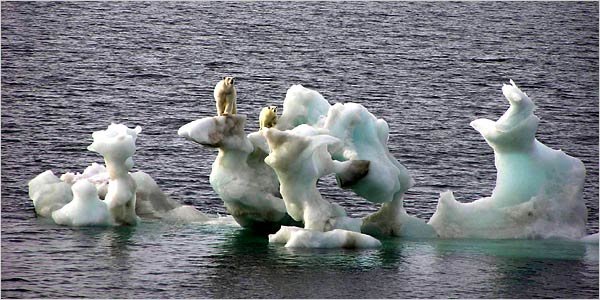
Dan Crosbie/Canadian Ice Service
Polar bears on chunks of glacial ice in the Bering Sea in 2004. Much
higher temperatures are forecast for the Arctic, climate scientists say.
PARIS, Feb. 2 — In a grim and powerful assessment of the future of the planet, the leading international network of climate scientists has concluded for the first time that global warming is “unequivocal” and that human activity is the main driver, “very likely” causing most of the rise in temperatures since 1950.
They said the world was in for centuries of climbing temperatures, rising seas and shifting weather patterns — unavoidable results of the buildup of heat-trapping gases in the atmosphere.
But their report, released here on Friday by the Intergovernmental Panel on Climate Change, said warming and its harmful consequences could be substantially blunted by prompt action.
While the report provided scant new evidence of a climate apocalypse now, and while it expressly avoided recommending courses of action, officials from the United Nations agencies that created the panel in 1988 said it spoke of the urgent need to limit looming and momentous risks.
“In our daily lives we all respond urgently to dangers that are much less likely than climate change to affect the future of our children,” said Achim Steiner, executive director of the United Nations Environment Program, which administers the panel along with the World Meteorological Organization.
“Feb. 2 will be remembered as the date when uncertainty was removed as to whether humans had anything to do with climate change on this planet,” he went on. “The evidence is on the table.”
The report is the panel’s fourth assessment since 1990 on the causes and consequences of climate change, but it is the first in which the group asserts with near certainty — more than 90 percent confidence — that carbon dioxide and other greenhouse gases from human activities have been the main causes of warming in the past half century.
In its last report, in 2001, the panel, consisting of hundreds of scientists and reviewers, said the confidence level for its projections was “likely,” or 66 to 90 percent. That level has now been raised to “very likely,” better than 90 percent. Both reports are online at www.ipcc.ch.
The Bush administration, which until recently avoided directly accepting that humans were warming the planet in potentially harmful ways, embraced the findings, which had been approved by representatives from the United States and 112 other countries on Thursday night.
Administration officials asserted Friday that the United States had played a leading role in studying and combating climate change, in part by an investment of an average of almost $5 billion a year for the past six years in research and tax incentives for new technologies.
At the same time, Secretary of Energy Samuel Bodman rejected the idea of unilateral limits on emissions. “We are a small contributor to the overall, when you look at the rest of the world, so it’s really got to be a global solution,” he said.
The United States, with about 5 percent of the world’s population, contributes about a quarter of greenhouse gas emissions, more than any other country.
Democratic lawmakers quickly fired off a round of news releases using the report to bolster a fresh flock of proposed bills aimed at cutting emissions of greenhouse gases. Senator James M. Inhofe, the Oklahoma Republican who has called the idea of dangerous human-driven warming a hoax, issued a news release headed “Corruption of Science” that rejected the report as “a political document.”
The new report says the global climate is likely to warm 3.5 to 8 degrees Fahrenheit if carbon dioxide concentrations in the atmosphere reach twice the levels of 1750, before the Industrial Revolution.
Many energy and environment experts see such a doubling, or worse, as a foregone conclusion after 2050 unless there is a prompt and sustained shift away from the 20th-century pattern of unfettered burning of coal and oil, the main sources of carbon dioxide, and an aggressive expansion of nonpolluting sources of energy.
And the report says there is a more than a 1-in-10 chance of much greater warming, a risk that many experts say is far too high to ignore.
Even a level of warming that falls in the middle of the group’s range of projections would be likely to cause significant stress to ecosystems, according to many climate experts and biologists. And it would alter longstanding climate patterns that shape water supplies and agricultural production.
Moreover, the warming has set in motion a rise in global sea levels, the report says. It forecasts a rise of 7 to 23 inches by 2100 and concludes that seas will continue to rise for at least 1,000 years to come. By comparison, seas rose about 6 to 9 inches in the 20th century.
John P. Holdren, an energy and climate expert at Harvard, said the report “powerfully underscores the need for a massive effort to slow the pace of global climatic disruption before intolerable consequences become inevitable.”
“Since 2001, there has been a torrent of new scientific evidence on the magnitude, human origins and growing impacts of the climatic changes that are under way,” said Mr. Holdren, who is the president of the American Association for the Advancement of Science. “In overwhelming proportions, this evidence has been in the direction of showing faster change, more danger and greater confidence about the dominant role of fossil-fuel burning and tropical deforestation in causing the changes that are being observed.”
The conclusions came after a three-year review of hundreds of studies of past climate shifts; observations of retreating ice, warming and rising seas, and other changes around the planet; and a greatly expanded suite of supercomputer simulations used to test how the earth will respond to a growing blanket of gases that hold heat in the atmosphere.
The section released Friday was a 20-page summary for policymakers, which was approved early in the morning by teams of officials from more than 100 countries after three days and nights of wrangling over wording with the lead authors, all of whom are scientists.
It described far-flung ramifications for both humans and nature.
“It is very likely that hot extremes, heat waves and heavy precipitation events will continue to become more frequent,” said the summary.
Generally, the scientists said, more precipitation will fall at higher latitudes, which are also likely to see lengthened growing seasons. Semi-arid subtropical regions, already chronically plagued by drought, could have a further 20 percent drop in rainfall under the panel’s midrange outlook for increases in the greenhouse gases.
The summary added a new chemical consequence of the buildup of carbon dioxide to the list of mainly climatic and biological effects foreseen in its previous reports: a drop in the pH of seawater as oceans absorb billions of tons of carbon dioxide, which forms carbonic acid when partly dissolved. The ocean would stay alkaline, but marine biologists have said that a change in the direction of acidity could imperil some kinds of corals and plankton.
The report essentially caps a half-century-long effort to discern whether humans, through the buildup of carbon dioxide and other gases released mainly by burning fuels and forests, could influence the earth’s climate system in potentially momentous ways.
The group operates under the aegis of the United Nations and was chartered in 1988 — a year of record heat, burning forests and the first big headlines about global warming — to provide regular reviews of climate science to governments to inform policy choices.
Government officials are involved in shaping the summary of each report, but the scientist-authors, who are unpaid, have the final say over the thousands of pages in four underlying technical reports that will be completed and published later this year.
Big questions remain about the speed and extent of some impending changes, both because of uncertainty about future population and pollution trends and the complex interrelationships of the greenhouse emissions, clouds, dusty kinds of pollution, the oceans and earth’s veneer of life, which both emits and soaks up carbon dioxide and other such gases.
But a broad array of scientists, including authors of the report and independent experts, said the latest analysis was the most sobering view yet of a century of transition — after thousands of years of relatively stable climate conditions — to a new norm of continual change.
Should greenhouse gases continue to accumulate in the atmosphere at even a moderate pace, average temperatures by the end of the century could match those last seen 125,000 years ago, in the previous warm spell between ice ages, the report said.
At that time, the panel said, sea levels were 12 to 20 feet higher than they are now. Much of that extra water is now trapped in the ice sheets of Greenland and Antarctica, which are eroding in some places.
The panel said there was no solid scientific understanding of how rapidly the vast stores of ice in polar regions will melt, so their estimates on new sea levels were based mainly on how much the warmed oceans will expand, and not on contributions from the melting of ice now on land.
Other scientists have recently reported evidence that the glaciers and ice sheets in the Arctic and Antarctic could flow seaward far more quickly than estimated in the past, and they have proposed that the risks to coastal areas could be much more imminent. But the climate change panel is forbidden by its charter to enter into speculation, and so could not include such possible instabilities in its assessment.
Michel Jarraud, the secretary general of the United Nations World Meteorological Organization, said the lack of clarity should offer no one comfort. “The speed with which melting ice sheets are raising sea levels is uncertain, but the report makes clear that sea levels will rise inexorably over the coming centuries,” he said. “It is a question of when and how much, and not if.”
The warming and other climate changes will be highly variable around the world, with the Arctic in particular seeing much higher temperatures, said Susan Solomon, the co-leader of the team writing the summary and the section of the panel’s report on basic science. She is an atmospheric scientist for the National Oceanic and Atmospheric Administration.
The kinds of vulnerabilities are very much dependent on where you are, Dr. Solomon said in a telephone interview. “If you’re living in parts of the tropics and they’re getting drier and you’re a farmer, there are some very acute issues associated with even small changes in rainfall — changes we’re already seeing are significant,” she said. “If you are an Inuit and you’re seeing your sea ice retreating already, that’s affecting your life style and culture.”
The 20-page summary is a sketch of the findings that are most germane to the public and world leaders.
The full report, thousands of pages of technical background, will be released in four sections through the year — the first on basic science, then sections on impacts and options for limiting emissions and limiting inevitable harms, and finally a synthesis of all of the findings near year’s end.
In a news conference in Paris, Dr. Solomon declined to provide her own views on how society should respond to the momentous changes projected in the study.
“I honestly believe that it would be a much better service for me to keep my personal opinions separate than what I can actually offer the world as a scientist,” she said. “My stepson, who is 29, has an utterly different view of risks than I do. People are going to have to make their own judgments.”
Some authors of the report said that no one could honestly point to any remaining uncertainties as justification for further delay.
“Policy makers paid us to do good science, and now we have very high scientific confidence in this work — this is real, this is real, this is real,” said Richard B. Alley, one of the lead authors and a professor at Pennsylvania State University. “So now act, the ball’s back in your court.”
Elisabeth Rosenthal reported from Paris, and Andrew C. Revkin from New York. Felicity Barringer contributed reporting from Washington.
Crude oil lingers from Exxon Valdez spill
RACHEL D'ORO
Associated Press
Globe and Mail
02-Feb-2007

Bill Scheer, of Valdez, Alaska, is covered in
crude oil while working on a beach fouled by the
spill of the tanker Exxon Valdez at Prince William
Sound, on April 13, 1989. (John Gaps III/AP Photo)
ANCHORAGE, Alaska — Lingering crude from the nation's largest oil spill has weathered only slightly in some places almost 18 years after the tanker Exxon Valdez ran aground and fouled hundreds of miles of Alaska shoreline, a new federal U.S. study released Wednesday concludes.
The estimated 85 tons of oil remaining at Prince William Sound is declining about 4 per cent a year and likely even slower in the Gulf of Alaska, according to research chemist Jeffrey Short of the National Oceanic and Atmospheric Administration.
At that rate of decline, oil could persist for decades below the surface of some beaches, Mr. Short and colleagues said in their report.
The study is to be published in the Feb. 15 edition of Environmental Science & Technology, the journal of the American Chemical Society.
“Such persistence can pose a contact hazard to inter-tidally foraging sea otters, sea ducks, and shorebirds, create a chronic source of low-level contamination, discourage subsistence in a region where use is heavy, and degrade the wilderness character of protected lands,” researchers wrote in their conclusion.
The study was partially funded by the Prince William Sound Regional Citizens' Advisory Council, which was formed by federal mandate after the Exxon Valdez spill to monitor industry operations. Researchers, however, said their findings and conclusions were not influenced by that sponsorship.
Exxon Mobil Corp. spokesman Mark Boudreaux said the Irving, Texas-based company's Valdez team planned to closely review the findings.
“Based on our initial review of the report, there is nothing newsworthy or significant in the report that has not already been addressed,” he said. “The existence of some small amounts of residual oil in Prince William Sound on about two-tenths of 1 per cent of the shore of the sound is not a surprise, is not disputed and was fully anticipated.”
Mr. Boudreaux said Exxon has supported more than 350 independent studies whose scientists have found no evidence of significant long-term impact from the spill.
The Exxon Valdez ran aground March 24, 1989, emptying 41 million litres of crude oil into Prince William Sound. The spill contaminated more than 1900 kilometres of shoreline and killed hundreds of thousands of seabirds and marine animals.
Short and the other researchers looked at subsurface oil from 10 randomly selected beaches in the spill area. Data from the study was collected in 2005 and compared with samples taken from the same beaches for a 2001 study.
Earlier research from other spills showed that oil could hold toxins for years if embedded in oxygen-depleted sediments where minimal weather-caused disintegration occurs, according to the new report. In the Valdez spill study, researchers found that thick, emulsified oil — called “oil mousse” — resists weathering and thus can be preserved in oxygen-containing sediments.
“Our results show it's not changing much,” Mr. Short said. “What's left is going to be there a long time.”
Exxon estimates it has paid $3-billion (U.S.) in cleanup costs, government settlements, fines and compensation. But it still has not paid an unresolved punitive damage judgment, originally set for $5-billion by a federal jury in 1994.
The case has since bounced between the federal court and the 9th U.S. Circuit Court of Appeals. In December, the appeals court ruled that the oil giant must pay $2.5-billion to compensate thousands of fishermen and others affected by the spill.
Earlier this month, Exxon asked the court to reconsider its decision.
John Devens, executive director of the Prince William Sound Regional Citizens' Advisory Council, said Exxon's prolonged stalling were unconscionable considering the social, economic and environmental damages.
“It's very difficult to understand why Exxon isn't a better industrial citizen,” Mr. Devens said.
Monuments Go Dark For Climate Change
Associated Press
February 1, 2007
PARIS - The Eiffel Tower's 20,000 sparkling bulbs went dark for five minutes Thursday night and the lights went out at the Colosseum in Rome and the Greek parliament in Athens in a demonstration of concern about climate change across the European continent.
Environmental activists timed the lights-out protest before the release Friday of a major climate change report that will warn of a worsening threat from global warming.
The City of Light dimmed between 7:55 p.m. and 8 p.m. when lights were switched off at the Eiffel Tower as well as the Paris' Hilton, where many of the scientists and officials from the Intergovernmental Panel on Climate Change are staying as they work on the climate change report. The hotel even switched off its electric revolving front door.
The scientists' long-awaited report says global warming is "very likely" man-made, the most powerful language ever used on the issue by the world's leading climate scientists, delegates who have seen the report said Thursday.
And the document, the most authoritative science on the issue, says the disturbing signs are already visible in rising seas, killer heat waves, worsening droughts and stronger hurricanes.
The protest extended to the southeastern city of Grenoble where a campaign rally organized by French Socialist presidential candidate Segolene Royal went ahead in the dark after organizers pulled the plug on lights in the meeting hall. The hall's microphones and speakers worked during the blackout.
Royal, a former environment minister, has pledged to make the fight against climate change her top ecological priority if elected in France's April-May elections.
Individuals also heeded the lights-out call by France's Alliance for the Planet which organized the demonstration.
"I think it's an important gesture," said Chantal Bericault, who said she turned off all electrical appliances in her apartment in the chic 8th district of the French capital.
Bericault, a jewelry store owner, said she had even braved her building's stairs in the dark.
Some experts frowned on the lights-out, saying it could consume more energy than it conserves because of a power spike when people turn the lights back on. They warned it could possibly cause brownouts or even blackouts, though no problems were immediately reported.
Several European cities staged symbolic blackouts along with Paris.
Authorities in Rome switched off the lights at two of the Italian capital's most popular monuments, the Colosseum and the Capitol.
In Spain, Madrid's city hall turned off one of the capital's most emblematic monuments, the Puerta de Alcala arch. In the southern city of Seville, local authorities did the same with the famous Giralda Tower, and the Mediterranean city of Valencia also turned out lights at some landmark buildings.
In the Greek capital, Athens, lights illuminating several public buildings -- including the parliament, city hall, and Foreign Ministry -- were temporarily turned off.
Copyright © 2007 KABC-TV and The Associated Press.
January 31, 2007
TransCanada set to boost Keystone pipeline
Turns up the heat on rival Enbridge as it aims to add oils sands link to key U.S. hub
DAVID EBNER
Globe and Mail
31-Jan-2007
CALGARY -- TransCanada Corp. increased the intensity of its competition with archrival Enbridge Inc. yesterday, saying it is ready to spend $700-million (U.S.) more on a proposed oil sands pipeline to expand and extend a project that is already budgeted at $2.1-billion.
TransCanada's Keystone pipeline would be a 3,000-kilometre link connecting Alberta with southern Illinois. The firm yesterday said it is ready to see whether oil producers want to support an added link to a key hub at Cushing, Okla., as well as back total capacity of 590,000 barrels a day, up from 435,000.
Last week, Enbridge said it had "industry support" to spend $2-billion for a new pipeline to move an additional 450,000 barrels to carry increasing output from the oil sands in northern Alberta. It would be on the same route that Enbridge's mainline follows, Canada's largest oil export connection that can carry almost two million barrels a day from Alberta to the U.S. border with a link to Chicago.
TransCanada, Canada's biggest natural gas pipeline company with significant power generation assets, is headquartered across the street in downtown Calgary from Enbridge, an oil pipeline company with some gas pipeline assets. Both are fighting to build the first big new line to handle anticipated oil sands production.
If the Keystone expansion and extension is successful, as much as 200,000 barrels a day of the total 590,000 could move to Oklahoma, with a further potential connection to Texas, TransCanada said on a conference call that discussed quarterly earnings.
"We've had very strong interest from the [oil] shipping community out of Alberta to get more of Keystone down to the Cushing hub and from there down to the Gulf Coast," TransCanada chief executive officer Hal Kvisle said on the call.
Canadian oil first started moving to the hub of Cushing last year when Enbridge's Spearhead connection with a capacity of 125,000 barrels a day linked the city with Chicago. The line immediately had a market impact, increasing prices for lower-grade oil from Canada -- typical of the country's output -- as the product was dispersed to more markets.
Cushing is the physical delivery point of crude oil for contracts of light, sweet crude -- also known as West Texas intermediate -- traded on the New Your Mercantile Exchange.
TransCanada said that if the expansion and extension of Keystone are not successful, it still plans to forge ahead with the original 435,000-barrel-a-day Keystone plan, which is supported by long-term shipping deals of 340,000 barrels a day, led by ConocoPhillips Co.
In the fourth quarter, TransCanada profit fell 23 per cent to $269-million (Canadian) or 55 cents a share from $350-million or 72 cents a year earlier. Excluding a one-time gain in 2005's fourth quarter for the sale of assets, profit in 2006's fourth quarter was up 14 per cent from $235-million or 48 cents.
In all of 2006, excluding the gain from asset sales, profit was $1.05-billion or $2.12 a share, up from $852-million or $1.75.
Stock of TransCanada rose to $39.22, up 16 cents or 0.4 per cent, and is near an all-time intraday high of $41.35 reached early this month.
In a presentation with its conference call, TransCanada said it has produced a total shareholder return, including stock gains and dividends, of 15 per cent in the past year and 20 per cent annually over the past five years.
January 27, 2007
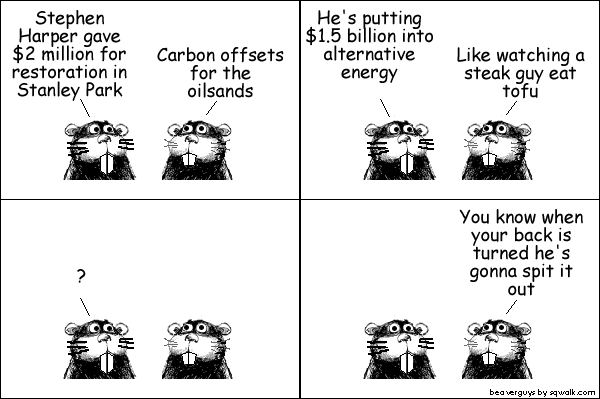
January 26, 2007
Radio-Canada's oil sands 'scoop' dug up nothing
Radio-Canada's oil sands 'scoop' dug up nothing


Radio-Canada's oil sands 'scoop' dug up nothing
Konrad Yakabuski
The Globe and Mail
Jan 25, 2007
Canada's public TV network is a two-headed, English-French creature with a mandate to foster a "shared national consciousness." Just how it's supposed to do this when it speaks out of two mouths, in two languages and to two different audiences is one of those great Canuck incongruities that gets shuffled under the carpet in Ottawa, where the myth of a benevolent bilingual broadcaster lives on.
This would be forgivable enough if all it meant was that francophone Canadians were spared the piercings of George Stroumboulopoulos while anglophones missed out on the weekly celebrity skewering that is Tout le monde en parle .
The damage done by Radio-Canada's programming last week of a sensationalist documentary on the development of Alberta's oil sands makes it all much harder to excuse or ignore. The episode of Zone Libre -- a fifth estate -like show -- single-handedly (and unjustly) did far more to promote suspicion of Alberta than it did to inform Quebeckers about the stakes involved in developing the biggest oil reserves outside of Saudi Arabia.
The show's primary "scoop" was its claim to have obtained secret minutes from an early 2006 meeting in Houston between oil industry types and Canadian and U.S. government officials in which the participants promised to pull out all the stops -- including streamlining environmental reviews -- to facilitate a fivefold increase in oil sands production. The show suggested this was to be accomplished by 2015 -- all to satisfy George W. Bush's desperate quest to reduce U.S. reliance on Mideast oil.
If viewers were still too dumb to figure out this would be an environmental calamity, they were treated to menacing music and images of northern Alberta's scarred landscape. When journalism needs a musical score to gets its message across, can you still call it journalism?
Radio-Canada would not have had to look too far to find an expert to explain the logistical and economic impossibility of expanding oil sands output so rapidly. Doing so would send the price of a double-double at the Fort McMurray Tim Hortons outlet higher than a barrel of West Texas intermediate.
What's more, the show didn't state that the "secret" report had been available for months to anyone with an Internet connection and, more important, had set out no timetable at all for the said increase in oil sands production. What the broadcast did establish in the viewers' mind was the indelible impression that the Conservatives' eagerness to scrap the previous Liberal government's Project Green -- its plan to reduce its greenhouse gas emissions -- stemmed from their own indebtedness to Big Oil, Republican advisers, and the C.D. Howe Institute.
The Toronto-based think tank's list of members, journalist Guy Gendron pointed out, "reads like the telephone book for the Alberta oil industry." The report then credits a C.D. Howe study released last spring for providing the ideological underpinning for the Tories' decision to abolish a string of Liberal environmental programs.
Did Mr. Gendron and his researchers read the report? Titled Burning our Money to Warm the Planet, the study does indeed denounce the ineffectiveness of the Liberal measures. Why? Because the Liberals relied on voluntary compliance and did not sufficiently crack down on Big Oil by imposing mandatory limits on carbon emissions. What's more, the report's lead author was Mark Jaccard, the Simon Fraser University professor and carbon tax proponent who inspired Liberal leadership candidate Michael Ignatieff's environmental proposals.
The oil and gas industry is no different than any other. It seeks to maximize profits with a minimum of government interference, unless, of course, that intervention involves subsidies. So, a healthy suspicion of its lobbying objectives is an essential journalistic tool.
Likewise, there is much to criticize in the Conservatives' early attempts at an environmental policy. The problem is that the Tories were very publicly restoring a series of Liberal programs at the very moment Radio-Canada was airing the Zone Libre documentary -- excerpts of which were fodder for Le Téléjournal nightly news for three days running.
Why are the Conservatives restoring those programs? Because no issue gets as much ink these days as the environment. The result is that even the Tories may soon succumb to the wisdom of a carbon tax. As for Big Oil, it can count on endless scrutiny by its official opposition, Big Environment, and experts such as Prof. Jaccard. And so it should be.
Zone Libre did neither Quebeckers nor that elusive "shared national consciousness" any favours with such a lopsided exposé.
January 22, 2007
LNG projects hit supply snags
COMMENT: Gateway Pipeline down. Kitimat LNG not far behind ...
Proposed terminals in B.C.’s north stalled as gas competition grows and costs head skyward
Krisendra Bisetty
Business in Vancouver
January 16-22, 2007
The future of close to $1 billion worth of liquefied natural gas projects in B.C.’s north is being threatened by acute commodity supply constraints and upwardly spiralling capital costs.
Kitimat LNG’s $500 million plant was scheduled to have broken ground in the northwestern B.C. city this spring, but the project has been pushed back at least until the fall. The company now expects to come on stream in 2010, a year later than planned.
“Really that’s due to the fact that we’re still working on our commercial arrangements to get the LNG supply secured for the terminal,” company president Rosemary Boulton said in an interview from Calgary, where parent company Galveston LNG Inc. is based. “Without that we’re really a little bit on hold.”
Kitimat LNG has secured only one relatively small potential contract with Australia’s Liquefied Natural Gas Ltd. for the supply of 1.8 million metric tonnes per year of LNG to its natural gas terminal and regasification facility.
The volume would fill only about 25 per cent of the proposed terminal in Bish Cove, which is south of Kitimat.
Meanwhile, rival WestPac LNG Corp., a privately-held Calgary company, is yet to secure any firm commitments because suppliers will consider serious discussions only after WestPac gets its environmental permit, something Kitimat LNG obtained in 2006.
WestPac is proceeding with plans to build a trans-shipment terminal at Ridley Island near Prince Rupert. But Stu Leson, the company’s Vancouver-based vice-president for business development, conceded that, with about a dozen competing LNG projects proposed for the North American west coast and one already being built in Baja, Mexico, gas supply is an issue.
“Certainly there is not enough supply to fill all the terminals if they were all built,” he said.
“Our position is on the West Coast there is potentially enough supply perhaps for two terminals.”
As well, WestPac and others are contending with ballooning capital costs.
Initially projected at $350 million, WestPac’s Prince Rupert project costs could jump by as much as 50 per cent by 2011 when construction is in full swing, said Leson. He added that the increase is due primarily to the price of nickel-content steel needed for LNG infrastructure rising by as much as 400 per cent in the past few years.
But Boulton regarded the supply constraints as more of a challenge than a setback.Things could look a little better around 2010, she said, when more LNG supply is expected to come on stream.
Global LNG supply, according to Vancouver energy expert Brian Moghadam, is expected to increase to about 44 billion cubic feet (bcf) a day by 2012 compared with current levels of around 22 bcf a day. About 13 bcf per day would then be available for North America’s needs.
Almost all North American LNG projects are having difficulty in sourcing supply, said Moghadam, not because there’s a shortage of gas but because of delays in building LNG liquefaction facilities overseas.
“These are huge multibillion-dollar projects, mired often in political risk (Russia, Nigeria, Iran, for example), environmental challenges and so on,” he said. “So for the time being, it’s an LNG sellers market.”
But there’s lots of customer interest, said Boulton.
“It’s a nice combination of utilities and some industrial customers in the oilsands area in Alberta.
“What we need to do is be able to match them with potential suppliers.”
The company initially was looking to source gas from Sakhalin Island north of Japan, a seven-day voyage to Kitimat, but it’s now scouring the rest of the world.
WestPac’s project will have a total capacity to transship the equivalent of up to one billion cubic feet of natural gas per day by LNG barges, trucks, railcars and an existing pipeline system, to the Pacific Northwest, Vancouver Island and Lower Mainland markets.
It’s looking to import LNG from Asia Pacific sources –Australia, Malaysia and Indonesia – as well as the Middle East, and sees Terasen Gas Inc. and BC Hydro as among potential local customers.
WestPac is aiming to supply between 150 million and 200 million cubic feet of natural gas per day, representing 15 per cent to 20 per cent of Terasen’s peak daily volumes.
January 20, 2007
PM's energy plan hailed
GREEN POWER I
Renewable energy projects to get incentives
Scott Simpson
Vancouver Sun
Saturday, January 20, 2007

Debra Brash, CanWest News Service
Prime Minister Stephen Harper views
a model of a turbine that is being used
at the tidal energy project at Race Rocks.
Independent power producers in British Columbia on Friday lauded a $1.5-billon renewable-energy initiative announced in Victoria by Prime Minister Stephen Harper.
The program offers long-term incentives for new green power projects, up to a total of 4,000 megawatts of new power coming from a wide array of sources including wind, biomass, small hydro and ocean energy.
That's an amount of power roughly equivalent to one-third of the total generating capacity of British Columbia's sprawling network of hydroelectric dams and reservoirs.
The program is comparable to a series of announcements made by the former Liberal government, but shelved when the Conservatives took power.
The Tories are calling their plan, which commences April 1, the ecoEnergy Renewable Initiative.
As a replacement for coal or natural gas-fired generation projects, it would deliver greenhouse gas emissions equivalent to taking one million cars off the road over the lifetime of the green generating facilities.
"There is no end to the potential of alternative, non-polluting energy sources," Harper said in a statement. He added that the initiative "will harness the power of our environment to help protect the environment for all Canadians."
Funds would be disbursed over a 10-year period for eligible projects built over the next four years.
Steve Davis, president of the Independent Power Producers Association of BC, said the incentives are "opportune" for project developers in B.C.
BC Hydro announced in August it had selected 38 projects with a total value of $3.6 billion to join the provincial electricity grid -- and is in the midst of developing another open call for power later this year.
Davis noted that many details of the program will be determined later in consultation with power producers -- including the manner in which the incentives will be allocated among provinces and project types.
But he added that the incentive would be valuable to B.C.'s independent sector -- particularly where green power producers find themselves with higher base-level costs than proponents of coal or gas-fired generation.
The incentive works out to a payback of one cent per kilowatt, or $10 per megawatt, for participants.
Hydro is currently paying an average 7.5 cents per kilowatt, or $75 per megawatt for new independent power projects joining its grid.
"On general pricing levels in British Columbia in the order of $75 a megawatt hour, a $10 lift is material. It will help them be ranked better when BC Hydro issues the next call," Davis said. "Each of these projects generates a significant amount of revenue for the provincial treasury. If it's small hydro, they pay a significant amount in water rentals each year.
"They have yet to define the edges of the definition, but they have clearly said wind, solar, geothermal and I'm confident the small-hydro sector would be in that."
Harvie Campbell, executive vice-president of Pristine Power, said the Tories' program was distinct from the Liberals' approach because it gives equal weight to all renewable technologies -- and indicated that the former government's program was weighted in favor of wind power.
"What's distinctive about the program is that it supports renewables no matter what kind of technology they are," Campbell said in an interview from Pristine's head office in Calgary.
The company has three projects in the works in B.C., including a biomass-fueled generating facility at Mackenzie in northern B.C.
"Wind doesn't yield any different benefits than for example small hydro -- and that's what's important to B.C.," Campbell said.
"B.C. is unlike the rest of the country in that there is incredible small hydro potential and it's every bit as environmentally friendly a power source as wind.
"By balancing out and saying 'We are not going to be technology-specific, what we want is renewable power, they are letting the developer choose what is the best technology to deliver that with."
Campbell said he expects a rapid takeup of the offer because sustainable power projects are getting bigger and bigger.
"It's a nice large first step but people are starting in other provinces to take 300, 600, 1,000 megawatt-type projects for this type of electricity so it will get eaten up very quickly."
© The Vancouver Sun 2007
January 19, 2007
Ranchers fear losses from project
COMMENT: BC's nascent wind energy developers evidently have to learn about public consultation, just like any other project proponents. The benign nature of the technology and project implementations is not immediately evident to many citizens, and it's certainly not understood by them as it is by the engineers and wind evangelists who have been immersed in it for years.
One tip the wind guys might take from the government and industry coalbed methane book: take residents and concerned citizens on a road trip. Let them see some wind installations, and meet people just like themselves who can speak first hand to the issues.
Government has paid to do many community information sessions promoting coalbed methane, and it has funded one or more of those junkets, again, for coalbed methane. Doesn't the wind sector have every right to expect the same treatment?
$140 million wind energy proposal will damage grazing areas if approved, they say
By Bruce Constantineau
Vancouver Sun
January 18, 2007
B.C. ranchers fear a proposed wind energy project near Chetwynd will cause major losses to their cattle operations by damaging summer grazing areas.
"We know we'll suffer a loss, it's just a question of how much," Mount Wartenbe rancher Monique Drinkall said in an interview. "Are we going to lose calves [after the project is built]? Are they going to get separated because they don't know where to go?"
Victoria-based Dokie Wind Energy Inc. wants to build a 70.5-megawatt wind energy operation on Wartenbe Ridge, about 10 km southeast of Chetwynd. The $140-million project received its approvals are required before it can go ahead.
The BC Cattlemen's Association has written a letter to the Peace River Regional District and several provincial ministers over concerns the project could displace ranching interests on Mount Wartenbe, Table Top Mountain, and Misery Ridge.
But Dokie Wind Energy president Ron Percival said only 12 cows will be displaced by the 10 hectares of Crown land the wind turbines will occupy.
"We're talking about taking up one per cent of the Crown land in question," he said in an interview. "We want to work with the [ranchers] to improve the capacity of the range. It's Crown land to be shared among many stakeholders."
Percival said the company has had 20 hours of meetings with the ranchers, but the two sides can't seem to agree on the issues.
Drinkall said it has been hard to get straight answers from Dokie Wind Energy, which doesn't seem to know exactly where the turbines will be located.
The timetable on the Wartenbe project is unclear because the company still doesn't have a contract to sell the power to BC Hydro, although it might obtain one this year.
But it expects to begin construction by late spring on a separate wind energy project located about 40 km west of Chetwynd. Dokie Wind Energy has a contract to sell 180 megawatts of power to BC Hydro annually, and completion of the project is expected by the end of 2009.
Percival understands the ranchers' concerns, but insists wind turbines are totally compatible with grazing animals.
"Go to Montana or Texas or Washington or California and you'll find cattle and turbines together," he said. "The cattle don't see them, and they don't care.
"Outside of B.C., the people who promote wind development are largely ranchers, and they're lined up to get projects done because having turbines on their ranches generates revenue."
Percival said his company has hired five agrologists who will try to meet with the affected ranchers this spring.
Chetwynd Mayor Evan Saugstad agrees the two sides can co-exist if they want to.
"The problem is they got off on the wrong foot and didn't really talk to each other at first," he said. "That can be a very hard thing to overcome."
bconstantineau@png.canwest.com
PM to boost funding for tidal power
COMMENT: The environmentalist flame that burns in Stephen Harper's Conservative government is fueled with coal and oil sands bitumen and nuclear energy.
The Conservatives, and the BC Liberals, confuse high tech fizz with green, but they are not the same thing. Where are the hard-nosed emission reduction targets? Where are the on-the-ground, in-your-town efficiency and conservation programs?
On Thursday Harper committed $2 million to rebuilding Stanley Park. Great, that'll fix the problem of climate change. Get those trees back to work sucking CO2 out of the atmosphere, I suppose.
On Friday he'll be announcing more money for alternative technologies.
But something is missing. Oh, yes, the sincerity. Like watching a vegetarian chew meat. No, maybe it's more like watching a steak guy eat tofu.
And you know that when your back is turned, he's going to spit it all out.
Trip to Metchosin will highlight new Tory support for alternative energy
Peter O'Neil and Richard Watts
Times Colonist; CanWest News Service
Friday, January 19, 2007
Prime Minister Stephen Harper will visit Race Rocks off Metchosin today to announce a major federal investment into alternative energy technology.
His visit to Victoria is seen as part of a new strategy to convince Canadians he's serious about environmental issues, and his stop at Race Rocks Ecological Reserve will highlight Tory support for a tidal-powered project there.
Yesterday, the Conservatives promised $2 million to help restore Vancouver's windstorm-ravaged Stanley Park.
Earlier this week, Harper's ministers announced a $238-million green science fund for fuel-cell, clean-coal and nuclear-energy research.
Harper has also agreed with the NDP to establish a special parliamentary committee to look at ways to beef up the Clean Air Act, ridiculed when it was announced in October.
Harper will be joined today by newly minted Environment Minister John Baird (who replaced Rona Ambrose), local MP and Natural Resources Minister Gary Lunn, and Indian Affairs Minister Jim Prentice.
They are expected to focus on a project by a small North Vancouver company, Clean Current Power Systems Inc., at Race Rocks, which is billed as "Canada's first free-stream tidal power project." While there, the ministers will encounter something lighthouse keepers and wildlife have only recently rediscovered -- silence.
Since late last year, power for the Race Rocks lighthouse, research station and eight-person dormitory -- all operated by Lester B. Pearson College of the Pacific -- has been supplied by tidal power.
The switch has allowed for the removal of decades-old diesel generators, along with their exhaust fumes, fuel consumption and noise.
"It's suddenly very quiet out there," said Pearson college director David Hawley in an interview yesterday.
Clean Current and Pearson College are partners in the project, which has received funding from Calgary energy giant EnCana Corp., and won a grant of just under $1 million in 2005 from Sustainable Development Technology Canada.
Today's announcement is expected to revive the 2005 Liberal budget's commitment of $920 million over 15 years for wind power. But the Tory government is saying its initiative is different because it puts more emphasis on other forms of energy generation, like solar and tidal power technology.
Harper, who didn't mention climate change last year in his election platform and has questioned climate-change science, is now trying to stress his government's commitment to the environment.
The policy switch came after the federal Liberals made the environment one of their top priorities, and a series of polls found global warming is a top public concern. This week, an Innovative Research poll obtained by the Vancouver Sun indicated that six out of 10 Canadians aren't convinced the Harper government cares about the environment.
But a clear majority also said they don't agree with Liberal Leader Stephane Dion's assertion that Canada must adhere to the 1997 Kyoto accord that calls on Canada to reduce greenhouse gas emissions by six per cent below 1990 levels.
Currently, annual environmentally harmful emissions in Canada from cars, factories and other sources are 28 per cent above 1990 levels.
© Times Colonist (Victoria) 2007
January 18, 2007
U.S. urges 'fivefold expansion' in Alberta oilsands production
U.S. urges 'fivefold expansion' in Alberta oilsands production
CBC News
January 17, 2007
The U.S. wants Canada to dramatically expand its oil exports from the Alberta oilsands, a move that could have major implications on the environment.
U.S.and Canadian oil executives and government officials met for a two-day oil summit in Houston in January 2006 and made plans for a "fivefold expansion" in oilsands production in a relatively "short time span," according minutes of the meeting obtained by the CBC's French-language network, Radio-Canada.
The meeting was organized by Natural Resources Canada and the U.S. Department of Energy.
Canada is already the top exporter of oil to the American market, exporting the equivalent of one million barrels a day - the exact amount that the oilsands industry in Alberta currently produces.
A fivefold increase would mean the exportation of five million barrels a day, which would supply a quarter of current American consumption and add up to almost half of all U.S. imports.
But the current extraction of oil from the tarsands results in the spewing of millions of tonnes of greenhouse gases into the atmosphere: it's already the biggest source of new greenhouse gas emissions in Canada.
The news of call for the massive boost in oil production comes as Prime Minister Stephen Harper has pledged to make the environment one of his top priorities, vowing that Canadians deserve more action on climate change. Polls show the environment is the number one concern of Canadians.
Yet, according to the minutes of the Houston meeting, to multiply its output by five and to do it quickly, Canada would have to "streamline" its environmental regulations for new energy projects.
"We need to look at additional pipelines from Canada to the U.S. as a new source of supplier, a growing source of supply," said Bob Greco of the American Petroleum Institute.
But the current extraction of oil from the tarsands results in the spewing of millions of tonnes of greenhouse gases into the atmosphere: it's already the biggest source of new greenhouse gas emissions in Canada.
The news of the call for the massive boost in oil production comes as Prime Minister Stephen Harper has pledged to make the environment one of his top priorities, vowing that Canadians deserve more action on climate change. Polls show the environment is the number one concern of Canadians.
Yet, according to the minutes of the Houston meeting, to multiply its output by five and to do it quickly, Canada would have to "streamline" its environmental regulations for new energy projects.
No plans to 'streamline' environmental assessments: PMO On Thursday, a spokesman for the Prime Minister's Office said the federal Tories will not "streamline" environmental assessments to speed up oilsands development.
"Canada's natural resources will be developed but that will not be done at the expense of the environment," Dmitri Soudas told the Canadian Press.
Canada's main oil lobby group said there is no pledge to increase production five-fold for the Americans.
"There is no promise," said Greg Stringham of the Canadian Association of Petroleum Producers. "It's up to the market whether this thing goes fast or slow."
In his state of the union address in 2006, U.S. President George W. Bush set out a goal to drastically reduce oil imports from the Middle East and make American dependence on Middle Eastern oil "a thing of the past."
"America is addicted to oil which is often imported from unstable parts of the world," Bush said then.
Paul Michael Weaby, a Washington insider and an expert on the geo-strategic aspect of the oil industry, said Bush is counting on Canada to achieve the U.S. of goal to wean the country off Middle Eastern oil - a goal now defined as a national security objective.
"He wanted to have a reduction of 1.5 million barrels a day by 2015 from the Middle East. Although he did not mention Canada, that is in fact where the replacement supply will come from."
Pipeline demands mount
Canadian oil pipeline to U.S. East Coast planned
By David Ebner, Globe and Mail, 17-Jan-2007
Pipeline demands mount
Shaun Polczer, Calgary Herald, 18-Jan-2007
Canadian oil pipeline to U.S. East Coast planned
By DAVID EBNER
Globe and Mail
January 17, 2007
Enbridge Inc. wants to move Canadian oil-sands output all the way to the Philadelphia region, and is working on early plans for a $1.4 billion pipeline that would carry domestic crude to the east coast of the United States for the first time.
The plan is part of a larger effort by Enbridge to build a network of new oil-pipeline connections in the United States so that expected increases in oil-sands production do not flood any single market.
The connection could be in service as early as 2010, according to the company, with the pipeline carrying 300,000 barrels a day. The link would begin in the Chicago region, which is now the main destination for Canadian oil.
Enbridge considers the project a "potential initiative," describing it as "very preliminary," according to company spokesman Glenn Herchak.
"Because of the increasing growth of the oil sands, we've seen some market interest (from oil producers) in the potential for new pipeline capacity into the (eastern U.S.) region," Herchak said.
The company has also had initial discussions with refiners to handle the oil, but Herchak wouldn't identify them.
One potential customer would be Sunoco Inc., which owns the largest refinery in the region, a facility in Philadelphia that can process 330,000 barrels a day.
ConocoPhillips Co. has a 230,000-barrel-a-day refinery in New Jersey and a 185,000-barrel-a-day operation near Philadelphia.
The Philadelphia connection is one of two big new pipeline concepts Enbridge is pursuing. Last July, it said it was looking at a $3.6 billion, 400,000-barrel-a-day line to connect Alberta with Texas. The idea remains in the early stages, Herchak said.
The new ideas to move Canadian oil to different areas of the United States follow the stall that hit the proposed Gateway pipeline, which would move oil-sands crude from Edmonton, Alberta, to the west coast of British Columbia for export to Asia. After significant opposition from aboriginal groups along the route, as well as slow talks between refiners in China and Canadian producers, Enbridge was unable to get long-term shipping contracts signed.
Pipeline demands mount
Enbridge: Alberta needs at least three, utility says
Shaun Polczer
CanWest News Service
January 18, 2007
CALGARY - At least three new pipelines will be needed to move Alberta's growing oilsands production to new markets in the United States and abroad, a senior official with Enbridge Inc. said Wednesday. Those are on top of a 400,000-barrel per day (bpd) link to the U.S. Gulf Coast and a proposed 300,000 bpd hook-up to Kitimat, B.C., said Rick Sandahl, Enbridge's senior vice-president of market development.
``There's a need for significant infrastructure changes going forward,'' he told a Calgary oilsands conference.
``Getting to existing markets isn't adequate, you need to have pipelines to get to new markets.''
According to industry forecasts, oilsands production is expected to triple to about 3.5 million bpd by 2015, requiring at least two million bpd of incremental transportation capacity out of Western Canada.
Sandahl said Enbridge has received strong interest from American refiners interested in securing access to more Canadian oil.
In addition to the Gulf Coast, other potential new markets include California, which could be supplied from Kitimat, and the Eastern Seaboard, which would require a $1.4-billion line from Chicago to move Canadian oil into places like Philadelphia, Baltimore and New Jersey.
An Eastern pipeline could also access refineries on the Canadian side of the border, particularly in Montreal.
Companies like Shell Canada Ltd. and Petro-Canada have speculated on building or modifying facilities in Eastern Canada to process Alberta heavy crude.
However, Sandahl noted the East Coast line is the ``most speculative'' proposal in Enbridge's $15-billion project inventory. If it goes ahead, the pipeline could be built and in service by 2012.
But the Gulf Coast remains the big prize for Canadian shippers.
It has the largest concentration of heavy oil refineries in North America and is looking to diversify supply sources that come mainly from Venezuela and Mexico.
Venezuelan President Hugo Chavez has threatened to reduce exports to the U.S. while Mexico's oil production is in decline.
Other proposed export pipes from Canada include a 250,000-bpd bullet line to Texas currently being advanced by Altex Energy Ltd.
Altex is a private company headed by Jack Crawford and a management group responsible for building the Alliance natural gas pipeline to Chicago in 2000.
``The scope and scale of what we're proposing to do at Altex is very similar,'' he said.
Altex proposes to ship raw bitumen to U.S. refineries capable of upgrading and refining it into finished products.
Acknowledging the debate over value-added processing at home, Crawford said the pipeline would serve as a hedge against rising costs for labour and materials in Alberta.
``We believe exporting at least part of it is a way to mitigate some of the risk of cost overruns we're seeing here with upgrading,'' he said.
OPTIONALCUTENDS
Andrew Kuske, a pipeline analyst with UBS in Toronto, said Enbridge stands to gain from future expansion projects.
``Enbridge's asset position is likely to fuel a significant portion of highly visible corporate growth over the next five years,'' he said in a research note.
Enbridge shares fell 69 cents in Toronto, to close at $38.45.
spolczer@theherald.canwest.com
January 16, 2007
Ottawa set to unveil climate plans
Harper government lays groundwork by borrowing Liberal initiatives
BILL CURRY
Globe and Mail
16-Jan-2007
OTTAWA — The Conservative government is launching a series of new climate-change policies this week before MPs return for what is expected to be a heated parliamentary session dominated by divisions over the environment.
Some of the measures will have a familiar ring, as they include elements of Liberal climate-change programs scrapped or frozen last year by the Conservatives. One will include the revival and expansion of a Liberal incentive for companies to build more wind power. Another, dealing with energy efficiency for homes, is sure to be compared with the Liberals' Energuide program that had been scrapped.
The Conservatives froze or axed dozens of climate-change programs upon taking office, promising a review of whether they were cost-effective and achieving results.
The announcements begin tomorrow and will mark the government's first policy moves since Prime Minister Stephen Harper pledged to do "a lot more" on climate change as he shuffled his cabinet this month.
Related to this article
Follow this writer
Add BILL CURRY to my e-mail alerts
Latest Comments
They unfroze some initiatives that were frozen pending an assessment...
Borrow or steal ideas? Dion's entire "green" plan was "borrowed...
This is probably the biggest damage control plan in recent memory...
I think it is a good idea for the 'new' gov't to steal the plans...
14 reader comments | Join the conversation
Natural Resources Minister Gary Lunn will kick off this week's media blitz by picking up reporters on Parliament Hill tomorrow morning in a low-emission bus. The plan is for the minister to tell his captive audience about the government's new and continuing support for clean-energy technology as they visit his department's suburban research centre.
That will be followed by an announcement Friday in Victoria, where new incentives for renewable power production will be rolled out. Then on Sunday in Toronto, the government will announce new energy-efficiency measures for vehicles and residential homes.
The announcements are likely aimed at building momentum for the Tories on the environment as they prepare to square off with the opposition over how to address the most challenging climate-change hurdles -- namely the emissions from Canada's big oil and power companies.
Advocates of wind power have been waiting for a signal from the Conservatives since a federal subsidy, introduced by the Liberals and called the Wind Power Production Initiative, was frozen early last year.
The program, launched in 2002, gave a federal subsidy of one cent for every kilowatt hour produced through wind power for the first 10 years of a new operation.
The 2005 Liberal budget promised to extend the program over 15 years for a total cost of $920-million, but the Conservatives said the incentive was on hold while all federal climate programs were reviewed.
The Liberals also promised a new program for all other renewable fuels -- such as solar and tidal power -- that would be worth $886-million over 15 years, but it was never implemented.
Mr. Lunn is expected to revive both programs this week and merge them under a new name and increased funding.
Bruce McCallum, president of the Canadian Bioenergy Association, said he would welcome a federal commitment to renewable power, but said industry is concerned about the lack of certainty.
Just as the previous Liberal commitments were derailed by a federal election, Mr. McCallum said, it is uncertain whether any announcements made this month would survive if the government is defeated this spring.
"Industry is getting very confusing signals," he said in an interview.
On energy efficiency, Mr. Lunn has previously promised a range of new regulations under the Energy Efficiency Act. The Conservatives gave notice last May that a range of air conditioners and other widely used appliances such as vending machines would be forced to use less power.
Air conditioners are a major drain on power supplies during hot summer days and ultimately produce more heat-trapping greenhouse gases. In Ontario, for instance, high power use in the summer forces Ontario Power Generation to fire up all of its coal-power plants, which are a leading source of greenhouse-gas emissions.
The David Suzuki Foundation issued a report yesterday calling for a 6-per-cent rebate on energy-efficient appliances that would be paid for by a 6-per-cent tax on non-efficient appliances.
Calling the proposal "Switch Green," Suzuki Foundation policy analyst Pierre Sadik said the idea has been well received by federal public servants.
"Everyone sees this as a win-win proposal and the way of the future," he said. "Now that the Harper government claims it's turned over a new leaf, the big question is, do they have the political will to make polluters pay?"
January 14, 2007
Do carbon offsets live up to their promise?
Moises Velasquez-Manoff
Christian Science Monitor
10 January 2007
In 2006, "carbon neutral" became the New Oxford American Dictionary's word of the year, evidence not only of the "greening" of our culture, but of our language as well. As scientists predict another bout of record-setting temperatures this year, climate concerns may soon "green" our wallets as well. By all accounts, 2007 is poised to see the industry of carbon neutrality - so-called carbon offsetting - grow dramatically.
In theory, the idea is simple. The consumer pays a third party to remove a quantity of carbon (in the form of a greenhouse gas) equal to what he or she emits. But how voluntary carbon offsets actually work is unclear at best, and potentially fraudulent at worst, say experts.
The problem: No current certification or monitoring system has any teeth, and there is no easy way to confirm that offsetting companies are doing what they promise. Now, various organizations are scrambling to provide standards for what experts call a fragmented market with a product of drastically varying quality.
The first-ever ranking of carbon offsetters recently released by Clean Air-Cool Planet, a nonprofit in Portsmouth, N.H., graded 30 companies on a scale of 1 to 10; tellingly, three-quarters scored below 5. Critics, meanwhile, question whether the carbon market might be a dangerous distraction at a time when decisive action is needed to avert climate catastrophe.
"On the one hand, there is the potential benefit of educating people through offsets," says Dan Becker, director of Sierra Club's global warming program. "On the other hand, if people view offsets like papal indulgences that allow you to continue to pollute, then it's probably not a good idea."
Many companies have nonetheless moved to make carbon neutrality part of their 21st-century brand identity. Travelocity and Expedia now offer customers the option of offsetting carbon emissions associated with their trips for a few extra dollars. In 2005, "Syriana" became the first carbon-neutral movie. In 2006, "An Inconvenient Truth" followed suit to become the first such documentary. With the purchase of 170,000 tons of carbon offsets, HSBC declared itself the first-ever carbon-neutral bank. Other companies, including Google and Ben & Jerry's - not to mention musical groups such as the Dave Matthews Band - are moving toward, or have arrived at, various levels of carbon neutrality.
And that's just the beginning, say analysts.The volume of metric tons of carbon traded on the voluntary market doubled last year over 2005. It's widely expected to double again in 2007. Of 92 companies polled by The Conference Board, a nonprofit business research organization, three-quarters were actively computing their carbon footprint. While only 15 percent were currently trading on the voluntary carbon market, 40 percent were considering it. Carbon was the topic du jour in more than two-thirds of the corporate boardrooms polled.
Carbon markets fall into two broad categories:
1. The cap-and-trade system. Countries that have ratified the Kyoto Protocol, an amendment to the global treaty on climate change, participate in this system by setting a limit, or cap, on greenhouse-gas emissions. Those companies that emit less than their allotment receive credits that they can sell on carbon exchanges. Those that emit more must purchase credits in order to avoid financial penalties. (The voluntary Chicago Climate Exchange also operates this way.) Proponents of this system trust the innovative power of the free market to promote energy efficiency.
2. The voluntary carbon market. In the United States, the market for carbon offsets is voluntary, driven primarily by corporations seeking to enhance their brand identity or to familiarize themselves with what they consider to be an inevitability.
Many offsets sold on this market are what Ricardo Bayon, director of Ecosystem Marketplace, a San Francisco-based information provider on ecosystems services, calls "gourmet." Their value lies not in the compliance, but in the prestige of achieving carbon neutrality. At first glance, this type of offset appears more straightforward: A consumer pays for a carbon-removal service.
Dig a little deeper, however, and it gets more complicated. There are many ways to remove carbon from the air, each operating on a different time scale and all of them of different "quality." You can capture greenhouse gases by planting trees. You can also prevent greenhouse gas from entering the atmosphere by burning methane released from animal manure and landfills. (As a greenhouse gas, methane is 23 times more potent than CO2.) Or you can preempt its release by building alternative-energy sources such as wind- and solar-power devices.
Compounding an offset's inscrutability is its intangibility. Unless you're willing to visit Uganda in 20 years to verify the existence of a new tree, a carbon offset is arguably invisible. "The carbon market is particularly difficult because of that issue," says Mark Trexler, president of Trexler Climate + Energy Services in Portland, Ore., the firm commissioned to author Clean Air-Cool Planet's (CA-CP) guide to carbon offsets. "You're dealing with stuff in the future in many cases that hasn't happened yet."
CA-CP's "A Consumer's Guide to Retail Carbon Offset Providers" attempts to wrangle a semblance of order from what one industry insider calls the "Wild West." It ranks offsetting companies on factors like transparency, third-party certification, their efforts to educate consumers, and how well they prove they're not selling the same carbon offset more than once.
CA-CP's ranking effort is the first in what's likely to be a burgeoning industry effort at standardization. Two San Francisco organizations, Business for Social Responsibility and Ecosystem Marketplace, recently joined forces to write guides on the voluntary carbon market, and Ecosystem Marketplace is about to release a book on the topic. This spring, the Center for Resource Solutions in San Francisco plans to release a certification standard it hopes will be universally adopted.
Central to the CA-CP report - and to the debate on how to gauge an offset's quality - is the topic of "additionality." Additionality is determined by answering a deceptively simple question: Would a project have happened anyway? If yes, the offset cannot be said to have additionality. If no, then it qualifies as a true offset. Simple - except that no one agrees on what could have happened.
"You put a bunch of climate wonks in a room, it's the one [topic] they're going to talk about most," says Mr. Bayon. "And it's the one that has bedeviled every single climate discussion I've ever seen."
But while experts disagree on the effectiveness of the carbon market at averting global warming, nearly everyone agrees on two points. First, the fact that people are beginning to factor in the cost of their carbon footprint when doing business is good. "You're starting to put a price on the emissions of carbon," says Bayon. "That cost begins to filter into your operations. And you start saying to yourself, 'Should I throw that 10 or 20 bucks out of the window?' "
Second, the more money invested in renewable energy, the better. "That has an important effect in the aggregate," says Bogdan Vasi, assistant professor at Columbia's School of International and Public Affairs in New York City. "As more and more people make these choices, they are creating a market, and slowly it's shifting the proportion of renewable energy to fossil-fuel energy."
But ultimately the carbon-offset market is more a phase than a destination, says Jonathan Isham, professor of international environmental economics at Middlebury College in Vermont. "We really want a world where, in a generation, we don't need offsets anymore," he says. "Once we get the legislation we need, prices will reflect the social costs of carbon." More trees not necessarily the way to a cooler earth
Everybody loves trees. They're beautiful, big, and green. Unfortunately, planting them may not be the best approach to reduce global warming, say scientists. While a tree does suck up carbon, its net cooling effect depends on latitude, according to a collaborative study from Lawrence Livermore National Laboratory in Livermore, Calif. Only trees planted at tropical latitudes have a net cooling effect. Those at temperate latitudes actually warm the planet.
And unless a forest is permanent (and who can guarantee that?), trees only temporarily sequester atmospheric carbon. When they burn or decompose, the carbon they contain is released back into the atmosphere. In tropical countries, where trees are most effective as a cooling agent, they're often up against poverty and political instability. "Does some guy wake up and say, 'Now I'm the dictator of the country. I want a golf course?' " says Michael Dorsey, a professor of environmental studies at Dartmouth College in Hanover, N.H. "There's the big issue."
Still, a tree's value shouldn't be discounted. While not the ideal carbon solution, they do increase biodiversity and decrease soil erosion. Most important, their natural appeal makes them ready-made symbols. "We do support tree-planting projects to get our employees engaged," says Erin Meezan, director of environmental affairs at Interface Inc., a textile company with an environmental bent. "It's one of the easiest things for people to understand. If you start getting into anaerobic digesters and underground injection, we lose them."
January 11, 2007
The Polar Dash for Oil
The Polar Dash for Oil
Luke Burgess, Pure Energy Report, 11-Jan-2007
COMMENT: The polar areas are special places on this earth. Both are largely untrammelled by the direct impacts of man, both awesomely rich laboratories for study of nature and the indirect impacts of man - the best places on earth for all nations to agree to suspend territorial claims, military presence, and exploitation.
This has been done in Antarctica with the 1959 Antarctic Treaty System. I'm sure it's not perfect, but it's a lot better than the "It's mine" hissyfit that is happening around the Arctic now that global warming and oil depletion are ganging up on the last places on earth we haven't dominated.
http://en.wikipedia.org/wiki/Antarctic_Treaty_System
We argued last year that expending energy to establish an international protection zone is preferable to gunboats and drillrigs. The subject then was increasing pressure, especially from the US, to open up the Northwest Passage to commercial shipping.
The Arctic: to defend or protect
http://www.sqwalk.com/blog2006/000935.html
Not all industry analysts think the Arctic will be the global oil honeypot that this writer seems to believe.
Arctic has less oil than earlier estimated
http://www.sqwalk.com/blog2006/000892.html
See also:
Melting Antarctic Ice Causing Sea Levels to Rise
http://www.sqwalk.com/blog2006/000701.html
Ticking Time Bomb
http://www.sqwalk.com/NewsItems2005.shtml
Arctic ice cap 1979 vs 2003
http://www.sqwalk.com/blog/000267.html
The Polar Dash for Oil
There's oil under the polar ice caps, but is it economic, and whose oil is it, anyway?
By Luke Burgess
Pure Energy Report
January 11, 2007
BALTIMORE, MD - As companies rush to find the new fields that will satiate our world's increasing demand for oil, their mad dash has pushed them to the ends of the earth, literally.
History Redux
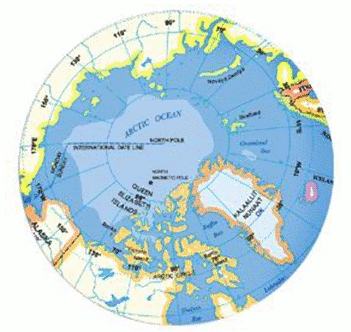
In 1848, when Thomas Roys sailed the Superior through the Bering Strait, effectively becoming the first ship to pass through the narrow water gap between North America and Asia, he wasn't in search of new land, scientific discovery, or even fame.
He was after oil.
The truth is that whale oil prices escalated dramatically during that time period, mostly because whales were becoming scarce. As their numbers decreased rapidly, whalers like Roys were forced to move further into uncharted territory.
This scenario is being replayed again on the world stage. And while the characters are different today, the problem is the same.
Let's face it . . . global demand for oil isn't going away. Soaring demand and depleting reserves are just plain facts we face amidst our ever-growing dependence for oil.
The world currently produces nearly 85 million barrels of oil per day (MMbbls/d), and according to the Energy Information Administration, we will need an additional 13 MMbbls/d just to keep pace with our burgeoning economy over the next eight years.
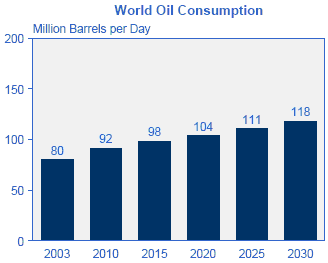
And since no other energy source is ready to take over the reins, oil companies are literally going to the ends of the earth to alleviate this impending crisis.
The Great Untapped Polar Hope . . . or Hype?
Nestled to the north - maybe under Santa's workshop - could be the solution that the oil industry has been looking for.
The U.S. Geological Survey suggests that the Arctic Circle may hold more that 25% of the world's untapped reserves. And this number doesn't reflect the vast unknown potential the area contains. Fact is, the Artic Circle is one of the most unexplored areas left on earth, and could very well include oil fields that would rival those drilled in the Middle East.
This hope, however, is surrounded by much controversy, not to mention the present difficulties faced in producing the oil from such harsh terrain.
Amid possible record oil reserves, certain people are worried that the Arctic's fragile ecosystem would crumble under the rigs and drills of oil exploration.
Environmentalists leading the charge against drilling bring several points forward. One of their contentions is that the Arctic wildlife would suffer dramatically from oil exploration, including such risks as oil spills.
Among their other concerns is global warming. In recent decades, the Arctic has seen the largest increases in average temperatures throughout the world.
Also, the amount of oil that is estimated to be in the Arctic has been challenged lately, with advocates severely lowering the number of reserves calculated by the USGS.
But protesters aren't the largest obstacle for oil companies.
The biggest problem lies in the technology.
Drilling in extreme temperatures like the Arctic is a grueling, laborious task.
In order for the Arctic Circle to become an economic source for oil, new technology will be needed to lower the cost of drilling, or else the protesters may not even need to bring out their markers and placards.
The Geopolitical Arctic Scramble
The Arctic region is about to become the center of attention for exploration and production, and the major oil companies are looking to play.
At the moment, there is a veritable scramble to lay claim on potentially rich property. The problem here, however, are the raging disputes set to ignite from the main countries involved-the U.S., Canada, Russia, Norway, and Denmark.
Conflicts have already surfaced.
The U.S. and Canada quarrel over land in the North West Passage, while Norway and Russia have a similar conflict in the area of the Barents Sea, and whichever way a person looks, disagreements arise. Not to be outdone, Denmark has laid claim over the entire Arctic Circle!
Each country is attempting to carve out its own pieces to exploit the profit that is sure to be generated from oil companies' exploration and future production on the land. The geopolitical Arctic war has already begun, and these countries have all come out swinging.
Time is of the Essence
There is no denying the dire need to find new sources of oil will be upon us in the near future.
And if no clear successor to oil emerges in the next few years with no significant discoveries being made, two factors will remain consistent-demand will increase, and production will decrease.
This will drive oil prices skyward, and when our escalating energy dependence consumes us, it will make $100 oil look like the deal of a lifetime.
Even though we haven't come to that crossroad yet, the question is: will we be prepared to handle it?
Luke Burgess is the managing editor and publisher of GoldWorld.Com. He also writes a weekly column for EnergyAndCapital.Com, and WealthDaily.Net. Furthermore, Luke co-edits The Pure Energy Report and Secret Stock Files with Michael Schaefer.