January 31, 2009
Powering the future
JUSTINE HUNTER
Globe and Mail
January 31, 2009
BC Hydro must cut its greenhouse gas emissions but continue to meet the province's growing power needs, which means choosing either natural gas or electric power as a main fuel source. Both have their supporters. Both need major investment. Both demand a commitment that will be difficult to break. So ... which will it be?
VICTORIA -- In Whistler, green energy comes in turquoise, the colour of a new pipeline running alongside the Sea to Sky Highway. This week, a crew was laying the final 160 metres of the 50-kilometre line. By April, it will be bringing natural gas to Whistler, allowing residents in the resort community to switch their 14,000 propane appliances to run on a cleaner fossil fuel.
In Hecate Strait off the Queen Charlotte Islands, clean energy will be white. It is the only colour option for the wind turbines that are on order. The groundwork for Canada's first offshore wind energy project is laid, not yet in bricks and mortar, but with a partnership agreement this week between NaiKun Wind Development and the Haida Nation. The rotors, 107 metres across, are expected to be spinning their contribution to the electricity grid by 2013.
Natural gas or electric power: Which holds the key to B.C.'s future?
In the face of ever-increasing demand for energy, B.C. must cut greenhouse-gas emissions by one-third of current levels by 2020. That squeeze has produced a quiet power struggle as the two biggest players in the domestic energy market - the people who heat and light homes and businesses - lock horns over territory.
The B.C. government's climate-change directive demands a fundamental change in the energy system that will take years to plan and execute. The province has an abundance of carbon-free energy in the form of hydroelectric power, but it isn't enough to meet even today's needs, much less the future's. B.C. also has a wealth of natural gas that will continue to offer a prime source of energy.
The first public shot in this debate appears to have been fired by Randy Jespersen, CEO of Terasen Gas, speaking at a business luncheon last November.
"My mother always told me that those who live in glass houses should cast no stones," he said as a prelude. Then he set out to demolish the energy plans of his company's chief rival, BC Hydro.
"My suggestion is not so much whether there is forecast error," he told the crowd, "but rather that we understand the consequence of forecast error."
Both utilities must file their forecasts with their regulator, the B.C. Utilities Commission, to ensure that these key services are adequately planning for the future. They should offer a glimpse at the future of energy consumption in British Columbia.
But BC Hydro, Mr. Jespersen argued, isn't calculating for a green future because it has understated the future demands for hydroelectricity. If he is correct, it is a miscalculation that could lead to higher rates, missed emission targets and increased reliance on dirty energy imports.
To advance his case, Mr. Jespersen projected key sections of BC Hydro's own long-term power acquisition plan on a screen for his audience.
That document, which is now before the BCUC for approval, does not account for the potential impact of increasing prices of fossil fuels, which may encourage consumers to switch to electric power. Nor does it fully account for the B.C. government's climate-action plan. It calls for the electrification of truck stops, ports and oil and gas facilities, and it encourages electric vehicles.
What if Mr. Jespersen is right, BC Hydro's CEO, Bob Elton, was asked in a recent interview.
"If he or other people are right and the loads are higher than we think, we track that all the time," he said. "So let's say the recovery is sharper than we expect, and let's say also that some of this fuel switching happens more quickly. There would be indications of it, we would have time to go back and say we need more."
Mr. Jesperson's critique was not an idle sideswipe. His company is competing with the notion that BC Hydro holds the solution to clean energy in the future.
"We need integrated thinking that will use the right energy form for the right application," the natural gas executive said in an interview.
Communities such as Whistler have been persuaded that natural gas is part of a sustainable future. "What is taking place now is all of the rules of play are being written and it's important that there is a willingness to look at all emissions on a net basis," Mr. Jespersen said. "There is no room for fiefdoms with greenhouse gases."
WILL CONSUMERS GO GREEN?
There is no shortage of ideas to supplement and conserve energy. Smart meters in homes. Electric cars in driveways. Tidal currents pushing turbines off Vancouver Island's shores.
The City of North Vancouver is working on a 100-year plan to produce local green energy. The changes are coming one neighbourhood at a time. This spring, a dark array of solar hot-water panels on the roof of the library will be ready to harvest emissions-free energy. In the meantime, a mini-plant provides heat for the building and surrounding neighbourhood with natural-gas-fired boilers.
Policies can change choices, but consumers still shape the market.
Harry Grimm has been in the housing construction industry for 20 years. He's a principal in Portrait Homes, which is currently building a 500-home development in Maple Ridge.
"To me, the game right now is affordability," Mr. Grimm said. The subdivision boasts ecological features that added to the cost of building each unit, but customers are not willing to lay down big bucks for the environment. "They say they like the green space, but if you say, 'It will cost you an extra five thousand dollars,' people say, 'I'd sooner have the granite countertop.' "
In the higher-end homes, he is installing electric hot-water tanks and natural-gas furnaces, but in most multifamily units, the heating is all electric baseboard.
That represents a new trend and one that might have Terasen Gas worried. But the company is building for the future, with two pipeline projects, including the Whistler initiative. As well, it is constructing a $190-million, liquefied natural gas storage facility on Mount Hayes, outside Nanaimo, for its Vancouver Island customers.
BC Hydro's investments are largely absorbed in maintaining its crumbling infrastructure. The corporation is still mostly running on the megaprojects of the 1960s and 70s - held together with "tape and twine," as one official recently put it.
For example, just east of Cranbrook, workers are rebuilding the Aberfeldie Dam, tearing out wood sluices dating back to 1922. When it's completed, the dam will produce five times as much hydroelectric power as before.
For seven of the past 10 years, BC Hydro has failed to produce enough electricity to meet domestic demand. On average, it is importing 10 to 15 per cent of its energy on a net basis, and much of its imports come from "dirty" sources including coal and natural gas located across the province's borders.
As a result, the power coming out of the electric socket is not as clean as one might think. About 17 per cent of BC Hydro's power is produced with fossil fuels.
As part of the province's green energy agenda, BC Hydro has been ordered to wean itself off electricity imports by 2016. Until then, BC Hydro can rely on the markets for shortfalls. After that, it will need additional supplies. It has not decided what those resources will be.
$6-BILLION DAM TOUTED
Many of the "go green" initiatives being touted to reduce B.C.'s greenhouse-gas emissions involve switching from fossil fuels to electricity.
A few weeks ago, BC Hydro participated in an event on the front driveway of the legislature. The B.C. government announced it is converting 34 vehicles into plug-in electric vehicles. A spokesman for the utility was there, enthusiastically speculating that up to 60 per cent of new vehicles on provincial roads by 2025 could be hybrids or fully electric vehicles.
University of Victoria professor Andrew Weaver is one of the world's leading authorities on global warming and climate change. He's also a member of B.C.'s Climate Action Team, helping shape government policy and, he hopes, the future of green energy in B.C.
He is no fan of switching to natural gas as a path to a greener future: "The only solution, to be perfectly blunt, is to go carbon neutral." And the only way to do that, he said, is for BC Hydro to get back in the business of mega-projects. "They should be carving out their niche with the Site C dam," he said.
That option has been on the drawing board for years and now comes with a price tag in excess of $6-billion. It would be built on the Peace River, just southwest of Fort St. John, and would produce enough electricity to provide power for nearly half a million homes.
"I cannot see what is stopping Site C," Prof. Weaver said. "There are environmental consequences, yes, but there are environmental consequences for everything we do and we have to stop using the atmosphere as an unregulated dumping ground."
Mr. Elton was non-committal about Site C. And while he wouldn't take the bait on the gas-versus-electricity debate, he urges consumers to conserve.
British Columbians, in terms of electricity consumption, are gluttons, having enjoyed cheap electricity for decades. There's been little incentive to unplug and switch off. Buried in BC Hydro's long-term plan, however, is a secret weapon: a promise of massive rate increases that may finally make a dent in habits.
"I hope consumers will enjoy that over the next 10, 20 years their bills won't go up," Mr. Elton said. Not because rates won't climb - they will - but because people will learn to use less.
"If we worked in the greenest offices and lived in the greenest homes, we would be consuming far less," he said. "That's the way to go."
*****
THE ECONOMY'S EFFECT
In early October, Bob Elton, CEO of BC Hydro, found himself before the corporation's regulator, the British Columbia Utilities Commission.
At the hearing, a lawyer put him on the spot about the utility's forecasting: "Let's just assume, for the sake of argument, that we're on the front end of a recession which will be felt in British Columbia. ...What kind of implications would that have for BC Hydro's priorities?"
Very little, Mr. Elton replied: "There have been significant ups and downs in this province in the last 40 years. The difference it makes to electricity consumption is not as much as you think."
By December, BC Hydro changed its corporate mind. It announced it would cut its call for green-energy proposals from independent power producers by 40 per cent. The reason? The slowdown in the economy.
Two weeks ago, it offered another revision: "Even this large range [of forecasts] may not necessarily capture all of the uncertainties inherent in possible future demand for electricity," the corporation told its regulator. "BC Hydro does not want to limit its opportunities to acquire cost-effective renewable power."
In a recent interview, Mr. Elton was rather sour on the whole forecasting business.
"If you could get three people in a room agreeing on forecasting right now, I'd like to meet them," he said.
BC Hydro's long-range planning document explains, without apparent irony, that it uses a Monte Carlo model for its forecasts. Presumably, it is not referring to gambling, but to a device designed to negotiate the uncertainty of economic activity, weather and electricity rates. The document selects a mid-range forecast based on the model, and assures the BCUC that it will watch for further developments.
The cut to BC Hydro's green-energy call was poorly received in many quarters, including then-B.C. energy minister Richard Neufeld. Mr. Neufeld, who has since left his post for a Senate appointment, said the corporation needs to build for the future - and it needs to start now.
"You don't start building on Monday and finish on Friday," he said in an interview. "I think too many people think you can build this stuff fast."
Net-importer or not?
BC Hydro's 2008 Annual Report says this:
Total BC generation: 59,995 GWh
Total BC consumption: 53,300 GWh
Surplus: 6,695 GWh
It's pretty clear: in 2008, BC generated considerably more power than British Columbians consumed. And that's the aspect of energy self-sufficiency that we should be concerned about, should it not?
In terms of meeting domestic demand, BC generates or acquires more power than it needs from domestic sources.
Everything else is tied up with the energy trading biz.
Net ...drumroll... EXPORTER!
You can quit reading here, if this stuff bores you. Wonks, read on...
We have talked about and questioned this net-importer story that has served the BC government, BC Hydro, and others so well, for most of this century. Few among us are sure what's really happening, we don't trust the net-importer dogma, so they continue saying "net-importer", we say "baloney", and it goes on and on, like the Everyready Bunny. (Anybody know what you get if you put the battery in the bunny backwards?)
It could cost $5,000 to $10,000 to do an expert analysis of the net sources and dispositions of electricity, and get a definitive answer to the question. I'd like to see that study done, if anyone wants to pony up for it. But then we'd still be left with a Marvin Shaffer vs. Mark Jaccard stand-off; expert vs. expert with most of us still as perplexed and mistrustful as ever.
I've been taking a simpler approach to this question. Once a year, BC Hydro publishes its annual report. It includes tables (see below) showing its costs for power, and where it comes from, and its revenues for power sold, and where it is sold. I think it's pretty persuasive.
The tables also have two great advantages over the $10,000 treatment: they are relatively easy to understand, and they come from the horse's mouth so they are difficult to argue with.
They are the source for the figures I used at the top of this note.
The tables actually include quite a bit more information. You can find BC Hydro's 2008 Annual Report and BC Hydro's other annual reports here.
The tables show that in 2008, BC Hydro sold marginally less energy than it bought, but it still earned $157 million on the trades. And this included a big transfer of energy from the domestic to the trade account.
BC Hydro's notes include this caution: "Prior to fiscal 2008, BC Hydro was a net importer of electricity for seven consecutive years due to average or below average system water conditions every year. Fiscal 2008 was an exceptional inflow year, with inflows well above normal, resulting in BC Hydro being a net seller of electricity. The outlook for fiscal 2009 is for a return to average inflow conditions and, as a result, it is expected that BC Hydro will once again be a net importer of electricity."
Hmm. Let's have a quick look at those previous years. Dunno what they're talking about. It looks like a surplus every year in the domestic accounts AND in the total numbers. The trade figures are less consistent. BC Hydro only started showing trade purchases in 2005; in the four years since, there has been alternating years of more sold than bought, and more power bought than sold. Prior to that, the trade purchases are not broken out in the annual reports. In 2006, when BC Hydro shows that it sold more power than it acquired in the trade account, it still profited $254 million for the year.
Charts here:
"http://www.sqwalk.com/bc2009/BCH2008EnergyCostsTable.gif"
"BCH2008EnergyCostsTable.gif"
One important aspect of this importing issue is that we buy energy from coal-fired generation plants in Alberta and elsewhere. Powerex even has a contract to buy all the output from a coal-fired generater in Montana. If we're going to reduce our carbon emissions, we have to stop doing that. And by the same token, we have to stop exporting fossil fuels - our coal to Japan and Korea and China - and natural gas to the US.
January 29, 2009
Haida Nation and NaiKun Form Landmark Partnership
Agreement a Milestone for Canada's First Offshore Wind Project
News Release
Marketwire
Thu. January 29, 2009
VANCOUVER, BRITISH COLUMBIA, Jan 29, 2009 (Marketwire via COMTEX) -- NaiKun Wind Energy Group Inc. ("NaiKun") (TSX VENTURE:NKW) and the Council of the Haida Nation are pleased to announce the formation of an historic partnership in support of the development of Canada's first offshore wind energy project.
The NaiKun project is located in the traditional territory of the Haida Nation, in British Columbia's Hecate Strait, between Haida Gwaii (the Queen Charlotte Islands) and the mainland.
The partnership will be a commercial limited partnership which will operate and maintain the NaiKun wind energy project after construction. The comprehensive limited partnership agreement provides for maximum benefits to the Haida Nation from the NaiKun project, including revenue sharing, environmental stewardship, and employment and economic development opportunities for the Haida.
The agreement formalizes the relationship between the Haida Nation and NaiKun which has been ongoing since 2002, and builds on the memorandum of understanding signed by the two parties in May 2007.
"The establishment of the limited partnership marks a significant milestone for NaiKun's business relationship with the Haida and is a key step forward for the development of offshore wind energy in British Columbia," said Michael C. Burns, chair of the board of directors at NaiKun.
"This agreement is the result of many years of working together and it reflects the commitment from both partners to move this project forward. NaiKun will gain from the knowledge and insight of the Haida and welcomes the thoughtful support of the Nation and its leaders," said Mr. Burns.
"The Haida people support development that brings benefits of all kinds - individual, commercial and environmental - to Haida Gwaii and to the Haida Nation," said Guujaaw, President of the Haida Nation.
"We fully believe that, subject to confirmation of environmental feasibility, this offshore project will bring significant long-term benefits to the Haida Nation. For these reasons we are proud to be participants in the project," said Guujaaw.
The Haida Nation and NaiKun Wind Operating Inc., a subsidiary of NaiKun, will participate equally in the partnership both in terms of ownership and economic value. NaiKun Wind Operating Inc. is the designated General Partner.
The project is contingent upon receipt of environmental approvals from the Haida Nation and through the harmonized federal/provincial environmental assessment process, and the award of an Electricity Purchase Agreement from BC Hydro.
Training and recruiting for the project will begin immediately to ensure a qualified workforce is in place as activity ramps up for the start of construction in 2012.
In addition to support from local First Nations, the NaiKun project also has strong public support. A public opinion poll conducted for NaiKun by the Mustel Group in September 2008 indicated that 73 per cent of British Columbians support the project.
NaiKun Wind Energy Group Inc. (TSX VENTURE:NKW) is a British Columbia-based renewable energy company that is traded on the TSX Venture Exchange. Additional information is available on NaiKun's website: www.naikun.ca.
SOURCE: NaiKun Wind Energy Group Inc.
NaiKun Wind Energy Group Inc.
Doug McClelland Director,
Communications (604) 631-4487
Email: dmcclelland@naikun.ca
Website: www.naikun.ca
For full details for NKW click here.
January 28, 2009
A test case for tackling the CO-2 challenge
DAVID EBNER
Globe and Mail
January 21, 2009
FORT NELSON, B.C. — The steel exhaust tower, two metres wide and 100 metres high, is the tallest structure for hundreds of kilometres. Located just south of Fort Nelson in remote northeastern British Columbia, it towers against the sky, and it spews invisible, atmosphere-cooking carbon dioxide, even as the temperature on the ground on a sunny mid-November morning is minus 20 C.
The tower, the release point for carbon dioxide extracted from the natural gas processed at Spectra Energy's massive Fort Nelson plant, is the largest emitter of carbon dioxide in the province at about 1.2 million tonnes a year, a figure projected to double as a predicted natural gas boom north of town in the Horn River Basin takes off.
The natural gas below the surface is mingled with carbon dioxide, about 10 per cent of the mix, which is what the Spectra plant currently strips off and emits.
Successfully dealing with the greenhouse gas is going to be crucial to the development of the region, which is home to one of the largest accumulations of natural gas in North America that is in the very early stages of being unlocked with new technology.
Spectra's Fort Nelson gas plant is the focal point for B.C.'s fight against global warming and the area is at the heart of the province's economic future.
Houston-based Spectra is spending $12-million – a quarter of the money coming from a provincial government grant – to assess the geology 2,000 metres below the surface and drill two wells in an effort to establish a suitable reservoir to sequester carbon dioxide.
The geology is likely the simplest part of the equation. Spectra and other large industrial emitters no doubt foresee future legislation limiting carbon dioxide emissions – but myriad, crucial details remain unknown, leaving the likes of Spectra operating in a fog of unknowns.
Among the glaring gaps is the lack of a national and continental legislative framework that would put all participants on a level playing field. Then there are the specifics, such as who would be liable if a below-ground reservoir were punctured and gas escaped – in this case, Spectra or the natural gas companies that had their product processed at Spectra's plant?
“The big open question is commercial. Right now, it doesn't pay to do this,” said Mark Jenkins, a Spectra engineer working on the reservoir project, during a walk around the site on a cold, clear day.
B.C., as part of the 11-member Western Climate Initiative, in the spring introduced cap-and-trade legislation, which would cap industrial emissions and allow companies to buy and sell credits, whether for reducing emissions or to pay for emissions that have not been cut. Details have not been finalized for the province's goal to slash emissions by a third by 2020 – about 21 million tonnes less than a recent estimate of 62 million tonnes of annual carbon dioxide emissions.
Spectra's aim is to emit less carbon dioxide even as it doubles the amount of natural gas it processes. If the company isn't successful, it will be extremely difficult for B.C. to reach its goal.
In neighbouring Alberta, home of the country's biggest emitters, the province is still committed to $2-billion of spending on carbon capture and sequestration technology – particularly for the oil sands – even as the province's surplus evaporates with plunging oil and natural gas policies.
Such movement by the provinces is happening because, after years of languishing, legislative action is percolating on a broader scale in North America. With former president George W. Bush exiting office, change could come quickly. President Barack Obama has said the environment is a key priority regardless of the recession. Prime Minister Stephen Harper acknowledged the likelihood of swift action in the U.S. by appointing a top minister, Jim Prentice, to the environment portfolio.
The Spectra project has already hit a setback, a harbinger of the daunting challenge to implement carbon capture and storage on a wide scale. The company had hoped to be able to inject the carbon dioxide into a saline reservoir below the plant, but the geology assessment showed the supposedly impermeable rock around the reservoir probably wouldn't keep the carbon dioxide in place.
Spectra is now looking at a spot about 15 kilometres from the plant, and pushed back the drilling of a first test well planned for last year to March. A second test well is scheduled for late this year or early 2010, with the goal of full-scale injection of carbon dioxide in 2013, about a year later than planned when the project was announced last spring.
The cost of implementing carbon capture and storage will be significant. While Spectra doesn't have a precise budget, project director Al Laundry said it will definitely be in the hundreds of millions of dollars.
If the cost is $500-million (U.S.), it would amount to 25 cents for every thousand cubic feet of natural gas the plant aims to process over a six-year period. It appears to be a big number but for consumers heating homes, or industries powering factories, the additional cost wouldn't be severe. It amounts to about 5 per cent of the current benchmark price of natural gas – $5 per thousand cubic feet – and is less than many daily price fluctuations of the commodity.
Spectra's Fort Nelson facility currently produces close to 500 million cubic feet of gas for sale daily, which it plans to double as Horn River production increases.
Already, about 50 million cubic feet of gas from Horn River is being sold. Spectra wants to increase output to about one billion cubic feet a day, reopening a part of the plant that was mothballed several years ago after conventional gas production in northeastern B.C. began to fall off.
Spectra's advantage is that it has a ready point source of carbon dioxide, rather than having to capture emissions from various places, a far more difficult task. The processing plant strips out carbon dioxide from natural gas, and a little bit of hydrogen sulphide. The carbon dioxide is vented and the hydrogen sulphide is converted into sulphur.
The gases would be compressed effectively into a liquid form, moved by pipeline to the injection site and pumped underground into a reservoir that could store between 20 and 50 years worth of emissions.
Power is another challenge. About 50 megawatts of power would be required for carbon capture and sequestration, largely for the compressors. That's 10 times more than what the plant currently uses, which Spectra generates itself, and about the same amount as is used by the town of Fort Nelson, population 5,000. Spectra is looking at using gas-powered turbines for about half its power needs and using waste-heat recovery for the rest.
B.C. Liberals selling out our energy future
Ralph Keller, Arthur Caldicott and Jim Abram
Times Colonist
January 28, 2009
Climate and terrain could make us the Saudi Arabia of renewable energy
There is an energy "gold rush" happening in British Columbia. With our mountainous terrain and wet-coast climate, we are poised to become the world's Saudi Arabia of sustainable energy from a variety of sources including run of river, wind and tidal power.
If fully exploited, these resources could create four times more power than B.C. Hydro currently produces, and give us billions of dollars for provincial coffers. But only if the resource remains a public asset, managed for public benefits.
British Columbians have been blessed with renewable, reliable and inexpensive electricity ever since W.A.C. Bennett had the foresight to develop publicly owned hydroelectric power almost 50 years ago. It might have been renewable, but it was not especially green -- ask anyone living in the Peace River country back then.
In 2002, the provincial government prohibited B.C. Hydro from developing new power projects, throwing British Columbia's renewable energy potential to the private energy sector.
Since then, more than a thousand applications have been made for renewable energy projects; 650 "run of river" applications now cover almost every viable river and stream. More than 400 applications are under review for wind, tide and wave permits.
The government has made it easy and inexpensive for private developers to access our water and wind resources. Over the life of the 30- to 40-year Independent Power Producer energy contracts being negotiated, the people of B.C. receive less than four per cent of gross revenues in return for the long-term-use of public resources and guaranteed purchase contracts.
Compared to the 15 to 25 per cent royalties and tax paid by oil and gas companies, our renewable energy resources are a giveaway.
The IPPs claim to be developing zero-emission "Green Power" which is climate friendly. To an extent, this is true. Some projects are about as "green" as energy production gets, and if approved by local communities, they should go ahead.
But many projects come with unacceptably high environmental price tags. Surprisingly, the Environmental Assessment Office has never yet turned down a proposal, but consider the overall impacts of this new gold rush: Roads and transmission lines that will criss-cross B.C.'s wilderness landscapes; thousands of hectares that will be clearcut; river diversion, tunnels and pipelines; massive drilling and blasting operations, with acid rock drainage and soil erosion.
Could these permanent disturbances to almost every coastal watershed really mean no damage to fish and wildlife?
Most disturbing is how the government has disempowered affected communities. Citizens have no meaningful way to engage with power-project applications since provincial legislation has removed local government jurisdiction.
Even if the vast majority of citizens oppose a particular project, the provincial government can (and does) overturn regional and community bylaws. It has ensured the people are voiceless and corporations get the last word.
In the past, B.C. citizens endured the negative social and environmental consequences of hydroelectric developments in the Peace and in the Kootenays.
In exchange, these projects did guarantee British Columbians a legacy of inexpensive and reliable energy, and B.C. Hydro's substantial profits have continued to offset costs of health care, education and other social programs.
Now British Columbia's vast renewable energy resources could lead Canada into a low carbon future and create wealth for its citizens. However, the present gold rush mentality and helter-skelter development is about to leave British Columbians with a new dark legacy of disturbed rivers, degraded landscapes, a tangle of high-voltage transmission lines in every direction -- and no continuing economic benefit.
The B.C. government could set into motion a plan to earn billions of dollars in green energy profits making us the wealthiest province in Canada. It could work with communities to develop energy.
Instead, the government is bent on privatizing our natural heritage and converting our common wealth into shareholder profits. For those corporations, it's green energy in more ways than one.
Ralph Keller is with Coast Mountain Expeditions, Ltd., Arthur Caldicott is a B.C. energy analyst and Jim Abram is a former president of the Union of BC. Municipalities and a director of the Strathcona Regional District.
January 18, 2009
Energy production a key to forestry revitalization
COMMENT: Minister Pat Bell: "I think it is a great window for us to jump through." What is this - suicide forestry?
That's some forestry revitalization strategy - burning trees. BC's version of tropical rainforest devastation. Everywhere trees are coming down for energy production. Bio-this, bio-that - it's all biocide. It does nothing for forests, exacerbates greenhouse gas production (don't kid yourself, burning a tree or combusting soya or cane or corn vegetation is just as much a release of a carbon sink as burning a fossil fuel. We have to stop burning things, folks.), and none of it creates a sustainable economy, let alone ecology. We're smart, no question about it, but still nature understands best how to create a sustainable ecology.
Bell's Ministry has 25 people in China selling BC's timber? Hello! And the dollar return on that is?
By Aaron Orlando
Revelstoke Times Review
January 12, 2009
 B.C. Minister of Forests and Range Pat Bell. (Aaron Orlando/Times Review) |
Forests and Range Minister Pat Bell was on a tour of rural communities in the region last week, including Revelstoke, Nakusp, Castlegar and Nelson. He says he’s looking for ways to reinvigorate the forest industry during the tour and is discussing his proposed four key points for a forestry revitalization.
Bell spoke to members of the Revelstoke Chamber of Commerce and other forestry stakeholders at a luncheon meeting at the Powder Springs Inn on Jan. 5.
Bell, who worked in the harvesting business in the 1990s, says he feels Revelstoke is an example of a community where forestry works. “I do come to this industry with some background and some knowledge and a lot of enthusiasm for what the forest industry can be throughout British Columbia and I think Revelstoke is a great example of something that has worked well in B.C., whether it’s Downie Timber, the Revelstoke Community Forest or the great Ministry of Forests team that we have here in Revelstoke. We’ve all worked well together to present an industry that’s integrated, that works well with recreation backcountry tourism operators and really has been the core and the heart of the community,” he said, adding that it was a model he’d like to see replicated in other communities in the province. “I really think it has been the community engagement that’s done it,” he adds.
Bell says the current market conditions will remain a challenge in the foreseeable future. “I don’t expect that the American market is coming back anytime soon,” he says.
This situation has been a reality under which he’s worked to come up with plans to guide the forest industry into the future.
He then went on to present four key points he’s been working on to guide the transition.
Getting more value out of our forests
“For a long time we’ve looked at our forest stands as a commodity product, as a product that we bring in and create a product quickly, simply and sell it into a market. And we’re price takers, we’re not price makers. We just simply take the product and flog it into a marketplace that may or may not want it,” he says, going on to say this needs to change.
Revelstoke has bucked that trend to some extent, says Bell. It is a model that we need to replicate around the province. “We need to extract more value from each and every log.” He says this extends beyond harvested logs to include what we leave behind in the bush.
During his career in the 1990s his company focused on extracting maximum value from each piece of wood that they touched and sought to take in everything possible. “So I think we need to be far more focused on full utilization of the resource within the principles of good ecosystem management. Clearly there is a role for course woody debris on the forest floor. It’s an important thing for many of our species to live under and create habitat for them, but let’s not use that as an excuse to leave behind significant components of residual material, not fully utilizing the resource.”
Bell says that there are policy barriers that reinforce the status quo that he’s looking to change. For example, harvesters bringing in less desirable materials can have it deducted against an annual allowable cut. “Our staff are looking right now at all the different policies that we have in place to remove those barriers and encourage full utilization.”
The ministry is piloting a lump-sum sales model through BC Timber Sales in which block lots are sold at a fixed price, rather than per cubic metre harvested. “What we’re trying to do is get you to take full value off of that site, whether it be for for wood or post and rail or for grinding it up into pellets or for utilizing in the energy system here in Revelstoke or whatever it has to be.” Maximizing the value for the parcel of land is the goal.
He says the pulp industry in B.C. developed during the 1950s and ‘60s due to efforts to better utilize waste products from dimensional lumber production.
Bell feels we’re in exactly the same situation today. This time around the new products will include energy, pellets, bio-fuels, bio-diesel, bio-ethanol and bio-refining.
He calls these products the “third leg of the forestry stool” when added to the other two legs: dimensional lumber as well as pulp and paper. He extends the metaphor by saying having three legs creates a far more stable base.
Managing silviculture better
Bell says we need to invest in the land base in a better way, reasoning that better silviculture practices can greatly increase the yield from the same plot of land.
Currently, we aren’t focusing enough on the possibilities in silviculture, says Bell. The common practice now is to do the bare minimum to meet legal requirements, but not much more.
A ministry of forests staff team is currently working on plans to reform the silviculture system The goal will be to focus on growing trees in general, not just making boards out of the trees that you grow. “It’s not something that we’ve ever had to turn our minds to, and I’m very excited about this opportunity. I think it is a great window for us to jump through,” says Bell, adding that all of the advanced silviculture jobs will be in rural B.C., which will in turn drive rural economies.
Focusing on China
Bell feels the Chinese market is a huge opportunity. He says the government has focused on introducing a wooden truss system to be used on existing leaky Chinese concrete buildings and has started installing them on houses in Shanghai.
He says in the past we’ve focused on marketing single family homes in China -- a strategy he feels wasn’t successful because they are not suitable due to density issues. “The market in China, I don’t think is the one that we have been chasing. The one we have been chasing is the idea of single family homes. I think we need to build components for their existing structures. I think if the Chinese get used to seeing wood on a regular basis, eventually it will become their product of choice and they will build their entire buildings out of wood as well,” adding it will be a step by step process.
The Chinese market potential is about 1.6 billion board feet per year, which equals about 10 per cent of B.C.’s annual output of about 14 billion board feet per year during a high year. Bell says the roofing market is only a start, saying there is room to move on other construction components. The ministry has 25 full-time staff in China now actively marketing products, in addition to about 15 people from private companies doing the same.
Large commercial wood buildings
Bell says the only real competitor in the institutional building market are buildings made of steel and concrete and that there are lots of opportunity in the sector. Wooden buildings have a much smaller carbon footprint, which is a key marketing tool.
As an example, Bell says the Heather Park Middle School in Prince George, which is located in his riding of Price George North, was made of wood.
Bell makes the pitch that wood buildings have far less of a carbon footprint because carbon is created during the production of steel and concrete, whereas wood is in effect sequestered carbon and remains so for the life of the building.
Using the example of the middle school he says building with wood instead of concrete reduced the amount of carbon released during construction by the equivalent of 10,620 cars being operated for a full year.
He says regardless of your personal beliefs surrounding global warming, this is a great marketing tool and gives the example of the Olympic Skating Oval in Richmond as an aesthetically pleasing example of what can be done with wood.
***
Bell feels that 2009 will be a key year for the industry and that the B.C. industry needs to face challenges head on -- including making tough decisions. “Whenever you are faced with challenging times, as we are today, you need to be prepared to make unpopular decisions because they will establish the right framework for long-term success, and those mean big shifts,” says Bell.
He describes a bright new future for forestry that will come with the development of renewable energy and fuels. “But it won’t be without pain,” he adds.
January 16, 2009
BC Hydro changes tune over green energy cutbacks
COMMENT: BC Hydro said in December that it would be contracting for less energy from IPPs than originally planned, in the latest "green call". But here is CEO Bob Elton a few weeks later, reversing himself. His defense? The "uncertainty of forecasting".
He should know about that. It was in 2002, also in a BC Utilities Commission (BCUC) review, of BC Hydro's own Vancouver Island Generation Project (which was later reintroduced as a private project called Duke Point Power). BC Hydro had rolled out its forecasts showing steadily increasing demand for electricity on Vancouver Island - forecasts it had used to support its contention that the GSX Pipeline was also necessary.
GSX Concerned Citizens Coaltion founding director, and Cobble Hill turkey farmer, Steve Miller, questioned BC Hydro's forecasts and its methods. His analysis was so astute, and his grilling of BC Hydro's lead forecaster so grueling, that BC Hydro disappeared the forecasts, disappeared the forecaster, and came back to the hearing with new forecasts, and this time at least, methods that were explainable, if not accurate. At the time, I don't recall Hydro using the "uncertainty" argument - that's gotta be the sloppiest defense of experts yet.
Elton also knows about having his wrists slapped by government. In 2005, after a year of what might have been some of the best public consultation it has ever done, BC Hydro issued a media alert that it would be releasing its 2005 Integrated Electricity Plan (IEP) at 10:00 Wednesday morning, December 8. The IEP was expected to be fairly green, and bullish on Site C.
But early that same Wednesday, Richard Neufeld, Minister of Energy, Mines and Petroleum Resources, pulled the plug on Elton, and suppressed the IEP. No release at 10:00 that morning. In his column that day, Vaughn Palmer said, "... even as the media advisory for those coming attractions circulated in provincial newsrooms, the Liberals were at work derailing it."
Like the forecasts, the IEP also disappeared. But unlike the new forecasts which were mere weeks in preparation, the IEP was gone for four months. When it re-emerged at the end of March, Site C was now relegated to consultations, and coal given an increased profile.
Here we are again. The IPP lobby was clearly aggrieved at BC Hydro's proposed reduction in power purchases in the present call, and it got the ear of government. The letter BC Hydro sent to the Utilities Commission has all the linguistic bad smells of having been dictated by the Liberal politburo in Victoria.
Palmer's words from 2005 are as apt today: "The B.C. Liberals have [once again] intervened directly in the management of BC Hydro..."
And Chief Judith Sayers is correct, the political pressure did come crashing down. And industry spokesman Dan Potts is on the money, so to speak: "There is no market for power at that price." referring to the price BC Hydro will have to pay for this IPP generated energy.
Government yanks BC Hydro's chain
Exhibit B-12, the January 12 letter to BCUC
BC Hydro changes tune over green energy cutbacks
JUSTINE HUNTERGlobe and Mail
January 15, 2009
Utility cites difficulty forecasting in last month's heavily criticized move to seek drastic reduction in clean power projects
VICTORIA -- Blistered by critics over its plan to scale back contracts for clean electricity because of economic uncertainty, BC Hydro this week moved to "clarify" that it may buy all the clean power it can get.
"We want to be clear that we recognize the uncertainty of forecasting," BC Hydro CEO Bob Elton said in interview.
"I think it would be silly to preclude the opportunities to get green power at a good price."
Last month, the Crown corporation asked its regulators for the authority to reduce its call for green energy projects by 40 per cent, a move welcomed by industrial customers but attacked by proponents of electricity produced without carbon emissions.
But on Jan. 12, a new letter arrived at the B.C. Utilities Commission from BC Hydro, noting that forecasting is a tough business these days.
The amendment to BC Hydro's long-range energy plan, tabled in December, "may not necessarily capture all of the uncertainties inherent in possible future demand for electricity," the letter states.
As a result, the corporation could find itself buying even more green electricity than it had originally planned.
B.C. Energy Minister Richard Neufeld said he was surprised in December when he heard Hydro announce it was cutting back on plans for green energy - and he welcomed the modification to that amendment.
"I think to be fair to Hydro, they were looking at what was happening around them at the time and maybe didn't think out far enough about what the B.C. government's energy plan envisioned."
The province has enacted an energy plan that requires BC Hydro to wean itself off electricity imports - which tend to come from greenhouse-gas-producing sources - by 2016.
BC Hydro routinely trades electricity with its neighbours such as Alberta and Washington State, but the province has been a net importer since the 1990s.
Customers can expect to pay more for greener electric power in the future, Mr. Neufeld acknowledged. "Everybody knows clean energy costs more," he said.
Chief Judy Sayers, of the Hupacasath First Nation, won a national climate-change award last year for her community's green power initiatives.
The Upnit Power Corporation on Vancouver Island started with a single run-of-the-river power project and has two others in the works.
But it has 10 more ventures on the drawing board it intended to submit through the clean energy call.
Ms. Sayers said BC Hydro's clarification this week looks more like backtracking.
"We should be completely independent for power.
"I think some of the political pressure came crashing down and they had to back off."
However, Dan Potts, executive director of the Joint Industry Electricity Steering Committee, said people should understand just how big a price they will pay for greener electricity.
His organization represents Hydro's large industrial customers.
He noted Hydro's long-range energy forecast puts a price tag on that new power at three times what industrial customers currently pay.
"There is no market for power at that price," he said.
"If people want to reduce greenhouse-gas emissions and feel good, then I guess that's what's going to happen. But we hope we can do it by the most cost-effective means possible."
Mr. Elton stressed that the amount of power the corporation will purchase from green energy producers will depend on the price.
"It is a procurement process," he said.
"We'd be very foolish not to remind people that are selling power to us that it's important they sharpen their pencils."
Exhibit B-12, BC Hydro to BC Utilities Commission, 12Jan2009
BChydro
Joanna Sofield
Chief Regulatory Officer
Phone: (604) 623-4046
Fax: (604)623-4407
bchydroregulatorygroup@bchydro.com
January 12, 2009
Ms. Erica M. Hamilton
Commission Secretary
British Columbia Utilities Commission
Sixth Floor - 900 Howe Street
Vancouver, BC V6Z 2N3
Dear Ms. Hamilton:
RE: Project No. 3698514
British Columbia Utilities Commission (BCUC)
British Columbia Hydro and Power Authority (BC Hydro)
2008 Long-Term Acquisition Plan (2008 LTAP)
BC Hydro writes with respect to the Evidentiary Update filed as Exhibit B-10 in the 2008 LTAP proceeding, and in particular with respect to BC Hydro's request for an amendment to the Order sought to reduce the Clean Power Call pre-attrition target to 3,000 GWh per year.
The Evidentiary Update includes a load forecast which projects future electricity needs in British Columbia within a large range of outcomes. Even this large range may not necessarily capture all of the uncertainties inherent in possible future demand for electricity. These uncertainties include those associated with the recovery of the economy which is related to world economic events, as well as opportunities created by British Columbia initiatives. Further uncertainties and opportunities result from the potential future demand created by the transformation to a low carbon economy, a British Columbia initiative as well as a world-wide trend. These further uncertainties and opportunities include the switching from other fuels to electricity for personal transportation, mass transit, heating and other applications. As a result of all of these uncertainties and opportunities, and the 2007 Energy Plan's goal to achieve electricity self-sufficiency by 2016, BC Hydro does not want to limit its opportunities to acquire cost-effective renewable power through competitive processes with independent power producers.
Pursuant to Section 18 of the Clean Power Call Request for Proposals (filed as Appendix M, Exhibit B-1-1), in awarding Electricity Purchase Agreements (EPAs) BC Hydro may in its sole discretion at the time of evaluation consider the load/resource balance, price and other evaluation criteria.
This Clean Power Call evaluation process may result in BC Hydro awarding EPAs up to or greater than the original target of 5,000 GWh per year if the EPAs are cost-effective. Such EPAs would be subject to BCUC review under the Section 71 filing process.
Yours sincerely,
Joanna Sofield
Chief Regulatory Officer
c. BCUC Project No. 3698514 Registered Intervenor Distribution List.
Exhibit B-12, this January 12 letter
Exhibit B-10, the December 22 letter reducing the purchase requirements
Island coal mine working at capacity
COMMENT: The stock market doesn't quite seem to agree with this promotional bumf.

Andrew A. Duffy,
Times Colonist, with files from Bloomberg
January 16, 2009
Hillsborough CEO expects Quinsam is poised for an incredible 2009 to 2010
Uncertainty in the global coal market does not appear to have affected Hillsborough Re-sources, which operates the Quinsam coal mine near Campbell River.
According to Hillsborough CEO David Slater, the Island mine, which produces coal used in the production of cement or in coal-fired electrical plants, is working at full capacity and the company is forecasting a strong 2009.
"I think 2009 and 2010 will be incredible years for us," said Slater, noting a number of domestic and international contracts booked with coal at high prices have the company on firm economic footing. "We are poised for a hell of a year. We have to keep our heads and keep costs under control, but that's the same for any business."
Hillsborough issued an operations and sales update for shareholders yesterday following concerns raised by the uncertainty in the market and announcements by other coal producers of reduced production, likely due to reduced demand in China.
China is the world's biggest user of coal, relying on the fuel for 80 per cent of its power generation, but slashed its overseas purchases for the first time in five years due to slowing economic growth.
Coal imports to China declined by 21 per cent to 40.4 million tonnes last year, the first drop since 2003, when shipments fell 0.5 per cent to 10.76 million tonnes.
In the update, Hillsborough noted it has budgeted to produce 520,000 tonnes from its Quinsam operation, all of which has been spoken for through various contracts, including 300,000 tonnes into the international market at the high price of $137 US per tonne.
"I'd like to say it was foresight and incredible timing, but luck has a part to play in that," said Slater of the high contract price.
The spot price for coal at Richards Bay, South Africa, the largest export terminal for the fuel, hit $83.70 a tonne recently, though that figure remains less than half of the record prices hit last year when the global economy was firing on all cylinders.
According to Slater, the Quinsam mine is working at capacity with 150 full-time workers, and after a 2008 that featured higher-than-expected operating costs, it is poised to improve productivity over the next two years.
In the update to shareholders, the company says new equipment -- part of a $32-million expansion plan announced in 2007 that's designed to double the size of the Quinsam mine -- and a year's experience for new members of its workforce should allow the company to reduce production costs.
Despite what appears to be good news on the horizon, the markets haven't taken much of a shine to the company. Hillsborough's share price (TSX:HLB) closed up $0.03 at $0.215, well off its 52-week high of $2.08.
"I don't know what it takes to get the market to sit up and take notice, but we think it's pretty good news," said Slater. "You just need to get on and prove you're right. If you keep your head and keep doing it, you'll probably be OK."
Hillsborough Resources Limited Updates Operations and Sales
News Release, Hillsborough Resources, 15-Jan-2009VANCOUVER, BRITISH COLUMBIA--(Marketwire - Jan. 15, 2009) - Hillsborough Resources Limited (TSX:HLB) (the "Corporation") provides an operations and sales update to its shareholders to address concerns with respect to the current uncertainty in the coal markets and various announcements by other coal operators.
As a result of favourable sales contracts and operational improvements, Management believes that Hillsborough is positioned to do well during 2009.
Hillsborough has budgeted to produce 520,000 tonnes of Quinsam products during calendar year 2009, all of which has been contracted for. Our upwardly revised projections for 2009 call for an average blended sales price of CDN$125/tonne, which includes 300,000 tonnes into the international market at US$137/tonne with an assumed average exchange rate of CDN to US of $0.838. Management expects that any additional production would be readily sold at market prices.
For the first half of 2009, Vitol has requested the next shipments for mid-March and mid-June.
Hillsborough also advises that new pricing with one of its cement customers will take effect April 1st with a substantial increase due to adjustments based on the contracted producer price index. Sales to other domestic customers are already at or above market prices.
Although Quinsam had higher than forecast production costs through 2008, the mine is much better positioned to improve productivity, to meet production targets, and to reduce costs during 2009. New equipment has been added, the new workforce has become more experienced, and the mine plan has a good balance of development and depillar coal. Blended FOB cash costs are budgeted at CDN$73/tonne. If above noted improvements are achieved, production costs will reduce.
The impact of the downturn in the steel industry and demand for metallurgical coal is being monitored closely by Management at Peace River Coal (PRC). The Trend transition project which is well underway is expected to bring PRC greater capital and management control as well as to deliver a reduced operating cost environment. Options around optimal production will be assessed as more clarity emerges from the customers and market sector.
Further, subject to regulatory and shareholder approval, the directors of the Corporation have approved a new employee share purchase plan to replace its former plan which terminated in accordance with its terms on December 31, 2008, permitting participants to be issued up to a maximum of 2,000,000 common shares, with the Corporation effectively matching 50% of their contributions.
About the Corporation
Hillsborough Resources Limited is a coal mining company that:
- Operates the 500,000 tpy Quinsam underground thermal mine near Campbell River, British Columbia, serving the local and west-coast U.S. cement industry with increasing sales into the export market.
- Is a limited partner in the Peace River Coal Limited Partnership (with 14.1%), which has substantial metallurgical coal properties both in production (Trend Mine) and under development near Tumbler Ridge, British Columbia.
- Owns the Crossville Mine in Tennessee on which options for new mine development are being evaluated but the mine remains in reclamation at this time.
- Holds the Wapiti thermal coal property north of Tumbler Ridge, and is planning development of a mine.
- Holds the Bingay Creek metallurgical coal property located in the Elk Valley region of southeast British Columbia.
Certain statements and information herein, including all statements that are not historical facts, contain forward-looking statements and forward-looking information within the meaning of applicable securities laws. Such forward-looking statements or information include but are not limited to statements or information as to estimates, forecasts, future financial or operating performance of the Corporation, future production, costs of production, capital requirements, operating expenditures, reserve potential, exploration drilling, exploitation activities and activities and events or developments that we expect to occur. Often, but not always, forward-looking statements and information can be identified by the use of words such as "may", "will", "should", "plans", "expects", "intends", "anticipates", "believes", "budget", "forecasted" and "scheduled" or the negative thereof or variations thereon or similar terminology.
With respect to forward-looking statements and information contained herein, we have made numerous assumptions including among other things, assumptions about prices, anticipated costs and our ability to achieve our goals. In particular, our statements regarding future production expectation is based on current existing current resource/reserve estimates, production contracts in place, historical costs and mining conditions.
Forward-looking statements and information are necessarily based upon a number of estimates and assumptions that, while considered by management to be reasonable and to be based on reasonable assumptions, are inherently subject to significant business, economic and competitive uncertainties and contingencies and involve known and unknown risks. Readers are cautioned that any such forward-looking statements and information are not guarantees and there can be no assurance that such statements and information will prove to be accurate, and actual results and future events could differ materially from those anticipated in such statements. Important factors that could cause actual results to differ materially from the Corporation's expectations include adverse exploration or development results; interruptions in the ability of the Corporation to produce coal from any of its mines; inability to meet production volumes required; adverse due diligence findings; re-assessments of corporate or development objectives and requirements; additional technical developments and considerations; unexpected increases in the costs of producing coal; changes in international coal or transportation markets; a rapid change in the value of the Canadian dollar particularly with respect to the US dollar; a fundamental slow down in the North American, Asian or worldwide economies; and other factors. See our recent annual information form and quarterly and annual management's discussion and analysis filed on SEDAR for additional information on risks, uncertainties and other factors relating to the forward-looking statements and information.
Although we have identified factors that would cause actual actions, events or results to differ materially from those disclosed in the forward-looking statements or information, there may be other factors that cause actual results, performance, achievements or events not to be as anticipated, estimated or intended. Accordingly, readers should not place undue reliance on the forward-looking statements or information. We expressly disclaim any intention or obligation to update or revise any forward-looking statements and information whether as a result of new information, future events or otherwise, except as required by law. All written and oral forward-looking statements and information attributable to us or persons acting on our behalf are expressly qualified in their entirety by the foregoing cautionary statements.
January 15, 2009
Tips flowing on pipeline bombings after EnCana reward offered
By Jamie Hall
Edmonton Journal
January 14, 2009
EDMONTON — Police have received more than a dozen tips since EnCana’s offer Tuesday of a $500,000 reward for information leading to the arrest of the pipeline bomber near Dawson Creek, B.C.
RCMP spokesman Sgt. Tim Shields said of as 5 p.m. Tuesday, 11 phone calls were logged through its dedicated tip line — 1-866-994-7473 — “and there have been more today but I know don’t exactly how many.”
The reward was called an “act of desperation” by terrorism expert Paul Joosee, who pointed to a lengthy investigation by police which has netted few solid leads and no prime suspect.
Since mid-October, a total of four explosions targeted EnCana’s sour gas operations in northeastern B.C., the most recent on Jan. 4 when a bomb blew apart a wall of a shed housing a sour-gas pipe.
Police say although no one has been injured yet, each successive bombing is getting closer to populated areas around the Tomslake community, prompting investigators to label the attacks “increasingly violent.”
Shields said police are also increasingly frustrated by the continued lack of co-operation shown by the “persons of interest” first identified during a press conference in early December.
Shields said the “small group” of individuals — he declined to say how many there are — either won’t talk to police at all anymore or, if they are still talking, “won’t talk about what we want to talk about.”
“They know who they are,” said Shields.
He stressed that they are not only hindering the overall investigation, but are stopping police from eliminating them as suspects once and for all.
“It’s proving to be difficult because we recognize the vast majority of people who have surfaced during the course of the investigation are going to be innocent, and our goal is to clear these people and eliminate them as quickly as possible,” said Shields.
“So, since we have a group of ‘persons of interest,’ we know that we want to be able to clear them, so, please, help us clear you.”
Shields characterized at least some of the tips received so far as being "very low quality,” but investigators are hopeful more substantive information will soon be forthcoming.
“We’re continuing to process all information, and all leads,” said Shields.
“It’s been a long and intense investigation, but we are still moving forward.”
© Copyright (c) The Edmonton Journal
See also
Encana to announce reward into B.C. pipeline bombings
Pipeline bombers probably local: expert
RCMP blows pipeline bombing investigation
Sabotage fears flow around B.C. pipelines
Third blast rocks B.C. pipeline
Six recent pipeline incidents, commission says
Oil vandal questioned in B.C. pipeline bombings
Somebody local with a grudge targeting oilpatch?
2nd explosion rocks northern B.C. pipeline
RCMP terror squad probes pipeline bombing
January 13, 2009
Powerlines linked to leukemia in B.C. report
By Pamela Fayerman
Vancouver Sun
January 12, 2009
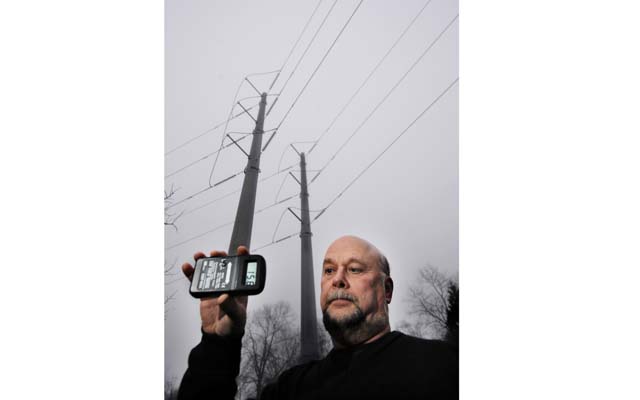 Cecil Dunn, a spokesman for the Tsawwassen Residents Against Higher Voltage Overhead Lines(TRAHVOL), stands under the lines along 53A Street. In his hand is a EMF tester, which measures the electromagnetic field. Photograph by: Stuart Davis, Vancouver Sun |
METRO VANCOUVER -- Living close to high-voltage power lines may produce one additional case of leukemia every two years in B.C., according to “ballpark assumptions” by B.C. Centre for Disease Control environmental health experts.
The projection by Dr. Ray Copes, director of the environmental health services division and Prabjit Barn, an environmental health scientist, is in an article headlined “Is living near power lines bad for our health?” in the November issue of the B.C. Medical Journal (BCMJ).
Government spokesman Jake Jacobs said the government was not influenced by the article when it decided to offer to buy homes along a controversial, upgraded B.C. Hydro right of way in Tsawwassen.
“The government had already made that decision several months ago,” Jacobs said in an interview. “The homeowners were offered this olive branch because of the high anxiety and because it was deemed as the reasonable thing to do.”
Cecil Dunn, spokesman for the property owners who spent nearly five years fighting the power-line upgrade, which was completed last year, said there are only a few days left for the owners to decide if they want to take part in the Home Purchase Offer Program.
It was expected that most owners of the 138 properties under the power line will seek appraisals, the first step in the process towards government purchase of the properties.
Dunn said he was not surprised the decision to buy the homes was made independent of the latest medical research.
“The government has always been aware of the liability but wouldn’t admit it. Now they are trying to quiet us down before the next provincial election.”
In the BCMJ article, Copes and Barn say that the International Agency for Research on Cancer regards as “sufficiently well established” the evidence that electromagnetic fields (EMF) are “associated” with childhood leukemia. Association does not show proof of cause but it is commonly a level of evidence found in epidemiological studies, such as those done decades ago which showed an association between smoking and lung cancer.
The B.C. authors focus on a 2005 British study which found that there is an increased risk of 69 per cent for leukemia in children living within 200 metres of power lines. The risk is increased to 23 per cent if children live 200 to 600 metres of the lines. In Tsawwassen, the power lines literally run right over more than 100 homes.
Copes said there have been so many studies that have found an association between power lines and childhood leukemia that “while one cannot presume EMF causes cancer, one also cannot ignore the pattern that has emerged over several studies.”
“The relative risk is modest but it is not zero,” said Copes, adding the British study was used to come up with the B.C. figure of one extra case every two years.
“Using current B.C. leukemia rates and assuming similar proportions of the population live near high voltage lines, on a statistical basis, there may be one additional leukemia in B.C. every two years. To eliminate this risk, one would need to achieve a separation distance of 600 metres between every high voltage power line and the nearest residence,” he said.
In 2005, the most recent year for which comprehensive B.C. Cancer Agency data exists, 38 children in B.C. were diagnosed with leukemia. The Fraser health region, which encompasses Tsawwassen, was the region with the highest tally of both children and adults diagnosed with leukemia. It is also the most populated region in the province.
About 520 adults are diagnosed with leukemia across the whole province each year.
Barbara Kaminsky, chief executive officer of the Canadian Cancer Society’s B.C. and Yukon division, said she had not read the article, but while one additional case every two years may not seem like a significantly increased risk, “if it is your son or daughter, then it is a big deal.”
Kaminsky said her organization has not changed its position from 2006 when it submitted a brief to the Environmental Assessment Office and the B.C. Utilities Commission that while there is insufficient evidence to either rule out or confirm a definitive link between exposure to EMF and leukemia, the potential carcinogenic effect does engender public concern, and so when it is practical to do so, power lines in close proximity to homes and schools should be avoided.
Sun Health Issues Reporter
pfayerman@vancouversun.com
© Copyright (c) The Vancouver Sun
Is living near power lines bad for our health?
Ray Copes, MD & Prabjit Barn, MScBC Medical Journal
Vol. 50, No. 9, November 2008
page(s) 494—BC Centre for Disease Control
The debate of whether there are adverse effects associated with electromagnetic fields from living close to high-voltage power lines has raged for years. While research indicates that large risks are not present, the possibility of a relatively small risk cannot be conclusively excluded.
Electromagnetic fields (EMFs) are produced by electrical appliances, electrical wiring, and power lines, and everyone is exposed to them at some level. Numerous studies have investigated EMF exposure and health. Although earlier studies did suggest associations between exposure and a variety of health effects including brain cancer, breast cancer, cardiovascular disease, and reproductive and developmental disorders, most of these associations have not been substantiated by more recent research. One notable exception to this is the association with childhood leukemia, which the International Agency for Research on Cancer regards as sufficiently well established to rate extremely low frequency magnetic fields as a “possible” human carcinogen.
The first study to link childhood leukemia with residential EMF exposure was published in 19792 and since then, a number of studies have found weak associations to support this original finding. Studies investigating childhood leukemia as a health outcome of EMF exposure have used measured and calculated magnetic fields, as well as distance of homes to power lines, as an exposure measure. Studies using magnetic field strength as an exposure measure have found that exposures greater than the range of 0.3 to 0.4 µT lead to a doubling risk of leukemia, with very little risk below this level. This exposure range is approximately equal to a distance of 60 m within a high-voltage power line of 500 kV.
However, a more recent study showed an elevated risk of leukemia among children living in homes with distances much greater than 60 m from high voltage power lines. This study involved close to 30000 matched case-control pairs of children living in the United Kingdom. It was found that children living in homes as far as 600 m from power lines had an elevated risk of leukemia. An increased risk of 69% for leukemia was found for children living within 200 m of power lines while an increased risk of 23% was found for children living within 200 to 600 m of the lines. This study was notable in that it found some elevation of risk at much greater distances than previous studies.
Although distance of homes from power lines can be considered a crude measure of exposure, the results of this study do merit attention. A limited understanding exists of how exposure to EMF can affect health. The underlying biological mechanism is unknown, making it difficult to determine which measure of EMF is most appropriate when evaluating health outcomes. Use of residential proximity may be a reasonable surrogate for direct measurements of EMF, but may also reflect other factors that are related to proximity to high voltage lines.
If the association found in the UK study does reflect a causal relationship, what are the potential impacts in BC? Using current BC leukemia rates and assuming similar proportions of the population live near high voltage lines, on a statistical basis, there may be one additional leukemia in BC every 2 years. To eliminate this risk, one would need to achieve a separation distance of 600 m between every high voltage power line and the nearest residence. While this could be done, it would require substantial changes to existing land use patterns and would require significant resources. While it can be argued that this action is consistent with some forms of the precautionary principle, based on best available evidence, one can achieve much greater risk reduction or health benefits if resources are directed to other larger, better established risks.
Dr Copes is the director of BCCDC’s Environmental Health Services Division. Ms Barn is an environmental health scientist at BCCDC.
January 12, 2009
EnCana to announce reward into B.C. pipeline bombings
By Linda Nguyen
Vancouver Sun
January 13, 2009
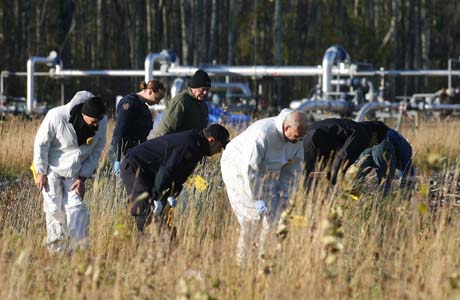 No one has been injured in the explosions, but police have said they fear the attacks are becoming increasingly violent. A cash reward, offered by EnCana, is expected to be announced as incentive for information on Tuesday. Photograph by: Handout, Canwest News Service |
DAWSON CREEK, B.C. - A “very significant cash reward” was set to be announced Tuesday in a joint news conference held by the RCMP and EnCana Corporation, an oil company that has been targeted in recent bombing attacks in northeastern B.C.
The reward was being offered in hopes of attracting more leads for police who have been investigating the case since the first section of EnCana’s sour gas line was bombed on Oct. 12, 2008. The explosion caused a two-metre crater under a pipeline south of the hamlet of Tomslake, about 30 kilometres south of Dawson Creek.
Four days later, another bomb farther down the road actually cracked a pipeline and caused a small amount of gas to leak out.
A third wellhead was hit and leaked on Oct. 31.
The most recent attack occurred on Jan. 4, when a fourth bomb blew apart a wall of a shed that housed a sour gas pipe. The targeted shed is just across the road from a house where a family with two young children live, causing RCMP to label the attacks as “increasingly violent.”
B.C. RCMP say there were currently no prime suspects in the investigation.
And a few residents in the small community have refused to co-operate with RCMP for various reasons even though a significant sour gas leak could be fatal.
The natural gas that flows through most of the pipes in the area contains deadly hydrogen sulphide, the compound that makes the gas “sour.”
Police were also continuing to look into whether the bombings are part of an “eco-terrorism” plot but say it is too premature to label it as such.
© Copyright (c) Canwest News Service
Neighbours frantic to catch pipeline bomber
Laura DrakeCalgary Herald
Monday, January 12, 2009
'Gave DNA Samples'; Pipeline attacks in B. C. spawn fear, suspicion
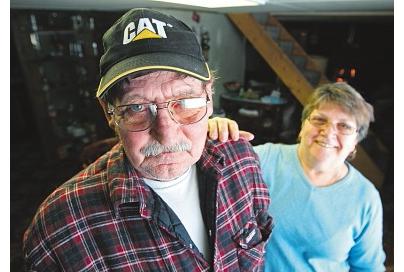 Willy Webster, with his wife Lisa, says "they think we are all criminals."John Lucas, Canwest News ServiceWilly Webster, with his wife Lisa, says "they think we are all criminals." |
TOMSLAKE, B. C. - After the first pipeline bombing, En-Cana security trucks drove up and down the darkened rural roads of the remote area of northeastern British Columbia every night, headlights flashing into the windows of houses along the unlit gravel pathways.
Jake Hebert was driving home one night during the height of it all, after a long stretch away for work. He was just about home when the security people pulled him over. When asked what he was doing, he explained he was heading back to the house he had lived in for 20 years.
"One was shining a light in my face and the other one was crawling under my truck," Mr. Hebert recalled.
"It was unbelievable."
Not long after, the fourth bomb in three months targeting EnCana's natural gas equipment in the area went off only 300 metres from the Tomslake-area cabin where Mr. Hebert lives with his mother, Lisa Webster, and her husband, Willy.
Tomslake, about 28 kilometres south of Dawson Creek, was previously most famous for being settled by Germans who fled Nazi persecution. Then, on Oct. 12, 2007, a two-metre crater from an explosion was found under a pipeline south of the hamlet. Four days later, another bomb further down the road actually cracked a pipeline and caused a small amount of gas to leak out.
A third wellhead was hit and leaked on Oct. 31. And Jan. 4, a fourth bomb blew apart a wall of a shed that housed a sour gas pipe. The targeted shed is just across the road from a house where a family with two young children live, causing RCMP to label the attacks as "increasingly violent."
The bombings have cast a pall over the small, tight-knit community of several hundred who live around Tomslake. Residents want desperately for the culprit to be caught -- not only because of fears that an explosion could trigger a fatal gas leak, but also to lift the cloud of suspicion that has fallen over them and their neighbours.
The cabin made of thick, knotted logs where Lisa and Willy Webster have lived for 20 years is only a few metres back from a rural road.
"Now security will drive by and stop and look in the windows and it's like, what do you think we're doing, building bombs at the kitchen table?" Mr. Hebert said.
"They think we're all criminals," Mr. Webster added.
Mr. Hebert said a close friend, who was part of a small sit-in to protest the oil and gas presence in the spring, was one of the first to face harsh scrutiny from authorities. "He finally just gave them DNA samples because he had enough," he said.
He is not the only one whose innocence was questioned because of objections to the oil and gas presence.
Jim and Jan Zacharias, who live several kilometres away from the Websters, heard their name was floated in connection with the attacks during some police interviews.
"The RCMP have been at our neighbour's house, saying 'Wouldn't those Zachariases be the kind of people to do this?' They just laughed," Ms. Zacharias said.
Though they have not participated in any protests or sit-ins, they have started a group called Citizens for Responsible Energy Development in the Peace. They have EnCana on speed dial. And they are well-known for their views on the industry, which has had a large impact on their lives in the last half decade.
However, the couple said they would not stop voicing their opposition to the oil and gas companies for fear of appearing suspect. "When this bomb went off here, everyone was all, 'You must be scared, you must be pissed,'" Mr. Zacharias said. "My concerns are the oil and gas, not the bomber. I'd rather he'd stop."
But at the same time, he's the reason people are finally paying attention," Ms. Zacharias added.
No one knows who is behind the attacks or why they are happening. The bombings are the most popular conversation topic between Tomslake and Dawson Creek, and everyone has a theory on who it is, be it a radical environmentalist, a disgruntled land owner or an ex-oilfield employee.
B. C. RCMP Sergeant Tim Shields said there is no prime suspect in the investigation.
See also
Pipeline bombers probably local: expert
RCMP blows pipeline bombing investigation
Sabotage fears flow around B.C. pipelines
Third blast rocks B.C. pipeline
Six recent pipeline incidents, commission says
Oil vandal questioned in B.C. pipeline bombings
Somebody local with a grudge targeting oilpatch?
2nd explosion rocks northern B.C. pipeline
RCMP terror squad probes pipeline bombing
January 09, 2009
B.C. beckons ... and EnCana comes calling
PATRICK BRETHOUR
Globe and Mail
January 9, 2009
VANCOUVER -- As symbols go, EnCana's proposed natural gas plant in northeastern B.C. is big, in every sense of the word.
For a start, there is the price tag for the Cabin Gas Plant in the Horn River Basin: $400-million for its first phase, and likely up to $2-billion if all six phases were to be built. The numbers are impressive, particularly since EnCana is contemplating that magnitude of investment amid widespread retrenchment in the energy industry. But the real significance of the Cabin plant will be as a visible reminder of the shift of energy capital from Alberta to British Columbia.
EnCana, Canada's natural gas heavyweight, epitomizes that shift. A half-decade ago, EnCana spent 70 cents out of every dollar of its capital budget for its foothills division within Alberta, with the remainder slated for B.C. Now, 50 cents out of every capital dollar for that division is being plowed into northeastern B.C., even as the overall capital budget has grown.
Mike Graham, executive vice-president and president of EnCana's foothills division, has high hopes for B.C.'s natural gas deposits in shale rock, which have until very recently been out of reach for the industry for both technological and economic reasons. "It's really emerging as one of the tremendous gas basins in North America," he says. The northeast as a whole could rival the "granddaddy" of shale plays, the Barnett Shale formation in Texas.
The numbers Mr. Graham recites for the size of B.C.'s possible gas riches are eye-popping. The Horn River Basin alone has 200 trillion cubic feet of natural gas "in place." That is one of the more expansive measurements of natural gas resources, but it is still impressive. At B.C.'s current rate of production, reserves of that magnitude would last for two centuries.
Further south is the Montney play, near Dawson Creek, where Mr. Graham says 500 trillion cubic feet could be waiting to be tapped. To review: If the energy industry were able to fully tap both those formations, the province could coast on current production levels until 2710 or so.
Now, that won't happen. Ultimate production is invariably smaller than the measure of gas in place. Whatever the percentage that is recovered, an enormous opportunity beckons in northeastern B.C., and one that is now being recognized and acted upon by the energy industry - witness EnCana's low-key moves to build its plant, along with the more publicized bidding war for land rights in the area.
Why the flurry of interest, given that the natural gas has been there for hundreds of millions of years? As with everything in the energy industry, it is the intersection of market demand and technology, swirling around to alter the economics of production and transform geographical oddities into hot commodities.
Shale formations have been tough to exploit; the rock formation is just not conducive to mainstream production techniques. The rough terrain of northeastern B.C. merely added to the challenge - not only were producing wells difficult to come by, but it was a slog just to get into position.
The rise in gas prices this decade (even with the recent dips of late
2008) means that profitability now beckons for technically challenging resources. Problem is, higher prices benefit every well across the planet
- taken alone they're not enough to guarantee that B.C. secures investment.
Technology has played a major role as well, in a way that more directly helps B.C.'s shale resources. Advances in horizontal drilling, and in techniques for fracturing rock deep underground, have driven down the costs of drilling wells in shale. Problem is, those technical advances benefit every shale play in existence. Again, taken alone, technology is not enough to guarantee that B.C.'s resources are fully exploited.
There is a third factor that Mr. Graham cites, one that is seemingly tipping the balance in B.C.'s favour: smart government policy. The Alberta government's hither-and-thither efforts to increase royalties clearly still sting the energy industry. British Columbia, by contrast, kicked in $100-million in royalty credits to help EnCana build roads it needed in the northeast. The company spent $1-billion, and got the infrastructure it needed. B.C. got roads, a modern bridge and an expanded natural gas industry, giving up only a comparative pittance in royalty revenue.
For his part, Mr. Graham makes his point by praising British Columbia's flexibility. "Some listen, and some don't."
Coal-bed methane industry finds a home in Peace Country
Scott Simpson,
VANCOUVER SUN
January 9, 2009
Canada Energy Partners wins over Hudson's Hope and becomes a first in B.C.
Condemned in many British Columbia communities as an environmental hazard, coal-bed methane development has found a home in the Peace River Valley.
A junior gas exploration company with a head office in Vancouver, a CEO from Baton Rouge, La., and a drilling partner from Texas, has succeeded where industry giants including Shell, Encana and BP, have faltered.
The Vancouver junior, Canada Energy Partners, and Texas-based GeoMet Inc.
announced earlier this week that they'd begun commercial shipment of coal-bed methane from an initial spate of wells in the vicinity of the historic northeast B.C. town of Hudson's Hope.
It is the first coal-bed gas project in B.C., where controversy has dogged every effort by the government to develop a potentially lucrative resource, to reach commercial production.
"There has been real resistance in the Fernie area, real resistance in Smithers, Vancouver Island, Princeton, Klappan," Baton Rouge native Ben Jones, president and CEO of Canada Energy, drawled in a telephone interview. "Our area is about the only one that has been sailing along -- with bumps, some stormy weather, but [it] has continued to sail."
Jones first came to B.C. in 1999 and acquired his first drilling lease for coal-bed methane in 2001, just as the government was gearing up to promote it.
He got the rights for an average $120 a hectare in an area of the province where recent bids exceed 100 times that amount, and multinationals such as Talisman Energy are talking about 10-year, $7.5-billion investments in coal-bed methane development.
So far Canada Energy and GeoMet, through subsidiary Hudson's Hope Gas, have drilled eight wells, with three now in production and five in the process of pumping out underground water so that the gas can begin to flow.
"With conventional exploration, your best production is at the beginning.
The best day is the first day and everything is downhill from there, whereas in coal-bed methane it's exactly the opposite," Jones said.
"These things will build over time, but it makes for an excruciating manager's life because it will make you pull your hair out.
"We will not have recouped our sunk costs probably for several years, but we could be in a positive cash flow as to our lease-operating expenses this year."
The global financial crisis hasn't hurt and Canada Energy chairman John Proust said it's not likely to pose future problems.
"We were very fortunate to do a significant financing prior to the market coming down, so we are well financed," he said from his Vancouver office.
"We've got approximately $16 million in our treasury currently and that takes us well through this year, well through next year."
In addition, he noted, Canada Energy has a development agreement with Crew Energy to undertake shallow and deep gas drilling on its properties in the Peace Region, which could bring in additional resource revenue.
Proust notes that the company could drill as many as 315 wells on its coal-bed project alone.
Since 2003, coal-bed methane, or CBM, has on three occasions been the subject of resolutions by the Union of B.C. Municipalities urging the province to deal exhaustively with community concerns before another well is drilled.
The principal fear is a repeat of environmental disasters that took place in the United States, notably Wyoming, as unsophisticated drilling efforts caused breaches in underground coal seams that allowed gas and saline water to contaminate aquifers containing potable water in the vicinity, and careless surface disposal of saline water that contaminated the landscape.
Those problems did not go unnoticed here in B.C.
Last month, the province announced a two-year moratorium on Shell Canada's drilling efforts in the Klappan coal field in northwest B.C., where aboriginal groups, environmentalists and local politicians were united in opposition to drilling on the premise that it could lead to contamination of drinking water and salmon streams.
Canada Energy and its 50-per-cent partner, Geomet, meanwhile, have worked through their issues and are now generally regarded in Hudson's Hope as a model of good corporate citizenry.
Jones noted that northeast B.C. is already home to a booming natural gas industry that has bolstered the province's finances at a time when resource revenues from forestry are crashing.
"Most of those people there were more familiar with oil and gas operations than any of these other areas. I think that was part of the reason we've been able to proceed along.
"And I want to compliment Hudson's Hope. It's a community of a lot of good people and most of them are fairly reasonable. Some of the most vociferous opponents of CBM, I have very positive, constructive dialogue with."
The harshest critic in Hudson's Hope, local landowner Steve Metzger, has concluded that there is little risk to the city's water supply.
"I'm never one who would say it's impossible for the methane to get into our water supplies here. But I'm not personally concerned about that," Metzger said in a telephone interview. "I understand how far away the gas is from where our water supplies come from and it's real unlikely that that's going to be a problem."
Metzger is resigned to the presence of the industry in the community, but remains concerned about the possible industrialization of the local landscape as more wells are developed.
Even on this issue, he's taking a wait-and-see attitude. "It got to the point where, you know, it's gone ahead and it's not going to stop.
"The focus has shifted to, 'Okay, it's here, how can we deal with it?' "
Fort St. John MLA Richard Neufeld, B.C.'s energy minister since May 2001, said he never imagined it would take so long for the industry to gain a foothold in B.C.
"I think it will be a little bit slower than what I had hoped for, and maybe in retrospect, that's not that bad," Neufeld said. "I think you do have to let people get accustomed to it, and now that we have one area that's producing coal-bed gas into a sales line, that's good news we can talk about in the rest of the province."
Hudson's Hope Mayor Karen Anderson said a fraction of the community is still expressing negative opinions about the industry, "but on the whole, I am quite pleased with Hudson's Hope Gas and the way they have gone forth with this venture of theirs."
"We heard some horror stories of things that went on in the States," Anderson said. "We did not let that scare us. We took an open-mind approach and had those [stories] investigated. We had the pros and the cons come and talk to us.
"We decided that we are a little community, that we are looking for growth in our community, that we are welcoming businesses within our community.
They are just another type of a business and they have really stepped up to the plate and been really forthright with us.
"Personally, and I think I can talk for the majority of council, we are quite happy with the working relationship we have with Hudson's Hope Gas."
How much is out there
Scott Simpson,Vancouver Sun
January 9, 2009
- B.C. is estimated to have a total coal-bed methane resource equivalent to at least 50 years' worth of conventional natural gas production.
- If industry can tap into that resource, it will generate billions of new royalty revenue dollars for the provincial treasury although the exact value will depend on the North American market price of natural gas over time.
- Coal-bed methane production is expanding in Alberta, Australia, China and the United States, where it now accounts for about 10 per cent of annual gas production.
What is coal-bed methane?
Vancouver SunJanuary 9, 2009
Coal-bed methane is the natural gas found in most coal deposits. It is virtually identical to the natural gas found underground in conventional sandstone formations. It was created, along with coal, as buried plant material was converted into coal over millions of years. The methane is effectively locked into the coal by the pressure created from being underground, and by saline water that sits in all the fractures where the gas might otherwise be able to seep. When the coal seam is drilled and the water is pumped out, the gas can begin to flow out of the coal, and becomes available to the gas producer. The resulting gas is typically a pure or "sweet" gas that requires very little processing before it can be passed along to consumers for home heating.
THE DEBATE
Controversy has dogged the B.C. government's efforts to establish a coal-bed methane industry. Disastrous events in some U.S. jurisdictions where the industry was allowed to proceed without proper environmental scrutiny has led to contamination of drinking water aquifers, livestock watering ponds, rivers and fields. That influenced many communities in B.C. which have been reluctant to see coal-bed methane reserves developed.
The industry's biggest challenge is managing the volume of water, often with a high sodium content, that must be pumped out of underground coal seams before coal-bed gas begins to flow.
THE FIX
Hudson's Hope Gas and its shareholders, Canada Energy Partnership and Geomet Inc., have addressed most community concerns through consultation and local investment. Water from its wells is removed by tanker truck and reinjected into spent gas wells near Fort St. John. According to the government, applications to re-inject water must be approved by the Oil and Gas Commission, and companies must keep this water isolated from potential groundwater zones. All disposal wells are lined with steel casing that is cemented into the well bore.
January 08, 2009
Gordon Campbell's green dream meets the new world
COMMENT: More basically silly analysis on energy issues from the mainstream media.
1. 3,000 or 5,000 gigawatt-hours, not gigawatts
2. 3,000 GWh would, on average, be enough to power 200,000 homes, but not EVs as well
3. BC Hydro predicts some 30% attrition from the call, so they really only expect to get 2,100 GWh.
4. This is not BC Hydro versus the government: The government gave BC Hydro and the Utilities Commission some very clear instructions to pursue energy conservation before new supply, and this is what Hydro is doing. Yes, there is somewhat of an inbuilt conflict between the idea of having a green IPP industry and maximizing conservation.
5. A really big problem with developing the IPP industry is high costs. Conservation is much cheaper. The spot market is generally cheaper. On top of that, the IPP industry has been hit by construction costs and financing difficulties (on top of the government's decision to force coal projects to capture carbon), such that Hydro now expects the 2006 Call winners only to deliver some 2,300 GWh/yr, a 67% attrition rate from the 7,100 GWh that was awarded. 2,033 GWh/y is attributable to the coal plants. If those are excluded from the calculation, attrition is 55% after signing EPAs with Hydro, due to the variety of financing, construction and in some cases fuel supply problems.
So, yes the green industry is in trouble, but it's due to a lot more than a decision by BC Hydro.
Tom Hackney, Policy Chair
BC Sustainable Energy Association
(250) 381-4463
thackney@shaw.ca
www.bcsea.org
By Miro Cernetig
Vancouver Sun
January 7, 2009
Premier Gordon Campbell's dream of making Vancouver, and British Columbia, a continental hub of green-power generation may be short-circuited -- by one of his government's own Crown corporations.
BC Hydro wants to cut its future demand for new, renewable power by a whopping 40 per cent. Instead of ordering up 5,000 gigawatts of new, green energy by 2016, the utility now says it needs to put out a "call" for only 3,000 gigawatts of green power.
This green power reduction -- enough electrons to power approximately 200,000 households and tens of thousands of electric cars -- is somewhat of a shock on political and economic fronts.
First, it means big trouble for the business plans of all those B.C. companies that want to build wind turbine farms, put up solar power panels or construct micro-dams for so-called run-of-river hydro projects. BC Hydro, in a report quietly filed with the B.C. Utilities Commission a few days before Christmas, is essentially anticipating a 40-per-cent cut in the province's future green electricity.
A few months ago, when BC Hydro made its call for that renewable power, it attracted 68 proposals, promising up to 17,000 gigawatts of new power a year. Now, if Hydro gets its way, this emerging sector -- which the B.C. government sees as a rising industry -- will see a deep cut in its domestic market. Only a handful of the proposals would likely survive.
This may delight some environmentalists. Although they don't generate greenhouse gases, many wind projects and run-of-the-river schemes are seen as despoilers of virgin wilderness.
But their demise, or delay for a decade or more, will come at a cost to the provincial economy, too.
The green-power industry says its proposals to create 5,000 gigawatts of new power by 2016 represent about $5 billion in investment and 4,500 years of employment -- not inconsequential in a period when the province's economy is turning down. That investment and employment will be almost cut in half if the B.C. Utilities Commission approves Hydro's plans for a reduction.
BC Hydro has put together a carefully considered argument for delaying its green-power needs. In a 100-page submission to the commission, it says higher prices for electricity passed on to its customers, along with conservation measures, will mean energy savings and reduced consumption.
It also offers up a rather bleak -- but realistic -- assessment of the province's economy. BC Hydro forecasts "a general forecast slowdown in economic activity over the next 24 months. This slowdown is due to a decline in the global and domestic demand for commodities and materials and the impacts of the financial and credit crisis."
There is a glimmer of hope in the document -- though it won't manifest itself until 2011 or so. "This downturn is," Hydro estimates, "not expected to be structural. That is, after the current slowdown, the rate of economic growth is expected to resume."
BC Hydro's bean-counters and power analysts have reams of documents to rationalize this policy reversal. It's probably a prudent bottom-line decision from a bottom-line perspective.
But it raises larger political issues. The question now being hotly debated within the Campbell government, which has staked its future on being a leader on renewable energy, is whether the utility is being short-sighted and hurting the government's long-term economic strategy.
Remember, Premier Campbell has staked his reputation on making B.C. a leader in reducing its carbon footprint. He has promised plentiful green power will also present a competitive advantage in a future when carbon emissions are a liability. Plentiful green power is part of the premier's 21st-century industrial strategy.
The premier's green dream is in danger of being seriously downscaled. The question for the B.C. Utilities Commission, which has the power to green-light or re-reject Hydro's plans, is who it thinks has the best bead on the future.
© Copyright (c) The Vancouver Sun
January 07, 2009
Kitimat LNG has had interest in company stake
COMMENT: Kitimat LNG had a pretty dodgy business scheme back when it wanted to import LNG and ship it (supposedly) to the tar sands. It still has a dodgy scheme now that it says it will export BC gas. This industry and this government with all the geologists, engineers and economists had it wrong. The "markets" which in their unthinking way get everything right (according to market fundamentalists) also had it wrong. And North America, instead of running out of natural gas, apparently has lots of it, thanks mainly to shale gas. We're back to conditions which prevailed up to 2000 - lots of gas, or the LOG theory.
What this news item confirms is just how dodgy Kitimat LNG really is. There's "interest" in the company. Ooh, that is so far from money on the table. It's so far from open season commitments of interest. In fact, all we have here is a company desperate to get outa Dodge, er, Kitimat. What Kitimat LNG is looking for now is to sell out. "Schmaltz said in December that it would consider a full takeover of its planned terminal." Read: "begging for an exit."
By way of caveat, I acknowledge that my crystal ball was picked up at a dollar store.
Edward McAllister, reporter, & Walter Bagley, editor
Reuters
Tue Jan 6, 2009
NEW YORK, Jan 6 (Reuters) - Kitimat LNG has received interest for a stake in the company, following an invitation for expressions of interest in November, the company told Reuters late on Monday.
Kitimat, which is developing a liquefied natural gas export plant in British Columbia, Canada, said it had also received interest for gas capacity in, and off-take of LNG from, the plant.
"Large Canadian and major international energy players have expressed concrete interest in our project through the process," Ilene Schmaltz, vice president of supply marketing at Kitimat, told Reuters.
"Potential investors have expressed interest in all the opportunities Kitimat LNG is offering, including terminal capacity, offtake and equity in the company," she added.
Schmaltz said in December that it would consider a full takeover of its planned terminal, should the right offer come along.
Kitimat is talking to companies that submitted expressions of interest and is working towards a binding bid process, Schmaltz said, though discussions are only preliminary at this time.
Kitimat LNG, a wholly owned subsidiary of Galveston LNG, in September scrapped its plans for an LNG import terminal to pursue the development of an export plant, seeking to take advantage of the high-paying markets of Japan, South Korea and China.
It plans to export gas produced in Western Canada by 2013, with four to five shipments per month.
The proposed terminal will have two LNG storage tanks with capacities of 210,000 cubic metres, with potential future expansion to three tanks.
LNG is natural gas cooled to liquid for transport in specially designed tankers. It is regasified at a terminal for transport ashore through pipelines.
(Reporting by Edward McAllister; Editing by Walter Bagley)
January 06, 2009
Carbon offset venture is catching fire
By Les Leyne
Times Colonist
January 6, 2009
Eleven months after the Pacific Carbon Trust was announced, the outfit is still advertising to do its first offset deal.
It's been a lengthy birthing process for B.C.'s newest Crown corporation, which has yet to develop a website and boasts just two or three employees. But this year the outfit is expected to make its first move. It is scheduled to offset at least 35,000 tonnes of greenhouse gas emissions produced from government travel.
It will do that by funding as-yet-unidentified projects in B.C. that reduce emissions. Those will likely be in the fields of renewable energy generation, energy efficiency initiative or tree-planting, to name a few.
The deals are not done yet, but the first partners are expected to be larger-scale industrial or commercial concerns with lots of capacity to reduce emissions.
The initial tonnage is just a fraction of what will eventually become a sizable enterprise. Within two years, the corporation is forecast to be buying offsets for one million tonnes of emissions annually.
That will offset a lot more than the government's travel emissions.
The B.C. government has to become carbon-neutral as a whole by 2010. So the scope and scale of this venture will expand dramatically over the next year.
It's still a fledgling enterprise at present. The Pacific Carbon Trust was allocated $9 million last year for the start-up. It's overseen by two nominal directors: Deputy Finance Minister Chris Trumpy and Climate Action Secretariat head Graham Whitmarsh.
As described in the Throne Speech, it is to invest in B.C.-only projects that produce permanent emission reductions that are measurable and verifiable.
Although there are various exchanges around the world doing a booming business in carbon offsets, the concept is treated with skepticism and mistrust in some quarters. International exchanges that take money from westerners with guilty consciences and plant trees in the Amazon are seen as ineffectual ventures at best, and outright cons at worst.
Creating a B.C. one was seen as a way of localizing the benefits, and ensuring they are for real. Liberals were keen at the time to highlight spinoff benefits like new jobs in carbon accounting, carbon brokerage and carbon auditing.
All those new "carbon jobs" were envisioned before the economic meltdown. It's hard to pinpoint the impact of the economic stall on the overall emission plan.
Any new jobs that materialize are even more welcome now than they were when first promised last year.
But carbon neutrality comes at a price. Reducing emissions adds millions to the cost of the public sector. Offsetting them adds millions more.
And the public sector is paying the carbon tax just like everyone else.
So just at a time when the B.C. Liberals are beginning the process of belt-tightening across all spheres of government, they have locked in a series of cost increases from which there is no escape.
Government travel is a good example. Avoiding or curtailing travel saves money. But the government budgeted $15 million for information technology, like video-conferencing, so that travel could be curtailed.
And a lot of travel is unavoidable. For months now, the government has been budgeting offsets into the travel costs. That reflects the emissions from aircraft, rental cars, even hotel rooms. It adds about one or two per cent to the total travel bill.
Those offset costs will be turned over to the Pacific Carbon Trust, which will then bestow the money on entities that can prove they are lowering emissions in B.C.
A cabinet order signed last month defines in 12 technical pages a lot of the details about how it works. Safe to say the rules are so stringent, the likelihood of any scams is slim to none.
Opposition critics were interested last spring in learning what percentage of government emissions would be reduced, as opposed to offset.
In other words, how much of the problem would the government just buy off, rather than fix?
Said Environment Minister Barry Penner: "We don't know the precise number yet."
But in the early going, it seems clear most emissions are being offset, rather than curtailed.
The trust is still advertising for qualified business partners it can deal with, through a request for qualifications that outlines in further detail what is expected.
The climate change issue that drove the creation of the Pacific Carbon Trust was pushed way down the agenda months ago by the economic collapse. It would be ironic if carbon offsets emerge over the next few years as a growth industry, given there aren't many of them around any more.
© Copyright (c) The Victoria Times Colonist
Pipeline bombers probably local: expert
By Jamie Hall
The Edmonton Journal
January 6, 2009
Attacks audacious, U of A researcher says
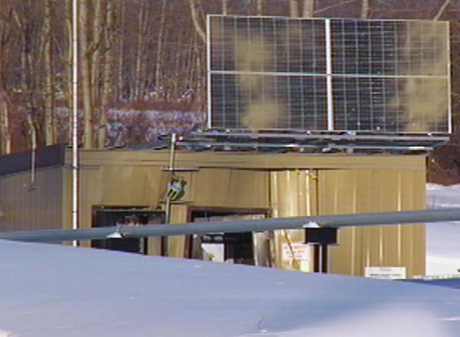 Site of another explosion at an Encana pipeline is shown near Tomslake, BC in this January 5, 2009 photo. It's the fourth such explosion in three months. The incident was discovered January 4, 2009 after gas line workers found a partially destroyed metering shed at a wellhead site. (Photograph by: Global TV, Canwest News Service) |
Whatever the bombers lack in technical ability, they make up for in will and audacity, a University of Alberta researcher said after the latest pipeline bombings at EnCana natural gas facilities in northern B.C.
"We're clearly dealing with someone who's an amateur, but it does show that although they lack technical ability, their will is certainly not lacking," said eco-terrorism expert Paul Joosse.
"They're continuing to carry out these attacks, even though we're throwing everything we have at them from a law enforcement perspective."
Evidence of the fourth explosion in three months was discovered Sunday by EnCana workers near the community of Tomslake, about 20 kilometres southeast of Dawson Creek.
The crew noticed damage to a small building housing a natural gas meter at a well site, which was promptly shut down as a precaution. A company spokesman said there was no damage to the wellhead or the pipeline, nor was there a gas leak at the facility.
The RCMP in Dawson Creek are investigating the bombings, with help from the Integrated National Security Enforcement Team, the explosives disposal unit and the forensic identification unit.
Joosse is convinced the attacks are being carried out by someone who lives in the area, but said it's difficult to say whether it's a single individual or a "small tightly knit group."
"Even if it is an individual," said Joosse, "there are other people who know about this person and are complicit in helping, if only through their silence."
Residents blocked oil and gas vehicles on a road running through the community of Kelly Lake last summer, an event Joosse said was a precursor to the explosions.
Joosse said the blockade was an illustration of "widespread community support for civil disobedience, and a widespread sentiment of frustration" by locals angry over what they see as the destruction of their land.
He said police strategy to elicit tips from the public in hopes that family members or close friends would come forward doesn't appear to be working.
"I think there are some locals who live vicariously through this person, and take a certain amount of pride that someone's sticking their neck out to do something about it," said Joosse.
© Copyright (c) The Edmonton Journal
Pipeline bombings 'increasingly violent': RCMP
The Canadian PressGlobe and Mail
January 6, 2009
DAWSON CREEK, B.C. — The attacks against EnCana's natural gas operations in northeastern British Columbia are becoming “increasingly violent,” says the RCMP, after a fourth attack that was dangerously close to a nearby home.
Workers discovered a damaged steel metering shed on Sunday near Tomslake, southeast of Dawson Creek.
The explosion follows three others in the area last October, targeting two pipelines and a wellhead.
There was no damage to an adjacent wellhead in Sunday's attack and there weren't any leaks.
Sgt. Tim Shields said while the third explosion in October occurred 800 metres from the closest house, the latest was just 250 metres away from the nearest home.
“The explosive sites have been successively getting closer to nearby residents,” Sgt. Shields said in a statement posted to the RCMP's website Tuesday.
“For this reason, we are considering these explosions are becoming increasingly violent. This poses a real risk to the public.”
Sgt. Shields said the latest explosion involved “high explosives” and left a very large debris field.
He didn't elaborate on what type of explosives were used or whether they were different than in previous attacks, but he did say the devices were likely not homemade.
Investigators believe whoever is responsible for the bombings is from the Tomslake area and has a grudge against EnCana, but police appear to have little else to go on and no suspects.
The only leads made public in the case so far are a threatening letter sent to EnCana shortly before the first blast, and the release last month of eight video surveillance images of customers at a store where the letter was mailed.
Police have said the black-and-white images haven't produced a suspect.
Sgt. Shields said police have identified several “people of interest,” but they haven't been co-operative.
Instead, investigators have been left pleading for the public's help.
“We're asking those people [of interest] and associated friends and family to come forward with what they know,” said Sgt. Shields.
“We are making the assumption that it is likely this won't stop until the suspect or suspects have been arrested.”
Last month, EnCana set up a dedicated telephone line and asked the bomber to call them, but the company isn't saying whether anyone made that phone call.
The first three explosions involved pipelines or wellheads carrying sour gas, a type of natural gas that contains highly toxic hydrogen sulphide, which can be fatal even in small amounts.
EnCana hasn't said whether the latest wellhead targeted also contains sour gas, but has said pipelines and wells in the area typically contain trace amounts of hydrogen sulphide.
RCMP investigate fourth pipeline bombing in B.C.
Canwest News ServiceVancouver Sun
January 5, 2009
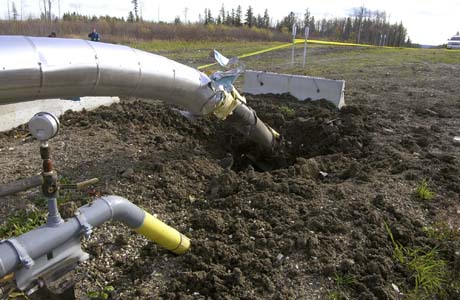 Damage caused to a natural gas pipeline is seen east of Dawson Creek, British Columbia, in this October 12, 2008 photo.(Photograph by: File photo/Canwest News Service) |
There has been another pipeline explosion in northeast British Columbia, the RCMP said Monday.
The site of what appears to be a deliberate explosion was discovered on Sunday after EnCana gas line workers located the partial destruction of a metering shed at a wellhead site near the community of Tomslake, B.C.
RCMP officers immediately secured the scene after the discovery, according to a police news release.
Investigators from the Integrated National Security Enforcement Team, the Explosives Disposal Unit and Forensic Identification are now investigating.
There were no injuries or gas leakage as a result of the blast.
This event is likely the fourth deliberate explosion in three months directed at EnCana natural gas facilities in the Tomslake area, east of Dawson Creek, B.C.
In October, there was a late-night explosion at a natural gas wellhead south of Dawson Creek, B.C., on the Alberta border, about 600 kilometres northwest of Edmonton.
That blast was the third of its kind in less than a month targeting natural gas facilities operated by EnCana Corp.
The first two bomb sites were also discovered in October along a natural gas pipeline running through the same area. The blasts occurred on Oct. 12, 16 and 31.
Prior to the first bombing, an individual or a group of people sent an unsigned, handwritten letter to a Dawson Creek newspaper warning EnCana to close its operations and leave the local area immediately.
The letter stated: “We will not negotiate with terrorists, which you are as you keep on endangering our families with crazy expansion of deadly gas wells in our homelands.’”
No one has been injured in any of the blasts.
© Copyright (c) The Vancouver Sun
See also
RCMP blows pipeline bombing investigation
Sabotage fears flow around B.C. pipelines
Third blast rocks B.C. pipeline
Six recent pipeline incidents, commission says
Oil vandal questioned in B.C. pipeline bombings
Somebody local with a grudge targeting oilpatch?
2nd explosion rocks northern B.C. pipeline
RCMP terror squad probes pipeline bombing
Lost in transmission
Kent Spencer,
The Province
January 06, 2009
138 homeowners offered speedy buyouts based on 'independent assessment' -- at potentially greater cost than burying loathed high-voltage lines
Homeowner Debbie McBride feels she has no choice but to accept a B.C.
government offer on her Tsawwassen property and move away from new overhead power lines.
"We're going to lose, no matter what.
"We would love to have our grandchild over in the swimming pool, but the 230,000-volt lines put kids at risk," McBride said yesterday.
She is one of 138 homeowners who have been offered buyouts by the province. The owners live under a four-kilometre overhead line that was increased in height and voltage last summer, despite residents'
objections.
"This is wrong at so many levels," said McBride. "Market values are down at the moment. Homeowners will only be given five days to accept or reject the offers. We must be out by July 31."
She expects the government-appointed "independent" assessor to submit a lowball offer of $100,000 less than she believes her home is worth.
The 2,300-square-foot house and lot, in the 5200-block Cambridge Court, is assessed at $677,000.
"Not one house has been sold since the lines went in last summer. Those are big towers. One looks like Frankenstein's neck," she said.
"We will not be able to replace the house we paid for 10 years ago. We would probably pay double. It was bought when our kids were teenagers.
"This will be like replacing a book of photographs. We thought we would live here until our 70s. It is close to the downtown core. We love our neighbours," she said.
Cec Dunn, co-president of Tsawwassen Residents Against Higher Voltage Overhead Lines, estimates the buyout will cost $70 million. He said the underground line could have been built for a net cost of $18 million.
"Taxpayers will pay for the province's mistake," McBride said.
Government spokesman Jake Jacobs said the offer is being made now because it is "the reasonable thing to do."
"Government recognizes that, due to the misinformation, there are those who still have some anxiety over the lines," said Jacobs, spokesman for the B.C. Ministry of Energy, Mines and Petroleum.
"This is a voluntary home-purchase-offer program, that will be based on market values. Homeowners are free to accept or reject the offers," he said.
"The cost of the buyout will be determined by how many people actually take the voluntary-purchase offer," he said.
Jacobs said the buyout won't cost more than putting the lines underground because the homes will be resold.
He said a government-sponsored independent study last March showed putting the lines underground would cost $30 million.
The Canadian Cancer Society came out against the Tsawwassen lines in 2006.
"We recommend the Environmental Assessment Office revise the transmission plan, if practical," the society's Barbara Kaminsky said then.
kspencer@theprovince.com
Research inconclusive
Studies have revealed concerns about possible health effects of long-term exposure to high electromagnetic fields (EMFs) from high-voltage power lines. These include memory and motor-skills loss, childhood leukemia, cancer and cataracts.
Low-frequency fields create currents in the body. Exposure to large, nearby EMFs has been proven to stimulate muscles or nerves or impair other bodily activity in short-term trials.
No studies have definitively proved or disproved a link between long-term exposure and human health risks.
A 1999 National Research Council science and engineering report concluded that "the results do not support the contention that electricity poses a major, unrecognized public-health danger."
January 03, 2009
Owners in power line fight ponder offer to sell homes
The Canadian Press
Globe and Mail
January 3, 2009
Tsawwassen -- A number of homeowners involved in a high-voltage battle over power lines in their neighbourhood are considering a provincial government offer to buy their houses.
Long-time resident Bernadette Kudzin said it's a tough decision to make now that the lines are up.
She said the power lines have affected the value of the houses, and that new residences could cost an additional $150,000 or more.
Homeowners say they've received a letter from BC Hydro, and have until Jan. 15 to decide if they want an independent valuation of their property to be made.
The offers will be made by March 10.
The residents will have five days to decide if they will accept.
Multibillion-dollar gas plant planned in B.C.
WENDY STUECK
Globe and Mail
January 3, 2009
VANCOUVER — EnCana Corp. has taken an early step toward building what could be a multibillion-dollar plant in northeastern British Columbia.
The plant would process natural gas from the Horn River Basin, a promising natural gas play that last year helped the province reap a record $2.7-billion from the sale of oil and natural gas exploration rights.
In a project description for the Cabin Gas Plant, submitted to the provincial government, EnCana outlines a plant that would be located about 60 kilometres northeast of Fort Nelson and have initial processing capacity of 400 million cubic feet a day.
The first phase of what could become a six-stage project is expected to be in production by 2011.
The estimated cost of the first phase is $400-million, EnCana spokeswoman Rhona DelFrari said Friday, with construction of subsequent phases hinging on future production.
“The magnitude of the project will depend on how much gas is produced in the area over the next few years,” Ms. DelFrari said. “Horn River is still such a new area for production, it will really depend on if companies deem if they are going to go bigger.”
EnCana submitted the project description in November under B.C.'s environmental assessment process. Typically, that step is followed by a formal application and public hearings to determine whether the project will get a green light to proceed.
EnCana is pursuing the plant on behalf of the Horn River Basin Shale Gas Producers Group, which consists of eight companies (including EnCana) that are spending millions in the hopes of unlocking the region's massive natural gas reserves – trapped in rock formations once thought impossible to tap.
New technology, higher prices for natural gas and declining stores of conventional gas have made shale gas more appealing, and the past few years have seen producers swarm the northeastern part of the province to test new ways of fracturing rock and wresting gas out of the ground.
Initial wells were costing more than $10-million each to drill and bring into production, Ms. DelFrari said. By multi-pad drilling – jamming as many as 20 wells on to every pad – the company hopes to bring the costs down to about $7-million.
Calgary-based EnCana, the country's largest gas producer, has, to date, drilled fewer than a dozen test wells in the Horn River Basin. But results were encouraging, and this year the company and its partner, Apache Corp. of Houston, plan to drill 40 wells in the area.
EnCana has estimated its production from the basin could eventually hit one billion cubic feet of gas a day – enough to heat five million Canadian homes for a year and the equivalent of about 170,000 barrels of oil, bigger than most oil sands mines.
EnCana is positioning the massive plant, which would serve all producers in the region, as a better environmental option than several smaller plants. The plant would process raw gas so that it could be transported to market in pipelines. According to the project description, the plant would pursue carbon capture and sequestration opportunities “assuming appropriate fiscal programs can be implemented.”
If the project goes ahead, it could employ as many as 600 people during construction and about 25 once in operation, Ms. DelFrari said.
EnCana and Apache have the largest landholdings in Horn River.
Last October, EnCana facilities near Dawson Creek were targeted in three separate attacks. Two pipelines and a wellhead were bombed. No one was injured in the attacks, which occurred after a letter was sent to EnCana and to local newspapers demanding that EnCana leave the area.
Last month, after determining the letters had been mailed from a Dawson Creek post office, RCMP posted surveillance photos on-line of eight people who had been at that location the day the threatening letter was sent and whom police had not been able to contact.
All but one of those people has now been eliminated from the investigation.
---
Cabin Gas Plant project at the BC Environmental Assessment Office