February 19, 2009
First nations win court fight over major B.C. power projects
COMMENT: Whew. Already a legendary figure in BC legal circles when it comes to high profile public interest and civil rights cases, and especially with respect to aboriginal rights, Greg McDade continues to rack 'em up. In early February, McDade and his client, the also legendary marine biologist Alexandra Morton, won a decision from the BC Supreme Court when it ruled that the jurisdiction over fish farms resides with the federal government, not the provincial government.
This week, the BC Appeal Court ruled in two power projects that aboriginal rights had not been adequately respected. And the potential outfall are huge.
The first major component of BC Transmission Corp's strategy to add capacity and redundancy to provincial transmission infrastructure is a new line between Merritt and the lower mainland. A necessary approval from the BC Utilities Commission had been granted, but the Appeal Court says the approval is invalid, and affected First Nations need to be consulted before the approval can be issued. Back to the drawing board, and expect first, that the project will be delayed by years, and second, that the financial accommodation with First Nations will be Olympian.
The Appeal Court ruling with respect to the Carrier Sekani and Kemano, though it goes back many decades, affects the electricity purchase deal between BC Hydro and Rio Tinto Alcan - itself already an agreement that was protracted and painful in its delivery.
Wrists were slapped everywhere, especially at the BCUC.
Off to the Supreme Court.
And with these decisions, could McDade and his clients be turning their attention to Williston Lake and the Peace River dams? To the Columbia Treaty projects? Don't go countin' yer Site Cs, not any time soon.
By Neal Hall
Vancouver Sun
February 18, 2009
VANCOUVER – The B.C. Court of Appeal has issued two major rulings upholding the rights of first nations to be consulted by the government, which will affect two major projects in B.C.
In one case, the court has struck down a licence required to build a massive new hydro transmission line from Merrit to Coquitlam because native Indians were not consulted.
In the other case, the court ruled there was “massive” infringement of the right of the Carrier Sekani Tribal Council to be consulted in the Kemano Power Project and later expansion near Kitimat that involves B.C. Hydro buying electricity from the Rio Tinto Alcan Inc. aluminum smelter.
The appeal court granted the appeal of the tribal council and found that the BC Utilities Commission erred in approving the Electricity Purchase Agreement (EPA) between BC Hydro and Rio Tinto Alcan in January 2008.
The court found “B.C. Hydro, as a Crown corporation, was taking commercial advantage of an assumed infringement on a massive scale, without consultation.”
The court was also critical of the BC Utilities Commission, finding “the commission has demonstrated in several cases an aversion to assessing the adequacy of consultation.”
“I think this is a very significant decision both for the Kemano project itself and also for aboriginal rights,” said Vancouver lawyer Gregory McDade, who represented native bands in both cases.
Tribal Chief David Luggi was pleased by the appeal court victory.
“We are pleased that the Court of Appeal has recognized in law that First Nations interests must be taken into account in important decisions relating to the Kemano Project," he said in a statement.
"The Alcan Kemano Project remains the most devastating environmental impact in our region.”
“First Nations were never consulted when the Kemano Project was built, and we were not involved in the backroom deal in the 1987 Settlement Agreement, by which flows in the Nechako River were reduced by over 70 per cent. Our fisheries have never recovered, and the Nechako Sturgeon is endangered and almost extinct.”
He said this was the first step "to ensure that the environment and First Nations interests are not ignored over long-term electricity sales.”
The Kemano project, which began in the 1940s, involved reversing the flow of a river and the creation of a watershed that discharges west into a long tunnel through a mountain down to sea level at Kemano where it drives the generators at the power station and then flows into the Kemano River.
Up to 80 per cent of the natural water flow of the Nechako River was diverted for the project, which affected fish and wildlife, especially salmon.
The Nechako River eventually joins the Fraser River at Prince George.
Alcan holds a water licence in perpetuity for the reservoir. It is obliged by the licence and an agreement made in 1987 settling litigation involving the provincial and federal governments to maintain water flows that meet specifications for migratory fish.
In the course of an expansion project, often referred to as Kemano II, the B.C. government changed its mind about allowing the full utilization of the reservoir, which shut down the project and prompted a lawsuit by Alcan.
The legal action was settled in 1997 on terms which included a power deal whereby the province would supply Alcan should it enlarge the smelter and need more electricity.
The settlement also granted Alcan the water licence on a permanent basis. But there was no consultation with native Indian bands in the area.
“My clients rely on the fishery and they have been ignored for 50 years on this,” McDade said in an interview. “This potentially has a huge environmental impact on the Nechako and the Fraser,” he said.
He pointed out that scientists believe diverting up to 80 per cent of the Nechako River has increased the temperature of the Fraser, which has affected salmon returning upstream in the summer.
“When the Fraser gets up to 20 degrees, fish begin to die,” McDade said. “Even half a degree can make a big difference.”
The two appeal court decisions are posted online: http://www.courts.gov.bc.ca/jdb-txt/CA/09/00/2009BCCA0068.htm
© Copyright (c) The Vancouver Sun
Court rulings delay power projects
MARK HUMEGlobe and Mail
February 19, 2009
Utilities commission must re-evaluate whether natives adequately consulted
VANCOUVER -- Two major power projects approved by the British Columbia Utilities Commission have been delayed by rulings issued by the B.C. Court of Appeal.
In separate judgments handed down yesterday, the court found the B.C. Utilities Commission erred in not determining whether natives had been adequately consulted over an Electricity Purchase Agreement (EPA), involving B.C. Hydro and Rio Tinto Alcan Inc., and over a new power line proposed by the British Columbia Transmission Corporation, from Merritt to Coquitlam.
One case involved a decision by the commission to reject a motion by the Carrier Sekani Tribal Council concerning a 2007 B.C. Hydro application for an EPA. The EPA would have cleared the way for B.C. Hydro to purchase surplus electricity from Rio Tinto Alcan Inc.
The power is generated by the diversion of water created by the Kemano power project, which was built by Alcan in the 1950s.
The Carrier Sekani argued that accepting the EPA would be a jurisdictional error because the band wasn't consulted initially, when the power project was first built. The water diversion flooded native graveyards and caused declines in important salmon and sturgeon fisheries.
The band argued there was a "historical, continuing infringement of aboriginal title and rights."
The B.C. Utilities Commission, however, rejected the Carrier Sekani position on the grounds that there were no new physical impacts created by the EPA.
But the court disagreed with that decision, saying B.C. Hydro had been "taking commercial advantage of an assumed infringement on a massive scale, without consultation."
The court ruled that the B.C. Utilities Commission must reopen the application for an EPA, so that it can consider whether a duty to consult with the Carrier Sekani had ever been met.
In the second case, the Court of Appeal found that the Kwikwetlem First Nation had not been adequately consulted over a 246-kilometre power line that the B.C. Transmission Corporation proposed to build from Merritt to Coquitlam.
The line would pass through the traditional territory of several bands, but the courts found the B.C. Utilities Commission had failed to assess whether there was adequate consultation.
"Consultation requires an interactive process with efforts by both the Crown actor and the potentially affected First Nations to reconcile what may be competing interests. It is not just a process of gathering and exchanging information. It may require the Crown to make changes to its proposed action based on information obtained through consultations. It may require accommodation," the court stated.
The court ordered the utilities commission to "reconsider the scoping decision" approving the transmission line.
February 18, 2009
BC Budget 2009: Commentary

A fiscal conversion, but not a philosophical one
PATRICK BRETHOURGlobe and Mail
February 17, 2009
Vancouver — Gordon Campbell has brought down the budget that Stephen Harper could only wish he had delivered – a deficit, but only the deficit that was necessary under the circumstances.
British Columbia will rack up a $495-million deficit in the next fiscal year, with the shortfall shrinking to $245-million in the following year and disappearing altogether by March, 2012.
On its face, the deficit is far smaller than many economists had expected (and less egregious than the government's supporters had feared). But even that surprisingly small number overstates the appetite of the Campbell government for deficit financing.
Unlike other governments that have jumped, or been pushed, into a deficit position, the B.C. Liberals are not defending the change on a philosophical basis. Deficits, however small and however temporary, remain anathema to Mr. Campbell and his ministers.
“There is no one around the cabinet or caucus table that is enthusiastic about us going into deficit this year,” Finance Minister Colin Hansen told reporters before delivering his budget speech to the legislature.
The government's anti-deficit words are matched by action, or rather comparative inaction. Mr. Hansen says B.C. has no structural deficit, meaning that the end of the recession should erase any shortfall – and that there is not a flood of new spending.
But dig deeper into the numbers of the budget and an even more conservative fiscal picture emerges. The government will pump $2.9-billion into the B.C. economy over the next three years to combat the recession, including $2-billion on an infrastructure spree (half-funded by Ottawa), another $401-million in accelerated provincial infrastructure spending and another $485-million from the fiscal stimulus package that Mr. Campbell unveiled in the fall.
That sounds like a stimulus package that Stephen Harper could have written, and that John Maynard Keynes would love. Despite the deficit, the B.C. government has become the last bastion holding out against the new fervour for deficit-fuelled stimulus spending.
The stimulus measures are only one half of the Campbell government's fiscal plan. On the other side of the ledger are spending cuts – big ones. First, there are general administrative efficiencies to be wrung out of various government departments, with advertising and travel spending taking major hits. The Liberals are also counting on a wage freeze in the public sector to deliver $400-million in savings in 2009-10 and 2010-11. Add it all up and the spending cuts amount to just over $3-billion – more than the stimulus spending. In the coming year, stimulus spending will outpace budget cutbacks in B.C., although only by a few hundred million dollars.
Over three years, the Liberals will actually withdraw $150-million from the provincial economy – and that figure is only as low as it is because of $1-billion that the federal government is contributing to the infrastructure spending.
The last-minute fiscal rectitude has left the government's supporters pleasantly surprised, and its opponents – particularly among public-sector unions – fuming.
Jim Sinclair, president of the B.C. Federation of Labour, condemned the budget cutbacks as nonsensical yesterday, zeroing in on the wage freeze and provisions for laying off civil servants as measures that show the government is not serious about lessening the bite of the recession. “Unemployment is the opposite of stimulus,” he said.
Meanwhile, the business-minded supporters of the conservative-minded provincial Liberals are quietly relieved that the government has made only a limited foray into deficit financing. Jock Finlayson, executive vice-president of the Business Council of British Columbia, said he had been expecting a deficit topping $1-billion.
He agreed that the B.C. budget is out of sync with the relatively free-spending ways of Ottawa. “It's a cautious budget for difficult times,” he said of B.C.'s fiscal plan, adding that the national government is better positioned to take the lead on stimulus spending because provinces are likely to see the effect from any of their own expenditures leak outside their own boundaries.
John Winter, president and chief executive of the B.C. Chamber of Commerce, praised the budget-cutting as a welcome sympathetic response to the waves of layoffs sweeping over the private sector. “That is reflective of the real world.”
Asked about the economic logic of increasing spending in one area while cutting it in another, Mr. Hansen took a similar tack. “It's a budget that says government has to live within its means.”
From surplus to 'frankly scary' in just one short year
GARY MASONGlobe and Mail
February 18, 2009
VICTORIA — There are two ways of looking at the budget presented yesterday by the British Columbia government.
The first is just how dramatically all the numbers have changed in 12 short months. And the priorities too.
Last year, the British Columbia government was projecting nearly a $1-billion surplus. The province was the happy recipient of hundreds of millions of dollars in oil and gas revenue. Premier Gordon Campbell was being hailed as a green revolutionary for introducing Canada's first true carbon tax.
This year, the environment rates barely a mention in the budget. Revenues have fallen off the cliff. After proclaiming for years that he'd never run a deficit, Mr. Campbell listened to his Finance Minister tell the legislature the province will spend almost $500-million more than it will bring in.
Which brings me to the second way of looking at this budget.
Compared with the kind of recession-related money problems a place like California is experiencing, this is nothing.
British Columbians had been warned a deficit was coming. The legislature had to be convened earlier this month so the government could introduce a legislative amendment that would allow it to run a deficit. Still, I think many were surprised it ended up being as small as it is – $495-million this fiscal year and a projected $245-million in 2010-11.
California is facing a $40-billion shortfall and is talking about laying off 20,000 civil servants. (Or put this way: B.C. has one-eighth the population of California but a deficit 1/88th the size of the one down there.)
Still, many of the figures found in B.C.'s budget are sobering and remind us of how different the world is today from a year ago.
One chart, for instance, illustrates the $6.6-billion decline in revenues the province is anticipating over the next three years. That includes a $4-billion tax-revenue hit and almost $3-billion less in royalties and taxes from natural resources.
The bar graph charting the economic woes in the United States is equally chilling. The annual growth in real GDP was 2.7 per cent in January, 2008. But it begins shrinking in each successive month until the bars on the graph dip below the baseline into negative territory. Since September of 2008 the decline in real GDP growth is 3.2 per cent.
“We've never seen numbers like that,” one Finance Ministry official said yesterday. “They are frankly scary.”
They are. And I think the B.C. government is being hopeful that the U.S. economy will begin turning around late this year and that real GDP growth will be almost 2 per cent in 2010. I hope the government's forecasters are right but my hunch is it's going to be much longer before the rebound begins. Which, in turn, could delay British Columbia's recovery.
B.C. likes to point out that of all the Canadian provinces it is the least reliant on trade with the United States. It does far more business with Asia (27.1 per cent) than Ontario (2.6 per cent) or Alberta (5.8 per cent). But I'm not sure B.C. is going to be able to count on a roaring trade relationship with Japan over the next few years. Things are deteriorating rapidly there and are slowing pretty dramatically in China as well.
All this is to say some of B.C.'s key economic forecasts for this year and going forward might be optimistic. Take the real GDP growth for this year. The budget predicts it will be minus 0.9 per cent. I believe the contraction will be greater as well.
There's a fascinating section in one of the B.C. budget documents that looks at previous recessions and economic downturns the province has endured. Particularly interesting is the comparison between the current economic crisis and the recession of 1982.
Back then, real GDP in the province shrunk by an astounding 6.1 per cent, compared with the minus 0.9 per cent predicted for this year. The unemployment rate in B.C. was 12.1 per cent, compared with the 6.2 per cent it is expected to average out at this year. Exports are expected to fall by 2.4 per cent this year compared with a whopping 5.4 per cent in '82.
“The downturn going into 2009 is unlike the 1982 recession,” the budget notes.
“But the present economic weakness in the global economy threatens to continue for several years with the risk to the Ministry of Finance's current forecast weighted to the downside.”
Which brings us to a third way of looking at this budget.
Not only could things be a lot worse, they could still become so.
Budget sets some important benchmarks for tough months ahead
EditorialVancouver Sun
February 18, 2009
In tough circumstances, Finance Minister Colin Hansen has produced a provincial budget that on paper is impressive.
But it comes with a list of caveats and uncertainties that rightly emphasizes that the course of the provincial economy over the year ahead is far from certain.
The surprisingly small deficit of $495 million for this fiscal year reflects not just a change in philosophy from a government that previously outlawed red ink, but an election-eve conversion from conservative budgeting to a bottom line that is imbued with a strong sense of hope that B.C.'s economy will rebound next year.
Given the recession into which the world is sliding, Hansen's budget paints a picture of a provincial economy and government finances still in relatively good shape. Compared to other provinces and G-7 countries, we certainly are.
Hansen anticipates the economy will shrink by just under one per cent in 2009, which is more conservative than what his panel of private sector economists forecasted. But he also acknowledges that the rate of decline over the past few months has confounded all of the previous projections.
Since the first quarterly report on the province's finances in September, the three-year projection for revenues has declined by $6.6 billion.
The government is also rushing in a stimulus plan that will ramp up capital spending by $2 billion over the next three years beyond the $10.6 billion in approved projects.
Those indicators would suggest a much larger deficit for the coming year than $495 million, given that the projected surplus in last year's budget was $800 million. But after years of presenting budgets with large forecasting allowances and conservative revenue forecasts, the cushions in this year's budget are more thinly supported.
There is no forecast allowance and provisions previously in the budget for future wage increases have been removed. There are also $250 million in spending cuts that have yet to be identified. That is in addition to almost $589 million in cuts -- with the exception of education and health -- ministries have already been told they will have to endure.
The budget also notes that health authorities have identified significant spending pressures that are not included, but will blow the budget if they cannot be contained.
All of this creates a bottom line for the government that more than ever depends on sound management and the ability to adjust to changing conditions.
As a starting point, however, this budget sets some important benchmarks for navigating through the tough months ahead.
First, the ramped up spending and the borrowing that goes with it are modest enough to allow the province to anticipate it will stay below the debt-to-GDP level that earned us a triple A credit rating.
That ratio may deteriorate if the economy continues to shrink. If so, the government's definition of what is affordable will also have to be amended.
The three-year plan calls for a smaller deficit next year and a return to surplus in year three. Adherence to that plan is as important as the budget for the current year because it represents our last line of defence against the deficit addiction that created the debt crisis of the 1990s.
Second, despite the fact that this is an election budget, the government has resisted the temptation to blow the doors off the treasury with spending promises that would haunt us in years to come. As it is, we can still expect the ramped-up capital spending will provide a steady stream of announcements between now and the official start of the campaign in April.
Realistically, given the state of change in the world, we all have to understand that the province's budgets may need to be modified on a more frequent basis than we're used to. It's quite possible that a new plan will be needed after the election.
But it is also a document that the Liberals can and will proudly carry into battle as evidence of the sound economic management they have delivered over the past eight years.
online
Poll question: Do you think the government can balance the budget in three years time? Answer Yes or No at vancouversun.com/opinion
You're not optimistic when it comes to the province's proposals to address gang violence. Fully 87.76 per cent of respondents to Tuesday's Opinion Web poll said the provincial government's plans won't be effective, while only 12.24 per cent said they would.
© Copyright (c) The Vancouver Sun
If, if, if -- modest deficit budget ripe for revision if things don't work out
By Vaughn PalmerVancouver Sun
February 18, 2009
As budget day approached, the B.C. Liberals were contacted by several members of their independent forecasting council who wanted to reduce their projections for economic growth. Again.
Council members had downgraded their forecasts for 2009 on several previous occasions, from two per cent on average, then one per cent and finally zero at the beginning of January.
Each time the revisions sent the government back to the drafting table on its own budget.
By law, the budget is grounded on the collective outlook of the dozen or so members of the council. In practice, the finance ministry averages the forecasts, then picks a growth rate slightly lower than the collective view.
These latest revisions would drop the council's forecast into negative territory, though only just. The experts were now saying the economy would shrink by about three-tenths of one per cent, or half a billion dollars worth of gross domestic product.
Too late, came the answer from the ministry of finance. Not that government doubted that the economy was sliding into recession. But the budget preparations were too far advanced for one more substantial revision.
And in any event, the ministry -- with its preference for lowballing -- was working from an expectation that the provincial economy would shrink by nine-tenths of one per cent (-0.9), a bit more than the running average from the outsiders.
But that still meant the Liberals were leaving themselves little room to manoeuvre on the budget and fiscal plan that was presented to the legislature Tuesday.
If "minus zero point nine per cent growth" turns out to be an optimistic scenario, if the economy continues to slide through the summer into the fall, if the U.S. recovery is postponed indefinitely . . . well, there's little doubt that the B.C. government will be forced to substantially revise the three-year budget and fiscal plan.
Even if the forecast turns out to be no more than accurate, the budget derived from it sets up major challenges for government.
First of all, the Liberals have to sort out the financing for the $3.3-billion Port Mann bridge project. The deal isn't final, so the budget came with a big asterisk saying "more later."
They also have to take the wraps off their "secret" plan to cover the provincial share of the cost of security for the 2010 Winter Olympics. Supposedly it is all taken care of in the budget.
But the Liberals flatly refused to say where the dollars are hidden. Their lips are sealed until an announcement from Ottawa in a week or so. So much for budget transparency.
Next challenge: The Liberals are calling on ministries and dependent agencies to "manage down" spending by about $2 billion over three years, reducing discretionary spending on travel, consultants, advertising, vehicles, equipment and grants.
Then they have rustle up another $250 million in savings from sources yet to be identified. If all of that were to come from staffing, it would mean across the board layoffs of about 10 per cent of the public service, although five per cent is a more likely figure.
While cutting overhead, operating and other expenses, most ministries will have to make do with minimal to non-existent increases in program funding over the three years. Health got most of the new program dollars -- a six-per-cent increase -- and still faces "spending pressures" amounting to a further 3.3 per cent.
Presuming the government endures no more shocks on the revenue side, makes the spending targets, finds the additional savings and contains the pressures, then it will be able to hold the line at a deficit of just $500 million the first year (beginning April 1) and $250 million in the second.
Most observers, me included, figured that when the Liberals decided to leave balanced budget territory on the eve of an election, they would go for bigger deficits. In for a penny, in for a billion, so to speak.
Instead they went small, in keeping with their stated dislike of deficits and determination to end them as soon as possible. But that was only on the operating side of the budget, where spending for programs is supposed to be offset by incoming revenue from taxation and other sources.
It was different story on the capital side of the budget, where the Liberals continue their practice of borrowing heftily for roads, bridges, transit lines, schools, hospitals, transit, hydro and other public works.
The collective provincial debt, mostly capital-related, is projected to grow from $40 billion in the first year of the B.C. Liberal plan to $47 billion in the third. Up from $33 billion just two years ago, or 40 per cent in five years.
All in the name of "infrastructure," though the preferred term these days is "economic stimulus." Note that billions will be borrowed and spent in 2010 and 2011, by which time the Liberals say the economy will be growing again and less in need of taxpayer-funded stimulus.
But if the economy isn't back on track by this time next year, then I expect the 2009 budget will have been declared a dead letter.
By these guys, should they win re-election. By the next government, should they fail.
vpalmer@direct.ca
© Copyright (c) The Vancouver Sun
Big money for infrastructure as B.C. faces two-year deficit
By Jonathan Fowlie Vancouver Sun February 18, 2009NDP's James disputes Liberals' claim of protecting health care, education and social programs
 Finance Minister Colin Hansen explains the budget to the media Tuesday. (Photograph by: Debra Brash, Canwest News Service, Vancouver Sun) |
British Columbia will run a $740-million deficit over the next two years, the government said Tuesday as it released a budget characterized by belt-tightening and fiscal restraint on one hand, and big infrastructure spending on the other.
Overall, the government promised to cut $1.9 billion in administrative and other costs over three years, allowing it to protect increases to what it says are key social services.
"Our priority has been to protect the vital health care, education and social programs that British Columbians have come to rely on," Finance Minister Colin Hansen said, "and [that have] actually become even more important to us as we go through the kind of economic challenges that the province -- and indeed the globe -- is going through today."
But New Democratic Party leader Carole James said the budget makes deep cuts in much-needed areas such as crime prevention, health care and services for children and families.
"This government stood up and said they were protecting health care and education, they stood up and said crime and safety was important. Well, their budget proves they didn't tell the truth," James said.
"We know the premier is completely out of touch with what is going on in British Columbia," James said. "He's saying to the people of this province, 'I'm going to do nothing, you're just going to have to wait it out.' "
The budget projects a deficit of $495 million in 2009-10, and $245 million in 2010-11. It proposes a return to a balanced budget by 2011-12.
On the spending side, the government promised to increase health care spending by $4.8 billion over the next three years, up from an increase of $3.9 billion it had previously promised.
But the bulk of the new money -- $920 million -- doesn't arrive until the 2011-12 fiscal year, leading some critics to question how reliable such a distant projection can be.
Post-secondary institutions will get more money: an additional $228 million over three years.
Funding for K-12 education will remain at previously announced levels.
Economists reacted favourably to the plan, with most calling the budget prudent and realistic.
"It's responsible, it's conservative and in many respects it assumes a smooth transition from recession into better economic times," said John Winter, president of the B.C. Chamber of Commerce.
Winter said his only concern was that some of the assumptions -- such as housing starts -- might be overly optimistic.
Jock Finlayson of the Business Council of B.C. had a similar reaction.
"We're calling it a realistic budget for tough times," Finlayson said.
Public-sector unions raised serious concerns, saying they believe the budget will lead to cuts at school boards and will place further pressures on an already-stressed health care system.
"There is a real struggle in the health-care system on the front lines, and this budget doesn't go in any major direction to help to solve it," said Judy Darcy, business manager of the Hospital Employees' Union.
"It will mean cuts at school boards," said Irene Lanzinger of the B.C. Teachers' Federation, who predicted funding levels will not meet rising costs caused by inflation and salary increases.
"It is not even a status quo budget."
By its own reckoning, the government will be operating on razor-thin margins.
It has eliminated the forecast allowance, a financial cushion that historically has provided up to $750 million in leeway, meaning the margin for error has been significantly reduced.
The government said it will need to find an additional $250 million in cuts over the next three years, the specifics of which are unlikely to be determined until after the May 12 election.
The budget called for $1.9 billion in spending cuts over three years, an amount the government said will not cut into key services.
"The belt-tightening that we're doing in government is about ensuring we free up dollars from the administration side and the discretionary side to fund the increases we have on the program-delivery side," Hansen said.
"It's incumbent on government to tighten its belt in difficult economic times."
The budget included no money for public-sector wage increases or bonuses for contract negotiations in 2010, and clawed back $400 million previously set aside to cover contract improvements.
In an e-mail written to staff members, Jessica McDonald, head of the public service, said the additional cuts may mean layoffs of up to five per cent.
"What we know at this stage is that direct impacts will definitely be under five per cent, including both regular and auxiliary employees," wrote McDonald, adding the number "could ultimately be much lower."
One of the few cushions the government retained is a contingency fund of $385 million for the coming fiscal year, and a total of $935 million over three years.
Historically, contingencies have been used to pay for new programs. But in Tuesday's budget, the government said the fund will be used "to help ensure the fiscal targets are met."
The final cost of Olympic security was not disclosed in the budget, but Hansen said it was accounted for in the government's planning, and promised details in about a week.
Also not in the budget was any accounting for the $3-billion-plus Port Mann Bridge project, which is still being negotiated. A deal on the project is expected to be completed by march.
The government predicted a short-lived recession for B.C., with a projected contraction of 0.9 per cent for 2009. It anticipates a recovery in 2010, with an expected growth of 2.4 per cent that year.
To help stimulate a recovery, the government confirmed it is budgeting $2 billion for accelerated infrastructure-building, $1 billion of which will come from the federal government. Details on where the money goes are expected in the coming weeks. One spending announcement was planned for today, with federal Minister of International Trade Stockwell Day in Victoria.
Including $10.6 billion in previously planned construction and $1.4 billion in grants for infrastructure projects, the province is promising $14 billion in overall infrastructure spending, which it estimates will generate 88,000 direct construction jobs over the next three years.
"This budget is about three things: It's about stability for B.C. families, jobs for B.C. families, and confidence," Hansen said.
"It's a confidence that we're going to get through this difficult economic time and be a stronger province at the end of it, because we will be able to capitalize if the opportunities are there."
© Copyright (c) The Vancouver Sun
Finance Minister Colin Hansen explains the budget to the media Tuesday.
Photograph by: Debra Brash, Canwest News Service, Vancouver Sun
Highlights of provincial budget
Vancouver SunFebruary 17, 2009
Economy
-- The B.C. government will run a deficit of $495 million for the coming year and another deficit of $245 million in 2010-2011 before returning to a balanced budget the following year.
-- Provincial debt will climb to $41.9 billion this year, and continue to climb to $47.5 billion by 2011-2012.
-- Provincial revenues will rise slowly this year, from $38.5 billion last year to $38.8 billion for 2009, then to $39.8 billion in 2010 and $41.2 billion in 2011. That's $6.6 billion less than the government had projected just five months ago.
-- Employment in B.C. will decline a further 0.5 per cent in 2009, which translates into about 11,000 fewer jobs. The unemployment rate is forecast to rise to 6.2 per cent this year, and fall to 6.0 per cent and 5.6 per cent in the next two years.
-- The B.C. economy (GDP) will contract by 0.9 per cent this year, recovering to 2.4-per-cent growth in 2010 and 2.6 per cent in 2011.
-- The province is expecting housing starts to decline a further 25.6 per cent this year, with single-digit growth beginning again in 2010 and beyond. Taxes collected from property transfers will similarly drop.
-- Corporate profits in the province are projected to decline 25.6 per cent in 2009, with taxation income for the province from corporations dropping by a similar percentage.
Budget items
-- $14 billion in infrastructure investment, approximately $2 billion of which is accelerated spending on projects not originally planned to get underway within the next three years. The province claims this money will create 88,000 jobs.
-- Of this money, $1.3 billion is earmarked for renovations and upgrading of schools, $1.7 billion for post-secondary initiatives, $2.5 billion for health care facilities, and $2.3 billion for transportation projects.
-- The province has identified $1.9 billion in administrative and other cost savings within government operations, largely through reductions in travel expenses, contracted professional services, and a 76-per-cent cut to Victoria's advertising budget.
-- Approximately 90 per cent of new spending over the next three years will go to health services, targetting improved access and increasing hospital beds.
-- $351 million in new money for social services, including income assistance, programs for adults with developmental disabilities, funding for children with special needs, and more money for child care subsidies.
-- $244 million in new operating funding for post-secondary institutions over the next three years, largely money to improve access to universities and colleges, as well as expand health-care programs.
-- $546 million in revenues from the carbon tax in 2009-2010. The $10-per-tonne tax increases to $15 in July, and $20 in 2010. Carbon tax revenues will grow to $968 million by 2011-2012.
-- A new Northern and Rural Homeowner Benefit worth $200 per year, beginning in 2011 after the temporary property tax deferment program ends.
-- $365 million in previously announced money for upgrading BC Place through 2011.
-- $110 million over three years for developing the energy sector, including $94 million for the Oil and Gas Rural Road Improvement Program.
-- One-year extension to the B.C. Mining Flow-through Share Tax Credit.
-- Removal of the expiry dates for film tax credits, and the extension of those credits to all Canadian-controlled companies.
-- $16 million to help immigrants upgrade work skills.
-- $15 million in one-time arts, culture and heritage grants.
-- 50-per-cent reduction to school property taxes for all farm land, beginning in 2011.
© Copyright (c) The Vancouver Sun
B.C. heads $495-million into the red
JUSTINE HUNTERGlobe and Mail
February 17, 2009
VICTORIA — B.C. Finance Minister Colin Hansen delivered a no-frills budget on Tuesday to take into the spring election that sets up a battle with the Liberals' traditional foes in the public-sector unions.
In the face of a shrinking economy, the province is cutting $3-billion from spending over the next three years, including a clawback of money that was pegged for wage increases for health care workers and civil servants in 2010.
Mr. Hansen said British Columbia will run two years of deficits – this fiscal year the province will sink $495-million into the red. That's a smaller deficit than many had anticipated, and the government expects to return to surplus in three years – in part because it will reclaim the $400-million that had been set aside for wage increases.
“Given the challenges that average British Columbia families are facing today as we go through this difficult time, it's simply not possible to put into this fiscal plan any additional dollars for general wage increases,” Mr. Hansen said.
British Columbia's Finance Minister Colin Hansen tables the provincial budget in the B.C. Legislature in Victoria Tuesday.
 British Columbia's Finance Minister Colin Hansen tables the provincial budget in the B.C. Legislature in Victoria Tuesday. (The Canadian Press) |
Jim Sinclair, head of the B.C. Federation of Labour, said the Liberal government is seeking to pick a fight with unions, but individuals will be caught in the middle.
“I think we are going to see more social unrest in British Columbia, more people upset that the government didn't get it,” he said. He said the funding shift sends a bad signal to public-sector workers, and it offers little to families worried about riding out a recession. “This budget really says to the unemployed, ‘Too bad.'”
The budget allocates $50-million this year to help the public sector do more with less – a “Transformation Fund” to help government workers get “retooled to deliver quality services to citizens with fewer staff.”
The budget was welcomed by a number of business leaders as a prudent fiscal plan and was warmly endorsed by the construction industry. The province will ramp up infrastructure spending this year by roughly $1.3-billion.
“It's the construction budget,” said Philip Hochstein, president of the Independent Contractors and Businesses Association, an outspoken ally of the B.C. Liberals.
“I know they are trying to do everything they can. Certainly in the next 90 days, before the May 12 election, we'll have lots of announcements.”
The provincial budget plan cuts government spending in almost every sector except health, education and social services.
Even public-safety services such as prosecution and court services are facing cuts over the next three years, just days after Premier Gordon Campbell promised to target gangs in B.C. with more police and prosecutors.
“The Premier stood up on Friday and said that was one of the most critical issues to deal with, the gang violence we are seeing,” said Carole James, Leader of the New Democratic Party.
“But they have cut the budget for public safety. Unbelievable.”
And while Mr. Hansen said the budget protects the most vulnerable, there appears to be little new money for tackling poverty and homelessness. Funding for employment and housing services will be cut, while the number of front-line workers handling income assistance will drop.
“It's about stability for B.C. families, it's about jobs for B.C. families and it's about confidence,” Mr. Hansen said in a question-and-answer session with reporters shortly before he delivered his budget speech in the legislature.
The main economic stimulus effort is reserved for building new roads, schools and hospitals, while Mr. Hansen said he is counting on the 2010 Winter Olympics to help fuel a turnaround.
“Dollar for dollar, the Olympic Games may be the best investment we will every make,” he said in his speech. “B.C. has been through tough times before. Each time, we've risen to the challenge. And each time we've emerged stronger.”
John Winter, head of the B.C. Chamber of Commerce, said it is a “safe budget,” but he doubts whether the province will turn the corner next year.
“I don't know if they are planning for the worst – it could be a lot worse.”
There are several key pieces still missing from Mr. Hansen's fiscal plan.
The Finance Minister could not answer questions about funding for Olympic security because the federal government has yet to sign off on the cost-sharing arrangement.
Nor could he say what the cost to taxpayers will be for building the $3-billion Port Mann bridge after the private-sector consortium in charge of construction announced it could no longer finance the new toll bridge on its own. That deal is still under negotiation.
As well, the plan calls for more cuts that have yet to be found: $250-million worth that won't be identified until after the May 12 election.
The economy is now forecast to shrink by 0.9 per cent in 2009, while the government is counting on a rebound in 2010.
Last week, the legislature was recalled early to pass legislation to set aside B.C.'s balanced-budget law so that Mr. Hansen could bring in Tuesday's fiscal plan.
The Finance Minister said his government still struggled to keep spending down.
“What British Columbia families are looking for today is a sense of responsibility,” he said.
“But it's also a budget that says governments need to live within their means. There is nobody around the caucus or the cabinet table that is enthusiastic about going into deficit this year.”
The largest program spending increase is in health care. Health spending is set to increase by almost 6 per cent this year, an increase of more than $800-million.
February 17, 2009
The Liberals struggle to put highlights in this year's throne speech
By Vaughn Palmer
Vancouver Sun
February 17, 2009
The B.C. Liberal government's throne speech for 2009 was a muted affair, particularly for an election year.
There was the usual combination of incomprehensible boilerplate -- "a new prism of trust" -- and over-the-top rhetoric -- "a flame that burns deep in the human heart."
Then a lengthy recitation-cum-defence of Liberal policy-making, including such major sources of controversy as the carbon tax, the softwood lumber agreement, and public-private partnerships.
The government-authored text hurled one gauntlet at the feet of the Opposition as the New Democratic Party prepares its election platform. "Now is not the time," the Liberals assured us, putting words into the mouth of the lieutenant-governor, "to raise the minimum wage."
But the telling aspect of the speech was in the details -- or lack of them -- in the government's own list of highlights.
Last year, the package, spread over two press releases and eight pages, highlighted 112 bulleted items, including separate "action plans" on climate change, health care, energy, first nations, education and early childhood learning.
This year the dutiful folks in government communications managed to wring three dozen highlights out of the text, but stretched mightily to do it.
Some of the items -- "a first-ever joint cabinet meeting with Alberta and Saskatchewan" -- weren't likely to crack the news lineup on the slowest day of the year.
Other "news" -- selling wood to China, building the Gateway -- was old enough to be retired to the provincial archives.
Oddly, the speech made no mention of the package of measures to fight criminal gangs, though it was new enough to warrant a second go-round, having been announced just last Friday.
There were updates on several works in progress. The B.C. pension plan, announced last fall, "will be up and running by Canada Day, 2010."
The Liberals are moving to develop a northeast transmission line, a northwest transmission line, and a northern energy corridor. More work will be done this year to advance the possibility of developing the hydroelectric dam at Site C on the Peace River.
But one much-worked-on initiative appears to be stalled. "The government is working with First Nations to develop a Recognition and Reconciliation Act that will establish a new statutory framework to further the implementation of the New Relationship," the throne speech said, giving no commitment that the text will see the light of day before the election or afterward.
"If it is able to be presented this session it will be," Premier Gordon Campbell told reporters later, then added, "if it is beyond this session, it will be."
The throne speech and press release hinted at some controversies in the making. "Government will work with the Union of B.C. Municipalities to develop new legislation to help ensure that provincial tax relief is not negated by local property tax hikes . . . . All levels of government must be equally disciplined to ensure that tax reductions at one level of government are not negated by tax increases at another."
But Campbell insisted he was not angling for a showdown with local government. "We will not be capping municipal tax rates," he said. "This is something we will be working with the municipalities on."
The Liberals also called on Ottawa to fix one of its laws. "The federal Navigable Waters Act should be repealed and replaced by legislation that meets the legitimate needs of the 21st century," the speech said, amid a discussion of regulatory barriers to fast-tracking infrastructure projects.
The Conservative government has discussed rewriting the act. But environmentalists point out that, because it protects navigable waters, the act also provides considerable protection for rivers, creeks, wetlands and other marine habitat.
Arguably, the biggest news in the throne speech was the cancellation of something that made headlines when the B.C. Liberals announced it last year.
"We had hoped to be in a position to introduce a voluntary all-day kindergarten program for five-year-olds this September," lamented the Liberals. Alas, "current economic circumstances, the need to develop appropriate space and the time to recruit qualified educators means it is not feasible in 2009."
What's left of government priorities? "Previously budgeted increases for health and education will be protected," according to the press release. "Ninety per cent of all budgeted new operating spending in the next three years will go to health care."
For the rest, well, save what you can. "Today we must brace for recession," the speech said. "How deep it might be, how long it will last, is impossible to say."
Not the most reassuring comment in a speech that was supposedly about "creating jobs, stability and confidence."
But there, at least, the Liberals were honest. They have no idea how bad things will get or how long the recession will last. Nor, I suggest, does anyone else.
© Copyright (c) The Vancouver Sun
B.C. Throne Speech targets homelessness
JUSTINE HUNTER, Globe and Mail, February 17, 2009Government promises integrated intervention strategy and community safety initiatives in run-up to Olympics
VICTORIA -- Programs designed to house the province's most entrenched homeless population will be expanded this year, Premier Gordon Campbell promised yesterday.
With less than a year before the 2010 Winter Olympics bring the international spotlight to Vancouver, the government set out a new commitment in the Speech from the Throne to combat poverty, drug addiction and mental-health issues in the country's most impoverished neighbourhood, the Downtown Eastside.
The speech, read by Lieutenant-Governor Steven Point, promised a new integrated, personalized homelessness intervention strategy and a new community safety strategy - initiatives that will be combined with expanded social housing.
Asked later for details, Mr. Campbell said the plan is not exactly new but will expand on existing programs like Victoria's Assertive Community Treatment teams that help find housing for the hardest-to-house.
Since the Victoria ACT teams started work a year ago, they have offered services to 152 clients - hardcore street people with repeated conflicts with the law - and today 131 people are still successfully housed.
The Premier said his government has marked progress in Vancouver's Downtown Eastside, but added: "We have to keep on this problem."
The Throne Speech focused on the economy and job creation, as expected, warning that B.C. must brace for a recession.
It acknowledged that the global economic crisis has brought a "tornado of change" to B.C. that will shape the provincial budget to be introduced today.
"It will be marked by significant fiscal restraint, discipline and new economic stimulus that is affordable, timely and cost effective," Mr. Point stated.
Billions of dollars in infrastructure spending on roads, schools and power transmission lines will aim to create jobs in the next three months - roughly as much time as the wait for the May 12 election. As well, the government promised investments in research into green energy and health care.
The Throne Speech also carried a strong social-policy note. "Governments have an important and vital role in shaping economic change and guiding social development," Mr. Point read.
Spending on health care and education will increase, while social housing will be expanded.
As well, the government announced plans for a Recognition and Reconciliation Act, which is expected be written and passed into law in the next two months.
Since November, the province and aboriginal leaders have been quietly working toward a law to reverse a 150-year-old policy of denying the legal rights and recognition of B.C.'s aboriginal people.
A draft paper is now being circulated among the province's top native leaders with a political commitment to make it law by mid-April, when the legislature stands down for the election campaign.
The law would codify a commitment made four years ago to a "New Era" of reconciliation with the province's native communities, and it would change the legal landscape for land claims in B.C.
"It will recognize constitutionally established aboriginal rights and title, and will facilitate partnerships and prosperity through shared decision making and revenue sharing," Mr. Point read. "If we get it right, it will be a significant provincial accomplishment for our times."
Shawn Atleo, a regional chief with the Assembly of First Nations, said it would have national implications if B.C. is willing to put into law what the federal government has refused to acknowledge.
"I think the intention is to move from a lack of dignity, to a place of dignity," he said in an interview.
"If we get this right now, before the election is held, this will impact the entire country. We would have a partner in the provincial government. We could turn to the federal government and strongly suggest we need equal measures from Canada."
The Recognition and Reconciliation Act would acknowledge that the province's aboriginal populations have long lived in B.C. It's a point that seems obvious given the historical record, but the fact has been resisted by government both in the courtroom and at the negotiations table.
Carole James, the New Democratic Party Leader, said she was struck mostly by what was missing in the speech: There was no mention of the gang warfare that has consumed Metro Vancouver in recent weeks.
She said Mr. Campbell showed he has run out of ideas.
"He used a large portion of his Throne Speech to talk about conferences, meetings, studies, things he was going to look at, at a time when families are concerned about losing their jobs ... [and] about being shot in the street."
Dennis Pilon, a political scientist from the University of Victoria, said he was struck by the strong appeal in the speech to resource communities - measures designed to protect jobs in forestry, mining and energy.
"Everyone's gut feeling is that Carole James and her team are not marching to victory in the election, but this suggests the Campbell Liberals are a little worried," Dr. Pilon said. "There are targeted messages to swing ridings."
February 16, 2009
Energy in the Throne Speech
On Monday, BC's Lieutenant Governor, Steven Point, read the Liberal Government's 2009 pre-election Throne Speech. It comes just a day before the provincial budget, and the two documents together are both a plan to run the province in the next fiscal year, and a platform to get the Liberals elected again in May.
Daunting.
Economic collapse, Olympic size budget overruns, growing public unrest about energy privatization, fish farms, oil tankers on the coast, coalbed methane, Pacific Gateway, Northern Gateway, and always the threat or hope that truth will out on Basi-Virk and how deeply that story penetrates into the vital organs of the Liberal beast.
Here is the full text of the 2009 Speech from the Throne:
http://www.leg.bc.ca/38th5th/Throne_Speech_2009.pdf
Highlights
These are the energy highlights as presented by the government in its news release:
- Government will work to help commercialize biodiesel and cellulosic ethanol production that turns wood waste into clean fuel. "help commercialize"? What is that? The Liberal government is so fixated on finding some, any, positive spin to wrap around the beetle-kill devastation across the province that it has lost sight of the fact that the feed stock for these energy schemes is here today in a wood-fibre tsunami, and will be gone tomorrow. Then what? Give us strategy, not electoral tactics.
- B.C. will pursue reciprocal arrangements and equivalency agreements to allow one thorough, comprehensive and scientific environmental assessment for one project. Industry hates regulatory and permitting processes. When the federal and provincial governments run parallel processes, as they are doing for Plutonic's huge 17 stream Bute Inlet Hydroelectric Project, it costs companies money and time. The Liberals are playing to its corporate supporters with this one.
- The Province will set an integrated, expanded transmission plan that encourages small-scale power projects, economic opportunity and jobs throughout B.C. by year end. Is this a case of the right hand doesn't know what its other right hand is up to? The Province has given the BC Utilities Commission the task of inquiring into tranmission issues in BC, with a duty to report by the middle of 2010. What sense does it make, then, to set out a transmission plan in advance of the BCUC findings and recommendations? Duh.
- New investments will be made in carbon-sequestration technology. Oh, great. It's somewhat like the Hydrogen Highway - a massive capital investment in high tech la la land combined with the only possible panacea that allows business as usual in a climate change world for some pretty big corporate interests in BC.
- Government will pursue a major expansion in electrical transmission capacity that will create thousands of new construction jobs and reduce energy loss through transmission. Refer back to the earlier item about transmission, the BCUC inquiry, etc.
- Government will work to expand transmission capacity along Highway 37 to open mining and energy opportunities while reducing greenhouse gas emissions. Let's see. The government claims that BC is a net importer of electricity. If that's the case, where will all this power come from to power up the proposed mines? Bute Inlet? And if mining companies will be the primary beneficiaries of the transmission line, who then should pay for it?
- The goal of a Northeast Transmission Line will be pursued to fuel energy development and reduce greenhouse gases.
- British Columbia will build on its competitive advantage as a global leader in clean engine technologies through a new commercial vehicle program that will help to create cleaner air, lower greenhouse gas emissions, lower costs, create jobs in research, development and manufacturing. I can hear them over at Ballard jumping with joy.
The complete speech
Here's most of the energy stuff, verbatim, from the speech. There is a certain amoung of padding, shall we say, and stuff from last year trundled out again.
Energy is another core competitive advantage for British Columbia.
B.C. is a low-carbon energy powerhouse.
New technologies and the global hunger for clean, low-carbon energy and new sources of traditional energy are putting B.C. in the driver's seat.
Even with our commitment to meet 50 per cent of B.C.'s future electricity needs through conservation, more power will be needed to ensure we are electricity self-sufficient by 2016.
Electric plug-in vehicles and other technologies aimed at reducing fossil fuel dependency will place new demands on our electricity system.
We can meet those demands and create jobs and opportunities for our citizens.
Our government will build on its Clean Energy Plan with new direction to BC Hydro and to the British Columbia Utilities Commission.
We will lead North America in creating green power that retains our low cost "heritage power" advantage for B.C. ratepayers.
We will build on our plan to ensure that at least 90 per cent of all new power produced in B.C. comes from clean sources.
More work will be done this year to advance the dialogue on Site C to decide its merit.
Independent power production will continue to create new jobs in rural communities.
Your government will not turn its back on those rural jobs.
Nor will it close its eyes to the dire fact of climate change or the significant contributions we can make in reducing greenhouse gases.
We will open up new opportunities for private investment to create jobs and meet our needs.
That will not only be good for our economy, it will be good for our planet.
Our government will pursue a major expansion in transmission capacity that will create thousands of new construction jobs and reduce energy loss through transmission.
The goal of a Northeast Transmission Line will be pursued.
An integrated, expanded transmission plan that encourages small scale power projects, economic opportunity and jobs throughout B.C. will be set by year end.
We can become global leaders in wind, run-of-river, tidal, geothermal, wave, solar and other forms of clean, renewable power and leading-edge transmission technologies.
Energy opportunities will transform the future of forestry in British Columbia with clean, carbon-neutral bioenergy, fueled by biomass from beetle-killed forests.
It will mean new jobs, new revenue streams and new electricity.
It will create new uses for waste wood left on the forest floor and reduce forest fire hazards.
It will encourage replanting in areas that would not otherwise be reforested and generate new value in the green economy as standing "carbon sinks."
These are the green fields of opportunity created by independent power producers.
We cannot turn our backs on them and still say that we care about climate change, rural job creation, clean power, or the future of our forest industry.
It is time to grow that potential.
Natural gas is one of the cleanest-burning fossil fuels. It too is an important source of rural jobs and investment in our province.
Our government will open up that industry while still ensuring the province meets its legal greenhouse gas reduction targets.
New policies are in place to require the elimination of routine gas flaring by 2016.
New investments will be made in carbon sequestration technology.
With that policy framework in mind, B.C. will make the most of its remarkable wealth of natural gas.
The Infrastructure Royalty Credit Program will continue to spur road and pipeline infrastructure in new and undeveloped areas of B.C.
The new Net Profit Royalty Program will generate jobs and investment in fields that are remote or technically challenging.
The Horn River and Montney Basins alone have as much as 69 trillion cubic feet of recoverable gas.
That could yield over $37 billion in provincial royalty revenue, enough to fund the Ministry of Environment for over 130 years.
And that is only two basins. And one type of revenue.
In 2008, we saw record oil and gas land rights sales of $2.66 billion.
Beyond that, the industry pays corporate tax, personal income tax, sales tax, property tax — and more.
Those dollars go to support priorities like health care and education in our communities.
Far from government subsidizing energy, energy is subsidizing government.
That is why the Province has just enhanced the Deep Well Royalty Program.
The Bowser Basin, Nechako Basin and offshore reserves all offer significant long-term potential.
The new North will build on that abundance.
This government will work with First Nations, northern communities and the private sector to open up a new Northern Energy Corridor.
We can build on our potential to ship clean, liquid natural gas to Asia that will reduce its growing dependency on coal power and dramatically cut greenhouse gases.
British Columbia can build on its competitive advantage as a global leader in clean engine technologies that use natural gas and renewable bio-gas as fuel for trucks, buses and other commercial vehicles.
A new commercial vehicle program will help to build on that potential, to create cleaner air, lower greenhouse gas emissions, lower costs and create more jobs in research, development and manufacturing.
British Columbia can build on its position as a global leader in fuel cell, compressed natural gas and hydrogen technologies.
All of those technologies are being driven and supported by our Climate Action Plan.
Those policies stimulate innovation, research, investment and job creation and reduce greenhouse gas emissions.
They convert landfill gas into clean energy.
They use bio-waste to produce clean energy.
Our government will work to help commercialize biodiesel and cellulosic ethanol production that turns waste wood into clean fuel.
Energy is as much of the new forest industry's future as lumber, trade and pulp and paper.
Tough as things are for forest workers and companies today, the forest industry remains vital to our future.
The new forest industry must be nimble, productive and innovative. It can be.
Over 90 per cent of the wood pellets we produce in B.C. are exported to Europe and Japan for clean thermal power production.
The new green economy and the world's thirst for green power is driving that market.
http://www.leg.bc.ca/38th5th/Throne_Speech_2009.pdf
February 14, 2009
Securing our future energy supplies requires integrated planning
By Greg Gowe and George Hoberg
Vancouver Sun
February 13, 2009
The fundamental public policy problem associated with clean energy development in British Columbia is the lack of an integrated provincial or regional planning process for this new electricity supply.
This glaring gap in energy governance is leading to bitter "river by river"
conflicts over each proposed "run-of-river" hydroelectric project.
The public outcry reached its zenith last year over a proposal to install run-of-river projects on eight tributaries of the Upper Pitt River, with the associated transmission lines to snake through Pinecone Burke Provincial Park. The project was derailed, at least temporarily, when Environment Minister Barry Penner refused to sign off on the needed adjustment to the park's boundaries.
Vociferous opposition to poorly planned wind projects, which are now being developed, and ocean projects, which will soon be developed, will surely follow.
This lack of energy planning is reminiscent of B.C.'s approach to forest land use planning in the 1980s, where bitter valley-by-valley conflicts were waged in what came to be known as the "war in the woods." As many will recall, it was not until the province initiated an integrated land use planning process in the 1990s, that calm was restored in our forests.
Until now, this gap in energy governance has been overshadowed by other controversies surrounding the development of renewable energy in B.C. The most notable of these is the vocal opposition to the government's policy decision to rely solely on private "independent power projects" (IPPs) to harness B.C.'s rivers, ocean and wind resources.
Other IPP opponents have called into question the amount of new generating capacity B.C. actually needs, pointing to ways we could limit the projected increase in demand, or cost-effectively import power from neighboring jurisdictions. Most recently, BC Hydro has been lambasted for its flip-flop (and flip again) on the amount of new electricity it intends to purchase from IPPs under the current "Clean Power Call."
While these issues are all worthy of public debate, they have diverted attention from the poorly planned approach that B.C. is taking to energy development. Embedded in the project-by-project approach are two significant shortcomings: 1) unnecessary environmental degradation; and 2) unnecessary roadblocks to the development of a robust clean energy economy in B.C., which is needed given the predicted consequences of climate change.
While there are existing natural resource planning and assessment policies and programs, they do not offer a solution when it comes to energy development. B.C.'s Strategic Land and Resource Plans were initiated in the 1990s primarily to quell forest use conflicts, and generally do not address energy issues. Furthermore, the provincial government has shown little appetite to reopen the plans, which were completed after years of intense negotiations with stakeholders.
Many new IPP projects are subject to federal and provincial environmental assessment processes. However, these processes are by definition site specific, and so do not adequately address the cumulative effects of multiple projects in a given area, nor provide an integrated planning perspective. BC Hydro is the sole purchaser of electricity produced by IPPs. But it is seemingly reluctant or unable to influence -- either through its long-term power acquisition planning process or through the criteria it develops to assess which IPP projects will be awarded supply contracts -- where generation projects get built.
Embracing the axiom "it's better late than never," the provincial government has, however, recently announced a new integrated electricity planning initiative that could inch this aspect of the IPP debate forward in a constructive manner. Specifically, it has ordered the province's energy regulator, the B.C. Utilities Commission (BCUC), to conduct an "inquiry related to British Columbia's electricity transmission infrastructure and capacity needs for the next 30 years." The inquiry process must commence by March 31 and the BCUC has been told to invite and consider submissions from a broad range of stakeholders. While the stated focus of this initiative is on power transmission infrastructure and capacity, not power generation, the inquiry's terms of reference appear broad enough to allow for an in depth assessment of the type of IPPs that should be built in B.C., and in what regions.
If this is the case, and if enough stakeholders participate, the inquiry could also be the start of a "wider conversation" that many experts have suggested that B.C. needs to determine what type of energy development we want, and what economic, environmental and lifestyle tradeoffs we are prepared to make to have that energy.
Given the increasing conflict in B.C. over IPPs, the importance of ensuring the province has a sufficient electricity supply, and the environmental consequences of any new electricity development, we are calling on the government to adopt an integrated provincial or regional planning process for new electricity supply.
The status quo is not good enough.
Greg Gowe is staff lawyer with West Coast Environmental Law; George Hoberg is a professor in the faculty of forestry at the University of British Columbia.
© Copyright (c) The Vancouver Sun
February 07, 2009
Pipeline would bring tankers into B.C. inlets
By Andrew Findlay
Georgia Strait
February 5, 2009
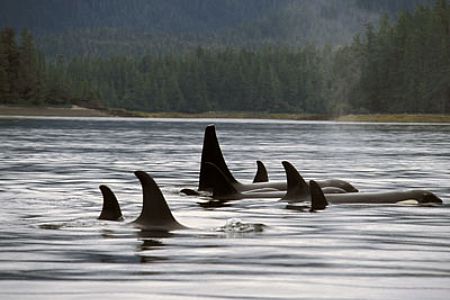 Critics claim that B.C.’s coastline will face new risks if Enbridge Inc. builds twin pipelines to Kitimat. (Ian McAllister photo) |
The sight of these massive mammals—which can weigh more than 40 tonnes—deftly corralling schools of tiny fish is truly astounding. Scientists call this spectacle “bubble net feeding”, and it’s not by accident that humpback, finback, and minke whales, along with Dall’s and harbour porpoises, orcas, and Pacific white-sided dolphins, congregate here: there is abundant food and a relatively hospitable environment for wildlife.
Caamano Sound is a universe away from the office towers of Edmonton, but these disparate locations are now inextricably linked by plans for the so-called Northern Gateway pipeline, which will connect Alberta with Kitimat on B.C.’s central coast. And you can’t talk about pipelines without discussing oil tankers plying some of the province’s most ecologically rich and diverse waters as they make their way from open ocean into Caamano Sound, around Gil Island, where B.C. Ferries’ Queen of the North foundered in 2006, and northeast up Douglas Channel to the port at Kitimat.
Marven Robinson is a wildlife guide and a band councillor with the Gitga’at First Nation in Hartley Bay, a small village at the mouth of Douglas Channel. He knows his way around the reaches, sounds, and narrows of this part of the coast like a taxi driver knows the city, and oil tankers cutting through the heart of Gitga’at territory don’t exactly square well with his vision of the future.
“With what happened to the Queen of the North, that was just a small spill and there’s still fuel leaking up from that,” Robinson says. “We’re being really careful about what we say publicly right now because we haven’t even met with the proponents yet.”
If the volatile economics of oil and environmental approvals fall into place, Calgary-based Enbridge Inc. hopes to construct 1,200-kilometre twin pipelines linking the oil fields of northern Alberta with the deep-water port at Kitimat. A westbound pipeline, about a metre in diameter, would carry 525,000 barrels of oil daily, and a 50-centimetre-wide eastbound line would daily transmit 193,000 barrels of condensate, a petroleum byproduct used to thin crude oil for transport and piping.
By selling 10 units at $10 million each, and giving buyers preferential treatment in booking capacity on the future pipeline, Enbridge has already raised $100 million from heavyweight Asian refiners and Canadian producers to help bring the project to regulatory approval.
The subplot to this story is that major oil-sands players like Suncor, Husky, Shell, and Petro-Canada desperately want the pipeline to access Asian markets as a cushion against threats from the nascent Barack Obama administration to wean the U.S. off its reliance on dirty oil-sands fuel.
Enbridge expects this $4-billion-plus project to create some 4,000 construction jobs as it crosses the traditional territories of at least 40 different First Nations bands in B.C. and Alberta. The company is promising state-of-the-art shipping protocols, with double-hulled vessels, radar-monitoring stations, pilot supertugs, and first-response emergency stations located in Kitimat and communities like Hartley Bay. Throughout the fall, Steve Greenaway, vice president of Enbridge Northern Gateway Pipelines—a general partner of Enbridge Inc.—led a series of open houses in communities along the pipeline route. Barring any major roadblocks, Greenaway says, Enbridge plans to file for regulatory approval by mid-2009, kicking off an estimated two-year environmental review to be carried out jointly by the Canadian Environmental Assessment Agency and the National Energy Board. At the earliest, construction could begin in 2011 or 2012. However, over the past two years there has been furious debate about the validity of an ambiguous federal government statement dating back to the early 1970s that refers to a moratorium on oil-tanker traffic along the B.C. coast. As far as Greenaway is concerned, though, the moratorium is not an issue.
“If there was a moratorium that was in any way enforceable, I’d suspect that the David Suzuki Foundation or the people at Dogwood [Initiative] would have pursued this in court,” Greenaway says. “As a British Columbian, I understand people’s concerns, but we feel that our safety systems will be as good as anything in the world.”
When it comes to provincial and federal government support, Greenaway has good reason to be optimistic about Northern Gateway’s prospects. The pipeline fits neatly within the B.C. Liberals’ energy game plan, which could have not only pipelines linking the coast to Alberta but also drilling rigs in Hecate Strait east of the Queen Charlotte Islands, an activity that has been off-limits for more than 30 years because of federal and provincial moratoriums on offshore oil and gas exploration and development. That’s why in the B.C. Energy Plan, the government promises to work “to lift the federal moratorium on offshore exploration and development and reiterate the intention to simultaneously lift the provincial moratorium”.
In a strange twist, former provincial NDP leader and cabinet minister Dan Miller has emerged as one of the most vocal cheerleaders for offshore oil exploration. Although high investment costs, uncertainty about proven reserves, and environmental issues will likely keep offshore oil and gas exploration on the shelf for some time, pipelines to the north coast are a very real possibility. Near the bottom of a 2008 throne speech dripping with sustainability rhetoric, Premier Gordon Campbell made references to an “energy corridor” that will be a boon to the northern economy. Kitimat LNG Inc., which has received both federal and provincial approval for its liquid-natural-gas port facility, received a major boost recently when Mitsubishi Corporation signed an agreement to purchase 1.5 million tonnes per year of terminal capacity and to acquire a minority interest in the project. The deal is expected to be finalized by the end of March this year. There have also been a slew of pipeline proposals, including those by Pacific Trail Pipelines, Pembina Pipeline, and Kinder Morgan Inc.
Enbridge, though, appears closest to breaking ground. In an enthusiastic August 2005 letter to Enbridge, Richard Neufeld, then minister of energy, mines, and petroleum resources, endorsed the pipeline and discounted the moratorium. Neufeld wrote that it “is not directed at, and has no application to oil tankers sailing to or from British Columbia ports”, referring instead to a so-called tanker exclusionary zone that targets only ships from Alaska transiting B.C. waters while bound for the U.S. (Neufeld, who is leaving provincial politics this spring to take a seat in the Senate, refused to respond to requests from the Georgia Straight for an interview.)
The federal government mouths a similar line, but a former minister of natural resources, Gary Lunn, preferred to duck hard questions about the tanker moratorium. After the last federal election, Lunn was removed from the ministry and replaced by Toronto MP Lisa Raitt, a lawyer and former CEO of the Toronto Port Authority. Environmentalists can take little comfort in her nomination. At an October 6 Oakville, Ontario, chamber of commerce meeting, Raitt was on record cheering about the possibilities of increased tourism and shipping opportunities in the North, thanks to the melting polar ice cap. She is also known for her combative relationship in the past with a citizens’ group called Community Air, against which she launched a lawsuit in 2006 for its criticism of the port authority. Like her predecessor, Lunn, neither Raitt nor her communications staff returned calls from the Straight.
Although governments prefer to dance around the prickly moratorium question, conservation groups, many First Nations, and other critics say the reasons for a moratorium still stand: simply that tanker traffic and oil spills pose a serious threat to the B.C. coast. Since 2006, ocean tankers have been quietly sailing into Kitimat’s port laden with as many as 350,000 barrels each of condensate, bound by railcar for EnCana Corporation’s operations in Alberta. Northern Gateway’s Greenaway sees this as proof positive that tankers can travel safely into Douglas Channel. But Eric Swanson, corporate campaigner for the Dogwood Initiative, a B.C. land-reform organization, says such shipping traffic is in blatant defiance of what the public wants—a rock-solid moratorium on tanker traffic in B.C.’s inside waters. Swanson is not surprised that politicians would prefer to sidestep the tanker-traffic issue rather than address it head-on—it’s a potential political time bomb. According to a poll conducted by the public-opinion research firm Synovate, a majority of British Columbians polled across the political spectrum desire an outright ban on oil-tanker traffic along the coast.
“The problem is that the moratorium was issued as a policy statement but it was never written down. What is clear is that there is a huge appetite for a crystal-clear ban on oil tankers. Seventy-two percent of B.C. residents support it, and that’s what we’re looking for,” Swanson says.
Ian McAllister, executive director of the nonprofit Pacific Wild, believes the distinction between the so-called tanker exclusionary zone and a tanker moratorium is moot.
“If the issue is protecting the coastline of British Columbia, then what’s the difference between tankers coming from Alaska and tankers going into Kitimat? It’s ridiculous.”
And when Alaska and oil tankers are mentioned in the same sentence, the Exxon Valdez immediately comes to mind. This 1989 disaster dumped 49.5 million litres of crude oil into Prince William Sound, killing an estimated 250,000 seabirds, 22 orcas, and untold numbers of fish and other marine organisms. By most conservative measures, Caamano Sound poses a much greater navigational challenge than the Alaskan sound that has been relegated to its place in history as the site of one of the worst oil-spill disasters on record. At the time, U.S. coast guard admiral Paul Yost said the 16-kilometre-wide accident site in Prince William Sound “was not a treacherous area” and “Children could drive a tanker through it.”
“If supertankers move around this coast, it’s not a matter of if but when a major disaster on the scale of Exxon Valdez would happen,” says Kevin Smith, whose company, Maple Leaf Adventures, takes tourists on wildlife-viewing trips in the central coast’s Great Bear Rainforest and frequently sails the proposed tanker route. “Big oil has millions of dollars to lobby government. Sadly, our burgeoning conservation economy on the coast doesn’t have that ability.”
Rob Williams, a marine researcher from the University of British Columbia, agrees that the prospect of an oil spill in an area as biologically diverse as Caamano Sound is unpalatable.
“Oil tankers pose a lot of threats to marine mammals, including noise, oil spills, and ship strikes. We don’t exactly know why this area is so rich, but there are some long, narrow channels that serve as bottlenecks for food, making it easier for whales to feed,” Williams says. The researcher has been using acoustic monitors to gauge the level of underwater shipping noise, known to have an impact on the ability of toothed mammals, such as orcas and dolphins, to use echolocation for finding food. “Caamano Sound may be one of the last chances we have on this coastline to protect an acoustically quiet sanctuary for whales.”
While environmentalists and scientists ponder a B.C. coastline with regular oil-tanker traffic, Enbridge faces an equally tough sales job as it tries to win support for its fossil-fuel superhighway across north-central B.C. Enbridge can count on support from the mayors of Prince George, Prince Rupert, and Kitimat, who have been boosting the project and its promise of jobs and tax dollars in their cities. Conversely, Nathan Cullen, NDP MP for Skeena–Bulkley Valley, has serious reservations about a pipeline linking northern Alberta’s dirty oil sands with the B.C. coast, and he remains highly skeptical about Northern Gateway’s economic benefit. There will be short-term jobs in pipeline construction, Cullen admits. He says, though, that over the long haul, B.C. communities in the Interior and along the coast will shoulder the burden of environmental risk from spills—whether it be in fish-bearing streams or the marine environment—and they will not share in the profits that will accrue to the head offices of Enbridge in Calgary and firms like Syncrude and Shell.
“We approach projects on a risk-benefit basis, and I don’t think the case has been made that the risks are worth the benefit,” Cullen says on the phone from Ottawa. “The Conservatives’ approach is ‘See no evil, hear no evil, and open up the oil corridor.’ This project is connected to the hyperdevelopment of the tar sands, and in the end we’re talking about 40 or 50 jobs that would be created by the pipeline. That’s your average Canadian Tire.”
Glenda Ferris is one citizen counting herself among those who have more to lose than gain. The proposed pipeline route passes within five kilometres of her rural property on Buck Flats Road west of Houston. She credits Enbridge representatives for making the effort to travel to the end of Buck Flats Road to meet with residents in November, but she says the meeting left her with more questions than answers. In her opinion, the open houses being held by Enbridge are more about fancy graphics and public relations than about incorporating citizen concerns into the ultimate design and routing of the pipeline.
“There are all kinds of questions about the potential of spills that they couldn’t or wouldn’t answer,” Ferris says. “It looks like someone just took out a map and drew a line between point A and point B. You have thousands of kilometres out there, and they put it right down the middle of our valley. We don’t want a pipeline here and don’t want tankers on the coast, but there’s a feeling that it’s almost a done deal. We’re frustrated.”
Buck Flats Road is just one back-yard brushfire that Enbridge may have to contend with. The proposed pipeline route crosses the territories of dozens of First Nations, each with specific concerns and wants, and smart companies know that it’s no longer acceptable to simply pay lip service to Native concerns. So does government. A landmark 2004 decision by the Supreme Court of Canada, in the case of Haida Nation v. British Columbia and Weyerhaeuser, explicitly states that the Crown must consult with and accommodate First Nations even when questions of aboriginal rights and title have not been resolved. This means, at best, that the proposal could get bogged down in protracted band-by-band negotiations and, at worst, that it could end up in the Canadian court system. The Haisla First Nation, under the leadership of Chief Steve Wilson, is tentatively in support of Northern Gateway and stands to benefit greatly from the development of port facilities in Kitimat. Enbridge has already signed a number of protocol agreements with individual First Nations along the pipeline route—including the Yekooche First Nation and the Nee-Tahi-Buhn band near Burns Lake—that come with attached funds, ostensibly to enable First Nations to hire their own consultants, and arrive at an informed decision about the pipeline. Chief Ray Morris says Enbridge has offered the Nee-Tahi-Buhn $110,000 in capacity-building funds as well as a chance to purchase equity in the project.
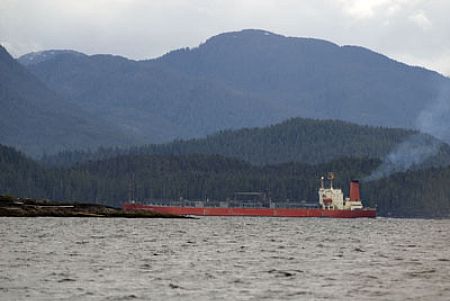 Tanker noise can disrupt marine mammals’ food-gathering. (Ian McAllister photo.) |
“Our band is very familiar with pipelines. There have been so many proposals,” Morris says on the phone, adding that his band will support the project only if it translates into future revenue for members.
The mood isn’t nearly as accommodating elsewhere. The Council of Haida Nations is on record as saying it will never support tanker traffic in its waters. In an October 14, 2008, letter to Enbridge, Fraser Lake’s Nadleh Whut’en band expressed “significant concerns over the proposed pipelines and their environmental and socio-economic impacts” and ordered Enbridge employees and consultants to stay out of the band’s territory until a formal agreement is in place. This sentiment was echoed at the offices of the Carrier Sekani Tribal Council in Prince George. Tribal Chief David Luggi represents eight bands in the region and views protocol agreements as an effort by Enbridge to purchase First Nations support for Northern Gateway. The proposed pipeline will cross the Stuart River, a major salmon system in Carrier Sekani territory, and member First Nations are rejecting the federal and provincial environmental review processes. In their place, Luggi says, the Carrier Sekani want a novel First Nations review that would be funded by government and use independent science and traditional knowledge to assess the impacts of the project on the environment, cultural heritage, and aboriginal rights and title. It would also allow adequate time and funds to fully engage and educate aboriginal communities and would delay a decision until “accommodations of infringements of aboriginal rights and title has taken place”.
“The B.C.–federal review process is focused on ensuring proper process rather than the substance of the project,” Luggi says. “The First Nations review-process framework would be applied to all new development proposals and not be restricted to the Enbridge proposal. We won’t participate in reviews if the funds are tied to any existing programs.”
The Carrier Sekani proposal was formally endorsed by other bands at a First Nations summit held in Vancouver last November. According to Luggi, the current process is tantamount to the project proponent trying to purchase First Nations support one band at a time.
Northern Gateway’s Greenaway denies that Enbridge is attempting to buy off Natives through protocol agreements. If the Carrier Sekani people disagree with the environmental-review process, he says, that’s a matter between them and government. He says he believes Enbridge is being as proactive as it can be in engaging community groups and First Nations well in advance of the official review process.
“The protocol agreements come with funding to allow First Nations to build capacity,” Greenaway says. “We are also offering opportunities for joint ventures and to become equity partners. These are still early days, and there’s a lot of work to be done.”
Despite gloomy economic circumstances that have caused capital to flee the oil sands, with projects that would have represented more than one million barrels of oil per day either postponed or cancelled since last December, Greenaway assures that Enbridge’s backers are thinking about the long term and remain committed to the project.
In Caamano Sound, the humpbacks and orcas are still feeding. Hartley Bay councillor Marven Robinson fears that oil tankers several football fields long plying the same waters as the myriad species that still thrive in traditional Gitga’at territory could become British Columbia’s oil-spill shame in the future. He’s also concerned that this energy-corridor juggernaut of pipelines and oil tankers is already a done deal in the minds of many politicians and oil-patch executives.
“Everybody around here is feeling that even if we say something against it, it’s going to go ahead anyways,” Robinson says.