March 31, 2009
Investor urges Enbridge to assess risk of delay
By David Ebner
The Globe and Mail
March 30, 2009
 Enbridge's proposed Northern Gateway project faces significant risk of delay due to the concerns, interests, and authority of the 42 First Nations along the project route (image: fishing boat arriving in Prince Rupert, Josh Paterson) |
VANCOUVER — The prospect that Enbridge Inc. [ENB-T]'s $4-billion Gateway pipeline project, which would connect Alberta's oil sands with lucrative Asian markets, could become mired in disputes with first nations groups has at least one major shareholder demanding a reckoning.
The company is set to bring its Gateway proposal, which has $100-million in backing from 10 companies, oil sands producers in Canada and refiners in Asia, before the National Energy Board in the next three months.
But given the climate of opposition that has dogged both this project, which was shelved in 2007 in part because of a lawsuit by the Carrier Sekani Tribal Council, and the proposed Mackenzie Valley pipeline, Enbridge investor Ethical Funds Co. wants the company to disclose how much risk it sees.
Vancouver-based Ethical Funds, which owns about 500,000 Enbridge shares, is putting a resolution before the company's May annual meeting, published this week in Enbridge's proxy circular. The resolution urges Enbridge to disclose in its quarterly filings how negotiations with native communities are progressing, "including reference to specific opposition."
"It seems pretty clear that there's risk to investors here," said Bob Walker, an Ethical Funds vice-president.
Enbridge, stung by the failure of its first effort to get Gateway moving ahead, has redoubled its work on the project this time, with a particular focus on relations with first nations.
The work centres on the duty of the government to conduct meaningful consultations with first nations about industrial projects that would traverse or be built on their traditional land.
A lack of consultation has slowed other projects, such as the Mackenzie Valley pipeline project.
The Dehcho First Nations sued the federal government about being unfairly excluded from the review of the Mackenzie pipeline. The suit delayed the project for a year and the Dehcho won $31.5-million.
The duty to consult has been largely taken over by companies such as Enbridge. The company last fall held a series of open houses, which is typical, and is trying to use social media such as YouTube and Facebook, where results are mixed. The Gateway project has just two friends on Facebook.
In both the Mackenzie case and Gateway, the first nation regions in question don't have settled land claims, making it harder for a project developer.
Adequate consultation is one of the "most complex questions clients are asking their advisers," said energy regulation lawyer Gord Nettleton of Osler Hoskin & Harcourt LLP.
"You must have very good communication and co-ordination with government."
Success will cost money, said Doug McArthur, a former deputy minister of aboriginal affairs in B.C. and now a public policy professor at Simon Fraser University.
"Sitting down is crucial and it's going to cost money," Mr. McArthur said. "It's no longer possible for companies to build these kinds of things without making substantial offers in terms of benefits and compensation."
Enbridge has tentative support from 25 of the 42 first nations groups along the 1,170-kilometre pipeline route. Enbridge pays money to the groups so they can be involved in deliberations over the pipeline and the money comes with a deal to commit to the review process led by the NEB.
"We've had a pretty good reception," said Ken MacDonald, an Enbridge vice-president.
The Carrier Sekani, representing eight first nations, about 10,000 people and one-third of the Gateway pipeline route, remains the main opposition. Chief David Luggi doesn't trust the National Energy Board process, which he said is almost guaranteed to lead to project approval.
He said the danger of one oil spill is too great for the fisheries business on the many prolific rivers of northern B.C.
"You do the real easy math, one spill, it'll have fatal results, for an undetermined amount of time and perhaps forever," Mr. Luggi said.
The Council of the Haida Nation on the Queen Charlotte Islands is also opposed to the pipeline.
March 30, 2009
BC Hydro attacks conflict allegation
COMMENT: Juicy stuff! Brookfield says BC Hydro is in a conflict of interest by evaluating private project proposals when it is developing its own project (Site C). It claims Hydro may be using info gathered in the power calls to, um, well, perhaps, improve the case for Site C. It even suggests that the high attrition rate of projects accepted by way of the calls is because BC Hydro essentially takes junk bids from unqualified companies.
Addendum: On March 26, Brookfield wrote to the Commission, claimed constructive intent, and advised that it would "have no objection" if the earlier letter was struck from the record. link
Scott Simpson,
Vancouver Sun
March 30, 2009
A conflict of interest allegation levelled against BC Hydro by an independent power producer should be struck from the record at a B.C. Utilities Commission hearing, the Crown corporation says.
Hydro says it has been prejudiced by "unsubstantiated assertions" that Brookfield Renewable Power made in a recent 10-page letter to the commission.
In the letter, Brookfield alleged that Hydro is unsuited to the dual role of public utility and solicitor of private power bids because Hydro's own projects, such as the proposed Site C dam on the Peace River, are in competition with privately owned electricity generation.
It called on the government of B.C. to create an "independent, transparent, arm's-length entity to manage all electric generation procurement activities."
Hydro has declined comment, but both Energy Minister Blair Lekstrom and NDP energy critic John Horgan previously dismissed the allegations.
However, in response to a query from The Vancouver Sun, former Hydro fairness commissioner Michael Asner examined Brookfield's report and said that if it is factually correct, Hydro is in both an apparent and a potential conflict.
Hydro is reviewing the economic case for self-building Site C dam while simultaneously conducting a "Clean Power Call" aimed at attracting bids for new private power developments.
Both efforts have a single purpose: to increase electricity supply in B.C.
Hydro disputes Brookfield's assertion that the dual effort "serves to undermine confidence in the process as well as the market signals that drive investment decisions for IPPs in British Columbia."
"The assertion that BC Hydro is in a conflict of interest with respect to the Clean Power Call because it may advance self-build projects in the future is a very serious allegation which BC Hydro does not accept," said Hydro's statement to the BCUC.
"Nor does BC Hydro accept Brookfield's assertions concerning the so-called market impacts.
"What has been clearly established on the record is that BC Hydro has received 68 proposals from 43 registered proponents representing in aggregate some 17,000 gigawatt hours per year of firm energy in response to the Clean Power Call."
In response to Hydro's request, the Utilities Commission ordered Brookfield to file a response by last Friday, and gives Hydro until today to comment on Brookfield's response.
Brookfield Renewable Power comment to the BC Utilities Commission, 06-Mar-2009
Sample Electricity Purchase Agreement (EPA) from the Clean Power Call
More documents on EPAs and the Clean Power Call
Brookfield backs down, 26-Mar-2009
Brookfield backs down
March 26,2009
Ms. Erica M. Hamilton
Commission Secretary
British Columbia Utilities Commission
900 Howe Street, Sixth Floor, Box 250
Vancouver, BC
V6Z 2N3
Dear Ms. Hamilton:
Re: British Columbia Hydro and Power Authority ("BC Hydro")
2008 Long Term Acquisition Plan ("2008 LTAP")
BC Hydro's Objection to Comments of Jack Burkom, Director
of Marketing for Brookfield Renewable Power Inc.
We write in response to your letter of March 24, 2009, requesting a response to BC Hydro's letter of March 19, 2009. Capitalized terms used in this letter have the meanings attributed to them in your March 24,2009 letter.
The Brookfield Letter was submitted as a commentary document in the 2008 LTAP proceeding, and was not intended to be put forward as "evidence". Our intention was to be constructive in making comments on the process underway to provide British Columbia with more investment in new, renewable power assets producing electricity at the lowest possible cost. It was certainly not our intention to prejudice BC Hydro or suggest that BC Hydro has acted in any manner other than with full professionalism in all of its endeavours, and we regret if the wording of our comments implied otherwise.
In light of the foregoing, we would have no objection to the Commission striking the Brookfield Letter from the 2008 LTAP record.
Yours very truly,
BROOKFIELD RENEWABLE POWER INC.
Ben Vaughan
Chief Operating Officer
Brookfield's letter of contrition, 26-Mar-2009
March 27, 2009
FACTS ON INDEPENDENT POWER PRODUCTION
Ministry of Energy, Mines and Petroleum Resources
March 25, 2009
Here are the facts on independent power production, to correct misleading claims about electricity generation in British Columbia.
Claim: B.C. does not need to be electricity self-sufficient; we can easily import any new electricity we need from other jurisdictions.
Fact: Government’s commitment to becoming self sufficient in electricity by 2016 will ensure BC Hydro has sufficient electricity supply to meet customer needs in the worst water years, and have a buffer supply for insurance when demand is higher than anticipated, or if expected energy efficiency savings do not materialize.
· BC Hydro’s own figures show it has become a net importer to meet its customers’ needs. BC Hydro has been a net importer of electricity for seven of the last 10 years.
· Despite the current economic climate, over the long term, B.C.’s economy will continue to grow, as will the need for electricity. The gap between supply and demand is expected to widen as we move to achieve our goals for using clean, renewable electricity in transportation and other sectors.
· It takes time to build new electricity infrastructure responsibly, and government is not going to risk being ‘caught short’ by not continuing to plan for the economic future of this province.
· The self-sufficiency policy ensures that B.C. benefits from the jobs and investment of new power supply infrastructure.
· Self sufficiency will reduce our reliance on imports. Many other jurisdictions B.C. currently relies on to meet our domestic needs generate electricity from coal-fired power plants – not the clean, green sources that we enjoy in this province.
· Many British Columbia residents are surprised to learn we rely on American power to keep our lights on or that the imported power comes from coal-fired power plants. Citizens expect us to be self-sufficient and clean, considering the ample natural resources we have.
· Government has put conservation and energy efficiency as the first option utilities must consider in meeting a growing demand.
· Government has set a goal for BC Hydro to meet 50 per cent of its growing needs through conservation, and its current resource plan does that and more.
Claim: The 2002 Energy Plan bans BC Hydro from building new electricity generation facilities.
Fact: BC Hydro provides 90 per cent of the total electricity the province generates – between 43,000 and 54,000 gigawatt house of electricity per year – and serves 95 per cent of B.C.’s population (BC Hydro Service Plan, 2009/10-2010/11). Therefore, BC Hydro is currently looking at building and expanding electricity generation for B.C.
· BC Hydro is investing more than $3.6 billion (BC Hydro Service Plan, 2009/10-2010/11) over the next two years to upgrade its dams and other public power infrastructure.
· In anticipation of increased demand, BC Hydro is adding capacity to the Revelstoke Dam and Generating Station. Revelstoke Dam is the most cost-effective energy source available to BC Hydro. This project will add about 500 megawatts of power, which will increase capacity at Revelstoke to 2,480 megawatts. As well, BC Hydro plans to add 1,000 megawatts of capacity with two new turbines at the Mica dam.
· Capital investments on several other sites are also proposed: Peace Canyon Stator replacement, GM Shrum Stator upgrade, Aberfeldie Dam Redevelopment and Coquitlam Dam Improvement Project.
· These capital projects will increase reliability and produce additional capacity for meeting B.C.’s power needs.
· BC Hydro has completed Stage 2 consultation of the Site C project on the Peace River. If built, this project would produce about 4,600 gigawatt-hours of electricity annually – enough for 460,000 homes – which is about 10 per cent of the electricity produced annually at BC Hydro’s existing hydroelectric facilities.
Claim: B.C. ratepayers are paying the capital costs of new power projects being built by private energy developers through Electricity Purchase Agreement contracts with BC Hydro, and are paying as much as double the current energy market rates.
Fact: Price protection and energy supply is assured within the contracts between BC Hydro and an independent power producer.
· Price stability can be predicted over the term of the contact. The price of electricity on the spot market can be volatile. Long-term contracts with power producers bring certainty and a guaranteed price.
· BC Hydro runs competitive procurement processes which result in the lowest cost projects. The resulting contracts are reviewed by the BC Utilities Commission to ensure they are in the ratepayers’ interest.
· The cost BC Hydro pays for new power supply from IPPs is similar to that being paid in other jurisdictions for new supply.
· Building new power projects is more expensive today than it was several decades ago. It costs more, not because they are IPPs, but because they are new projects. Similarly, a new home or vehicle costs more to build today than it did in the 1960s or 1970s.
· Since 1998, BC Hydro rate increases have remained below the rate of inflation and well below those of similar service providers (BC Hydro Service Plan, 2009/10-2010/11). Ratepayers still enjoy some of the lowest rates in North America and government is committed to maintaining that competitive advantage.
Claim: The government wants to privatize BC Hydro and sell all of its assets.
Fact: BC Hydro and its assets are not being privatized or sold.
· The BC Energy Plan released in 2007 reaffirms the government’s commitment to public ownership of BC Hydro and its assets while broadening the supply of available energy.
· The BC Hydro Public Power Legacy and Heritage Contract Act and the Transmission Corporation Act require that our public power legacy be maintained.
· This government has also established the Heritage Contract in Perpetuity. This benefits ratepayers by continuing to receive low-cost electricity for generations to come and helps keep rates among the lowest in North America.
Claim: Bill 30 was passed to put an end to meaningful local input into the approval of private power projects on Crown land. These projects are impacting rural communities in a negative way and there is not enough consultation with communities. These projects are also being ‘fast tracked’ with minimal environmental review.
Fact: Local input is still requested in the application process and the review of power projects, regardless of size or ownership, and is comprehensive in scope.
· When a proponent wants to develop a hydroelectric project, they must apply for a water license and a Crown land license, which grants them the right to construct their projects on Crown land and to use the water subject to the terms and conditions specified in the license.
· The project application is made available for review to agencies, local governments, First Nations and special interest groups for feedback. This feedback is used by the permitting agencies when considering whether to approve the application and in setting conditions for any approvals.
· Any run-of-the-river project must follow a multi-step process for development, and for projects of over 50 MW in size this includes an Environmental Assessment Act process.
· Requirements include, but are not limited to:
o A land tenure permit for projects situated on Crown land. This requirement falls under the Land Act;
o Application for a water license (which falls under the Water Act) for any run-of-river projects using water;
o Projects other than run-of-river will require different permits, depending on the type (i.e. wind, biomass, geothermal, etc);
o Consultation with First Nations.
· Considering the size and scope of a project, there could be no fewer than 11 provincial approvals that must be attended to when considering an IPP permit. As well, there could also be as many as six federal departments that would have to approve an IPP, if federal approval is needed (Ministry of Agriculture & Lands, Independent Power Production in B.C. – A Guidebook for Proponents, http://www.al.gov.bc.ca/clad/IPP_guidebook.pdf).
· Water licenses are for fixed terms and after the term expires, the IPP holding the license no longer has any rights to use the water without obtaining a new water license. Granting fixed terms on licenses ensures that the Province retains control over the water resources, while ensuring that IPPs can meet their contractual obligations to deliver power to BC Hydro.
Claim: B.C.’s rivers and streams are being exploited by these run-of-river projects and will be privatized. Once an American IPP or another foreign entity owns them, they will control our river and stream systems and that provision will be guaranteed under NAFTA.
Fact: IPP projects are not new – they have been contributing clean energy to the provincial power grid since the late 1980s. Between 1996 and 1997, numerous IPP projects were announced by the then-government.
· Rivers and streams will continue to remain in public hands – IPPs do not own them.
· There are mandatory time limits on water power licenses to ensure ownership of our rivers and waterways remain in public hands. Prior to changes made by the current government in 2003, water power licenses were issued with no expiration date.
· IPPs receive water licences of 40 years, and when those end, so do the water licenses and the land tenure rights. A company would have to re-apply to have the water/land tenure license renewed in order to keep operating.
· If power producers want to use water systems for a run-of-river project, they must pay water rental fees that typically can amount to significant revenue to the Province over the life of a project.
· This arrangement can be compared to what a forest company does – it pays the government ‘stumpage fees’ to access timber on Crown land through a 25-year lease arrangement with the option of renewal after 25 years.
· NAFTA does not prevent government from regulating its water resources, or determining whether or not to issue a licence.
Claim: When the long-term contracts with IPPs expire with BC Hydro, these IPPs will be free to export their power to the U.S. This will result in BC Hydro having to bid against U.S. buyers and be forced to increase our consumer rates in order to support those bids.
Fact: B.C. has always been an exporting province and our natural resources are the foundation of our economy. For decades, B.C.’s resource-based exports have supported jobs and wealth creation in the Province. IPPs have been able to export power to the U.S. and elsewhere since the 1993 Long-Term Firm Electricity Export Policy. However, there has not been significant export activity by IPPs due to a number of factors:
· Availability and cost of transmission to the U.S.;
· Challenges in marketing intermittent supply from projects such as wind and run-of-river;
· The available opportunities to sell power to BC Hydro.
· When a water license expires, it will be up to the government of the day to decide whether or not the license should be renewed.
Claim: Critics claim that the National Energy Board and Stats Canada data say that BC Hydro has been a net exporter of energy for seven of the past 10 years yet BC Hydro’s own data says it has been a net importer – why the difference?
Fact: Critics are mistaken in their interpretation of the National Energy Board (NEB) and Stats Canada data on electricity matters.
· BC Hydro, StatsCan and the NEB use different data sets. BC Hydro’s information shows it has been a net importer of electricity in seven of the past 10 years. BC Hydro’s data shows that it has had to purchase up to 12 per cent of domestic requirements during this period.
· StatsCan and the NEB include contribution numbers from other utilities and generators, like Fortis BC, Columbia Power and Teck. They also report at the Canada/U.S. border and do not include transactions between BC Hydro and Alberta.
Claim: There are almost 1,000 water licences staked on rivers throughout B.C. and it’s a gold rush of private power producers taking over B.C. resources.
Fact: As of September 2008, there were about 550 water power applications outstanding in the Province; however, many of these are inactive.
· As of Dec. 31, 2008, only 88 IPP licenses have been issued that are still current (61 since 2001) and 154 applications have been refused or abandoned. Of the 88 licenses issued, 26 of them were prior to May 2001; 62 since 2001. In other words, one-quarter of these were approved prior to 2001.
· A total of 47 IPPs are operating all around the province and 15 of them have been generating green electricity for over 10 years. (32 of the 47 IPPs are run-of-river) (Ministry of Environment, Water Stewardship Division stats)
· Comparing water licence applications to operating IPPs is like comparing mineral claims to operating mines – there are more than 50,000 mineral claims staked in B.C. but only a handful of operating mines. It does not take into account the enormous environmental, financing, and other regulatory processes power projects need to pass before they can become a reality.
Claim: There are literally hundreds of run-of-river IPPs operating in the Province. These projects offer nothing to rural communities.
Fact: This is false. There are currently 47 operating IPPs around British Columbia, 32 of which are run-of-river, and the economic benefits are provincewide, especially in rural communities.
· Total construction employment from IPPs that started construction since 2001 is about 4,000 person years. There is also indirect employment in the way of supporting community facilities. (Industry employment figures, as of Feb. 2009 (IPPBC)
· According to industry figures, IPPs have already invested $2.4 billion in B.C. with an additional $6.8-billion currently ongoing or expected in connection with existing calls for power.
· There are more than 1,100 workers employed on 47 operating projects and another 18 projects currently under construction. Current construction represents over $2 billion of private investment. (Industry employment figures, as of Feb. 2009 (IPPBC))
· Not all IPPs are run-of-river projects. Current IPPs include natural gas fired, heat recovery and biomass generation. Future projects could include wind, geothermal, ocean and solar electricity projects.
Claim: First Nations do not support independent power projects.
Fact: First Nations are involved in many IPP projects around the Province.
· The Squamish First Nation is involved in the Furry Creek and Ashlu run-of-river projects. Ashlu will become the property of the Squamish First Nation at the end of their power sales agreement with BC Hydro.
· The Hupacasath First Nations is an example of a proponent that has an electricity purchase agreement with BC Hydro for their China Creek Project on Vancouver Island, which is in service, and they are looking to another agreement with BC Hydro for a further project on Corrigan Creek.
· The Taku Land Corporation also has an electricity purchase agreement on Pine Creek and another one on Kwoiek Creek which involves the Kanaka Bar Indian Band.
· The Klahoose on Cortes Island signed an agreement with Plutonic Power for a benefits sharing arrangement for the East Toba River and Montrose Creek IPP projects. Plutonic will pay royalties to the Klahoose for the next 50 years and will also see jobs and training offered to band members.
· Nai Kun Wind Energy and the Haida Nation have formed a commercial partnership to operate and maintain Nai Kun’s proposed wind farm in Hecate Strait. The agreement formalizes a relationship that’s been developing since 2002.
-30-
Media Contact:
Jake Jacobs
Public Affairs Officer
250 952-0628
250 213-6934 (cell)
For more information on government services or to subscribe to the Province’s news feeds using RSS, visit the Province’s website at www.gov.bc.ca.
Download this media release.
‘No more run of river’ B.C. Greens
Jesse Ferreras
The Pique (Whistler)
26 March 2009
Sterk says additional hydro isn’t needed, focus should be on conservation
B.C.'s Green Party wants to put an end to run of river hydro projects, its leader told Pique Newsmagazine Friday morning.
Jane Sterk, leader of the B.C. Greens since October 2007, said in an interview that it's time to put an end to run-of-river hydro projects and focus on delivering electricity to British Columbians through conservation.
"We're for the most part saying no more run of river, that we don't need more hydro, that through conservation and renewable energies we can move away from these projects," she said.
"The run of river projects, for the most part, have been very controversial and they have not been accepted in the regions where they've been introduced."
Run of river projects, often referred to as "independent power producers" when developed by private companies, have been a big issue in B.C. since at least 2006, when the provincial government passed Bill 30.
That bill came after the Squamish-Lillooet Regional District denied in early 2005 a rezoning application for the Ashlu Creek hydro project, near Squamish. The district denied the rezoning on the grounds of "community concern and objection" to the project, as well as a lack of overall strategy for IPP production.
Bill 30 was introduced in the legislature in April 2006. Called the Miscellaneous Statutes Amendment Act, it proposed an amendment to the Utilities Commission Act saying that nothing in the Community Charter or under the Local Government Act could supersede an authorization granted by the B.C. Utilities Commission to a utility operating on Crown land.
That means if a public or private utility is being built on Crown land in a municipality or regional district, the local government can't stop it.
The move has touched off a hot debate throughout B.C. that is promising to make run of river projects a key election issue. The Greens, who released their election platform Thursday, are promising to repeal Bill 30 if elected on May 12.
"We just think decision-making should be made at the local level," Sterk said. "The regional districts and municipalities have a better understanding of the impacts of these projects on their areas, their regions."
Other promises by the Greens include changes to the environmental assessment process, something that's been a point of consternation when it comes to run of river projects. The current process, administered by the Environmental Assessment Office, prescribes a nine-stage assessment. The provincial cabinet then decides whether to approve it or not.
Critics of run of river feel the process administered by the Environmental Assessment Office (EAO) doesn't go far enough to assess the projects. In their platform, the Greens propose to "strengthen" the environmental assessment and account for the cumulative impacts of multiple projects, rather than just each one individually.
"We would change the assessment process," Sterk said. "We would require that there be cumulative impacts accounted for in these run of river projects."
West Vancouver-Garibaldi Liberal MLA Joan McIntyre, now running for re-election in the newly-formed riding of West Vancouver-Sea to Sky, said she doesn't think there's anyone more committed to conservation than the B.C. Liberals.
"We introduced a 55-point energy plan several years ago that we've been in the process of executing," she said. "Over the last three years, we've brought in eight pieces of legislation related to both our environment and energy, but we have a very aggressive target of 50 per cent of B.C. Hydro's incremental resource needs through conservation by 2010."
As for Bill 30, McIntyre thinks it's often "misunderstood" by its critics.
"What that did, is it was a small amendment that allowed some of these independent power producers exactly the same rights as B.C. Hydro would have," she said. "Nothing more, nothing less."
Speaking about run of river hydro, McIntyre said that British Columbia is looking at a "whole mix of renewables" in order to meet the province's energy needs "and that includes run of river."
"(Run of river) is a very important part of our goal to be electricity self-sufficient by 2016," she said. "We have been relying on our ability to produce green power so we don't have to import from sources that are coal-fired and using gas from our neighbouring partners like Washington and Alberta."
McIntyre is facing off against the Green Party's Jim Stephenson in the contest for her riding. A spokesman for B.C.'s New Democratic Party said the party will have a candidate in West Vancouver-Sea to Sky ready on April 8, about a month before British Columbians vote on May 12.
James tells business leaders she will lower, not raise, their taxes
Vaughn Palmer,
Vancouver Sun
March 27, 2009
But will leader's view prevail if NDP is elected?
Opposition leader Carole James spoke to business leaders in downtown Vancouver on Thursday and reminded them of something that not many of them expected from a New Democratic Party government.
She'll give them a tax cut. And not a small one either.
"Maintaining a competitive tax environment is extremely important," said the text of the speech James delivered to the crowd of about 100 who assembled for the breakfast meeting organized by the B.C. Business Council.
"It's why I am going to lower your taxes, not raise them."
Then the swipe at the B.C. Liberal government:
"British Columbia, I have to say, is one of the only places in the developed world that is increasing taxes during this recession."
She meant the carbon tax, of course.
Or "the gas tax," as the NDP prefers it.
"It's set to go up next year, the year after that, and the year after that. Marc Jaccard, the government's top adviser, says that it has to go up to 24 cents a litre before it will make any real dent in greenhouse gases."
James let the number sink in.
"Twenty-four cents," she said. "Economic recklessness of the worst kind."
Then the promise: "The government's gas tax must go. And should I have the opportunity, it will be eliminated."
Yes, she said that a year ago. But worth noting again, particularly given the dollars associated with the promise and the projected savings for the business community.
Based on the government's figures, the carbon tax will collect about $2 billion over three years. Moreover two thirds of the tax is paid by businesses of all kinds.
So James is promising to cut taxes on business by $1.3 billion over three years.
How can that be when the government claims the tax is revenue neutral?
Because revenue neutrality was achieved by returning the money raised from the carbon tax through cuts in other taxes.
James would get rid of the carbon tax, mostly paid by business, without cancelling the offsetting cuts in other taxes, which mostly benefited individuals. Hence her promise, taken in isolation, would disproportionately benefit business.
But if James repeals the carbon tax without reversing the reductions in other taxes, wouldn't that blow a hole in the provincial budget?
"Yes," James conceded, eliminating the carbon tax "will add to the deficit ... in the short term."
And in the long term? James made only a passing reference to her preferred substitute for the carbon tax as a means of inducing reductions in carbon dioxide and other greenhouse-gas emissions.
"I support cap-and-trade," she said, and that was all she said. Most analysis of cap-and-trade suggests it is a form of hidden taxation and one that may well be paid in larger proportion by business and industry.
James made a second reference to her intention to increase the deficit, when she spoke of the need for a more "aggressive" plan of economic stimulus and infrastructure construction than the one announced by the B.C. Liberals.
"Infrastructure, as you know, will cost money.
"It will increase B.C.'s relatively low public debt. And yes, in the short-term, it will increase British Columbia's deficit."
Considering just the $2-billion tax cut and the increased capital spending, it does sound as if James's short-term deficit will be larger than the one proposed by the B.C. Liberals, namely $500 million this year and $250 million next.
Still James defended her debt-and-deficit intentions. "It's necessary to keep people working. It's necessary to build the infrastructure a modern economy needs. And it's necessary to ensure that vital public services aren't slashed."
James promised the business community "will be fully consulted on the government's economic and fiscal policy." The text didn't mention "labour laws, regulations and policies," but business leaders are more worried about what she would do to make it easier for workers to organize and hold their employers to account.
For the rest, James was a study in moderation.
"I support the creation of wealth. I support a strong and vibrant business community. I support a competitive tax regime. And I support a competitive regulatory regime."
She even pledged "to fight the idea that protectionism is any sort of economic solution. Because it's not. ... Open trade creates wealth, it drives innovation, it improves productivity and it grows our economy."
I wonder if she's told the hard-liners in her own party.
But there's the problem for business leaders in dealing with James. Even if they credit her good intentions, they wonder if her moderate views would prevail, should the NDP take power.
March 25, 2009
Pacific Trail Pipelines Kitimat to Summit Lake project clears another hurdle
COMMENT: Getting approval to do something is not the same as doing something. Both the GSX Pipeline and the Duke Point Power project had approval. Seabreeze has approval to build all sorts of things - transmission systems, wind projects, hydro projects. It's not until customers are locked down and investment money can be secured, that a project might get built. Kitimat LNG is proposing an LNG export terminal which until last year was to be an LNG import terminal. The business case for the one is as specious as the business case for the other. It also needs a billion dollar, or maybe it's now a $2 billion pipeline to move the gas to Kitimat - that's this Pacific Trails project, also known as Kitimat-Summit Lake (KSL): that's what this approval is about. It needs shippers. The shippers need to find some gas, and some customers. None of those things are in place.
Last year, PNG, the partner in the KSL, had a customer company which apparently defaulted on a commitment to secure capacity to Kitimat. PNG itself is in really bad shape - severely underutilized and aging infrastructure, economic downturn everywhere along its pipeline route. Kitimat LNG is on equally dodgy footing. Late last year it announced it was seeking expressions of interest from potential customers. The deadline was three months ago, yet from the company ... silence. Must be some very unhappy investors in Kitimat LNG, I suspect.
See:
LNG Partners does not make payment to PNG
KLNG puts call out for potential clients

The Canadian Press
March 24, 2009
VANCOUVER, B.C. - Pacific Trail Pipelines Limited Partnership said Monday that its proposed Kitimat to Summit Lake Pipeline Looping Project as cleared another hurdle.
The company said a decision under the Canadian Environmental Assessment Act has found that, with appropriate mitigation measures, the project is "not likely to cause significant adverse environmental effects."
"The receipt of the decision marks the next major milestone in the development of the KSL Project following the receipt of the B.C. Environmental Assessment Authority environmental certificate last year," the company said in a statement.
The project includes the construction of 463 kilometres of pipeline and compression facilities to allow the transportation of up to one billion cubic feet per day of natural gas from Summit Lake to Kitimat LNG Inc.'s proposed liquefied natural gas.
PTP is a partnership between Pacific Northern Gas Ltd. (TSX:PNG) and Galveston LNG Inc., the parent company of Kitimat LNG Inc.
British Columbia LNG project gets green light
Cowan Thant ZinPortworld News
24th March 2009
 Some 463 km of pipeline to be laid |
The west coast of Canada could soon have a loading terminal for LNG carriers at Kitimat in north-western British Columbia.
Pacific Trail Pipelines (PTP) had proposed a pipeline project to move up to 1 billion ft³ per day of natural gas from Summit Lake to Kitimat LNG Inc's proposed LNG export terminal in Kitimat.
The Kitimat to Summit Lake Pipeline Looping Project (KLS Project) needs approval under the Canadian Environmental Assessment Act before it can move along.
Federal authorities last week issued a go-ahead decision, saying that “with appropriate mitigation measures”, the project “is not likely to cause significant adverse environmental effects”.
“The receipt of the decision marks the next major milestone in the development of the KSL Project following the receipt of the B.C. Environmental Assessment Authority environmental certificate last year,” said PTP.
The KSL Project entails the construction of approximately 463 kilometres of 36 inch diameter pipeline and compression facilities.
The Kitimat terminal is slated to have facilities for storage, loading, delivery and liquefaction.
According to a press release, PTP, a 50/50 partnership between Pacific Northern Gas Ltd. and Galveston LNG Inc., the parent company of Kitimat LNG Inc., was formed for the purpose of developing the KSL Project.
Greg Weeres, vice president operations and engineering for Pacific Northern Gas said,"We are very pleased to have these major environmental approval processes completed successfully and look forward to delivering the many potential benefits this project would bring to our existing customers, to First Nations located in the Summit Lake to Kitimat area and to our shareholders.”
According to PTP, Kitimat LNG Inc. has already received provincial and federal permits and certificates for the construction and operation of the terminal.
According to another source, Mitsubishi has tentatively agreed to buy 1.5 million tonnes per year of terminal capacity and acquire a minority equity interest in the terminal.
PTP says its company mission is "moving natural gas from Western Canada to Asian markets."
Private power protest goes viral

MARK HUME
Globe and Mail
March 25, 2009
Campaign seeks moratorium on independent hydro projects
VANCOUVER -- A campaign by groups protesting the development of private power projects on British Columbia rivers has gone viral in an attempt to drown Liberal MLAs in a flood of messages tomorrow.
The Web-based event, called 10,000 Voices, will demand a moratorium on private hydro power projects - and it sends a signal that social networking through Twitter, Facebook and e-mail will be a powerful tool in the May 12 provincial election.
"I think we'll easily meet the target of 10,000 people from across the province, from Vancouver to Prince George. They will take action on the day and say make sure we do green power right," said Gwen Barlee, policy director for the Wilderness Committee, one of 12 groups behind the initiative.
"We have over 1,000 supporters on the Facebook site, we have over 1,000 signed up on [the website] 10000voices.org and then we have a multiplier effect. And that's just the Wilderness Committee," she said.
Ms. Barlee said the growing protest against independent power projects - which are proposed on some 600 B.C. rivers and streams - has "absolutely gone viral" heading into the election.
Ms. Barlee said when the groups agreed to join forces to pressure the government for policy change, the Wilderness Committee studied the communications strategy used by President Barack Obama in winning both the
2008 Democratic primaries and the national election.
"We were looking at Obama, at how he'd effectively used the Internet and Facebook," Ms. Barlee said.
"Facebook is a relatively new tool, at least in a campaign perspective for the Wilderness Committee. And it's also a tool that reaches out to a younger segment of the population that sometimes isn't a typical environmental supporter," she said.
Wilderness Committee staff are also using Twitter, the way Mr. Obama did in his campaign of change, urging people to help him get out the vote.
Andrew Radzik, outreach co-ordinator for the Wilderness Committee, said the multiplying effect of social networking is what makes the approach so powerful.
In the past, organizations like his would have had to launch massive and expensive advertising campaigns to reach such a large audience. Now they are relying on the message to spread from person to person, growing exponentially in the process. Everyone who gets involved is being asked to sign up at least one other supporter.
"One of the things we really wanted to do with this was to give people who really care about this issue the ability to take it and explain it to other people," Mr. Radzik said. "So it's not just, 'Hey, everybody we've got this thing happening' but it's asking people to be a part of it, to spread the word.
"What we found was that people are incredibly effective messengers when they go out and talk to the people they regularly would, to their friends, their family, their co-workers."
Mr. Radzik said while the aim of the campaign is to unleash a flood of e-mails, phone calls and faxes on the offices of government MLAs tomorrow, people have started doing their own events in advance.
He just got an e-mail from a group who heard about 10,000 Voices on a Facebook kayaking site. They used Facebook to plan a rally, got a poster from campaign organizers and then got coverage on a local news broadcast.
The 10,000 Voices campaign states that independent hydro power projects should be halted because they will damage B.C. rivers and put public resources in private hands.
The Independent Power Producers Association of British Columbia did not return calls. But the association has been doing its own outreach over the Internet, offering members news flashes, event alerts, issue flags and briefing papers through its website (http://www.ippbc.com).
'Green' projects cry for analysis
Editorial
Times Colonist
March 25, 2009
This year's list of British Columbia's 10 most threatened rivers is a warning. A review of the boom in private power projects on rivers and creeks is overdue.
Five of the rivers are on the list, says the Outdoor Recreation Council of B.C., because they are threatened by so-called "run-of-river power projects." That suggests a real concern about the rush to stake claims and develop power projects in wilderness watersheds across the province.
The boom began with provincial government encouragement. The B.C.
Liberals' energy policy, introduced in the first term, called for private producers to deliver most new power to B.C. Hydro. Run-of-river projects were the big winners.
They are green, at least in terms of emissions. Their relatively small scale keeps capital costs down. They are also cheap to run for the 40 years B.C. Hydro was prepared to guarantee purchase at good rates.
The projects are appealing. Even with the best conservation efforts, B.C.
will need more energy in time. Coal plants and nuclear are out politically; big projects such as Site C in northeast B.C. would take years and be controversial; buying from outside the province could get expensive. Smaller-scale hydro looks like the best bet.
Especially as sold to the public. A typical newspaper report, from June 2001, enthused that "the projects don't look like what you might expect."
The article described an inflatable rubber dam about the size of a small pickup truck that diverted part of the stream back toward a side channel.
The water flowed through a pipe into a warehouse-size 14-megawatt power plant and back into the river.
No reservoir was needed and the valley had already been logged.
The reality has been much different. Bute Inlet rivers and streams were ranked No. 8 on this year's threatened river list because of a proposed run-of-river development.
The area, on the mainland across from Campbell River, is the site for a proposed $3.5-billion development that would produce more than 1,000 megawatts. It would involve the diversion of 17 streams, more than 300 kilometres of new roads, 445 kilometres of new transmission lines and 16 power plants.
The development, given the size of the area and the disadvantages of the alternatives, could still be the best option, particularly with a strict approval process that considered ways to minimize environmental and public impact. It is going through the environmental assessment process.
But the highly credible council -- and other groups -- have raised legitimate concerns about the review process. The council notes that the combined effect of the proposals could be "industrialization of the coast."
It's time for a review of the projects proposed and developed so far, from both an economic and environmental perspective. Their size and number are beyond anything anticipated when the policy changes were introduced in 2002.
After seven years, a review -- perhaps by the auditor general, supported with the necessary additional funding -- would be a welcome sign of openness and managerial competence.
March 23, 2009
'Green' energy threatens B.C. rivers, report warns
By Larry Pynn
Vancouver Sun
March 23, 2009
Run-of-river power proposals that divert streams feared a significant impact on wildlife habitat
 Fish stocks are being threatened by run-of-river projects, although they are described as green energy power projects. (Photograph by: Bill Keay, Vancouver Sun) |
Half of B.C.'s 10 most threatened rivers are at risk from so-called green energy projects, according to an annual report released today by the Outdoor Recreation Council of B.C.
Mark Angelo, rivers chair for the council, said the public is concerned about a flood of private run-of-river power proposals all over B.C. in the absence of a comprehensive provincial strategy that considers cumulative impacts.
Bute Inlet, which ranked eighth on the council's list, is the site of a Plutonic Power proposal involving a record 17 stream diversions, 445 kilometres of transmission lines, 314 kilometres of roads, 142 bridges, 16 powerhouses, and a substation.
"Looking at Bute Inlet, that's a footprint that far exceeds what people think about as a green project," said Angelo, noting that even a small project in the wrong place can have significant impacts.
The Flathead River in southeast B.C. ranks first on this year's list due to proposed coal mining and coalbed methane development. It placed second in 2008 and first in 2007.
The B.C. Liberal administration has championed private power projects to the point of passing legislation that removes the ability of local governments to stand in their way.
"A lot of people feel alienated from the process," said Angelo, an Order of Canada recipient who also heads the B.C. Institute of Technology's fish, wildlife, and recreation program.
He said the province's environmental assessment office is designed mainly to help industry make a project work. Environmental concerns relate not just to infrastructure, but potential changes to stream flows and temperatures and insect production that could affect fish survival downstream.
The Peace River ranked sixth on this year's list and is threatened by BC Hydro's power dam proposal for Site C, a stretch downstream of Hudson's Hope that holds important farmland, wildlife habitat, and archeological sites.
The low-flow Kettle River near Grand Forks ranked second, in part due to a Cascade Heritage Power Project run-of-river proposal in Cascade Canyon.
Other run-of-river projects: Purcell Green Power's plan for Glacier/Howser creeks, third on the list, near Kaslo; and Kleana Power Corp.'s plan for Klinaklini River, 10th on the list, southeast of Kitimat.
The upper Pitt River placed first last year on the council's list due to an independent power project that would have run powerlines through neighbouring Pinecone Burke Provincial Park.
The province turned down the project after a groundswell of public protest.
Around B.C., rivers are threatened not just by power projects but by urban and industrial development, water extraction, sedimentation, drought, pollution and mining.
Angelo said it is impossible to "separate the health of our fish stocks from the health of our rivers."
Others on this year's list: the Fraser River, fourth, for urbanization, industrial development and pollution; Brohm River, a productive steelhead stream near Squamish, fifth, for development and excessive water extraction; the Coquitlam, seventh, for excessive sedimentation and urbanization; and the Coldwater River and other Thompson River streams for water extraction and development.
The council solicited nominations for the 17th annual list of most endangered rivers from its member groups, which, in turn, boast close to 100,000 members, as well as from the general public and resource managers.
For more information, www.orcbc.ca.
March 20, 2009
Proposed Pipeline Sparks Oil Spill Fears
By Chris Wirth & Joan Delaney
Epoch Times
Mar 18, 2009
Pipeline megaproject would result in heavy tanker traffic on B.C.'s north coast
 Oil tankers will ply northern B.C. waters if Calgary-based Enbridge Inc's Northern Gateway project goes ahead. (Kystverket/AFP/Getty Images) |
With the 20th anniversary of the devastating Exxon Valdez oil spill coming up on March 24, concerns are mounting over a proposed twin pipeline megaproject running from Alberta to British Columbia that would cross hundreds of kilometres of untouched wilderness.
The Enbridge Inc. Northern Gateway project would carry tar sands petroleum from Edmonton across northern B.C. to Kitimat en route to markets in Asia and the west coast of the U.S. A second pipeline would move condensate, a compound used to thin petroleum, from Kitimat back to Edmonton.
The $4 billion-plus project, which includes the construction of a supertanker terminal in Kitimat, would transport an estimated 525,000 barrels of oil per day and result in heavy oil tanker traffic along the rocky northern coastline of B.C.
Worried about the risk of oil pipelines and tanker traffic to ocean and salmon stream eco-systems, a number of First Nations and environmental groups oppose the Gateway project, including the Dogwood Initiative, an organization based in Victoria dedicated to sustainable land reform.
“They are proposing transporting almost half of the total production of the Alberta oil sands through the coast of BC, which is a lot of oil and hundreds of tankers. With that amount of oil comes a significant risk with spills at the port, spills from the tankers, and with spills on the pipeline,” says Charles Campbell, Dogwood's communications director.
To raise awareness, Dogwood has distributed over 200,000 removable “oil slick” decals to stick on loonies, which also display the organization's website, notankers.ca.
This has raised the ire of the Royal Canadian Mint, which has warned Dogwood that it is violating the law by defacing currency and could face fines and imprisonment.
Campbell argues that the law in question was designed to prevent people from melting down coins and using them for other purposes, noting that loonies carrying the decals are undamaged and perfectly usable. He says the campaign will continue.
“We feel that the risk of an oil spill outweighs the risk of prosecution. There’s nothing to prevent people from using these coins and furthermore we encourage them to use them and continue putting them into circulation.”
“They are proposing transporting almost half of the total production of the Alberta oil sands through the coast of BC, which is a lot of oil and hundreds of tankers. With that amount of oil comes a significant risk with spills at the port, spills from the tankers, and with spills on the pipeline.”
 |
Friends of Wild Salmon (FWS), a citizens’ coalition based in northern B.C., is calling for a public enquiry into the project. FWS coordinator Pat Moss says that aside from tanker traffic, the location of the pipelines, which will cross hundreds of salmon streams and two major rivers, is a worry.
“Certainly the biggest single concern would be a major oil spill from a tanker on the coast as there’d be so much oil spilled at one time. But the pipeline also crosses over a 1,000 kilometres on its way to the coast, which includes numerous crossings of the Fraser and Skeena rivers.”
Moss disputes claims that the project will benefit the long-term economy of the region and questions whether the employment it does create is worth the damage the tanker traffic could have on the all-important salmon industry.
“There are hardly any ongoing jobs beyond the construction phase, and the question is are you putting at risk the many thousands of jobs that rely on wild salmon and the coastal water system. The wild salmon economy is a critical part of the economy of British Columbia, and we don’t want to trade off the employment and economic benefits of one sector for another.”
Steven Greenaway, Enbridge’s VP of public and government affairs, says the Calgary-based company “probably shares nearly all” the environmental concerns surrounding the project but believes that the safety measures proposed to deal with the increased tanker traffic can alleviate many potential risks.
“We don’t see it as an economic versus environment, win-lose proposition. For example, we believe our marine plan, that would see four to six powerful escort tugs operating on the north coast, new radar installations, and increased environmental monitoring, can actually make all shipping safer on the north coast than it is today,” he says.
While many of the 4,000 construction jobs created by the pipeline will be short-term, Greenaway points out that those employed will have learned new skills which they can use to start other careers.
The project will create many long-term jobs related to the maintenance of the pipeline and the marine terminal in Kitimat, he says, as well as generate substantial tax revenue for the B.C. and Alberta governments. There is also potential for B.C. shipyards to build up to six support tugs.
The Edmonton Journal reported that Enbridge had an increase in oil spills in 2007 to 13,177 barrels, up from 5,633 barrels in 2006. In January, Enbridge was successfully sued for $1.1 million by the state of Wisconsin for violating permits relating to wetlands and waterways.
Throughout the fall, Enbridge held a series of open houses in communities along the pipeline route, and a Joint Review Panel (JRP) process by the Canadian Environmental Assessment Agency and the National Energy Board is scheduled to start by mid-2009.
However, a resolution passed at a First Nations Summit in Vancouver in November called on the federal government to establish an independent First Nations review process for the pipeline project.
Hereditary chiefs, elected chiefs, and representatives from six First Nations agreed that consultation attempts by the government and Enbridge have not met “a standard of genuine engagement” with the six groups.
The Haida Nation of the Queen Charlotte Islands has said it opposes the plan, which would bring more than 150 oil tankers a year into the North Coast waters at the edge of Haida territory.
"The Haida Nation will certainly not accept tanker traffic where we would bear the burden of risk and oil spills in our waters. Our livelihoods would be jeopardized," said Robert Davis, representative of the Council of the Haida Nation, in a news release.
Some First Nations along the pipeline route are considering legal action because they say they won’t be involved at the decision-making level in the JRP. They say the review process is currently designed to grant approvals irrespective of potential harms in First Nation communities
According to the Calgary Herald, Enbridge is considering offering aboriginal groups an equity stake in the pipeline in order to secure their support. At the earliest, construction of the 1170–kilometre pipeline could begin in 2011 or 2012.
Meanwhile, Dogwood’s Campbell says the decal campaign will continue at least until the B.C. provincial election on May 12.
“We have hundreds of supporters who are ordering the decals themselves and putting them in circulation. That speaks to the commitment that British Columbians have to the coast and reflects the polls that say B.C.’ers don’t want oil tankers plying their coastal waters."
BC Hydro accused of electricity supply conflict
Scott Simpson,
Vancouver Sun
March 20, 2009
Producer wants independent bid process for new energy
An independent power producer is accusing BC Hydro of an apparent conflict of interest over its management of bids for private sector electricity supply.
Brookfield Renewable Power says Hydro should not be in a position of developing new public energy resources -- such as the proposed Site C dam on the Peace River -- and simultaneously soliciting private sector bids for power that could compete with Hydro's own plans.
Brookfield, which operates five small independent hydroelectric facilities in British Columbia, is calling on the government to turn the job of soliciting private power bids over to an independent agency.
Brookfield says Hydro's dual role is responsible for the huge attrition rate among independent power producers bidding into the Crown corporation's periodic calls for new sources of electricity -- 61 per cent in 2006.
Hydro issues the calls to augment its own sprawling roster of heritage dams and generating stations around the province.
"Few other jurisdictions in North America suffer the same attrition rate in bringing in new, renewable generating projects on-line," Brookfield Renewable marketing director Jack Burkom says in a March 6 filing with B.C. Utilities Commission.
The filing is part of a lengthy BCUC hearing that examines Hydro's long-term electricity acquisition plan.
"This high rate of attrition may create the appearance of a conflict of interest for BC Hydro.
"As more projects fail, BC Hydro by default becomes the only remaining option to ensure there is construction of the needed electric generating infrastructure in British Columbia."
Burkom goes on to say that "removing any appearance of a conflict of interest will greatly serve to improve the confidence in the market signals driving investment in renewable energy in British Columbia."
It is unusual that an independent would take such an aggressive stance about Hydro's dual role -- given its need to maintain a business relationship.
Brookfield is one of the largest independents in B.C. and according to the document, the company has almost 100 years of experience as owner, operator and developer of hydro power facilities around the world.
B.C. Minister of Energy, Mines and Petroleum Resources Blair Lekstrom rejected Brookfield's contention.
"I don't think there is any conflict here whatsoever. With all due respect to this group as well as all IPPs, our bottom line is the ratepayers in British Columbia. That has always been and will always be our priority,"
Lekstrom said in an interview.
"We are working with IPPs. . . If you are bidding the call, do your best, be competitive, and we will look at those options."
New Democratic Party energy critic John Horgan said Brookfield was "in the business of generating revenue and returns for their shareholders, not in the public interest of British Columbians, in my opinion."
"They are already getting above market value for their product."
Craig Orr, executive director of Watershed Watch Salmon Society, suggested Brookfield's suggestion would cause even less public scrutiny of independent power projects than is available at present.
"If you set something up that had true public interest reflected in it, that would be good. But I don't see it happening -- the public does not have a say on energy issues right now in British Columbia.
"It's veiled as a conflict of interest but they're advocating making it easier to develop these projects."
The Vancouver Sun reported in January 2008 that Hydro had fired a fairness commissioner, Michael Asner, who had strong concerns about Hydro's apparent decision to give consulting accountant firm Deloitte Touche an inside track on a major contract to rework Hydro's system of soliciting contract work.
March 19, 2009
BC Hydro electricity import controversy examined
By Scott Simpson
Vancouver Sun
03-17-2009
MARCH 17, 2009: One of the biggest controversies in the British Columbia electricity market revolves around the notion that BC Hydro is somehow overstating the province's dependence on imported electricity.
In case you're not familiar with this controversy, it goes something like this:
A provincial cabinet minister or BC Hydro official state that Hydro is a net importer of power and needs to expand electricity resources in order to lessen dependence on electricity from the United States.
BC Citizens for Public Power, Western Canada Wilderness Committee or others counter that Hydro/government are overstating the case and that exports have exceeded imports in most years over the past decade based on numbers supplied by Statistics Canada.
The subtext for this debate is whether or not B.C. and Hydro should be pursuing a strategy of using independent power producers to build small-scale electricity generating facilities to make up the presumed power shortfall. Hydro and government say yes, BCCPP and WCWC say no.
Bystanders are left to wonder who's right.
UBC forestry prof George Hoberg and co-author Christopher Mallon decided to review the import-export stats upon which the arguments are based, and comes up with some interesting conclusions.
It turns out both sides are right, sort of.
Hoberg and Mallon note also that Hydro could in theory lessen its dependence on new, independent sources of power by using more of the cheap power available from British Columbia's entitlement under the Columbia River Treaty instead of building new supply. But they note that the issue of using the B.C. entitlement — the power is actually generated in the United States but ‘belongs’ to Canada under a complicated treaty arrangement — is a “complex policy issue.”
Read it at Hoberg's blog site
Download PDF
REALITY CHECK: Hydro's import-export numbers, showing the crown corp. in a net import position for seven of the last eight years, are derived from its annual report, which is audited. Stats Can numbers include B.C.'s other power utility, Fortis, as well as exports by Teck Cominco and Alcan.
Blog Posting to http://greenpolicyprof.org/wordpress
Electricity Trade in British Columbia: Are We a Net Importer or Exporter?
George Hoberg and Christopher MallonMarch 17, 2009
The conflict
Electricity policy in British Columbia has become increasingly controversial over the past several years. The conflict has focused on new hydroelectricity projects being developed by private sector “independent power producers” (IPPs). Environmentalists and unions have been highly critical of the Campbell government’s decision to rely on IPPs for new sources of electricity. The critics have raised concerns about losing public control over water resources as well as the cost-effectiveness and environmental consequences of multiple, small, privately operated hydro facilities. IPP advocates emphasize the environmental advantages of hydropower compared to other, especially fossil fuel sources of energy, and the complex review and approval process required.
Part of the conflict over IPPs stems from differences about how much new electrical power we need in BC. IPP advocates point to economic and population growth, and BC Hydro forecasts electricity demand will increase by 32% over the next 20 years (from 59,000 GWh/yr to 78,000 GWh/yr). They also note that BC Hydro has become a net importer of electricity over the past decade. IPP critics question the need for so much new power. They emphasize the potential for conservation, but also claim that BC has been a net exporter of electricity.
Whether the province is a net importer or exporter of electricity has thus become an important part of the dispute. For example, Western Canada Wilderness Committee’s Gwen Barlee claims. “According to B.C. Stats, the province has been a net exporter of electricity for seven out of the last 11 years.” Steve Davis, President of the Independent Power Producers Association of BC, claims “Prior to fiscal 2008, BC Hydro was a net importer of electricity for seven consecutive years.” At first glance, it is hard to imagine that both claims can be true, and it seems counterproductive to have a dispute about what would seem to be a question easily resolved by examining official statistics.
Our objective
We’ve tried to address this factual issue by digging into the sources and numbers. The situation is indeed complex, but not so complex that it needs to be mystifying or an unresolvable conflict. We believe a somewhat more nuanced approach produces a clear picture of the situation. We’ve provided a detailed analysis below in the hopes that it will help resolve some of the factual conflicts and make way for a more productive dialogue on the real issues at dispute in the controversy over private power in BC.
Analytical challenges
There are several confounding factors which contribute to this difficulty, including having several different power producing entities in British Columbia, an international agreement that includes power transmission, the fact that BC imports and exports power for profit, and multiple sources of data. Despite these confounding factors, Statistics Canada has collected data on BC’s electricity generation and trade for over three decades, and some clear patterns emerge from this data.
Context Fact #1: BC Hydro electricity trade is not the same thing as BC electricity trade. BC Hydro is not the only source of generation in the province – Fortis BC operates in the Kootenays, and large industrial generators also provide power to the grid, most notably Alcan in Kitimat, and Teck Cominco in Trail. Last year, the industrial producers contributed 20% of total BC electricity generation – the figure has fluctuated only slightly between 19 and 22% over the past 5 years. Despite how it dominates our thinking about electricity in BC, BC Hydro only generates less than 80% of the province’s electricity (we were unable to find figures separating out BC Hydro from other BC utilities). This critical fact allows the apparently competing statements by Barlee and Davis above to both be correct. Barlee is correct because BC Stats uses Statistics Canada and National Energy Board figures which include all sources of generation (see below). Steve Davis is correct because he’s only referring to BC Hydro (that data is shown at the bottom of this post).
Context Fact #2: Through the Columbia River Treaty, BC is entitled to power generated in the US -- this is the so-called “Canadian entitlement to downstream benefits.” BC agreed to build dams on the Canadian portion of the Columbia to help the US with flood control, and our dams also increase the amount of power the US can get from their dams. In exchange, we received an entitlement of about 1200 MW of power, compared to BC Hydro’s total capacity of about 11,280 MW. While the US officially delivers this power to BC, we don’t take it as power to be used in the province. Instead, Powerex, the BC Hydro subsidiary that handles cross-border trades, sells it in the US market, and BC gets revenue without ever importing the power (The most recent budget (p. 142) reports this amount as $255 million for fiscal year 08/09). IPP critics argue that the so-called CE – the Canadian entitlement – should be considered part of domestic power resource. If we did, the net trade balance would look more favourable.
Context Fact #3: BC Hydro does a lot of electricity trading to take advantage of the market to raise revenues, not to address changing power needs to BC customers. As a result, the trades flows in the Statistics Canada data are higher than they “need to be” to serve BC power customers. Unfortunately, it is hard to separate out these flows designed to take advantage of fluctuating prices from those designed to address actual power needs. However, these revenue-oriented exports and imports are likely to balance each other out, so while they may inflate the magnitude of total trade flows, they shouldn’t affect the net flows significantly.
Context Fact #4: There are multiple sources of data. BC Hydro has its own data, but it does not address imports and exports by non-BC Hydro sources of generation. The National Energy Board reports monthly statistics for BC, but they only measure flows across the Canada-US border, not interprovincial flows. Statistics Canada data reports trading from all BC entities, and includes international trade from the NEB as well as interprovincial trading. The basis for the Statistics Canada data is provided here. These are complex issues, and if you disagree with our interpretation, please comment below or email.
What the data say
1. Historically, BC has been a net exporter of electricity. As Figure 1 below shows, in the past 32 years, there have only been five years in which BC has imported more power than it has exported. One thing apparent from the long-term data is a significant amount of fluctuation in imports and exports. These fluctuations result from changing environmental conditions that affect supply and demand, such as the amount of precipitation filling BC reservoirs and weather impacts on demand for heating and cooling.

2. BC’s trade surplus in electricity is declining, and over the past five years a small trade deficit has emerged. BC was in a deficit 4 of the last 10 years. Three of the past 5 years have been deficit years. Over the past 5 years (2004-08), BC imports exceeded exports by 4,807 GWh, 1.5% of the 327,271 GWh generated in BC over that 5 year period. Figure 2 shows the electricity trade balance of the last 10 years. Figure 3 puts these trade flows in perspective of total BC generation.
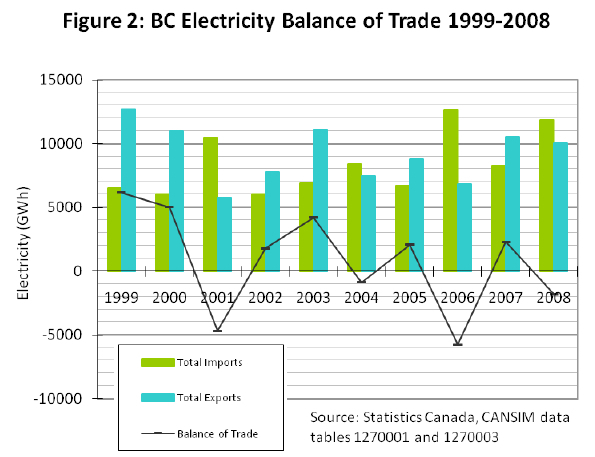
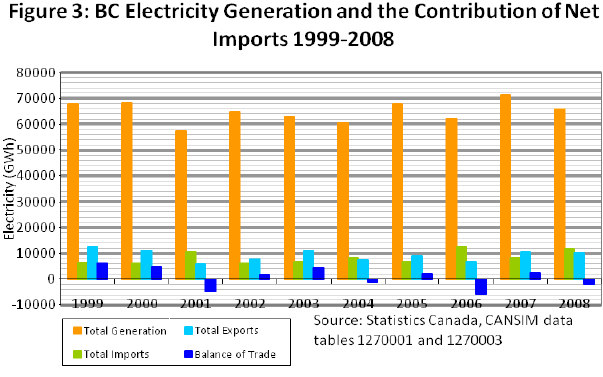
3. The Canadian Entitlement to the downstream benefits of the Columbia River Treaty is not included in current trade statistics. If it were included as a BC generation resource, BC would have access to 1,200 MW of capacity. Table 1 compares that figure to other BC projects. Essentially, it is somewhat larger than one very large new dam project.
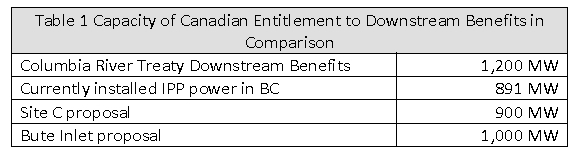
The CE would provide an additional 4,300 GWh/year of electrical energy to BC. If we had been using that energy, it would have eliminated the trade deficit for all put one of the past 5 years. Pooling the past 5 years together, if we’d used the CE it would have turned a 5 year deficit of 1.5% into a 5 year surplus of 5.1%. That compares to BC Hydro’s forecasted increase in demand of 32% over 20 years, or a 16% increase in electricity generation if the province meets the BC government requirements that half that increase in demand be met with conservation. BC Hydro’s current planning assumes even higher potential for conservation – they believe 72% of future demand growth can be offset through conservation, meaning that demand could be met with only a 9% increase in new sources of electricity. Including the downstream benefits of the Columbia River Treaty doesn’t eliminate the forecasted gap in BC electricity supply, but it does narrow it.
Whether or not BC should take the Canadian entitlement as power is a complex policy question that should consider, among other things, that at present that power is currently displacing fossil and nuclear sources of generation in the US. Our purpose here is merely to put the magnitude of the CE in perspective.
Some other notable patterns in the data
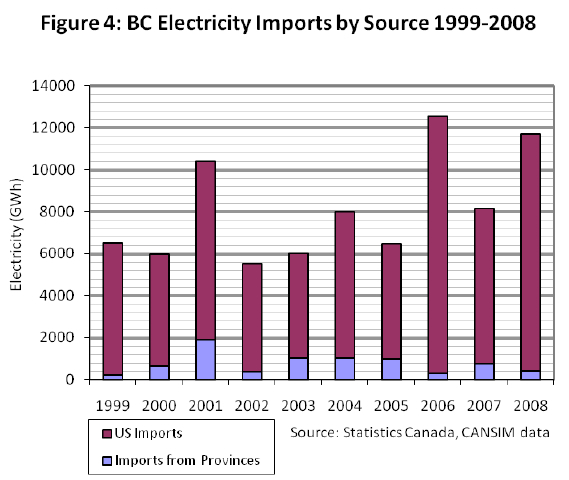
The following two figures show the sources of BC import and the destination of BC exports. They reveal that trade across the 49th parallel is far more important than trade across the Rocky Mountains. We also include a table of BC Hydro trading statistics for the record.
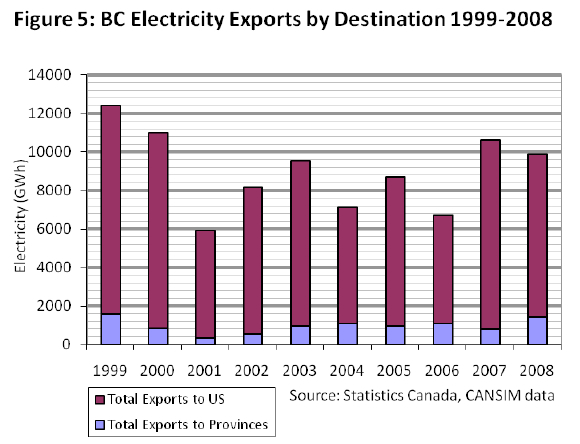
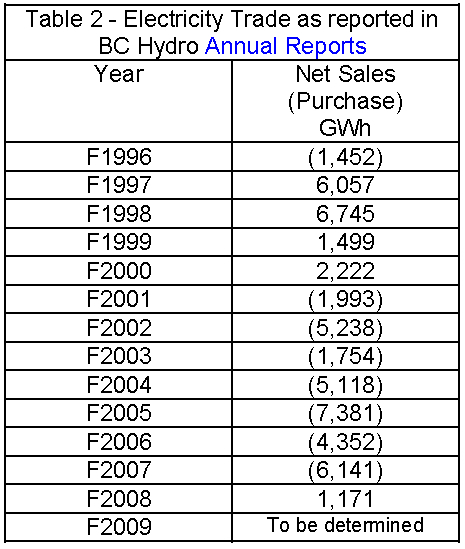
Blog Posting to http://greenpolicyprof.org/wordpress
Download PDF
March 18, 2009
IPPs push up power costs, industry says
Scott Simpson,
Vancouver Sun
March 18, 2009
Hydro could wind up selling power for less than it has to pay for it, critic claims
BC Hydro customers could take a $400-million-per-year financial hit if the Crown corporation signs up too many independent power producers to sell it electricity, a spokesman for Hydro industrial customers is warning.
The Vancouver Sun has learned that Brian Wallace, legal counsel for the Joint Industry Electricity Steering Committee, said in speech last week that without restrictions on expansion of independents, or IPPs, Hydro could be forced to sell large annual power surpluses at a loss to buyers in the United States.
Wallace said Hydro could find itself in a position where it is contracted to pay IPPs $120 a megawatt hour for electricity -- but find no buyers willing to pay more than $60.
Wallace said Hydro "clearly" needs more electricity, but in the view of the industry groups, Hydro is planning to buy "more than is required to meet customer needs."
Last year Hydro issued a 'Clean Call' for green power and IPPs responded with bids to build about 17,000 gigawatt hours of new power supply.
Hydro eventually decided to narrow its call to 3,000 gigawatt hours -- equivalent to about 25 per cent of current supply -- but indicated it will contract for as much as 5,000 if it finds the bid prices affordable.
At the sixth annual B.C. Power Summit last week, however, Wallace urged Hydro and the province to rebuff what he described as IPP demands to "aggressively" increase green power production.
"Going along with such demands will lead to substantial exports of electricity on a regular basis, and annual losses in the range of $400 million per year," Wallace said, according to a printed copy of his speech.
"These losses are equal to about 13 per cent of current domestic revenues or 90 per cent of BC Hydro's net income."
Melissa Davis, executive director of B.C. Citizens for Public Power, a group that opposes private sector power development, said Wallace's comments prove there is widespread opposition to the provincial government's energy policy and expansion of IPPs.
"Academics, environmentalists, labour groups, first nations, and thousands of impacted ratepayers have criticized the government's energy policy and their privatization of B.C.'s electricity sector," Davis said. "Our observations have been repeatedly disputed and dismissed. Wallace's report reinforces our collective claims with respect to the exaggerated need for new sources of electricity."
BC Hydro president and CEO Bob Elton said Hydro is trying to "strike a balance" between buying too much electricity and buying too little, and believes the nominal 3,000 gigawatt hour cap represents that balance.
Elton also noted that no price has been set for electricity purchased in the Clean Call, so Wallace's numbers may not be correct.
Jim Gemmill, chairman of the board of directors of the Independent Power Producers Association of B.C., said he was sympathetic to the industry group, given the economic challenges faced by members in the forest and mining industries. "They are are obviously going through some tough times right now and I don't think we can ignore that," Gemmill said.
But he noted that Wallace's assumptions -- and Hydro's -- are based on a very ambitious conservation program wherein all Hydro customers reduce electricity consumption about 25 per cent, with only a moderate contribution of new power needed to augment that.
If Hydro fails to reach conservation targets, he said, the province could be challenged to find enough power to support domestic demand.