July 30, 2009
LTAP: Government mulls response to B.C. Hydro ruling
Sam Cooper
Victoria Times Colonist
July 30, 2009
B.C. Utilities Commission decision shoots down independent power
B.C.'s energy minister says the government is preparing a swift response that could include a legal challenge to the B.C. Utilities Commission's bombshell ruling against B.C. Hydro's massive call for clean energy.
This week, the BCUC refused to endorse B.C. Hydro's long-term call for 3,000 gigawatts of power from public and independent power producers because it was not "in the public interest."
Energy Minister Blair Lekstrom said he was surprised by the ruling. "It flies in the face of our agenda to reduce greenhouse gas emissions."
After the ruling, IPP investors have run for the exits, leaving a budding industry valued at up to $14 billion after the May 12 B.C. election with a dubious future, according to some analysts.
Plutonic Power Corporation, which has a pending $4-billion, 1,027-megawatt proposal on the Bute Inlet north of Powell River, saw its share price drop from $4 to less than $3 following the BCUC decision.
Company representative Elisha McCallum said Plutonic will not comment on its business prospects until the government and B.C. Hydro respond to the BCUC ruling.
NaiKun Wind CEO Paul Taylor, former head of ICBC, said IPP investors are worried.
"You just have to look at ours and [Plutonic Power Corporation's] stock price," he said.
"Investors are concerned and trying to understand what [the ruling] means."
Taylor said his company had lobbied the BCUC to approve B.C. Hydro's blanket call for power.
Naikun was one of about 60 bidding for contracts in the November 2008 call, and can still apply under a different process, he said.
"I found the ruling confusing," Taylor said. "It's totally in conflict with the government's clean-energy policy."
Lekstrom said there is a lot of concern from IPPs wondering if the government's plans will change with the BCUC ruling, but he insists it's full steam ahead.
"We are committed to our clean-energy industry and our climate action and energy plans," he said.
B.C. Hydro says it will return to the BCUC with a revised long-term acquisition plan.
NDP energy critic John Horgan said the BCUC ruling is a rebuke to Premier Gordon Campbell and his power privatization plans, and a victory for ratepayers.
The BCUC shot down government claims that the province needs more power, Horgan told Canwest News Service.
Horgan said power purchased from independent power producers would cost up to twice as much as B.C. Hydro energy, sending ratepayer bills through the roof.
"The government has been saying we have this crisis; we need the IPPs or the lights will go out," Horgan said. "Thank goodness we have a regulator that protected ratepayers and stopped Premier Campbell from privatizing power in B.C."
Eric Doherty of the Wilderness Committee, an environmental group strongly opposed to run-of-river projects, said the BCUC ruling is "telling B.C.
Hydro to put more emphasis on energy conservation and less on energy generation."
LTAP: Burrard Thermal won’t be cranked up, BC Hydro says
By Fiona Anderson
Vancouver Sun
July 30, 2009
 BC Hydro will not be boosting production at the Burrard Thermal Plant (pictured), its natural-gas-fired generating station. Photograph by: Peter Battistoni, Vancouver Sun |
BC Hydro will not be boosting production at the Burrard Thermal Plant, its natural-gas-fired generating station, despite a decision by the BC Utilities Commission that pointed to the station as the potential source of more power.
In its decision released earlier this week, the BCUC said BC Hydro could rely on 6,000 gigawatt hours (GwH) of power from Burrard Thermal annually, a decision that caught environmentalists, independent power producers, BC Hydro and the provincial government by surprise.
When running near capacity, Burrard Thermal — which was to be phased out as a non-emergency source of power by 2014 — is the single-largest source of greenhouse gas emissions in the province.
But BC Hydro CEO Bob Elton said the utility had no intention of increasing its use of Burrard Thermal, which last year produced just 300 GwH of electricity.
“We have no intention of running Burrard more than we did before,” Elton said in an interview. “So we won’t be running Burrard seven days a week, 24 hours a day, which is what we’d have to do to achieve the kind of 6,000 GwH hours the commission is talking about.
“We won’t be doing that, and we don’t believe we have a social licence to do that.”
But by crediting Burrard Thermal with a possible 6,000 GwH of power — compared to the 3,000 GwH BC Hydro suggested — the BCUC limits the amount of power BC Hydro can acquire from elsewhere.
And earlier this year, BC Hydro sought proposals from clean energy producers, like run-of-river projects and wind energy, for 3,000 GwH of power — the exact difference between what BC Hydro said Burrard Thermal should be good for, and the BCUC’s view.
Steve Davis, president of the Independent Power Producers Association of B.C., said the critical question was what would happen to the most recent proposals before BC Hydro.
BC Hydro is the independent producers’ only buyer, Davis said.
“So, how they interpret the BCUC decision is a critical filter to how we interpret the decision.”
Contracts already in place between BC Hydro and IPPs from previous calls for clean energy will remain in force, he said.
Davis speculates the BCUC may have preferred Burrard Thermal over independent producers because of the low price of natural gas included in the projections in BC Hydro’s proposed plan.
“But it overlooks half a dozen other negatives on Burrard [Thermal],” Davis said. “It’s very inefficient, it’s old, it needs to be completely refurbished, [and] it’s one of the highest point sources of GHG in the province.”
Tzeporah Berman, executive director of PowerUP Canada, a non-profit group focusing on climate change and green energy, said the BCUC’s decision “flies in the face of B.C.’s climate action plan” by increasing “dependence on dirty energy and rising greenhouse gas emissions.”
Under its climate action plan, the government aims to reduce greenhouse gases from 2007 levels by six per cent by 2012 and 18 per cent by 2016.
B.C.’s energy minister Blair Lekstrom told The Vancouver Sun on Tuesday that firing up Burrard Thermal “was not in the cards.”
fionaanderson@vancouversun.com
© Copyright (c) The Vancouver Sun
LTAP: Media coverage of BCUC decision
COMMENT: On July 27, 2009, the BC Utitilies Commission issued its decision in which it rejected BC Hydro's 2008 Long Term Acquisition Plan (LTAP). It is a momentous decision, with huge repurcussions.
The decision itself is here.
Read Tom Hackney's comments introducing the LTAP decision, here. Tom is VP-Policy with the BC Sustainable Energy Association.
An assortment of statements and responses to the LTAP decision are here.
What follows are media coverage and commentary on the decision.
Utilities commission snubs B.C.'s energy plan
Mark HumeGlobe and Mail
July 30, 2009
The British Columbia Utilities Commission came in for both praise and criticism Wednesday for a stunning ruling that has called into doubt the provincial government's energy plan.
In rejecting B.C. Hydro's long-term acquisition plan and in refusing to endorse a shift to privately produced energy, the commission has sent shock waves through the province – but it also opened the opportunity for a long-overdue public dialogue on power policy, said John Horgan, energy critic for the New Democratic Party.
“I would like to see this trigger a real discussion about long-term energy needs. … We have the time now,” Mr. Horgan said, noting the commission has given B.C. Hydro until next year to return with a revised plan.
He said the ruling may be shocking, but it is in keeping with the BCUC's role of being an independent arbiter, responsible for the public interest.
“I believe the commission did what you'd hope a regulator would do,” Mr.
Horgan said. “The government has been saying for some time that there is a crisis of [energy] supply, and our demand is going at breakneck pace and we are in crisis. The regulator looked at the data, examined the evidence and said, ‘I don't think so.' And that's a good thing. It means government and B.C. Hydro now have to take stock.”
The B.C. government first introduced its energy plan in 2002, updating it in 2007.
The plan calls for B.C. to become energy self-sufficient by 2016, and it put B.C. Hydro on a course to emphasize the development of new independent power projects, or IPPs.
In its ruling, the utilities commission rejected B.C. Hydro's long-term acquisition plan as “not in the public interest,” and refused to endorse the corporation's clean-energy call, which was meant to spur IPP development.
In the wake of the decision, shares of Plutonic Power Corporation, the biggest bidder in B.C. Hydro's calls for new projects, fell sharply, with analysts saying IPPs could be put on hold because of the ruling.
Plutonic has not yet responded, saying it needs time to study the ruling.
Energy Minister Blair Lekstrom said the province intends to stay the course on private power development, but Mr. Horgan said that would be wrong.
“B.C. Hydro is a regulated utility. It came forward with an acquisition plan. And the regulator said, ‘This isn't good enough, come back in a year and tell us a different story.' How he can say full speed ahead, I don't know,” Mr. Horgan said.
Rafe Mair, a former Social Credit cabinet minister and radio talk-show host, has been campaigning against IPPs with the Save Our Rivers Society for the past several years.
Mr. Mair said he was thrilled by the BCUC ruling.
“It's a condemnation of the government's plan. … The hallmark of the Campbell [energy] policy has just been taken and shredded to bits,” he said.
But Mr. Mair said he expects the government will find a way to revive its power plan.
“For the moment, it's a great, great victory for the people who have campaigned so hard to bring to public attention what this power policy is all about … but I have no doubt the Campbell government will legislate the private power back in somehow,” he said.
Tom Hackney, vice-president of policy for the BC Sustainable Energy Association, said he is concerned by the ruling because it undermines B.C.
Hydro's effort to use IPPs to move away from fossil fuels.
“Our view is there is a real need to develop renewable energies in B.C. to reduce our dependence on fossil fuels – and it is worrying to see a decision like this,” he said.
Green Premier's agenda hits snag as energy plan rejected
Mark HumeGlobe and Mail
Jul. 29, 2009
Commission says British Columbia government's initiative not in public interest
The British Columbia government's energy plan and the future of new renewable-power projects in the province have been shaken by a ruling from the B.C. Utilities Commission.
After hearings that lasted almost a year, the commission has rejected BC Hydro's long-term acquisition plan as “not in the public interest” and has refused to endorse its push for clean energy.
The government's clean – or green – energy plan has been a key initiative pursued by Premier Gordon Campbell and was a major issue in the May election. The ruling could call into question the viability of the B.C.
government's policy of reducing greenhouse gas emissions by at least 33 per cent below 2007 levels by 2020. That promise, and a long term goal of an 80 per cent reduction by 2050, was put into law last year with passage of the Greenhouse Gas Reduction Targets Act.
Some analysts say the ruling – which shocked the government and the stock market – indicates B.C. has been over-estimating the amount of power the province needs in order to justify the development of independent power projects.
“We have a very flawed energy plan in this province … the government cannot continue to exaggerate the need for power,” said Lori Winstanley, a spokeswoman for the professional employees' union known as COPE, which has long been critical of BC Hydro's energy plan.
For years the opposition NDP has questioned the Campbell government's energy plan, claiming independent hydro projects that harness some of the province's rivers – known as run of river projects – pose hazards to the environment, and sports fisheries.
The ruling delivered a quick blow to independent power producers (IPPs), with shares for Plutonic Power Corp. plunging about 24 per cent yesterday, falling $1.00 to $3.08.
A spokesman for Plutonic, the biggest bidder in B.C. Hydro's calls for new projects, said the company would react later.
Dow Jones Newswires said the commission's decision “could put the development of new renewable-power projects in the province on hold.”
But Blair Lekstrom, B.C.'s Minister of Energy, Mines and Petroleum Resources, tried to steady the market by saying the government remains committed to pursuing the development of more clean, renewable energy through IPP's.
“We are focused on developing clean and renewable energy resources. We are going to continue down that path,” said Mr. Lekstrom.
He said he was surprised by the ruling, which included a refusal to allow BC Hydro to downgrade the Burrard Generating Station. Burrard is a conventional thermal plant fuelled by natural gas that supplements hydroelectric generation in years of low water flows.
BC Hydro wanted to rate Burrard as capable of producing a maximum of 3,000 gigawatt hours annually, while BCUC said the figure should be 5,000 GWh.
If the Burrard potential is rated 2,000 GWh higher, then the need for private power would have to drop by the same amount.
“Fully the biggest surprise is Burrard thermal, talk of moving that from 3,000 to 5,000 [GWh],” said Mr. Lekstrom. “That certainly doesn't fit with the direction that we have set as a province … and that's clean renewable energy and reduce our greenhouse gas emissions where we can.”
Bob Elton, CEO of BC Hydro, said the 236-page decision is a detailed and complicated ruling.
“It will take us two or three days to really be clear about what it does mean for the clean power call,” said Mr. Elton.
“As a matter of urgency, we are going through [the ruling] and we will figure out what our position is, what we intend to bring forward. As we've always said a lot will depend on the prices of those [IPP] projects,” he said.
He said BC Hydro did get much of what it wanted in the ruling.
“We were looking for a bunch of things, a total of $630-odd-million of expenditures on different things … and they approved all but $2-million,”
he said. “They approved, for example $418-million on demand side management, that's a huge thing for us. ”
BCUC also approved $41-million to continue consultation on Site C, a proposed mega-project on the Peace River.
On the rejection of the overall long-term acquisition plan, Mr. Elton said BC Hydro will be back before the utilities commission next year with a revised proposal.
Ms. Winstanley, director of strategic communications and campaigns for COPE, the Canadian Office and Professional Employees Union, said the ruling has three key aspects: the rejection of the long-term acquisition plan, a refusal to endorse the clean energy call, and a refusal to allow BC Hydro to downgrade the capacity of Burrard thermal.
“Those are the most significant pieces of the decision, but also there were deficiencies in the government's [energy] conservation plan,” she said.
Tom Hakney, vice-president of Policy for the BC Sustainable Energy Association, said his organization “is frankly surprised and somewhat concerned,” by the ruling.
“The commission is telling BC Hydro to go back and rely on Burrard thermal for energy. We're concerned about that. That is antiquated technology,” he said.
“The commission essentially told them to rely more on Burrard thermal, and there would therefore be less need for [new renewable] energy,” said Mr.
Hakney. “Our view is there is a real need to develop renewable energy in B.C. to reduce our dependency on fossil fuels.”
Hydro power plans take body blow
Vaughn Palmer, Vancover Sun, 29-Jul-2009Utilities commission snubs green power call, likes Burrard gas burner
The BC Utilities Commission sent a shock wave through the energy sector Monday when it balked at key elements of BC Hydro's long-term plan to acquire new sources of electricity, both public and private.
The lengthy ruling -- more than 200 pages and 46 directives -- was not a complete defeat for the government-owned electrical utility.
The commission greenlighted more than $600 million worth of proposals to upgrade B.C.'s publicly owned generating capacity, including $41 million to continue planning on the proposed Site C dam on the Peace River.
But on other points, many of them integral, the trio of commissioners were unpersuaded. "Accordingly the commission finds that Hydro's long term acquisition plan is not in the public interest and rejects it."
In a directive that cheered opponents of private power, the commission said it "declines to endorse" Hydro's recent call for proposals from private operators to build wind farms, run-of-the-river projects and other kinds of clean power. It also denied Hydro's request to spend $2 million to implement the clean-power call.
Neither directive prevented Hydro from continuing to vet the 68 proposals that were received under the clean-power call. Nevertheless, the stock market responded by driving down the share value of B.C.-based private power companies like Plutonic and NaiKun.
While the commission dealt a psychological blow to private power, it called its own judgment into question by favouring Burrard Thermal, the publicly owned natural-gas-fired generating station near Port Moody.
On paper, the decades-old plant is said to represent 10 per cent of provincial generating capacity and power needs. But it is rarely used, partly because of the cost of firing it up, partly because of concerns over emissions.
The provincial government wants the plant phased out completely, leaving Hydro to determine the precise timetable.
Hydro proposed reducing its reliance on Burrard Thermal as part of the submission to the utilities commission. In support, it provided two reports from consultants.
One suggested it would take a "significant investment" -- maybe $350 million, maybe a lot more than that -- to bring the plant up to full operating capacity. The second said a fully operational Burrard Thermal "would be the largest point source of greenhouse gas emissions in the province and the second largest point source of nitrous oxide."
Case closed, one would think. But the utilities commission didn't see it that way. It rejected Hydro's proposal to reduce the reliance on Burrard Thermal for long-term planning purposes. It also endorsed the notion that the ancient dump could be treated as if it were capable of close to 100 per cent of its on-paper specs: 900 megawatts of capacity and up to 6,000 gigawatt hours of electricity annually.
The commission left it to "BC Hydro's management to maintain a dialogue with and to inform the public at large of the planned reliance on Burrard," including the logic (elusive as it was) of the commission.
This on a day when the Lower Mainland was already on notice about declining air quality across the region.
Where did the commissioners get the notion that Burrard Thermal could be restored to credibility in the planning process with a regulatory stroke of a pen? Perhaps from the Canadian Office and Professional Employees Union (COPE) which represents unionized employees at Hydro and in that capacity argues against private power and in favour of keeping everything public.
The key passage from union's submission, according to the commission:
"COPE submits that the only requirements binding on BC Hydro are the various statutory, regulatory and permitting regimes. These do not include public opinion."
Tell that to the voters of Tsawwassen, who this spring voted out their government MLA over the imposition of a strictly legal power-line upgrade on their community.
The whole Lower Mainland region would be up in arms over any attempt to treat Burrard Thermal as a practical substitute for, say, increased capacity from wind farms or run-of-the-river power.
Nevertheless, the commission used its belief in the continuing potential for Burrard Thermal as a partial justification for discounting the need for several thousand gigawatts of green power.
"Surprising," said provincial Energy Minister Blair Lekstrom in his immediate reaction to the commission directives. Firing up Burrard Thermal was "not in the cards," he insisted, and the government would be making that clear once he had finished digesting the entire report.
Nor were the Liberals giving up their drive for energy self-sufficiency and cleaner power, both public and private. "It's the future," he said.
All of which suggests that the most likely course of events will be the one implied by directive No. 32: "The commission determines that BC Hydro's next long-term acquisition plan filing should be on or before June 30."
Back to the drawing board, in other words. And before Hydro submits a revised plan to the commission, the Liberals will doubtless clarify that Burrard Thermal has no future and clean, green power most certainly does.
Green power stocks fall on surprise utilities commission ruling
NICOLE MORDANTVancouver Sun
JULY 29, 2009
Shares in a number of green energy companies slumped on Tuesday after the B.C. Utilities Commission unexpectedly rejected BC Hydro's plan for developing green power projects.
The companies, which aim to produce electricity from renewable sources such as wind, water or biomass, have been waiting for more than a year for the province's power utility to announce the winners of long-term electricity contracts.
The results were expected any day now by applicants such as run-of-river hydro power producer Plutonic Power and Naikun Wind Energy Group. But an unexpected decision from provincial regulators threatens to delay or change the terms of BC Hydro's power call.
In a surprise move late on Monday, the B.C. Utilities Commission, which regulates BC Hydro, rejected the power utility's long-term business plans, which includes its proposal to buy clean electricity from small, independent producers. The commission took issue with several areas of BC Hydro's plan, including whether they met the provincial government's requirement to meet self-sufficiency in electricity by 2016.
"Had the [Long-Term Acquisition Plan] been approved . . . BC Hydro would have been ready to announce the winners very quickly," said Tom Hackney, vice-president for policy at the BC Sustainable Energy Association. "Under these circumstances there is a lot of uncertainty."
Macquarie Research analyst Steve Harris said that while the language in the utility commission's report is "somewhat ambiguous," his interpretation is that the clean power call is "dead."
But Investment bank Versant Partners analyst Massimo Fiore said it wasn't clear what impact the rejection of the business plan would have on power producers' plans, and that is spooking investors. "It sounds bad, but it may not be that bad," Fiore said.
Paul Taylor, chief executive of applicant Naikun, said that in his discussions with provincial government officials on Tuesday it was clear that they are committed to the clean power call and the province's energy plan. "In my view it's full steam ahead," Taylor said.
BC Hydro declined to comment.
BC Hydro, which is mandated to make B.C. self-sufficient in electricity by 2016, netted 68 proposals from 43 parties for 17,000 gigawatts of annual power production in its call for clean power.
Shares in Plutonic Power, one of those most widely expected to secure an electricity purchase agreement, dived 24 per cent to $3.09 in TSX trading on Tuesday.
Naikun Wind Energy Group, which is developing the country's first wind energy project off the northwest coast of B.C., fell seven per cent to 63 cents on the TSX Venture exchange.
Run of River Power shed 11 per cent to 15.5 cents.
BC Utilities Commission decision murky on clean power
By Greg AmosThe Tyee
July 30, 2009
VANCOUVER- The only certainty resulting from the BC Utilities Commission’s long-awaited decision on a key BC Hydro planning document is another long wait until June 30, 2010 for more answers.
Despite approving nearly all of BC Hydro’s $633 million worth of requested expenditures, the BCUC rejected the Crown corporation’s 2008 long-term acquisition plan (LTAP) - a document that sets out BC Hydro’s balance between energy conservation and new power production over the next decade.
“In essence, they’d like us to take another run at it,” BC Hydro spokesperson Susan Danard told The Tyee. “There were some areas where the commissioner didn’t think the plan was sound.”
The rejection could mean trouble for proponents who bid for the 3,000 gigawatt-hours per year riding on BC Hydro’s 2008 Clean Power Call. Some publicly-traded companies saw huge drops on the stock market following the announcement.
But the door’s not entirely shut. The BCUC noted BC Hydro still “has the scope, with or without Commission endorsement” to enter into electricity purchase agreements (EPAs).
The long-delayed decision was originally slated for March but finally dropped late on Monday afternoon. BC Hydro has until June 2010 to produce a new LTAP.
The 235-page decision was not the ringing endorsement sought by independent power producers, who put in bids for a total of 17,000 gigawatt-hours per year under the 2008 call. That amount of new power would account for nearly a third of the 55,000 gigawatt-hours per year currently generated by BC Hydro.
For those who will be proceeding to EPAs, some caution may be in order: BC Hydro could face increased scrutiny when called before the commission to defend the merits of each EPA, the decision noted.
The decision did give the green light to BC Hydro's largest ever program aimed at conservation, as $418 million was approved for BC Hydro’s demand side management plans from fiscal 2009 through 2011. That money will support a range of energy audits, retrofits, and conservation promotion. But whether the public will buy in remains an open question.
“We always say build more, buy more, and conserve more,” said Danard. “One of the challenges is, can you bank on customer behavior?”
To hedge the bets, BC Hydro also sought and received commission approval for $140 million towards upgrading a 47-megawatt natural gas-fired power plant in Fort Nelson, $30 million towards expanding the Mica hydroelectric dam near Revelstoke, $41 million towards consultation on the proposed Site C hydroelectric dam on the Peace River, and $1.6 million towards ensuring the reliability of Port Moody’s Burrard Thermal generating station.
A growing industrial cost base in northeast B.C., fed partly by the power demands associated with oil and gas infrastructure, underlies the possible expansion of the Fort Nelson facility, Danard said. Other parts of B.C. face declining power consumption, where the slumping forest industry means near-dormant status at several pulp and paper mills.
The rejection could mean trouble for proponents who bid for the 3,000 gigawatt-hours per year riding on BC Hydro’s 2008 Clean Power Call.
Greg Amos reports for The Tyee
The elephant in the room
Katherine Palmer Gordon
FOCUS Magazine
28 August 2009
There’s a finite amount of oil and gas on the planet and by most credible accounts, we’re about half way through our supply of the stuff. At the same time, governments are starting to get it that to avoid catastrophic climate change, we’ll have to shift our energy and transportation infrastructure away from an almost complete reliance on burning fossil fuels to burning virtually none. But fossil fuels have made it possible for humankind to leap from the dark and dreary discomfort of our agrarian ancestors into the dazzling light of modern urban living.
Without fossil fuels, we might have to give up a whole lot of comfort and convenience. Is there any way to avoid going backwards? Who wants to talk about that?
A round of applause, everyone: after years of stonewalling on the global warming file, the government of Canada finally (if reluctantly) joined other G8 countries in mid-July to set the kind of meaningful emissions reductions targets for developed countries that climate change scientists have been pleading for: 80 percent by 2050.
The G8 summit also agreed that in order to prevent calamitous environmental change, global average temperature must not rise more than two degrees Celsius above pre-industrial levels. This collective agreement followed decisive action by the new Obama government in the United States, with the passing in June of the American Clean Energy and Security Act by the House of Representatives.
The Waxman-Markey Bill, as it is known, is the first legislation in America to tackle climate change so dramatically: it introduces a cap and trade system, and sets targets of a 17 percent reduction in emissions from 2005 levels by 2020 and a whopping 83 percent by 2050. The Waxman-Markey Bill has yet to navigate the treacherous waters of the US Senate (expected this fall), and the G8 agreement is “aspirational” rather than obligatory.
Nonetheless, both initiatives signal a potentially fundamental shift in attitude of the governments of some of the nations having the highest greenhouse gas emissions on the planet
For the first time, there seems to be more than a dim glimmer of light at the end of the global warming tunnel. If the G8 countries can achieve these targets - assuming the targets are high enough - perhaps there is hope that the worst impacts of the climate change catastrophe we have wrought on the planet can be averted.
Can we do it?
The answer to that question is not an Obama-esque “Yes, we can,” says Dogwood Initiative Executive Director Will Horter, but an unequivocal “We must.”
“We’re in a bus going over a cliff,” says Horter of the devastating potential of global warming.
That includes temperatures rising by as much as six degrees by the end of this century, let alone two, with disastrous environmental and social consequences and severely endangering human life in many parts of the planet. The truth is more than inconvenient, says Horter: “It’s terrifying.”
To slow the bus in time, says Horter, we need to focus on five top priorities: “Conservation, conservation, conservation, conservation and conservation.” He doesn’t mean just switching off the light when leaving the room: Horter means energy conservation on a scale far beyond anything currently on the agenda in British Columbia. He doesn’t think even 80 percent reductions are enough: “BC needs to reduce its emissions by 99.7 percent by 2050,” says Horter.
But that’s not even on the radar for most of us.
According to BC Hydro, British Columbians are among the highest per capita energy users on the planet. Any conservation consciousness we do have remains completely overshadowed by a culture of unconstrained consumerism dependent on the abundant availability of cheap energy. We don’t think it’s necessary to even switch off the lights, let alone forgo cars, clothes dryers and winter trips to Mexico. Far from falling, therefore, BC’s emissions just keep going up.
What limited conservation and energy efficiency initiatives the federal government has introduced to date have done nothing to reduce emissions: between 1990 and 2006, Canada’s overall emissions increased by 26 percent. The provincial government’s 2007 energy plan doesn’t come close either. It prioritizes “a secure and reliable energy supply for years to come.” It has a target of reducing greenhouse gas emissions by 33 percent by 2020, but even that seems doomed to fail. Despite containing some conservation and efficiency incentives, the plan is entirely predicated on greater efficiency in meeting our growing energy demand rather than including any tough measures to reduce use significantly.
We are engaged in a hopeful courtship with renewable energy - wind, sun, geothermal, biomass and run-of-river sourced power - in the belief that it can one day replace fossil fuels in maintaining our current lifestyle. But Robert Bryce wrote in the Wall Street Journal in March 2009 that the entire energy output in the United States from solar and wind sources is equivalent to that of one average-sized coal mine. American peak oil analyst James Kunstler, author of The Long Emergency, says: “No combination of alternative fuel systems currently known will allow us to run what we are running, the way we’re running it, or even a substantial fraction of it.”
The simple and unpalatable truth, say people like Kunstler and Horter, is that to reach even a 33 percent reduction in emissions, let alone 80 percent or Horter’s 99.7 percent target, our lifestyles will have to change. Victoria University law lecturer Dr Michael M’Gonigle puts it this way: “We have to fundamentally change our consumer culture now, and reverse our insatiable demand for energy, before we can even begin to address the climate crisis.”
Natural Resources Canada (NRC) and the provincial Ministry of Environment both cite a litany of climate change impacts that have been experienced in BC. NRC spells them out bluntly: “Windstorms, forest fires, storm surges, coastal erosion, landslides, snowstorms, hail, droughts and floods [already] have major economic impacts on BC’s communities, industries and environment, with the risks magnified in low-lying coastal areas.” BC’s transportation and energy infrastructure is identified as being at significant risk: “In many places in BC, pipelines, power and telecommunications transmission lines and transportation networks are geographically confined to narrow valleys and coastal stretches and therefore vulnerable to disruption from landslides, coastal storms and surges, flooding and forest fires.”
A brief refresher on climate change impacts
It’s rare these days to see the phrase “climate change impacts” unaccompanied by words like “catastrophic,” “devastating,” and “disastrous.”
But why would a six degree temperature increase be so bad?
Scientists believe that at uncertain thresholds of temperature rise, feedback mechanisms will kick in that will accelerate greenhouse gas emissions from natural sources of stored carbon and create runaway heating of the planet. For example, deeper levels of permafrost in the Arctic would begin to melt (near surface permafrost has already begun to melt) and release to the atmosphere immense quantities of carbon dioxide and methane—an extremely potent greenhouse gas-causing even more warming. If that threshold is passed humanity will have relinquished any possibility of reversing the buildup of greenhouse gases and preserving our current climate.
By the end of the 21st century the melting of glaciers and ice sheets around the planet, combined with warmer and therefore expanding ocean water, could result in significant sea level rise. Low-lying coastal areas, often highly populated, would experience perennial flooding or permanent submergence. Many of the planet’s great coastal cities, including London, New York, Shanghai and Vancouver would be at risk. Forests are also under threat from the mountain pine beetle, spreading north as fast as the temperature rises. Last, but not least, there is increasing competition among farmers, homeowners, industries and power companies for less and less water. NRC also states that there will be “implications for trans-border agreements.” Read: the United States, suffering from the same impacts, will be casting an ever more covetous eye on Canada’s water and energy sources.
Humans depend on the oceans for our existence.
Through condensation and evaporation they provide most of our fresh water, while our oxygen supply depends on the constant circulation of world currents. But human-generated greenhouse gases are continuing to be absorbed by the oceans at an increasing rate. Increased acidification of the water and slowing of the currents caused by melting of the Arctic ice may lead to a complete collapse of fish stocks and an “oceanic anoxic event” causing mass extinctions of land species - including us.
With all of these accumulating impacts, we can also expect to see already unacceptable levels of global poverty rise as governments of developed countries struggle to meet the costs of mitigating their own challenges, let alone contribute to poorer nations. The ability to grow food in hotter regions may become severely constrained, putting billions of people at risk of starvation. More fortunate places - such as Canada, where increasing temperatures may expand the food-growing opportunities in some areas - may find themselves facing a massive influx of refugees fleeing uninhabitable regions.
These are not speculative ideas. We have already witnessed some of these events over the last several decades. Thirty years ago American climatologist James Hansen, now the director of NASA’s Goddard Institute for Space Studies, created one of the first climate change models, predicting much of what has already happened.
Hansen was profiled in The New Yorker magazine in June this year and stated that he now considers the threat of global warming to be far greater than even he had initially suspected, saying that carbon dioxide is being pumped into the air some ten thousand times faster than nature can process it and that we have already passed the maximum safe level of carbon dioxide in the atmosphere. The only answer, Hansen told journalist Elizabeth Kolbert, is to cut annual global emissions by a minimum of 75 percent.
Peak oil considerations
A fundamental reconsideration of our consumer culture is also necessitated by peak oil, which seems likely to take us to zero emissions eventually whether we like it or not.
The Hirsch Report on peak oil issued by the US Department of Energy in 2005 states that when the oil supply reaches maximum production capability and then starts declining, there will be “abrupt and revolutionary” changes in energy usage. We rely on oil for the production and delivery to our doorsteps of the majority of our food, water, medical supplies, transportation, and heat, let alone luxury goods. “Without timely management,” the Hirsch Report states, “the economic, social and political costs of peak oil will be unprecedented.”
When peak oil does occur, say pundits, post-peak production decline and severe increases in the price of oil are bound to have negative implications for the global economy. James Kunstler is blunt: “The implications of a permanent worldwide energy crisis are enormous.
Industrial societies will never again enjoy the two to seven percent annual economic growth considered healthy. This amounts to finding ourselves in a permanent depression. It could put us out of business as a society.” The supply to ordinary citizens will be abruptly constrained as states start to control remaining supplies.
Countries with remaining oil reserves will begin hoarding those reserves. The war in Iraq, motivated by the urgent American desire to supplement its oil resources, may be just one sign of things to come.
Jeff Rubin is the former chief economist of CIBC World Markets and author of the recently-released Why Your World Is about to Get a Whole Lot Smaller: Oil and the End of Globalization. In a CBC Radio interview in May he stated: “Cheap oil is a thing of the past.” Rubin’s basic premise is that with rising energy prices brought on by a shrinking supply, we are about to see a reversal of globalization. “Almost everything we see around us has been carried here from the other side of the world,” he told the CBC. “What’s made that work is cheap oil. But as oil rises to over $140 a barrel, that no longer makes any economic sense.”
Rubin also says that to see evidence of the impact of oil depletion and consequential rising prices we just have to look at the current economic recession—caused not by the collapse of sub-prime mortgages in the United States, but by $147/barrel oil. “The recession was already occurring in other countries well before it hit the US,” says Rubin, “as a result of the cost of oil.”
The Hirsch Report states that viable peak oil mitigation options exist, but they will take extraordinary efforts from governments, industry and consumers. A 20-year transition to a global society not based on fossil fuels is required to avoid the worst potential impacts of economic meltdown as the world’s oil-reliant industries collapse.
A snapshot of a future without fossil fuels
In The Long Emergency, Kunstler writes: “We are faced with the necessity to downscale, re-scale, right-size and reorganize all the fundamental activities of daily life: the way we grow food, the way we conduct commerce and the manufacture of things we need, the way we school our children and the size, shape and scale of our towns and cities.”
In Kunstler’s view we may be able to utilize renewable energy to provide limited power on a seasonal and intermittent micro-scale. But in doing so, we will have to be prepared to live without a consistent or abundant supply of power on a daily basis. In the meantime, we will have to return to a society based on a labour-intensive local farming economy with cottage industries supplying our basic needs, no commercial aviation, and no long-distance commercial transportation network.
Rubin says we won’t be able to import billions of dollars of food from China and California: “We’ll have to grow food in our own backyards and eat it seasonally. We’ll be moving into dense downtown housing instead of commuting 50 kilometres each way to work and converting our abandoned subdivisions into farmland. Our children will be farmers rather than baristas.”
If Kunstler and Rubin are correct, we are looking at a not-too-distant future that is far more similar to our great-grandparents’ way of life than ours. We will be walking everywhere. We won’t have guaranteed power at the flick of a switch. We certainly won’t be eating Californian strawberries in January.
Renewable energy—pipedream or solution?
The Suzuki Foundation and Pembina Institute claim that renewable technology could supply all of Canada’s energy needs. Guy Dauncey agrees. “The price for solar is becoming competitive. Run of river power is sustainable if it is done correctly. Wind is available in ample quantities in BC and there is no downside except noise,” he says.
But despite Dauncey’s enthusiasm, there are many flies in the ointment of renewable energy technology. BC Hydro isn’t counting on more than 15 percent of its supply coming from smaller-scale renewable energy, admitting that while it may contribute significantly: “[It] will not be enough if demand for electricity continues to grow.” In other words, we need to keep the large hydro dams running.
Technically, of course, hydro as we currently know it in BC is also renewable energy. But even large-scale hydro is a debatable proposition in the face of global warming and peak oil. In a 2008 planning study the Pacific Institute on Climate Change called BC’s energy production and distribution infrastructure “highly vulnerable.”
The study warns that decreasing snow packs and increasing drought will limit the availability of water for hydroelectric production. There will be higher costs to maintain pipeline infrastructure, let alone expand it. The increasing frequency of storms poses threats to power delivery, especially to remote communities.
Renewable energy - whether large-scale hydro, wind or run-of-river - also requires significant amounts of fossil fuels just to construct and maintain its infrastructure, including access roads and delivery grids. Matt Horne, director of the Pembina Institute’s BC Energy Solutions portfolio, tosses another spanner in the works:
“We need infrastructural investment to upgrade the main grid to feed alternative energy sources into it.”
The main power grid in BC wasn’t designed for the integration of renewable energy sources and can’t absorb more than 20 percent of its power from local intermittent sources like solar and wind.
“If we can’t change the grid,” says Horne, “it’s going to be very challenging.” Changing the grid would be hugely expensive—and again require vast consumption of fossil fuels.
Feasibility studies indicate that large scale storage technology for intermittent sources like solar, wind and waves may be impossible, and to replace our current use of fossil fuels, biomass would have to be deployed on a scale beyond our production capability. James Kunstler points out that ethanol and biodiesel, now being used experimentally in vehicles and aircraft, require more energy to produce than they return (and notes that the ethanol craze sparked severe food shortages in some parts of the world in 2008 as prices rose dramatically in response to the demand for corn).
The Pembina Institute admits that while geothermal energy is readily available in Canada (via heat pumps), it is also anything but cheap, and not cost effective for individual homes.
Solar panels and small-scale wind systems provide only fluctuating supply: when the sun’s not shining or wind not blowing, there’s no power.
They also can’t compete with current cheap electric rates. As for hydrogen power, Matt Horne notes that, “With the technology available today most hydrogen is taken from natural gas, so it still requires use of fossil fuels and produces greenhouse gases. That’s not sustainable.” The alternative, he says, “is to extract it [from water] using electrolysis, but that is very costly and to date no-one has come even close to producing hydrogen in a zero-emission system that can compete with other energy options.”
What about the nuclear option?
Nuclear energy relies on the mining of uranium, a non-renewable resource, but that uranium could be converted into plutonium (the same material used in the creation of nuclear bombs), exponentially increasing the supply of nuclear fuel to almost infinite levels.
The production and output of nuclear energy is also much more efficient than traditional fossil-fuelled energy, on a scale Cambridge physics professor David J.C. MacKay says is massive: “The amounts of fuel and waste that must be dealt with at a nuclear reactor can be up to one million times smaller than the amounts of fuel and waste at an equivalent fossil-fuel power station.” MacKay also points out the average Briton produces 30 kilograms of carbon dioxide a day from conventional sources; the same amount of nuclear energy consumed would produce a mere two grams of waste.
But, while the amount of waste is small, it remains a dangerous toxic substance with a shelf life of thousands of years. In his online book Sustainable Energy - without the hot air, MacKay notes that most of the world’s uranium supply is buried deep beneath the oceans and extremely difficult - and costly - to get to.
Even if nuclear energy were a truly renewable clean source of energy, BC’s energy plan also states unequivocally: “No nuclear power.” While it might be more efficient at meeting our energy needs than, say, coal, it carries significant risks associated with any failure of the reactor, and is far from emissions-free.
Mark Winfield, director of the Pembina Institute’s environmental governance portfolio, says that each stage of the nuclear energy production process, from uranium mining to plant operation, is fraught with potential environmental problems, adding that existing Canadian plants have had routine accidental releases of radionuclides, classified by Health Canada and Environment Canada as toxic substances.
“Significant releases of hazardous air pollutants, radionuclides and smog and acid rain-causing pollutants occur throughout the process of mining and producing uranium fuel,” says Winfield, “and greenhouse gases, particularly carbon dioxide, are produced during the construction of reactors, as a result of the operation of equipment in the uranium mining process, the milling of uranium ore, mill tailings management activities, refining and conversion operations and the transportation of uranium between milling, refining and conversion facilities and transportation required in the management of radioactive waste.”
Besides the estimated $11 billion-a-pop construction cost of a nuclear plant today, Winfield points out the costs of cleanup of an accident could run into the trillions of dollars.
And he questions the reliability of nuclear energy: “The Ontario CANDU reactor fleet, for example, has been subject to severe performance and reliability problems. Some Ontario facilities have had average operating capacities below 40 percent rather than the expected 85 to 90 percent range. Reactors expected to have operational lifetimes of 40 years have turned out to require major refurbishments after 25 years of service.
Refurbishment projects themselves have run seriously over budget and behind schedule.”
In other words, don’t count on nuclear energy being the solution to renewable energy’s challenges.
The conversation we’re not having
Jeff Vail is a Colorado-based lawyer specializing in global energy infrastructure. Vail has undertaken extensive analysis of the net energy return on renewable sources of energy. He says this is a “critical measure of whether it is possible to transition on a large scale from a fossil fuel powered economy to one based on renewable energy, or whether a global ‘powerdown’ is inevitable.” If it is not realistic for society to make the transition, says Vail firmly, “then we must not waste what little surplus energy we have on a fools’ errand.”
Vail has concluded that the hype about the energy return on renewables (for example, that wind farms will pay back the energy required to build them within as little as one year) is significantly over-estimated. “I don’t think it’s a stretch to say that energy return on energy invested (EROEI) figures are more likely to be marketing copy intended to secure venture capital than the result of rigorous inquiry,” he says wryly. He uses wind again as an example. “If it’s so efficient,” he asks rhetorically, “why haven’t we already made the transition of the vast majority of our energy base to wind?”
Both Vail and Michael M’Gonigle feel we should be focussing efforts on powering down instead of maintaining our addiction to energy by looking for other sources. Says M’Gonigle, “There’s a place for renewable energy here, but looking for a technical fix to our problems is a typical 21st century distraction from the real issue. The renewable energy folks aren’t being realistic. Where is the discussion of seriously reducing energy demand for the long term?”
Our role in the equation
Vancouver lawyer Cheryl Slusarchuk is chair of the Climate Action Team, created by the provincial government in 2007. Slusarchuk says there is still time to avoid the worst impacts of global warming if we take strong action now: “It’s imperative that [we] begin to prepare for the realities of a global low-carbon economy as soon as possible.”
But she also says: “Our daily habits - as consumers and as members of communities—will have to change, [and] changing our ways is never easy. What we are driving at now is the largest and most significant shift in public attitudes ever.
We are attempting to alter, in the span of just a few years, behaviours that have been entrenched for generations.”
Matt Horne of the Pembina Institute agrees that a fundamental change has to take place. “We’re not even close to making the changes required from what are now slowly declining energy sources to steeply declining ones,” says Horne. Horter and M’Gonigle add that despite all the warning bells, a conversation about a transition away from fossil fuels is simply not occurring.
Horter says bluntly: “That requires sacrifice and neither the public nor politicians want to know about that.” M’Gonigle agrees: “We need an immediate and open discourse on changing to a conservation culture, including the hard facts.
But it’s not politically acceptable to send that kind of negative message. People don’t want to know the hard facts. They’ll just flip the channel if they don’t like what they hear. So politicians keep saying, ‘yes, we can’ instead of ‘no, we can’t,’ and the exact opposite of what needs to occur is happening.”
In denial on the big picture of out-of-control emissions and looming peak oil, we prefer to be distracted by details: fretting about banning drive-throughs in Vancouver, buying EnergyStar dryers, and arguing over the dinner table about which environmental group has their facts right about run-of-river projects and whether the carbon tax is better than cap and trade. Add the latest financial crisis into the mix, and we get even more distracted as we cross our fingers that the economy will soon recover.
Little wonder then that climate change mitigation has been far from the top of the political agenda to date. Until recently, the federal government was too busy fighting international agreements on emissions caps and bailing out failing auto manufacturers to consider anything beyond a token energy conservation strategy - a strategy that has been derided by the United Nations International Panel on Climate Change.
But the United States has upped the ante with the Waxman-Markey bill and Canada is under pressure to follow suit, as its agreement to the G8 targets demonstrates. As far back as May, Environment Minister Jim Prentice was forecasting emissions legislation for Canada, linking it to the American plan. Prime Minister Stephen Harper has openly admitted that Canada needs to match the US in its regulation of emissions or risk losing ground with its biggest trading partner.
All the same, there’s reason for caution. There is no concrete plan in place to back up these ambitious targets. Less than 24 hours after the G8 agreement, Prentice stated openly that the targets are aspirational and that Canada will not meet them. Industry Minister Tony Clement told newspaper reporters: “We want to do it, but in a way that ensures we don’t beggar ourselves.” In other words, if cutting emissions means slowing down economic growth, then forget it.
A plan for how to deal with energy constraints when peak oil hits also does not appear to be on the radar, for either the federal or provincial government.
The top priorities for the provincial government remain clear: aggressive industrial expansion, especially in the oil and gas sector, and the implementation of an economic stimulus package focussed on building highways and bridges.
The two faces of the provincial government
To its credit, British Columbia is the first jurisdiction in North America to introduce a carbon tax as an incentive to reduce fuel consumption. In terms of emissions mitigation, the energy plan also calls for clean electricity generation, high efficiency transportation and housing standards, best practices in resource extraction methodologies, and the establishment of a clean energy development fund.
BC Hydro’s strategic plan calls for meeting 50 percent of future electricity demand by conservation initiatives, including incentives for reducing current consumption and increasing technology efficiency, as “the first and best choice for managing the future supply gap.”
Two-tier electricity pricing has been adopted as a conservation strategy, and smart metering is on its way.
The trouble is that neither the government nor BC Hydro is working on reducing overall demand in any serious way. Jeff Rubin dismisses energy-efficiency initiatives as a “giant head-fake,” fooling people into thinking they are conserving power when they aren’t: “Efficiency just lowers the cost of what we’re using, so we simply consume more.” BC Hydro is investing millions of dollars in conservation promotion programs, but also plans to spend more than $3 billion to upgrade and expand its existing capital infrastructure to meet future demand. The David Suzuki Foundation has analyzed the likely impact of that expansion, and concluded that by 2015 emissions from electricity generation in BC will increase from 600,000 tonnes annually in 1990 to nearly 6 million tonnes.
As for the provincial government’s energy strategies, in 2004 energy policy analyst Dale Marshall wrote a damning report called Running on Empty. “BC’s energy sector is fundamentally unsustainable,” wrote Marshall. “We are giving up long term security to achieve short term goals. We have no plan for when oil and gas resources run out.”
Nothing appears to have changed in the last five years. The carbon tax has been criticized as grossly inadequate. The $25 million clean energy fund represents a fraction of the more than $300 million dollars the government is pouring into oil and gas subsidies (perhaps an indication that the government has no more faith in renewable technology than James Kunstler).
Running on Empty also points out that the plan contains many inconsistencies and contradictions.
“For example, it calls for a climate change plan that addresses greenhouse gas emissions, but that’s impossible when the province’s stated goals are to double oil and gas production. That puts in question the real motives of the provincial government,” wrote Marshall.
Matt Horne says that in 2009 there continue to be huge contradictions in BC’s approach. “There is no plan on how expansion of natural gas extraction fits with climate change mitigation, for example. It’s completely irresponsible on the part of the government.”
The contradictions go on from there: The government is supporting a trans-provincial pipeline to carry oil extracted from the Alberta tar sands to the west coast. The government wants a “thriving” offshore oil and gas industry up and running by 2010. Funding is being provided to research the economic viability of creating a new petroleum refinery and establishing a petrochemical industry in the province, and to foster the development of unconventional sources such as tight gas and coal bed methane. In late June, Energy Minister Blair Lekstrom announced that the province had sold an unexpectedly high number of new drilling licences, telling the newspapers: “We’re very happy.”
BC’s Energy Plan calls for zero emissions from coal-fired plants in BC, but it’s another empty goal in the face of statistics on BC’s coal production and its export volumes to countries like China, where no such constraints exist. Natural Resources Canada notes that more than 80 percent of Canada’s annual production of 70 million tonnes of coal comes from BC and Alberta.
More than 40 percent of that is exported: the Pembina Institute estimates that BC’s exported coal is responsible for 60 million tonnes of emissions annually. Notwithstanding such damning facts, the provincial government continues to actively support expansion of coal mining.
Such contradictions aren’t difficult to understand from a political perspective: in this culture, restricting access to cheap electricity, oil and gas is tantamount to political suicide.
Guy Dauncey, president of the BC Sustainable Energy Association, says he would prefer to see the government’s plan containing zero support for the oil and gas sector. “But you have to be realistic. The voter base is prioritizing health, education and roads over climate change and no government is going to risk losing billions of dollars in revenue from the oil and gas sector to pay for those things.” The same is true of the billions of dollars of revenue produced by the coal industry.
Raising prices to reduce consumption - the premise behind the carbon tax and BC Hydro’s two-tier pricing system - is also politically dicey. Raise them too high and you incur rates shock, followed by losing the next election. “Having said that, part of the problem in BC leading to our excessive consumption is we have some of the cheapest power in the world,” says Dauncey, who thinks the carbon tax should be significantly increased.
But Will Horter says that while price signals are good for reduction they don’t work when you need to reduce something effectively to zero, which is what’s required. “What you need for that is heavy regulation.” Matt Horne agrees: “Governments need to get comfortable with taking a role in constraining consumer activity. We absolutely need much stronger regulation around efficiency and conservation.”
In other words, it’s time for government to get tough. At the very least, it’s time to make some priority-shifting decisions: for the same amount of tax money used to bail out the Canadian automobile manufacturing industry, for instance, the federal government could have installed high-efficiency on-demand hot water heaters in every home in the country.
What needs to happen?
Michael M’Gonigle says we need to fundamentally change our carbon-based economy: “We need to make the economy based around walkable cities, public transportation and regional organic food production that doesn’t rely on petroleum-based fertilizers and long-distance truck delivery. We need to think about growing into an eco-economy instead of the kind of industrial growth we seem to think is so essential.”
M’Gonigle is enthusiastic about the potential that represents: “It opens up great possibilities,” he says. We don’t need to keep thinking in terms of fossil-fuelled economic growth, which is ultimately going to fail: “Call it the strategy of ‘growing into no growth.’
Instead of electric cars, for example, why not talk about how to build car-free cities? Instead of seeking more profits from power exports to California, why not work like crazy to reduce our food imports from that distant state with a massive commitment to enhance local food production right here?”
But it’s a long leap to get to that point. Horter thinks that individuals need to join forces in getting government to start doing what needs to be done. The key strategy is to start having the conversation: “There’s huge collective power when you get people together to communicate this way.”
Horter says the Dogwood Initiative has tried to simplify its strategy into three approaches.
“First, let’s stop making it worse. Tell the government to stop subsidizing the oil and gas sector. Tell it not to lift the moratorium on offshore oil and gas exploration. Tell it to stop sending coal tankers to China. These steps are very tangible and easy to understand.”
Next, says Horter, the government needs to do its turn, and make individuals mitigate their existing footprint. Initiatives like BC Hydro’s Power Smart program fit here, as does increasing the efficiency of appliances, vehicles and buildings and investing in the liveable city concept. But far more could be done, including massively expanding the public transportation network, especially rail, and supporting regional organic food production. Regulation needs to be the dominant part of the equation. “Let’s undertake subsidized energy retrofits for existing buildings, carbon-zero codes for new construction, large investments in public transportation and tiered pricing for energy that really rewards conservation.”
Third and last, says Horter, by all means let’s look at renewable energy sources and where they can fit in. But, like Kunstler and Vail, that place will be in a “greatly reduced demand model.”
The problem is, of course, we in Canada have become overly dependent on cheap energy to support our way of life. Neither environmentally nor economically sustainable, some sort of crisis is looming on the horizon. While there may still be time to avert it, mostly we’ve been sitting on our hands instead of preparing for the future.
“There are many things we could be doing to make the transition to an energy-constrained future easier,” says Matt Horne. “We need to do it, because we are facing a crisis. I just hope an impending crisis is sufficient to make people make the changes necessary. If an actual crisis occurs, it is going to be too late.”
- Katherine Palmer Gordon is an award-winning author and freelance writer. Her best-selling fourth book, The Garden That You Are (Sono Nis Press, 2007) explores the culture of gardeners, the importance of growing food, and what connects each of us to our place on the Earth.
July 29, 2009
LTAP: Reaction to BCUC rejection
COMMENT: As predicted, the BCUC rejection of BC Hydro's Long Term Acquisition Plan (LTAP) has created a firestorm of media statements from all sectors.
Some are critical of the Commission for favouring Burrard Thermal over clean energy. Some are using the decision to beat up on government and BC Hydro for favouring IPPs over Burrard.
There is in all a degree of shrillness and stridency that underscores the obvious: people are pulling from the decision the bits which support their particular spin on the issues at hand. COPE likes the support for Burrard and claims the Commission concluded that BC Hydro "does not need the power asked for in the Clean Call". The NDP sees it as a "rejection of more private power". Tzeporah Berman spins the decision from the opposing camp: the Commission "sides with fossil fuels". Good grief.
But the decision is a large and complex document. None of these statements could have been made based on a considered reading of the whole thing. Worse, none of these statements is correct: it is all spin.
Energy in British Columbia is a large and complex affair, and we need to find a way to talk about it, understand the issues, and come to resolutions on them in a more reasonable way than this.
In a number of important instances, the Commission said that BC Hydro had not made a persuasive, or in some cases, comprehensible, case for a particular part of the plan, so the Commission was not going to render a decision on it. That's a criticism of BC Hydro's work, but it is not a rejection of the plan.
The BCUC is very much at fault, here. It plays an extremely important role, and this has been the most important LTAP and possibly the Commission's most significant review ever. Its decision was predestined to be met with great huffing and puffing. BCUC could have asked questions and given direction during the proceeding to BC Hydro that its evidence and arguments weren't going to cut it with the Commission and had better be improved on before all the evidence was in.
The Minister responsible for BC Hydro and Energy Policy, Blair Lekstrom, has already signalled that the Energy Plan stands, the Clean Energy Call will proceed, and Burrard is to be phased out. None of this actually goes against the LTAP decision, despite the spin, but it is clear that government is not going to have its policies opposed by the Commission.
The biggest failure, however, is BC Hydro's. It didn't make the case for its plan. It's not the first time in recent years that BC Hydro's agenda has failed at the Commission or with government: BCUC turned down the Vancouver Island Generation Project and the first Long Term Electricity Purchase Agreement with BC Hydro, the government itself rejected the first draft of the 2005 Integrated Electricity Plan. And now the LTAP.
It's not all BC Hydro's fault. With VIGP, it was following government orders, and government, Hydro, and the BCUC all found a way to get around the decision and bring VIGP back anyway (the Call for Tenders which privatized the project). The IEP was conducted as a model of an open, consultative, process so for government to reject it was hardly fair. LTEPA? Who will ever know - but government was very much involved with those negotiations.
All of these dramatic (and expensive) blows may well mean that CEO Bob Elton, who presided over them all, may be considering moving on to another stage in his career.
The decision itself is here.
Read Tom Hackney's comments introducing the LTAP decision, here. Tom is VP-Policy with the BC Sustainable Energy Association.
Here is an assortment of statements and responses to the LTAP decision. Media coverage and commentary is in a separate post, here.
BCUC Decision Good News for Hydro Ratepayers
News ReleaseJohn Horgan
NDP Energy Critic
July 28, 2009
VICTORIA - The B.C. Utilities Commission's decision to reject the B.C. Liberal plan for more private power is good news for British Columbians concerned about higher electricity rates and for the environment, says Opposition energy critic John Horgan.
Horgan said today's decision backs the Official Opposition's call for a moratorium on private power projects until we have a better understanding of our long-term energy needs.
"The BCUC has quite rightly rejected Premier Campbell's arguments that these power projects will benefit British Columbians in any way," said Horgan, the MLA for Juan de Fuca.
"This decision is a victory for those who believe that the province's resources should be used for the benefit all British Columbians, not just for friends and donors of the B.C. Liberals."
Horgan called on the Campbell government to recognize the decision as an opportunity to engage in a meaningful discussion about our long-term energy needs.
"The commission also found that B.C. Hydro's conservation measures are inadequate. This decision translates into a failing grade for the B.C. Liberal energy plan."
Carole James and the Official Opposition have been calling for a moratorium on all new private power projects to ensure that they meet environmental standards, are done in consultation with local communities and first nations, and fit with the energy needs of the province.
"Independent power projects that use B.C.'s rivers to create power for export to California for the benefit of a few corporations are not in the public interest," said Horgan. "Especially when they will result in skyrocketing electricity rates for B.C. families."
-- 30 --
Contact: Tim Renneberg, 250-361-6314 or 250-356-0592
http://www.johnhorgan.ca/news/news-releases/bcuc-decision-good-news-hydro-ratepayers
Utilities Watchdog Bites Private Power
News ReleaseCOPE 378
July 28, 2009
Not Green, Not Smart, Not Needed
BURNABY — Yesterday the BC Utilities Commission (BCUC) released an order which unequivocally curtails the gold rush towards private power in BC.
The BCUC concluded that the Long Term Acquisition Plan (LTAP) submitted by BC Hydro was “not in the public interest”, disrupting the provincial governments’ ongoing political interference of our public utility.
The BCUC order is a vindication of the comprehensive analysis submitted by COPE 378 on the LTAP and Clean Power Call. The BCUC agrees with COPE 378’s research and submissions: the government cannot exaggerate the need for power by downgrading the Burrard Thermal plant, shortchanging conservation efforts and forcing the purchase of private power, with British Columbians and ratepayers taking the risk.
Flowing from their decision that the LTAP was fundamentally flawed, the BCUC again agreed with COPE 378 that BC Hydro does not need the power asked for in the Clean Call. The Clean Call would have burdened BC Hydro with 3000 Gigawatts of surplus power - an enormous amount of unneeded electricity. The Commission’s decision means BC Hydro cannot use an LTAP decision to justify expenditures and expensive contracts with private power and then try and recover the costs through taxpayers.
The BCUC decision ensures each energy purchase contract and expenditure will come under more scrutiny to demonstrate if the project is in the best interest of British Columbians.
The BCUC also found the conservation efforts in the LTAP lacking. The Commission called the Demand Side Management provisions “deficient” and said that programs will decay.
“We are thrilled that the BCUC has recognized what we’ve been saying all along,” said COPE 378 President Andy Ross, “this is power we don’t need at a price we can’t afford.”
Over night markets quickly reacted to the BCUC's decision to reject the government's rush into private power and stocks plummeted. Hardest hit is Plutonic Power, the corporation developing a massive system of hydro projects in the Bute and Toba Inlets.
Yet unknown is if the powerful private power lobby will convince the provincial government to overturn the BCUC’s decision, or more ominously, its mandate and autonomy. “We saw it with Alcan. The BC Liberal government could use their cabinet powers to do an end-run around the BCUC,” warned Ross. “Alternatively the government could backstop the purchase of private power under the guise of economic stimulus.”
- 30 -
Media Contact: Lori Winstanley, (778) 828-4039
BC Energy Watchdog Sides With Fossil Fuels
by Tzeporah Bermanzero carbon canada
July 28, 2009
Well, no one said the transition off fossil fuels was going to be easy….
Yesterday, the BC Utilities Commission rejected the province’s main utility’s (BC Hydro) proposed Long Term Acquisition Plan. It’s a real example of the powerful hold of old-fashioned thinking getting in the way of the race to a clean economy.
You can read the whole 236 pages here
(http://www.bcuc.com/Documents/Decisions/2009/DOC_22470_LTAP_Decision_WEB.pdf).
Here’s my take:
1. We need to get vehicles, buildings etc. off fossil fuels asap. The BCUC took us backwards. The BCUC not only rejected suggestions to move in the direction of electric cars etc., it actually directed BC Hydro to look into saving electricity by having its electricity users switch to gas!
2. We need to shut down greenhouse gas emitting power plants and switch to zero carbon sources. The BCUC actually rejected the utilities’ proposal to decrease its reliance on Burrard Thermal (pictured left) which runs on natural gas and is the biggest GHG polluter in the Vancouver region when it’s fired up. The provincial government wants it shut down as part of its climate and energy strategies. Let that sink in — the utility company(!) wants to decrease its reliance, the government wants to reduce carbon emissions and the “public interest” watchdog goes the other direction.
Ugh.
3. We need aggressive energy conservation measures to use less and clean power built to replace fossil for what we still use. The BCUC was mixed on the first front and outright awful on the second. Instead of moving aggressively to ramp up clean energy, the Commission rejected funding for the utility to complete clean power proposals it had already called for.
BC has shown leadership (such as that’s defined in North America) on some climate policies but lags on clean energy. The province is finally on the verge of getting its very first wind farm on the grid and has 30-odd run of river hydro projects. These are pretty tepid numbers compared to what’s going on under Obama to the South, Ontario and other provinces to the West and China or South Korea to the East.
The basic problem is that these utility commissions are a good idea — they guard against energy price gouging and are supposed to make sure that things happen in the public interest — but what do you do when they define the public interest as “cheap” as opposed to avoiding catastrophe? The fossil fuel status quo is the cheap and easy route. And focusing on electricity without the whole energy picture leads to short-sighted mistakes.
Three-quarters of the energy used in BC is fossil fuelled. This is actually less than most places. BC has enviable advantages because most of its electricity (a small proportion of overall energy, but important) comes from big dam hydropower. So the climate gurus recommend using those big dams as backup “batteries” to a modern renewable energy system. Then the cars, buildings etc. can be “electrified” running on a no-carbon, green grid.
If the province hopes to realize that kind of vision with the kind of urgency climate change requires, the provincial government had better step in and provide some clarity. Here’s a news release I put out earlier:
BCUC Decision Supports Increased Greenhouse Gas Emissions
PowerUP Canada calls on BC Government to Take Action
July 28, 2009, Yesterday the British Columbia Utilities Commission (BCUC) rejected BC Hydro’s Long Term Acquisition Plan (LTAP) with a 238 page decision that was a serious blow to the clean energy transition and climate leadership in British Columbia.
“The BCUC decision would result in increased dependence on dirty energy and rising greenhouse gas emissions. It flies in the face of BC’s Climate Action Plan and could result in clean energy investment and jobs leaving the Province,” said Tzeporah Berman, Executive Director of PowerUP Canada.
BCUC recommended increased reliance on the aging, inefficient and polluting Burrard Thermal Plant (pg 115) and requested BC Hydro do an analysis of the cost effectiveness of decreasing electric demand by using natural gas for heating/hot water instead of clean electricity in new residential and commercial construction (pg175-179). The BCUC further rejected funding to complete the Clean Power Call process.
“At a time when the United Nations is calling global warming the greatest threat humanity has ever faced and competing jurisdictions are racing to build a clean energy economy, the idea that BC would continue reliance on fossil fuels is absurd,” continued Tzeporah Berman.
“The BC Government needs to step in and assure the public and investment community that this province is committed to climate leadership and developing a clean energy economy.”
The lack of planning for climate solutions is further apparent in BCUC’s refusal to ensure that BC Hydro’s demand forecast include demand for electric vehicles (pg 53-55). In contrast this month the Ontario government announced new subsidies, plans for charging stations and special carpool lanes to support the expansion of electric cars.
One bright point in the decision is that the Commission has begun to recognize the importance of energy conservation (DSM) measures. However even on this topic, the BCUC throws existing laudable efforts into disarray by rejecting the DSM plan.
For more information:
Tzeporah Berman 604-313-4713
www.powerupcanada.ca
Blog: www.zerocarboncanada.ca
Twitter/tzeporah
http://www.zerocarboncanada.ca/bc-energy-watchdog-sides-with-fossil-fuels
Energy Minister Calls NDP Response to Rejection of Private Energy Proposal Surprising
Andrea Boyes, CFAX-1070, Jul 28, 2009THE PROVINCIAL NDP IS APPLAUDING THE BC UTILITIES COMMISSION'S DECISION TO REJECT BC HYDROS PROPOSAL TO PURCHASE ENERGY FROM PRIVATE PRODUCERS----SOMETHING THE MINISTER OF ENERGY SAYS SHOWS THE OFFICIAL OPPOSITIONS LACK OF COMMITTMENT TO 'CLEAN GREEN ENERGY INITIATIVES'
BLAIR LEKSTROM SAYS HE FINDS THE OPPOSITIONS COMMENTS ABOUT THE SITUATION, SURPRISING
"I think what that tells me is they are in favor of putting out more greenhouse gas emissions, and not following through in support of clean, green energy initiatives"
LEKSTROM SAYS REJECTION OF THE PROPOSAL DOESN'T FIT WHERE THE PROVINCE IS HEADED
"this decision is as I indicated, a big surprise. I don't think that the people of the Lower Mainland would see this as a positive decision, and we are committed to growing the clean, renewable industry sector in British Columbia and that committment stands firm"
ENERGY CRITIC JOHN HORGAN BEGS TO DIFFER HOWEVER, AS HE TOLD CFAX EARLIER TODAY THAT PEOPLE SHOULD BE PLEASED WITH THE DECISION AS IT WILL SAVE THEM THE MONEY THEY WOULD HAVE HAD TO PAY UNDER PRIVATE POWER PRODUCERS.
- ANDREA BOYES
http://www.cfax1070.com/newsstory.php?newsId=9973
Energy regulator’s shocking rejection of BC Hydro energy plan
Media ReleaseBC Sustainable Energy Association
July 29, 2009
VICTORIA, BC – On Monday, the BC Utilities Commission rejected BC Hydro’s 2008 Long-Term Acquisition Plan, which has been under review for the last year.
“We are surprised and concerned at the Utilities Commission decision to reject BC Hydro’s long-term energy plan,” said Tom Hackney, Vice-President for Policy of the BC Sustainable Energy Association. “BC needs to develop its renewable energy resources if it is to move off fossil fuel dependency, and BC Hydro’s plan was going in that direction. This decision undermines that.”
A key part of the Commission’s decision was its rejection of BC Hydro’s proposal to down-rate the Burrard Thermal Generating Station to 3,000 Gigawatt-hours per year of energy. The Commission strongly suggested that Hydro consider relying on Burrard for 5,000 GWh/y.
“The Burrard Generating Station is an old, inefficient, polluting technology, located in a confined air-shed with many people and serious air quality problems,” said Hackney. “It is troubling that the Commission should reject Hydro’s plan to reduce reliance on Burrard.”
Although the Commission approved the spending of $418 million to implement BC Hydro’s energy conservation and efficiency plans, it nevertheless rejected the plan itself.
“This decision is clearly not a win for the environment and our fight against climate change,” said Naomi Devine, BCSEA Director. “It is a serious step backward in BC’s transition off of fossil fuels and our journey toward a sustainable future. The Commission does not seem to be taking seriously government's climate change policies and our urgent need to reduce greenhouse gas emissions.”
“Because the Commission second-guessed Hydro on the energy rating of Burrard Thermal and rejected Hydro’s conservation plans, they then concluded that the case to justify the 3,000 Gigawatt-hour per year Clean Energy Call had not been met,” said Hackney. “This introduces unfortunate uncertainty into the industry. It would have been better had the Commission accepted the plan and called for Hydro to correct any errors with the filing of its next energy plan.”
The BC Sustainable Energy Association (www.bcsea.org) is a non-profit society that envisions a future in which all of BC's energy needs are met with clean, efficient, renewable energies. We actively promote sustainable energy in BC through practical projects, education and policy development.
- 30 -
For more information, contact:
Tom Hackney 250-381-4463
Guy Dauncey 250-881-1304
July 27, 2009
LTAP: Utilities Commission rejects BC Hydro's 2008 Long-Term Acquisition plan
The BC Utilities Commission has just released its decision on BC Hydro's 2008 Long-term Acquisition Plan.
Decision (PDF)
The Commission has taken issue with several critically important parts of the plan, including the demand-side management plan and the amount of reliance on Burrard Thermal for generation:
- Section 6.0 reviews BC Hydro’s request for primary relief namely a determination that the 2008 LTAP is in the public interest.
- In section 6.2 the Commission Panel reviews the energy and capacity self-sufficiency obligation in section 3 of Special Direction 10 (SD 10) and determines that BC Hydro has not adequately addressed the self-sufficiency obligation established by SD 10 in its 2008 LTAP.
- In Section 6.3 it reviews BC Hydro’s Load Forecast and approves it.
- In Section 6.4 it reviews BC Hydro’s Demand Side Management (DSM) Plan and finds that it cannot determine whether BC Hydro’s DSM Plan complies with section 44.1 of the Act and rejects it. (See M271/2008 Demand Side Measures Regulation)
- In Section 6.5 it reviews BC Hydro’s existing and committed resources and endorses BC Hydro’s plan to rely on Burrard for 900 MW of dependable capacity. It rejects BC Hydro’s plan to reduce its reliance on Burrard to 3,000 GWh/year of energy for planning purposes.
- In Section 6.6 it reviews the load/resource gap and determines that it cannot endorse a specific volume from the 2008 Clean Power Call.
- As a result of having rejected or found deficient a number of material parts of the 2008 LTAP, in Section 6.7 the Commission Panel rejects the 2008 LTAP.
This is a very strong slap on the wrist for BC Hydro. Practical consequences are not entirely clear. The BCUC's main recourse against Hydro is to rule that certain expenses can't be rolled into the rate base, i.e. paid for by BC Hydro ratepayers. However, when this happens, the expense is then borne by the shareholder, i.e. the government, which means less revenues from Hydro to government coffers, thense to program spending.
Tom Hackney, V-P for Policy
BC Sustainable Energy Association
(250) 381-4463
thackney@shaw.ca
www.bcsea.org
July 17, 2009
BOMB: Letter gives EnCana three months to leave or attacks will 'get a lot worse'
Nathan VanderKlippe and Wendy Stueck
Globe and Mail
Friday, Jul. 17, 2009
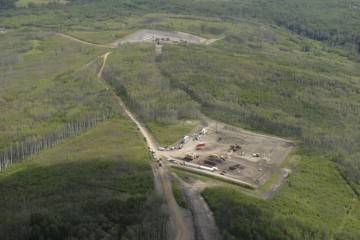 Two-page letter sent to newspaper promises 'summer vacation' free of bombings, but warns that could change |
A letter sent to a daily newspaper and addressed simply to “EnCana” says attacks against the company will stop for three months to give it a chance to leave the area.
“We can all take a summer vacation including your security personnel and the RCMP who have not helped you to date anyway,” the letter states, adding that the six explosions that have occurred so far have been minor and controlled to make the point that “you are indeed vulnerable, [and] can be rendered helpless.”
The letter, delivered to the Dawson Creek Daily News Wednesday and released yesterday by the RCMP, is the second sent in connection with a string of attacks against EnCana wells and pipelines. The first letter was sent to local newspapers in October, days before the first blast occurred.
Police believe the two hand-printed letters were drafted by the same person. The first was sent from Dawson Creek; the second from Spirit River, Alta., which is located 95 kilometres to the east.
Spirit River is relatively near the ranch owned by Wiebo Ludwig, the Alberta man who famously warred against the natural-gas operations of AEC, which merged with PanCanadian to form EnCana.
RCMP have said in the past they have ruled out Mr. Ludwig as a suspect, a statement they reiterated Thursday.
The B.C. explosions amount to “blackmail against not only industry, but also against the local community,” RCMP Sgt. Tim Shields told reporters in Dawson Creek.
RCMP have taken the deliberate step of calling the acts “terrorism,” a term Sgt. Shields said accurately describes the explosions, but carries with it no change in either police response or investigation funding.
In Dawson Creek, oil-and-gas workers whose jobs take them close to the bombing sites said they spend little time worrying about their safety, based on a belief that whoever is responsible is taking care to avoid hurting people.
“This guy who's doing this – he's not out there to hurt nobody,” said an oil-and-gas worker who attended the scene of the fifth bombing.
That wellhead explosion was just 500 metres from where the sixth blast went off, rupturing a natural-gas pipeline.
“He's just trying to get back at the oil companies,” said the worker, who spoke on condition of anonymity over his fear of losing his job for speaking out.
Clues in the two letters have led RCMP to believe that the person responsible – police believe it is most likely a single individual, who they have taken to calling “the bomber” – lives in or near Tomslake, B.C., a small community near the Alberta border.
Tomslake was populated by immigrants from the Czech Sudetenland around the time of the Second World War, and language used by the letter-writer indicates he or she could form part of that ethnic group, Cpl. Shields said. The first letter referred to “home lands,” while the second mentioned “our territories of the Tomslake and Kelly Lake districts.”
“We know that the Tomslake area was once referred to, especially after World War II, as the Sudeten homeland, and the word ‘territory' was also included in that description of Tomslake at that time,” Cpl. Shields said. “So, it was a term that was used in the past.”
From the tone and content of the letters, it appears the writer wants to come across as powerful, smart and in control, psychologist Mike Webster said yesterday.
The letter also carries elements of what's called “duping delight” – some criminals' tendency to gloat over their exploits or taunt police, a tendency that can backfire.
Such people may want to insert themselves into the investigation or collect souvenirs, said Mr. Webster, who's worked with police agencies for decades and recently testified at the Braidwood inquiry into the taser death of Robert Dziekanski.
“If he is more interested or has a greater need for demonstrating his intelligence or his power over EnCana and the police, he's going to screw up,” Mr. Webster said.
Mr. Webster disagreed with the RCMP's characterization of the attacks as terrorism, saying that the attacks appear aimed at the company, not the public at large.
“There's an argument to be made that the community is somewhat in support of the individual who is responsible,” said Mr. Webster.
The investigation has cost at least $1-million to date. There have been no arrests.
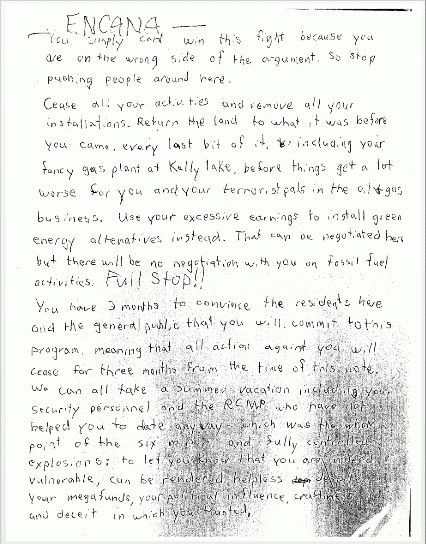 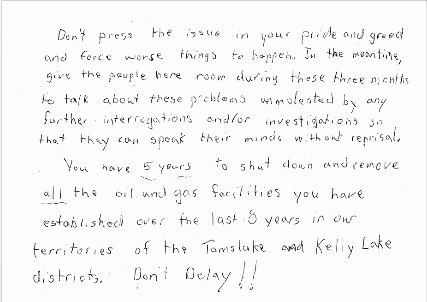  |
RCMP scout locales in hunt for bomber
NATHAN VANDERKLIPPEGlobe and Mail
Friday, Jul. 17, 2009
RCMP in northern British Columbia have begun scouting for sites to set up a new, temporary detachment in the small town of Tomslake, where they suspect the area's oil and gas bomber resides.
Plans for the new detachment will be revealed today by RCMP, who gave advance notice of their intentions to a group of concerned residents in Tomslake yesterday.
“What I want is basically a full service police station out here,” Staff Sgt. Stephen Grant told about thirty people gathered for a Rural Crime Watch meeting last night. Mr. Grant is the commander of the 27-member Dawson Creek detachment.
Over the past nine months, six explosions have been set at natural gas installations in the area owned by EnCana Corp. The explosions have all happened in a relatively small area between Tomslake and Dawson Creek, which is a 30-kilometre drive north-west.
The six bombings have damaged infrastructure, but so far hurt no one.
Two anonymous letters sent to local media by the person believed to be responsible for the bombings have referenced Tomslake. Police believe the language in the letters – especially references to “our home lands” and “our territories” – points to a resident of the area, which was populated around the time of the Second World War by Czechoslovakian Sudetenlands immigrants. Some of those immigrants used that terminology to describe their new Canadian home.
Current plans call for the small satellite detachment to be maintained for six months, or until the bomber is caught, although Mr. Grant expressed hope that it could be continued beyond that time.
“We're looking at potential sites in the area,” he said in an interview. “We're working with the regional government to locate a spot, and we hope to get that going pretty quick.”
The RCMP bid to catch whoever is responsible for the bombings has damaged relations with some in the area, as people have been tailed, subjected to hostile questioning, watched in their own homes and, in one case, accused in a public restaurant of being the bomber.
Mr. Grant acknowledged those tactics have not always gone over well.
“We all know how this initial investigation was conducted,” he told the Tomslake group. “It did not leave a good taste in people's mouths.”
But he hopes the new detachment, even if it is temporary, will help mend some of those issues.
“We've always been too distant from the community here,” he said. “So the connection we have with the people isn't as strong as it should be. I believe by having a base here within the community we're going to be more responsive, we'll have a better connection with people. I think it's going to be positive all around.”
RCMP are also bringing in additional gunpower, including a six-month posting to the area for a long-serving member of the force who has trained as a sniper and worked with U.S. and Canadian army bomb patrols in Afghanistan.
Police must contend, however, with substantial elements of the community that believe the bomber is doing them a service.
Many have harsh feelings toward the natural gas development that has descended upon them in recent years with a cloud of highway dust and the roar of drilling rigs in a once-quiet place. As a result, enough people have sympathy for whoever is setting the explosions that one woman told Mr. Grant: “the bomber is at least giving us a bit of a voice.”
Police have attempted to convince people otherwise by pointing to the danger the explosions have posed to natural gas workers, including those whose work to repair the fifth explosion involved welding a repair mere centimetres from a roaring natural gas flame.
“This person would like to think they're Robin Hood, but they're endangering the people that live here,” Mr. Grant said.
Police believe the bomber has likely used an all-terrain vehicle to travel to the remote locations where the bombings were set. Members of the Tomslake Rural Crime Watch have nonetheless stepped up their own volunteer patrols, devoting long hours to driving the community's gravel roads in hopes of discovering something suspicious.
For them, the new detachment is entirely welcome.
“It's a necessary evil generated by the circumstances that have developed in our area,” said Rural Crime Watch chairman Geri Demyem.
See previous
Hunt for pipeline bomber draws harassment complaints
RCMP buoyed by new leads in B.C. pipeline bombings
RCMP say 6th bomb targeting B.C. pipeline caused small sour gas leak
Explosion caused pipeline leak, EnCana says
Tips flowing on pipeline bombings after EnCana reward offered
Encana to announce reward into B.C. pipeline bombings
Pipeline bombers probably local: expert
RCMP blows pipeline bombing investigation
Sabotage fears flow around B.C. pipelines
Third blast rocks B.C. pipeline
Six recent pipeline incidents, commission says
Oil vandal questioned in B.C. pipeline bombings
Somebody local with a grudge targeting oilpatch?
Olympics executive takes new appointment at BC Hydro
COMMENT: Does Dan Doyle=Site C? BC Hydro's bio is effusive: "Large complex building projects are second nature to Doyle. With more than 35 years of experience with B.C.'s Ministry of Transportation, most recently as deputy minister, he has overseen some of the province's landmark construction initiatives."
Umdaly didn't last long. Brian Smith was chair from 1996-2001. Larry Bell from 2001-2007. Mossadiq Umedaly for a mere 18 months. Did he not like the job? Did Gordon Campbell not like him doing the job?
By Derrick Penner
Vancouver Sun
July 17, 2009
The head of construction efforts for Vancouver's Olympic organizers is taking on a new position as chairman of the BC Hydro board of directors.
Dan Doyle, executive vice-president of construction for the Vancouver Organizing Committee for the 2010 Olympic and Paralympic Games (Vanoc), was named to the Hydro post on Thursday. He'll replace Mossadiq Umedaly, who has been chair of the board since the end of 2007.
Doyle, a career civil servant in the provincial Ministry of Transportation, retired as deputy minister of the department in 2005.
During his career, he served as chairman of Rapid Transit 2000, the company that oversaw construction of SkyTrain's Millennium Line, and advised on projects including the province's Gateway initiative and the Canada Line.
Doyle joined Vanoc in 2006 to oversee its $580-million venue-construction program as part of a reorganization that saw his predecessor, Steve Matheson, senior vice-president of venue construction, dismissed.
Doyle will remain with Vanoc, where CEO John Furlong credited him with "delivery of a successful venue construction program" and with a razor-thin $310,000 contingency.
"Mr. Doyle's contributions to the province over the last 35 years make him a natural fit for the BC Hydro team," Blair Lekstrom, minister of energy, mines and petroleum resources -- and minister responsible for the Crown corporation -- said in a news release.
© Copyright (c) The Vancouver Sun
Dan Doyle
Chair, BC HydroAppointed July 16, 2009
 |
Large complex building projects are second nature to Doyle. With more than 35 years of experience with B.C.'s Ministry of Transportation, most recently as deputy minister, he has overseen some of the province's landmark construction initiatives. Highlights include the rehabilitation of Vancouver's Lions Gate Bridge and the development of the Sea-to-Sky Highway Improvement project. Doyle also served as chairman for Rapid Transit 2000, the company responsible for building the Millennium Line extension to Vancouver's rapid transit system.
A civil engineer by training, Doyle’s lengthy career has been recognized with many accolades, including the APEGBC President's Award in 2007, the Canadian Transportation Person of the Year (2005) and the Lifetime Achievement Award from the Institute of Transportation Engineers. In addition, he was awarded the Lieutenant Governor's Silver Medal for Excellence in Public Administration (2002).
Federal Review Panel Established for Environmental Assessment of Proposed Bute Inlet Hydroelectric Project
COMMENT: The federal review panel has been appointed for the Bute Inlet Hydroelectric Project. They'll probably be sitting on their duffs for months, because:
- the proponent (formerly Plutonic Power Corp, now a wholly owned subsidiary called Bute Hydro Inc.) has a very detailed environmental impact statement (EIS) to put together. The company has suggested that it may not be released until early 2010.
- in its current Green Energy Call, BC Hydro said in December 2008 that it was looking for 3000 GWh of energy. Bute Inlet is 2905 GWh per year - so if selected by BC Hydro would preclude all the other IPPs and their projects - a political and diplomatic disaster for BC Hydro, the BC Utilities Commission, the BC Government, and for IPPBC. It won't happen. So, Plutonic doesn't need to rush the EIS.
The bios of two of the panellists, Les Cooke and George Kupfer, reflect a deep immersion in Alberta conventional energy issues, and approval of significant tar sands projects. Concerns about a BC run-of-river application may seem to them as peas at the bottom of a stack of mattresses, and intervernors who express concern as so many princesses. Ian Birtwell, with a background in salmon issues, will likely expect some pretty hard-nosed science to back up any expert opinion that the Bute project will have detrimental impacts on salmon or their habitat.
News Release
Canadian Environmental Assessment Agency
July 16, 2009
OTTAWA – July 16, 2009 – Canada’s Environment Minister Jim Prentice announced today the establishment of a three-member federal review panel for the proposed Bute Inlet Hydroelectric Project in British Columbia.
Minister Prentice appointed Les Cooke as panel chair, as well as Ian Birtwell and George Kupfer as panel members. Biographical information on the panel chair and members is available in the accompanying backgrounder.
The panel terms of reference for the environmental review were issued by the Minister in May 2009, along with the document entitled “Guidelines for the preparation of the Environmental Impact Statement”. The Panel Terms of Reference document describes the review process and the procedures to be followed by the federal panel in conducting the review, as well as details on the scope of the environmental assessment.
In accordance with its terms of reference, the panel will:
conduct an examination of the environmental effects of the proposed project and the significance of those effects;
consider measures that are technically and economically feasible to mitigate any adverse environmental effects, as well as the need for and the requirements of any follow-up programs with respect to the project; and
consider comments from the public that are received during the review.
Further information on this project, along with the terms of reference, is available on the Canadian Environmental Assessment Agency Registry under registry number 09-05-44825.
Bute Hydro Inc. is proposing to construct 17 run-of-river hydroelectric facilities in the vicinity of Bute Inlet. Major components, in addition to the generating facilities, include a substation near the mouth of Southgate River, associated access roads and ancillary works, 216 km of 230 kV collector transmissions line and a 227 km 500 kV trunk transmission line from the proposed substation near the mouth of Southgate River to the existing 500 kV substation at Malaspina.
-30-
For more information, media may contact:
Lucille Jamault
Senior Communications Advisor
Canadian Environmental Assessment Agency
Tel.: 613-957-0434
http://www.ceaa-acee.gc.ca/050/Document-eng.cfm?DocumentID=37642
Proposed Bute Inlet Hydroelectric Project
Federal Review Panel - Biographical Notes
Les Cooke
Les Cooke has over 40 years of strategic policy and planning, program management and executive experience with the governments of Saskatchewan and Alberta, and provincial governments in South Africa. He completed graduate studies in land and resource planning at the University of Alberta. He is President of Les Cooke and Associates, a consultancy focused on strategic management and organizational effectiveness in forest management and infrastructure development.
Mr. Cooke has held executive positions focused on natural resource and environmental management, economic development and strategic policy and planning. He has led national strategic planning processes for the Canadian Council of Ministers of the Environment and the Canadian Council of Forest Ministers. He has spearheaded new approaches to public sector governance and program management, including Aboriginal business development, integrated land management and partnership-based environmental management. Mr. Cooke has extensive experience in facilitative leadership and consensus driven partnerships involving a wide array of government agencies and stakeholder communities. He has frequently managed complex organizational environments involving boards, commissions, authorities and interagency task teams.
Mr. Cooke has chaired resource management organizations and served on environmental assessment panels. He has chaired the Board of Directors of the Saskatchewan Wetlands Conservation Corporation and served as the Vice-Chairman of the Alberta Advisory Committee on Heavy Oil and Oil Sands Development. He was a member of the joint federal-provincial panels examining the development of the Kearl oil sands mining and extraction facility and the expansion of the Muskeg River oil sands operation, both in northern Alberta.
George Kupfer
George Kupfer is a consultant focusing on community consultation and facilitation related to social and environmental issues. He has a sociology degree from Seattle Pacific University, as well as a Masters and Ph.D. in Sociology from the University of Washington. He taught at the University of Alberta for 15 years, before establishing his own company, Fresh Start Limited, and continues to work extensively in Alberta.
Dr. Kupfer has facilitated many community consultation and stakeholder engagement initiatives related to industrial projects and their impacts. He has led multi-stakeholder consultations on drilling applications, gas pipeline developments, sour gas issues, transmission line route selection and forest conservation. He facilitated a multi-stakeholder review of the Alberta environmental impact assessment process. He has facilitated Crown consultation processes with First Nations for the federal and Alberta governments and advised the National Energy Board on the development of an internal Aboriginal consultation process. He has worked with First Nations and Metis, industry, communities and government departments in Alberta, British Columbia and the Northwest Territories.
Dr. Kupfer has served on numerous environmental assessment panels, specifically related to water management issues. He was recently a member of the joint federal-provincial panel reviewing a run-of-the-river hydroelectric project on the Peace River near Dunvegan, Alberta. He was also a member of panels reviewing water management projects for the Pine Coulee and Little Bow/Highwood projects in Alberta, and was a panel member for reviews of the Jackpine and Horizon oil sand developments in northern Alberta. He managed the review panel, as well as the scientific review of the Alberta-Pacific pulpmill and served as social impacts advisor to the Oldman River Dam Panel.
Ian Birtwell
Ian Birtwell is an aquatic ecologist with particular expertise on the effects of industrial development on fish and fish habitat. He worked as a biologist and research scientist for Fisheries and Oceans Canada for over 30 years and retired in 2006. He has a Ph.D. in estuarine Ecology from Kings College, London University.
Dr. Birtwell has devoted his career to researching and reviewing the effects that human developments have on the aquatic environment. His research has focused on the lethal and sublethal aspects of stressors on the survival of fish and on their habitat. He has done extensive work on the effects of sediment and turbidity on aquatic systems. He has studied the impacts of oil spillage and transportation, pulp mill effluents, placer gold mining, oil sands development, diamond mining, municipal effluent, specific contaminants, as well as effects of electricity production and thermal and dissolved gas pressure changes. Dr. Birtwell's research results have contributed to the formulation of regulations under the Fisheries Act, and have been used in testimony in court and in cooperative ventures with non-governmental organizations, industries, and government agencies, to assist fish and fish habitat protection. He contributed to the formulation of Fisheries and Oceans Canada’s fish habitat policy, and has provided expert opinion for governments in over 30 court cases involving habitat damage and the deposition of deleterious substances.
Dr. Birtwell has been spokesperson and expert witness before federal and provincial public hearings including the joint federal-provincial environmental assessment panel reviewing the effects of the Alberta-Pacific pulp mill. He has participated in international, national, regional and provincial committees related to habitat, pollution issues and legislation. He has delivered numerous lectures to scientific, administrative and public audiences, and has authored over 150 scientific publications. While working for Fisheries and Oceans Canada, he received the Deputy Minister’s Commendation for contribution to environmental assessment.
http://www.ceaa-acee.gc.ca/050/Document-eng.cfm?DocumentID=37560
July 12, 2009
BC Hydro announces fiscal results for 2009
Press Release
BC Hydro
July 10, 2009
VANCOUVER – BC Hydro today announced its financial results for Fiscal 2009, including a consolidated net income of $366 million for the year ended March 31, 2009, which is comparable to the prior year's net income.
"Overall, our financial results for Fiscal 2009 are in line with expectations and I am very pleased that the energy saved through our Power Smart programs exceeded expectations," said Bob Elton, BC Hydro President and CEO. "We have also made good progress in our capital plan to upgrade aging assets to meet growing customer demand and improve system resiliency. Unfortunately, the economic downturn has affected many industries, especially forestry, which resulted in decreased demand for electricity from the industrial sector."
Other highlights of the Annual Report include:
* Domestic revenues were $2,814 million – $130 million lower than the previous year, primarily as a result of decreased revenue from the industrial sector mainly due to closures in the current year of pulp and paper operations in the forestry sector.
* Total energy costs of $2,393 million were $336 million higher than in the prior year. BC Hydro experienced a 14 per cent decrease in hydro generation over the prior year due to lower water inflows and system constraints, causing BC Hydro to purchase higher-priced market energy to meet domestic requirements.
* Energy saved through Power Smart programs surpassed expectation and continued to deliver cost-effective energy over the last fiscal year, producing cumulative energy savings of 983 GWh, an increase of 657 GWh over Fiscal 2008. This increased saving is equivalent to powering 65,700 homes for a year.
* Capital expenditures of $1,400 million in the year were $324 million higher than the previous year, primarily due to reinforcement work on the Vancouver Island transmission reinforcement project and generation replacements and expansion projects such as the Revelstoke Unit 5 installation to meet growing customer demand, and system improvements to the distribution network.
* Energy trading income increased in Fiscal 2009 mainly as a result of favourable electricity price spreads between the Northwest and Southwest and between the Northwest and Alberta during peak periods in the current year, and growth in natural gas trading activity over the previous year.
* Operating costs were $27 million lower in Fiscal 2009, primarily as a result of higher costs in the previous fiscal year for First Nations settlement provisions. These lower operating costs were partially offset by higher expenditures in the current year on demand side management and smart metering and infrastructure projects, higher maintenance costs to address equipment failures at the G.M. Shrum Generating Station, expenditures on Phase 2 of the Site C project, and higher levels of work in vegetation maintenance to improve system resiliency.
Contact:
Susan Danard
Media Relations
Phone: 604 623 4220
Drop in demand means lower profits at BC Hydro
By Fiona AndersonVancouver Sun
July 10, 2009
Utility reported it had to purchase more expensive energy to meet demand
 BC Hydro posted profits of $366 million last year, down slightly from the $369 million the provincially owned electric utility earned a year earlier. Photograph: Vancouver Sun files |
BC Hydro posted profits of $366 million last year, down slightly from the $369 million the provincially owned electric utility earned a year earlier.
The drop in profit came as rate increases were offset by a decrease in demand, mainly from industries such as forestry that were hard hit by the recession, BC Hydro said in its annual report, released Friday.
Energy costs for the year — which ran from April 1, 2008 to March 31, 2009 — were higher ($2.4 billion compared to $2.1 billion) as lower reservoirs led to power generation being down 14 per cent, the report said.
As a result, BC Hydro had to purchase more expensive energy to meet demand.
Water flow “is our largest variable, it’s our fuel,” BC Hydro spokeswoman Susan Danard said in an interview. So the utility keeps a watchful eye on snowpack in the north and rain in the south.
But despite the dry summer the Lower Mainland has been enjoying so far, it is too early to predict what water inflow will be like this year, Danard said. While the south has been dry, the Peace River area, where BC Hydro’s largest facilities are located, has been quite wet.
Domestic revenues at the utility fell $130 million to $2.8 billion even though the utility added 34,000 customers, mainly in the Interior of the province and on Vancouver Island.
In addition to a drop in industrial consumption, BC Hydro’s Power Smart program — which encourages customers to reduce energy consumption by 10 per cent — saved 983 gigawatt hours (GWh) of energy, an increase of 657 GWh from the amount saved in 2008. The increase in saved energy is enough to power more than 65,000 homes for a year, the report said.
Revenues at Powerex, BC Hydro’s trading arm, were up $189 million due to increases in revenue from both electricity and gas trades. Higher prices in electricity more than offset a 13-per-cent drop in sales to increase revenue. And Powerex’s push to grow its gas business led to volume growth of 27 per cent while prices were up eight per cent.
Last year, BC Hydro experienced more widespread power failures caused by transmission and substation issues than in previous years, affecting more customers, the report said.
That would include last summer’s underground electrical fire, which caused as many as 20 per cent of downtown Vancouver customers, many of them businesses, to be without power for up to four days.
fionaanderson@vancouversun.com
© Copyright (c) The Vancouver Sun
Local voices must be heard in decisions on power projects
BY GEORGE HEYMAN AND SARAH COX
The Vancouver Sun
11 Jul 2009
Bute Inlet, a long and deep fiord 300 kilometres north of Vancouver, is famous for many things. Some call it “Canada’s Himalayas” because of the striking glacier-covered mountain slopes and temperate rainforest. Loggers know it as a place where nature can’t be tamed, where avalanches and rockslides tear down mountainsides and mini-tornados funnel down the fiord in legendary winter storms. Fishers count five kinds of salmon in the emerald inlet. Mountaineers eye Mount Waddington, the highest peak entirely in British Columbia, near the Homathko Icefield which feeds the inlet with streams of gravel-studded water.
 Bute Inlet is where Plutonic Power Corporation plans a power project.(ALISTAIR HOWARD/PLUTONIC POWER) |
For Sierra Club BC, Bute Inlet was a place we’d heard much about, yet didn’t know at all. In the news, Bute has become synonymous with a controversial power proposal to harness over 1,000 megawatts of electricity from 17high elevation creeks and rivers and march it over the mountains to the electrical grid.
Last week, Sierra Club staff and volunteers boated up the 75-kilometre inlet, and travelled along overgrown logging roads to remote river valleys that could soon house turbines and transmission lines. We wanted a first-hand view of the scope of the development owned by Plutonic Power Corp and its partner General Electric — a controversial proposal that spurred more than 250 Quadra Island residents to overflow a local hall on a Sunday morning in February to voice objections to the project.
In a “green power” gold rush invisible to most of us, the provincial government has granted more than 130 water-for-power licences. Close to 600 more applications are pending — primarily placeholders for corporations laying claim to B.C.’s public rivers for future development.
Run-of-river proposals are touted as “green power” because, like 90 per cent of B.C.’s clean hydro power, once infrastructure is in place they are largely carbon-neutral. But this green power moniker raises many difficult questions that challenge the environmental community and all British Columbians.
Do we carve up a wilderness area — in Bute’s case one that encompasses the southern most range of B.C.’s coastal grizzlies, endangered marbled murrelet habitat and all five species of B. C. salmon — to produce power for export in an attempt to slow our rapid ascent to global warming’s tipping point?
How do we calculate the carbon footprint of producing and shipping turbines and penstock from Austria and China, ferrying work crews in and out by helicopters and airplanes and leaving a 100-metre-wide swath of felled trees to release their carbon contents into the atmosphere beside transmission lines channelling “carbon-neutral” power?
In the name of green power, do we compromise or destroy burgeoning ecotourism ventures that create sustainable jobs and infuse money into the local economy?
The sheer scale of Plutonic’s proposal warrants questions and concern. It is 33 times larger than the 30-megawatt limit set by the state of California’s renewable energy bill for run-of-river hydroelectric power. In addition to the 17 stream diversions and 445 kilometres of transmission lines, the project will involve 314 kilometres of roads, 142 bridges, 16 powerhouses, and a substation — all this in a wilderness area so visually stunning that Beautiful British Columbia magazine recently named a trip to Bute Inlet one of “50 things to do before you die.”
The Homathko logging camp, where we stayed at Bute’s eastern tip, is equipped with its own run-of-river project that generates more than enough electricity to fuel a plethora of power equipment and feed and house 30 people. We climbed uphill to see the waterfall source of the camp’s abundant electrical supply, and couldn’t help but note that this small scale “run of river” is a non-invasive harnessing of water tumbling downhill.
As B.C. speeds up development of cleaner, carbon-neutral energy, we need a well-thought, comprehensive and publicly acceptable template to assess the full environmental footprint of new power proposals.
• Is the proposed development truly “green” when its impacts on habitat, species and irreplaceable ecosystems and landscapes are considered? Is a mix of additional alternatives, including wind and solar, less environmentally destructive?
• What is the “full carbon accounting” when emissions caused by construction and maintenance are factored in?
• What is the appropriate scale of a “green power” project — 1,000 megawatts such as Bute or much smaller, like California’s limit of 30 megawatts?
• What is the cumulative impact of dozens of power projects on a watershed?
• Will the new power replace dirty coal or natural gas fired generation, or will it be exported with no carbon reduction strings attached?
Rights to use our rivers and public land must be granted through open public processes, not sacrificed by provincial policies that transfer accountability from the public to shareholders and allow corporate claims of commercial confidentiality to trump our freedom of information laws.
Bill 30, passed by the B.C. government in 2006, removes input and planning approval from local governments and communities during provincial assessment of proposed water-for-power projects.
Our water as well as our atmosphere is a common asset, and we need to ensure public benefit from its use. We must develop green energy, but in a way that retains the right of B.C. to make decisions in the public interest with political accountability.
We can’t run the risk of having those decisions blocked by investor rights clauses in trade agreements. We can’t afford to silence local voices, and we can’t afford to extinguish open and broad-based public discussion about how best to extricate ourselves from our carbon quagmire.
George Heyman is executive director of Sierra Club BC. Sarah Cox is the organization’s policy and campaigns adviser.
BOMB: Land of suspicion
b>Brian Hutchinson
National Post
July 11, 2009
 Tim and Linda Ewert, son Woody and daughter-in-law Gabrielle stand on their property which borders an EnCana pipeline which has been targeted by an unknown bomber. (Keith Winsor for National Post) |
Police say a terrorist is blowing up a B.C. gas pipeline. Not all the locals agree
There is anger in the Peace, and suspicion. Someone is making homemade bombs, planting them beside natural gas wells and pipelines. Setting them off. Scaring families, exposing them to harm.
A terrorist is in their midst, say police. Neighbours wonder about one another. Since October, six explosions have rocked the rolling green foothills of northeastern British Columbia. There have been two this month. Whoever is responsible is edging closer to Pouce Coupe, a rural village 10 kilometres south of Dawson Creek.
All of the targets are owned by EnCana Corp. Like many other oil and gas companies tapping into gas fields in B. C.'s Peace River region, EnCana is in the business of sucking gas from the ground.
It is among the industry's dominant players; here in the Peace, it is the most visible. The EnCana logo seems ubiquitous. "It's the biggest bear in the barn, that's for sure," says Lyman Clark, Mayor of Pouce Coupe.
The Mayor is an unabashed EnCana booster. He speaks glowingly of the Calgary-based company, its community spirit, its willingness to sprinkle cash around his village when it's needed.
That new wheelchair ramp attached to the community centre? Built and installed by EnCana. The new school? Construction funded, in part, by EnCana.
But there are plenty of folk who have issues with the company. "It's assumed that because it's big, EnCana is out to screw everybody," says the Mayor.
Among other things, En-Cana is accused of being aggressive and arrogant in its dealings with locals, especially in negotiating right of entry to their land.
EnCana acquires subsurface mineral rights from the province, but must buy surface access separately. Often, that means dealing with farmers and ranchers who may want nothing to do with the gas business, or who feel they are being low-balled by the company.
This is rich, productive country, on the edge of a fertile plain that stretches far into Alberta. The land here supports woodlots, wheat and canola fields, and livestock.
But agriculture is giving way to industry. Specifically, the oil and gas business. The old way of life is eroding, people complain. Tim and Linda Ewert have been farming near Pouce Coupe since 1974. The couple and their children have grave concerns about the gas industry that, they said, arrived in the area about eight years ago, and came on "like a tidal wave."
Like everyone else in the area, they soon learned what escaped gas can do.
Commercial natural gas is either sweet or sour; most reservoirs found deep underground contain both. Sour gas contains hydrogen sulphide, which is lethal. Even a small amount escaped into the environment can potentially kill, or cause damage to animal and plant tissue.
The Ewerts and some of their neighbours claim to have suffered from accidental leaks; these are rare, but they do happen. Symptoms in humans include headaches, respiratory problems, loss of balance, even loss of consciousness.
The Ewerts digested whatever information they could find; inevitably, their research led them to Wiebo Ludwig, the fire-breathing Alberta preacher and farmer who led a personal crusade against a number of oil and gas companies. He alleged their operations were poisoning his family and his farmland.
In 2001, Mr. Ludwig was convicted of bombing and vandalizing oil and gas installations near his family farm in Hythe, Alta., which is less than an hour's drive east of Pouce Coupe. He spent more than a year in prison before being released on parole.
The Ewerts have since paid visits to the Ludwig farm.
"We heard people say he is an absolute lunatic," says Mr. Ewert. "But we cast around and we found that there was something to what he was saying about the gas industry. So we have some sympathy for him."
And while they say they don't condone violence or acts of terror, the Ewerts have some sympathy for the bomber in their midst.
This, even though the last two explosions occurred nearby. The July 1 bombing took out part of a wellhead. EnCana crews were still repairing the damage on July 4 when another bomb exploded, this one at a pipeline.
Mr. Ewert and his family saw a plume of smoke, and called the local EnCana office. They say that a company employee conceded that some sour gas had escaped. While the leak was quickly contained, thanks to automated controls and shutoff valves, it caused widespread alarm.
Yet the Ewerts are glad for the resulting publicity the bombing caused. "We don't feel any more threatened by the bomber than we do the industry. If anything, we feel more a threat from the industry," says Mr. Ewert. "In fact, I think the bomber has done quite a service to the community."
"I think he's made a lot of people stop and go, 'Oh, maybe there is a problem,' " his wife, Linda, says.
EnCana has a regional office in Dawson Creek, and about 1,600 gas installations scattered about the region. Most are set deep in the pine forests or in the bush. These include exploration and drilling sites, wells, compression and processing plants, and buried pipelines.
Plain-clothed officers and private security guards now move around some of these locations, hoping to catch sight of the bomber. Surveillance cameras are fixed along fence lines.
Despite their best efforts, hundreds of officers on the ground and special investigation units flown in from Vancouver, Alberta, and Ottawa haven't been able to nab the perpetrator.
An RCMP spokesman says local residents are being less than forthcoming. A $500,000 reward offered by EnCana for information leading to the bomber's arrest and prosecution has not been claimed.
Some say the RCMP has gone overboard.
Dennis MacLellan says he's "a person of interest" to po-lice. He has a longstanding beef with EnCana, and he's not been afraid to talk about it.
The dispute relates to his land, a tree farm near Pouce Coupe. EnCana wants access to it, he says, so that it can develop a lease.
"I'd prefer they didn't come onto the property," says Mr. MacLellan. EnCana has offered him some money, but it's not nearly enough. He wants $100,000.
The RCMP has him under surveillance, he says. There are cameras outside his apartment building in Dawson Creek. Investigators approached him inside a local restaurant. Uninvited, they sat down at his table. The men got into a shouting match; tall and burly, Mr. MacLellan isn't one to back down.
"They called me a terrorist," he says. Now his 72-year-old mother is worried; she already has a heart condition.
No one, it seems, escapes the Mounties' notice. "I've got one [village] councillor here who was stopped three times by police inside of three miles," say Lyman Clark. "Each time they were like, 'Whatcha doing here, boy?' "
RCMP Staff Sergeant Stephen Grant heads the region's 27-member detachment in Dawson Creek. He refuses to discuss the active investigation. However, he agrees that it has grown, and that it is logical to assume people have been interviewed. Police have been in touch with Wiebo Ludwig, for example.
Mayor Clark says he thinks the bomber is likely a local person. He points to a map. The Peace River region is vast and mostly wild, he says. A stranger would have trouble navigating it. "It's a jungle," says the Mayor. "A big-city person would get eaten by a bear before he could plant a bomb."
It could be "a demented EnCana employee," he says. "Someone with a really bad taste in his mouth."
Or perhaps a local eccentric. Pouce Coupe has more than a few, says the Mayor. "It could be one of our local rustics, a recluse. People we call bush bunnies. Someone living in an old beat-up camper trailer who dumps his refuse down a ravine. Someone who has been told by EnCana to shove off. Some vengeful warrior type."
The Mayor says it's only a matter of time before the bomber's identity is revealed.
"It's a strange mind we're dealing with. I know plenty of people who would like to find him in action," he says. "Hunters, trappers."
Does he mean people with firearms?
"Yup."
---------
PIPELINE BLASTS
Oct. 11, 2008 First blast occurred in a remote location 50 km east of Dawson Creek.
Oct. 16 East of Dawson Creek, about half a kilometre from Alberta border. Explosion caused a pipeline to leak some gas.
Oct. 30 Third explosion occurred 12 km northwest of Tomslake. The blast hit a wellhead that leaked.
Jan. 4, 2009 Fourth explosion near Tomslake partly destroyed a metering shed.
July 1 Damage done to a wellhead in fifth explosion that occurred near Pouce Coupe, B. C., about 8 km south of Dawson Creek.
July 4 Sixth explosion occurred within a kilometre of staff working to fix the wellhead damaged on July 1. The explosion caused a gas leak. RCMP said the leak didn't harm the public, workers or environment.
National Post
Earlier posts:
RCMP buoyed by new leads in B.C. pipeline bombings
RCMP say 6th bomb targeting B.C. pipeline caused small sour gas leak
Explosion caused pipeline leak, EnCana says
Tips flowing on pipeline bombings after EnCana reward offered
Encana to announce reward into B.C. pipeline bombings
Pipeline bombers probably local: expert
RCMP blows pipeline bombing investigation
Sabotage fears flow around B.C. pipelines
Third blast rocks B.C. pipeline
Six recent pipeline incidents, commission says
Oil vandal questioned in B.C. pipeline bombings
Somebody local with a grudge targeting oilpatch?
July 10, 2009
BOMB: Hunt for pipeline bomber draws harassment complaints
Mark Hume
Globe and Mail
Friday, Jul. 10, 2009
Residents of B.C. town question RCMP tactics
An RCMP team hunting for the EnCana pipeline bomber in northeastern British Columbia has been accused of harassing and intimidating people in an attempt to get a break in the case.
Several residents of the Dawson Creek area say they have been interrogated up to eight times, pressured to take lie detector tests and asked for DNA and fingerprint samples.
One man said he fled a busy restaurant when police loudly accused him of being the bomber.
The RCMP say they have not received any formal complaints about their tactics.
But Vancouver lawyer, Jason Gratl, vice-president of the B.C. Civil Liberties Association, said he has written to the RCMP asking them to stop harassing two clients.
“They are acting like state or secret police,” Mr. Gratl said. “The RCMP have fomented a climate of paranoia and suspicion … by applying a level of social pressure that amounts to harassment and intimidation.”
The RCMP has more than 250 investigators trying to catch whoever is responsible for six bomb attacks on EnCana infrastructure since October. Police have interviewed more than 450 people so far, without any charges laid.
Mr. Gratl said four people have contacted him with complaints about police.
One of those is Dennis MacLennan, who says he willingly agreed to a police interview last fall, after the first bombings, but when investigators kept returning with more questions, he decided not to co-operate any more.
That, he said, led to a confrontation with members of the Integrated National Security Enforcement Team in a local café.
“They come and sit at my table … and they start engaging me in questions. I said, ‘look I don't want to talk to you, my lawyer has advised me not to' … So I get up to leave and one member of the INSET team starts yelling at me: ‘You're the bomber You're the bomber' You know, in a public restaurant … this is just absolutely atrocious behaviour,” Mr. MacLennan said.
He is in a dispute with EnCana over the amount of money he claims is due for a well on his property, but says that shouldn't make him a bombing suspect.
“I do my business by the rules … I'm not some radical crazy,” he said.
But police have kept after him for months.
“They just kept pressuring me and chasing me around town, talking to people I'm doing business with and telling them I'm under investigation … destroying business opportunities for me. It's been quite stressful … they've gone to my landlord and said, ‘Would you be surprised if we arrested him?' and poisoning the atmosphere with people I've had relationships with for 10 and 20 years,” he said.
“My friends think there must be something to it if the police are being this persistent. All sorts of rumours are being spread.”
A woman, who asked not to be named, sounded distraught as she described being a police suspect.
“They've talked to me three times; our son at least six times. It's interviews, interrogations, wanting fingerprints, DNA, lie detector tests. They wanted my cellphone record … It's two or three hours of questioning at a time, over and over again,” she said.
The woman, who is not one of Mr. Gratl's clients, said she knows others who have been questioned by police, and most are withdrawing from social contact.
“I can see some of the same symptoms of [post traumatic stress disorder] in those who have been police targets … there is isolation, paranoia, just like they have been in combat,” she said.
Another woman, who has not been questioned herself, said a friend was interrogated repeatedly and “he was absolutely torn apart by the intimidation. He was a basket case.”
She said she didn't want her name in the media, fearing it might result in a police visit.
RCMP Corporal Dan Moskaluk, media relations officer for the North District, said police would like to hear from anyone who thinks they have been treated unfairly.
“I guess the response to those types of issues [is that] we are always concerned,” he said.
“At this point in time I'm not aware of any formal complaints that have been received or are being investigated … but again we would certainly welcome any issues that people would like to voice to us,” he said.
See previous
RCMP buoyed by new leads in B.C. pipeline bombings
RCMP say 6th bomb targeting B.C. pipeline caused small sour gas leak
Explosion caused pipeline leak, EnCana says
Tips flowing on pipeline bombings after EnCana reward offered
Encana to announce reward into B.C. pipeline bombings
Pipeline bombers probably local: expert
RCMP blows pipeline bombing investigation
Sabotage fears flow around B.C. pipelines
Third blast rocks B.C. pipeline
Six recent pipeline incidents, commission says
Oil vandal questioned in B.C. pipeline bombings
Somebody local with a grudge targeting oilpatch?
July 09, 2009
NaiKun offshore wind farm presents environmental dilemma
By Anne Murray
Georgia Straight
July 9, 2009
It’s a dilemma that forward-thinking, environmentally conscious people do not want to face: Will moving toward carbon-free energy sources mean disrupting bird migration routes and having a negative impact on wildlife populations?
| See also Anne Murray: What we risk when oil spills along B.C.'s coast |
This weekend sees the July 12 deadline for public comments on the massive NaiKun wind farm proposed for Hecate Strait. The initial phase proposes 110 wind turbines spaced over 100 square kilometres generating 396 megawatts—the first offshore wind farm in British Columbia, located in shallow water immediately east of Naikoon Provincial Park in Haida Gwaii. The project is welcomed by some northerners as an opportunity for employment and a big step forward in sustainable energy generation. After all, wind is something that Hecate Strait does rather well.
The problem arises, however, that this exact location, the shallow water around McIntyre Beach and Rose Spit, is a designated important bird area under the BirdLife International program that lists critical sites for bird populations in over 200 countries worldwide. Millions of migrating birds pass through this IBA every spring and fall, including shorebirds, diving and dabbling ducks, geese, sea birds, loons, and grebes. The footprint of the proposed NaiKun wind farm, close to shore in shallow water, is a prime feeding and staging area for many species of birds, including large numbers of sea ducks, such as black and white-winged scoter. According to recent Environment Canada telemetry studies, large numbers of black scoter stage for up to a month in this area during spring migration (curiously, the Environment Canada data was not available to be included in the environmental assessment report).
The presence of the documented important bird area, and three others affected by the extended infrastructure of the wind farm, places the NaiKun proposal in the highest Category 4 level of sensitivity, according to Environment Canada’s guidelines for wind farms, since it includes a very large number of turbines located in or near an important bird area. Category 4 sensitivity indicates that an alternate site should be considered. Similarly, BirdLife International’s position on wind farms recommends complete avoidance of bird migration hot spots and important bird areas under the precautionary principle.
Disturbance to birds is not limited to the risk of mortality and injury from rotating turbines. Studies in Europe show that birds often fly around the array of turbines, moving away from previous feeding areas or flight paths. The constant disturbance and/or lack of access to prime feeding areas can result in diminished fitness, lower breeding success, or other stresses on the population, particularly for birds in the middle of their long migrations.
As well as birds, the marine waters of Hecate Strait are rich in whales, sea lions, porpoises, fish, and crabs. These are wildlife with high economic as well as ecological value. The environmental assessment lists 35 species of marine mammals that potentially exist in the area, including four populations of killer whales (orcas), but it does not mention that whale watching generates $108 million a year in B.C. (according to a 2003 Fisheries and Oceans Canada fact sheet) and that it has been a significant source of visitor growth in the last two decades, providing employment and foreign currency for many coastal towns. Similarly, the fishing industry is a source of valuable employment and dollars for many northerners. Crab and sablefish fishers have been among those writing in with critiques of the studies and concerns over the location.
The Haida people and other islanders are faced with some difficult choices in deciding whether to accept this large wind farm in their offshore waters. It is essentially a giant experiment in action. Although the proponents claim that no significant effects on marine mammals, birds, or marine ecology have been identified, they admit: “Continued monitoring during and after construction of the proposed wind farm will add much to the existing knowledge base, providing ecological information essential to advancing our understanding of marine mammals and associated environmental interactions of large offshore developments.”
There is a strong case for the precautionary principle and a reconsideration of location for our first offshore wind farm. You can comment on the environmental assessment until midnight on Sunday (July 12) by visiting the Environmental Assessment Office’s Web site and looking at the documentation for the NaiKun Offshore Wind Energy Project.
Anne Murray is conservation chair for B.C. Nature, and author of A Nature Guide to Boundary Bay and Tracing Our Past: A Heritage Guide to Boundary Bay, both published by Nature Guides B.C.
July 07, 2009
BOMB: RCMP buoyed by new leads in B.C. pipeline bombings
By Becky Rynor, Renata D'Aliesio and Dan Healing
Canwest News Service
July 6, 2009
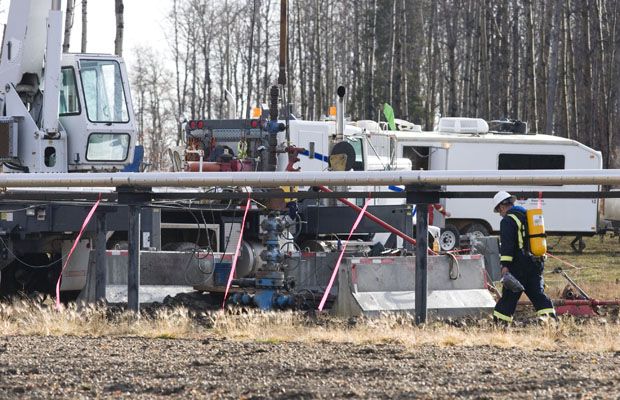 Crews from EnCana work to stop the flow of gas in a wellhead in northeastern B.C. that was caused by bomb blast on Nov. 1, 2008, seen here in this file photo. A similar blast occurred July 4, 2009, at an EnCana Corp. site in Pouce Coupe, B.C., about eight kilometres south of Dawson Creek. This is the sixth bombing — and the second in a week — of natural gas infrastructure in northeastern B.C. Photograph by: Kit Fast, Peace photoGraphics file photo |
Investigators probing a series of bombings that have hit EnCana Corp. gas pipelines in northeastern British Columbia — which RCMP have called acts of "domestic terrorism" — say they're encouraged by several new leads.
"The biggest thing is, we've been receiving some phone tips, and we're following up on those," RCMP spokesman Cpl. Dan Moskaluk said Monday.
"Prior to the last two incidents, we weren't getting that much from the public. With these two latest incidents, as a result of the messaging we put out and the concern from the public . . . people have started phoning in."
EnCana spokeswoman Rhona Delfrari welcomed the news.
"We are relying on the police," she said. "We definitely hope they get some leads, and it's very encouraging if people are calling in and providing tips because, really, it's the whole community that's being targeted now."
On Saturday morning, EnCana officials were alerted to an explosion on a company site near the community of Pouce Coupe, B.C., just south of Dawson Creek, after a concerned resident in the area reported a loud bang.
The blast released a small amount of toxic hydrogen sulphide.
Delfrari said the drop in pressure set off an alarm and the pipeline was automatically shut down. She added most of the pipelines operated by EnCana have the same capability.
There have now been six bomb attacks on EnCana pipelines in the region, dating back to mid-October 2008, when an explosion ripped out a two-metre crater under a pipeline near the hamlet of Tomslake, B.C., about 30 kilometres south of Dawson Creek.
The bombings started shortly after a threatening letter was anonymously sent to EnCana, telling the company get out of the area.
Subsequent bomb attacks have drawn ever closer to populated areas around the Tomslake community, close to the B.C.-Alberta border.
EnCana has offered a $500,000 reward for information leading to the arrest of the perpetrator.
Dawson Creek Mayor Mike Bernier said EnCana employees and security had already been in the area, working to repair a pipeline damaged in a previous explosion on July 1. That blast released a quantity of non-toxic gas.
Dawson Creek is about 600 kilometres northwest of Edmonton.
Premier Ed Stelmach said Monday the Alberta government is working with oil and gas companies to ensure their work sites are properly protected.
"It's very disconcerting, obviously, not only to the immediate residents but to us here in Alberta," the premier said at his annual Stampede breakfast in Calgary.
"We've had reasonable peace when it comes to oil and gas development, and this is most unfortunate because according to the RCMP, it is putting lives at risk," he said.
"We're going to be working with the oil and gas companies, as we have done in the past, to put in place the kind of security that is necessary to protect the public."
Stelmach said Alberta Energy Minister Mel Knight were expected to receive a further briefing on the latest incidents.
Brenda Kenny, president of the Canadian Energy Pipeline Association, said the industry is confident the police are doing what they can but solving the case may require a timely tip from a neighbour.
"Any time you're seeing this kind of sabotage, your first concern is the safety of the workers and the public," she said. "Obviously, there's somebody out there who has taken the law into their own hands and they're running the risk of hurting themselves very badly. It's an abhorrent situation."
On Sunday, Bernier warned it was "just a matter of time" before the rash of bombing attacks on natural-gas pipelines ended in death or injury.
The mayor urged members of the public to come forward, saying he's convinced "somebody" in the region "knows something" that could lead police to a suspect.
"I think, with the endangerment to EnCana workers that were on the ground, these are somebody's family members, and that may have raised the ire of the community," Moskaluk said Monday. "This is a form of domestic terrorism."
© Copyright (c) The Vancouver Sun
See previous
RCMP say 6th bomb targeting B.C. pipeline caused small sour gas leak
Explosion caused pipeline leak, EnCana says
Tips flowing on pipeline bombings after EnCana reward offered
Encana to announce reward into B.C. pipeline bombings
Pipeline bombers probably local: expert
RCMP blows pipeline bombing investigation
Sabotage fears flow around B.C. pipelines
Third blast rocks B.C. pipeline
Six recent pipeline incidents, commission says
Oil vandal questioned in B.C. pipeline bombings
Somebody local with a grudge targeting oilpatch?
July 06, 2009
Spain's Gas Natural may take stake in Canadian LNG
COMMENT: Wow. KitimatLNG has MOUs in place now for 70% of its proposed 5 mmtpa LNG export terminal. MOUs, right? An MOU and a contract are different in the same way that one of those Nigerian "I am the daughter of the late General Cheato Scamo" emails or more mildly, a "Congratulations, you may already have won" magazine subscription come-on is different from a cheque.
A sure deal, contingent on some minor conditions such as the price of the LNG, firm supply arrangements, the billion dollar Pacific Trails Pipeline. Small stuff.
Still, it is slightly more substantial than it was a year ago, when the company surprised everyone (not least of all its own private shareholders) by announcing that, um, it was now going to be an export terminal, not an import terminal.
Reuters
Mon Jul 6, 2009
- MOU would see Spanish firm take 30 pct Kitimat output
- Has option to take equity stake in LNG terminal
- Follows similar MOU with Korea Gas
CALGARY, Alberta, July 6 (Reuters) - Spanish natural-gas distributor Gas Natural (GAS.MC) agreed on Monday to take 30 percent of the output from a planned liquefied natural-gas facility on Canada's West Coast and may buy a stake in the operation, the proposed plant's operator said in a release.
Closely held Kitimat LNG Inc said it has signed a memorandum of understanding with Gas Natural, which will see the Spanish firm acquire up to 1.6 million tonnes of LNG a year from the Kitimat liquefaction operation for 20 years.
Gas Natural also has an option to take an equity stake in the LNG terminal.
The agreement is the second major supply deal for the Kitimat operation in just over a month. In early June it signed memorandum of understanding with Korea Gas Corp under which Kogas would acquire 2 million tonnes of LNG a year from the terminal for 20 years, with the option to acquire an equity stake in the plant.
The proposed Kitimat plant, on a port in northern British Columbia, would have the capacity to export 3.5 million to 5 million tonnes of super-cooled gas a year, the equivalent of four or five cargoes a month.
Kitimat, which was originally supposed to be an import project, now intends to export LNG from Western Canada to markets across the Pacific in Asia by 2013.
Gas Natural supplies natural gas to 11 million customers in Spain, France, Italy and Latin America, and has a generating arm producing electricity in Spain, Mexico and Puerto Rico.
It is also in a joint venture with Repsol (REP.MC), which operates a fleet of LNG carriers. (Reporting by Scott Haggett; editing by Rob Wilson)
© Thomson Reuters 2009 All rights reserved
LNG pumped about $3B facility near Kitimat
By Dave CooperEdmonton Journal
July 7, 2009
Construction on new natural gas export plant to be completed in 2013
A proposed $3-billion liquid natural gas export facility near Kitimat, B. C., moved a step closer Monday after the signing of a second agreement with a major international customer.
"One after the other like this gains us a lot of momentum, and we are kind of pumped up about it right now," said Rosemary Boulton, president of Kitimat LNG.
Monday's memorandum of understanding is with Gas Natural, a leading European LNG operator, which will purchase 30 per cent of the production from Kitimat for 20 years. In June, Korea Gas Corporation took a 40-per-cent share, and discussions are progressing with other buyers and B. C. gas suppliers.
Boulton said final engineering work will likely begin this fall after all deals and financing are in place, with the goal of starting construction next spring and completion in 2013.
The plant will be on First Nations land, and those communities will receive rent. The jetty will handle one ship at a time, and be able to load in about 24 hours. The company plans to fill at least one ship each week, with future expansion of 50 per cent possible at the site.
The Kitimat LNG facility is 15 kilo-metres west of the existing port of Kitimat, towards open ocean.
Initially proposed five years ago as an importing facility, the recent major gas finds in Northern B. C. and general robust production throughout North America forced a rethink. "Initially it looked like the natural gas supply would be declining, especially with the use of it in the oilsands, but the whole market has switched." said Boulton.
"With this new shale gas, it seemed we were going the wrong way. The market fundamentals supported a reversal of the plant," she said.
Canada produces about 16 billion cubic feet a gas each day, and half goes to the U. S. "There has been concern that the U. S. might not need that much, and if that pushes volumes back into Canada, we will be back to the pre-1985 days when there was a big gas bubble," said Boulton. The Kitimat facility will be able to ship 700 million cubic feet a day of liquefied natural gas to Asian customers, enough to at least dent the market oversupply.
Rob Whitwham, vice-president of pipelines for Spectra Energy Transmission, said "with all the excitement around the huge shale gas plays in the Horn River and Montney areas, the supply picture is very robust in this part of the world."
B. C. gas production is expected to triple to 7.6 billion cubic feet per day in the next decade as gas from these areas arrives in the market. Pacific Trail Pipelines, a joint venture on Kitimat LNG and Pacific Northern Gas, will connect with Spectra's existing pipeline system, which has room for the new northern shale gas.
"This Kitimat LNG facility is a very welcome new market outlet for B. C. gas. It takes both market and supply, and if there is something that can bring things to a grinding halt it is a lack of markets for gas," he said.
dcooper@thejournal.canwest.com
© Copyright (c) The Edmonton Journal
July 05, 2009
BOMB: RCMP say 6th bomb targeting B.C. pipeline caused small sour gas leak
By Steve Mertl
The Canadian Press
Sat, 2009-07-04
VANCOUVER, B.C. - For the sixth time in nine months, and the second time in three days, a bomb has exploded near EnCana's natural gas pipeline in northeastern British Columbia.
The blast early Saturday morning took place less than a kilometre from where EnCana workers were trying to cap a gas well damaged in an explosion Thursday.
"Our crews were at the wellhead site, where they were working to stop the gas leak," EnCana spokeswoman Rhona DelFrari said from Calgary.
"Around 2:30 in the morning they heard a loud bang, so they immediately went to the spot where they thought it was and that's where they discovered the explosion at the pipeline."
The Mounties are labelling the bombings as domestic terrorism and have flown in a unit of its Integrated National Security Enforcement Team to investigate.
RCMP spokesman Cpl. Dan Moskaluk said the EnCana crew, as well as a nearby resident, reported the explosion.
The blast caused a brief leak of potentially toxic sour gas but the pipeline's control system sensed the drop in pressure and triggered emergency shutdown valves to isolate that portion of the line.
It's not clear whether the EnCana repair crew was downwind of the leak but Moskaluk said no one was hurt.
Some nearby residents evacuated their homes when they heard the blast, said DelFrari, but it was unnecessary.
The small amount of leaked sour gas dissipated instantly, she said, and tests of the air showed no signs of hydrogen sulphide, which can kill in small quantities.
"So there was no risk to the public," said DelFrari.
It's the sixth bombing against EnCana (TSX:ECA) gas-transmission facilities since October.
The bombings have all taken place along a 15-to-20-kilometre stretch of the pipeline near Pouce Coupe, just south of Dawson Creek on the B.C.-Alberta border about 1,050 kilometres northeast of Vancouver.
The string of unsolved bombings has left Pouce Coupe, which has less than 800 residents, edgy and suspicious.
"This is an attack on the entire community now," said DelFrari. "This isn't just an attack on EnCana as a corporation. This person is putting everyone's lives in risk right now."
Police suspect the bomber is someone who has a grudge against EnCana and who perhaps lives in the area.
The attacks began with three bombings shortly after a letter was sent to a Dawson Creek newspaper and to EnCana. It labelled oil and gas companies terrorists and demanded EnCana stop natural gas development in the area.
There was another explosion in January, then none until this week.
Most have targeted wells or pipelines carrying sour gas.
Moskaluk said though no one has been hurt yet, the bombings have created stress in Pouce Coupe, as well as nearby Dawson Creek, which depends economically on energy development.
"Many have been questioned, many have been brought in for interviews," he said.
"They're all looking at one another. You can imagine how that's eating away at people."
Moskaluk said police won't be releasing information on the type of explosives used or the bombs'construction. He could not say if the latest bomb had been planted before or after Thursday's blast.
He said police hope this sixth attack will trigger some tips to help them catch the bomber.
I think if somebody comes forward then I think there's a little bit of strength in numbers," said Moskaluk.
EnCana has offered a $500,000 reward for information and set up a special phone line for the bomber to call them but so far it hasn't rung.
Meanwhile, EnCana is maintaining bolstered, 24-hour security along the pipeline. But DelFrari admitted there's no way to ensure the bomber doesn't strike again.
"Let's face it, it's hard to patrol hundreds of kilometres of pipeline and we have about 150 wells in the Dawson area," she said.
See previous
Explosion caused pipeline leak, EnCana says
Tips flowing on pipeline bombings after EnCana reward offered
Encana to announce reward into B.C. pipeline bombings
Pipeline bombers probably local: expert
RCMP blows pipeline bombing investigation
Sabotage fears flow around B.C. pipelines
Third blast rocks B.C. pipeline
Six recent pipeline incidents, commission says
Oil vandal questioned in B.C. pipeline bombings
Somebody local with a grudge targeting oilpatch?
July 04, 2009
China gives Teck breathing room on debt
COMMENT: This "strategic partnership with the mining industry's most important customer", as Teck CEO Don Lindsay puts it, indeed secures Canadian coal for Asian buyers. Japanese (Sumitomo already owns X% of Teck), Korean, and Chinese investment in Teck structurally locks in certain things:
- the role of BC as an exporter of resources, whereas BC's future would be far more secure with a greater emphasis on value-added use of resources and manufacturing
- BC's annual production of coal (mostly from Teck) amounts to a third of the greenhouse gas emissions for which this province can be held accountable. This deal implies the continuation of coal exports (and GHG emissions) for years to come, completely contrary to what we must do if we are to reduce carbon emissions globally
Andy Hoffman
Globe and Mail
July 3, 2009
State-owned fund invests $1.7-billion in miner and offers hope of new markets
China is taking a major stake in Teck Resources Ltd. (TCK.B-T17.97-0.46-2.50%) in a $1.7-billion deal that will give the Canadian miner a partnership with the world's largest commodity buyer and much needed cash to reduce its debt load.
The deal between Vancouver-based Teck and state-controlled China Investment Corp. comes as Chinese companies have been scouring the globe for resource assets, most notably oil and copper.
CIC is acquiring more than 101 million Class B Teck (TCK.B-T17.97-0.46-2.50%) shares at $17.21 each through a private placement, or about 17.5 per cent of that class of stock, Teck said Friday.
That would give the Chinese sovereign wealth fund about 17.2 per cent of Teck's equity and a voting stake of 6.7 per cent. Teck's Class A shareholders would hold a 61.8-per-cent voting interest in the company.
On a conference call, Teck chief executive officer Don Lindsay described the deal as a “strategic partnership” with the mining industry's most important customer.
He said the private placement would create a “financial relationship with a deep pocketed investor who could provide potential financing assistance for existing development projects and potential new growth opportunities.”
Mr. Lindsay, a former investment banker, also said CIC would help give Teck insight into the Chinese economy and metals demand.
“This will deepen our relationship with what is clearly the biggest customer of our core products,” Mr. Lindsay said.
China's cash-rich, state-controlled companies have been on acquisition sprees. In the oil industry, the Chinese have become the most aggressive deal makers, taking advantage of low oil prices (CL-FT59.66-0.75-1.24%) to help feed the country's energy needs. China had won a deal to take a major stake in one of the world's largest miners – Rio Tinto PLC – but the deal was scrapped in favour of massive rights issue a joint venture between Rio and BHP Billiton Ltd.
Teck, in turn, has been moving to cut the $9.8-billion (U.S.) in debt it loaded up on to pay for the takeover of Fording Canadian Coal Trust last year.
It has made several inroads, trimming a $5.8-billion bridge loan that was to come due in October and arranging a series of asset sales at better-than-expected prices. The company also suspended its dividend and slashed 1,400 jobs.
Teck said CIC is acquiring the stock for investment purposes as a “long-term passive financial investor” and will hold the shares for at least a year following the anticipated closing in mid-July.
The Chinese company has also agreed that after that year, it won't sell the stock within the industry or to any large Teck customer.
Teck had previously said it did not plan to issue equity to help pay down its crushing debt load. However, Canada's largest base metals miner had indicated it could sell a 20 per cent interest in its coal operations or strike a partnership agreement with one of its large metals customer.
“The move is surprising given recent company quotes that it was not looking to raise equity but rather potentially sell a stake in the Elk Valley [metallurgical] coal operations,” BMO Nesbitt Burns analyst Tony Robson said in a report to clients.
In the past, China has not been a major buyer of Teck's coking coal, which is used to make steel. However, the Asian super power has recently been buying more of Teck's coal and will presumably increase its purchases under the arrangement.
Teck's dual class share structure gives voting control of the company to the family of chairman Norman Keevil and Japan's Sumitomo Metals.
China's resource plays
ReutersJuly 3, 2009
A look at 2009's slate of Chinese investments in commodities
Teck Resources (TCK.B-T17.97-0.46-2.50%) said on Friday it will sell a 17.2-per-cent equity stake to state-owned China Investment Corp. through a private placement that will raise $1.74-billion and help the miner pay down debt.
China's Commerce Ministry recently said that China would steadily push its “go abroad” investment policy, unperturbed by the collapse of a $19.5-billion tie-up between Rio Tinto and Chinese metals conglomerate Chinalco.
The following are some major Chinese investments in the commodities and energy sectors this year:
June 24, 2009 – Sinopec, China's largest oil refiner, agreed to buy Swiss oil explorer Addax Petroleum Corp. (AXC-T49.900.731.48%) for $7.24-billion, a deal that will give it access to high-potential oil blocks in West Africa and Iraq.
June 23, 2009 – Chinese power company GCL-Poly Energy Holdings said it would pay $3.38-billion for a Jiangsu province solar parts maker in a move to tap the country's growing solar energy industry.
June 9, 2009 – Canadian mining and exploration company Consolidated Thompson (CLM-T3.240.175.54%) said it had finalized terms of an agreement with China's Wuhan Iron and Steel Corp for a $240-million investment.
May 24, 2009 – Asia's largest oil and gas producer PetroChina agreed to buy Keppel Corp.'s 45.5 per cent stake in Singapore Petroleum Company for $1.02-billion U.S.).
April 30, 2009 – Chinese state-owned China Nonferrous Metal Mining Group agreed to take a majority stake in Australian rare earths miner Lynas Corp Ltd. $185.7-million.
April 1, 2009 – Australian zinc miner OZ Minerals agreed to sell most of its assets to China's Minmetals for $1.21-billion.
Feb. 24, 2009 – Chinese steel mill Hunan Valin Iron and Steel said it will pay $1.2-billion ($770-million) for a 16.5 per cent stake in Fortescue Metals Group.
Feb. 5, 2009 – Shenzhen Zhongjin Lingnan Nonfemet, China's third-largest zinc producer, wins Australian government approval to acquire a controlling stake in zinc miner Perilya.
July 02, 2009
BOMB: Explosion caused pipeline leak, EnCana says
COMMENT: Despite a half million dollar reward from EnCana, a tips line, and 200 officers and agents on the case, the RCMP are no closer to the culprit(s) in these acts of sabotage. This last looks suspicious too - but EnCana wouldn't hide its own operational safety shortcomings behind the vandalism smokescreen. Would it?
Sunny Dhillon
Globe and Mail
Jul. 01, 2009
RCMP officers on their way to northern B.C. to look into leak not far from site of four earlier bombings
A spokeswoman for EnCana says a gas leak in northern B.C., not far from the site of four pipeline bombings, appears to have been caused by an explosion.
The RCMP's Integrated National Security Enforcement Team has been called to Pouce Creek, B.C., near Dawson Creek, to investigate after a gas leak was first reported Wednesday morning.
“It appears that there may have been some type of explosion at this site,” said EnCana's Rhona DelFrari.
“Based on the previous incidents that have happened, we've called in the RCMP.”
There have been four bombings at EnCana pipelines since October. More than 200 investigators have been on the case, spanning B.C., Alberta, central and eastern Canada and the U.S., but no charges have been laid.
When asked what led the company to believe this most recent incident was the cause of an explosion, Ms. DelFrari said, “The vandalism or the damage that was done to this well indicates that it may have been something that exploded there to cause the leak.”
The explosion took place in a remote area and Ms. DelFrari said the leak is relatively minor. The nearest residence is more than three kilometres away from the site. RCMP and EnCana staff have secured and contained the area.
The leak was first noticed by an Encana employee Wednesday morning. The employee was doing a routine check when he noticed damage at an EnCana wellhead, as well as a drop in pressure.
Ms. DelFrari said the latest blast is frustrating.
“Nobody has been injured [in any of the bombings] but we never know what could happen if this continues in the future,” she said.
“So it's very stressful for residents in the area and for EnCana employees and we really hope that if this was caused by someone, that this person realizes that this is dangerous and that it stop.”
RCMP have thus far said little about the incident.
Corporal Dan Moskaluk said in a statement Wednesday afternoon that a determination is still being made whether this leak is related to the four earlier bombings.
Cpl. Moskaluk did not return calls seeking comment.
Last month, RCMP determined a June 11 explosion in a garbage can near Pouce Coupe was not linked to the bombings.
At that time, RCMP spokesman Sergeant Tim Shields said investigators have also been unable to determine if 85 sticks of an explosive and 24 blasting caps stolen from a drilling site near Chetwynd, B.C., last summer were used during the explosions.
Shields said investigators are still seeking tips and reminded the public that EnCana is offering a $500,000 reward for information in the case.
In January, a metering shed near the community of Tomslake was damaged by a blast, only 250 metres away from the nearest residence.
The first three explosions last October involved pipelines or wellheads carrying sour gas, which contains toxic hydrogen sulphide.
Mounties hit a dead end after identifying and ruling out eight people spotted on video surveillance in a store with a postal outlet on the same day a threatening letter was mailed.
The letter was sent to local media and EnCana, calling oil and gas companies, and EnCana in particular, “terrorists” and demanding the company stop natural gas operations in northeastern B.C.
B.C. pipeline leak may have been caused by blast: EnCana
By Laura DrakeEdmonton Journal
July 1, 2009
EDMONTON — After months of quiet, northeastern British Columbia has been rocked by what appears to be another explosion at a natural gas pipeline.
“There’s preliminary indications there may have been an explosion,” said EnCana spokesman Alan Boras Wednesday.
“This appears to have some similarities to the previous incidents, that’s why the RCMP have been called in.”
An EnCana employee discovered the leak at a wellhead near Pouce Coupe early Wednesday morning after noticing a drop in pipeline pressure.
The RCMP’s anti-terrorism unit, the Integrated National Security Enforcement Team, was dispatched to the scene. Investigators have not yet positively determined whether the leak was deliberately caused.
Boras said the line carried sweet, not sour, gas, so there was none of the dangerous hydrogen sulphide chemical present. However, he said, it is extremely flammable and does require careful handling. He added that it was discovered during a routine check, so it probably happened overnight Tuesday.
The company notified police and the area was secured.
Police have been searching for the people responsible for explosions targeting EnCana’s sour gas facilities in the area. The attacks began in mid-October, around the same time a letter was sent to EnCana from an anonymous person telling them to get out of the area. There were four explosions after that, with each successive bombing getting closer to populated areas around the Tomslake community.
The most recent explosion occurred on Jan. 4 when a bomb blew apart the wall of a shed housing a sour-gas pipe.
Police have labelled the attacks “increasingly violent,” although no one has yet been injured.
Boras said there’s no way to tell if the most recent leak is related to the others.
“It would be speculative to make any assessment like that. It will require the work of the police force to determine whether or not that’s the case,” he said.
He also said there has been no communication from anyone claiming responsibility for the attacks since the original letter.
Pouce Coupe is about 400 kilometres northwest of Edmonton.
© Copyright (c) The Edmonton Journa
See previous
Tips flowing on pipeline bombings after EnCana reward offered
Encana to announce reward into B.C. pipeline bombings
Pipeline bombers probably local: expert
RCMP blows pipeline bombing investigation
Sabotage fears flow around B.C. pipelines
Third blast rocks B.C. pipeline
Six recent pipeline incidents, commission says
Oil vandal questioned in B.C. pipeline bombings
Somebody local with a grudge targeting oilpatch?