June 29, 2009
Glowing reviews
Sean Holman
Public Eye Radio
June 28, 2009
Association for Mineral Exploration British Columbia president and chief executive officer Gavin Dirom wants the Campbell administration to rescind its prohibition on uranium and thorium exploration and mining.
And he's invited the Campbell administration to take a trip to Saskatchewan, the world's largest uranium producer, to see how that ore can be safely extracted.
Speaking on Public Eye Radio, Mr. Dirom said, "We're advocating that we and the government take a road trip to Saskatchewan and learn how it can be done in a very, very safe way to very high standards...And that may effect or impact an opportunity to change or rescind the regulatory ban."
BC Hydro's $825 Million Dam Deal
Andrew MacLeod
June 26, 2009
TheTyee.ca
Price seems way too high to NDP critic, who questions Lib donor tie.
Representatives of both B.C. Hydro and Teck Resources Ltd. say they are happy with the $825-million price they negotiated for B.C. Hydro to take one-third ownership in the Waneta Dam, near Trail in southern B.C.
But that price is significantly more than what stock analysts thought Teck might get, leading New Democratic Party energy critic John Horgan to wonder if the publicly-owned company was bailing out a big B.C. Liberal Party donor.
"That's where they met," said B.C. Hydro spokesperson Susan Danard while explaining the price was reached after weeks of negotiations. "For us, we feel it's a good value to our ratepayers."
"We obviously arrived at a price both parties are happy with, that we think is fair," said Greg Waller, the Vice-President Investor Relations and Strategic Analysis for Teck. "We think it's a very good transaction for the people of B.C.," he said, adding the company did well too. "It's a good transaction for us."
But John Hughes at Desjardins Securities was quoted in early May saying Teck might get $500 million for a stake in Waneta.
And Tony Robson at BMO Research had the value even lower, at about $425 million.
As a BMO research note on the sale put it, "B.C. Hydro's price for the asset is well above BMO Research's C$425M valuation of the available excess power." BMO is using a 10 per cent nominal discount rate, the research note said, "which may well be higher than [the rate] used by utilities in valuing assets, hence resulting in a higher transaction price."
Only Hydro and Teck know worth: Teck VP
"The analysts who are commenting are mining analysts," said Teck's Waller.
"It doesn't surprise me they wouldn't recognize the full value of an asset like this with some of the attributes it has."
It is rare for assets like dams to sell, so it is hard to know their worth until they change hands, he said. "The people who'd know the value best would be B.C. Hydro and ourselves."
B.C. Hydro's Danard said the utility calculated what it could pay based on what it would cost per megawatt hour of energy. After everything's accounted for, power from the Waneta Dam will cost about $75 per megawatt hour, she said.
That's comparable to other recent B.C. Hydro deals, she added, including the 2006 tender for power from private energy companies and a recent deal to buy power from Alcan. The rate is much lower than what it would cost B.C. Hydro to start a new project of that size.
In 2006, The Tyee reported the result of the tender was a B.C. Hydro commitment to buy power at rougly double the market rate. The same article noted the utility said building the Site C dam would generate power at $42 per megawatt hour.
Price sounds high: Horgan
"It sounds like a premium price," said the NDP's Horgan. "Almost a billion for an old piece of infrastructure." The dam, on the Pend d'Oreille River, opened in 1954.
There are many unknowns about the sale, Horgan said, but "On the surface it doesn't appear to me to be a good deal for ratepayers to pay that much for power they could have had on the open market for a better price."
The deal may result in B.C. Hydro acquiring relatively cheap power, he said, but it is possible they could have had the same power for even cheaper, without the burden of looking after the dam.
There are a number of reasons B.C. Hydro could have driven the price down, he said. Teck is in financial trouble, the economy is in a downturn and there were only a few potential buyers. "My understanding is there was only one bid and it was B.C. Hydro's."
Besides, for years Teck has been selling about a third of the power the dam produces, the amount beyond what it needs to run the Trail smelter.
"Hydro has always had the option to purchase Cominco power surplus to their smelting needs. They've never done that," said Horgan. "Why would you pay a premium to then be responsible for operation and maintenance?"
He plans to ask energy, mines and petroleum resources minister Blair Lekstrom about the sale when the budget is debated in the fall, he said.
"They better have some dam good answers during budget estimates."
Teck's Liberal donations
A look at Teck's most recent quarterly report appears to back Horgan's suspicion. In the first three months of 2008, the company sold the surplus power from Waneta Dam for $75 US per megawatt hour, roughly the same as what B.C. Hydro says it calculates it will be paying for power once it owns a share of the dam.
But in the first three months of this year, the price of power from the dam was much lower at just $37 US, or about $44 Canadian, per megawatt hour.
Horgan said when he first heard about the sale, he wondered if the government-owned power utility was paying a high price to bail out a private company that has been a big backer of Premier Gordon Campbell's B.C. Liberal Party.
Since 2005, according to Elections B.C.'s database, companies listed as Teck Cominco Limited, Teck Cominco Ltd. and Teck Cominco Metals Ltd. have given over $478,000 to the Liberals. That includes a pair of donations worth $160,000 in January, 2005, just four months ahead of a provincial election.
Teck chairman Normal Keevil's name also appears alongside a $70,000 donation the Quintette Operating Corporation, at one time a Teck subsidiary, made to the Liberals before the 2005 election.
Minister Lekstrom was unavailable for an interview, though he has reportedly said the sale was a "great deal" for B.C. Hydro ratepayers.
A ministry spokesperson asked for questions to be submitted by e-mail.
After receiving them, he wrote to say Lekstrom would be unavailable for an interview.
Review, due diligence coming
The sale needs approval from the B.C. Utilities Commission to go through.
B.C. Hydro's Danard said the Crown corporation will file the required documents with the BCUC within the next couple weeks, and much more detail will be available.
The BCUC will take a rigorous look at whether B.C. Hydro got the best possible deal for the power, she said.
B.C. Hydro will also take a closer look at the 55-year-old dam, she said.
"We believe the facility's in pretty good shape," she said. In calculating an appropriate price, she said, the utility assumes a well maintained dam will last forever.
For B.C. Hydro the sale would mean a new source of low-emission energy produced within the province, she said. "It's almost like acquiring another heritage asset."
No doubt it's also good for Teck, she added. "It strengthens their balance sheet, which gives their employees job security."
- Andrew MacLeod is The Tyee's Legislative Bureau Chief in Victoria.
Crowd protests IPP project
By Sam Van Schie
Nelson Star
June 24, 2009
 Click here to play video. |
Opponents of the proposed Glacier/Howser private hydro project crammed into a school gym in Kaslo, filling every chair, lining the walls and sitting on the floor during a project open house on June 23.
Many people in Nelson were disappointed they had to travel so far to the meeting, despite numerous requests and petitions to the BC Environmental Assessment Office asking the meeting be held in Nelson.
During the meeting West Kootenay Society spokesperson Lee-Ann Unger again asked the EAO to reconsider the decision not to meet in Nelson.
Project Assessment Director Garry Alexander noted that many people there were from Nelson.
“I see many good comments here coming from the people of Nelson,” he said.
“At this time I don’t see a need to reconsider.”
The EcoSociety sent about 125 supporters up to Kaslo on school busses and many more Nelsonites made the trip themselves.
After the meeting Unger estimated about half of the more than 1,200 people at the meeting were from Nelson.
Nelson-Creston MLA Michelle Mungall made the trip. She put her question to the EAO late in the meeting, explaining it had been her intent to just listen to what her constitutes were saying, but felt the need to get up to address the panels.
“Walking in here we were worried that we were going to be dismissed as a bunch of hippies, a bunch of people who are just angry,” she said. “But what you’re seeing here tonight is incredible passion and fervor for the land we live on.”
It wasn’t just figure heads who waited in the long line to have their turn to speak.
Sandra Nelkin, an 11-year resident of Nelson, expressed her concern about the project generating more power than the Kootenays could use and asked how much would be sold to the United States.
Simon Gourdeau from Axor couldn’t answer her question. He said that would be up to BC Hydro who, he said, would benefit greatly from the project.
“BC Hydro structured the project, so it will never lose a penny on this,” he said. “We’ll always sell it to BC Hydro at 70 per cent the market rate. They will always be getting the power cheaper than they could if importing it.”
After the meeting, Nelkin said she was very disappointed by the response from Axor and said they seemed to dodge her question.
“It’s a very flawed process,” said Nelkin.
This sentiment was expressed by many of the project opponents who asked why there wasn’t an independent third party in the room.
The open house had a panel of representatives from Axor, the proponent and hopeful owners for the project, and a second panel of environmental officers.
Axor was scheduled to make a presentation about the project. However, the school closed at 10:30 p.m., leaving a long lineup of people still hoping to speak in the first scheduled question period, which began at 7:30 p.m.
After the meeting, Alexander said while it was unfortunate that speakers were cut short and Axor couldn’t present, they had no plan to return to Kaslo to finish the meeting.
“I think everybody had lots of opportunity to gather information and at this time they can still submit comment by e-mail,” he said.
He said the meeting was a little bigger than he expected and many people were asking questions outside of the scope of the project, such as asking about the energy planning or suggesting conservation measures in place of further development.
These comments, he said, wouldn’t be included in his summary to the minister, however anything related to the project would be in the review and also addressed on their website.
Throughout the meeting people were yelling and cheering from the gallery to express their dismay over the project. Alexander noted this meeting was a little rowdier than most that he saw on this project.
Unger said she hopes the panels got the message that people of the Kootenays don’t want this project.
“You can run, but you can’t hide in the West Kootenay,” said Unger. “They tried to avoid public input by avoiding a meeting in a more populated area and it simply didn’t work.”
People who missed the public meeting in Kaslo can download a copy of the application and information about the environmental assessments at eao.gov.bc.ca.
Comments can be e-mailed to glacier.howser@gov.bc.ca or sent by post to Garry Alexander, Project Assessment Director / Environmental Assessment Office / PO Box 9426 Stn Prov Govt / Victoria, BC V8W 9V1
June 26, 2009
New study underscores the importance of recycling and composting in achieving Zero Waste in Greater Vancouver
News Release
Belkorp
June 25, 2009
New study underscores the importance of recycling and composting in achieving Zero Waste in Greater Vancouver
Selecting appropriate disposal option critical to bridging gap to Zero Waste
VANCOUVER, June 25 /CNW/ - A recently completed study by Dr. Jeffrey Morris of Sound Resource Management Group, Inc., a noted international economist and life cycle analysis expert, found that recycling and composting in Greater Vancouver far outweigh disposal in terms of mitigating the environmental impacts associated with products and materials in the waste stream.
The study examined two different scenarios: a base case (status quo as of 2008) and a Zero Waste scenario, the latter of which assumes that waste diversion was increased from the current 53% level to beyond 80% over a 20 year planning horizon.
Achieving the Zero Waste objective Dr. Morris identified in his study will result in a reduction of over 4 million tonnes of greenhouse gases.
Dr. Morris's conclusions point to the need for a Zero Waste strategy that prioritizes the diversion of all organic waste to composting systems, maximizes the effectiveness of existing recycling programs and initiatives, and accelerates the development of new diversion efforts such as Extended Producer Responsibility (EPR) initiatives.
Given these conclusions, Dr. Morris stressed that disposal options, such as landfilling and incineration, should be seen only as an interim solution necessary to bridge the gap between the present situation and a zero waste objective.
"Disposal options must be assessed in terms of their flexibility and whether they will facilitate or hinder the achievement of zero waste," said Dr. Morris. "Under these conditions, we found that disposing of municipal solid waste in landfills better meets this objective compared to incineration in three key environmental impact areas - climate change, human health and ecosystem toxicity."
The study was commissioned by Belkorp Environmental Services to assess the environmental impacts associated with the existing solid waste management system in Greater Vancouver. Copies of the Morris Study will be available online at www.belkorp.com.
"Dr. Morris is a global leader in life cycle analysis and his work sheds new light on the environmental impacts of disposal options at a time when our region is making critical decisions about its solid waste future," said Ted Rattray, President, Belkorp Environmental Services. "We will be sharing his work with Metro Vancouver, the BC Ministry of Environment and other interested stakeholders, such as the Recycling Council of BC, to add to the body of knowledge on this issue and to help ensure we are collectively making informed decisions about our solid waste future."
Belkorp Environmental Services is currently involved in recycling and waste disposal services in Greater Vancouver and actively supports the adoption of a zero waste philosophy by Metro Vancouver. Belkorp designed and built the first cardboard recycling plant of its kind in BC. It also built the first newsprint de-inking and recycling facility in the province, owned and operated a used oil recycling plant in North Vancouver, and was part owner of an organics composting facility that was eventually bought by the Village of Whistler and relocated in Whistler.
The company's subsidiary, Wastech Services Ltd., handles municipal solid waste under contract to Metro Vancouver, operating four waste transfer stations and the Cache Creek Landfill. Wastech also operates a cardboard baling facility, a wood waste recycling facility and recycling depots at each of its transfer stations.
In this study, Dr. Morris applies a comprehensive life cycle analysis approach to the assessment of two scenarios for managing municipal and demolition/construction solid waste streams generated in Greater Vancouver.
Life cycle analysis as applied to solid waste management systems is a technique for assessing cradle to grave environmental impacts associated with production, use, and discard of products and materials in our society.
A fact sheet outlining the key findings from this report is available at www.belkorp.com.
Dr. Morris was the keynote speaker at the Recycling Council of British Columbia (RCBC)'s 2009 Conference.
For further information:
Dr. Jeffrey Morris,
Sound Resource Management Group, Inc.,
(360) 867-1033,
jeff.morris@zerowaste.com;
Saphina Benimadhu,
Longview Communications Inc.,
(604) 694-6036,
sbenimadhu@longviewcomms.ca
Companies have big plans for Metro's garbage
Rebecca Tebrake
Vancouver Sun
June 26, 2009
One proposal would burn waste in a long-closed pulp mill in Gold River to generate electrical power
As Metro Vancouver inches closer to deciding what to do with its garbage, some of the companies offering potential solutions are doing their best to be noticed.
Today, it's the turn of Covanta Energy and Green Island Energy, two companies that planned to unveil an update of a plan to turn a long-closed pulp mill at Gold River into a garbage incinerator.
They are promising that the plan to burn Metro's garbage in one of Vancouver Island's most depressed regions could create 130 permanent jobs, $30 million in annual economic activity and a $500-million boost during construction.
Covanta wants to convert the Bowater Mill, which closed in 1999, into an incinerator at a cost of up to $550 million.
It would then take 700,000 metric tonnes of Metro Vancouver's garbage a year to the island by barge, burn it and convert it into 90 megawatts of power, said Covanta vice-president Tom Lyons.
The site already has the power lines needed to funnel the energy into the provincial power grid.
Municipalities would have drop off their garbage at the Port of Metro Vancouver.
The proposal is one of dozens that have come forward since Metro Vancouver starting looking at options to deal with the region's solid waste. Today's announcement builds on a proposal made to Metro in 2006 during an earlier search for garbage solutions.
Even though it's working toward a goal of diverting 70 per cent of the material now in the garbage stream, by 2015 the region will still have
1.125 million tonnes of garbage a year to get rid of, Metro spokesman Bill Morrell said.
The Cache Creek landfill, where much of Metro's solid waste now goes, is expected to be full by the end of next year.
Metro Vancouver is looking at eight broad options to deal with solid waste that can't be diverted, including landfills and energy-to-waste facilities such as the Gold River incinerator.
Covanta says it will invest in the Gold River facility only if it scores a contract with Metro. However, Morrell said the region isn't looking at specific proposals right now, but trying to determine in which direction to go.
"There's a lot of good ideas out there," said Morrell. "How applicable [the solutions] all are in our particular situation, that's what the technical people are looking at right now."
But that's not stopping companies in the waste disposal business from blowing their horns.
Meanwhile, Belkorp Industries Inc., an environmental services company that owns Wastech and the Cache Creek landfill, has produced a study saying recycling and composting are the most environmentally friendly way to manage solid waste. Besides the landfill, Belkorp has interests in technology to do that.
The Metro garbage debate is likely to keep raging until September -- when the region releases a draft of its new solid-waste management plan -- and beyond.
Critics such as Monica Kosmak hope the plan won't include incineration plants such as the one proposed at Gold River. "Incinerators emit dioxins, furans, and heavy metals like mercury," said Kosmak, an independent waste consultant. "Those are carcinogens."
Covanta has been fined $68,278 for emissions violations in New Jersey, Massachusetts and Pennsylvania.
"We are in compliance 99.9 per cent of the time," said Brian Bahor, Covanta's vice-president of sustainability. "Our goal is 100, but it's undeniable that at some points in time you exceed your stack limit."
Covanta said the Gold River facility will be equipped with state-of-the-art emission control systems and will meet or exceed federal and provincial emissions standards.
Kosmak said that doesn't mean much. Standards are set based on the best levels of technology, not safe levels of exposure, she said. As well, chemicals that don't make it out of the smoke stack end up in the fly ash, which has to be buried and can leach into water systems.
June 19, 2009
Energy producers make $178-million bet on B.C. shale gas play
COMMENT: These petroleum and natural gas rights auctions happen every month. Sometimes they are huge. The biggest sale was for $610 million in July 2008. This month, June 2009, was for $176 million, the biggest sale in 2009, by far - all other months have been well under $20 million. Nobody is interested in oil - they're all after gas and the big shale plays are what's hot.
ExxonMobil in its own right, and its Canadian subsidiary, Imperial Oil, are big buyers in the June auction. Of $176 million in drilling licences, Exxon spent $116 million. The block of rights are just north of Fort Nelson, in the Horn River shale area. A block smack in the middle of the Exxon acquisition was bought by an agent for $62 million. Buying for?
Globe and Mail
Jun. 19, 2009
Amid a supply glut of natural gas, companies have slapped down a surprise $178-million bet in British Columbia on the long-term future of the commodity.
In the first significant spend in Western Canada this year, the money is for new exploration rights to the hot Horn River play in northeastern B.C.
While the surprise spending isn't a major reversal of the industry's funk, it does signal that energy producers still believe in long-term demand for natural gas, despite the crash in prices. And key players in the business are now convinced that politics will help underpin that demand, marketing the commodity's ample availability, and its locally sourced and cleaner nature, compared with coal or imported oil.
Even with the unexpected haul for the provincial treasury, this year's take is way down: B.C. is on pace for an 80-per-cent decline in sales of new rights from last year's record and Alberta faces a similar slide, looking at its worst year since 1992. Saskatchewan is down 97 per cent from a record last year.
“[The decline] reflects the state of the industry,” said Gregg Scott, president of Scott Land & Lease Ltd., a large land-acquisition consultancy.
Horn River epitomizes the problems of the present and the promise of the future. A shale play, it could be the largest gas discovery in Canadian history.
It is barely developed, but exploitation of similar geology in Texas and Louisiana is much further advanced.
Last year, a surge from those plays spiked gas supply in the United States by 7.1 per cent, the biggest such gain in decades. The volume of new supply was unforeseen. After a long plateau, most industry leaders and analysts believed there would be a peak and subsequent decline in production. The industry spent money on expensive liquefied natural gas facilities to import overseas gas.
The burst of additional supply then ran head-long into lower demand, as the recession sapped thirst for the fuel. The price sank so far that producers have been capping thousands of wells because they are not profitable at current prices. Supply has climbed another 2 per cent this year.
But even though low prices and ample supplies are hurting sellers of gas, new discoveries of vast reserves could be good news, said Peter Tertzakian, chief energy economist of ARC Financial and author of the new book The End of Energy Obesity .
In recent years, tight supplies have led to acute price spikes, discouraging more widespread use of the fuel. If shale supplies are as ample as predicted, such swings might be quelled. The fuel is cleaner than coal and oil, and doesn't have to be shipped to North America from the Middle East, making the supply more secure – and keeping investment dollars closer to home. Gas is also usually relatively affordable, compared with oil.
These are all important political features that could see gas gain market share in electricity generation, Mr. Tertzakian said.
Industry groups – including the Canadian Association of Petroleum Producers – rushed yesterday to call gas “the fuel of the future,” “clean-burning,” and “sustainable,” after a U.S. report this week suggested new shale gas fields could supply current American demand for 100 years at current consumption rates. [see Report]
A lot more drilling has to be done to demonstrate the reserves are as large as suspected. Other issues, such as the environmental impact of new drilling techniques on the water supply, must also be resolved and could moderate the pace of development, said commodity price analyst Martin King of FirstEnergy Capital. [see Fracing]
Mr. King projects prices will become much more reasonable in the next three years or so, with a ceiling of $7 (U.S.) to $9 per 1,000 cubic feet – far less than recent price spikes of $14 and $15, but still enough for sellers to make money.
For now, the current benchmark price of about $4 could fall – and the rest of the year looks bad for sellers of gas, Mr. King added.
In B.C., the government celebrated yesterday's auction of Horn River rights as an endorsement of the region, even in a recession. But the energy world has changed, said Blair Lekstrom, the province's Energy Minister. Though B.C. once considered Alberta its chief rival, the government now sees Texas and Louisiana as the real competition when crafting policies to encourage business activity. Horn River producers have applied for a new ultralow royalty program, saying it's necessary because the region is remote and far from market.
“We look at all jurisdictions involved in this,” Mr. Lekstrom said. “Our goal is to be the most competitive jurisdiction in North America,” Mr.
Lekstrom said.
June 10, 2009
Carbon tax no cash cow in its first year
DERRICK PENNER,
Vancouver Sun
June 10, 2009
The provincial government paid out $38 million more in carbon tax breaks to British Columbians than it collected in carbon taxes in the first year of the climate-change initiative's implementation.
However, how much British Columbians reduce their carbon production won't be known until the province starts reporting its emissions figures to the federal government in the coming years, a conference on the carbon tax heard Tuesday.
"That [reporting] hasn't started yet," said John Robinson, one of the conference co-chairs. "The next few years will tell the tale."
Another difficulty, Robinson added, is that it will be difficult to tell how much of carbon reductions that B.C. sees will be related to the tax, and how much should be attributed to other factors.
The simplest measure of reduced carbon emissions will come from a reduction in energy use, Robinson said, and there won't be "a flashing green light saying [this part of the reduction] is caused by the tax."
The conference, titled Decoding Carbon Tax Pricing, is being staged by the Pacific Institute for Climate Solution, a collaboration of the University of Victoria, University of B.C., University of Northern B.C. and Simon Fraser University around the first anniversary of the controversial tax.
The intent of the conference, which began Monday and runs through today, is to review what industries and institutions are doing in response to the tax and to other B.C. climate-change initiatives.
Robinson, a professor at the Institute for Resources, Environment and Sustainability at UBC, said B.C. appears to be coping fairly well with the carbon tax in its first year.
Although the tax is intended to be revenue-neutral, British Columbians actually received more money out of the climate initiative's attendant tax cuts than the provincial government received in carbon tax revenue.
Glen Armstrong, assistant deputy minister in the finance ministry outlined those numbers from the February provincial budget.
The provincial budget showed $300 million in carbon-tax revenue for fiscal 2008-09, some $38 million less than estimated due to factors including lower than expected gasoline consumption.
However, the income tax cuts associated with the carbon tax to make sure the initiative was not a cash cow for government totalled $338 million -- 70 per cent of which went back to individuals.
B.C. Transmission Corp. receives approval for 255-km power line
Vancouver Sun
June 10, 2009
Several more hurdles need to be cleared before project proceeds
The British Columbia Transmission Corp. on Tuesday received provincial environmental approval for its $602-million power transmission line between the Interior and the Lower Mainland.
The plan to build an additional 255-km 500-kilovolt power line from its Nicola substation near Merritt to its Meridian substation in Coquitlam is designed to keep up with expected demand growth in the province's most populous region.
However, in granting the approval, Environment Minister Barry Penner and Blair Lekstrom, Minister of Energy, Mines and Petroleum Resources, said BC Transmission will have to minimize habitat loss for the northern spotted owl and secure a wetland site for the Oregon spotted frog. It will also have to provide funding for the Ministry of Forests to help mitigate the loss of timber harvesting land resulting from the project.
The loss of spotted owl habitat was a key concern of environmental groups when the new power line was first proposed, given that there were only seven owls living in the wild within the region at the time.
The environmental approval is only one hurdle of several the project has to clear. A news release from the Ministry of Environment noted that BC Transmission still needs to secure provincial licences, leases and a certificate of public convenience and necessity from the B.C. Utilities Commission.
The province has also committed to more discussions with first nation communities, which have been critical of the provincial environmental assessment process for not addressing impacts of earlier transmission-line construction on the proposed route.
The line would use existing BC Hydro rights of way for most of its length, but would require 74 km of new right of way to be cleared and widening of the right of way for another 60 km. BC Transmission wants the project completed by 2014.
© Copyright (c) The Vancouver Sun
Environmental Assessment Office (EAO) webpages for the
Interior-Lower Mainland Transmission Project
June 09, 2009
Support for run-of-river projects runs along party lines
By Sam Cooper
The Province
June 7, 2009
NDP fear private power will lead to demise of B.C. Hydro
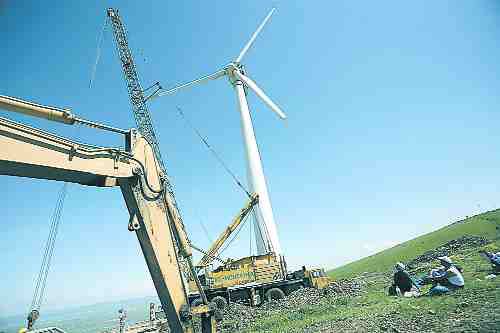 The clean-power industry is booming and B.C. is a world leader. Photograph by: Reuters, The Province |
IPPs are private power companies that compete to sell energy to B.C. Hydro. Of 48 IPPs currently operating in the province, most are run-of-river. In the future, wind, solar, geothermal and ocean power are expected to join the IPP mix.
Rather than using the giant river dam/reservoirs traditionally used for power generation, run-of-river technology diverts water with smaller blockages, channeling it through pipes, usually over several kilometres, with steep vertical drops. Rushing water shoots through energy-capture turbines before re-entering the river.
Proponents say these "micro-dam" operations reduce environmental impact -- critical to a provincial Liberal government that has called for more and cleaner power in a push to make the province energy self-sufficient by 2016, while also meeting aggressive targets for greenhouse-gas emission reduction.
The Independent Power Producers Association of B.C. (IPPBC) says it now has 320 member companies, up from 22 in May 2001.
There are currently 580 water-licence applications for rivers across the province by IPPs.
The IPPBC says B.C. Hydro has identified 900 small hydro sites for potential development.
IPPs supply power to 500,000 homes in B.C., contributing about 10 per cent of B.C.'s total system capacity, IPPBC says.
B.C. political parties are starkly divided on IPPs, with the NDP calling for a moratorium on run-of-river operations and the Liberals pushing for increased use.
IPPBC head Steve Davis says that within 10 years the B.C. IPP industry could rival provincial resource giants like forestry or mining for market size.
IPP critics say the projects are not as green as some claim, as wilderness is despoiled and wildlife destroyed with construction of service roads, power lines and water pipes.
NDPers charge IPP promotion is a government ploy to privatize B.C. Hydro. But the Liberals say increased competition from IPPs will keep energy costs down and that environmental assessment standards ensure only the best projects move forward.
Dr. John Nyboer, a Simon Fraser University energy expert, says that as governments around the world face climate change and scarcity of fossil fuels, the "rate of investment in alternative energy is skyrocketing. The last few years in B.C., it's been booming."
But any method of energy production, including run-of-river, has tradeoffs and "pros and cons on all environmental sides," Nyboer says.
© Copyright (c) The Province
Political and industry insiders are jumping ship to IPPs
By Sam Cooper
The Province
June 7, 2009
B.C. Liberals, Hydro personnel head up independent firms
Are B.C. Liberals and independent power producers too cozy? Consider these facts and figures.
Since Gordon Campbell took power in 2001, IPPs have given his party at least $850,000.
That figure is sure to shoot to more than $1 million when donation records for the May 2009 election are released, says NDP environment critic Shane Simpson.
The Independent Power Producers Association of B.C. says membership jumped from about 20 companies in 2001 to 320 in 2009.
And as the number of IPPs and lucrative B.C. Hydro "energy-purchase agreement" contracts mounts under Campbell's watch, boardroom and staff lists of B.C.'s biggest IPPs increasingly resemble alumni associations of B.C. Liberal and B.C. Hydro grads.
No company has scooped more Liberal insiders than Plutonic Power Corporation, a B.C. run-of-river upstart now partnered with U.S. giant General Electric.
Here are some of the company's executive B.C. Liberal grads: Tom Syer (former deputy chief of staff to Premier Gordon Campbell), Dave Cyr (former aide to Mike de Jong, then Liberal minister of aboriginal relations), Bill Irwin, (former ministry of tourism staffer) and Robert Poore (former executive assistant to then-revenue minister Rick Thorpe).
Plutonic Power Corporation has donated $99,781 to the B.C. Liberals since 2006, including 2009 donations released to The Province by spokesperson Elisha McCallum.
Individuals from Plutonic have also made donations, with CEO Donald McInnes handing at least $30,000 to the Liberals since 2001.
But hefty donations and legions of former Liberals don't equal government favouritism for Plutonic, McCallum says.
"Our CEO had the vision to find the people with the best skills," McCallum says.
"There is no preferential treatment provided to us. The insinuation that there is some conspiracy theory is ridiculous."
Other insiders who've assumed leadership in the IPP world are: Geoff Plant (former attorney-general, now chair of Renaissance Power); Naikun Wind CEO Paul Taylor (former CEO of ICBC and a deputy finance minister); Stephen Kukucha, president and CEO of Atla Energy (former senior policy adviser for the ministry of environment); Bruce Young (former B.C. Liberal campaign manager, now a director of Atla Energy); Bob Herath (former ministry of the environment staffer now with Syntaris Power); and Alexander Kiess (former project supervisor with B.C. Hydro, now consulting as a project supervisor for Syntaris Power).
In a Province interview, Blair Lekstrom, minister of energy, was asked whether the exodus of Liberal insiders to IPPs might suggest undue influence by the industry.
"I'd take great offence if someone suggested that," he said. "I'm not influenced because of who someone is or where they used to work."
IPPBC head Steve Davis also brushed aside suggestions the government is too cozy with IPPs.
"The protections for the public are huge and already in place," he said.
"Every single [EPA] contract must be reviewed by the B.C. Utilities Commission."
© Copyright (c) The Province
Private power industry is booming in B.C., but is that a good thing?
By Sam Cooper
The Province
June 7, 2009
Stock prices are soaring, but some say run-of-river hydro isn't clean
 Plutonic Power Corporation's Toba Valley project gets under way. Plutonic's run-of-river project near Bute Inlet has environmentalists screaming about 'pristine wilderness' being despoiled and 17 streams and rivers being muddied. Photograph by: Jason Payne, The Province, file, The Province |
Gordon Campbell wasn't kidding when he warned that the future of B.C. was at stake in the last election -- or at least its energy future.
The fate of a booming clean-energy industry worth up to $14-billion hung in the balance as taxpayers headed to the polls May 12.
So did the fate of B.C. Hydro. And the power bills almost everyone pays each month.
During the campaign, the NDP had promised to slap a moratorium on private-sector run-of-river power companies if they won.
A Liberal win would mean full-steam ahead for companies like Plutonic Power Corporation, purveyors of a controversial $4-billion, 1,027-megawatt proposal on the Bute Inlet north of Powell River that has environmentalists screaming about "pristine wilderness" being despoiled and 17 streams and rivers being muddied.
With Gordon Campbell's Liberal victory, Plutonic stock exploded for a 21-per-cent gain on the post-election morning of May 13, reaching market capitalization of about $170 million. Company shares had surged from a low of $2.08 on May 1 to a high of $3.81.
One Plutonic shareholder on the investor website Stockhouse.com summed the action up like this: "Good to see BC stays Liberal, dam tree hugging Ndp'ers are bad for business . . . lol." So were they popping champagne corks at Plutonic's Vancouver headquarters on May 13 as company stock rocked? "No," spokesperson Elisha McCallum says flatly.
McCallum is one of a number of ex-B.C. Hydro employees and former high-level Liberal party staffers now working for Plutonic.
"We were hopeful [for a Liberal win] and very supportive of the party," she acknowledged last week. "There was a sense of relief the day after the election." That relief was shared by the entire industry, says Steve Davis, head of the Independent Power Producers Association of B.C., which represents 320 IPPs.
With the Liberal win and a pending B.C. Hydro energy-acquisition plan due in July, there was a potential for $5 billion in direct IPP investment -- on top of $5 billion for existing projects and further billions in indirect investment, Davis told The Province.
NDP energy critic John Horgan says the biggest election victory May 12 didn't go to Gordon Campbell, star rookie Liberal MLA Kash Heed or even upset Independent winner Vicki Huntington.
"It [went to] Plutonic," Horgan said. "Now they're set to go into Bute Inlet and do a $4 billion project that will lead to billions in revenue -- and all for stakeholders and Liberal insiders."
Project critics like the Raincoast Conservation Society's Chris Genovali say that with cumulative damage, the Bute proposal could be as intrusive as a giant dam.
But as McCallum and industry supporters point out, environmentalists don't all oppose the projects. Some prominent voices, such as Tzeporah Berman of PowerUP Canada, have come out in support of IPP projects as a valuable expansion in renewable power.
Still, NDP environment critic Shane Simpson insists the Liberal IPP push is unleashing "a gold-rush mentality."
"There is phenomenal wealth to be made and the provincial government is prepared to set aside the environment," Simpson says.
Dr. John Nyboer, a Simon Fraser University renewable-energy and climate-change expert, says he wouldn't label B.C.'s sprouting IPP industry an "exorbitant" gold rush -- but he notes that as in any gold rush, anyone can try to hop aboard the IPP gravy train.
"It's hard to keep track of how many IPPs there are in B.C.," Nyboer says. "You can put a single solar-power cell on the roof and register [as an IPP]."
Nyboer says investment in renewable energy has skyrocketed in the last 10 years, and especially since 2006 in B.C.
But alternative-energy sources cost more to develop than traditional sources, so hydro ratepayers pay tariffs to "level the playing field."
Nyboer points to Germany, a world leader in IPP development that also tops Europe for electricity prices. "Going renewable is an investment," he says. "It may serve Germany well, depending on what you see happening with tomorrow's energy supply."
In other words, if world governments unify for tough carbon-emission restrictions, renewable energy leaders like Germany and B.C. could corner power markets.
But with the current global economic slump, B.C.'s government may have locked 20- to 40-year IPP energy purchase agreements (EPAs) in too high, says Horgan.
"B.C. Hydro recognizes the industrial load is going in the toilet," he says. "Every time a mill closes, energy demand decreases."
Horgan says B.C. ratepayers are already on the hook for about $30 billion in "unfunded liabilities" in EPAs.
In the worst-case scenario, B.C. Hydro will "be forced" to buy too much electricity from IPPs at premiums of up to $125 a megawatt, when they can produce it for $50 a megawatt. Demand will continue to decrease and power will be dumped to the U.S. for $50 or less a megawatt.
"Why buy high and sell low?" Horgan says. "If the trend line continues, the costs to ratepayers will be enormous."
B.C. Hydro could even go under, he warns.
"The shareholders in these IPP companies will be rubbing their hands together -- and people with electric heat are going to be rubbing their hands to stay warm, because they won't be able to heat their homes."
Blair Lekstrom, B.C.'s Minister of Energy and Mines, disputes the NDP's numbers. He says he believes the existing IPP contract commitment for B.C. ratepayers is about $21 billion.
But he admits that number could jump to as much as $60 billion with B.C. Hydro decisions due this summer.
E-mail reporter Sam Cooper at scooper@theprovince.com
© Copyright (c) The Province
June 03, 2009
Propaganda pipeline
Gordon Hoekstra
Prince George Citizen
Friday, 29 May 2009
 Propaganda pipeline - The Stewart River near Fort St James, close to where the Enbridge Pipeline will cross the river, is shown in this file photo. (Citizen file photo by Brent Braaten) |
Enbridge is footing the bill for a northern advocacy group to generate community support for its proposed $4.5-billion project The recently-formed Northern Gateway Alliance which is advocating support for Enbridge's $4.5 billion pipeline through northern B.C. is the brainchild of Enbridge and is being bankrolled by the company, The Citizen has learned.
The Alliance was rolled out earlier this month during the North Central Municipal Association's annual convention as a community coalition in support of the Enbridge project. It has also been billed as a "grassroots" group designed to create a voice for the North. Community leaders who have signed on include Prince George mayor Dan Rogers, Mackenzie mayor Stephanie Killam and Kitimat mayor Joanne Monaghan.
The recent announcement made no mention of Calgary-based Enbridge's involvement.
But it is not the communities that are paying the bills, setting up the website or organizing the group's activities. It is Enbridge.
In fact, the chair of the Northern Gateway Alliance, former Prince George mayor Colin Kinsley, is on Enbridge's payroll.
Neither Enbridge nor Kinsley deny that Enbridge is bankrolling the Alliance, and that the community group was the company's idea.
"It's what Enbridge engaged me to do," says Kinsley.
But the North American pipeline giant denies they are engaging in "astroturfing" -- a term that describes companies that fund or create seemingly grassroots organizations to give their cause legitimacy.
Enbridge spokesperson Steve Greenaway said that characterization is unfair. "I'm not willing to accept that we are somehow trying to do this from the top down. We have gone to community after community after community to explain the details of our project and we will continue to do that," he said.
Asked if the company was being dishonest in spearheading the creation of a so-called grassroots organization, Greenaway said no.
"I don't think it's fair to say that we're putting words in anyone's mouth. Those people are coming forward voluntarily and allowing, you know, allowing, quotes to be placed on our website," said Greenaway. (The quotes from mayors like Rogers and Killam are posted on the Alliance website).
"I think it's important that all voices are heard in this debate, and I think in terms of, you know, support we have provided through compensating a chair who is going to assemble a board of community leaders across the pipeline, to characterize compensating him for part-time work, as somehow, is anything untoward about that, is unfair," said Greenaway.
He would not say how much Enbridge is spending on the creation and support of the Alliance, but did acknowledge that Kinsley was being paid by the company, which was also offering administrative support to the Alliance effort.
Kinsley acknowledges it could be argued the Alliance is not a grassroots organization if Enbridge has hired him to create it, but said that somebody has to lead it. "It's a great deal of work, and an immense amount of travel."
Kinsley also argues that the intent of the Alliance is to support the pipeline project proceeding to the regulatory review where questions can be asked by northerners. (Only once has the National Energy Board, one of the project's reviewing agencies, rejected a major project, the Sumas 2 energy plant near the B.C.-Washington border).
"We want to make sure this thing isn't stopped in its tracks," says Kinsley. But the former mayor's enthusiasm for the project is hard to hide.
He defends the merits of the project by rolling out stock Enbridge arguments, pointing to a focused economic regional impact, lauding a trust Enbridge plans to create for community projects, maintaining there is no oil tanker moratorium on the coast off Kitimat and calling the federal government review process robust. "It's probably the most sophisticated approach to a major project such as this, that's ever been undertaken," he says.
Kinsley makes a similar pitch on the Alliance's website.
"This will be an outstanding project and it will have economic benefits that are untold for northern B.C. and Alberta, for both aboriginal and non-aboriginal communities," he says in a short video on the site.
Kinsley plans to take this message to Rotary Clubs, chambers of commerce, town councils and regional districts, as well as construction and contractor associations. Also in the works is an educational package targeted at school children.
He's also encouraging supporters to sign up on the Alliance's website.
So far, under 200 supporters have signed up.
Even a casual inspection of the Alliance and the Enbridge Northern Gateway Pipeline's websites show startling similarities.


The design of both websites is similar, including the type faces, the muted green colour scheme and the positive messages on the project.
Identical messages cycling on both sites proclaim: Enbridge is a Canadian company that has been safely building, operating and maintaining pipelines for 55 years; Thousands of direct and indirect jobs will be created to support the construction and operation of the Northern Gateway pipeline, benefiting workers in northern B.C. and Alberta.
There are about 20 messages.
The logos on both sites are also very similar with an identical stylized green leaf. There's also a direct link from the Alliance website to the Northern Gateway Pipeline website.
There's little doubt that Enbridge's effort to create the alliance is aimed directly at environmental groups who do not support the project.
Kinsley argues that environmental groups are not local groups and are funded by U.S. foundations. Greenaway offers a similar argument.
An environmental group that is based in the North, the Terrace-based North West Watch, is dismayed by Enbridge's recent tactics in creating the alliance. North West Watch representative Julia Hill noted she just recently learned of the term "astroturfing" to describe this type of activity.
According to SourceWatch, a project of the Madison, Wisc.-based Center for Media and Democracy, "astroturfing" refers to apparently grassroots-based citizen groups or coalitions that are primarily conceived, created and/or funded by corporations, industry trade associations, political interests or public relations firms.
Texas Sen. Lloyd Bentsen, a longtime Washington and Wall Street insider, is credited with coining the term.
There are numerous examples of the practice in the U.S. including its use to block health-care reform and to oppose restrictions on smoking in public places.
Closer to home, the B.C. Forestry Alliance was created as a citizens' group in the early '90s to improve the image of the forest sector, where it faced criticism from environmental groups on logging in the southwest of B.C. The group was funded by the forest industry whose members also sat on its board.
North West Watch recently applauded Terrace mayor Dave Pernarowski for pulling out of the Northern Gateway Alliance. Pernarowski had objected to the wording on the alliance's site that indicated unqualified support for the pipeline project.
North West Watch and Friends of Wild Salmon are calling for an independent public inquiry into the pipeline project similar to one held in the late '70s.
Carrier Sekani Tribal Council chief David Luggi is not surprised by Enbridge's tactics. "I think Enbridge is using (Kinsley) as a pivotal PR point," observed Luggi. "It's a PR (public relations) machine firing up on all cylinders."
The Carrier Sekani Tribal Council has been calling for a separate government-funded, First Nations-led review process to assess major projects in their traditional territory.
In 2006, First Nations, which included the tribal council, had requested $2.4 million from the federal government to spearhead their own review of Enbridge's proposed pipeline. Later that year, the tribal council filed a federal court challenge of the federal government's decision to send Enbridge's proposed pipeline to a review panel. The tribal council wanted the court to overturn the creation of the panel because they said they were not consulted.
Rogers, the Prince George mayor, who has signed up with the alliance, says he is under no illusion that the group is a creation of Enbridge.
"I think that everyone understands that is participating is that it's being driven by Enbridge. No surprises there," says Rogers. "It's PR strategy."
Nevertheless, Rogers is comfortable being associated with the alliance, saying Enbridge is looking at signing up those that believe there may be benefits because there will be those that are adamantly opposed.
Rogers says he is supportive of the project moving to the review stage.
"I'm not afraid as the mayor of B.C.'s northern capitol to reiterate, as the largest centre in the northern region, there are some economic benefits that could flow to our community," he said. "We want a stake in those discussions and to participate in those discussion as it unfolds."
Rogers said the city has not put any money into the alliance.
Project information
- The 1,170-kilometre pipeline is proposed to carry oil from the Alberta oil sands to Kitimat where it will be exported to regions like Asia and California. A twin pipeline will carry condensate, an oil thinner, back to the Alberta. The thrust behind the project is to create an offshore export outlet for oil produced from the Alberta tar sands which normally flow south to the interior of the United States.
- The project was shelved in late 2006, but was put back on the front burner in 2008 this year when Enbridge secured $100 million from western oil producers and key Asian refiners to get the project through a joint regulatory process with the National Energy Board and the Canadian Environmental Assessment Agency.
- The environmental assessment process could take two years or more to complete.
- Key issues in the complex project -- described as the largest crude-oil pipeline expansion in North America -- include mountainous terrain, hundreds of river crossings and a tanker terminal at Kitimat.
- Thousands of workers will be needed during the two-and-a-half years of construction, but relatively few when complete. Probably about 50 workers in Kitimat and a handful of workers along the route in a few communities.
Tar sands and coast focus of forums
Kitimat Sentinel
June 03, 2009
Oil sands and the risk to BC’s coastline was the topic for two-authors at the end of a five-day tour of BC’s northwest.
In a series called “A story with two ends”, Ian McAllister, author of The Great Bear Rainforest and most recently The Last Wild Wolves of the Great Bear Rainforest, together with business journalist Andrew Nikiforuk, who authored Tar Sands: Dirty Oil and the Future of a Continent, presented a packed room at the Rod and Gun Club with what pipeline development will mean not only for the local ecosystems but also for the nation-at-large.
Approximately 100 people attended the forum on Friday evening.
“I’m not here to tell people whether to be for or against the Enbridge pipeline,” Nikiforuk told the Sentinel. “But this is no ordinary pipeline. It’s connected to the world’s largest energy project.”
Enbridge is proposing to construct a twin-pipeline from Alberta, just north of Edmonton, to Kitimat. A 36-inch pipeline will export bitumen to a marine terminal proposed to be built in Kitimat while a 20-inch pipeline will send condensate east.
Condensate is a diluent which makes piping the petroleum easier.
Nikiforuk said his involvement in the tour was to provide the “big picture” of tar sands.
Through previous forums he said he found that some people are shocked at the scale of tar sands development and most people don’t realize that Canada is the number one supplier of oil to the United States.
Opening up markets for the bitumen overseas presents some problems for job creation, he explained. He estimated that for every 400,000 barrels of oil a day that Canada exports, the country is also exporting 18,000 jobs.
“Rather than upgrading and refining the bitumen in Alberta we would be putting it in a pipeline and shipping it off for upgrading and refining either in Asia or southern California,” he said.
No public policy currently exists for adding value to bitumen here in Canada.
“We’ve got this new export staple and we’re repeating the same mistakes we made in the lumber industry,” he continued. “We’ll just export all these raw logs, we won’t bother adding any value.”
He said that tar sands shouldn’t even be developed until a Plan B is in place for investing in renewable energy.
“We should have had a plan b in place long before people started pointing fingers.” “You don’t invest $200 billion into the development of bitumen without having at least a $100 billion investment in renewable, climate change action and fossil fuel reduction in the country.”
According to Nikiforuk, if Canada is still on the tar sands resource in 30 years time “we’re going to fail as a civilization.”
National policy and sands development aside, the coastline of BC has much to lose from the arrival of a pipeline and the increase in tanker traffic, says McAllister.
He said he has seen the area where the Exxon Valdez tanker spilled its oil and said there was far more room there than there is on the outskirts of the Douglas Channel.
He also said that models have shown that if a tanker spilled that within 30 days, depending on the season, oil will spread up to Prince Rupert, over to Haida Gwaii and down to Bella Bella.
It isn’t the Douglas Channel that poses the risk, however, it’s the network of islands outside it.
“The Douglas Channel is not a problem,” said McAllister. “If you’re awake you’re probably going to be okay in the Douglas Channel.”
It’s outlying islands like Gil Island where trouble can begin.
And if it was only a few tankers a year and you could choose your schedule it wouldn’t be so bad but sending a tanker through the area in the winter, with hurricane force winds, could be disastrous.
But oil isn’t the only thing to be concerned about, he said.
The acoustic environment in the Douglas Channel is one of the quietest in BC and an increase in traffic would put that in jeopardy.
“When you’re looking at endangered species or threatened species, or recovering species (such as blue whales, etcetera), this would be considered one of the best habitats because it’s still quiet,” he said.
In Prince Rupert and Puget Sound there have been disturbances on whale’s ability to communicate, which has been attributed to shipping traffic.
“I think that the way this process has been going that Enbridge in particular has not really considered the true cost of introducing oil tankers for the first time to the inshore waters of the inside passage,” he said.
He also said that sending the bitumen to be refined in Asia, the pollution that is created is entering the food web and coming back to BC.
Nikiforuk said there is certainly a risk of spill from the pipeline itself and pointed some incidents over the past ten years at Enbridge pipelines, including spills in Wisconsin and Minnesota.
He said pipeline breaches could happen for a number of reasons including corrosion or poor welding.
He also said there is a tendency to put multiple pipelines where one goes.
“If [a community had] known that one pipeline would lead to six or seven they would never have said yes to the first one.”
Nikiforuk also worried against government level changes to Canada due to the influx of money from oil.
“When you have a lot of oil money, it starts to bend any government out of shape,” he said.
He said when there’s easy money taxes get cut, but then government’s begin spending too much and that, in turn, leads to secrecy.
As it is he said there is no fiscal responsibility for tar sands and Canada has been criticized for not having a sovereign fund to have money available for future generations.
Kitimat was the pair’s final stop after meetings in Prince George, Burns Lake, Smithers and Terrace. It was presented by Forest Ethics, Friends of Wild Salmon and the Pembina Institute.
June 02, 2009
KOGAS signs MOU with Kitimat LNG
News Release
Kitimat LNG
June 1, 2009
World’s largest LNG importer agrees to purchase 40% of production from Canadian LNG terminal for a 20-year period
CALGARY, June 1, 2009 – Kitimat LNG Inc. announced today that it has signed a memorandum of understanding (MOU) with Korea Gas Corporation (KOGAS), under which KOGAS will acquire up to 40 per cent of Kitimat LNG’s production and an option to acquire an equity stake in Kitimat LNG’s liquefied natural gas (LNG) export terminal.
With the MOU, KOGAS, the world’s largest LNG importer, plans to purchase two million tons per annum (mtpa) of LNG from the proposed terminal for 20 years. The total purchase value would be more than US$20 billion over 20 years of operation.
“We welcome KOGAS’s participation in our project,” said Rosemary Boulton, President of Kitimat LNG. “The addition of a strong international company and leading LNG buyer such as KOGAS marks a significant milestone in the development of the Kitimat LNG terminal.”
“Our agreement with Kitimat LNG is key to our ongoing efforts to ensure a secure supply of natural gas for Korea in the long-term,” said Kangsoo Choo, CEO of KOGAS. “We are pleased to add natural gas from Canada to our portfolio and tap into the country’s growing sources of supply.”
Kitimat LNG is progressing with discussions with other potential terminal users and investors for terminal capacity, off-take from the terminal and equity in the 5.0 mtpa project in Kitimat, B.C.
“KOGAS’s involvement reinforces that our project is supported by strong business fundamentals and trends in the global and Western Canadian natural gas markets,” added Boulton. “We look forward to working with KOGAS in moving the LNG terminal ahead and providing the economic benefits associated with the project to Canada and Korea.”
-30-
Contacts:
Ian Noble, Karyo Edelman (on behalf of Kitimat LNG): 604-623-3007 (office), 604-809-9650 (cell)
About Kitimat LNG Terminal– Kitimat LNG Terminal is a project of Kitimat LNG Inc. (www.kitimatlng.com), a Calgary-based private company focused on the development of liquefied natural gas (LNG) and related facilities in North America. Kitimat LNG Terminal is proposing to construct, own and operate a liquefied natural gas terminal near the Port of Kitimat in British Columbia. The facility will receive natural gas via pipeline from Western Canada. At the terminal, the natural gas will be cooled and liquefied in preparation for export via ship to growing Asian markets.
About Korea Gas Corporation
Korea Gas Corporation (www.kogas.or.kr) was incorporated by the Korean government in 1983. Since its founding, it has grown to become the world's largest LNG importer. As the nation's sole LNG provider, the Corporation is fully committed to providing clean, safe and convenient energy to the people of Korea. In keeping with this mission, KOGAS operates three LNG terminals and a nationwide pipeline network spanning over 27,200km in order to ensure stable supply for the nation. KOGAS currently imports 26 million tons of LNG per year.