December 23, 2009
Premier's climate-change hypocrisy could doom first nation's way of life
By Chief Kathie Dickie, Vancouver Sun, December 22, 2009
Allowing major plant to avoid building a carbon capture storage facility should not be an option
We are the Fort Nelson First Nation. We have just under 800 members comprising 14 major families. You may not have heard of us, or have yet to visit the far northeastern corner of the province that is our home, but we're here. And right now, we're trying to reconcile the Premier's words on preventing climate change and advancing first nations with his performance in our backyard.
Calgary-based EnCana Corporation, Canada's largest gas producer, along with a consortium of seven other oil companies, is planning to build the biggest gas processing plant in North America in the heart of our 1910 treaty territory. The Cabin Gas Plant, with its related infrastructure and pipelines, is a multi-billion-dollar project designed to open up B.C.'s Horn River Basin to shale gas development.
Like your community -- like any community -- we'd welcome the jobs, economic opportunities, and tax revenues such a development would deliver to the province. But, like any community, we have concerns.
The B.C. Environmental Assessment Office has declared the Cabin Gas Plant will have significant adverse environmental effects. The last time such a declaration was made -- the Kemess North mine -- the project did not receive an environmental assessment certificate. The risks of significant adverse environmental, social and cultural effects outweighed the project's economic and social benefits. It is our hope that a similar common-sense ruling will apply to the proposed Cabin Gas Plant.
Indeed, the Cabin Gas Plant is expected to be the largest point source emitter of greenhouse gasses in B.C. EnCana anticipates that the gas plant will emit 2.2 million tonnes of CO2 annually, the equivalent of adding 450,000 cars to B.C.'s roads each year. In all, the Cabin Gas Plant will increase B.C.'s annual greenhouse gas emissions by 3.3 per cent.
We support the idea of a plant. And we believe in action on climate change.
EnCana's initial proposal of a carbon capture storage system for the plant has now been dropped as too expensive. Meanwhile, 15 kilometres away from the proposed plant, Spectra Energy has proposed a similar, smaller, gas plant. Unlike EnCana, Spectra remains committed to carbon capture storage in the Fort Nelson area. The Fort Nelson First Nation cannot support the installation of a massive gas plant without a carbon capture storage facility.
We've been told many things by the B. C government as we've tried to participate in the environmental assessment process. One official said that because our 100-year-old treaty doesn't specifically address clean air, we have no say on clean air when it comes to the construction of the biggest greenhouse gas creator in B.C. Imagine being told by a government official in 2009 that you have no say on the quality of air you or your children breathe! What parent would stand for it?
We are Dene, and our traditions and customs and practices have revolved around moose, fur-bearers and freshwater fish since time immemorial. Most of our families still practice traditional lifestyles -- hunting, trapping, harvesting, and fishing -- living off the land year round. Every September, community bonds are renewed through the fall moose hunt, with its traditions and practices that remind us of our shared heritage.
All this will be lost -- cut to pieces -- by the plant site and the vast development that it will bring to the Horn River Basin which is already seeing roads, pipelines, and drill sites destroying habitat, game trails, and trap lines in the last and best land in our territory
We understand the value to the province of shale gas development in the Horn River Basin. But such economic development, whether for our community or yours, should not come at the expense of a gutting of the land, water, and air where a community lives. We are the only Treaty 8 Nation that lives within the Horn River Basin, and this gas plant, designed to open the basin to drilling, pipelines and gas development, will have an immense effect on our rights and interests. Without the capacity to determine and plan for this development, the survival of the Fort Nelson First Nation is in jeopardy. This plant and the development that it brings must not mean the end of us.
It is a proud moment for us all when the premier declares his passion for carbon reduction and aboriginal rights. But if he's saying that while he's railroading a first nation in order to construct a massive greenhouse gas emitter, that's worse than hypocrisy. It's a reminder that in all these decades, nothing has changed -- that protecting the environment and working with first nations are to be done only when it's convenient for the B.C. government.
What we seek is eh'thee oh t'deh. That's Dene for "balance: it is even." Here in our part of this province, that means working together so that those who live off the land can continue to do so and those who want to pursue family-supporting jobs in the sensible development of shale gas production can do so as well.
We live in a place where winter arrives in October and doesn't leave until April, and where clean air and fresh water are among our few tangible assets. And we are a community in B.C. We believe that, like any community in B.C., we deserve the opportunity to try and seek a balance for our community.
We believe that when a large industrial complex and infrastructure are proposed for a community in B.C., the community deserves the right to try and plan for it in a way that advances the community interest, not destroys it. And we believe that a government that champions certain values in front of the world should not be engaged in actively working to destroy these same values at home.
Like your community, though, we are not uniform in our outlook. Like your community, we are made up of those who want to pursue traditional ways and those who want the opportunity to pursue different economic goals. Achieving balance between the traditional and the new development will test us all. We are only one generation out of the residential schools and, as in any community, the old and the new do not always sit easily together.
Ignoring us or excluding us because the reality of our existence is an inconvenient truth to bureaucrats or the Premier is not an alternative for this or any first nation. We should be participating fully in the effort to achieve balance.
The path to balance can start with something as simple as a demonstration of respect. Other times, it takes the courts. We hope the B.C. premier, who holds the honour of the Crown and our community in his hands, chooses respect.
Kathie Dickie is the chief of the Fort Nelson First Nation.
© Copyright (c) The Vancouver Sun
December 22, 2009
B.C. only province with rising greenhouse gases
CBC News
Monday, December 21, 2009
British Columbia was the only province in the country to report an increase in greenhouse gas emissions from major industries in 2008, according to figures released by Environment Canada.
The figures cover so-called "facility greenhouse gas emissions" from power plants and heavy industries such as mining, pulp and paper, and petroleum.
British Columbia's dubious distinction was largely the result of oil and gas extraction, Environment Canada said.
The current boom in exploration for shale gas, which has a higher CO2 content, is likely to have played a significant role, energy policy consultant Chris Bataille said.
"On a year-by-year basis I wouldn't want to put too much weight on it," he said, "although in the long run we can probably expect emissions to increase from natural-gas extraction in B.C.'s northeast."
Last week B.C. Premier Gordon Campbell was honoured in Copenhagen for introducing a provincial carbon tax.
But critics such as George Heyman of the Sierra Club say the honour is tainted because the B.C. government continues to offer tax breaks to the petroleum industry.
"This is one of the disturbing contradictions in the Campbell Liberals' climate-change policy," he said. "They've introduced targets, they've introduced a carbon tax — and yet we're actually going in the wrong direction."
But even with last year's poor result, B.C. still ranks far below Alberta in such facility emissions. In 2008, its heavy industries emitted eight times as much greenhouse gas as B.C., Environment Canada figures show.
December 20, 2009
Ingmar Lee's Statement
Ingmar Lee
December 20, 2009
Today I climbed the 200ft flagpole on the front lawn of the BC legislature:

Victoria's tallest fire-ladder fully extended |
Here is the banner I hung:
 |
I climbed the flagpole because I'm unhappily ashamed to be a 'Canadian.' Although I've never trended much towards any nationalist or patriotic proclivity, I'll admit to a slight twinge of pride of nation was when a former Prime Minister, in spite of overwhelming pressure, said 'fuck you' to GWB when he wanted Canada to join in with his attack, invasion, occupation, torture, rape and massacre of Iraq. But given our current Prime Minister, Stephen Harper's recent cowardly, grudging and sneering performance at Copenhagen, I'm utterly embarrassed to be a member of this country. And to make matters worse, the drunken Premier of British Columbia, Gordon Campbell joined Harper in Denmark to offer his 'support.' And to make matters even worse, Tzeporah Berman, CEO of ForestEthics Canada, which purports to work to protect BC forests and on other environmental issues, followed Campbell to Copenhagen to issue him an award for "Climate Leadership."
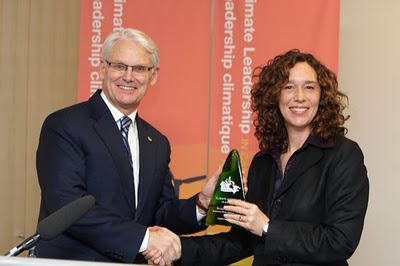 Gordon Campbell and Tzeporah Berman at Copenhagen |
After nearly a decade of Gordon Campbell at the helm, the British Columbia environment has taken a horrific corporate shit-kicking. With our institutionally corrupt and gerrymandered excuse for democracy, and with giant transnational logging corporation's as his principal campaign financiers, Campbell has won successive majority governments by garnering on average, about 30% of the vote. And it is truly an embarrassment how cheap these corporations have been able to buy themselves a British Columbia government. The predictable result is that Campbell has presided over an unprecedented level of destruction in our forests. His very first act of government back in 2001 was to abolish the Ministry of Environment. Next, he immediately reinstated the Grizzly bear trophy hunt. His government oversaw a culling of Golden eagles, which they scapegoated for the logging-caused extinction of the Vancouver Island marmot. As Canada's 'Most Endangered Species' these marmots only survive in captive breeding laboratories now. Campbell gutted the provinces Forest Practices Code, and then attempted to privatize the public forests of BC, which comprise more than 90% of the provinces land mass.
Campbell is responsible for a massive proliferation of fish-farming on the Pacific coast which has resulted in an epidemic of sea lice which has infected and is killing off our wild salmon. He has expanded the development of oil and gas, even pushing for oil and gas development in the clear Pacific waters and no mining application has crossed his desk that he couldn't approve. Currently, he's plowing enormous new highway infrastructure through the Burns Bog and is champing at the bit to allow giant American energy corporations to install "Run of River" power infrastructure in what remains of the provinces final intact watersheds. The list of Gordon Campbell's voracious attacks on the British Columbia environment are far too many to cover in this essay, but his most egregious scheme of all is just now getting off the ground.
Premier Campbell is the lead proponent and champion of the proposed "Enbridge Nothern Gateway Pipeline" which is slated to deliver 'dirty oil' from the notorious Alberta Tar Sands, to the BC Central Coast. This 1100 km, 1 metre diametre pipeline will send half of Tar Sands daily production sluicing across our province, to be loaded onto more than 300 VLCC's, -Very Large Crude Carriers- every year. This will result in a veritable super-tanker traffic jam in the narrow fiords and amongst the rock-pile that is BC's Pacific coast and will guarantee horrific Exxon Valdez-scale oil disasters. A single accident will immediately destroy Campbell's only, albeit seriously greenwashed example of a semblance of wilderness conservation. This year, after a decade of secret, exclusive negotiations with several select environmental collaborators, Campbell announced, onstage with his ForestEthics collaborators, that he had reached an agreement to "protect" just 30% of a tract of relatively contiguous primaeval wilderness known as the 'Great Bear Rainforest.' The other 70% has been handed over to voracious logging corporations.
I've been focussing my efforts on battling the Gordon Campbell Pipeline for several years now, even as the US-based Enbridge Pipeline corporations PR machinations proceed apace across the province. Currently, the significant majority opposition to the pipeline is disorganized, and several so-called environmental organizations, including ForestEthics, are positioning themselves to lead the fight. These due-process oriented, charitable status-quarding organizations have already established themselves as collaborators with the Neocon Campbell government, and Campbell has now ensconced them, including Berman on a new "Green Energy Task Force." This task force has been set up to persuade the people of BC to allow wild rivers to be developed en masse by private American corporations for the purpose of providing "Green" power to the insatiable American market. Initially the ROR campaign, spearheaded by Campbell, and greenwashed by Berman, and bewilderingly, by Dr Andrew Weaver, -a noted BC climatologist who shared the IPCC Nobel Prize and who stumped blatantly for Campbell during this years election after his University of Victoria department received $94 million in funding from the Campbell regime- insulted the BC environmental community by equating anyone who questioned the private development of BC's wild rivers as being ignorant climate-change deniers. Now, in the new Campbell-appointed Task Force, they are trying a kinder, gentler approach.
The once-powerful and united BC Environmental Movement has been divided into an unbridgeable schism, -between Grass-roots activists who stand in the way of business as usual, (BAU) and well-funded environmental bureaucracies who work according to BAU. These BAU organizations, with ForestEthics as the worst example, have become shameless greenwashers of the BC government and the darlings of the corporate media.
When Tzeporah Berman wormed her way through 100,000 awakened climate-change activists whose favoured slogan was "System Change, Not Climate Change to present her award to one of the very worst climate-change troglodytes on the planet, she utterly forfeited any remaining credibility she and the Canadian branch of ForestEthics may have had as an environmental activists. This was the final straw that drove me up the flagpole. It is of paramount importance to the world that all the stops must be pulled out to shut down the planet-killing Alberta Tar Sands mega-project. It is a black/white issue that cannot be compromised. It is essential that the people of the world understand that the Premier of BC is busily forwarding and facilitating that horrific blight on the planet, and people must understand the greenwashing that is greasing its wheels. It must be shouted out loud and clear.
Today, I have once again been charged with "mischief endangering life" a charge which could garner a lifetime prison sentence. This is the same charge I am already facing for another act of non-violent civil-disobedience which I committed earlier this year. I'm told it will cost me $50,000 to conduct a credible legal defence, -which of course, I could never afford. I have also been told that I do not qualify for legal aid, on account that I have no record of my recent employment history, which is basically odd jobs for cash. I live in BC's vast underground economy, largely because I believe that it is unethical to pay taxes to Gordon Campbell and Stephen Harper. I believe that I serve my community with my environmental work instead, and even if there had been a paper trail, my income is so far below the poverty line that I'd be exempt anyway. I do not expect justice before the Gordon Campbell kangaroo court, and I guess, for people like me, jail time is a rite of passage.
By email.
Oil pipeline to Kitimat prompts flagpole climb
CHEK News, 20-Dec-2009

Louise Dickson
Times Colonist
Sunday, December 20, 2009
Environmental protester Ingmar Lee was arrested by Victoria police yesterday morning after scaling the flagpole at the B.C. legislature in full climbing gear.
Firefighters, police and ambulance were on the scene as Lee, who is known for his tree sit-ins at Langford's Spencer Road interchange and Cathedral Grove, climbed the pole and tried unsuccessfully to unfurl a banner protesting a proposed pipeline from the Alberta oilsands to Kitimat.
"He was up there about 30 minutes and was trying to come down by himself but couldn't make it all the way down," said Staff Sgt. Darren Laur. "It was so cold, we had to bring him down in a fire basket."
Email to a friendEmail to a friendPrinter friendlyPrinter friendly
Font:
* *
* *
* *
* *
AddThis Social Bookmark Button
Lee has been charged with mischief, said Laur. He was released on a promise to appear in court at a later date.
After he was released, Lee insisted he hadn't been rescued and wasn't cold, just happy to accept a ride in the fire bucket.
Lee, who lives on B.C.'s central coast, said he was protesting the fact that Premier Gordon Campbell is championing the construction of a 1,100-kilometre pipeline to Kitimat, where oil would be loaded onto supertankers.
"Campbell has been getting quite a bit of green press recently, but that doesn't square with someone who wants to build a pipeline to deliver half of daily tarsands production to the B.C. coast," said Lee.
ldickson@tc.canwest.com
December 18, 2009
B.C.'s gas sector expects an extra $600m in 2010
SCOTT SIMPSON
Vancouver Sun
December 18, 2009
British Columbia's natural gas stimulus package will generate at least $600 million in additional investment in the province next year, according to a new study.
PricewaterhouseCoopers states in a survey that the package of incentives announced Aug. 6 by provincial Energy Minister Blair Lekstrom will effectively counter the twin effects of declining North American gas demand and declining natural gas prices that emerged last year as a consequence of the global economic recession.
The survey was released Thursday by the provincial government.
PricewaterhouseCoopers surveyed 14 companies operating in B.C. and representing 75 per cent of gas production in the province, in order to determine the impact of the stimulus package.
The package includes an incentive for wells drilled from September 2009 through June 2010.
The government offered a one-year royalty rate of two per cent on those wells, compared to an average rate of about 19 or 20 per cent.
Eleven of 14 companies responded to the survey, representing 67 per cent of total B.C. natural gas production and accounting for $2.61 billion of investment in exploration and development of gas deposits in 2008.
In 2009 their investment dropped to $1.86 billion, mainly as a result of very low natural gas prices and declining demand as a consequence of the global economic recession.
The respondents said that the drops in both price and demand were expected to have an even more significant effect in 2010 and they were anticipating investments of $1.52 billion in B.C. - until the stimulus was announced.
PricewaterhouseCoopers said that as a result of the incentives, the respondents estimated they would increase their spending by $600 million for a total of $2.1 billion.
"Before stimulus, investment in B.C. in 2010 would have been 18.5-per-cent lower than 2009 investment standards," the PWC study said.
"With stimulus, investment in 2010 is expected to be 12.7-per-cent higher [estimated] than 2009 investment levels."
In a news release Lekstrom said, "B. C. continues to be one of the most competitive natural gas jurisdictions in North America and this stimulus package will further strengthen the sector while increasing provincial revenues."
"The whole intent of our royalty credit programs or our stimulus package most recently is to ensure we can attract the capital investment that is needed to maintain a competitive advantage and maintain jobs," Lekstrom said in an interview.
"We do a lot of work when we develop these packages, consultation with industry, with government looking at what we need to attract revenue and that investment and at the end of the day to see PWC verify the hard work that's gone into these is rewarding."
Lekstrom believes the royalty reduction was "one of the best moves we've made."
"Getting two per cent of something is a lot better than 19 per cent of nothing. Not only did the province generate some revenue as a result of that, but it generated jobs and economic activity here in the northeast as well."
He said B.C. was mindful of the need to keep as many rigs as possible in the province during the recession -- or risk losing them to other jurisdictions such as the United States, where a natural gas boom is under way.
"Once they make a determination that they are going to move capital or shift that capital elsewhere, or move those rigs somewhere else, it's very difficult to bring them back.
"So a big part of what we tried to do is secure the activity and the rigs that we have in place here in British Columbia. I think we've done that."
Dave Pryce, Western Canada operations vice-president of the Canadian Association of Petroleum Producers, concurred.
"We've said all along that if you set the right fiscal framework, the industry will respond favourably."
Pryce noted that B.C. also enjoyed a strong year -- third best on record
-- for natural gas exploration rights auction bids.
"It seems out of sequence with the cyclical nature of the gas price we're in -the low end," Pryce said in an interview.
"I think there are a couple of reasons. One obviously is the stimulus package. I think industry looks at that as a long-term commitment by the Crown [which is] saying, 'We want your business, we want you to come here.'"
Pryce said the stimulus package is "well positioned" with emerging major gas plays, the Horn and Montney plays where companies are looking to get in early and establish substantial land positions in expectation of a payback that could endure for several decades.
"You put those two together and I think that is why you are seeing the investment out of sequence with the cycle."
Meanwhile, the ministry announced that its December gas rights auction attracted $172 million in bonus natural gas bids.
That brought the 2009 calendar year total to $893 million.
The two best years on record are 2008, when B.C. received $2.66 billion bonus bids, and 2007 when the total was just over $1 billion.
ssimpson@vancouversun.com
December 17, 2009
Environmental Groups Recommend New Approaches to Clean Electricity in BC
Media Release, David Suzuki Foundation, Pembina Institute, Watershed Watch Salmon Society, West Coast Environmental Law, December 17, 2009
Several environmental organizations today released a blueprint for improving the planning and development of renewable electricity projects in British Columbia. The recommendations, authored by the David Suzuki Foundation, the Pembina Institute, Watershed Watch Salmon Society and West Coast Environmental Law, have been endorsed by 25 environmental organizations across the province.
British Columbians are deeply concerned about climate change, and while they support clean electricity to address climate change, many harbour concerns about how clean electricity is currently developed. Government energy and climate policies have stimulated a rapid increase in the rate of development of renewable electricity projects, but public support has not kept pace in many cases. Projects have frequently been opposed due to concerns about social, environmental and economic costs.
The blueprint released today, “Recommendations for Responsible Clean Electricity Development in British Columbia,” outlines how planning and development can proceed in a way that is more transparent, strategic and inclusive of and beneficial to all British Columbians — First Nations and the public alike — while limiting environmental impacts.
The groups recommend that British Columbia’s progress on clean electricity policy and development can be dramatically improved by:
1. Ensuring that energy conservation and efficiency is the highest priority.
2. Making British Columbia’s electricity supply as clean, renewable and low-impact as possible.
3. Adopting a renewable electricity planning framework that limits environmental, social and economic impacts and maximizes public benefit.
4. Reforming water licensing, land leasing decisions and governance.
5. Strengthening the environmental assessment process, addressing and managing cumulative effects, and improving monitoring and compliance performance.
6. Developing an informed consensus about the conditions whereby renewable electricity could be exported from British Columbia, if at all.
-30-
Organizations endorsing the Recommendations for Responsible Clean Electricity Development in British Columbia:
BC Spaces for Nature
BC Sustainable Energy Association
Cassiar Watch
David Suzuki Foundation
Forest Ethics
Friends of Clayoquot Sound
Friends of Wild Salmon
Georgia Straight Alliance
Living Oceans Society
Northwest Watch
Outdoor Recreation Council
Pacific Wild
Pembina Institute
Raincoast Conservation Foundation
Sierra Club of Canada, BC Chapter
Skeena Watershed Conservation Coalition
SkeenaWild Conservation Trust
Steelhead Society of British Columbia
Sunshine Coast Conservation Association
T. Buck Suzuki Environmental Foundation
Watershed Watch Salmon Society
West Coast Environmental Law
West Kootenay EcoSociety
Wilderness Tourism Association
Wildsight
For more information, contact:
Karen Campbell, Pembina Institute, cell: 604-928-2258
Craig Orr, Watershed Watch Salmon Society, cell: 604-809-2799
Josh Paterson, West Coast Environmental Law, phone: 604-601-2512
The full recommendations are available at: http://bc.pembina.org/pub/1951
December 05, 2009
Independent power costs raise questions about B.C. policy
By Scott Simpson
Vancouver Sun
December 4, 2009
Depending on whom you choose to believe, a wholesale expansion of British Columbia's electricity supply is either fiscal folly or a wise investment in the future.
Both Energy Minister Blair Lekstrom and the Independent Power Producers Association of B.C. (IPPBC) anticipate that the government's plan to contract several billion dollars' worth of new private sector electricity development will strengthen both domestic power supply and B.C.'s natural advantages in the power export market.
Skeptics include British Columbia's largest industries, and critics such as Marvin Shaffer, a consulting economist and adjunct professor at Simon Fraser University who has participated as an intervenor in several BC Hydro hearings before the B.C. Utilities Commission.
And would you believe that BC Hydro's own calculations suggest that at least part of the time, the government-owned utility will be forced to sell electricity at prices lower than what it's paying independent power producers (IPPs) to deliver it to them?
Hydro is in the process of firming up long-term contracts with IPPs to buy power at prices that average out, conservatively, to about $100 per megawatt hour.
Meanwhile documents recently filed to the utilities commission by Hydro suggest that the overnight purchase price for a megawatt of power at a primary trading hub in the western United States — Hydro's primary export power customer — is somewhere around $60.
That has more or less been the standard price for the last five years according to studies by U.S. federal electricity market regulators — although the overnight price in California was closer to $80.
Hydro projections indicate that spot market prices won't hit $100 until 2032.
Hydro's primary industrial customers, who account for about one third of the electricity consumed each year in B.C., calculates that this disparity could cost BC Hydro customers $300 million a year — or more — in what amounts to a subsidy to IPPs.
There is no such thing as a typical year for a utility that relies on rainfall to power its hydroelectric facilities.
But in general terms, Hydro is looking to boost B.C.'s electricity supply by about 10 per cent through contracts with independents.
All of it will be renewable power including wind and small-scale hydro.
That expansion will be enough to make B.C. electricity self-sufficient by 2015, as well as create enough additional power to create a viable, long term power export business capitalizing on booming U.S. demand for green power.
The export market looks solid — recent documents from California regulators suggest that utilities in the southwest state may be willing to pay as much as $130 a megawatt for fixed volumes of renewable power on fixed-price 20-year contracts.
That means Hydro could develop a solid, profitable market for about half the renewable electricity supply it is in the process of contracting through its 2008 Clean Call to independent project developers.
The other half of the equation is more complicated.
Hydro has orders from government to contract for enough new power to meet domestic supply in even the most critical low-water year, with a deadline of 2015 to reach that target.
Most years, however, it has a lot more water available for power generation than the critical year baseline requires.
That means Hydro will in most years be receiving from IPPs a volume of power that exceeds domestic demand — and will be in a position of having to sell it on to the overnight market at prices that could be lower than the price IPPs are receiving to put it on the grid.
The baseline for new domestic power supply is 3,000 gigawatt hours of power, but in a bumper water year, Hydro could be seeking a market for a surplus that could reach 10,000 gigawatt hours.
The Joint Industry Electricity Steering Committee, representing Hydro's large industrial customers including operators of mines and pulp mills, wonders if the provincial government has a business plan demonstrating how all of these possibilities will ultimately work to B.C.'s advantage.
"I'm all for it if it makes money," said steering committee executive director Dan Potts.
"The thing I don't understand is the fundamental economics. Our estimate is that every 1,000 gigawatt hours is going to cost an extra $300 million. And it goes on year after year. At least, after the fast ferries were done, you could park them.
"But once you commit to a long term contract you've got to keep your commitments.
"If you look at the cost curve for major hydro investments, over time the costs go down, but with IPP contracts you've got a commitment to pay a certain dollar figure plus escalation for the duration of the contract."
Consultant Marvin Shaffer has advocated that Hydro take advantage of opportunities to import power wherever practical — such as trading markets where prices are lower than IPP contracts.
Shaffer says there is "no question" new electricity supply developments will cost more than Hydro's existing heritage assets.
However, he said, "the self-sufficiency policy is forcing us to have surpluses in most years, in all but extreme drought conditions.
"We are certainly paying more than the market would pay for it. If BC Hydro was a commercial enterprise, or if [Hydro subsidiary] Powerex was doing this as a commercial venture, they wouldn't buy power at the prices BC Hydro is paying.
"Those firm forward prices for the next five years are in the $50-$60 range. I'm sure they will go up in the future but it's just a huge risk to think that they are going to go up to $100 or more."
Energy Minister Blair Lekstrom acknowledged that an element of risk may creep in where Hydro experiences a surplus of power.
But he dismisses suggestions that Hydro may incur huge trading losses or that the province is contracting some kind of huge subsidy for IPPs.
"I am not a supporter of 'Buy high, sell low,'" Lekstrom said. "That is just not going to happen under my watch of this ministry."
He agreed in some years Hydro may be selling some surplus power at short term non-contract prices, for less than it's paying to receive it but on balance, favourably priced long-term export contracts represent a net benefit to B.C.
Short term trading losses on spot markets, on the other hand, represent the price of making B.C. electricity self-sufficient. Lekstrom calls self-sufficiency an "insurance policy" and said the cost of the "policy" will be reasonable.
"Our ability under the export is not in the short term markets. It's in the long term contracts with the PG&Es [Pacific Gas and Electric Company] of the world, and the other utilities.
"The [Hydro-estimated] prices you are looking at in those charts are not based on contracts that would be negotiated with our clean renewables, for which many U.S. jurisdictions would [wish to] secure long term contracts. We have had ongoing discussions with those."
Paul Kariya, executive director of the Independent Power Producers association of B.C., sees California as the key to the success of the entire venture, and "as I understand it, a [delivered] price of $130 in 2015 isn't out of the question."
He is confident the government's renewable power will succeed and that it will be profitable for the province.
But Kariya agreed with a suggestion that it would benefit the debate for the government to produce more information about how the policy will work, and how it will succeed. "I agree wholeheartedly that this is something government must do and I have asked for a single document or something that pulls it all together. That is something I haven't seen," Kariya said.
He added that such information would make it easier for publicly traded IPPs to demonstrate the viability of their projects and attract investment.
ssimpson@vancouversun.com
© Copyright (c) The Vancouver Sun
The fight for our future begins
Scott Simpson,
Vancouver Sun
December 5, 2009
Evidence of global warming continues to stack up despite a growing cloud of skepticism
On the eve of a pivotal United Nations climate conference that many observers are already describing as a failure, some of the gloomiest climate research data on record has been making its way into the public realm.
In recent days, leaders of nations including Canada, China and the United States have indicated they will attend this month's UN climate conference in Copenhagen.
The decision by U.S. President Barack Obama to make an appearance, albeit a short one, at Copenhagen prompted Prime Minister Stephen Harper to announce last week that he, too, would attend.
Neither Harper nor Obama, however, is promising significant action to reduce fossil fuel emissions in their respective nations -- both are promising to implement greenhouse gas cuts that will leave them, by 2020, still short of reduction targets other developed nations are attempting to reach by 2012 under the terms of the Kyoto Protocol.
Moreover, the purpose of Copenhagen is to build on the Kyoto Protocol by setting new, more ambitious targets for reducing emissions -- and that means Canada and the U.S., most notably among developed nations, will be left even farther behind.
Meanwhile, scientific evidence of global warming continues to stack up -- even here in British Columbia -- paralleling reports of increased human-caused concentrations of greenhouse gas in the Earth's atmosphere.
"Even as the science is screaming out, saying we've got to deal with it, the policy makers are posturing and managing messages and doing nothing,"
University of Victoria climatologist Andrew Weaver said in an interview.
Weaver is one of the authors of an international report released last month updating research since the landmark 2007 report of the Intergovernmental Panel on Climate Change.
"It's a very frustrating time to be a climate scientist. You feel like Noah, screaming out, 'Okay, it's going to rain, time to do something,' and nobody is listening."
The new report says concentrations of greenhouse gas are at their highest levels ever recorded, Arctic sea ice is disappearing 40-per-cent faster than projected just two years ago, and the rate of sea level rise from warming oceans is 80-per-cent faster than predicted in 2001.
These findings appear to present an overwhelming rebuttal to recent claims by climate change skeptics that, based on allegedly stolen e-mails from researchers at England's University of East Anglia, some sort of global conspiracy is underway to fabricate evidence of climate change.
Weaver said the controversy has obscured the fact that two other independent sets of data -- both produced by researchers based in the United States -- show that, if anything, the British data is underestimating the severity of the situation.
"The denial movement don't care about facts," Weaver said. "All they want is to try and throw a bunch of stuff at the public jury hoping that something sticks and leaves an element of doubt. I think the average person recognizes this for what it is: an attempt by special interest groups to undermine the science in the lead-up to Copenhagen."
In recent weeks, some of the world's most compelling research comes from British Columbia, where BC Hydro is supporting studies into the behaviour of glaciers that are essential to drinking water, aquatic habitat -- and future electricity supply.
A study co-authored by University of Northern B.C. glaciologist Brian Menounos and cartographer Roger Waite, looking at 20 years worth of satellite imagery for B.C. and western Alberta, reported in October that glacier-covered terrain shrank more than 3,000 square kilometres from 1985 to 2005, that 2,000 of 14,000 glaciers "disintegrated," and that 3,000 glaciers disappeared altogether.
Waite and Menounos are part of a group of glacier researchers associated with the Western Canadian Cryospheric Network, which represents universities in British Columbia, Alberta and Washington state, and have received funding from BC Hydro and Environment Canada to investigate the effects of global warming on the mountain watersheds Hydro needs to generate electricity.
Waite and Menounos were aided in their work by a German glacier researcher, Tobias Bolch, who had previously undertaken studies of substantial glacier declines in Asia's Himalayas and Europe's Alps.
They compared satellite images from 1985 and 2005 in a B.C.-Alberta area that accounts for 23 per cent of North America's non-polar ice.
On average, they found that B.C. glaciers shrank 11 per cent.
The findings for Alberta are even more dramatic -- glacier coverage fell
29 per cent between 1985 and 2005 on the eastern slope of the Rocky Mountains.
According to Waite there is a distinct mark, almost like the grime ring in a bathtub, that denotes the maximum growth of glaciers during the Little Ice Age that lasted until about the middle of the 19th century.
"When you see that, it brings it home that the ice has decreased by quite a lot," Waite said in an interview.
There was a period about 7,000 years ago, following the last major Ice Age, when glaciers almost disappeared, but Waite said the current rate of melting greatly exceeds the natural history of that event. "What [glaciologists] will say is that it never has retreated at this rate. The rate of ice melting far exceeds what happened at the end of the [major] ice ages."
Nor was there any evidence that any glaciers, anywhere in B.C., are growing.
British Columbia Environment Minister Barry Penner echoed those findings in a recent interview that suggests the melt trend continues.
"One of the things that gave me concern [happened] this past summer, in August. The Ministry of Environment issued [an advisory] which was in my memory unprecedented," Penner said.
"It was a high stream flow advisory -- in August during what amounted to a drought. How could that be? Because it was so hot that the glaciers on the coast were melting at a very rapid rate.
"There were clearly, unusually high flows when we hadn't had any rain on the coast for weeks and yet the water levels were so high that people in the river forecast centre felt we needed to issue a public warning about staying away from riverbanks -- particularly in the Sea to Sky corridor where we have some good-sized ice caps.
"Those kinds of things really trouble me because that's our heritage up there. I view that as our insurance plan for long droughts. When it starts melting at such a rate that the rivers are raging, with no precipitation contributing, all coming from the ice melt, you know you are drawing down your heritage assets at a rapid rate."
Glaciers provide water
A BC Hydro report released last month at a glaciologists' conference in Lake Louise shows that while Hydro relies primarily on rain and snowmelt to supply its hydroelectric reservoirs, glaciers provide up to 11 per cent of annual water inflow to reservoirs for its Revelstoke and Mica generating stations on the Columbia River.
In particular, they provide a late summer bump of water after all the previous winter's snow has melted.
An 11-per-cent shift in glacier water inflows to those reservoirs represents the difference between a good water year and bad one for Hydro.
If you compound an 11-per-cent decline over as few as three years, you're looking at a significant, persistent supply shortfall for the province's primary electricity generating system -- and for all the U.S. generating stations on the Columbia downstream of the Canada-U.S. border, including the Grand Coulee, the fifth largest dam in the world.
Numbers like that explain at least partially the interest of the B.C.
provincial government in developing substantial new small-scale hydroelectric resources over the next 15 years, for both domestic consumption and export.
Other numbers explain Canada's broader reluctance, under Harper's Conservative government, to embrace Copenhagen as an opportunity to commit to large-scale greenhouse gas emission reductions.
Natural Resources Canada reports that energy resources account for seven per cent of Canada's GDP, make a positive $55-billion-per-year contribution to the nation's balance of trade, and represent 20 per cent of domestic exports.
They are also the primary reason the Canadian dollar has gained strength against the U.S. currency in the last two years, buoyed by higher global prices for oil. Canada would need to curtail emissions 29 per cent just to come into compliance with the Kyoto Protocol that it ratified in 2002.
Canadian plans failed
Kyoto is only the first of a series of greenhouse gas emission reduction targets that by 2050 would put emissions 50 per cent below the 1990 'baseline' levels established by international climate scientists as essential to avert runaway global warming by the end of the century.
The United States, facing a 31-per-cent cut to reach the Kyoto target, declined under Republican president George W. Bush to become a signatory to the protocol. European nations, by contrast, face cuts of three to nine per cent, and will go into the Copenhagen conference prepared to negotiate a second, deeper round of cuts.
Efforts by the former federal Liberal government to curtail Canadian greenhouse gas emissions did not succeed, and two subsequent sets of policies by the Conservatives have achieved nothing.
According to a forthcoming book co-authored and co-edited by University of British Columbia political scientist Kathryn Harrison, "Canada accepted perhaps the most ambitious commitment among all parties to the [Kyoto] agreement."
Harrison suggests Canada is unlikely to take action until its largest trading partner and largest oil customer applies the spurs. She thinks this has become likely with Obama's election.
"After two 'made-in-Canada' plans, it has become increasingly clear that the next round of Canadian climate policy will be made in the United States," Harrison writes in Global Commons, Domestic Decisions: The Comparative Politics of Climate Change, which will be published in 2010 by MIT Press.
"Given the close integration of the two economies, actions to reduce greenhouse gas emissions in the United States will reduce the economic effects of, and thus political opposition to, adoption of comparable measures in Canada. And if the opportunity to respond to voters'
expectations at a low cost is not enough, the threat of trade retaliation will undoubtedly ensure that Canada closely follows the U.S. lead."
In an interview, Harrison said, "Climate change is a particularly difficult issue for Canada in two ways. One of them is that our economy is relying to a significant degree on production and to a large degree sale of fossil fuels.
"Fossil fuels, used as intended, produce climate change. So we are in some ways in the business of producing greenhouse gasses.
"It's also true that our manufacturing sectors and we as individuals are used to having low-cost fossil fuel-derived energy available to us. So climate change represents a big challenge for the Canadian economy and for Canadians because if we are going to be serious about addressing climate change we have to over time move away from a fossil fuel-dependent economy.
"Fossil fuel production in Canada, certainly the oil sector, is certainly getting more, not less, greenhouse gas intensive as we move from reliance on conventional crude to oilsands and heavy oil."
A 'huge' issue for Canada
Harrison noted that Alberta's oilsands at this point account for "a relatively small per cent of Canada's emissions."
"But growth in production [from oilsands] is expected to account for a very significant share in Canada's growth in emissions" if Canada proceeds on its present course.
"So absolutely, this is a huge issue for Canada as we try to deal with climate change."
Harrison adds that curtailing emissions would be challenging for any Canadian federal government, not just one with a power base in Alberta.
"The Conservatives actually have seats in Alberta. They have more members of their caucus from western provinces that produce oil and gas.
"So in that sense it could be more difficult for them. But this is a difficult issue for any federal government, not just because of the economic significance of the oil and gas industry for Canada but also, because it's regionally concentrated, the industry tends to have very powerful defenders in the form of provincial governments.
"It's not just Alberta and Saskatchewan. Increasingly, it's provinces and territories that are counting on expansion of their currently small oil and gas sectors like Newfoundland, Nova Scotia, Northwest Territories.
"The industry has a strong voice on its own but it also has powerful defenders at the table at first ministers conferences or meetings of environment ministers."
Harrison doubts Canada will take more decisive action without a stronger message of support from voters.
"I think to some degree Canadian voters have been inconsistent. We want politicians to fix this problem, to show leadership but whenever proposals come out that might involve some pain a lot of people make a big stink.
"Witness the reaction to a very minor carbon tax in British Columbia -- two cents a litre and people were outraged.
"That's where I think there's a lot more the electorate could do to put their actions -- and indeed it's going to take money -- where their ideas are, and to back politicians who take tough positions."
Two groups of countries
Meinhard Doelle, an environmental law specialist at the Schulich School of Law at Dalhousie University, believes a failure at Copenhagen to advance the emission limits inherited from the Kyoto Protocol would serve Canada's interests -- but only in the short term.
"Broadly speaking you have two groups of countries in the negotiations,"
Doelle said in an interview.
"You have countries that are pushing for more ambitious global agreement, and you have countries that are pushing for a less ambitious global agreement -- or none at all.
"I think right now Canada falls into the category of a country that would like nothing better than to have no agreement or an unambitious agreement because of the short-term economic costs that are associated with meeting a more ambitious goal.
"We clearly have challenges that no one else has. We are one of only a few developed countries that are significant exporters of fossil fuels and that creates challenges that put us in a different position than most other developed countries."
If Canada were to take a longer-term view, he adds, a greater commitment to action might be easier to embrace.
"Europe has positioned itself uniquely so far to take full economic advantage of the transition we know is inevitable, not just because of climate change but also because of energy security issues.
"You know the transition is coming. Really the question is, how long do you delay engaging in that transition? The tradeoff is that, for as long as you can delay it, you have a marginal competitive advantage.
"But as the transition takes place, those that paid a little bit of extra early on are way ahead because they are more energy efficient because they have invested in technologies that are part of the solution, and all of a sudden the scale on the economic side shifts dramatically to those countries that are ahead of the game.
"The real risk for Canada is that for the benefit of protecting a few industries in the short term, we are going to lose big-time in the long term."
Tories posturing?
Simon Fraser University energy economist Mark Jaccard, a globally sought expert on greenhouse gas emission policies, sees more than a small amount of posturing in the way the federal Tories and the Alberta Conservative government are dancing around the issue of emission controls.
Jaccard was one of the Conservatives' choices for a National Round Table on the Environment and the Economy which in 2009 delivered a report, titled Achieving 2050; A Carbon Pricing Policy for Canada.
The report indicated that the greenhouse gas emission reduction targets set by the Tories, 20 per cent by 2020 and 65 per cent by 2050, represent change on a scale "that should not be underestimated."
"Greenhouse gases are so widely embedded in the energy we use that to significantly reduce emissions will have wide-ranging economic and social implications," the report warns.
The round table recommended an economy-wide cap-and-trade system to "provide real market incentives" for both businesses and families to reduce dependence on fossil fuel by putting a price -- a noticeable cost
-- on every purchase or expense that requires combustion of CO2-emitting fossil fuel, whether it's driving an automobile or buying an imported strawberry at a grocery store.
The recommendation for a cap-and-trade system to curtail emissions followed a blunt rejection by the Tories in 2008 of an earlier round table report on the merits of implementing carbon taxes to achieve the same objective.
True to his non-partisan approach, Jaccard's consulting company followed up this year with a report for TD Economics, David Suzuki Foundation and Pembina Institute, titled Climate Leadership, Economic Prosperity, looking at both cap-and-trade and carbon taxes as tools for reducing emissions without sacrificing the economy.
Jaccard has said publicly on many occasions that he does not care which policy is adopted -- his only interest is seeing a meaningful reduction of emissions that does not destabilize the Canadian economy.
He believes the report for TD Economics and its enviro-partners contains a blueprint to achieve that goal.
However the report was quickly rejected after its November release by both federal Environment Minister Jim Prentice and Alberta Premier Ed Stelmach
-- even though, Jaccard noted in an interview, it was premised upon the work of the federal government's own advisory body, the round table.
Jaccard wonders how much of the report's negative reception was due simply to the way in which the data was presented.
For example, his company's economists described Alberta as facing a minus-10-per-cent growth rate projected over the next 10 years if an emission reduction policy is adopted nationally.
What was absent from that projection was an explanation that in fact, Alberta's economy would grow 50 per cent in 10 years under an emission policy rather than 60 per cent without one, Jaccard said.
December 03, 2009
Enridge project's potential hazards making opponents edgy
Barbara Yaffe,
Vancouver Sun
December 3, 2009
Environmental activists try to turn off the oilsands taps by targeting pipeline carrying oil from Alberta to Pacific for transit to Asia
Against a pristine backdrop of blue mountains and ocean mist, a solitary grizzly surveys a bountiful realm.
That captivating image appeared on a poster last week, advertising a speaking tour by two West Coast journalists opposed to an oil pipeline promising prosperity and jobs in northern B.C.
The talks by Andrew Nikiforuk and Ian MacAllister, delivered in Vancouver, Victoria and Sidney, dealt with potential environmental hazards posed by Enbridge's Northern Gateway Project.
Their tour suggests opponents are starting to mobilize against the pipeline venture, which will take the debate about Canadian exports of dirty oil from Alberta into B.C.
"Groups like ours are organizing and preparing major opposition to the pipeline," Andrew Frank, representing Forest Ethics, wrote in an e-mail.
"Shortly, we'll be releasing an online animation tracing the route and showcasing the First Nations and other local opposition along each section of the proposed pipeline."
Forest Ethics, one of several groups opposing the project, has offices in Vancouver, Toronto, Bellingham, and San Francisco and claims to have been instrumental in saving half of Ontario's boreal forest and B.C.'s Great Bear Rainforest.
The stakes in the Enbridge enterprise are sky-high.
The 1,170-kilometre multi-billion-dollar pipeline, by 2015, would link the oilsands near Fort McMurray to a port in Kitimat on B.C.'s north coast.
Oil would flow west, while condensate -- used in oilsands production -- would flow east to Alberta in a second, twinned pipeline.
Environmentalists are on edge, not just because of a sensitive ecosystem in B.C.'s north that could be threatened by oil tanker traffic featuring everything from narrow coastal channels fraught with navigational hazards, the Mackenzie, Fraser and Skeena watersheds, the Great Bear Rainforest, and a wildlife population that includes the spirit bear, humpback whales, orcas and grey whales, wild salmon, sea lions and herring.
No, there's more to this fight. For eco-activists, busy lobbying Fortune 500 companies to boycott the oilsands, the project is anathema because it would enable Canada to wean itself off exclusive reliance on the U.S. as an oilsands purchaser.
Oil producers want market diversification because they fear potentially restrictive climate change regulations that could soon be introduced south of the border. If a pipeline can carry oilsands oil to the Pacific for transit via tanker to Asia, the activists' goal of turning off the taps in Alberta's oilsands could be seriously thwarted.
Of course, there's a whole other side to this story.
Enbridge, on its website, says its development would translate into jobs
-- 4,000 during a three-year construction phase plus long-term operational jobs -- and "hundreds of millions of dollars in tax revenues over the life of the project."
The company, which hopes to break ground in 2012 following public and governmental reviews by the National Energy Board and the Canadian Environmental Assessment Agency, is also promising a trust "to create real, tangible benefits in communities along the route."
But the going will be tough. Several B.C. first nations representatives showed up last May at Enbridge's annual general meeting to warn
shareholders: "We will do whatever it takes to defend our lands and waters against this threat from Enbridge."
At present, the only pipeline connecting the oilsands to the Pacific -- the TransMountain Line -- runs to the Lower Mainland, for domestic consumption.
Whether a second line can make its way through extremely rough terrain remains to be seen.
December 02, 2009
Oil exports to Asia drive expansion plans at B.C. ports in Vancouver and Kitimat
By Don Whiteley
Vancouver Sun
December 1, 2009

Burnaby’s Chevron refinery, where oil is shipped to Asian markets. (Photograph by: Andy Clark, Reuters)
VANCOUVER — In the past six months, the concept of Canada shipping crude oil to Asian markets has warmed considerably, with major Chinese and Korean investments in Alberta’s oilsands developments and the impending announcement of serious backers (likely Asian) for a new crude-oil pipeline to Kitimat stoking the fires.
Adding a huge stimulus to this concept is the fear in Alberta that U.S. President Barack Obama and his government are serious about putting shackles on Canada’s oilsands production. The term “dirty oil” just won’t go away, and given that the U.S. now takes nearly all of Canada’s oil exports, the risk of serious economic damage is real. Any alternative customer — especially in Asian markets — is worth pursuing vigorously.
As a result, environmental and first nations organizations are shining huge spotlights on the Enbridge Inc. proposal to build a 525,000-barrels-of-oil-per-day pipeline — called Northern Gateway — from Alberta to a tidewater port at Kitimat. Enbridge expects to file its formal application for this project early next year, and at the same time announce significant commercial support for the project.
All the environmental media campaigns are aimed at this northern proposal which, even if it gets fast-track government approval (highly unlikely), won’t see a ship enter the harbour until 2015 at the earliest.
Flying completely under the radar and blissfully ignored by those same environmental and first nations organizations is an existing and rapidly growing crude oil shipment business through the Port of Vancouver, complete with its own significant expansion goals and sights also set on future Asian markets.
Kinder Morgan Canada already runs a crude oil pipeline from Alberta to Burnaby, recently expanding it to carry 300,000 barrels a day of oil. It also has another expansion program in the works (perhaps getting the green light in the next few months) to take that line, a few steps at a time, up to a maximum potential of 700,000 barrels a day.
While some of that oil continues through an extension to Burnaby’s Chevron refinery and oil refineries in Washington state, and some of the pipeline capacity (about 20 per cent) is used to ship refined products such as gasoline, almost all of the expanded capacity has left our shores on a ship.
In 2009, the Port of Vancouver saw crude oil shipments grow by 94 per cent (as of the end of October) from 1.7 million tonnes last year to 3.3 million tonnes this year. Kinder Morgan officials say they expect to load 80 oil tankers in 2009, compared with 55 the year before. In less than a year since Kinder Morgan’s expanded pipeline was opened for business, it’s pretty much full.
Why is the environmental movement ignoring this business? Part of it lies in the fact that oil has been shipped through Vancouver in tankers since the 1950s, with nary a drop spilled anywhere. That’s not a stat you’d like widely known if your goal is to stop similar shipments from a new port in Kitimat.
Added to that is the fact that the ships destined for Kitimat are VLCCs (very large crude carriers), which hold two million barrels of oil. Ships coming to Vancouver are much smaller.
But they may soon get bigger.
Port Metro Vancouver has, for the past five years, been working behind the scenes on protocols and regulations designed to first allow the current fleet of ships taking on oil at Burnaby’s Westridge Terminal to take on maximum loads.
Aframax tankers — the largest to berth at Westridge — can carry about 700,000 barrels of oil. But restrictions dictated by the Second Narrows waterway means they can never take a full load, and can draw only 12.5 meters of water.
“The goal is to be able to have an Aframax, fully loaded, at 15 meters,” said Yoss LeClerc, Port Metro Vancouver’s harbour master. “By the end of the first quarter next year, we’ll go to 13.5 meters, but there’s still some work to do to hit 15 meters.”
Water depth and channel width are not the issue here; it’s how can you safely navigate those depths and widths with the regulations, new navigational aids, and crew training to take better advantage of the existing channel, with perhaps a little dredging to help. As LeClerc explains, the goal of allowing fully loaded Aframax tankers to transit the Second Narrows is achievable with a significant increase in safety margins.
But that’s not the end of it. The next goal is to determine if Suezmax-sized tankers — carrying one million barrels — can safely get to and from the Westridge loading dock.
(Panamax ships are the largest vessels that can use the Panama Canal; Suezmax ships are the largest vessels that can use the Suez Canal; and Aframax vessels break that naming pattern as they use an acronym from the Average Freight Rate Assessment (AFRA) tanker rate system.)
Norm Rinne, the senior director for business development at Kinder Morgan Canada, says that the current fleet of Aframax and the smaller Panamax-sized tankers are just the right ships for the California ports, where most ships from Vancouver are headed. But if Asian markets become the primary destination for all that crude oil, then bigger ships will be needed.
“We can grow the pipeline over time, look to add a Suezmax, and offer a more cost-effective route to Asia if that market grows,” Rinne said. “That’s what we like about expanding our corridor: Our shippers have the most options. If it makes sense for a Suezmax, then it gives a more economic route for barrels to Asia.”
Said the port’s LeClerc: “Suezmax is not impossible. We have the width, the depth, and we have plans to dredge First and Second Narrows. There is a possibility for Suezmax.”
He points out that a loaded Suezmax vessel will need 18 meters of depth.
Rinne says that once Kinder Morgan has expanded its Vancouver pipeline system to 700,000 barrels a day, additional market demand would require a new pipeline to Kitimat, perhaps paralleling in some respects the Enbridge project.
And that may end up being Canada’s ace in the oil export business. Combined, the Kinder Morgan and Enbridge projects would bring crude oil capacity on Canada’s West Coast to about 1.6 million barrels a day, with 700,000 through Vancouver and 900,000 through Kitimat.
If exports to the U.S. dry up — even partially — there will likely be a gold rush to get these new outlets in place as quickly as possible.
© Copyright (c) The Vancouver Sun