December 31, 2004
Wind energy projects in BC
The GSX Concerned Citizens Coalition was asked about its opinion on offshore wind in BC. The response turned into a summary of wind in BC, and we felt was worth sharing.
One of GSXCCC's strong opinions is that we do not need gas-fired electricity generation on Vancouver Island. We believe that with a balanced approach to energy issues, including robust transmission links from the mainland, investment in efficiencies, conservation, and renewable energy technologies, especially wind, that Vancouver Island could become a global showcase for progressive sustainable energy solutions.
At GSXCCC, however, we have been focussed for five years now on fighting BC Hydro's fossil fuel "solution" for the island, and have never had the resources or opportunity to turn our attention to these better solutions.
In 2004, the BC Sustainable Energy Association was launched, to respond to that need for an organization whose purpose is to advocate for the sustainable energy vision. Check BC-SEA out at www.bcsea.org, and their wind section. BC-SEA has new chapters forming across British Columbia almost monthly.
Wind studies that have been done in BC have inconclusive findings. Some are exuberant at the potential, like the Helimax study.
The recently announced Canadian Wind Energy Atlas doesn't rank BC as high as Alberta, for example. That's misleading because BC has many spots with excellent wind potential, even if our winds may be more seasonal and gustier than Alberta's.
A poorer assessment of wind potential in BC is one done at considerable expense by BC Hydro a few years ago. Hydro did it in part as a sop to GSXCCC's opposition to the Vancouver Island gas projects. It extrapolated from known wind data to places miles from the data source, gave higher factors to mountain tops, and ignored shorelines and offshore - and in general was the modern equivalent of one of those unempirical maps of the world from the middle ages, where the cartographer (or in this case the computer) made it up when it didn't have any real information. BC Hydro has more (and better) info now at its Green Power site
There are four wind projects that we are aware of in BC:
1. The Holberg Wind project on the northwest coast of Vancouver Island, near Holberg, is the only wind project with a contract with BC Hydro. It has completed a review by the BC Environmental Assessment Office (EAO). It will be the first production wind site when it eventually gets built. Proposed at 58.5 MW, with 45 turbines. It is 50% owned by Stothert Power Corp of Vancouver and 50% by Global Renewable Energy Partners which is in turned owned by Vestas, which dominates the world's wind turbine business. EAO Company
2. The Sea Breeze Energy Knob Hill project, also on the north of Vancouver Island, has EAO approval, but has no customer. Until the Knob Hill project gets a contract with BC Hydro (or some other customer - unlikely, I think) it won't get built. It's 450 MW with 150 turbines - though by the time it gets built, the technology may have progressed considerably. Sea Breeze Power Corp (SBX on the TSE-Ventures Exchange) has a large presence in BC wind energy circles, but to date has no actual projects on the ground - like the other three listed here. EAO Company
3. A company called Nomis Power Corp has a new application into the EAO for the Nahwitti Wind Power project, again on the north of Vancouver Island. Interestingly, the contact for Nomis is Russ Hellberg, former mayor of Port Hardy, and a strong proponent of offshore oil and gas development. Starting at 50 MW and growing to 400 MW, the project expects to begin with 25 turbines. EAO
4. The Nai Kun Wind Farm, proposed off the northeast coast of Haida Gwaii, in Hecate Strait intersect, is the only offshore wind project that I am aware of. It's taking a long time to get moving, and has big challenges, but it is the most exciting of the four. It is large - 700 MW - and has a big additional expense getting power onto the grid. The proponent just announced an agreement with the Council of the Haida Nation - which brings the Haida in as an equity participant, allows the company to install wind and seabed testing equipment, and ensures that the project won't be encumbered by Aboriginal Title and Rights claims. It also has an application before the EAO. The company estimates 140 to 235 turbines. Nai Kun Wind Development is owned by Uniterre Resources (UNT on the TSE-V) EAO Company
December 30, 2004
BC Hydro to tweak Campbell River water flows
Grant Warkentin
Campbell River Mirror
29 December 2004
BC Hydro is determined to make a power plant at Duke Point part of its long-term plan to power Vancouver Island.
"It's a balance of green energy, Powersmart and Duke Point," Tom Veary of BC Hydro told council Monday night.
Veary said BC Hydro is banking that the latest incarnation of its plan to put a natural gas-fired power plant at Duke Point in Nanaimo will be accepted by the BC Utilities Commission in the new year. He said the plant, coupled with ongoing Powersmart programs and green energy projects, such as the wind farm proposed for Holberg, will help make sure there is enough electricity to keep the lights on in Vancouver Island homes.
Veary said the utility has the responsibility to make sure there will be enough power for Vancouver Island in three-four years, when supply and demand are estimated to be too close for comfort. Right now, 60 per cent of Vancouver Island's power supply comes from underwater cables linked to the Mainland. About 20 per cent comes from hydroelectric generation, such as the John Hart Dam near Campbell River, and about 10 per cent comes from the Island Cogeneration plant by the Elk Falls mill.
The Duke Point power plant would be similar to the Campbell River cogen plant, generating just over 250 megawatts of electricity.
Veary said that even if the Duke Point project, now proposed to be built by an Alberta company instead of BC Hydro, is rejected, BC Hydro will still be able to keep the Island powered.
"We will do it - it's just a matter of how we do it," Veary said, explaining that the utility has several contingency plans in place to make sure the Island's electricity supply is planned for, no matter what happens. That could include replacing sets of underwater cables, more Powersmart promotions and more green energy projects.
Veary was excited about the possibilities northern Vancouver Island holds for green power generation, from the Holberg wind farm to tidal power projects to micro-hydroelectric power generation.
He suggested that in a decade or two, Vancouver Island could possibly produce more power than it uses if it keeps on with green energy projects.
Veary said the utility plans to introduce programs to offset greenhouse gas emissions caused by projects such as the Duke Point power plant.
That could include planting more trees, incentives to help corporations become more efficient or offering credits and even cash for communities to dedicate green spaces as carbon sinks, areas permanently dedicated to absorbing greenhouse gas emissions and producing oxygen.
Near Campbell River, BC Hydro plans to tweak the way it generates power. A new water use plan, expected to receive final approval in March or April, details how BC Hydro should use the Campbell River water system to generate hydroelectric power at its three dams between Gold River and Campbell River.
The plan will slightly increase the water flows through the John Hart Dam, allowing the utility to generate a bit more electricity as well as make river access easier for fish.
The slightly increased flows will allow fish better access to the river system. BC Hydro also plans to increase flows in the Elk Canyon and plans to release water in pulses, to mimic the actions of a natural river.
Veary said flows at the dam could increase in the next couple of weeks - local reservoirs are at a higher level than normal for this time of year.
He said that's unusual, considering the dry summer kept reservoirs at lower levels than normal this summer and fall.
Alcan settles Enron claim with Powerex for $110M US
CBC Business News
29 Dec 2004

COMMENT: This rather complex arrangement between Alcan, BC Hydro/Powerex and Enron results in $110 million payment to Powerex from Alcan. Gee, what sunk costs might that offset? Or will it have to go to repayments to California?
More importantly, perhaps, is the announcement by Alcan that it intends to cancel the long term supply agreement with BC Hydro, effective 2009. This means 140 MW (approx 1200 GWh of electricity) of capacity that Alcan will no longer deliver to Powerex.
In its 2004 Integrated Electricity Plan, published in March 2004, BC Hydro says this of the Alcan deal: "BC Hydro assumes that these projects will continue to supply electricity upon the expiry of their current contracts." This now means that there will be 140 MW less capacity in BC Hydro's supply basket in 2009 than Hydro had been planning on.
This may have no impact in the current BC Utilities Commission review of BC Hydro's "VICFT-EPA" for Duke Point Power. On the other hand, perhaps BC Hydro will try to have it considered in the context of a "no award" outcome, with cable replacement in the 2008-2010 time frame. The logic there is that if Duke Point Power does not go ahead, the power shortfall would have to come from the mainland. This Alcan announcement means there will be 140 MW less available from the mainland in 2009 than previously planned on.
Could be that Alcan is just playing a negotiating strategy here, too. It has no forecast need for the power. Its recent actions in Kitimat seem to be to not add to aluminum production and to sell power. BC Hydro, notorious for its stonewalling or dysfunction with negotiations, may not get down to the short strokes with Alcan until the eleventh hour. And as we've seen before, it may take the BCUC or even the government, to force a resolution.
We must be vigilant, in the VICFT-EPA and in future BC Hydro antics, that it isn't the people of BC who get jerked around by the corporate agendas.—Arthur Caldicott
MONTREAL - Alcan Inc. announced Wednesday that it has paid $110 million US to Powerex, a subsidiary of B.C. Hydro, to settle a claim arising from the collapse of American energy trading company Enron.
Alcan said following the cancellation of its Kemano Completion generating project in northwestern B.C., it assigned to Enron Power Marketing Inc. the right and obligation to deliver specified volumes of electricity to Powerex.
When Enron went bankrupt in late 2001, Powerex filed a claim against Alcan and an arbitrator upheld the claim.
The company said it recorded a pre-tax charge of $100 million US in the fourth quarter of 2002. The remaining $10 million US will be charged to income in the fourth quarter of 2004.
Alcan terminating agreement with B.C. Hydro
Alcan also announced Wednesday that it has given B.C. Hydro five years notice that it will stop selling 140 megawatts of power to the utility under a long-term electricity purchase agreement.
The agreement, signed in 1990, gives Alcan the right to recall electricity for its own industrial purposes.
"In light of our recent experiences with low water levels in British Columbia and in consideration of our future potential industrial needs in British Columbia, Alcan is acting responsibly with regard to this initiative," said Cynthia Carroll, president of Alcan's primary metals group.
All energy deliveries under the agreement will end on Dec. 31, 2009.
Shares of Alcan closed down 22 cents at $58.91 on the TSX.
December 29, 2004
Heroic efforts stopped GSX pipeline
Peter Ronald
Letter-to-the editor
Victoria Times Colonist
December 28, 2004
The heroic efforts of many dedicated volunteers received short shrift in your recent editorial on the GSX pipeline’s demise (“GSX idea floats away;’ Dec. 22). The project’s cancellation is indeed very good news, but for all of Vancouver Island and Gulf Islands residents.
Cobble Hill and the besieged marine environment of Boundary Pass and Satellite Channel will be spared another utility corridor and B.C. Hydro’s Vancouver Island overall gas strategy has been weakened.
The breadth of public opposition included hundreds of people who attended five days of hearings in Port Alberni, 900 people in two days at North Cowichan, three massive public meetings in Nanaimo, more in Campbell River — all opposed to gas-fired plants in their communities.
Hundreds more expressed their pipeline objections at National Energy Board and Federal Energy Regulatory Commission meetings, hearings, information and scoping sessions in Victoria, Sidney, the Gulf Islands, Whatcom and San Juan Counties.
Thanks are due to these many caring and courageous residents who read voluminous reports, prepared briefs, participated in regulatory hearings, signed petitions, donated money and otherwise organized to warn of the significant economic and environmental flaws of this project. Without this effort we would still be saddled with a bloated white elephant impeding other future energy options.
Increasingly expensive, locally polluting and greenhouse-gas-producing, natural gas is not a sustainable path for our Island’s energy future.
Peter Ronald, Director,
Georgia Strait Concerned Citizens Coalition
& Marine Habitat Program Co-ordinator,
Georgia Strait Alliance, Victoria.
December 22, 2004
BCUC panelist removed for apprehension of bias
GSX Concerned Citizens Coalition
304 - 733 Johnson Street, Victoria, BC, V8W 3C7
Telephone (250) 381-4463
Email: thackney@island.net Website: www.sqwalk.com
For Immediate Release: December 22, 2004
BCUC panelist removed for apprehension of bias
VANCOUVER, BC-The Georgia Strait Crossing Concerned Citizens Coalition (GSXCCC) today brought forward motions charging that a perception of bias exists among the members of the British Columbia Utilities Commission (BCUC) panel that is preparing to review the BC Hydro-Duke Point Power natural gas plant electricity price agreement (EPA).
Coalition lawyer William Andrews asserted that member Murray Birch should not be sitting on the panel because of his current position as president of Alliance Pipeline Ltd., a major player in the natural gas pipeline sector. After a mid-day recess, the panel returned to announce Mr. Birch would no longer serve on the panel.
"A reasonable person cannot be expected to accept that the president of a major natural gas company could be impartial in considering a project of this size and importance to his industry," argued Andrews. "If it's okay for the member to sit on this panel then the conclusion would be that it's okay for the natural gas industry to regulate B.C. Hydro. The issue is fundamental to fairness and the public's confidence in the regulatory process."
In a second motion, GSXCCC challenged the behaviour of panel chairman Robert Hobbs who appeared to have made a decision regarding Mr. Birch's participation before allowing any input from the intervenors. The panel dismissed this application.
"Apprehension of bias is not conflict of interest; we are not alleging wrong doing," said Tom Hackney, GSXCCC president. "The critical point is that justice must be seen to be done in proceedings that affect the interests of the people of this province. The public must have confidence in the people and the processes that are determining our energy future."
The panel is conducting a pre-hearing conference in preparation for next month's hearing into the electricity purchase agreement (EPA) recently filed by BC Hydro and Pristine Power, the company proposing the Duke Point Power Partnership natural gas fired electrical generation plant at Nanaimo.
With Mr. Birch gone, Commissioner Hobbs and Commissioner Boychuk will continue to consider pre-hearing motions, including the question of whether the terms of the EPA should be kept secret or not. So far BC Hydro has refused to reveal the price it has committed to pay for electricity from the proposed gas plant. Hydro has also refused to reveal most of the other details of the contract.
- 30 -
For more information contact: Peter Ronald (250) 616-7895 (cell)
Hearing Transcript Volume 4 - Pre-hearing Conference-December 22
BC Hydro VICFT - Electricity Purchase Agreement
December 21, 2004
News coverage of GSX cancellation
Scott Simpson, Vancouver Sun, 21 Dec 2004
Andrew Duffy, Times-Colonist, 21 Dec 2004
Aubrey Cohen, Bellingham Herald, 21 Dec 2004
The Province, 21 Dec 2004
Globe and Mail, 21 Dec 2004
Steve Mertl, National Post, 21 Dec 2004
Robert Barron, Nanaimo Daily News, 21 Dec 2004
Editorial, Times-Colonist, 22 Dec 2004
Aaron Bichard, Cowichan News Leader, 22 Dec 2004
Andrea Rondeau, Cowichan Valley Citizen, 22 Dec 2004
Ladysmith Chronicle, 28 Dec 2004
Grant Warkentin, Campbell River Mirror, 29 Dec 2004
BC Hydro kills pipeline to Island
Despite $50 million spent, gas prices make project uneconomical
Scott Simpson
Vancouver Sun
21 Dec 2004
BC Hydro abandoned its plans for a $340-million gas pipeline to Vancouver Island on Monday, saying rising natural gas prices have made the controversial project uneconomic.
Hydro has already spent $50 million on preparations for the Georgia Strait Crossing (GSX) project, including a drawn-out hearing before the National Energy Board that attracted a swarm of community, environmental and aboriginal groups who were strongly opposed.
Abortive decisions associated with the foundering GSX megaproject have cost Hydro ratepayers -- and B.C. taxpayers -- $120 million this year.
Hydro generation executive vice-president Dawn Farrell said the Crown corporation now believes Vancouver Island energy needs are best served by adding new electrical transmission lines from the mainland, and by gas deliveries from an existing Terasen pipeline between the mainland and the Island.
The 16-kilometre marine crossing from Sumas, Wash., to Duncan, was conceived as part of a $760-million megaproject that included construction of a series of gas-fired thermal generating plants on Vancouver Island.
Hydro was developing GSX in partnership with Williams Co., an Oklahoma-based energy company, but Hydro will absorb all costs associated with the project.
"The original GSX project was anticipating that there would be a number of gas plants built on the Island to support the growth of loads on the Island, and that there would also be growth of [gas-fired] plants on the mainland side," Farrell said.
"In combination, all those gas plants would require a fairly big pipe. That demand has not materialized."
The price of natural gas has effectively tripled since the GSX project was announced in March 2000.
Farrell said the project "no longer made economic sense."
She said it was cheaper for Hydro to abandon the project than to carry it through.
"In the short run and the long run, stepping away from it -- even after paying the $50 million -- will be less expensive for ratepayers," Farrell said.
In November, Hydro announced it would absorb $70 million in costs associated with its failed bid to build a gas-fired generating plant at Duke Point near Nanaimo.
That project was rejected by the B.C. Utilities Commission after Hydro had already spent $120 million on studies and equipment.
The commission said Hydro, as a public institution, could not carry through with Duke Point and instead had to transfer the costs and risks of new electricity infrastructure projects to the private sector.
The Duke Point project has rematerialized as a private sector project supported by Hydro, but the Crown corporation is only getting back $50 million of its original expenditures.
Farrell said electricity rates will not be affected by the decision.
Energy lawyer David Austin called GSX a "financial boondoggle" that shows all Hydro projects should be subject to a detailed cost accounting before they proceed "and become a 120-car train wreck."
"BC Hydro should not be allowed to pursue any similar projects unless it does a full, public analysis before spending any more large sums of money," Austin said.
Members of a Vancouver Island residents' coalition that opposed the project are "jubilant" about Monday's decision.
"Our group certainly didn't want a pipeline going through its backyard, but having learned more about Hydro's broader electricity strategy, we also were not happy with the idea of simply committing the Island to a fossil-fuel electricity future," said Tom Hackney, president of the GSX Concerned Citizens Coalition.
"It looks as if gas prices and the price calculations have validated our concerns."
The coalition and other groups, including Hydro's major industrial customers, continue to argue against construction of the Duke Point plant, calling it too expensive.
The B.C. Utilities Commission is expected to stage a hearing in January at which those concerns will be aired.
"We're happy to see that GSX project cancelled," said Brian Battison, spokesman for the Mining Association of B.C.
"We think that's the right decision. The next decision they should make is to cancel the Duke Point project. That would be a wise decision to cancel that very questionable project."
Existing electrical transmission lines that run from Tsawwassen to the Island are expected to be at the end of their useful life by 2006 and will be replaced.
Terasen, meanwhile, has a proposal before the B.C. Utilities Commission to push more gas through its existing gas pipeline to the Island, rendering the GSX pipeline redundant.
© The Vancouver Sun 2004
Pipeline to Island scrapped
Andrew A. Duffy
Times Colonist; with files from Canadian Press
21 Dec 2004
B.C. Hydro and its U.S. partner, Williams Gas Pipelines, announced Monday they are scrapping the proposed $340 million Georgia Strait Crossing pipeline.
The GSX was to provide gas-fired electricity generation on Vancouver Island, but has been dropped because it's too expensive and no longer fits the Island's energy needs.
A coalition of opponents that had long argued the project didn't make economic or environmental sense is "thrilled beyond words," said Peter Ronald, director with the GSX Concerned Citizens Coalition.
"It's been nearly five years of unsupported hard work by the grass roots community."
Despite having spent $50 million over four years to get the GSX through regulatory hearings, Hydro officials said Monday the GSX is no longer a competitive supply option as the number of gas-fired plants needed on the Island never materialized.
"It's quite a large pipeline, and required a lot of gas plants being built in the future to have it make economic sense," said Dawn Farrell, Hydro's executive vice president for generation.
The project was designed on the assumption that Vancouver Island, with a population of about 640,000, would have three gas-fired generating stations, but so far only one has been built and a second has stumbled through the regulatory approval process.
Hydro is also exploring options with Terasen, which has existing facilities and a pipeline to the Island, for ways to deal with peak demand.
The GSX was a 136-kilometre pipeline that was to begin at the Huntington-Sumas trading hub, travel 53 kilometres across Washington state to Cherry Point, 67 kilometres across Georgia Strait and then 16 kilometres on Vancouver Island to connect with the existing Terasen Gas pipeline at Shawnigan Lake.
The gas was to be used to fuel a proposed $370 million 265-megawatt Vancouver Island Generation Project at Duke Point in Nanaimo and the existing 240-megawatt generation plant at Campbell River.
But the VIGP was killed by the B.C. Utilities Commission for being too large and expensive given the Island's energy needs.
That prompted Hydro to issue a call for tenders to find on-Island generation.
Last month Hydro announced Duke Point Power Ltd., a wholly owned subsidiary of Macquarie Essential Assets, Pristine Power and a group of private investors, was the successful bidder to provide Vancouver Island with a new source of electricity.
Their project is a 252 megawatt, gas-fired power plant to be built at Duke Point for $280 million. It will be reviewed by the BCUC next year.
How it will be fueled has yet to be determined.
Hydro has already said it would prefer to use a proposal from Terasen -- seen as much cheaper -- to increase gas supply to the Island as the means to fuels the plant.
And Farrell says that's one of the reasons the GSX was killed, despite the fact it provided a fall-back plan to bring fuel for the project.
"This takes the GSX off the table as an issue," she said of it being brought up and compared during Terasen's BCUC hearings.
Hydro hopes to sit down with Terasen over the next few months to discuss options.
"This is something that we think bodes well for the future, for ourselves, for B.C. Hydro and for our customers on Vancouver Island," Terasen spokesman Dean Pelkey told the Canadian Press
"We've said all along that we believe we can provide natural gas to B.C. Hydro for this project. I think what we're seeing now is they are coming around to agreeing with us.
© Times Colonist (Victoria) 2004
Aubrey Cohen
The Bellingham Herald
21 Dec 2004
BC Hydro to seek alternative to county line
A proposed natural-gas pipeline from Sumas to Vancouver Island will not be built, Williams Pipeline Co. and BC Hydro announced Monday.
The two companies went public in 1999 with plans for a $209 million pipeline to serve three planned power plants on Vancouver Island. The line would have run 33 miles from Sumas to Cherry Point, then under the Georgia Strait.
One of those plants is unlikely to be built, and there are cheaper alternatives to serve the others, BC Hydro spokesman Stephen Bruyneel said. BC Hydro officials also thought the pipeline could serve another power plant on the British Columbia Lower Mainland, but that did not happen.
The decision to build the pipeline had been on hold since September 2003 pending a review of energy needs on Vancouver Island, Williams said in a statement. Bruyneel said the utility wrote off the $34 million spent on the project against last year's earnings.
Opponents of the pipeline, who had raised a variety of environmental concerns, celebrated Monday's news.
"Ding dong the witch is dead," said Fred Felleman, president of Fuel Safe Washington.
It was obvious from the start that there were cheaper and less damaging alternatives, such as pressurizing an existing pipeline, Felleman said. "Why were we put through this process in the first place?"
North Sound Baykeeper Wendy Steffensen agreed.
"There were several alternatives that appeared cheaper and less environmentally degrading and they all went through Canada," she said.
Point Whitehorn resident Eliana Steele-Friedlob said she also was pleased.
"It's not that we're against energy. We all need gas and oil," she said. "It's just that we have to be careful about how these projects are designed and who they benefit."
Steele-Friedlob worried that Williams might try to pursue some sort of pipeline within the United States and noted that the company had bought rights-of-way through the county. Williams spokeswoman Beverly Chipman said BC Hydro owns the rights-of-way, and Bruyneel said BC Hydro officials did not yet know what they would do with them.
The pipeline had federal approvals in the United States and Canada. Federal courts were considering an appeal of a U.S. Federal Energy Regulatory Commission ruling, which said that Washington state and Whatcom County waived jurisdiction in the matter by missing review deadlines.
Reach Aubrey Cohen at aubrey.cohen@bellinghamherald.com or 715-2289.
Hydro pulls the plug on Georgia Strait Crossing project
The Province
21 Dec 2004
Gas demand pipeline designed to satisfy just not there, say project partners
B.C. Hydro and its U.S. partner Williams Gas Pipelines have scrapped a $340-million line to Vancouver Island after concluding the customer base wasn't there.
The Georgia Strait Crossing, or GSX, project, proposed in 2000, was to bolster supply for Williams' customers in northwestern Washington and feed gas-fired electricity generation facilities on Vancouver Island.
But Hydro concluded the large gas requirements that GSX was supposed to feed have not materialized, said Dawn Farrell, the Crown corporation's executive vice-president for generation.
The pipeline would have stretched about 60 kilometres from a point on the Canada-U.S. border to an existing pipeline south of Duncan, on Vancouver Island.
The project was designed on the assumption that Vancouver Island, with a population of about 640,000, would have three gas-fired generating stations. But so far only one has been built and a second has stumbled through the regulatory approval process.
Hydro's share of the pipeline's planning costs was $50 million, which it wrote off its books last year. Farrell said Hydro is pursuing alternatives to supplying Vancouver Island to help cover peak winter demand.
They include boosting power transmission from the B.C. mainland and working with Terasen Inc. to supply Hydro's proposed Duke Point power project near Nanaimo through Terasen's existing line to the island.
But the B.C. Utilities Commission rejected Hydro's initial proposal for Duke Point in September 2003, telling it to look for a cheaper alternative. Hydro put out a call for private-sector proposals and last month settled on one by a consortium of investors led by Pristine Power Inc. of Calgary.
The $280-million proposal for a smaller plant now must go through another commission hearing, scheduled to begin next month.
B.C. Hydro puts clamp on natural gas pipeline
Globe and Mail
21 Dec 2004
Vancouver -- British Columbia Hydro and Power Authority and Williams Gas Pipelines, a unit of Williams Cos. Inc., announced yesterday they are cancelling a $340-million natural gas pipeline to Vancouver Island. The Georgia Strait Crossing (GSX) project, proposed in 2000, was to bolster supply for Williams' U.S. customers and feed gas-fired electricity generation facilities on Vancouver Island. "A large capacity pipeline like GSX is no longer a competitive supply option because the large gas supply requirements it was designed to meet have not materialized," B.C. Hydro spokeswoman Dawn Farrell said in a release. The line was predicated on the building of three thermal-electric plants on Vancouver Island. Only one, ICP, has been built so far and a second, the Duke Point facility near Nanaimo, is working its way through the regulatory process. WMB (NYSE) rose 12 cents to $16.37. CP
TOP
B.C. Hydro, Williams cancel $340-million GSX gas pipeline to Vancouver Island
Steve Mertl
Canadian Press
12 Dec 2004
VANCOUVER (CP) - B.C. Hydro and its U.S. partner Williams Gas Pipelines have scrapped a $340-million line to Vancouver Island after concluding the customer base wasn't there.
The Georgia Strait Crossing, or GSX, project, proposed in 2000, was to bolster supply for Williams' customers in northwestern Washington and feed gas-fired electricity generation facilities on Vancouver Island. But Hydro concluded the large gas requirements that GSX was supposed to feed have not materialized, said Dawn Farrell, the Crown corporation's executive vice-president for generation.
The pipeline would have stretched about 60 kilometres from a point on the Canada-United States border, east of Saturna Island, B.C., to an existing pipeline south of Duncan, on Vancouver Island.
The project was designed on the assumption that Vancouver Island, with a population of about 640,000, would have three gas-fired generating stations, Farrell said in an interview.
But so far only one has been built and a second has stumbled through the regulatory approval process.
"In order for the pipeline to be required, you'd have to have a third plant on the island, plus some more requirements for gas supply here on the Lower Mainland," said Farrell.
"We don't foresee that in the short term. So what we've determined is the pipeline is no longer a competitive supply option for getting gas to those plants."
Williams spokeswoman Beverly Chipman said the cancellation poses no problems for the company. Williams did not have any customers signed up for the proposed line and will look at alternatives to meet future demand in northwestern Washington.
Farrell said Hydro is pursuing alternatives to supplying Vancouver Island to help cover peak winter demand.
They include boosting power transmission from the B.C. mainland and working with Terasen Inc. (TSX:TER) to supply Hydro's proposed Duke Point power project near Nanaimo through Terasen's existing line to the island.
"This is something that we think bodes well for the future, for ourselves, for B.C. Hydro and for our customers on Vancouver Island," Terasen spokesman Dean Pelkey said in an interview.
"We've said all along that we believe we can provide natural gas to B.C. Hydro for this project. I think what we're seeing now is they are coming around to agreeing with us."
Farrell said concerns about economic growth were not behind the GSX project's cancellation.
"In fact economic growth is taking place in B.C.," she said. "Our loads are growing quite well. It's more, what is the lowest-cost way to serve those loads?
"Right now with gas prices being higher, we're looking at a number of other supply options."
The issue of supplying gas and electricity to Vancouver Island has been problematic for years.
Hydro's Island Cogeneration Plant was built in Campbell River after residents of Port Alberni opposed it for environmental reasons.
Terasen now is locating a liquified natural gas storage facility at Port Alberni to supply fuel to meet cold-weather demand.
Pelkey said it could also play a role in supplying the Duke Point power project, if it is built. Terasen would also add compressor stations to its existing line to the island to ensure an adequate supply, he said.
"Now it's a question of us and them sitting down together and coming to some kind of agreement," he said.
Farrell said discussions on Terasen's proposed options should take place over the next couple of months.
But the Duke Point project has had problems of its own.
The B.C. Utilities Commission rejected Hydro's initial proposal in September 2003, telling it to look for a cheaper alternative.
Hydro put out a call for private-sector proposals and last month settled on one by a consortium of investors led by Pristine Power Inc. of Calgary.
The $280-million proposal for a 252-megawatt plant - down from Hydro's 265-megawatt project - now must go through another commission hearing, scheduled to begin next month.
The revamped Duke Point project is still opposed by major B.C. industrial power users who say it's little different from Hydro's original plan and will boost electricity rates to all B.C. customers by three per cent.
"We're glad (the GSX pipeline) was cancelled," said Brian Battison of the Joint Industry Electricity Steering Committee. "This project should also be cancelled."
Duke Point essentially would provide expensive power for peak-load periods, demand that could be met using existing transmission lines from the mainland and through industrial load management, he said.
Hydro's new lines to Vancouver Island are scheduled to go into service in 2008, one year after Duke Point is supposed to come on stream, said Battison.
"So this is an expensive project for a one-year gap when you can fill that gap through other means," he said.
© The Canadian Press 2004
Editorial
Times-Colonist
22 Dec 2004
Five years after the initial announcement stirred the waters, the controversial Georgia Strait Crossing pipeline has died — officially, at least with barely a sound.
B.C. Hydro and Williams Gas Pipelines of Salt Lake City said this week that they were scrapping their plan for a $340-million line linking the mainland to Vancouver Island. The customer base wasn’t there, they said.
The project, known as GSX, was unveiled in September 1999. The theory was that GSX would provide the raw material for two co-generation power plants on the Island, and help to ensure that our supply of electricity would remain stable for decades.
The initial plan called for the pipeline to be in operation by 2002, but that proved to be optimistic. The last scheduled completion date was in October 2005, but there was no way the companies could have made it they had already missed several interim targets this year.
Only one gas-fired power plant has been built on the Island, and another has faced major hurdles getting through the regulatory process.
Those plants will rely on gas provided by Terasen Inc., which owns the natural gas pipeline built at the north end of the strait 14 years ago.
The GSX pipeline would have stretched from the Sumas area in Washington State to the strait, passed the Gulf and San Juan islands and connected with the existing pipeline near Duncan.
The cancellation is good news for many residents in the Cobble Hill area, who would have been directly affected by the construction work on the Island, and by the risk of something going wrong.
In the long term, though, we shouldn’t be surprised if we hear of other proposals that could be just as controversial. The population of the Island continues to rise, and the increased use of technology means our demand for electricity is rising faster than people are moving here.
Even after the Duke Point plant starts producing power, and after the new hydro lines from the mainland are completed in 2008, it will just be a matter of time before there are calls for more sources of energy.
So while GSX is dead, don’t kid yourself — the debate over new power sources is only sleeping.
This editorial triggered a letter to the editor from GSX Concerned Citizens Coalition director Peter Ronald: Heroic efforts stopped GSX Pipeline
Robert Barron
Daily News
21 Dec 2004
The proposal for a $340-million Georgia Strait Crossing natural gas pipeline proposal was taken off the table Monday after B.C. Hydro determined there are now lower cost options available.
Ted Olynyk, a Hydro spokesman, said the large supplies of natural gas that were originally thought to be required to meet Vancouver Island’s growing energy needs “never materialized.”
“One reason for this is Campbell River’s Island Cogeneration Plant has switched from using only natural gas and now has the capability of switching back and forth with diesel,” he said.
“As well, Terasen Gas’ Resource Plan lessens the need for the GSX pipeline.”
Terasen has plans for a natural gas storage facility, which would be fed with its own cross-strait gas lines, in south Nanaimo which would help supply the proposed gas-fired electrical generation plant at Duke Point and other needs,
The 136-kilometre GSX gas line project proposal, by B.C. Hydro and Utah-based Williams Gas Pipeline, from Sumas, Washington, to Vancouver Island was intended to help meet the gas requirements of the Island Cogeneration Plant, the proposed Duke Point power plant and a possible third plant on the Island.
Olynyk said about $50-million has already been spent on the GSX project in research, regulatory work, environmental studies and other costs, and Hydro intends to take a provision against its 2004 fiscal income to cover the amount.
B.C. Hydro’s proposal for a $370-million 265-megawatt gas-fired electrical generation plant Duke Point was not given the green light by the B.C. Utilities Commission last year after the BCUC determined Hydro had failed to prove it was the least costly means to fill the Island’s energy needs.
However, the BCUC encouraged Hydro to seek proposals from the private sector.
Last month, after a Call for Tender process, Hydro announced it intends to enter into a purchase agreement with Alberta’s Pristine Power, who intend to privately build a 252-megawatt plant at the same location, if BCUC approval is given.
Terasen Gas and storage facility
Plans by Terasen Gas to build a $100-million liquefied natural gas storage facility, capable of holding one-billion cubic feet of natural gas, near Timberlands Road are also before the BCUC.
Hearings into Terasen’s proposal are expected to reconvene when the BCUC makes a final decision on the Duke Point plant.
If the BCUC denies the Duke Point power plant proposal a certificate of public convenience and necessity, the justification for Terasen’s project would then be challenged as the Duke Point plant is part of the mix in its resource plan.
Locals rejoice as Hydro finally crosses out GSX
Aaron Bichard
Cowichan News Leader
22 Dec 2004
Steve Miller, vice-president of the GSX Concerned Citizens Coalition, received an early Christmas present Monday when BC Hydro announced the official scrapping of the $340-million plan to pipe natural gas across the water.
The company said due to the failure of anticipated supply requirements to materialize, the Georgia Strait Crossing pipeline is no longer the most cost-effective way to deliver energy to Vancouver Island.
"When I heard, I felt like jumping up and down for joy, but then I realized we are not out of the woods yet," Miller said. "They are backing out on their massive gas strategy but it does not mean they are not going to still use gas to produce energy.
"We are now going to fight the Duke Point plant."
BC Hydro had been moving ahead with the GSX since 2000, spending $50 million on engineering studies, plans and research to get the project going.
"We need a firm supply by 2007 and natural gas is a firm, dependable supply," Hydro spokesperson Ted Olynyk said. "But as soon as we realized there were alternative solutions at lower costs we cancelled this project and will go with Terasen's alternatives."
Part of the solution is to rely on Campbell River's duel fuel Island Co-generation Plant, as well as to utilize the proposed Duke Point Power Project and Terasen's Ladysmith storage facility. A possible third site is also being considered on Vancouver Island.
"The cost savings come in the alternative ways to provide the gas," Olynyk said. "Our goal is to provide services for low costs."
Miller said the four-year fight was a good example of concerned citizens forcing change.
"We, the people, were able to delay them long enough for the cavalry to arrive and in this case the cavalry was time," he said. "It was long enough for them to realize the demands they were basing their plans on weren't going to become a reality.
"Now local farmers can rest easy."
The GSXCCC opposed the pipeline because members didn't want it buried in their neighbourhood.
Miller and his group also believe there are more environmentally sound and cost-effective alternatives to natural gas and are going to continue trying to stop the Nanaimo project from moving forward.
Hydro is aiming to have new cables laid across the Strait as early as 2008 but is going to continue pursuing natural gas as a means to deliver low cost energy.
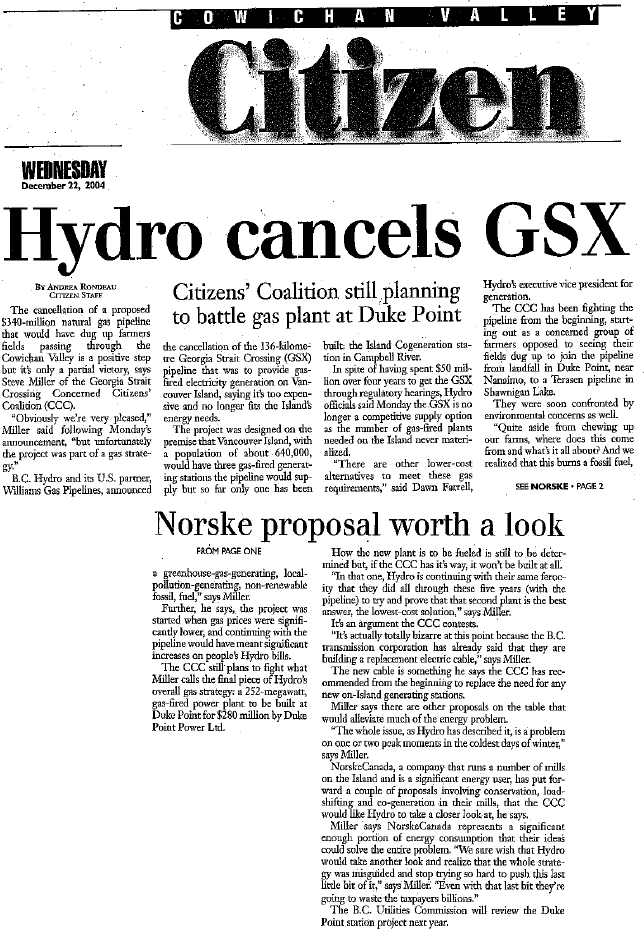
Hydro cancels GSX
Andrea Rondeau
Cowichan Valley Citizen
22 Dec 2004
Ladysmith Chronicle
28 December 2004
Terasen's proposal to build a liquified natural gas storage tank north of Ladysmith is one step closer to regulatory approval, with BC Hydro and its American partner, Williams Gas Pipelines, announcing last week they are scrapping the Georgia Strait Crossing (GSX) pipeline.
The pipeline was a complicating factor in ongoing hearings into Terasen's project by the BC Utilities Commission (BCUC), which must approve the storage facility before construction can go ahead.
Key to the commission's decision is who would supply gas for a proposed 252-megawatt, gas-fired power plant at Duke Point, awarded to Duke Point Power Ltd. last month in Nanaimo.
The BCUC is expected to approve or reject the plant next year. The GSX pipeline project, worth an estimated $340 million, was to begin at Sumas, Washington and run 67 kilometres under the Strait of Georgia to connect with the existing Terasen pipeline at Shawnigan Lake. The gas was to help fuel the existing 240-megawatt generation plant at Campbell River, as well as the proposed $370 million, 265-megawatt Vancouver Island Generation Project at Duke Point. The latter was rejected last year by the BCUC for being too large and too costly.
Hydro spokesperson Dawn Farrell said the large gas requirements the GSX pipeline was designed to meet have not materialized, thus defeating the rationalization for the project.
"There are lower cost alternatives to meet these gas requirements which, together with the fuel switching capability [from gas to diesel] now available at the Island Cogeneration Plant in Campbell River, means there can be enough reliable gas supply on the Island to meet required demands without GSX," Farrell said in a release.
The decision to kill the pipeline eliminates a potential roadblock in the approvals process for both the Terasen and the Duke Point projects, said Farrell.
"Cancelling the project now will stop all further expenditures on the project and also eliminates it as an issue," she said. Hydro had spent an estimated $50 million on the GSX project in research, environmental studies and other related costs.
A Terasen Gas spokesman told Canadian Press last week the cancellation of GSX bodes well for the company's future, its customers on Vancouver Island, and BC Hydro.
"We've said all along that we believe we can provide natural gas to BC Hydro for this project," said Dean Pelkey. "I think what we're seeing now is they are coming around to agreeing with us."
Hydro plans to meet with Terasen over the next few months to discuss options.
Grant Warkentin
Campbell River Mirror
29 December 2004
Campbell River's Island Cogeneration plant was a major factor in BC Hydro's decision last week to scrap a $340 million natural gas pipeline to Vancouver Island.
"The Island cogeneration plant now has dual fuel-switching capabilities which lessened the load for natural gas supply during peak demand for natural gas supply on Vancouver Island. That was a big help," said Ted Olynyk, BC Hydro's spokesperson in Nanaimo. "That obviously had a big play in consideration for cancelling GSX (the Georgia Strait Crossing pipeline). That, coupled with Terasen's proposal, made GSX no longer competitive as a supply of natural gas on Vancouver Island."
Curtis Mahoney, manager of the cogen plant located next to NorskeCanada's Elk Falls mill, said the plant added its capability last year to burn two types of fuel to produce electricity. "Last summer we had a major overhaul and after that we had the commissioning of that process," he said.
The plant primarily burns natural gas to generate up to 250 megawatts of electricity. It can also burn distillate, a form of diesel fuel, as a backup during peak demand for natural gas. Dawn Farrell, executive vice-president of generation for BC Hydro, said there was not enough demand to justify building the pipeline, which would have connected Vancouver Island with Washington State. The project was a partnership between BC Hydro and Williams Gas Pipelines.
"A large-capacity pipeline like GSX is no longer a competitive supply option because the large gas supply requirements it was designed to meet have not materialized," she said. "There are other, low-cost alternatives to meet these gas requirements which, together with the fuel-switching capability now available at the Island Cogeneration plant in Campbell River, means there can be enough reliable natural gas supply on the island to meet required demands without GSX."
BC Hydro's original plan was to construct three natural gas-fired power plants on Vancouver Island and connect them with the natural gas pipeline. Only one cogen plant was ever built, located in Campbell River as a second choice because Port Alberni residents opposed the plant for environmental reasons.
The Georgia Strait Crossing pipeline has been opposed since it was first proposed in 2000. The GSX Concerned Citizens Coalition celebrated BC Hydro's decision and said they would now like to see the utility halt its plans to build a natural gas-fired power plant at Duke Point in Nanaimo.
"Over-sized and over-priced, GSX was doomed from the start," said Arthur Caldicott, director of the citizens' coalition. "So many people on Vancouver Island, the Gulf Islands, the Lower Mainland and Washington State have fought long and hard against the pipeline project and they all deserve credit for this great victory today."
Dodie Miller, a director with the citizens' coalition, said BC Hydro has always overestimated Vancouver Island's power needs.
"Now that Hydro has acknowledged the pipeline was misguided, it is time to re-examine the need for Duke Point," Miller said. "This project is not the least-cost option because gas-generated electricity is no longer cheap, and it is time BC Hydro recognized this."
December 20, 2004
Lights finally go out on GSX Pipeline
GSX Concerned Citizens Coalition
304 - 733 Johnson Street, Victoria, BC, V8W 3C7
Telephone (250) 381-4463
Email: thackney@island.net Website: www.sqwalk.com
For Immediate Release: December 20, 2004
Lights finally go out on GSX Pipeline
Victoria, BC-BC Hydro & Williams Gas Pipeline announced earlier today that their GSX pipeline project is finally well and truly dead. The need for natural gas on Vancouver Island was overestimated and less expensive and less damaging alternatives are available. The same economic and environmental arguments should now help cancel the proposed Duke Point Power gas plant in Nanaimo, according to the GSX Concerned Citizens Coalition (GSXCCC).
"BC Hydro recognized their mistake and has had the courage to admit it," said GSXCCC president Tom Hackney. "We trust they will now move as quickly as possible to renew the sub-sea cable system to Vancouver Island, which should have been the priority all along."
However, GSX was only one part of the BC Hydro's gas strategy for Vancouver Island. The crown corporation still intends to go ahead with the Duke Point gas plant, an expensive and polluting long-term solution to a short-term energy supply problem.
"BC Hydro consistently overestimates Vancouver Island's future energy demand," said Dodie Miller, a director of GSXCCC. "Now that Hydro has acknowledged the pipeline was misguided, it is time to re-examine the need for Duke Point. This project is not the least-cost option because gas-generated electricity is no longer cheap, and it is time BC Hydro recognized this."
Cost effective solutions to meet the Island's short-term energy needs are available: Norske and other large industrial users have offered to take action to compensate for the theoretical brief periods of time, estimated at a few hours per day over a week at most in the winter of 2007/08, when equipment failure could potentially cause a power shortfall.
"Over-sized and over-priced, GSX was doomed from the start," said GSXCCC director Arthur Caldicott. "So many people on Vancouver Island, the Gulf Islands, the Lower Mainland and Washington State have fought long and hard against the pipeline project and they all deserve credit for this great victory today."
The GSX Concerned Citizens Coalition has campaigned since 2000 against BC Hydro's gas strategy for Vancouver Island. The Coalition has a hundred individual members and eight member groups, including the Sierra Club of Canada - BC Chapter, Georgia Strait Alliance; Council of Canadians - Victoria and Cowichan Chapters, Saturna Island Community Club, Pender Island Conservancy Association, Shawnigan Lake Watershed Watch and the Canadian Parks And Wilderness Society - BC.
- 30 -
For further information, contact:
Tom Hackney (250) 381-4463
Arthur Caldicott (250) 370-9930 x.22
GSX Pipeline Project Cancelled
BC Hydro news release
Williams news release
Proposed GSX Pipeline Project Cancelled
December 20, 2004
Other Options More Cost Effective at Ensuring Reliable Supply for Vancouver Island
PROVINCE-WIDE – BC Hydro and Williams have today announced the cancellation of the Georgia Strait Crossing (GSX) pipeline project. The $340 million natural gas pipeline had been proposed by the two companies in 2000 as the best way to meet the demand for gas transportation along its United States route and to natural-gas fired electricity generation facilities on Vancouver Island.
"A large capacity pipeline like GSX is no longer a competitive supply option because the large gas supply requirements it was designed to meet have not materialised," said Dawn Farrell, Executive Vice President, Generation. "There are other lower cost alternatives to meet these gas requirements which, together with the fuel switching capability now available at the Island Cogeneration Plant (ICP) in Campbell River, means there can be enough reliable natural gas supply on the Island to meet required demands without GSX."
"Cancelling the project now will stop all further expenditures on the project and also eliminate it as an issue in ongoing regulatory processes relating to Terasen and the Duke Point Power Project."
In April 1998, BC Hydro sought private sector proposals to help it meet the natural gas requirements for ICP, a proposed natural gas fired (then to be situated in Port Alberni) and a possible third facility somewhere else on Vancouver Island. BC Gas (now Terasen), Centra/ West Energy and Williams Gas Pipelines submitted proposals. Williams' proposal was deemed the most cost effective at that time.
"Our goal now remains the same as it was when we starting looking at GSX – to ensure the lowest cost, most reliable electricity for our customers on Vancouver Island," added Farrell. "There are a range of lower cost alternatives to GSX, including a number with Terasen. These will ensure that on-Island electricity generating facilities – including the proposed Duke Power Project in Nanaimo – have enough natural gas supply to maintain their firm reliable supply of electricity for our customers even during the most critical winter months."
Contact:
Stephen Bruyneel
BC Hydro
Phone: (604) 623-4344
Beverly Chipman
Williams
Phone: (801) 584-7048
Williams Announces End to Proposed Georgia Strait Project
December 20, 2004
TULSA, Okla. — A unit of Williams (NYSE:WMB) announced today an agreement to discontinue development of the Georgia Strait Crossing pipeline project.
Williams Gas Pipeline and British Columbia Hydro and Power Authority – co-sponsors of the project – have mutually agreed to end plans to construct a $209 million natural gas pipeline across the Strait of Georgia to serve electric generation facilities on Vancouver Island, B.C.
Project development costs, estimated at approximately $34 million, were funded by BC Hydro. Under the terms of the agreement with Williams, BC Hydro assumes full responsibility for all project costs.
The decision on whether the project would proceed has been on hold since September 2003 pending a regulatory review of energy needs on Vancouver Island.
As a result of the Canadian regulatory process, BC Hydro has decided to pursue other alternatives to meet short-term energy needs and will move forward with plans to replace aging electric transmission cables.
“In light of BC Hydro’s decision to pursue other alternatives, we agree that it is time to terminate the project,” said Allison Bridges, vice president of commercial operations for Williams Northwest Pipeline. “When it was originally proposed, this was a viable alternative for supplying Vancouver Island’s long term energy needs, and we believe it also held long term, cost-effective options for future industrial development in western Washington.”
The 84-mile pipeline project received a FERC certificate in September 2002 and similar approval from the National Energy Board of Canada in December 2003.
About Williams (NYSE:WMB)
Williams, through its subsidiaries, primarily finds, produces, gathers, processes and transports natural gas. The company also manages a wholesale power business. Williams’ operations are concentrated in the Pacific Northwest, Rocky Mountains, Gulf Coast, Southern California and Eastern Seaboard. More information is available at www.williams.com.
------------------------
Contact Information:
Beverly Chipman Williams Media Relations 801-584-7048
Courtney Baugher Williams Investor Relations 918-573-5768
December 17, 2004
The Bottom Line
Dr. Patrick Moore
The Province
17 Dec 2004
COMMENT: What a wierd article, this piece by Patrick Moore.
The first sentence talks about renewable potential in geothermal, wind and biomass. That's the come-on, like calling your band Bare Naked Ladies.
The second sentence says we should offset some of the costs of implementing these renewables with revenues from oil and gas.
The rest of the article is a promotion of offshore drilling . The comparison fails here because the BNL do make great music, though they wear clothes and aren't ladies at all.
BC's windfall revenues from existing terrestrial drilling license sales and gas production royalties are already an opportunity to build up the fund that Dr. Moore champions. This fund is in fact one step recommended in "Oil and Gas in British Columbia, 10 Steps to Responsible Development", a set of policy recommendations proposed in 2004 by Dogwood Initiative, West Coast Environmental Law and other organizations.
The first two sentences are absolutely supportable. But it does not follow from the setup, that BC needs to or should expand oil and gas extraction into the ocean, as Dr. Moore proposes.
It is disingenuous and manipulative of Dr. Moore to construct the argument this way. It's the way Imperial Tobacco sells cigarettes: using images of someone climbing a mountain, surrounded by blue skies and clean air, to sell Players brand smokes.
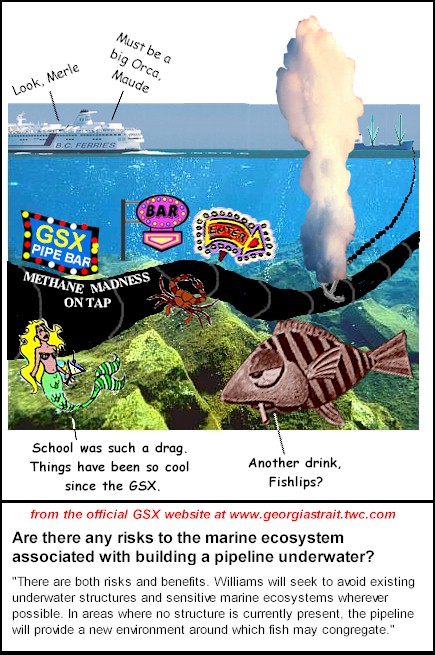
Footnote: Patrick Moore's description of the benefits to marine life of drilling rigs on the ocean floor is reminiscent of a comment by Williams of one benefit of the GSX Pipeline, that its presence would "provide a new environment around which fish may congregate." An artist's impression of how this might look, is here - Arthur Caldicott
Three sources of renewable energy are undeveloped in B.C.: Geothermal heat pumps (solar energy stored in the ground for heating and hot water), wind and biomass (using waste wood to generate electricity and heat).
So why not use revenue from oil and gas development to research and implement these renewable energies of the future? Such a fund could turn British Columbia into a global leader in sustainability.
The record of safety in offshore drilling has already been established by activities in the North Sea, China, the Gulf of Mexico and Hibernia off Newfoundland.
Indeed, there are marine benefits to such drilling. Undersea infrastructures become artificial reefs that provide habitats for thousands of marine species -- from shellfish to herring. An artificial reef society in Vancouver sinks decommissioned vessels and aircraft to enhance marine life for the benefit of divers.
The U.S. is also putting the artificial reef concept to action. Research funded by the Minerals Management Service, the U.S. Geological Survey and the industry-supported California Artificial Reef Enhancement Program involved extensive underwater surveys of marine life at rigs and natural reefs in the Santa Barbara Channel.
The research shows that drilling platforms are important not just as collectors of marine life but also as fish producers. The rigs harboured huge numbers of young rockfish in greater concentrations than the natural reefs, as well as more large adult rockfish than did the natural habitats. The rigs were home to more fish and more species of fish than the natural reefs.
Offshore drilling and aquaculture can also work hand-in-hand. In California, there is a proposal for an aquaculture cage system to be anchored to a decommissioned oil platform, allowing aquaculture in an exposed location.
There are over 3,000 oil rigs in the Gulf of Mexico. When some were exhausted, the government and the oil companies began planning to remove them. Unexpectedly, it was the fishermen who demanded the rigs be left in place. It turns out 85 per cent of all fishing trips in the Gulf target oil reefs because that is where most of the fish can be found. The artificial reef is a powerful enhancer of marine productivity.
There is no reason why active aquaculture operations could not take place while an offshore oil platform was in active production. By ensuring any negative environmental impacts are detected early, the farmed fish or shellfish would act as the proverbial canaries in the coal mine.
The offshore energy initiative offers economic development to struggling coastal communities and provides enhanced marine productivity. Proceeds can be used to develop renewable energies to keep B.C. green well into the future.
The people, economy and environment will benefit. It makes sense.
- Dr. Patrick Moore, was a co-founder of Greenpeace and is chairman and chief scientist of the Vancouver-based Greenspirit Strategies Ltd.
JIESC minces no words with the BCUC
Power at $220/MWh?
Collusion between BCUC and BC Hydro?
You gotta be kidding!
The Joint Industry Electricity Steering Committee is joining other intevenors in the BCUC review of the proposed Electricity Purchase Agreement between BC Hydro and Duke Point Power.
Excerpts from the JIESC letter:
Electricity price
Whatever the precise costs are it is clear they are substantial and BC Hydro’s submissions must seen and must be tested. The JIESC estimates that this project will have annual fixed costs in the range of $75 million per year, and that at an 80% utilization rate the costs will be approximately $88/MWh.
Furthermore, we are advised that at current gas prices the Duke Point Gas Plant will only be utilized about 20% of the time, like most similar plants, and will have a cost of around $220/MWh, several times the prices contemplated in the VIGP Decision.
Ratepayers are the ones who will pay the cost of this agreement for the next twenty five years and the public interest dictates that they must have an opportunity to examine the costs of the EPA and must have the time and information to allow them to have informed input to your decision.
Secret communications
The JIESC is also concerned by the unprecedented secret or confidential direct
communications between the Commission, its staff and the Applicant. These communications, to the extent the intervenors are aware of them ....
We request that the Commission immediately and fully disclose all communications by the Commission Panel or its staff with the applicant and/or Duke Point Power ....
JIESC Dec 16 Letter to BCUC.pdf
December 16, 2004
Ticking Time Bomb
John Atcheson
Baltimore Sun
15 Dec 2004
The Arctic Council's recent report on the effects of global warming in the far north paints a grim picture: global floods, extinction of polar bears and other marine mammals, collapsed fisheries. But it ignored a ticking time bomb buried in the Arctic tundra.
There are enormous quantities of naturally occurring greenhouse gasses trapped in ice-like structures in the cold northern muds and at the bottom of the seas. These ices, called clathrates, contain 3,000 times as much methane as is in the atmosphere. Methane is more than 20 times as strong a greenhouse gas as carbon dioxide.
Now here's the scary part. A temperature increase of merely a few degrees would cause these gases to volatilize and "burp" into the atmosphere, which would further raise temperatures, which would release yet more methane, heating the Earth and seas further, and so on. There's 400 gigatons of methane locked in the frozen arctic tundra - enough to start this chain reaction - and the kind of warming the Arctic Council predicts is sufficient to melt the clathrates and release these greenhouse gases into the atmosphere.
Once triggered, this cycle could result in runaway global warming the likes of which even the most pessimistic doomsayers aren't talking about.
An apocalyptic fantasy concocted by hysterical environmentalists? Unfortunately, no. Strong geologic evidence suggests something similar has happened at least twice before.
The most recent of these catastrophes occurred about 55 million years ago in what geologists call the Paleocene-Eocene Thermal Maximum (PETM), when methane burps caused rapid warming and massive die-offs, disrupting the climate for more than 100,000 years.
The granddaddy of these catastrophes occurred 251 million years ago, at the end of the Permian period, when a series of methane burps came close to wiping out all life on Earth.
More than 94 percent of the marine species present in the fossil record disappeared suddenly as oxygen levels plummeted and life teetered on the verge of extinction. Over the ensuing 500,000 years, a few species struggled to gain a foothold in the hostile environment. It took 20 million to 30 million years for even rudimentary coral reefs to re-establish themselves and for forests to regrow. In some areas, it took more than 100 million years for ecosystems to reach their former healthy diversity.
Geologist Michael J. Benton lays out the scientific evidence for this epochal tragedy in a recent book, When Life Nearly Died: The Greatest Mass Extinction of All Time. As with the PETM, greenhouse gases, mostly carbon dioxide from increased volcanic activity, warmed the earth and seas enough to release massive amounts of methane from these sensitive clathrates, setting off a runaway greenhouse effect.
The cause of all this havoc?
In both cases, a temperature increase of about 10.8 degrees Fahrenheit, about the upper range for the average global increase today's models predict can be expected from burning fossil fuels by 2100. But these models could be the tail wagging the dog since they don't add in the effect of burps from warming gas hydrates. Worse, as the Arctic Council found, the highest temperature increases from human greenhouse gas emissions will occur in the arctic regions - an area rich in these unstable clathrates.
If we trigger this runaway release of methane, there's no turning back. No do-overs. Once it starts, it's likely to play out all the way.
Humans appear to be capable of emitting carbon dioxide in quantities comparable to the volcanic activity that started these chain reactions. According to the U.S. Geological Survey, burning fossil fuels releases more than 150 times the amount of carbon dioxide emitted by volcanoes - the equivalent of nearly 17,000 additional volcanoes the size of Hawaii's Kilauea.
And that is the time bomb the Arctic Council ignored.
How likely is it that humans will cause methane burps by burning fossil fuels? No one knows. But it is somewhere between possible and likely at this point, and it becomes more likely with each passing year that we fail to act.
So forget rising sea levels, melting ice caps, more intense storms, more floods, destruction of habitats and the extinction of polar bears. Forget warnings that global warming might turn some of the world's major agricultural areas into deserts and increase the range of tropical diseases, even though this is the stuff we're pretty sure will happen.
Instead, let's just get with the Bush administration's policy of pre-emption. We can't afford to have the first sign of a failed energy policy be the mass extinction of life on Earth. We have to act now.
John Atcheson, a geologist, has held a variety of policy positions in several federal government agencies.
© 2004 Baltimore Sun
Power plant plan creating unlikely allies
Patrick Hrushowy
Cowichan News Leader
15 Dec 2004
COMMENT:Patrick Hrushowy has used his News Leader soapbox in the past to natter at the GSX Concerned Citizens Coalition for harbouring accursed NIMBYs and environmentalists. Think about it, folks - what could be more natural and virtuous than a passion to protect one's own backyard and environment? Migosh! How could values we all subscribe to - protect our own place - become such an iconic label of disparagement as NIMBY and environmentalist have become in the pens of people like Mr. Hrushowy?
The GSX Concerned Citizens Coalition (GSXCCC) has since its informal beginning in 2000 been critical of the GSX Pipeline and the gas-fired generation plants it is intended to provide fuel to. That's five years now. And we have learned a lot, and earned the respect of the NEB and BCUC for our effective and substantial contribution to the hearings we have participated in. It is however, a mark of the full spectrum of shortcomings with the gas-fired strategy, that we found reason to criticize the projects on so many grounds. We pointed out those shortcomings, at meeting after growing meeting, in town after town, and earned the approbation of Mr. Hrushowy.
Before the National Energy Board (NEB) review of GSX began, a Marine Coalition had formed out of some of the early members of GSXCCC to address marine issues with the pipeline proposal. It is an impressive coalition, as well, comprised of scientists of many stripes and even a former chair of the Canadian Association of Petroleum Producers.
Another friendly breakaway: the landowners on the GSX Pipeline route decided to form their own organization, the Vancouver Island Pipeline Landowners Association (VIPLA). They formed an alliance with the (deep breath) Canadian Association of Pipeline Landowner Associations (CAPLA) and engaged a lawyer to represent their interests.
Which left the GSXCCC holding the bag on all the other issues. Just a group of local people ... from Cobble Hill, Nanaimo, Port Alberni, Campbell River, Victoria, Vancouver, Bellingham, Seattle, San Juan-Saturna-Pender-Salt Spring Islands, and member groups like the Sierra Club of BC, Canadian Parks and Wilderness Society, Georgia Strait Alliance, Council of Canadians.
Sure, we were and still are critical of the gas-fired strategy on many fronts. Here are two:
Safety: a gas pipeline like the GSX carries gas at a pressure nine times that of the propane bottle on your barbeque. GSX is the same diameter - 16" - so picture that propane tank stretched from the landfall at Cherry Point, to Nanaimo. Bang. Oops, sorry to scare you. A pipebomb joke.
Seismic: we're so accustomed to living in an area with constant seismic activity, that we discount the seriousness of making our energy infrastructure dependent on a system that is highly vulnerable to seismic events.
Our three big issues, though, and the ones our members are most passionate about are:
Greenhouse gases and global warming You're an empiricist, or you don't believe the evidence of our senses and tools and science. Either way, human-caused climate change is the greatest threat to life on earth and earth as we know it, since humans first evolved.
Economics Vancouver Island gas-fired electricity will be the most expensive electricity generated in the province, well above the $55/MWh that BC Hydro is prepared to pay for green energy, and the $24/MWh cost to BC Hydro of hydroelectric power in BC. The price of natural gas remains at levels three times its price when BC Hydro and the BC government first concocted the gas strategy for Vancouver Island - and it shows no sign of falling anytime soon. They're just not making more of the stuff fast enough
Need for the electricity BC Hydro has been hammering at Vancouver Island residents for five years telling us the lights were going to go out. It was an emotional gun to the head that was impossible to rebut, until the GSXCCC came along and one of our directors, an economist and statistician, pulled the guts out of BC Hydro's self-serving and indefensible load forecasts. Hydro ended up sacking its forecasting wizard, rewrote its forecasts, suffered the acute embarrassment of having its new forecasts cut in half by the BCUC because of the evidence led by GSXCCC, and ultimately had its Duke Point project rejected by the BCUC.
Solutions The bottom line is, Vancouver Island can meet its energy needs for years to come with a sustainable and balanced portfolio of initiatives:
- conservation and efficiencies - referred to as "demand side management"
- replace the aging HVDC cable from the mainland
- move aggressively to sustainable energy sources, including micro-hydro, wind, tide, solar, geothermal.
For the record, Mr. Hrushowy, the GSXCCC has never taken a position on the pulp industry, never discussed it at any meeting, public or private, and you are flat wrong in suggesting a link between GSXCCC and groups that would shut down the pulp industry, if indeed there are any. Lots of people belong to many different things in all organizations. The membership of GSXCCC is indeed diverse, and that is a reflection of the broad range of things that are wrong with BC Hydro's gas strategy.
Thanks for the mostly positive recognition in your column, Mr. Hrushowy. "Our own GSX Concerned Citizens Coalition" feels kinda good. - Arthur Caldicott
Some strange bedfellows are linking arms figuratively to try to stop the Duke Point power plant project at Nanaimo that BC Hydro is selling to private sector operator Pristine Power.
The 252 megawatt power plant proposal that BC Hydro recently chose as the winning project to meet Vancouver Island's near term power needs is at serious risk of being stopped before anyone can begin construction. Hydro's choice for this project, and the Energy Purchase Agreement that goes with it, still needs the approval of the B.C. Utilities Commission. Hearings are scheduled to begin in Vancouver on Jan. 11 and there will be a town hall meeting in Nanaimo on Jan. 15.
The line up of opponents is a mile long but standing out are our own GSX Concerned Citizens Coalition and the Joint Industry Electricity Steering Committee.
In the rarefied world of utility regulation, intervenor lists a mile long are common and seldom merit media attention as lawyers and experts figuratively argue over how many angels can dance on the head of a pin.
This one is different. The JIESC, for instance, is the group representing the pulp mills on Vancouver Island and the Lower Coast - the largest electrical energy consumers in the province. They are digging in their heels and are prepared to block this project, even if it means appealing to the highest court available.
JIESC believes the project is just plain wrong in economic terms. It's too expensive, they say, with electricity costing almost four times as much as BC Hydro is currently paying for electricity generated in small private run-of-river projects.
Duke Point will be fired with natural gas, a premium fuel whose cost is forecast to continue to rise. Not only that, the JIESC says BC Hydro still does not have a firm fix on the cost of bringing extra natural gas to Vancouver Island to fire the project. Terasen has made some estimates but has not finalized the figures. They, too, need to go before the BCUC for approval for their plans, which includes the proposal to build a facility in North Oyster to liquefy and store natural gas. Only when Terasen finalizes its application to the BCUC will the full costs be known.
There are some in the JIESC that worry that this Duke Point project has all the makings of a new fast ferries fiasco, the financial debacle that was largely responsible for bringing down the former NDP government.
The GSXCCC is opposing on environmental grounds, along with economic arguments. This group has proven its determination and has learned a lot since forming to fight this project several years ago. They will present far more cogent arguments than the emotional environmental rhetoric that characterized their positions in the past.
These are strange bedfellows, indeed, with a lot of the people involved in GSXCCC being members of other groups that would love to shut the pulp industry down on environmental grounds.
Got a tip or comment? E-mail me at phrushowy@shaw.ca.
December 14, 2004
Hydro silent on payments to Island power producer
Scott Simpson
Vancouver Sun
14 Dec 2004
Pristine Power is to build a power generation plant near Nanaimo
BC Hydro is coming under heavy criticism for its secrecy about the price it will pay for electricity from a proposed power generating facility on Vancouver Island.
Stakeholders expect the gas-fired plant near Nanaimo to drive up electricity prices for all Hydro customers in B.C. -- but said on Monday that it's impossible to fairly evaluate the project when a key piece of information is missing.
The Pristine Power project is planned to undergo a hearing in front of the British Columbia Utilities Commisson next month.
"This is a 25-year-minimum project, and we have no idea what we are getting into," said Jim Quail, legal counsel for the B.C. Public Interest Advocacy Centre, on Monday.
"It might be a great price. It might be a terrible price. Either way, it's going to have an impact on the rate that we all pay for our electricity, possibly for a long time to come."
Hydro announced on November 3 that it had selected Pristine Power to carry forward a minimum $280 million project to build a generating plant at Duke Point near Nanaimo in an effort to address a looming electricity shortfall on Vancouver Island.
Neither Hydro nor Pristine would disclose how much Pristine will be paid for its electricity.
Later that month the British Columbia Utilities Commission (BCUC) appeared to agree that the details should remain secret -- disappointing Hydro watchdog groups that represent industry as well as ordinary consumers.
Hydro maintains that price information must remain confidential, in order to protect bidders' competitive interests -- particularly as future opportunities emerge for private sector companies to join the province's electricity grid.
"It's purely for competitive reasons and bidders have reinforced to us that it's critically important for them to participate in these types of processes that maintain confidential their bid information," said Mary Hemmingson, Hydro's power planning manager.
Hemmingson said Hydro has received 500 information requests from stakeholders in advance of next month's hearing and said those requests will be met by a BCUC-imposed deadline of this Friday.
"The one piece we don't feel is appropriate to release -- because it could compromise the competitive process -- is the specific price information for either the successful bidders or the unsuccessful bidders," Hemmingson said.
She added that the BCUC has endorsed Hydro's request for confidentiality on the Pristine bid -- and noted that the commission will itself review the price information and make its own determination about whether the cost of the project is appropriate.
The price of Duke Point energy is partially contingent on the price of natural gas -- and will assuredly be more expensive than what consumers now pay for a system that is dominated by low-cost hydroelectric generating facilities.
The project has also attracted controversy because it resurrects a BC Hydro Vancouver Island energy plan that the utilities commission decided last year was too expensive.
The rewritten plan requires Hydro to book $70 million in corporate writeoffs which will ultimately be borne by the province's taxpayers, based on costs already incurred by Hydro in its own, earlier, efforts to carry the project forward.
© The Vancouver Sun 2004
December 04, 2004
CBC Yellowknife, on GSX and MGP
CBC - Yellowknife
03 Dec 2004
COMMENT:On Thursday, Dec 2, I was interviewed by CBC - Yellowknife about our experience with the GSX proceeding conducted by the National Energy Board.
The context and audience was for the Mackenzie Gas Pipeline Project (MGP), for which a "Joint Review Panel" has been assembled to conduct a review of the project under the Canadian Environmental Assessment Act and for which a sometimes-in-parallel and sometimes-sequential process will be conducted by a smaller panel under the National Energy Board Act. The internet gateway into the thing is through the Northern Gas Project Secretariat.
The MGP process is different than that received by GSX. With GSX, a three person "Joint Review Panel" reviewed the project under both Acts, in a single proceeding.
Another difference: participant funding for GSX was $100,000, while for the MGP it's a little higher, at $1.5 million. (GSX Concerned Citizens Coalition received $25,000 in the GSX proceeding, thanks in large part to Tom Hackney's marvellous ways with the forms and reports required by bureaucrats)
The two projects had/have Rowland Harrison as a panel member in common. My impression of Harrison was that he brought a conservative, conventional force to the panel.
I am caught out on a factual error. I said that the NEB never denies approval. I was wrong.
- In April 2004, an NEB panel turned down the high profile and highly unpopular application for a powerline from the proposed Sumas Energy 2 generation project in Sumas Washington to BC Hydro's Clayburn Substation in Abbotsford. Given that the project was opposed by MPs, MLAs, the BC government, local governments, hundreds of local citizen intervenors, and only the proponent, a privately held US company, was for the powerline, it became an easy decision to oppose for the NEB. NESCO, the proponent, is now taking the NEB to court.
- The NEB has also turned down a rates revision request by TransCanada Pipelines, in Feb 2003, and a request by New Brunswick to relax gas export rules, in Sept 2002.
An interview with Denis Tremblay of the NEB follows mine in this transcript - Arthur Caldicott
---
(6) Mackenzie Gas Project
CBC Special Report, Thursday, December 3, 2004, 5:15 p.m.
CBC: The National Energy Board will have a large role in approving construction of a pipeline down the Mackenzie Valley. The board is an independent agency of the federal government. The NEB isn't well known in the North, but it is on Vancouver Island. About a year ago the board approved construction of a 60-kilometre pipeline from a point on the Canada/U.S. border to a point south of the town of Duncan, British Columbia. The Georgia Straight Crossing is a small project compared with the proposed Mackenzie pipeline, but the review process is similar.
Arthur Caldicott is a founding director of the Georgia Straight Crossing Concerned Citizens Coalition, a group that opposed the pipeline and he joins us from Vancouver Island. Good afternoon Arthur.
CALDICOTT: Good afternoon.
CBC: So tell me why you were opposed to the pipeline?
CALDICOTT: Well the pipeline, all of these projects, the Mackenzie gas pipeline and the GSX pipeline that was proposed for Vancouver, these projects are always the instrument of some large well funded corporation or corporation and government from outside the community who wants to impose their big visions on small communities or on First Nations and we were a typical small community on Vancouver Island that had this big gas pipeline being proposed to run right through it. Very quickly community concerns grew about many issues; pipeline safety, the marine implications of putting a new pipeline in the ocean, land owner concerns about alienating farm land and particularly firing up Vancouver Island with gas fired electricity would mean in the narrower global warming was becoming the most acutely relevant concern. So the concerns were you know spread across quite a vast range, but it all started with a big project being imposed on a small community and the community pushing back.
CBC: Now I want to talk about I guess your whole experience with the National Energy Board. What did you expect from the NEB going into the hearing?
CALDICOTT: Well we didn't know what to expect because we were all knew to this as are most of the people up the Mackenzie Valley. So we knew nothing about what a regulatory proceeding was and the National Energy Board probably did the best they could to try and introduce the community to what their processes are and in doing that they encouraged people from all of the communities along the pipeline route to come out and present their concerns to the board. Where that backfired for the National Energy Board and I think we were misled by them was that by encouraging the public to get involved they led to the public to believe that the public could actually have a say in the decision and that proved not to be the case cause at the end of the day after all the public has gone home the doors on the room close and the hearing becomes an exercise for lawyers, experts, highly funded people who can stand their professional lives doing these things.
It's no place for common citizens. So you know we kind of learned this as we went and we managed to find some funding from supportive people and from some supportive agencies that enabled us to hire a lawyer to represent us in the hearing. Much of the work we did we did on our own, two in the morning when our regular jobs were finished we were digging through transcripts and digging through previous regulatory proceedings and learning an awful lot about energy and pipelines. I think we did quite a valiant job, but at the end of the day of course the project was approved.
CBC: So during the hearing did the board question a lot of what you had proposed or addressed?
CALDICOTT: The way a proceeding or a hearing is conducted is all of the interveners, you have to formally get registered as an intervener, all of the interveners ask questions of each other through a formal process called information requests and file evidence. Once again, the evidence has to be filed formally as well. So the only record you get to ask questions on are the evidence that's been filed and through that process you can ferret out quite a bit of information, but you don't get it all of course. Most of the questions are asked of the proponent, the applicant, the company that wants to build a project. Very seldom does the proponent or does the National Energy Board ask questions of an intervener and in our case particularly very few persons were asked of us because of course we weren't providing much original evidence.
We did on gas supply, however, and we did on some of the load forecasting numbers that B.C. Hydro was providing to the National Energy Board, but largely the questions aren't asked of us. The tough asking questions are the proponent and without a big bank of experts it's hard to position questions that expose the weak parts of a proponents set of arguments and evidence, but really when it comes down to it it's what the National Energy Board is there to do. Their purpose is to find where the public convenience is in a project that is being proposed and to determine whether or not there's a need for the project that's being proposed and the public view of what a public convenience or what's serving in the public interest is and what need is is quite different. It's vastly different than what the board construes public convenience to be and need to be in terms of a project that's being proposed to them.
It's that big gap between the board's interpretation of public convenience and necessity and the public that was probably one of the biggest learning experiences for us.
CBC: Do you think then that this process favours the developer?
CALDICOTT: Yes, it clearly favours the developer. It always favours the developer. The National Energy Board to the best of my understanding has never turned down a project. Some get withdrawn when they see their opportunity to getting approval are slim, but for the most part the National Energy Board approves projects. Now they may condition their approval. They may say, well in the case of the GSX Pipeline, they said you can't build a pipeline unless you build a gas plant to use fuel from it, but that's pretty much self evident. The company is not going to build the pipeline unless there's somebody to buy the fuel. But no, largely the National Energy Board works with industry to facilitate industry's projects. That's pretty much their mandate in the absence of the government that more strongly represents the interests of people, of communities and First Nations. The National Energy Board will always be to some extent the handmaiden of industry.
CBC: So how can the NEB address disparity or resources between the groups?
CALDICOTT: Well one fellow who participated in the Sable Island pipeline said you've got to de-lawyerize and de-expertize the process first of all because by making it a club for highly specialized professionals you cut the people out of the picture. Most people can't quit their jobs and go be full-time regulatory participants. Somehow that has to be balanced out so that the people can actually participate on a fair and equal level with industry, with corporations and with government. You know in this real world or real politics what Canada needs is some sort of national energy strategy that represents more strongly and gives more weight to the interests of the environment or weight to the interests of aboriginal entitlement, more weight to the interest of communities and land owners cause right now the deck is hopelessly stacked in favour of industry.
CBC: So what did you learn from being involved in this process Arthur?
CALDICOTT: Well the first thing I would counsel anybody getting into a big project like this is make sure you're equipped for the long run. We naively kind of though this thing would all be over in three weeks or three months, it's five years now and we're still working on it. So I would counsel anybody to build an organization around them that doesn't depend solely on the energies of one or two or three people, that has some carrying some capacity and some continuity should any of the key people burn out, which almost certainly they are going to do, make sure there's funding in place, make sure there's some sort of paid staff on board because volunteers can't do all of this all of the time. That would be one thing. Lobby governments, make sure that the public are continuously well informed. Going back to the early days of Green Peace I strongly recommend implementing as much as possible of all hunters ideas of planting mind bombs, using the media in the minds of people,
make use of all electronic technologies at your disposal, the internet, e-mail, websites.
CBC: Well I'm glad you made that distinction between mind and mine.
---Laughter
CALDICOTT: Right.
CBC: All right Arthur, so it could be a lengthy process for anyone that's involved in the review of the Mackenzie gas pipeline up here?
CALDICOTT: Oh, of all the projects in Canada this one is going to be far and away the biggest. I encourage everyone to get as much support as possible to those interveners with public interest and aboriginal interveners on the Mackenzie gas pipeline cause they are going to need all the support and help they can get.
CBC: All right Arthur, thank you very much for this today.
CALDICOTT: My pleasure.
CBC: Okay, bye-bye.
CALDICOTT: Cheers.
CBC: Arthur Caldicott is the founding director of a group called the Georgia Straight Crossing Citizens Coalition. He lives on Vancouver Island. Now Arthur said that the NEB has never said no to a project. That contradicts some of the research CBC reporter Julie Green has gathered. The NEB told her that they have turned down two proposals over the last 14 years and we'll find out more tomorrow about the NEB hearings here in the Territory and how you can get involved. You can tune into the Trail Breaker tomorrow morning between six and eight thirty.
CBC Special Report, Friday, December 3, 2004, 7:25 a.m.
CBC: Yesterday on the Trail Breaker we brought you the story of how hundreds of people got involved in the review of a power line in Abbotsford, British Columbia. The review was conducted by the National Energy Board. The NEB will also play a major role in the review of the Mackenzie gas project and now is the time for the public to get involved and to tell us how we're joined by Denis Tremblay. Mr. Tremblay is a spokesperson for the board and we've reached him at his office in Calgary. Good morning sir.
TREMBLAY: Good morning.
CBC: Well if I want to tell the NEB what I think about the pipeline what do I need to do?
TREMBLAY: Well as you know the NEB has scheduled the project for public hearing and in there there's three ways that people can participate in the hearing process. One of the ways is by a letter of comment, sending in a letter to the board and giving their opinion or their views about the project. Then a second one is a oral statement process where the people can schedule and come to the hearing and give their point of view at the public hearings that will be held eventually on this project. A third one is to file as a full-fledged intervener in the hearing.
CBC: And what does an intervener do?
TREMBLAY: Well the intervener can ask written questions from the applicant up until the public hearing and then during the public hearing it can cross-examine the witnesses of the applicant and other parties and it can present its own witnesses.
CBC: Well the role of an intervener sounds at the very least time
consuming and probably expensive. What help is available from the board?
TREMBLAY: Well as far as the expense the board has no funding, intervener funding process. So that's up to the interveners.
CBC: Yeah, is there any other way NEB can help?
TREMBLAY: Well it can help…
CBC: By sharing information or anything like that?
TREMBLAY: Well it has to be careful of what type of information it shares with any of the parties, even the applicant or interveners because it is a quasi judicial body and it's limited by how much assistance it can give to any party.
CBC: I wonder sir, can you tell me what's the difference between the review by the National Energy Board on this project and the review by the Joint Review Panel?
TREMBLAY: Well they are both looking at, like the Joint Review is dealing with the socioeconomic matters and environmental matters and the
NEB is looking at all the other matters like engineering, land matters, economics, markets and all that.
CBC: So if someone makes a presentation to the Joint Review Panel will they have to make the same points to the National Energy Board?
TREMBLAY: No, the National Energy Board will be using the Joint Review Panel's report as part of its hearing process. So all the environmental and socioeconomic evidence presented to the Joint Review Panel, the board will use that report before making its final decision on its subjects.
CBC: All right. So now I understand the Joint Review Panel will begin their hearings in March. What about the National Energy Board hearings?
TREMBLAY: Well the way I understand it right now they'll try to follow shortly after them. It will be sort of concurrent hearings. Like the Joint Review might do let's say for example one week in Inuvik, then the board would follow shortly after that and do its process. So they'll be more or less concurrent. They'll be running around the same time.
CBC: So Mr. Tremblay, where can people get more information about this process?
TREMBLAY: About the NEB process?
CBC: Yeah.
TREMBLAY: Well first of all one of the processes of the hearing is the hearing order itself, which is available upon request of the board or it's available on our website and as far as when we conduct public information sessions, like we've had about four or five already to inform the public, right now it's to inform them how the board works and all that, but then there might be some other information sessions as we get closer to the hearing to let people know exactly how a hearing process works. So we intend to have public information sessions to inform the people of our process and what we are.
CBC: All right. Well with that Denis Tremblay, thank you very much for joining me this morning.
TREMBLAY: You're welcome.
CBC: Bye-bye now.
TREMBLAY: Bye-bye.
CBC: Denis Tremblay is a spokesperson for the National Energy Board in Calgary.
December 03, 2004
Gold River holds faint hope
Andrew A. Duffy
Times Colonist
03 Dec 2004
CREDIT: Deddeda Stemler, Times Colonist
The Green Island Energy site would occupy the old mill facility at Gold River.
COMMENT:The BC Utilities Commission is an unfriendly place for citizens. Lawyers, experts, corporate batboys - these people are more at home in the BCUC's formal regulatory proceedings. That hasn't daunted the folks who live in Nanaimo and on Gabriola Island, and it sure hasn't intimidated the citizens of Gold River, who have filed as intervenors or interested parties in the (deep breath) BCUC review of BC Hydro's application for an Electricity Purchase Agreement with Duke Point Power Partnership.
In September 2003, the BCUC denied BC Hydro's application for the Vancouver Island Generation Project (VIGP). BC Hydro responed with a Call for Tenders (CFT) process to elicit bids for lower-cost power solutions for Vancouver Island. In the CFT, BC Hydro was looking for projects up to 300 MW capacity, and Green Island Energy put in a bid for a 75 MW "biomass" plant to be located in Gold River.
In November 2004, BC Hydro picked its same old VIGP, privatized, reduced in cost (How? That's another question entirely and most of the intervenors in the EPA review are trying to get answers to that very question.), and renamed Duke Point Power (DPP). BC Hydro told Green Island Energy that it just couldn't fit GIE's 75 MW project with others to get the package it needed. GIE is screaming unfair, and indeed, unfair it is.
It is nevertheless wonderful to see the people of Gold River mobilizing around this issue, and taking steps to barge through the doors of the arrogant BC energy club, normally the exclusive domain of BC Hydro, BCUC, Ministry of Energy & Mines, and a few academics and consulting firms - and demanding a voice in energy decisions.
This is not an endorsement of Green Island Energy's Gold River project. Burning garbage is a risky business, fraught with the potential and likelihood of releasing an obscene stew of toxins into the local environment. Rumours persist that GIE would resort to coal from the nearbly Quinsam Mine if other fuels were not available. If or when the GIE project has commercial viability, if not out of the CFT, perhaps in a subsequent call for capacity or energy from BC Hydro, the project itself will have to undergo a rigorous environmental assessment. Unfortunately, in British Columbia today, with the existing Environmental Assessment Act, such an assessment is not likely to happen. In the meantime, go for it, people of Gold River. - Arthur Caldicott
BC Hydro VICFT - Electricity Purchase Agreement link
Green Island Energy's letter of intervention and letter from counsel
The short-term future of Gold River is in the hands of the B.C. Utilities Commission.
When the BCUC meets in January to examine the electricity purchase agreement between B.C. Hydro and the group that intends to build a gas-fired generation plant in Nanaimo, it will in essence be deciding the fate of programs and services available in the mid-Island village.
If the BCUC approves the deal between B.C. Hydro and Duke Point Power Ltd., a wholly owned subsidiary of Macquarie Essential Assets, Pristine Power and a group of private investors, it will all but kill plans to build a thermal generating power plant in Gold River. And in so doing will take away any economic certainty the village of 1,359 may have had.
"There's no question it will have an impact in the short term," said Gold River mayor David Lewis. "Right now in our budget we don't have enough money to run some of our recreation facilities next year.
"At least if (the plant was built in Gold River) it would give us some certainty going forward and we could work around it."
The village had been pinning its hopes on a plan by Green Island Energy to build a biomass-burning plant (fuelled by wood, construction waste and pelleted garbage) on the site of an abandoned pulp mill.
When the mill closed in 1999 it put 300 people out of work. As a result, the village's annual budget was slashed to about $2 million from $6 million.
"We lost 83 per cent of our tax base, our budget has been cut but services haven't really subsided," said Lewis, noting the Green Island plant, rumoured to cost $250 million to build, would replace a good chunk of that lost tax revenue.
It would also provide 30-40 year-round jobs in a town where, according to the 2001 census, there are only 750 jobs.
"And that's significant," said Lewis.
But the Green Island project lost out in the call-for-tender process to Pristine's 252 megawatt, gas-fired power plant to be built at Duke Point in Nanaimo.
If approved by the BCUC, at a cost of $280 million, the Pristine plant would replace the supposedly dead-and-buried Vancouver Island Generation Project, a 265-megawatt plant Hydro intended to build on the same site at a cost of $370 million.
That project was originally rejected by the BCUC as too large and costly a way to make up the Island's energy shortfall, prompting the call for tenders.
Lewis says the BCUC hearings -- to take place in Nanaimo Jan. 12-15 at the Coast Bastion Inn -- are the last chance to overturn the deal.
And he argues it should be overturned not just because Gold River needs its plant, but because it's in the public interest.
"We feel the decision Hydro made was biased in favour of the Duke Point project, but there is a low-cost alternative," he said, adding he felt the Gold River project wasn't evaluated because it did not fit into Hydro's narrow criteria.
He's hoping the BCUC will look into that tender process as well during the hearings and force Hydro to reconsider its decision.
"I'm comfortable and confident the commission panel will uphold the public interest," he said.
B.C. Hydro spokeswoman Elisha Moreno says the utility will not comment on any of the projects or proponents until after the hearing in January as it would compromise the process. However, she did say that on a cost-effectiveness basis the Duke Point project was the clear winner.
- - -
December 02, 2004
Nai Kun Wind Project agreement with Haida Nation
Leanne Ritchie
The Prince Rupert Daily News
02 dec 2004
COMMENT: It's wonderful to see sustainable energy projects that respect the land, the oceans, and First Nations. Nai Kun Developments have met directly with the Council of the Haida Nation and a rare agreement between the company and the Haida Nation has been forged that will allow Nai Kun to proceed with a wind study mast, and that will ensure that the Haida people are full participants and beneficiaries of the project.
Backed by ABB, the Nai Kun project has financial and technical credibility that is missing from the Holberg Wind Project, and the Sea Breeze Power Knob Hill Project. Nevertheless, it is still missing the one thing that will make it happen - a customer. Holberg has one - BC Hydro, but Sea Breeze and Nai Kun do not. - Arthur Caldicott]
Environmental Assessment Office Nai Kun project centre
Nai Kun Wind Development Inc.
The company which wants to install a large scale wind farm north of Haida Gwaii has made several steps forward in its agreements with the Council of the Haida Nation.
On Friday, Nai Kun announced that the Council of the Haida Nation has granted Nai Kun a permit to install a temporary wind mast to undertake a sea bed survey at the site of its proposed 700 MW wind farm in Hecate Strait.
"We've been working with the Council of the Haida Nation for three years, from the beggining of the project, explaining what our objectives are and listening to theirs," said Michael C. Burns, CEO of Nai Kun and Uniterre Resources. "It's to the point were we are now at a win-win situation."
The wind mast will also have attached to it temperature, wave and current monitoring devices, as well as an x-band radar unit to monitor sea birds in the area of the proposed site. Nai Kun has agreed to retain the services of the Council of the Haida Nation dive team to conduct eight scuba surveys in the vicinity of the mast.
"The granting of this permit represents a milestone in the relationship between the Council of the Haida Nation and Nai Kun," said Burns.
"This permit, in addition to those granted by the federal and provincial governments, allows the company to proceed with installation and survey work in the spring of 2005."Nai Kun does have data from 12 years of data from Envorinment Canada's Rose Spit mast located on land in the vicinity of the farm site.
Burns said by putting a new mast in the water, they will be able check that data against data from the site and then be able to chose the best equipment for the project.
In addition, Burns as chairman of Uniterre Resources, said that Uniterre has agreed to issue a share purchase warrant entitling the Haida Tribal Society, which represents the Council of the Haida Nation and the Haida people, to acquire to 860,193 common shares of Uniterre for a period of two years at a price of $.22 per share for the first year and .25 per share for the second year.
The shares have been granted to provide the Haida people an opportunity to participate in the ownership of Nai Kun and to further the partnership between the Haida people and Nai Kun for the development of the significant wind resource off the shores of Haida Gwaii.
Burns said the Haida see potential in the project in and in their involvement so "owning a piece of the rock makes sense."
When fully operational, up to 350 wind turbines will generate enough electricity to power 240,000 homes. Expected to begin construction in 2006, the project is currently raising development financing and undergoing environmental review.
Up to 350 wind turbine towers, with blades and generators, will rise approximately 80 meters above the ocean surface. The towers will be fixed into the sea bed in shallow waters. The strong winds over Hecate Strait will turn the blades and generators to produce electricity. The electricity from the turbines will be gathered offshore and transmitted to a nearby BC Hydro substation via sea-cable and land-based transmission line.
Burns added as the project moves forward There will 100s of man years of employment created.
"There will be continued opportunities for everyone in the region," he said.
Nai Kun Wind Development Inc. and ABB New Ventures of Mannheim, Germany are the partners in the project. Nai Kun Wind Development Inc. is a B.C. company created for the sole purpose of developing the Nai Kun Wind Farm.
ABB is a global leader in power and automation technologies and will design and provide engineering services for the project.
Court rejects challenge to proposed pipeline
The Associated Press
Bellingham Herald
02 Dec 2004
DENVER - The 10th U.S. Circuit Court of Appeals on Wednesday rejected a pipeline safety group's challenge to a proposed natural gas pipeline that would cross Whatcom County on its way from Canada back into Canada.
The ruling does not clear the project. The 10th Circuit still is considering whether Washington state and Whatcom County waived jurisdiction over the pipeline by missing deadlines for reviewing applications for the pipeline project.
In Wednesday's case, Fuel Safe Washington challenged the Federal Energy Regulatory Commission's decision to approve the 47 miles of pipeline, a joint project of Salt Lake City-based Williams Northwest Pipeline and British Columbia Hydro and Power Authority.
The $248 million line would stretch from a point on the U.S.-Canadian border near Sumas, and cross part of Whatcom County before connecting to an existing pipeline on Vancouver Island, where it would fuel a proposed power plant.
Fuel Safe argued that FERC's environmental review of the project was inadequate, that FERC failed to consider alternative Canadian routes for the pipeline, and that the agency has no jurisdiction over the pipeline because it wouldn't cross state lines.
A three-judge panel of the 10th Circuit unanimously rejected those claims Wednesday. The panel said the environmental review was adequate, and that Fuel Safe could not argue that FERC lacks jurisdiction because it failed to make that argument during earlier hearings before the agency
--