August 29, 2005
Feds slap local energy company
Tom Fowler
Houston Chronicle
Aug. 26, 2005
In one of largest such orders, Kinder Morgan unit must change how it operates
Kinder Morgan Energy Partners' 3,900-mile-long Pacific Operations system, which supplies six Western states with gasoline, diesel fuel and jet fuel, has been hit by a rash of accidents in the past two years, including:
• May 28: Gasoline leaks close to a highway in the Fort Bliss Military Reservation near El Paso. The company concluded the cause was defective pipe.
• April 1: Gasoline and diesel fuel leak into Summit Creek that flows into Donner Lake near a ski resort outside of Truckee, Calif. Company had no additional information.
• Nov. 22, 2004: About 96,000 gallons of gasoline spray the air near San Bernardino, Calif., polluting a portion of the Mojave Desert and shutting down Interstate 15 for hours. Company concluded the line had been damaged by a third party.
• Nov. 9, 20 04: In Walnut Creek, Calif. five contractors were killed when a backhoe used to lay a water main hit a pipeline, sparking a blast.
• April 27, 2004: Corroded pipe leads to about 105,000 gallons of diesel fuel fouling the Suisun Marsh near Fairfield, Calif., killing wildlife.
Source: Company and Transportation Department
Federal pipeline regulators have ordered Houston-based Kinder Morgan Energy Partners to change how it operates more than 3,900 miles of pipelines in six Western states following a recent string of accidents.
In what is being called one of the largest regulatory actions undertaken by the U.S. Department of Transportation's Pipeline and Hazardous Materials Safety Administration, the company must restructure its internal inspection program, get an independent review of its operations and analyze recent incidents, including one that killed five people.
The order didn't come as a surprise to the company — a spokesman said it had been working with regulators on the issues for months and has fixed some already. But it is unusual in its breadth, affecting more than 40 different pipeline segments that carry gasoline, diesel and jet fuel throughout the West.
Most of the recent incidents were due to third parties, such as construction backhoes digging nearby, striking the pipelines. But in its letter to the company, regulators said the recent accidents "indicate a widespread failure to adequately detect and address the effect of outside force damage and corrosion. This failure has systematically affected the integrity of the Pacific Operations unit."
The Kinder Morgan companies operate more than 25,000 miles of pipelines in the nation, carrying crude oil, natural gas and refined products.
While the company has invested in new construction, much of its growth has come through acquisitions. Most of the pipeline system in question came to the company in 1998 when it acquired Santa Fe Pacific Pipeline.
Kinder Morgan said it would spend more than $900 million this year maintaining and operating its pipelines and other assets.
"We share the PHMSA's priorities to operate our pipelines as safely as possible and to protect the public, employees and the environment," company spokesman Larry Pierce said. "These are top priorities at Kinder Morgan."
About 60 percent of accidents along pipelines under Kinder Morgan's Pacific Operations were caused by what is called outside force damage, namely another company or individual damaging the pipeline with equipment, according to the Transportation Department.
One of the worst accidents occurred Nov. 9, 2004, in Walnut Creek, Calif., near San Francisco. Contractors laying a water main are thought to have struck a pipeline with a backhoe, sparking a blast that killed five workers.
But some incidents are due to age and wear and tear. An April 27, 2004, release of 105,000 gallons of diesel into a marsh near Fairfield, Calif., was due to a patch of corrosion almost 14 feet long. The firm paid more than $5 million in fines, penalties and restitution in that case.
Damon Hill, a spokesman with the PHMSA, said the broad scope of the order is due to the large number of incidents in the company's Pacific operations: 44 since Jan. 1, with 14 resulting in the release of more than five barrels of refined petroleum.
"We didn't find any clear-cut violations of integrity management rules, but we did see some weaknesses in the use of their tools to interpret data," said Hill.
For example, the order notes that in some instances Kinder Morgan used internal pipe inspection tools that aren't sufficient to identify certain defects.
The company's organizational structure also expects workers in different departments to identify specific pipeline safety threats, but it does not allow workers from one department easy access to data from another department, the order says.
Kinder Morgan has 120 days to submit a revised integrity management plan to regulators. The company must also provide a list of outside experts it may use to do the independent evaluation within 30 days.
"It's possible, we may choose to appeal certain elements in the order, but we've been working with them on these issues for months," Pierce said.
Copyright 2005 Houston Chronicle
August 25, 2005
Transportation Department Orders Kinder Morgan to Address Rise in Pipeline Incidents
U.S. Department of Transportation
Pipeline and Hazardous Materials Safety Administration
Thursday, August 25, 2005
Contact: James Wiggins/Damon A. Hill
Tel.: (202) 366-4831
The U.S. Department of Transportation’s Pipeline and Hazardous Materials Safety Administration (PHMSA) today announced it ordered Kinder Morgan Energy Partners (KMEP) to address a recent increase in incidents along its hazardous liquids pipeline system. The agency issued a Corrective Action Order requiring KMEP to comprehensively address integrity threats along the entire 3,900-mile Pacific Operations unit.
The order requires a thorough analysis of recent incidents, a third-party independent review of operations and procedural practices, and a restructuring of KMEP’s internal inspection program. KMEP must have a revised integrity management plan approved by PHMSA within 120 days. Failure to comply may result in an assessment of civil penalties of as much as $100,000 per day.
Since January 1, 2003, KMEP has experienced at least 44 accidents with some 14 resulting in the release of more than five barrels of refined petroleum products, some in or near environmentally sensitive areas or major transportation corridors.
“Our investigations into these incidents identified inadequacies in Kinder Morgan’s interpretation of in-line inspection information to evaluate and repair their pipeline systems,” said PHMSA Acting Chief Safety Officer Stacey Gerard. “It is imperative for operators to utilize the most comprehensive set of technologies available to improve their ability to consistently characterize and address every possible threat their systems pose to public safety.”
Recent PHMSA investigations of these accidents, and reviews of KMEP’s operations and procedures, prompted the agency Order requiring KMEP to apply technologies and procedures to help evaluate its pipelines, Gerard said.
PHMSA pipeline engineers and agency State Pipeline Safety Program partners will continue to carefully monitor and scrutinize KMEP’s activities.
-END-
Corrective Action Order - Kinder Morgan Energy Partners, L.P.
August 24, 2005 | News Release
- regarding KM's Pacific Operations - systems in California, Nevada, Arizona, New Mexico and western Texas.
Final Order - Kinder Morgan Energy Partners, L.P.
April 22, 2005
- Rockland CA to Reno NV
Final Order - Kinder Morgan Energy Partners, L.P.
March 23, 2005
- finding of violation and assessing $25,000 fine
Corrective Action Order - Kinder Morgan Energy Partners L.P.
May 1, 2004
- Concord to Sacramento
All pipeline operators at one time or another come under the finger-wagging oversight of OPS, including Terasen, the recent willing takeover subject of Kinder Morgan.
Final Order - Trans Mountain Oil Pipe Line Company (a Terasen company)
June 6, 2005
- regarding adherence to maintenance and inspection standards on the TM pipeline in BC and WA
Kinder Morgan open houses in BC
Kinder Morgan has placed ads in newspapers inviting the public to find out more about them. Open houses in Cranbrook, Prince George, Whistler, Kelowna, and Vancouver are scheduled.
Between 29 Aug - 1Sept, they're on Vancouver Island:
Victoria, 31 Aug, 10am - 1pm, Holiday Inn, Topaz Room.
Nanaimo, 31 Aug, 5-8pm, Coast Bastion Inn, Malaspina Room.
www.terasen.com
www.kindermorgan.com
Terasen gas plant project still alive
Edward Hill
Ladysmith Chronicle
Aug 23 2005
A natural gas storage facility north of Ladysmith is still in the works, says Terasen Gas, despite the demise of the Duke Point power project and Terasen's recent takeover by a Texas energy company.
Carol Greaves, Terasen's community relations manager, said the company will re-start the approval process with the B.C. Utilities Commission within the next several months. The BCUC previously gave the go-ahead in February, predicated on supplying gas to a 252-megawatt power plant, which BC Hydro abandoned in June.
Greaves said Terasen is still calculating the economics of building a $100-million liquid natural gas (LNG) facility, but suggested its construction is likely.
"It depends on projected use. The facility will offer a flexible source to store gas. We will buy it in the summer when prices are lower, and draw from it in the winter when demand is greater," Greaves said. "It will contribute to stabilizing prices."
Houston-based Kinder Morgan, which operates pipelines within North America, took control of Terasen Aug. 1 for $6.9 billion. Kinder Morgan was primarily interested in Terasen's Alberta oilsands pipeline network.
Greaves said for B.C. customers and projects, "it's business as usual. Nothing is going to change."
LNG storage is slated for construction about six kilometres northwest of Ladysmith near Mt. Hayes, on 12 hectares of a 42-hectare parcel owned by Terasen. The Cowichan Valley Regional District granted the LNG storage environmental certification and zoning approval last year.
The tank will be massive, 60 metres in diameter and 55 metres high, holding up to 30 million cubic metres of LNG. Natural gas is stored in a liquid state at -162 degrees Celsius, which reduces its gaseous volume by a factor of 600, but makes it a dangerous substance to humans.
Should the tank ever rupture, from an earthquake or otherwise, the plan calls for an earthen dike that holds the same volume as the tank.
In June, at about the same time the Duke Point project died, Terasen entered into an agreement with the with the Chemainus First Nation and Cowichan Tribes' Khowutzun Development Corporation.
"The project might affect [Chemainus First Nation] land," Greaves said. "We want them to help with site prep work."
If the project gets the nod from the BCUC, Chemainus members have been guaranteed contracts for site road construction, land clearing and pipeline installation, among other jobs.
August 24, 2005
The wind blows for free, advocate argues
Guy Dauncey
Guest Commentary
Victoria News
Aug 24 2005
They are spinning on the windswept hills of southern Alberta, and on a hill outside Whitehorse, in the Yukon.
They are spinning in downtown Toronto and along the shores of the St. Lawrence, in Quebec. But there are no wind turbines spinning in British Columbia - yet.
The production of electricity from the wind is making rapid progress around the world. By the end of 2003, wind turbines had 39,000 megawatts of global capacity. By the end of 2004, it had risen to 47,000 MW. In Quebec, the government has just given approval for the construction of a further 2,000 MW.
In Calgary, the public light rail system is powered by 12 wind turbines in the southern prairies, near Pincher Creek. The program is called "Ride the Wind," and moves the Calgary C Trains while producing no greenhouse gas emissions at all. Wind-generated electricity is also powering many Calgary households, which purchase green electricity credits to show that their power has come from Alberta's turbines.
Overall, in Canada, wind turbines have 570 MW of capacity. The Canadian Wind Energy Association believes that Canada could have 10,000 MW of wind power capacity by 2010.
But don't wind turbines kill birds? Aren't they ugly, and noisy?
And what happens when the wind is not blowing?
These are all important questions.
The first generation of turbines with latticed frames were certainly no friends of birds, especially if they were inappropriately located.
But the new turbines have smooth tubular stems, with nowhere for a bird to rest. Studies show that on average they kill no more than one or two birds per turbine per year. If we want to protect the birds, we should look after our cats. [and cars, and pesticide use ...]
To some people, wind turbines are ugly. But many people like their sleek designs and see them as an emblem of the future. If you live very close, they will sometimes produce a background noise, but most of Canada's wind farms are in remote areas where few people live.
What happens when the wind is not blowing?
The answer is simple: they stop turning. This is why it will never be possible for a community to get all its energy from the wind. Here in B.C., however, we are blessed with a hydro system which can be used like a battery. When the wind is blowing, and the turbines are putting energy into the grid, the hydro engineers can hold back the water in the dams. When the wind stops, the dams can do their part. This eliminates the problem and allows them to contribute consistent
power to the grid.
How much power could wind turbines in B.C. produce?
A recent study done for BC Hydro suggested we have potential for 5,000 MW, enough to power almost a million homes. The best locations are in the Peace River country, on the northern end of Vancouver Island, and along B.C.'s mid-coast off Haida Gwaii.
How much will it cost?
The cost varies according to the wind, ranging from 6 to 12 cents a kilowatt hour. The owners of a 58.5 MW project that was recently scrapped at Holberg, on northern Vancouver Island, negotiated a low-price contract with BC Hydro before they knew how much wind there was, and had to back out when the numbers didn't work.
Power from natural gas, for comparison, costs 9 cents a kilowatt hour, which is guaranteed to increase since North America has only enough gas left for 10 more years, after which it must be shipped in as liquefied natural gas from unstable countries like Russia, Algeria, and Iran.
Coal-fired power is still cheap, but coal is the dirtiest of all fuels, and "clean coal" technologies which will not produce greenhouse gas emissions are still years off. Wind energy, by contrast, is a gift from the sun (since it's the sun's heat that causes the wind to blow).
It is renewable, clean, and goes on forever.
In Denmark, where the modern wind energy movement began, farmers, teachers, and other people have formed wind energy cooperatives, and own their own turbines. Globally, a study from Stanford University has suggested that the world could harvest five times more power from the wind than we are currently using for all purposes - if we wanted to.
The BC Sustainable Energy Association believes that wind energy has a big future in B.C., as long as policies and rules are put in place to encourage it.
Let's hope we don't have to wait much longer!
- Guy Dauncey is president of the BC Sustainable Energy Association,
www.bcsea.org, and author of the book Stormy Weather: 101 Solutions to Global Climate Change. He lives in Victoria.
August 23, 2005
The EUB’s ‘men without chests’
Andrew Nikiforuk
Calgary Herald
August 23, 2005
In one of his most famous essays, the Christian philosopher C.S. Lewis once described bureaucrats who banished all magnanimity and heart from their decisions as “men without chests.”
The Energy and Utility Board’s recent decision to grant Compton Petroleum another 21 /2-month extension on its plans to drill sour gas wells in the city’s southeast corner illustrates just how advanced this organic atrophy has become among the agency’s faceless directors.
By now almost every Calgarian knows the direction of this sad narrative. A company, whose president wouldn’t live near a sour gas well, gleefully declares its intent to put nearly 250,000 citizens as well as a future hospital, in harm’s way so it can enrich itself. All because the oil and gas regulator has no plan, no policy and no heart.
I can’t name a world-class city that would allow active production of a highly hazardous gas and well known chemical warfare agent in its backyard. Or that would entrust the safety of its citizens to an agency so chronically understaffed that it openly expects ordinary Albertans to do its own police work. Or that would relinquish its sovereignty to a board so morally captive to provincial cash flows that it even rubber stamps wells for companies in steady “noncompliance” mode without so much as demanding a $100,000 reclamation bond.
It gets worse. By the board’s own reluctant calculations and that of rural economist Peter Boxall, the health risks of sour gas devalue properties anywhere between five and 10 per cent. Any rural house in an emergency response zone, for example, loses $6,000 in value.
So Compton’s project will sour property values in the city by at least $15 million.
Men without chests, however, don’t bat an eyelash when it comes to expropriating property rights or the security of ordinary citizens.
After giving Compton two months to produce a coherent emergency response plan, the EUB has now rewarded the company’s insouciance by giving it another delay so that Compton can, in all likelihood, work harder at convincing taxpayers and other agencies to help foot the bill.
Fortunately the Calgary Regional Health Authority has challenged this insanity with a damning legal appeal of the board’s chestless actions.
The CRHA’s motion of appeal says everything the mayor should have said. It accuses the board of not considering the potential social and economic costs of the project; and it accuses the EUB of failing to establish the costs of evacuating, sheltering and providing medical care to persons affected by an accidental release of sour gas.
The CHRA repeatedly accuses the board of erring, ignoring or misinterpreting so much evidence that “the board could not properly carry out its mandate to determine the public interest and weigh the social and economic effects of the proposed project.”
These accusations have been echoed across the province. In Drayton Valley, where the board has abused rural Albertans by putting some households in as many as 52 emergency response zones (and thereby eliminated all value), people are getting fed up.
Citizens there have actually brought industry’s high-density sour gas drilling to a standstill by objecting to every sour gas well. “The companies came in and said, ‘We will do what we want,’ ” says 56-year-old local Louis Mastre, and “we are fighting back.”
The residents of Drayton Valley, of course, support a vigorous oil and gas industry, but one run and regulated by men with chests.
They want what southeast Calgarians want: a commitment to public health and safety first.
They want priority land use zoning that keeps sour gas wells and high-density drilling away from schools, hospitals and grandmothers like Mastre. They want full cost accounting and industry to pay for property devaluation as well as full health-risk insurance for the residents of sour gas zones.
And they want the regulator to responsibly act on industry’s appalling $9-billion deficit in unreclaimed wells and facilities.
Calgarians will know when sour gas developments in cities and towns are safe when their leaders practise what they preach.
So when Premier Ralph Klein and Energy minister Greg Melchin make the ultimate sacrifice, and devalue their homes and that of their neighbours, by sticking sour gas wells in their backyards and all without improper health and economic assessments, and then submit to monitoring by an understaffed agency directed by men without chests and no cleanup fund, then we’ll know that sour gas is good for us.
Until that distant time, Compton’s rude proposal will remain a bad business supported by men without chests. “Do as you would be done by” remains a mighty measure of men, said Lewis. Even in an oil and gas town.
ANDREW NIKIFORUK IS A PROUD CALGARIAN, WON THE GOVERNOR’S GENERAL AWARD IN 2002 FOR SABOTEURS: WIEBO LUDWIG’S WAR AGAINST BIG OIL.
Kinder Morgan Marked by Spills
Jeremy J. Nuttall
TheTyee.ca
August 23, 2005
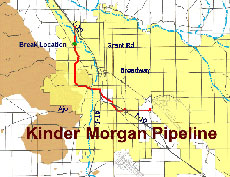
Trouble in Tuscon
Terasen suitor's many pipelines figure in several
U.S. disasters, including a very deadly one.
Kinder Morgan, the company that hopes to take over the B.C. gas utility Terasen, is “the poster child for pipeline problems,” according to Carl Weimer, executive director of the Bellingham, Washington--based Pipeline Safety Trust.
Weimer says Kinder Morgan has a poor safety record, which he attributes to the company taking over a huge network of pipelines in a short time frame. “They’ve expanded rapidly and a lot of the pipelines they took over are older pipelines. And that has undercut some of the safety,” he says.
Weimer, whose trust is funded by a court-ordered endowment created after an Olympic Pipe Line Co. pipeline in Bellingham burst and then exploded in 1999, killing three and destroying Whatcom Creek, says ongoing internal inspection is the best way to stay on top of pipeline maintenance. Weimer adds that Terasen has a good record on this front. “Hopefully the personnel won’t go through a dramatic change” during the takeover, he says, given Terasen staff’s credible record.
According to Terasen, many of their pipelines are approaching 50 years of age, and some, particularly under Vancouver, are as old as 70 years. Many of the lines Kinder Morgan took over in the U.S. are around 50 years old, says Weimer, which has resulted in several failures on its network.
Explosion killed five
The most dramatic and deadly incident had another cause, however. Five people were killed last November in Walnut Creek, California, after an excavator ruptured a high-pressure petroleum line. Gasoline filled the pipe trench and was ignited by a welding torch.
Kinder Morgan spokesman Rick Rainey told The Tyee that the incident had nothing to do with the company’s practices. “It was a backhoe operator that ruptured our pipeline, so that had nothing to do with integrity,” he says.
However, the California Department of Industrial Relations didn’t see it exactly that way. In its 20-page report on the Walnut Creek explosion, the department said the main contributing factor was that the pipeline was not properly marked: “The primary cause of the incident was that the location of the petroleum line was not known to employees working in the area.”
Negligence cited
In the end, Kinder Morgan was cited for two counts of “serious willful” and fined a total of $140,000. In the report, “willful” is defined as a situation “where evidence shows that the employer committed an intentional and knowing violation -- as distinguished from inadvertent or accidental or ordinarily negligent -- and the employer is conscious of the fact that what they are doing constitutes a violation, or is aware that a hazardous condition exists and no reasonable effort was made to eliminate the hazard.”
Right underneath that violation “serious” is defined as “cited where there is substantial probability that death or serious physical harm could result from a condition which exists -- or from practices, operations or processes at the workplace.”
The fines to the three other companies involved amounted to $51,750, less than half of what Kinder Morgan was fined for its part in the accident, even though Kinder Morgan insists the accident was not really its fault.
Another blemish on Kinder Morgan’s environmental record is a 2004 70,000-gallon diesel spill into a Northern California marsh from an old, corroded pipeline. However, according to Rainey, the company had wanted to replace the very pipeline that leaked into the marsh, and would have done so, except that California’s “cumbersome permitting process” held up the company’s attempts to change the line.
“It took us three years to even get permits. Had it been done a little more timely,” says Rainey, “we wouldn’t have had the issue of the rupture.”
Still, Kinder Morgan pled guilty in the case and paid about $3 million in penalties and restitution. The company didn’t notify the California government about the spill until 18 hours after it had occurred, a failure for which it was cited. Kinder Morgan attributed the delay to the time it took them to identify the leak and be certain there was a one.
Houses sprayed with gas
Not all of the leaks have been hard to locate. In 2003 in Tuscon, Arizona, 19,000 gallons of gasoline spilled out of another Kinder Morgan pipeline, spraying a housing development and flooding nearby streets. The resulting pipeline closure caused major gas shortages in the state.
In December 2004, a Kinder Morgan pipeline burst in the Mojave Desert in California. For 12 hours, it spewed diesel more than 70 feet into the air. The fuel seeped an estimated 50 feet below the surface and the clean up involved removing 7,500 tons of dirt from the site.
Rainey defends Kinder Morgan’s history and says that overall, “despite a couple of recent high-profile incidents,” the company has a clean record. “We have a very aggressive integrity management program, and that will be applied,” he says of the standards the company will promote in B.C.
Safety commitment lauded
According to Rainey, since the company was formed in 1997 it has increased its pipelines by 6.5 times yet spends 10.5 times more on safety and maintenence. He says the incidents have little to do with negligence. “It’s certainly not for lack of dedicating financial resources to make sure [pipelines] are safe,” he says.
Rainey says Kinder Morgan’s record is considered better than the industry average -- according to his company’s records. That sentiment is echoed by Terasen’s director of public affairs, Cam Avery. “In most quarters they’ve got above-industry-standard record,” says Avery, adding that B.C. standards would apply if Kinder Morgan succeeds in its takeover bid. “Terasen gas is regulated in British Columbia according to British Columbia standards.”
Rainey also stresses the company is actively trying to improve its practices. “Commitment to safety is our top priority,” he says.
However, Kinder Morgan has been cited for not complying with government safety standards, and for not performing emergency training. In December 2004, Kinder Morgan was fined $26,630 and promised to buy emergency equipment for a California town after failing to conduct the minimum 10 emergency drills at a Nevada oil-holding facility and for neglecting to conduct two oil-spill response drills. The safety drills were required by the Environmental Protection Agency.
Out of Enron
Kinder Morgan was formed by Richard Kinder and Bill Morgan, both former executives of the infamous energy giant Enron Corporation. Richard Kinder was the president of Enron until 1997, when he handed the reins over to Kenneth Lay, who now faces fraud charges related to the collapse of the company.
As with Lay, Kinder and his family are strong supporters of George W. Bush. Kinder’s wife raised more than $200,000 for Bush during the 2004 election, and had pledged $100,000 to the Bush campaign in 2001. According to Mother Jones, during that 2001 campaign Kinder and his wife served as regional co-chairs for Bush’s Presidential Exploratory Committee, and Kinder has given $379,745 US to the Republican party.
Terasen stockholders will vote on the sale of Terasen to Kinder Morgan in late October. If the deal is approved, Terasen could be under Kinder Morgan control by December.
Scott Webb, a Terasen gas utility spokesperson, says there is some nervousness within Terasen about the deal. There’s “a little bit of uncertainty,” he says. “This all happened very fast.” Webb added that some Terasen employees are excited that Terasen may be acquired by a company that really wants to own it.
The B.C. Ministry of Energy and Mines and the Ministry of the Environment were approached for comment on safety and regulatory issues in B.C. but were not available by press time.
Jeremy Nuttall is a Penticton radio reporter and freelance writer.
August 22, 2005
Activists, companies split over Kyoto panel
Bill Curry
Globe and Mail
22-Aug-2005
OTTAWA
Environment Canada's hope of bringing together industry executives, environmentalists and senior public servants to craft policies might not get off the ground as boycotts are threatened over who gets to run the meetings.
Some environmental critics are questioning why EnCana, a company that has been one of the most vocal critics of the Kyoto Protocol, has been asked to fill a leadership role as co-chair of a panel that will propose energy policies.
But Gerry Protti, the EnCana executive vice-president who has been named to the post, said he is proud of his company's environmental record and is looking forward to taking part in the policy sessions.
He noted that EnCana has invested in tidal-power technology, as well as research into ways to capture carbon dioxide emissions and inject them back into Earth.
"We still think [Kyoto's] a huge challenge and I think the entire energy sector recognizes that. Having said that, I think we're taking a leadership role in terms of reduction of greenhouse gas emissions.".
In July, 21 environmental groups said they would boycott the first of four such policy tables after it was announced that a vice-president of Imperial Oil had been named co-chair of the meetings dealing with chemicals.
There will also be tables dealing with the mining and forestry sectors.
Each table is co-chaired by both an industry representative and a senior public servant.
John Bennett, senior policy adviser for the Sierra Club, said that if the government wants to get industry involved, it should invite companies, such as Shell and Suncor, that have been more supportive of Kyoto and the government's environmental plan.
Mr. Bennett said environmental groups are giving Environment Canada a bit more time to convince them environmental concerns will not be sidelined by the views of industry at the four tables. "If they don't, there will be a boycott of all the tables," he added.
"The companies that fought the hardest against doing the right thing end up with the most influence with the government. It might have been some crackerjack's idea that this would be a smart way to get them in the house, but they weren't thinking what that communicated to Canadians."
Rick Smith of the Environmental Defence Fund expressed similar concerns, saying: "It's another bizarre decision by the government. It's yet another fox-in-the-henhouse scenario."
But not all environmentalists are ready to give up on the tables, or think industry representatives should be rejected out of hand.
Marlo Raynolds of the Pembina Institute, a not-for-profit environmental-policy research and education organization, took part in one of the planning meetings for the energy table. He said that while he has some concerns, he is still hopeful the meetings can be positive.
Mr. Raynolds said he is pushing for the volunteer co-chair positions to rotate and include environmentalists. EnCana deserves some credit for getting involved in the project, he added.
"It creates an opportunity for EnCana to show and demonstrate some leadership and I think we'll have to see how they use that opportunity."
Environment Canada spokesman Sebastien Bois said the co-chairs are expected to be neutral and will not be representing the positions of their companies or departments. Mr. Protti's experience in government and with outside policy groups makes him "very qualified" for the position, Mr. Bois added.
Mr. Protti, a former public servant with the Alberta government, said he received a personal invitation from Alex Himelfarb, Clerk of the Privy Council, to take part in the meetings.
Mr. Protti said he and the other energy co-chair, fisheries deputy minister Larry Murray, have been working on a list of members for the table. He predicted it will involve between 25 and 30 people.
August 21, 2005
The Breaking Point
Peter Maass
New York Times
August 21, 2005
The largest oil terminal in the world, Ras Tanura, is located on the eastern coast of Saudi Arabia, along the Persian Gulf. From Ras Tanura's control tower, you can see the classic totems of oil's dominion -- supertankers coming and going, row upon row of storage tanks and miles and miles of pipes. Ras Tanura, which I visited in June, is the funnel through which nearly 10 percent of the world's daily supply of petroleum flows. Standing in the control tower, you are surrounded by more than 50 million barrels of oil, yet not a drop can be seen.
The oil is there, of course. In a technological sleight of hand, oil can be extracted from the deserts of Arabia, processed to get rid of water and gas, sent through pipelines to a terminal on the gulf, loaded onto a supertanker and shipped to a port thousands of miles away, then run through a refinery and poured into a tanker truck that delivers it to a suburban gas station, where it is pumped into an S.U.V. -- all without anyone's actually glimpsing the stuff. So long as there is enough oil to fuel the global economy, it is not only out of sight but also out of mind, at least for consumers.
I visited Ras Tanura because oil is no longer out of mind, thanks to record prices caused by refinery shortages and surging demand -- most notably in the United States and China -- which has strained the capacity of oil producers and especially Saudi Arabia, the largest exporter of all. Unlike the 1973 crisis, when the embargo by the Arab members of the Organization of Petroleum Exporting Countries created an artificial shortfall, today's shortage, or near-shortage, is real. If demand surges even more, or if a producer goes offline because of unrest or terrorism, there may suddenly not be enough oil to go around.
As Aref al-Ali, my escort from Saudi Aramco, the giant state-owned oil company, pointed out, ''One mistake at Ras Tanura today, and the price of oil will go up.'' This has turned the port into a fortress; its entrances have an array of gates and bomb barriers to prevent terrorists from cutting off the black oxygen that the modern world depends on. Yet the problem is far greater than the brief havoc that could be wrought by a speeding zealot with 50 pounds of TNT in the trunk of his car. Concerns are being voiced by some oil experts that Saudi Arabia and other producers may, in the near future, be unable to meet rising world demand. The producers are not running out of oil, not yet, but their decades-old reservoirs are not as full and geologically spry as they used to be, and they may be incapable of producing, on a daily basis, the increasing volumes of oil that the world requires. ''One thing is clear,'' warns Chevron, the second-largest American oil company, in a series of new advertisements, ''the era of easy oil is over.''
In the past several years, the gap between demand and supply, once considerable, has steadily narrowed, and today is almost negligible. The consequences of an actual shortfall of supply would be immense. If consumption begins to exceed production by even a small amount, the price of a barrel of oil could soar to triple-digit levels. This, in turn, could bring on a global recession, a result of exorbitant prices for transport fuels and for products that rely on petrochemicals -- which is to say, almost every product on the market. The impact on the American way of life would be profound: cars cannot be propelled by roof-borne windmills. The suburban and exurban lifestyles, hinged to two-car families and constant trips to work, school and Wal-Mart, might become unaffordable or, if gas rationing is imposed, impossible. Carpools would be the least imposing of many inconveniences; the cost of home heating would soar -- assuming, of course, that climate-controlled habitats do not become just a fond memory.
But will such a situation really come to pass? That depends on Saudi Arabia. To know the answer, you need to know whether the Saudis, who possess 22 percent of the world's oil reserves, can increase their country's output beyond its current limit of 10.5 million barrels a day, and even beyond the 12.5-million-barrel target it has set for 2009. (World consumption is about 84 million barrels a day.) Saudi Arabia is the sole oil superpower. No other producer possesses reserves close to its 263 billion barrels, which is almost twice as much as the runner-up, Iran, with 133 billion barrels. New fields in other countries are discovered now and then, but they tend to offer only small increments. For example, the much-contested and as-yet-unexploited reserves in the Alaska National Wildlife Refuge are believed to amount to about 10 billion barrels, or just a fraction of what the Saudis possess.
But the truth about Saudi oil is hard to figure out. Oil reservoirs cannot be inventoried like wood in a wilderness: the oil is underground, unseen by geologists and engineers, who can, at best, make highly educated guesses about how much is underfoot and how much can be extracted in the future. And there is a further obstacle: the Saudis will not let outsiders audit their confidential data on reserves and production. Oil is an industry in which not only is the product hidden from sight but so is reliable information about it. And because we do not know when a supply-demand shortfall might arrive, we do not know when to begin preparing for it, so as to soften its impact; the economic blow may come as a sledgehammer from the darkness.
Of course the Saudis do have something to say about this prospect. Before journeying to the kingdom, I went to Washington to hear the Saudi oil minister, Ali al-Naimi, speak at an energy conference in the mammoth Ronald Reagan Building and International Trade Center, not far from the White House. Naimi was the star attraction at a gathering of the American petro-political nexus. Samuel Bodman, the U.S. energy secretary, was on the dais next to him. David O'Reilly, chairman and C.E.O. of Chevron, was waiting in the wings. The moderator was an éminence grise of the oil world, James Schlesinger, a former energy secretary, defense secretary and C.I.A. director.
''I want to assure you here today that Saudi Arabia's reserves are plentiful, and we stand ready to increase output as the market dictates,'' said Naimi, dressed in a gray business suit and speaking with only a slight Arabic accent. He addressed skeptics who contend that Saudi reservoirs cannot be tapped for larger amounts of oil. ''I am quite bullish on technology as the key to our energy future,'' he said. ''Technological innovation will allow us to find and extract more oil around the world.'' He described the task of increasing output as just ''a question of investment'' in new wells and pipelines, and he noted that consuming nations urgently need to build new refineries to process increased supplies of crude. ''There is absolutely no lack of resources worldwide,'' he repeated.
His assurances did not assure. A barrel of oil cost $55 at the time of his speech; less than three months later, the price had jumped by 20 percent. The truth of the matter -- whether the world will really have enough petroleum in the years ahead -- was as well concealed as the millions of barrels of oil I couldn't see at Ras Tanura.
or 31 years, Matthew Simmons has prospered as the head of his own firm, Simmons & Company International, which advises energy companies on mergers and acquisitions. A member of the Council on Foreign Relations, a graduate of the Harvard Business School and an unpaid adviser on energy policy to the 2000 presidential campaign of George W. Bush, he would be a card-carrying member of the global oil nomenclatura, if cards were issued for such things. Yet he is one of the principal reasons the oil world is beginning to ask hard questions of itself.
Two years ago, Simmons went to Saudi Arabia on a government tour for business executives. The group was presented with the usual dog-and-pony show, but instead of being impressed, as most visitors tend to be, with the size and expertise of the Saudi oil industry, Simmons became perplexed. As he recalls in his somewhat heretical new book, ''Twilight in the Desert: The Coming Saudi Oil Shock and the World Economy,'' a senior manager at Aramco told the visitors that ''fuzzy logic'' would be used to estimate the amount of oil that could be recovered. Simmons had never heard of fuzzy logic. What could be fuzzy about an oil reservoir? He suspected that Aramco, despite its promises of endless supplies, might in fact not know how much oil remained to be recovered.
Simmons returned home with an itch to scratch. Saudi Arabia was one of the charter members of OPEC, founded in 1960 in Baghdad to coordinate the policies of oil producers. Like every OPEC country, Saudi Arabia provides only general numbers about its output and reserves; it does not release details about how much oil is extracted from each reservoir and what methods are used to extract that oil, and it does not permit audits by outsiders. The condition of Saudi fields, and those of other OPEC nations, is a closely guarded secret. That's largely because OPEC quotas, which were first imposed in 1983 to limit the output of member countries, were based on overall reserves; the higher an OPEC member's reserves, the higher its quota. It is widely believed that most, if not all, OPEC members exaggerated the sizes of their reserves in order to have the largest possible quota -- and thus the largest possible revenue stream.
In the days of excess supply, bankers like Simmons did not know, or care, about the fudging; whether or not reserves were hyped, there was plenty of oil coming out of the ground. Through the 1970's, 80's and 90's, the capacity of OPEC and non-OPEC countries exceeded demand, and that's why OPEC imposed a quota system -- to keep some product off the market (although many OPEC members, seeking as much revenue as possible, quietly sold more oil than they were supposed to). Until quite recently, the only reason to fear a shortage was if a boycott, war or strike were to halt supplies. Few people imagined a time when supply would dry up because of demand alone. But a steady surge in demand in recent years -- led by China's emergence as a voracious importer of oil -- has changed that.
This demand-driven scarcity has prompted the emergence of a cottage industry of experts who predict an impending crisis that will dwarf anything seen before. Their point is not that we are running out of oil, per se; although as much as half of the world's recoverable reserves are estimated to have been consumed, about a trillion barrels remain underground. Rather, they are concerned with what is called ''capacity'' -- the amount of oil that can be pumped to the surface on a daily basis. These experts -- still a minority in the oil world -- contend that because of the peculiarities of geology and the limits of modern technology, it will soon be impossible for the world's reservoirs to surrender enough oil to meet daily demand.
One of the starkest warnings came in a February report commissioned by the United States Department of Energy's National Energy Technology Laboratory. ''Because oil prices have been relatively high for the past decade, oil companies have conducted extensive exploration over that period, but their results have been disappointing,'' stated the report, assembled by Science Applications International, a research company that works on security and energy issues. ''If recent trends hold, there is little reason to expect that exploration success will dramatically improve in the future. . . . The image is one of a world moving from a long period in which reserves additions were much greater than consumption to an era in which annual additions are falling increasingly short of annual consumption. This is but one of a number of trends that suggest the world is fast approaching the inevitable peaking of conventional world oil production.''
The reference to ''peaking'' is not a haphazard word choice -- ''peaking'' is a term used in oil geology to define the critical point at which reservoirs can no longer produce increasing amounts of oil. (This tends to happen when reservoirs are about half-empty.) ''Peak oil'' is the point at which maximum production is reached; afterward, no matter how many wells are drilled in a country, production begins to de cline.SaudiArabia and other OPEC members may have enough oil to last for generations, but that is no longer the issue. The eventual and painful shift to different sources of energy -- the start of the post-oil age -- does not begin when the last drop of oil is sucked from under the Arabian desert. It begins when producers are unable to continue increasing their output to meet rising demand. Crunch time comes long before the last drop.
''The world has never faced a problem like this,'' the report for the Energy Department concluded. ''Without massive mitigation more than a decade before the fact, the problem will be pervasive and will not be temporary. Previous energy transitions (wood to coal and coal to oil) were gradual and evolutionary; oil peaking will be abrupt and revolutionary.''
Most experts do not share Simmons's concerns about the imminence of peak oil. One of the industry's most prominent consultants, Daniel Yergin, author of a Pulitzer Prize-winning book about petroleum, dismisses the doomsday visions. ''This is not the first time that the world has 'run out of oil,''' he wrote in a recent Washington Post opinion essay. ''It's more like the fifth. Cycles of shortage and surplus characterize the entire history of the oil industry.'' Yergin says that a number of oil projects that are under construction will increase the supply by 20 percent in five years and that technological advances will increase the amount of oil that can be recovered from existing reservoirs. (Typically, with today's technology, only about 40 percent of a reservoir's oil can be pumped to the surface.)
Yergin's bullish view has something in common with the views of the pessimists -- it rests on unknowns. Will the new projects that are under way yield as much oil as their financial backers hope? Will new technologies increase recovery rates as much as he expects? These questions are next to impossible to answer because coaxing oil out of the ground is an extraordinarily complex undertaking. The popular notion of reservoirs as underground lakes, from which wells extract oil like straws sucking a milkshake from a glass, is incorrect. Oil exists in drops between and inside porous rocks. A new reservoir may contain sufficient pressure to make these drops of oil flow to the surface in a gusher, but after a while -- usually within a few years and often sooner than that -- natural pressure lets up and is no longer sufficient to push oil to the surface. At that point, ''secondary'' recovery efforts are begun, like pumping water or gas into the reservoirs to increase the pressure.
This process is unpredictable; reservoirs are extremely temperamental. If too much oil is extracted too quickly or if the wrong types or amounts of secondary efforts are employed, the amount of oil that can be recovered from a field can be greatly reduced; this is known in the oil world as ''damaging a reservoir.'' A widely cited example is Oman: in 2001, its daily production reached more than 960,000 barrels, but then suddenly declined, despite the use of advanced technologies. Today, Oman produces 785,000 barrels of oil a day. Herman Franssen, a consultant who worked in Oman for a decade, sees that country's experience as a possible lesson in the limits of technology for other producers that try to increase or maintain high levels of output. ''They reached a million barrels a day, and then a few years later production collapsed,'' Franssen said in a phone interview. ''They used all these new technologies, but they haven't been able to stop the decline yet.''
The vague production and reserve data that gets published does not begin to tell the whole story of an oil field's health, production potential or even its size. For a clear-as-possible picture of a country's oil situation, you need to know what is happening in each field -- how many wells it has, how much oil each well is producing, what recovery methods are being used and how long they've been used and the trend line since the field went into production. Data of that sort are typically not released by state-owned companies like Saudi Aramco.
As Matthew Simmons searched for clues to the truth of the Saudi situation, he immersed himself in the minutiae of oil geology. He realized that data about Saudi fields might be found in the files of the Society of Petroleum Engineers. Oil engineers, like most professional groups, have regular conferences at which they discuss papers that delve into the work they do. The papers, which focus on particular wells that highlight a problem or a solution to a problem, are presented and debated at the conferences and published by the S.P.E. -- and then forgotten.
Before Simmons poked around, no one had taken the time to pull together the S.P.E. papers that involved Saudi oil fields and review them en masse. Simmons found more than 200 such papers and studied them carefully. Although the papers cover only a portion of the kingdom's wells and date back, in some cases, several decades, they constitute perhaps the best public data about the condition and prospects of Saudi reservoirs.
Ghawar is the treasure of the Saudi treasure chest. It is the largest oil field in the world and has produced, in the past 50 years, about 55 billion barrels of oil, which amounts to more than half of Saudi production in that period. The field currently produces more than five million barrels a day, which is about half of the kingdom's output. If Ghawar is facing problems, then so is Saudi Arabia and, indeed, the entire world.
Simmons found that the Saudis are using increasingly large amounts of water to force oil out of Ghawar. Most of the wells are concentrated in the northern portion of the 174-mile-long field. That might seem like good news -- when the north runs low, the Saudis need only to drill wells in the south. But in fact it is bad news, Simmons concluded, because the southern portions of Ghawar are geologically more difficult to draw oil from. ''Someday (and perhaps that day will be soon), the remarkably high well flow rates at Ghawar's northern end will fade, as reservoir pressures finally plummet,'' Simmons writes in his book. ''Then, Saudi Arabian oil output will clearly have peaked. The death of this great king'' -- meaning Ghawar -- ''leaves no field of vaguely comparable stature in the line of succession. Twilight at Ghawar is fast approaching.'' He goes on: ''The geological phenomena and natural driving forces that created the Saudi oil miracle are conspiring now in normal and predictable ways to bring it to its conclusion, in a time frame potentially far shorter than officialdom would have us believe.'' Simmons concludes, ''Saudi Arabia clearly seems to be nearing or at its peak output and cannot materially grow its oil production.''
Saudi officials belittle Simmons's work. Nansen Saleri, a senior Aramco official, has described Simmons as a banker ''trying to come across as a scientist.'' In a speech last year, Saleri wryly said, ''I can read 200 papers on neurology, but you wouldn't want me to operate on your relatives.'' I caught up with Simmons in June, during a trip he made to Manhattan to talk with a group of oil-shipping executives. The impression he gives is of an enthusiastic inventor sharing a discovery that took him by surprise. He has a certain wide-eyed wonder in his regard, as if a bit of mystery can be found in everything that catches his eye. And he has a rumpled aspect -- thinning hair slightly askew, shirt sleeves a fraction too long. Though he delivers a bracing message, his discourse can wander. He is a successful businessman, and it is clear that he did not achieve his position by being a man of impeccable convention. He certainly has not lost sight of the rule that people who shout ''the end is nigh'' do not tend to be favorably reviewed by historians, let alone by their peers. He notes in his book that way back in 1979, The New York Times published an investigative story by Seymour Hersh under the headline ''Saudi Oil Capacity Questioned.'' He knows that in past decades the Cassandras failed to foresee new technologies, like deep-water and horizontal drilling, that provided new sources of oil and raised the amount of oil that can be recovered from reservoirs.
But Simmons says that there are only so many rabbits technology can pull out of its petro-hat. He impishly notes that if the Saudis really wanted to, they could easily prove him wrong. ''If they want to satisfy people, they should issue field-by-field production reports and reserve data and have it audited,'' he told me. ''It would then take anybody less than a week to say, 'Gosh, Matt is totally wrong,' or 'Matt actually might be too optimistic.'''
Simmons has a lot riding on his campaign -- not only his name but also his business, which would not be rewarded if he is proved to be a fool. What, I asked, if the data show that the Saudis will be able to sustain production of not only 12.5 million barrels a day -- their target for 2009 -- but 15 million barrels, which global demand is expected to require of them in the not-too-distant future? ''The odds of them sustaining 12 million barrels a day is very low,'' Simmons replied. ''The odds of them getting to 15 million for 50 years -- there's a better chance of me having Bill Gates's net worth, and I wouldn't bet a dime on that forecast.''
The gathering of executives took place in a restaurant at Chelsea Piers; about 35 men sat around a set of tables as the host introduced Simmons. He rambled a bit but hit his talking points, and the executives listened raptly; at one point, the man on my right broke into a soft whistle, of the sort that means ''Holy cow.''
Simmons didn't let up. ''We're going to look back at history and say $55 a barrel was cheap,'' he said, recalling a TV interview in which he predicted that a barrel might hit triple digits.
He said that the anchor scoffed, in disbelief, ''A hundred dollars?''
Simmons replied, ''I wasn't talking about low triple digits.''
he onset of triple-digit prices might seem a blessing for the Saudis -- they would receive greater amounts of money for their increasingly scarce oil. But one popular misunderstanding about the Saudis -- and about OPEC in general -- is that high prices, no matter how high, are to their benefit.
Although oil costing more than $60 a barrel hasn't caused a global recession, that could still happen: it can take a while for high prices to have their ruinous impact. And the higher above $60 that prices rise, the more likely a recession will become. High oil prices are inflationary; they raise the cost of virtually everything -- from gasoline to jet fuel to plastics and fertilizers -- and that means people buy less and travel less, which means a drop-off in economic activity. So after a brief windfall for producers, oil prices would slide as recession sets in and once-voracious economies slow down, using less oil. Prices have collapsed before, and not so long ago: in 1998, oil fell to $10 a barrel after an untimely increase in OPEC production and a reduction in demand from Asia, which was suffering through a financial crash. Saudi Arabia and the other members of OPEC entered crisis mode back then; adjusted for inflation, oil was at its lowest price since the cartel's creation, threatening to feed unrest among the ranks of jobless citizens in OPEC states.
''The Saudis are very happy with oil at $55 per barrel, but they're also nervous,'' a Western diplomat in Riyadh told me in May, referring to the price that prevailed then. (Like all the diplomats I spoke to, he insisted on speaking anonymously because of the sensitivities of relations with Saudi Arabia.) ''They don't know where this magic line has moved to. Is it now $65? Is it $75? Is it $80? They don't want to find out, because if you did have oil move that far north . . . the chain reaction can come back to a price collapse again.''
High prices can have another unfortunate effect for producers. When crude costs $10 a barrel or even $30 a barrel, alternative fuels are prohibitively expensive. For example, Canada has vast amounts of tar sands that can be rendered into heavy oil, but the cost of doing so is quite high. Yet those tar sands and other alternatives, like bioethanol, hydrogen fuel cells and liquid fuel from natural gas or coal, become economically viable as the going rate for a barrel rises past, say, $40 or more, especially if consuming governments choose to offer their own incentives or subsidies. So even if high prices don't cause a recession, the Saudis risk losing market share to rivals into whose nonfundamentalist hands Americans would much prefer to channel their energy dollars. A concerted push for greater energy conservation in the United States, which consumes one-quarter of the world's oil (mostly to fuel our cars, as gasoline), would hurt producing nations, too. Basically, any significant reduction in the demand for oil would be ruinous for OPEC members, who have little to offer the world but oil; if a substitute can be found, their future is bleak. Another Western diplomat explained the problem facing the Saudis: ''You want to have the price as high as possible without sending the consuming nations into a recession and at the same time not have the price so high that it encourages alternative technologies.''
From the American standpoint, one argument in favor of conservation and a switch to alternative fuels is that by limiting oil imports, the United States and its Western allies would reduce their dependence on a potentially unstable region. (In fact, in an effort to offset the risks of relying on the Saudis, America's top oil suppliers are Canada and Mexico.) In addition, sending less money to Saudi Arabia would mean less money in the hands of a regime that has spent the past few decades doling out huge amounts of its oil revenue to mosques, madrassas and other institutions that have fanned the fires of Islamic radicalism. The oil money has been dispensed not just by the Saudi royal family but by private individuals who benefited from the oil boom -- like Osama bin Laden, whose ample funds, probably eroded now, came from his father, a construction magnate. Without its oil windfall, Saudi Arabia would have had a hard time financing radical Islamists across the globe.
For the Saudis, the political ramifications of reduced demand for its oil would not be negligible. The royal family has amassed vast personal wealth from the country's oil revenues. If, suddenly, Saudis became aware that the royal family had also failed to protect the value of the country's treasured resource, the response could be severe. The mere admission that Saudi reserves are not as impressively inexhaustible as the royal family has claimed could lead to hard questions about why the country, and the world, had been misled. With the death earlier this month of the long-ailing King Fahd, the royal family is undergoing another period of scrutiny; the new king, Abdullah, is in his 80's, and the crown prince, his half-brother Sultan, is in his 70's, so the issue of generational change remains to be settled. As long as the country is swimming in petro-dollars -- even as it is paying off debt accrued during its lean years -- everyone is relatively happy, but that can change. One diplomat I spoke to recalled a comment from Sheik Ahmed Zaki Yamani, the larger-than-life Saudi oil minister during the 1970's: ''The Stone Age didn't end for lack of stone, and the oil age will end long before the world runs out of oil.''
Until now, the Saudis had an excess of production capacity that allowed them, when necessary, to flood the market to drive prices down. They did that in 1990, when the Iraqi invasion of Kuwait eliminated not only Kuwait's supply of oil but also Iraq's. The Saudis functioned, as they always had, as the central bank of oil, releasing supply to the market when it was needed and withdrawing supply to keep prices from going lower than the cartel would have liked. In other words, they controlled not only the price of oil but their own destiny as well.
''That is what the world has called on them to do before -- turn on the taps to produce more and get prices down,'' a senior Western diplomat in Riyadh told me recently. ''Decreasing prices used to keep out alternative fuels. I don't see how they're able to do that anymore. This is a huge change, and it is a big step in the move to whatever is coming next. That's what's really happening.''
Without the ability to flood the markets with oil, the Saudis are resorting to flooding the market with promises; it is a sort of petro-jawboning. That's why Ali al-Naimi, the oil minister, told his Washington audience that Saudi Arabia has embarked on a crash program to raise its capacity to 12.5 million barrels a day by 2009 and even higher in the years after that. Naimi is not unlike a factory manager who needs to promise the moon to his valuable clients, for fear of losing or alarming them. He has no choice. The moment he says anything bracing, the touchy energy markets will probably panic, pushing prices even higher and thereby hastening the onset of recession, a switch to alternative fuels or new conservation efforts -- or all three. Just a few words of honest caution could move the markets; Naimi's speeches are followed nearly as closely in the financial world as those of Alan Greenspan.
I journeyed to Saudi Arabia to interview Naimi and other senior officials, to get as far beyond their prepared remarks as might be possible. Although I was allowed to see Ras Tanura, my interview requests were denied. I was invited to visit Aramco's oil museum in Dhahran, but that is something a Saudi schoolchild can do on a field trip. It was a ''show but don't tell'' policy. I was able to speak about production issues only with Ibrahim al-Muhanna, the oil ministry spokesman, who reluctantly met me over coffee in the lobby of my hotel in Riyadh. He defended Saudi Arabia's refusal to share more data, noting that the Saudis are no different from most oil producers.
''They will not tell you,'' he said. ''Nobody will. And that is not going to change.'' Referring to the fact that Saudi Arabia is often called the central bank of oil, he added: ''If an outsider goes to the Fed and asks, 'How much money do you have?' they will tell you. If you say, 'Can I come and count it?' they will not let you. This applies to oil companies and oil countries.'' I mentioned to Muhanna that many people think his government's ''trust us'' stance is not convincing in light of the cheating that has gone on within OPEC and in the industry as a whole; even Royal Dutch/Shell, a publicly listed oil company that undergoes regular audits, has admitted that it overstated its 2002 reserves by 23 percent.
''There is no reason for any country or company to lie,'' Muhanna replied. ''There is a lot of oil around.'' I didn't need to ask about Simmons and his peak-oil theory; when I met Muhanna at the conference in Washington, he nearly broke off our conversation at the mention of Simmons's name. ''He does not know anything,'' Muhanna said. ''The only thing he has is a big mouth. We should not pay attention to him. Either you believe us or you don't.''
o whom to believe? Before leaving New York for Saudi Arabia, I was advised by several oil experts to try to interview Sadad al-Husseini, who retired last year after serving as Aramco's top executive for exploration and production. I faxed him in Dhahran and received a surprisingly quick reply; he agreed to meet me. A week later, after I arrived in Riyadh, Husseini e-mailed me, asking when I would come to Dhahran; in a follow-up phone call, he offered to pick me up at the airport. He was, it seemed, eager to talk.
It can be argued that in a nation devoted to oil, Husseini knows more about it than anyone else. Born in Syria, Husseini was raised in Saudi Arabia, where his father was a government official whose family took on Saudi citizenship. Husseini earned a Ph.D. in geological sciences from Brown University in 1973 and went to work in Aramco's exploration department, eventually rising to the highest position. Until his retirement last year -- said to have been caused by a top-level dispute, the nature of which is the source of many rumors -- Husseini was a member of the company's board and its management committee. He is one of the most respected and accomplished oilmen in the world.
After meeting me at the cavernous airport that serves Dhahran, he drove me in his luxury sedan to the villa that houses his private office. As we entered, he pointed to an armoire that displayed a dozen or so vials of black liquid. ''These are samples from oil fields I discovered,'' he explained. Upstairs, there were even more vials, and he would have possessed more than that except, as he said, laughing, ''I didn't start collecting early enough.''
We spoke for several hours. The message he delivered was clear: the world is heading for an oil shortage. His warning is quite different from the calming speeches that Naimi and other Saudis, along with senior American officials, deliver on an almost daily basis. Husseini explained that the need to produce more oil is coming from two directions. Most obviously, demand is rising; in recent years, global demand has increased by two million barrels a day. (Current daily consumption, remember, is about 84 million barrels a day.) Less obviously, oil producers deplete their reserves every time they pump out a barrel of oil. This means that merely to maintain their reserve base, they have to replace the oil they extract from declining fields. It's the geological equivalent of running to stay in place. Husseini acknowledged that new fields are coming online, like offshore West Africa and the Caspian basin, but he said that their output isn't big enough to offset this growing need.
''You look at the globe and ask, 'Where are the big increments?' and there's hardly anything but Saudi Arabia,'' he said. ''The kingdom and Ghawar field are not the problem. That misses the whole point. The problem is that you go from 79 million barrels a day in 2002 to 82.5 in 2003 to 84.5 in 2004. You're leaping by two million to three million a year, and if you have to cover declines, that's another four to five million.'' In other words, if demand and depletion patterns continue, every year the world will need to open enough fields or wells to pump an additional six to eight million barrels a day -- at least two million new barrels a day to meet the rising demand and at least four million to compensate for the declining production of existing fields. ''That's like a whole new Saudi Arabia every couple of years,'' Husseini said. ''It can't be done indefinitely. It's not sustainable.''
Husseini speaks patiently, like a teacher who hopes someone is listening. He is in the enviable position of knowing what he talks about while having the freedom to speak openly about it. He did not disclose precise information about Saudi reserves or production -- which remain the equivalent of state secrets -- but he felt free to speak in generalities that were forthright, even when they conflicted with the reassuring statements of current Aramco officials. When I asked why he was willing to be so frank, he said it was because he sees a shortage ahead and wants to do what he can to avert it. I assumed that he would not be particularly distressed if his rivals in the Saudi oil establishment were embarrassed by his frankness.
Although Matthew Simmons says it is unlikely that the Saudis will be able to produce 12.5 million barrels a day or sustain output at that level for a significant period of time, Husseini says the target is realistic; he says that Simmons is wrong to state that Saudi Arabia has reached its peak. But 12.5 million is just an interim marker, as far as consuming nations are concerned, on the way to 15 million barrels a day and beyond -- and that is the point at which Husseini says problems will arise.
At the conference in Washington in May, James Schlesinger, the moderator, conducted a question-and-answer session with Naimi at the conclusion of the minister's speech. One of the first questions involved peak oil: might it be true that Saudi Arabia, which has relied on the same reservoirs, and especially Ghawar, for more than five decades, is nearing the geological limit of its output?
Naimi wouldn't hear of it.
''I can assure you that we haven't peaked,'' he responded. ''If we peaked, we would not be going to 12.5 and we would not be visualizing a 15-million-barrel-per-day production capacity. . . . We can maintain 12.5 or 15 million for the next 30 to 50 years.''
Experts like Husseini are very concerned by the prospect of trying to produce 15 million barrels a day. Even if production can be ramped up that high, geology may not be forgiving. Fields that are overproduced can drop off, in terms of output, quite sharply and suddenly, leaving behind large amounts of oil that cannot be coaxed out with existing technology. This is called trapped oil, because the rocks or sediment around it prevent it from escaping to the surface. Unless new technologies are developed, that oil will never be extracted. In other words, the haste to recover oil can lead to less oil being recovered.
''You could go to 15, but that's when the questions of depletion rate, reservoir management and damaging the fields come into play,'' says Nawaf Obaid, a Saudi oil and security analyst who is regarded as being exceptionally well connected to key Saudi leaders. ''There is an understanding across the board within the kingdom, in the highest spheres, that if you're going to 15, you'll hit 15, but there will be considerable risks . . . of a steep decline curve that Aramco will not be able to do anything about.''
Even if the Saudis are willing to risk damaging their fields, or even if the risk is overstated, Husseini points out a practical problem. To produce and sustain 15 million barrels a day, Saudi Arabia will have to drill a lot more wells and build a lot more pipelines and processing facilities. Currently, the global oil industry suffers a deficit of qualified engineers to oversee such projects and the equipment and the raw materials -- for example, rigs and steel -- to build them. These things cannot be wished from thin air or developed quickly enough to meet the demand.
''If we had two dozen Texas A&M's producing a thousand new engineers a year and the industrial infrastructure in the kingdom, with the drilling rigs and power plants, we would have a better chance, but you cannot put that into place overnight,'' Husseini said. ''Capacity is not just a function of reserves. It is a function of reserves plus know-how plus a commercial economic system that is designed to increase the resource exploitation. For example, in the U.S. you have infrastructure -- there must be tens of thousands of miles of pipelines. If we, in Saudi Arabia, evolve to that level of commercial maturity, we could probably produce a heck of a lot more oil. But to get there is a very tedious, slow process.''
He worries that the rising global demand for oil will lead to the petroleum equivalent of running an engine at ever-increasing speeds without stopping to cool it down or change the oil. Husseini does not want to see the fragile and irreplaceable reservoirs of the Middle East become damaged through wanton overproduction.
''If you are ramping up production so fast and jump from high to higher to highest, and you're not having enough time to do what needs to be done, to understand what needs to be done, then you can damage reservoirs,'' he said. ''Systematic development is not just a matter of money. It's a matter of reservoir dynamics, understanding what's there, analyzing and understanding information. That's where people come in, experience comes in. These are not universally available resources.''
The most worrisome part of the crisis ahead revolves around a set of statistics from the Energy Information Administration, which is part of the U.S. Department of Energy. The E.I.A. forecast in 2004 that by 2020 Saudi Arabia would produce 18.2 million barrels of oil a day, and that by 2025 it would produce 22.5 million barrels a day. Those estimates were unusual, though. They were not based on secret information about Saudi capacity, but on the projected needs of energy consumers. The figures simply assumed that Saudi Arabia would be able to produce whatever the United States needed it to produce. Just last month, the E.I.A. suddenly revised those figures downward -- not because of startling new information about world demand or Saudi supply but because the figures had given so much ammunition to critics. Husseini, for example, described the 2004 forecast as unrealistic.
''That's not how you would manage a national, let alone an international, economy,'' he explained. ''That's the part that is scary. You draw some assumptions and then say, 'O.K., based on these assumptions, let's go forward and consume like hell and burn like hell.''' When I asked whether the kingdom could produce 20 million barrels a day -- about twice what it is producing today from fields that may be past their prime -- Husseini paused for a second or two. It wasn't clear if he was taking a moment to figure out the answer or if he needed a moment to decide if he should utter it. He finally replied with a single word: No.
''It's becoming unrealistic,'' he said. ''The expectations are beyond what is achievable. This is a global problem . . . that is not going to be solved by tinkering with the Saudi industry.''
It would be unfair to blame the Saudis alone for failing to warn of whatever shortages or catastrophes might lie ahead.
In the political and corporate realms of the oil world, there are few incentives to be forthright. Executives of major oil companies have been reluctant to raise alarms; the mere mention of scarce supplies could alienate the governments that hand out lucrative exploration contracts and also send a message to investors that oil companies, though wildly profitable at the moment, have a Malthusian long-term future. Fortunately, that attitude seems to be beginning to chang e.Chevron's''easyoilisover'' advertising campaign is an indication that even the boosters of an oil-drenched future are not as bullish as they once were.
Politicians remain in the dark. During the 2004 presidential campaign, which occurred as gas prices were rising to record levels, the debate on energy policy was all but nonexistent. The Bush campaign produced an advertisement that concluded: ''Some people have wacky ideas. Like taxing gasoline more so people drive less. That's John Kerry.'' Although many environmentalists would have been delighted if Kerry had proposed that during the campaign, in fact the ad was referring to a 50-cents-a-gallon tax that Kerry supported 11 years ago as part of a package of measures to reduce the deficit. (The gas tax never made it to a vote in the Senate.) Kerry made no mention of taxing gasoline during the campaign; his proposal for doing something about high gas prices was to pressure OPEC to increase supplies.
Husseini, for one, doesn't buy that approach. ''Everybody is looking at the producers to pull the chestnuts out of the fire, as if it's our job to fix everybody's problems,'' he told me. ''It's not our problem to tell a democratically elected government that you have to do something about your runaway consumers. If your government can't do the job, you can't expect other governments to do it for them.'' Back in the 70's, President Carter called for the moral equivalent of war to reduce our dependence on foreign oil; he was not re-elected. Since then, few politicians have spoken of an energy crisis or suggested that major policy changes are necessary to avert one. The energy bill signed earlier this month by President Bush did not even raise fuel-efficiency standards for passenger cars. When a crisis comes -- whether in a year or 2 or 10 -- it will be all the more painful because we will have done little or nothing to prepare for it.
Peter Maass is a contributing writer. He is writing a book about oil.
Copyright 2005 The New York Times Company
Cogen up and running 95 per cent of the time
Grant Warkentin
Campbell River Mirror
Aug 17 2005
The Island Cogen power plant beside the Elk Falls paper mill has had minimal downtime this year.
During the second quarter of 2005, the natural gas-fired power plant was capable of generating electricity 95 per cent of the time, or 496,025 megawatt-hours. During the same time last year, the plant was only capable of generating electricity 46 per cent of the time, or 191,482 megawatt-hours of electricity.
The Island Cogen facility was shut down for four days in the second quarter of 2005 for maintenance compared to 63 days for the same period 2004. That's because in spring 2004, the plant was undergoing a major upgrade to increase its capacity to generate electricity. The plant's owners, Calpine Power Income Fund, are happy with the performance of all its power plants.
"We are pleased to announce another quarter of strong results from all of our facilities," said Toby Austin, president and CEO of Calpine Canada Power Ltd., manager of Calpine Power Income Fund, in a news release. "All of our facilities performed at high levels of availability, contributing to net earnings at or above expected levels."
Since the upgrade, the plant has been able to generate more electricity - and more revenue - for its owners.
During the first six months of 2005, the plant generated 1,018,881 megawatt-hours of electricity at 97 per cent availability.
During the same time, the plant earned $22.2 million in revenue from electricity sales compared to $13.2 million during the same time last year.
The company also made more money from the excess steam it sells to NorskeCanada's paper mill next door. During the first six months of 2005, it sold $6.4 million worth of steam to the paper mill compared to $4.9 million during the same time last year.
"As a result of the strengthening Canadian dollar, as well as natural gas prices, the steam price has increased 25 per cent over the prior quarter," says the news release. "Steam volumes, although higher than the second quarter of 2004, were lower than expected due to repairs to equipment required for delivery of steam to NorskeSkog.
"Lost revenue from lower steam sales was offset by the plant's higher deliveries of electrical power during this period." Last week, however, revenue and deliveries of steam have returned to normal levels, according to the news release.
August 19, 2005
Offshore oil decision promised by year's end
Rudy Haugeneder
Victoria News
August 19, 2005
Minister says it won’t happen unless environmentally safe
BC’s bitter offshore oil and gas battle with Ottawa is quickly nearing a conclusion. Ottawa has set a year-end deadline on the fate of the decades old moratorium on BC offshore oil and gas exploration and development, says a federal cabinet minister.
The federal government will make “a full decision” on the future of BC’s vast oil and gas reserves “by the end of this year,” said Western Economic Diversification Minister Stephen Owen.
“We’re getting close,” the former deputy attorney general of BC said in an interview Tuesday at the University of Victoria.
Owen wouldn’t disclose what he expects the federal cabinet decision will be, but said offshore development won’t be allowed to take place unless it’s “environmentally safe.” He said that may be the reason “oil and gas companies are in no hurry to see exploration.”
However, several southern Vancouver Island high-technology companies that provide offshore oil and gas expertise are eager for the moratorium to be lifted.
David Fissel, vice president of ASL Environmental Sciences that provides oceanographic environmental assessments to offshore rigs in Africa, Russia and the US said “It would generate jobs and business opportunities for all of us. Estimating that there are at least 100 ocean science and engineering companies head quartered in BC-dozens in the Victoria area-that would benefit if the moratorium is lifted, he said, “it would be nice, from a business point of view, to be closer to home.”
Local MP and former federal environment minister David Anderson said the Campbell government won’t like Ottawa’s answer.
He said the idea of lifting the moratorium has been “90 per cent dead and shelved” for several months at the federal level-and the provincial government knows it.
It’s why the Campbell government “didn’t mention the moratorium before or after the (May) provincial election,” he said.
Anderson said in an independent review by a Royal Society of Canada panel of experts shows 75 per cent of British Columbians oppose offshore oil and gas exploration and developments at this time.
“To do anything else would make a mockery of the process,” Anderson said. Another local Liberal MP, Dr. Keith Martin, seemed taken aback by Owen’s unexpected remarks, but agreed no exploration and development should be allowed unless it’s environmentally safe.
Only then will the federal government give the green light to offshore development, said Martin, the parliamentary secretary to Minister of Defence Bill Graham and a strong proponent of alternative energy such as tidal power.
The Royal Society’s offshore report concluded that “provided an adequate regulatory regime is put in place, there are no science gaps that need to be filled before lifting the moratoria on oil and gas development.” Steve Simons, provincial oil and gas communications director, is also surprised that Ottawa is ready to act on the moratorium because “they haven’t given us a deadline date.”
He said the Royal Society Report estimates BC waters have six offshore oil fields holding 100 million barrels of oil, and nine gas fields with 9.8 trillion cubic feet of natural gas.
Simons said that based on an oil price of $35 a barrel, the total value of BC’s potential oil and gas reserves is $110 billion.
Oil and gas prices are currently around $67 a barrel. Acknowledging that the moratorium is likely to be lifted at some time, Anderson said it’s ok to leave the oil and gas in the ground until better environmentally safe technology is developed to extract it. Owen was at UVIC to announce $3 million in federal grants for ocean research and the technology sector.
August 17, 2005
Tom Hackney: Activist of the Year

Sierra Club of Canada has named Tom Hackney, the president and founding director of the GSX Concerned Citizens Coalition, as "Activist of the Year".
August 2005 issue of Sierra Life
“Tom has shown that perseverance, dedication and a strong vision for the future can affect change at the highest levels,” said the BC Chapter Executive Director Kathryn Molloy. “Volunteers like Tom are by far this organization’s greatest asset."
See Tom's article in the Fall 2005 issue of Sierra Report, also excerpted on sqwalk.
The GSX Concerned Citizens Coalition echoes the Sierra Club's high opinion of Tom, and applauds the award decision. Tom is an awesome guy - principled, disciplined and fiercely hard-working. And fun.
August 15, 2005
How We Got Screwed on Terasen Deal
Rafe Mair
TheTyee.ca
August 15, 2005
Richard Kinder, former Enron president
Thanks to BC Libs, Texans control our gas profits, and supply.
I am just a poor one time lawyer, one time politician and part time environmentalist who does a bit of broadcasting and writing. I know nothing about oil and natural gas except what it costs me. But I do know bullshit when it wafts my way, especially if the source is anywhere near where politicians ply their trade, PR people hang out (usually the same place) or when CEOs of large companies tell us about the huge social benefits they are about to confer on our province by reason of their utterly unselfish corporate policy.
So, when the government and a CEO tell me that the sale of what was once BC Gas to Kinder Morgan, a Texas company in the pipeline business, is a great deal for me, knowing the sources, I ask: How?
First a bit of the history. During the Vander Zalm years the Gas division of BC Hydro was hived off and privatized making a hell of a pile of money for many investors. Nothing wrong with that, I suppose, except I didn’t get in on it. At that time foreign ownership was limited to 20 percent, meaning that at least BC Gas would be under local control and management and, one assumes, attuned to what their shareholders wanted.
This 20 percent rule wasn’t popular for the big kids in the game because it made it difficult to raise money on share sales and unpalatable for corporate takeover – which, of course, was the whole point of the restriction. Always on the lookout for campaign donations, the Campbell Liberals eliminated the 20 percent rule and BC Gas, now called Terasen Energy, was ripe for the plucking.
Texas poker
And a Texas pipeline company, Kinder Morgan, plucked and took over the whole shebang.
Richard Kinder, CEO of Kinder Morgan, didn’t try to kid the folks at all. No shilly shallerer, Big Dick made it clear that what his company really wanted were the pipelines Terasen has going into the Alberta tar sands which, when the price of oil makes them viable for extraction (which is pretty damned soon) will need those pipelines and more into the United States. Let me quote Kinder verbatim:
“For Kinder Morgan, the merger will dramatically broaden our footprint into Canada…. (Strange way to put it but Mr. Kinder is after all from Texas, where George W. Bush also learned all he knows about the English language).
“Terasen has two core businesses – a low risk, large regulated natural gas distribution company in British Columbia that produces stable cash flow, and a strategically located refined oil products and crude oil pipeline business that offers tremendous growth potential. Terasen’s pipelines are well positioned to transport growing production from the Alberta oil sands, which is expected to become an increasingly important supply source to North America and Asia. There is a definite need for additional infrastructure from the Alberta oils sands, and we have a great opportunity to use the capital strength of the combined company – along with our expertise in building and operating pipelines – to increase capacity on Terasen’s existing pipeline system to help meet the growing demand of an oil starved world.”
Several questions arise here. If Kinder Morgan is going to export oil to Asia, will that be out of Vancouver on tankers sailing out through the Straits of Juan de Fuca, creating environmental concerns?
But my main question is this: Isn’t Mr. Kinder saying, “Look folks, what a hell of a deal this is. A nice big fat cash flow from the pockets of British Columbians to help us build pipelines to the Alberta tar sands?”
Pump and run?
Nothing wrong with that, you say?
How do we ensure that Kinder Morgan will maintain and upgrade pipelines and build for the future? The surface answer is, of course, that Kinder Morgan needs our cash … but what about after their oil pipelines are all done and making money hand over foot? How much will Mr. Kinder care from his Texas skyscraper when the BC pipelines Terasen acquired don’t much matter any more? If we don’t like the service we’re getting or the government thinks, as a matter of public policy, we need more gas, do we phone Mr. Kinder’s voice mail in Dallas to complain or make our point?
The government and the companies say that the price of natural gas will be governed by the BC Utility Commission and that’s true. But BCUC has no power to force Kinder Morgan to make more pipeline capacity available nor any ability to pressure it to upgrade its infrastructure. When Terasen stood alone, with a mandated Canadian majority ownership, its main business was supplying the BC natural gas market. When that is merely a convenient cash cow to be used as necessary, are we to believe that Kinder Morgan will deal with us as if we mattered?
Hydro next?
Can Hydro be far behind? Premier Campbell says “no” but he also told us he wouldn’t privatize any part of Hydro – and he has. He also promised to keep BC Rail – and he hasn’t. He had Terasen under Canadian control and gave that up.
I only raise Hydro because if that is sold to American shareholders it will be the same as with Terasen – power and water for greedy and thirsty Americans first and the needs of British Columbia for those commodities last.
We are quickly moving to the place where American needs for oil, gas and water will trump our needs for the same. Moreover, the environmental problems this will raise will be ours not theirs and the profits not ours but theirs too.
We have taken a Canadian company that controlled the natural gas we use and turned it over to a foreign owner to use what should be our profits, public profits, to build American pipelines from the tar sands to America
Whom the gods wish to destroy, they first make mad.
Rafe Mair’s column for The Tyee runs every Monday. He can be heard every weekday morning from 8:30-10:30 on 600AM. His website is www.rafeonline.com.
U.S.-Canada power cable proposed for Vancouver Island
King Lee
Business Examiner (South edition)
Aug 15 2005
To say that Sea Breeze Power Corp. is just full of wind is simply not correct.
While it is true that the B.C.-registered, Vancouver-headquartered power provider is heavily into Vancouver Island wind farms, it is also developing a Pacific regional transmission system with plans for a $300-million, 990-megawatt, 19-kilometre undersea hydroelectric cable across the Strait of Juan de Fuca between Victoria and Port Angeles, Wash.
Sea Breeze's proposal for a 150-turbine, 80-metre-high wind farm at Knob Hill, 35-kilometres west of Port Hardy and eight kilometres north of Holberg that is expected to produce 450 megawatts of energy has provincial environmental assessment approval. It is the first of 10 Sea Breeze projects in the province.
"I've been a long-time observer of wind energy development," said Paul Manson, Sea Breeze president, in a telephone interview from Vancouver.
He called the fact that there was not a single wind-energy source in B.C. "close to scandalous."
But Manson said his company was also interested in hydro-electricity and began looking into that aspect of energy supply to Vancouver Island about two years ago, when BC Hydro's Duke Point power project was still being planned and hotly debated.
At that time, the Bonneville Power Administration, a federal agency under the U.S. Dept. of Energy that operates 75 per cent of the Pacific Northwest's high-voltage grid with more than 24,000 kilometres of transmission lines and 285 sub-stations covering eight states, targeted Port Angeles as a "transmission constrained" area in need of a major upgrade.
On June 17 this year, BC Hydro pulled the plug on the Duke Point project, citing continuing legal appeals that increased the risk of the power plant not being built on time.
"We knew there were difficulties in selling power to BC Hydro," Manson said. "We didn't appreciate how deep those problems were."
So Sea Breeze looked for partnership alternatives and found Boundless Energy, LCC, a transmission engineering firm, and ABB Inc., an international contractor and manufacturer of high-voltage, direct current (HVDC) equipment and cables.
Sea Breeze also signed a US$8 million development loan agreement with Energy Investors Fund.
"We're long overdue for major investments in this sector," said Manson, who predicted this was only the "tip of the iceberg" in new investments in the hydro-electricity industry.
Manson also raved about HVDC, the type of cable to be used in the Juan de Fuca transmission corridor, calling it "hands down, the best technology today."
He said the direct current (DC) method was far superior to alternating current (AC) because there were no fluctuating electro-magnetic fields, it eliminates oil-cooled lines that sometimes led to leakage, there was less line energy loss and it has minimal impact on the marine environment.
Manson said the Juan de Fuca line will connect two relatively weak transmission systems and also relieve the electrical congestion now facing the Blaine, Wash., inter-tie while serving the power needs of Vancouver Islanders.
He said the island just about hit peak capacity on Jan. 4, 2004, when consumption came within "dozens of megawatts" of "brown-outs" faced by Californians.
B.C. is a net importer of energy, buying energy from the U.S. and Alberta in a five-hour period between midnight and 5 a.m., but selling power (at a higher price) in the other hours of the day.
Sea Breeze has filed the application for the Juan de Fuca cable, found financing and completed feasibility and impact studies.
Manson said a B.C. Transmission Corp. feasibility study is now underway but he is confident it will concur with his company's and Bonneville Power Administration's findings.
"We've already done our homework," Manson said. "I'm highly confident there (are) no show-stoppers here."
The Juan de Fuca line will have a 400-megawatt capacity northward and 550-megawatt capacity southbound, compared with the 265-megawatt capacity proposed for the failed Duke Point project.
Sea Breeze signed a protocol with the Esquimalt First Nations last month and is working with Esquimalt and View Royal municipalities to clear the path. The line is expected to go through Macaulay Point in Esquimalt to the Pike substation near Thetis Lake in View Royal.
Manson said the cost for the first line is about US$200 million and should be about the same for the second line.
He said construction should begin in the fall of 2006 and directional drilling will be done for the 30-centimetre-wide tunnel near the foreshore so that the lines will not disturb tidal zones or burial remains.
Sea Breeze hopes the lines will become operational by the fall of 2007.
The majority of Sea Breeze shareholders are California residents. It started in 1991 as International Powerhouse Energy Corp. In 1999, it went public in a reverse takeover. In 2003, it acquired Sea Breeze Energy Inc. and changed its name to Sea Breeze Power Corp.
Sea Breeze's major competitors are Canadian Utilities Ltd., Hydro-Quebec and TransCanada Corporation (TRP).
August 13, 2005
Soaring oil prices set to shake up our business world
Peter Ladner
At Large
Business in Vancouver
August 9-15, 2005; issue 824
In case you hadn't heard, oil prices are likely to keep going up. Goldman Sachs is forecasting that oil prices will spike as high as US$105 a barrel by 2010. The chief economist of the International Monetary Fund (IMF) is predicting that China's thirst for petroleum, combined with supply pressures, will keep oil prices volatile for the next 25 years, including spikes up to $US100 a barrel. The rate of growth in oil demand last year was faster than it has been in 25 years. The IMF forecasts China's oil consumption in 2030 to match current U.S. consumption, which is about a quarter of the world's oil production.
And if supply and political pressures don't hike the cost of oil, carbon taxes will. Europe has already started to charge $64 per tonne of CO2 emitted until 2007, with higher penalties coming in 2008 if a company exceeds its greenhouse gas emissions allowance.
Many unpredictable factors could intervene to stop these hikes from happening, but there's also a chance that the fear premium, based on the unpredictable security of supply from corrupt, politically hostile countries, could speed up the arrival of $100-per-barrel oil.
At some price point, consumers and businesses will be forced to cut their consumption to allow soaring demand to line up with the much slower growth of supply. This is all background for the current port truckers' strike, a damaging, desperate reaction to a slight increase in fuel prices compared to what's coming. The truckers got caught in the price squeeze and are trying to force their way out of it. Their frustration is matched by taxi drivers in Vancouver City. They recently won a price increase based on higher fuel costs, but say it's still not enough to cover their unavoidable higher costs.
Fuel costs clearly make up a significant portion of a trucker's or taxi driver's variable costs, but higher fuel costs will find their way into all of our businesses and bottom lines.
How ready are you?
Vancouver sustainability strategist Rob Abbott recommends every business develop and incorporate alternative energy rules into all capital expenditures, with any expenditure on new energy sources being on "non-carbon" sources.
CIBC World Markets economist Jeff Rubin, one of the forecasters predicting that crude oil prices will double in the next five years, with $100 per barrel a possibility by 2010, points out that this isn't the 1970s. Then, workers tried to win wage increases to protect their purchasing power against the ravages of inflation driven by oil prices. "In today's world," writes Rubin, "where production and jobs can easily be shifted to low-wage economies, North American wages will have to eat energy price increases, and in the process, stomach the loss of purchasing power that comes along with it."
What will your industry have to stomach?
Think about the tourism industry. Virtually every tourist arrives here thanks to oil. More expensive oil means more expensive trips. Northwest and Delta Air Lines are expected to file for Chapter 11 bankruptcy protection in mid-September, citing the need to cut costs and adjust to record high fuel costs.
Should we be focusing on attracting tourists who don't have far to come? Will convention travel growth continue? Can buses and trains possibly replace cars for nearby rubber-tire traffic? Will a lot of tourists just stay home?
What will we eat in a $100-per-barrel oil world? The food industry is particularly vulnerable to oil shocks, with the average food product travelling 1,500 miles to our table. By one estimate, a quarter of all the travel by heavy goods vehicles is to carry food around. Exotic foods are bound to become more expensive as the increasing costs of transportation are factored into their prices. Protecting the agricultural land reserve so we can produce more food locally takes on a new urgency as all import costs rise. Meanwhile, local food exporters will be scrambling to stay competitive in export markets requiring high transportation costs to reach the marketplace.
Conversely, if you're in a business that can rescue oil-captive companies in times of rising prices, opportunity isn't just knocking, it's pounding on the door. The alternative energy business will be coming into a much more favourable financial zone.
Lighter materials (carbon fibre cars) and lighter loads (Ikea is looking at inflatable furniture) will show up on everyone's agenda.
Anyone who can source supplies, materials and customers close to home will have an advantage. Every business and consumer will feel the impact of oil prices as high as $100 a barrel.
Businesses that plan on being profitable in 2010 should be prepared for that possibility. With it comes a vastly different economic landscape.
Peter Ladner is a Vancouver city councillor and vice-president, Business in Vancouver Media Group, pladner@biv.com. His column appears weekly.
Energy strategy a bright idea
Murray Campbell
Globe and Mail
13-Aug-2005

COMMENT: Canada has avoided talk of a national energy strategy ever since it was first tried in the 1970s by the government of Pierre Trudeau - and eventually succumbed to the self-centred bullying and influence of the oil companies and of Alberta.
The federal government is still afraid to talk energy strategy, but others are not - the Pembina Institute, for one. Some of the corporations, for another. And the Council of the Federation - Canada's Premiers - at last.
There's still a long way to go to an enlightened, visionary, sustainable policy for the country, but it's a start.
BANFF, ALTA.
The Council of the Federation is looking for some legitimacy. It wants Canadians to see that their provincial leaders are not just whiners looking to squeeze more money out of the federal government.
Luckily, it has seized an issue that has the potential to burnish its reputation. It can help Ontario out of a pickle and, in the process, save the country. It didn't get much notice but the decision of the premiers to strike a committee to look at energy strategy has the potential to make Canada a slightly smaller, less regionalized country. It might also help make it more prosperous.
Right now, Canada is a collection of fiefdoms when it comes to the transmission of electricity. This may have made sense historically because of the way the various provinces generate power. Some provinces - British Columbia, Manitoba, Quebec and Newfoundland - are blessed with abundant hydroelectric resources. Others, such as Manitoba and Saskatchewan, rely on the coal in their backyards. For its part, Ontario will take electricity any way it can to meet unceasing demand.
Interregional co-operation is rare. Look at a map of North America and you see lots of transmission lines from Canada into the United States. There are four major U.S. east-west lines but none in Canada. We've managed to build transcontinental railways, air corridors and a national broadcaster, but we've neglected to find a way to ship megawatts across the country.
As Ontario Energy Minister Dwight Duncan said yesterday: "It's crazy that we don't have an east-west grid."
This omission is thrown into stark relief every time Ontario struggles to keep the lights on. Its neighbours have very little capacity to help it avoid brownouts and blackouts whenever demand threatens to exceed supply. Yesterday's decision by Ontario Power Generation to abandon two 30-year-old reactors at the Pickering A nuclear generating station is simply another illustration of why Ontario needs help.
The 10-year forecast for energy resources in Ontario is gloomy. The province's nuclear fleet is aging and it has to decide very soon whether to refurbish existing units and whether to build new ones. It is also in a race against time to see if it will be able to replace the power lost when the plug is pulled on the coal-fired stations in 2008. It is working to get power from Manitoba, Quebec and Newfoundland but nothing is assured.
The 1,030 megawatts that the Pickering units might have supplied were not part of any supply predictions. But in an ideal world the units could have been brought back on line in three years for about $2-billion and the fact that this isn't going to happen will not allow Mr. Duncan to sleep more comfortably at night.
Ontario's plight might cause some across Canada to snicker, because it's always fun to see the mighty humbled. But this would be a wrong-headed reaction, because Canada - even those still hoping the eastern bastards freeze in the dark - needs Ontario.
The province provides 40 per cent of the revenue the federal government receives but gets back much less in services. It is Canada's economic powerhouse because industry has been able to count on an abundant supply of affordable energy.
Ontario will suffer if investors get spooked about the reliability or price of electricity. But so, too, will those provinces getting transfer payments from Ottawa that are underwritten by Ontario.
Newfoundland Premier Danny Williams says his colleagues recognize that they cannot insulate themselves from Ontario and that's why they agreed this week to develop a "pan-Canadian" energy strategy that would match demand and supply nationwide.
"We need to look at it nationally," he said yesterday as the premiers ended their talks. "We've never done that. Everybody's sort of been dealing within their own territory and that's why I think it's a great initiative."
It isn't controversial like the premiers' opposition to the U.S. softwood lumber position. It doesn't yet involve big money like the plan to revive postsecondary education. But the premiers have thankfully begun the work of making Canada stronger.
Give nuclear power a chance
Give nuclear power a chance
Editorial, Esquimalt News,
Aug 10 2005
BC Sustainable Energy Association replies
Guy Dauncey, BCSEA, 15 Aug 2005
Give nuclear power a chance
Editorial
Esquimalt News
Aug 10 2005
COMMENT: Another plug for nuclear that avoids mentioning the two things that make nuclear so ill-advised: the industry's history of things going disastrously wrong, and its failure to address the question of what to do with spent fuel.
The petty visions of environmentalists and energy companies threaten to wrest B.C. from its potential as an energy supplier to the entire Northwest.
During the battle that eventually struck a dagger into the heart of Nanaimo-based Duke Point power plant proposal, environmentalists rightly contested the idea of burning fossil fuels to generate electrical power. After all, conversion of fossil-fuel to steam to electrical power rates as one of the least efficient methods of power conversion, doubly so when one factors in the permanent loss of fossil fuels and inevitable skyrocketing costs when fossil-fuel availability dwindles.
Duke Point opponents demanded investigation of hydroelectric, wind and tidal power to meet the needs of Vancouver Island and the province as a whole. Yet that push underscores a strikingly similar lack of vision, largely because wind and tidal power don't have the capacity to meet the province's future energy demands.
As for dams, the province has a plethora already. From the mighty W.A.C. Bennett Dam in the far north, to Revelstoke, down to modest-sized generation systems near Squamish and Campbell River, there are few rivers remaining suitable for sufficient hydroelectric generation on a scale necessary to meet energy demands. Further, dams are not pretty: they permanently destroy ecosystems on a large scale- something environmental groups must pause to ponder. Consider Williston Lake, a massive body of water created by the construction of the W.A.C. Bennett Dam that rates among the top five largest human-made lakes on the planet. So vast is the reservoir that it changed climates in the area forever.
But the reservoir also beckons with the promise of a solution: nuclear power.
The main challenge with nuclear power is the availability of a suitably large body of water to cool the generators. Ideally located next to an existing power-grid feeding the province, the perpetually cold artificial lake beckons as an ideal location for nuclear power generation.
Unlike the environmental impact of gas-powered generators or hydroelectric dams, the impact of nuclear power is measurable and manageable. Indeed, industry experts consider the compact CANDU reactors - designed and built in Canada - one of the safest and most environmentally sensitive power-generation systems available, and as proof point to decades of safe reactor operation in Ontario.
B.C. has the ideal foundations to embrace an energy-dependant future with a series of nuclear power plants that would allow B.C. to not only meet its own needs but export electrical power for decades to come.
Environmental groups and power company executives can either recognize this or continue to do as they have done: bicker over short-term visions and stopgap "solutions" that carry a much greater economic and environmental price for the entire province.
BC Sustainable Energy Association replies
Guy Dauncey
BCSEA
15 Aug 2005
Dear Sir,
On August 10th, your Editorial criticized “the petty visions of environmentalists”, that helped persuade BC Hydro to kill off its plans to build a natural gas fired power plant at Duke Point, Nanaimo, and then said that “wind and tidal power don’t have the capacity to meet the province’s future energy needs.” It went on to sing the praises of nuclear power for BC.
I am one of the environmentalists who put in a large amount of effort to stop the Duke Point proposal. The Duke Point plant would have produced 1,800 gigawatt hours of electricity a year, while generating 800,000 tonnes a year of polluting CO2, and other toxic gases.
My analysis of the potential energy which BC could obtain from wind, solar, tidal, geothermal, and other clean, sustainable sources of electricity, combined with a strong commitment to energy efficiency, using BC Hydro’s own data, and other studies, comes to 84,000 gigawatt hours. This would generate around 400,000 part-time and full-time jobs over a 30-year period. With 46 times more power than Duke Point would have provided, I think this might be sufficient to meet our needs.
Your enthusiasm for nuclear power should perhaps be tempered by the fact that no investors in the private sector will touch nuclear power without a cast-iron guarantee of government subsidies, for it is far too expensive and dangerous a product. No-one on the planet has yet come up with a way to keep the resulting radioactive waste secure for 100,000 years, which is one of several reasons why Germany is in the process of closing down all 17 of its nuclear reactors.
If any of your readers would like to work with us in the BC Sustainable Energy Association to build more support for safe, sustainable ways of generating energy, we would welcome your involvement (see www.bcsea.org).
Sincerely,
Guy Dauncey
President, BC Sustainable Energy Association
Victoria
TOP
August 09, 2005
Nfld. may go solo on huge hydro project
Dene Moore
Globe and Mail
09-Aug-2005
ST. JOHN'S, NFLD. - With a mid-summer heat wave pushing North America's electrical demand to record highs, Newfoundland Premier Danny Williams says his province is considering going ahead on its own to develop a massive hydroelectric project in Labrador.
He said the time is right for the Lower Churchill development, and that an in-house project will be among four possible proposals under close consideration in the coming months.
"Our financial situation is starting to improve," Mr. Williams said at a news conference yesterday to announce which of 25 proposals received earlier this year will proceed to an assessment phase.
With $2-billion from the federal government under a renegotiated offshore accord, he said the province's financial capability has improved greatly. "We're in a position to seriously consider it," Mr. Williams told reporters.
The price of energy is another important factor.
The completed development, which the province hopes to have running by 2014, will produce 2,824 megawatts of electricity from Gull Island and Muskrat Falls on the Churchill River - enough to power 1.4 million households a year.
Newfoundland and Quebec have been negotiating a deal on and off for more than two decades, and in November, 2002, the former Liberal provincial government had billboards printed and a public television address prepared to announce a $4-billion agreement.
But the deal was derailed by opposition Conservatives, including Mr. Williams, and public protests.
One of the major hurdles is public outrage over Churchill Falls, the previous hydro project developed with Quebec. Completed in 1972, Churchill Falls is one of the largest power installations in the world. Quebec has reaped nearly $1-billion in profit while Newfoundland has gained little. The agreement doesn't expire until 2041.
With a Lower Churchill deal still far in the distance, at least one municipal group has formally demanded any new deal redress the wrongs of Churchill Falls. The Combined Councils of Labrador also seeks priority for jobs and lower utility costs.
However, a deal that involves Quebec still is a strong possibility.
Among the four proposals to be considered by Newfoundland and Labrador Hydro-Electric Corp. over the next six to eight months is a joint proposal by Hydro Quebec, Ontario Energy Financing Co. and Montreal-based SNC Lavalin Group Inc. Proposals by Calgary-based TransCanada Corp. and a consortium comprising Macquarie North America Ltd., the Innu Development Partnership, Peter Kiewit Sons, and Innu Kiewit Constructors are also under consideration.
"We're at the very early stages of this process," said Ed Martin, president of the Crown corporation. "We are far from committing to commercial arrangements with anyone, just yet."
Still, Newfoundland hopes to start negotiations this month with the Innu of Labrador to resolve land claim issues outstanding that could affect any future development.
A 2003 blackout in Ontario and eight U.S. states made North American electrical capacity a priority for governments, and Ottawa has expressed interest in an east-west power grid.
Both Ontario and Quebec have warned of looming power shortages, and Ontario had two days of brownouts last week as temperatures soared to 40 C. Demand is also urgent in the northeastern U.S. New York is setting records weekly as temperatures soar and residents try to cool off.
"Our timing is ideal. It's kind of an endorsement of this project that there's such demand," said Dean MacDonald, chairman of the board of Newfoundland and Labrador Hydro. "All of them are in dire need of that energy."
Gwich'in say they'll meet Imperial in pipeline talks
Dave Ebner
Globe and Mail
09-Aug-2005
A first nations group in the Northwest Territories is complaining about its negotiations with Imperial Oil Ltd. regarding a land-access deal for a portion of the proposed Mackenzie Valley natural gas pipeline. The Gwich'in Tribal Council said in a in a press release yesterday that negotiating with Imperial "has not been easy." However, the Gwich'in said they would meet with Imperial next week despite their frustrations. The Gwich'in control land near the Mackenzie Delta and a portion of the pipeline would cross their territories. Imperial is the lead proponent of the $7-billion project, which is currently stalled as the company works to get several pieces in place.
Terasen boosts pipeline capacity
Terasen boosts pipeline capacity
Gordon Jaremko, Vancouver Sun, 09-Aug-2005
Terasen's plan to push pipeline expansion fits suitor's strategy
Dave Ebner, Globe and Mail, 09-Aug-2005
Terasen boosts pipeline capacity
Gordon Jaremko
Vancouver Sun
09-Aug-2005
EDMONTON -- Terasen Inc. has started work aimed at doubling the capacity of a pipeline in Alberta, getting a quick start on fulfilling oil sands growth ambitions that prompted the $6.9-billion takeover on Aug. 1 of the company by Houston-based Kinder Morgan Inc.
The $800-million expansion of the Corridor pipeline between Fort McMurray and Edmonton will double capacity by 2009 and allow for increased flows later.
Engineering, environmental planning and community consultation began on initial plans to raise shipments to 500,000 barrels per day from 260,000 by laying a new jumbo pipe, 105 centimetres in diameter, in Corridor's right-of-way.
Although the plan calls for the 450-kilometre line to be dedicated to the Athabasca Oil Sands Project at first, Terasen president John Reid has predicted Corridor traffic could double again to one million barrels eventually.
Talks are underway with Athabasca senior partner Shell Canada Ltd. on "meaningful incremental opportunities in terms of third-party volumes," Reid told a telephone conference call for analysts and media.
Corridor was built in 2002 solely to link the Athabasca project's Muskeg bitumen mine near Fort McMurray to its oil upgrader at Shell's Edmonton-area Scotford refinery, Terasen spokesman Philippe Reicher said.
But industry demand is on the rise for capacity to ship bitumen, a heavy oil, from the Fort McMurray region to Edmonton-area processing sites.
On top of a $4-billion, 140,000-barrels-daily expansion announced by Athabasca and a lineup of other production projects in the Fort McMurray region, construction is beginning on the $1.8-billion Heartland Upgrader at Fort Saskatchewan. Northwest Upgrader is proposing a second new plant northeast of Edmonton to turn bitumen into refinery-ready light oil.
Delivery capacity could be rapidly increased with low-cost additions of pumps to the new jumbo pipe that will be laid in the Corridor right-of-way, Reicher said. The added pipe will be more than double the size of the current line.
"We are embarking on a very exciting project," Terasen Pipelines president Rich Ballantyne said in a statement.
Terasen is also awaiting approval from the National Energy Board for a $210-million capacity addition on its Trans Mountain Pipe Line from Edmonton to Vancouver to increase oil sands shipments.
The NEB application is the first step in a staged, $2.57-billion growth plan that eventually includes a new Trans Mountain branch line across B.C. to a deep-water port at Kitimat or Prince Rupert for oil sands tanker exports to the U.S. and Asia.
Terasen's plan to push pipeline expansion fits suitor's strategy
Dave Ebner
Globe and Mail\
09-Aug-2005
CALGARY - Terasen Inc. is pushing ahead with an $800-million pipeline expansion to move more raw output from the Alberta oil sands to Edmonton for processing.
The announcement, made yesterday, fits within the overall strategy of Houston-based Kinder Morgan Inc., which last week unveiled a $3.1-billion (U.S.) deal to buy Vancouver-based Terasen for its exposure to growth in the oil sands.
There are "hellacious opportunities" for growth in the region, Richard Kinder, chairman and chief executive officer of Kinder, told investors on a conference call last week.
Terasen wants to roughly double the capacity on its Corridor pipeline by 2009 to about 500,000 barrels a day of diluted bitumen, from 260,000 currently.
The line could eventually carry upward of 1.5 million barrels of diluted bitumen a day, Rich Ballantyne, president of Terasen Pipelines, said in an interview yesterday.
The Corridor system, whose main line is 500 kilometres, connects the Athabasca Oil Sands Project, majority owned by Shell Canada, north of Fort McMurray with a Shell upgrader and refinery outside of Edmonton. Increasing capacity will require a new pipeline to be built alongside the existing line, and Terasen, in a press release yesterday, said engineering and environmental work has begun.
The expansion could cost $800-million, Terasen CEO John Reid said in late July on a conference call to discuss quarterly results.
There "isn't that much more money after that" that needs to be spent to further expand the line toward 1.5 million barrels of diluted bitumen, Mr. Ballantyne said. Once the new line is built - with a diameter of about one metre - it will only need additional pumping stations along the line to move more diluted bitumen through it, he explained.
That level of capacity also means Corridor could carry production from other companies beyond Shell, Mr. Ballantyne said, deals that Terasen is looking at right now.
Terasen said it plans to file regulatory documents this fall for the first expansion and hopes to begin cons tructioninlate2006.p
Athabasca, majority owned by Shell Canada, said in April it aims to nearly double its production of raw bitumen to 300,000 barrels a day by 2010. Athabasca produced a daily average of 164,200 barrels of bitumen in the April-June period.
Minister responds on Terasen
Richard Neufeld
The Province
09-Aug-2005
Re Michael Smyth's column on the sale of Terasen.[entitled "Liberal loophole allows sale of Terasen"]
Terasen Inc. has gas, pipeline and water utility-company subsidiaries, including Terasen Gas (formerly called B.C. Gas), which has always been a private company.
It acquired B.C. Hydro's gas division in 1988, expanded in Alberta, and renamed the gas division Terasen Gas.
Kinder Morgan, a U.S. firm, has made an offer to purchase Terasen Inc.
In B.C., no person or firm can own more than 20 per cent of any regulated utility without approval of the B.C. Utilities Commission an independent agency created to ensure ratepayers' interests are protected.
Investment Canada also reviews these acquisitions.
Michael Smyth refers to Bill 85, a bill passed based on the BCUC's recommendation following a public inquiry.
A key benefit of the bill was to put Terasen Inc. on equal footing with other regulated utilities.
The result was also a reduction in unnecessary regulatory requirements and revitalization of B.C.'s economy by encouraging job creation.
Richard Neufeld,
Minister
Energy and Mines
August 06, 2005
Higher natural gas prices boost B.C. treasury's fortunes
What's really driving the market is a shortage of gas in North America, industry official says
Scott Simpson
Vancouver Sun
August 05, 2005
British Columbia's treasury could be in for a $600-million windfall this year as hot weather in the United States drives natural gas prices far higher than originally forecast by the B.C. Finance Ministry.
Based on a Vancouver Sun analysis of the difference between current North American contract prices for natural gas, and the ministry's own, conservative projections, B.C. has reaped about $200 million more in gas royalties than expected through the first four months of the current fiscal year.
Last March, the province projected the average price of gas for the 2005-2006 fiscal year at $5.71 per gigajoule -- a B.C. homeowner burns an average of nine gigajoules of gas per month.
September contracts for natural gas on the New York Merchantile Exchange (Nymex), the trend-setting North American market, were selling on Wednesday for the equivalent of $10.80 Cdn per gigajoule.
Over the first four months of the current B.C. fiscal year, gas on the New York exchange has averaged $8.83 Cdn -- and Thursday's close represented a nine-month high.
Futures prices on Nymex show gas contracts well above that level for the remainder of the province's fiscal year.
The B.C. finance ministry is reluctant to comment on the impact of higher gas prices -- revenue figures will be released as part of a quarterly budget review in September.
Analysts with Calgary's First Energy Capital Corp. recently revised upwards their 2005 natural gas price forecast to $9.50 Cdn -- and projects a further increase by year's end.
"With loads of new gas-fired power generation capacity in place in the United States, demand for natural gas is likely to grow," a report issued in late July predicted.
First Energy also notes that at mid-2005, the per-hectare prices that exploration companies are paying for gas and oil leases in B.C. are higher than at any time since the California energy crisis of 2000.
"That reflects what industry perceives the value of the resource under that land to be worth," said David Molinski, assistant deputy minister in the oil and gas division of the B.C. Energy Ministry.
"They recognize that B.C. is a good place to do business, so they are pricing their bids for the land accordingly.
"This also indicates that there is a lot more competition now in B.C.'s oil patch to acquire land.
"But I also think B.C. has become a really competitive jurisdiction in the North American picture now and industry is choosing to go to B.C."
Drilling activity has gone up 24.3 per cent in B.C. in the last two years, according to the ministry.
"We're acquiring a lot more of the investment that's been happening in Canada, more of that is flowing to B.C."
Molinski said the wide array of factors that influence the flow of royalties, making it tough to predict where prices will go next.
The province lists Canadian Natural Resources Limited of Calgary as the busiest company in B.C. -- it has been active here since 1991.
"What's really driving the market is that there is a shortage of gas in North America and as a result gas prices are higher," said Steve Laut, president and chief operating officer of Canadian Natural Resources Limited.
"If you want to find gas in Canada you need to go north and you need to go west, and northeast B.C. fits right in there. It's one of the areas in Canada that's not as explored as southern or eastern Alberta.
"The B.C. government can take some of the credit for getting more activity there and obviously that generates more revenue for the government. Price does help the growth because you've got more cash flow to reinvest."
© The Vancouver Sun 2005
August 03, 2005
Kinder Morgan takeover of Terasen - Media medley 2
Proposed U.S. takeover good for Terasen, shareholders
Don Cayo, Vancouver Sun, 03-Aug-2005
Oilpatch abuzz with takeover talk
Paul Haavardsrud, Times Colonist (Victoria), 03-Aug-2005
Kinder Morgan bid for utility applauded
Scott Simpson, Times Colonist (Victoria), 03-Aug-2005
No changes expected after Terasen takeover
Gordon Hoekstra, Prince George Citizen, 03-Aug-2005
Kinder Morgan offer will bolster Terasen
Jon Harding, National Post, 03-Aug-2005
Takeover pushes Terasen shares to 15 per cent gain
Scott Simpson, Vancouver Sun, 03-Aug-2005
Terasen sale has downside
Kent Spencer, The Province, 03-Aug-2005
Natural resources shouldn't be sold off to foreigners
Richard Floyd, Vancouver Sun, 03-Aug-2005
Takeover pushes Terasen shares to 15 per cent gain
Scott Simpson, Vancouver Sun, 03-Aug-2005
Liberal loophole allowed sale of Terasen
Michael Smyth, The Province, 04-Aug-2005
Proposed U.S. takeover good for Terasen, shareholders
Don Cayo
Vancouver Sun
03-Aug-2005
Despite the predictable gnashing of teeth over what some British Columbians imagine to be a loss of sovereignty, I see little to dislike in Kinder Morgan's offer to buy B.C.'s Terasen Gas for 20 per cent more than the going price for its stock.
The offer is really for two companies -- Terasen Gas, which delivers natural gas to about 875,000 B.C. homes and businesses; and Terasen Inc., which has two key oil pipelines out of Alberta's tarsands area. The gas company is what most British Columbians care about, but it's the pipeline prospects that must be tempting Richard Kinder to offer nearly $7 billion for a company that lists its assets as worth $5 billion.
The purchase has yet to be approved by either the BC Utilities Commission or Terasen's shareholders. But the precedent of American-owned Duke Energy winning approval to take over Westcoast Energy in 2001 suggests the B.C. Utilities Commission is open to such a move. And shareholders are, given the generosity of the offer, unlikely to say no.
If the deal goes ahead, the impact will be nil for customers, almost nil for employees, and potentially sizeable, favourably so, for the pipeline operation.
The distribution side of the business is a regulated monopoly, and exactly the same regulations -- and the same regulator -- will continue to control the cost paid by B.C. consumers. Terasen, whatever owner, must continue to buy natural gas at market prices and pass that cost on, with no markup allowed. And it must continue to cover its costs and make its profit from a charge for delivery that is set by the regulator and is not subject to dramatic swings like the supply-and-demand-driven price of gas.
So even if Kinder Morgan wanted to start gouging its new customers -- and I can't imagine why a company would risk screwing up a good and steadily profitable business that it just bought -- the BC Utilities Commission stands in the way. And there's no reason to believe the commission would treat American owners any more kindly than the mostly Canadian shareholders that own the company now.
As for jobs, the handful of head-office executives who may well find themselves redundant will no doubt negotiate decent exit packages for themselves.
But, aside from those few cuts, a new owner won't have much room to swing the axe. Terasen's work simply doesn't lend itself to jobs that can be whisked away -- its 2,500 workers are almost all tied to a specific patch of geography. You can't lay a pipe or connect a gas fitting by phone from Houston or Bangalore.
There are, to be sure, some "exportable" jobs associated with gas distribution, but Terasen, under its former name of BC Gas, either already ditched them or never had them in the first place.
The company was formed in 1988 when Inland Gas bought BC Hydro's Lower Mainland Gas Division. But for more than a decade, the privately owned company -- it was never a Crown corporation -- farmed out its billing to BC Hydro. In late 2001, it switched that contract, plus an additional one for its 135-employee call centre in Kelowna, to a private company, Accenture.
As for the pipeline side of the business, Terasen is a significant player that's poised to get bigger. It has nearly $3 billion worth of expansions on its wish list awaiting regulatory approval, most notably a proposal to twin its Trans Mountain oil pipeline from Edmonton to the Lower Mainland and Puget Sound or, possibly, to extend it to Prince Rupert to deliver oil for export to Asia. While a new owner will no doubt want to review -- and possibly revise -- these plans, what Kinder Morgan brings to the table is much improved access to capital. The company will have about $30 billion in assets, compared with Terasen's $5 billion, and a better debt-to-equity ratio, which means it can borrow money more cheaply.
As Mines and Energy Minister Richard Neufeld noted when I spoke to him on the phone, "If we just had Canadian companies investing in oil and gas, we'd have a pretty small industry." Companies like Shell from the Netherlands, BP from the U.K. and Exxon from the U.S. have contributed greatly to the Canadian industry's growth.
The Kinder company has enjoyed phenomenal growth since it was formed in the late 1990s, and has built a reputation there as a good employer and a good company to deal with.
So what don't I like about this deal? Only that I don't hold any Terasen stock.
Oilpatch abuzz with takeover talk
Paul Haavardsrud
Times Colonist (Victoria)
03-Aug-2005
CALGARY -- Speculation a big slice of Canada's oilpatch is in the crosshairs of international buyers is driving fresh trading in the sector, helping push a passel of energy names to new highs.
A pair of oilsands-related takeovers, combined with Washington's efforts that helped thwart a $18.4-billion US takeover of Unocal Corp. by a Chinese company, is leaving investors wondering if more bids for Canadian shops are on the way. The benchmark Canadian energy index rose to a record high Tuesday.
The profile of northern Alberta's oilsands, already a hot investment theme for money managers, is being raised even further with pipeline giant Kinder Morgan Inc.'s $6.9-billion bid for Terasen Inc. Monday, followed by Total SA's $1.35-billion offer for Deer Creek Energy Ltd Tuesday.
"Terasen is, I think, the first full takeover of a company based on ... an oilsands exposure strategy," said Wilf Gobert, an analyst at Peters & Co. in Calgary. "Along with the Chinese bowing out of the Unocal deal ... this maybe underscores interest in looking at oilsands. There's a common thread."
With Canadian markets closed for Monday's holiday, energy stocks also spent Tuesday catching up to the U.S. oilpatch, which traded higher on the back of rising oil prices.
NYMEX crude for September delivery rose 33 cents to $61.90 a barrel Tuesday. Monday, the contract hit a record $62.30.
Such buoyancy wasn't lost on the S&P/TSX Energy Index. It rose nearly four per cent in Tuesday's session, pacing the broader index, which jumped nearly 200 points, its biggest gain in 15 months.
Big movers in the oilpatch included: Canadian Natural Resources Ltd., up $2.85, Suncor Energy Inc. ($2.97), Talisman Energy Inc. ($3.29), Petro-Canada ($3.97), Nexen Inc. ($3.76), Imperial Oil Ltd. ($4.50), Husky Energy Inc. ($3.60), and Opti Canada Inc. ($3.95).
"We're continuing to see a lot of interest in the oilsands, and I think yesterday the takeovers certainly added some additional interest," said Kate Warne, Canadian market strategist at Edward Jones in St. Louis. "I think to solely attribute [share price gains Tuesday] to merger and takeover announcements is probably incorrect, but to leave it out would also be incorrect."
Indeed, with the exception of Talisman, each of the biggest movers on the day boast a healthy exposure to the oilsands.
Long-rumoured to be looking at making a further move into the oilsands, Total's decision to finally pull the trigger on Deer Creek also has market players again musing that other major international shops could be readying their own overtures.
Among the energy giants perennially rumoured to be interested in snapping up Canadian companies are BP Plc., Royal Dutch/Shell Group, and Italy's ENI SpA.
CNOOC Ltd., which Tuesday announced its retreat from the politically charged Unocal saga, also means China's state-controlled oil company will see its name added to that well-established list.If the U.S. government is unwilling to see foreign powers invest in its backyard then, the thinking goes, it's easy to envision CNOOC, and its $20 billion in stray cash, turn an eye northward.
"We believe CNOOC is not finished," Thomas Burnett, president of New York-based institutional research firm Merger Insight told Bloomberg News. "They may look at Canada which is more receptive to bids from foreign companies."
Kinder Morgan bid for utility applauded
Scott Simpson
Times Colonist (Victoria)
03-Aug-2005
VANCOUVER -- A $6.7-billion bid for Terasen Inc. got warm reviews on Tuesday from analysts and stock markets.
Shares in Terasen, the Vancouver-based operator of British Columbia's primary gas distribution utility, jumped in heavy trading as stock markets began to digest the friendly takeover bid announced a day earlier by Houston-based Kinder Morgan Inc.
Terasen shares jumped $4.60, with more than 12.3 million shares changing hands, and closed at a record $36 on the Toronto Stock Exchange.
In New York, Kinder Morgan rose $6.13 US on a volume of 5.2 million shares, closing at $94.73.
The deal will be voted up by Terasen shareholders in late October and finalized by year's end, assuming it receives all regulatory approvals including that of the B.C. Utilities Commission and federal assent under the Competition Act.
Analysts participating in a Terasen teleconference offered congratulations to president and CEO John Reid, who admitted the deal makes his own future uncertain.
According to Terasen, the company's shares are 60 per cent held by institutions -- such as mutual funds -- and 40 per cent held by retail or individual investors.
"We do believe the offer price from Kinder Morgan provides full and fair value for our shareholders based on both relative and absolute metrics," Reid said.
"We do believe that the opportunity for Terasen shareholders to acquire Kinder Morgan shares will enable our shareholders to hold shares in a larger, more liquid company operating in the North American energy infrastructure space."
The bid to Terasen shareholders is comprised of cash and shares of Kinder, one of the top performers on the S&P-500, and requires the U.S. company to assume more than $3 billion in Terasen debt as part of the transaction.
Kinder chair and CEO Rich Kinder said the deal was motivated by Terasen's pipeline connection to the Alberta oilsands, a sprawling natural resource he described as "hellaciously significant" to North America's energy future.
Dominion Bond Rating Service was more cautious, putting Kinder's debt rating "under review with negative implications."
"The negative implications reflect, among other factors, the higher balance sheet leverage with lower cash flow/debt support resulting from the transaction at KMI, and the relatively high purchase price proposed," DBRS said.
The service described the deal as Kinder's largest-ever financial transaction, but although it was voicing caution in the short term, it said it expects the deal to yield positive longer term benefits.
"Based on its preliminary review, DBRS expects the proposed transaction to have a positive impact on KMI's business risk as a result of the increased scope and scale of its regulated pipeline and gas distribution operations, and growth potential," DBRS said.
Dominion suggested the price offered for Terasen shares, roughly a 14 per cent premium to last Friday's close, was somewhat high -- and that's probably good news for the company's many shareholders.
Bob Hastings, analyst with Canaccord Capital, said the deal took the market by surprise.
"There were no rumours out there that something like that was going to happen, which is the way it's supposed to be, of course."
Hastings said the value of the bid was too great for Terasen directors to reject out of hand and it gives the shareholders the option of taking cash or else staying in the energy sector by acquiring Kinder shares.
"They have a fiduciary responsibility, an obligation, to their shareholders, to look at bids when they come in.
"This is a high price that shareholders wouldn't be able to realize otherwise -- and they still have the ability to participate through taking some stock back."
No changes expected after Terasen takeover
Gordon Hoekstra
Prince George Citizen
03-Aug-2005
The $6.9-billion takeover of Terasen is not expected to negatively impact plans to expand pipeline capacity from Alberta's oilsands to B.C.'s west coast, including through northern B.C.
It's also not expected to affect the City of Prince George's deal with Terasen Gas, which is meant to generate about $25 million for the city over 17 years.
U.S.-based Kinder Morgan chairman and CEO Richard Kinder said the driving force for the takeover was to become a player in the expanding Alberta oilsands production. He noted Kinder Morgan's expertise is in pipelines.
"Terasen has identified more than $2.5 billion US of potential expansion and growth opportunities, and less than half of those are in our (buy-out) model," Kinder told analysts on a conference call. "We certainly hope and believe we'll be able to spend at least that much in the next several years and hopefully more as we identify continued growth opportunities," he said.
Terasen is one of two companies with plans to expand pipeline capacity from the Alberta oilsands to B.C.'s west coast. Terasen's $2.5-billion plans includes options for a southern or northern route, either to Prince Rupert or Kitimat. A competing proposal from Enbridge is focused solely on a northern B.C. route, also either to Prince Rupert or Kitimat. Enbridge's $3.6-billion proposal includes a condensate line, which would run parallel to the oil pipeline.
Condensate -- which would return in tankers from Asia -- is a liquid that can be used to dilute heavier oil to make it easier to ship by pipeline.
The proposals are expected to create between 1,200 to 2,000 construction jobs, and another 150 to 200 permanent jobs. Both proposals are meant to provide additional pipeline capacity, needed as crude production from Alberta's oilsands is expected to double by the end of the decade to about two million barrels a day.
Kinder noted that $50 billion US in spending is planned in the Alberta oilsands in the next five to 10 years.
Asked by an analyst about Terasen's, as well as Enbridge's, plans to increase pipeline capacity to B.C.'s coast, Kinder said he expected there to be increased movement of Alberta oilsands crude to the U.S., but also probably to Asia.
Kinder also said he didn't think the two proposals were mutually exclusive.
"We believe there may be opportunities to expand well beyond what we have in our model, and we think there's opportunities to go north," he said. "Enbridge is a fine company, but we certainly think, though, that we'll be able to get our share of the additional production coming out."
Kinder Morgan also said it thinks it has an advantage over Enbridge's proposal because it could phase in expanded pipeline capacity.
Terasen is currently working on a project to expand capacity into B.C., and then will decide on a northern or southerly route, said Terasen spokesman Cam Avery. While Avery said Terasen believes it has a good proposal now, Kinder Morgan's purchase of Terasen will give the plan a boost. "The ability with a bigger company, bigger balance sheet, better access to low-cost capital -- we think it makes it that much more attractive," he said.
The deal is subject to regulatory approval in Canada and the U.S., and it also needs approval from shareholders.
City of Prince George official Kathleen Soltis said Kinder Morgan's buyout of Terasen is not expected to impact its deal with Terasen Gas. The city got the green light in a referendum last summer to borrow $58.6 million to finance a leasing agreement with Terasen Gas designed to generate nearly $25 million over 17 years. Mayor Colin Kinsley said the city realized that utilities often change hands, so it needed language that provided strong protection of its interests. "We've got it covered six ways from Sunday," he said.
Kinder Morgan offer will bolster Terasen
Jon Harding
National Post
03-Aug-2005
CALGARY -- Kinder Morgan Inc.'s $6.9-billion cash, share and debt bid for Canadian natural gas distributor Terasen Inc. packs financial muscle behind Terasen's growth plans and is seen by analysts as a potential trump card in the battle to become the first shipper of oilsands crude from Alberta to the West Coast.
The offer, made Monday, which includes Houston-based Kinder Morgan's assumption of more than $3-billion of Terasen debt, helped push Terasen stock past the $35.91-per-share price at which the bid is valued on a pro-rated basis. The stock jumped 14.65% to close at $36 on the Toronto Stock Exchange in heavy volume.
Vancouver-based Terasen is currently Canada's second-largest pipeliner of oil produced in the northeastern Alberta tarsands, behind Calgary-based Enbridge Inc.
Both are jockeying to expand their separate links to the major U.S. midwest refining hub and in the case of Enbridge, to build a $2.5-billion line, called Gateway, from Edmonton to a West Coast port 1,160 kilometres away in either Prince Rupert or Kitimat.
Terasen moves crude from oilsands projects on its Trans Mountain system to Burnaby, B.C., and Puget Sound on Washington State's coast.
It is proposing to twin the line to Burnaby, an option costing $2.3-billion, or build a line north to a new terminal in either Kitimat or Prince Rupert, an option with a price tag of about $2.57-billion.
Output from the oilsands is expected to double in the next five years from one million barrels a day today to two million and to continue to climb for years after, which means producers need new refining customers.
They have recently looked toward China and its energy-ravenous economy and to refineries in California.
PetroChina agreed in April to become a major shipper on the Gateway project, and in return, Enbridge said it would help China's largest oil company sign agreements with oil companies to secure up to 200,000 barrels a day of Canadian crude.
That development, along with the decision by Enbridge to seek commitments from producers for the remaining 200,000 barrels a day of Gateway capacity, was seen as a giving Enbridge an edge in what is turning into a tight race.
"A company isn't going to build a pipeline, run it half empty and have tolls that aren't economic for producers," said Lanny Pendill, an analyst with Edward Jones.
"If you get there first and secure the commitments, then it's a huge competitive edge."
But Terasen's deal with Kinder Morgan now may give its Trans Mountain expansion project a leg up, Mr. Pendill said.
"I never had concerns about Terasen's ability to do their projects, but maybe it would have meant issuing more equity, which could dilute the earnings benefit," he said. "Kinder Morgan has much deeper pockets."
The offer from Kinder Morgan was a premium of about 20% over the average price of Terasen's stock in the past 20 trading days.
Terasen chief executive John Reid told analysts the offer was too good to refuse.
"Ultimately it comes down to a value proposition and we felt this was a very attractive price," he said when asked why the Vancouver-based firm would sell at a time when its stock price was already at record highs.
Brian Purdy, research analyst at FirstEnergy Capital Corp. in Calgary, Kinder Morgan's long list of relationships with U.S. refiners will be attractive to Canadian producers.
"Refining capacity for heavy oil in the U.S. is pretty tight but if anyone is going to have an opportunity to find customers, it's Kinder Morgan. They're front and centre," he said.
- - -
TERASEN INC.
Ticker: TER/TSX
Closing price: $36, up $4.60
Volume: 12,367,473
Avg. 6 mo. vol.: 229,161
Takeover pushes Terasen shares to 15 per cent gain
Scott Simpson
Vancouver Sun
03-Aug-2005
Investors drove up Terasen Inc. shares 15 per cent on Tuesday, fuelled by a $6.9-billion takeover deal by U.S. energy giant Kinder Morgan Inc.
Shares in Terasen, the Vancouver-based operator of British Columbia's primary gas distribution utility, jumped $4.60, with more than 12.3 million shares changing hands, to close at a record $36 in Toronto.
In New York, Kinder Morgan rose $6.13 US on a volume of 5.2 million shares, closing at $94.73.
The surprise deal, announced Monday, was greeted warmly by market-watchers.
Analysts participating in a Terasen teleconference offered congratulations to president and CEO John Reid, for a deal is widely seen as maximizing the value of the company for its investors.
According to Terasen, the company's shares are 60 per cent held by institutions -- such as mutual funds -- and 40 per cent held by retail or individual investors.
The deal offers Terasen shareholders $35.75 per share, or cash and Kinder Morgan shares, or Kinder shares in a proportionate formula of 65 per cent cash and 35 per cent shares.
"We do believe that the offer price from Kinder Morgan provides full and fair value for our shareholders based on both relative and absolute metrics," Reid said.
"We do believe that the opportunity for Terasen shareholders to acquire Kinder Morgan shares will enable our shareholders to hold shares in a larger, more liquid company operating in the North American energy infrastructure space."
The bid to Terasen shareholders is comprised of cash and shares of Kinder, one of the top performers on the S&P 500, and requires the U.S. company to assume more than $3 billion in Terasen debt as part of the transaction.
Kinder chair and CEO Rich Kinder said the deal was motivated by Terasen's pipeline connection to the Alberta oil sands, a sprawling natural resource he described as "hellaciously significant" to North America's energy future.
Dominion Bond Rating Service was more cautious, putting Kinder's debt rating "Under Review with Negative Implications."
"The negative implications reflect, among other factors, the higher balance sheet leverage with lower cash flow/debt support resulting from the transaction at KMI, and the relatively high purchase price proposed," DBRS said.
The service described the deal as Kinder's largest-ever financial transaction, but although it was voicing caution in the short term, it expects the deal to yield positive longer term benefits.
"Based on its preliminary review, DBRS expects the proposed transaction to have a positive impact on KMI's business risk as a result of the increased scope and scale of its regulated pipeline and gas distribution operations, and growth potential," DBRS said.
Dominion suggested the price offered for Terasen shares, roughly a 14-per-cent premium to last Friday's close, was somewhat high -- an interpretation that's probably good news for the company's shareholders.
In a Canaccord Capital letter to investors, energy sector analyst Bob Hastings described the deal as "a positive transaction" for Terasen shareholders and allows Kinder to expand its scale of operations "through stable, regulated, low risk assets."
Terasen sale has downside
Kent Spencer
The Province
03-Aug-2005
Terasen Gas's proposed sale to an American company amounts to selling off a piece of Canada, say B.C. consumers worried by the move. But stock market investors liked what they saw yesterday and gave Terasen shares a substantial boost.
"The Americans are definitely looking out for their own good," said Sean Hevesy, 29, of Squamish yesterday.
"There will be serious implications in the coming years if there is an energy shortage."
Shelley Kean, 52, of North Vancouver said British Columbians invested a lot of money into one of Terasen's forerunners when it was part of Crown-owned B.C. Hydro. "Now that money will be spent by a Texas company on an ideology opposite to most Canadians," she said.
The pair were responding to a $6.9-billion bid announced earlier this week by energy giant Kinder Morgan of Houston, Tex., that wants to scoop up Vancouver-based Terasen Inc., an investor-owned pipeline utility which delivers natural gas to most British Columbians and is also involved in pipeline development to transport Alberta oilsands crude to U.S. and to Asian markets. Another subsidiary, Terasen Utilities, delivers water to 90 resorts, universities and airports.
The deal requires the OK of 75 per cent of Terasen shareholders as well as approval by the B.C. Utilities Commission. Kinder Morgan is offering shareholders $35.91 in cash or stock for each Terasen share. Terasen shares closed up $4.60 yesterday to $36.00 on the Toronto Stock Exchange.
And while some consumers were showing concerns about the deal, B.C. Energy Minister Richard Neufeld said the purchase showed confidence in B.C.'s future.
"Kinder Morgan is a pretty big player in the oil and gas industry," he said. "Consumers do not need to be concerned because [natural] gas prices will still be regulated by the B.C. Utilities Commission."
But NDP economic critic Mike Farnworth said the Liberals brought in legislation in 2003 that allowed foreign ownership of Terasen Inc. The company's Lower Mainland operation was part of B.C. Hydro until the Gas Division was sold to investor-owned Inland Natural Gas in 1988. The merged company was renamed B.C. Gas. That name was changed to Terasen a few years ago.
"The interests of B.C. consumers need to be taken into account in whether or not the sale can go through," Farnworth said.
Kinder Morgan chairman Richard Kinder is one of the world's richest individuals with a ranking on the Forbes Top 500 list.
A major supporter of U.S. President George W. Bush, Kinder quit as chairman of Enron in 1996. The energy-trading giant was rocked a few years later by scandal, suffering the largest bankruptcy in U.S. history.
Kinder, described by Forbes business magazine as a "no-nonsense" Vietnam veteran, pays himself $1 per year.
He said yesterday that the combination of Terasen's growth opportunities and his company's financial muscle will provide the scale and scope for the new company to tap Alberta's ever-growing oilsands potential.
Kinder said he expected production from the oilsands to double over the next five to seven years.
Natural resources shouldn't be sold off to foreigners
Richard Floyd
Vancouver Sun
03-Aug-2005
Americans have gone ballistic over the thought of a Chinese oil and gas company buying Unocal Corp., a major energy enterprise. However, Canadians note that Fortune magazine ranks Kinder Morgan, bidding for Terasen Inc., as "one of America's most-admired companies."
Two spins: Americans emphasize that the Chinese National Overseas Oil Corporation is a state-owned (Communist) business. Canadians blithely ignore the hand-in-glove relationship between Big Oil, of which Kinder Morgan is part, and the Bush ("We need an energy bill that encourages consumption") White House.
Two results: Americans fend off an evil takeover by outsiders. Canadians turn over another valuable asset.
Richard Floyd
Crescent Beach
Takeover pushes Terasen shares to 15 per cent gain
Scott Simpson
Vancouver Sun
03-Aug-2005
The Texas billionaire behind the surprising bid for Terasen Inc. is bullish on British Columbia.
Kinder Morgan Inc. chair and CEO Rich Kinder reiterated in an analysts conference on Tuesday that his company's main motive in a $6.9-billion friendly bid for British Columbia's biggest natural gas utility is its ownership of pipeline links to the Alberta oil sands.
But Kinder said that as his company began to study Terasen, he began to recognize the value of the Vancouver-based utility's residential gas delivery business.
"We believe this is a stable, regulatory environment in Canada and we will be extraordinarily focused on expanding the infrastructure. We like the location. We think it's strategic," Kinder said.
"We think the whole Vancouver, western British Columbia area is poised for continued high demographic growth. We see steady organic growth there in the range of about two per cent. We see a low risk rate structure."
Neither Terasen nor Kinder Morgan expect significant layoffs as a result of the takeover, which could be finalized by year's end pending regulatory approvals from the B.C. Utilities Commission and federal agencies governing competition and foreign ownership.
Reid said in a Terasen analysts conference that he believes government reaction to the deal -- which still requires shareholder approval -- is generally favorable.
"It's a little early to tell as yet but I think it's positive," Reid told analysts. "We had some phone conversations [Monday] with various political leaders both in this province and in Alberta, and federally, and I didn't see anything coming out of those calls that would represent any sort of major hurdle at this stage. It is very preliminary, these are early reactions, but I don't see any issues."
Some Vancouver Sun readers voiced concern about a non-Canadian company owning the B.C. utility, expressing fears that it could lead to British Columbians being deprived of home heating fuel in favour of U.S. consumers.
However, B.C. Energy and Mines Minister Richard Neufeld said the company remains a regulated monopoly under the control of the B.C. Utilities Commission.
The BCUC will have final say on the conditions under which the deal can proceed.
Neufeld said the decision by a U.S. company to invest such a large sum in B.C. represents more evidence of British Columbia's surging economy.
"We live in a global economy and especially a North American economy when it comes to the energy market."
Neufeld added that foreign-owned companies such as Shell, BP and Exxon have operated in Canada for decades with no adverse impacts on the nation's sovereignty, he added.
Kinder stated that while the parent company would remain Kinder Morgan, headquartered in Houston, "we expect to add Canadian representation on our board."
"The Terasen Gas headquarters will remain in Vancouver, the Terasen Pipeline headquarters will remain in Calgary," he said.
Reid said Terasen will soon enter into discussions with the utilities commission about a transfer of ownership-- and he said the sale earlier in this decade of Westcoast Energy to Houston-based Duke is a precedent in favour of his company's deal.
"This isn't exactly a change in shares of the utility company. It's a change at the parent level which should make it a somewhat easier transaction in terms of regulatory approval.
"If we look back at the Duke-Westcoast precedent we are looking to that as a model on a go-forward so we have a degree of confidence following that route that we will get this done by the end of the year."
David Austin, an energy sector analyst who serves as legal counsel for independent power producers in B.C., said it was uncommon for a Canadian utility to be in the hands of a foreign owner.
"Inevitably what happens is that the foreign owner finds there is nothing sexy about owning a utility in Canada. More importantly, the foreign owner's stockholders and analysts say 'why are you holding a utility in Canada, because we cannot really track its performance very well?' "
It's conceivable, he added, that Kinder Morgan could put Terasen Gas back on the market in a few years while holding onto the company's pipeline assets.
Liberal loophole allowed sale of Terasen
Michael Smyth
The Province
04-Aug-2005
The Gordon Campbell government cleared the decks for the Americanization of Terasen Gas two years ago by passing a law with a rather ironic -- some would say downright sneaky -- name.
The B.C. Hydro Public Power Legacy and Heritage Conservation Act reassured British Columbians that the Liberals had no plans to sell B.C. Hydro to Americans or anyone else.
But Terasen? That was a different story.
Inserted amid all the hype and hoopla about protecting Hydro's owned-by-B.C. heritage, the Liberals added a sub-clause in the law that removed restrictions against the foreign ownership of Terasen.
Terasen, of course, used to be called B.C. Gas. It also used to be owned by the people of the province when it was an arm of B.C. Hydro.
That ended in the 1980s, when Bill Vander Zalm, the Social Credit premier of the day, decided to privatize the government's gas business.
But Vander Zalm, now a fierce critic of foreign takeovers of B.C. Rail and other Crown assets, placed strict rules on the company's ownership and operation.
Under those rules, Terasen could not be sold or merged.
It could not have more than 20-per-cent foreign ownership.
And it could not move its head office out of B.C.
The Liberals quietly threw that all out the window in 2003.
"Terasen Inc. is the only B.C. company subject to these outdated restrictions," Energy Minister Richard Neufeld briefly explained in the legislature.
"The repeal will increase Terasen's access to investment dollars."
The overwhelmed NDP opposition -- all two members -- mustered a five-minute protest in the house.
"Day by day, we're losing control of our utilities," said NDP MLA Jenny Kwan.
Leonard Krog, then running for the NDP leadership, put up the most spirited fight.
"These legislative changes worth potentially millions of dollars are being made on behalf of a company that is a major donor to the Liberal party," said Krog.
"It has been done without a word of notice to British Columbians or Terasen customers."
But the Liberals just swatted away the NDP complainers like pesky fleas.
The Liberals' message: If you really want to own a natural-gas company, just go and buy its stock.
That's exactly what then-Liberal MLA Brian Kerr told a constituent upset about the Liberals' hands-off approach to Terasen.
"I had to inform her that . . . if she did want to continue to own it, she could go on the Toronto Stock Exchange."
Hopefully she took his advice. Terasen stock soared on news of the American takeover, taking the entire TSE along for the giddy ride.
For shareholders in the company, that's hopefully enough to soothe the sting of the latest Yankee intervention in our resource economy.
- - -
Listen to Nightline B.C. with Michael Smyth every weeknight at 7 p.m. on CKNW, AM 980
Voice mail: 604-605-2004
E-mail: msmyth@direct.ca
August 01, 2005
Kinder Morgan to acquire Terasen - Media medley
Kinder Morgan - Terasen joint press release
U.S. firm offers $3-billion for Canada's Terasen
Catherine McLean, Globe and Mail, 01 Aug 2005
Houston-based Kinder Morgan to buy Terasen Inc., formerly B.C. Gas, for $6.9B
John Valorzi, Canadian Press, 01 Aug 2005
Energy Pipeline Operator to Buy Canadian Rival
Reuters, New York Times, 02 Aug 2005
U.S. company to buy B.C.'s Terasen Gas for $6.9 billion
Scott Simpson, Vancouver Sun, 02 Aug 2005
$6.9B on table for Terasen
Peter Brieger and Paul Vieira, National Post, 02 Aug 2005
U.S. giant bids for Terasen
Scott Simpson, Vancouver Sun, 02 Aug 2005
Texas energy firm gobbles up Terasen Gas in $7-billion deal
Kent Spencer, The Province, 02 Aug 2005
U.S. firm offers $3-billion for Canada's Terasen
Catherine McLean
Globe and Mail
August 1, 2005
Kinder Morgan Inc. unveiled an agreement Monday to buy Terasen Inc. for $3.1-billion (U.S.), giving the U.S.-based energy giant critical strategic involvement in the Alberta's oil sands.
Kinder Morgan is the latest company from outside the country's borders to secure a spot in this key market. Until Monday, Chinese firms had been the most aggressive suitors, making three separate investments this year. However, lately the oil sands have attracted more attention from the United States, as evidenced by Treasury Secretary John Snow's tour of the region last month.
Terasen's main pipeline from the oil sands runs from Edmonton to B.C.'s Lower Mainland. It operates another that runs south to the U.S. Midwest. With Kinder Morgan's backing, Terasen will have greater access to capital to expand pipelines and move more crude from the oil sands.
Larger rival Enbridge Inc. is also pushing ahead with expansion plans to send more oil sands crude to the U.S.
“It has great upside potential in the sense the oil sands play is going to get larger and larger,” Kinder Morgan chief executive officer Richard Kinder said Monday in an interview. “We think with Terasen's current footprint, the pipelines it has in place, and our financial wherewithal, we'll be able to dramatically increase our capacity to take more product coming out of Alberta.”
Houston-based Kinder Morgan started looking at the oil sands a year ago, according to Mr. Kinder. Over the past six to eight weeks, the two parties held discussions. The combined company will have 40,000 miles of pipelines and more than 1.1 million natural gas distribution customers.
Kinder Morgan is also assuming $2.5-billion in debt. Kinder Morgan said the value of the transaction is $35.91 (Canadian) a share, a 14-per-cent premium to Friday's closing price of $31.40. For each share, Terasen shareholders can choose $35.75 in cash, 0.3331 shares of Kinder Morgan, or $23.25 in cash and 0.1165 Kinder Morgan shares.
The deal will immediately be accretive in terms of earnings and cash flow per share, Mr. Kinder said. Kinder Morgan expects the combined company's earnings per share and dividend will grow at approximately 10 per cent annually.
“This transaction is a real validation in many ways of what it is that we're trying to do with the oil sands,” Terasen chief executive officer John Reid said Monday in an interview. “I believe the folks at Kinder Morgan see that, and think that in partnership we can move that so much further ahead. This transaction is about growth. It's about accelerating, further developing growth opportunities.”
Analysts are bullish on the outlook for production at the oil sands, which currently stands at one million barrels a day, about 1 per cent of global output. It could reach as high as 11 million barrels a day in the 2040s, analyst Steven Paget of FirstEnergy Capital Corp. wrote in a report a few weeks ago.
According to Terasen, Canadian oil sands production is projected to rise to about 2 million barrels of crude a day between 2010 and 2012.
Those forecasts are bringing in foreign investors. In April, China National Offshore Oil Corp. bought a one-sixth share in Calgary-based MEG Energy Corp. for $150-million. In May, China Petroleum & Chemical Corp. (Sinopec) took a 40-per-cent stake in an upstart project controlled by Synenco Energy Inc.
Kinder Morgan's deal must be approved by 75 per cent of Terasen shareholders who attend a special meeting held before Oct. 31. Regulatory approval is also required. The board of Vancouver-based Terasen is recommending shareholders vote in favour of the transaction.
Terasen said it has agreed to pay a termination fee of $75-million under certain circumstances, without elaborating. There has been speculation that the company could spin off a utility, Terasen Gas. However, Mr. Kinder said Kinder Morgan has no such plan.
Houston-based Kinder Morgan to buy Terasen Inc., formerly B.C. Gas, for $6.9B
John Valorzi
Canadian Press
Monday, August 01, 2005
TORONTO (CP) - Houston-based Kinder Morgan Inc. is buying Canada's Terasen Inc. in a cash, share and debt deal that values the Vancouver company at nearly $7 billion and provides the financial muscle needed to rapidly grow the pipeline network sprouting from the Alberta oilsands.
In a blockbuster deal announced Monday afternoon, Kinder Morgan and Terasen detailed an agreement that will see the Houston company pay $35.91 Cdn in cash or stock for each Terasen share, creating a major North American energy transportation and distribution company.
The total purchase price, including assumption of debt, is about $5.6 billion US, or $6.9 billion Cdn, the companies said.
The acquisition of Terasen, a natural gas utility and oil pipeline company formerly known as B.C. Gas, is the second major acquisition of a Vancouver-based pipeline company by a U.S. energy giant in recent years.
Westcoast Energy, which operated natural gas pipelines on the West Coast and had other significant energy businesses across Canada, was acquired by Duke Energy several years ago.
Monday's announced acquisition of Terasen has been unanimously approved by each company's board of directors and by a special committee of independent directors created by the Terasen board to oversee the sale. The deal is expected to close by the end of the year, subject to Terasen shareholder approval and other regulatory approvals.
"For shareholders, it means a 20-per-cent premium over the price they've been getting the last 20 days which has been trading at its high so it's a great financial gain for shareholders," said Terasen spokesman Cam Avery.
The combined company will have about 64,000 kilometres of natural gas and petroleum transportation pipelines, more than 1.1 million natural gas distribution customers, about 150 terminals, 9,000 employees and a value of more than $19 billion US.
Including Kinder Morgan affiliate Kinder Morgan Energy Partners L.P. (NYSE:KMP), of which KMI is the general partner, the value of the total combined companies will be about $35 billion US.
Terasen operates British Columbia's major gas distributor, with about 875,000 customers.
"For gas customers, it won't make any difference at all because those are regulated companies and the gas business will continue to operate as Terasen gas in B.C.," said Avery.
But a key lure for Kinder Morgan was Terasen's growing presence in the oil pipeline business, where the Vancouver company's pipelines in B.C., Northern Alberta and the United States are well-positioned to ship growing production from the Alberta oilsands to markets in Canada, the United States and Asia.
"This transaction will combine two strong entities to create a premier energy company in North America with a bright future," said Kinder Morgan chairman and CEO Richard Kinder.
"It is a win-win transaction for both entities that is expected to produce immediate shareholder value through strong earnings and cash flow accretion, as well as provide exciting future growth opportunities. For Kinder Morgan, the merger will dramatically broaden our footprint into Canada."
He noted that the financial strength of the combined company will help finance new pipeline construction to service the oilsands sector.
"There is a definite need for additional pipeline infrastructure from the Alberta oilsands, and we have a great opportunity to use the capital strength of the combined company - along with our expertise in building and operating pipelines - to increase capacity on Terasen's existing pipeline system and help meet the growing demand of an oil-starved world," he said.
Canadian oilsands production is projected to double from current levels to about two million barrels of crude oil a day between 2010 and 2012. According to the National Energy Board, Canada's recoverable oilsands reserves are the largest in the world. They currently account for about 37 per cent of all Canadian oil production, and are expected to make up two thirds of domestic production by 2015.
Terasen president and CEO John Reid said the planned combination is a great opportunity for Terasen (TSX:TER) and its shareholders.
"This transaction creates significant immediate and long-term value for our shareholders and gives us the scale, resources and access to capital we need to accelerate our business strategy and lead the development of world-class infrastructure across Western Canada."
"The offer represents a significant premium to our recent share price at a time when Terasen is trading at all-time highs, and gives Terasen shareholders the opportunity to participate in the ongoing success of the combined company.
"Kinder Morgan is one of the largest and most respected energy transportation and storage companies in the United States, is the market leader in most of its businesses and has produced outstanding returns for its shareholders. We are very pleased to become a significant part of a much larger and stronger enterprise."
Avery said other petrolem companies would likely welcome the move.
"For the petroleum pipeline customers - these are the big oil companies - and they're all familiar with Kinder Morgan because Kinder Morgan are bigger pipeline players than we are," Avery said. "They'll probably welcome it because it means a bigger, more sound financially sound company taking pipeline proposals to them".
© The Canadian Press 2005
Energy Pipeline Operator to Buy Canadian Rival
Reuters
New York Times
August 2, 2005
HOUSTON, Aug. 1 (Reuters) - An energy pipeline operator, Kinder Morgan, said on Monday that it had reached a deal to buy a Canadian pipeline company, Terasen, for $3.1 billion to expand its share of Canadian oil shipments.
The purchase also calls for Kinder Morgan to take on $2.5 billion in Terasen's debt.
Kinder Morgan's offer totals 35.91 Canadian dollars for each share of Terasen, a premium of about 20 percent over the average price of the last 20 trading days, the company said.
In addition to gaining Terasen's 2,800 miles of pipelines, which carry 680,000 barrels a day of petroleum and petroleum products, the deal will position Kinder Morgan to expand its network into Alberta's growing production of crude oil from oil sands.
That area was projected to double its production from current levels to about two million barrels a day between 2010 and 2012.
Alberta's oil sands reserves are believed to be the largest in the world and currently account for more than a third of Canada's oil production.
Terasen also owns a utility in western Canada that distributes natural gas to 875,000 customers in British Columbia.
Under the deal's terms, Terasen shareholders can elect to receive 35.75 Canadian dollars in cash per share, 0.3331 shares of Kinder Morgan common stock per share, or 23.25 Canadian dollars in cash plus 0.1165 Kinder Morgan common stock per share, the companies said.
The deal, which was unanimously approved by each company's board of directors, will require Terasen shareholders' approval in a vote to be held no later than Oct. 31.
The combined company will own 40,000 miles of natural gas and petroleum pipelines and reach more than 1.1 million natural gas distribution customers.
U.S. company to buy B.C.'s Terasen Gas for $6.9 billion
Scott Simpson
Vancouver Sun
02-Aug-2005
More than 875,000 Terasen Gas customers in British Columbia will be paying their monthly heating bills to a company based in Houston, Tex., under a $6.9-billion deal announced Monday.
The deal would see Vancouver-based Terasen purchased by Kinder Morgan of Houston, a $35-billion company with a high-profile owner that was ranked this year by Fortune magazine as one of "America's most-admired companies."
Work on the deal began three months ago when Kinder Morgan approached Terasen.
It requires approval of 75 per cent of Terasen shareholders, who are being offered a premium of nearly 20 per cent over the current value of the company's shares. It would also require some approvals by the B.C. Utilities Commission.
Canadian investors own 99 per cent of Terasen Inc. shares, the firm says, with half of those stocks owned by individual shareholders and the other half owned by pension funds and mutual funds.
Terasen has two main components, a gas-delivery utility serving householders and commercial customers in B.C., and a pipeline company that provides service in both Canada and the United States.
The future of Terasen's pipeline operations represent the biggest prize in the deal because of the company's connections to the Alberta oil sands, its 2,700-kilometre Express pipeline into the U.S. Rocky Mountain states, and a growing U.S. desire for North American sources of petroleum.
Kinder Morgan chairman and CEO Richard Kinder said in an interview from Houston that the deal will have relatively little impact on Terasen's 2,553 employees.
"This is not a program where we are planning to cut a lot of jobs or anything else," Kinder said.
"These are assets and people we like very much. I think it's going to be, as [Terasen president and CEO] John Reid and I were talking earlier, a win-win for the shareholders and employees of both companies."
Kinder is one of the United States' wealthiest citizens and a solid backer of President George W. Bush.
His personal net worth exceeds $1.2 billion.
He was formerly a president of Enron Corp., the Houston-based energy trading company that was rocked by scandal in the early part of this decade due to allegations of manipulation of the California energy market.
However according to the website of Forbes business magazine, Kinder "wisely" left Enron in 1996, well before the scandal, because he was uncomfortable with the company's lack of emphasis on hard assets such as pipelines.
He created a new company that scooped up Enron's pipeline assets and never looked back, emerging as the United States first-ranked pipeline company.
"Vietnam vet careful to avoid Enron excesses: flies coach class, pays himself just $1 a year," says Forbes.
Kinder gets all of his compensation through the value of the company's shares -- average annual returns have been 40 per cent since 1999, 35 per cent since 1997.
Terasen's Reid said the deal won't bring any changes for the company's gas customers, who will still get their monthly bills on Terasen letterhead.
"At this point the immediate concern, I guess, is what this would mean to me as a customer of Terasen Gas -- are my gas bills going to go up, all those types of things," Reid said.
"The answer is absolutely no, there will be no change that is not positive. Service will continue at least at the present level.
"Going forward, the fact that we are part of a larger organization and everything that gives us access to means, ultimately, that we will have even better levels of service."
He described Kinder Morgan as "a very, very successful company, very much an operating company focused on the same types of assets, the same type of business as Terasen, focused on good customer service and efficiency.
"I think it's a business culture that will be consistent with ours."
The union representing some 400 workers at Terasen condemned the deal, saying the B.C. government should take action to protect B.C. jobs, the province's supply of natural gas and fair consumer pricing.
"This is a terrible way to celebrate B.C. Day, by seeing a former Crown Corporation and an important B.C.-owned and based company move to Houston, Texas," Andy Ross, president of Canadian Office and Professional Employees' Local 378, said in a news release.
"The provincial government has a lot to answer for, since it made this corporate runaway possible in the first place."
$6.9B on table for Terasen
Peter Brieger and Paul Vieira
National Post
02-Aug-2005
One of the biggest energy distribution companies in the United States -- headed by the former president of Enron Corp. -- offered yesterday to buy Terasen Inc., the Vancouver oil and gas distribution giant, for $6.9-billion, including debt.
In another sign that takeover activity in North America's oil and gas sector appears set to continue, Houston's Kinder Morgan Inc. said Terasen, formerly B.C. Gas Inc., would give it access to the fast-growing production from Alberta's oilsands and a stable, cash-producing gas distribution business.
Under the proposed deal, investors have three options: they can tender each Terasen share they own for $35.75 in cash -- a 20% premium over the average closing price in the three weeks ended July 29; trade one Terasen share for 0.3331 shares of Kinder Morgan; or take $23.25 in cash and 0.1165 Kinder Morgan shares.
Yesterday, Kinder Morgan stock finished at US$52.31, down US10 cents, on the New York Stock Exchange, short of its 52-week high of US$53.96 while Terasen closed on Friday near its 52-week high of $31.40.
In its most recent quarter ended June 30, Kinder Morgan posted a profit of US$221.8-million, a 13.6% increase from the year-ago period, based on sales of US$2.1-billion.
The company is led by Richard Kinder, who left now-disgraced Enron in 1996 because he was reportedly uncomfortable with its "asset light" strategy.
Mr. Kinder, ranked as one of the 400 richest people in the world and one who enjoys close ties with the White House, built the company after buying Enron's liquid-gas pipeline operations with a college classmate.
Yesterday, he described the Terasen bid as a way to buy a stable business and "dramatically broaden our footprint into Canada," particularly in the oilsands.
Mr. Kinder will stay on as chairman and chief executive of the new company that will include Terasen, although some of the Canadian assets will retain the Terasen brand.
If the deal garners shareholder approval, earnings per share in 2006 are expected to be US$5 with almost US$800-million of free cash flow, Kinder Morgan said. The company's annual dividend would also rise to US$3.50 from US$3 a share.
According to U.S. Securities and Exchange Commission filings, Kinder Morgan has spent more than US$500-million in acquisitions since January, 2002; Terasen is its biggest catch yet.
Both companies said their respective boards have approved the deal. John Reid, Terasen's chief executive, has urged shareholders to accept the offer, which would create a company of 9,000 employees.
"The offer represents a significant premium to our recent share price at a time when Terasen is trading at all-time highs," he said.
"This transaction ... gives us the scale, resources and access to capital we need to accelerate our business strategy."
Vancouver-based Terasen, which reported $2-billion in 2004 sales, distributes natural gas to 875,000 customers -- about 95% of the British Columbia market. Through its pipeline division, the company transports oil from Alberta to B.C., Washington state and the U.S. Midwest. Together, the company would be the second-largest operator of natural gas pipelines in the United States with 40,000 miles of oil and gas pipelines and more than 1.1 million natural gas distribution customers.
The proposed transaction would also create the largest owner of storage terminals in the United States, handling 80 million tons of coal and storing up to 72 million barrels of petroleum products annually, Kinder Morgan said.
Kinder Morgan has a spotty record with U.S. state regulators. Last month, it was fined US$500,000 in California in relation to a pipeline explosion in California that killed five people. It is the subject of a U.S. nationwide review of its pipeline operations and maintenance practices as a result of those and other mishaps.
- - -
TERASEN INC.
Ticker: TER/TSX
Fri. close: $31.40, down 24 cents
Friday volume: 231,010
Avg. 6 mo. vol.: 131,580
U.S. giant bids for Terasen
Scott Simpson
Vancouver Sun
02-Aug-2005
A solid connection to Alberta's booming oil sands was the driving force behind Kinder Morgan's stunning $6.9-billion bid for Terasen Inc., the chair and CEO of the Houston, Texas-based pipeline company said Monday.
The company is offering Terasen shareholders a premium of almost 20 per cent on the trading value of company shares over the past month, via options that include straight cash at $35.75 per share, or cash and Kinder Morgan shares, or Kinder shares.
Terasen has been trading in record territory in recent months, and closed at $31.40 last Friday in Toronto.
Richard Kinder, chair and CEO of Kinder Morgan, said in an interview from Houston that he hopes Terasen shareholders taking Kinder shares will hold onto them -- noting that the company is one of the Standard & Poors 500's best performers.
The deal requires 75 per cent shareholder support and cannot exceed 65 per cent cash or 35 per cent stock in Kinder Morgan Inc.
"If you look at the time we formed Kinder Morgan Inc. in July of 1999. . . we've had a compound annual return of 40 per cent which is, if the not the very best, then one of the very best in the S&P 500 from that time to this time," Kinder said.
It's the biggest deal in the Canadian pipeline sector since Houston-based Duke Energy bought Vancouver's Westcoast Energy in 2001 for $8.5 billion US.
The new, combined Terasen-Kinder Morgan entity would be worth $19 billion, Kinder said.
His company began hunting a year ago for ways to expand its profile in the Alberta oilsands play.
"We are strictly a mid-stream company but we have made a practice of trying to find important trends to ride. Certainly we think given the type of production increases we've already seen and expect to see over the next five to seven years in the oilsands, that's something we want to be involved in given the size of our pipeline operations around North America.
"Obviously alternatives ranged from going in and trying to start from scratch to buying a company. The more we saw Terasen, the more we liked them because it's a unique combination."
"You have assets not just in the oilsands play in terms of their pipelines," but in the company's B.C. gas distribution company as well, he said.
"We like that business, too. So what we saw in Terasen was a good stable company with good assets, good people, not much overlap with what we do, and yet we saw a good potential for the future in expanding and extending the pipeline infrastructure.
"We see, and I think this is pretty well the consensus, growth in production from the oilsands from about one million barrels a day to about two million barrels in five to seven years.
"We plan on doing the best we can to capture a significant amount of those growth volumes to go through pipelines that we would either expand present lines or build new lines."
The combined company will have about 64,000 kilometres of natural gas and petroleum transportation pipelines, 1.1 million natural gas distribution customers including 875,000 residential customers in B.C., and 150 terminals around the continent according to a joint news release.
The deal has unanimous approval of the board of directors of each company and by a special committee of independent directors, struck by Terasen, to oversee the deal.
The transaction will require Terasen shareholder approval prior to closing, which is expected by year's end.
The deal is contingent on approval by 75 per cent of Terasen shareholders, as well as assent from the B.C. Utilities Commission.
"We think this an excellent transaction. We think we are creating a real leader in the energy transportation business in North America," said Terasen president and CEO John Reid.
"The combination of the two and the geographical and industry coverage that it's going to give the two of us together and the ability to drive growth further, I think, has to be exciting for both sides."
Terasen at present has plans in the works for more than $2 billion worth of pipeline expansion projects including twinning its Trans Mountain petroleum pipeline from Edmonton to Greater Vancouver and Puget Sound, and Reid said the new parent company will be in a better financial position to finance such projects.
It's the latest move for a company with deep roots in British Columbia. Terasen announced in March 2003 that it was changing its name from BC Gas.
The company was formed 17 years ago in a merger of private and crown-owned gas distribution companies.
In the Lower Mainland, the gas company was previously owned by the province and operated as part of BC Hydro. The Interior B.C. component was a shareholder-owned company, Inland Natural Gas. The two companies were merged into a single, shareholder-owned entity in 1988.
A BLOCKBUSTER DEAL:
Monday's $6.9-billion deal to sell B.C.'s Terasen Inc. to the U.S.'s Kinder Morgan Inc. has been unanimously approved by each firm's board of directors and a special committee of independent directors. Here are the details:
THE PAYOUT:
- Terasen shareholders can receive $35.75 per share, a 20-per-cent premium. They can also elect to take 0.3331 shares of KMI or a share/cash combo of $23.25 in cash plus 0.1165 shares of KMI.
- Total purchase price, including assumption of debt, is $6.9 billion
THE FINE PRINT:
- Deal must be approved by regulators
- Kinder becomes CEO of the combined entity
- 75% of shareholders must approve the deal on or before Oct. 31.
- Terasen won't seek competing bids and has agreed to pay a $75-million termination fee under certain conditions if the deal fails.
THE PLAYERS:
John Reid
CEO, Terasen Inc., Vancouver
Heads a firm with:
- 875,000 customers
- 2,553 employees
- 8,000 kilometres of gas and petroleum transmission pipelines
- $5 billion in assets
- Operates 90 water and wastewater infrastructure services in 50 communities in Western Canada.
- Market cap of $3.3 billion.
Richard Kinder
CEO, Kinder Morgan Inc., Houston, Texas
Kinder Morgan Inc. and its partner firms Kinder Morgan Energy Partners and Kinder Morgan Management operate a series of companies with:
- 6,500 employees
- 56,300 km of natural gas and other pipelines.
- 240,000 retail gas customers
- 145 terminals for gas, coal and other energy products.
- Combined market cap of more than $22 billion US.
Texas energy firm gobbles up Terasen Gas in $7-billion deal
Kent Spencer
The Province
02-Aug-2005
The union representing more than 400 workers at Terasen Gas yesterday demanded the provincial government protect their jobs following the sale of Terasen to a U.S. company.
"Premier Gordon Campbell should immediately demand that B.C. jobs be protected in this sale, and that B.C. businesses and residents be guaranteed first right to natural gas from this province and at a fair price," said Andy Ross of the Canadian Office and Professional Employees Union.
Terasen, a natural-gas utility and oil pipeline company that supplies gas to 875,000 customers in B.C., was bought by Houston, Tex.-based Kinder Morgan for cash, stock and debt in a $6.9-billion Cdn deal.
Ross called it "a terrible way to celebrate B.C. Day -- by seeing a former Crown corporation and an important B.C.-owned and based company move to Houston, Tex."
He said "a corporate boardroom in Texas" will decide what's in the best interest of shareholders, not B.C. customers or workers."
"I'm hopeful the head office won't be closed down, but I won't be surprised if it is," he said.
Ross said there was protection against foreign ownership built in when B.C. Gas was split off from B.C. Hydro in 1988, but that protection was removed in 2003 by the B.C. Liberals.
"They have a lot to answer for," he said. "People have been lining up to buy Terasen. I think the name was changed from B.C. Gas to Terasen so it wouldn't tie into B.C."
The Terasen sale is the second major acquisition of a Vancouver-based pipeline company by a U.S. energy giant.
Westcoast Energy, which also operated pipelines, was acquired by Duke Energy several years ago.
"It's interesting and sad," said Vancouver energy analyst David Austin. "There is no major gas or oil-related company with headquarters in B.C. any more."
Austin said B.C. residents shouldn't fear sudden price hikes.
"Given that gas prices are fully regulated by the B.C. Utilities Commission, it doesn't matter who owns it," he said.
But Austin is concerned about the future of employees at Terasen's head office in Vancouver.
"When Duke bought Westcoast, it gutted the whole head-office function," he said.
Kinder Morgan said the head office of Terasen Gas will remain in Vancouver and the name will stay the same.
Kinder Morgan chairman Richard Kinder said his company was interested in Terasen's new pipelines, which transport oil from large reserves in the Alberta oilsands to the U.S. midwest.
Kinder said Terasen's pipelines would "help meet the growing demand of an oil-starved world."
Company spokesman Larry Pierce said North American-based oil is needed as opposed to off-shore supplies.
"Demand is increasing all the time," he said.
Kinder Morgan, which specializes in pipelines, natural gas distribution and storage terminals, will have about 64,000 kilometres of pipelines as a result.
Terasen president John Reid said the deal "marks a significant milestone in our history."
Kinder Morgan has offered $35.91 per Terasen share, a 20-per-cent premium on recent closing averages.
Terasen shareholders, who must approve the deal on Oct. 31, will be able to collect $35.75 cash, 0.331 shares of Kinder Morgan stock or a combination of both cash and stock.
The stock traded as low as $18.08 in 2003 and ended 2004 at $27.71.
The transaction has been unanimously approved by both companies' boards of directors and should be completed by the end of 2005.
The Lower Mainland portion of Terasen Gas was a public utility called B.C. Gas from 1950 to 1988. It was sold by Premier Bill Vander Zalm's government in 1988 and combined with a company called Inland Natural Gas, which served the Interior.
B.C. Gas was renamed Terasen Gas two years ago, a name that means "sent from the Earth."
Terasen is also a large private-sector water operator, supplying 90 locations. It also runs the sewage system for Langford on Vancouver Island.
QUICK FACTS:
- Price tag: $6.9 billion Cdn, assuming debt. $35.91 in cash or stock per Terasen share.
- Terasen: Formerly B.C. Gas. Vancouver firm is a major gas distributor in B.C. and operates oil pipelines to the Alberta oilsands and into U.S.
- Kinder Morgan: Based in Houston, Tex. Major energy transportation and storage company with more than 56,000 kilometres of natural gas and products pipelines and 145 terminals. KMI owns the general partner interest of Kinder Morgan Energy Partners, a major pipeline operator.
- Combined company: About 64,000 km of natural gas and petroleum pipelines, more than 1.1 million natural gas distribution customers, about 150 terminals, 9,000 employees and a value of more than $19 billion US.