September 29, 2005
Harvesting the wind: Nai Kun
Glenn Bohn
Vancouver Sun
26-Jul-05
Nai Kun Wind Developments has an ambitious plan to build the largest wind farm in Canada
OLD MASSET - To most people, the storm-battered seas off the northeast coast of the Queen Charlotte Islands seem a cold, inhospitable place. But to civil engineer Fred Dabiri, those shallow and wind-swept waters are just the place he's been looking for.
Dabiri is one of the directors of Vancouver-based Nai Kun Wind Development Inc., a company that wants to build the largest wind farm in Canada and the largest offshore wind farm in North America.
The Vancouver company is pitching a 700-megawatt project, which would generate enough electricity to power about 240,000 homes.
A total of 350 wind turbines would be anchored on the seabed, in depths of 20 metres, about eight kilometres or more offshore.
Because the turbines would not be on land, where the wind is slowed by trees and hills, they could tap the full force of the wind.
Throughout the year, the winds here average about 58 km/h, or about twice the speed needed to make wind an economically attractive energy source.
In November, December and January, when winter storms bash the islands, Environment Canada has recorded gusts of wind up to 161 km/h.
The modern-day windmills used to convert that non-polluting resource to electricity would not be little things.
Each steel tower, a single column topped by three slow-moving blades, would rise about 80 metres above the ocean surface.
Dabiri says the sheer size of the machines would make them difficult to transport to a land-based site, because each would need a highway-standard access road. Those roads would have to cross streams and cut through forests. And the northeast corner of the archipelago the Haida call Haida Gwaii is a long-established park -- Naikoon Provincial Park -- not a logging area that already has wide gravel roads.
"Environmentally, it's far more damaging to be on the land than the ocean," Dabiri said during a recent interview at a windy beach at Old Masset. "This is a much cleaner way to generate power."
There are already existing or proposed offshore wind farms in the ocean near Wales, England, Denmark and Sweden. The largest such project, constructed in 2002, at Horns Rev in Denmark, now generates about one- fourth the power that Nai Kun would produce.
There are also large land-based wind farms in Europe and North America -- including ones in Alberta, Saskatchewan, Ontario, Quebec, Prince Edward Island, Nova Scotia and Yukon.
A company called Cape Wind is proposing the first offshore wind farm in the U.S., about eights kilometres offshore Cape Cod in Massachusetts.
Like other wind energy companies, Cape Wind paints itself green by noting its energy project would produce no greenhouse gases and no clouds of toxic smoke. But Cape Wind is getting a rough ride from a conservation group, the Alliance to Protect Nantucket Sound. In May, the non-profit group hired Charles Vinick, who was prominent in the successful "Free Willy" campaign to return a captive killer whale to the ocean.
The Alliance to Protect Nantucket Sound, like many of its counterparts elsewhere, uses environmental arguments to oppose the wind energy scheme. For instance, it makes much of the fact that the Cape Wind project is on the Atlantic flyway, the migration route used by millions of songbirds and threatened bird species. The anti-wind farm group calls the 130 proposed wind turbines "130 navigation and safety hazards" for oil tankers, commercial fishing boats, ferries and sailboats. The esthetics of all those turning blades on the sea -- and the impact that may have on tourism and property values -- is another argument aimed at Cape Wind. The Cape Cod Chamber of Commerce, which wants Cape Cod to remain one of the top 10 tourist destinations in the U.S., fears a wind farm would be "a major blight on the horizon" that will keep tourists away.
So far, the wind farm proposal in B.C. hasn't fuelled those kinds of attacks or triggered a big anti-wind farm campaign.
Michael Burns, the president of Nai Kun Wind Development, said a person on the beach in the Charlottes would have difficulty seeing the wind turbines. According to the current plan, the closest wind turbine would be eight kilometres offshore. There are no houses in Naikoon Provincial Park. (The company spells its name differently, but both the park and the company are named after a Haida family.)
"If you stood on the beach in Naikoon Park, these things would appear about three-quarters of an inch high," he said.
In a recent column published in the New Scientist magazine, prominent Canadian environmentalist David Suzuki distanced himself from environmentalists in North America and Europe who are, in Suzuki's words, "locking horns with the wind industry" and arguing that wind turbines destroy the ambience of the countryside.
"We cannot shout from the rooftops about the dangers of global warming and then turn around and shout even louder about the 'dangers of windmills,'" the Vancouver-based scientist and broadcaster wrote. "Climate change is one of the greatest challenges humanity will face this century."
One of the most recent rebuffs of wind farms occurred in June in the state of Victoria in Australia, where authorities rejected a 70-turbine land-based wind farm on the grounds that it threatened a nearby colony of rare, wedge-tailed eagles. An independent panel predicted "significant numbers" of eagles could fly into turbine blades.
Nai Kun Wind Development Inc. is proposing a far larger wind farm in northwest B.C. than the Australia project or the proposal at Cape Cod.
The 700 megawatts of power it would generate is relatively small in comparison with the 11,000 megawatts BC Hydro can provide to its residential and commercial customers, which include power-hungry industries and businesses that consume vast quantities of electricity.
Dabiri said the electricity generated by Nai Kun would not be used on the Queen Charlottes, which now rely mostly on diesel-generated electricity, because wind power projects need to be built in concert with a big hydro-electric facilities. They need to be connected with a large electrical grid, to balance out supply and demand. Wind turbines will generate the most electricity in winter when the winds are heaviest, while hydro dams generate the most electricity in summer, when snowmelt tops the reservoirs.
"Hydro can take the energy from the wind farm whenever it comes," Burns said. "If they've got too much energy, they simply hold the water behind a dam and use the wind energy. When there's less wind energy than usual, they run more water through the dam."
Nai Kun has designed a 700-megawatt project because that's the amount of additional energy that BC Hydro could carry in its existing main transmission line from Prince Rupert to Greater Vancouver. No additional transmission lines -- a pricey proposition -- would have to be built. Subject to a power-purchasing agreement that Nai Kun hopes to negotiate with B.C. Hydro, wind-generated electricity would be transmitted through an underwater cable to the main transmission line south of Prince Rupert and used as Hydro sees fit.
Although Hydro doesn't buy any wind-generated electricity now, the Crown corporation is seeking regulatory approval this fall to ask independent power producers to sell Hydro power as their projects come on stream, as early as 2010.
Mary Hemmingsen, Hydro's director of power planning and portfolio management, is one of the Hydro officials who will visit the northern coast of the Queen Charlottes this August to learn more about the Nai Kun proposal.
Hemmingsen said Hydro wants at least 50 per cent of the energy it wants to buy to be "clean energy," a category that she said includes wind power, run-of-the-river hydro power and biomass-generated power. Energy sources that are not considered clean include coal or gas-fired power plants.
There are some taxpayer-subsidized incentives that wind power companies can take advantage of, including a federal tax credit of about $10 for every megawatt of power.
But the cost of that power -- whatever the source -- remains key.
"We're looking for the most cost-effective bid," Hemmingsen said.
Nai Kun hopes its first wind turbines will be installed and be generating power by late 2008.
Burns, the company's president, is a former chief financial officer for BC Gas and a former vice-president of IBM Canada. Dabiri is president of David Nairne and Associates, a B.C.-based firm of engineers, architects and project planners that is already building the largest construction projects in the Queen Charlottes, or Haida Gwaii. Other directors come from B.C. Hydro, Westcoast Energy and other oil and gas firms.
Burns said he is confident the company will be able to raise the $1.5 billion it needs from private investors, when it's time to seek financing. He said B.C. Hydro and the company don't yet have any signed agreements that commit Hydro to buy wind-generated electricity from Nai Kun, but those deals can't come until electricity is actually being produced.
Nai Kun isn't pioneering a new wind turbine technology. It would buy wind turbines from existing manufacturers. But finding $1.5 billion isn't the only hurdle the company will have to jump.
Environmental impact studies, which can take years, have yet to be done. Sometime afterwards, the provincial and federal governments would have to give the green light. The Haida's yet-to-be-resolved legal claim over the "land, inland waters, seabed and sea" of Haida Gwaii is another factor, because the Supreme Court of Canada ruled in 2004 that governments must consult with and accommodate aboriginal groups affected by land and resource developments.
Nai Kun sought and obtained permits from the provincial and federal governments for the right to do seismic tests, wind tests and other environmental studies, but has also obtained a written permit from the Council of the Haida Nation, the political organization that represents Haida interests on the islands.
Nai Kun has also proposed to make the Haida 50-50 partners in a company that would operate and maintain a wind farm.
Wilson Brown, the elected chief of the aboriginal village of Old Masset, said the village council doesn't yet have a formal position about the megaproject proposal.
"There's not enough data to make an informed decision," he said.
Brown said he is responsible for the aboriginal community of Old Masset but is also one of the commercial crab fisherman who want to make sure the wind turbines won't damage crab habitat.
"I want to make sure my livelihood is still protected," he said.
Village of Masset Mayor Barry Pages said his municipal council has also made no formal decisions and hasn't yet held any public meetings.
"The crab fishing industry is a major player in our community and there are major questions that need to be addressed," Pages said, echoing Brown's concerns.
TAPPING THE WIND'S ENERGY:
The who, what, where and why of a proposed wind energy megaproject in the Queen Charlotte Islands, or Haida Gwaii
Who: Nai Kun Wind Development Inc., a wholly-owned subsidiary of Uniterre Resources Ltd., a Vancouver-based energy and exploration company on the Toronto Venture Exchange.
What: Nai Kun is proposing a "wind farm" with as many as 350 huge wind turbines. The modern-day windmills could generate as much as 700 megawatts of electricity or enough power for 240,000 homes.
Where: The wind turbines would be anchored in the shallow waters of stormy Hecate Strait, at least eight kilometres from the northeast coast of Graham Island.
Why: The company is proposing the $1.5 billion private-sector venture for profit. An underwater cable would bring the power to the B.C. mainland, where the company wants to sell the power to BC Hydro. The potential jobs: about 2,500 person-years of work during the construction period and about 50 permanent jobs.
Ran with fact box "Tapping the Wind's Energy", which has been appended to the end of the story.
© The Vancouver Sun 2005
If Ralph's a friend, who needs enemies?
Andrew Nikiforuk
Globe and Mail
Wednesday, September 28, 2005
Ralph Klein has taken time out from his Jean Chrétien retirement course to issue prosperity cheques. The media can't gush enough about his beneficence; other Canadians are envious. Everyone wants some "Ralph bucks." But please don't envy us. Whenever a government sends money to its citizens, you can be sure it wants to hide an addiction or buy forgetfulness. And in Mr. Klein's case, the Premier is hoping his prosperity dividend will obscure the province's growing economic vulnerability and a trail of land abuse so grotesque that even Americans in Dick Cheney's Wyoming might shake their heads.
Frenzied gas drilling by EnCana and other land-eaters has turned some parts of Wyoming, Colorado and New Mexico into what even the National Geographic now calls "national sacrifice zones." Alberta, which has no plan other than frenzied drilling, may yet outdo Wyoming on the sacrifice scale. According to Statistics Canada, Alberta is now the country's largest single producer of cattle, natural gas, oil, bitumen, coal-bed methane and unplanned urban growth. The Alberta Genuine Progress Indicator, just published by the Pembina Institute (a non-profit energy watchdog), says if that everyone spent their natural capital so liberally, "five planets would be needed to meet global consumption demands."
To print Ralph bucks, the province has systemically looted one landscape after another. Forty years ago, Alberta's boreal forest was a wilderness; today, provincial records show that 90 per cent has been seriously fragmented by roads, well sites, seismic lines, pipelines and power lines, and looks like an industrial park. What isn't being drilled is being logged.
In Drayton Valley, southwest of Edmonton, the government allows companies to build highly toxic sour-gas wells so close to people's homes that many Albertans live in what's known as "emergency response zones" (in the event of a leak or accident, they would die or suffer permanent brain damage if not evacuated in time). There are as many as 52 such zones; to be located inside one devalues a home by an average of $6,000. But property devaluation is par for the course in Alberta.
The eastern slopes of the Rockies, Alberta's signature landscape, is now slated for gas drilling so intensive that within the industry it's known as "carpet-bombing." Watersheds and fescue grasslands -- which can capture more carbon dioxide than forests (maintaining these lands is the province's smartest climate-change fighter) could all be destroyed to make a few more "Ralph bucks."
To accommodate urban sprawl and other goodies, the government admits that it has over-allocated water from every major river in southern Alberta -- an area experiencing a 3-per-cent economic growth rate. In 50 years, no one expects to be able to float down the Bow or Oldman rivers.
To please Dick Cheney, we are now liquidating Alberta's No. 1 revenue earner, natural gas, faster than VLT gamblers can eat up cash. Even with a quarter of the world's drilling rigs at play in Alberta, production is dropping by 3 per cent a year (according to Dave Hughes, a geologist at Natural Resources Canada). We have a nine-year supply of conventional gas left -- and the sorry replacement, coal bed methane, promises to fragment more land, threaten more water, use more energy and unsettle more rural Albertans than all previous drilling combined.
The much vaunted oil sands, Alberta's original "provincial sacrifice zone," remain a sobering study in megaproject mismanagement. It's not likely that the world's biggest holes in the ground will ever be reclaimed, and most projects are already being dogged by the rising costs of steel, water, solvents, natural gas, manpower and basic infrastructure. Even industry sources describe the province's cumulative impact planning as "dysfunctional."
Although Mr. Klein pretends that Alberta is deficit-free, don't believe it. The provincial oil-and-gas regulator (the Alberta Energy and Utility Board) reports that the oil patch has $9-billion worth of wells and gas facilities that haven't been cleaned up -- and has only set aside $20-million for the job. Alberta Infrastructure Minister Lyle Oberg admits that the province has a $7-billion backlog in work on schools and roads. A $1-billion water strategy has gone largely unfunded. Growth, of course, never pays for itself. But you'll never hear that truth in Alberta.
When a society greedily eats its children's future, the social indicators generally look bad. Pembina's sobering, 51-page Genuine Progress Indicator reports that Alberta has Canada's highest rate of car crashes and fatalities, a divorce rate that grew by 357 per cent in the last 40 years and one of the worst gambling records anywhere. Albertans now spend more on gambling ($2-billion) than the province earns from oil revenues. Many consider it Mr. Klein's most impressive legacy.
Saving for the future, a no-brainer, just isn't happening. Norway has a rainy day petroleum fund worth $100-billion and Alaska has a $35-billion fund (plus its own petro cheques). Yet Alberta hasn't put one penny in the province's static $12-billion Heritage Fund since 1987. With Ralph bucks, who needs to worry about rainy days or grandchildren?
The worst is this: Alberta can't even be bothered to collect a fair share of its fossil-fuel wealth. Between 1995 and 2002, Norway and Alaska collected twice as much revenue from their oil and gas reserves. In contrast, Alberta simply let the profits slip south of the border. Our one-per-cent royalty rate for oil sands remains a continental embarrassment.
The poet Sir Walter Scott once asked if there breathed a man "with soul so dead/Who never to himself hath said, 'This is my own, my native land!' " Gamblers with petro bucks can't be bothered with such reflective nonsense. Envy us? Hell, no. Envy Norway.
Andrew Nikiforuk is a Calgary journalist and author of Saboteurs: Wiebo Ludwig and the War Against Big Oil.
September 22, 2005
Trade pact cost us a bundle
by David Orchard
Across Canada the price of gasoline rose steadily over the summer. Recently it shot up another 30%. We were told that this unprecedented leap was because Hurricane Katrina in the Gulf of Mexico affected U.S. production.
Why does a storm in the U.S. drive up Canadian prices? There was no storm in Alberta. No drilling rigs were toppled in Saskatchewan. Yet Canadians are now paying up to $1.44 a litre or over $6 per gallon for gasoline, more than in most places in the U.S. How can this be? Isn't Canada an oil and gas producer, the largest foreign source in fact for the U.S.?
The answer is spelled FTA and NAFTA. Not long ago we had a made-in-Canada price for energy, Canadian oil and gas companies, and a 25 year reserve of gas set aside for Canada's future needs. A cold country, with vast distances, quite reasonably gave its own citizens a better price for oil and gas than it charged for export -- just as Saudi Arabia, Venezuela and other oil exporting countries do for their citizens.
Abundant energy was Canada's advantage in an era of world competition. China has cheap labour, the U.S. a warmer climate. Canada had energy.
All of that changed in 1988 when Canada, for reasons unknown to most of its citizens, signed the Canada-U.S. free trade agreement (FTA) and with the stroke of a pen gave away control of its energy.
The energy terms of the FTA bear repeating.
Canada abolished its reserve requirements for its own future needs -- so all of our reserves can now be exported -- and agreed to never charge the U.S. more for exports of energy than it charged Canadians. In addition, if Canada faced a shortage of any form of energy it would continue to send the same proportion of its energy to the U.S., even if Canadians went short themselves.
It is safe to say that no other country in the world has, in time of peace, signed away so completely its energy resources, present and future.
In 1994, the FTA was expanded to NAFTA to include Mexico. Mexico refused to sign the energy clauses Canada had signed.
Those of us who spoke out against the FTA pointed out this was not free trade, but forced trade, and warned the agreement would have profound effects on our future, our energy security and our sovereignty.
We were accused of being "fearmongers," of being "anti-trade," of being "protectionist" and so on. Now even those who hurled those accusations are realizing they have been standing on quicksand.
The results stare Canadians in the face and hit their wallets every time they fill their cars, trucks, industrial or agricultural machines with fuel.
As Canada exports more and more oil and gas -- it has by-passed Saudi Arabia as the largest supplier to the U.S. -- some still attempt to justify these agreements. However, under the FTA, the U.S., now taking 60 % plus of our production, will, when the shortage comes, have the right to 60% (or more!) in perpetuity -- Canadians will have the right to whatever is left.
Oh, but the Alberta tar sands are there, we are assured. Rarely mentioned is that the petroleum coming out of the tar sands is going south to the U.S. virtually royalty free and that large reserves of increasingly valuable natural gas are being burned to process this tar sands production. In other words, Canada is actually subsidizing -- at great financial and environmental cost -- the giveaway of a precious finite resource.
The NAFTA promise of secure access to the U.S. market was never anything but an illusion and nothing but shreds remain of the guarantee of an end to arbitrary U.S. tariffs. Yet the take over of our industries continues apace -- from energy to beef, from manufacturing to retail. It's time to wake up.
We need to set up a coast to coast comprehensive review of the FTA and NAFTA. This review should examine in detail the effects of these agreements on our economy and sovereignty and then make an informed recommendation about the future.
Integrating our energy and our economy into that of the U.S. means being subject to U.S. ownership, decisions, priorities and prices. It means losing the capacity to direct our future and our own resources in our national interest.
We don't have to remain tied into agreements that will see our energy prices driven through the roof, or watch our economy and control of our destiny move into foreign hands.
Some insist that Canada continue to suffer and crawl, but it is not necessary. Both the FTA and NAFTA have withdrawal clauses that enable Canada, with six months notice, to withdraw without penalty or conditions and then revert back to trading with the U.S. under existing multilateral trade rules.
Let's not wait till our industries and agriculture become completely uncompetitive or until Canadians are left begging for their own energy at 40° below zero. As we watch the catastrophic events unfold in the Gulf of Mexico it is clear that Canada too has important decisions to make to safeguard its future.
--------------------------------------------------------------------------------
David Orchard is the author of The Fight for Canada - Four Centuries of Resistance to American Expansionism, and ran for the leadership of the federal Progressive Conservative Party in 1998 and 2003. He farms at Borden, SK and can be reached at tel (306) 652-7095, e-mail: davidorchard@sasktel.net, http://www.davidorchard.com
September 21, 2005
We Can Help New Orleans, But Can We Help Ourselves?
Ricardo Acuña
Parkland Institute
Edmonton Journal
20-Sep-2005
Alberta has a positive track record of using its natural resource wealth to help in times of crisis. Hurricane Katrina was no exception. But what would happen if the crisis was at home?
Recently the Alberta Energy and Utilities Board suspended its Maximum Rate Limitation systems to allow the Alberta oil patch to extract up to 30,000 extra barrels of oil per day on a “temporary basis. ”The goal, according to the EUB, is to help the United States meet its energy needs for “as long as necessary. ”
There has been much rhetoric from the Klein government of late about exclusive provincial control over natural resources and the spoils that go with it. One might ask if Alberta would be just as willing to lift limits on production in order to help avert a Canadian energy crisis.
If it were to happen today, the answer to that question would be irrelevant. Alberta would simply not be able to increase oil extraction for domestic consumption, regardless of whether it wanted to or not.
That’s right, the provincial and federal governments can easily increase production for export in response to a crisis in the US, but are currently prohibited from doing so for domestic consumption.
Article 605 of the North American Free Trade Agreement (NAFTA) states that Canada can do absolutely nothing to reduce the proportion of oil being exported to the United States relative to the proportion being consumed domestically. NAFTA’s proportionality provisions are not limited to oil they extend to natural gas, energy and petrochemicals as well but these days it is oil that is front and centre.
In 2004, Canada produced approximately 3. 1 million barrels per day of oil, of which about 68% (2. 1 million barrels per day) was exported to the United States. What proportionality means is that regardless of how much - or how little - oil we are producing, our governments cannot ever take any steps which will result in less than 68 % of it going to the United States.
What would that mean if a hurricane like Katrina were to hit Nova Scotia or Montreal today?Quite simply that, if we choose to abide by the rules of NAFTA, we would not be able to help. Regardless of how much oil there is in Alberta, we would not be able to help.
But there is a choice, and the time is right to do something about it.
International trade agreements are essentially legal contracts. When one party refuses to adhere to the rules of the contract, the other parties can also ignore the rules.
The basic premise of NAFTA was that Canada would give up control over our natural resources in order to gain access to the US market. By ignoring the softwood lumber decision, the US has reneged on its side of the bargain. We no longer have to live up to our side of the bargain.
US Vice President Dick Cheney has said on a few occasions that Alberta’s oil is one of the “pillars of North American energy security. ”The truth is that, under NAFTA, Alberta’s oil may be a pillar of the United States’ energy security, but it can do nothing for energy security in Canada - especially in a crisis.
Whether it is by declaring NAFTA null and void, or by having the US declared in violation, or by simply issuing due notice that we are withdrawing from the agreement, Canada must assert its sovereignty over our energy and trade policy now. If we do not, and find ourselves faced with a disaster like Katrina, we will not be able to help ourselves. Instead, we will have to rely on the charity and good will of those in the world that do have control over their own resources.
Ricardo Acuña is executive director of the Parkland Institute, a non-partisan public policy research network based at the University of Alberta.
*****************************************
Parkland Institute
11045 Saskatchewan Drive
Edmonton, AB T6G 2E1
Switchboard: (780) 492-8558
Fax: (780) 492-8738
www.ualberta.ca/parkland
*****************************************
Takeover tidal wave on the way
Takeover tidal wave on the way
Gary Park, Petroleum News, Aug-2005
Total eyes larger footprint in oil sands
Gary Park, Petroleum News, Aug-2005
Takeover tidal wave on the way
Gary Park
Canadian Correspondent
Petroleum News
August 2005
Global strategist bets U.S. securities regulator will ease oil sands reserve rules, freeing U.S. companies to buy existing Alberta sands operators
The U.S. Securities and Exchange Commission will relax its rules on what constitutes proved oil reserves, freeing major oil companies to embark on a buying binge in the Alberta oil sands, predicts a leading North American analyst.
Added momentum could come from the International Monetary Fund adopting a broader definition of measuring the bitumen deposits, boosting Canada’s oil reserves to two or three times those of Saudi Arabia, he said.
Donald Coxe, chairman and global portfolio strategist for Chicago-based Harris Investment Management and chief strategist for the Bank of Montreal, said Aug. 5 he is counting on the SEC changing rules that are more than 30 years old and opening the door to a flurry of acquisitions.
He told a conference call he believes the result will be a “disappearance” of publicly traded companies operating in the oil sands “once the SEC comes out with its rulings.
“I believe Big Oil is going to want to go (into the oil sands) and buy these companies.”
Oil sands bandwagon rolling
In a week when U.S. energy giant Kinder Morgan made a stunning C$6.9 billion bid for Vancouver-based Terasen followed a day later by the C$1.35 billion takeover of Deer Creek Energy by France’s Total, plenty of other energy executives and analysts climbed on the oil sands bandwagon.
John Mawdsley, senior vice president with brokerage firm Raymond James, issued a new report forecasting that the oil sands resource will deliver a “wall of profit” over the next several decades.
He said the northern Alberta deposits will eventually push Canada to third place in world oil production after Saudi Arabia and Russia.
To bolster his argument, Mawdsley noted that Suncor Energy’s C$3.4 billion Millennium expansion paid off its capital costs within two years of coming on stream, regardless of a C$1.4 billion cost overrun and is now generating “massive amounts of cash flow which will fund future expansions.”
His 128-page report said Canada is one of the few non-OPEC countries positioned to increase its oil output from reserves that are currently booked at 175 billion barrels and likely to increase.
Within 10 years, Canada’s production will trail only Saudi Arabia among all OPEC members, he said.
To underscore the attraction of the oil sands, he said a project costing C$350 million and producing 25,000 barrels per day would generate after-tax returns in the low 20 percent range over 25 years if West Texas Intermediate prices remained above US$40 per barrel. At US$60 per barrel, the profits would climb to the 25-309 percent range.
Even high prices for natural gas, needed for some extraction and processing operations, is not likely to undo the promise of the oil sands, Mawdsley said.
He said a barrel of synthetic crude that sells for US$60 per barrel can be profitably produced if gas costs US$10 per thousand cubic feet.
Mawdsley’s overall forecast projects that synthetic crude volumes will quadruple to 4 million bpd by 2020 and could eventually satisfy 25 percent of North America’s consumption.
Commenting on the Kinder Morgan-Terasen deal, Matthew Akman, a CIBC analyst, said in a note to clients that energy infrastructure growth in the United States is “limited because U.S. oil and gas production has peaked. Canada offers attractive energy production growth that attracts U.S. players.”
Oil sands companies will be seized
Deer Creek President and Chief Executive Officer Glen Schmidt said the expectation of long-term oil prices has prompted large companies such as Total to rapidly change their view of the oil sands, which were considered an overly expensive, fringe resource only two years ago.
He said the old yardstick is no longer an accurate instrument to measure “what’s happening today and in the future.”
For Coxe, there is little doubt that companies with existing oil sands operations, such as Suncor, Canadian Oil Sands Trust and Western Oil Sands, will be seized, despite the growth in their market values.
“The wealth of the oil companies has also grown by leaps and bounds,” he said, while cautioning investors not to buy equity in hopes of pocketing a large gain from a takeover.
Existing SEC rules prevent large chunks of oil sands holdings from being booked as reserves and would, in fact, limit Alberta’s bitumen resource to just 12 billion barrels, not the 175 billion barrels that are increasingly accepted by various authorities, including the Oil & Gas Journal.
Instead the SEC only assigns reserves once a company has built a facility to extract bitumen, in what Coxe describes as a “legal and accounting technicality.”
As well, the regulator requires companies to estimate their reserves based on prices at Dec. 31 each year, resulting in a writedown of hundreds of millions of barrels because it coincided with a slump to uneconomic heavy oil prices.
As one example, Husky Energy was forced to delete 39 percent of its heavy crude reserves, which were trading at US$12.27 per barrel on Dec. 31 against an average price for 2004 of US$28.75, while synthetic crude or upgraded heavy oil was trading at almost US$50.
In fact, by Jan. 10 this year the price of Lloydminster heavy crude was US$21.56, sufficient for Husky to return 98 percent of the of the reserves subtracted by negative revision to the proved reserve category.
That was an extreme version of the usual winter-time dip in heavy crude, which rebounds along with demand during the road-building season.
SEC asked to reconsider approach
Coxe said Cambridge Energy Research Associates sent a brief to the SEC, asking the commission to reconsider its approach to distinguishing proved from probable reserves and arguing that reserves that were highly profitable shouldn’t be immediately worthless.
CERA said companies should be allowed to include probable reserves in addition to proved reserves.
Coxe said in a March report that oil sands pioneers — Suncor and Syncrude Canada — struggled for decades to produce oil consistently at a cash cost of less than US$20 a barrel.
“They have long since driven wellhead costs far below that level,” although they face the risk of brutal winter weather, mechanical failures and accidents, natural gas prices, steel prices, labor rates, provincial royalties and the rising value of the Canadian dollar, he said.
But a new technology developed for the Long Lake project by Nexen and OPTI Canada should see “wellhead costs drop to single digits and stay there,” Coxe said.
Total eyes larger footprint in oil sands
Gary Park
Canadian Correspondent
Petroleum News
August 2005
Total is prepared to import its own technical and management experts and set more ambitious goals for its rapidly expanding Alberta oil sands holdings, said the president of the French giant’s Canadian subsidiary.
Following Total’s C$1.35 billion acquisition of Deer Creek Energy, Jean-Luc Guiziou told a conference call that his company is weighing the possibility of doubling first-phase production from the Joslyn project to 100,000 barrels per day by 2010.
The eventual goal is to produce 500,000 bpd from the Athabasca region of northern Alberta, said Philippe Arman, Total’s director of exploration and development for the Americas, joining Syncrude Canada, Suncor Energy and Shell Canada as the leading oil sands producers.
To that end, Total is on the lookout for a third project to add to its 50 percent stake in the ConocoPhillips Canada-operated Surmont venture and Joslyn.
As well, Total, which spends about C$10 million a year on research and development of heavy crudes, has teamed up with Devon Canada to study the use of vaporized solvents rather than natural gas-generated steam to inject into deep bitumen deposits and coax them to the surface.
Away from Venezuela?
Without making any direct connections, the Total executives were seen as pointing to a shift in their company’s heavy oil operations from troubled Venezuela to the political calm of Alberta.
Raymond James analyst John Mawdsley said Total could have taken its money to any number of places, such as Venezuela, Russia or offshore West Africa, but chose the oil sands. He said the drawing power was political stability, a huge resource base and known technology — something that is not available anywhere else.
Like all foreign-owned producers in Venezuela, Total has been a victim of the impulsive behavior of the Latin American country’s populist president, Hugo Chavez.
In just the last six months, Chavez has promised a new deal for Total and its partners in the Sincor heavy crude project, only to accuse Total, Royal Dutch/Shell and Norway’s Statoil of inflating their Sincor production and demand that they pay an additional US$1 billion in royalties.
They are also being compelled to convert production-sharing agreements into joint ventures.
The belief among some analysts is that Chavez is applying strong-arm tactics to force the foreign companies to surrender a portion of their ownership stake to Venezuela’s state-owned PDVSA.
Instead those companies are having second thoughts about their future in Venezuela and others are turning their attention to Alberta, where the Canadian and Alberta governments have worked closely since the 1980s to develop predictable royalties and environmental regulation.
—Gary Park
September 20, 2005
Whistleblowers, tread carefully.
Article raises suspicions about Alyeska official being let go
Joy Mapaye, ktuu.com, 17-Sep-2005
WSJ article questions Alyeska firing
webcenter11.com, 19-Sep-2005
Article raises suspicions about Alyeska official being let go
Joy Mapaye
ktuu.com
Saturday, September 17, 2005
Article raises suspicions about Alyeska official being let go
Anchorage, Alaska - Was Alyeska Pipeline Service Company’s number two executive fired because of his warnings about the pipeline? A Wall Street Journal article Saturday raised the question, and a long-time critic says that's exactly what happened.
The Wall Street Journal says last month, the former chief operating officer of the trans-Alaska oil pipeline, Dan Hisey, warned of 101 risks in the oil pipeline's integrity. The article says in an Aug. 16 memo, Hisey warned a consortium of the pipeline's owners that a plan to fully automate the line will be in trouble because of lack of staff, delayed maintenance, insufficient funding and other problems.
These are all issues that have been discussed in the past, but one critic says what's significant about this is that Hisey was the number two executive at APSC and he is intimately familiar with operations. The article goes on to say that one week after Hisey sent the memo out, he was told his position had been eliminated.
The Wall Street Journal quotes APSC officials as saying Hisey's job was eliminated as part of a restructuring and was unrelated to the memo. However, long time oil-industry critic Chuck Hamel says this is exactly why Hisey was fired. Hamel says with chief executive David Wight retiring, Hisey saw an opportunity.
“He's going to be the fall guy, so he realized that with Mr. Wright leaving, he can approach the owners and say, 'Look, here's what the problems are.' Hoping that they would agree, they would together fix it with money, and instead he got fired,” said Hamel (right).
The article also mentioned that in the memo Hisey (below) wrote about replacing a leaking valve, Check Valve 109, near the Klutina River. Experts say a failed valve in this area could trigger an oil spill.
“I think the oil companies should be proper with the people of Alaska and release that document to everybody,” said Hamel.
Chuck Hamel says it's likely the Wall Street Journal will continue to look at this story. Hamel has since written a memo to U.S. Sen. Pete Domenici and Alaska Gov. Frank Murkowski, asking them to improve oversight of the Alyeska Pipeline Service Company owners.
KTUU-TV did attempt to contact APSC for comment, but officials did not return the calls.
The governor's press secretary, Becky Hultberg, says they have not had the opportunity to review Hamel's letter. She says the same thing goes for the Wall Street Journal article. So at this point, she says, they have no comment until they get a chance to review the documents in question.
WSJ article questions Alyeska firing
webcenter11.com
September 19, 2005
(September 19, 2005) An article appearing in the Wall Street Journal is calling a firing at Alyeska into question.
Alaska Pipeline COO Dan Hisey wrote a memo that warned of 101 risks in the pipeline's integrity.
The article says Hisey warned the pipeline's owners that the plan to fully automate will be in trouble because of lack of staff, delayed maintenance, insufficient funding and other problems.
The pipeline is currently undergoing a $250 million dollar upgrade, called the strategic reconfiguration project.
However, one week after Hisey sent the memo out, he was told his position had been eliminated. Alyeska officials say Hisey's job was eliminated as part of a restructuring and was unrelated to his memo.
Alyeska is reviewing the merits of the recommendations contain in the memo from Hisey. A spokesman for the pipeline company says they are taking the actions necessary to keep the line safe and efficient.
Methanex Kitimat to provide terminal for EnCana
News Release
Methanex
September 20, 2005
METHANEX KITIMAT TO PROVIDE TERMINALLING SERVICES TO ENCANA
Methanex Corporation has entered into an agreement to provide terminalling services to EnCana at Methanex’s Kitimat, British Columbia site. EnCana advises that it plans to import diluent through this terminal for use in its oilsands projects in Alberta.
In addition, the agreement provides EnCana the option to buy from Methanex, and Methanex the option to sell to EnCana, the Kitimat site (excluding the methanol and ammonia facilities), within the five-year term of the agreement. Methanex recently announced its plan to shut down its Kitimat production facilities in early January 2006.
“This is a win-win for Methanex and EnCana” said Bruce Aitken, President and CEO of Methanex. “It will enable us, over time, to offset some of the Kitimat shutdown costs and will provide EnCana with a convenient terminalling facility on the west coast of Canada.” Aitken continued, “An important feature of the agreement is our right to use the Kitimat terminal facilities to import methanol from our other production facilities through Kitimat. This will allow us to continue to provide a secure, long term supply of methanol to our customers in the Pacific Northwest.”
The agreement is subject to certain conditions precedent. Methanex expects to commence terminalling services for EnCana in early 2006.
Methanex is a Vancouver based, publicly-traded company engaged in the worldwide production and marketing of methanol. Methanex shares are listed for trading on the Toronto Stock Exchange in Canada under the trading symbol “MX” and on the Nasdaq National Market in the United States under the trading symbol “MEOH.” www.methanex.com
September 18, 2005
'The new Kuwait'
Joe Morris
Business Editor
West Virginia Gazette-Mail
September 18, 2005
Could W.Va. be sitting on the answer to the energy crisis?
A major fuel reserve in West Virginia is capable of gushing the equivalent of half the oil under the ground in Iraq, but no one is yet willing to build the refinery that will get the stuff tank-ready. That's essentially what it would take to turn West Virginia, with its ample coal seams, into "the new Kuwait," according to energy experts at the Pentagon.
Speaking at a research forum in Roanoke last month, the Defense Department's William Harrison, a top adviser in the military's Clean Fuel Initiative, said the Pentagon is serious about partnering with energy companies to develop alternative fuels. And the most viable alternative, he said, appears to be diesel and other motor fuels produced by gasifying and then liquefying coal through a catalyzed chemical reaction known as the Fischer-Tropsch process.
"If you build it, we will come," Harrison told the Consortium for Fossil Fuel Science, a Department of Energy-funded research center. "With West Virginia's coal reserves equaling about 70 billion barrels of oil," he said, "perhaps West Virginia could be the new Kuwait."
Liquefying coal through Fischer-Tropsch "offers the promise of starting new industries in West Virginia that could also increase demand for West Virginia coal," said Richard Bajura, director of West Virginia University's National Research Center for Coal and Energy, who was also at the conference.
There have been some initial steps in West Virginia, but nothing definitive. Two years ago the state Development Office pledged itself to help a Pennsylvania company, WMPI Proprietary LLC, secure land in Logan County in order to build such a plant. More recently, the Mingo County Redevelopment Authority commissioned a feasibility study, also to look at the possibility of building such a plant.
WMPI hasn't followed up because it has been preoccupied with building its first Fischer-Tropsch plant in Pennsylvania. The Mingo study won't be out for probably two more months, according the agency's director, Mike Whitt. "But this thing looks like it makes sense," he said. In light of all the coal here and the large amount of diesel that the state uses, "it looks like a no-brainer."
Fischer-Tropsch, named after its German inventors, is neither new nor untested technology. Franz Fischer and Hans Tropsch, working in a government-funded science institute in Berlin, perfected the method in the 1920s, and the Nazis relied on it to feed their war machine.
"It has always been viable, and it almost seems to be exceptionally viable today," said Anthony Stranges, a professor of the history of science at Texas A&M University who concentrates in the history of energy development.
"The economics are very favorable for it."
Nevertheless, today the only company employing Fischer-Tropsch on a major scale is South Africa's government-affiliated Sasol Ltd., based in Johannesburg. Over the past 50 years, much of which while South Africa was shut out of the global economy because of its racial segregation policy, Sasol has produced nearly 1.5 billion barrels of synthetic fuel from coal, while on a daily basis it churns out 150,000 barrels, dispensed in filling stations across the country. Its coal refining supplies about 28 percent of South Africa's fuel needs, the company says, saving the country more than $5.1 billion annually in foreign exchange.
The Defense Department is suddenly interested in Fischer-Tropsch not only because it could help reduce U.S. dependence on foreign oil but also, as the existence of its Clean Fuel Initiative implies, because it's aiming to switch to environmentally friendlier energy sources in the wake of some costly cleanups. It has spent more than $60 million, for instance, in studying and remediating perchlorate, a constituent of its jet fuels that may pose a health danger to groundwater supplies near military bases. Fischer-Tropsch fuels strip out pollutants such as sulfur, mercury and arsenic. The Natural Resources Defense Council, one of the country's biggest environmental groups, estimates that such plants emit about 40 percent less carbon dioxide than conventional power plants.
On the other hand, demand for coal is pretty high as it is, and were West Virginia coal to become a viable substitute for oil, the result could be a mining frenzy the likes of which have never been seen.
"Clearly the technology works," said Richard Kassel, director of the NRDC's Clean Fuels and Vehicles Project in New York. But while the burning may be cleaner, "somebody needs to take a good hard look at what this means for the natural resources and beauty of the state."
What has held Fischer-Tropsch plants back, however, is not environmental concerns. Rather, it's the financial risk involved. Construction can cost several billion dollars, and if the fuel ends up costing more than gasoline and other oil products, there won't be any buyers. Even the Pentagon, for all its enthusiasm, has made it clear that it won't overpay.
"Our strategy is not to write big checks, but rather to bring the right mix of industries together to make processes commercially viable," Harrison said.
Fischer-Tropsch fuels would be a bargain next to oil even if the cost of crude were to plunge roughly 45 percent, to about $35 a barrel, but that is considered the cost-cutoff point. No one is predicting anything like such a decline, yet coal-liquefaction plants take years to build, and oil prices have proven highly volatile.
"Cost is a key consideration," Bajura said. "The fear is that the price of oil could drop below the Fischer-Tropsch fuels."
The last time investors started lining up money for Fischer-Tropsch plants, in the 1970s, the OPEC oil cartel opened up its spigots and pushed the price of crude down to $10 a barrel, and that was that. Even before that, there had been spurts of activity that eventually fizzled. During the 1950s, the federal government built Fischer-Tropsch demonstration plants in Bruceton, Pa., just across the West Virginia border, and in Louisiana, Mo. Over the years, the government has spent hundreds of millions for research into such fuel conversions, but nothing ever came of it because, according to Stranges, the investment never materialized.
"It didn't pay off and it wasn't worth doing," he said.
Don't count on such a scenario to repeat itself, said John Ward, a spokesman for Headwaters Inc., a South Jordan, Utah-based company that is now building coal-to-liquids plants abroad and advising companies on the technology in the United States.
"The question is, does OPEC or anyone else today still have the ability to lower the price [of crude] to $10?" Ward said. "There are several functional changes in the landscape that make that much less likely, especially the strong demand [for oil] from China."
To Stranges, who has studied the torturous path of Fischer-Tropsch research and development through the years, it's long past time to take the plunge. "Instead of going in circles, as we have been, why not just build it so we'll have it?" he said. "That way we can keep improving it."
That's what seems to be happening. But it's generally private companies, not the federal government, that are taking the initiative. For the most part, however, they've opted to do so abroad. Shell USA and ExxonMobil Corp. have coal-to-liquid projects underway in China and Qatar. Tulsa, Okla.-based Syntroleum Corp. recently signed an agreement to look into building a coal-to-liquids plant in Australia. And just last month, Headwaters signed deals to build two plants for coal liquefaction, a process similar to
Fischer-
Tropsch, in China. Similar efforts are in the works in India and the Philippines, Ward said.
The enthusiasm of China, in particular, to embrace Fischer-Tropsch and related coal-to-liquids projects comes down to the government's commitment, according to Ward. "They've simply got a government willing to invest." But the United States is starting to catch up.
DKRW Energy LLC of Houston intends to start building a coal-to-liquids plant in Wyoming next year, with operations scheduled to get underway between 2008 and 2010. Rentech Inc. in Denver and Clear Energy Inc. in Calgary, Alberta, have similar hopes.
Yet it is WMPI, of Gilberton, Pa., that appears to be the furthest along. It expects to start construction in April on a $112 million Fischer-Tropsch plant near Gilberton that would transform 1.4 million tons of waste coal a year into 60 million gallons of liquid fuel. It has agreements with Shell and Sasol for technical help and, more importantly, it secured federal loan guarantees in the energy bill just passed by Congress that should put it over the top on financing, said John Rich, WMPI's president. Eventually, Rich said, he sees the plant building out its capacity, requiring a $4.2 billion investment.
Once the Gilberton plant gets going, WMPI will start looking for second and third sites, Rich said, and the Logan location is still a possibility. A memorandum of understanding signed with the state Development Office in 2003 pledges the state to "exercise its best efforts within applicable laws to facilitate and assist WMPI in the location and development of WMPI's coal-to-oil project in West Virginia."
The property under consideration is owned by a private party whose identity WMPI wouldn't disclose. The Development Office official involved did not return calls for comment.
The Mingo feasibility study, meanwhile, is drawing on the expertise of Headwaters and nine other participants. They include WVU's Bajura and Christine Risch, an energy economist from Marshall University. There are also lawyers from Boston-based Cambridge Associates, Patton Boggs LLP in Washington and Jackson Kelly PLLC in Charleston, and executives from San Francisco-based URS Corp., a huge global engineering and construction firm; the energy consultancy UtiliPoint International Inc. of Albuquerque; and the engineering and technology consultant Augusta Systems Inc. in Morgantown. The study will come up with estimates of the overall cost of such a plant as well as the amounts and types of coal necessary and available, among other things, Whitt said. He estimates that a plant would need more than a million tons of coal a year.
Even if the study green-lights a Mingo plant, it would take probably four to five years to bring about, Whitt said. Investors would be the first thing needed, he said, adding that the plant wouldn't hinge on government support. "We don't like to look for the government to fund things for us," he said. "Someone has to be willing to take the risk and get egg on their face if it doesn't work out."
To contact staff writer Joe Morris, use e-mail or call 348-5179.
Mines ask Victoria to plug into northwest
Paul Luke
The Province
September 18, 2005
Megawatts needed to tap wealth
Metal czar Carl Zuber has a high-tension problem that keeps him from being the happiest man in B.C.'s mining industry.
The company Zuber chairs, bcMetals Corp., has just received environmental approval from the province to build the Red Chris mine, a copper-gold project 450 kilometres north of Smithers.
Zuber is finding customers for the concentrates Red Chris will produce and nailing down financing for the $228-million project.
But Zuber's financial and regulatory successes will come to nothing unless the province strings a transmission line as far as 335 km into the northwest.
Without 37.5 megawatts of juice from that line, Red Chris, which would employ 250, won't see the light of day -- no matter how many bankers want to finance it.
"We just need the power," Zuber says. "The rest is business."
Goaded by decent metal prices, bcMetals and other companies are puncturing northwest B.C. like a Swiss cheese in a rush to unearth ore bodies. And when they do find something, electricity-hungry miners are queuing up to press the B.C. government to build a transmission line along Highway 37 to Iskut or Dease Lake.
Some $2.1 billion of potential mining investment in the area hinges on the line being extended from Meziadin Junction, where it currently stops, according to the newly formed Northwest Powerline Coalition.
Dan Jepson, executive director of the B.C. & Yukon Chamber of Mines, says the northwest region's mineral wealth could go untapped because the largest projects can't generate enough power with diesel generators.
"Our members feel the most important thing the government can look at right now is providing power up the Highway 37 corridor," Jepson said.
Bill Bennett, provincial minister of state for mining, sympathizes with the industry's plea. The province has yet to decide whether to extend power to the northwest.
But it is considering issues such as line size and projected demand, Bennett says. Also to be resolved is the issue of whether industry should share in costs.
"We're not going to see new mines up there, I don't think, without power being taken up," Bennett says.
First Nations in the area are less sympathetic.
Curtis Rattray, chairman of the Tahltan Central Council in Dease Lake, says the Tahltan expect to be directly engaged in determining the shape of any power line.
The Tahltan, wary of the social and economic impact of a line, argue a land-use plan for the area is essential.
"A power line would determine the pace and feasibility of resource development in our traditional territory in lieu of a land-use plan," Rattray said.
"There's a requirement for a land-use plan prior to a transmission line being put in place."
The pricetag of a line will depend on how much power it packs.
Studies done for B.C. Transmission Corp. estimate a 138 kilovolt (kV) line would cost $185 million, a 230 kV line $375 million and a 287 kV version $368 million.
- - -
A RED-HOT ZONE FOR MINERAL EXPLORATION
- The northwest accounted for $55 million of the $130 million spent on exploration in B.C. last year, according to B.C. ministry of energy and mines.
- Forty-one firms were seeking minerals in the area last year.
- Vancouver-based NovaGold Resources alone is spending a whopping $40 million on exploring its copper-gold-silver property at Galore Creek -- dwarfing the $29 million spent on exploration across the entire province in 2001.
- Other active sites in the region are Fortune Minerals' Mount Klappan coal project, Hard Creek Nickel's Turnagain nickel project and Copper Fox Metals' Schaft Creek project.
- Mining is a $4.5-billion industry in B.C. that supports 6,442 direct jobs.
Preparation for a line would eat up two years and construction, depending on the option, three or four years.
A fourth option would reduce the four-year requirement by building the infrastructure for a 287-kV line, firing it up at 138-kV and later boosting it to 287 kV.
Vancouver-based NovaGold Resources is by far the largest player in the northwest region. Carl Gagnier, executive vice-president at NovaGold Canada, says his company is spending about $40 million this year to explore its Galore Creek gold-silver-copper property 150 km northeast of Stewart.
That investment, which is fuelling an army of 10 drilling rigs and 170 people at the camp, is said to make Galore Creek North America's biggest exploration program this year. A mine at Galore Creek would cost an estimated $1 billion US to build and employ about 500 people once it's operating, possibly by 2010.
A mine of Galore Creek's scale would consume an enormous 80 megawatts of electricity, making diesel-generated power out of the question, Gagnier says.
"We have to connect to the B.C. grid in order to make the project viable," Gagnier says. "If the grid is extended up Highway 37 to Iskut it makes it much easier to connect."
Donald McInnes, head of Vancouver-based Western Keltic Mines, says a power line makes sense for the northwest and the rest of B.C. Northern mines buy goods and services from around the province and employ people from all regions, McInnes says.
Western Keltic, which owns the Kutcho Creek project 100 km east of Dease Lake, could generate its own power -- though a provincial line to Dease Lake would trim its operating costs, McInnes says.
"If a power line is built now, the mines that might be built in that area may not happen in this copper cycle," he says.
"But it will happen in the next one."
© The Vancouver Province 2005
September 16, 2005
BC Hydro boosts plans to build controversial Site C dam
Scott Simpson
Vancouver Sun
Thursday, September 15, 2005
Two senior managers have been assigned to prepare the Peace River project for final approval, a memo shows
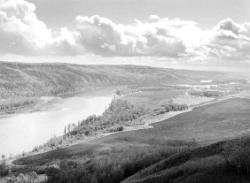
CREDIT: Ian Lindsay, Vancouver Sun Files
Peace River Valley islands and farmland face being covered with water if BC Hydro gets to build the Site C dam near Fort St. John.
BC Hydro is accelerating plans for a controversial $3.5-billion power project that would require flooding a vast area of the Peace River Valley and is assigning two senior managers to prepare the Site C dam project for final approval.
A Sept. 7 internal Hydro memo says the two have been appointed to set the direction for public and first nations consultation, regulatory approvals and communications -- prompting several Site C critics to suggest that Hydro has decided the project will proceed.
The project, to be built near Fort St. John, is supported by Energy Minister Richard Neufeld but has been opposed by area residents and environmentalists since it was first proposed in the mid-1970s.
Potentially B.C.'s fourth-largest hydroelectric facility, it has been rejected in the past as too costly and because of adverse environmental impacts.
At a rough cost of $3.5 billion, not including potential compensation to first nations and the impact of escalating construction costs across North America, it would be one of the most expensive infrastructure projects ever undertaken in B.C.
The dam would join two others already in service on the Peace including the WAC Bennett Dam and Peace Canyon, and would flood an additional area of the Peace Valley 15 times as large as Stanley Park.
It would be a 900-megawatt facility generating enough electricity to serve 500,000 households -- although that's still less power than British Columbia imports each year to serve the province's domestic needs.
The Hydro memo announces that Steve Eckert, acting manager for power acquisitions, has been promoted to acting general manager for Site C. Hydro staffer Al Boldt, who has experience in large project design and construction, has been appointed manager of public and regulator affairs for Site C.
"Steve will provide leadership to take the project through to the approval stage," the memo says.
Hydro spokeswoman Elisha Moreno said Wednesday that despite the appointments, the Site C project won't proceed until -- and unless -- it receives approval from the Hydro board and provincial cabinet.
"We don't want people to think this is a done deal by any account," Moreno said.
However, Hugh Taylor, land use manager for the West Moberly First Nation, noted in an interview that when Richard Neufeld paid a recent visit to the area to study proposals for wind power, "Site C was all he could talk about."
"I think it means they are trying to keep the project going. They will probably hold off formal approval until they are so far down the line that it only makes sense to complete it. I don't think Hydro is being very transparent, and it's prejudicial to wind power proponents," said Taylor.
Ruth Ann Darnall, chairwoman of the Peace Valley Association, said it now appears Hydro intends to proceed with the project.
"I don't understand why Hydro is doing all this if they're not sure cabinet will tell them to go ahead," Darnall said. "I think it would be nice if folks down south could generate their own power."
Brian Churchill, an environmental consultant in Fort St. John, said Hydro appears to be following Neufeld's leadership on Site C.
"I'm really concerned that at this point in time the cost estimates of Site C, are very unclear as to whether this project is in the province's best interests or not. We're missing properly-done cost estimates for building Site C, transmission lines for Site C, and for the environmental and social impacts of Site C," Churchill said.
"I personally don't think the public will support Site C. The Peace River Valley has paid its price in supporting the energy needs of the province . . . in the two existing Hydro dams."
Hydro critic David Austin, who represents independent power producers in B.C., called on Hydro to produce a comprehensive assessment of Site C's costs before taking other steps towards development of the project.
He's not opposed to Site C in principle, but said Hydro is "getting too far ahead of themselves without the release of the basic financial model."
Austin has made formal requests for Site C cost details, in Hydro hearings before the B.C. Utilities Commission, but said he is still waiting for a satisfactory response.
"The project has been around a very long time and the creation and release of a properly functioning financial model should be a very simple exercise," Austin said.
THE NUMBERS:
- Current estimated cost of project: $3.5 billion.
- Electricity potential: 900 megawatts, enough for 500,000 homes
- Time required to complete project: Seven years.
- Approvals required: BC Hydro board, B.C. provincial cabinet, B.C. Utilities Commission.
- Jobs created: 7,650 person-years of work.
- Peak workforce: 2,015 people in year four of construction.
CAPACITY OF BC HYDRO'S TOP FIVE GENERATING FACILITIES:
Shrum Generating Station/WAC Bennett -- 2,730 megawatts
Revelstoke -- 1,980 megawatts
Mica -- 1,805 megawatts
Peace Canyon -- 694 megawatts
Seven Mile -- 594 megawatts
Site C on Peace River -- 900 megawatts
Source: Vancouver Sun
Ran with fact boxes "The Numbers" and "Capacity of BC Hydro's Top Five Generating Facilities", which have been appended to the end of the story.
Gregoire: Washington needs to ease its oil dependence
David Ammons
Seattle Times
15 September 2005
OLYMPIA, Wash. -- Washington can become a world leader in biofuels and other non-petroleum energy sources that can ease reliance on foreign oil and help the state's farm economy at the same time, Gov. Christine Gregoire said Thursday.
The governor and legislative leaders also announced hearings on what they strongly suspect is gasoline price-gouging.
And Gregoire told a news conference that Washington is reasonably well prepared for an earthquake or other natural disaster, but needs to study ways of improving. The joint House-Senate hearings also will take up this topic. The sessions will be in October, with locations and times to be announced soon.
Gregoire said she has asked the U.S. Department of Justice to probe whether the oil industry gouged consumers during the recent run-up of prices, particularly after Hurricane Katrina.
Gregoire, who battled Enron's energy pricing when she was state attorney general, said there appears to be no legitimate reason for Washington pump prices to jump 20 cents a gallon in the aftermath of the hurricane.
Washington is remote from the Gulf Coast, relies on Alaskan crude oil and has refineries, she noted. The state Legislature may well want to pass anti-gouging legislation to protect against a recurrence, she said.
In the longer term, she said, the state should get serious about developing its potential for producing ethanol and other biofuels from Washington-grown grains.
"It improves our energy independence and keeps our petrodollars in Washington," the governor said. "It creates new jobs in the state, reduces pollution and reduces other environmental problems and risks, and it helps farmers maintain the profitability of their farms."
Dependence on oil is crippling Washington's farmers, she said.
"Our farmers are paying out more for a gallon of diesel fuel than they earn for a bushel of wheat. We may have the opportunity to plug our farmers right into the fuels they need. They could be producing the crops to make the fuel."
Gregoire said she has been talking with biofuel companies about setting up shop in Washington, primarily in the eastern part of the state. She gave no specifics.
State Rep. Hans Dunshee, D-Snohomish, said a biodiesel plant called the New Roosevelt Project is proposed for Spokane, Columbia or Lincoln county.
"We could have five million gallons of biodiesel coming on line next August or September," he told reporters. "I think we can get something done. It will mean jobs here in Washington and fuel in the tanks of Washingtonians. I think it's a great step forward."
The state motor pool and ferry system are early customers for biofuel, said state Rep. Jeff Morris, D-Anacortes. The Legislature has put in place one of the country's strongest tax incentive packages, he said.
"The Northwest stands a good chance of becoming a biofuel leader in the world," he said.
Gregoire agreed: "The idea that we could be an international leader is real."
Washington also is doing important work in solar energy, wind-generated power and other alternative sources of energy, she said.
At her wide-ranging news conference, the governor also touted the state's emergency preparedness, saying the state wouldn't have been caught as flat-footed as the Gulf region. The state has a clear chain of command and knows that state and local government, not the feds, will have to be the early responders during the first 72 hours after a disaster, she said.
Gregoire said Washington must fix its earthquake-vulnerable bridges and roads, especially the Alaskan Way viaduct in Seattle and the State Highway 520 bridge across Lake Washington. Both would have failed if the 2001 Nisqually Quake had lasted another 15 seconds, she said.
Drawing an analogy to Katrina, she said "These are our levies. The earthquake is our hurricane."
State Sen. Pam Roach, R-Auburn, faulted Gregoire for talking about biofuels and oil dependency rather than putting sole emphasis on state residents being prepared to survive a disaster.
"She should stick to talking about survival. She should be alerting our people about storing up food and water and flashlights, first-aid kits, being ready to leave damaged residences, completing a ham radio network for Washington state, and talking about how families can stay in communication with each other in a disaster.
"Katrina is not an opportunity to move forward an environmental or energy agenda."
---
On the Net:
Legislature: http://www.leg.wa.gov Gov.: http://www.governor.wa.gov
http://seattlepi.nwsource.com/
Hot natural gas prices may boost B.C.'s surplus
Derrick Penner
Vancouver Sun
16-Sep-2005
British Columbia has an estimated $1.4-billion budget surplus, but if natural gas prices remain high, and one of B.C.'s most prominent economists is right, the surplus is likely to becomes even bigger.
Helmut Pastrick, chief economist for Credit Union Central B.C., said he believes the province's projections revealed Wednesday in its budget update are still conservative.
"I'm of the view we'll see higher numbers," Pastrick said. "I still put economic growth at a higher level, more growth in housing."
Pastrick added that, assuming there are no spending surprises, the government is likely to see an even bigger surplus.
Finance Minister Carole Taylor's budget update projects the government will take in $34.5 billion by the end of 2005-06 -- a $1.4-billion gain from the $33.1 billion that was written into government's February budget -- which will help raise its overall surplus to $1.3 billion.
Tax recoveries, estimated at $15.5 billion in Taylor's update, are running $753 million ahead of February's budget. Resource revenues, pegged at $4.4 billion in the revision, are also $488 million ahead of expectations written into the earlier budget.
The province, however, may not be being generous enough in its projections for its resource revenues given the performance of natural gas prices versus the assumptions used by Ministry of Finance staff to calculate its revised expectations.
Royalties on B.C.-drilled natural gas are the biggest source of provincial resource revenue, which the ministry estimated at $1.8 billion in Taylor's budget update, $199 million ahead of February's expectations.
Taylor's updated fiscal plan shows that her staff based that projection on $6.51 per gigajoule average price for natural gas to the end of the 2005-06 fiscal year.
Prices on Thursday, however, hit $10.17 at the Sumas hub, the main distribution point for gas exports to the U.S. West Coast, and have averaged $7.67 since the start of the government's fiscal year in April.
In an interview, Taylor said the province will hold to a conservative approach to setting its expectations, which are based on the projections of industry experts.
"Everyone realizes that this is a moving target," she said. "If you look at natural gas [prices], we don't know if we can sustain these levels."
Taylor added that despite knowing that B.C.'s economy was still performing well, the results of her staff's budget revision were still unexpected.
"We certainly anticipated that the numbers would be better than the February budget, but I'd say it was a surprise on the upside, even from those expectations," she said.
However, Taylor added that besides the additional spending and tax breaks and spending increases that government has already committed to, she will not succumb to temptation and start spending more of the surplus.
Within the additional $753 million in taxes the province expects to take are some $282 million in additional personal income tax revenue and $190 million more in property transfer taxes. The expectation for corporate income tax revenues was also raised -- by $140 million.
Taylor said the province will continue to re-examine the competitiveness of its tax regime, but does not expect any more tax cuts in the immediate future.
"I think there are other priorities for this [budget] update," Taylor said.
In 2006, she noted, government will be under pressure to give its employees wage increases after several years of an official wage freeze, though the province does not know how long the current economic boom will last.
"There are a lot of issues, and if you're a prudent manager, which is what I'd like to be, you make sure your budget will withstand a few disappointments," Taylor said.
Peter Simpson, CEO of the Greater Vancouver Home Builders' Association, said a change to the property transfer tax is one measure his organization would like to see.
depenner@png.canwest.com
RISING REVENUE TIDES:
The provincial government is collecting more revenue than it expected this year, some $1.4 billion more than was pencilled in to its February budget, according to Finance Minister Carole Taylor's budget update released Wednesday. Here are some of the revised expectations:
Total revenue:
$34.5 billion +$1.4 billion
Taxation revenue: $15.5 billion
+$753 million, including:
- Personal income tax: $$5.5 billion +$282 million
- Property transfer tax: $650 million +$190 million
- Corporate income tax: $1.2 billion +$140 million
Natural resource revenue: $4.4 billion +$488 million, including:
- Natural gas royalties: $1.8 billion +$199 million
- Forests revenue: $1.2 billion +$166 million
- Energy and minerals: $775 million +$62 million
- Columbia River treaty: $305 million +$55 million
Other provincial revenue: $6.7 billion +84 million
Contributions from federal government: $5.6 billion +$131 million
Crown corporation income: $2.3 billion
-$56 million, including:
- B.C. Lottery: $892 million +/- 0
- Liquor distribution branch: $779 million +/- 0
- ICBC: $224 million +48 million
- B.C. Hydro: $329 million
-$66 million
- B.C. Rail: $39 million
-$37 million
History is turned on its head as Campbell and native leaders reach out
Vaughn Palmer
Vancouver Sun
September 16, 2005
VICTORIA - Not many first nations leaders can rival Stewart Phillip's record for militancy over the years.
Mount Currie ... Seton Portage ... Apex Alpine ... Adams River ....
From the 1970s to the 1990s, Phillip turned up at most of the big showdowns, often as a participant, sometimes getting arrested, always quotable.
After Oka, he said Canada "could end up looking like Northern Ireland." At Gustafsen Lake, he accused the police of "behaving like cowardly goon squads of some Central American military junta."
Just last year, on the front lawn of the legislature, he accused the B.C. Liberals of trying to buy off natives with "beads and trinkets."
But on Wednesday he was sitting on the floor of the legislature with other aboriginal leaders, listening appreciatively during the budget update speech.
Phillip, who is president of the Union of B.C. Indian Chiefs, came to hear the promise of a $100-million New Relationship fund.
The fund is to help first nations develop their own capacity (staff, facilities, training) to manage land, resources and social programs in partnership with government.
Phillip confided to reporters that when he accepted the premier's invitation to attend, he had a nagging fear in the back of his mind about one more parade of beads and trinkets.
But $100 million. That was "undeniable evidence that times have changed."
Phillip was not alone in this assessment. He was joined on the floor of the house -- and in praising the fund -- by Shawn Atleo of the B.C. Assembly of First Nations and Ed John of the First Nations Summit.
John is a fascinating study as well. He was a cabinet minister in the last New Democratic Party government.
He didn't let partisan history keep him from praising the Liberals for making "a significant investment in the new relationship."
He was also enough of a gentleman not to highlight why the New Democrats could never have gotten away with this level of generosity to first nations: Because the Liberals, then in Opposition, would have roasted them for it.
All three leaders emphasized the degree to which the native organizations have worked together to promote the new relationship, since signing a landmark accord earlier this year.
Still, Phillip best illustrates the distance travelled already, and not only because of his militant history.
His organization, the UBCIC, has shunned B.C. treaty negotiations from the outset.
While several dozen bands toil at the treaty table, Phillip has repeatedly denounced the process as a huge waste of time and money.
He took another shot Wednesday, saying "we need to learn the lessons" about spending vast amounts on talks and studies, with no results.
"I don't want to hear a stampede of lawyers and consultants coming down the hall to help us spend the money," Phillip said, to knowing laughter from his colleagues.
He hopes the new relationship will provide an alternative route for bands that want to get on with sharing power and managing land and resources.
He, like the other native leaders, says the fund is "only the first step." But for the first time in long years, he admits to being "hopeful."
Of course, when Phillip mounted his first barricade in the mid-'70s, he was in his mid-20s, with all the preoccupations of a young firebrand. Today, he's an established leader (eight years and counting in the UBCIC presidency) with six grandchildren.
"I have to start thinking of their future. I have to think less of public posturing. I have to think more about getting results."
But all that perspective has its own risks. Phillip faces a running critique from his own crop of young militants these days, and has to persuade them the new relationship is the real thing.
What persuaded him to go this far? He has no hesitation in answering. "The premier stepped out on this issue."
Hard to believe, especially for natives.
As Opposition leader, Gordon Campbell fought the Nisga'a treaty in court. As premier, he ramrodded a treaty referendum that infuriated native leaders.
Now, he's leading B.C. to what looks like reconciliation and unprecedented recognition of native rights and autonomy.
"Maybe only Campbell can do it," Phillip says.
The line echoes a political maxim from south of the border: "Only Nixon can go to China." As U.S. president, Richard Nixon opened up relations with Communist China. His history as a ferocious anti-Communist left little room to accuse him of selling out.
Maybe Campbell's history protects his back with those who might otherwise oppose the new relationship. It is harder to accuse him of selling out.
Then again, thinking of the UBCIC president's history, you could say the same about him: "Only Phillip can go to Campbell."
September 14, 2005
VICTORY: GSX & Duke Point are dead - for now
Tom Hackney, GSX Campaigner and this year’s winner of the Sierra Club of Canada’s Conservation Chapter Award
Duke Point is dead. After six years, BC Hydro has shelved plans to build a gas-fired power plant at Duke Point near Nanaimo. With it goes the last vestige of a plan that would have seen 900 MW of gas-fired power generation on Vancouver Island and a pipeline across the Strait of Georgia.
The story began in September 1999, when BC Hydro announced plans to partner with the US giant, Williams Gas Pipeline Company, to build the Georgia Strait Crossing (GSX) natural gas pipeline from Washington State to Vancouver Island, linking to the existing Centra Gas pipeline.
Hydro planned to meet all new electricity demand using gas-fired power plants on Vancouver Island. The 250-MW Island Cogeneration Project was slated for Campbell River, MacMillan Bloedel (now Weyerhauser) was partnering with a private firm to build a 250-MW power plant at its mill site in Port Alberni, and BC Hydro planned to locate a 640-MW plant near Duncan by 2007.
The Sierra Club of Canada, BC Chapter became involved when Bo Martin and Tom Hackney of the Energy and Climate Change Committee decided to intervene in the federal regulatory process. Bo and Tom thought the climate change harm of fossil fuel use was unjustifiable, especially when BC Hydro’s own Electricity Conservation Potential Review (1994) showed potential to cut electricity demand by 25 percent or more. This theme has remained constant, and has gathered public support and political recognition. In 2003, the BC Utilities Commission ruled that a greenhouse gas (GHG) liability should be factored into the costing of gas-fired generation. And then in February 2005, the Kyoto Protocol became law, along with Canada’s GHG reduction targets.
But in early 2000, the energy to fight Hydro’s plans came mainly from people’s shock at seeing maps showing high-pressure pipeline routes through their back yards, past schools, and across farm fields. People became furious at community meetings when BC Hydro officials said the decisions were unalterable.
The BC Chapter linked up with citizens in Cobble Hill and Duncan and with the Georgia Strait Alliance and other groups to form the GSX Concerned Citizens Coalition. The Coalition (GSXCCC) devoted huge amounts of time and energy to refuting Hydro’s claims, bringing powerful evidence to the National Energy Board review of GSX and the BC Utilities Commission’s two reviews of successive power plant proposals for Duke Point (first BC Hydro’s Vancouver Island Generation Project, then the private Duke Point Power roposal).
GSXCCC also mobilized people all over the mid Island, as BC Hydro sought sites for the next power plant. First, the Coalition alerted Port Alberni residents, who blocked rezoning near a residential area. Next, the Coalition brought out crowds in North Cowichan to warn municipal leaders against changing their industrial zoning. BC Hydro finally found a site and sympathetic municipal leaders in Nanaimo, though by 2005, Mayor Gary Korpan was forced to acknowledge that his support for the power plant represented his personal views, not those of the City.
Despite a rubber-stamp approval of GSX by the National Energy Board in 2003, the GSXCCC and others delayed the pipeline so long that BC Hydro cancelled it in 2004, citing high gas costs and unfavourable economics for gas-fired generation (which we had warned of in 2001). Accordingly, BC Hydro then reduced its gas-fired generation plan to a single additional plant, part of the 252-MW Duke Point Power electricity purchase agreement. Hydro claimed this was needed to ensure “the lights wouldn’t go out” on Vancouver Island.
This already represented a big success, given the Sierra Club’s goal of reducing the use of fossil fuels to generate electricity. But we were going for gold. GSXCCC developed extensive evidence to refute the myth that a power shortfall could only be met by building power plants, and brought that evidence to the Utilities Commission’s review of the Duke Point Power deal.
In February 2005, the Commission approved the purchase agreement. But the GSXCCC, the BC Sustainable Energy Association, and the Society Promoting Environmental Conservation, working with the Joint Industry Electricity Steering Committee, applied to the BC Court of Appeal for leave to appeal the decision. It claimed that information was inappropriately kept secret and that there was a reasonable apprehension that the Commission had acted with bias.
On June 14, the Court granted leave to appeal. But the Coalition’s appeal never went ahead. Three days later, BC Hydro publicly announced it was cancelling plans for a gas-fired power plant at Duke Point.
There is a footnote to this story. BC Hydro is still looking for ways to generate more electricity on Vancouver Island in 2006, and will be again accepting bids from independent power producers. But it would seem the table has tilted slightly in favour of renewable energy. For the first time – undoubtedly because of the evidence submitted by the GSXCCC – the BC Utilities Commission will consider the liability of greenhouse-gas emissions and the cost of offsetting them when it assesses power generation proposals.
From the Fall 2005 Sierra Report
EnCana sells Ecuadorean oil assets to China
Paul Haavardsrud
Calgary Herald, with files from Canadian Press
Wednesday, September 14, 2005

COMMENT:Pressures on EnCana, on the street, in the media, and at the 2004 AGM pushed the company to sell its Ecuadorean operations, particulary the OCP Pipeline.
The strategic problem for NGOs, in what initially was viewed as a victory of sorts, is what happens next. Any purchaser is going to be aware of the controversies, and will be buying in, fully prepared to take the heat. Andes Petroleum Company, a consortium of Chinese companies, is well removed from the shareholder and investor vulnerabilities that a North American or European company is exposed to.
Chinese energy investments continue to expand globally, an echo of US, Dutch and British energy capitalists from a hundred years ago. What forces this unleashes, at the end of the easy oil era, rather than at its beginning, will be profound.
Encana's news release
CALGARY -- EnCana Corp. closed the book on a six-year stay in Ecuador, selling its contentious South American assets to a state-owned Chinese oil venture for $1.42 billion US.
The sale comes only weeks after violent protests against the country's petroleum industry led to speculation that EnCana's year-long search for a buyer would be further drawn out.
As part of a move to focus on the North American natural gas business, EnCana confirmed its assets in Ecuador were on the block last September, while announcing the $2.1 billion US sale of its North sea oil interests to Nexen Inc.
Given the ongoing struggles of doing business in Ecuador, which most recently saw its petroleum industry shut down as demonstrators protested the handling of the country's petro-wealth, the list of potential buyers for EnCana's assets was believed to be limited to national oil companies that are better suited to working around political and social unrest.
EnCana's chief executive Gwyn Morgan has said doing business there was "constantly a roller-coaster."
© The Vancouver Sun 2005
September 13, 2005
US Government Slams Kinder Morgan's Safety Procedures
Jeremy J. Nuttall
TheTyee.ca
September 13, 2005
Suisun marsh: 70,000 gallons of diesel
Out to buy BC's Terasen, Texas pipeline
firm ordered to clean up its act.
A day after The Tyee first reported on the marred environmental record of Kinder Morgan, the company wanting to take over Terasen, the Texas based pipeline giant was hit with a corrective action order from the US Department of Transportation's Pipeline and Hazardous Materials Safety Administration.
According to PHMSA spokesperson Damon A. Hill, the August 24 order, addressed to co-founder Richard Kinder, tells Kinder Morgan to review their operating procedures.
"We issued this order to get this company to address the recent rash of incidents that they've had in the past couple of years," says Hill. "They've had a significant number of them."
Now, Hill says, the PHMSA wants Kinder Morgan to restructure their safety procedures in hopes of creating a sound network. "We did an analysis of what we thought could be going wrong with the company. We looked at their integrity management (and) the way they implement their integrity management," he says.
Hill adds although no clear cut violations were found, the PHMSA "did see weaknesses in use of their tools to interpret the data that they receive when they conduct integrity management inspections."
'A widespread failure'
The order points out "recent accidents indicate a widespread failure to adequately detect and address the effects of outside force damage and corrosion. This failure has systematically affected the integrity of the Pacific Operations Unit."
It focuses on eight more severe accidents out of the 44 Kinder Morgan has experienced over the last two years. Such as the Suisun Marsh diesel spill, which leaked 70,000 gallons of fuel into the Northern California marsh. According to the order, the cause of that spill was a 14-foot section of corroded pipe that was not identified as requiring repair.
Of the seven remaining incidents, five of them are listed to have been the result of an outside force, meaning third party involvement. One such case was an explosion that killed five people. Kinder Morgan was found to have not marked the pipeline properly and was cited $140,000 for their part in the accident.
The order goes on to point out three of the accidents were not addressed by Kinder Morgan in a timely manner, among them the Suisun Marsh spill.
'We fully intend to comply'
Hill says the company has a problem with organizing its own internal inspection reports with other information key to safely running pipelines.
According to the order, Kinder Morgan practices internal inspection relying on multiple departments, however those departments don't always have access to each other's information. And the order says the "internal inspection geometry tools employed by the respondent (Kinder Morgan) are generally insufficient."
Kinder Morgan spokesperson Rick Rainey says the company is taking the order seriously.
"Many of those steps we have already taken including a third party review of our operations and procedural practices as well as a restructuring of our internal inspection program," says Rainey. "We fully intend to comply with the order in that regard."
Kinder Morgan is appealing some elements of the order, but Rainey was unable to say which ones by press time.
Effect on sale not clear
The British Columbia Utilities Commission is currently reviewing the intended sale of Terasen gas when its owner, Terasen Inc, is taken over by Kinder Morgan.
BCUC spokesperson Bill Grant says the only way the corrective action order can have an effect on the sale of Terasen is if one of the sale's 15 registered interveners submits the order as part of their contention. Grant adds such a submission could be considered because part of the BCUC's responsibility is to ensure Terasen offers quality service to customers.
"If parties can demonstrate that (circumstances prompting the order) might have an impact on Terasen gas, then that would have an impact on the reliable service issue," says Grant. "I don't believe anybody's made a submission on that."
During the interview with The Tyee, Rainey repeatedly mentioned Terasen pipes would be maintained by the same people performing the task now. "One of the issues that's kind of gotten lost in this whole discussion is that following the completion of this sale, you're essentially going to have the same people that are in charge of pipeline integrity for those Canadian assets in place once the sale goes through," he says.
This is not the first time Kinder Morgan has been dealt with by the PHMSA. Their website has many instances where Kinder Morgan shows up on a list of compliance section orders served to numerous companies since the early 90s.
Jeremy J. Nuttall is a Penticton radio reporter and freelance writer. To read his previous report on Kinder Morgan's safety record, go here.
September 10, 2005
Enbridge pipeline proceeds
Vancouver Sun
September 10, 2005
CALGARY -- With a planned in-service date of mid-2008, Enbridge Inc. said Friday it will proceed with construction of the 380-kilometre Waupisoo pipeline from the Alberta oilsands to the Edmonton refinery hub. The Calgary-based firm said it has reached agreement on long-term shipping commitments with ConocoPhillips Canada, Petro-Canada, Suncor Energy Inc. and Total E&P Canada Ltd. Enbridge will construct the 30-inch (76-centimetre) diameter pipeline at an estimated cost of $400 million in 2005 dollars. The line's initial capacity will be 350,000 barrels a day, with a maximum capacity of 600,000 barrels per day.
© The Vancouver Sun 2005
Opposing energy projects has a price
Michael Campbell
Vancouver Sun
September 10, 2005
Problems arise when new energy supplies don't keep pace with rising demand
COMMENT: This begins like a column that should be an engaging read, but Michael Campbell stays well away from any useful analysis of the problem he identifies. Yes, our fossil fuel energy demands have outpaced industry's ability to deliver. Yes, communities are objecting with increasing strength to ugly, poisonous, dangerous energy projects in their neighbourhoods. Yes, the system is highly utilized, with no tolerance for breakdown.
But Campbell seems to suggest that the solution is for NIMBYs to get off the case, and allow the growth that might otherwise take place. He doesn't follow through to a proposal for serious uptake on conservation and more efficient use of existing supply. He doesn't go anywhere near talking about investing in sustainable technologies.
Heck, he doesn't even acknowledge that the five year sustained resistance against the GSX Pipeline and the Duke Point Power project has saved British Columbians hundreds of millions of dollars. - Arthur Caldicott
They are protesting the Sumas 2 power project. They are protesting offshore oil drilling. They opposed the Duke Point power project. Some residents in South Delta are up in arms over the proposal to put higher-voltage power lines in their neighbourhood in order to transport electricity. And no one dares mention nuclear power in North America in spite of the fact that it may be the best existing solution to our energy needs.
In other words, at every opportunity there are individuals and groups ready to oppose the expansion of energy resources. I'm not saying that I want a brand-new power project in my neighbourhood either, but our reluctance to further our energy supplies and infrastructure presents a problem.
The growth in our consumption continues to outpace our increase in supplies. There are more cars, more home computers, more data centres, more electronic gear, more energy needs for manufacturing, bigger houses to heat and numerous other demands that are relentlessly increasing our energy needs. Even our push for alternative sources of energy often relies on energy inputs from other sources. For example, methanol from corn takes more energy to produce than it creates.
What this spells is an obvious problem that Hurricane Katrina simply exacerbated when it comes to oil and gasoline. There is no mystery why gas prices have spiked up in the wake of the U.S. losing 10 per cent of its refining capacity. Demand continues to grow while the supply of gasoline through the refiners was curtailed.
North American refineries have been operating at full capacity for years and had no ability to absorb the loss of 12 refineries. The question should be: Given that we had capacity problems that inevitably would lead to gasoline supply shortages and higher prices, why weren't more refineries built?
The answer is that nobody wants them in their area. While demand for gasoline has been steadily growing, there has not been a refinery built in the U.S. in 25 years. Forbes magazine has just reported on Arizona Clean Fuel's application to build a refinery in the desert near Yuma Arizona. Now keep in mind that Arizona Clean Fuel has been cited many times for its friendly environmental record, but when it came to building a new refinery that made no difference.
It has taken 10 years to get the state and federal environmental approval, which means the company can now enter the permit phase, where it will face more organized opposition. It's anyone's guess how many legal challenges and other hurdles will need to be overcome before the project is finally started.
As I said, when demand continues to rise and supply doesn't keep pace, we have a problem. What's scary is that in the face of such obvious problems we're being greeted with solutions like the proposal to nationalize the oil industry, which a Leger Marketing poll suggests is supported by about half of Canadians.
Even leaving aside the avalanche of problems such a solution would immediately trigger, it still wouldn't negate the fact that regardless of who is the owner we still need to expand capacity and infrastructure. Yet there is still vocal and effective opposition to any such proposal. I'm not passing judgment on the merits of the opposition, I'm simply pointing out that it has consequences in terms of supply and that means higher prices.
Michael Campbell's Money Talks radio show can be heard on CKNW 980 on Saturdays from 8:30 a.m. to 10 a.m.
© The Vancouver Sun 2005
September 09, 2005
Terasen asks for natural-gas hike of 13.3%
Wendy Mclellan and John Bermingham
The Province
09-Sep-2005
B.C.ers are about to experience the after-effects of Hurricane Katrina on their natural-gas bills.
Terasen Gas filed a request yesterday with the B.C. Utilities Commission to up its rates for residen-tial customers in mainland B.C. by 13.3 per cent, effective Oct. 1.
Vancouver Island customers will not be affected because they follow a different regulatory schedule.
The rate hike would add $180 to the average annual natural-gas bill in the Lower Mainland.
"The primary reason is the repercussions from Hurricane Katrina," said Terasen spokesman Dean Pelkey. "At first we thought it would be an increase of five to 10 per cent, but with the damage to the infrastructure on the Gulf Coast, it will be 13.3 per cent."
Utilities commission spokesman Rob Pelat said a decision on Terasen's request will be made early next week.
"We've already had [an increase] in July of 5.6 per cent," he said. "Just have a look at the market-price of natural gas -- it's just been horrendous."
Said Jim Quail of the B.C. Public Interest Advocacy Centre: "It's very painful, but I don't think Terasen is the villain.
"The market price goes up, unfortunately, and we get skinned. Once again, consumers are the victims of large market forces, which have been worsened by Hurricane Katrina."
Peter Dyne of the Consumers Council of Canada said natural-gas bills could rise another 30 per cent.
"There's more incentive for people to think about insulating their houses," he said from Ottawa. "The trouble is those things cost money, too. It's a very difficult problem, particularly for low-income consumers."
Rudy Lawrence, president of the Council of Senior Citizen's Organizations of B.C., agreed: "It's going to have an impact on some people for sure, not just seniors, but a lot of people on low incomes. That's just scandalous."
Homeowners are shifting to other forms of heating, said Doug Rempel, owner of Solace Energy, a Burnaby home-heating retailer.
Customers are looking at investing in geothermal heating systems and high-efficiency gas furnaces.
"People are concerned, so they're putting in considerably more expensive systems when they're building homes," said Rempel.
Energy Minister Richard Neufeld said there are no plans to help out with the bills.
"Those higher energy costs will be experienced by mostly people that live outside the Lower Mainland, in the colder regions," said Neufeld. "Royalties do increase as the price of natural gas goes up, and so the province will be receiving more revenue. But we haven't contemplated anything about rebates."
Terasen makes its money from delivering the gas, not on its price. The company says it has to raise rates to cover the anticipated increase in natural gas prices.
wmclellan@png.canwest.com
jbermingham@png.canwest.com
- - -
HEATING TIPS . . .
At least 50 per cent of your energy bill goes to heating your home. Here are some tips to reduce heat loss:
WINDOWS
- Up to one third of the heat can escape through windows. Put storm windows or plastic sheeting on single-glazed windows.
- Consider installing energy-efficient windows.
HEATING SYSTEM
- Clean your furnace filters.
- Avoid heating uninsulated spaces.
- Close the fireplace chimney damper between fires to keep warm air in.
- Avoid heating unused rooms by closing doors and warm-air-supply registers or lower the room thermostat for baseboards.
-- B.C. Hydro
Hydro's net income off 90% in 2006 first quarter
Scott Simpson
Vancouver Sun
09-Sep-2005
BC Hydro's net income fell 90 per cent in the first quarter of fiscal 2006, despite significantly higher trade revenues, the crown corporation reported on Thursday.
In a statement accompanying the first quarter report for 2005-2006, Hydro said it recorded net income of $5 million after regulatory transfers, compared to $52 million in the same period a year earlier.
"Key drivers for the lower net income this quarter were increased costs related to energy purchases to help meet domestic needs and increased finance charges," reported Hydro chief financial officer Alister Cowan.
Hydro also reduced its forecast for annual net income by $20 million, to $376 million, adding that its fiscal payment to the British Columbia government for 2006 would be $302 million.
Revenues from domestic electricity sales moved up by $1 million to $633 million compared to the first quarter of the 2005 fiscal year that ended March 31.
Electricity trade revenues, derived principally from sales to the United States, were up $92 million -- but those gains were effectively wiped out by a $106 million increase in electricity purchases on behalf of customers in B.C.
"Total sales volumes increased by three per cent as a result of an additional 18,996 residential customers compared with the same period last year, as well as an increase in activity in the light industrial and commercial sector as a result of improving economic conditions," Hydro said.
About $30 million of that amount was "due to higher volumes of electricity purchases from Independent Power Producers and other long-term commitments at higher unit prices to meet an increase in domestic load requirements."
Hydro traditionally uses a buy and sell strategy to take advantage of short term differences between electricity prices here and in the U.S., buying comparatively cheap U.S. power during off-peak hours, and opening up its dams to generate power when prices are at premium levels south of the border.
However, Hydro spokeswoman Elisha Moreno said in an interview, the crown corporation put more focus on buying electricity from other sources during the quarter -- with the objective of refilling its reservoirs that were somewhat depleted after two years of comparative drought.
"At June 30, 2005," Hydro reported, "the combined storage in BC Hydro's reservoirs was 119 per cent of average, compared with 91 per cent of average last year.
"Faster-than-normal runoff in the quarter resulted in water inflows into BC Hydro's reservoirs which were 16 per cent higher at June 30, 2005."
"We are coming off a couple of successive lower water years. If we have an opportunity to rebuild our reservoir levels without having significantly negative impact on our financial results then we are definitely going to take advantage of that," Moreno said.
Cowan said Hydro has enough total generating capacity to meet domestic needs but added that the system's flexibility "enables us to look at the most economic way to meet customer demand. In the past quarter, it was cheaper for us to import some electricity from the market than it was to use more expensive resources like Burrard Generating station."
Over the longer term, he said, the result will be lower costs "and better financial performance for our customers in B.C."
Wasco rides with the wind
Eileen M. Garvin
Portland Business Journal
2 September 2005
PPM Energy's wind projects boost city's bottom line
When President George W. Bush signed the nation's new energy bill in New
Mexico in August, the reverberations were felt far north in the small town
of Wasco, Ore. (population 381).
That's because the Energy Policy Act includes tax breaks for the
development of renewable energy sources, which have been a boon to the
agricultural community east of The Dalles.
This summer, Portland's PPM Energy Inc. launched the second phase of a wind
farm that has been encouraged by the federal Energy Production Tax Credit,
which provides a 1.8 cent-per-kilowatt-hour tax credit for electricity
generated through wind turbines.
PPM Energy has invested $90 million in Klondike II, a 50-turbine project
expected to create 75 megawatts of wind power.
"That's a $90 million investment in steel and concrete and turbines," says
Jan Johnson, PPM Energy spokeswoman.
That investment also translates into revenue for Sherman County, which saw
a 10 percent increase in property taxes in the year following the first
phase of the project, Klondike I.
For PPM Energy, Klondike II is another success story for an Oregon company
that grew from 12 employees to 300 in just four short years. This year, it
posted operating profits of $98 million, up from $35 million last year.
PPM Energy is a U.S. subsidiary of international energy company
ScottishPower. A wind power wholesaler, PPM Energy also deals in natural
gas generation and storage.
When ScottishPower purchased the company in 1999, it was then a small
division of electric utility PacifiCorp., which operates as Pacific Power
in Oregon. Interested in pursuing non-utility business, ScottishPower spun
out PPM Energy in 2001.
It quickly grew to employ approximately 300 people, and ScottishPower now
plans to invest $1.6 billion in building its wind capacity in the next five
years. The company is in the process of selling PacifiCorp. to MidAmerican
Energy Holdings Co. for $9.4 billion in a deal subject to approval by the
SEC and other regulatory bodies.
PPM Energy got its start in the wind business through marketing when it
agreed to buy the power produced by the Stateline Wind Farm -- FPL Energy's
454-turbine wind farm straddling Umatilla County, Oregon, and Walla Walla
County, Washington.
"We took all the power," says Johnson. "(FPL) would not build it until they
had someone who would take all the power."
PPM Energy warehoused the power produced at Stateline and sold it to
customers such as Seattle City Light and the city of Eugene. Success in the
marketing business naturally led to operating and building its own wind farms.
PPM Energy now owns or controls wind power projects in seven states --
Oregon, Colorado, California, Iowa, Washington, Wyoming and Minnesota --
representing 830 megawatts of wind power, and is building new farms in New
York and Kansas.
Customers include utilities such as Alliant Energy, Xcel Energy and San
Diego Gas and Electric, public power authorities like Southern California
Public Power Authority and the Bonneville Power Administration, and such
public entities as Seattle City Light and Sacramento Municipal Utility
District.
Klondike I came online in 2001 with just 16 turbines producing up to 24
megawatts of electricity, enough to power 6,100 homes. PPM Energy has been
selling that power to the Bonneville Power Administration.
Last December, Portland General Electric signed a 30-year agreement with
PPM Energy to purchase the output from Klondike II. According to the
American Wind Energy Association, 1 megawatt of wind generates as much
electricity as 300 households would use in year.
More than one kind of green
Wind power is hailed as a clean and green energy source, but it makes money
too, and not just for the company. The Klondike project also has created
local jobs. Local farmers also collect leasing fees for the land used by
the turbines, and the wind farm does not disrupt their traditional farming
practices.
"It is a very positive story for Oregon," says Rachel Shimshak, director of
Renewable Northwest Project, an organization that promotes the development
of renewable energy in the Northwest. PPM Energy is a member of the
organization, which provides a meeting place for environmentalists,
consumer groups and businesses.
In a report last December, Renewable Northwest Project hailed the wind farm
as a sound choice for economic diversification for Sherman County.
"Sherman County was dead last in terms of per capita income in the state,"
says Shimshak. "We think it is a great story. It is something welcomed by a
community that is desperate for economic development."
Sherman County Judge Gary Thompson is enthusiastic about the potential for
tax revenue brought by PPM Energy.
"The economy in Sherman County has been down in the doldrums for so many
years because it has been primarily agriculture-based," says Johnson, a
fifth generation farmer. "This is something new that is really going to
help us."
The county granted PPM Energy a three-year tax abatement for Klondike II.
It will continue to collect property taxes from Klondike I, and PPM Energy
has agreed to donate the approximate amount that it would have paid in
property taxes into a 501c3 to fund county schools, fire districts and
economic development.
Thompson says that translates into approximately $700,000 year.
"That is quite a boon for economic development," he says.
Looking to the future
The American Wind Energy Association, a national trade association, says
PPM Energy is ahead of the curve in planning for the future.
"They are seeing that wind energy is going to be a big part of the future,"
says Wind Energy Association spokesperson Christine Real de Azua.
Real de Azua says PPM Energy has been a leader in 2005 -- a record year for
wind power development -- and is the fourth largest wind power purchaser in
the country.
The strong track record has encouraged the company to pursue more wind
power projects in the Pacific Northwest. PPM Energy is currently in the
permitting stage for projects in Arlington, Ore., and Bickleton, Wash.
Klondike III is also on the horizon.
September 08, 2005
Teck Cominco Announces Acquisition of 15% Interest in Fort Hills Oil Sands Project
TeckCominco News Release
06-Sep-2005
Vancouver, B.C. -- Teck Cominco Limited today announced that it has entered into an agreement with UTS Energy Corporation and Petro-Canada to subscribe for a 15% interest in the Fort Hills Energy Limited Partnership (the “Partnership”), which is developing the Fort Hills oil sands project in Alberta, Canada.
The aggregate subscription price is $475 million. Teck Cominco will earn a 10% interest in the Partnership by funding $250 million of Petro-Canada and UTS expenditures. In a separate transaction, Teck Cominco will earn a further 5% interest from UTS by funding an additional $225 million of UTS expenditures. On closing of the transactions, expected to occur in October, Teck Cominco will be issued a 15% interest and the interests of UTS and Petro-Canada in the Partnership will be adjusted to 30% and 55%, respectively. The subscription price will be satisfied by Teck Cominco contributing 34% of project expenditures until project spending reaches $2.5 billion and its 15% share thereafter. Closing of the transactions is subject to due diligence, definitive documentation and receipt of regulatory approvals.
Teck Cominco President and CEO Don Lindsay said: “Fort Hills is an ideal opportunity to further diversify our production base in a commodity which will be increasingly important in a world concerned about security of energy supply, and in which Canadians can be expected to play a major role. It is consistent with our strategy of emphasizing the development of quality, long life assets in a variety of significant products in favourable jurisdictions.
Teck Cominco’s proven open pit mining expertise should make a significant contribution to the success of Fort Hills, which will involve mining and extraction as well as upgrading to a final petroleum product. We look forward to working with UTS and project operator Petro-Canada to add value to this project, and view this transaction as the foundation for potential further opportunities in the oil sands business.”
Fort Hills, located approximately 90 kilometres north of Fort McMurray, is a long-life asset with 2.8 billion barrels of bitumen resource. Regulatory approvals are in place for up to 190,000 barrels per day of bitumen production, with initial start-up by the end of the decade. Plans include an integrated upgrader. The project partners are currently evaluating the best location for the upgrader and the technology to be employed.
In a separate transaction, UTS has agreed in principle to grant to Teck Cominco the right to acquire at fair market value a 50% working interest in “Lease 14”, an oil sands property contiguous to the Fort Hills property. The option would be exercisable following delineation by
UTS of the resource on Lease 14 in the event that UTS determines that Lease 14 should be developed as a satellite mine to Fort Hills, subject to agreement of the Partnership.
Teck Cominco will host a conference call to discuss this news release. The call will take place on Tuesday, September 6, 2005 at 5:30 a.m. (PDT) / 8:30 a.m. ( EDT). The dial-in phone number is 416-231-6596, toll-free at 866-250-4910. To access a recording of the call at a later time, dial 1-416-640-1917 and enter code 21151341#. The recording will be available until November 7, 2005.
A live audio webcast of the conference call, together with supporting presentation slides, will be available at Teck Cominco's website at www.teckcominco.com. The webcast will also be available at www.Q1234.com and www.newswire.ca. The webcast will also be archived at www.teckcominco.com.
Teck Cominco is a diversified mining company, headquartered in Vancouver, Canada with assets of over $6 billion. Shares are listed on the Toronto Stock Exchange under the symbols TEK.MV.A and TEK.SV.B. The company is a world leader in the production of zinc and metallurgical coal and is also a major producer of copper and gold. Further information can be found at www.teckcominco.com.
The slideshow presentation is at www.teckcominco.com
September 07, 2005
Tsawwassen power line foes to fight underground proposal
Maurice Bridge
Vancouver Sun
07-Sep-2005
TRAHVOL is holding a public meeting tonight, Wednesday, 07-Sep-2005, at 7:30 p.m. at the South Delta Rec Centre.
TRAHVOL website: www.trahvol.com
IRAHVOL website: www.irahvol.org
BCTC VITRP web info: www.bctc.com
BC EAO VITRP website: www.eao.gov.bc.ca
BCUC VITRP website: www.bcuc.com
TSAWWASSEN - A group of Tsawwassen residents who have been fighting attempts to run a pair of high-voltage power lines to Vancouver Island through their neighbourhood are gearing up for another battle.
B.C. Transmission Corp. has applied to the B.C. Utilities Commission for permission to run the lines underground along its right-of-way, which overlaps the property lines of 147 private homes in the area. It says it will use expropriation if it cannot reach an agreement with the property owners.
"They need 21 metres of your backyard to put these two lines in . . . in some cases, it's people's entire yards," Maureen Broadfoot said Tuesday.
Broadfoot is the spokeswoman for Tsawwassen Residents Against Higher Voltage Overhead Lines (TRAHVOL), which fought an earlier proposal to run the lines overhead. She said TRAHVOL was promised by the premier, local MLA Val Roddick and the former chair of BCTC that they would not recommend construction of an overhead line.
The residents are opposed to both overhead and underground power lines because of fears of adverse health risks, including cancer.
TRAHVOL says the electro-magnetic field (EMF) levels of the new underground lines would be almost 200 times higher than the World Health Organization warning level for childhood leukemia and other adverse health risks.
BCTC says its proposal strictly adheres to all public health, safety and environmental protection standards and is well below the precautionary guideline for EMFs endorsed by the WHO.
Broadfoot says in addition to opposing the power lines on health grounds, the residents are upset at the idea of expropriation.
"They've basically said they're going to negotiate with us, although three months have gone by and we've not heard boo from them, " Broadfoot said. "If they're unsuccessful, then they'll expropriate."
"The residents' group did our town public consultation, and 100 per cent of the people said, 'Forget it, we're not giving you underground rights.' "
Dennis Maniago, vice-president of system planning and asset management for BCTC, said Tuesday the corporation is not trying to acquire any extra land, but simply wants to make use of its existing right-of-way.
Two overhead power lines are already on the right-of-way, he said.
He said the problem is rooted in a subdivision plan from the 1960s which allowed homes built at the time to use part of the right-of-way as back yards.
"We have had an overhead right-of-way from some 50 years there, it's about 53 metres wide, so what we simply would be looking for is an exchange of overhead rights for underground rights," he said.
"We would be putting it within the right-of-way, which is within their [residents] property."
BCUC is expected to consider the proposal in November, with a decision by February or March.
TRAHVOL is holding a public meeting tonight at 7:30 p.m. at the South Delta Rec Centre.