October 31, 2005
Resource expo eyes northern wealth
Aboriginal and business leaders meet to discuss development
Scott Simpson
Vancouver Sun
Monday, October 31, 2005
Aboriginal leaders, resource-industry companies and politicians are gathering this week in Vancouver for a conference that could unlock even more of British Columbia's northern wealth.
Resource Expo 2005 is organized by the Native Investment and Trade Association, focusing this year on natural gas and oil industry development, mining and forestry.
Three Canadian premiers, 2010 Winter Olympics CEO John Furlong and Alaska Gov. Frank Murkowski are on the speakers' roster.
Conference organizer Calvin Helin said Canadian federal and provincial governments are spending a total of $18 billion per year in transfer payments to first nations and Inuit peoples -- costs that could be reduced or avoided if those groups were brought closer to the economic mainstream.
For B.C., that means incorporating aboriginal interests into the development of natural resources in light of Supreme Court of Canada decisions recognizing the duty of Canadian governments to consult on questions of land use.
B.C. teems with opportunities for oil-and-gas development as well as potential for new mines that could provide high-paying employment for local first nations -- with the provincial government gaining the opportunity to increase resource royalty revenue.
However, those projects often need first nations support to proceed.
Resource Expo attracts many of the aboriginal leaders who represent a key to unlocking those resources -- and their attendance is an indication of their willingness to listen, Helin said.
"I think this is one of the best times in the history of aboriginal people that we have a chance to actually move forward," Helin said in a recent interview.
"The tribes have real leverage. They are figuring out how to utilize that leverage in a way that makes a difference to the grassroots people. People should be aware of it, not only aboriginal people but non-aboriginal business people should be aware that these opportunities are there.
"We have to turn what's a social and economic drain into a huge economic and social positive. We've never been in a better situation to do this."
Helin describes the conference as a neutral forum.
"It's hard to get a lot of these people from remote places together and if you want to do business with them you have to go out and meet with them -- and if you're going to Nunavut it's a $3,000-$4,000 ticket."
Tony Fogarassy, an energy-sector lawyer who works with clients on first nations issues, will update conference delegates on recent legal and political developments, notably B.C.'s "New Relationship" policy.
"If a project can be done right, with environmental sensitivity, then first nations would love to be a part of it," Fogarassy said.
"The downside of all of this is that it takes time. Most companies look at their quarterly financials or year-ends and expect certain deliverables, or shareholders expect certain deliverables to be met. When they deal with first nations communities the timelines are different."
Michael McPhie, president of the Mining Association of B.C., says "the greatest majority" of resource-development projects in B.C. will have a "substantive first nations component."
"This conference is a really good example of bringing all these groups together. It shows how top-of-mind it is to most of us."
The mining industry took a hit earlier this week when the B.C. Assembly of First Nations announced unanimous support for first nations who oppose Northgate Minerals' plan to use Duncan Lake to store gold mine waste for a $200-million expansion of their Kemess gold mine.
McPhie says one of the benefits of Resource Expo is that it can serve as a forum for resource developers to highlight well-executed projects.
"There are going to be challenges. When you interlace that with an uncertain treaty environment, with Supreme Court decisions in different forums on different issues, I think what it speaks to is the need for forums like this to show projects that have been done well.
"Are there going to be conflicts? Of course. That's human nature. But I think [what] we need to do as an association is first to recognize the very legitimate role that indigenous people play in our decision-making and find ways to work together. That's got to be critical."
Resource Expo 05
Native Invest Trade Association
Oct 31 - Nov 1
Sheraton Wall Centre, Vancouver
October 30, 2005
Between Midnight and the Rooster's Crow
a film about EnCana in Ecuador

directed by Nadja Drost
Follow the story of big oil from the toxic rivers of the Amazon to company headquarters in Alberta.
Canadian oil giant EnCana is under fire for the construction of an oil pipeline that is generating controversy and conflict in the Amazon.
Faced with the contamination of their lands and coercion by military forces, Ecuadorian peasants tap into reserves of remarkable strength and courage as they resist. Between Midnight and the Rooster’s Crow explores the experiences of the people whose lives are being drastically altered by the race for black gold -- a race fuelled by oil companies, a government desperate for foreign investment, and a rapidly-globalizing world.
* Best Canadian Documentary at Hot Docs Canadian International Documentary Festival
* Best Documentary, Bogotá Film Festival
* Honourable Mention, Best Canadian Film, Planet in Focus International Film Festival
Calgary, Thursday, November 3
Uptown Stage and Screen
610 8th Ave. SW, Calgary
Advance Tickets are available at Sunnyside Market, 338 - 10 St. NW
For more info: 270-3200
Edmonton, Friday, November 4
Global Visions Film Festival
Screens Friday November 4th, 9pm
Garneau Theatre
8712 109 St., Edmonton
www.globalvisionsfestival.com
Vancouver, Saturday, November 5
Amnesty International Film Festival, Vancouver
Screens Saturday, November 5th, 6:25 pm
Pacific Cinémathèque
1131 Howe Street, Vancouver
For more info: www.amnesty.bc.ca/filmfest/
Victoria, to be announced
October 29, 2005
B.C. oil, gas industry to grow 20% in 2006
SURVEY: Sector expects to drill 1,600 wells next year, placing the province in third spot
Scott Simpson
Vancouver Sun
Saturday, October 29, 2005
British Columbia's booming oil and gas industry will grow an estimated 20 per cent in 2006 as activity across Canada reaches record levels, a new industry survey suggests.
The Petroleum Services Association of Canada's drilling forecast for 2006 says the industry will grow six per cent next year, "the result of continued strong commodity prices and a growing emphasis on natural gas from coal."
Alberta will account for the bulk of all Canadian activity with an estimated 20,000 wells -- a "milestone record" -- representing a six-per-cent increase in wells drilled in that province.
The level of activity in Saskatchewan will remain flat, at 3,430 wells, while B.C. in third place will see 1,600 wells drilled -- a 20-per-cent increase.
"While the total number of wells drilled in B.C. is relatively low compared to Alberta, activity levels in that province have been climbing over the past few years," PSAC president Roger Soucy said in a news release.
"B.C. is becoming a favourable location for oil and gas activity, and with the move towards southern B.C. for NGC [natural gas from coal], we are expecting a significant elevation in activity levels there."
PSAC said it's basing its 2006 forecast on crude oil prices of $60 US per barrel and natural gas prices of $9.50 Cdn per thousand cubic feet an Alberta gas trading hub.
"For most of 2005, the commodity price story was oil. More recently, natural gas prices have risen significantly. We expect the pricing of both commodities to stay strong next year," Soucy said.
In a subsequent interview, Soucy said commodity prices are important, but added that B.C. government efforts to expand the industry are major factors.
"The provincial government over the last three or four years has set the stage, so to speak," Soucy said. "They have expanded the infrastructure in the province, in the northeast in particular, so that it was easier to gain access to the resource. They have expanded road systems, upgraded roads and bridges."
B.C.'s summer drilling program has also boosted activity.
"Historically there was only a 90-day window of opportunity to drill in B.C.," during winter when northeastern B.C.'s vast muskeg plain was frozen.
"What that created was a situation where the equipment and the rigs moved in from Alberta for three months and then left at the end of the winter season. That didn't help the local communities to benefit much.
"Now what's happening is that you see a very active service and supply industry in B.C., growth of jobs, business opportunities, and so forth. The government has done its part."
In addition, British Columbia is attractive because, unlike the mature gas fields of Alberta, this province is relatively unexplored.
Soucy said there is still tremendous potential in B.C. for gas drillers to make huge, lucrative finds.
"B.C. has a good resource area that hasn't been exploited to the extent it has in Alberta, where, particularly in the south, the industry is almost limited to small wells that produce low amounts for a short period of time.
"That's not the case in B.C., where there is still lots of potential for very good quality wells that will produce for a number of years. That's why you're seeing the activity levels you're seeing in B.C. now."
October 28, 2005
BCUC postpones cable projects consolidation decision
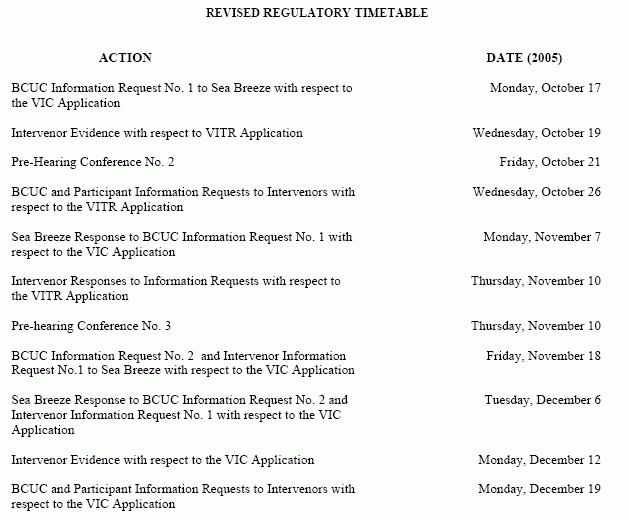
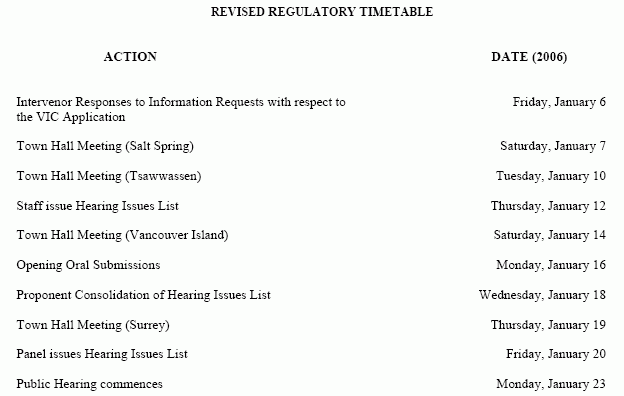
The BC Utilities Commission has issued some (in)decisions and a revised schedule following the BCTC - VITR Pre-Hearing Conference on October 21.
1. Consolidation
The Commission is deferring a decision on consolidation of the BCTC - VITR application and the Sea Breeze - VIC application until:
- Sea Breeze has filed its responses to BCUC IR#1 to Sea Breeze in the VIC application on November 7
- completion of the VITR Pre-Hearing Conference #3 on November 10.
"If after reviewing the responses to the BCUC Information Request No. 1 and after hearing submissions during the Pre-hearing Conference, the Commission Panel decides to proceed with a review of the Sea Breeze CPCN Application the Commission Panel expects that a consolidated process will be more efficient and effective than the alternative of two review processes. Therefore, the Commission Panel has established a process that assumes the Sea Breeze CPCN Application is to be consolidated. If, however, the Commission Panel decides that a consolidated process is not appropriate in the circumstances, then a revised regulatory timetable for review of the VITR Application will be issued after the Pre-hearing Conference to be held on November 10, 2005. "
2. Town Hall Meetings
A schedule is provided (see below), but may be adjusted based on further submissions to the Commission
3. Scope will not include prior decisions on zero-rating HVDC
"the Commission Panel concludes that scope of this proceeding should not include a review of prior Commission decisions regarding the zero-rating of the HVDC system for planning purposes."
4. TRAHVOL request for clarification as to whether environmental effects are within scope
"IRAHVOL requests that the Commission Panel provide further directions to Participants regarding whether or not “environmental and socio-economic issues” are within the scope of this proceeding. IRAHVOL submits that if it were not for participant funding issues, IRAHVOL would not seek further directions as applied for in Exhibit C34-5 regarding the scope of this proceeding (T2: 257). The Commission Panel is of the view that participant funding issues should be given no weight when considering procedure or any other matters that are before the Commission. IRAHVOL’s request is denied, and IRAHVOL is encouraged not to raise participant funding issues unless done so pursuant to the Participant Assistance/Cost Award Guidelines and in writing."
5. Panel Inspection of Transmission Line Corridor
Commission is uneasy about doing the inspections, based on one objection from BCPIAC - BCOAPO. Commission awaits further submission from TRAHVOL.
6. Process for Review of Hul’qumi’num Treaty Group Request
"By letter dated October 19, 2005 (Exhibit C27-5), Hul’qumi’num Treaty Group sought certain orders. The process for review of this request will not be established at this time, and may be established after further submissions from Hul’qumi’num Treaty Group (T2: 318)."
BCTC-VITR: BC Transmission Corp. - Vancouver Island Transmission Reinforcement, 230 kV AC cable from Delta to Duncan
http://www.bcuc.com/ApplicationView.aspx?ApplicationId=78
Sea Breeze-VIC: Sea Breeze Pacific Regional Transmission System Inc. - Vancouver Island Cable, 300 kV HVDC Light cable from Surrey to Victoria
http://www.bcuc.com/ApplicationView.aspx?ApplicationId=90
Canada can control oil destiny: Morgan
Heft makes companies predators, not prey
By DAVE EBNER
Globe and Mail
Friday, October 28, 2005
CALGARY -- Canadian oil and natural gas companies are big enough and strong enough to fend off advances by potential international suitors, the outgoing chief of Canada's largest energy company says.
Gwyn Morgan -- speaking yesterday in his EnCana Corp. office on the 18th floor of Bankers Hall in Calgary -- said his company has reached a size where it doesn't need to fret about being someone else's dinner.
"If you're one of the strongest and fastest, you're not at the back, you're not going to be taken out by those that are chasing you, in the Darwinian sense," Mr. Morgan said.
Mr. Morgan made his point -- which is shared by Murray Edwards of Canadian Natural Resources Ltd. -- during his first extensive interview since announcing on Tuesday that he is stepping down as chief executive officer of EnCana.
Speculation about the future of Canadian oil and gas companies hit the headlines this month, reaching a particularly fevered pitch last week as investors pushed stock of EnCana up almost 10 per cent in a single day on rumours of a bid from Royal Dutch Shell PLC.
EnCana has said there was no bid, no suggestion of a bid and no talks about a bid.
Shell yesterday reported its quarterly results.
Shell's chief financial officer said on a conference call that that it would be difficult to justify a "very large acquisition" to investors given high prices in the market.
Deals of less than $10-billion (U.S.) would be more sensible, the CFO said. EnCana's market capitalization is more than $40-billion.
Mr. Edwards, vice-chairman of Canadian Natural, the No. 2 player behind EnCana, said he is "skeptical" about the potential for foreign takeovers and added that Calgary companies are just as capable of buying their international peers.
"Canadian companies have got to a size where they're as much acquirers as acquirees, in terms of critical mass," Mr. Edwards said in a Tuesday interview.
In May, rumours swirled around that Talisman Energy Inc., Canada's No. 3 independent explorer, was going to be bought by France's Total SA, chatter that pushed Talisman stock higher.
Mr. Edwards said the world's biggest public energy companies simply might not be interested in Canadian firms.
That's because some assets owned by domestic players were acquired in sales by supermajors like BP PLC. Talisman owns former BP assets, for instance, and in 1999 Canadian Natural acquired its Horizon oil sands lease from BP as part of a $1.1-billion (Canadian) purchase of oil properties in Alberta.
"A lot of these assets were acquired over time through rationalization by other people," Mr. Edwards said. "I'd be skeptical if guys wanted to go back" to buy back what they sold.
In January, 2002, Mr. Morgan unveiled a made-in-Canada merger to create EnCana by bringing together his Alberta Energy Co. with PanCanadian Petroleum.
"When the opportunity came to bring the two companies together, I knew and David [O'Brien of PanCanadian] knew that we could create something that was so much stronger and would most likely be able to maintain its independence for a long time to come," Mr. Morgan said.
Because of this, there is no pressing need to bulk up today, Mr. Morgan said, especially if it's only to get bigger rather than better.
"To do that would be a very short-term, foolish thing to do. Unless you can merge assets that are complementary, you're going to lose," Mr. Morgan said.
Talisman CEO Jim Buckee said his company has assets that are attractive to supermajors, but added Talisman is strongest as a whole, and that selling parts are not part of the plan.
"I know they like the Southeast Asia assets and they like [Canadian] Foothills very much. But having said that, I couldn't answer for what the majors are going to do," Mr. Buckee, a onetime BP executive, said in an interview last week after his company announced a $2.5-billion takeover of North Sea oil producer Paladin Resources PLC.
Mr. Morgan is being replaced as EnCana CEO on Jan. 1 by Randy Eresman, currently the company's chief operating officer. Mr. Morgan said Mr. Eresman was the obvious choice.
"Randy's consistently been No. 1 on the depth chart," Mr. Morgan said. "Since that was well known by the board and well accepted and supported by the board, we didn't have to have a long discussion when I told them what my plans are because [the succession] was something that was a natural evolution."
Canadians stand tall
Leaders of Canada's two biggest oil and natural gas companies say homegrown firms are not likely to be picked off by larger international players, suggesting in fact, that Calgary based explorers could just as easily be the acquirers, not acquirees.
The Canadian and U.S. independents ($U.S.)
EnCana Corp. $41 billion
Devon Energy $29 billion
Burlington Resources $27 billion
Canadian Natural Resources $22 billion
Anadarko Petroleum $21 billion
Talisman Energy $16 billion
The supermajors ($U.S.)
BP PLC $244 billion
Exxon Mobil $358 billion
Royal Dutch Shell PLC $209 billion
Total - NYSE $158 billion
Exxon, Shell: spare a subsidy sir, we're not rich enough yet
Possible Federal stake in pipeline 'still on table'
Claudia Cattaneo and Paul Vieira, Financial Post, 28-Oct-2005
Exxon, Shell gush to record profits
Steve Quinn, Associated Press, in Globe and Mail, 28-Oct-2005

COMMENT: More federal subsidies to oil and gas companies already engorged with obscene profits? Exxon and Shell want the Mackenzie Gas Pipeline because they'll make money operating it, it will open up new fields for development of lucrative oil and gas, and it will provide gas to the oil sands - where Exxon and Shell are also major players and need the valuable gas to extract the even more valuable oil from the sand. Oil sands operators are already greased up on subsidies, tax and royalty breaks. And so rich, it makes your head spin. In one of these articles, Exxon is reporting revenues of $100 billion in the quarter. Enough.
Possible Federal stake in pipeline 'still on table'
Imperial said no: source
Claudia Cattaneo and Paul Vieira
Financial Post
Friday, October 28, 2005
A proposal by Ottawa that it could take an equity stake in the Mackenzie Valley pipeline "is still on the table" despite being rejected by the companies behind the megaproject, highly placed sources confirmed yesterday.
"There's no denying the question of equity was used inside the umbrella discussion of subsidies," a senior source said. "And Imperial [Oil Ltd.], as soon as 'equity' was mentioned, they said 'no.' "
"It's certainly there in so far as the feds are concerned," the source said.
Anne McLellan, the Deputy Prime Minister and the minister responsible for the pipeline file, denied a National Post story that a formal offer has been made to try to move forward the stalled $7-billion project proposed by a consortium of oil companies led by Imperial.
Ms. McLellan told reporters yesterday the government has no intention of re-entering the megaproject business and emphasized that a "private-sector" solution is required when it comes to Mackenzie.
However, she did not rule out the idea.
"We have not put any proposal on the table," she said. "We have talked to Imperial because they came to us with the discussion around fiscal enhancements. In fact, there is a long, long, lengthy list of things that could or could not be done. It is way too soon to see whether this government will choose to take a serious look at a package that is defined as fiscal enhancements."
Several sources confirmed the Post report that the federal government has proposed taking a stake of about 20% in the pipeline.
The proposal was made because Ottawa is now very concerned that a rival US$20-billion line from Alaska is gaining momentum and wants the Mackenzie project back on track, although "in the end there may be other ways than outright ownership to help the project move forward," said one source.
A proposal for an equity stake "was put on the table and the producers' group, basically, said 'no thanks.' And [the producers'] position now is that we are not going to discuss it," said another source.
Secret negotiations between the companies backing the project and the federal government over fiscal terms are getting down to the wire.
Imperial has said it will decide by next month whether enough progress has been made so it can move forward with public hearings for the pipeline, which would bring to market much-needed supplies stranded in the Arctic and help cap soaring natural gas prices.
The talks have bogged down on fiscal terms with Ottawa and access and benefits deals with aboriginal groups along the Mackenzie Valley. Imperial and its partners, Shell Canada Ltd., ConocoPhillips and the Aboriginal Pipeline Group -- an aboriginal enterprise -- want a fiscal regime that recognizes that the up-front costs are huge and it will take years before profits are recorded.
But the government believes giving breaks to highly profitable energy firms would be politically unpopular at a time consumers are being squeezed by high energy bills. Ottawa's negotiators have advanced the equity proposal as a way of getting something in return.
Ottawa's ownership in the megaproject could be similar to the 20% interest the State of Alaska is seeking to hold in Alaska gas pipeline under agreements being negotiated with Alaska producers, the sources said.
Ms. McLellan confirmed that Imperial has approached the government about cutting a deal that would make the project more financially palatable.
"Absolutely no proposal has been made to Imperial in any form in relation to any fiscal enhancements," Ms. McLellan said.
"The one thing I will say is that we're all committed to making sure this project takes place but we clearly see this as a private sector-driven project in co-operation with the aboriginal communities along the valley.
"We know that Imperial has talked about fiscal enhancements. We have indicated we're willing to sit down and talk to them about that but the suggestion that there has been any proposal at any time from us in relation to this project on the fiscal enhancement side is completely false."
Tim Hearn, Imperial's CEO, said recently the oil companies are not looking for handouts, but terms that recognize that today's high gas prices are unlikely to continue as large quantities of liquefied natural gas come to North America from foreign sources in the next decade.
He said the terms should also take into account that the project is opening a new basin and requires huge capital investment that will not yield a return for many years.
The government sources said oil companies have asked for tax and royalty concessions of $1.2-billion to $2-billion and certainty on fiscal terms.
© National Post 2005
Exxon, Shell gush to record profits
Hurricanes help drive largest oil company past $100-billion (U.S.) in sales for quarter
By STEVE QUINN
Associated Press
inGlobe and Mail
Friday, October 28, 2005
DALLAS -- High prices for oil and natural gas propelled Exxon Mobil Corp. and Royal Dutch Shell PLC to their best quarterly results ever yesterday, with Exxon becoming the first U.S. company to ring up quarterly sales of $100-billion (U.S.).
To put Exxon's performance in perspective, its third-quarter revenue was greater than the annual gross domestic product of some of the largest oil-producing nations, including the United Arab Emirates and Kuwait.
The world's largest publicly traded oil company also set a record for U.S. companies by posting profit of almost $10-billion, according to Standard & Poor's equity market analyst Howard Silverblatt.
Both Exxon and Shell said their performances were buoyed by higher prices for crude oil and natural gas, even as output suffered due to a busy hurricane season in the Gulf of Mexico. The companies noticed slight decreases in fuel demand.
Exxon's profit ballooned 75 per cent to $9.9-billion, compared with $5.7-billion a year ago. Revenue grew to $100.7-billion from $76.4-billion in the prior-year period. The previous oil industry earnings record was Exxon's 2004 fourth-quarter profit of $8.4-billion.
At Shell, third-quarter profit grew 68 per cent to $9-billion, compared with $5.4-billion a year earlier. Revenue at the Anglo-Dutch company rose 8 per cent to $76.4-billion.
"We are capturing the benefits of high oil and gas prices and refining margins," Shell chief financial officer Peter Voser said, referring to the profit margin on each barrel of crude that is refined into gasoline, diesel and jet fuel.
Shares of Exxon fell 60 cents to $55.60 on the New York Stock Exchange, where U.S.-traded shares of Shell rose $1.15, or 1.93 per cent, to $60.65.
Excluding special items, Exxon's profit was $8.3-billion, or $1.32 a share, or slightly below the $1.38 per share expected by analysts polled by Thomson Financial.
With oil futures above $60 a barrel for much of the third quarter, Exxon's profit from petroleum exploration and production rose by $1.8-billion to $5.7-billion. Prices for gasoline, diesel and jet fuel lifted refining and marketing profits by $727-million to $2.1-billion.
However, income at the company's chemicals unit declined by $537-million to $472-million, a reflection of the higher prices for raw materials.
Exxon said the hurricanes slashed U.S. production volumes by 5 per cent from a year ago, while global daily production slipped to 2.45 million barrels of oil equivalent from 2.51 million barrels. By the end of the year, it will cost the company about $100-million after taxes, the company estimated.
Shell said its adjusted earnings -- arrived at by stripping out the fluctuating value of petroleum -- added up to $7.4-billion, sharply higher than analysts' forecasts.
Shell's profit from exploration and production increased by $2.6-billion to $5-billion in spite of an 11-per-cent decline in oil and natural gas output. Its refining and marketing profit climbed by $201-million to $1.7-billion. Its chemicals business saw profit decline by $251-million to $321-million.
Shell said hurricane damage would cost it about $350-million, although much of the expense would be covered by insurance.
Slick profits
High gasoline prices in the wake of hurricanes Katrina and Rita helped fuel record profits at Exxon Mobil and Royal Dutch Shell.
$106.7-billion Combined profits expected this year for the world's five biggest publicly traded oil companies -- Exxon Mobil, BP, Shell, Chevron and Total.
26% The estimated increase in profits at the Big 5 energy companies this year.
28% The rise in U.S. gasoline price in the past 12 months.
Although many polls show U.S. consumers are intent on altering their behaviour (i.e., driving less), we still have not seen significant structural shifts in behaviour.'
Man Financial analyst Edward Meir
SOURCES: BLOOMBERG NEWS, THOMSON FINANCIAL, ENERGY INFORMATION ADMINISTRATION
Bid process lets funny smell taint Ridley Island deal
Don Cayo
Vancouver Sun
Friday, October 28, 2005
A bad smell is emanating from the few known facts concerning the likely sale of Ridley Island coal terminal in Prince Rupert.
The short story is that Ottawa is poised to turn over a facility that cost $250 million (in 1980s dollars) for just $20 million, most of which won't be paid until years from now. The only "preferred bidder" has no track record in running a port. And even though the coal industry is on a roll, the bidder isn't asked to pledge even-handed access to all companies wanting to use the terminal.
Would you like to know why there's only one bidder on the list, or who else would like to make a bid, and what they might bring to the table? Me, too.
Yet, if there's a scandal here, it's not that this basic information is being kept secret. Fact is, these days it's the norm for a government to invite some bids and refuse to consider others for reasons they never explain.
Governments like pre-qualified bidders, particularly for complex procurement contracts or large construction jobs that are complicated by a design component, because the bidding process has become so convoluted and expensive. Companies balk at going through such hoops unless they see a reasonable chance of winning; "pre-qualification" limits the competitors and tells them who they're up against. And the government people who pick the winning tender no doubt find it more convenient and less risky to deal with known quantities.
So in theory, pre-qualified bidders are companies proven to possess the expertise and resources necessary to do the job. I have enough faith in the general integrity of the system to believe that's often the case.
But a pre-qualified bidder could be one who pays bribes, who is friends with or related to a decision-maker, or is a political ally. With so much of the process hidden, how can the public tell?
With complex contracts there may be cases where it's justified for a government to take what looks on the surface like a second-best bid. But in the absence of detailed information and independent assessment, it's hard to have confidence that any given instance is a valid case.
And certainly it's possible to manipulate the criteria for pre-qualification to ensure a certain bidder gets, or doesn't get, a job. That's what I think happened last year when BC Ferries called for proposals on three big new ferries that are now being built in Germany. The criteria for yards to be allowed to make a final bid included basing 40 of 100 points on an examination of each yard's recently built, similar-sized ships. Since no B.C. yard had built any such ships, they had no chance of winning the contract -- yet BC Ferries CEO David Hahn and Premier Gordon Campbell were able to maintain the political fiction that they hadn't arbitrarily excluded B.C. bids.
The danger of losing accountability when public contracts are negotiated in private first hit my radar screen several years ago when I started looking at public-private partnerships. They're inherently complex, often involving not just design and construction, but also operation. Trade secrets are involved in many bids, and it's not fair to ask a bidder to tip its hand to competitors.
I wrote about P3s and accountability during the Campbell government's first stumbling forays into that turf, and later during its more successful hand-off of P3s to Partnerships BC.
And, lo, Partnerships BC came up with a full-disclosure policy. It publishes all contract information, except the details of the losing bids, once a contract is awarded. It also releases a value- for-money report on what it would cost if government did the work. And a fairness commissioner -- the first one was the independent-minded Ted Hughes -- observes each bid process and reports publicly on it.
This is a made-in-B.C. template that could provide the basis for accountability policies for other arms of government. Unfortunately, it has so far been ignored.
For example, the province's Alternative Services Secretariate, the body that steers through all privatization initiatives, releases only summaries of contracts and withholds key information such as performance penalties and/or rewards. And Vanoc, with all its pricey Olympic construction looming, can't or won't even tell me how extensively it will be requiring bidders to pre-qualify, let alone what its disclosure policy will be.
Which is a pity. Because when things are hidden, people are certain to wonder why.
So whenever there are questions -- when something smells funny as it does now in Prince Rupert -- many will assume the worst. And, as with the Ridley deal, the process and the projects will be tainted -- whether they deserve to be or not.
© The Vancouver Sun 2005
October 27, 2005
Alberta proposes giving oil priority over environment
John Cotter
Canadian Press
Thursday, October 27, 2005
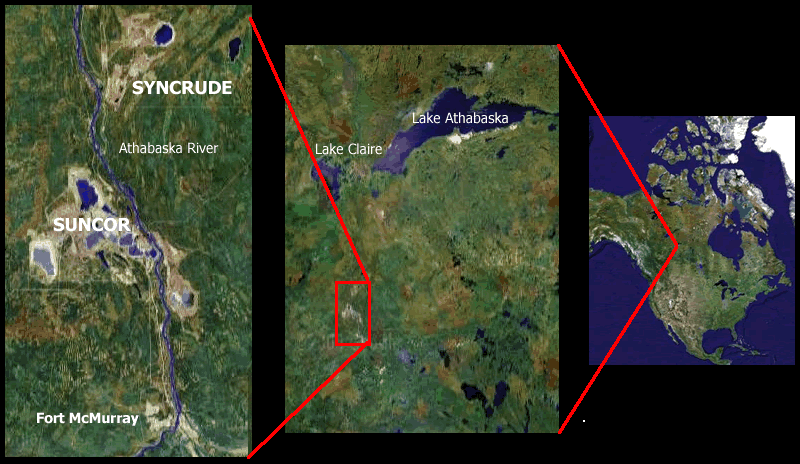
EDMONTON -- Alberta is proposing sweeping changes to the way it manages its booming oil sands sector, but critics fear the new plan will run roughshod over the environment.
The proposed Mineable Oil Sands Strategy would make mining the top priority in development areas over other concerns such as forestry, rivers and wildlife. (link)
The change is expected to increase oil sands recovery and make development, including the reclamation of mined areas, easier to manage.
"We are developing a strategy that will help coordinate development in this area," Energy Minister Greg Melchin said Wednesday.
Recent reports suggest Alberta's oil sands could triple production to as much as 1.2 million barrels a day in the next 20 to 25 years.
With enough investment, the oil sands could contribute up to half of Canada's oil supply by 2020, an increase of more than 25 per cent.
Environmental groups such as the Pembina Institute warn the Alberta government's proposal marks a fundamental shift in policy. (link)
In the past, oil sands mining has been permitted on the condition that rivers remain intact, the integrity of watersheds is maintained and key wildlife corridors are preserved.
Under the proposal, strip-mining the oil sands would take priority over protecting the environment, said Pembina Institute spokesman Chris Severson-Baker.
He estimated the plan would mean writing off 2,800 square kilometres of boreal forest.
"Albertans who value the integrity of the province's boreal forest and the people who live, fish, hunt and trap in the Athabasca region should be concerned about this strategy," he said.
Severson-Baker called on the province to shelve the strategy and come up with a better plan.
Alberta Environment Minister Guy Boutilier said the proposal would balance economic development and environmental protection.
"The environment is our mother ship," he said in a release.
The proposal would allow companies to reroute some tributaries of the Athabasca River. Any fish habitat lost from such activity would have to be replaced.
© The Vancouver Sun 2005
Alberta Ministry of Energy Mineable Oil Sands Strategy pages
Pembina Institute statement on Mineable Oil Sands Strategy
Tell the Alberta Government what you think
October 25, 2005
Gas will stay up: analyst
By ANGELA BARNES
Globe and Mail
Tuesday, October 25, 2005
TORONTO - Relatively high natural gas prices are here to stay for the next few years, according to Bank of Nova Scotia's commodities expert. That isn't good news for Canadian homeowners facing a long cold winter of high heating costs, but it is for Canadian gas producers.
"Today's tight North American supply/demand balance for natural gas is unlikely to ease significantly until 2008, when six new U.S. LNG [liquefied natural gas] import terminals come on stream," said Patricia Mohr, vice-president of Scotia Economics, in the latest report on the bank's commodity price index.
Natural gas prices on the New York Mercantile Exchange have doubled in the last year, rising from $7.37 (U.S.) a million British thermal units in October, 2004 to a record high of $14.22 three weeks ago. They have since eased off to around $13, helped in part by indications that demand has eased somewhat, particularly in the industrial sector, in the face of the exceptionally high prices.
Ms. Mohr sees NYMEX natural gas prices averaging around $9 per mmbtu next year and West Texas intermediate crude oil prices averaging about $60 a barrel - levels "guaranteeing exceptionally strong financial results for Canadian oil and gas producers," she said. Crude prices touched a record intraday high of $70.85 on Aug. 30, just as hurricane Katrina was bearing down on New Orleans.
It currently stands at about $61.35 High energy prices were a key factor fuelling the rise in the Scotiabank commodity price index to a record high in September, its second in as many months. The index increased 9 per cent from August to a level that is double the October, 2001 cyclical low.
Climbing metal and mineral prices also were a major contributor to the advance in the index, which measures price trends in 32 of Canada's major exports. "Widespread gains in most base metals, precious metals, uranium and potash offset slightly lower prices for nickel, aluminum and cobalt," Ms. Mohr said. The metals and minerals index rose to a record last month to stand 2 per cent above the peak set in June, 1988.
BCUC rules out oral hearing on Terasen deal
By Scott Simpson
Vancouver Sun
Tuesday, October 25, 2005
Utilities commission is satisfied with written submissions
The B.C. Utilities Commission announced Monday that there will be no oral hearing on the proposed $6.9-billion sale of Terasen Inc. to Texas-based Kinder Morgan Inc.
BCUC commission secretary Robert Pellatt said in a letter to Kinder Morgan that hearings proceed to an oral stage "only when the commission panel has questions arising from written submissions."
The BCUC was deluged with a record volume of correspondence, more than 6,000 letters, in connection with the sale. Many of those letters came from Terasen Gas residential customers who objected to an American company taking ownership of the province's largest gas utility.
Vancouver-based Terasen, like Kinder Morgan, is a publicly traded company. Kinder Morgan made an unsolicited offer for Terasen in August at a 19-per-cent premium to recent share value.
Terasen shareholders voted overwhelmingly last week to accept that offer.
Pellatt said the BCUC is satisfied with written correspondence on the transaction and expects to issue a final decision on Nov. 10.
"The commission has an established practice of proceeding with an oral phase only when the commission panel has questions arising from written submissions," Pellatt said, adding that in this instance the panel "does not have any questions" arising from the proceeding.
"Further, given the extensive submissions and comments received in the written process ... the commission panel considers the record is closed for this proceeding."
Terasen public affairs director Cam Avery said the commission was "able to enjoy a huge, huge amount of information."
Avery added that concerns expressed by many correspondents were "beyond the purview of the commission."
"Canada's energy export policy is just not part of the BCUC's deliberations," Avery said.
Pending approvals from the BCUC, and from Industry Canada, the Kinder Morgan purchase could be wrapped up by Nov. 30.
Avery said Terasen's customers won't notice a difference: Terasen Gas will still be the name of the company on monthly gas bills, and rates cannot rise as a result of the deal.
"You will see no effect on your gas bill as a result of this transaction. Gas rates are reviewed quarterly by the B.C. Utilities Commission and have been for years. This transaction will have no effect on people's gas bills," Avery said.
"It will still be a Terasen Gas billing, same people hooking up the meters, same people reading the meters, same people buying the gas for them. Nothing is going to change here."
© The Vancouver Sun 2005
SE2 issues simmering with MPs
By Trudy Beyak
Chilliwack Progress
Black Press
Oct 23 2005
A legal battle over a controversial international power line is surging ahead, triggering renewed public environmental concerns in the Fraser Valley.
Conservative MPs - including the Opposition party's environment critic Bob Mills - took a public stand last Saturday against Sumas Energy 2, an American power corporation which wants approval to build a power line on Canadian soil.
SE2 is a 660-megawatt natural-gas-fuelled power plant, which Washington state has approved to be built in Sumas less than 500 metres from the Canadian border.
The power plant, if built, would "become the largest new air polluter in the Fraser Valley," said Langley MP Mark Warawa, a former Abbotsford councillor.
Mills said this legal case will be carefully watched across Canada.
"This issue is precedent-setting for every border region across Canada," said Mills.
There has been unanimous opposition to SE2 from local citizens and local governments, the province of B.C. and the Conservative Party of Canada, Warawa said.
The power company intends to spew more than 2 1/2 tons of pollution daily into the confined Fraser Valley air shed, which has a history of episodes of poor air quality. The B.C. government has stated it would not approve such a power plant in the Fraser Valley on the north side of the border.
SE2, however, is appealing the National Energy Board of Canada's decision to deny the company owners the right to construct a 230,000-volt international power line through Abbotsford to wheel power from its power plant to U.S. markets.
The Federal Court of Appeal is set to hear SE2's appeal case in Vancouver from Nov. 7 to 9.
Whatcom County, meanwhile, will not permit the company's 230,000-volt power line to be built in its jurisdiction because of public concerns on the south side of the border about decreased property values and health concerns.
Sharon Roy, a director with Whatcom County, said the county continues to be opposed to SE2.
"We are very much opposed to the building of that power plant - and we certainly don't think it is fair that Canadians would have to breathe most of the pollutants to be emitted from that power plant," Roy said.
Whatcom County is watching the legal proceedings in Canada with interest. If SE2 fails in its bid to build a power line in Canada, the company may eye a legal challenge in Whatcom County, predicts Roy.
Lawyers for the Province of B.C., City of Abbotsford, FVRD, and Sierra Legal Defence Fund, including Tom Berger, have submitted legal arguments against SE2.
Mills said environment ministry officials must represent Canadian interests abroad.
"An International Joint Commission report recommended the federal government become more involved with cross-border air-pollution initiatives," Mills said.
Depending on which way the court rules, this matter could still end up on the desk of the Canadian federal government for approval, said Abbotsford Coun. Patricia Ross.
"The U.S. will get the power generation, but it will be mostly Canadians that will suffer the negative effects."
Alex Drozdow, president of the federal Liberal Abbotsford riding, said the organization is opposed to SE2 and feels confident the court will make the right decision and uphold the NEB denial decision.
October 24, 2005
Bidder offered a fraction of Ridley's cost
By Peter O'Neil
Vancouver Sun
Monday, October 24, 2005
'Fire sale' offer by group expected to gain control of port facility unacceptable, MP says
OTTAWA -- The expected winning bidder in the privatization of Ridley Terminals, the coal shipping facility in northern B.C. that cost taxpayers $250 million to construct in the early 1980s, offered $20 million for the Crown corporation in 2003, The Vancouver Sun has learned.
But the offer included only $3 million in cash up front, with the remaining amount to be paid out starting seven years after the deal closes and continuing for the next 33 years in amounts no greater than $500,000 annually.
The offer, from Ontario companies Fortune Minerals Ltd. and Federal White Cement Ltd., was obtained by Conservative MP John Cummins and provided exclusively to The Vancouver Sun.
"This asset has got some value but it's being sold off at fire sale prices. And you've really got to wonder why," said Cummins.
"This is outrageous. To begin these payments in the seventh year, and it ends 40 years later, really rubs salt in the wounds."
Members of the Ridley Shippers Coalition, a group of western Canadian mining firms that oppose the planned sale to the Ontario companies, say the Fortune bid was inferior to at least two offers from their member companies.
They provided The Sun with documents showing that Western Canadian Coal of Vancouver offered $25 million, of which $5 million would be delivered within six months of the deal closing and the remaining $20 million over eight years.
However, the WCC offer was made March 30, 2004, after the original competition was over and coal prices had jumped substantially.
Cline Mining of Toronto offered $9.36 million up front plus a royalty over 15 years of $64 million, which was intended to pay off Ridley's huge debt. No date was included in that document.
The Fortune offer was based on Ridley being cleared of its debts.
Fortune President Robin Goad said the B.C.-Alberta coalition is trying to manipulate the media to advance their self-interests.
He said the leaked Fortune offer doesn't reflect the final terms of the deal he expects to strike with Ottawa, though he said he was forbidden from saying what those terms are because of a confidentiality agreement.
The proposal is detailed in a Sept. 30, 2003, letter sent via courier to former transport minister David Collenette from Goad and Federal White Cement president George Doumet.
Northern Energy Mining Inc. president Pat Devlin, a member of the Ridley Shippers Coalition, urged the government Friday to consider his group's bid to run the terminal as a co-operative that will keep shipping costs low.
He said the Fortune group intends to charge higher fees that will make it a profit but will hurt the ability of Canadian resource firms to compete with Australian exporters.
"Remember, when this was built by the federal government it was never supposed to be a privately run, for-profit business. It was to be a benefit to the province and the country, and Canadian taxpayers paid $250 million for it. So selling it out cheap is only justifiable if it still creates the economic benefit it was originally intended for."
The leak of the deal's terms is the latest in a bizarre business saga that has included a bitter clash between Transport Minister Jean Lapierre and the corporation's so-called "rogue" management team and board of directors.
Lapierre was forced earlier this month to obtain a cabinet order preventing Ridley from signing long-term contracts after he failed to bring the managers and board to heel with a "dressing down" in his office earlier this year.
Lapierre said last week he will go ahead with his plan to obtain cabinet approval to begin negotiating with the Fortune group, despite complaints from industry and opposition MPs.
But Cummins said the federal government is shortchanging taxpayers by selling a valuable asset just prior to a rebound in coal prices that has considerably increased the asset's value.
"I think the government should just pull back from this issue. This whole thing needs a rethink. The government needs to determine what's in the best interests of northern British Columbia."
The issue came up in the B.C. legislature Thursday when the New Democratic Party called on the B.C. government to step in to prevent the sale to Fortune.
B.C. Transportation Minister Kevin Falcon, who acknowledged that Victoria had considered acquiring Ridley from Ottawa, said he's satisfied the privatization plan will result in "equal and open access for all users in British Columbia."
© The Vancouver Sun 2005
Earlier articles on the Ridley Island sale to Fortune Minerals are here
October 23, 2005
Canada doesn't have oil, Alberta does
By Rondi Adamson
Toronto Star
23-Oct-2005
Canada doesn't have oil, Alberta does, and U.S. is our main trading partner, says Rondi Adamson
The United States does not have too much "control" of our oil. The idea that it does — because, under NAFTA, we sell a certain proportion of oil to the United States — shows a failure to understand any number of things.
Who is the "our" in our oil? I don't know many Albertans, but I know enough of them to know they don't think Ontario, or much of the rest of Canada, is part of that "our."
Since Ottawa sold its stake in Petro-Canada, it could be argued that the federal government doesn't control any oil. Albertans do. And Albertans may feel that they kindly allow Ottawa to collect billions of dollars in taxes from that oil.
In short, Eastern oil consumers and Western oil producers most likely disagree about who controls what, and who it "belongs" to.
Control of oil comes from the marketplace, not from any buyer. Let's just imagine that the Canadian government mandated oil sales to China. China would then buy less from everyone else and American firms would still end up paying about the same price on the world market and getting about the same amount.
The only difference? According to John Palmer, economics professor at the University of Western Ontario, "We would force Canadian producers to pay more to ship it to China instead of the United States. In the process, we would further strain Canada-U.S. relations while donating cheap oil, by probably subsidizing the transport costs, to China."
Prime Minister Paul Martin should keep that — among other things — in mind when he decides to use oil to threaten the United States. Speaking two weeks ago in New York, the Prime Minister attempted to address the ongoing softwood lumber dispute. He hinted that Canada would look at China and India as a marketplace for "our" oil, restricting energy exports to the United States, if the Bush administration doesn't smarten up.
Apart from how morally questionable it is to suggest that trading with a dictatorship like China is a preferable/equal option to trading with a free country like America, there is also the matter of reality.
Canada is dependent on the American market, which buys approximately 85 per cent of what we have to offer. This is not to mention how our Prime Minister is causing further deterioration of already tenuous Canada-U.S. relations.
In the world market, oil is fungible. Who sells how much to whom is of little import. The price is determined by supply and demand, not a single oil company, or state. Certainly, if American demand dropped, so would the world price, but American firms do not set oil prices.
It would be nice if Canadian politicians would realize all of this and find less childish ways to deal with our largest trading partner. We always seem to be reacting against the United States, rather than carefully thinking through our rhetoric and our options.
Rondi Adamson is a Toronto writer whose work has been published in the Christian Science Monitor, Wall Street Journal Europe and USA Today.
Scrap NAFTA to loosen American grip on our energy sources
By Linda McQuaig
Toronto Star
23-Oct-2005
We would have to scrap NAFTA to loosen American grip on our energy sources, notes Linda McQuaig
When it comes to oil, the Middle East is where the action is. Or as Dick Cheney once put it — before he was vice-president and became careful about saying such things — the Middle East is "where the prize ultimately lies."
Outside the Middle East, generous oil endowments are rare. Interestingly, Canada is among the well-endowed. With our small population and relatively abundant reserves, we are one of the few western nations with the potential for something the U.S. yearns for: energy independence.
Oil is the lifeblood of the modern economy. It's the most effective and flexible form of energy, so we could count ourselves lucky up here.
Too bad, then, that we trusted our fate back in the early 1990s to a small team of negotiators appointed by the Mulroney government.
Sadly, in the course of negotiating the North American Free Trade Agreement, these Canadian negotiators acquiesced to Washington's demands for guaranteed access to our oil. They agreed to Section 605, which prevents us from cutting back our oil exports to the U.S. The section also prevents the U.S. from cutting back its oil exports to us, but they don't export oil to us.
This has potentially ominous implications for Canada.
The world is rapidly running out of easily accessible oil. Supplies of affordable oil will therefore be more precarious in the future. A recent report by the U.S. Energy Department's National Technology Laboratory bluntly noted: "The world has never faced a problem like this."
Of course, oil contributes to global warming, so it's important we reduce our consumption. But, until we move to an alternative or learn to live with less, oil remains crucial to our way of life.
Yet, despite looming oil shortages, Canada is blithely exporting roughly 70 per cent of all the oil we produce each year to the U.S., rapidly depleting what's left of our easily accessible oil. Under NAFTA, we can't cut back that proportion, unless we cut our own consumption.
Meanwhile, Canada is also an oil importer. The eastern and central parts of the country, including Ontario, rely heavily on imported oil.
So, if there were international oil shortages, many Canadians would suffer. NAFTA would prevent us from redirecting oil headed for the U.S. to destinations in Canada, no matter how great the Canadian need.
If this doesn't amount to handing over too much control over our oil to the U.S., what would?
The Mulroney government presumably surrendered this control in exchange for what it said was a guarantee that our goods would have access to the U.S. market — a guarantee which, we were told, was Canada's reason for signing NAFTA. But the final deal contained no such guarantee, as Canadian critics noted at the time, and as the ongoing softwood lumber saga underscores.
So we not only gave up control over our oil, it seems we gave it up for, well, nothing.
Linda McQuaig, a Toronto-based commentator, is author of It's the Crude, Dude: War, Big Oil and the Fight for the Planet. available in paperback. lmcquaig@sympatico.ca.
Senate Energy Committee Approves ANWR Drilling
Green Car Congress
20 October 2005
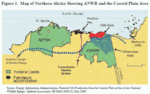
ANWR. Click to enlarge.
The Senate Energy and Natural Resources Committee on Wednesday approved legislative language instructing the Secretary of the Interior to create and implement an oil and gas leasing program in the Coastal Plain of the Arctic National Wildlife Refuge that impacts no more than 2,000 surface acres.
The legislation approved by the committee today is Title IV of the budget reconciliation bill to be marked up by the Senate Budget Committee on October 26. The committee passed Title IV in response to instructions from the Budget Committee to raise $2.4 billion in revenue for fiscal years 2006-2010. According to the Congressional Budget Office, the competitive sale of oil and gas leases in the plain will raise $2.5 billion during that time.
During the meeting over the ANWR provision, three amendments were offered and defeated.
Sen. Maria Cantwell (D-Wa), offered an amendment to ensure the payment to the US Treasury of 50% of revenues from oil and gas leasing and production on the Coastal Plain. Defeated 9–13.
Senator Ron Wyden (D-Or), offered an amendment prohibiting the exportation of oil and gas produced under ANWR leases. Defeated 10–12.
Ranking Member Jeff Bingaman (D-NM), offered an amendment to limit the authorization of oil and gas development on the Coastal Plain in the same manner as in other units of the National Wildlife Refuge System. Defeated 8–14.
The time is ripe for ANWR. Global and national conditions mandate the environmentally-sound development of oil and gas in the Arctic. The Senate first passed ANWR legislation in 1996. If that hadn’t been vetoed, I don’t think we would be paying $3 a gallon for gasoline today. The hurricanes in the Gulf underscored what Congress has known for along time: We must produce more of our own oil and we must diversify the places where we produce it. We must do it for our economy and our energy security.
—Sen. Pete Domenici (R-NM), Chair, Senate Energy and Natural Resources Committee
In March of 2004, the Energy Information Administration, at the request of Representative Richard W. Pombo, Chairman of the U.S. House Committee on Resources, published a report using government figures and analyzing—to the extent that anyone can without sinking a well shaft down through the coastal plain—the effect of drilling in ANWR.
Given the uncertainty over the exact amount of oil in place, the report lays out three scenarios: one for low-oil resources, one the mean case, the other for high oil resources.
Some of the report’s findings:
The mean-case estimate is that there are 10.4 billion technically recoverable barrels of oil in ANWR, divided into many discrete fields. This estimate includes oil resources in Native lands and State waters out to a 3-mile boundary within the coastal plain area. The mean estimated size of oil resources in the Federal portion of the ANWR coastal plain is 7.7 billion barrels.
It will take approximately 10 years to bring the first field on-line (comparable to other Arctic drilling).
Assuming sequential development of the fields, rank ordered by size, ANWR production would peak, in the mean case scenario, in 2024 at 870,000 barrels of oil per day.
Today the US imports some 10.5 million barrels per day. In 2025, the EIA estimates that almost to double to some 20 million barrels imported per day.
Using the EIA’s projections of declines in domestic oil production and increases in oil consumption (mostly from the transportation sector), by 2025 ANWR would reduce US reliance on imported oil by four percentage points—from 70% to 66%.
In other words, ANWR oil would make a small difference, but not a substantive, strategic difference. It doesn’t come close to solving the problem or providing “energy security.” Even if peak ANWR oil were available today, the US would still be importing more than 9 million barrels per day, and climbing.
As an aside, the 2,000 acres don’t need to be contiguous, and only the equipment that touches the ground (i.e., the pipeline stanchions, not the pipelines, which are in the air) count toward the figure. Since a drilling platform can occupy as little as 10 acres, there’s still the possibility of having several hundred platforms, with a maze of interconnecting roads and pipelines, spread throughout the 1.5 million acre reserve.
October 22, 2005
No fur flying at the VITR Pre-Hearing Conference
On Friday, October 21, the BC Utilities Commission held a Pre-Hearing Conference with applicants and intervenors in both the BCTC - VITR proceeding and the Sea Breeze - VIC proceeding.
The transcript is here.
The big point of debate was expected to be whether the Sea Breeze VIC application should be consolidated with VITR. In my notes, only one intervenor firmly opposed the Sea Breeze motion to consolidate, and despite lots of cautions about the Sea Breeze proposal and whether it would pass the "threshold" or "credibility test" of the BCUC, even the heavy hitters - BCTC, BCH, JIESC - did not oppose.
"What credibility test?" was asked, to which no answer was forthcoming.
The lawyer for Sea Breeze came all set up to defend a motion that he expected to have roundly trashed in the debate, and when he had his chance at the microphone, he was at sixes and sevens in his reply which was cobbled on the spot out of his prepared notes and his need to recognize that most likely (the decision is now in the hands of Chairman Hobbs, who may seek advice from Heaven, but sure isn't taking any from anyone else) Sea Breeze was going to get what it wanted.
On a number of occasions Hobbs was reminded about the risk of appeal if he were to make any decision that was not watertight in terms of its legal integrity. One great line from Mr. Carpenter, counsel for BCTC: "I'm not going to suggest that some of my friends in this room are actually wearing their court robes under their suits but I can assure you that they have them close by." (The GSX Concerned Citizens Coalition is pleased to take significant credit, with thanks to its lawyer, Bill Andrews, for the sensitivity of appeal at the BCUC.)
The fur didn't fly, so it wasn't as rich a day as some hearing days - the mention of energy and Vancouver Island is akin to a lit cigarette tossed out a car window.
Perhaps the next most interesting event in these two proceedings will be the Sea Breeze replies to BCUC Information Request #1 with respect to the VIC application. I expect a lot of people will devour that document. It's due November 7. Some excerpts from the lengthy IR are appended, below.
BCTC-VITR: BC Transmission Corp. - Vancouver Island Transmission Reinforcement, 230 kV AC cable from Delta to Duncan
http://www.bcuc.com/ApplicationView.aspx?ApplicationId=78
Sea Breeze-VIC: Sea Breeze Pacific Regional Transmission System Inc. - Vancouver Island Cable, 300 kV HVDC Light cable from Surrey to Victoria
http://www.bcuc.com/ApplicationView.aspx?ApplicationId=90
--
BCUC Information Request #1
[The BC Utilties Commission has fired its first Information Request to Sea Breeze for the Vancouver Island Cable (VIC) project. Here are just a few of the questions from the 3 MB, 27 page document. The selection is pretty random. These are questions that I could understand, and which I found interesting after a quick read of the 27 page IR.]
Sea Breeze does not agree with BCTC's assessment of HVDC Light® technology in its CPCN application for the VITR Project.
56.1 From Sea Breeze's perspective, what are the errors or misconceptions in BCTC's review of HVDC Light®? Please support the list of errors with relevant statistics, system studies, or technical papers, and include BCTC's Appendices P, Q, and R in the review.
2.1 The VIC Application states that Sea Breeze management is confident that, if a CPCN is granted for VIC, there will be no major difficulty in obtaining funding. Please explain whether Sea Breeze believes that a CPCN under Section 45 of the Utilities Commission Act ("UCA") is the unique significant condition precedent for arranging funding for VIC, and if so why it holds this view. If a CPCN is not the unique significant condition precedent, what others are there?
3.6 Where the VIC proposed route would be in lanes, streets or other municipal property, does Sea Breeze anticipate that it will be expected to pay fees under franchise or operating agreements with the municipalities through which it will pass? Why or why not? Please outline the discussions regarding franchise or operating fees that Sea Breeze has had to date with municipalities.
[there are more in this vein on ROW from BCTC, expropriating from unwilling private owners, etc.]
6.1 On page 178, Sea Breeze states it agrees with the position of BCTC, that there is a clear need for new transmission facilities providing additional reliable transmission capacity from the Mainland to Southern Vancouver Island. Please confirm that in Sea Breeze's view, the power supply deficiency lies on Vancouver Island and the primary requirement of the new transmission facilities is to carry power to the Island,
6.2 The VIC Application states that the Juan de Fuca Cable Project is well advanced and is scheduled to be operational as much as one year prior to VITR. On page 180, Sea Breeze states that either VIC or the Juan de Fuca Project will avoid the need for the VITR project until 2016. On page 178 of the VIC Application, Sea Breeze submits that the Vancouver Island transmission need is best served "by one or both of (Sea Breeze's) proposed projects. If the Juan de Fuca Cable Project is "well advanced" and is sufficient to meet the transmission need, why is Sea Breeze proposing VIC?
6.3 Please expand on how "well advanced" the Juan de Fuca Cable Project is, and when all necessary project approvals are expected.
6.4 The discussion on page 160 indicates that the VIC and Juan de Fuca projects are redundant until 2016, when they would become complementary. Please explain how Sea Breeze believes the Commission should deal with the VIC Application at this time, when Sea Breeze appears to be also actively pursuing the more-advanced Juan de Fuca Project.
6.9 Please clarify the statement on page 204 that ".. .when energized this project (Juan de Fuca) would come under the jurisdiction of the BCUC pursuant to the Province's legal definition of a 'utility'." Does Sea Breeze expect that the Commission will approve rates for the Juan de Fuca cable?
6.10 Please discuss whether Sea Breeze intends to hold an Open Season for VIC transmission rights. Why or why not?
6.11 Please discuss whether Sea Breeze is requesting Commission approval of a CPCN for the VIC Project on the basis that it will be a merchant transmission facility. Why or why not?
8.2 The VIC Application at page 199 estimates the EPC cost of VIC at $302 million, based on a turnkey project estimate from ABB. Please provide a copy of the information with regard to cost and schedule that Sea Breeze received from ABB.
[and many more questions that nose around Sea Breeze costs for VIC]
9.12 Sea Breeze notes on page 44 of the VIC Application that the VIC will bypass the Gulf Islands. What (if any) are the differences between the VITR and the VIC with respect to providing transmission service to the Gulf Islands?
11.3 If the Commission were to conclude that HVDC Light technology as set out in the VIC Application and/or the VIC route is the preferred option, is there any reason why it should not direct BCTC to adopt this option?
12.1 The VIC Application at page 44 states that the VIC project line will be operated exclusively by BCTC. Does this mean that BCTC will be the only customer of Sea Breeze? What other customers would Sea Breeze intend to serve using the VIC line?
14.5 With reference to Exhibit B-6, BCUC DR 56.4 in the VITR proceeding, please provide a comparison of the seismic risk of VIC to VITR Options i and 2, in terms of the ability to withstand seismic events that have a return period of once every X years.
15.1 Further to the statement that HVDC Light® systems are in commercial operation around the world, please provide a summary of all comparable HVDC Light® systems that are in service, stating the length of the cables, the transmission capacity and commercial in-service date of each.
15.2 For each of the foregoing HVDC Light® systems, please provide the year by year availability performance statistics, including Forced Energy Unavailability and Scheduled Energy Unavailability.
17.0 Reference: VIC Application, Exhibit HI, page 8
"The VIC Project eliminates or defers for many years the need to upgrade the Island's AC grid to relieve constraints on Cut-Plane D (between Dunsmuir and Pike substations) because it will serve the major load on Vancouver Island below the existing bottleneck. BCTC has estimated that it would cost $49 million to alleviate such north to south transmission constraint."
Reference: VIC Application, Exhibit Bl, p. 188
"Our studies indicate that the transmission capability problem can be related to any of the transmission sections between Dunsmuir and Pike Lake, hence the additional infeed at VIT alone does not provide an adequate solution."
17.1 Please supply the studies referenced on page 188.
[this may be a key part of Sea Breeze's costing comparison. I believe Sea Breeze says BCTC is not including costs of necessary upgrades on the line between Duncan (VIT) and Victoria (Pike) if VITR goes ahead.]
"Export of energy off island via VITR by an DPP, BC Hydro, or Powerex, to a customer in the Lower Mainland or U.S. would be problematic."
26.1 What level of on-island generation would be required before a power flow in the VI to Lower Mainland direction could be reasonably expected on either the VIC or VITR projects?
26.2 Is Sea Breeze aware of any VI to Lower Mainland scheduling path constraints?
Sea Breeze notes that the VIC would become part of the BC electricity grid and would be operated exclusively by BCTC.
29.1 Does Sea Breeze expect to continue to own the VIC?
Sea Breeze suggests that one or both of the VIC and the Juan de Fuca Cable Project could meet the need for new transmission facilities to Vancouver Island.
55.2 The construction of transmission facilities alone is not sufficient to ensure an adequate supply of energy to Vancouver Island customers. Please provide Sea Breeze's proposals with respect to the acquisition of energy. In the response, please address potential energy sources, the responsibilities of the various parties (including BCTC and BC Hydro), the mechanism(s) for accessing transmission capacity on the Juan de Fuca link, the implications for BC Hydro's EEP and REAP, and the consequence of BC Hydro not acquiring capacity on that link.
Sea Breeze submits that it is not necessary, nor would it be appropriate, for the Commission to carry out a detailed review of the potential environmental effects of the VIC Project.
85.1 Given that the relative environmental impact of the VIC and VITR projects has been cited by Sea Breeze as a factor in favour of the VIC project, why is it not appropriate that the Commission consider the environmental effects in its deliberations?
Read the entire IR:
BCUC Information Request #1 at
Power station due to be in operation by mid-November
Vancouver Sun
22-Oct-2005
Construction is entering the final stages at the new power station on China Creek. Project engineers hope to throw the switch on the twin generators in mid-November.
The project has been led by the Hupacasath First Nation, with $2.5 million of the funding from the federal government.
The 6.5-megawatt station will power about 6,000 homes.
Revenues from the project will be paid out to the various equity partners on a quarterly basis.
The city of Port Alberni will receive five per cent, while Ucluelet First Nation will get 10 per cent. The industry partner, Sunex, will take home 12.5 per cent of revenue, leaving 72.5 per cent for project proponent Hupacasath First Nation.
Gather round the gas flare for a big Alberta boost
By JEFFREY SIMPSON
Globe and Mail
Saturday, October 22, 2005
EDMONTON -- Each Albertan will be receiving a $400 cheque in January. Called a "resource rebate," it's each taxpayer's share of $1.4-billion carved from the huge provincial surplus. It's really, really dumb policy.
Maybe the rebate is great politics. Maybe Premier Ralph Klein's popularity as Alberta's Santa Claus will jump a few points in the polls. As policy goes, however, the rebate stinks.
The first page of the economics textbook says: Don't overheat a hot economy. Alberta's economy is the hottest in North America. It doesn't need more heat, which is what the rebate will provide when people spend the money.
When recipients spend, retailers will be happy. So will manufacturers in Ontario and the United States. And hoteliers in Arizona or Hawaii. Some of the rebate money will stay in Alberta, where it isn't needed economically, and the rest will go elsewhere.
The rebate's unfair, too. The millionaire gets it, and so does the person on welfare. If the government wanted to help people on low incomes, the rebate is perverse.
Alberta already has Canada's lowest taxes. It also has the brightest future within Canada. The place is crying out for visionary political leadership. Instead, it gets cheesy rebates.
The paranoid right-wingers in Alberta think the rest of Canada lusts after Alberta's wealth. They're coming. Just you wait. They're cooking up another national energy program. As with all paranoia, it's not based on facts, just memories, fears and an ideological agenda.
No one in the rest of Canada wants to hold Alberta back. Instead, they want to grab hold of the province's coattails and soar into the future.
Alberta has an amazing opportunity to show Canada how to succeed in a globalized world driven by knowledge, innovation, research and brainpower.
The places in the world that hard-wire this message -- It's global, stupid! It's knowledge, stupid! -- into their genes will be the ones with the highest standards of living, the best jobs and the best social programs.
Alberta has the people, resources, wealth and power to lead. It needs the political vision to set high targets for a big-sky place.
So here are a few.
Make the province's two leading universities -- the University of Calgary and the University of Alberta -- rank in the world's top 50 by 2020. The ambition for the largest university, the U of A, should be No. 20 in '20. University operating budgets are rising by 6 per cent annually for the next three years (after years of previous neglect). The U of A has a terrific new president, Indira Samarasekara; she can aim for the top 20 if she gets the resources.
Make Alberta's school system, already one of the continent's best, the best in North America and one of the top two or three in the world. Alberta has the power to make this happen -- if the political leaderships exists.
Make Alberta's training systems, public and private, the best in Canada. Labour shortages are everywhere in the province's hot economy. It's going to take public investments in skills development and upgrading to keep abreast, or ahead, of demand.
Make Alberta one of the top two or three places for medical research in North America, and one of the top five in the world. Former premier Peter Lougheed's brilliant invention, the Alberta Heritage Fund, already finances medical research. It could do so much more. What does the world call the breakthrough in diabetes treatment? The Edmonton Protocol, because that's where the discoveries were made. Build on this legacy. On second thought, leap from it.
Make Alberta a continental leader in sustainable development. Don't just burn huge quantities of natural gas to develop the tar sands, because the carbon emissions will be huge. Finance urgent research into carbon sequestration, shipping and burying carbon, so that a virtuous circle is created of energy exploitation with diminished atmospheric impact.
Make Alberta the model for health-care experimentation. Help break Canada free from the existing model that is devouring public budgets everywhere, depriving governments of the ability to make more sensible investments in the future.
Make Alberta the country's fairest place. Shrink poverty, because poverty holds back development. Unequal societies are often less productive than more equal ones. Lower taxes don't necessarily mean high productivity, right-wing ideology notwithstanding. If they did, Finland wouldn't have the world's most productive economy.
Make every important decision revolve around this question: How does Alberta become the most outward-looking place in North America? The world isn't at all "flat," as one pundit pretends, but space is shrinking.
Alberta has a superb private sector, a competent civil service, creative people, an excellent work ethic, a can-do spirit, and natural resources in high demand. It's been hugely influential in reshaping how people elsewhere think about public issues, whether or not the province understands this influence.
Alberta has the power to do better than cutting cheques to itself. That's why its future political decisions are so important to Albertans, and to the rest of us.
COMMENT:Well, we should be cooking up a national energy program, despite intimidation by Alberta.. We have health policy, environment policy, industrial policy, trade policy, but no energy policy.
Oh, let's see, it's the most important economic activity right now in the world. It's the largest resource economy in the country. It makes and breaks governments and nations. Energy is the stuff which is driving American international policy. And it pits little old Canada against the largest richest corporations the world has ever known.
And we shouldn't do a little national strategizing around it? Gimme a break. Of course we should, and it's only because Alberta Ottawa is afraid of an Albertan hissy-fit that it won't talk about what we so obviously need. Canada needs a national energy policy.
British Columbians are up in arms over the Kinder Morgan takeover of Terasen. You don't think that's the stuff of national energy policy? Kinder Morgan is the agent of US energy policy. Terasen should be a part of Canada's.
Canada's largest ever energy project is the Mackenze Gas Pipeline, controversial for a generation, and still the subject of intense debate. No policy guides its implementation or abandonment - oh, no - just a bunch of companies pushing their interests on government and indigenous peoples.
How about all the public discussion about using energy as a weapon in lumber wars with the US? And what about NAFTA and Canada's impossibly dumb commitment to ensure oil and gas keep flowing to the US? What about paced development, instead of market-driven expansion that does its thing without reference to local needs or sustainability. What about the fiscal and regulatory environment in which renewable energy could be thriving?
We need a national energy policy, and we should be developing it right now. - Arthur Caldicott
October 21, 2005
Ottawa to review U.S. takeover of Terasen
By PETER KENNEDY
Globe and Mail
Friday, October 21, 2005
VANCOUVER -- In an unusual move, Ottawa issued a public statement yesterday saying it will review U.S. energy giant Kinder Morgan Inc.'s proposed $6.9-billion takeover of Terasen Inc. to ensure that it will be of "net benefit" to Canada.
Facing opposition in British Columbia, Federal Industry Minister David Emerson is stepping aside from the review process to avoid conflict of interest allegations stemming from an earlier role as a director of Terasen, which was previously known as BC Gas.
"He will not be involved in the final decision on this investment," a spokesman for Mr. Emerson said, adding that Intergovernmental Affairs Minister Lucienne Robillard will be the one to approve the deal if it proceeds.
Mr. Emerson's decision to recuse himself comes after Terasen shareholders overwhelmingly approved the controversial takeover by Kinder Morgan, a Houston-based pipeline operator, at a meeting in Vancouver on Tuesday. The acquisition is widely seen as a strategic move by Kinder Morgan to gain a broad foothold in the Alberta tar-sands industry and to give Terasen more capital to expand the pipeline side of its business.
However, it has sparked a firestorm of criticism from citizens and politicians who worry about the ramifications of a U.S. firm gaining control of a Canadian company that supplies natural gas to 870,000 B.C. residents.
"We do not want the possibility that the U.S.A. Patriot Act will give the American government access to our billing records via Kinder Morgan," said David Askew, a member of the Vancouver chapter of the Council of Canadians.
Corky Evans, a B.C. New Democratic Party MLA, said the B.C. Utilities Commission, which is also reviewing the sale, should open up the transaction to public hearings before Canada's third-largest utility is sold to a U.S. company.
"This is about whether or not Canadians should be able to have a conversation about Canada before we sell a chunk of it," he said.
A spokesman for Mr. Emerson said Ottawa doesn't usually issue a statement to say that it is reviewing a transaction like the one involving Terasen. However, he said the decision to do so was due, in part, to criticism of the deal.
"I'm told that the B.C. Utilities Commission has received something like 5,000 e-mails on this, almost universally opposed," the spokesman said. "They tend to come from Canadian nationalists who don't want to see the company sold into foreign hands.'' Industry Canada has issued a statement saying there is an ongoing review of the transaction under the Investment Canada Act, which gives the federal government the ability to negotiate enforceable commitments with the investor during the review process. It also said that acquisitions that are subject to review under the act receive approval only when they demonstrate a net benefit to Canada.
Yesterday, B.C. Energy Minister Richard Neufeld said he preferred to offer no opinion on the transaction, saying it is up to the B.C. Utilities Commission to determine whether it is in the best interests of the citizens of British Columbia.
October 20, 2005
Share and share alike
By Donald Gutstein
Georgia Straight
Publish Date: 20-Oct-2005
The evening after the British Columbia government introduced legislation imposing a contract on the province's teachers, Michael Smyth interviewed British Columbia Teachers' Federation president Jinny Sims and Labour Minister Mike de Jong on his CKNW Nightline BC radio show. Smyth was argumentative and surly with Sims. He accused her of not being straight with the public. When he interviewed de Jong, Smyth was respectful and attentive. He sought de Jong's opinion; he disputed Sims's opinion. Smyth ended the segment with a promo for his next-day column in the Province.
The column continued his attack on teachers. Smyth accused Sims of displaying "predictable moral outrage", as if it had been fabricated for the cameras and tape recorders. He lambasted the union for its "militancy" and the NDP for its predictably "snuggly relations" with the teachers.
As for the government, Smyth informed us, Premier Gordon Campbell had to bring down the hammer because "the hammer.is the only thing the BCTF understands." The kindly but firm father applied the punishment he knew would hurt but would be good for his unruly children.
Several days later, his column and radio show spread some of the blame for the impasse to the government. Both sides were at fault, Smyth said and wrote. Government was responsible for provoking and baiting the teachers, among other factors.
It's as if he's creating his own echo chamber. He shouts "teachers are militant" or "government provoked the teachers" in one direction. He shouts it again in another. It bounces back from somewhere else, as other media pundits join in. Soon the message surrounds us and we don't know any more where it originated. The message seems to have always been out there, so it must be true.
Smyth is not alone in appearing on supposedly rival news outlets. Vancouver Sun political columnist Vaughn Palmer appears every morning on CKNW's Morning News With Philip Till. Palmer also hosts the Voice of BC show weekly on Shaw Cable 4. Keith Baldrey, Global TV's legislative bureau chief, is a weekly radio commentator on the "Cutting Edge of the Ledge" segment of the Bill Good Show on CKNW.
CKNW is one of 50 radio stations across Canada owned by Corus Entertainment, including four in Vancouver. Both Corus, which also owns 10 cable channels, and Shaw Cable-the second-largest cable system in the country-are controlled by the Shaw family of Calgary, whose net worth last year was $635 million.
Global TV, the Vancouver Sun, and the Province are owned by the Asper family of Winnipeg. The Aspers own major newspapers across Canada, the Global Television Network, eight cable channels, and the canada.com Web sites. This family was worth $1.09 billion in 2004.
When the Senate Communications Committee came to town earlier this year to study media concentration, it heard loudly and clearly that CanWest holds too much of the Vancouver English-language media market. The inevitable consequence, many presenters told the committee, is a reduced diversity of news and opinion available to citizens.
Now CanWest is sharing its people with Shaw and Corus. Reduce, reuse, and recycle are excellent concepts when applied to the environment; they are dangerous when practised by news media.
CTV, CHUM, and the Globe and Mail are small players in the Vancouver market. CBC radio and television are the only news organizations equal in size and scope to the giants. But after its recent labour troubles, the public broadcaster may be permanently weakened. That leaves industry leaders the Vancouver Sun, the Province, Global TV, and CKNW, and they're increasingly speaking with one voice.
Some of the connections between CanWest and Shaw-Corus are long-standing. The premier's brother, Michael Campbell, has had his Money Talks show on CKNW for years, and his Vancouver Sun business column is tired news. Vaughn Palmer has been doing his Voice of BC show for several years.
Others are more recent. Global TV anchor Jill Krop often hosts CKNW's The World Today. Weatherman Phil Reimer does the weather for the Sun and CKNW.
In January 2005, CKNW began airing Adler on Line, hosted by right-wing broadcaster Charles Adler from Winnipeg. Adler does a TV segment each night on Global Winnipeg, known as "Adler on Global", and he hosted CanWest's Global Sunday program in Calgary for several years.
CanWest News columnist Jonathan Manthorpe is a regular guest with John McComb's CKNW afternoon show discussing international affairs. Shell Busey writes a Sunday Homes column in the Province and hosts two weekend radio shows on CKNW.
If these exchanges were happening within one company, it would be called convergence. The late Izzy Asper once said his model in building his company was the Chicago Tribune. In the mid-'90s, the paper constructed a cable-television studio in the middle of its fourth-floor newsroom. Reporters who wrote stories in the day's paper would be interviewed in the evening about the story and add elements not included in the print version-at no extra pay, of course. Convergence was supposed to increase revenues and reduce costs.
But the exchanges are happening between separate companies. And not only are they sharing their human resources, they're writing and talking about each other.
On September 29, the Province ran a picture of CKNW reporter Leanne Yuzwa, who is noteworthy, perhaps, because she's a boxer.
On September 7, Fanny Kiefer returned to work as the ubiquitous host of Shaw Cable's Studio 4. The next day, the Province put her picture on the front page and ran a story and another picture inside. The Sun provided a long article.
A Province story about the epidemic of drug-overdose deaths in the Downtown Eastside near the end of August quoted just two sources: a police constable and CKNW. The Province E-Today section of August 12 carried a discussion about Philip Till's suitability as CKNW's morning-show host. Several days before that, Pete McMartin's Sun column discussed an on-air interview he had done with Till.
And that's just in a two-month period. Are CanWest and Shaw setting the stage for a merger that would create the largest media empire in Canada? Or are two of Canada's wealthiest families merely obsessed with cost-cutting by laying off staff and sharing whomever is left with the other guys, a kind of contracting-out to the competition?
CanWest's near-monopoly means that its commentators and columnists are the experts, not because they are most knowledgeable and well- informed but because they have the soapbox and no one else can compete. If another organization wants to be taken seriously, it grabs CanWest's experts.
These practices may be good for shareholders but they do little for readers and viewers. With so few major news organizations in the city, the pool of experts is shallow. They know each other, they interview each other, and they rarely disagree. The range of opinions is narrowed even further.
Sharing employees creates other concerns for the audience. Can CanWest ever report objectively on Corus or Shaw, or Corus on CanWest, if their most high-profile people are scurrying between the organizations? Can one reporter work simultaneously for two competing media organizations? Can one reporter use the facilities of one newsroom to write for another? Where is the reporter's loyalty when she obtains a scoop? What ethical issues might arise?
Certainly, the love-in between the two companies today is a far cry from the situation seven years ago when they were bitter rivals vying for the media empire of the late Frank Griffiths. When he died in 1994, Griffiths had assembled in Western International Communications the jewels of B.C. broadcasting: BCTV and CKNW, plus eight other television stations, 11 radio stations, interests in four cable channels, and a 54-percent interest in Canadian Satellite Communications, a satellite TV provider.
In 1997, Izzy Asper and son Leonard sat down opposite J.?R. Shaw and son Jim in a Toronto hotel to divvy up the WIC assets, but no deal was reached. Two years later, after bids, counterbids, and lengthy court challenges, a deal was finally reached-the one that had been before them all along. CanWest got the television stations; Shaw got CanCom and Corus, the radio stations, and the cable channels.
Leonard Asper became CEO of CanWest in 1999, and within a year he transformed the company from a money-spinning second-rate television network into a converged conglomerate with billions of dollars in debt after paying $3.2 billion for Conrad Black's major city daily newspapers and a half interest in the National Post (later increased to full ownership).
Jim Shaw took over in 1998 and turned his father's cable firm, the second-largest in Canada, into a diversified media empire of radio stations, cable channels, and Internet holdings, plus the leading Canadian animation house, Nelvana. Unfortunately, his empire was created just before 9/11, when advertising revenues tanked. Corus took several years to climb out of its hole back to profitability.
Corus compensated for lost advertising revenues by laying off as many staff as possible while still being able to run the operation. Less than a week after Corus received CRTC approval to take over the Women's Television Network, it axed 60 jobs. This followed an earlier company move to eliminate 100 jobs across the country, except for in the radio division. The radio cuts came next: 20 of the 155 full-time employees at the four Vancouver stations and 11 more in Edmonton. With its depleted resources, Corus needs CanWest.
The end game is not yet clear. Both companies seek an end to foreign-ownership restrictions. This would allow them to cash out. But opening Canada's media to control by people like Rupert Murdoch, who owns sham news service Fox News, is a nonstarter unless Stephen Harper and the Conservatives gain power. The Canadian Radio-television and Telecommunications Commission wouldn't necessarily turn them down, because it has become so supportive of what the industry wants.
Leonard Asper and Jim Shaw are probably having too much fun moving the dominoes around the board to want to sell. So they might do a deal.
Telus says the future is friendly, but in media the future is all about controlling content and distribution. CanWest has huge content resources but no electronic distribution systems such as cable or satellite TV to deliver them. Shaw-Corus has the cable and satellites but is light on content. Together they make a world-class powerhouse, at least domestically.
Such a combination would make the Aspers and Shaws even richer. But it would be a black day for Canadians, weakening our rights to receive the information we need to be informed citizens. The echo chamber would be made permanent and we would forever lose our bearings.
Meanwhile, Jim Pattison's AM600 pulled the plug on Rafe Mair's talk show last week. Mair ended up on that station after his popular CKNW show was cancelled by Corus several years ago, in part because he was critical on-air of Corus's cost-cutting measures. Who will tell those stories now?
October 18, 2005
China as Canada's No. 1 trade partner? Not likely
By Richard Gwyn
Toronto Star
18-Oct-2005
One of the first things China will do once it becomes a major customer for Canada's oil — as apparently is Prime Minister Paul Martin's policy — is to tell us to get lost when we next suggest that Beijing join the Kyoto Protocol to combat global warming.
The same answer will come winging across the Pacific should we complain about China's treatment of its democracy activists.
On these issues and many more like them, we will, if not actually get lost, then go silent as soon as China starts importing the rumoured 400,000 barrels a day of Alberta tar sands oil.
There's no argument whatever that Martin is absolutely right to go toe-to-toe with President George Bush and his administration over American failure to abide by the NAFTA panel ruling against it on the softwood lumber issue. The panel decision was unanimous. Three other panels have ruled the same way on the same issue.
Even The Wall Street Journal, usually a cheerleader for Bush, believes Washington should pay back the $5 billion it has collected in special charges on our lumber.
In economic terms, the lumber issue isn't that big a deal. Despite the discriminatory treatment, we're still selling a lot of the stuff across the border. But ignoring international law and thereby putting the NAFTA trade pact at risk is a very big deal indeed.
The best measure of how big a deal this is is that Americans, themselves, are getting nervous about their own behaviour.
On a trip to London last week, the State Department's legal counsel John Bellinger told reporters, "We are very interested in countering this perception that the U.S. doesn't have regard for international law." Earlier, Bellinger had said the same thing to the judges of the International Court of Justice at the Hague.
Bellinger's problem — and that of the U.S. in terms of its image around the world — is that "perception" is reality.
Thus, in Sunday's New York Times, columnist Nicholas Kristof wrote that, "The Bush administration's campaign to bully a poor country (by cutting off some aid) over the (International Criminal) court is cultivating more ill will toward the U.S. than extremists ever could have."
Bellinger himself had a hard time in London coming up with any significant current examples of the U.S. implementing the spirit and letter of international agreements. But, and this is a big but, "U.S. Bad" doesn't mean "China Good."
Of course, we should sell our logs and rocks to China, or to anybody. With the tar sands, though, there is the embarrassing fact that digging out the oil from it does more to heat the globe than any other oil project, by far.
But the notion of China as an alternative trade partner to the U.S. is pure fantasy. In fact, a double fantasy.
As trade partners go, China would make the U.S. look like a patsy.
Brazil, which entered into a much-touted, special trade agreement with China, is now going through an agonizing rethink because so few of the agreed return benefits (investments, infrastructure projects) have come through.
Also, for whatever we would get, we'd find ourselves paying a political surcharge. The surcharge of silence about China's repressive, authoritarian regime.
There'd be more than silence in the equation. The Chinese industrial and commercial system remains comprehensively corrupt. Bribes paid over there — as they have to be to get almost anything done — will come back here, in one way or another.
In the immortal words of the otherwise forgotten Social Credit leader Robert Thompson, "The Americans remain our best friends, whether we like it or not."
It would help, though, if they tried a bit harder to be a bit friendlier.
Richard Gwyn's column appears Tuesdays and Fridays. gwynR@sympatico.ca.
October 17, 2005
Fossil fuels are here to stay, says expert
Gordon Jaremko
CanWest News Service
Monday, October 17, 2005
Doom-and-gloom forecasts for gas, coal and oil are wrong, says SFU prof in a new book
EDMONTON -- Reports of the death of fossil fuels are greatly exaggerated, a prominent Vancouver scholar and public servant has concluded after a research odyssey burned off his preconceptions and academic training about energy.
"They call me the fossil fool now," Mark Jaccard joked recently between lectures he was giving in Edmonton.
But the Simon Fraser University professor and former chief executive officer of the British Columbia Utilities Commission was only half-kidding.
Cambridge University Press in England will this fall publish a book by Jaccard that breaks away from a recent gush of literature claiming current supply scares, price spikes and environmental resistance are the death rattles of oil, natural gas and coal. The volume will be titled Sustainable Fossil Fuels: The Unusual Suspect in the Quest for Clean and Enduring Energy.
It has been assumed for decades societies will gradually switch to renewable energy forms and wean themselves off oil, gas, coal and atomic power, Jaccard said.
But he concluded the assumptions he was taught were wrong. His forthcoming book forecasts that oil, gas and coal will still satisfy 58 per cent of world energy needs in the year 2100.
That market share will be down from today's 85 per cent but still require high production because total global consumption of all energy forms will grow as developing countries strive for North American-level living standards.
That includes China, whose seemingly endless industrial and transportation needs will see it battle the United States and other trading partners for investment opportunities in the Canadian oilsands. China now buys most of its imported oil from the Middle East, Indonesia and Africa. It is also expanding its presence in central Asia, a rapidly growing energy producing region, as well as South America.
Heating, cooking, transportation and electric power are bound to become steadily more expensive, Jaccard said. Costlier sources of fossil fuels will be tapped. Producers and consumers alike will face stricter environmental standards. Expensive alternatives such as wind and solar power will spread. A revival of atomic power awaits regions with the greatest need for new supplies.
But obtaining energy to maintain current living standards, and support new services and gadgets requiring energy, will not bankrupt North American consumers, Jaccard predicted.
By the end of this century energy will burn up about eight per cent of family budgets, he calculated. That will be up from today's six per cent but still barely half the 16 to 20 per cent of Canadian and American household money, work and time that went into gathering and preparing fuel and tending primitive appliances in 1900, Jaccard said.
Periodic cost increases above the long-range average trends are built into the global energy market and play a role in stimulating economic evolution, he suggested.
Current steep oil prices, for instance, are part of a natural trend to replace dwindling traditional supplies from conventional wells with costlier new sources such as Alberta's oilsands.
"Prices will jump around," Jaccard said. But governments can help make energy changes easier by introducing policies that help markets adapt to changing needs and technologies, he added.
For example, clear, long-range emissions-reduction targets should be set by climate change policy makers so industry can engineer new projects to make steady improvements, he said.
He urged Canada to try a system of "niche market regulation'' used in California. The state stimulated cuts in auto emissions and helped spawn hybrid electric and gasoline cars by requiring manufacturers to make small fractions of their fleets comply with low- to zero-pollution targets, Jaccard said.
CALCULATING THE TRUE COST OF ENERGY PRODUCTION
It takes energy to make energy -- and a lot of it -- in the northern Alberta oil sands.
Bitumen projects will burn 1.01 billion cubic feet of natural gas a day by late 2006, the National Energy Board says in a new forecast. That will be a 40-per-cent increase from 2004 and about twice as much gas as all the homes in Alberta burn.
The growth in gas consumption roughly matches the pace of increases in oilsands output, which is forecast to hit 1.2 million barrels per day by late 2006.
The consumption growth rate is expected to moderate as new projects adopt emerging methods of cutting their use of gas -- or making their own fuel -- for heat-driven bitumen extraction systems, synthetic-oil upgrading and power generation.
But energy will remain a big oilsands expense. FirstEnergy Capital Corp. forecasts that as production grows to two million barrels daily by 2010, annual operating costs will more than double to about $10 billion from $4 billion in 2004 with increasingly expensive gas driving much of the rise.
The Alberta government will pay a share of the tab. Oilsands royalties are collected on the net value of production to the industry, after subtracting expenses.
Ran with fact box "Calculating the True Cost of Energy Production", which has been appended to the end of the story.
© The Vancouver Sun 2005
October 15, 2005
Kitimat selected for Enbridge's Gateway Pipeline
Kitimat, B.C., Selected as End-Site Location for Enbridge's Gateway Project
Enbridge news release, 14-Oct-2005
$4-billion pipeline to land in Kitimat
Scott Simpson, Vancouver Sun, 15-Oct-2005
COMMENT:Good news in Kitimat; Disappointment in Prince Rupert, the other potential terminal location for the proposed Gateway Pipeline, which - if built - will transport oil from Alberta's oilsands to China and other markets, including, possibly, the US. A Chinese company has already secured half the capacity of the Gateway project. (link)
Dashed hopes at Fortune Minerals, as well, which appears to have won a quiet move by the federal government to sell Ridley Island Terminals near Prince Rupert (link). Revenues from the Gateway project will not now be part of Ridley Island's future.
It won't look like boom town in Kitimat for a while, as the Methanex plant closes on November 1 and 125 or so people are out of jobs. But EnCana has an option on the Methanex site for a "soluent" terminal facility (link), and Gateway is actually two pipelines, the oil export pipe, and a "condensate" import pipe. Even if the EnCana project and the Enbridge condensate project eventually become just one project, Kitimat is going to be busy. Then there's the Galveston Kitimat LNG project on the books as well, proceeding through a BC environmental assessment with little fanfare. (link)
But the big issue: oil tankers in Douglas channel. There's some understanding that a tanker moratorium is in place on the coast. Does it apply to the oil tankers that will be taking Gateway oil to China and elsewhere? What do the Haisla and Haida think of this? What do the salmon think of this?
Kitimat, B.C., Selected as End-Site Location for Enbridge's Gateway Project
NEWS RELEASE TRANSMITTED BY CCNMatthews Printable Version
FOR: Enbridge Inc.
TSX SYMBOL: ENB
NYSE SYMBOL: ENB
OCT 14, 2005 - 12:30 ET
CALGARY, ALBERTA--(CCNMatthews - Oct. 14, 2005) - Enbridge Inc. (TSX:ENB) (NYSE:ENB) is pleased to announce that after months of fieldwork, Kitimat, British Columbia, has been selected as the end-site location for the proposed Gateway Project. Key factors in the decision to select Kitimat were the deepwater port and abundant industrial land.
"Enbridge is very excited about the Gateway Project and what it will mean to the North Coast of British Columbia," said Art Meyer, President of Gateway Pipeline Inc. "We believe this project will bring economic benefits not only to Kitimat, but the entire region during both the construction and operation phases."
The Gateway Project is estimated to cost approximately $4 billion and will consist of a petroleum export pipeline and a condensate import pipeline along the same right-of-way, and a marine terminal. The pipeline will run from Strathcona County, near Edmonton, to Kitimat.
"The Gateway Project is good news for Kitimat and will provide many opportunities for our community in the future," said Mayor Richard Wozney of the District of Kitimat. "We have worked hard over the last number of months to attract Enbridge as a corporate citizen and look forward to working with them."
The Gateway Project is expected to generate thousands of direct jobs during construction and up to 75 permanent jobs for the operation of the pipeline, marine terminal and related facilities.
Over the past three years Enbridge has met with communities and First Nations, interest groups and governments to discuss the Gateway Project and is committed to open and transparent consultation about the project.
Once commercial certainty and regulatory approval are achieved for the Gateway Project, Enbridge anticipates starting construction in 2008, with the pipeline being operational in 2010.
Gateway Pipeline Inc. is a wholly owned affiliate of Enbridge Inc. that has been created to manage the development of the Gateway Pipeline.
Enbridge Inc., a Canadian company, is a leader in energy transportation and distribution in North America and internationally. As a transporter of energy, Enbridge operates, in Canada and the U.S., the world's longest crude oil and liquids transportation system. The Company also has international operations and a growing involvement in the natural gas transmission and midstream businesses. As a distributor of energy, Enbridge owns and operates Canada's largest natural gas distribution company, and provides distribution services in Ontario, Quebec, New Brunswick and New York State. Enbridge employs approximately 4,400 people, primarily in Canada, the U.S. and South America. Enbridge's common shares trade on the Toronto Stock Exchange in Canada and on the New York Stock Exchange in the U.S. under the symbol ENB. Information about Enbridge is available on the Company's web site at www.enbridge.com.
Certain information provided in this news release constitutes forward-looking statements. The words "anticipate", "expect", "project", "estimate", "forecast" and similar expressions are intended to identify such forward-looking statements. Although Enbridge believes that these statements are based on information and assumptions that are current, reasonable and complete, these statements are necessarily subject to a variety of risks and uncertainties pertaining to operating performance, regulatory parameters, weather, economic conditions and commodity prices. You can find a discussion of those risks and uncertainties in our Canadian securities filings and American SEC filings. While Enbridge makes these forward-looking statements in good faith, should one or more of these risks or uncertainties materialize, or should underlying assumptions prove incorrect, actual results may vary significantly from those expected. Enbridge assumes no obligation to publicly update or revise any forward-looking statements made herein or otherwise, whether as a result of new information, future events or otherwise.
BACKGROUND INFORMATION ON THE ENBRIDGE GATEWAY PROJECT
- The Gateway Project, estimated to cost approximately $4 billion, involves the proposed development of two new pipelines, a new marine terminal, tankage, pumping stations and related facilities.
- The Gateway Project will run from Strathcona County near Edmonton to Kitimat, British Columbia.
- Key factors in the decision to select Kitimat as the end-site location for the pipeline were the deep-water port and abundant industrial land.
- The pipeline will be 1,200 kilometres in length.
- The petroleum export pipeline will be 30-inches in diameter and designed to move an average of 400,000 barrels per day.
- The condensate import pipeline will be 20-inches in diameter and designed to move an average of 150,000 barrels per day.
- Condensate is a by-product of natural gas production and is used as feedstock to oil refineries but its primary use in Western Canada is to dilute heavy oil for easier transport by pipeline.
- Certified marine tankers will be used to either import condensate or export petroleum. The marine terminal will include tankage, emergency response equipment, tanker births and other related facilities.
- Enbridge anticipates filing the National Energy Board application for the Gateway Project in April 2006, beginning construction in 2008 and having the pipeline operational in 2010.
- The socio-economic benefits during construction of the project are estimated at $1.52 billion in BC and $1.26 billion in Alberta.
- During the operation of the Gateway Project, the socio-economic benefits are estimated at $107 million per year in BC and $60 million per year in Alberta.
- The Gateway Project is an important part of Canada's energy future and will help ensure there is enough capacity to transport new oil expected from Canada's oil sands in the years to come.
FOR FURTHER INFORMATION PLEASE CONTACT: Enbridge Inc.
Jim Rennie
News media:
(403) 231-3931
Email: jim.rennie@enbridge.com
or
Enbridge Inc.
Bob Rahn
Investment community:
(403) 231-7389
Email: bob.rahn@enbridge.com
Website: www.enbridge.com
or
NATIONAL Public Relations
Michelle Ward
(604) 970-5901
Email: mward@national.ca
$4-billion pipeline to land in Kitimat
GATEWAY I Enbridge project means thousands of jobs for northwest B.C.
Scott Simpson
With files from Leanne Ritchie, Prince Rupert Daily News
Vancouver Sun
October 15, 2005
The final decision on a Pacific terminal for Enbridge's $4-billion Gateway pipeline project came down to money, with Kitimat announced Friday as the Calgary company's preferred location.
The sprawling pipeline project, slated to span some 1,200 kilometres from Edmonton to the Pacific Ocean, is expected to create a mini-job boom and economic spinoffs worth about $1.5 billion for the B.C. economy.
A route to Prince Rupert would have cost at least $500 million more than Kitimat, although an Enbridge spokesman said communities across northern British Columbia will benefit from the project.
The company expects unspecified "thousands" of jobs during a two-year construction phase and about 75 permanent jobs including about 35 at the terminal in Kitimat.
Gateway Pipeline Inc. president Art Meyer said economic spinoffs will include materials purchases, construction jobs and indirect employment.
The company hopes to gain all regulatory approvals by 2007 and have the pipeline operational by 2010.
"Certainly this is great news for Kitimat, and Terrace, and the region," said Kitimat Mayor Richard Wozney, who was in Terrace for the announcement.
"We welcome this industrial investment. I think it will be a great addition to our community and to our private port operation in Kitimat.
"This will add to our reputation as being somewhat of an energy hub and a petrochemical centre. We hope they will get through all of their regulatory approvals, start construction in 2008 and be in operation in 2010."
Gateway involves twin pipelines between Kitimat and Edmonton -- a condensate line taking oil-thinning materials east from a terminal in Kitimat to oil processing facilities in Alberta, and a larger petroleum line carrying crude oil to the West Coast.
The project must still address regulatory and market hurdles -- including signing up enough pipeline customers to make the lines economic.
Meyer noted during a teleconference with reporters that the proposed condensate line already has strong support from shippers.
Later this month Enbridge will embark on an "open season" for expressions of interest from shippers for the petroleum line -- which passed a major milestone earlier this year when PetroChina signed a memorandum of understanding for half its capacity.
"We have decided on Kitimat as the end point for the pipeline. That's really been based on economic criteria, as well as the deep water port and industrial land that's available in the area. But the primary factor was economic and a business case determined Kitimat was the most appropriate choice," Meyer said.
"With that said, we certainly do see this project being an economic benefit to the entire region and we've been pleased to work with all communities in the region to pursue that.
"We are looking forward to working hard over the next while to make this vision a reality, both through the phase in which we will be confirming commercial certainty, then through the regulatory approval process, and finally into construction."
Meyer said the pipeline route to Prince Rupert was longer, but it would have meant a shorter travel time for tankers plying the route from a B.C. terminal to potential markets in California and Asia.
The Other Hurricane
Has the Age of Chaos Begun?
By Mike Davis
TomDispatch.com
October 6, 2005
The genesis of two category-five hurricanes (Katrina and Rita) in a row over the Gulf of Mexico is an unprecedented and troubling occurrence. But for most tropical meteorologists the truly astonishing "storm of the decade" took place in March 2004. Hurricane Catarina -- so named because it made landfall in the southern Brazilian state of Santa Catarina -- was the first recorded south Atlantic hurricane in history.
Textbook orthodoxy had long excluded the possibility of such an event; sea temperatures, experts claimed, were too low and wind shear too powerful to allow tropical depressions to evolve into cyclones south of the Atlantic Equator. Indeed, forecasters rubbed their eyes in disbelief as weather satellites down-linked the first images of a classical whirling disc with a well-formed eye in these forbidden latitudes.
In a series of recent meetings and publications, researchers have debated the origin and significance of Catarina. A crucial question is this: Was Catarina simply a rare event at the outlying edge of the normal bell curve of South Atlantic weather -- just as, for example, Joe DiMaggio's incredible 56-game hitting streak in 1941 represented an extreme probability in baseball (an analogy made famous by Stephen Jay Gould) -- or was Catarina a "threshold" event, signaling some fundamental and abrupt change of state in the planet's climate system?
Scientific discussions of environmental change and global warming have long been haunted by the specter of nonlinearity. Climate models, like econometric models, are easiest to build and understand when they are simple linear extrapolations of well-quantified past behavior; when causes maintain a consistent proportionality to their effects.
But all the major components of global climate -- air, water, ice, and vegetation -- are actually nonlinear: At certain thresholds they can switch from one state of organization to another, with catastrophic consequences for species too finely-tuned to the old norms. Until the early 1990s, however, it was generally believed that these major climate transitions took centuries, if not millennia, to accomplish. Now, thanks to the decoding of subtle signatures in ice cores and sea-bottom sediments, we know that global temperatures and ocean circulation can, under the right circumstances, change abruptly -- in a decade or even less.
The paradigmatic example is the so-called "Younger Dryas" event, 12,800 years ago, when an ice dam collapsed, releasing an immense volume of meltwater from the shrinking Laurentian ice-sheet into the Atlantic Ocean via the instantly-created St. Lawrence River. This "freshening" of the North Atlantic suppressed the northward conveyance of warm water by the Gulf Stream and plunged Europe back into a thousand-year ice age.
Abrupt switching mechanisms in the climate system – such as relatively small changes in ocean salinity -- are augmented by causal loops that act as amplifiers. Perhaps the most famous example is sea-ice albedo: The vast expanses of white, frozen Arctic Ocean ice reflect heat back into space, thus providing positive feedback for cooling trends; alternatively, shrinking sea-ice increases heat absorption, accelerating both its own further melting and planetary warming.
Thresholds, switches, amplifiers, chaos -- contemporary geophysics assumes that earth history is inherently revolutionary. This is why many prominent researchers -- especially those who study topics like ice-sheet stability and North Atlantic circulation -- have always had qualms about the consensus projections of the Intergovernmental Panel on Climate Change (IPCC), the world authority on global warming.
In contrast to Bushite flat-Earthers and shills for the oil industry, their skepticism has been founded on fears that the IPCC models fail to adequately allow for catastrophic nonlinearities like the Younger Dryas. Where other researchers model the late 21st-century climate that our children will live with upon the precedents of the Altithermal (the hottest phase of the current Holocene period, 8000 years ago) or the Eemian (the previous, even warmer interglacial episode, 120,000 years ago), growing numbers of geophysicists toy with the possibilities of runaway warming returning the earth to the torrid chaos of the Paleocene-Eocene Thermal Maximum (PETM: 55 million years ago) when the extreme and rapid heating of the oceans led to massive extinctions.
Dramatic new evidence has emerged recently that we may be headed, if not back to the dread, almost inconceivable PETM, then to a much harder landing than envisioned by the IPCC.
As I flew toward Louisiana and the carnage of Katrina three weeks ago, I found myself reading the August 23rd issue of EOS, the newsletter of the American Geophysical Union. I was pole-axed by an article entitled "Arctic System on Trajectory to New, Seasonally Ice-Free State," co-authored by 21 scientists from almost as many universities and research institutes. Even two days later, walking among the ruins of the Lower Ninth Ward, I found myself worrying more about the EOS article than the disaster surrounding me.
The article begins with a recounting of trends familiar to any reader of the Tuesday science section of the New York Times: For almost 30 years, Arctic sea ice has been thinning and shrinking so dramatically that "a summer ice-free Arctic Ocean within a century is a real possibility." The scientists, however, add a new observation -- that this process is probably irreversible. "Surprisingly, it is difficult to identify a single feedback mechanism within the Arctic that has the potency or speed to alter the system's present course."
An ice-free Arctic Ocean has not existed for at least one million years and the authors warn that the Earth is inexorably headed toward a "super-interglacial" state "outside the envelope of glacial-interglacial fluctuations that prevailed during recent Earth history." They emphasize that within a century global warming will probably exceed the Eemian temperature maximum and thus obviate all the models that have made this their essential scenario. They also suggest that the total or partial collapse of the Greenland Ice Sheet is a real possibility -- an event that would definitely throw a Younger Dryas wrench into the Gulf Stream.
If they are right, then we are living on the climate equivalent of a runaway train that is picking up speed as it passes the stations marked "Altithermal" and "Eemian." "Outside the envelope," moreover, means that we are not only leaving behind the serendipitous climatic parameters of the Holocene -- the last 10,000 years of mild, warm weather that have favored the explosive growth of agriculture and urban civilization -- but also those of the late Pleistocene that fostered the evolution of Homo sapiens in eastern Africa.
Other researchers undoubtedly will contest the extraordinary conclusions of the EOS article and -- we must hope -- suggest the existence of countervailing forces to this scenario of an Arctic albedo catastrophe. But for the time being, at least, research on global change is pointing toward worst-case scenarios.
All of this, of course, is a perverse tribute to industrial capitalism and extractive imperialism as geological forces so formidable that they have succeeded in scarcely more than two centuries -- indeed, mainly in the last fifty years -- in knocking the earth off its climatic pedestal and propelling it toward the nonlinear unknown.
The demon in me wants to say: Party and make merry. No need now to worry about Kyoto, recycling your aluminum cans, or using too much toilet paper, when, soon enough, we'll be debating how many hunter-gathers can survive in the scorching deserts of New England or the tropical forests of the Yukon.
The good parent in me, however, screams: How is it possible that we can now contemplate with scientific seriousness whether our children's children will themselves have children? Let Exxon answer that in one of their sanctimonious ads.
Mike Davis is the author of many books including City of Quartz, Dead Cities and Other Tales, and the just published Monster at Our Door, The Global Threat of Avian Flu (The New Press) as well as the forthcoming Planet of Slums (Verso).
Copyright 2005 Mike Davis
This was originally published as a tomgram at TomDispatch.com
"a regular antidote to the mainstream media"
October 13, 2005
Martin dismisses criticism from Klein
that oil is Alberta's to sell
Greg Bonnell
Canadian Press
Thursday, October 13, 2005
COMMENT: Albertans are as intelligent and industrious as other Canadians. But that's it. They're not smarter than the rest of us. They don't work harder than the rest of us. They're not more deserving or entitled than other Canadians. But they're a hell of a lot richer than the rest of us.
Albertans don't pay provincial sales tax. They don't have a provincial debt. They're constant contributors to national accounts. Lucky them. And that's all it is. Luck of geographical placement.
Yet Ralph Klein gloats about his province's economy as if he made it all happen, as if Albertans earned the riches. His province is not rich because of special business acument. It's because they "have" most of Canada's oil and gas. Alberta would be debt free and Klein's voters rich, even if he were permanently pissed to the eyeballs and unable to stand up between elections. What's fair or just about that?
By today's rules, what's under Alberta isn't Canada's oil and gas. It is Alberta's. (Actually, it belongs now to whatever corporations Alberta has sold the rights to. Alberta keeps some, in the form of royalties, but most of it is handed over to the corporations. Corporations which are rolling in unprecedented profits. Undeserved, unearned profits. But that's another rant.)
This is not right. It's time to rewrite the deal. Canada's environment belongs to all of us, and it's our national duty to protect it. Canada's natural resources should belong to all of us, and it's time to change the deal. Time for Canada to stand up to Alberta's bullying and claim substantially more of the benefits for all Canadians of all that fossil fuel wealth.
Paul Martin is playing that old electoral strategy that makes the US a foe. George Bush makes that easy to do right now. "BC vs Ottawa" has been a winning gambit for decades. Alberta has played the same game against Ottawa at least ever since Trudeau's National Energy Program in 1980.
Martin has nothing to lose in Alberta, and plenty to win in the rest of the country. Maybe it's time to get ugly with Klein.
I can already hear the whining about "National Energy Program II" starting in Alberta and BC. Yep.
And how to stay the course when those bloated oil and gas corporations turn their bankrolls to bringing down a government.
OWEN SOUND, Ont. (CP) - Prime Minister Paul Martin was on the defensive Wednesday about his government's role in promoting Canada's commodities, a day after Alberta Premier Ralph Klein told Ottawa to keep its hands off of his province's resources.
"Of course the federal government has a role in trying to open markets, new markets, and we will continue to do that," Martin told reporters in Owen Sound, Ont., where he met with community leaders. He was responding to criticism from Klein, who has pointedly said his province's petroleum isn't the prime minister's to sell.
"I'm not trying to pick a fight with anybody. I just want the Americans to live up to the terms of the NAFTA agreement, both in letter and spirit," Martin later told reporters at an event in Petersburg, Ont., near Kitchener.
Martin slammed the U.S. for continuing to impose duties on Canadian softwood lumber, while also hinting that countries such as China and India are becoming a more lucrative market for Canadian oil that the U.S. needs.
Washington is refusing to recognize a trade panel's final ruling that said U.S. duties on Canadian softwood are unwarranted.
Martin and other government leaders have been careful not to directly link the softwood conflict with punishment for the United States on other trade fronts.
But speaking to a Wall Street audience last week, Martin warned that the softwood dispute is threatening the integrity of the continental trade pact and future economic relations.
Martin said Wednesday that business leaders have encouraged his government to develop more markets for a range of Canadian commodities.
"That should not be a disagreement with Mr. Klein. In fact, I would have expected Mr. Klein to really support our position, given the importance of his own cattle producers," he said.
Klein said Wednesday in Edmonton that he in fact does support Martin trying to open new markets for Canadian products.
"I think that what we have here is a media thing. I don't care if he wants to sell and promote our oil but it's not his to sell. That is the only point I was trying to make."
The Opposition, meanwhile, renewed calls for Martin to get tough with U.S. President George W. Bush to solve the longstanding softwood lumber problem.
Conservative Leader Stephen Harper said the United States needs to be reminded of its legal obligation to comply with NAFTA rulings.
"If the U.S. has some difficulty with that . . . then this is going to have repercussions," he told reporters in Vancouver Wednesday.
The U.S. has collected $5 billion in duties on softwood imports since May 2002, hurting Canadian companies which export lumber south of the border.
© The Canadian Press 2005
October 12, 2005
Secret firm backs bid for Ridley Terminals
Mining officials slam Ridley sale
Peter O'Neil, Vancouver Sun, 10-Oct-2005
B.C. coal miners object to terminal plan
Peter Kennedy, Globe and Mail, 11-Oct-2005
Fortune responds to Vancouver Sun article regarding Ridley Terminals Inc.
Fortune Minerals news release, 11-Oct-2005
Secret firm backs bid for Ridley Terminals
Peter O'Neil, Vancouver Sun, 12-Oct-2005
Shippers have 'huge concern' about Ottawa's handling of coal terminal
Don Whiteley, Vancouver Sun, 12-Oct-2005
Bidder offered a fraction of Ridley's cost
Peter O'Neil, Vancouver Sun, 24-Oct-2005
COMMENT: What a wierd situation this is, in which corporations are whining to government to interfere on their behalf against other corporations. Big guys whining about little guys, no less. These are corporations which have invested a fortune, so to speak, in putting governments in place which generally march in time to the hands-off tune of these same corporations. Corporations which were upstaged by Fortune Minerals, not quite one of their own.
BC's other coal port, Westshore Terminals at Roberts Bank had revenues last year of some $127 million dollars. Net earnings were $48 million. In the first six months of 2005, revenues of the Westshore Terminals Income Trust jumped to $76 million and net earnings of $27 million. This is no penny-ante operation ekeing out a tough living. It's no wonder Teck Cominco et al want a piece of the Ridley Terminals action now that the coal business, especially, is booming in the north.
Westshore Terminals is owned by BC's own King Midas, Jim Pattison. Over 90% of Westshore's business is derived from a comfortable relationship with the "Coal Partnership" - essentially Teck Cominco, Fording (with substantial Teck Cominco ownership) and Elk Valley Coal Corporation (which is largely a Teck Cominco and Fording entity).
One might ask, however, why the federal government was okay with operating the Ridley Terminal for the years it was losing money, but feels it necessary to privatize the thing just when it looks like it is poised to make substantial profits - and on highly suspect giveaway terms.
Mining officials slam Ridley sale
Association says Prince Rupert facility shouldn't go to Ontario firm
Peter O'Neil
Vancouver Sun
Monday, October 10, 2005
CREDIT: Glenn Baglo, Vancouver Sun Files
Ridley Terminals coal-loading facility near Prince Rupert.
OTTAWA -- The federal and B.C. governments, despite touting a "Pacific Gateway" initiative to help Canada exploit booming Asian markets, are acting against the interests of Western Canadian resource exporters by planning to sell off the Ridley Terminals facility to an Ontario-based junior mining firm, says a mining industry official.
The Mining Association of B.C. said Transport Minister Jean Lapierre should take a second look at a proposal by five resource companies from Vancouver and Calgary, including mining giant Teck Cominco, to buy and operate the Ridley coal shipping facility in Prince Rupert.
Association president Michael McPhie said the coalition will ensure that Canadian shippers are charged shipping fees low enough to allow them to compete with Australian firms.
McPhie said he realizes that Lapierre is anxious to get rid of money-losing Ridley, which cost taxpayers $250 million in the early 1980s and is believed to be on the market for a tiny fraction of that price.
"But I don't think expediency should be a driver for making good or bad decisions," he said, adding that Lapierre's move contradicts political promises to make it easier for Canada to trade with China and India.
Lapierre has confirmed that Fortune Minerals Ltd., a London, Ont.-based mining firm with no revenue-producing properties, is the front-runner to acquire the Crown corporation, which he said is costing taxpayers $500,000 a month in subsidies. Fortune stresses that it has $20 million in cash and three mining properties, including one coal project in northern B.C., nearing production stage.
But a group of five resource firms based in B.C. and Alberta say the federal government should re-open bidding to allow them to buy and operate Ridley as a kind of co-operative that is focused on keeping shippers' costs down.
The group is called the Ridley Shippers Coalition and is made up of Teck Cominco, Northern Energy and Mines, and Western Canadian Coal, all based in Vancouver. Sumitomo Canada, a subsidiary of a giant Japanese firm, and Grand Cache Coal, both based in Calgary, are also part of the coalition.
Fortune president Robin Goad said Friday he will issue a news release before markets open Tuesday to confirm The Vancouver Sun's disclosure that his company, along with an unidentified corporate partner, are poised to acquire Ridley.
He ridiculed the coalition's position that the terminal should be shipping resources at below-market prices.
"It's nonsense. How many businesses operate not-for profit?" Goad said.
Goad also confirmed that he asked Lapierre to prevent Ridley management from signing long-term contracts before the sale is complete.
The unusual move by Lapierre, who had cabinet issue an order under the Financial Administration Act, was necessary because Ridley wanted to sign contracts -- and hand over some of its assets -- at below-market costs.
He said some of Ridley's putative customers were members of the same coalition trying to buy the Crown corporation.
The federal government is preparing legislation and budgeting at least $500 million as a down payment to advance the gateway concept that's aimed at improving port, road and rail infrastructure on the West Coast.
"It makes geographic sense that British Columbia become the nexus of trans-Pacific trade, the gateway to Asia," Prime Minister Paul Martin said in a speech earlier this month, echoing early statements from B.C. Premier Gordon Campbell.
"But make no mistake: the further development of the Pacific Gateway will benefit not only B.C., and not only the West, but all of Canada. Indeed, when we say that Canada is much greater than the sum of its parts, this is the kind of example we can point to."
The B.C. government said earlier this year it would consider buying Ridley, but recently wrote to Lapierre saying it is satisfied with Ottawa's plans to privatize the facility.
Lapierre said the provincial government is satisfied that a sale to Fortune wouldn't be contrary to the interests of the resource industry.
© The Vancouver Sun 2005
B.C. coal miners object to terminal plan
Ottawa names Ontario firm as preferred bidder for sole operator of gateway
By PETER KENNEDY
Globe and Mail
Tuesday, October 11, 2005
VANCOUVER -- British Columbia's mining industry is urging Ottawa to reconsider a process that could make a small Ontario company the sole operator of a B.C. shipping terminal that is emerging as a key gateway for Asia-bound coal shipments from Western Canada.
The plea comes after the federal Ministry of Transport named Fortune Minerals Ltd. of London, Ont., as the preferred bidder among the roughly 60 companies that expressed interest in buying the Ridley Island coal terminal at Prince Rupert.
B.C. Mining Association president Michael McPhie said rising coal prices and the prospect of soaring port shipments in the next few years has made Ridley a "strategically important asset" for the province's resource sector.
"Having a single operator running the terminal with a profit motive could seriously comprise access in the future," he said.
Mr. McPhie said the industry wants Ottawa to consider an alternative proposal from a coalition of northwestern coal producers, including Teck Cominco Ltd., Northern Energy and Mining Inc. and Western Canadian Coal Corp.
Ridley Terminals Inc. president Greg Slocombe agrees that Ottawa should consider the coalition's plan to run the terminal in a co-operative environment where all of the members share in the costs and the risks. "Why not put it in the hands of those who are going to own and operate it as a cost centre," Mr. Slocombe said.
By making the terminal available to the industry at large, he said Ottawa can help the Canadian coal sector compete with rivals in Australia that run their terminals as a co-operative and benefit from closer proximity to sea ports.
The controversy over ownership has arisen two years after Ottawa put the terminal up for sale. At that time, the Prince Rupert region was facing the economic consequences of its declining fishing and forestry sectors.
But because of rising coal prices and the development of new mines in B.C. and Alberta, coal shipments through Prince Rupert are expected to soar in the next few years, reaching up to eight million tonnes annually by 2008, compared with 1.3 million last year, according to Ridley Terminals estimates.
Vancouver-based Hillsborough Resources Ltd. expects to boost shipment levels after signing a preliminary deal to develop a basket of B.C. coal properties in a joint venture with the coal division of Anglo American PLC of South Africa.
"We are aghast that the federal government would consider a private company as the sole owner of that facility," Hillsborough president David Slater said.
A spokeswoman for federal Transport Minister Jean Lapierre confirmed that ministry officials are in talks with Fortune Minerals, which was named the primary bidder following a request-for-proposals process that she described as both "legal and open.'' But she said no final decision on who gets to operate the terminal will be made until the company's proposal is reviewed by a cabinet committee.
In an interview, Fortune Minerals president Robin Goad said fears that his company will limit access to the terminal, if it is allowed to buy the site, are "groundless."
"As part of our proposal we are providing guarantees to the federal and [B.C.] provincial governments that we will provide free and open access to all bulk shippers on a commercially competitive basis," he said. "We have guaranteed to maintain the facility as a bulk handling terminal with priority being given to coal."
Fortune is a junior exploration company that is developing the Mount Klappan coal project, about 300 kilometres northeast of Prince Rupert. It is one of two partners in a private company that hopes to acquire and operate the Ridley Terminal. The other partner is a yet-to-be-named B.C. firm with significant experience in shipping and handling bulk material, Mr. Goad said.
Fortune responds to Vancouver Sun article regarding Ridley Terminals Inc.
News Release
Fortune Minerals
10/11/05
Issued Capital: 34,037,573
LONDON, ON, Oct. 11, 2005 (Canada NewsWire via COMTEX) --
Fortune Minerals Limited (TSX-FT) is responding to an article that appeared last Friday in the Vancouver Sun newspaper, which quoted federal Transport Minister, Mr. Jean Lapierre as indicating that Fortune has been selected as the primary bidder for Ridley Terminals Inc. (RTI), a Crown Corporation that owns and operates the Ridley Island coal terminal in the City of Prince Rupert, British Columbia. RTI operates on lands under lease from the Prince Rupert Port Authority, which is also a Federal Crown Corporation.
Fortune confirms that it is a shareholder of Northwest Bulk Terminals Inc. (NBTI), a private company that has submitted a proposal to Transport Canada (TC) to purchase the assets of RTI pursuant to a tendered "Request for Proposal" process. The other shareholder in NBTI is a British Columbia company with expertise in handling bulk materials. NBTI is in discussions with representatives of TC with respect to such a purchase. Completion of the proposed transaction would be subject to various conditions.
Prince Rupert has an ice-free, deepwater harbour and is the closest port in North America to Asia in terms of sailing time. It is also a western terminus for the Canadian National Railway Company. The coal terminal was built by the federal government in the 1980's to load and export coal from the past producing Quintette and Bullmoose coal mines in northeast British Columbia. The facility has an annual capacity of approximately 16 million tonnes.
NBTI has a business plan, which it believes will make the Ridley terminal profitable. The proposed acquisition presents a significant opportunity for Fortune to participate in Asian economic growth through this major conduit for Canadian sourced commodities. The terminal is located 330km southwest of the Company's Mount Klappan anthracite coal project, which was recently assessed in a positive, full feasibility study expected to be released shortly.
Fortune Minerals is a diversified natural resource company with seven mineral deposits and a number of exploration projects, all located in Canada. They include the Mount Klappan anthracite coal deposits in British Columbia, and the NICO cobalt-gold-bismuth deposit, the Sue-Dianne copper-silver deposit and other base and precious metals exploration projects in the Northwest Territories. Fortune is the managing partner of Formosa Environmental Aggregates Ltd., an industrial mineral company developing the Greenock high calcium limestone quarry in Ontario. Fortune Minerals is a company focussed on outstanding performance and growth of shareholder value through assembly and development of high quality mineral resource projects.
SOURCE: Fortune Minerals Limited
please contact: Fortune Minerals Limited: Robin Goad, President, Julian Kemp, Vice President, Jennifer Gauthier, Executive Assistant, Tel.: (519) 858-8188, Fax: (519) 858-8155, info@fortuneminerals.com, www.fortuneminerals.com; Renmark Financial Communications Inc.: John Boidman: jboidman@renmarkfinancial.com; Sylvain Laberge: slaberge@renmarkfinancial.com; Henri Perron: hperron@renmarkfinancial.com; Media:
Cynthia Lane: clane@renmarkfinancial.com, Tel.: (514) 939-3989, Fax: (514) 939-3717,
www.renmarkfinancial.com;
To request a free copy of this organization's annual report, please go to http://www.newswire.ca and click on reports@cnw.
Copyright (C) 2005 CNW Group. All rights reserved.
Secret firm backs bid for Ridley Terminals
Peter O'Neil
Vancouver Sun
Wednesday, October 12, 2005
OTTAWA -- An unidentified B.C. company is backing the bid by Fortune Minerals, a small Ontario resource firm with no operating revenues, to acquire the Ridley Terminals coal-shipping facility from the federal government over the objections of the B.C. mining industry, Fortune's president said Tuesday.
"This is not an east-versus-west issue, which some people are trying to make it sound like," said Robin Goad, who added that the mystery company has experience in the area but doesn't want its identity publicized.
Fortune, in a news release Tuesday confirming The Vancouver Sun's report last week that it was the lead bidder for Ridley Terminals, said it was in fact bidding for Ridley through a private company called Northwest Bulk Terminals Inc.
"The other shareholder in NBTI is a British Columbia company with expertise in handling bulk materials," Fortune said in the release.
Goad said the company is a private firm that doesn't want its identity exposed. NBTI was incorporated last December in Ontario, and lists only two individuals connected to the company, both as administrators: Goad and Fortune chairman Georges Michel Doumet, a Vancouver businessman and president of Federal White Cement Ltd., an Ontario company.
Goad would neither confirm nor deny rumours that B.C. billionaire Jim Pattison is Fortune's NBTI partner, but Doumet said the billionaire isn't a shareholder in NBTI.
"He's not involved," Doumet said.
Pattison, who publicly declared his interest in buying the Crown corporation when the federal government began seeking buyers in 2003, is already a powerful player in the increasingly lucrative coal shipping industry.
The Jim Pattison Group is sole owner of Westshore Terminals, located at Roberts Bank near Delta. Westshore is the largest coal-handling facility on the North American west coast.
Pattison, speaking through administrative secretary Maureen Chant, said Tuesday: "We don't comment on those kinds of things."
A group of resource firms based in Calgary and Vancouver, including Teck Cominco, is lobbying the federal government to reconsider the sale to Fortune, based in London, Ont., and contemplate their bid to acquire Ridley.
The group, called the Ridley Shippers Coalition, wants to run the terminal as a kind of owners' co-operative that would charge discount fees to ship coal, sulphur, wood pellets, and other bulk commodities low enough to compete with shipper- or government-owned terminals in Australia, Canada's main competitor in Asian markets.
The Mining Association of B.C. publicly questioned federal Transport Minister Jean Lapierre last week for not considering the Western Canadian coalition's bid, noting that the federal and B.C. governments are openly pushing for ways to help exporters tap into red-hot Asian economies.
Ridley's management, described by Ridley chairman Mike Tarr as "rogue" in the eyes of the federal government, has been trying to sign long-term contracts with shippers over Lapierre's objections.
The minister took the unusual step this month of using a cabinet decree to prevent Ridley from signing deals longer than 18 months.
Lapierre needs cabinet approval before he launches full-scale negotiations to sell the facility at a price believed to be a fraction of the $250 million it cost to build in the early 1980s.
© The Vancouver Sun 2005
Shippers have 'huge concern' about Ottawa's handling of coal terminal
Don Whiteley
Vancouver Sun
Wednesday, October 12, 2005
As the acting minister of natural resources, John McCallum, jets off to Beijing on an energy and lumber sales mission, he might want to drop in on Prince Rupert first to check out a management mess in the Ridley Island Coal Terminal.
Key to any future major sales of coal to Asian markets, this high-tech, state-of-the-art facility sits idling while Ottawa dithers over who should take it over and run it. What's worse, Transportation Minister Jean Lapierre recently issued an order preventing the current management team from signing any more contracts with shippers until the terminal's sale has been completed.
With China and others begging for coal, and coal prices at record levels, who in his right mind would stop management from doing deals? There are other potential coal suppliers in the world, and a prospective Asian buyer would move in a heartbeat if there was any whiff of turmoil over access to the coal.
As Vancouver Sun Ottawa reporter Peter O'Neil has explained in detail over the last few days, there's a very nasty catfight over the future of the facility and who will get to run it. After a bidding process that was launched three years ago, the federal government has selected a "preferred" bidder in the form of Northwest Bulk Terminals Inc. Fortune Minerals of Toronto is the only identified shareholder. Fortune has very little operating experience, but has an intriguing silent partner in this deal described only as "a British Columbia company with expertise in handling bulk materials." Jimmy Pattison maybe?
Apparently spurned in its bid to run the terminal is a shippers coalition that reads like a who's who of the mining business, including Teck Cominco, Western Canadian Coal Corp., Northern Energy and Mining Corp. -- all operating companies with oodles of experience. Backing the shippers coalition is the B.C. Mining Association, which argues that Ridley Island Coal is of such strategic importance to a number of B.C. coal producers that it shouldn't be run by one private company.
This fight will eventually result in a new owner, and whichever way it goes it should signal a new and very profitable era for a terminal that was built in the 1980s to handle the Northeast coal development, but has lost money consistently. It currently operates at only a fraction of its capacity.
But the federal government's decision to tie the hands of the current management team by prohibiting the signing of any new contracts threatens to derail the entire process.
Gary Livingstone, president of Western Canadian Coal Corp. (and a shippers coalition member), is beside himself over this move, and expressed concern over the fate now of a letter of intent he signed with Ridley for production from his company's new mine starting next July.
"The only point of that is to give a free hand to Fortune to go in there, rip up any commitments, and charge whatever they want," he said. "I recall seeing some quotes talking about the fact that the federal government admitted they directed Ridley based on a request from Fortune.
"That gives shippers like us a huge concern," he said. "We were the first ones to go through the port, and we're operating under what we believe is a long-term commitment. For them to make that statement -- we're now evaluating that to see what legal rights we have."
Livingstone said he signed a letter of intent with Ridley management a year ago and has been shipping some coal since last December.
"We're investing $300 million on a new mine we're bringing on stream next year," he said. "We're operating on the premise we have an agreement in place. If the feds do something that affects that, it will give us some very serious concerns."
Livingstone credited the current management team with doing an "outstanding job" of getting more product moving through the terminal and looking to the future. "When you read in the paper comments about 'rogue' management, it's unbelievable. To hear that from Ottawa, who are so far removed from what is happening in B.C. -- it's mindboggling."
When Fortune's silent partner is identified, it may become much clearer why Ottawa seems intent on giving the job to this small company instead of the high-powered consortium now in second place.
There is speculation that Jimmy Pattison is involved, and a Pattison spokesperson on Tuesday would neither confirm nor deny any involvement on his part. With his interest in Westshore Terminals, Pattison certainly fits Fortune's definition of a company with "expertise in handling bulk materials."
Another company mentioned as a possible partner is Salt Lake City-based Savage Companies, through its Canadian subsidiary Savage CANAC Corp. Savage operates large bulk terminals for coal, petroleum coke and sulphur in the U.S.
Savage spokesman David Wolach confirmed Savage's interest in operating the terminal, but said there was no agreement with anyone. "We've had discussions, and we're interested in participating, but nothing has been signed," he said.
But in the meantime, it seems ludicrous to handcuff an existing management team trying to drum up business for a taxpayer-owned terminal in a region of B.C. that has been depressed for more than a decade.
Ridley Terminals President Greg Slocombe says he can still accommodate growth and expansion in coal shipments on a spot basis, despite the handcuffs. But his ability to go after bulk commodities other than coal have been seriously impacted. That makes no sense whatsoever from a business perspective.
© The Vancouver Sun 2005
Hunger For Natural Gas
By Stan Cox
www.alternet.org
October 12, 2005
The era of cheap natural gas, like that of cheap oil, is ending. We have barely begun to assess the drastic, worldwide changes that will ensue.
Two Gulf hurricanes and the approaching winter in the Northern Hemisphere have kept natural gas futures hovering near all-time highs. But with the accelerating depletion of reserves in North America, the intermittent gas crises we've been seeing since 2001 will start coming thicker and faster, finally merging into an era of permanent scarcity.
A chronic gap between supply and demand would mean plenty of hardship in the United States and Europe, which have come to rely on natural gas not only for heat, but increasingly for electricity generation and manufacturing. But the future looks even more grim in the global South, where the maintenance of human life itself has come to depend on the steady and reliable supply of natural gas that's needed to synthesize nitrogen fertilizer for food production.
Turn off the gas, and a lot of American families would have a hard time cooking dinner -- but a lot of families in places like Nepal and Guatemala would have nothing to cook.
Nitrogen and human existence
Crop plants assemble carbon, hydrogen, oxygen and nitrogen into proteins that are essential both to plant growth and to the diets of humans and other animals. Of those four elements, nitrogen is the one that's too often in short supply. If you see yellowish, stunted crops, whether they're in an Indiana cornfield or an Indonesian rice paddy, it's likely that you can blame it on a lack of nitrogen.
A world of 6.4 billion people, on the way to 9 billion or more, needs more protein than the planet's croplands can generate from biologically provided nitrogen. Our species has become as physically dependent on industrially produced nitrogen fertilizer as it is on soil, sunshine and water. And that means we're hooked on natural gas.
Vaclav Smil, distinguished professor at the University of Manitoba and author of the 2004 book Enriching the Earth: Fritz Haber, Carl Bosch and the Transformation of World Food Production, has demonstrated the global food system's startling degree of dependence on nitrogen fertilization. Using simple math -- the kind you can do in your head if there's no calculator handy -- Smil showed that 40 percent of the protein in human bodies, planet-wide, would not exist without the application of synthetic nitrogen to crops during most of the 20th century.
That means that without the use of industrially produced nitrogen fertilizer, about 2.5 billion people out of today's world population of 6.2 billion simply could never have existed.
If farming depended solely on naturally occurring and recycled nitrogen fertility, the planet's cropped acreage could feed only about 50 percent of the human population at today's improved nutrition levels, according to Smil. But absolute dependence on synthetic nitrogen is geographically lopsided -- it's largely in countries with a high human-cropland ratio that survival hinges on nitrogen fertilizer. This includes India, Indonesia, and China, where four in 10 human beings on Earth reside.
In contrast, those countries lucky enough to have ample cropland and relatively low population density could survive on far less synthetic nitrogen than they currently use.
The nation that ranks as the world's third biggest nitrogen fertilizer consumer could, conceivably, get by without the stuff. If that country, the United States, were to moderate its meat consumption, raise all livestock on pasture and rangeland instead of nitrogen-wasting grains, rely more on legume crops (plants like beans and alfalfa that obtain nitrogen from the air with the help of bacteria), curb waste and cut food exports, it could maintain its food supply without using any synthetic nitrogen at all, according to Smil's calculations.
The momentum of past population growth is expected to add two to four billion people to the world's population by 2050, even with concerted efforts to rein in growth. Almost all of the increase will occur in Africa, Asia, Latin America and the Middle East. That will double the demand for nitrogen fertilizer in those regions, and by that time, says Smil, 60 percent of their inhabitants will depend existentially (in the literal sense, not the philosophical one) on natural gas-derived nitrogen fertilizer.
Danger: Flammable
Ironically, in that vast volume between the earth's surface and the atmosphere's upper limits, nitrogen is the most abundant element. We're continuously bathed in nitrogen gas, which makes up 78 percent of the air we breathe. But in the air, nitrogen atoms are paired up, each atom linked to another by an extremely tight molecular bond. Those molecules can't be used by living organisms unless that bond is broken, and only a small number of single-celled species have developed a means to do that biologically.
To pry nitrogen atoms apart chemically requires intense energy; it happens, for example, around a bolt of lightning. So it was not until 1909 that humans developed an industrial-scale method, called the Haber-Bosch process after its German inventors, to reassemble nitrogen atoms into another molecule, ammonia, that is usable by crop plants.
The two essential inputs to the Haber-Bosch process are air, which is free, and natural gas, which is expensive and becoming more so. Therefore, to extend Vaclav Smil's reasoning, 40 percent (soon to be 60 percent) of the Earth's inhabitants owe their survival to natural gas, a non-renewable fossil fuel. And if Julian Darley is right, a species that can't survive without natural gas is a species in big trouble.
Darley is author of the 2004 book, "High Noon for Natural Gas," in which he argues that the era of cheap and plentiful gas, like that of cheap oil, is coming to a close. Humans began tapping the Earth's deposits of oil and natural gas a little over a century ago. We've been exhausting the planet's oil reserves more quickly than gas reserves, because oil is easier to pump, transport and use. The planet's gas endowment will last longer, but the world is now using more each year than is being discovered -- an ominous sign.
Accelerated consumption across the globe, says Darley, will continue to drive up natural gas prices, deplete reserves, and trigger chronic shortages. In a world where growing energy demand has begun to run up against environmental limits, gas is almost too good to be true, and, it seems, too good to leave in the ground. For instance:
* Countries trying to meet the greenhouse emissions limits set by the Kyoto Protocol are rapidly building natural gas-fired power plants, which emit much less carbon dioxide than do coal plants. Even in the United States, the world's number-one Kyoto deadbeat, most newly built power plants are gas-fueled, even as our domestic gas reserves dwindle.
* In response to criticism of its heavy coal burning, China intends to triple or quadruple its use of natural gas for power generation in the coming decade.
* The petroleum industry is pushing hard to build large numbers of liquefied natural gas (LNG) tankers, along with the requisite high-tech port facilities in the major producing and consuming nations. That will make it easier for a big energy-using nation like the U.S. to suck not only from gas pipelines on its own continent but from wells almost anywhere on the planet, as we currently do to feed our oil habit.
* Building and operating a global LNG system will require vast amounts of energy -- much of it supplied by gas, of course. To produce the power required to haul liquefied gas across oceans while keeping it cooled to about -260 degrees Fahrenheit, LNG tankers draw on their own cargo. And an explosion at a LNG terminal could produce a fireball a mile wide -- qualifying LNG as a potential WMD.
* The process of extracting oil from sands in the Canadian province of Alberta -- often looked to as a key new resource in a "safe" part of the world -- requires natural gas, and a lot of it. Darley predicts that if the oil sands are to satisfy even one-eighth of North America's demand, they will have to absorb a quarter to a half of Canada's natural gas production!
* Hydrogen is often hailed as a fuel of the future, but today, most hydrogen is manufactured from -- what else? -- natural gas. Hydrogen could be generated by, say, using solar energy to split water molecules, but don't count that happening on a large scale as long as gas is available. President Bush's well-hyped 2003 FreedomCar initiative relied mostly on gas-derived hydrogen.
Not everyone is as pessimistic about natural gas as is Darley. The U.S. Department of Energy, as usual, paints a much rosier picture of potential gas reserves. Vaclav Smil appears to expect future gas availability to end up somewhere between what Darley and the DOE predict. But on one point there seems to be universal agreement: Consumption of the world's natural gas will continue to accelerate, and in the rush, gas could prove even more volatile than oil, politically and economically as well as chemically.
The timetable for peak gas or plateauing natural gas production and an eventual decline is much harder to forecast it is for oil. But a perfect storm of long-term forces appears to be blowing demand in only one direction -- up -- and the greatest access to such a hard-to-transport, hard-to-store resource will likely go to those players with the most money and the strongest armies.
Why armies? Because the world's remaining natural gas reserves lie mostly in the Mideast, Central Asia and Russia, almost guaranteeing that a century of conflict and chaos lies ahead.
Natural gas reserves of the top 10 countries.
The slice of the pie labeled "Rest of World" includes a number of small countries, many of them in Africa. Their gas reserves could sponsor decades of domestic fertilizer production. But, as people from Kirkuk to Caracas to the Niger Delta can tell you, fossil fuel reserves also can attract a lot of unwelcome attention from more powerful, energy-hungry nations.
Empty Stomachs, Full Jacuzzis
As natural gas becomes both more portable and more essential to food production in much of the world, impoverished farmers in Bangladesh and Egypt will find themselves bidding for it against Kansas farmers, homeowners from sweltering Phoenix or frigid Buffalo, and appliance-makers from Shanghai.
Ask someone whose children's lives depend on getting nitrogen out of the air and into food crops, and she'll probably tell you there's no higher use for natural gas. But in affluent societies that take food for granted, gas ("one of the cleanest, safest and most useful of all energy sources") can provide a lot of options that, after a while, start looking like necessities: keeping the house cool in August, cooking a corn-fed pot roast, driving to the store when you're out of organic milk, or relaxing in a hot tub.
Fertilizer production currently uses only about 5 percent of the world's natural gas production, and nonagricultural uses are already asserting greater dominance over tightening gas supplies on this continent. The escalation of gas prices in recent years has made fertilizer production far less profitable; as a result, the U.S. has lost 30 percent of its nitrogen fertilizer production capacity. American farmers now obtain more than half of their nitrogen fertilizer from abroad, making them the world's biggest importers of the product.
Mainstream economists, as always, predict an easy resolution: as the price of natural gas goes up, they say, people and nations will get more serious about conservation. But natural gas, latched onto increasingly as a somewhat more benign substitute for other fossil fuels, is playing the role of methadone in humanity's vain attempt to ease its withdrawal from coal and oil. And market forces tend to go haywire when dealing with addictive substances.
Without a right to food, people have no rights at all. So when there's a worldwide rush on a mineral resource essential to the production of adequate food -- when the market is the problem, not the solution -- non-market measures are needed to ensure that farmers are free to raise essential food crops.
The Food and Agriculture Organization (FAO) of the United Nations has nonbinding "Right to Food" guidelines stating in part that,
States should consider specific national policies, legal instruments, and supporting mechanisms to protect ecological stability and the carrying capacity of ecosystems, to insure the possibility for sustained, increased food production in present and future generations, prevent water pollution, protect the fertility of the soil, and promote the sustainable management of fisheries and forestry.
A firm legal basis for ensuring that all people have access to the means of food production is the UN's 1976 International Covenant on Economic, Social and Cultural Rights, which recognizes "the right of everyone to be free from hunger." The treaty has been ratified by more than 150 nations. The United States is not among them.
Americans cannot expect to support a universal right to food by the roundabout and inadequate practice of importing natural gas and fertilizer, using them to produce surplus grain, and then exporting the grain to countries with food deficits. Every nation must have the means to grow its own food sustainably, with efficient recycling of crop, livestock and human wastes. And when those nutrients aren't sufficient, farmers need guaranteed access to fossil fuels and fertilizers as well.
Nitrogen fertilizer made it possible for us to overpopulate the Earth, and now we're hooked. Someday, as reserves of fossil fuels dwindle, our descendents will come to inhabit a less crowded planet, on crops fed entirely by sunlight and natural fertility. Whether that future population decline happens humanely through planning and restraint or cruelly through catastrophe depends largely on how we manage nonrenewable resources, especially natural gas.
Stan Cox is senior scientist at the Land Institute in Salina, Kansas and a member of the Institute's Prairie Writers Circle. The assistance of Prof. Tim Crews of Prescott College is much appreciated.
October 11, 2005
Fort St. John leads parade of B.C.'s oil and gas boom
By Gordon Jaremko
Times Colonist (Victoria)
11-Oct-2005
FORT ST. JOHN -- Alberta industrial expansion into northeastern British Columbia startles even welcoming local boosters with its power.
"Right now it's almost overwhelming," said travel agent Marva Kosick, president of the Fort St. John Chamber of Commerce. "It's hard to keep up. We're getting new highways, roads, houses, apartments, stores -- anything you can name, it's being built," she said.
About 20 Alberta companies are spending $4.5 billion a year developing natural gas in the region, said Steve Spalding, B.C. manager for the Canadian Association of Petroleum Producers (CAPP). EnCana Corp. alone has long-range commitments averaging $1 billion a year.
In the industry's North America-wide quest for new gas supplies, "B.C. has a key role to play," Spalding told an annual oil and gas conference held by Fort St. John, the industry's regional capital 700 kilometres northwest of Edmonton.
The B.C. gas investments equal about half of annual spending on Alberta's oilsands, based in a community that likes to call itself "the energetic city" with one-third the population of the Fort McMurray region. The B.C. activity is less visible because it spreads conventional drilling, pipelines and plants across vast northern bush country, but signs of strain are everywhere.
All 1,000 motel and hotel rooms in the Fort St. John area routinely fill up every night, thanks to forest products mill construction on top of the gas development. The nearest vacancies are 70 kilometres south in Dawson Creek, and are scarce there. Recreational vehicle camps are full of blue-collar workers' heated trailers and vans. Roads are crowded well before dawn.
And there are still not enough people for all the work available. "There's a shortage of virtually every skill set you can think of," said Fort St. John Mayor Steve Thorlakson. "Unemployment is too low to calculate."
A $12-million oil and gas trades training centre is being built in Fort St. John, with energy companies covering half the cost. By the end of this month, an oil and gas service sector support and recruitment team led by the B.C. Energy Ministry will have held job fairs in 14 communities across the B.C. since the start of the year.
Enthusiasm for energy development has spread into the aboriginal population, which is demanding trade and business training as well as environmental standards and compensation.
"We too are very interested in becoming wealthy," said Liz Logan. As deputy chief of the regional Treaty Eight First Nations coalition, she echoes leaders in the Alberta oilsands region's aboriginal capital of Fort McKay, home base for a growing community-owned business conglomerate.
In the Fort St. John area Doig River First Nation's DRE Oilfield Services is one of the biggest locally owned employers, fielding about 100 staff during winter drilling seasons.
As in the oilsands, where royalty and tax deferrals tailored to industry requests feed the development wave, the B.C. gas boom is fuelled by government co-operation. In B.C. the collaboration started during construction of the $5-billion Alliance Pipeline from the Fort St. John region to Chicago in the late 1990s via a route across Alberta past the northern outskirts of Edmonton.
B.C. policy includes royalty breaks for deep drilling and costly field developments, road and pipeline construction partnerships with energy firms, and a grant scheme called Fair Share that taps provincial royalties to help northern municipalities build services for industrial growth.
The current highly favourable regime came together quickly that in early 2003 after talks between B.C.'s then newly elected Liberal government and CAPP, energy ministry oil and gas policy director Cameron Lewis recalled.
"This is one of the few jurisdictions in North America that is increasing its gas reserves," Lewis said.
The energy ministry will this fall ask the cabinet to make gas development incentives that were initially granted for a three-year trial period into a permanent fixture of B.C. policy, Lewis said.
The package will be sweetened by a fresh royalty plum which makes rates reflect net profits on new fields rather follow traditional practice of taking shares off gross revenues, he predicted.
A 33-year-old environmental moratorium will continue to prevent oil and gas drilling offshore of British Columbia, with the pro-development provincial government blaming Ottawa for indecision on plans to lift the ban.
"The biggest hurdle is to get the federal government moving," B.C. Energy Minister Richard Neufeld said in an interview. "I don't expect much movement until after the next election."
But Neufeld acknowledged popular opposition, encountered by federal and provincial public inquiries, against throwing open drilling targets in some of Canada's most gorgeous and best-preserved coastal areas including the Queen Charlotte Islands region.
"It will come in time," Neufeld said, inspired by visions of wealth in geological surveys projecting eventual discoveries of oceans of energy -- eight billion barrels and 40 trillion cubic feet of natural gas.
"The quickest way for us not to make it happen is to move too fast," he said, adding that his government may have to settle for preliminary seismic exploration as fulfilling its declared objective of a thriving B.C. offshore oil and gas industry by 2010.
October 10, 2005
In Canada's Wilderness, Measuring the Cost of Oil Profits
By CLIFFORD KRAUSS
New York Times
October 9, 2005
I've flown over one of those so called tailing ponds really lakes. They are a black glimmering abomination held like the sword of doom over all the waters of the Athabasca Delta and the Arctic. No one is talking about this in Canada. Ever wonder why?
Phil Carson
ScreenWeavers
Digital Tapestries
http://www.screenweavers.com
250-740-0943
FORT McMURRAY, Alberta - Just north of this boomtown of saloons and strip malls, a moonscape is expanding along with the price of oil.
Deep craters wider than football fields are being dug out of the pine and spruce forests and muskeg swamps by many of the largest multinational oil companies. Huge refineries that burn natural gas to refine the excavated gooey sands into synthetic oil are spreading where wolves and coyotes once roamed.
Beside the mining pits, propane cannons and scarecrows installed by the companies shoo away migrating birds from giant toxic lakes filled with water that was used in the process that separates oil sands from clay and dirt.
About 82,000 acres of forest and wetlands have been cleared or otherwise disturbed since development of oil sands began in earnest here in the late 1960's, and that is just the start. It is estimated that the current daily production of just over one million barrels of oil - the equivalent of Texas'
Because the oil sands region is so remote, the environmental damage receives little attention from the Canadian news media or public comment from Prime Minister Paul Martin's government. But industry leaders acknowledge that they face an enormous challenge because refining oil sands is several times more energy intensive than conventional oil production. In addition, the process is a major source of heat-trapping gases and far more destructive to the landscape than traditional drilling.
"There is a significant environmental footprint associated with the development of the resource, and that could become a potential constraint to growth," Gordon Lambert, vice president for sustainable development at Suncor Energy Inc., said in an interview. But he added that with technological improvements in extraction and refining, "we're bending the curve on a number of these historic environmental issues."
Oil sands development was once considered a crazy dream, too expensive and polluting to be profitable. But with oil prices exceeding $60 a barrel, companies like ExxonMobil, Royal Dutch Shell and Chevron Texaco are committing large investments to new projects, and some companies are offering record-breaking bids to lease growing amounts of land for future development. Energy-hungry China
In a neighboring and politically stable country, the oil sands are destined to become an increasingly important source of energy for the United States market for decades. The industry and government say the northern Alberta sands hold proven reserves of 175 billion barrels, a claim some experts dispute. But if it is true, only Saudi Arabia
But environmentalists have a list of warnings, starting with the energy costs of extracting the oil.
"What bugs me about oil sands is that it is a resource that is being inefficiently used," said Marlo Raynolds, executive director of the Pembina Institute, an environmental research group based in Calgary. "We're using natural gas, which is the cleanest fossil fuel, to wash sand and make a dirtier fuel. It's like using caviar to make fake crabmeat."
The environmentalists also warn that the growing oil sands industry threatens to tear up a huge stretch of Canada's
They also say that Canada, already behind in its commitments to reduce greenhouse gas emissions under the Kyoto Protocol on climate change, will not be able to reach its Kyoto targets if production of oil sands keeps rising at the current rate.
Few Canadians seem to be complaining. This year, every Albertan - even children - is receiving a $400 check in the mail from the provincial government, whose budget surplus has exploded from oil revenue. While Fort McMurray is among the fastest-growing cities in Canada, real estate prices are climbing across the province.
The few protesters tend to be local Indians, although many of the local bands are getting into the oil sands business or supplying projects with services.
"There are no moose, no rabbits, no squirrels anymore," complained Howard Lacorde, 59, a Cree trapper whose trapline has been interrupted by a new oil sands project developed by Canadian Natural Resources. "The land is dead," he added, shaking in anger, as he walked through a construction site that was once his trapline.
Suncor, the EnCana Corporation and Shell Canada Ltd. are talking about setting up a cooperative effort to capture, transport and sell carbon dioxide that otherwise would be released into the air from oil sands production. Total S.A. is considering building a nuclear power plant here to extract the oil sands without having to use increasingly expensive natural gas and reduce emissions of heat-trapping gases, which many scientists associate with global warming.
The companies say they are committed to restoring the lands they drill and mine to a state as close to natural as possible, and they note that advanced technologies are decreasing the amounts of gas released per barrel of oil they produce.
So far they have reclaimed 13,000 acres of forest and wetlands, about 15 percent of the land disturbed. But the provincial government has approved oil-sand work on more than 230,000 additional acres over the next 60 years, and applications for new projects are proliferating.
Suncor, the earliest major operator and still one of the biggest, has made a public commitment to environmental responsibility. It has planted 3.1 million trees, taking cuttings from shrubs and native vegetation. The company says it is recycling 90 percent of the water it uses, and it boasts that one species of toad considered at risk is thriving in its reclaimed ponds.
On a new production site using steam injection to liquefy rather than mine the raw material of oil sands and raise it to the surface, Suncor will reuse water from the mining operation instead of using fresh river water.
"With concerted effort and the technology in play, we will be taking on the environmental challenge aggressively," Mr. Lambert of Suncor said. But he conceded that "the economic growth we are experiencing means a rising greenhouse gas production profile."
The only thing likely to slow production is a sustained decline in oil prices, something few energy specialists predict.
"There is no environmental minister on earth who can stop the oil from coming out of the sand, because the money is too big," said Canada's environment minister, Stéphane Dion, in an interview. "But we have to be very strict on environmental impact."
Federal government chronically unable to sustain its own environmental initiatives
Commissioner finds federal government chronically unable to sustain its own environmental initiatives
2005, 2005 Report of the Commissioner of the Environment and Sustainable Development, 29-Sep_2005
Environmental lethargy is one more example of a worn-out government
Editorial, Vancouver Sun, 10-Oct-2005
Commissioner finds federal government chronically unable to sustain its own environmental initiatives
News Release
The Commissioner's Perspective—2005, 2005 Report of the Commissioner of the Environment and Sustainable Development
Ottawa, 29 September 2005
While the federal government has announced many initiatives to put Canada on a path to environmental sustainability, it rarely sees them through to completion, says Johanne Gélinas, Commissioner of the Environment and Sustainable Development, in her Report tabled today in the House of Commons.
“When it comes to protecting the environment, bold announcements are made and then often forgotten as soon as the confetti hits the ground,” said Ms. Gélinas. “The federal government seems to have trouble crossing the finish line.”
The Commissioner's most recent Report details urgent examples of unfinished environmental business in areas such as Canada's deteriorating oceans, the protection of biodiversity, and the safety of drinking water in First Nations communities, as well as in other areas of federal responsibility.
The Report also looks at the government's efforts to protect national parks and to follow through on its commitment to “green” federal purchasing. As well, it includes the results of three audits of environmental petitions submitted to the government by Canadians—one of which deals with the government's promise to update requirements for nuclear liability insurance coverage to meet international standards.
“The issues we raise this year pose concrete risks to the environment and well-being of Canadians,” said Ms. Gélinas. “Federal performance must improve markedly if vital initiatives are to achieve their goals.”
The Commissioner of the Environment and Sustainable Development and her audit team are part of the Office of the Auditor General of Canada. Her mandate is to audit and report to Parliament and Canadians on significant environmental and sustainable development issues.
- 30 -
The Report of the Commissioner of the Environment and Sustainable Development is available on the Office of the Auditor General of Canada Web site (www.oag-bvg.gc.ca).
Information:
Julie Hébert, Communications
Tel.: (613) 952-0213, ext. 6292
E-mail: communications@oag-bvg.gc.ca
Environmental lethargy is one more example of a worn-out government
EDITORIAL
Vancouver Sun
Monday, October 10, 2005
The federal government is blowing a lot of hot air on environmental issues and its lack of action is threatening Canadians' well being. That finding comes through loud and clear in the lengthy report of the commissioner of the environment and sustainable development, an arm of the Auditor-General's office.
And whether you think the concept of sustainable development is as important in human history as the industrial revolution or is junk science peddled by an international cadre of social engineers, the criticism of political inertia stands up.
The report takes the government to task for making bold announcements, which are often forgotten "as soon as the confetti hits the ground." Commissioner Johanne Gelinas accuses her political masters of failing to sustain their initiatives with policies, plans and structures that would allow departments to implement the programs, or track their progress when they do.
In some cases, the matters in question are of grave consequence to human health, such as safe drinking water. Ottawa has been slow to update quality guidelines, which set limits for contaminants, and has not lived up to its responsibilities to inspect water on aircraft, putting thousands of travellers at risk.
The audit found that as many as half a million people living in 600 first nations communities have no assurance that their drinking water is safe because there are no federal laws or regulations in place. Despite $2 billion spent to address the problem, the situation has deteriorated. The report warned further that a five-year, $600-million water management strategy approved in 2003 won't improve quality or safety on a continuing basis.
The report says Ottawa has done little to protect Canada's oceans and reverse dwindling fish stocks, or to address the problems of pollutants, invasive species or declining biodiversity.
It found that insurance coverage carried by operators of nuclear facilities is at levels established 30 years ago and no longer meets international standards.
The report says Parks Canada must upgrade its parks management plans -- half of those examined in the audit were outdated.
It also complained that the government has no policy on "buying green." Given its annual $13-billion procurement budget, that could make a dramatic difference to fledgling industries involved in environmentally sensitive manufacturing, recycling, alternative energy and conservation.
Gelinas blamed bureaucratic infighting and turf wars for the lack of coordination on programs that cross departmental boundaries. Programs and staff are often changed without regard for results and senior bureaucrats aren't held accountable, she added.
In other words, it's business as usual in Ottawa.
The report's wide-eyed surprise that politicians don't do what they say they'll do must be disingenuous. Liberal commitments to environmental action aren't meant to protect the environment; they are meant to win the votes of those who care about such things. Once the votes have been cast, there is no imperative to follow through.
It's a flaw in our system that governments too long in power see perpetuation of their privilege to be their over-riding purpose. The environment is only one of the many issues of concern to Canadians that are subservient to the Liberal priority of preserving the status quo.
What little governments do accomplish is typically limited to the early years of their mandate. After that, the pledge to public service mutates into a sense of entitlement. That happened long ago to the Chretien-Martin Liberals.
Unless there are political points to score, there probably will be no action taken on the commissioner's report, which will join dozens of others the government has ignored over the years. Canadians must come to understand that, in a vibrant democracy, they must not let government cynicism, greed and political opportunism supersede the public interest.
© The Vancouver Sun 2005
October 08, 2005
The Clusterfuck Nation Chronicle: Calgary
by Jim Kunstler
The Clusterfuck Nation Chronicle
Commentary on the Flux of Events
October 3 2005
for previous chronicles click on
Clusterfuck Nation Archives
I was way out in Calgary, Alberta, last week, the tar sands capital of western Canada. I was there to yak on camera for a CBC-sponsored documentary about suburbia, and the city itself proved to be a strange and interesting case of immersive delusional behavior.
Calgary started out, of course, as the railhead for western ranching and a jump-off for various gold rushes in the late 19th century. Now it has become an archetypal city of immense glass boxes in a sterilized center surrounded by an asteroid belt of beige residential subdivisions -- sort of what Rochester, New York, would be like if it had an economy. The vast suburbs ooze out onto the prairie to the east, along with their complements of strip malls, power centers, car dealerships, and fry-pits, and on the west they bump up against the foothills of the Rockies.
The real estate scene in Calgary is rip-roaring because newcomers are flooding in to work the tar sand angles. No doubt the tar sands will generate a lot of wealth in the years ahead. But those who think they will save western civilization from a Peak Oil clusterfuck are going to be very disappointed. We are not going to run the interstate highway system, Walt Disney World, and WalMart on the Canadian tar sands.
These days, a lot of people (including news reporters) are saying that the tar sands contain the equivalent of a trillion barrels of oil, which is just plain nonsense. It's more like the equivalent of 180 billion barrels -- with world consumption at 30 billion annually (do the math). But the word equivalent is tricky, too, because it's only the equivalent in volume, not in the cost of recovery, since the stuff does not flow out of the ground at room temperature like Texas sweet light crude. The process requires a huge up-front mining operation on top of everything else, conducted in a climate so cold that the 13-foot-diameter tires of giant dump trucks crack regularly. The Achilles heel of the operation is that it requires hundreds of millions of dollars a year worth of natural gas to melt the stiff goop out of the sand, and that Canada's natural gas supply is verging on depletion just as ours is. They'll have a gnarly choice in a few years: either heat their homes or power the tar sands operation.
Another catch is that even in the short term, the petroleum that is recovered is not going exclusively to the United States or even Canada. The Chinese have been very busily inking contracts for substantial gobs of it. Is George Bush going to send the 82nd airborne into Alberta to secure access to the tar sands?
But this blog entry is not really about the tar sands, it's about the expectations of the people working off of them, which is that they assume the easy motoring utopia will continue indefinitely and are madly busy building a suburban infrastructure for it to dwell in, even while Canadians themselves are now paying the equivalent of $4 US a gallon for the privilege to commute forty miles a day.
What's going on in Calgary, with new subdivisions of half-million dollar houses opening every month, is the North American tragedy in microcosm. Because every new suburban house built, every new Target store opened, every new parking lot paved, every highway widened will be a project in the service of a living arrangement with no future. It is a true madness that beats a path to historic tragedy.
And this is what you have to think about, wherever you live in the US or Canada: what kind of projects and proposals are moving right now in the permitting pipeline of your own municipal planning boards? Things waiting to be built in the next year or two. Chances are they're the same suburban furnishings we've been getting for half a century, in the latest state-of-the-art releases. Each one is a tragedy. Each one will carry us further into darkness.
How do you stop such suicidal behavior? Probably not by persuasion or exhortation. People change what they are doing when circumstances compel them to and not before. The American public barely even thinks about these things. The Sunday New York Times news section contained not one story this week bout the current state of oil-and-gas operations in the Gulf of Mexico. The fact is that Hurricanes Katrina and Rita destroyed more than 90 production platforms as well as pipelines and drilling rigs. The implications are so obvious and we are not getting them.
The Clusterfuck Nation Manifesto
Eyesore of the Month: September 2005
The Golden Arches still stand in Biloxi, Missisippi, following the wrath of Katrina, but just about everything else lies shredded across the landscape. The people of Mississippi face a critical crossroads as they contemplate rebuilding. Will they simply restore the suburban pattern that was wiped clean by the hurricane? Or will they change the rules to encourage compact redevelopment in recognition that the age of easy motoring is over? To rebuild suburbia as it was will be exactly the kind of tragic misstep that this nation can't afford.
Read more Jim Kunstler at www.kunstler.com
Race for Arctic pipeline heats up for Canada, U.S.
By BARRIE MCKENNA
Globe & Mail
Saturday, October 8, 2005
WASHINGTON -- The race is officially on to deliver the Arctic's vast reserves of natural gas to energy-hungry markets in Canada and the United States.
Alaska Governor Frank Murkowski says he's just days away from striking a royalty deal with Exxon Mobil Corp., British Petroleum and ConocoPhillips Co. that would pave the way for the $20-billion (U.S.) pipeline megaproject.
"I anticipate receiving an affirmative response from the producers within the next few days," Mr. Murkowski said, adding that today's lofty natural gas prices have finally made the long-planned project economic.
The pending deal comes as Exxon subsidiary Imperial Oil Ltd. and other producers are at loggerheads with Ottawa over the fiscal terms of a second shorter and cheaper northern pipeline -- a $7-billion (Canadian) line to tap into natural gas in Canada's Mackenzie Valley.
A deal on the Alaska pipeline could put pressure on Ottawa to come to terms with Imperial Oil on the all-Canadian line. Imperial chief executive officer Tim Hearn warned this week that the Mackenzie pipeline might never get built if it can't reach a deal soon with Ottawa and native groups.
"If this thing drags out and drags out, I believe Alaska will get built and we might as well just take a back seat for a long period of time," he told reporters in Calgary.
And some analysts agree.
"If the Alaskans are going, the bigger line will be the one that gets all the attention," said Calgary-based energy analyst Ian Doig. "I don't think Ottawa can move that quickly."
The two projects are so ambitious that there may not be enough capital, manpower, expertise and pipe steel in North America to build both routes at once, Mr. Doig said.
At least two companies are involved in both projects -- Exxon and ConocoPhillips. Shell Canada Ltd. is also involved in the Mackenzie Valley project. Alaska officials insist they aren't in competition with the Mackenzie Valley project. Indeed, Mr. Murkowski has said both projects should go ahead.
Exxon and the other producers on Alaska's North Slope were tight-lipped about the state's offer on royalties, jobs and access to the gas -- the culmination of 18 months of intense negotiations between the state and the companies.
"We will evaluate the State of Alaska's fiscal contract and will respond when our assessment is complete," said Exxon spokeswoman Susan Reeves from Houston.
Even with a royalties deal, Alaskan officials conceded it will be four or five years before construction can begin. "If we get an agreement this would be an important step in getting North Slope gas to market," said Chuck Logsdon, gas line adviser to Mr. Murkowski.
Mr. Logsdon said the state hasn't given producers a deadline to respond, but it anticipates a deal "pretty soon."
Buoyed by the recent price surge, which has pushed the cost of natural gas to about $14 (U.S) per thousand cubic feet, Alaska insists its project is now clearly economic.
Meanwhile, Imperial Oil, eager for guarantees from Ottawa to help it recoup the massive investments needed, said the pipeline remains uneconomic.
But analysts and industry insiders said Imperial is using an artificially low $2.50 per thousand cubic feet estimate of the future natural gas price in its modelling to extract a better deal from Ottawa.
"No one is using that number," said Wilf Gobert, vice-chairman and head of research at Peters & Co. Ltd. in Calgary. "Imperial Oil is trying to protect their downside."
"Nobody has a $2.50 gas price," echoed an oil and gas industry executive, who asked not be named.
Mr. Gobert said most producers are using a long-term forecast of $4 per thousand cubic feet, still well below the current price. Most investors, on the other hand, are betting that gas prices will retreat from their current peak, but remain above $5 for several years.
The 5,500-kilometre Alaska pipeline, running south through British Columbia and Alberta, would take at least a decade to build and would rank as one of the largest construction projects ever. The proposed pipeline would deliver 4.5 billion cubic feet of gas a day, or about 7 per cent of average U.S. consumption.
The U.S. Congress has already approved $18-billion in loan guarantees. But the producers are apparently seeking additional concessions to help with project financing.
October 07, 2005
Municipalities pursue own energy projects
By Charlie Smith
The Georgia Straight
Publish Date: 6-Oct-2005
Thomas Osdoba is working on a sustainable energy precinct for Vancouver.
While senior governments have mostly ignored the impact of a global peak in oil production (see previous story), some municipal and regional governments have decided to generate their own energy. The City of Vancouver, the City of North Vancouver, and the District of West Vancouver have created or are developing their own projects within their communities.
Meanwhile, the Greater Vancouver Regional District collects approximately $5 million each year by generating electricity at its Burnaby waste incinerator and selling it to B.C. Hydro. The GVRD is also examining the possibility of generating wind power at the Iona Jetty and at Pitt Lake. In addition, the GVRD is considering installing a microgenerator to generate electricity from water flowing through pipes linking the Capilano and Seymour reservoirs.
Tom Osdoba is the manager of the City of Vancouver’s sustainability group, which is working on the creation of a 200-hectare energy precinct covering much of False Creek Flats and southeast False Creek. Osdoba told the Georgia Straight that it’s very difficult to create new energy systems one parcel at a time, which is why the city is examining the concept over a large area.
“You get economies of scale and better opportunities not only to reduce energy use but to identify sources of energy that are greener and cleaner and less dependent on fossil fuels,” Osdoba said.
The city has hired a consultant to examine the business case and capital costs of creating a new utility for the area.
This “community energy system” would share heat and power loads in a connected loop of pipes. Power could be fed into the system from solar, wind, or hydrogen sources.
The City of North Vancouver owns the Lower Lonsdale Energy Corporation, which has a partnership with Terasen Utility Service to distribute steam heat created by burning natural gas. The District of West Vancouver is offsetting some of its municipal costs with a microturbine at Eagle Lake.
Osdoba said the City of Vancouver is also trying to reduce emissions by both downsizing the civic fleet of vehicles and obtaining energy-efficient “smart cars”. On September 22, the sustainability office also launched the city’s “One Day” initiative with a car-free celebration in Gastown. He said that the city is encouraging residents to reduce energy consumption by starting with small steps. “If you drive to work every day, try to take the bus or try to bike just one day a week. Or car pool,” he said.
Osdoba said that the impetus for “One Day” and other sustainability initiatives have come from Mayor Larry Campbell and city council. Vancouver COPE Coun. David Cadman was one of the first politicians in the country to anticipate the potential consequences of a global peak in oil production. Cadman, former president of the Society Promoting Environmental Conservation, also appeared on the Vancouver Planetarium stage with Richard Heinberg, Julian Darley, and Bill Rees to discuss this topic in May 2003.
Cadman told the Straight that he thinks every new building in this city will have to be as energy-efficient as possible. He also said that Cool Vancouver—a citywide initiative to address climate change, which he quarterbacked—was designed to ratchet down energy consumption to ensure costs remained neutral for taxpayers.
“Obviously, with rising prices, the less you consume, the more you can begin to flatline your costing,” Cadman said. “We’re going to have to be even more rigorous about that in the years to come.”
The city’s three TransLink directors—Cadman, Campbell, and Vision Vancouver Coun. Raymond Louie—also voted to buy natural-gas buses for the regional transit fleet over the objections of staff and TransLink chairman Doug McCallum.
Perhaps the most ardent environmentalist on council, however, is COPE’s Fred Bass. He told the Straight that he entered municipal politics because he believes that local governments can change the world. He claimed that it happened during the 1980s, when local peace movements and civic bodies around the globe brought pressure on national governments. This resulted in a landmark disarmament agreement between then–U.S. president Ronald Reagan and Soviet leader Mikhail Gorbachev.
Bass noted that in the 1990s, local governments were the first to ban tobacco use inside buildings and in bars and restaurants. Senior governments followed. More recently, the City of Vancouver has pioneered the four-pillars drug-addiction strategy, which viewed drug addiction as a medical issue and led to the creation of the country’s first supervised injection site. Bass said municipal governments can also lead the way in dealing with emissions that contribute to global warming. He also noted that there is a limited supply of oil, which will lead to higher prices in the future. “On top of that, it is a totally nonrenewable resource,” Bass said. “When our great-grandchildren hear that we took oil and burned it in cars and generated CO2 and pollutants into the sky—and didn’t get more out of this nonrenewable resource—they’re going to be very disappointed with what we did.”
He emphasized that the reason he became a city councillor was to reduce the uncontrolled emission of greenhouse gases, which he described as an “emergency” for the world to address.
The Georgia Straight
GVRD's Waste-to-Energy Factsheet
The Burnaby Waste-to-Energy Facility, built in 1998, generates 15 MW of electricity and provides steam to an integrated co-generation facility and an adjacent paper recycling mill.
GVRD Cache Creek Landfill gas collection
(gas is collected and flared, but projects to utilize the gas cannot be explored due to lack of funding.)
Vancouver Energy Precinct
Vancouver South East False Creek
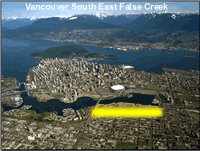
Vancouver Sustainability Precinct
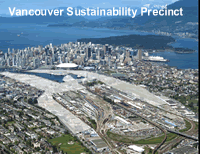
Lower Lonsdale Energy Corporation
West Vancouver's Green Energy Project (Eagle Lake)
BC Hydro's Eagle Lake micro hydro page
Running on empty
By Charlie Smith
Georgia Straight
Publish Date: 6-Oct-2005
Why everyone should worry about gas prices
Julian Darley is director of a Vancouver think tank called the Post Carbon Institute. He says people should focus on finding local solutions to the looming energy crisis.
Two-and-a-half years back, author Richard Heinberg gave local residents a glimpse into the future. Heinberg, a California writer and instructor, had come to the Vancouver Planetarium for a panel discussion on energy. The price of oil was hovering at about US$25 per barrel, but he predicted a sharp increase before the end of the decade.
“At this point, we’re discovering about one barrel of oil for every three or four that is pumped and burned,” Heinberg said. “So, clearly, a production peak is inevitable at some point.”
This thin, middle-aged, and casually dressed intellectual seemed an unlikely prophet. Sure, he said all the right things. His car ran on biodiesel, which is a chemically altered vegetable oil. He also mentioned that he placed photovoltaic panels on his home’s roof to generate electricity from sunlight. But Heinberg was so unassuming, so cerebral, and so completely lacking in evangelistic fervour. He seemed hardly the type to trigger a cataclysmic change in the way people perceive the world around them.
But that evening at the planetarium, Heinberg had a profound impact on the audience. Two other panelists—UBC professor Bill Rees and Vancouver environmental philosopher Julian Darley—provided equally chilling commentaries. Rees noted that for more than 20 consecutive years, the world had consumed more oil than had been discovered. Darley, director of the Vancouver-based Post Carbon Institute, emphasized a looming crisis with natural gas.
“I call this the carbon chasm,” Darley told the audience.
Since that evening, the international price of oil has shot up by 160 percent. Vancouver motorists now routinely shell out $1.20 per litre of gasoline at the pump. The cost of natural gas has almost tripled.
The International Energy Agency has reported that Hurricane Katrina shut down 1.4 million barrels of daily oil production and curtailed activity at 14 refineries. This caused retail gasoline price hikes of more than 30 percent in Europe and 13 percent in Asia, according to the IEA. Since then, Hurricane Rita has wiped out more oil and gas production in the region.
Darley and other analysts claim that a looming global shortage of oil could cause gasoline prices to spike even more sharply in the coming years. Darley told the Georgia Straight that this could cripple the world economy, which is mostly based on moving goods and services around the globe.
“It’s like saying to a person, ‘You’ve got to become an argon breather tomorrow because we’re switching away from this oxygen stuff,’” Darley said.
Matthew Simmons, a former advisor to George W. Bush and a Houston energy investment banker, wrote a book earlier this year suggesting that Saudi Arabian oil production may have already peaked. The Saudis claim to have a quarter of the world’s proven reserves: 262 billion barrels. Saudi Arabia has been the world’s largest oil producer for many years. Simmons told the Straight in a phone interview that 90 percent of this production has come from five aging oil fields on the eastern edge of the Saudi peninsula.
According to Simmons, 60 percent of all Saudi oil has come from just one field, Ghawar, since it began producing in 1951. He said the northern portion of Ghawar is almost depleted. He also claimed that the quality of the oil isn’t nearly as high in the southern portion of Ghawar. “In the last couple of years, there have been so many ‘supply additions’ coming on that we don’t have any idea whether Ghawar is producing five million barrels a day or three-and-a-half million barrels a day,” Simmons said. “The fact that we don’t [know] should scare the bejesus out of people.” | Greatest “Proved” Oil Reserves by Country (barrels) Saudi Arabia 261.9 billion Canada 178.8 billion Iran 125.8 billion Iraq 115.0 billion Kuwait 101.5 billion United Arab Emirates 97.8 billion Venezuela 77.2 billion Russia 60 billion Libya 39 billion Nigeria 35.3 billion |
Simmons, author of Twilight in the Desert: The Coming Saudi Oil Shock and the World Economy (John Wiley & Sons, $31.99), said that the second-largest Saudi field, Safaniya, can theoretically produce two million barrels per day of very heavy oil. “I think its peak production was 1.2 million barrels a day, and it’s about 600,000 barrels a day now,” he said. “Therein lies all the world’s spare capacity. That should scare people.”
The IEA forecasts demand for oil this year to average 83.5 million barrels per day. This means that more than 30 billion barrels of oil will be consumed in 2005. Total supply will average 84.85 million barrels per day.
Last July, a top Saudi official, Adel Al-Jubeir, dismissed Simmons’s claims during a live on-line question-and-answer session sponsored by the Washington Post. Al-Jubeir asserted that his national oil company, Saudi Aramco, is “very conservative when it comes to reservoir management”.
“The data he uses is outdated,” Al-Jubeir claimed. Simmons, however, told the Straight that the Saudis have not released any data to him to contradict his conclusions.
During that evening at the planetarium in 2003, Heinberg explained that the United States was once both the world’s largest oil producer and largest oil exporter. In effect, he said, it was the Saudi Arabia of the latter 19th century and early 20th century.
Heinberg, author of The Party’s Over: Oil, War and the Fate of Industrial Societies (New Society, 2003), noted that U.S. oil exploration peaked in the 1930s. This came after discoveries in East Texas and Oklahoma. Overall U.S. oil production peaked in 1970.
Since then, America has increasingly relied on imports. The nation consumed an average of 21.4 million barrels of oil per day during August, according to the U.S. Energy Information Administration. About 58 percent was imported.
Heinberg claimed that the U.S. experience as a producer has been repeated in many other oil-rich nations. After reaching a peak, oil production has often gone into a downward spiral. Heinberg forecast that the global peak in oil production would likely occur between 2004 and 2010.
“Whatever happens in the U.S. is the precursor for what is bound to happen in the rest of the world as far as oil is concerned,” he predicted.
It’s a controversial theory with plenty of detractors. In a September 22 news release, IEA executive director Claude Mandil claimed there is no shortage of oil and gas in the ground, just a shortage of technology to recover it. The same news release suggested there was more oil in the Canadian tar sands than all the world’s current reserves combined.
Canadian author David Frum, a former speechwriter to President Bush, wrote a column in the National Post last January ridiculing the notion that the world is running out of oil. He claimed that consumers will respond to price signals and switch to alternative fuels. “The world will never run out of oil,” Frum wrote in his article.
The B.C. Liberal government still plans to twin the Port Mann Bridge and widen Highway 1 to eight lanes, which indicates that Heinberg’s message hasn’t registered with the premier. Meanwhile, the Vancouver International Airport Authority is proceeding with a $1.4-billion plan to accommodate more fuel-guzzling airplanes.
Heinberg emphasized in his book that when more than half the petroleum is withdrawn from a reservoir, the cost of recovering oil increases sharply. That’s because more energy is required to extract the resource. When this occurs in a majority of fields around the world, it marks the end of cheap oil.
Heinberg’s message seems to have penetrated the Washington, D.C., establishment. He appeared on a panel late last month hosted by U.S. Congressman Roscoe Bartlett. Last February, the U.S. Department of Energy released a report on the peaking of world oil production, describing it as “an unprecedented risk-management problem”.
The numbers are astronomical. BP has claimed there are 1.2 trillion barrels of proven reserves in the world. But some doubt the validity of this number. In 1998, retired petroleum geologists Colin Campbell and Jean Laherrère wrote an article in Scientific American claiming that OPEC (Oil Producing and Exporting Countries) members had exaggerated their proven reserves. By switching to higher numbers, they were allowed to export more oil under OPEC’s quota system.
“There is good reason to suspect that when, during the late 1980s, six of the 11 OPEC nations increased their reserve figures by colossal amounts, ranging from 42 to 197 percent, they did so only to boost their export quotas,” Campbell and Laherrère wrote.
Simmons said that after the Saudis nationalized their oil industry, they jacked up their proven reserves by 100 billion barrels. Simmons also noted that Kuwait, United Arab Emirates, Iraq, and Iran had earlier boosted their proven reserves by larger percentages than the Saudis.
“There weren’t any new discoveries,” Simmons said. “There wasn’t any technology going on, and there wasn’t any drilling going on.”
He claimed that Canada also fudged the numbers when it suddenly increased its proven oil reserves from five billion to 180 billion barrels in 2003. It accomplished this feat by including bitumen resources in the Alberta tar sands.
Simmons said that comparing bitumen to light sweet oil is akin to comparing a 1947 Plymouth to a Maserati. “What you have in the tar sands is a slightly different carbon grade than coal,” he said. “It has nothing to do with oil. The energy intensity of turning it into synthetic crude is enormous.”
For western economies, the Saudi situation probably deserves the most scrutiny. Simmons wrote that one sign of potential trouble is the fact that billions of barrels of water have been injected into Saudi oil fields to maintain pressure.
He claimed that one giant oil field, Abu Sa’fah, has gone to “artificial lift”, which likely means the pressure is dropping. He said there are indications that Berri, another giant, is probably approaching the end of its life. Simmons also claimed that Abqaiq, a 65-year-old giant Saudi field, has pretty much been depleted.
“Five years ago, nobody mentioned the fact that Abqaiq could ever deplete,” Simmons said.
How high can oil prices go from here? Jeff Rubin, chief economist of CIBC World Markets, recently predicted in his Globe and Mail column that the cost will soon reach US$100 per barrel. Last March, investment-banking firm Goldman Sachs suggested it could reach US$105 per barrel. Simmons, the Houston energy investment banker, told the Straight that he thinks the price could eventually top US$200 per barrel—three times the current level.
He explained that at US$65 per barrel, gasoline costs 20 cents per cup. Simmons pointed out that petroleum companies have not found any massive new oil fields in decades. The last giant discovery was Mexico’s Canterell field in 1975. He also claimed that oil companies don’t want to spend money on refineries or to replace old pipelines.
“In three more weeks, they’re going to report the third-quarter earnings,” Simmons said. “The top five are going to report between $30 and $35 billion dollars. It will be more money than any group of five companies have made in the history of the world.”
On September 29, the Canadian Centre for Policy Alternatives released a three-page report claiming that consumers are being gouged by the oil companies. But for Darley, the more pressing long-term issue is how the world will cope with a sharp reduction in its supply of fossil fuels in the coming years. During an October 1 presentation to students at UBC, he predicted that it could lead to more warfare as nations jostle for control over resources.
“Almost anywhere where there is oil and gas, you can see a heightened military buildup there,” Darley said, echoing the views of U.S. author and military analyst Michael Klare. “This total militarization of energy policy is a very unfortunate move, but I’m afraid it’s what we can expect.”
Darley’s message was bleak, but he offered a hopeful alternative at the end of his lecture. The best antidote to sky-high energy costs was something he called “global relocalization”, taking care of basic needs within local communities. He harked back to the days before the oil economy was created in the 19th century, a time when people often entertained each other with music and live theatre.
Some students in the audience responded enthusiastically, breaking into a song with environmental lyrics. It was a festive moment punctuating an often gloomy presentation.
One of the student singers, 20-year-old Sara MacLennan, later told the Straight that she had never had the peak-oil scenario laid out in such a stark manner. “It is a scary thought,” she said.
MacLennan added that in her native country of Scotland, there is a great deal of emphasis on alternative energy sources, such as wind and tidal power, which might pick up the slack. Chris Borstad, a 27-year-old civil-engineering student, told the Straight that Darley’s message impressed upon him the need for action.
“The fossil-fuel institution was never really questioned by the older generation,” Borstad said. “It was sort of handed to them as a great way to improve life.”
Borstad said that when he uses the term peak oil in conversation with friends and acquaintances, some don’t know what he means. “It’s a minority of people here at UBC right now that can really understand the implications,” he said.
However, if gas prices continue rising, and Darley, Heinberg, Simmons, Rees, and others get their message across in major media outlets, that probably won’t be the case for very much longer.
The Georgia Straight
`Caribou People' wage last stand in the Arctic
BY PAUL SALOPEK
Chicago Tribune
Fri, Oct. 07, 2005
THE PORCUPINE RIVER, Canada - (KRT) - Old Stephen Frost is preparing to kill a caribou.
The Gwitchin Indian elder stands in his skiff on this silver-skinned stream in Canada's vast and wild Yukon Territory. He shoulders a heavy .30-.30 rifle. And he fires twice at eight of the deer-like animals swimming the sparkling currents - Whang! Whang!
The herd is only 20 feet away. But, inexplicably, the bullets go high. The caribou scramble ashore unscathed.
Peering back at Frost with the large, frank eyes of children, the animals vanish into a maze of willow branches dense as basketry.
"Lousy luck," Frost rasps.
The 72-year-old woodsman, a weather-beaten crag of a man who likes to come across as hard-boiled, mutters excuses. He blames the rocking boat. He curses his aging, unsteady legs. But he is a bad actor.
Later, he will pass up more opportunities to kill caribou. And, forgetting his lousy luck altogether, he will shoot other game with heedless skill - plugging a beaver through the eye and blasting a duck out of the water at 40 yards.
"Them caribou ain't got much of a future," he finally admits, uneasily. "To be honest, I'm glad to see 'em get out of rifle range."
Frost is referring to the central catastrophe facing his obscure tribe of Arctic hunters: The once-mighty Porcupine caribou herd, which has been the main food source of his people since the last Ice Age, is dwindling, nobody knows exactly why. And now, controversially, the U.S. government wants to drill for oil in the caribous' calving grounds in the Arctic National Wildlife Refuge, or ANWR, just across the Alaskan border.
Like many traditional Gwitchin, Frost fears that oil rigs in the refuge will deal a knockout blow to the ailing herd and herald the slow death of his tribe's 13,000-year-old subsistence culture, the last of its kind in North America.
Frost doesn't dwell on this crisis. Nor does he talk much about his wife, Ethel, who is ill with cancer. Nor, aside from a few crusty jokes, does he complain about his own creaking body, which is starting to fail him, with pains stabbing his arthritic knees and neck.
Instead, the stoic old hunter betrays his sorrows by what he withholds.
On days that follow, Frost loads two rifles and a shotgun into his boat. Tying on his greasy marten-fur cap, he stalks the waters of the Porcupine River as he has for more than 60 springs. But he doesn't take an animal. He misses. He holds his fire. He displays a forlorn quality of mercy that no subsistence hunter can afford.
---
Sometime later this month, Congress is set to decide, after almost 30 years of contentious debate, whether to allow oil exploration to proceed in ANWR, the country's premier wildlife refuge.
Hurricanes Katrina and Rita blew new life into the dispute after ripping through the nation's oil infrastructure and boosting gasoline beyond $3 a gallon. Now, drilling proponents are seizing on that price spike to push for more domestic oil production.
"When Katrina and Rita come into it, the American people know what to be scared of," says Sen. Ted Stevens, R-Alaska, who is helping shepherd the Arctic drilling plan through an omnibus budget bill. "I think the American people are asking: `Why don't we have enough energy?' And they're not susceptible anymore to misrepresentations that ANWR is some kind of pristine wilderness. It's empty. It's ugly."
To environmentalists, that's sacrilege.
Many activists regard the Alaskan refuge - christened by some a "precious jewel of the circumpolar north" - as a cross between a cathedral and the Alamo: a symbolic last stand to protect not only a vast Arctic ecosystem but the sacred idea of American wilderness itself. The remote 19.6 million-acre sanctuary teems seasonally with caribou, polar bears, wolves and some 150 species of birds. If this holy of holies is pried open for oil, they warn, few protected areas in the country would be safe from development.
The Bush administration, which has made ANWR the centerpiece of its energy policy, calls these claims fear-mongering. Government officials point out that only an eighth of the refuge - some 1.5 million acres of coastal plains dubbed the "1002 area" - would be subject to exploration. Moreover, they say ANWR's untapped petroleum reserves are a necessary antidote to the crippling U.S. addiction to foreign oil. Five billion to 11 billion barrels of black gold are thought to lie pooled under the tundra, or enough oil to power the entire U.S. economy for six months to a year.
But largely lost in all this acrimony is another, older conflict altogether: an improbable human-rights struggle with echoes from the frontier wars of another century.
The Inupiats, or Eskimos, generally support drilling in ANWR for the jobs and revenues it will bring to Alaska's frozen North Slope. But further south, among the immense spruce barrens of central Alaska and the Canadian Yukon, the Gwitchin Indian tribe sees the appearance of new oil rigs in the same ominous light as Plains Indians watching immigrant wagons trundle over the prairie horizon.
For the Gwitchin - "Caribou People" whose population of 7,000 is divided between Canada and Alaska - the stakes couldn't be higher.
Because of its geographical isolation, and the high cost of flying food into its tiny communities, the tribe maintains one of the last true subsistence hunting traditions on the continent. Today, every Gwitchin still consumes an average of 250 meals of caribou meat a year.
Yet by cruel coincidence, in the 100,000-square-mile patch of Alaskan and Canadian wilderness that the caribou call home, oil abounds in just one spot: directly under the animals' sensitive ANWR calving grounds.
"The big oil corporations say they can drill there without harming the land or the wildlife," says Joe Linklater, chief of the Canadian village of Old Crow. "Well, that's like our tribe telling Americans to trust us with an experiment that may end up taking away all their cars.
"We didn't ask for this fight," Linklater adds. "This is about our survival as a people."
The Gwitchin effort to safeguard their caribou-based culture isn't new. Their fight began back in 1988, when worried tribe members from Canada and the United States (the American tribe spells its name "Gwich'in") gathered for the first time in generations at Arctic Village, Alaska, to coordinate a common defense against both the global oil industry and the most powerful government on the planet.
Since then, this little-known war of resistance, planned in log cabins at one of the uttermost ends of the Earth, has taken some bizarre turns.
Tough hunters who had never set foot on a plane have donned cheap business suits and jetted to Washington, where they have stalked the halls of Congress on behalf of the caribou. Some have carried bags of dried caribou meat on their lobbying trips because restaurant food makes them ill. Others have gotten hopelessly lost on the capital's subway system.
Along the way, the rustic tribe has pressured the Canadian government to protest ANWR drilling on environmental grounds. They have recruited Jimmy Carter and Robert Redford as allies. And, collectively, their handful of villages have scraped together hundreds of thousands of dollars - squeezed from cash-strapped tribal councils or solicited from U.S. and Canadian environmental groups - to broadcast the Indian perspective of the ANWR crisis.
Old Crow, Canada, population 245, is a typical front-line community in this small, cold war.
Hunkered on the gravelly banks of the Yukon's wild Porcupine River, the village is an absurdly remote and beautiful place. Still untouched by roads, its cluster of 50 or so frame houses is accessible by bush planes that jounce over the ice-smeared Ogilvie Mountains from the faded gold rush town of Dawson City. Other visitors travel two rugged days cross-country, by riverboat or snowmobile as the season dictates, to reach the village from the nearest Canadian highway.
Old Crow's branch of the Gwitchin tribe, the Vuntut, or "Lake People," isn't necessarily opposed to industrial development. They once allowed oil exploration on federal holdings in their tribal lands, noting that it wasn't in the critical caribou calving areas. And they have invested their funds shrewdly in a local airline and in real estate in Whitehorse, the distant territorial capital.
But few other Arctic villages have undertaken the quixotic step of earmarking $250,000 of their $8 million annual budget to block the world's last superpower in its tireless quest for oil.
Among the tattered notices pinned to the village bulletin board - hand-scrawled requests to buy babiche, or caribou rawhide, and terse announcements for shooting matches at the local dump - there is a crisp memo "encouraging all residents to come hear the latest report from our neighbors who carried our message to the United States Congress."
"People outside just don't realize how much we depend on these damned caribou," says Stephen Frost, the caribou hunter who lives in Old Crow. "What are we going to do if they disappear? Close up shop and move to Washington? Are the politicians or the oil companies going to buy us a lifetime supply of hamburgers?"
As a village elder, Frost tries to project a cranky optimism around Old Crow.
He does this even in his cramped home, where his wife, Ethel, a heavyset woman with artificially curled hair, shuffles from the room whenever the rare visitor arrives. Frost teases her gently about her shyness. Or he cracks profane jokes. But in quiet moments a certain melancholy drapes his coppery features. He quietly shoves grains of sugar around his kitchen tabletop with a work-gnarled thumb. Or gazes for long, silent stretches out his windows at the Porcupine River, where he was raised unschooled except in the harsh lessons of trap lines and fishing camps.
Beyond the sparkling river jut billions of cold-stunted spruce trees. It's springtime 75 miles north of the Arctic Circle. And there are caribou out there, moving through the forests like smoke.
---
A few facts about barren-ground caribou:
They are biological putty - creatures so warped by the extremes of environment that they seem afflicted with a multiple personality disorder.
During the lush Arctic summers, when caribou turn into mowing machines, their stomachs balloon in size by almost 50 percent. Stuffing themselves with grass and lichen, many gain half their body weight in fat. Their coarse dark hairs, hollow for insulation and to improve buoyancy on river crossings, turn pale and shaggy in the winter. Bulls sprout baroque, 5-foot antlers to joust over females. Then, a few months later, they drop them. No feature is immune from this shape-shifting. Even their hooves elongate in the cold, to better dig through winter snow. The same caribou sighted in January and June might easily be mistaken for two different species.
They are constant strangers.
In the spring, caribou herds can trudge hundreds of miles north to the treeless Arctic shoreline, where open vistas and sea breezes foil predators and biting insects. There, they give birth to their young in scenes of wild abundance and untrammeled beauty that rival Africa's Serengeti. By late summer they are on the move again, back to the shelter of the boreal forest. Tens of thousands of caribou die on these annual migrations. As evidence, a grim confetti of caribou bones litters the tundra, the leftovers of hungry grizzlies, wolves, eagles, foxes, ravens and human beings.
"Pretty much everything eats, scavenges or parasitizes the caribou," says Dorothy Cooley, a Yukon government biologist. "A big chunk of the northern ecosystem rides on their backs."
The crucial question, of course, is how a new oil field in ANWR would add to that heavy burden. And because science can't provide a mathematical reply, the answer has been hijacked by rhetoric on all sides.
A computer-modeled study recently released by the U.S. Department of the Interior, for instance, suggests carefully that calf survival in ANWR would plummet if the caribou are spooked from their grass-rich calving grounds. And here the oil industry scoffs, citing positive wildlife trends at Prudhoe Bay, the largest oil field on Alaska's North Slope.
"Clearly, from the central caribou herd experience at Prudhoe, oil infrastructure does not chase away the herd and does not decimate it as the greens claim," says Adrian Herrera, a spokesman for Arctic Power, a pro-drilling lobby group funded largely by the state of Alaska. "This isn't an either-or situation. You can have development and preserve the environment at the same time."
Herrera invokes a mantra that has helped smooth the passage of the drilling agenda through Congress: "Clean" new oil technology, such as lateral drilling - where one wellhead can tap huge areas - means that just 2,000 acres of ANWR's calving grounds will be disturbed by the roughnecks and their machines.
Still, a majority of U.S. and Canadian biologists remain skeptical.
Years of research demonstrate, they say, that pregnant cows have in fact shied from the pipelines and gravel roads at Prudhoe; they have retreated to less disturbed habitat - a luxury not available to the Porcupine herd because its coastal plain is small by comparison, and hemmed in by inhospitable mountains. (Bulls are less sensitive and have been known to enjoy the breezes atop drilling pads.)
Such nuanced arguments frustrate the Gwitchin.
Any tinkering with their herd, they insist, is like gambling with the air they breathe. If the animals are merely frightened away to more-distant migration routes, they say, communities like Old Crow, which straddles ancient caribou river crossings, could simply cease to exist.
"The ancestors warned us about this bad time coming," says Randall Tetlichi, a traditional healer in Old Crow. "I think the caribou know what's happening in this world, and they have decided to leave, to go back to the spirit world."
Tetlichi offers this bleak assessment atop Old Crow Mountain, 5 miles from the village. He has just killed a bull caribou. It is one of five he will shoot this season to feed his family - a perfect animal lying in the snow under an electric blue sky. Panting with exertion, Tetlichi chops off the bull's head and scoops out the finger-size botfly maggots that infect most caribous' throats. The eyes in the decapitated head are huge. Even dead they shine like molten tar. Occasionally, from certain angles, they catch the Arctic sunlight and reflect it back pale green, the color of lightning.
---
Gale Norton, the U.S. secretary of the interior and the senior government official responsible for ANWR, once visited Gwitchin country in Alaska and responded to elders' anxieties over oil drilling in the refuge by urging the Indians to "expand your worldview."
What Norton implied was: The needs of the industrial majority trump the needs of the aboriginal few. Her advice, though, fundamentally misreads the nature of modern Gwitchin life. It isn't narrow. It straddles millenniums.
According to archaeological evidence found in caves in the Yukon, the Gwitchin may be the oldest native culture in the Americas. The tribe's ancestors arrived from Siberia at least 13,000 or 14,000 years ago, long before the more famous Eskimo.
Shadowing herds of migratory animals, they dragged moose-hide tents with the aid of harnessed dogs. Their shamans conversed with animals through dreams - particularly with the vutzui, or caribou. The tribe, linguistically related to the Navajo, was fond of tests of strength, such as wrestling matches for men and women. And having reached what is now central Alaska and the Yukon, they settled down to gorge on wild berries, salmon and a cornucopia of game.
Few modern Gwitchin sugarcoat this past: They are still too close to the land for that. In famine times, infant girls were killed to save food, and crippled elders would ask to be left behind to starve.
Today, willow bows and dog sleds have given way to high-powered rifles and motorboats in Old Crow. But because of the tribe's profound seclusion, the pace of modern assimilation still feels jarring, raw.
Junked snowmobiles and plastic lawn chairs crowd yards alongside gory piles of decapitated caribou. Inside the cramped little homes - simple frame structures that cost the tribe an average of $120,000 to build because every nail must be flown in - hanks of jerked caribou meat, rifles of all calibers, antlers, skin blankets and other frontier artifacts jostle with satellite televisions that rarely seem to be switched off.
Teens sporting baggy hip-hop pants and eyebrow rings now monitor the caribous' migration on a Web site that tracks collared animals by satellite. Meanwhile, at the village store, a relic of the famed Hudson's Bay Company fur-trading empire, Indian elders scratch their heads over cans of Pringles-brand potato chips. A single air-freighted cucumber costs $4.10.
"Too much white man's stuff too fast," says Tetlichi, the village healer. "It's like eating a lot of Kentucky Fried Chicken. Heartburn avenue."
Tetlichi, 53, is deeply worried about the Americans' plans for ANWR. But he sees it as just the latest blow to a way of life already reeling under the combined assault of television, alcohol and the wage economy.
Old Crow is a relatively healthy Arctic community. It isn't plagued to the same terrible degree as other native settlements by problems like drug abuse or teen suicides. (In Alaska, the suicide rate among Indian youths is three times the national average.) Still, the Gwitchin aren't completely immune from the effects of cultural erosion.
The village school teaches up to ninth grade. Half the kids who leave for a boarding school in Whitehorse never return. And those who do often end up working low-paid tribal jobs. Very few live completely off the land anymore, as their parents did. Many feel adrift, caught between worlds, and seek solace in drugs or alcohol. Though Old Crow is officially "dry," liquor is smuggled into the village, most recently in a shipment of dog food. A bootleg pint of vodka sells for $150.
"That's what makes saving the caribou even more important," says Tetlichi, who has the cautious step of an alcohol survivor. "They are - what's the English word? - the anchor."
Tetlichi wears his long braids tucked up under a baseball cap. He is munching happily on dried caribou in his house. He slathers the dark jerky, which he eats all day, with butter - like toast - while his wife, Mabel, hunches over a table, tenderizing red caribou steaks with the butt of a butcher knife. Overhearing mention of ANWR, she declares, "We are very" - WHACK - "angry with" - WHACK - "President Bush!"
Their son Randy Jr. isn't listening.
He's mesmerized by the MTV show "Pimp My Ride," which features an auto shop that tarts up jalopies. "Lady, you ain't gonna recognize this Mustang!" the host is promising from the set in faraway Los Angeles.
A few pickup trucks have appeared in Old Crow in recent years, brought in on temporary ice roads or barged to the otherwise roadless village on the Porcupine River. Randy Jr., 11, has never seen a real sedan.
---
By early summer, the sun never sets in the Arctic. The quality of light is hallucinatory. For about three months it drenches the world continuously, giving the impression of a landscape without secrets. Even the deepest tree shadows are a pale, watery blue - a hue that, if it had a taste, would chill the palate like spearmint.
This sunny simplicity, however, is deceptive.
ANWR may well be, as many activists say, the biggest environmental battle in a generation. And it probably has spawned the most organized and focused Native American resistance campaign since the Red Power movement of the 1960s. But all this human drama is unfolding against a backdrop of complex and troubling environmental change.
According to the U.S. Arctic Research Commission, today's Arctic temperatures are the highest in 400 years. Canadian data suggest that the Yukon alone has warmed by 3 degrees since the 1960s. Glaciers are in retreat. Arctic seas have heated up, changing fish distributions. And spruces and grizzlies are advancing poleward into the once treeless tundra.
The effect of climate change on caribou has been perplexing.
In some regions, according to wildlife experts, the early-greening tundra has provided a bumper crop of caribou food, and the herds have boomed. This fact is recited often by the oil companies working on Alaska's North Slope. (At Prudhoe Bay, the largest oil patch in the United States, the caribou herd has grown fivefold since 1978.)
Yet 100 miles to the east, the Gwitchin's beleaguered Porcupine herd has plummeted from 178,000 to 123,000 animals in the past 16 years. Researchers think that erratic thaws and freezes in the wintering grounds may be the culprits. This creates an icy armor over the snow, preventing hungry caribou from reaching the forage beneath.
"You used to see 500 animals at a time crossing this river, like one big stampede," Frost the hunter recalls, standing on the gravel riverbank of Old Crow. "Today, you're lucky to see 50 at a time."
It's a luminous May afternoon in the village. Gunshots echo in the distance. Hunters are bringing in dead caribou on boats and on four-wheeled buggies. But old Frost has stayed home. His legs ache - new aging pains. And his wife, too, isn't feeling well today.
Upstream, a tributary of the Porcupine has thawed and broken up, and chunks of ice slide down the currents. Mini-bergs the size of pianos collide, tinkling musically on the waters like falling glass. The river sounds like a crystal chandelier swaying in a breeze.
"This is how the land wakes itself up, renews itself," Frost explains, squinting poker-faced from the shore, his hands balled in his pockets. And given his burden of woes, it's a measure of the man that he says this without the least self-pity.
---
Dorothy Frost is crying.
It's the last weekend in May - Big Caribou Days, a homespun festival celebrating the annual spring migration in Old Crow. And Dorothy, a tribal administrator and one of Stephen Frost's numberless relatives, is supposed to be giving a pep talk. She fidgets in the log community hall before a crowd of villagers clad in rubber boots and fleece jackets, outlining the Gwitchin's caribou crusade. But her voice trails off. Normally a jovial woman in glasses, she covers her eyes with her hand and sobs. Later another speaker, an elderly man just returned from lobbying in Washington, also breaks down. So does a young woman who stands in the audience to offer reassurance. It's hard to watch.
"Everybody's emotional right now," says Dorothy Frost, recovering her composure. "Things are coming to a head."
The Gwitchin people have no legacy of armed resistance to European invasion, no mythic or bloodstained Wild West to draw grim inspiration from. There was no Gwitchin Geronimo. No northern Sitting Bull. Like most Canadian Indians, the usually peaceful tribe was incorporated into a tumultuous world the invaders called "New" through commerce, when the Scottish explorer Alexander Mackenzie first showed up on the Porcupine River in the 1790s, paddling a bark canoe packed with furs and trade beads.
"Nearly all European travellers who have visited the (Gwitchin) refer to their fine physical appearance and pleasant dispositions," wrote an anthropologist studying Old Crow as recently as 1946. "I found them to be self-confident and forthright, kindly, generous, intelligent, and honest."
The great irony of their long battle against the United States is that, win or lose, this very act of defiance has opened the door to change. And now, an alien new bitterness simmers in Old Crow. If Congress approves oil development in ANWR, some tribe members are vowing to meet the bulldozers at the refuge boundary with their hunting rifles.
"I've got news for the Americans," an angry young lobbyist named Shawn Bruce tells the somber community hall crowd. "If it comes down to it, we will become militant over that herd. We got Gwitchin men over in Iraq now. We got Vietnam vets. We will train warriors. We won't let them in the calving grounds. I burn. I am mad."
Stephen Frost, the master hunter, is more philosophical.
"I think what upsets people most isn't that them Americans will drill, but that they'll drill without even knowing we goddamned Indians exist," he sighs. "They'll get the oil for their cars. That'll be it."
Surveys taken since Hurricane Katrina jacked up gasoline prices tend to bear him out. According the Pew Research Center for the People and the Press, public support for oil development in ANWR has risen from 42 to 50 percent over the past six months.
Back in Old Crow, Big Caribou Days ends on a down note. Almost nobody joins the late-night jigging contest - a dance competition set to fiddle music inherited from 18th century European trappers. Frost walks home early, complaining about his knees.
A man of habit, he had gone out caribou hunting the day before, one last time for the season.
Ethel was away in Anchorage, undergoing a checkup at the cancer clinic. And the Frost household, long since emptied of its 11 children, had been unbearably silent.
The old man had sat on the banks of his beloved river, feeding willow sticks into a small fire. He never took a shot. Only a few straggling bulls were fording the Porcupine by this late date; the cows were already up north, leading the migration to their embattled Alaskan calving grounds some 200 miles away.
Frost passed the time calling to the birds. He did this uncannily, mimicking the squeal of field mice in distress. Again and again, Arctic owls in their snowy winter plumage swooped low. And ravens diverted from their high tangents in the sky to investigate.
He smiled. For a little while at least, all his troubles seemed like a dream. And for the first time in weeks, Frost seemed truly happy.
---
© 2005, Chicago Tribune.
Mackenzie pipeline uneconomic, Imperial CEO says
By DAVE EBNER
Globe and Mail
Friday, October 7, 2005
CALGARY -- The proposed $7-billion Mackenzie Valley natural gas pipeline doesn't make economic sense unless Ottawa signs another special fiscal deal for the backers, the chief executive officer of Imperial Oil Ltd. says.
"We're not asking for handouts, we're not asking for giveaways," Tim Hearn, Imperial president and CEO, told reporters after a speech yesterday at the Calgary Chamber of Commerce.
"That is not what we're working on. We're trying to find a framework, because today, under current conditions, we don't have an economic project, and we're working to make sure we can find one."
Mr. Hearn wasn't specific about what Calgary-based Imperial wants, though he did mention "how various costs are recovered."
"We're looking at cash flow timing things, and how we may construct the framework in such a way that it will make it economic."
While Mr. Hearn says he doesn't believe Imperial can make money on a Mackenzie line under current fiscal rules, others suspect the line could be quite profitable, especially compared with the project's competition.
Mackenzie Valley would be more profitable than a proposal for a gas line out of Alaska and other projects looking to import liquefied natural gas (LNG) to North America from Qatar, said brokerage Tristone Capital Inc. in a lengthy report in May on the subject.
"Pipelines appear economic," Tristone concluded, noting that Mackenzie would recover costs and produce a 10-per-cent return with natural gas at about $3.10 (U.S.) gas a thousand cubic feet.
Imperial -- majority owned by Exxon Mobil Corp. of Irving, Tex., the world's largest public oil company -- is using a long-term natural gas projection of $2.50 a thousand cubic feet. In the 1990s, gas averaged $2, which rose to $6 this decade before hurricane Katrina. It is now about $14.
"The world is not short of natural gas," Mr. Hearn said. "I'll guarantee you that if LNG comes into North America, you won't find $14 gas. I don't know where it'll be but it won't be $14."
Many market outlooks suggest that while LNG will probably pull down gas prices in North America, $5 a thousand cubic feet has been suggested by a majority of prognosticators as a reasonable long-term forecast.
Though Mr. Hearne said the project is not economic under current rules, he noted the company is committed to building the Mackenzie line and almost $400-million has already been spent.
Asked about Imperial's gas forecast, Mr. Hearn said: "I'm not going to comment on it." Asked why he believes the pipeline is not economic, Mr. Hearn said: "I'm not going to answer your question."
The Globe and Mail reported last week that Imperial is asking for significant breaks from Ottawa, requests that follow the federal government's offer in July of $500-million (Canadian) in social and economic funding for northerners.
Research conducted by the Sierra Club of Canada, an environmental lobbyist, indicated last week that Imperial's requests amount to a dollar tally of $2-billion.
However, several government sources said it is hard to quantify, given various natural gas price forecasts.
Imperial is the lead proponent of the Mackenzie pipeline, a group that includes Shell Canada Ltd. and ConocoPhillips Canada, among others.
In mid-September, Paul Smith, a senior vice-president at Imperial, said issues the company wants to negotiate with Ottawa included royalties.
"We didn't ask for royalty breaks," Mr. Hearn said yesterday.
Oil tankers in Juan de Fuca Strait:
1977 rules on oil ports stay intact
By Kimberly Wetzel
Medill News Service
Seattle Times
7 October 2005
WASHINGTON - A House committee yesterday struck down a portion of an energy bill that Washington state lawmakers warned would increase the risk of an oil spill in Puget Sound.
The House Rules Committee removed proposed changes to the Magnuson Amendment, a 1977 law that caps oil-refinery expansion and the number of oil tankers moving through the Strait of Juan de Fuca and Puget Sound.
"This is a big victory for Puget Sound," said Rep. Jay Inslee, D-Bainbridge Island, who testified against the bill before the committee. "We really dodged a bullet on this. We're very happy with the outcome."
Legislators were concerned that changing key portions of the Magnuson Amendment would have meant more tanker traffic in the Sound, increasing the danger of a spill. More than 600 tankers entered Puget Sound last year.
The amendment, written by the late U.S. Sen. Warren Magnuson, D-Wash., prevents oil companies from expanding their Puget Sound operations beyond what's needed to serve the growing energy demands of Washington residents.
The bipartisan effort to keep the amendment intact was led by Inslee, Rep. Norman Dicks, D-Bremerton; Rep. Dave Reichert, R-Auburn; and Democratic Sen. Maria Cantwell, who had vowed to fight the provision if it made it to the Senate.
The broader energy bill would streamline refinery expansion in response to the damage of Gulf Coast oil-production facilities by hurricanes Katrina and Rita. It was to go to the House floor today without proposed changes to the Magnuson Amendment.
Washington legislators said they were upset the provision was included as part of the bill, noting they weren't consulted or even told about it until three days ago.
"Since the provision had little impact on the ability to increase refining capacity in our state, we were concerned that it should not set a future precedent," Dicks said. "This is a great victory for our delegation."
The bill's sponsor, Rep. Joe Barton, R-Texas, agreed to remove the provision at yesterday's hearing. Barton's staff members declined to comment yesterday.
Both Inslee and Dicks said committee members probably were swayed by Reichert, the sole Republican in the state delegation opposing the change.
Reichert is in his first term in the House, representing a district that has become more concerned about environmental issues over the years.
Mike Shields, Reichert's chief of staff, said the congressman was pleased with the effort.
"It was a triumph of bipartisanship," Shields said. "In a short amount of time, these congressmen were able to work together."
Earlier yesterday, Reichert, Inslee and Cantwell wrote congressional leaders, asking that the provision be removed.
October 06, 2005
Hydro to reveal plans for upgrade
By Scott Simpson
Vancouver Sun
06-Oct-2005
BC Hydro will reveal plans later this month for British Columbia's biggest electricity system upgrade in a generation.
Hydro has been looking at every plausible power option except nuclear energy -- the list includes hydro, wind, gas and coal generation -- in a plan to head off and eventually eliminate B.C.'s dependence on foreign electricity imports.
"This is the next 20 years we are looking at here, and we haven't done anything this significant since maybe 1995," Stephen Bruyneel, director of corporate communications and public affairs for Hydro, said in an interview Wednesday.
"Overlaying all this work is a goal of making British Columbia energy self-sufficient over the next 20 years. We'd like to get to a point where we would be able to rely on our own resources."
The plan may open a Pandora's box.
Electricity production options are set out in a series of briefing papers provided in late September to members of a provincial "integrated electricity planning" committee.
The committee was struck to provide input to Hydro on the best combination of options.
The briefing documents say the cheapest source of power is conservation through energy efficiency projects such as Power Smart.
Hydro ranks the Site C dam No. 1 for lowest cost electricity generation behind conservation -- followed by geothermal, wind, small hydro, coal, and a re-powering of the aging Burrard Thermal gas-fired generating plant in Port Moody.
Bruyneel cautioned that the list is more of a "snapshot" than an authoritative financial study, using numbers provided by industry, and was intended to facilitate discussion.
"They are just preliminary estimates. Obviously until somebody went and bid it into a call you wouldn't know exactly what they were willing to spend on it or how much it's going to cost," Bruyneel said.
Factors complicating those estimates include the future price of natural gas and any surcharges that may apply to greenhouse gas emissions produced by coal- or gas-fired generating plants.
Recent Hydro planning documents examine everything from "controversy" over the proposed $3.5-billion Site C dam on the Peace River to "NIMBYism" in regions of the province that don't produce as much electricity as they consume.
For example, Hydro documents report that there is support around the province for requiring the Lower Mainland and Vancouver Island to take a bigger role in new power generation since both are net consumers of electricity.
Alternatively, Hydro suggests that pulling Site C out of a portfolio of new projects could raise the overall cost of energy independence by $200 million and would effectively put responsibility for all new electricity supply into the hands of the private sector.
Bruyneel said a decision by Hydro's board of directors will be announced later this month.
It will likely be a political football, as the final decision on power options rests with the Hydro board and B.C. Energy Minister Richard Neufeld.
POWER PLAY:
Some of the power generation options being examined by BC Hydro:
- Site C Peace River dam
- Repowering Burrard Thermal
- South Meager Geothermal Project
- Pulverized coal
- Wind power
Natural gas may hit $20
Geoffrey Scotton
Calgary Herald
Thursday, October 06, 2005
'It's not a possibility. It's going to happen'
Natural gas prices could top $20 US this winter, analysts warned Wednesday -- as traders in New York sent the price of the critical heating, cooling, cooking and electrical generation fuel into record territory.
Natural gas contracts for December climbed as high as $14.75 US per million British thermal units (mmBTU) on the New York Mercantile Exchange (NYMEX) before closing down slightly from Tuesday's record of $14.22 US. Experts say the soaring prices -- which include a record $15.13 US Wednesday for January gas -- are just a taste of things to come.
"If we have a colder-than-normal winter this winter I think we are going to be in a real crisis," said Tristone Capital Corp. managing director of research, Chris Theal. "We're going to see NYMEX gas clearly through $20 US in that scenario."
Theal and other analysts warned a meeting of chartered financial analysts Wednesday morning that conditions are forming that could see U.S. gas prices skyrocket, a scenario that could take the price for Calgary consumers into the low-$20s per gigajoule (GJ) range.
That possibility would not only wallop Calgary consumers, it could cost the province hundreds of millions of dollars as its winter natural gas rebate program -- just expanded to include the month of October -- is open-ended at gas prices above $12 per GJ.
This month, the province will pay consumers $3.51 for every GJ of gas after consumer rates rocketed to $12.26 per GJ. The addition of October to the rebate program will cost the province $45 million and if gas prices stay between $9 and $12 per GJ the rebate tab for the heating season will hit $615 million.
"Gone are the days of cheap natural gas," said Theal.
Multiple market threats of inadequate natural gas storage, shut-in production from U.S. Gulf coast hurricanes, climbing consumption, flat or declining continental supply and cold winter weather have the potential to combine and push natural gas prices into the stratosphere, Theal and other say.
"It's the perfect storm," said Peter Linder, president of DeltaOne Capital Partners Corp., who told the Herald he's certain prices will top $20 US per mmBTU in any event, likely by December.
"It's not a 'possibility.' It's going to happen . . . probably before Jan. 1," said Linder, adding he predicts U.S. gas prices averaging $15 US per mmBTU in 2006.
He forecast Calgary consumers will pay two to 2.5 times for gas this winter what they paid last winter, when natural gas rates topped out at $7.31 per gigajoule, but that prices could go higher, even into the low-$20s. (A gigajoule, or GJ, and an mmBTU are roughly equivalent measures.)
"Enjoy the rebates," said Linder. "Accept the fact that we're in a new environment, adjust your spending accordingly and learn to live with it."
Gordon Singer, chairman and chief executive of QVGD Investors Inc., said winter temperatures are key, but the stage will be set within weeks by efforts to store three trillion cubic feet (tcf) of winter gas by Nov. 1, the end of storage season. Those efforts have been severely hampered by massive U.S. Gulf coast storms such as hurricanes Rita and Katrina, which have impaired 30 per cent of long-term production, shut in eight billion cubic feet of daily gas production -- and created more than 226 billion cubic feet of lost production.
"If we can't meet that three tcf and it's a cold year, all bets are off on prices," said Singer. Theal noted, "The market's struggling to get to three tcf by the beginning of the heating season."
gscotton@theherald.canwest.com
© The Calgary Herald 2005
The History of GSX Pipeline in gas prices
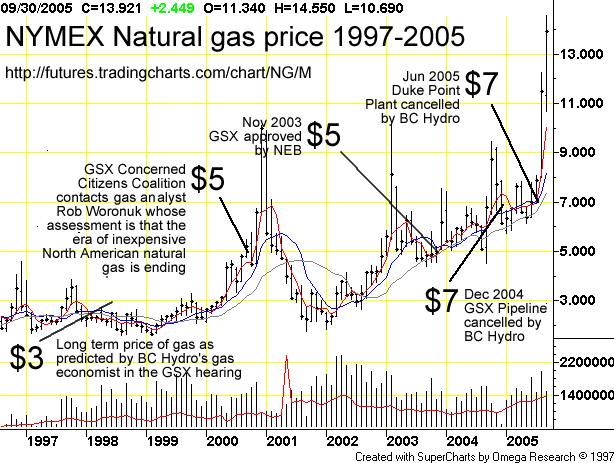
Coal burning riles Cape Mudge
Grant Warkentin
Campbell River Mirror
Oct 05 2005
The Cape Mudge Indian Band worries its members are facing a higher risk of cancer due to coal burning at Elk Falls mill.
"The Cape Mudge Village...is already profoundly and negatively affected by the airborne emissions from the NorskeCanada Elk Falls pulp mill. Additional contamination from the burning of coal would create further damage to the health, safety and enjoyment of life of this aboriginal community," says a letter from the band's lawyers to the provincial government.
Cape Mudge band manager Brian Kelly told Canadian Press recently that the Cape Mudge and Campbell River Indian bands are almost demographically identical- except that the Cape Mudge Band, whose reserve is blanketed with more emissions from the mill than the Campbell River band's reserve, has a higher rate of cancer among its members.
In the Sept. 27 letter to Randy Alexander, provincial director of water and waste protection, law firm Donovan and Company, representing the band, outlines their concerns over emissions from NorskeCanada's Elk Falls pulp and paper mill. The law firm explains the band wants to see extensive monitoring of air quality at the band's Quadra Island village to learn what sort of health effects emissions from the mill's smoke stacks is having on band members.
The problem, the law firm says, is an unwillingness by NorskeCanada to address the issue and refusal in the past to respectfully deal with the band.
"Norske is well aware of the concerns by the We Wai Kai Nation (Cape Mudge band) with respect to the impact of its airborne emissions on the Cape Mudge village, particularly how the stack emissions frequently become entrained and travel directly through Cape Mudge village and how local residents have suffered respiratory ailments and extraordinarily high cancer death rates," the law firm says. "Norske, however, ignored repeated requests for proper monitoring of air quality in the village.
"The consultation with the We Wai Kai First Nation-has been perfunctory and inadequate; it has-scarcely gone beyond mere notification."
On Tuesday, mill spokesperson Carole Dodds said NorskeCanada is continuing to work with the Cape Mudge band to improve air quality monitoring equipment on Quadra Island.
On Oct. 1, mill manager Norm Facey said if the mill were causing health problems, mill employees would be the ones most affected. And if they were affected, the Workers Compensation Board would be "all over" the mill, he added.
Facey also told Canadian Press that the company was willing to work with the Cape Mudge Band to install more monitoring equipment but added that if the Elk Falls mill is not allowed to continue burning coal, it will have a severe economic impact on the mill.
The mill has been burning coal in its main power boiler for several years, technically on a trial basis, as a supplementary fuel.
The mill's goal is to help its main fuel source - salty hog fuel - burn more efficiently and with fewer pollutants.
However, the coal-burning trials have attracted concerns and opposition from area residents and environmentalists, including Cortes Island resident Dolores Broten, who runs pulp and paper mill watchdog group "Reach for Unbleached."
Broten is skeptical of a technical assessment interpreting data from the coal-burning trials. She believes the data is inadequate and incomplete.
As well, she said, the mill can't ignore a health risk assessment done on the mill's emissions a decade ago, which outlines health risks caused by the mill's emissions.
"The consultant notes that the health risk assessment for airborne dioxin (a toxic chemical emitted from burning coal and salty hog fuel) showed no risk to persons in the Campbell River area. This statement is not accurate," she said in a letter to Alexander. "That risk assessment did in fact show a health risk to the members of the Cape Mudge First Nation."
Broten is also skeptical of the government's standards for the mill.
"The technical assessment assures us that Elk Falls pulp mill emissions meet all provincial standards, most of which were developed 25 years ago," she said. "The technical assessment also assures us that Elk Falls pulp mill emissions are significantly lower than those for a hazardous waste incinerator or a municipal garbage incinerator.
None of these are appropriate comparisons.
"Elk Falls is supposed to be a pulp and paper mill, not a contaminated site, a hazardous waste incinerator or a coal-fired power plant."
The mill's permit to burn coal expired last week but has been extended to the end of October.
October 05, 2005
Crossed wires at the BCUC -
VITR and VIC as of October 5, 2005
Vancouver Island Transmission Reinforcement (VITR)
Background
The Vancouver Island Transmission Reinforcement (VITR) is a project of the BC Transmission Corporation (BCTC) to build a 230 kV AC transmission cable to carry electricity from the Lower Mainland to Vancouver Island. BCTC filed an application for a Certificate of Public Convenience and Necessity (CPCN) for the VITR with the BC Utilities Commission (BCUC) in July 2005. The project is stated to cost about $245 million and will be completed in two phases, operational in October 2008 and Phase II when required, 2017 is suggested.
BCTC-VITR site: http://tinyurl.com/e4j9e
BCUC project site: http://www.bcuc.com/ApplicationView.aspx?ApplicationId=78
EAO project site: http://www.eao.gov.bc.ca/epic/output/html/deploy/epic_project_home_250.html
The proposed route would be overland on existing right-of-way (ROW) from Arnott Terminal in South Delta, through Tsawwassen; underwater to Galiano Island (through the United States, for half of this first underwater leg); overland at Galiano; underwater again to Salt Spring Island; then overland on existing ROW on Salt Spring, across Sansum Narrows, and to Vancouver Island Terminal just north of Duncan in North Cowichan. (map, below)
It is referred to by the BCUC as BCTC-VITR.
BCTC-VITR is at the pre-application stage of an environmental assessment (EA) by the BC Environmental Assessment Office (EAO).
The application to BCUC contains this paragraph, surrendering considerable discretion to the BCUC with respect to changes to the proposed transmission solution, but pleading for approval:
BCTC must have a transmission solution to Vancouver Island in place by the fall of 2008. ... BCTC respectfully requests that the Commission approve the Project as proposed, or with modifications considered to be in the public convenience and necessity and supported by the evidence, rather than denying the Project if it finds that the Project, as proposed, is not in the public interest. [1.4 Order Sought]
BCTC-VITR Timetable: Hearing November 28, 2005
Here are the key dates in the BCUC timetable for the BCTC-VITR proceeding, revised as of October 5, 2005:
16 Sep 2005 Intervenor and Interested Party Registration
16 Sep 2005 Participant Assistance/Cost Award Budgets
10 Oct 2005 BCTC Responses to Information Requests
17 Oct 2005 Intervenor Evidence
12 Oct 2005 Sea Breeze to file further motions for the Pre-hearing Conference
21 Oct 2005 Pre-hearing Conference
26 Oct 2005 BCUC and Participant Information Requests to Intervenors
10 Nov 2005 Intervenor Responses to Information Requests
12 Nov 2005 Town Hall Meeting (Salt Spring)
16 Nov 2005 Staff issue Hearing Issues List
19 Nov 2005 Town Hall Meeting (Vancouver Island)
21 Nov 2005 Town Hall Meeting (Tsawwassen)
21 Nov 2005 Open Oral Submissions
22 Nov 2005 BCTC Consolidation of Hearing Issues List
24 Nov 2005 Panel issues Hearing Issues List
28 Nov 2005 Public Hearing Commences
Intervenors
There are now 50 intervenors in the BCUC-VITR proceeding. Compare this to the Duke Point - Electricity Purchase Agreement hearing, which had 39 intervenors, or the Terasen - Kinder Morgan Acquisition hearing, with 31.
Many of these intervenors are residents along the ROW in Tsawwassen and on Salt Spring.
Two organizations, TRAHVOL and IRAHVOL (Tsawwassen/Island Residents Against High Voltage Overhead Lines) have filed as intervenors to represent the concerns of these respective residents. More, below
The Corporation of Delta, the Islands Trust, Capital Regional District - these local governments have registered, also representing local interests.
South Delta Secondary School & Delta School District, again, representing local concerns.
The Elk Valley Coal Corporation, Norske Canada, Joint Industry Electricity Steering Committee (JIESC), Terasen
Sea Breeze Pacific Regional Transmission System Inc. - see more, below
GSX Concerned Citizens Coalition.
No Vanport Sterilizers, yet.
Interest of IRAHVOL and TRAHVOL and others
IRAHVOL and TRAHVOL share concerns about electromagnetic fields (EMF) generated by alternating current transmission systems, and about continued use of overhead transmission lines. TRAHVOL is opposed to the VITR route through the Tsawwassen ROW, irrespective of whether it goes overhead or underground. IRAHVOL is likewise opposed to continued use of the Salt Spring ROW, and is pushing for an all-submarine cable.
Both organizations have engaged lawyers to represent them at the BCUC. TRAHVOL have engaged Mark Underhill and Joe Arvay. Arvay is one of the lawyers that dominates public interest legal issues in British Columbia. His firm also does work for the provincial government. (Chris Jones, at the time working for Arvay Finlay, represented the province in support of the GSX Pipeline.) Murray Rankin is also advising.
IRAHVOL have engaged David Austin, a director of and legal agent for the Independent Power Producers of BC. Austin has a long history of critical opinion on energy issues in BC, and particularly with respect to BC Hydro.
While we're still on lawyers, Delta is represented by James Yardley, who represented Abbotsford and later, David Suzuki Foundation, in the Sumas Energy 2 Powerline proceeding.
Delta essentially supports the TRAHVOL position and is opposed to the current BCTC to underground in existing ROW in Tsawwassen and supports alternative technologies or routes that eliminate concerns with EMF.
www.irahvol.org
www.trahvol.org
Vancouver Island Cable (VIC)
Interest of Sea Breeze Pacific Regional Transmission System Inc.
Sea Breeze is proposing an alternative to the BCTC-VITR, and on September 30, 2005, filed an application for a CPCN with the BCUC for the Vancouver Island Cable (VIC) project, a 550 MW HVDC Light cable system. HVDC Light is proprietary technology of ABB, and purports to have performance benefits that are superior to those of AC transmission.
The VIC application to BCUC gives a cost comparison table that shows Phase I & II of the VITR project at $266 million and the VIC project at $324 million. Sea Breeze then factors in other costs and benefits associated with VITR and VIC and gives a "Total Project Cost" for VITR of $289 million and VIC of $163 million. There's a great amount of apples-to-oranges in this table, and the ensuing complex discussion that is about to unfold between the two projects won't be easy stuff.
Sea Breeze Vancouver Island Cable site: www.vancouverislandcable.com
The VIC proposed route is underground or underwater along its entire length. From the Ingledow Substation in Surrey to White Rock it proposes to run alongside existing roads. It would run underwater from White Rock, through the United States to the southeast end of Saturna Island, then along the GSX Pipeline route to the north end of the Saanich Peninsula. On land again, it would run alongside roads or other powerline ROW to Pike Substation. (map, below)
Some argue that BCTC appears to be biased against DC transmission. Phasing out its existing HVDC. Denying that ABB's DC Light technology has merit. In April, BCTC released a report it had commissioned which concluded that "For VITR, HVDC LightTM is more expensive to construct, has higher losses, and costs more to maintain than the 230 kV ac alternative. It does not offer any technical advantage in this situation ...."
http://www.sqwalk.com/Rashwan_HVDCLightAnalysis_2005-04-08.pdf
Hearing Process
In its application, Sea Breeze says it filed the VIC CPCN application as a result of an invitation by the Commission on August 9.
The "invitation" is included in the hearing order for BCTC-VITR, and says this:
If Sea Breeze files a CPCN Application and desires to have it reviewed in this proceeding, then Sea Breeze should file the CPCN Application ...no later than the end of September 2005. Participants should assume that information requests to Sea Breeze will be due on October 17, 2005, assuming Sea Breeze files either a CPCN Application or Intervenor Evidence. http://tinyurl.com/be8lo
Sea Breeze then recommends that the BCUC confirm its consolidation of the VIC CPCN application with the existing BCTC-VITR proceeding.
This should be challenging - for the Commission, for intervenors, and for the public interest. Stay tuned.
What's this?
The bottom of a number of pages of the BCTC-VITR application filed with BCUC contains this peculiar image:

http://tinyurl.com/bh774
Perhaps the company slogan should be "designed in mirrors".
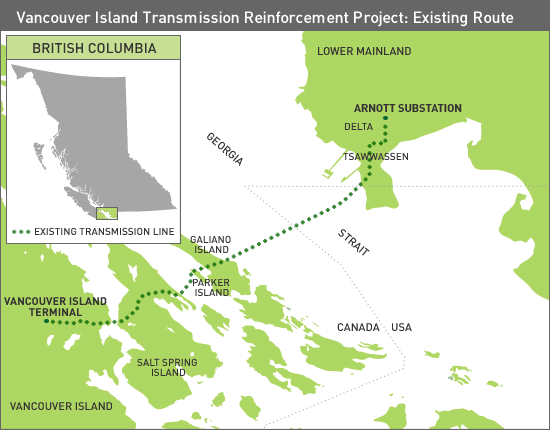
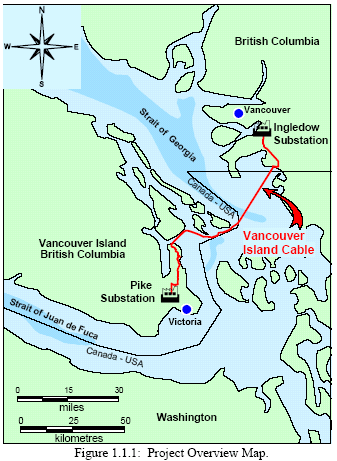
October 04, 2005
SUV sales tank as gas soars
Greg Keenan
Globe and Mail
Tuesday, October 4, 2005
Gas guzzlers stay on lots as auto makers report big decline in luxury 4WD category
Soaring gas prices sent sales of sport utility vehicles into the tank in North America last month.
Sales of the biggest SUVs tumbled as hurricanes Katrina and Rita and fears of gas shortages sent fuel prices soaring to well above $1 a litre across most of Canada and $3 (U.S.) a gallon south of the border.
"These ultra high gas prices are taking a toll on the larger, less fuel-efficient light trucks," said industry analyst Dennis DesRosiers, who heads DesRosiers Automotive Consultants Inc. in Richmond Hill, Ont.
The slide hit large SUVs in particular. Sales in that category, which includes such behemoths as Dodge Durango, Ford Expedition, GMC Yukon and Nissan Armada, slumped 50 per cent last month in Canada from year-earlier levels, according to data released by the auto makers yesterday.
That compares with an overall decline of just 2.4 per cent in the Canadian vehicle market last month.
The market also suffered from the end of discount programs at some auto makers that allowed consumers to pay the same price as employees for their new vehicles.
The SUV slide may, however, be a regional phenomenon.
"Out here, [gas prices] are not top of mind," said Ted Knight, who owns Crestview Chrysler Dodge Jeep in Regina as well as dealerships elsewhere in Saskatchewan and in Medicine Hat, Alta.
"It's not anywhere near what I thought it would be," Mr. Knight said. "We're selling Durangos, we're selling Grand Cherokees."
But even sales of luxury SUVs, which have held up in the face of higher gas prices, took it on the chin last month.
Sales of Ontario-made vehicles such as the RX330 for Toyota's luxury Lexus division slumped 17 per cent in Canada.
It was a similar story for the Chrysler Pacifica, which is built in Windsor, Ont. It slumped 24 per cent in the U.S. market.
Last month, sales of the Toyota Sequoia fell 30 per cent, to 38 units from 54, and sales of Chrysler's Dodge Durango plunged 64 per cent to 249 from 698.
Overall, sales in Canada fell to 124,175 vehicles, from 127,233 in September of 2004.
Each of the Big Three reported a drop, with Ford and GM noting large declines in truck sales.
At DaimlerChrysler Canada Inc., car sales fell, while truck sales rose, sparked by a big jump in sales of minivans.
Carlos Gomes, a Bank of Nova Scotia economist, said high gas prices packed a double whammy for auto makers.
First, they put a dent in sales of SUVs and other light trucks last month.
Sales of all light trucks -- which include minivans, so-called crossover utility vehicles that are based on a car chassis instead of a truck chassis and actual trucks -- fell about 10 per cent in Canada.
High gas prices, Mr. Gomes said, also dampen consumer confidence, which is a key driver of vehicle sales.
He acknowledged that the mood of consumers is likely more buoyant in provinces that benefit from high oil prices such as Alberta, than it is in Ontario and Quebec, which are the biggest markets for new vehicles.
The percentage declines in sales of large SUVs were similar in the U.S. market, where they represent a much larger and more important slice of the overall market than they do in Canada.
Sales of SUVs and trucks slumped 50 per cent for General Motors Corp., while Ford Motor Co. saw sales of traditional, truck-based SUVs tumble by the same amount.
This is another blow to Ford and GM, because they rely heavily on highly profitable SUVs to make up for money-losing passenger car operations.
The two largest U.S. auto makers are already reeling, with massive losses in their North American automotive operations caused in part by years of sliding market share.
Ford is preparing a major financial restructuring that is expected to be unveiled this month and include several plant closings and thousands of job cuts in the United States.
GM is in the midst of negotiations with the United Auto Workers union south of the border on ways to trim the auto maker's soaring health-care costs.
A switch to more fuel-efficient vehicles benefits Asia-based auto makers, which have already grabbed more than 50 per cent of the passenger car side of the market in both Canada and the United States.
"It's history repeating itself," said Thomas Leritz, an investment manager with Argent Capital Management in Clayton, Mo. "You go back to the seventies, during those oil shocks the Japanese took market share."
Join the online conversation on this article, here: http://tinyurl.com/arpnp
Best headline in a long time ... Arthur
Northern towns await pipeline decision
Scott Simpson
Vancouver Sun
October 04, 2005
Whether Enbridge picks Prince Rupert or Kitimat, oil line will benefit both
A $3.5-billion pipeline project that would create thousands of construction jobs and light up the economies of communities across northern British Columbia is about to take another major step in its development.
Enbridge Pipeline's Gateway project envisions two 1,200-kilometre pipelines running from Edmonton to the B.C. coast, either at Prince Rupert or Kitimat, and the company said Monday that an announcement of the final choice for the line's western terminal is just days away.
No matter which city is finally chosen, benefits are expected to resonate across the north.
"It's pretty significant all the way along the route in terms of benefit to the local communities and to the province as well," said Doug Ford, a community consultant with Enbridge Pipelines.
The number of permanent jobs at a loading-unloading terminal would number about 40, but the mayors of both coastal cities see the project as a key aspect of economic revitalization.
Prince Rupert has been hurting, employment-wise, since the closure of the Skeena Cellulose pulp mill several years ago, while Kitimat is reeling after a recent announcement by Methanex that it is closing its Kitimat methanol plant because North American natural gas prices make it a money-loser.
Both mayors have taken Enbridge on tours of their local port facilities, but insist they're not privy to a final decision.
"We've made our arguments that Kitimat is a better location than the other location, based on cost, based on the fact that we're an industrial community, and we have the land available, and so on," Kitimat Mayor Richard Wozney said.
"We've got our ears to the ground and we're waiting for the thunder to hit Kitimat."
Prince Rupert Mayor Herb Pond said the project, coupled with container port development and cruise ship stops, could create enough critical mass to support a whole new marine industry in his community.
Overall, he added, the project would be great news for all communities in northern B.C. -- Enbridge said it will require "thousands" of workers during a two-year construction project that could begin as early as 2007.
"Obviously, the first hit is the construction phase, which is going to be great for everybody in the north. The only negative [that] one might talk about at all is that it's going to require so many people that it may in fact drain from other projects. But we'll deal with that problem," Pond said.
The Gateway project includes an oil pipeline carrying Alberta crude to the coast, and a separate line carrying an oil-thinning condensate in the other direction -- from a Pacific coast terminal to Albertan oil fields.
Enbridge announced on Monday that the open season -- the sign-up period for shippers to indicate their interest in participating -- for the condensate line was a roaring success.
The open season ended on Friday with enough response that the company now plans to increase the diameter of the pipeline to about 51 centimetres (20 inches) from about 41 centimetres (16 inches).
The open season for the oil pipeline is expected to commence later this month.
The oil line will not be commercially viable until Enbridge signs up enough shippers to fill the pipe -- although the company took a major step forward last April when it announced that PetroChina signed a memorandum of understanding for shipments encompassing about half the line's 400,000- barrel-per-day capacity.
The proposed pipelines must also receive approval from the National Energy Board and the Canadian Environmental Assessment Agency, as well as support from more than 40 B.C. and Alberta first nations along the proposed route.
"Based on the open season, we can now be confident we will have at least the minimum required threshold of 150,000 barrels per day committed to the line, and probably more," said Richard Bird, a vice-president at Enbridge, in a company news release.
"The successful open season on the condensate line also means we will be able to focus on lower tolls for the crude oil line."
Enbridge will stage open house meetings in several B.C. communities along the pipeline route beginning n extmonth.
A meeting is scheduled for Kitimat on Oct. 18, but Wozney said that's "not necessarily" an indication his city will be selected for the route. Obviously, I hope that will be the case."
Prince Rupert Mayor Herb Pond had a similar story.
"Enbridge representatives were up through the area two weeks ago, and met with council, just doing a general update," he said. "They continue to have teams of people in our community doing economic assessments and all those kinds of things. But there's no hint yet as to what decision they've made . . ."
October 03, 2005
Sea Breeze: Vancouver Island Cable
Sea Breeze has filed its application with the BC Utilities Commission for a certificate of public convenience and necessity (CPCN) for a 550 MW HVDC Light cable system to Vancouver Island.
In order G-70-05, dated August 7, 2005, the BC Utilities Commission (BCUC) said "If Sea Breeze files a CPCN Application and desires to have it reviewed in this proceeding, then Sea Breeze should file the CPCN Application ... no later than the end of September 2005. Participants should assume that information requests to Sea Breeze will be due on October 17, 2005, assuming Sea Breeze files either a CPCN Application or Intervenor Evidence."
Sea Breeze has asked that its VIC project be reveiwed in a process parallel to the review of the BCTC VITR project.
The cable would run underground from the Ingledow Substation in Surrey, along road routes to White Rock, across Georgia Strait on much the same route as the GSX Pipeline, to the tip of the Saanich Peninsula, then again underground down to the Pike Substation (where Sea Breeze's other cable, the Juan de Fuca Cable is also proposed to terminate.)
The full application is now on the project's website at www.vancouverislandcable.com. Happy reading.
Interesting times at the BCUC. Will BCTC blink?
A natural gas primer -- and where the money goes
Randy Jespersen
Vancouver Sun
03-Oct-2005
Ever since Terasen Gas announced natural gas costs were increasing, we have heard from many of our customers questioning our reasoning.
British Columbia is blessed with large natural gas reserves and I am often asked who makes money from this resource. Why do we allow "our" natural gas to be sold outside B.C. rather than keeping it for ourselves?
The rights to B.C.'s natural gas reserves are owned by the provincial government, which earns a royalty on every gigajoule of gas sold, based on a percentage of the market price. When the market price rises, the government makes more money. According to the latest provincial budget update, Victoria expects to earn $1.8 billion in 2005 from natural gas royalties alone.
The companies exploring for and producing oil and natural gas in B.C. are some of the largest in the world: EnCana, Petro-Canada, Canadian Natural Resources, Talisman (Canadian firms); Imperial Oil and Devon (U.S. firms), and Shell and British Petroleum (European.)
Terasen Gas is not in the exploration or production side of the business, and we don't own or control natural gas reserves or production. We buy gas on behalf of our 875,000 customers here in B.C. and are allowed to only recover our actual cost of gas (i.e. no mark-up), our profit coming from the delivery charges.
Every three months we review commodity rates with the BC Utilities Commission. If we expect to pay more for natural gas than what we are charging, we ask for a rate increase. This occurred in July and September. Likewise, if we expect the gas to cost us less than we are charging, we ask to reduce rates. Rate reductions occurred in January 2004 and January 2002.
Since June 2005, natural gas prices across North America rose more than 30 per cent. But our purchasing strategies, which include hedging and gas storage, have saved our customers more than $270 million this coming winter.
The current rise in prices is the result of increased demand caused by a hot summer, the rising price of crude oil, and disruptions to supply caused by hurricanes in the Texas gulf region. Why do events far from B.C. result in us paying more for natural gas?
The answer lies in the development of the natural gas sector.
In 1985 Canadian governments deregulated natural gas prices to improve access to markets. This caused prices to fall as production increased and producers tried to realize value from the long-term proven reserves they had been required to hold. In the following years, demand grew as natural gas was increasingly used for home heating, fireplaces, manufacturing processes, electricity generation, and as a replacement for diesel fuel.
Over time, a network of pipelines crisscrossing North America was built, allowing natural gas to move to markets where demand is greatest. A competitive market was created where price differences from one side of the continent to the other are typically just the cost of transportation.
Eliminating constraints to market access ensures B.C. gets full value for its gas reserves and because of our location near supply sources, B.C.'s natural gas consumers enjoy lower transportation costs.
Some people are worried that Canada is running out of gas. That's not the case. We are running low on easily accessible, cheap-to-produce natural gas found in prior years. According to the National Energy Board, Canada has 70 to 80 years of natural gas reserves based on current levels of production.
Much like B.C.'s rich heritage of hydro-generation assets, where the costs of producing electricity from a new dam will be higher than from existing facilities, there will be additional costs to find new gas reserves.
But B.C. has many options: The Nechako and Bowser basins, coal bed methane, offshore reserves, and liquefied natural gas imports from terminals being built across Canada, the U.S. and Mexico.
We have ample supplies of natural gas to heat our homes and run our businesses well into the future while continuing to attract major new investment and generate substantial government revenues providing benefits to all British Columbians.
Randy Jespersen is president of Terasen Gas.
Natives want province to halt coal-burning at mill
The Canadian Press
October 1, 2005
CAMPBELL RIVER -- The First Nation on Quadra Island has asked the B.C. government not to approve an application for the Elk Falls pulp and paper mill to burn any more coal until the emissions have been studied.
The 200-member Cape Mudge band is worried about the possible health effects of emissions from the NorskeCanada mill.
An emissions-fallout study commissioned by Norske during the past year showed elevated levels of various toxic compounds around the Cape Mudge lighthouse a few hundred metres south of Cape Mudge village, but mill personnel said the figures were well within safety limits.
Mill vice-president Norm Facey said if the mill waste were causing health problems the group most likely to be affected would be mill employees.
"If that was happening the [Workers Compensation Board] would be all over us," he said.
Government agencies are required to consult with and help protect First Nations from the environmental and health impact of industrial plans.
A Cape Mudge member said new or recurring cases of cancer have been coming in at a rate of at least two a year over the past 10 years or more, about three times the number of cases at the nearby Quinsam Indian reserve, which receives only a fraction of the mill's smoke-stack emissions compared to Cape Mudge.
Cape Mudge band administrator Brian Kelly said the two First Nations communities are an almost exact mirror image of each other demographically, in population, age distribution, dietary habits and lifestyle, such as smoking.
"I don't see there's any reason [the cancer rate] would be different [apart from the mill emissions]," Kelly said.
Cape Mudge band members in their 40s and early 50s have been diagnosed with cancer, he said. "It's not like it's people 75-plus."
The mill is seeking an open-ended amendment to its present temporary permit to burn up to 83 tonnes of coal a day as an auxiliary fuel for its boilers.
The permit expired Friday. The Environment Ministry's waste-protection branch extended it for 30 days and also extended the consultation period until the end of October.
Facey said if the company was not allowed to go on burning coal at the mill, that would have a severe impact on the operation's economics, already hit by several other factors such as the high value of the Canadian dollar.
Facey said the mill was prepared to work with the First Nation to try to get more continuous-monitoring equipment, perhaps for a study over two years.
A letter from the band to the B.C. government called for increased air pollution monitoring.
"Additional contamination from the burning of coal would create further damage to the health, safety and enjoyment of life of this aboriginal community," the letter said.
October 02, 2005
Gas prices beginning to affect consumer behaviour
Barrie McKenna
Globe and Mail
September 29, 2005
WASHINGTON -- The high price of gas already has consumers feeling a lot less confident and with another surge in energy prices yesterday, economists are watching for signs the price shock is enough to get people to actually change the way they live and spend.
"Consumers have to adjust their budgets," insisted economist Peter Morici, a business professor at the University of Maryland in College Park, Md. "Something is going to have to give."
The first hint of a consumer pullback is likely to show up in purchases of non-essential goods and services, including apparel, cars and leisure travel, according to Prof. Morici. He also predicted there would be changes in behaviour as people drive less, buy more fuel efficient cars, car pool and turn to public transit.
"We are going to see conservation in gasoline that we didn't expect," he said. "We've crossed the threshold."
Oil, gasoline and natural gas prices all jumped yesterday, on news of a decline in crude inventories in the United States and continuing fears over refining capacity. The question now is whether those high prices will radically change behaviour.
That hasn't been the pattern over the past decade, according to a report released yesterday by Statistics Canada that showed Canadians consumed a record 40.3 billion litres of gasoline last year, up nearly 17 per cent from a decade earlier.
Still, there is plenty of evidence that high energy prices are starting to bite.
Consumer confidence in the United States suffered its largest drop in 15 years after hurricane Katrina sent gasoline prices to record highs, according to report this week by the U.S. Conference Board.
Energy costs are also spooking business owners. Owners of small and medium-sized Canadian companies said they too are fretting about the economic fallout from higher fuel prices, according to a survey by the Canadian Federation of Independent Business. The study found that 88 per cent of respondents said energy prices were now a major cause of concern.
A report yesterday showed consumer strains are already turning up in credit card delinquencies among Americans. The American Bankers Association blamed rising fuel costs for a record high percentage of credit card customers who've fallen behind on their payments.
"Gas prices are taking huge chunks out of wallets, leaving some individuals with little left to meet their financial obligations," ABA chief economist James Chessen said.
The ABA said 4.81 per cent of credit card accounts were past due by 30 or more days in the second quarter, up from 4.76 per cent in the first quarter. He pointed out that the effects of hurricanes Katrina and Rita won't show up until the fourth quarter.
Gasoline for October delivery jumped 17.29 cents (U.S.) or 8 per cent to close at $2.33 a gallon on the New York Mercantile Exchange, the highest since Sept. 1. Crude oil for November delivery rose $1.28 or 2 per cent to $66.35 a barrel. Natural gas for October delivery rose $1.251 or 9.9 per cent to $13.907 per million British thermal units, the highest close since trading began in 1990.
A World Turned Upside Down
George Monbiot
The Guardian
September 2005
The corporations are demanding regulation, and the government is refusing to give it to them
Climate change denial has gone through four stages. First the fossil fuel lobbyists told us that global warming was a myth. Then they agreed that it was happening, but insisted it was a good thing: we could grow wine in the Pennines and take Mediterranean holidays in Skegness. Then they admitted that the bad effects outweighed the good ones, but claimed that it would cost more to tackle than to tolerate. Now they have reached stage 4. They concede that it would be cheaper to address than to neglect, but maintain that it's now too late. This is their most persuasive argument.
Today the climatologists at the Snow and Ice Data Centre in Colorado will publish the results of the latest satellite survey of Arctic sea ice(1). It looks as if this month's coverage will be the lowest ever recorded. The Arctic, they warn, could already have reached tipping point: the moment beyond which the warming becomes irreversible(2). As ice disappears, the surface of the sea becomes darker, absorbing more heat. Less ice forms, so the sea becomes darker still, and so it goes on.
Last month, New Scientist reported that something similar is happening in Siberia. For the first time on record, the permafrost of western Siberia is melting(3). As it does so, it releases the methane stored in the peat. Methane has 20 times the greenhouse warming effect of carbon dioxide. The more gas the peat releases, the warmer the world becomes, and the more the permafrost melts.
Two weeks ago, scientists at Cranfield University discovered that the soils in the UK have been losing the carbon they contain: as temperatures rise, the decomposition of organic matter accelarates, which causes more warming, which causes more decomposition. Already the soil in this country has released enough carbon dioxide to counteract the emissions cuts we have made since 1990(4).
These are examples of positive feedback: self-reinforcing effects which, once started, are hard to stop. They are kicking in long before they were supposed to. The intergovernmental panel on climate change, which predicts how far the world's temperature is likely to rise, hasn't yet had time to include them in its calculations. The current forecast - of 1.4 to 5.8 degrees this century - is almost certainly too low.
A week ago, I would have said that if it is too late, then one factor above all others is to blame: the chokehold big business has on economic policy. By forbidding governments to intervene effectively in the market, the corporations oblige us to do nothing but stand by and watch as the planet cooks. But on Wednesday I discovered that it isn't quite that simple. At a conference organised by the Building Research Establishment, I witnessed an extraordinary thing: companies demanding tougher regulations, and the government refusing to grant them(5).
Environmental managers from BT and John Lewis (which owns Waitrose) complained that without tighter standards that everyone has to conform to, their companies put themselves at a disadvantage if they try to go green. "All that counts", the man from John Lewis said, "is cost, cost and cost." If he's buying eco-friendly lighting and his competitors aren't, he loses. As a result, he said, "I welcome the EU's Energy Performance of Buildings Directive, as it will force retailers to take these issues seriously."(6) Yes, I heard the cry of the unicorn: a corporate executive, welcoming a European directive.
And from the government? Nothing. Elliot Morley, the minister for climate change, proposed to do as little as he could get away with. The officials from the Department of Trade and Industry, to a collective groan from the men in suits, insisted that the measures some of the companies wanted would be "an unwarranted intervention in the market".
It was unspeakably frustrating. The suits had come to unveil technologies of the kind which really could save the planet. The architects Atelier Ten had designed a cooling system based on the galleries of a termite mound. By installing a concrete labyrinth in the foundations, they could keep even a large building in a hot place - like the arts centre they had built in Melbourne - at a constant temperature without air conditioning(7). The only power they needed was to drive the fans pushing the cold air upwards, using 10% of the electricity required for normal cooling systems.
The man from a company called PB Power explained how the 400 megawatts of waste heat poured into the Thames by the gas-fired power station in Barking could be used to warm the surrounding homes. A firm called XCO2 has designed a virtually silent wind turbine, which hangs, like a clothes hoist, from a vertical axis. It can be installed in the middle of a city without upsetting anyone(8).
These three technologies alone could cut millions of tonnes of emissions without causing any decline in our quality of life. Like hundreds of others, they are ready to deploy immediately and almost universally. But they won't be widely used until the government acts: it remains cheaper for companies to install the old technologies. And the government won't act because to do so would be "an unwarranted intervention in the market".
This was not, I now discover, the first time that the corporations have demanded regulation. In January the chairman of Shell, Lord Oxburgh, insisted that "Governments in developed countries need to introduce taxes, regulations or plans Š to increase the cost of emitting carbon dioxide."(9) He listed the technologies required to replace fossil fuels, and remarked that "none of this is going to happen if the market is left to itself." In August the heads of United Utilities, British Gas, Scottish Power and the National Grid joined Friends of the Earth and Greenpeace in calling for "tougher regulations for the built environment"(10).
So much for the perpetual demand of the thinktanks to "get government off the backs of business". Any firm which wants to develop the new technologies wants tough new rules. It is regulation that creates the market.
So why won't the government act? Because it is siding with the dirty companies against the clean ones. Deregulation has become the test of its manhood: the sign that it has put the bad old days of economic planning behind it. Sir David Arculus, the man appointed by Blair to run the government's Better Regulation Task Force, is also deputy chairman of the Confederation of British Industry, the shrillest exponents of the need to put the market ahead of society. It is hard to think of a more blatant conflict of interest.
I don't believe it is yet too late to minimise climate change. Most of the evidence suggests we could still stop the ecosystem from melting down, but only by cutting greenhouse gases by around 80% by 2030. I'm working on a book showing how this can be done, technically and politically. But it has now become clear to me that the obstacle is not the market but the government, waving a dog-eared treatise which proves some point in a debate the rest of the world has forgotten.
References:
1. This was reported by Steve Connor, 16th September 2005. Global warming 'past the point of no return'. The Independent. But the centre has just announced that its results won't be published until the end of the month. http://nsidc.org/news/
2. Steve Connor, ibid.
3. Fred Pearce, 11 August 2005. Climate warning as Siberia melts. New Scientist.
4. John Pickrell, 7th September 2005. Soil may spoil UK's climate efforts. New Scientist.
5. Resource '05, 13th-15th September 2005. BRE, Watford.
6. Bill Wright, energy and environment manager, John Lewis Partnership.
7. See http://www.atelierten.com/ourwork/profiles/0513-federation-square.pdf
8. Quiet Revolution 6kW. Brochure from XCO2. Offord St, London. http://www.xco2.com/quietrevolution
9. Lord Oxburgh, 27th January 2005. Quoted in Greenpeace press release: Shell Chair urges government to act now on climate change. http://www.greenpeace.org.uk/climate/climate.cfm?ucidparam=20050210110220
10. Tony Juniper et al, 1st August 2005. Letter to Margaret Beckett and other ministers. Available on request from Friends of the Earth.
October 01, 2005
Why Cheap Gas Is a Bad Habit
Robert J. Samuelson
Newsweek
Sept 19, 2005
Higher pump prices would help push Americans away from gas guzzlers.

Mario Tama / Getty Images
Hurricane Katrina’s impact was felt far beyond New
Orleans. All drivers learned the cost on oil disruption.
Sept. 19, 2005 issue - What this country needs is $4-a-gallon gasoline or, maybe, $5. We don't need it today, but we do need it over the next seven to 10 years via a steadily rising oil tax. Coupled with stricter fuel-economy standards, higher pump prices would push reluctant auto companies and American drivers away from today's gas guzzlers. That should be our policy. The deafening silence you hear on this crucial subject from the White House, Congress and the media is a sorry indicator of national shortsightedness.
Katrina's message is clear: we are vulnerable to any major cutoff of oil. This cutoff came from a natural disaster, but the larger menace is a political cutoff. Two thirds of the world's proven oil reserves lie around the Persian Gulf; these countries, led by Saudi Arabia, now provide about a quarter of today's oil supply. This flow could be interrupted at any time for many reasons—terrorism, war, domestic upheaval, deliberate cuts. Many other oil exporters are similarly unreliable: Russia (the No. 2 exporter), Venezuela (No. 5) or Nigeria (No. 8).
Until oil's geography changes, a prudent society would respond to this unavoidable insecurity. After the first oil "crisis" in 1973, Americans did. Congress created a Strategic Petroleum Reserve (SPR) and mandated fuel-economy standards. Drivers were sobered by high prices. From 1970 to 1990, average fuel economy for cars rose from 13.5 miles per gallon (mpg) to 20mpg. For "light trucks" (a category covering pickups, SUVs and minivans), the gains were from 10mpg to 16mpg. But in the 1990s, there was massive backsliding. Fuel economy stagnated, as millions of Americans shifted to SUVs and pickups. The SPR languished. In 1992, it had oil equal to 83 days of imports; by 2000, that was only 52 days.
Complacency reigned. Americans re-embraced the notion of cheap gasoline as a "right" that, if impaired, must be blamed on greedy oil companies, monopolistic OPEC or some sinister conspiracy. Thus, "gouging" was last week's acceptable explanation for the sharp run-up of gasoline prices. Forget the law of supply and demand. Forget our continuing vulnerabilities.
More than 60 percent of our oil use goes for transportation, dominated by road travel. It's a myth that encouraging more fuel-efficient vehicles means that we will all have to drive shoeboxes. The advent of "hybrid" vehicles—combining internal-combustion engines and electric motors—promises fuel-efficiency gains of 10 percent to 50 percent based on existing technologies, says David Greene of the Oak Ridge National Laboratory. But it's also a myth that simply issuing tougher fuel standards will bring instant relief.
"It's going to take a long time," says Walter McManus of the University of Michigan Transportation Research Institute. "You've got 225 million vehicles out there. It's about 15 years to turn over the fleet." Actually, the math is worse than that. From 2003 to 2025, the number of vehicles may grow by 50 percent, projects the Energy Information Administration. The increase reflects more people (from today's 297 million to 351 million in 2025) and higher incomes. The upshot: to keep total gasoline consumption constant, average fuel efficiency must improve roughly 50 percent.
We should be able to do this. Car companies can shift decisively toward hybrids. Despite the hype, annual hybrid sales this year will amount to a mere 234,000 out of total sales of about 17 million, McManus says; and present production plans would raise that to only about 600,000 by 2009, he projects. But if companies are to be shoved toward hybrids, they have to be assured of strong demand, because there's a definite downside. On average, hybrids cost $3,000 to $4,000 more than conventional cars, says Greene. (The reasons: the cost of batteries and the need for two power systems.) The traditional U.S. car companies—General Motors, Ford and Chrysler—are unfortunately the least prepared for change. They tied their fortunes to the biggest SUVs and pickups.
Hence, the need for a stiff oil tax. Government needs to foster a market for fuel efficiency. The tax should be introduced gradually—paralleling tougher fuel standards— and, perhaps, tempered if global oil prices rise sharply. One way or another, Americans should know that the era of cheap gasoline is history. Some drivers will want hybrid versions of their present vehicles; others will downsize. It's not a national tragedy for someone to trade an Expedition for a Taurus.
At times, individual freedom must be compromised to improve collective security. Even with this approach, we would not insulate ourselves from all upsets in the world oil market, including a catastrophic loss of supply. Barring huge oil discoveries or technological breakthroughs, "energy independence" is another myth. But we could limit our exposure. The fact that we're not trying is—considering how warnings of New Orleans's vulnerability were ignored—an irony worth noting.
© 2005 Newsweek, Inc.
NEWSWEEK BLOG TALK
16 blogs are discussing Samuelson: Why Cheap Gas is a Bad Habit right now. View All