December 23, 2009
Premier's climate-change hypocrisy could doom first nation's way of life
By Chief Kathie Dickie, Vancouver Sun, December 22, 2009
Allowing major plant to avoid building a carbon capture storage facility should not be an option
We are the Fort Nelson First Nation. We have just under 800 members comprising 14 major families. You may not have heard of us, or have yet to visit the far northeastern corner of the province that is our home, but we're here. And right now, we're trying to reconcile the Premier's words on preventing climate change and advancing first nations with his performance in our backyard.
Calgary-based EnCana Corporation, Canada's largest gas producer, along with a consortium of seven other oil companies, is planning to build the biggest gas processing plant in North America in the heart of our 1910 treaty territory. The Cabin Gas Plant, with its related infrastructure and pipelines, is a multi-billion-dollar project designed to open up B.C.'s Horn River Basin to shale gas development.
Like your community -- like any community -- we'd welcome the jobs, economic opportunities, and tax revenues such a development would deliver to the province. But, like any community, we have concerns.
The B.C. Environmental Assessment Office has declared the Cabin Gas Plant will have significant adverse environmental effects. The last time such a declaration was made -- the Kemess North mine -- the project did not receive an environmental assessment certificate. The risks of significant adverse environmental, social and cultural effects outweighed the project's economic and social benefits. It is our hope that a similar common-sense ruling will apply to the proposed Cabin Gas Plant.
Indeed, the Cabin Gas Plant is expected to be the largest point source emitter of greenhouse gasses in B.C. EnCana anticipates that the gas plant will emit 2.2 million tonnes of CO2 annually, the equivalent of adding 450,000 cars to B.C.'s roads each year. In all, the Cabin Gas Plant will increase B.C.'s annual greenhouse gas emissions by 3.3 per cent.
We support the idea of a plant. And we believe in action on climate change.
EnCana's initial proposal of a carbon capture storage system for the plant has now been dropped as too expensive. Meanwhile, 15 kilometres away from the proposed plant, Spectra Energy has proposed a similar, smaller, gas plant. Unlike EnCana, Spectra remains committed to carbon capture storage in the Fort Nelson area. The Fort Nelson First Nation cannot support the installation of a massive gas plant without a carbon capture storage facility.
We've been told many things by the B. C government as we've tried to participate in the environmental assessment process. One official said that because our 100-year-old treaty doesn't specifically address clean air, we have no say on clean air when it comes to the construction of the biggest greenhouse gas creator in B.C. Imagine being told by a government official in 2009 that you have no say on the quality of air you or your children breathe! What parent would stand for it?
We are Dene, and our traditions and customs and practices have revolved around moose, fur-bearers and freshwater fish since time immemorial. Most of our families still practice traditional lifestyles -- hunting, trapping, harvesting, and fishing -- living off the land year round. Every September, community bonds are renewed through the fall moose hunt, with its traditions and practices that remind us of our shared heritage.
All this will be lost -- cut to pieces -- by the plant site and the vast development that it will bring to the Horn River Basin which is already seeing roads, pipelines, and drill sites destroying habitat, game trails, and trap lines in the last and best land in our territory
We understand the value to the province of shale gas development in the Horn River Basin. But such economic development, whether for our community or yours, should not come at the expense of a gutting of the land, water, and air where a community lives. We are the only Treaty 8 Nation that lives within the Horn River Basin, and this gas plant, designed to open the basin to drilling, pipelines and gas development, will have an immense effect on our rights and interests. Without the capacity to determine and plan for this development, the survival of the Fort Nelson First Nation is in jeopardy. This plant and the development that it brings must not mean the end of us.
It is a proud moment for us all when the premier declares his passion for carbon reduction and aboriginal rights. But if he's saying that while he's railroading a first nation in order to construct a massive greenhouse gas emitter, that's worse than hypocrisy. It's a reminder that in all these decades, nothing has changed -- that protecting the environment and working with first nations are to be done only when it's convenient for the B.C. government.
What we seek is eh'thee oh t'deh. That's Dene for "balance: it is even." Here in our part of this province, that means working together so that those who live off the land can continue to do so and those who want to pursue family-supporting jobs in the sensible development of shale gas production can do so as well.
We live in a place where winter arrives in October and doesn't leave until April, and where clean air and fresh water are among our few tangible assets. And we are a community in B.C. We believe that, like any community in B.C., we deserve the opportunity to try and seek a balance for our community.
We believe that when a large industrial complex and infrastructure are proposed for a community in B.C., the community deserves the right to try and plan for it in a way that advances the community interest, not destroys it. And we believe that a government that champions certain values in front of the world should not be engaged in actively working to destroy these same values at home.
Like your community, though, we are not uniform in our outlook. Like your community, we are made up of those who want to pursue traditional ways and those who want the opportunity to pursue different economic goals. Achieving balance between the traditional and the new development will test us all. We are only one generation out of the residential schools and, as in any community, the old and the new do not always sit easily together.
Ignoring us or excluding us because the reality of our existence is an inconvenient truth to bureaucrats or the Premier is not an alternative for this or any first nation. We should be participating fully in the effort to achieve balance.
The path to balance can start with something as simple as a demonstration of respect. Other times, it takes the courts. We hope the B.C. premier, who holds the honour of the Crown and our community in his hands, chooses respect.
Kathie Dickie is the chief of the Fort Nelson First Nation.
© Copyright (c) The Vancouver Sun
December 22, 2009
B.C. only province with rising greenhouse gases
CBC News
Monday, December 21, 2009
British Columbia was the only province in the country to report an increase in greenhouse gas emissions from major industries in 2008, according to figures released by Environment Canada.
The figures cover so-called "facility greenhouse gas emissions" from power plants and heavy industries such as mining, pulp and paper, and petroleum.
British Columbia's dubious distinction was largely the result of oil and gas extraction, Environment Canada said.
The current boom in exploration for shale gas, which has a higher CO2 content, is likely to have played a significant role, energy policy consultant Chris Bataille said.
"On a year-by-year basis I wouldn't want to put too much weight on it," he said, "although in the long run we can probably expect emissions to increase from natural-gas extraction in B.C.'s northeast."
Last week B.C. Premier Gordon Campbell was honoured in Copenhagen for introducing a provincial carbon tax.
But critics such as George Heyman of the Sierra Club say the honour is tainted because the B.C. government continues to offer tax breaks to the petroleum industry.
"This is one of the disturbing contradictions in the Campbell Liberals' climate-change policy," he said. "They've introduced targets, they've introduced a carbon tax — and yet we're actually going in the wrong direction."
But even with last year's poor result, B.C. still ranks far below Alberta in such facility emissions. In 2008, its heavy industries emitted eight times as much greenhouse gas as B.C., Environment Canada figures show.
December 20, 2009
Ingmar Lee's Statement
Ingmar Lee
December 20, 2009
Today I climbed the 200ft flagpole on the front lawn of the BC legislature:

Victoria's tallest fire-ladder fully extended |
Here is the banner I hung:
 |
I climbed the flagpole because I'm unhappily ashamed to be a 'Canadian.' Although I've never trended much towards any nationalist or patriotic proclivity, I'll admit to a slight twinge of pride of nation was when a former Prime Minister, in spite of overwhelming pressure, said 'fuck you' to GWB when he wanted Canada to join in with his attack, invasion, occupation, torture, rape and massacre of Iraq. But given our current Prime Minister, Stephen Harper's recent cowardly, grudging and sneering performance at Copenhagen, I'm utterly embarrassed to be a member of this country. And to make matters worse, the drunken Premier of British Columbia, Gordon Campbell joined Harper in Denmark to offer his 'support.' And to make matters even worse, Tzeporah Berman, CEO of ForestEthics Canada, which purports to work to protect BC forests and on other environmental issues, followed Campbell to Copenhagen to issue him an award for "Climate Leadership."
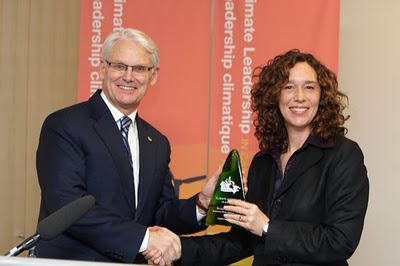 Gordon Campbell and Tzeporah Berman at Copenhagen |
After nearly a decade of Gordon Campbell at the helm, the British Columbia environment has taken a horrific corporate shit-kicking. With our institutionally corrupt and gerrymandered excuse for democracy, and with giant transnational logging corporation's as his principal campaign financiers, Campbell has won successive majority governments by garnering on average, about 30% of the vote. And it is truly an embarrassment how cheap these corporations have been able to buy themselves a British Columbia government. The predictable result is that Campbell has presided over an unprecedented level of destruction in our forests. His very first act of government back in 2001 was to abolish the Ministry of Environment. Next, he immediately reinstated the Grizzly bear trophy hunt. His government oversaw a culling of Golden eagles, which they scapegoated for the logging-caused extinction of the Vancouver Island marmot. As Canada's 'Most Endangered Species' these marmots only survive in captive breeding laboratories now. Campbell gutted the provinces Forest Practices Code, and then attempted to privatize the public forests of BC, which comprise more than 90% of the provinces land mass.
Campbell is responsible for a massive proliferation of fish-farming on the Pacific coast which has resulted in an epidemic of sea lice which has infected and is killing off our wild salmon. He has expanded the development of oil and gas, even pushing for oil and gas development in the clear Pacific waters and no mining application has crossed his desk that he couldn't approve. Currently, he's plowing enormous new highway infrastructure through the Burns Bog and is champing at the bit to allow giant American energy corporations to install "Run of River" power infrastructure in what remains of the provinces final intact watersheds. The list of Gordon Campbell's voracious attacks on the British Columbia environment are far too many to cover in this essay, but his most egregious scheme of all is just now getting off the ground.
Premier Campbell is the lead proponent and champion of the proposed "Enbridge Nothern Gateway Pipeline" which is slated to deliver 'dirty oil' from the notorious Alberta Tar Sands, to the BC Central Coast. This 1100 km, 1 metre diametre pipeline will send half of Tar Sands daily production sluicing across our province, to be loaded onto more than 300 VLCC's, -Very Large Crude Carriers- every year. This will result in a veritable super-tanker traffic jam in the narrow fiords and amongst the rock-pile that is BC's Pacific coast and will guarantee horrific Exxon Valdez-scale oil disasters. A single accident will immediately destroy Campbell's only, albeit seriously greenwashed example of a semblance of wilderness conservation. This year, after a decade of secret, exclusive negotiations with several select environmental collaborators, Campbell announced, onstage with his ForestEthics collaborators, that he had reached an agreement to "protect" just 30% of a tract of relatively contiguous primaeval wilderness known as the 'Great Bear Rainforest.' The other 70% has been handed over to voracious logging corporations.
I've been focussing my efforts on battling the Gordon Campbell Pipeline for several years now, even as the US-based Enbridge Pipeline corporations PR machinations proceed apace across the province. Currently, the significant majority opposition to the pipeline is disorganized, and several so-called environmental organizations, including ForestEthics, are positioning themselves to lead the fight. These due-process oriented, charitable status-quarding organizations have already established themselves as collaborators with the Neocon Campbell government, and Campbell has now ensconced them, including Berman on a new "Green Energy Task Force." This task force has been set up to persuade the people of BC to allow wild rivers to be developed en masse by private American corporations for the purpose of providing "Green" power to the insatiable American market. Initially the ROR campaign, spearheaded by Campbell, and greenwashed by Berman, and bewilderingly, by Dr Andrew Weaver, -a noted BC climatologist who shared the IPCC Nobel Prize and who stumped blatantly for Campbell during this years election after his University of Victoria department received $94 million in funding from the Campbell regime- insulted the BC environmental community by equating anyone who questioned the private development of BC's wild rivers as being ignorant climate-change deniers. Now, in the new Campbell-appointed Task Force, they are trying a kinder, gentler approach.
The once-powerful and united BC Environmental Movement has been divided into an unbridgeable schism, -between Grass-roots activists who stand in the way of business as usual, (BAU) and well-funded environmental bureaucracies who work according to BAU. These BAU organizations, with ForestEthics as the worst example, have become shameless greenwashers of the BC government and the darlings of the corporate media.
When Tzeporah Berman wormed her way through 100,000 awakened climate-change activists whose favoured slogan was "System Change, Not Climate Change to present her award to one of the very worst climate-change troglodytes on the planet, she utterly forfeited any remaining credibility she and the Canadian branch of ForestEthics may have had as an environmental activists. This was the final straw that drove me up the flagpole. It is of paramount importance to the world that all the stops must be pulled out to shut down the planet-killing Alberta Tar Sands mega-project. It is a black/white issue that cannot be compromised. It is essential that the people of the world understand that the Premier of BC is busily forwarding and facilitating that horrific blight on the planet, and people must understand the greenwashing that is greasing its wheels. It must be shouted out loud and clear.
Today, I have once again been charged with "mischief endangering life" a charge which could garner a lifetime prison sentence. This is the same charge I am already facing for another act of non-violent civil-disobedience which I committed earlier this year. I'm told it will cost me $50,000 to conduct a credible legal defence, -which of course, I could never afford. I have also been told that I do not qualify for legal aid, on account that I have no record of my recent employment history, which is basically odd jobs for cash. I live in BC's vast underground economy, largely because I believe that it is unethical to pay taxes to Gordon Campbell and Stephen Harper. I believe that I serve my community with my environmental work instead, and even if there had been a paper trail, my income is so far below the poverty line that I'd be exempt anyway. I do not expect justice before the Gordon Campbell kangaroo court, and I guess, for people like me, jail time is a rite of passage.
By email.
Oil pipeline to Kitimat prompts flagpole climb
CHEK News, 20-Dec-2009

Louise Dickson
Times Colonist
Sunday, December 20, 2009
Environmental protester Ingmar Lee was arrested by Victoria police yesterday morning after scaling the flagpole at the B.C. legislature in full climbing gear.
Firefighters, police and ambulance were on the scene as Lee, who is known for his tree sit-ins at Langford's Spencer Road interchange and Cathedral Grove, climbed the pole and tried unsuccessfully to unfurl a banner protesting a proposed pipeline from the Alberta oilsands to Kitimat.
"He was up there about 30 minutes and was trying to come down by himself but couldn't make it all the way down," said Staff Sgt. Darren Laur. "It was so cold, we had to bring him down in a fire basket."
Email to a friendEmail to a friendPrinter friendlyPrinter friendly
Font:
* *
* *
* *
* *
AddThis Social Bookmark Button
Lee has been charged with mischief, said Laur. He was released on a promise to appear in court at a later date.
After he was released, Lee insisted he hadn't been rescued and wasn't cold, just happy to accept a ride in the fire bucket.
Lee, who lives on B.C.'s central coast, said he was protesting the fact that Premier Gordon Campbell is championing the construction of a 1,100-kilometre pipeline to Kitimat, where oil would be loaded onto supertankers.
"Campbell has been getting quite a bit of green press recently, but that doesn't square with someone who wants to build a pipeline to deliver half of daily tarsands production to the B.C. coast," said Lee.
ldickson@tc.canwest.com
December 18, 2009
B.C.'s gas sector expects an extra $600m in 2010
SCOTT SIMPSON
Vancouver Sun
December 18, 2009
British Columbia's natural gas stimulus package will generate at least $600 million in additional investment in the province next year, according to a new study.
PricewaterhouseCoopers states in a survey that the package of incentives announced Aug. 6 by provincial Energy Minister Blair Lekstrom will effectively counter the twin effects of declining North American gas demand and declining natural gas prices that emerged last year as a consequence of the global economic recession.
The survey was released Thursday by the provincial government.
PricewaterhouseCoopers surveyed 14 companies operating in B.C. and representing 75 per cent of gas production in the province, in order to determine the impact of the stimulus package.
The package includes an incentive for wells drilled from September 2009 through June 2010.
The government offered a one-year royalty rate of two per cent on those wells, compared to an average rate of about 19 or 20 per cent.
Eleven of 14 companies responded to the survey, representing 67 per cent of total B.C. natural gas production and accounting for $2.61 billion of investment in exploration and development of gas deposits in 2008.
In 2009 their investment dropped to $1.86 billion, mainly as a result of very low natural gas prices and declining demand as a consequence of the global economic recession.
The respondents said that the drops in both price and demand were expected to have an even more significant effect in 2010 and they were anticipating investments of $1.52 billion in B.C. - until the stimulus was announced.
PricewaterhouseCoopers said that as a result of the incentives, the respondents estimated they would increase their spending by $600 million for a total of $2.1 billion.
"Before stimulus, investment in B.C. in 2010 would have been 18.5-per-cent lower than 2009 investment standards," the PWC study said.
"With stimulus, investment in 2010 is expected to be 12.7-per-cent higher [estimated] than 2009 investment levels."
In a news release Lekstrom said, "B. C. continues to be one of the most competitive natural gas jurisdictions in North America and this stimulus package will further strengthen the sector while increasing provincial revenues."
"The whole intent of our royalty credit programs or our stimulus package most recently is to ensure we can attract the capital investment that is needed to maintain a competitive advantage and maintain jobs," Lekstrom said in an interview.
"We do a lot of work when we develop these packages, consultation with industry, with government looking at what we need to attract revenue and that investment and at the end of the day to see PWC verify the hard work that's gone into these is rewarding."
Lekstrom believes the royalty reduction was "one of the best moves we've made."
"Getting two per cent of something is a lot better than 19 per cent of nothing. Not only did the province generate some revenue as a result of that, but it generated jobs and economic activity here in the northeast as well."
He said B.C. was mindful of the need to keep as many rigs as possible in the province during the recession -- or risk losing them to other jurisdictions such as the United States, where a natural gas boom is under way.
"Once they make a determination that they are going to move capital or shift that capital elsewhere, or move those rigs somewhere else, it's very difficult to bring them back.
"So a big part of what we tried to do is secure the activity and the rigs that we have in place here in British Columbia. I think we've done that."
Dave Pryce, Western Canada operations vice-president of the Canadian Association of Petroleum Producers, concurred.
"We've said all along that if you set the right fiscal framework, the industry will respond favourably."
Pryce noted that B.C. also enjoyed a strong year -- third best on record
-- for natural gas exploration rights auction bids.
"It seems out of sequence with the cyclical nature of the gas price we're in -the low end," Pryce said in an interview.
"I think there are a couple of reasons. One obviously is the stimulus package. I think industry looks at that as a long-term commitment by the Crown [which is] saying, 'We want your business, we want you to come here.'"
Pryce said the stimulus package is "well positioned" with emerging major gas plays, the Horn and Montney plays where companies are looking to get in early and establish substantial land positions in expectation of a payback that could endure for several decades.
"You put those two together and I think that is why you are seeing the investment out of sequence with the cycle."
Meanwhile, the ministry announced that its December gas rights auction attracted $172 million in bonus natural gas bids.
That brought the 2009 calendar year total to $893 million.
The two best years on record are 2008, when B.C. received $2.66 billion bonus bids, and 2007 when the total was just over $1 billion.
ssimpson@vancouversun.com
December 17, 2009
Environmental Groups Recommend New Approaches to Clean Electricity in BC
Media Release, David Suzuki Foundation, Pembina Institute, Watershed Watch Salmon Society, West Coast Environmental Law, December 17, 2009
Several environmental organizations today released a blueprint for improving the planning and development of renewable electricity projects in British Columbia. The recommendations, authored by the David Suzuki Foundation, the Pembina Institute, Watershed Watch Salmon Society and West Coast Environmental Law, have been endorsed by 25 environmental organizations across the province.
British Columbians are deeply concerned about climate change, and while they support clean electricity to address climate change, many harbour concerns about how clean electricity is currently developed. Government energy and climate policies have stimulated a rapid increase in the rate of development of renewable electricity projects, but public support has not kept pace in many cases. Projects have frequently been opposed due to concerns about social, environmental and economic costs.
The blueprint released today, “Recommendations for Responsible Clean Electricity Development in British Columbia,” outlines how planning and development can proceed in a way that is more transparent, strategic and inclusive of and beneficial to all British Columbians — First Nations and the public alike — while limiting environmental impacts.
The groups recommend that British Columbia’s progress on clean electricity policy and development can be dramatically improved by:
1. Ensuring that energy conservation and efficiency is the highest priority.
2. Making British Columbia’s electricity supply as clean, renewable and low-impact as possible.
3. Adopting a renewable electricity planning framework that limits environmental, social and economic impacts and maximizes public benefit.
4. Reforming water licensing, land leasing decisions and governance.
5. Strengthening the environmental assessment process, addressing and managing cumulative effects, and improving monitoring and compliance performance.
6. Developing an informed consensus about the conditions whereby renewable electricity could be exported from British Columbia, if at all.
-30-
Organizations endorsing the Recommendations for Responsible Clean Electricity Development in British Columbia:
BC Spaces for Nature
BC Sustainable Energy Association
Cassiar Watch
David Suzuki Foundation
Forest Ethics
Friends of Clayoquot Sound
Friends of Wild Salmon
Georgia Straight Alliance
Living Oceans Society
Northwest Watch
Outdoor Recreation Council
Pacific Wild
Pembina Institute
Raincoast Conservation Foundation
Sierra Club of Canada, BC Chapter
Skeena Watershed Conservation Coalition
SkeenaWild Conservation Trust
Steelhead Society of British Columbia
Sunshine Coast Conservation Association
T. Buck Suzuki Environmental Foundation
Watershed Watch Salmon Society
West Coast Environmental Law
West Kootenay EcoSociety
Wilderness Tourism Association
Wildsight
For more information, contact:
Karen Campbell, Pembina Institute, cell: 604-928-2258
Craig Orr, Watershed Watch Salmon Society, cell: 604-809-2799
Josh Paterson, West Coast Environmental Law, phone: 604-601-2512
The full recommendations are available at: http://bc.pembina.org/pub/1951
December 05, 2009
Independent power costs raise questions about B.C. policy
By Scott Simpson
Vancouver Sun
December 4, 2009
Depending on whom you choose to believe, a wholesale expansion of British Columbia's electricity supply is either fiscal folly or a wise investment in the future.
Both Energy Minister Blair Lekstrom and the Independent Power Producers Association of B.C. (IPPBC) anticipate that the government's plan to contract several billion dollars' worth of new private sector electricity development will strengthen both domestic power supply and B.C.'s natural advantages in the power export market.
Skeptics include British Columbia's largest industries, and critics such as Marvin Shaffer, a consulting economist and adjunct professor at Simon Fraser University who has participated as an intervenor in several BC Hydro hearings before the B.C. Utilities Commission.
And would you believe that BC Hydro's own calculations suggest that at least part of the time, the government-owned utility will be forced to sell electricity at prices lower than what it's paying independent power producers (IPPs) to deliver it to them?
Hydro is in the process of firming up long-term contracts with IPPs to buy power at prices that average out, conservatively, to about $100 per megawatt hour.
Meanwhile documents recently filed to the utilities commission by Hydro suggest that the overnight purchase price for a megawatt of power at a primary trading hub in the western United States — Hydro's primary export power customer — is somewhere around $60.
That has more or less been the standard price for the last five years according to studies by U.S. federal electricity market regulators — although the overnight price in California was closer to $80.
Hydro projections indicate that spot market prices won't hit $100 until 2032.
Hydro's primary industrial customers, who account for about one third of the electricity consumed each year in B.C., calculates that this disparity could cost BC Hydro customers $300 million a year — or more — in what amounts to a subsidy to IPPs.
There is no such thing as a typical year for a utility that relies on rainfall to power its hydroelectric facilities.
But in general terms, Hydro is looking to boost B.C.'s electricity supply by about 10 per cent through contracts with independents.
All of it will be renewable power including wind and small-scale hydro.
That expansion will be enough to make B.C. electricity self-sufficient by 2015, as well as create enough additional power to create a viable, long term power export business capitalizing on booming U.S. demand for green power.
The export market looks solid — recent documents from California regulators suggest that utilities in the southwest state may be willing to pay as much as $130 a megawatt for fixed volumes of renewable power on fixed-price 20-year contracts.
That means Hydro could develop a solid, profitable market for about half the renewable electricity supply it is in the process of contracting through its 2008 Clean Call to independent project developers.
The other half of the equation is more complicated.
Hydro has orders from government to contract for enough new power to meet domestic supply in even the most critical low-water year, with a deadline of 2015 to reach that target.
Most years, however, it has a lot more water available for power generation than the critical year baseline requires.
That means Hydro will in most years be receiving from IPPs a volume of power that exceeds domestic demand — and will be in a position of having to sell it on to the overnight market at prices that could be lower than the price IPPs are receiving to put it on the grid.
The baseline for new domestic power supply is 3,000 gigawatt hours of power, but in a bumper water year, Hydro could be seeking a market for a surplus that could reach 10,000 gigawatt hours.
The Joint Industry Electricity Steering Committee, representing Hydro's large industrial customers including operators of mines and pulp mills, wonders if the provincial government has a business plan demonstrating how all of these possibilities will ultimately work to B.C.'s advantage.
"I'm all for it if it makes money," said steering committee executive director Dan Potts.
"The thing I don't understand is the fundamental economics. Our estimate is that every 1,000 gigawatt hours is going to cost an extra $300 million. And it goes on year after year. At least, after the fast ferries were done, you could park them.
"But once you commit to a long term contract you've got to keep your commitments.
"If you look at the cost curve for major hydro investments, over time the costs go down, but with IPP contracts you've got a commitment to pay a certain dollar figure plus escalation for the duration of the contract."
Consultant Marvin Shaffer has advocated that Hydro take advantage of opportunities to import power wherever practical — such as trading markets where prices are lower than IPP contracts.
Shaffer says there is "no question" new electricity supply developments will cost more than Hydro's existing heritage assets.
However, he said, "the self-sufficiency policy is forcing us to have surpluses in most years, in all but extreme drought conditions.
"We are certainly paying more than the market would pay for it. If BC Hydro was a commercial enterprise, or if [Hydro subsidiary] Powerex was doing this as a commercial venture, they wouldn't buy power at the prices BC Hydro is paying.
"Those firm forward prices for the next five years are in the $50-$60 range. I'm sure they will go up in the future but it's just a huge risk to think that they are going to go up to $100 or more."
Energy Minister Blair Lekstrom acknowledged that an element of risk may creep in where Hydro experiences a surplus of power.
But he dismisses suggestions that Hydro may incur huge trading losses or that the province is contracting some kind of huge subsidy for IPPs.
"I am not a supporter of 'Buy high, sell low,'" Lekstrom said. "That is just not going to happen under my watch of this ministry."
He agreed in some years Hydro may be selling some surplus power at short term non-contract prices, for less than it's paying to receive it but on balance, favourably priced long-term export contracts represent a net benefit to B.C.
Short term trading losses on spot markets, on the other hand, represent the price of making B.C. electricity self-sufficient. Lekstrom calls self-sufficiency an "insurance policy" and said the cost of the "policy" will be reasonable.
"Our ability under the export is not in the short term markets. It's in the long term contracts with the PG&Es [Pacific Gas and Electric Company] of the world, and the other utilities.
"The [Hydro-estimated] prices you are looking at in those charts are not based on contracts that would be negotiated with our clean renewables, for which many U.S. jurisdictions would [wish to] secure long term contracts. We have had ongoing discussions with those."
Paul Kariya, executive director of the Independent Power Producers association of B.C., sees California as the key to the success of the entire venture, and "as I understand it, a [delivered] price of $130 in 2015 isn't out of the question."
He is confident the government's renewable power will succeed and that it will be profitable for the province.
But Kariya agreed with a suggestion that it would benefit the debate for the government to produce more information about how the policy will work, and how it will succeed. "I agree wholeheartedly that this is something government must do and I have asked for a single document or something that pulls it all together. That is something I haven't seen," Kariya said.
He added that such information would make it easier for publicly traded IPPs to demonstrate the viability of their projects and attract investment.
ssimpson@vancouversun.com
© Copyright (c) The Vancouver Sun
The fight for our future begins
Scott Simpson,
Vancouver Sun
December 5, 2009
Evidence of global warming continues to stack up despite a growing cloud of skepticism
On the eve of a pivotal United Nations climate conference that many observers are already describing as a failure, some of the gloomiest climate research data on record has been making its way into the public realm.
In recent days, leaders of nations including Canada, China and the United States have indicated they will attend this month's UN climate conference in Copenhagen.
The decision by U.S. President Barack Obama to make an appearance, albeit a short one, at Copenhagen prompted Prime Minister Stephen Harper to announce last week that he, too, would attend.
Neither Harper nor Obama, however, is promising significant action to reduce fossil fuel emissions in their respective nations -- both are promising to implement greenhouse gas cuts that will leave them, by 2020, still short of reduction targets other developed nations are attempting to reach by 2012 under the terms of the Kyoto Protocol.
Moreover, the purpose of Copenhagen is to build on the Kyoto Protocol by setting new, more ambitious targets for reducing emissions -- and that means Canada and the U.S., most notably among developed nations, will be left even farther behind.
Meanwhile, scientific evidence of global warming continues to stack up -- even here in British Columbia -- paralleling reports of increased human-caused concentrations of greenhouse gas in the Earth's atmosphere.
"Even as the science is screaming out, saying we've got to deal with it, the policy makers are posturing and managing messages and doing nothing,"
University of Victoria climatologist Andrew Weaver said in an interview.
Weaver is one of the authors of an international report released last month updating research since the landmark 2007 report of the Intergovernmental Panel on Climate Change.
"It's a very frustrating time to be a climate scientist. You feel like Noah, screaming out, 'Okay, it's going to rain, time to do something,' and nobody is listening."
The new report says concentrations of greenhouse gas are at their highest levels ever recorded, Arctic sea ice is disappearing 40-per-cent faster than projected just two years ago, and the rate of sea level rise from warming oceans is 80-per-cent faster than predicted in 2001.
These findings appear to present an overwhelming rebuttal to recent claims by climate change skeptics that, based on allegedly stolen e-mails from researchers at England's University of East Anglia, some sort of global conspiracy is underway to fabricate evidence of climate change.
Weaver said the controversy has obscured the fact that two other independent sets of data -- both produced by researchers based in the United States -- show that, if anything, the British data is underestimating the severity of the situation.
"The denial movement don't care about facts," Weaver said. "All they want is to try and throw a bunch of stuff at the public jury hoping that something sticks and leaves an element of doubt. I think the average person recognizes this for what it is: an attempt by special interest groups to undermine the science in the lead-up to Copenhagen."
In recent weeks, some of the world's most compelling research comes from British Columbia, where BC Hydro is supporting studies into the behaviour of glaciers that are essential to drinking water, aquatic habitat -- and future electricity supply.
A study co-authored by University of Northern B.C. glaciologist Brian Menounos and cartographer Roger Waite, looking at 20 years worth of satellite imagery for B.C. and western Alberta, reported in October that glacier-covered terrain shrank more than 3,000 square kilometres from 1985 to 2005, that 2,000 of 14,000 glaciers "disintegrated," and that 3,000 glaciers disappeared altogether.
Waite and Menounos are part of a group of glacier researchers associated with the Western Canadian Cryospheric Network, which represents universities in British Columbia, Alberta and Washington state, and have received funding from BC Hydro and Environment Canada to investigate the effects of global warming on the mountain watersheds Hydro needs to generate electricity.
Waite and Menounos were aided in their work by a German glacier researcher, Tobias Bolch, who had previously undertaken studies of substantial glacier declines in Asia's Himalayas and Europe's Alps.
They compared satellite images from 1985 and 2005 in a B.C.-Alberta area that accounts for 23 per cent of North America's non-polar ice.
On average, they found that B.C. glaciers shrank 11 per cent.
The findings for Alberta are even more dramatic -- glacier coverage fell
29 per cent between 1985 and 2005 on the eastern slope of the Rocky Mountains.
According to Waite there is a distinct mark, almost like the grime ring in a bathtub, that denotes the maximum growth of glaciers during the Little Ice Age that lasted until about the middle of the 19th century.
"When you see that, it brings it home that the ice has decreased by quite a lot," Waite said in an interview.
There was a period about 7,000 years ago, following the last major Ice Age, when glaciers almost disappeared, but Waite said the current rate of melting greatly exceeds the natural history of that event. "What [glaciologists] will say is that it never has retreated at this rate. The rate of ice melting far exceeds what happened at the end of the [major] ice ages."
Nor was there any evidence that any glaciers, anywhere in B.C., are growing.
British Columbia Environment Minister Barry Penner echoed those findings in a recent interview that suggests the melt trend continues.
"One of the things that gave me concern [happened] this past summer, in August. The Ministry of Environment issued [an advisory] which was in my memory unprecedented," Penner said.
"It was a high stream flow advisory -- in August during what amounted to a drought. How could that be? Because it was so hot that the glaciers on the coast were melting at a very rapid rate.
"There were clearly, unusually high flows when we hadn't had any rain on the coast for weeks and yet the water levels were so high that people in the river forecast centre felt we needed to issue a public warning about staying away from riverbanks -- particularly in the Sea to Sky corridor where we have some good-sized ice caps.
"Those kinds of things really trouble me because that's our heritage up there. I view that as our insurance plan for long droughts. When it starts melting at such a rate that the rivers are raging, with no precipitation contributing, all coming from the ice melt, you know you are drawing down your heritage assets at a rapid rate."
Glaciers provide water
A BC Hydro report released last month at a glaciologists' conference in Lake Louise shows that while Hydro relies primarily on rain and snowmelt to supply its hydroelectric reservoirs, glaciers provide up to 11 per cent of annual water inflow to reservoirs for its Revelstoke and Mica generating stations on the Columbia River.
In particular, they provide a late summer bump of water after all the previous winter's snow has melted.
An 11-per-cent shift in glacier water inflows to those reservoirs represents the difference between a good water year and bad one for Hydro.
If you compound an 11-per-cent decline over as few as three years, you're looking at a significant, persistent supply shortfall for the province's primary electricity generating system -- and for all the U.S. generating stations on the Columbia downstream of the Canada-U.S. border, including the Grand Coulee, the fifth largest dam in the world.
Numbers like that explain at least partially the interest of the B.C.
provincial government in developing substantial new small-scale hydroelectric resources over the next 15 years, for both domestic consumption and export.
Other numbers explain Canada's broader reluctance, under Harper's Conservative government, to embrace Copenhagen as an opportunity to commit to large-scale greenhouse gas emission reductions.
Natural Resources Canada reports that energy resources account for seven per cent of Canada's GDP, make a positive $55-billion-per-year contribution to the nation's balance of trade, and represent 20 per cent of domestic exports.
They are also the primary reason the Canadian dollar has gained strength against the U.S. currency in the last two years, buoyed by higher global prices for oil. Canada would need to curtail emissions 29 per cent just to come into compliance with the Kyoto Protocol that it ratified in 2002.
Canadian plans failed
Kyoto is only the first of a series of greenhouse gas emission reduction targets that by 2050 would put emissions 50 per cent below the 1990 'baseline' levels established by international climate scientists as essential to avert runaway global warming by the end of the century.
The United States, facing a 31-per-cent cut to reach the Kyoto target, declined under Republican president George W. Bush to become a signatory to the protocol. European nations, by contrast, face cuts of three to nine per cent, and will go into the Copenhagen conference prepared to negotiate a second, deeper round of cuts.
Efforts by the former federal Liberal government to curtail Canadian greenhouse gas emissions did not succeed, and two subsequent sets of policies by the Conservatives have achieved nothing.
According to a forthcoming book co-authored and co-edited by University of British Columbia political scientist Kathryn Harrison, "Canada accepted perhaps the most ambitious commitment among all parties to the [Kyoto] agreement."
Harrison suggests Canada is unlikely to take action until its largest trading partner and largest oil customer applies the spurs. She thinks this has become likely with Obama's election.
"After two 'made-in-Canada' plans, it has become increasingly clear that the next round of Canadian climate policy will be made in the United States," Harrison writes in Global Commons, Domestic Decisions: The Comparative Politics of Climate Change, which will be published in 2010 by MIT Press.
"Given the close integration of the two economies, actions to reduce greenhouse gas emissions in the United States will reduce the economic effects of, and thus political opposition to, adoption of comparable measures in Canada. And if the opportunity to respond to voters'
expectations at a low cost is not enough, the threat of trade retaliation will undoubtedly ensure that Canada closely follows the U.S. lead."
In an interview, Harrison said, "Climate change is a particularly difficult issue for Canada in two ways. One of them is that our economy is relying to a significant degree on production and to a large degree sale of fossil fuels.
"Fossil fuels, used as intended, produce climate change. So we are in some ways in the business of producing greenhouse gasses.
"It's also true that our manufacturing sectors and we as individuals are used to having low-cost fossil fuel-derived energy available to us. So climate change represents a big challenge for the Canadian economy and for Canadians because if we are going to be serious about addressing climate change we have to over time move away from a fossil fuel-dependent economy.
"Fossil fuel production in Canada, certainly the oil sector, is certainly getting more, not less, greenhouse gas intensive as we move from reliance on conventional crude to oilsands and heavy oil."
A 'huge' issue for Canada
Harrison noted that Alberta's oilsands at this point account for "a relatively small per cent of Canada's emissions."
"But growth in production [from oilsands] is expected to account for a very significant share in Canada's growth in emissions" if Canada proceeds on its present course.
"So absolutely, this is a huge issue for Canada as we try to deal with climate change."
Harrison adds that curtailing emissions would be challenging for any Canadian federal government, not just one with a power base in Alberta.
"The Conservatives actually have seats in Alberta. They have more members of their caucus from western provinces that produce oil and gas.
"So in that sense it could be more difficult for them. But this is a difficult issue for any federal government, not just because of the economic significance of the oil and gas industry for Canada but also, because it's regionally concentrated, the industry tends to have very powerful defenders in the form of provincial governments.
"It's not just Alberta and Saskatchewan. Increasingly, it's provinces and territories that are counting on expansion of their currently small oil and gas sectors like Newfoundland, Nova Scotia, Northwest Territories.
"The industry has a strong voice on its own but it also has powerful defenders at the table at first ministers conferences or meetings of environment ministers."
Harrison doubts Canada will take more decisive action without a stronger message of support from voters.
"I think to some degree Canadian voters have been inconsistent. We want politicians to fix this problem, to show leadership but whenever proposals come out that might involve some pain a lot of people make a big stink.
"Witness the reaction to a very minor carbon tax in British Columbia -- two cents a litre and people were outraged.
"That's where I think there's a lot more the electorate could do to put their actions -- and indeed it's going to take money -- where their ideas are, and to back politicians who take tough positions."
Two groups of countries
Meinhard Doelle, an environmental law specialist at the Schulich School of Law at Dalhousie University, believes a failure at Copenhagen to advance the emission limits inherited from the Kyoto Protocol would serve Canada's interests -- but only in the short term.
"Broadly speaking you have two groups of countries in the negotiations,"
Doelle said in an interview.
"You have countries that are pushing for more ambitious global agreement, and you have countries that are pushing for a less ambitious global agreement -- or none at all.
"I think right now Canada falls into the category of a country that would like nothing better than to have no agreement or an unambitious agreement because of the short-term economic costs that are associated with meeting a more ambitious goal.
"We clearly have challenges that no one else has. We are one of only a few developed countries that are significant exporters of fossil fuels and that creates challenges that put us in a different position than most other developed countries."
If Canada were to take a longer-term view, he adds, a greater commitment to action might be easier to embrace.
"Europe has positioned itself uniquely so far to take full economic advantage of the transition we know is inevitable, not just because of climate change but also because of energy security issues.
"You know the transition is coming. Really the question is, how long do you delay engaging in that transition? The tradeoff is that, for as long as you can delay it, you have a marginal competitive advantage.
"But as the transition takes place, those that paid a little bit of extra early on are way ahead because they are more energy efficient because they have invested in technologies that are part of the solution, and all of a sudden the scale on the economic side shifts dramatically to those countries that are ahead of the game.
"The real risk for Canada is that for the benefit of protecting a few industries in the short term, we are going to lose big-time in the long term."
Tories posturing?
Simon Fraser University energy economist Mark Jaccard, a globally sought expert on greenhouse gas emission policies, sees more than a small amount of posturing in the way the federal Tories and the Alberta Conservative government are dancing around the issue of emission controls.
Jaccard was one of the Conservatives' choices for a National Round Table on the Environment and the Economy which in 2009 delivered a report, titled Achieving 2050; A Carbon Pricing Policy for Canada.
The report indicated that the greenhouse gas emission reduction targets set by the Tories, 20 per cent by 2020 and 65 per cent by 2050, represent change on a scale "that should not be underestimated."
"Greenhouse gases are so widely embedded in the energy we use that to significantly reduce emissions will have wide-ranging economic and social implications," the report warns.
The round table recommended an economy-wide cap-and-trade system to "provide real market incentives" for both businesses and families to reduce dependence on fossil fuel by putting a price -- a noticeable cost
-- on every purchase or expense that requires combustion of CO2-emitting fossil fuel, whether it's driving an automobile or buying an imported strawberry at a grocery store.
The recommendation for a cap-and-trade system to curtail emissions followed a blunt rejection by the Tories in 2008 of an earlier round table report on the merits of implementing carbon taxes to achieve the same objective.
True to his non-partisan approach, Jaccard's consulting company followed up this year with a report for TD Economics, David Suzuki Foundation and Pembina Institute, titled Climate Leadership, Economic Prosperity, looking at both cap-and-trade and carbon taxes as tools for reducing emissions without sacrificing the economy.
Jaccard has said publicly on many occasions that he does not care which policy is adopted -- his only interest is seeing a meaningful reduction of emissions that does not destabilize the Canadian economy.
He believes the report for TD Economics and its enviro-partners contains a blueprint to achieve that goal.
However the report was quickly rejected after its November release by both federal Environment Minister Jim Prentice and Alberta Premier Ed Stelmach
-- even though, Jaccard noted in an interview, it was premised upon the work of the federal government's own advisory body, the round table.
Jaccard wonders how much of the report's negative reception was due simply to the way in which the data was presented.
For example, his company's economists described Alberta as facing a minus-10-per-cent growth rate projected over the next 10 years if an emission reduction policy is adopted nationally.
What was absent from that projection was an explanation that in fact, Alberta's economy would grow 50 per cent in 10 years under an emission policy rather than 60 per cent without one, Jaccard said.
December 03, 2009
Enridge project's potential hazards making opponents edgy
Barbara Yaffe,
Vancouver Sun
December 3, 2009
Environmental activists try to turn off the oilsands taps by targeting pipeline carrying oil from Alberta to Pacific for transit to Asia
Against a pristine backdrop of blue mountains and ocean mist, a solitary grizzly surveys a bountiful realm.
That captivating image appeared on a poster last week, advertising a speaking tour by two West Coast journalists opposed to an oil pipeline promising prosperity and jobs in northern B.C.
The talks by Andrew Nikiforuk and Ian MacAllister, delivered in Vancouver, Victoria and Sidney, dealt with potential environmental hazards posed by Enbridge's Northern Gateway Project.
Their tour suggests opponents are starting to mobilize against the pipeline venture, which will take the debate about Canadian exports of dirty oil from Alberta into B.C.
"Groups like ours are organizing and preparing major opposition to the pipeline," Andrew Frank, representing Forest Ethics, wrote in an e-mail.
"Shortly, we'll be releasing an online animation tracing the route and showcasing the First Nations and other local opposition along each section of the proposed pipeline."
Forest Ethics, one of several groups opposing the project, has offices in Vancouver, Toronto, Bellingham, and San Francisco and claims to have been instrumental in saving half of Ontario's boreal forest and B.C.'s Great Bear Rainforest.
The stakes in the Enbridge enterprise are sky-high.
The 1,170-kilometre multi-billion-dollar pipeline, by 2015, would link the oilsands near Fort McMurray to a port in Kitimat on B.C.'s north coast.
Oil would flow west, while condensate -- used in oilsands production -- would flow east to Alberta in a second, twinned pipeline.
Environmentalists are on edge, not just because of a sensitive ecosystem in B.C.'s north that could be threatened by oil tanker traffic featuring everything from narrow coastal channels fraught with navigational hazards, the Mackenzie, Fraser and Skeena watersheds, the Great Bear Rainforest, and a wildlife population that includes the spirit bear, humpback whales, orcas and grey whales, wild salmon, sea lions and herring.
No, there's more to this fight. For eco-activists, busy lobbying Fortune 500 companies to boycott the oilsands, the project is anathema because it would enable Canada to wean itself off exclusive reliance on the U.S. as an oilsands purchaser.
Oil producers want market diversification because they fear potentially restrictive climate change regulations that could soon be introduced south of the border. If a pipeline can carry oilsands oil to the Pacific for transit via tanker to Asia, the activists' goal of turning off the taps in Alberta's oilsands could be seriously thwarted.
Of course, there's a whole other side to this story.
Enbridge, on its website, says its development would translate into jobs
-- 4,000 during a three-year construction phase plus long-term operational jobs -- and "hundreds of millions of dollars in tax revenues over the life of the project."
The company, which hopes to break ground in 2012 following public and governmental reviews by the National Energy Board and the Canadian Environmental Assessment Agency, is also promising a trust "to create real, tangible benefits in communities along the route."
But the going will be tough. Several B.C. first nations representatives showed up last May at Enbridge's annual general meeting to warn
shareholders: "We will do whatever it takes to defend our lands and waters against this threat from Enbridge."
At present, the only pipeline connecting the oilsands to the Pacific -- the TransMountain Line -- runs to the Lower Mainland, for domestic consumption.
Whether a second line can make its way through extremely rough terrain remains to be seen.
December 02, 2009
Oil exports to Asia drive expansion plans at B.C. ports in Vancouver and Kitimat
By Don Whiteley
Vancouver Sun
December 1, 2009

Burnaby’s Chevron refinery, where oil is shipped to Asian markets. (Photograph by: Andy Clark, Reuters)
VANCOUVER — In the past six months, the concept of Canada shipping crude oil to Asian markets has warmed considerably, with major Chinese and Korean investments in Alberta’s oilsands developments and the impending announcement of serious backers (likely Asian) for a new crude-oil pipeline to Kitimat stoking the fires.
Adding a huge stimulus to this concept is the fear in Alberta that U.S. President Barack Obama and his government are serious about putting shackles on Canada’s oilsands production. The term “dirty oil” just won’t go away, and given that the U.S. now takes nearly all of Canada’s oil exports, the risk of serious economic damage is real. Any alternative customer — especially in Asian markets — is worth pursuing vigorously.
As a result, environmental and first nations organizations are shining huge spotlights on the Enbridge Inc. proposal to build a 525,000-barrels-of-oil-per-day pipeline — called Northern Gateway — from Alberta to a tidewater port at Kitimat. Enbridge expects to file its formal application for this project early next year, and at the same time announce significant commercial support for the project.
All the environmental media campaigns are aimed at this northern proposal which, even if it gets fast-track government approval (highly unlikely), won’t see a ship enter the harbour until 2015 at the earliest.
Flying completely under the radar and blissfully ignored by those same environmental and first nations organizations is an existing and rapidly growing crude oil shipment business through the Port of Vancouver, complete with its own significant expansion goals and sights also set on future Asian markets.
Kinder Morgan Canada already runs a crude oil pipeline from Alberta to Burnaby, recently expanding it to carry 300,000 barrels a day of oil. It also has another expansion program in the works (perhaps getting the green light in the next few months) to take that line, a few steps at a time, up to a maximum potential of 700,000 barrels a day.
While some of that oil continues through an extension to Burnaby’s Chevron refinery and oil refineries in Washington state, and some of the pipeline capacity (about 20 per cent) is used to ship refined products such as gasoline, almost all of the expanded capacity has left our shores on a ship.
In 2009, the Port of Vancouver saw crude oil shipments grow by 94 per cent (as of the end of October) from 1.7 million tonnes last year to 3.3 million tonnes this year. Kinder Morgan officials say they expect to load 80 oil tankers in 2009, compared with 55 the year before. In less than a year since Kinder Morgan’s expanded pipeline was opened for business, it’s pretty much full.
Why is the environmental movement ignoring this business? Part of it lies in the fact that oil has been shipped through Vancouver in tankers since the 1950s, with nary a drop spilled anywhere. That’s not a stat you’d like widely known if your goal is to stop similar shipments from a new port in Kitimat.
Added to that is the fact that the ships destined for Kitimat are VLCCs (very large crude carriers), which hold two million barrels of oil. Ships coming to Vancouver are much smaller.
But they may soon get bigger.
Port Metro Vancouver has, for the past five years, been working behind the scenes on protocols and regulations designed to first allow the current fleet of ships taking on oil at Burnaby’s Westridge Terminal to take on maximum loads.
Aframax tankers — the largest to berth at Westridge — can carry about 700,000 barrels of oil. But restrictions dictated by the Second Narrows waterway means they can never take a full load, and can draw only 12.5 meters of water.
“The goal is to be able to have an Aframax, fully loaded, at 15 meters,” said Yoss LeClerc, Port Metro Vancouver’s harbour master. “By the end of the first quarter next year, we’ll go to 13.5 meters, but there’s still some work to do to hit 15 meters.”
Water depth and channel width are not the issue here; it’s how can you safely navigate those depths and widths with the regulations, new navigational aids, and crew training to take better advantage of the existing channel, with perhaps a little dredging to help. As LeClerc explains, the goal of allowing fully loaded Aframax tankers to transit the Second Narrows is achievable with a significant increase in safety margins.
But that’s not the end of it. The next goal is to determine if Suezmax-sized tankers — carrying one million barrels — can safely get to and from the Westridge loading dock.
(Panamax ships are the largest vessels that can use the Panama Canal; Suezmax ships are the largest vessels that can use the Suez Canal; and Aframax vessels break that naming pattern as they use an acronym from the Average Freight Rate Assessment (AFRA) tanker rate system.)
Norm Rinne, the senior director for business development at Kinder Morgan Canada, says that the current fleet of Aframax and the smaller Panamax-sized tankers are just the right ships for the California ports, where most ships from Vancouver are headed. But if Asian markets become the primary destination for all that crude oil, then bigger ships will be needed.
“We can grow the pipeline over time, look to add a Suezmax, and offer a more cost-effective route to Asia if that market grows,” Rinne said. “That’s what we like about expanding our corridor: Our shippers have the most options. If it makes sense for a Suezmax, then it gives a more economic route for barrels to Asia.”
Said the port’s LeClerc: “Suezmax is not impossible. We have the width, the depth, and we have plans to dredge First and Second Narrows. There is a possibility for Suezmax.”
He points out that a loaded Suezmax vessel will need 18 meters of depth.
Rinne says that once Kinder Morgan has expanded its Vancouver pipeline system to 700,000 barrels a day, additional market demand would require a new pipeline to Kitimat, perhaps paralleling in some respects the Enbridge project.
And that may end up being Canada’s ace in the oil export business. Combined, the Kinder Morgan and Enbridge projects would bring crude oil capacity on Canada’s West Coast to about 1.6 million barrels a day, with 700,000 through Vancouver and 900,000 through Kitimat.
If exports to the U.S. dry up — even partially — there will likely be a gold rush to get these new outlets in place as quickly as possible.
© Copyright (c) The Vancouver Sun
November 29, 2009
Group formed to oppose pipeline plan
Gordon Hoekstra
Prince George Citizen
Thursday, 26 November 2009
A new environmental group based in Prince George has been formed to fight Enbridge's proposed $4.5-billion oil and condensate pipelines through northern B.C.
The Sea to Sands Conservation Alliance's concerns focus on the risk of a spill from the pipeline and the environmental implications of exporting oil from the Alberta tar sands. Bitumen from the Alberta oil sands create more greenhouse gas emissions - and require more water and natural gas - than conventional oil during mining and production.
Enbridge has said it has a good track record of safety on its pipelines, and it is working hard to maximize economic benefits to local economies.
"I think the concerns outweigh the benefits," said Mary MacDonald, one of the organizers of the new group which has a core of about half a dozen people in Prince George and growing distribution list of about 50 people.
The group - whose concerns echo those of other environmental groups - has also started a facebook site with about 380 members.
The proposed 1,170-km pipeline would carry oil from Alberta's tar sands through northern B.C. to Kitimat, where it would be loaded on tankers for shipment to the U.S. west coast or Asia.
Asia offers an alternate market for oil from Alberta, which almost all flows to the U.S. via pipelines.
The proposed pipeline travels near Prince George, at Bear Lake, and will cross more than 1,000 rivers and streams.
Enbridge Northern Gateway Pipelines spokesman Steve Greenaway said the company would like to hear the new group's concerns directly. "I hope they would consider participating in our community advisory board process because that's where groups and organizations can come and sit directly at the table, and ask all the tough questions," he said. "It's certainly our obligation to answer as many as we can."
Enbridge is getting ready to hold another round of community advisory board meetings, but the sessions are not completely open. People must apply to attend the meetings. The sessions are also currently not open to the media.
Enbridge had shelved the project in late 2006, but put it back on the front burner early in 2008 after securing $100 million from Western oil producers and key Asian refiners to get the project through the regulatory process under the National Energy Board and the Canadian Environmental Assessment Agency.
Key issues in the complex project - described by Enbridge as the largest crude oil pipeline expansion in North America - include mountainous terrain, the hundreds of river crossings and a tanker terminal at Kitimat.
Thousands of workers will be needed during the estimated three-year construction period, but relatively few when complete. It's estimated that 200 permanent workers will be needed for the pipeline, most of those in Kitimat.
Enbridge has said it plans to file its environmental application before the end of this year or early next year.
A two-year assessment timeline - should the company get approval - puts the start of the three-year construction period beyond 2012.
Sea to Sands Conservation Alliance blogspot: http://s2sca.blogspot.com/

November 26, 2009
Shell Scratches Surface
Eric Swanson
Dogwood Initiative
Nov 24, 2009
The same year that Royal Dutch Shell's Canadian subsidiary was forced to put their coalbed methane plans on hold in BC's Sacred Headwaters region, the company was quietly laying the groundwork for a large coalbed methane project in northeast BC.
 Royal Dutch Shell has an operating coalbed methane project in northeast BC |
The same year that Royal Dutch Shell's Canadian subsidiary was forced to put their coalbed methane plans on hold in BC's Sacred Headwaters region, the company was quietly laying the groundwork for a large coalbed methane project in northeast BC.
In 2008 Shell signed a joint venture agreement with Canadian Spirit Resources, dumping $50 million into the "Farrel Creek pilot project" just north of Hudson's Hope, BC. The project is adjacent to the Peace River Coalbed Methane project, which is the first and only commercially producing CBM project in the province.
Shell has been busy. They have purchased 95 sections of land, have completed an expandable gas processing plant, a gas gathering system, and a total of twelve wells so far. The project sold its first unit of gas in June 2009.
Shell is tapping into gas trapped in the Gething formation, home of the first coal discovered in BC. Potential reserves of the Gething formation have been pegged at about 4 trillion cubic feet, about half the potential reserves estimated to be in the Klappan anthracite coals in BC's Sacred Headwaters.
 |
The Hague-based multinational has donated cash to a park in Hudson's Hope, has taken town councilors on a tour of their plant, and are nearing a decision about whether to scale up the project and become 75% owners in the process.
Gordon Campbell's provincial government panders to the gas industry; their drive to slash royalties and provide other subsidies to the richest industry in the world will produce a short term revenue fix, but place a long term environmental and social burden on the next generation of British Columbians.
Shell's coalbed methane project is an unfortunate example of Campbell's brand of climate leadership.
November 21, 2009
Customer groups absent in naming of committees
COMMENT: Note that there are only two women, as well. And one has only been a "name" in energy circles for less than a year.
But nobody claims these task forces will do anything other than endorse policies already determined by the government that established the task forces in the first place. So they might as well have put Paris Hilton on one of them for all the difference it's going to make.
Scott Simpson
Vancouver Sun
November 21, 2009
Organizations representing BC Hydro's industrial, commercial and residential customers are absent from the rosters of four committees charged with transforming British Columbia into an electricity export powerhouse.
As announced by Premier Gordon Campbell on Nov. 2, the groups will make recommendations on an ambitious agenda, including regulatory reform of BC Hydro, procurement of new power projects, export market opportunities, first nations partnerships in new power development and green power expansion.
Hydro itself has no representation, although the Crown corporation's legal counsel, Jeff Christian, joins former chairman Mossadiq Umedaly, a political appointee, former Powerex vice-president Tim Newton and frequent Hydro consultant Ren Orans among 29 group members announced Friday by the government.
There are some surprises in the way the appointees were distributed among the four groups. For example, Pembina Institute carbon-trading analyst Matt Horne was named to the resource development group rather than the one looking at carbon pricing.
Energy Minister Blair Lekstrom noted in an interview that groups not represented on the groups will have the opportunity to present their interests.
"Anybody who is not [named] on there and can contribute -- and we think there are many out there -- will be given the opportunity to put their submissions in for these groups to consider," Lekstrom said.
Newton was named chairman of the group charged with recommending improvements to Hydro's methods for soliciting new power supply from independent producers.
McCarthy Tetrault law firm partner Cheryl Slusarchuk, who in 2007 was named chairwoman of the Premier's Climate Action Team, will lead a group looking at carbon trading and expansion of BC Hydro's electricity export market.
Public relations adviser James Hoggan leads a group looking at first nations partnerships in electricity projects, and promotion to communities of private power projects -- the latter an issue that has created bitter divisions within B.C.'s environmental advocacy community.
Canadian Hydrogen and Fuel Cell Association director John Webster leads a committee looking at environmentally sustainable development of new power supply including biomass, solar and tidal power.
November 20, 2009
Green Energy Advisory Task Force Members Named
NEWS RELEASE
For Immediate Release 2009EMPR0021-000655
November 20, 2009
Ministry of Energy, Mines and Petroleum Resources
GREEN ENERGY ADVISORY TASK FORCE MEMBERS NAMED
VICTORIA – The committee members of the Green Energy Advisory Task Force, dedicated to ensuring B.C. remains a leader in clean and renewable energy, were announced today by Blair Lekstrom, Minister of Energy, Mines and Petroleum Resources, Barry Penner, Minister of Environment, and John Yap, Minister of State for Climate Action.
“The new members of the Green Energy Advisory Task Force are leaders who will help us to turn green energy potential into real economic, environmental and social benefits for British Columbians,” said Lekstrom. “Advancing B.C.’s green energy potential is one of the highest priorities for British Columbia, and these leaders will help us to maximize our clean, green energy opportunities.”
As announced by Premier Gordon Campbell on Nov. 2, 2009, the Green Energy Advisory Task Force is composed of four advisory task force groups, reporting directly to the Cabinet Committee on Climate Action and Clean Energy, including:
Green Energy Advisory Task Force on Procurement and Regulatory Reform
This task force will recommend improvements to BC Hydro’s procurement and regulatory regimes to enhance clarity, certainty and competitiveness in promoting clean and cost-effective power generation; and identify possible improvements to future clean power calls and procurement processes.
Green Energy Advisory Task Force on Carbon Pricing, Trading and Export Market Development
This task force will develop recommendations to advance British Columbia’s interests in any future national or international cap and trade system, and to maximize the value of B.C.’s green-energy attributes in all power generated and distributed within and beyond B.C.’s borders. The task force will assess the market opportunity for B.C.’s clean and renewable electricity, plus any barriers and how they may be addressed, including any future national or international cap and trade system.
Green Energy Advisory Task Force on Community Engagement and First Nations Partnerships
This task force will develop recommendations to ensure that First Nations and communities see clear benefits from the development of clean and renewable electricity and have a clear opportunity for input in project development in their areas. It will work in partnership with First Nations, not only to respect their constitutional right, but to open up new opportunities for job creation and reflect the best practices in environmental protection.
Green Energy Advisory Task Force on Resource Development
This task force will identify impediments to and best practices for planning and permitting new clean, renewable-electricity generation to ensure that development happens in an environmentally sustainable way. The task force will also consider allocation of forest fibre to support energy development and invite input from solar, tidal, wave and other clean energy sectors to develop strategies to enhance their competitiveness.
“It’s encouraging that such a talented group of people care enough about British Columbia to dedicate their time and energy into helping us capture the environmental benefits of developing more renewable power, which is part of our fight against climate change,” said Penner.
The advisory task force groups will also undertake a comparative review of existing policies in other jurisdictions. The advisory task force group membership, listed in the backgrounder, consists of clean-energy experts, energy consultants, renowned climate experts, leading academics, First Nation representatives and environmentalists.
“The demand for clean energy is growing in B.C. and around the world,” said Yap. “The Green Energy Advisory Task Force will be an integral part of our province’s move towards a low-carbon economy where we focus on green jobs and new investment opportunities.”
Information on the new Green Energy Advisory Task Force can be found at www.greenenergytaskforce.gov.bc.ca. Clean and renewable energy continues to be a cornerstone of British Columbia’s climate action plan that will create jobs, support families and generate new economic activity throughout British Columbia. Electricity self-sufficiency and clean and renewable power generation is integral to B.C.’s effort to reduce its carbon footprint and fight global warming.
-30-
A backgrounder follows.
Contact:
Jake Jacobs, Media Relations
Ministry of Energy, Mines and Petroleum Resources
250 952-0628
250 213-6934 (cell)
BACKGROUNDER
November 20, 2009
Ministry of Energy, Mines and Petroleum Resources
GREEN ENERGY ADVISORY TASK FORCE MEMBERS NAMED
Advisory Task Force on Procurement and Regulatory Reform
- Tim Newton, former vice president of Powerex, Director, Board of the Western Electricity Coordinating Council (chair)
- Larry Blain, CEO, Partnerships BC
- Jeff Christian, litigator with Lawson Lundell
- John Keating, founder and CEO of Canadian Hydro Developers
- Dave Kusnierczyk, managing director of Fred Olsen Renewables Canada
- Duncan McCallum, partner with the Public Sector and Infrastructure Group, RBC Capital Markets in Toronto
- Mossadiq Umedaly, former chair of BC Hydro
Advisory Task Force on Carbon Pricing, Trading and Export Market Development
- Cheryl L. Slusarchuk, partner with McCarthy Tetrault (chair)
- Warren Brazier, chair of Clark Wilson LLP Energy and Natural Resources Practice Group
- Scott MacDonald, CEO of Pacific Carbon Trust
- Martin Merritt, former president and CEO of the Alberta Market Surveillance Administrator
- Ren Orans, managing partner of Energy and Environmental Economics
- James Tansey, president and co-founder of Offsetters BC
Advisory Task Force on Community Engagement and First Nations Partnerships
- James Hoggan, president of Hoggan and Associates and chair of the David Suzuki Foundation (chair)
- David Andrews, principal of Cloudworks Energy
- Mike Bernier, mayor of Dawson Creek
- Chief Ken Brown of the Klahoose First Nation
- Peter Kirby, CEO of Xietl (Taku Tlingit)
- Craig Lodge, president of Pinnacle Pellet Inc.
- Dave Porter, CEO of the First Nations Energy and Mining Council
Advisory Task Force on Resource Development
- John Webster, audit and assurance group partner of Price Waterhouse Coopers and director of Fuel Cell Canada (chair)
- Craig Aspinall, manager of Public Policy for Western GeoPower Corporation
- Tzeporah Berman, executive director and co-founder of PowerUp Canada and Co-Founder of ForestEthics
- Paul Hemsley, president of Hemmera
- Matt Horne, director of Energy Solutions, Pembina Institute
- David Huggill, Western Canadian policy manager for the Canadian Wind Energy Association
- Jonathan Rhone, president and CEO of Nexterra and chair of CleanTech CEO Alliance
- John Walker, president and CEO of FortisBC
- Dr. Steve Wilson, principal of EcoLogic Research
Contact:
Jake Jacobs, Media Relations
Ministry of Energy, Mines and Petroleum Resources
250 952-0628
250 213-6934 (cell)
The 10-billion-barrel battle
By Dave Simms
CBC News
Friday, November 20, 2009
1 man's campaign to end B.C.'s offshore drilling ban
Henry Lyatsky is a man on a mission.
The Calgary-based oil industry consultant is on a one-man campaign to lift the moratorium on offshore oil drilling on Canada’s West Coast.
While his message gets a sympathetic ear in in his home town, the centre of Canada’s oil industry, his mission is more of an uphill battle in British Columbia.
 Henry Lyatsky, a Calgary-based oil and mining industry consultant, says the 'silent majority' in B.C. want a moratorium on offshore oil exploration lifted. (CBC) |
Along with an estimated 40 trillion cubic feet of natural gas, it could exceed Newfoundland’s offshore reserves. Both Chevron and Royal Dutch Shell drilled test wells in the area before the ban was imposed but have not released their results.
Standing in the way is the moratorium on tanker traffic B.C. imposed in 1971 and the ban on exploration Ottawa imposed a year later. Provincial efforts in the 1980s to lift the federal ban foundered in 1989 along with the Exxon Valdez, which spilled 40 million litres of crude oil off the coast of Alaska.
In a commentary in the Oil and Gas Journal, Lyatsky argues the majority of residents in B.C. want the jobs and wealth that would come from development, but they have been drowned out by environmentalists.
“The revenues are huge for the province,” Lyatsky told CBC News. “Look at Newfoundland: They got rich off of offshore oil and look at the number of jobs that get created.”
 A view of sunset from Anthony Island at the southern tip of Haida Gwaii.A view of sunset from Anthony Island at the southern tip of Haida Gwaii. (Chuck Stoody/CP Photo) |
“It has to be a very silent majority,” she said, given that thousands of people took part in federal hearings from 2003 to 2004 on whether to lift the moratorium and 75 per cent supported keeping it in place. All of the First Nations representatives who took part also opposed lifting the ban.
Still, in a province where the forestry industry is struggling, the unemployment rate is 8.3 per cent, and the provincial government raised $2.66 billion on the sale of onshore oil and gas exploration rights in 2008, the argument is getting some traction.
Offshore fields are much bigger, as are the resulting royalties to governments.
“The public seems to be on-side, but the support for exploration is diffuse around the province,” Lyatsky said. “The opposition to exploration is in the minority but it’s concentrated, it’s vocal, and it’s committed, so it’s very forceful. What we need to do is to energize our own supporters, who are many, and simply overcome that opposition by the weight of democratic numbers.”
Blair Lekstrom, B.C.'s minister of energy, agrees with Lyatsky that the silent majority in B.C. supports lifting the moratorium. Lekstrom's government wants exploration to proceed but, he adds, "unless it can be done in an environmentally responsible and scientifically sound manner, then we wouldn't proceed."
 The worst oil spill in U.S. history leaked 40 million litres of crude into Alaska's Prince William Souond from the Exxon Valdez in March, 1989. The worst oil spill in U.S. history leaked 40 million litres of crude into Alaska's Prince William Souond from the Exxon Valdez in March, 1989. (Jack Smith/AP Photo) |
The federal department told CBC News it has no plans to lift the ban at this time.
Lyatsky wants the oil industry — investors, companies, professional associations and consultants — to mobilize opinion.
His timing might be problematic.
An earthquake measuring 6.6 shook the southern tip of Haida Gwaii on Nov. 17.
And on the other side of the Pacific, Australia recently set up a commission to investigate the country’s third-worst oil spill, when as much as 30,000 barrels leaked into the Timor Sea off the country’s northwestern coast. The spill was the first accident among 1,500 wells drilled in Australian waters since 1984, but it continued from Aug. 21 to Nov. 3 and was marked by a fire that burned for two days, destroying the rig.
 The West Atlas rig leaked oil for 10 weeks this fall into the Timor Sea 250 km. northwest of Australia.The West Atlas rig leaked oil for 10 weeks this fall into the Timor Sea 250 km. northwest of Australia. (AP Photo/PTTEP Australasia) |
“When the moratorium was put in place in 1972, it was done so because of concerns about the environment,” she said. “Now we know way more about the impacts of the offshore oil-and-gas industry on the environment. We know that despite modern technology, spills continue to happen.”
Lyatsky says all the objections to offshore drilling are overrated and have been already been answered through extensive experience elsewhere in the world.
O’Connor doubts that.
“When you live here,” she said, “and you depend on the coast, these concerns aren’t overrated. They are really important.”
Lyatsky believes his view will prevail.
“I would say it’s in our own hands," he said. "The chances are pretty good if we make the effort to push things forward. Nothing will happen if we do nothing. It can be done. I’m certain it can be done.”
November 18, 2009
BC Hydro pares bid list for Clean Power, calls for price cuts
Scott Simpson
Vancouver Sun
November 18, 2009
Names of successful bidders still under wraps
BC Hydro will begin awarding electricity sales contracts in December after paring its Clean Power Call list to 13 successful bidders and asking for lower price bids from 34 other hopefuls, the Crown corporation announced on Tuesday.
A further 21 proposals out of the original list of 68 green-power projects announced last year have been dropped for various reasons, including a lack of preparation or individual decisions to withdraw.
The corporation is not disclosing which proposals are successful and which ones may not make the final cut, citing a desire to keep all bids as competitive as possible.
Hydro last year received a total of 68 bids for 17,000 gigawatt hours of power annually, and the trimmed-down list now totals 13,000 gigawatt hours from 47 projects put forward by 31 proponents.
That's still almost three times the amount of power -- 5,000 gigawatt hours -- that Hydro is looking to contract from the clean call, primarily from run-of-river hydro and wind power projects for development of electricity for delivery onto the BC Hydro grid.
Companies with proven track records such as Vancouver-based Cloudworks Energy are on the list of 47 remaining projects, but Hydro is not specifying which projects are among the 13 considered the best candidates.
Cloudworks has six projects listed, tops among all proponents.
Others listed include Plutonic Power's massive Bute Inlet run-of-river hydro project, and the Naikun Wind/Haida Nation offshore wind park proposal.
"BC Hydro is committed to working with companies that provide clean, renewable power to find new sources of cost-effective energy to help meet new energy demand as we look towards serving future generations of customers in the province," said Bob Elton, BC Hydro president and chief executive officer, in a press release.
"BC Hydro will now move forward with discussions aimed at securing electricity purchase agreements with the proponents of the 13 proposals that have been identified as the most cost-effective," the press release said.
"In addition, BC Hydro will provide an opportunity for the proponents of the remaining 34 proposals to make their proposals more cost-effective.
Proposals remaining in the Clean Power Call include hydro, wind and waste heat."
Hydro said it intends to begin awarding contracts in December, and plans to file them with the BC Utilities Commission for final disposal in early 2010.
Paul Kariya, executive director of Independent Power Producers Association of B.C., welcomed the announcement, saying it would help position B.C. as "a North American leader in clean energy and in the effort to tackle climate change, for the benefit of all British Columbians."
"The Clean Call will drive sustainable economic growth and create jobs while reducing our province's carbon footprint," said Kariya in a press release. "Many of these projects will deliver significant benefits and opportunities to local communities and First Nations."
"All the [47] proposals are still alive," Hydro spokeswoman Susan Danard said in an interview. "Some could move in and out of that group of 13 that we are really honing in on.
"If you look at all the proposals that are advancing, 13 plus 34, what it gets us is 13,000 gigawatt hours of energy per year. So even with the ones that have been eliminated, we are still left with a very healthy, competitive call. It's good news for our ratepayers because it means we have a variety of good projects to look at and it's competitive."
She said it's up to proponents who may not make the final cut to decide if they want to push ahead, knowing that the odds of getting a contract are shrinking because some projects have already been accepted.
"We are giving them an opportunity to go back and have further discussions with us. We are saying 'We can't go straight into negotiating an electricity purchase agreement with you but we don't want to eliminate you
- if you are truly interested come and have further discussions with us and we will see if we can get you to a price that's affordable'."
Nexen plans big expansion in British Columbia
Vancouver Sun
November 18, 2009
Nexen Inc. will spend $200 million on its Horn River shale gas play in B.C. over the next year to quadruple its current output, chief executive Marvin Romanow said at an investor conference in New York Tuesday.
And he added during the webcast presentation that the company plans to triple its gas capacity from the area again in the following 12 months.
The company will drill eight 1,800-metre horizontal wells this winter and use 18 fracture stimulations in each well to destroy the rock and allow gas to be recovered, Romanow said.
In last year's program, the company was using only 10 fractures per well.
Romanow said Nexen will continue to buy land in the Horn River Basin.
November 17, 2009
BC Hydro proceeds with next step of Clean Power Call
News Release
BC Hydro
November 17, 2009
VANCOUVER – BC Hydro is continuing to advance the Clean Power Call to acquire clean, renewable and cost-effective electricity, the crown corporation announced today. The Clean Power Call will support the BC Energy Plan's goal of achieving electricity self-sufficiency in the province by 2016. In addition, it will support the province's efforts to reduce greenhouse gas emissions and encourage economic development.
"Clean, renewable energy continues to be a cornerstone of B.C.'s Climate Action Plan. At the same time, the development of a clean energy sector will create jobs and new economic opportunities in B.C.," said Blair Lekstrom, Minister of Energy, Mines and Petroleum Resources. "The reduction in greenhouse gas emissions from the development of a renewable power industry will mean B.C. will have more allowances to allocate to the cap and trade system, which is good for B.C.'s economy."
"BC Hydro is committed to working with companies that provide clean, renewable power to find new sources of cost-effective energy to help meet new energy demand as we look towards serving future generations of customers in the province," said Bob Elton, BC Hydro president and chief executive officer.
BC Hydro received a total of 68 proposals representing more than 17,000 gigawatt hours per year of electricity. BC Hydro has eliminated 21 proposals that are not proceeding in the Clean Power Call either because proponents withdrew their proposals; the proposals did not meet the requirements of the request for proposals, or the proposals were considered to have too high a level of risk. BC Hydro will now move forward with discussions aimed at securing electricity purchase agreements with the proponents of the 13 proposals that have been identified as the most cost-effective. In addition, BC Hydro will provide an opportunity for the proponents of the remaining 34 proposals to make their proposals more cost-effective. Proposals remaining in the Clean Power Call include hydro, wind and waste heat.
BC Hydro intends to begin awarding contracts for the Clean Power Call in December and plans to file the agreements with the British Columbia Utilities Commission in early 2010. For a list of proposals continuing in the call process, please go to here, or see below.
The Clean Power Call complements BC Hydro's two-phase Bioenergy Call for Power, which will utilize wood infected by the mountain pine beetle as well as other wood fibre and biomass fuel sources to supply firm, clean energy.
Contact:
Susan Danard
Media Relations
Phone: 604 623 4220

November 16, 2009
First nations lawsuit seeks to halt power line to Lower Mainland
RICHARD J. DALTON JR.,
Vancouver Sun
November 16, 2009
A lawsuit filed by first nations in the Okanagan seeks to quash a key certificate needed for a proposed high-voltage power line to the Lower Mainland, claiming the province never consulted with aboriginals about the project and two existing high-power lines.
The lawsuit, filed in B.C. Supreme Court in Vancouver last week by the Upper Nicola Indian Band and Okanagan National Alliance against three provincial ministers and BC Transmission Corp., says the province should discuss with first nations the two existing power lines before getting an environmental assessment certificate for a third line.
The $600-million expansion project would add a high-voltage power line connecting the Nicola substation near Merritt to the Lower Mainland. The power lines would pass through at least two first nations' lands: Upper Nicola, which is part of the Okanagan Nation, and the Nlaka'pamux Nation.
Existing high-voltage lines pass through first nations lands in the Okanagan.
Chief Tim Manuel of the Upper Nicola Indian Band said, "This came in 35 year ago, and they never ever consulted us."
"The impacts are certainly both cultural and spiritual and medicinal," he said. "It has impacted everything we do: our traditional lifestyle, our hunting, our food gathering."
The Nlaka'pamux Nation Tribal Council is expected to file a separate lawsuit soon.
Tim Howard, a lawyer with the Vancouver-based law firm Mandell Pinder, which is representing the Upper Nicola Indian Band and Okanagan Nation Alliance, said the province has refused to discuss the existing power lines with his clients.
The minister of energy, mines and petroleum resources and the minister of environment, two of the defendants in the lawsuit, issued an environmental assessment certificate June 3, despite the lack of consultation with first nations, Howard said. The third defendant in the suit is the minister of aboriginal relations and reconciliation.
"It's like someone builds a great big house on your land without ever asking you, without ever talking to you about the impacts, without ever dealing with you at all about the house," Howard said. "And they've always planned an extension to the house. And later on they say 'We want to build an extension, and we only want to talk to you about the new room.' And you say, 'No, no, no. It's connected to the house. Let's talk about the house.
We've never talked about the house.'"
BC Transmission Corp. spokesman Michael Witherly said the provincial Crown corporation received the lawsuit on Friday and hasn't had time to review it yet.
But he said, "BCTC takes its obligations to consult with first nations seriously."
First nations did win a victory earlier this year, when the B.C. Court of Appeal suspended another certificate needed for the project, ruling the BC Utilities Commission didn't consult with first nations before issuing a certificate of public convenience and necessity. The commission is now reconsidering whether to issue the certificate.
Howard and Manuel noted that the province bought homes in Tsawwassen after residents complained about a new power line.
Manuel said his band also seeks monetary damages, but that determining an amount would be difficult. "How do you measure the impact of a way of life when it's been disturbed, the right to hunt and gather?" Manuel asked.
"How do you measure the impact of that?"
November 14, 2009
AltaGas short-circuits BC Hydro
By Scott Simpson
Vancouver Sun
November 13, 2009
Proponents of independent power project in B.C.’s northwest have quit Hydro’s bidding process
 Proponents of a major independent power project in northwest British Columbia have quit BC Hydro’s bidding process in favour of cutting a power sales deal directly with the provincial government, documents show. And it appears the negotiations are tied into a deal to kick-start construction of the oft-proposed $400-million Northwest Transmission Line. (Photograph by: Handout, Vancouver Sun) |
Proponents of a major independent power project in northwest British Columbia have quit BC Hydro’s bidding process in favour of cutting a power sales deal directly with the provincial government, documents show.
And it appears the negotiations are tied into a deal to kick-start construction of the oft-proposed $400-million Northwest Transmission Line.
AltaGas Income Fund is proposing a near-doubling of the generating capacity it originally envisioned from the Forrest Kerr hydro project on the Iskut River — one of a trio of projects the company has in the area, according to recent filings with the B.C. Environmental Assessment Office.
The Forrest Kerr project was approved in 2003 but never built.
AltaGas submitted the project as part of Hydro’s 2008 call for new sources of renewable electricity.
Based on the company’s successful completion this month of the Bear Mountain wind park at Dawson Creek, it looked like a safe bet for Forrest Kerr to be selected.
AltaGas is now seeking an amendment to the project’s EAO certificate that would allow it to divert 70 per cent more water from the Iskut River and increase generating capacity at Forrest Kerr from 115 megawatts to 195.
More power from Forrest Kerr would mean more revenue for AltaGas. But it would also enable the company to help fund a new transmission line that has been stalled since November 2007 when NovaGold and Teck Mining pulled out of a commitment to invest $158 million.
Finance Minister Colin Hansen said in September that as much as $90 million could be coming in private sector investment for the northwest line.
Both the independent power sector and the mining sector have indicated the line is vital to development of the northwest.
The provincial government has announced on several occasions its intention to build transmission into the area, but the project languished until September 2009 when Prime Minister Stephen Harper announced in Washington, D.C, that the federal government would contribute $130 million to the line.
“Having considered the implications of these developments, AltaGas has decided to withdraw its proposals for the [northwest] projects from the clean power call,” AltaGas said in a Nov. 5 filing to stock market regulators.
“Since withdrawing, AltaGas has sought and obtained the Province of British Columbia’s agreement to engage in negotiations with the Province of British Columbia with a view to finding a mutually beneficial outcome regarding the [northwest hydro] projects and the NTL (northwest transmission line).”
In an email, AltaGas Income Trust chairman and CEO David Cornhill confirmed discussions are underway but declined to elaborate.
“As with all commercial discussions, we are not in a position to comment further,” he wrote.
BC Hydro referred questions about the negotiations to the provincial government.
Blair Lekstrom, Minister of Energy, Mines and Petroleum Resources, declined to comment on the details of discussions with AltaGas, noting that Hydro and BC Transmission Corp. are also involved.
“We’ve always said we wanted to speak with any individuals that are interested in a partnership on the northwest transmission line if they wanted to come to the table,” Lekstrom said in an interview.
“If we were to ever reach an agreement I will be the first to be out there because it’s something we’ve said we want to do. If we are successful in that type of negotiation I think it’s good news for everybody.
“The other thing is, for anybody that would utilize that line, the reality is that you pay at the front end or you pay at the back. If the opportunity is there to have a good negotiation at the front end of that and allow these projects to proceed ... I’m hopeful, but I can’t add a lot more.”
© Copyright (c) The Vancouver Sun
November 07, 2009
Natural gas returns less likely on Island
Robert Barron
Nanaimo Daily News
Friday, November 06, 2009
Despite hopes earlier this decade that central Vancouver Island could soon be the centre of a vibrant natural gas industry, those expectations have faded dramatically.
Mike Dawson, president of the Canadian Society for Unconventional Gas, said changing markets and new technologies over the last few years have made it difficult for energy companies to tap into the billions of cubic feet of coal bed gas, a very pure form of natural gas, in the region.
In the Nanaimo coal basin, stretching roughly from Chemainus to Parksville, the province estimates there is about 300 billion cubic feet of gas trapped beneath the earth, and another 800 billion cubic feet of gas in the Comox-Campbell River coal basin.A number of energy companies began moving forward in 2002 to determine how much of the gas they could access for commercial uses.
Quinsam Coal and U.S.-based Cornerstone Gas were looking to drill exploratory wells in an area northwest of the Campbell River Airport to determine the potential for development.
In 2004, the Snuneymuxw First Nation signed an agreement with Akita Drilling to look at developing the gas in the Nanaimo basin.
But Dawson said the slow economy has led to the price of natural gas to drop to levels that wouldn't justify the costs of extraction of the gas on the Island.
He said new technology in the U.S. that has allowed the industry to extract natural gas resources from shale deposits (which are easily-accessible and plentiful) for the first time has led to the industry's interest to stray from Vancouver Island to other sources in the U.S. that are nearer to the markets.
"Certainly the wind has come out of the sails for the development of the industry on Vancouver Island at this time," Dawson said from his Calgary office Monday.
"If the pace of the economic recovery in North America picks up, the markets may demand the development of new natural gas sources but right now we have a large amount of gas in an environment where less is needed."
November 06, 2009
Will it be bye, bye Burrard Thermal? Well, not so fast
Elaine Golds
The Tri-City News
November 06, 2009
The press release from the Ministry of Energy, Mines and Petroleum Resources last week might have you thinking the Burrard Thermal generating plant in Port Moody will soon be shut down and our air quality will be much improved as a consequence.
Wrong on both counts.
I think this press release was more about the BC Liberal government creating energy policies to favour its supporters in the private power industry.
BC Hydro’s Burrard Thermal plant on Port Moody’s north shore has the capacity to generate up to 10% of Hydro’s electricity output. Built between 1961 and ’75, and upgraded in the 1990s, this plant burns natural gas to produce electricity. It has rarely been used at full capacity and remains in good operating condition.
Since 2002, the plant has been used mostly to supply electricity during our peak demand period in the winter, when it is cold and dark. Since that time, it has provided, on average, slightly less than 300 gigawatt hours (GWh) per year, a mere 5% of its full capacity.
The plant also provides voltage regulation for transmission lines feeding into the Lower Mainland and is kept fully operational so that it could supply emergency electricity in the event of, for instance, ice storms.
Overall, using Burrard Thermal to meet peak demand periods is an excellent use for this older but still important facility. I certainly don’t support it being used at full capacity but it is well suited to provide peak power.
Last week’s press release was strangely silent on the use of Burrard to supply peak electricity but I expect this vital function will remain in place.
Despite the Minister of Energy’s claims, Burrard produces very little in the way of greenhouse gases or other pollutants such as nitrogen oxides. Given that it operates in the winter, it can’t contribute at all to smog production, which happens during the hot and sunny summer months. As well, installation of selective catalytic reduction units in the 1990s reduced Burrard’s nitrogen oxides emissions by 90%.
Used as a peaking facility for a few weeks in the winter, it now contributes about 0.03% of the total nitrogen oxides and less than 0.3% of greenhouse gases in the lower Fraser Valley airshed.
By contrast, road transportation accounts for 38% of nitrogen dioxide emissions and 36% of our greenhouse gas emissions.
If you are looking for a culprit on which to blame poor air quality or global warming, you might want to check out what’s parked in your garage.
While run-of-river power is a renewable source, these plants supply only intermittent power, mainly in the spring, when creek flows are high from snowmelt. They cannot substitute for Burrard Thermal because most of these plants are unable to supply power in the winter, when their high elevation intakes are frozen.
In 2008, BC Hydro bought approximately 1,500 GWh of electricity from about 30 run-of-river facilities around the province. This electricity is some of the most costly that BC Hydro purchases. Despite the high price, it is mainly available when there is a surplus of potential electricity i.e., water in BC Hydro’s system. Thus, run-of-river power is high-priced but low-value. This summer, when BC Utilities Commission suggested BC Hydro had only a limited need for this type of electricity, it got its knuckles rapped by government.
BC Hydro also purchases electricity from private companies that generate electricity from natural gas. Last year, it purchased almost 3,000 GWh of such electricity about 10 times more than is generated at Burrard Thermal.
If burning natural gas to generate electricity is such a dastardly activity, I have to wonder why the provincial government is not asking BC Hydro to reduce electricity purchases from these companies?
The government claims B.C. is not self-sufficient in electricity production. In fact, in most years, we export more electricity than we import. Most of the electricity we purchase from outside the province is coal-generated electricity from Alberta in the middle of the night when there is little demand for it and the electricity is low-priced.
One of the benefits of hydro power is that it is easy to shut off or adjust unlike coal plants, which are very inefficient to ramp up and down. This means our night-time purchases of electricity actually help the Alberta plants run more efficiently and, thus, conserve carbon dioxide.
In general, I think we have a sensible and reasonably balanced electricity system in B.C. I’m all for doing more to improve its efficiency and reduce impacts on the environment but I don’t support policies that appear to be designed simply to deliver more profit to private companies.
- Elaine Golds is a Port Moody environmentalist who is vice-president of Burke Mountain Naturalists, chair of the Colony Farm Park Association and president of the Port Moody Ecological Society.
November 05, 2009
Island coal operation would supply Asian steel mills
By Marcel Tetrault
Canwest News Service
October 31, 2009
Plans are to extract washed coal for next 20 to 25 years
The coal seam stretching 25 kilometres in the hills between Fanny Bay and Courtenay on Vancouver Island might soon become a component of Korean and Japanese steel.
Comox Joint Venture, a partnership between Compliance Coal Corp. of Vancouver and subsidiaries of Japanese import/export company Itochu Corp. and Korean electronics, chemical and telecommunications giant LG, recently held an open house in Fanny Bay.
The 3,100-hectare underground coal deposit could contain as much as 100 million tonnes of coal. The partnership plans to extract between one and 1.5 million tonnes of washed coal annually for 20 to 25 years.
That is a lot of coal. According to project manager Dan Berkshire, all of the coal ever mined on Vancouver Island, excluding the existing Quinsam coal mine, amounts to just 50 million tonnes.
"This one project is larger than all of the total previous coal," he said. "It could potentially be a very big project."
The coal is metallurgical coal, used in steelmaking.
"It is really quite rare," said Berkshire. "And there is no substitute for metallurgical coal in the making of steel."
While the coal is all metallurgical coal, the company estimates about one fifth of the product extracted might be diverted to generate electricity.
"Possibly up to 20 per cent could be sold as thermal coal," said Berkshire. "We're still in the engineering stage so we don't know what the ratio might be."
Facilities planned for the site include mine entrances, a coal washing plant, storage facilities, stockpiles, waste rock piles and offices.
Those surface structures will be confined to a 200-hectare portion of the site that sits in a valley about six kilometres west of Fanny Bay.
Several different transportation plans are currently under consideration.
The coal might be shipped by rail or truck to Port Alberni and then shipped out in freighters or it could be trucked to either Middle Point in Campbell River or Duke Point in Nanaimo.
Compliance president and CEO John Tapics said that they hope to have the mine up and running by the end of 2012.
He said that where the company will get the water required to wash the coal is still to be determined.
"In terms of the overall need for any makeup water, there's still a question because the plant hasn't been designed."
Company representatives say the mine would provide about 200 direct full-time jobs over its 20-year life, about 40 jobs associated with transport of the coal and another 300 to 500 indirect support jobs.
The project is currently at the pre-application stage of the environmental assessment process. Once an application is submitted a review process is initiated that includes public consultation before the minister of the day makes a decision on the application.
The company expects to complete the environmental study, as well as a feasibility study for the mine, in the first half of 2010.
They hope to have the required government permits early in 2011.
© Copyright (c) The Vancouver Sun
Total impact of hydro projects on B.C.'s rivers unknown, experts say
Scott Simpson
Vancouver Sun
November 4, 2009
Run-of-river projects damage fish stocks, U.S. researcher tells conference
British Columbia is decades behind other North American jurisdictions when it comes to confronting the impacts that hydroelectric development may have on the environment, a green energy conference heard Tuesday in Vancouver.
Simon Fraser University energy economist Mark Jaccard told the conference that neighbouring U.S. jurisdictions have for decades studied hydro development on an ecosystem scale.
Jaccard, one of hundreds of academics who shared a Nobel Peace Prize for research on climate change, said he was surprised to learn that B.C.
doesn't take the same approach.
A representative of independent power producers defended B.C.'s environmental assessment process as "rigorous," but welcomed public input on what he described as "higher standards" for assessing his industry.
A veteran U.S. researcher offered compelling evidence for closer examination of run-of-river power projects, showing long-term declines in native fish populations on streams occupied by either large-scale hydroelectric dams or small-scale penstock equipment to generate power.
The conference was organized by SFU as a dialogue titled Building a Vision for Green Energy in British Columbia, and attracted virtually all of the strongest critics of private-sector power development in B.C., as well as several members of the Independent Power Producers Association of B.C.
Jaccard recalled that when he was teaching at SFU in the 1990s, the Northwest Power Planning Council -- an entity covering Montana, Washington, Idaho, and Oregon -- did river basin-scale studies as part of its policy.
"I am surprised that we haven't seen that we are doing that here. We have to pay a lot more attention to cumulative effects. In the case of greenhouse gas emissions, this is easy.
"But in the case of river basin usage, it's much more difficult. Although I haven't studied the system closely in British Columbia right now, my impression is that we need a much better river basin planning system. And it needs to be tied in to our energy planning and our larger environmental goals as well."
Harvie Campbell, chairman of Independent Power Producers Association of B.C., indicated his industry's willingness to discuss the issue.
"We want to step up to see what the communities need in addition to the standard environmental assessment to make sure this works for everybody."
Jack Stanford, a professor at the University of Montana, has been researching the impact of hydro power on aquatic environments since 1971
-- principally at a biological station on Flathead Lake reservoir.
He has also studied hydro systems in Norway that are comparable to small-hydro operations in B.C.
One of his conclusions is that both plant and fish species decline on water courses used to generate electricity -- and that those declines defy efforts to artificially restore the streams to their former productivity.
He described the effects of the facilities as "pervasive" -- including injections of water coming via penstock from upstream intakes where stream temperatures are colder and thus less productive for aquatic life.
"It's really hard to replace this kind of thing once it's been regulated [with hydro development]."
Whether it's Atlantic salmon in Norway or the giant minnows that once teemed in the Flathead, the fish get smaller and their abundance declines, he said.
Stanford noted that Norway enjoys one of the world's highest standards of living, but cannot restore its salmon despite well-funded efforts.
"They have traded their salmon culture for Easy Street," he said.
ssimpson@vancouversun.com
Source
November 04, 2009
BC Hydro board shuffles CEO Bob Elton aside
By Scott Simpson
Vancouver Sun
November 4, 2009
 Bob Elton is leaving his post as president and CEO of BC Hydro, the crown corporation announced on Wednesday. (Photograph by: Bruce Stotesbury, CNS files) |
British Columbia’s biggest Crown utility is looking for a new leader, one with vision, political acumen and perhaps a ruthless streak that was lacking in the outgoing president and CEO.
BC Hydro chairman Dan Doyle announced on Wednesday that Bob Elton is being shuffled out of his role as president and chief executive officer after a six-year reign marked by civility and poise in the face of consistent pressure and controversy.
Elton is personally popular among Hydro employees and is likely to be missed, although Doyle said he is recommending him for a spot on the Crown corporation’s board of directors in addition to a special advisory role.
“He’s been a phenomenal guy for me to deal with since I’ve been here, but we are also looking to the future,” Doyle said in an interview. “We want to use Bob’s skill sets and also bring somebody else in who will run this ship to where we are going in the future.”
Elton’s departure marks the fourth and final turnover of senior leaders among the province’s two electricity utilities in less than one year.
Jane Peverett resigned as president and CEO of BC Transmission Corp. in January — just a few weeks after former federal Cabinet minister David Emerson took over as BCTC chairman. Peverett still has not been replaced.
Dan Doyle succeeded Mossadiq Umedaly as chairman of BC Hydro on July 16.
“We are looking everywhere for a suitable candidate — inside, outside,” Doyle said. “The one thing we have to look at here is not what we are doing today in Hydro, but what we can do for British Columbia.
“We also need to look and see if there’s not energy in British Columbia that could benefit this province if it was sold elsewhere.”
Elton’s first piece of advice to his successor may be to listen closely to what the government wants, even if there is evidence it is at odds with Hydro’s primary mandate to provide reliable electricity service to customers at the lowest possible cost.
Some of the biggest controversies during Elton’s tenure were a consequence of Hydro’s dual role as an essential public utility as well as a political tool of government.
For example, in 2005, Hydro forfeited $120 million of ratepayers’ money when it walked away from plans to build a natural gas pipeline and a gas-fired generating plant to boost electricity service reliability on Vancouver Island.
The gas project was initiated by the former NDP government and was ultimately quashed by the Liberals. But it was Hydro that bore the brunt of controversy for pressing ahead with a natural gas plant at a time when the world was increasingly preoccupied with the impact fossil fuels are having on climate change.
Nor did Hydro win itself any friends in government when it was revealed in mid-2008 that the Crown corporation had no plan to deal with massive gas industry growth that looms in northeast British Columbia.
The industry is the single largest contributor of resource royalty revenue to the province, and a shortage of electricity in the northeast would be a profound constraint on its growth — although an investment in the northeast in advance of gas sector growth would impose upon ratepayers an expense that Hydro traditionally would have sought to avoid.
Hydro was also the vessel for a Liberal plan to purchase electricity from Alcan at premium rates in order to facilitate a $2-billion modernization of the company’s aging aluminum smelter in Kitimat.
Hydro took the hit when the plan was rejected by the B.C. Utilities Commission as too rich for ratepayers. And even after a revised plan was approved, it was blocked by first nations still seeking redress from the provincial government for allowing their traditional territory to be flooded for development of Alcan’s Kemano generation station a half-century ago.
Given half a chance, Hydro was able to strike its own deals for redress with other first nations around the province, and Doyle noted Elton’s success in that endeavour in a letter to employees announcing Elton’s departure.
Most recently, and perhaps at the expense of Elton’s status as one of B.C.’s most highly paid civil servants, Hydro suffered a stunning setback when its monumental long-term electricity acquisition plan was rejected this past July by the B.C. Utilities Commission.
The province clearly wanted the aging Burrard thermal gas-fired generating facility off the books as a firm asset on Hydro’s roster of power plants, but Hydro instead chose to list it in a manner that diminished access to power sales contracts by independent power producers.
The independents, or IPPs, are a cornerstone of the Liberal’s energy plan.
Hydro’s reliance on Burrard, if only as a paper exercise, was a prudent reflection of a significant multi-year drop in electricity demand in B.C as a result of tumbling power demand by a depressed forest industry.
That tumble meant less IPP power would be required – and in terms of its primary mandate, less need for BC Hydro to contract IPPs to add more power to the grid.
But the Liberals want more IPP power on the grid, not less, to fuel an electricity export industry unparalled in B.C.’s 30-year history of power sales to the U.S.
They also want a green power expansion in the expectation that electricity consumption will escalate in response to climate change as an alternative to fossil fuel use.
Hydro’s fidelity to its mandate, however, was probably Elton’s undoing.
New Democratic Party energy critic John Horgan said Elton understands the electricity sector better than anyone in cabinet or in the civil service in Victoria.
“‘Just do it’ doesn’t work,” Horgan said. “The regulator is there for a reason.
“My sense is that Elton was providing too much opposition to the ‘just go and do it’ philosophy that the premier’s office and the political apparatus were putting in place.
“Governments operate on four year cycles and they want to get things done in a manner that fits the political time frame but a corporation the size and scale of BC Hydro just can’t operate that way.”
© Copyright (c) The Vancouver Sun
BC Hydro CEO Bob Elton 'transitioning' to special adviser to utility's board
STEVE MERTLCanadian Press
November 04, 2009
VANCOUVER, B.C. - The president of BC Hydro is being shifted out of the job because the Crown-owned utility is headed in a different direction, Hydro chairman Dan Doyle said Wednesday.
Chief executive Bob Elton will be replaced by Jan. 1 after a six-year stint, Doyle announced. An executive-search firm has been hired to find candidates inside and outside Hydro, he said.
Elton will be "transitioning" to a new role as special adviser to Hydro's board of directors - with a seat on the board, Doyle said - and executive chairman of Powertech Labs Inc., a subsidiary that does technology consulting.
In an interview, Doyle said Elton's departure has nothing to do with recent controversies over Hydro's role in the government's electric-power agenda.
"It was my idea," said Doyle, a highly regarded career bureaucrat appointed Hydro chairman last July.
Doyle said Elton was helpful to him settling in as chairman and knows the power business, which is why he'll stay on as an adviser.
"And yet I could see that we would be moving in a slightly different direction and would need different leadership," said Doyle.
"I think the direction that I want to move in is more about economic development in the province and making sure we take full advantage of that."
Under Elton, he said, Hydro is well positioned to fulfil the government's policy goals of electrical self-sufficiency by 2016, with reliance on clean sources such as run-of-river hydro and wind power.
Last summer, the B.C. Utilities Commission rejected Hydro's proposed future plans, which were based on the Liberal government's policy of leaning more on buying electricity from independent power producers that now have several projects in the works.
The commission said Hydro had over-estimated future B.C. power demands and that its plans should include continued use of the gas-fired Burrard Thermal plant near Vancouver.
The government last week directed Hydro and the commission not to include Burrard Thermal, except as an emergency source of power.
Doyle played down the stumble, saying Hydro got 90 per cent of what it asked the commission for, and the government had resolved the Burrard Thermal question with its directive.
"That was not part of my decision-making process," in replacing Elton, he said.
Energy Minister Blair Lekstrom said he played no part in shifting Elton, though he was consulted.
"I think as BC Hydro looks to the future they have found a need for Mr. Elton and his expertise," Lekstrom said.
"At the same time they obviously made a decision that (after) six years at the helm they wanted to move forward and look for a new CEO at this point."
But NDP energy critic John Horgan said he believes Elton was forced out of the top job for arguing the government's agenda to change the regulatory regime governing Hydro and create a new power export policy was not achievable in a two-month time frame.
"And they said, well, we'll find someone else to do it and that's why they're moving him out," he said.
Premier Gordon Campbell announced Monday he's creating a new cabinet committee on clean energy and climate change, with four task forces to deliver advice by the end of January on reforming the legislation governing Hydro, export policy, carbon pricing and trading and project development.
Horgan also questioned why Elton to go simply because Hydro was changing its focus.
"Hydro always has been an economic-development driver," he said.
"To suggest that Mr. Elton was unfamiliar with that and needed to be removed to find someone who understood that is a stretch.
"My sense is the new direction that Dan Doyle's talking about is a new political direction, not a new direction for the corporation per se."
©The Canadian Press, 2009
This looks like a sideways move
By Vaughn PalmerVancouver Sun
November 5, 2009
Liberals save face and severance by shuffling Elton into advisory role
BC Hydro tried to put the best face on the news Wednesday that president and CEO Bob Elton was leaving after six years at the top of the giant government-owned utility.
"Bob will be transitioning to a new role as special adviser to the BC Hydro board and executive chair of Power Tech," was the quote from board chairman Dan Doyle, himself a recent arrival. "His knowledge and experience will continue to be an asset to the company in the months ahead."
Still, it looked like a sideways shuffle undertaken to save face and severance. The B.C. Liberals appointed Doyle last July, amid rumours that they wanted the new board chair to preside over change in the executive suite. This, surely, was confirmation of their intentions.
"I wanted Bob here," was all Doyle would say when I asked if nice guy Elton was being kept around to save a big severance payout. He'd been averaging more than $500,000 a year in pay, bonuses and other compensation.
Doyle did confirm that the move would clear the way for "a change of direction." As to the nature of that shift, he dropped a couple of clues.
Hydro needs to be more mindful of Premier Gordon Campbell's goal of making B.C. self-sufficient in the production of electricity by 2016, the board chair suggested. What about the premier's drive for green power? "Wrong to say that Hydro doesn't get green power," Doyle replied, citing the successful Power Smart program for energy conservation. But he agreed that the company could be criticized for the "pace" of its efforts to encourage the generation of more power from greener sources.
What about building power for export? "I think we should," Doyle told me, but he added that the call would be up to the government and its newly appointed advisory task force on green energy.
Beyond Doyle's guarded remarks, there was last week's more obvious hint from the premier and his ministers. The B.C. Liberals have been concerned that investors were losing confidence in the province as a place to develop power projects, particularly since a recent ruling by the BC Utilities Commission that blocked Hydro's last call for proposals from private operators.
So last week the cabinet eliminated that regulatory obstacle, ensuring that even as BC Hydro invests billions in upgrading its publicly owned assets, it will also be buying power on contract from private operators.
The action was cheered by independent power producers. "There's been a certain degree of investor fatigue with B.C. because of an uncertain investment climate," said the CEO of one of the largest producers, Donald McInnes of Plutonic Power, in an interview with the Dow-Jones news service this week.
"The premier is working very diligently to restore that investor confidence," he told reporter Brian Truscott.
McInnes noted that the government had tried to nurture the sector through earlier means -- a special directive to the utilities commission, other policies aimed at BC Hydro. "Subtle policy direction obviously hasn't worked," he added.
Nothing subtle about the latest actions. The cabinet rejected the utilities commission's preference for continued reliance on the natural-gas-fired Burrard Thermal plant. The plant is officially declared a relic, available only for emergency backup purposes. Hydro is thus freed to seek out private operators to develop the equivalent amount of replacement power via wind farms, run-of-the-river generating stations, and other sources of greenhouse-gas-emissions-free electricity. Nor should there be any doubt that the house-cleaning at the top is also intended to speed up the drive for more generating capacity, probably including power for export.
In fairness to Elton, he had to steer the company through an era of mixed messages. A cabinet that four years ago demanded an energy plan, then ordered it scrapped just 48 hours before it was to be released. A premier who went from being a climate-change skeptic to one of the leading advocates of climate action in the space of two years.
A government that was on fast forward so long as the premier was focused. Then constipated as soon as his attention was diverted elsewhere.
The news about Elton sparked a round of mainly groundless speculation about successors. Deputy energy minister Greg Reimer. Jessica McDonald, the premier's recently departed deputy. Vanoc boss John Furlong. Deputy finance minister Graham Whitmarsh.
Doyle, for his part, has hired a head-hunting firm and launched it on what he insists will be "a real hunt" for the CEO.
What's he looking for? "Huge intellect. Leadership. Presence. Ability to deal with stakeholders." Others would say the next Hydro chief needs a thorough grasp of the much-changing energy industry. Plus the know-how to preside over what looks to be the biggest expansion in generating capacity (in-house and on-contract) since the 1970s.
But if Elton were talking, he might say his successor will most of all need the ability to distinguish signal from noise, particularly in the messages coming from the political masters in Victoria.
© Copyright (c) The Vancouver Sun
B.C. powering up for green initiatives
DAVID EBNER
Globe and Mail
3 November 2009
Private industry asked to develop a fresh slate of ideas to back province's commitment to clean power
British Columbia will ask private industry for a new slate of green electricity proposals in the spring, Premier Gordon Campbell says, as the government pushes to more quickly develop clean energy for the province and for export.
This new call for green power would quickly follow contracts expected to be awarded soon to companies that made proposals to BC Hydro in the last request for clean electricity - plans that were submitted a full year ago.
Mr. Campbell's announcement, in response to questions from reporters after a speech at a power producers conference, represents a redoubled effort to develop green electricity in the province.
It comes after the development process stalled in the summer and as B.C.
faces fresh competition from Ontario, where the new Green Energy Act aims to spark a surge of clean-power development and lure investment dollars from elsewhere.
Speaking to industry leaders at a lunch-time address, Mr. Campbell said he wanted to deliver a clear and unequivocal message that B.C. backs clean-power development.
"Clean energy will be a cornerstone," Mr. Campbell said as he also officially announced a new "green energy advisory task force" to report to the Premier and cabinet to accelerate green-power development.
In B.C., green developers have focused on wind power and run-of-river energy. The latter has been controversial and attracted protest.
Run-of-river projects pull water out of mountain streams and move it through a turbine to generate electricity before the water is returned to the river.
Opponents have various grievances: They are against private power generation; they worry about the impact on fish; they say too many projects will be built; and they are against the export of electricity.
Outside of the Vancouver hotel where Mr. Campbell spoke yesterday, a half-dozen people demonstrated, including one person in a salmon costume.
The province's last green development process was plunged into disarray in July when the BC Utilities Commission, a regulator, told BC Hydro that the plans for new clean power weren't in the public interest. Among the conclusions, the commission said that BC Hydro had overestimated electricity demand and that the old natural gas-fuelled Burrard Generating Station could be relied upon for additional power.
Mr. Campbell's government last week effectively quashed the ruling when it told the utilities commission that BC Hydro needs to cut its reliance on the greenhouse-gas-spewing Burrard facility, a decision the government said in August that it was planning to make.
As part of the stop-go green power process, the provincial government has explicitly made exports part of its goals, which gives it and BC Hydro leeway to call for as much development as it thinks private industry is willing to handle.
Companies are still somewhat skittish after the confusing summer. Paul Sweeney, president of developer Plutonic Power Corp., which organized yesterday's conference, said he wants to see the results of last year's green-power call before thinking about the new one Mr. Campbell said will come in the spring.
Plutonic, with partner General Electric Co., is developing a run-of-river project north of Vancouver. It had submitted a large proposal to BC Hydro in last year's green-power call.
B.C. launches green-power policy review
By Scott Simpson, Vancouver Sun, November 3, 2009
Four reports due in January 2010
Premier Gordon Campbell on Monday announced a sweeping, fundamental review of energy policy in British Columbia.
Speaking at the annual conference of the Independent Power Producers association of B.C., Campbell said the Liberals will create four groups to work on distinct facets of the province's green power sector.
The intention is to make B.C. an international leader in green power development -- both for this province and for export to markets including the United States and Alberta, Campbell said. Its intention is also to attract and strengthen the independent power sector in B.C.
IPPs have been frustrated at times by protracted power sales contract negotiations with BC Hydro, which have made it challenging to attract investor support for projects. They have also been a target for some environmental and public policy-based non-government organizations -- and even by BC Hydro's large-scale industrial customers -- for allegedly driving up the cost of adding new electricity supply.
Most recently, publicly traded IPPs took a beating in the markets after an unexpected B.C. Utilities Commission ruling sharply curtailed their ability to gain entry to the B.C. electricity market despite explicit provincial policy to the contrary.
Campbell made it clear in his speech that the government is steadfast in its support for expansion of independent power supply. "We have enormous resources in British Columbia and those resources allow us to provide not just the people that live in this province with green and clean, low-carbon power, it allows us to expand our horizons to build an economy based on green, clean low-carbon power -- and we have to do that together, and that means we have to do that with the independent power producers of British Columbia," Campbell told conference delegates.
All four groups stand under the umbrella of the green energy advisory body that was announced in the B.C. throne speech last August.
Campbell is looking for an exceptionally short turnaround time for the groups to report back to government -- he wants responses by January 2010, which is a nanosecond in the often ponderous regulatory world of B.C.'s electricity sector.
The groups will review everything from regulation of BC Hydro and expanded electricity export opportunities, to community engagement in the development of new, private sector power development.
Hydro's 'procurement regime,' which issues calls for new sources of electricity, will also be examined to "enhance clarity, certainty and competitiveness in promoting clean and cost-effective power generation," according to a press release that accompanied Campbell's announcement.
Campbell also announced a new cabinet committee to which the groups must report. It includes himself, Environment Minister Barry Penner and Energy Minister Blair Lekstrom, as well as the chairs of BC Hydro and BC Transmission Corp. "It's going to be a lot of work, but the work has to be done," said Harvie Campbell, IPPBC chairman. "The premier is right. The organizations of 20 years ago won't fit the green energy future we have to put together. It means a number of different groups must coalesce, quickly and get answers going, for the economy, the environment, and for the industry."
Tzeporah Berman, executive director of Power Up Canada, said she was impressed with "the breadth and commitment" to green energy development that the four groups would have to encompass. "It's about creating clean energy and new jobs for British Columbia and addressing climate change," Berman said. "The short timeline shows that they are committed to sending the right signals to the investment community, which is incredibly important because other jurisdictions are beating us to the punch. I was also really relieved to see that the government is committed to reviewing the environmental guidelines around approval and acceptance [of IPP power projects] and to strengthening the criteria for ensuring what projects happen and what don't."
© Copyright (c) The Vancouver Sun
New independent power could add $26.1 billion to B.C. economy
By Scott Simpson
Vancouver Sun
November 3, 2009
The independent power sector could inject $26.1 billion into the British Columbia economy by 2020, according to a PricewaterhouseCoopers study to be released today in Vancouver.
The report, commissioned by the Independent Power Producers Association of B.C., says $26.1 billion in capital investment could generate $9 billion for economic growth over the next 11 years -- representing a 4.5-per-cent increase in the size of the provincial economy.
PwC is still polishing the report and expects to release an authoritative version before year's end. A draft version is being presented today to IPPBC members at their annual conference. IPPs are now working through a BC Hydro call for power that seeks 6,000 gigawatt hours (GWh) of new green energy from wind, run-of-river hydro, bioenergy and other renewable sources of electricity.
But the report says IPPs could deliver more than four times that amount -- 26,500 GWh -- to the grid by 2020. The numbers are not far-fetched -- Hydro's most recent call received bids totalling 17,000 GWh, and there are many projects around the province still in earlier stages of development.
Some of the electricity could be used to develop a substantial export industry -- producing 12,000 GWh per year to sell to green-power-eager markets in the United States. But the report also notes that electricity demand within B.C. could absorb all 26,500 gigawatt hours if new high-density office and residential buildings opt for electric heating instead of natural gas.
Total employment impacts from IPPs, at that level of development, would reach 87,000 person-years, and government revenues generated through the construction phase of potential IPP projects are estimated at $1.6 billion, the report says.
PwC says the Central Interior would realize the greatest benefit from biomass projects -- which require waste wood for fuel -- because it is the hub of B.C.'s forest industry.
The Lower Mainland-South Coast has the greatest potential for benefit from run of river development.
The Peace River region, meanwhile, would realize the greatest benefits from development of wind energy.
"From our perspective it's a good news story," PwC partner John Webster, who is presenting the report, said in an interview on Monday.
"Essentially once you've got the market estimates of electricity demand and you have the capital expenditures that derive from that, you plug the numbers into a very conventional economic input-output model."
The report should spur both the industry and the government to action -- and alert communities around B.C. to the economic opportunities on their doorsteps, said Harvie Campbell, IPPBC chairman.
"The purpose of the report is more to get specific about what that opportunity is, and what the demands are going to be on the industry, the opportunity for the communities, etc.," Campbell said. "We need to make sure we are working hand in hand with Victoria, with BC Hydro, with BCTC to bring about this big opportunity for the province."
© Copyright (c) The Vancouver Sun
November 02, 2009
Task Force, Committee to Lead Clean Energy Development
News Release
Office of the Premier
Ministry of Energy, Mines and Petroleum Resources
November 2, 2009
VANCOUVER – The Province will establish a Green Energy Advisory Task Force, as committed in the August 2009 throne speech, and a new Cabinet Committee on Climate Action and Clean Energy, Premier Gordon Campbell announced today at the Independent Power Producers of B.C. annual conference.
“Clean energy will be a cornerstone of B.C.’s climate action plan that will create jobs, support families and generate new economic activity throughout British Columbia,” said Premier Campbell. “This task force and the new committee will ensure B.C. remains a leader in clean and renewable energy by developing our resources, maximizing our opportunities and establishing our potential as the supplier of choice for clean power.”
The Green Energy Advisory Task Force will be comprised of four advisory task force groups, to report directly to the new Cabinet Committee, include:
- Green Energy Advisory Task Force on Procurement and Regulatory Reform
This task force will recommend improvements to BC Hydro’s procurement and regulatory regimes to enhance clarity, certainty and competitiveness in promoting clean and cost-effective power generation; and identify possible improvements to future clean power calls and procurement processes. - Green Energy Advisory Task Force on Carbon Pricing, Trading and Export Market Development
This task force will develop recommendations to advance British Columbia’s interests in any future national or international cap and trade system, and to maximize the value of B.C.’s green-energy attributes in all power generated and distributed within and beyond B.C. borders. The task force will also develop recommendations on carbon-pricing policies and how to integrate these policies with any cap and trade system developed for B.C. - Green Energy Advisory Task Force on Community Engagement and First Nations Partnerships
This task force will develop recommendations to ensure that First Nations and communities see clear benefits from the development of clean and renewable electricity and have a clear opportunity for input in project development in their areas. It will work in partnership with First Nations, not only to respect their constitutional right, but to open up new opportunities for job creation and reflect the best practices in environmental protection. - Green Energy Advisory Task Force on Resource Development
This task force will identify impediments to and best practices for planning and permitting new clean, renewable-electricity generation to ensure that development happens in an environmentally sustainable way. The task force will also consider allocation of forest fibre to support energy development and invite input from solar, tidal, wave and other clean energy sectors to develop strategies to enhance their competitiveness.
The task force groups will consist of clean-energy experts, energy consultants, renowned climate experts, leading academics, First Nation representatives and environmentalists. The members of those committees and terms of reference will be announced in the coming days. All task force groups will also undertake a comparative review of existing policies in other jurisdictions.
The new cabinet committee will include the Premier, Minister of Energy, Mines and Petroleum Resources Blair Lekstrom and other cabinet ministers whose portfolios are important to the development of clean energy, and existing members of the climate action committee. Additionally, the committee will include the chairs of BC Hydro and the BC Transmission Corporation.
“These task force groups and this new committee will help the Province work with BC Hydro, BCTC and the BCUC in developing future long-term acquisition plans that produce more opportunities and jobs for British Columbians, especially in rural and remote communities,” said Lekstrom. “It will help us make the most of our energy potential, while retaining competitive rates for all British Columbians.”
“The task force groups and the new cabinet committee will help us advance our climate action goals to reduce greenhouse gas emissions and build a greener economy that generates well-paying jobs while maintaining high environmental standards for both the permitting process and the operational phase of any project that gets built,” said Environment Minister Barry Penner.
As part of the Province’s commitment to end reliance on Burrard Thermal, government has clarified its intention to the BCUC to replace the firm energy supply from Burrard Thermal with clean, renewable and cost-effective energy. BC Hydro estimates that ending their reliance on Burrard Thermal Generating Facility for energy needs will also save tens of millions of dollars over the next seven to 10 years in maintenance and capital costs.
BACKGROUNDER
Members of the Cabinet Committee on Climate Action and Clean Energy
The Cabinet Committee on Climate Action and Clean Energy will develop recommendations to Cabinet that will maximize British Columbia’s economic potential as a clean energy powerhouse, producing clean, reliable, competitively priced power that meets British Columbians’ electricity needs, reduces global greenhouse gas emissions and fosters economic development and job creation in every region of the province.
- Premier Gordon Campbell
- Minister of Aboriginal Relations and Reconciliation George Abbott
- Minister of State for Climate Action John Yap
- Minister of Energy, Mines and Petroleum Resources Blair Lekstrom
- Minister of Environment Barry Penner
- Minister of Forests and Range Pat Bell
- Minister of Housing and Social Development Rich Coleman
- Minister of State for Intergovernmental Relations Naomi Yamamoto
- Minister of Small Business, Technology and Economic Development Iain Black
- Minister of Transportation and Infrastructure Shirley Bond
- Eric Foster, MLA Vernon-Monashee
- BC Hydro chair, Dan Doyle (ex-officio)
- Executive chair and CEO, British Columbia Transmission Corporation, David Emerson (ex-officio)
Members of the energy task forces and terms of reference will be available in the near future.
Contact:
Jake Jacobs, Public Affairs Officer
Ministry of Energy, Mines and Petroleum Resources
250-952-0628, 250-213-6934 (cell)
Bridgitte Anderson, Press Secretary
Office of the Premier
604-307-7177
Premier Campbell announces sweeping B.C. energy policy review
Scott SimpsonVancouver Sun
November 2, 2009
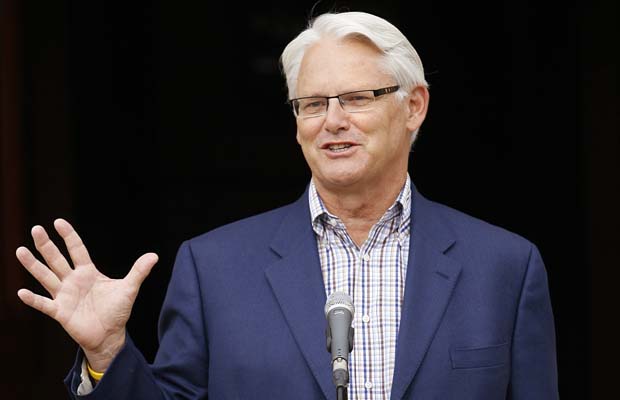 Premier Gordon Campbell is looking for an exceptionally short turnaround time for four different task forces on energy policy review to report back to government — he wants responses by January 2010, which is a nanosecond in the often ponderous regulatory world of B.C.'s electricity sector. (Photograph by: Todd Korol, Reuters files) |
VANCOUVER — B.C. Premier Gordon Campbell on Monday announced a sweeping, fundamental review of energy policy in British Columbia.
Speaking at the annual conference of the Independent Power Producers association of B.C., Campbell said the Liberals will strike four distinct task forces to work on various facets of the green power sector in B.C.
The intention is to make B.C. an international leader in green power development — both for this province and for export to markets including the United States and Alberta.
Its intention is also to attract and strengthen the independent power sector in B.C.
The task forces will review everything from the regulation of BC Hydro to community engagement in the development of new, private sector power development.
All four task forces stand under the umbrella of the Green Energy Advisory Task Force that was announced in the B.C. Throne Speech last August.
Campbell is looking for an exceptionally short turnaround time for the task forces to report back to government — he wants responses by January 2010, which is a nanosecond in the often ponderous regulatory world of B.C.'s electricity sector.
Campbell also announced a new cabinet committee to which the task forces must report. It includes himself, Environment Minister Barry Penner and Energy Minister Blair Lekstrom, as well as the chairs of BC Hydro and BC Transmission Corp.
In a press release, the government detailed the task forces as follows:
• Green Energy Advisory Task Force on Procurement and Regulatory Reform. This task force will recommend improvements to BC Hydro's procurement and regulatory regimes to enhance clarity, certainty and competitiveness in promoting clean and cost-effective power generation; and identify possible improvements to future clean power calls and procurement processes.
• Green Energy Advisory Task Force on Carbon Pricing, Trading and Export Market Development. This task force will develop recommendations to advance British Columbia's interests in any future national or international cap and trade system, and to maximize the value of B.C.'s green-energy attributes in all power generated and distributed within and beyond B.C. borders. The task force will also develop recommendations on carbon-pricing policies and how to integrate these policies with any cap and trade system developed for B.C.
• Green Energy Advisory Task Force on Community Engagement and First Nations Partnerships. This task force will develop recommendations to ensure that first nations and communities see clear benefits from the development of clean and renewable electricity and have a clear opportunity for input in project development in their areas. It will work in partnership with first nations, not only to respect their constitutional right, but to open up new opportunities for job creation and reflect the best practices in environmental protection.
• Green Energy Advisory Task Force on Resource Development. This task force will identify impediments to and best practices for planning and permitting new clean, renewable-electricity generation to ensure that development happens in an environmentally sustainable way. The task force will also consider allocation of forest fibre to support energy development and invite input from solar, tidal, wave and other clean energy sectors to develop strategies to enhance their competitiveness.
October 30, 2009
IPPBC Welcomes Paul Kariya as New Executive Director
COMMENT: This notice is in advance of IPPBC's annual general meeting and trade show from Sunday, Nov 1, to Tuesday, Nov 3. More details here.
News Release
Independent Power Producers Association of B.C.
Oct 29, 2009
 Paul Kariya appointed new Executive Director of IPPBC. |
"We are delighted to have been able to attract someone of Paul Kariya's calibre to this position," said Harvie Campbell, Chair of the IPPBC. "Dr. Kariya's background and experience in managing complex issues and in dealing with governments and stakeholder groups will be real assets to the independent power industry in this province."
"The credibility that Paul Kariya brings to this position will help the industry work more effectively with First Nations, environmental groups, the media, and others," said Campbell.
Most recently, Dr. Paul Kariya has been teaching Leadership in the Graduate School at Trinity Western University. He served as executive director of the Pacific Salmon Foundation from 2002 to 2008, chief executive officer of Fisheries Renewal BC from 1998 to 2001; and executive director of the BC Treaty Commission from 1994 to 1998. Kariya also served in various positions with the federal government from 1979 to 1994, primarily in the departments of Fisheries and Oceans and Indian and Northern Affairs. He has a BA from the University of B.C. and post-graduate degrees from Clark University.
"This is an exciting time for all who want to help society shift to increased reliance upon clean power sources and greater conservation efforts in B.C.," said Paul Kariya. "There are numerous challenges but also tremendous opportunities here. The provincial government is committed to growing the industry, First Nations are interested in business partnerships and the public is keen for positive dialogue on subjects such as alternative energy sources, sustainability and a healthy environment. I look forward to contributing to the growth of the independent power sector in British Columbia."
The Independent Power Producers Association of B.C. represents 320 project developers and service providers in the power generation sector in the province. The role of IPPBC is to support the development and continued viability of an independent power industry. The association serves the public interest by providing cost-effective electricity though the responsible development of generation resources in order to help meet the goals of provincial self-sufficiency by 2016.
For more information, please contact
Independent Power Producers Association of B.C.
Harvie Campbell
Chair, IPPBC
(778) 945-1002
or
Independent Power Producers Association of B.C.
Paul Kariya
Executive Director, IPPBC
(604) 818-1827
www.ippbc.com
October 29, 2009
LTAP: MEMPR "clarifies intention" on Burrard Thermal
COMMENT: This puts the boots to BCUC's decision on the LTAP.
Burrard is out! "Effective immediately Burrard will no longer be used for planning purposes for firm energy."
The Clean Power Call is in! And BC Hydro now has to acquire even more energy by 2016 than it anticipated in the 2008 LTAP - happy day for IPPs.
PROVINCE ADVANCES COMMITMENT TO CLEAN, RENEWABLE ENERGY
Media ReleaseMinister of Energy, Mines and Petroleum Resources
October 28, 2009
VICTORIA – As part of its commitment to reduce greenhouse gases and become a clean energy powerhouse, the Province has clarified its intention to the British Columbia Utilities Commission (BCUC) to end BC Hydro’s reliance on the Burrard Thermal Generating Facility for energy needs. The decision was announced today by Blair Lekstrom, Minister of Energy, Mines and Petroleum Resources.
“We’ve been committed since 2001 to ending BC Hydro’s reliance on Burrard and to only using it for emergency back-up capacity,” said Lekstrom. “In B.C, we have the opportunity to develop clean, renewable, cost-effective electricity with virtually no greenhouse gas emissions. That will also improve air quality in the Lower Mainland.”
BC Hydro has been planning to reduce its reliance on Burrard, as proposed in its recent Long Term Acquisition Plan, to help meet the legislative target to reduce greenhouse gas emissions by six per cent by 2012, 18 per cent by 2016, and 33 per cent by 2020. Today’s direction is consistent with the government’s Climate Action Plan, BC Energy Plan, and the Utilities Commission Act.
Effective immediately Burrard will no longer be used for planning purposes for firm energy. It will only be used for up to 900 megawatts of emergency capacity.
“In providing this direction, BC Hydro will replace the firm energy supply from Burrard Thermal with clean, renewable and cost-effective energy,” said Lekstrom. “Ending our reliance on energy from Burrard Thermal for planning purposes is also a critical component of B.C.'s greenhouse gas reduction strategy.”
Burrard will no longer be relied upon for energy but will continue to be available to provide emergency back-up power in the event of generation or transmission outages, which is a benefit to British Columbians. Typically, Burrard’s actual operation is less than 10 per cent of what it is capable of generating per year.
Clean and renewable energy continues to be a cornerstone of British Columbia’s climate action plan that will create jobs, support families and generate new economic activity throughout British Columbia. BC Hydro has been upholding that plan. Electricity self-sufficiency and clean and renewable power generation are integral to B.C.’s effort to reduce its carbon footprint and fight global warming.
This decision will also allow BC Hydro to continue to acquire 6,000 GWh of cost-effective, clean and renewable power. This includes up to 5,000 GWh from the Clean Call and up to 1,000 GWh from Phase 2 Bioenergy Call for Power.
-30-
Contact:
Jake Jacobs
Public Affairs Officer
Ministry of Energy, Mines and Petroleum Resources
250 952-0628
250 213-6934 (cell)
B.C. government orders Burrard Thermal writeoff
By Scott SimpsonVancouver Sun
October 29, 2009
 The aging Burrard Thermal generating plant. (Photograph by: Ian Lindsay, Vancouver Sun files) |
VANCOUVER — The British Columbia government has written off the aging Burrard Thermal generating plant as a reliable source of electricity.
Energy Minister Blair Lekstrom announced late Wednesday that BC Hydro can no longer include the 50-year-old, gas-fired plant on its roster of power generating facilities.
At full operation, Burrard is one of the largest sources of greenhouse gas in the province, but has been increasingly relegated by BC Hydro to a role backing up the province's sprawling network of hydroelectric facilities — due to its age and the relatively high cost of natural gas.
However, despite limited use Hydro has been listing Burrard on its books as part of its primary electricity supply.
That policy effectively diminished the amount of new, private sector power development deemed necessary to enable Hydro to reach its government-mandated target of making B.C. electricity self-sufficient by 2016.
The policy helped minimize the rate increases that are necessary to cover the cost of development of new power generation.
But it also cramped the government's plans to expand private power development in hopes of creating enough surplus power for expanded export sales to the United States and Alberta.
In an interview, Hydro vice-president Bev Van Ruyven said Thursday that Hydro is now 6,000 gigawatt hours per year short of the generating capacity needed to meet the self-sufficiency target and is now looking at its options for hitting the government's target on schedule.
Hydro has a number of options including a pending deal with Teck Cominco for expanded power supply from private generating facilities in southeast B.C., development of a new biomass-powered generation sector — and expanding its call for green power generation bids.
Check out Scott Simpson’s blog: www.vancouversun.com/energy
© Copyright (c) The Vancouver Sun
Burrard Thermal goes to back burner
Tom FletcherBC Local News
October 29, 2009
VICTORIA – Energy Minister Blair Lekstrom has made good on his promise to order the shutdown of Burrard Thermal in Port Moody, BC Hydro's largest fossil fuel electricity generation facility.
Lekstrom has directed the B.C. Utilities Commission that effective immediately, Burrard Thermal will no longer be used in BC Hydro's energy supply plans, and will only fire its natural gas boilers for up to 900 megawatts of emergency power.
One emergency scenario is an ice storm such as one that brought down power lines across much of Quebec in 1998, Lekstrom said.
Lekstrom promised the action in late July after the utilities commission rejected parts of the government's energy plan and advised BC Hydro it should count the capacity of the aging facility in its plans.
"This is about clarifying our position as government," Lekstrom said. "We were very clear going back to 1996, Burrard Thermal was not in the future plans in British Columbia. We think that it has lived its life cycle. We believe that as we move forward into clean, renewable energy opportunities in British Columbia, we're blessed with a diversity of that opportunity. Burrard is not part of that."
B.C.'s Independent Power Producers Association applauded the government's move.
"Reducing our reliance on Burrard will reduce greenhouse gas emissions, improve air quality in the Lower Mainland and grow B.C.'s economy through the development of new renewable energy sources," said Harvie Campbell, chairman of the association.
Lekstrom said the decision to override the utilities commission on use of Burrard Thermal does not diminish its authority to protect the public interest in electricity rate and expansion decisions. Its mandate from the government is to approve "clean, affordable power" and keep electricity rates in B.C. among the lowest on the continent, he said.
BC Hydro has spent $8.7 billion since 2001 on projects to expand its dams and electricity grid. The Crown-owned utility is also studying the Site C dam project, a third dam on the Peace River that has been under consideration for 30 years.
Premier Gordon Campbell has repeatedly vowed that BC Hydro's dams and other heritage assets will remain publicly owned, and that if Site C is constructed it too will be owned and operated by BC Hydro.
Government clears way for greener power expansion
Scott SimpsonVancouver Sun
October 30, 2009
BC Hydro should focus on sources of clean, renewable, cost-effective electricity, minister says
The British Columbia government has ordered BC Hydro to yank the aging Burrard Thermal generating plant off its roster of baseline electricity sources.
The decision throws open the doors to a significant expansion of private-sector power development, and sparked a fresh round of debate Thursday among private power supporters and opponents.
The decision, which came in the form of a special Cabinet directive to the B.C. Utilities Commission, forces Hydro to accelerate power-acquisition plans established to meet B.C.'s goal of being electricity self-sufficient by 2016.
Hydro is now looking to add 6,000 gigawatts per year of new electricity supply -- enough power for 600,000 homes.
At full operation, Burrard is one of the largest sources of greenhouse gas emissions in the province.
In practical terms, the 50-year-old gas-fired plant located along the Port Moody Arm of Burrard Inlet is serving only a nominal backup role for the province's sprawling network of hydroelectric facilities.
But Hydro has been listing Burrard on its books as part of its primary electricity supply -- thus dampening the amount of new private-sector power necessary to meet the government-mandated self-sufficiency target.
Energy Minister Blair Lekstrom said in an interview on Thursday that the government wants Hydro to focus on sources of clean, renewable and cost-effective electricity.
"Burrard is antiquated technology in an airshed that is pretty difficult to manage," Lekstrom said. "When we think about the air quality, running this just doesn't make sense."
Lekstrom said Hydro will seek 1,000 gigawatt hours of power through development of a biomass-burning sector, and a further 5,000 gigawatt hours from Hydro in-house development and private-sector projects.
But he added that the government won't accept bids from private power developers unless the electricity they offer is reasonably priced.
"At the end of the day, this is about affordable electricity for British Columbians. I'm not a supporter of buying electricity at any cost. I think I've made that clear since I've been in this portfolio."
Hydro vice president Bev Van Ruyven said the Crown corporation is now looking at its options for hitting the government's target on schedule.
Hydro is already in the midst of a clean power call that attracted 17,000 gigawatt hours' worth of bids -- although Hydro had previously stated it would only contract for 2,000 GWh after scrutinizing bids and accounting for attrition.
"Going forward, if Burrard is not in our planning stack, we now have a gap that we need to fill to meet the self-sufficiency goal in 2016," said Van Ruyven.
She added that Hydro is reviewing the government's order and will have a better idea of its options in about 10 days.
Hydro has a number of options, including Hydro in-house projects that upgrade and expand generation from the Crown corporation's own "heritage"
hydroelectric facilities including Mica and Revelstoke.
David Austin, B.C. electricity sector commentator and legal counsel for some power producers, agreed with the decision on Burrard.
"Finally, Burrard is being recognized as the industrial relic that it is, and subject to seeing the fine print [in the government's announcement], is being unconditionally and absolutely relegated to the role of last-resort use. It isn't being junked, but pastured for infrequent use like cold snaps or major equipment failures."
Harvie Campbell, chair of the Independent Power Producers Association of B.C., said the decision gives the industry the certainty it was lacking last summer after the BCUC made a controversial ruling that Hydro should increase the amount of power supply it keeps on the books for Burrard -- in order to minimize the impact upon ratepayers of adding new power supply.
The cabinet directive effectively overturns the BCUC's ruling.
"The most important aspect of this directive, for the industry, is that it constitutes concrete action," Campbell said. "The financial community was watching. They were concerned it had taken us this long to get where we are."
Campbell said both Hydro and industry will have to address the high attrition rate -- about 30 per cent -- among private power bids previously accepted by Hydro in order to help the Crown corporation reach its self-sufficiency target.
"That is not a criticism of anyone. It underlines the need for the IPP community to work more closely with BC Hydro in fashioning acquisition processes that will work."
Donald McInnes, CEO and vice-chair of Plutonic Power, said the government's order "has given BC Hydro and the utilities commission the tools required to allow BC Hydro to go out and procure further energy."
Port Moody Mayor Joe Trasolini said Burrard pays the city about $1.4 million per year in grants and royalties in lieu of taxes.
He said the directive will cost the city about $200,000 a year in lost royalty revenue -- equivalent to a 0.75-per-cent property tax increase to residents.
Aaron Hill, an ecologist with Watershed Watch Salmon Society, said it "makes sense" to minimize B.C.'s reliance on fossil fuel for electricity supply.
"But rather than rushing to dam and divert B.C. rivers and streams for hydro power, much of which is likely to be exported to California, we should be making energy efficiency and conservation our number one priority."
Tzeporah Berman, executive director of PowerUP Canada, noted that 75 per cent of B.C.'s total energy consumption is fossil fuel, so "direction from the government that opens the way for more wind farms and other clean energy projects is good news."
"If we are going to reduce global warming pollution and create new clean economy jobs in B.C., this kind of clarity is critical," Berman said.
Melissa Davis, executive director of BC Citizens for Public Power, said the Burrard order "is simply a way for the government to continue to manufacture an energy crisis and justify the need for private power production -- under the guise of acting as a solution to climate change."
October 24, 2009
Carbon trust faces tonnes of work
By Scott Simpson,
Vancouver Sun
October 24, 2009
B.C. could be paying $25 million a year to compensate for its carbon emissions
Calculating the difference between a $25 carbon credit purchased in British Columbia and a 14-cent credit purchased in daily trading on the Chicago Climate Exchange is apparently not a matter for simple arithmetic.
The $25 credit is what you, as taxpayers, are forking out to support the B.C. government's ambitious, precedent-setting plan to make itself carbon-neutral before 2011.
B.C. anticipates that core government agencies and offshoots, including schools and health districts, will be annually responsible by the end of 2010 for about one million more tonnes of carbon dioxide emissions than their conservation efforts can reasonably prevent.
That's where you come in.
The government's ambition, announced by Premier Gordon Campbell in 2007, is to compensate for every one of those million tonnes by purchasing carbon credits from businesses and industries that reduced their reliance on fossil fuels such as oil, natural gas, or coal -- and had their efforts certified by independent, third-party auditors.
PACIFIC CARBON TRUST
The credits are collected by Pacific Carbon Trust, a new Crown corporation that pays emitters an unspecified amount for each tonne of CO2 emissions they cut through innovative conservation efforts, and resells them to government at $25 a tonne.
Assuming the scheme can be carried out in the time frame established by the premier, the province will be paying $25 million a year to compensate for its carbon emissions.
There are entire B.C. government ministries such as energy, finance, and environment, whose annual capital expenditures are less than $25 million, according to the government's 2010 fiscal year estimates.
Cheaper credits are available.
You can buy a tonne of carbon credit, or offset, for 14 cents on the spot market of the Chicago Climate Exchange, although critics suggest your money would be safer in a penny mining stock from a Howe Street promoter circa 1975.
You could buy one from the European Climate Exchange, which is pricing a tonne of carbon at about the same level as B.C. That would mean shipping tax dollars to foreign jurisdictions with no commensurate economic stimulus to justify the effort.
The good news here, if you're in favour of the B.C. government's effort, is that this province has established a market and a trading system that appear to be working as hoped -- as the first North American jurisdiction with mandatory carbon emission reduction targets.
(Credits available in Chicago are from voluntary emission cutbacks whose pedigrees, as the price of carbon on that market suggests, are suspect.)
Christine Schuh, environmental practice leader for PricewaterhouseCoopers, said in an interview that comparing B.C.'s pricing system to Chicago's is like comparing apples to oranges. The system in this province is regulated, while Chicago's is not.
But she added that it's also difficult to compare B.C. to the European exchange, because the systems themselves are "not equal yet."
Based in Calgary, Schuh serves on the Independent Organization for Standardization (ISO) committee that developed globally recognized standards for measuring and validating greenhouse gas emissions.
If there is a weakness in the B.C. system, she said, it's that it may not yet be aggressive enough to attract large-scale efforts by industry.
MOTIVATING CHANGE
"To motivate behavioural change in a population, you need prices for carbon credits in the $5-to-$60 price range per tonne. If you want to make technology like carbon capture and storage economically feasible, the price of those credits needs to be $80-plus per tonne.
"Keeping that as a reference point, the $25 per tonne is probably a good starting point, but it's not going to be the end point."
The CEO of Pacific Carbon Trust, Scott McDonald, believes they are off to a good start. Since April, the trust has contracted 66,000 tonnes per year of carbon offsets on the province's behalf.
Earlier this month, it announced an open call for credits with no quota or time limit.
"We are not sitting here waiting," McDonald said. "Our pitch to the large emitters is that there is a price signal around carbon. So if you are doing your [economic] models around new investments, include a price for carbon in that price model. ... It becomes very attractive to do these kinds of projects.
"We want to make that opportunity available and make them aware of that."
Pacific Carbon Trust and private-sector "aggregators" such as Sempa Power Systems and Offsetters Clean Technology are unearthing businesses that have made legitimate efforts to lower their carbon emissions.
There are vacation resorts, hotels, and greenhouses on the list. And no doubt to the government's great relief, a big fish: One of the largest greenhouse gas emitters in the province.
LAFARGE GETS ON BOARD
It is Lafarge Cement, the multinational whose Richmond cement plant is regularly listed by Environment Canada as one of British Columbia's top 10 emitters of carbon dioxide and related gases believed to contribute to global warming through combustion of fossil fuel.
Lafarge burns coal to make cement. Coal burns with a high intensity that is fundamental to the manufacture of their product. But the cement process can tolerate supplementary amounts of biomass, Lafarge director of business development Randy Gue noted.
"We are a public company, we are profit-driven, we looked at the incentives that are there," Gue said in an interview.
"The sale of the carbon offsets helps basically fund the cost of doing the project and the risks that are involved in [introducing] different fuels.
That's really the purpose of carbon offsets, to incent companies to shift away from traditional methods and incent projects that wouldn't normally happen in an unregulated carbon market."
There is a further bonus, he noted: Reducing the use of fossil fuel in the manufacturing process also reduces the amount of carbon tax Lafarge will have to pay the province.
OFFSETTERS AIDS COMPANY
Vancouver-based Offsetters Clean Technology, a pioneer in the aggregation and sale of offsets, approached Lafarge with the opportunity after hearing about the company's struggles to source a consistent and reliable, cost-effective supply of waste wood for its burners.
Aggregators are pivotal to the success of the trust, tracking potential bidders, measuring greenhouse gas emissions, calculating potential savings and contracting third-party validators to pore over the data and confirm the extent of emission savings.
"We knew that Lafarge was looking for wood and that they were hesitant about the cost of the wood, so we went to them and said 'Look, we can help subsidize the cost of fuel-switching for you,'" Offsetters president and co-founder James Tansey said.
"It would have been very challenging for Lafarge to do this on their own, secure the documentation, secure the prices, and negotiate on their behalf. That's our role as a business."
Tansey describes B.C.'s time frame for reaching one million tonnes of offsets as "challenging."
Pacific Carbon Trust's Scott McDonald said the Crown corporation is "actively engaged" with virtually all of the province's large emitters, including Spectra Energy, Teck Cominco, Rio Tinto Alcan, Lehigh Cement and Chevron.
Spectra, which operates natural gas processing plants in the northeast B.C. gas patch, is already working to achieve what it calls "near-term emissions reductions across our B.C. natural-gas-gathering, processing and transportation system."
Those activities, which include an ambitious carbon capture and storage project at Fort Nelson gas plant, are happening irrespective of the activities of the trust.
Valley residents are ready to fight Metro's plan to burn garbage
Patricia Ross,
Vancouver Sun
October 24, 2009
Serious concerns have been raised about Metro Vancouver's plan to install six waste incinerators around the Lower Mainland: The prohibitive costs, the potential impact on the environment and the inherent disincentive to recycle that comes with incineration.
These are all important issues, to be sure. But there is one issue that is of greatest significance to me and to my constituents: air quality.
Resolving the region's garbage crisis is a complex challenge. There are no easy solutions. What must be understood is that there are limitations to operating in an airshed as extraordinarily challenged as ours.
Given the recent memory of Sumas 2 -- the proposed Washington state project that was defeated after strong opposition based on concerns about air quality -- the air we breathe should be top-of-mind in these discussions.
Instead, Metro Vancouver has chosen to ignore the Valley's legitimate and growing health and air-quality concerns and surge ahead with its campaign to sell us on the benefits of burning garbage for energy. In the process, they have cited the hundreds of incinerators in use throughout Europe, some in the heart of major cities such as Paris and Vienna, as reason to feel secure about the issue of emissions and air quality.
What they are not telling us is that 33,000 European doctors have signed a petition calling for a ban on further waste incineration and the closing of existing facilities for what they believe are serious human health concerns.
In 2007, researchers in the United Kingdom established that there is a significantly higher death rate for young children (up to 12 months) who are regularly exposed to smoke from incinerators. And despite the proliferation of incineration facilities across the U.K., there is vigorous public opposition to the practice of burning garbage for energy, largely due to mounting health issues that can be linked to incineration.
In Nottingham, for example, residents living downwind of the Eastcroft waste incinerator associate its emissions with a spike in respiratory health issues in the community. They call it the "Eastcroft cough."
We know that incinerators produce harmful chemicals such as dioxins that are not only toxic but also persistent and bio-accumulative. That alone should be enough to give us pause, considering the livestock and produce that originate in the valley. But in the case of incinerator emissions, there is also significant risk in what we don't know.
In addition to a number of other chemicals, we know that incineration produces fine particles called nanoparticulates, and we know these particles can pass through the most sophisticated scrubbing equipment.
Research into the impact of these particles on human health is still preliminary, but early indications are that nanoparticulates can be linked to serious human diseases such as cancer. In fact, the health complications caused by nanoparticles have been compared to those of asbestos.
At a minimum, given that nanoparticles are not measured, reported, or required to be, we need to err on the side of caution.
Carried by the winds off Georgia Strait, these dioxins, nanoparticles and other potentially harmful chemicals produced by incineration will find their way into our airshed. Incineration experts have cited European cities with similar mountainous geography to rebut the air quality argument here, but there is no comparison to the Fraser Valley. University of B.C. Prof. Douw Steyn, an internationally recognized air quality expert, says the valley is so vulnerable to incremental increases in emissions that it is pointless and misleading to compare it to cities in Europe when advocating incineration.
As the people in the Fraser Valley know, our geography can be unforgiving when it comes to air quality. In 2001 when the region fought against Sumas 2, Metro Vancouver agreed. In a letter to the National Energy Board, Metro Vancouver declared that, "SE2 is neither an appropriate nor responsible decision to locate within this sensitive airshed or in such close proximity to a major residential area where the air quality is already above levels at which significant human health effects can be observed."
That argument still stands, but today Metro Vancouver is proposing new sources of pollutants.
Last week the region learned a lot about recycling alternatives at the Resilient Cities conference. We know that other waste solutions exist and that these models have been applied successfully in Seattle, Portland, and San Francisco. Each of these cities rejected incineration in favour of a waste management plan that emphasizes reducing, reusing and recycling.
San Francisco, for example, has achieved a 75-per-cent diversion rate and relies on existing landfills as a flexible disposal option. This helps, not hinders, their ability to get closer to zero waste. Compare this to incineration, which demands a steady flow of waste and landfill space to house toxic ash generated by the burning garbage, and the sustainable answer becomes clear.
Metro Vancouver has the time and opportunity to explore waste management options that are sustainable and responsible. The plan favoured by Metro Vancouver is neither.
As the debate continues, you can be sure that residents of the Fraser Valley will continue to fight for their right to clean air and a healthy future.
Patricia Ross is the chairwoman of the Fraser Valley Regional District and an Abbotsford city councillor.
October 23, 2009
Gas auction attracts $370 million to B.C.
By Scott Simpson
Vancouver Sun
October 23, 2009
It's the second-largest average per-hectare price paid to lock up new drilling rights in northeast patch
There appears to be no letting up in the race to lock up natural-gas wealth in northeast British Columbia.
On Thursday, Energy Minister Blair Lekstrom announced that the province received $370 million in bonus bids in its monthly auction for gas exploration rights, making it the sixth largest monthly sale on record, and the second-largest average per-hectare price paid to lock up new drilling rights in the province's northeast gas patch.
Bidders anxious to secure tenure of one of North America's hottest gas patches scooped up 58 parcels covering 65,787 hectares, paying an average per-hectare price of $5,625, second-highest in B.C. history, the government reported.
The sprawling Montney gas field attracted most of the interest. It is one of two major new fields attracting record bids. The other is Horn River. Both are in British Columbia's portion of the Western Canada Sedimentary Basin.
"Most of what we are talking about today is in the Montney formation," Lekstrom said in an interview. "Every day, both of these formations seem to get a little better as there is more work done on them. They seem to expand and the quality and the opportunity expands at the same time, so I think these numbers today are reflective of that."
So far this year B.C. has gained $700.6 million in drilling rights despite a protracted dip in natural gas prices that has substantially reduced gas and oil exploration activity in Western Canada and across North America, where moderate weather and growth of unconventional gas resource development in the United States are creating an unprecedented glut of gas in storage.
Lekstrom said the auction results are partially attributable to the government's recent decision to slash gas royalty payments for one year, attracting more investment to B.C.
In September, the minister announced that wells drilled from September 2009 to through June 2010 will receive a one-year royalty rate of two per cent compared to the average rate of 20 per cent.
"The latest stimulus package we put out, I think, gives some certainty to the industry of where our province stands with oil and gas and the future," Lekstrom said.
© Copyright (c) The Vancouver Sun
October 17, 2009
Province halts major transmission system inquiry
By Scott Simpson
Vancouver Sun
October 20, 2009
Government's desire to export green power and a recent utilities commission ruling are thought to be behind the delay
The provincial government has put the brakes on a major inquiry into the future of British Columbia's electrical transmission system.
A review of documents on the website of the B.C. Utilities Commission shows that the inquiry is attracting unprecedented interest from stakeholders including first nations, municipal governments, BC Hydro ratepayer groups and independent power producers.
The inquiry was ordered last year as a means of addressing B.C.'s transmission needs for the next 30 years. Jurisdictions across North America are facing the same challenge -- aging networks of towers and wires that are close to capacity and need repair, upgrade and expansion.
BC Transmission Corp. says B.C. needs an estimated $4.5 billion worth of upgrades -- and that's not counting a new transmission service for northwest B.C., nor the cost of expanding transmission to allow independent power producers to hook into the system, nor the cost of expanding opportunities to export electricity to the United States.
Last Friday, the utilities commission ordered an indefinite postponement of the inquiry as well as related regional consultations with numerous first nations around the province.
The postponement came after BC Hydro and BC Transmission Corp. said they were making changes to their initial submissions for the inquiry due to a "policy-level review" by the provincial government.
It's expected that the reviews are related to the government's interest in expanding the development of independent power production in B.C. for the U.S. export market.
B.C. has an ambitious plan for so-called green power exports, notably to a receptive market in California, but is stymied from moving ahead until it deals with a ruling earlier this year by the B.C. Utilities Commission that put a damper on expansion of the independent power sector.
According to Energy Minister Blair Lekstrom, the government is reviewing Hydro and BCTC submissions
"to make sure that the information they are filing is consistent with our policy. . . . That's taking longer than anticipated."
Lekstrom expects the inquiry will resume in November.
Ludo Bertsch, an intervenor representing Energy Solutions for Vancouver Island, said he is surprised by the delay, given the enormous public interest in the hearing.
"It's probably the largest hearing that BCUC has put together. There are over 100 intervenors and dozens of interested parties registered," Bertsch said in an interview.
Blog: www.vancouversun.com/energy
BCUC letter to participants, October 16, 2009
October 06, 2009
Pollution charges laid in dramatic Burnaby oil pipeline rupture
Larry Pynn , Vancouver Sun, October 5, 2009
METRO VANCOUVER -- The B.C. Ministry of Environment has laid charges in connection with the dramatic rupture of a crude oil pipeline in Burnaby in 2007.
Kinder Morgan Canada and Trans Mountain Pipeline are each charged with seven counts, and B. Cusano Contracting and R.F. Binnie & Associates each with six counts under the federal Fisheries Act, federal Migratory Birds Convention Act, and provincial Environmental Management Act.
Scott Norris, a provincial conservation officer with the commercial environmental investigation unit, said in an interview Monday that the investigation was conducted in cooperation with Environment Canada.
Each count carries a maximum potential fine of $1 million.
The case was remanded Monday in Vancouver provincial court until Jan. 13, 2010.
A federal transportation safety board report last March concluded that failure to verify the accuracy of 1957 design drawings indicating the location of the pipeline led to a contractor's excavator bucket causing a massive rupture.
That oversight was among a series of errors leading to the July 24, 2007, spill of 234 cubic metres of crude oil on Inlet Drive.
The board found that no one determined ahead of time that the drawings were inaccurate; rather than running in a straight line, the 610-millimetre-wide pipeline actually snaked its way to the Westridge terminal.
The pipeline, which was operated by Kinder Morgan and owned by Trans Mountain Pipeline, ruptured at 12:31 p.m. during digging of a parallel trench for a new City of Burnaby storm sewer line on Inlet Drive.
The 1957 design drawings showed a "constant offset of 8.5 metres from the east property line of Inlet Drive" but in fact the offset varied between four and almost 10 metres, the board found.
It was assumed by all parties that the sewer line would maintain a distance of 2.8 metres from the oil pipeline.
The report said that Burnaby and Kinder Morgan signed an agreement allowing for the sewer construction that required in part for a Kinder Morgan inspector to verify the depth and location of the 4.1-km pipeline, which delivers crude oil from above-ground tanks to tankers at Westridge dock.
A Kinder Morgan inspector using a radio-detection hand-held pipeline locator verified the location of the oil pipeline along only about a 30-metre stretch on July 16, 2007.
The contractor did not ask for a greater area of the pipeline to be checked, and the inspector did not offer to do more, even though an alignment discrepancy had been noted between the 1957 drawings and another construction drawing from previous work.
The report also found that "inadequate communication" within Kinder Morgan and between Kinder Morgan and the consultant and contractor on the project resulted in "no common understanding or acceptance of the project work plan and the contractor's construction schedule."
Burnaby hired B. Cusano Contracting and engineering consultant R.F. Binnie & Associates for the job.
The board found that the amount of oil released was greater than necessary because the flow was cut off to a tanker after the rupture and "was not in conformity with standard emergency shutdown procedures."
Crude oil spewed up to 15 metres in the air for about 25 minutes before the oil flow was stopped, affecting 50 homes and properties and the waters of Burrard Inlet.
The report said 210 cubic metres of oil were recovered. There was no explosion or fire and no injuries in the rupture, although several people were sprayed with oil.
About 250 residents voluntarily left their homes.
lpynn@vancouversun.com
September 22, 2009
NTL: Does B.C.'s new power line fall short of being green?
Mark Hume
Globe and Mail
September 22, 2009
Accusations of 'greenwashing' are flying around the Northwest Transmission Line, but there's more to the project than meets the eye.
Prime Minister Stephen Harper came under attack from environmentalists last week following his announcement, in Washington, that Ottawa will provide $130-million from the Green Infrastructure Fund for a power line in northwestern British Columbia. Was the criticism justified? Or did Mr. Harper get unfairly attacked?
He was accused of "greenwashing" the Northwest Transmission Line, a $404-million project that will push power cables along the scenic Stewart-Cassiar Highway into a remote corner of the province that has some of the most beautiful landscapes in Canada.
The federal funding is conditional on a contribution from the B.C. government - which provincial Energy Minister Blair Lekstrom was quick to promise. B.C. hopes to raise $90-million in private-sector money (good luck with that), and that would leave the province on the hook for the remaining $184-million.
That's big money, and it's no wonder both Ottawa and Victoria are spinning this as a "green" project - hoping to win broad public support for what at first glance appears to be a power line meant to help a cluster of new mines open.
"This transmission line is anything but green," said Merran Smith, climate director with the non-profit ForestEthics.
"This transmission line is about electrifying coal and metal mines more than it is about clean, green energy," agreed Eric Swanson, a campaigner with the Dogwood Initiative, an environmental group with offices in Victoria.
Looking at where this transmission line will go, it's easy to see why environmentalists are upset. At 335 kilometres in length, it falls short of reaching the communities of Dease Lake and Telegraph Creek, which depend on dirty diesel generation. So there are no green benefits there.
But the line reaches deep into a region where 10 mines are proposed. Having access to relatively cheap, reliable hydro is expected to be a key factor in making these projects go.
Is a transmission line that powers mines, which might not otherwise be built, but which leaves towns dependent on diesel, really a green project? Obviously not. But there's more to the Northwest Transmission Line than the mines it could serve.
Also waiting for that transmission line to be built are seven wind and hydro generating stations, including one announced recently in which the Iskut Band Council will partner with Aski Enterprises Inc. to develop a 150,000-hectare wind farm.
And there has been lots of talk about linking the new transmission line to the Alaska power grid - which would allow the northern state to ship power through B.C. to rapidly growing markets in the Pacific Northwest.
A recent study identified 170,000 megawatts of undeveloped hydropower resources in the U.S. - and the single "largest available potential" was found in Alaska, where about 45,000 MW are awaiting development.
B.C.'s Northwest Transmission Line will encourage development of that Alaska hydropower, and it will also stimulate expansion of the state's transmission-line system, which will allow many isolated native communities to get off expensive diesel generation.
So the view from Alaska is very much that the new power line is a green project, as it is from Iskut, where the band council is excited about its huge wind-farm proposal.
It's clear both the mines and the renewable-power projects can only be built at some environmental cost, however.
The biggest concern has to be over the potential damage that could be done to rivers in a region that is one of greatest wild-salmon strongholds left in North America.
When all the factors are weighed, it seems fair enough for Mr. Harper to call the transmission line green because it will stimulate renewable power developments and get native communities (at least in Alaska) off dirty diesel generation.
It's just too bad he didn't go a step further for the planet, and provide extra funding to ensure that the mine and power developments are environmentally sensitive. Now that really would have been green.
Follow the money, not the trash pile, in solving waste management mess
Pete McMartin
Vancouver Sun
September 22, 2009
In Delta, where I live, we play host to the garbage of Vancouver, Richmond, south Surrey, White Rock and Richmond, not to mention our own.
Please, don't give it another thought. I know you don't.
That's the thing about garbage: out of sight, out of mind.
But I sometimes think that however convenient it might be for me to be able to truck my garden waste or old appliances a couple of miles down the street to the dump, it might also be instructive for the citizens of Vancouver or Richmond or south Surrey to start a dump in their own municipalities and live with that eye-watering smell of soiled baby diapers that so often emanates from the dump and wafts over the adjoining fields. There's no aroma quite like it. I wonder how the folks in Dunbar would like living next to that. It brings a whole new appreciation and sense of urgency to where we put our garbage.
The folks at Metro Vancouver, whose job it is to find places to put that garbage, have tried to solve that question of where to put our garbage for over a decade. To no avail.
Originally, with room running out at the Vancouver dump and the Cache Creek disposal site up-country, Metro Vancouver acquired the Ashcroft Ranch, six kilometres away from the Cache Creek site. It was private land.
When a local native band made known its intentions to challenge the establishment of a dump in court, the provincial government nixed the Ashcroft plan because it was afraid of what repercussions a successful court challenge to a fee-simple title might have elsewhere in the province.
Back to the drawing board. Encouraged by the province, Metro explored the idea of trucking the garbage out of province to Washington state. In this, it was only following the lead of several B.C. communities that already did so, including, notably, Whistler.
Then -- surprise! -- the province announced its intention in this year's budget to outlaw exporting of garbage. What unlucky, not to mention inexplicable, timing.
Trucking garbage out of province, however, was only intended as an interim solution. Metro Vancouver's long-term plan was its waste-to-energy proposal -- the construction of a half dozen incinerator plants in the Metro area that would generate electricity and heat local homes.
Despite years of exhaustive studies that found that, since 1997, incinerator technology had improved to the point that pollutant levels would be well below all international health tolerances, and that detrimental effects to ambient air quality downwind would be so negligible as to be barely detectable, and despite the fact that the technology was already widely used in Europe, and despite the fact that there was already a working waste-to-energy incinerator in Burnaby (which Metro Vancouver chief administrative officer Johnny Carline lives directly downwind of, incidentally), Metro Vancouver's campaign for the incinerators has been a hard sell.
The public, we are told, wants nothing to do with them.
How do we know this?
Well, a day before Metro Vancouver launched a series of public meetings on the waste-to-energy plan, an Angus Reid poll was released that found 65 per cent of respondents believed incineration would have a negative effect on air quality.
What a fortuitous act of public service that was. Of course, the poll was commissioned by Belkorp Environmental Services Inc., which owns a company called Wastech, which operates the Cache Creek landfill, to which Wastech desperately wants the province to approve a 40-hectare extension that would keep it open for decades to come.
Belkorp, by the way, can claim among its administration senior vice-president Gary Collins, the former Liberal finance minister. It also hired to lobby for the Cache Creek extension uber-lobbyist and former deputy minister to the premier Ken Dobell.
There are other players who want our garbage. Some local industries want to burn it. Fort St. John wants some action. In Gold River on Vancouver Island, Covanta Energy, the largest waste-to-energy company in the world, wants to build an incinerator to burn our garbage to produce, and sell, electricity. To do its lobbying for the Gold River plant, Covanta hired Andrew Wilkinson, former deputy minister and past president of the B.C.
Liberal party. Adding weight to Covanta's local position is its announcement in July of its intention to buy seven waste-to-energy facilities in North America from Veolia Environmental. Among those seven that Covanta is buying is the Burnaby incinerator.
Burned or buried, Metro Vancouver's garbage is going to be worth several tens of millions of dollars a year. Trash isn't the issue here. Cash is.
As for Metro Vancouver having any input in that, if history is any indication, I'd say it's already up in smoke.
pmcmartin@vancouversun.com or 604-605-2905
September 17, 2009
COAL: Copper Mountain rejects Taseko bid
COMMENT: Copper Mountain Mining is a sister company of Compliance Energy, spun out of Compliance a few years ago, with what at the time seemed like a rather fanciful, stock-promoter's scheme to create market activity.
But, it looks like there may actually be minable copper at the site, and now Copper Mountain Mining is even the subject of takeover bids.
Compliance Energy, you will remember, is the proponent of the Raven Underground Coal Mining Project on Vancouver Island, and Jim O'Rourke heads up both companies.
You can't see it in the photo, but just down to the right is Highway 3, at the Princeton end of the Hope-Princeton and the old building from the previous copper operation at this site. It was that building that Compliance optioned to be the powerhouse for its coal-fired generation plant. Then the government killed the coal plant with its order that all carbon must be sequestered, and Compliance turned its option into an acquisition of the entire mine property. And here we are today.
 Copper Mountain Mining Corporation's superpit (outlined in blue), located 15 kilometres southwest of Princeton. (Photograph by: Handout photo illustration, Vancouver Sun files) |
By Marke Andrews
Vancouver Sun
September 17, 2009
VANCOUVER — Copper Mountain Mining Corp. has rejected an unsolicited, conditional share-exchange merger proposal by Taseko Mines Ltd. which would give Taseko control of Copper Mountain near Princeton.
In a statement, CMMC said the offer, made Tuesday, not only undervalues the company, it undermines its current financing. CMMC is currently raising $50 million in an equity offering for the Copper Mountain Project, a 7,300-hectare mine site south of Princeton, which CMMC claims to have five billion pounds of copper.
Jim O’Rourke, CEO of CMMC, said in a statement that Taseko “is currently taking action in an attempt to stop our equity offering. Their approach of interfering with the company’s financing could deprive our shareholders of substantial benefit that could result from the development program which is underway.
“The $50-million equity offering satisfies the company’s equity requirements for the Copper Mountain Project. We are taking all steps necessary to protect the company and our shareholders.”
The bid causes a flurry of trading Thursday on the Toronto Stock Exchange. Copper Mountain shares reached a one-year high of $1.97, while Taseko Mines shares jumped three per cent to $3.00.
© Copyright (c) The Vancouver Sun
NTL: Northwest Transmission Line gets critical subsidy
B.C. will build $404m power line now that Ottawa’s committed funding
Derrick Penner,Vancouver Sun
September 17, 2009
 Blair Lekstrom, B.C. minister of energy and mines. (Photograph by: CNS files)/b> |
The province promised it will push ahead with construction of the $404-million transmission line through northwestern B.C. following Prime Minister Stephen Harper's announcement Wednesday that the federal government would cover up to $130 million of the cost.
Harper made the announcement during his visit to Washington, heralding the line as a step towards building "a more efficient electricity grid, [and] increasing our use of clean and renewable sources of energy generation."
Gavin Dirom, CEO of the Association for Mineral Exploration B.C., said the electricity provided by the line has the potential to unlock $15 billion in private investment for the region and thousands of jobs.
The funding, Harper said, would come out of the federal government's green infrastructure fund and serve as a possible first move in establishing a power link between Canada and Alaska.
Blair Lekstrom, provincial minister of energy and mines, said the federal government's $130-million promise was all B.C. has been waiting for to make a commitment to build the 335-kilometre, 287-kilovolt line, which will have the potential to serve several proposed mining projects in the region, one of which is edging towards approval for construction.
"We made a commitment to build the Northwest Transmission Line and we are going to to do that," Lekstrom said in an interview, "and this announcement ... allows us to move forward with that."
With the federal government funding commitment, the line's potential cost to the province is up to $274 million.
Lekstrom said his ministry is in discussion with possible private-sector partners in the project.
He said he couldn't name any at this point nor suggest how big their financial commitments would be, however Finance Minister Colin Hansen said there could be as much as $90 million in private-sector support for the line.
Initial plans to construct the northwest line collapsed when Teck Resources Ltd. shelved its plans to participate in construction of the Galore Creek mine in the region in conjunction with Vancouver company NovaGold.
That project was to contribute some $180 million to construction of the power line and plans were thrown into jeopardy without the contribution.
The line is proposed to stretch from Terrace to Meziadin Junction on Highway 37, then further north to the tiny community of Bob Quinn Lake, south of Dease Lake.
The B.C. Transmission Corp. is preparing an application for the project's environmental review. If that proceeds as planned, construction on the line could start in 2010 and the line could be in service by 2012.
Mining groups, independent power producers and industrial-development proponents applauded the federal commitment and provincial promise, though critics countered that the power line project will be anything but green.
Pierre Gratton, CEO of the Mining Association of B.C., said his group would like to see the power line stretched further, but that this will be a good step that boosts the potential for development.
"There's an estimated dozen or so [mining] projects that become much more viable with this line," he said in an interview.
Some of that investment may come from independent run-of-river power projects that could tap into the line, according to Harvey Campbell, chairman of the Independent Power Association.
"That wire coming in is going to open up potential on any number of fronts," Campbell said.
However, Tom Hackney, vice-president for policy of the B.C. Sustainable Energy Association, said there are more promising areas of the province for developing independent power projects than the northwest that are closer to big population centres.
Eric Swanson, corporate campaigner for the Dogwood Initiative, argued that the line will lead to a massive increase in energy consumption in Northern B.C. rather than tap new green energy sources.
"This transmission line is about electrifying coal and metal mines more than it is about clean, green energy," Swanson said in a news release.
Harper pledges $130-million for northern B.C. power line
Justine HunterGlobe and Mail
Sep. 16, 2009
 Project could eventually connect with Alaska in bringing clean energy alternatives to communities and industry in the region (Getty Images) |
The B.C. government is promising a new power transmission line will deliver an economic jolt for the province's remote northwest corner after the federal government pledged a share of the construction funds.
“We're going to build the Northwest Transmission Line,” said Blair Lekstrom, the province's minister of energy, mines and petroleum resources.
Prime Minister Stephen Harper announced Wednesday that the project will be eligible for up to $130-million in green infrastructure funds as part of “Canada's commitment to clean energy.”
But the project still faces significant hurdles: An environmental assessment process has not been completed, a share of private-sector financing has not been secured, and it appears that the project needs the approval of the B.C. Utilities Commission.
Buoyed by the cash commitment from Ottawa, Mr. Lekstrom brushed those details aside, saying the environmental assessment can be turned around in 180 days: “It would be my hope we could see shovels in the ground as early as next year.”
The 335-kilometre line would extend B.C. Hydro service to sparsely populated communities along Highway 37 from Terrace, but mostly, the project is geared to stimulating economic activity along the corridor.
Proponents say the project would unlock investment in a string of potential new mines, while promoting clean energy by reducing reliance on diesel generators.
Environmentalists scoffed at the notion that the project is green. “This transmission line is about electrifying coal and metal mines more than it is about clean, green energy,” said Eric Swanson, a campaigner for the environmental group the Dogwood Initiative.
“If everyone is unemployed, I don't think the air they breathe is going to matter much,” Mr. Lekstrom retorted. “The key is finding a balance that works for everyone.”
The B.C. Mining Association and other business interests praised the announcement.
“This particular project is paramount to the province's development,” said John Winter, president of the B.C. Chamber of Commerce.
Pierre Gratton, head of the B.C. Mining Association, said the transmission line could stimulate up to $15-billion worth of investment in the coming decade.
“The northwest is being held back by a lack of access to power,” he said. “There are a dozen or so mining projects that, without access to power, are much more expensive to bring into operation. This makes them much more viable.”
The line will cost an estimated $404-million to build.
Finance Minister Colin Hansen said he expects to land $90-million in private sector financing now that Ottawa has stepped up, and the project would not increase the government's deficit because the remaining costs will be paid for by a self-sustaining Crown corporation, BC Hydro.
“It is great news for all of us and we can move ahead with all due haste,” he said. “This is going to open up a whole quarter of the province.”
John Horgan, the New Democratic Party critic for energy, isn't sure the financial plan stands up.
“There's no business plan, there's no private sector partner and there is no environmental approval,” Mr. Horgan said.
The project has been to the altar before.
Two years ago, the province put the proposal on hold after private sector financing fell apart. At one point B.C. had a $158-million commitment from Teck Resources Ltd. and NovaGold Resources Inc.
The two companies want to build Galore Creek, which would be Canada's biggest copper mine, and the transmission line is a key component. However, the project is stalled as the companies wrestle with total development costs at more than $5-billion.
Red Chris, a copper and gold mine proposed by Imperial Metals Corp., also would require the power line. Red Chris still faces a legal challenge from environmental groups.
Brian Kynoch, president of Imperial, said the government's investment will help his company raise the money to build the project.
The two mines would emit several hundred thousands tonnes of carbon dioxide equivalent, which scientists link to global warming.
But Mr. Lekstrom said the power line would also open up potential small green hydro projects as well as eliminate the need for diesel power in small towns in the region.
About 3,000 tonnes of carbon dioxide equivalent would be eliminated in two towns, home to several hundred people.
Transmission line to power northwest B.C.
Clare OgilvieThe Province
September 17, 2009
 A transmission line in northwest B.C. will benefit mining projects, such as the Galore Creek copper-gold mine. (Photograph by: Handout, The Province) |
Power to help residents, spur commercial run-of-river projects
B.C.'s Northwest is about to be electrified in a big way.
Prime Minister Stephen Harper announced Wednesday the federal government would help fund a new 287-kilovolt line extending 335 kilometres from Terrace to Cranberry Junction and north to Bob Quinn Lake.
The $400-million line will provide access to the electricity grid for customers while supporting the economic diversification of the area, long an argument of supporters of the project.
It is also a step in connecting Alaskan and Canadian power grids as the U.S. and Canada move toward cleaner sources of energy.
"Our government is supporting environmentally-sound infrastructure and initiatives that promote cleaner, greener energy," said the prime minister.
"The Northwest Transmission Line (NTL) will facilitate the development of green energy and help provide British Columbia's northern and remote communities with more sustainable and affordable power."
The NTL will also open up commercial opportunity for the development of green power by way of run-of-river projects and help to reduce the reliance on diesel in communities that do not have electric power.
Currently, remote communities and mining operations rely on diesel fuel for energy. Once the NTL is in place, it is projected to reduce greenhouse-gas emissions by 208,000 tonnes of CO2 a year -- the equivalent of almost 35,000 cars.
According to the Mining Association of British Columbia, the NTL is also expected to bring $15 billion in economic investment to the area and create 10,700 jobs.
It will also allow more development, including mining.
"We think this is a terrific step in the right direction and we are pleased to see this federal support come in and we think it can be meaningful in terms of both the run-of-river green-power projects, but also mining projects like our own Galore Creek with Teck [Resources],"
said Greg Johnson, vice-president of strategic development for NovaGold Resources.
Residents in communities up and down Highway 37 were also pleased.
"It will set the stage for development because it removes uncertainly for billion of dollars of potential capital investment, thousands of potential jobs, and it is focused on an area that obviously needs it," said Prince George Mayor Dan Rogers.
Said Terrace Mayor Dave Pernarowski: "We just feel this type of infrastructure development is absolutely imperative for Northwest B.C.'s continued success."
Byng Giraud, general-secretary of the Highway 37 Powerline Coalition, has waited for more than a decade to see the NTL get funded.
"This means there will be power to places in the province that have never even had electricity and that lack of power has also prevented any kind of industry coming."
The funding will be a shared effort with up to $130 million coming from the federal government. The province has committed up to $250 million and another $10 million toward an environmental assessment and First Nations consultation.
"Today's announcement brings a new power line in northern B.C. one step closer to reality, which is excellent news for northern British Columbia and B.C.'s mining industry," said Pierre Gratton, president and CEO of the Mining Association of B.C.
PROVINCIAL AND FEDERAL PARTNERSHIP TO ELECTRIFY THE NORTH
News Release, Ministry of Energy, Mines and Petroleum Resources, 16-Sep-2009VICTORIA – The Northwest Transmission Line will now go ahead with the announcement of $130 million committed by the Government of Canada through the Green Infrastructure Fund, announced Blair Lekstrom, Minister of Energy, Mines and Petroleum Resources.
“We are pleased that the federal government has recognized the importance of the Northwest Transmission Line and we are pushing ahead with the $404 million NTL that will open mining and energy opportunities in the northern part of the province,” said Lekstrom. “NTL will help communities in the region transition away from diesel generation and reduce greenhouse gas emissions.”
This is an important step towards building a powerline that has the potential to generate billions of dollars in capital investment, create thousands of new jobs and open economic opportunities on a global scale in the Northwest.
The Province has already invested $10 million to support the environmental assessment and First Nations consultation process. The new 287-kilovolt line will extend 335 km from Terrace to Meziadin Junction and north to Bob Quinn Lake, providing access to the electricity grid for customers while supporting the economic diversification of the area.
The project could support the development of a number of new mines, take advantage of the vast mineral potential in that region and help realize the potential of the Prince Rupert Fairview Container Terminal. It will also support the development of clean, renewable electricity projects in the region. Expanding transmission along highway 37 could stimulate thousands of jobs and billions of dollars worth of economic activity for British Columbia.
B.C. is recognized as a clean energy powerhouse and this project will help British Columbia to reach its goal of curbing greenhouse gas emissions by 33 per cent by 2020.
-30-
Contact:
Jake Jacobs
Ministry of Energy, Mines and Petroleum Resources
250 952-0628
250 213-6934 (cell)
September 15, 2009
COAL: Raven Coal Project on CBC
Arthur Caldicott on the Raven Coal Project
CBC_OnTheIsland_ArthurCaldicott_RavenCoalProject_20090915.mp3
CBC's Gregor Craigie interviews Arthur Caldicott about Compliance Energy's plan to start up the Raven Underground Coal Mine.
15-Sep-2009
John Tapics of Compliance Energy on Raven Coal Project
CBC_OnTheIsland_JohnTapics_ComplianceEnergy_20090914.mp3
CBC's Gregor Craigie interviews Compliance CEO about the company's plan to start up a new underground coal mine south of Courtenay.
14-Sep-2009
Raven Underground Coal Project - New coal mine on Vancouver Island, 23-Aug-2009
Screaming coal prices and a new mine on Vancouver Island?, 01-Feb-2008
September 08, 2009
Will the environment be a vanishing interest for Campbell too?
Gary Mason
Globe and Mail
Sep. 08, 2009
At one time, it was Five Great Goals for a Golden Decade, an ambitious bit of target-setting that was going to make British Columbians global leaders in everything from literacy to healthy living.
But soon the handful of worthy objectives would be mostly forgotten as B.C. Premier Gordon Campbell diverted his attention towards establishing his province as a gateway to Asia-Pacific fortunes.
With time, however, that, too, would become a policy enthusiasm that waned on the Premier's interest meter, with little progress made to forge closer trade ties with economic powerhouses such as China and India.
Mr. Campbell had moved on to health care, and the search for novel ideas to streamline costs and find new ways to deliver service.
He launched a costly province-wide Conversation on Health.
When the travelling road show failed to produce much of anything in the way of cost-saving innovations, health care was dropped as his cause du jour.
More recently, Mr. Campbell rebranded himself as the Green Premier, widely hailed by environmentalists for being the first major political leader in the country to introduce a carbon tax.
Other measures designed to cut greenhouse gas emissions were applauded by everyone from David Suzuki to California Governor Arnold Schwarzenegger.
But now many of those same people who once heaped praise on Mr. Campbell are wondering whether the environment is just another of his passing fancies.
Whether his call to arms on climate change is destined to become part of a political legacy increasingly littered with pet projects that go nowhere.
It's been just over two years since Mr. Campbell launched his campaign to combat rising greenhouse gas emissions.
Which is about the length of time the Premier has traditionally spent promoting a favourite cause before moving on to something else.
Fuelling fears the environment will soon join the Conversation on Health and other initiatives on the scrap heap of once great causes, have been recent cuts to programs and bodies considered to be at the core of the government's green agenda.
The Climate Action Secretariat, the body overseeing the government's many initiatives on the climate change front, has seen its budget reduced to $7-million from $20-million. Staff numbers have been cut too.
LiveSmart BC, a popular program that offered a range of cash incentives for homeowners who invested in energy-saving technology, was axed.
In its recent budget, the government introduced royalty changes to encourage unconventional gas development.
Many environmental organizations believe that one move alone will prevent the government from meeting its provincial greenhouse gas emission reduction targets.
The government was also criticized for offering Harmonized Sales Tax exemptions for residential energy use that reduce the incentive for families to make their homes energy efficient.
Matt Horne, director of the B.C. Energy Solutions Program for The Pembina Institute, is worried the inroads Mr. Campbell made in the last two years will be lost unless there is a renewed focus on his part to forge ahead with efforts to slash greenhouse gas emissions by building a greener economy.
“Climate change is a problem that is only going to be solved with an enduring willingness to make bold choices,” Mr. Horne said in an e-mail.
Environmental organizations are certainly a hard lot to please. Often, whatever governments do is never good enough.
The B.C. government's recent Speech from the Throne did indicate a continued commitment to developing alternative energy sources such as wind power. It announced a Green Energy Task Force will be formed to map out a plan to maximize the province's clean power potential.
Still, you can't help get the feeling that Mr. Campbell, while still ideologically dedicated to the climate change fight, has lost some of the fire he once had for the issue.
We'll know soon enough if the flame goes out completely and the environment becomes another of the Premier's vanishing interests.
September 07, 2009
BOMB: Climate of fear grips gas country
By Hanneke Brooymans
Edmonton Journal
September 7, 2009
Farmers remain on edge 11 months into enCana bombings in northeastern B.C.
 Above, Regina Mortensen and her husband, Alf, look out of the window of their farmhouse onto their property, which is encircled by wells and compressor stations. Although the couple have allowed energy development on their lands, the fact that their property is situated in a dip in the landscape leaves them nervous that heavy hydrogen sulphide would accumulate in the event of a leak. (Photograph by: Photos By Ed Kaiser, The Journal, Edmonton Journal) |
It is early evening in Tomslake and the rural roads are eerily quiet.
This corner of northeastern British Columbia is no longer the place to go for an idle drive, even on one of summer's last beautiful days. As tension ratchets up around the 11-month search for the EnCana bomber, chances are a watchful, nervous neighbour will call the RCMP.
"You don't just hop in your truck and drive around anymore," says one local farmer. He hasn't driven certain roads for months now, because he doesn't want people second-guessing why he is there. Nevertheless, he feels strongly enough about the burgeoning gas development to take a reporter and photographer on a short tour to point out the many drilling rigs, flares and compressor stations in his area.
The farmer is too nervous to have his name published, for fear of becoming the target of RCMP interrogations, harassment and phone tapping. This is what happens to anyone who openly criticizes the oilpatch in the area, he says, a view echoed by others in the area.
The wish to avoid police attention has made residents reluctant to talk, even to each other, about the bomber or development issues for fear their views might be misconstrued.
At the Dawson Creek RCMP detachment, Staff Sgt. Stephen Grant is conscious of those concerns, but he won't comment further on the chilling effect the incidents and the resulting investigation are having on the community.
The RCMP, along with the Integrated National Security Enforcement Team, have thrown considerable resources at the hunt for the perpetrator-- or perpetrators--of the six explosions on EnCana pipelines.
Grant says they've had more than 250 staff working on the case over the last 11 months, as many as 40 or 50 at certain points in time. About 1,000 interviews have been conducted, he adds.
Last week, the Dawson Creek detachment set up a new rural unit in Tomslake, 28 kilometres to the south. Part of the mandate of the four officers in the new unit is to ease the security fears of people in the area.
But residents say they won't relax until the bomber is caught.
Not even the bomber's most recent letter--promising a three-month vacation from attacks to give EnCana time to announce a withdrawal from the area--has provided any relief.
In the mid-July letter, the bomber said the reprieve was to "give the people here room during these three months to talk about these problems unmolested by any further interrogations and/or investigations so that they can speak their minds without reprisal."
As it turns out, the opposite is happening.
 Surrounded on three sides by gas sites, Alf and Regina Mortensen would have a difficult time getting out of the low-lying area where their home sits if there was ever a gas leak. (Photograph by: Ed Kaiser, The Journal, Edmonton Journal) |
Many people approached by The Journal declined to say anything at all about development in the area and about the bomber. Others would only speak on the condition of anonymity. Only a few were unbowed by the climate of suspicion and fear.
"A lot of people like to stay off the topic," acknowledges Renate Green, who lives on a farm gifted to her by her father.
But Renate and her husband Ed speak frankly about the issues they've had with the rapid pace of development all around them. They've kept development off their own land, but that didn't stop the oil companies from planting wells in the land all around them.
An entourage of service trucks followed. They were, Ed said, "like a train, steady, one after another, one going in, another going out."
The trucks ran early. They ran late. For a while, both Ed and Renate were severely sleep deprived.
Fine particles of dirt were kicked up over the landscape in their wake. "At one point, I could see our house enveloped in a cloud of dust."
More worrisome were the five episodes of "funny odours" in the air. The first time, Ed felt so nauseous he had to drive away from his home. He complained about the sour gas exposures, just as he reported all their other concerns to the B.C. Oil and Gas Commission.
"I probably have a complaints sheet there a mile long," Ed said.
The industry improved its operations after all his "squawking," he said.
Others in the area agree that both EnCana and Murphy Oil, by far the two biggest operators, are responsive to residents' concerns.
Crystal Lardner points to the stupendous view that rolls down from a hilltop over a hay field and out over woodlots to the next ridge, about four kilometres away. Her sister, who owns the land, managed to convince the company not to build a road through the middle of the field and the woodlot. Instead, the road was built out of view, connecting to the well pad built in the corner of a section.
Though Lardner doesn't like the damage the gas companies' fleets do to the local roads and she doesn't welcome the Olympic-sized flames that flare up on the skyline --sometimes as many as five at a time--she understands how it has come to be.
Says Lardner: "If farmers were paid adequately for their cattle and hay, they wouldn't have to say OK to oil and gas."
Illustrating the point, Tony Schwertner Sr. points to the compressor station built about 800 metres downhill from the family home. It earns more money for him than he and his sons can make off farming.
In fact, the three of them make their money primarily in Fort Mc-Murray's construction trade. And though Schwertner said he misses the "peaceful place" the area was before development ramped up, now that it's here and not going away, he'd welcome more development on his land.
And then there are the Mortensens. She is 76, he is 80, and their farmhouse is encircled by wells and compressor stations as little as 500 metres away. They are another example of the pragmatism forced onto farmers in the area.
"If we wouldn't have let them on our land, they would have gone on our neighbour's land," says Regina.
It's a simple math: all the inconvenience and none of the money.
 A flare burns at a well and compressor site in the early evening in the Tomslake area. (Photograph by: Ed Kaiser, The Journal, Edmonton Journal) |
This spring, when Alf smelled "a stink in the air" from inside the house in the middle of the night, he called the Oil and Gas Commission right away. The commission and En-Cana were out immediately.
The commission can see that the growth in the area means they have to increase their local presence, said spokesman Steve Simons. They have an office ready and equipped in Dawson Creek, although staffing it has taken longer than originally expected, due to the recession and budget cuts. Still, a simple phone call to a number in Fort St. John will get someone 24 hours a day, seven days a week, he said.
The commission holds community meetings in the area and is doing a better job of educating the public that they can come to them with concerns, he added.
As for EnCana, it has posted a$1-million reward for information that leads to the arrest of the bomber, and there is certainly no talk of it leaving. The company has about 200 wells in the area now, as well as gathering lines, collection pipelines and compressor stations.
"We plan to continue to develop the resource there in a long-term manner on an ongoing basis, drilling a number of wells each year," says company spokesman Alan Boras.
Any time there is development and the need to share a land base, there will be varying viewpoints on the best way to do that, Boras says. For the most part, EnCana has found common ground with those in the area.
For example, he says, the company has about 200 surface lease agreements in the Dawson Creek area and only two went to an arbitration board.
But the wary farmer, the one who doesn't want to be named, says most people have no faith in the arbitration board and think it's a waste of time. He says a proper, independent assessment of all the risks involved in expanding industry in the area should have been done before expansion got going.
He worries about the flares, as do many area residents, and wants to know in more detail what chemicals they're releasing, and in what volumes. What, he wonders, are the implications for the health of residents in the area?
He says that it's not that he is against industry. He just wants it done properly.
But in the hamlet of Tomslake, where the bombings have temporarily stopped, but the fear and paranoia still run high, that's a discussion that is just not happening anymore.
"If you have any concerns," he says, "you're automatically anti-industry. There is no middle ground for thoughtful improvement of the way this development is occurring."
© Copyright (c) The Edmonton Journal
September 03, 2009
GATEWAY: Haida Nation says no way to oil tanker traffic
Alex Rinfret
Queen Charlotte Island Observer
September 2, 2009
Plans by a Calgary company to pipe crude oil to Kitimat, allowing it to be shipped through north coast waters, are "ludicrous" and "unbelievable", and will never be allowed to happen, says Haida Nation president Guujaaw.
Speaking to two top executives from Enbridge Inc. at a public gathering in Skidegate Friday (Aug. 28), Guujaaw said the project would put the entire Haida way of life at risk for nothing more than the chance for investors and company officials to make money.
Guujaaw said islanders learned first-hand from Prince William Sound people who visited Haida Gwaii earlier this year what happens when an oil spill contaminates the ocean and coastline.
"Those people lost their traditional ways, lost their access to food," he said, following the crash of the Exxon Valdez oil tanker in 1989, the effects of which are still being felt.
Guujaaw said no one should believe company promises that an oil spill would be immediately contained and that compensation would be paid for any environmental damage.
The Alaskan people are still waiting for compensation, he said. And it would be impossible to move fast enough to contain a spill in the isolated and storm-prone north coast waters.
Guujaaw said the two executives who traveled to Skidegate to hear from the Haida, Enbridge president Pat Daniel and Enbridge Northern Gateway Pipelines president John Carruthers, seem like nice guys, but they are also "monsters" whose goal is to get the pipeline built and make money, no matter how that could affect the future of the Haida Nation.
"It is unbelievable what these people will calmly get up here and propose to us," he told the audience of elders, chiefs and other islanders. "They themselves would risk nothing in doing this, they have nothing to lose."
Guujaaw called the Alberta tar sands, where the oil would be coming from, "one of the biggest unnatural disasters going on in the world right now," and said it's "crazy. a goofy idea" to ship oil from Alberta to southeast Asia at the same time that Canada is importing oil.
He ended by telling Mr. Carruthers and Mr. Daniel that the Haida Nation will not put its land and waters at risk for this project or anything else.
"I'm not going to say we'll be affected, because there is no damn way this is going to happen," he said.
Mr. Daniel, who according to the Financial Post took home compensation of $6.5-million last year, and Mr. Carruthers started the gathering with a brief explanation of the pipeline project. They said they had come to Haida Gwaii because of the Living Oceans Society, which had urged them to listen to the people who would be directly affected by north coast tanker traffic.
Mr. Daniel said Enbridge is in the oil delivery business. The company operates crude oil pipelines and natural gas pipelines, including the longest oil pipeline in the world. The reason Enbridge wants to build a pipeline from Edmonton to Kitimat is that it would allow Alberta oil producers to sell to a whole new market in Southeast Asia, rather than being limited to the United States.
Mr. Carruthers said the project would see 14 tanks built beside Kitimat's deep harbour to store crude oil. Tankers would load the oil then take it to the Southeast Asia or anywhere else the producers could sell it.
"We envision 225 tankers coming in each year," he said. These vessels would be various sizes, ranging from cruise ship size to supertanker.
The project must undergo two public regulatory processes before it goes ahead, one through the National Energy Board, and one through the Canadian Environmental Assessment Agency.
"We will make sure this is as safe a project as you can get," Mr. Carruthers said. "We need to make sure the project is safe and that people benefit."
But elder after elder told the two men that there is no way anyone could guarantee that hundreds of tankers loaded with crude oil would never have an accident, and that just one spill could end all traditional food gathering on Haida Gwaii.
"What we're talking about today doesn't feel good inside," said Diane Brown. "To lose our food source is not an option, you can't pay us anything to get that back. As a grandmother and a woman of the nation, I can promise you that I will do everything in my power not to see this go through."
Reynold Russ, Chief Iljuwaas, said he heard many people speak against the pipeline project when he was at the elders gathering in Terrace this summer. The people from Prince William Sound were also promised that there would be no oil spills, he said.
"It was supposed to be accident-free and yet how many tons of crude oil was dumped?" he said, adding that the Enbridge officials should have visited the islands to hear the opposition before they ever proposed this project.
"Haida Gwaii is our island, our land, we own it, lock stock and barrel," Chief Iljuwaas said. "We don't want money."
September 02, 2009
GATEWAY: B.C. natives object to pipeline project
Mark Hume
Globe and Mail
Sep. 01, 2009
Haisla First Nation objects to plan for twin pipeline system Edmonton to Kitimat
An Indian band on the British Columbia coast has raised concerns about a proposed new northern pipeline and tanker port that is now under federal review.
In a letter to the Canadian Environmental Assessment Agency and Enbridge Inc., the Haisla First Nation expresses objections to the plan for a new twin pipeline system from near Edmonton to a marine terminal in Kitimat.
The proposed project, being jointly proposed by Enbridge Inc. and Enbridge Northern Gateway Project, would export petroleum from and import condensate to the oil fields in northern Alberta.
“The potential impacts of oil spills associated with the proposed project are of significant concern,” said the letter sent by Dolores Pollard, chief councillor of the Haisla Nation.
The letter was released on Tuesday.
Ms. Pollard said the Haisla have not been meaningfully engaged by the government in the review process and have concerns “with respect to Enbridge's ability to safeguard the environment.”
Ms. Pollard said the the native organization “will take every necessary step, including resort to the courts, to continue the protection of our people and our rights.”
Comments on the project from Donovan & Co. on behalf of Haisla Nation, 24-Aug-2009
Northern Gateway Pipeline Project
Canadian Environmental Assessment Agency
http://www.ceaa-acee.gc.ca/050/details-eng.cfm?CEAR_ID=21799
August 31, 2009
BOMB: "It's Like the Wild West Out Here" (2/2)
By Chris Arsenault*
Inter Press Service News Agency
August 30, 2009
 Schoolteacher Rick Koechl worries about sour gas wells near his home. (Credit:Chris Arsenault/IPS) |
DAWSON CREEK, British Columbia, Aug 30 (IPS) - The once serene road to Tim and Linda Ewert's organic farm near Tomslake in northeastern British Columbia has become a mess of dust clouds, drilling rigs and hordes of pick-up trucks as the area transforms into the newest frontier of Canada's natural gas boom.
Someone, or a group of people, is unhappy with area's petroleum-fuelled transformation. In the last year, six attacks have blown up pipelines near the Ewert's farm, drawing attention to a region rarely discussed by Canada's urban chattering classes.
"Use your excessive earnings to install green energy alternatives instead," wrote the alleged bomber in a Jul. 15 letter, the most recent communique. "That can be negotiated here but there will be no negotiation with you on fossil fuel activities."
"The pace of the development hit us like a tsunami," said Tim Ewert, an organic farmer living near Tomslake.
"There were never any baseline studies done on air or water. They never checked to see what size or how deep the local aquifers were before starting the whole drilling programme," Ewert told IPS over hot coffee and hand-rolled cigarettes at his family farmhouse.
The lack of baseline data makes it difficult, if not impossible, to analyse the cumulative impacts of gas activity.
"We counted 82 trucks pass the house one day before noon," said Woody Ewert, Tim's son, who came into the house fresh from plowing the fields.
"The amount of dust that traffic generates on our gravel road is incredible. Our lawn would look like we were in a fog bank but it was just dust," Woody told IPS.
Farmers in the area frequently complain about excessive noise, dust, bullying from company land agents, environmental contamination and other irritants from the gas industry.
"It's like the Wild West out here," said Ken Vause, a farmer who says unlicensed land agents from a gas company are hounding him into accepting a sour gas pipeline on one of his fields that could pose harm and hurt the land's value.
"I don't condone what this person [the bomber] is doing," said Rick Koechl, a junior high school teacher living some 40 minutes from the bombed sites. "But at least it's bringing attention to the situation up here. We've had legal organisations help us with this fight, but that's not very sexy, is it?"
Koechl thinks new wells producing dangerous sour gas, which is contaminated with hydrogen sulfide, should have to be at least one kilometre from people's homes. He also wants the companies to stop flaring sour gas as the wasteful process creates carbon disulfide, a neural toxin, and other dangerous by-products.
"We have people in the neighbourhood who work in the industry, but they fought alongside us to keep companies at a reasonable distance," said Koechl. "They know how dangerous this stuff [sour gas] is."
While several gas companies operate in the region, the bomber has exclusively targeted EnCana. That company has been a better neighbour to the Ewerts than other firms, says Tim.
"We've put together a programne called 'courtesy matters' to deal with some of the nuisance issues residents have complained about," says EnCana's Brian Liverse. The company also sponsors plenty of charitable organisations in the area, including hospital associations; minor sports teams, youth groups, and the Salvation Army.
Farmers like Ewert and Koechl think the provincial government refuses to enact fair environmental legislation because it is dependent on gas revenue. Woody Ewert thinks British Columbia should double the royalties it charges gas companies.
"When I'm my dad's age, I'd like to be able to burn gas. At the rate we're going, there won't be a drop left," Woody Ewert told IPS.
"The B.C. government has some excellent programmes to stimulate their economy and oil and gas activity in the area," said EnCana's Liverse, noting that drilling rigs are moving to B.C. from neighbouring Alberta, the traditional heart of Canada's petroleum industry.
Alberta's environmental regulations are notoriously lax. An article in the Journal of Environmental Management argues that the province is a "first world jurisdiction" with a "third world analogue" in its treatment of the oil industry. That companies would move across the border in part because they find the political climate more favourable is troubling, say the Ewerts.
Attacks near Tomslake aren't the first case of high-profile sabotage against Canadian sour gas pipelines. On Apr. 20, 2000 an Alberta court convicted Wiebo Ludwig, a farmer and preacher, of bombing gas wells owned Alberta Energy Co. Ltd. (AEC). Ludwig claimed his wife miscarried a child because of sour gas exposure.
During their investigation of Ludwig and his associates, police admitted to blowing up a gas well themselves in order gain credibility for an informant. In 2002, AEC merged with PanCanadian to form EnCana, initially valued at 30 billion dollars. EnCana reps refused to comment on what, if anything, the company learned from the Ludwig saga.
In Alberta alone there were "more than 160 incidents of sabotage" against resource industries (oil, gas, hydro and forestry) between 1997-1999 causing "millions of dollars in damages", according to documents released to IPS from a freedom of information request to CSIS, the Canadian Security Intelligence Service.
The heavily censored documents did not provide figures for 21st century sabotage. Sources familiar with the issue say the numbers are far higher than 160 incidents.
While sabotage against EnCana has drawn significant attention to northeastern British Columbia, residents say the government is still listening to industry at their expense. Even Tom Flanagan, a conservative professor at the University of Calgary, the brain trust of Canada's petroleum industry, thinks grievances from farmers may be legitimate.
"My wife thinks so, she grew up in rural Alberta and says oil companies don't give farmers a fair shake," Flanagan told IPS.
* This is the second of a two-part series on the sabotage of gas pipelines in Northern Canada, and the impacts of energy development in the region. Part 1 is here.
August 30, 2009
Save Burrard Thermal, reduce greenhouse-gas emissions: Mark Jaccard
By Charlie Smith
Georgia Straight
August 27, 2009
A former B.C. Utilities Commission chair, Mark Jaccard, has said he supports the B.C. government’s decision to issue a directive to the BCUC. But in a phone interview with the Straight, the SFU professor of resource management added a caveat: he supports phasing out the burning of natural gas—which creates greenhouse-gas emissions—to generate electricity as long as there is no carbon-capture-and-storage facility. However, he added that B.C. Hydro should not sell the site, and he thinks Burrard Thermal should be kept ready to operate on natural gas in case this is needed in an emergency.
Jaccard emphasized that the plant should be retained because it might be possible to generate electricity without creating emissions by burning hydrogen. “Burrard is fantastic because of where it’s located,” he said. “It’s got transmission lines right there. It’s got a substation. It’s got loading terminals. There is no development around it.”
In the August 25 throne speech, Lt.-Gov. Steven Point stated that the BCUC—which is B.C.’s energy regulator—will “receive specific direction” and that “clean, renewable power generation will be integral to our effort to fight global warming.” On July 27, the BCUC rejected B.C. Hydro’s 2008 Long-Term Acquisition Plan, which undermined its plans to buy power from private companies operating run-of-river generating plants. The ruling also declined B.C. Hydro’s plan to reduce its reliance on Burrard Thermal’s 3,000 gigawatt-hours per year of firm energy.
Jaccard said he thinks it is appropriate for the government to issue a directive to the commission in light of the July 27 order. “I see nothing wrong if the throne speech is suggesting a special direction and that it be specific with respect to Burrard Thermal,” he said.
When Jaccard was the BCUC chair in the 1990s, the Glen Clark government issued a directive to the commission not to investigate B.C. Hydro or hold any hearings into the Crown utility as long as it didn’t seek a rate increase. “From 1996 to 2001, Hydro never came forward for a rate increase, so the BCUC had no authority to go in,” Jaccard recalled.
At the time, the B.C. Liberal critic for B.C. Hydro, Gary Collins, condemned the NDP government’s actions. Collins told the legislature that the NDP government’s move cleared the way for any government to make political decisions about electricity rates. “That’s wrong, and it’s wrong for all the reasons that we drafted a Utilities Commission to take those decisions to set rates outside the cabinet and put them on an independent body,” Collins said in 1996, according to Hansard.
The organization that represents many B.C. Hydro employees, Canadian Office and Professional Employees Union Local 378, issued a statement on August 25 describing the closure of Burrard Thermal as a “mistake” that threatens the security of energy supplies in Metro Vancouver. COPE 378 also stated that most run-of-river projects are unable to produce electricity in the winter because of their elevations and due to weather conditions. “This is an ideological decision that is bad for business, bad for industry, and bad for all of B.C.,” COPE 378 acting president David Black said in the statement.
August 28, 2009
BOMB: Pipeline Sabotage Blows Image of Stable Canada (1/2)
By Chris Arsenault*
Inter Press Service News Agency
August 27, 2009
 Unknown saboteurs have blown up six sour gas pipelines in northern Canada. (Credit:Chris Arsenault/IPS) |
POUCE COUPE, British Columbia, Aug 27 (IPS) - North America's largest natural gas corporation hopes a one-million-dollar bounty will take down the saboteur who is blowing up their pipelines in northern Canada.
Since October 2008, six controlled explosions have rocked sour gas pipelines operated by EnCana energy around the Tomslake area in the province of British Columbia. EnCana's reward is thought to be the largest in Canadian history.
While Calgary-based EnCana is the largest player in the area, a boom in unconventional gas extraction has transformed the rolling hills and sleepy farmland in this sparely populated region to a bustling hub of activity.
"We really ramped things up in 2003," Encana spokesperson Brian Liverse told IPS during an interview at the company's field office.
The corporation has several hundred wells in British Columbia, and between 150 and 200 in the area facing sabotage, says Liverse.
Much of the region's gas is sour, or contaminated with hydrogen sulfide, a "highly toxic gas" which can cause death within a few breaths, according to the U.S. Agency for Toxic Substances and Disease Registry.
"The gas rigs are like Christmas trees, they just dot the landscape," said Lyman Clark, the mayor of Pouce Coupe, the village nearest to attacked sites.
On Jul. 15, days after the most recent attack, the Dawson Creek Daily News received a handwritten letter, allegedly from the bomber, demanding that EnCana cease operations in area.
"Return the land to what it was before you came every last bit of it… before things get a lot worse for you and your terrorist pals in the oil and gas business," wrote the bomber.
In a rare move, the Integrated National Security Enforcement Team (INSET), a mix of top law enforcement officials tasked with investigating the attacks, have posted the bomber's handwritten letters on their website.
At least 250 members of INSET - including masked men with high-powered machine guns and a sniper flown back directly from Afghanistan - have descended on the Peace River region of northeastern British Columbia.
In the Jul. 15 letter, the saboteur promised to suspend attacks for three months so "We can all take a summer vacation including your security personnel and the RCMP who have not helped you to date anyway."
EnCana admits to hiring private security, but Brian Liverse wouldn't say how many or what kind of agents the company is employing.
The point of the attacks was "to let you [EnCana and the rest of the gas industry] know that you are indeed vulnerable, [and] can be rendered helpless despite your megafunds, your political influence, craftiness, and deceit," wrote the alleged bomber.
World demand for natural gas is expected to climb 51 percent by 2030 and British Columbia's provincial government, which owns subsurface petroleum rights, is pushing hard for increased investment. Since 2000, companies have drilled more than 10,000 oil and gas wells in the region.
In 2008, the province reaped a record 2.7 billion dollars from selling natural gas drilling rights. But as sour gas lines cut into fields of canola, companies flare toxic chemicals lighting up the night sky with an eerie glow, and trucks kick up dust on previously tranquil dirt roads, some local residents say increased production is coming at their expense.
"Billions of dollars leave our community every year, yet our elders have to travel to Vancouver when they get sick," said Cliff Calliou, Chief of the Kelly Lake First Nation, an indigenous community of some 500 residents 30 minutes from the bombed sites.
Industry's incursions are "changing the way of life in the community, our hunting, trapping, berry picking - even just going camping," Calliou told IPS during an interview at Kelly Lake's community centre, where several dozen residents attended a conference on strategies for dealing with the petroleum industry.
Despite the region's oil wealth, many houses in Kelly Lake are ramshackle trailers.
Unlike other native groups, there is no official treaty between Kelly Lake and the Canadian government. Natives say the gas is being stolen from unceded land and have launched a 5.2-billion-dollar claim for recompense.
After the first attacks last fall, police and media speculated - without evidence - that the bomber came from the Kelly Lake First Nation. "They [police] threw two people in jail with no charges," Calliou told IPS. He describes police actions in the community as a "witch hunt".
Natives aren't the only ones claiming police harassment. Members of INSET loudly accused local businessman Dennis MacLennan of being the bomber as he sat in a diner. The public accusations have severely impacted his business, according to media reports.
Police also accused 76-year-old Regina Mortensen, a grandmother recovering from hip surgery, of sabotaging the pipelines.
Police spokesperson Rob Vermeulen refused to comment on specific allegations of abuse. "One of our goals is to eliminate persons of interest and we can only do that by talking to people," Vermeulen told IPS. Some residents complain they have been interviewed more than four times.
At a July press conference, police accused the saboteur of "terrorising these communities of Pouce Coupe and Dawson Creek" and labeled the attacks "eco-terrorism".
But the mayor of Pouce Coupe, an ardent supporter of the gas industry, doesn't see it that way.
"I have discussed this [sabotage] with some pipeline workers," Mayor Lyman Clark told IPS at the village's office. "One just frankly told me 'I am more afraid of the bears.' "
Accessing gas in northern British Columbia isn't easy or cheap compared with other jurisdictions. Companies use a technique called horizontal drilling where rigs dig down around 2.3 kilometres and then sideways for another 2 kms, according to EnCana's Brian Liverse.
Geologically, Canada is at a disadvantage compared to other petroleum producers, but companies value political stability. That, more than anything, is what the bomber is attacking. And the companies are scared.
* This is the first of a two-part series on the sabotage of gas pipelines in Northern Canada, and the impacts of energy development in the region. Part 2 is here.
B.C. environment minister eyes Cache Creek landfill expansion
By Kelly Sinoski
Vancouver Sun
August 27, 2009
 The Cache Creek landfill site was earlier scheduled to close in 2010. (Photograph by: Handout photo, Vancouver Sun files) |
Environment Minister Barry Penner is pitching the Cache Creek landfill expansion as a possible alternative to exporting waste to Washington, setting the scene for another showdown with a local first nations group.
Nlaka’pamux Nation Tribal Council chief Bob Pasco said the first nations group will fight the expansion of the landfill, claiming it’s polluting local rivers and affecting salmon stocks.
The group has already filed a suit against the landfill operators, claiming it was excluded from the environmental assessment process.
“They continue to move in the direction of putting in a landfill that’s already leaking,” Pasco said. “Twenty years ago we told them this and they shoved it down our throats.”
Penner hasn’t specifically said B.C. will approve an expansion to the Cache Creek dump, but it’s an option as Metro Vancouver struggles with a garbage crisis.
Metro had applied for provincial approval to temporarily export 600,000 tonnes of waste annually to Washington state, but the province now says it will outlaw international exports of B.C.’s garbage.
This surprised officials in Cowichan Valley, which already exports trash to Washington. Powell River and Whistler also send their garbage south of the border.
Penner said he prefers a “made-in-B.C. solution” and noted the government is reviewing two environmental assessments on proposals to expand the Cache Creek landfill.
One of the proposals would see it expanded by seven hectares, which would keep it open until 2012, and the other by 45 hectares, which would allow it to remain open for another 20 years.
Metro could also consider sending the region’s waste to a proposed incinerator at Gold River on Vancouver Island, he said.
“Those opportunities are right there,” Penner said. “Those are two alternatives I’m aware of besides exporting garbage to the United States.
“It makes sense to deal with our environmental problems here in B.C., rather than exporting our problems to somewhere else.”
But Marvin Hunt, a Surrey councillor and chairman of Metro’s waste management committee, said Penner’s suggestions are hypothetical because neither the Cache Creek expansions nor the proposed Gold River incinerator has been approved.
The Gold River facility would only be built, he added, if Metro signs a deal to send its garbage there, while first nations are adamant about closing down the Cache Creek landfill.
The province halted the approval process for a new landfill at the Ashcroft Ranch site over concerns about aboriginal land claims.
“Bobby Pasco has basically said ‘over my dead body,’” Hunt said. “[Penner] is sort of tentatively defying [first nations] on the expansion, but that’s become his issue, not ours. We’re still going around the same mulberry bush.”
Hunt maintains Metro’s only option now is to strike a deal with Vancouver to temporarily dump the region’s trash in the city landfill, location in Delta.
But if the province is willing to defy the first nations and build a landfill in the Interior, he said, Metro is ready to go on the Ashcroft site.
But Pasco said “there are better ways than hiding” trash in the south Cariboo.
“We don’t like Metro Vancouver wanting to protect their environment down there and keep it clean and pure and export all the bad stuff up here,” he said.
“They’re going to try but I don’t think we’re going to sit back and let them do it.”
Cache Creek Mayor John Ranta, however, is hopeful the landfill will be expanded as it will keep 200 jobs in the community and bring Cache Creek $1 million in royalties every year.
Although the tribal council opposes expanding the Cache Creek landfill, first nations leaders for the Ashcroft and Bonaparte bands are in support of it.
© Copyright (c) The Vancouver Sun
August 27, 2009
So many new challenges for SE2 vanquisher
Brian Lewis
The Province
August 27, 2009
FVRD chair responsible for booming area twice size of P.E.I.
For someone who says she doesn't like fighting, Patricia Ross throws one heck of a punch (figuratively speaking) when Fraser Valley air quality is threatened.
And now the veteran Abbotsford councillor, who gained notoriety several years ago by leading a successful campaign to halt construction of the Sumas Energy 2 power plant in neighbouring Washington state, has entered a much bigger ring.
Elected last December as chair of the Fraser Valley Regional District, Ross is responsible for a rapidly growing region stretching between Abbotsford and Boston Bar.
At 13,900 square kilometres, the FVRD is more than twice the size of Prince Edward Island. Between 2003 and 2031, its population is projected to grow by 82 per cent to nearly 500,000.
Taken together, its massive size (seven electoral districts and six
municipalities) and the robust growth rate would be challenging enough for any first-term chair.
But, thanks to having heavily populated Metro Vancouver next door, and the Lower Mainland's prevailing westerly winds, Ross has inherited the added challenge of defending her region's air quality.
That task is complicated by Metro's dilemma of coping with the 3.6 million tonnes of solid waste its 2.3 million people produce annually.
While more than half its garbage is recycled, Metro must still dispose of the rest.
And now that the B.C. government announced in Tuesday's throne speech that exporting B.C. waste to the U.S. will not be allowed, the limits to Metro's waste-disposal options increase. And there is increased urgency for Metro to build up to six waste-to-energy incineration plants to burn roughly 600,000 tonnes of garbage annually.
Consequently, Valley politicians and taxpayers now see even darker shades of red.
Despite Metro's claims that these technologically sophisticated plants, which use the garbage as fuel to produce electricity, create only "negligible" pollution, many in the Valley don't accept that.
They say their counter-arguments are armed with equally strong scientific and technical claims that Metro's studies haven't counted all the toxins that such plants produce.
"Garbage is the dirtiest fuel on the planet," Ross says. "Metro's studies on this technology are flawed.
"They only talk about pollution averages but those plants will produce a wider variety of toxins than the natural-gas-fired SE2 would have. The plant byproducts must still be dumped in landfills."
She's disappointed that Metro backed the FVRD in its six-year fight against SE2 but now is taking the opposite position.
That mistrust may be reflected in other inter-regional district issues, such as transit.
The FVRD has no desire, for example, to merge with TransLink, even though Ross says co-operation between the two must be fostered.
And, as the new chair, she's closely following a Valley transit study by Victoria and the FVRD that includes the option of using the old Interurban rail line for modern light-rail transportation.
Promoting regional tourism, raising the FVRD's profile, and managing rapid residential, commercial and industrial development, so it doesn't overrun the Valley's key agricultural sector, are also major issues for Ross.
It's more than enough to keep Ross in her new political ring.
Victoria faces free-fall in resource revenues
Of Note:
- Natural gas/ Prices are now at $2.90 a unit, half the $5.87 a unit the shown in the February budget. The budget showed that every $1 change in the price of gas has an impact on revenues of $275 million to $325 million.
- Last year, the gas industry contributed $2.6 billion in land sales and
$1.3 billion in royalty revenues to the provincial economy. This year, both those figures will be off significantly
Gordon Hamilton
Vancouver Sun
August 27, 2009
The collapse of British Columbia's resource industries is expected to push provincial government revenue projections into a steep decline, far deeper than the $2.8-billion drop forecast in last February's budget.
Revenues from all sectors except mining are tumbling as global demand for many of the province's natural resources continues to drop.
"It's the great disappearing act," Jock Finlayson, executive vice-president of the Business Council of B.C., said of the province's resource revenues.
"The fact of the matter is, almost all categories of provincial revenue are going to be down significantly from what Finance Minister Colin Hansen forecast in his budget a few months ago."
The February budget forecast a $2.8-billion decline in resource revenues over the next three years.
Since then, natural gas prices have plummeted to half what they were and revenues from forestry, which would normally pump $1 billion a year into the budget's bottom line, have dried right up.
Hansen acknowledged the magnitude of the economic downturn on the province's revenue stream last Thursday when he told reporters it was "far beyond what we previously had anticipated."
The forest industry normally contributes $2 billion a year to revenues.
After costs of running the ministry of forests are deducted, the net contribution is $1 billion. This year, the net contribution is likely to be zero, despite a $100-million cut expected in ministry operations.
Stumpage payments collected on Crown timber have been hit by a double
whammy: Both log prices and harvest volumes are down. Ministry figures show stumpage revenues for the period March 31 to July 30 at only $34 million this year, down 72 per cent from $123 million collected in 2008.
Further, corporate taxes have vanished and taxes collected under the Softwood Lumber Agreement are down an estimated 40 per cent.
The clearest indicator of the revenue crunch facing Hansen comes from figures on lumber shipments to the U.S. and on revenue estimates from the natural gas sector, which are based on the price of gas.
Lumber shipments are down 28 per cent year-to-date from 2008, which was a poor year, and 45 per cent from 2007, according to Statistics Canada.
"There's nothing I can see out there that would reverse this slow downward trend," said John Allan, president of the B.C. Council of Forest Industries.
Rick Jeffery, president of the Coast Forest Products Association, said logging on the Coast is sporadic because of the collapse in demand and a prolonged forest-fire season. The manufacturing side is operating at about 50 per cent capacity. On top of that, stumpage payments are down 75 per cent, and other revenue streams are weak.
"Nobody is making any money, so we are not paying any corporate taxes."
Also, unemployed workers pay no income taxes, noted Finlayson.
In the energy sector, natural gas has also taken a hard hit. Prices are now at $2.90 a unit, half the $5.87 a unit the shown in the February budget. The budget showed that every $1 change in the price of gas has an impact on revenues of $275 million to $325 million.
B.C. will benefit once gas prices turn around, said David Pryce, vice-president of operations for the Canadian Association of Petroleum Producers. Interest is high in two new gas fields but low prices mean capital to develop them is difficult to raise.
Last year, the gas industry contributed $2.6 billion in land sales and
$1.3 billion in royalty revenues to the provincial economy.
Pryce said land sales are "down significantly" this year. Just how significantly is shown in the ministry of energy's August auction for natural gas and oil exploration rights. It attracted only $37 million in bonus bids. By comparison, the August, 2008 auction brought in $501 million.
Only mining remains profitable as demand for copper and coal from China have taken an unexpected surge. Payments from the industry to all levels of government in 2008 were $545 million, according to a PricewaterhouseCoopers report on the mining sector.
"No one expects it to be comparable to last year, but it's fair to say we are going to be paying because companies are making money," said Pierre Gratton, chief executive officer of the Mining Association of B.C.
ghamilton@vancouversun.com
WAY, WAY DOWN
Provincial revenues from stumpage fees paid by forest companies so far this fiscal year, compared to the same period in 2008.
2009: $34.4 million
2008: $123 million
-72%
Source: Ministry of Forests and Range
Falling energy revenues push Alberta $6.9 billion into deficit
Trish Audette and Archie McLeanCanwest News Service
August 27, 2009
Province still in better shape than others, finance minister says
The Alberta government tried to put a happy face on its dire budget outlook Wednesday as it released details of the record $6.9-billion deficit it's now projecting for this fiscal year.
The province unveiled a first-quarter update that predicts a massive drop in energy royalties and income-tax revenue.
The total shortfall -- $2.2 billion more than initially expected -- is largely due to energy royalties totalling only $3.9 billion, when the April budget had non-renewable resource cash pegged at $5.9 billion.
The state of the province's economy one quarter into the 2009-10 fiscal year shows a sharper period of recession than expected, Finance Minister Iris Evans said, but she added the province expects a stronger recovery next year.
"It's still a better news story in Alberta than anywhere else in the country," she said. The finance minister said interpreting the economic picture in "doom and gloom" terms would be "belittling the entrepreneurship of Albertans."
One of the few bright spots in Wednesday's financial update was the Heritage Savings Trust Fund -- Alberta's so-called RRSP -- which saw unexpected gains in the first quarter, bouncing back from a $3-billion loss by the end of last year.
The savings fund raised about $1.1 billion in the first quarter of the fiscal year -- but the province has no plans to lock in the savings.
"You can't really save money while you're spending your emergency savings," Evans said Wednesday.
The province plans to funnel about two-thirds of the increase directly into general revenues for future spending, leaving the fund with just a $328-million net increase to $14.3 billion. Wednesday's deficit announcement stands in stark contrast to the situation a year ago, when Premier Ed Stelmach's government was predicting an $8.5-billion surplus.
Once the envy of every provincial government, with record-high oil prices driving a massive expansion of public infrastructure spending, Alberta lost its grip on the boom when the global recession shattered the energy market.
As expected, tanking natural gas prices are eroding the government's revenue stream. The province predicts it will generate $1.9 billion in natural gas royalties during the 2009-10 year, well off the $3.7 billion identified in the budget.
Projected oilsands royalties are also much lower than expected, at only
$644 million compared to the $1 billion predicted in April. The government is also reeling from a $532-million hit to its personal income tax revenue, now pegged at $8 billion this fiscal year.
So far, there is no sign of how the province plans to head off an economy that's running red. The deficit puts Stelmach in a bind, politically. He has promised there will be no new taxes on his watch, which has led to speculation about layoffs or deep program cuts.
"As long as I'm premier of this province, there will be no tax increases,"
Stelmach told reporters at the Calgary Stampede last month. "You cannot tax your way out of a recession, and we're not going to do that."
Liberal deputy leader Laurie Blakeman blasted the government Wednesday.
"What is the plan? As a citizen of Alberta what does this mean for me?"
she asked. "The message we're getting is, 'Stay tuned; we'll tell you in six months.' But as a citizen of this province, I have to know."
The budget picture in Alberta is grim on several other fronts:
- Lower land sales for oil and gas production add up to a projected $153 million loss compared to budget expectations;
- Gambling revenue is expected to be down $84 million from budget predictions;
- Lower than expected fuel purchases make for a $20-million loss;
- Weak housing starts and lower vehicle registration numbers add up to a projected $10-million reduction; and
- A slowdown in hotel stays and rates make for a $3-million projected loss in tourism levy revenue.
Liberals' new energy moves draw mixed reaction
Scott Simpson
Vancouver Sun
August 27, 2009
The provincial government's plan to "maximize" B.C.'s green electricity sector drew cheers and jeers on Wednesday.
The B.C. Liberals announced in this week's throne speech that they will strike a "task force" to beef up renewable energy development -- including private sector projects -- with an eye to export electricity sales.
The Independent Power Producers association of B.C. was "very encouraged"
by the announcement, which comes a month after the BC Utilities Commission
(BCUC) rejected BC Hydro's plan to expand the private power sector.
BC Citizens for Public Power executive director Melissa Davis condemned the move, saying, "The government is well aware of widespread disapproval of their plan to privatize B.C.'s electricity sector.
"We can expect exorbitant profits to go to private power producers who are generating new sources of power to be sold to BC Hydro for grossly inflated rates," Davis said.
Private-sector power development has been a fundamental tenet of Liberal energy policy since the party took power in 2001, and the speech committed the government to giving the BCUC "specific direction" to continue that development.
"That task force will be asked to recommend a blueprint for maximizing British Columbia's clean-power potential, including a principled, economically viable and environmentally sustainable export development policy," Lt.-Gov. Steven Point said in the speech.
"It will review the policies, incentives and impediments currently affecting B.C.'s green-power potential, and it will identify best practices employed in other leading jurisdictions."
Harvie Campbell, chair of the independent producers association, said the government has been "rock-steady" in its commitment to new electricity generation and in Tuesday's speech, "reinforced" that vision.
"This gives us certainty," Campbell said. "This gives us clarity and it really instills that confidence, particularly in the investment community, that this province is going to move forward with its green economy.
"It stands out across North America in terms of the potential resource and the potential to grow that green economy."
The government said it will phase out BC Hydro's aging Burrard thermal generating plant, which is maintained at present as an emergency backup power supply.
It will also provide direction to the utilities commission to support development of new renewable power supply.
"Whether it is the development of Site C [hydroelectric dam], run-of-river hydro power, wind, tidal, solar, geothermal, or bioenergy and biomass -- British Columbia will take every step necessary to become a clean-energy powerhouse, as indicated in the B.C. Energy Plan," the speech said.
Blog: www.vancouversun.com/energy
Overruling utilities regulator puts Campbell in tricky spot
Robert Matas
Globe and Mail
August 26, 2009
"It's critical that we restore the independence of the utilities commission to properly do its job on behalf of utilities and consumers alike without political interference. We intend to do that." Gordon Campbell, as opposition leader in November, 2000
The B.C. government chipped away at the independence of the British Columbia Utilities Commission this week, announcing its intention to overrule a decision rejecting BC Hydro plans that included downgrading the Burrard generating plant.
The government initiative announced in yesterday's Throne Speech revives one of the most hotly debated issues in the recent provincial election campaign - private hydroelectric projects - and raises questions about the government's commitment to ensuring that the utilities regulator remains free of political interference.
The Burrard Generating Station is a conventional thermal plant fuelled by natural gas that provides power at peak times, such as last year's harsh winter storm. Reflecting government policy on greenhouse-gas emissions and energy self-sufficiency, BC Hydro had proposed scaling back reliance on the Burrard plant and shifting energy production to privately produced green power projects, such as independent run-of-river, wind power and biomass projects. Run-of-river projects involve diversion of water from streams through a powerhouse and then back into the river.
Some environmentalists have raised concerns about the impact of the projects on the streams, fish and habitat, while others have supported the projects as green alternatives to large-scale dams.
The utilities commission rejected the long-term plans after concluding that BC Hydro had inflated its demand for private power by underestimating how much electricity the Burrard plant could provide.
Energy Minister Blair Lekstrom said yesterday the government is not compromising the independence of the utilities commission by directing it to endorse the phasing out of the Burrard plant. The government has said "for some time" that the Burrard plant was not in its plan for clean renewable energy development, he said in an interview. The government intends to issue a directive to the commission on where the government is heading on the matter, he said. "If it was not clear enough for them before, it certainly will be following this directive that Burrard Thermal is not part of our future, in terms of electricity generation."
He dismissed a suggestion that the direction was political interference. "This is about clearing up something we thought was very clear," he said.
The B.C. government has issued directions to the utilities commission on four previous occasions since the Liberals succeeded the NDP in 2001.
John Horgan, the NDP energy critic, said the initiative contradicts comments by Premier Gordon Campbell in November, 2000, to Canadian Institute of Energy. "He made so much noise and brayed so loudly about non-interference with the regulator," Mr. Horgan said. "[Mr.] Campbell has now decided interference with the independence of the commission is okay. It is a result of [the commission] not giving the answer that he wanted to hear in July," he said.
Mr. Horgan called on the government to set out evidence that contradicts the utilities commission's findings. "Show me why you are better informed than the commission and I may agree. But they have not done that, they have not presented any evidence," Mr. Horgan said
Utilities watchdog gets choke chain
Tom FletcherBlack Press
August 25, 2009
The Burrard Thermal plant is unknown to many B.C. residents.
Tucked away on the north shore of Burrard Inlet, it’s part of a little outpost of the dirty energy industry that West Coast folks tend to associate with Alberta. Imperial Oil’s Ioco refinery was dismantled and sold in 1995, six years after the nearby IPSCO steel mill went cold for the last time. (Yes, B.C. was once a steel producer, or at least a recycler.)
Yellow piles of sulfur extracted from natural gas, some oil tanks and pipelines and the six boiler stacks of the gas-fired Burrard Thermal station are the main remnants of this industrial history seen by commuters on the Barnet Highway, as it winds its way into East Hastings Street.
In what may be its last loud bark, consumer watchdog B.C. Utilities Commission has said Burrard Thermal should fire up four of its six old boilers to help meet growing electricity demand. As one would expect, the NDP and its anti-environmentalist pals were ecstatic. It’s the death knell for Gordon Campbell’s “pirate power” scheme, they crowed.
The commission’s decision, a book-length broth of acronyms that only a lawyer could love, rejects parts of the B.C. Liberal energy plan. But it seems contradictory at times.
Self-sufficiency in electricity is a fine goal, they say, which is why the outmoded, 35-per-cent efficient Burrard Thermal kettle should be brought to boil. It’s also a valuable backup, so it shouldn’t be phased out by
2015 as B.C. Hydro intends. (It can either be a primary source or a backup source, but not both.)
Elsewhere, the commissioners admit they don’t expect B.C. Hydro will actually, you know, run the old smog factory flat out. Commissioners are sensitive to the “social licence” of government in this matter, which one insider explained to me is “code for riots in the streets.” They say Hydro would likely end up importing dirty power instead of making it.
I caught up with Energy Minister Blair Lekstrom in his hometown of Dawson Creek, where he was presiding over the opening of B.C.’s first commercial wind energy project. (That would be one of those pirate power schemes we don’t need.) With the BCUC now under orders to revise its energy forecast, I asked him, can they overrule the government on private power, or anything else? The short answer seems to be no.
“They’ll continue to play a very important role in British Columbia, I can tell you that,” Lekstrom said. “We want to make sure that, you know, if the direction that was given wasn’t clear enough on Burrard Thermal, we’re evaluating that.”
Compared to the BCUC, Lekstrom is clear enough. The old watchdog has been sitting on the porch for so long that its barking doesn’t make sense any more. No need for a one-way trip to the vet, just a choke chain and maybe some nice medication to help it sleep away its autumn years.
Environment Minister Barry Penner is less diplomatic than Lekstrom. In addition to being B.C.’s point man on greenhouse gas emissions, he is the MLA for Chilliwack-Hope, the area that would collect most of the pollution from Burrard Thermal. This was all debated in great scientific detail during the successful fight to stop Sumas Energy 2, a Washington state project that would have been twice as efficient as Burrard.
“The people I have talked to can’t believe it,” Penner said when I asked him about Burrard Thermal.
Oddly, the BCUC went along with B.C. Hydro’s current position that those newfangled plug-in cars are just a flash in the pan.
Here boy, here’s a nice cookie.
Tom Fletcher is legislative reporter and columnist for Black Press and BCLocalnews.com.
August 26, 2009
Throne speech focuses on cost-cutting measures as revenues plummet
By Jonathan Fowlie
Vancouver Sun
August 26, 2009
VICTORIA — The Liberal government warned in a grim throne speech Tuesday that costs must be dramatically cut, requiring everything from public-sector wage freezes and possible layoffs to significant reviews of health authorities, boards of education and Crown corporations.
“The fiscal cupboard is bare and currently hangs on a wall of deficit spending,” said the speech, delivered by Lt.-Gov. Steven Point.
“We must minimize spending on non-essential services and target discretionary spending where it is needed most: to help patients, students, children and families and to create a new economic framework, new revenue and new jobs while protecting public services that are indispensable,” the speech said.
Saying B.C. is caught in an “economic maelstrom” and the province’s “worst recession in 27 years,” the speech shows Premier Gordon Campbell’s government now is focused on cost-cutting.
It foreshadows a return to the type of line-by-line spending reviews Campbell launched after he was first elected premier in 2001.
The government has already initiated a review of BC Ferries and TransLink to ensure public dollars are not “used to subsidize unreasonably high compensation levels or administrative costs.”
In the throne speech, the government said not only that it may change those organizations as a result of the review, it also promised similar reviews for all health authorities, boards of education and Crown corporations.
“Where Crown agencies or functions delivered by them can be more cost-effectively administered directly by line ministries, they will be,” the speech said.
“Where service-delivery mechanisms can be improved at a lower administrative cost, they should be.”
Early in Campbell’s first term, the government launched the “core services review,” which scrutinized all programs and services offered by government. It resulted in major restructuring of various government programs.
The government said last week it is closing Tourism BC and rolling its operations into the ministry of tourism.
Campbell said after Tuesday’s speech he did not have any specific plans for other organizations, but that it is important that every government dollar is scrutinized.
“When the government is the single shareholder, we have responsibilities to our taxpayers and we intend to exercise those responsibilities,” Campbell said.
“We’re focusing on what is critical. What’s critical is to focus on those health and education services as we move ahead. And in a tough economic time like this, it is important to make difficult decisions,” he said.
In the speech, the government also promised cuts in other areas.
“Significant reductions in controllable costs, including government funding for discretionary grants and contributions, will be necessary,” it said, adding that all ministries will face similar scrutiny.
In its February budget, the government announced plans to cut $1.9 billion in administrative and other costs over three years, and projected a deficit for this year of $495 million.
More recently the government said revenue dropped by more than $2 billion during the last three months alone, and costs have risen by more than $500 million to fight forest fires and provide additional social assistance.
It says that will mean larger deficits for a longer period of time, and more savings will have to be found.
The speech said rising public-service wage and benefit costs “only put more pressure on government to find savings through layoffs and other workforce reductions.”
“That is something that our government is working very hard to minimize. As long as we are mired in deficits, there is simply no money available for public sector wage increases.”
The government has said it will need to run a deficit for four years instead of two, suggesting it may propose a four-year wage freeze when talks begin with public-sector unions next year.
Darryl Walker, president of the B.C. Government and Service Employees’ Union said Tuesday he had been expecting a two-year freeze and was surprised by the apparent shift in position.
Walker said he was frustrated that the government used the throne speech to push its collective bargaining position. But he said he will reserve judgment until next Tuesday’s budget to see exactly what the government has in mind.
“We’re waiting until Tuesday to really see the budget so we can go line by line and see what it will mean for our members,” he said, adding he is mostly concerned about potential job losses.
The speech included a defence of the government’s plan for a harmonized sales tax, which it said “places us on a stronger job-creation and investment footing,” said the speech, adding that moving on the tax now — and taking the $1.6 billion being offered by Ottawa as an incentive — will help spur investment and avoid heavier debt costs.
“As difficult and rapid as this decision was, it was critical to our economic future,” the speech said.
Campbell’s government has faced heavy criticism from some business sectors, including tourism, homebuilders and restaurant owners.
In the speech, the government acknowledged some will be asked to make “significant adjustments,” but for the first time promised it will “work to help mitigate negative impacts.”
It did not elaborate on what measures might be considered.
New Democratic Party leader Carole James was immediately critical of the speech, saying it was a “disappointment” and offered no real solutions.
“There’s not a plan here to deal with the pressures that families are facing,” James said. “There isn’t an economic plan to deal with the downturn and the fiscal challenges we face in British Columbia.”
James said the reviews promised by Campbell are meant as a distraction to ease some of the public pressure he is facing over issues such as the HST.
“Let’s remember this government set up those agencies,” she said. “They set up the health authorities, they set up TransLink, they set up ferries in a private corporation.
“Now they are saying they are going to review them and maybe there is a problem.
“Well, the government created the problem. They set up those entities.”
Click here to read the entire throne speech
© Copyright (c) The Vancouver Sun
Energy in the Throne Speech
ExcerptsSpeech from the Throne
August 25, 2009
This government will implement an aggressive strategy to turn the challenge of climate change to our citizens' economic advantage.
Green energy will be a cornerstone of British Columbia's climate action plan.
Electricity self-sufficiency and clean, renewable power generation will be integral to our effort to fight global warming.
The BC Utilities Commission will receive specific direction.
Phasing out Burrard Thermal is a critical component of B.C.'s greenhouse gas reduction strategy.
Further, this government will capitalize on the world's desire and need for clean energy, for the benefit of all British Columbians.
Whether it is the development of Site C, run-of-river hydro power, wind, tidal, solar, geothermal, or bioenergy and biomass — British Columbia will take every step necessary to become a clean energy powerhouse, as indicated in the BC Energy Plan.
Government will use the means at its disposal to maximize our province's potential for the good of our workers, our communities, our province and the planet.
While these forms of power require greater investment, in the long run, they will produce exponentially higher economic returns to our province, environmental benefits to our planet and jobs throughout British Columbia.
High-quality, reliable, clean power is an enormous economic advantage that will benefit every British Columbian in every part of this province for generations to come.
Ready access to clean, affordable power has been a huge strategic incentive to industrial development in British Columbia.
We will build on past successes with new strategies aimed at developing new clean, renewable power as a competitive advantage to stimulate new investment, industry and employment.
New energy producers will be looking for long-term investments leveraged through long-term power contracts that give them a competitive edge in our province.
B.C.'s multiple sources of clean, renewable energy are far preferable to reliance on other dirtier forms of power.
We will open up that power potential with new vigour, new prescribed clean power calls and new investments in transmission. New approaches to power generation, transmission and taxation policies will create new high-paying jobs for British Columbia's families.
A new Green Energy Advisory Task Force will shortly be appointed to complement the work of the BCUC's long-term transmission requirement review.
That task force will be asked to recommend a blueprint for maximizing British Columbia's clean power potential, including a principled, economically-viable and environmentally-sustainable export development policy.
It will review the policies, incentives and impediments currently affecting B.C.'s green power potential, and it will identify best practices employed in other leading jurisdictions.
We will promote biomass power solutions and convert landfill waste into clean energy that reduces harmful methane gas emissions.
We will act to outlaw the international export of British Columbia's garbage and landfill waste.
The government has mandated methane capture from landfills to ensure we deal responsibly with our own waste and convert it to clean energy where practicable.
We can be leaders in the commercialization of cellulosic ethanol and other biofuels, as we are in hydrogen and fuel cell technology.
Low-carbon gas development is the key to maximizing B.C.'s energy potential where it can occur with minimal environmental impact.
A new comprehensive Asia Pacific Gateway Authority will be pursued with the federal government. Through it, government will redouble its efforts to open up the critical Northern Corridor with its massive potential as a trade and transportation corridor. That will generate billions of dollars in economic activity and thousands of jobs for Canada's and B.C.'s workers.
Together, we are opening up our transportation gateways, with new investments in our roads, bridges, ports, railways, airports, border crossings and ferries.
A new transmission line along Highway 37 will replace dirty diesel power in First Nations communities, open new opportunities in mining and clean power production and create job opportunities throughout the Skeena Region.
A new Northern Energy Corridor will open up our ability to export liquefied natural gas from the Northeast through the Port of Kitimat to the massive Asian marketplace.
Speech from the Throne, August 25, 2009
Natural gas prices in Canada could fall below $1, report warns
COMMENT: Back in 2000, after years of natural gas prices trundling along around $2 per thousand cubic feet (mcf), BC Hydro introduced its plan to build a gas pipeline to Vancouver Island and build gas-fired generation plants on the island. Then the California energy crisis happened (brought on by greed unleashed by deregulation in wholesale markets there), and gas shot up as high as $10 mcf.
We mocked when BC Hydro's expert gas economist said that he expected the long term price of gas to level out around $3. As North America careened into diminishing supplies, and high prices drew dozens of proposals for LNG import terminals, we cheered.
High and volatile gas prices were a big factor in the eventual decision by BC Hydro's board to kill the pipeline and the gas plants and BC Hydro's entire natural gas strategy.
And now, with global economies in the dumpster, gas demand off, and North American supplies ramping up from huge shale gas plays, I'd be surprised if that economist isn't having a laugh of his own.
Quote to note: "You need to stop incenting producers to drill." That's the last sentence on this page. Yet the BC government is "incenting" the blazes out of the gas industry in northeast BC. (Earlier comments on this subject here and here.)
Fact check: This article says the AECO price has fallen below $2, but the NGX site says the last AECO spot trade was at $2.26. Henry Hub prices are around $3.28, according to Stockwatch.)
By John Morrissy
Financial Post
August 25, 2009
 The U.S. natural gas market may be set to turn the corner, says Reuters columnist John Kemp. (Photograph by: Herald Archive, Canwest News) Service |
Natural gas in Canada, already scraping along at prices below $2, a low not seen since 2002, may fall below $1 in the coming weeks, according to a report from FirstEnergy Capital.
"The market is trying to rationalize all of the gas that is piling up and there are fewer and fewer places to put it. We expect that a $1 handle on prices will start becoming more common in the next few weeks," said analyst Martin King.
The Calgary-based energy advisory said that although Canadian natural gas supplies "continue to drift lower," there is yet no evidence of large-scale shut-ins taking place.
In fact, inventory levels in Western Canada, at 492.46 billion cubic feet as of Aug. 23, now exceed the 489 billion cubic feet of existing storage capacity, prompting King to suggest that some dormant storage sites have been reactivated.
"At this stage, we still believe that shut-ins on the scale of 0.5 (billion) to 0.8 billion cubic feet per day may be needed for a short period of time for some kind of balance to be achieved in this market," the energy advisory's report said.
"If this does not occur, then protracted extreme price weakness is likely in store for the middle to late part of September to prices below $1 per gigajoule," the report said. A gigajoule is a standard measure equal to the amount of energy consumed by a 100-watt light bulb in approximately four months.
Average prices at the AECO natural gas hub in Alberta dipped below $2 Cdn to about $1.90 Cdn this past weekend, FirstEnergy said.
Prices have been on a downward spiral since the middle of 2008, driven lower by the economic downturn as well as surging supplies from liquefied natural gas producers, and new "resource-play" gas fields that have come on stream in recent years.
© Copyright (c) The Vancouver Sun
Natural gas prices can't find a bottom
David ParkinsonGlobe and Mail
Thursday, Aug. 20, 2009

The slip-sliding natural gas market plumbed new seven-year depths Tuesday, and industry watchers warned that overflowing storage facilities and tepid demand could push prices still lower.
The New York Mercantile Exchange's benchmark U.S. natural gas contract, for September delivery, closed at $3.10 (U.S.) per million British thermal units, down 6 cents on the day and their lowest settlement price since August, 2002. It marked the ninth consecutive decline for Nymex gas futures, during which the September contract has tumbled nearly a dollar.
September prices at Alberta's AECO natural gas hub fell 13 cents (Canadian) to $2.54 a gigajoule, down nearly 25 per cent in the past two weeks.
Slumping demand for natural gas due to the economic downturn has been compounded by swelling supplies, from new large-scale shale gas fields that have come on stream in the United States, and by unusually cool summer weather that has tempered the usual strong summer gas-fired electrical demand for air conditioning. The combination has left natural gas storage facilities in both Canada and the U.S. bursting at the seams, and the overflow is landing in the spot market, depressing short-term prices.
“Short term, there's just too much gas and there's nowhere to put it,” said Henry Cohen, president and chief executive officer of energy-focused money management firm Full Cycle Energy Investment Management Ltd.
Although temperatures in many major North American markets have heated up in the past week, market watchers said it has come too late to make much difference. Traders realize that there won't be enough hot days to make a dent in the serious oversupply.
Analysts said that as summer winds up and the market moves into the slower-demand autumn season, prices could slide further – perhaps as low as $2 (U.S.) per million BTU. Even the hurricane season is unlikely to change that, as short of catastrophic-level storms, any production disruptions could be easily made up by ample supplies from other regions, analysts said.
“ Short term, there's just too much gas and there's nowhere to put it”
Prices have fallen to uneconomic levels for producers in both Canada and the U.S., yet production has been stubborn to pull back, and has actually been rising in many U.S. producing regions. Mr. Cohen noted that American producers were encouraged to continue drilling in shale deposits in order to avoid losing property leases, which led to significant new production coming on stream even as prices fell.
Tight credit conditions have caused many producers to maintain output despite unprofitable prices, because they need to generate cash flow to cover their financial needs.
Analysts noted that still-strong prices for longer-term natural gas futures are also encouraging producers to maintain their output levels; the futures curve continues to signal prices north of $5 by the end of this year, and nearly $6 by next fall.
Analysts said that if prices dip toward $2 in the short term, it could convince many producers to shut in some production – especially in Canada, where break-even costs for many natural gas fields are in the $7 range, compared with less than $5 for most U.S. producers. Already, some big producers have been scaling back their output, including Canadian giant EnCana Corp.
But as long as forward-curve price expectations remain high, those supply issues may well persist, said Randy Ollenberger, energy analyst at BMO Nesbitt Burns in Calgary.
“The [forward] strip is still reasonably high,” he said. “I think you need to see the whole curve move lower. You need to stop incenting producers to drill.”
August 24, 2009
BC Hydro: EPAs from Clean Power Call to be awarded in Fall 2009
Clean Power Call Update
BC Hydro
August 24, 2009
Proposals Evaluation Status Update and CEAP Application
The purpose of this notice is to provide Proponents who have submitted Proposals in the Clean Power Call with information concerning:
1. The status of BC Hydro’s evaluation of the Proposals, including BC Hydro’s assessment of the status of First Nations consultation; and
2. BC Hydro’s application for relief from certain requirements of the CEAP.
1. Status Update
In light of recent decisions of the B.C. Court of Appeal, including The Carrier Sekani Tribal Council v. British Columbia Utilities Commission et. al., for Proposals submitted in the Clean Power Call BC Hydro will be assessing the status of First Nations consultations to determine whether adequate consultation has occurred with respect to the proposed sale of power to BC Hydro. Further information may be required from certain Proponents to enable BC Hydro to complete that assessment.
Additional information regarding the evolved requirements of BC Hydro’s First Nations consultation assessment will be posted shortly to BC Hydro’s Clean Power Call website. Please be advised that BC Hydro will contact Proponents in respect of any additional information that may be required concerning projects submitted to the Clean Power Call.
With respect to the future timing of the Clean Power Call process, we anticipate that any EPA awards will occur in the Fall of 2009.
2. CEAP Application
Given BC Hydro's ongoing assessment of the status of First Nations consultation in relation to the Clean Power Call, BC Hydro has filed an application with the British Columbia Utilities Commission (BCUC) requesting relief from section 4.10 of British Columbia Transmission Corporation's (BCTC) Competitive Electricity Acquisition Process (CEAP). The requested relief is with respect to the date by which BC Hydro is required to select successful Clean Power Call Proponents and submit an application to BCTC for a corresponding modification of network transmission service. If this application is not submitted to BCTC by the specified deadline, all Interconnection Requests for the Clean Power Call are deemed withdrawn. BC Hydro has requested that the CEAP deadline be extended to December 31, 2009. As per Order G-96-09 issued on August 20, 2009, the BCUC has agreed to this request to extend the CEAP deadline for the Clean Power Call only.
Clean Power Call update, BC Hydro, 24-Aug-2009
August 23, 2009
COAL: Raven Underground Coal Project - New coal mine on Vancouver Island
Compliance Coal Corporation, 60% partner in the Comox Joint Venture with Japanese and Korean partners each holding 20%, is proposing to open a new underground coal mine in the Tsable River watershed between Parksville and Courtenay on Vancouver Island.
The mine is estimated to produce 2.2 million tonnes of coal per year (reduced to 1.5 million tonnes of "clean coal" per year), or 44 million tonnes over the 20 year expected life of the mine.
Options for shipping the coal (to Japan and Korea) include truck or rail to Port Alberni; truck or rail to Buckley Bay or Campbell River, then barge to Texada Island; truck or rail to Duke Point, truck to Gold River.
The project triggers both a provincial and federal environmental review.
A project description has been filed with the BC Environmental Assessment Office (EAO) and the project is now in Pre-Application status with the EAO. It will be reviewed, draft Terms of Reference (TOR) for a project review will be published, and the public will be given 30 days to comment on the draft Terms. When the final Terms will be issued, and the proponent will disappear for a while, preparing its formal application and environmental impact statement.
When the application is submitted, the project review will move into Application status. This is unlikely to happen for a year or more.
Two of the biggest issues with the Raven project are water and carbon:
Water - impacts on groundwater and the Tsable River drainage, water used for washing the coal, water produced in the mining operation, impacts on salmon - these are perhaps the biggest environmental impacts and concerns with the project. The project description says nothing of any substance about water - that will have to wait for the project application.
Carbon - greenhouse gas emissions when this coal is burned - this is an issue the government will eventually have to address, given how much coal BC mines and exports. So far, it has not been an issue government is willing to confront, neither with the existing mines (virtually all TeckCominco operations), nor with applications for new coal mines (Raven is one of a number, not unique). But there always has to be a first, and there is eventually a right time - this may be the time, and the mine.
Folks concerned about this project have very few opportunities to intervene in any substantial way through the formal regulatory process.
This is an issue that will have to be dealt with on the streets, in media, and with elected representatives.
There is no indication that the company will require any zoning or permits from the Comox Regional District. Many authorizations are required from the province - including a mine permit and a lease for surface lands from the Integrated Lands Management Bureau (ILMB) - and from federal agencies (section 7.2 of the pre-application)
Project home at the BC Environmental Assessment Office:
http://a100.gov.bc.ca/appsdata/epic/html/deploy/epic_project_home_351.html
Project Description
http://tinyurl.com/lqkkl7

Screaming coal prices and a new mine on Vancouver Island?, 01-Feb-2008
August 22, 2009
The big drill
By Scott Simpson
Vancouver Sun
August 21, 2009
B.C.’s natural gas sector is poised for an unprecedented boom
 B.C.’s shale gas resources, including those in the Horn River Basin and the Montney Shale Zone, are estimated to be between 250 trillion cubic feet and1,000 trillion cubic feet, according to the Ministry of Energy, Mines and Petroleum Resources. (Photograph by: Graphics, Vancouver Sun) |
What energy crisis? Despite what you may be hearing about a global peak in oil production, waning reserves, and $100-plus oil prices, North America is suddenly awash in fossil fuel.
Sophisticated new drilling methods and a shared epiphany among exploration companies about the vast potential for new natural gas production from deep underground shale deposits have overturned decades of gloom about waning gas supplies.
“Natural gas will displace coal. It will displace oil,” said Mike Graham, Canadian foothills division president for Calgary-based gas giant EnCana. “There is no reason North America shouldn’t be energy self-sufficient if we can displace a lot of the oil with natural gas.”
British Columbia is emerging as a major player in this new enterprise.
Gas exploration and development companies, all the way from obscure juniors to global giants like ExxonMobil, have scrambled into northeast B.C. in the past three years, desperate to reserve a piece of the Horn River and Montney shale plays (or underground geologic formations) that are perceived as two of the most lucrative on the continent.
Since 2006, at least 19 companies have paid B.C. $3.65 billion to lock up large land positions in one or both of those areas, and the price per hectare has climbed three- to five-fold.
The total estimated volume of shale gas in B.C. is as much as 1,000 trillion cubic feet — enough to supply all of North America for 40 years, although the volume of gas that can be economically extracted is likely to be substantially lower.
“These plays rank up there with the best in North America. The more holes that are punched, and the more information we have, the better people are feeling about these plays,” Energy Minister Blair Lekstrom said in an interview.
“This definitely allows us the opportunity to become an energy powerhouse in British Columbia. Most importantly, it generates revenue to invest into health care and education, programs that are pretty tight as we look at the economic situation.”
Most of the focus has been upon Horn River, but Lekstrom noted that Montney, which is located near Dawson Creek and encompasses both shale gas and tight sandstone gas formations, could be even bigger.
Indeed for B.C., the only energy crisis is that there is suddenly too much of the stuff on the market. There is several months’ worth of gas already in storage. “I’ve seen it a few times in my career where storage gets very full, and you can get some brutal pricing in late summer and fall. This is going to be one of those years,” EnCana’s Graham said.
Across North America, companies are slashing production as prices tumble below the level at which it is economic to produce the gas — thanks to booming production from about 20 shale and “tight” gas fields scattered across the U.S.
Gas generates royalty income for B.C. and an ongoing decline in gas prices is cutting hundreds of millions of dollars out of revenue projections — $500 million this year alone.
This week, the trading price for natural gas reached its lowest point in seven years on the New York Mercantile Exchange, and analysts think it will creep even lower before making a modest recovery this winter.
On Friday, gas was trading as low as $2.80 US per unit for September delivery, and the February 2010 price was $5.35 — both numbers are well below the estimated price the B.C. government assumed when it released its deficit-destined budget last February.
Gas was $13.30 in July 2008.
“Industrial demand for natural gas has declined, Scotiabank Economics commodity analyst Patricia Mohr said in an interview. “It certainly declined in the first half of this year because of the recession and also because of the development of new, quite low-cost natural gas shales and what are called tight sands basins, in the U.S.
“Supplies have become much more ample in the United States and the cost curve has also dropped. Some of these shales are fairly low cost to produce.”
You can’t get this gas out of the ground with a conventional drilling rig. The gas is locked tight into the surrounding rock, which must be fractured, or ‘fraced’ in the industry vernacular, with high pressure injections of a sand-water compound.
Wet sand forcing its way into the rock causes fractures that open up a route for trapped gas to escape to the surface, often at high pressure.
The other key technique is to drill a conventional hole down into the deposit and then veer the well off at a series of right angles, like spokes on a wheel. These horizontal spokes allow for a wider distribution of mud, and the capture of gas from a bigger underground area than a single vertical well could reach.
Calgary-based EnCana, the biggest gas producer in B.C., has been lethally effective with these techniques in the Montney over the past five years, developing productive wells with the precision of an industrial assembly line. The company expects to apply the same techniques in Horn River as well.
It’s worth noting that EnCana got in early at both Montney and Horn River, and occupies central positions on both of those resources.
“We can drill thousands of wells in the Montney, and it’s similar in the Horn River. So we have decades of drilling out in front of us,” EnCana’s Graham said.
EnCana’s production cost at Montney is $3.50 US per unit of gas (a Terasen residential customer is currently paying $5.96 Cdn for approximately the same volume) and expects Horn River will be the same when fully developed over the next four or five years.
The break-even cost for a conventional, shallow, vertical well in Alberta, by contrast, is $7.50 according to a recent analysis by BMO Capital Markets.
Graham noted that the B.C. government has made the province “more competitive” with royalty schemes that exact lower payments upon companies willing to invest in unconventional resources. EnCana, he added, is exclusively focused on unconventional plays.
“To be successful in the natural gas industry you’ve definitely got to think long term.”
EnCana’s success in the Montney sandstone region has fuelled optimism about the shale portion of the basin, whereas expectations for Horn River come from spectacular gas flows from just 81 wells spread over 11,500 square kilometres.
The nearest town is Fort Nelson, which is preparing for a surge in activity by opening up new industrial land.
“We anticipate increased growth and we are experiencing moderate impact right now,” said Tyler Mattheis, Fort Nelson community development officer. Mattheis said “nothing explosive” is happening right now, but he noted that there’s more activity than might reasonably be expected to accompany depressed gas prices. “We haven’t seen really seen the dip that we expected.”
Nexen Inc., one of the Canadian participants at Horn River, said companies jumped into the area as they sensed a boom was coming, in order to lock up contiguous land blocks that would help keep exploration costs down.
“We’re at a stage where we’ve proved the resource is there. We’ve proved we can produce it out of the ground. Now the focus is, can we do it in a cost-effective manner,” said Tim Chatten, a Nexen’s investor relations analyst.
© Copyright (c) The Vancouver Sun
August 19, 2009
Peace River region rejects another hydro dam
By Scott Simpson
Vancouver Sun
August 18, 2009
 Parts of the Peace River valley would be flooded if BC Hydro’s Site C dam and reservoir were established. (Photograph by: Ian Lindsay, Vancouver Sun files) |
Northeast British Columbia won’t yield to BC Hydro’s Site C mega-hydroelectric project without a fight.
Directors of the Peace River regional district have voted to recommend the B.C. government reject Hydro’s request to undertake geotechnical surveys of potential locations for the estimated $6-billion Site C dam and its reservoir.
Hydro needs the studies — which will investigate the stability and composition of the earth in the vicinity of the proposed dam site — as part of preparatory work prior to any decision about whether or not to proceed with the estimated 900-megawatt project.
It is asking B.C.’s integrated lands management branch for a 10-year licence of occupation for the area. Hydro already has two dams and reservoirs upstream of Site C.
The district wants “compensation, mitigation and monitoring program measures” undertaken before Hydro is allowed to proceed with any investigative work — including consideration for the loss of several regional parks, farmland and archaeological sites that would be inundated by the creation of a reservoir with a 9,300-hectare surface area.
That’s the same position the district took in 1981 when Site C was previously studied in detail — and Fort St. John Mayor Bruce Lantz noted that although Hydro is engaged in a public consultation process, there has been no action on the region’s concerns in the 28 years since that position was taken.
“Nothing has really changed, and Hydro hasn’t done anything about it,” Lantz said in a telephone interview on Tuesday. “They’ve not come forward and talked about mitigation or compensation or any of those issues, and those are fairly important to the people who live and work in the area.”
Lantz, a director on the regional district board, said the projected dam and flood areas are “littered with historic, recreational and cultural situati ons that need to be addressed.
“I’m amazed in this day and age with concerns about food security we are wiping out 5,200 hectares of ‘class-one’ and ‘class-two’ agricultural land.”
Lantz said a Hydro promise to create a recreational area on the ensuing Site C reservoir is dubious — noting that during public information meetings last year Hydro representatives acknowledged that it would take at least 20 years for the slopes of the reservoir to stabilize enough to allow public access.
Peace River South MLA Blair Lekstrom, minister of Energy, Mines and Petroleum Resources, said he was “a little surprised” that regional district members didn’t simply “pick up the phone” to ask him about Hydro’s intentions.
“This is not about building the dam. This is about the ability to get in on some land and do some test holes, look at core samples to see if there is proper material if the decision ever was made to go ahead,” Lekstrom said.
He said it was a “reasonable request” for regional district board members to raise the issue of compensation for the impact of Site C, should it proceed, and that “there are opportunities to look at that.”
Lekstrom noted that the region gets compensation for resource extraction, notably oil and gas activity, through B.C.’s Fair Share program, but said there is nothing in the northeast that matches the Columbia Basin Trust program to assist communities in southeast B.C. for the impact of dams on the Columbia River system.
“I think it’s definitely a discussion we want to hold with the region if a decision is made to move on this.”
Visit Scott Simpson’s energy blog here.
© Copyright (c) The Vancouver Sun
August 18, 2009
LTAP: Commission ruling leaves private power producers crying a river
Melissa Davis
Vancouver Sun
August 18, 2009
You can bet your bottom dollar that the July 27 ruling by the BC Utilities Commission on BC Hydro's 2008 Long Term Acquisition Plan sent a jolt through the premier's office, the provincial energy and environment ministries, and their friends in the private power industry.
After examining the evidence from almost a full year of hearings, the government's own independent regulatory body determined that the LTAP was "not in the public interest."
Without a doubt, the BCUC ruling represents a fundamental challenge to the government's energy plan, which called for the province to achieve energy "self-sufficiency" and "insurance" of supply through the purchase of large quantities of electricity. To realize these objectives, the plan prohibited BC Hydro from generating any new sources of energy (excluding Site C, presently part of a five-year review process) and, instead, directed its Crown utility to negotiate long-term Energy Purchase Agreements with private power producers.
To date, BC Hydro has negotiated more than $30 billion in contracts -- the specific terms and conditions guarded in secrecy -- to purchase electricity for the province at rates that dramatically exceed market prices ($80 to $125 per megawatt hour).
The result has been a manufactured competitive energy market and soaring electricity costs for residential consumers.
Not surprisingly, following the May provincial election, the Liberal government interpreted their third consecutive leadership win as a licence to proceed in their plans to privatize BC's electricity sector -- despite widespread opposition by community and environmental groups, first nations, and tens of thousands of citizens.
John Calvert, Simon Fraser University professor and author of Liquid Gold:
Energy Privatization in British Columbia, remarked that the BCUC decision raises legitimate concerns about the government's unrealistically high projections of future electricity requirements and its direction to BC Hydro to meet these projections by purchasing more and more electricity from private power developers.
"The government should not be forcing ratepayers to subsidize the construction of private power projects by requiring BC Hydro to sign outrageously expensive long-term energy purchase agreements," Calvert said.
Ultimately, the provincial government will need to seriously examine the content of the BCUC ruling with respect to their energy policy.
Essentially, they are left with two options: either accept the decision of the Commission and concentrate their efforts on conservation and public renewable energy projects that are needed, or disregard their own independent regulatory body altogether in order to further advance their privatization agenda. As a government elected by the people of this province, one can only hope that that they will act -- as the BCUC has -- in the public's interest.
Melissa Davis is the executive director of BC Citizens for Public Power.
Gas plant must curb emissions, watchdog says
Scott Simpson
Vancouver Sun
August 18, 2009
A proposed $500-million natural gas processing plant in northeastern British Columbia will become the province's single-largest source of carbon dioxide unless the government tightens the rules for greenhouse gas emissions, the Pembina Institute said Monday.
EnCana and a consortium of gas producers are seeking approval from the B.C. environmental assessment office to build the Cabin gas plant 60 kilometres northeast of Fort Nelson, to process large volumes of gas that are expected to be produced from the sprawling Horn River Basin.
Horn River has been cited as one of North America's largest potential gas plays and in the past two years has fattened the provincial treasury with hundreds of millions of dollars in bonus bids for drilling rights.
When fully operational, the plant will annually emit 2.166 million tonnes of carbon dioxide -- about twice the CO2 output of B.C.'s largest emitter, Rio Tinto Alcan's aluminum smelter in Kitimat, and equivalent to 3.27 per cent of B.C.'s total industrial emissions.
Cabin would rank approximately as the 25th-largest CO2 emitting facility in Canada. It will produce 800 million cubic feet of gas per day.
The Pembina Institute, a Calgary-based fossil-fuel watchdog group, said emissions from the Cabin gas plant "would be the equivalent of adding almost 450,000 cars to B.C. roads."
Matt Horne, B.C. energy solutions program director for Pembina, said in an interview that emissions from Cabin would be "significant on a North American basis" because the Horn River gas resource is considered one of the single-largest gas plays on the continent.
In a recent letter to the environmental assessment office, Pembina staff asks that approval for the Cabin plant include a requirement that it be equipped with low- or zero-emission technology that captures CO2 and stores or processes it for disposal, rather than discharging it into the atmosphere.
"We think there needs to be a binding requirement for that level of emissions, and how the company achieves it should be up to them."
EnCana is leading the project on behalf of a group of producers who are now exploring Horn River and looking for a processing venue to commence operation within two years as gas production ramps up.
Cabin will provide 267 person-years of employment during the initial 18-month construction phase, and 40 to 50 full-time jobs when the plant becomes operational. Plant operations at Cabin are expected to continue for 25 years.
EnCana notes in its submission to the environmental assessment office "a strong possibility" that ramped-up gas production in B.C. could cause North American CO2 emissions to drop if it displaces existing fossil fuel consumption. Natural gas is 20- to 50-per-cent cleaner per unit of energy compared to higher-carbon fuels such as coal and oil. EnCana vice-president Mike Forgo said the plant will be designed in such a way as to accommodate carbon capture and storage technology.
"We've got the facility capture-ready," Forgo said. "You could come in and hook into the system without a whole lot of trouble and you could capture the CO2."
But Forgo said that until the provincial and federal governments enact legislation providing direction on carbon capture to industry it is difficult to act.
Climate Change Implications of the Proposed EnCana Cabin Gas Plant
Media ReleasePembina Institute
August 17, 2009
Vancouver, August 17, 2009 — The EnCana Cabin Gas Plant proposed for northeast British Columbia is currently under review by the provincial Environmental Assessment Office. At full operational capacity, the proposed plant would emit 2.2 million tonnes of greenhouse gases per year — the equivalent of adding almost 450,000 cars to British Columbia roads.
The climate issues surrounding the EnCana Cabin Gas Plant proposal are significant. British Columbia has legislated a commitment to reduce provincial greenhouse gas emissions. If approved, the EnCana Cabin Gas Plant would increase British Columbia’s emissions by 3.27% (based on 2006 emissions).
"As the province moves towards a low carbon economy, responsible long-term infrastructure and sustainable resource development decisions will be essential," says Matt Horne, the Director of British Columbia Energy Solutions at the Pembina Institute.
The Pembina Institute has submitted a letter to the Environmental Assessment Office with recommendations for addressing the climate change implications of the EnCana Cabin Gas Plant during the project's environmental assessment. The four recommendations are
1. Include the greenhouse gas emissions from the facility in relation to British Columbia’s provincial emissions reduction targets.
2. Require the proposed facility to meet emissions standards equivalent to a gas processing facility equipped with zero or low emissions technology such as carbon capture and storage.
3. Include the greenhouse gas emissions that would result from the expanded upstream gas production needed to supply the processing capacity of the proposed facility.
4. Include the greenhouse gas emissions of the end use of the gas processed by the EnCana Cabin Gas Plant.
The Environmental Assessment Office is accepting comments on the EnCana Cabin Gas Plant proposal until August 21, 2009.
-30-
For more information:
Read the backgrounder, “EnCana’s Proposed Northeast British Columbia Cabin Gas Plant: Accounting for the Climate Change Implications,” at:
http://bc.pembina.org/pub/1873
Read the Pembina Institute’s letter to the Environment Assessment Office at:
http://bc.pembina.org/pub/1867
Contact:
Matt Horne
Director, British Columbia Energy Solutions
The Pembina Institute
Cell Phone: (778) 235-1476
Office Phone: (604) 874-8558 ext. 223
Email: matth@pembina.org
Media Release
Matt Horne, Pembina Institute, 17-Aug-2009
LiveSmart's death wounds companies
Ann Hui
Times Colonist
August 18, 2009
Demise of rebates for 'green-energy' leaves support sector out in the cold
The phones at City Green have been ringing since Friday.
The calls have mostly been about the sudden end of LiveSmart B.C., a rebate program for energy-efficient homes. And about 15 to 25 per cent of them, said Peter Sundberg, executive director of City Green, have been calling to cancel their energy assessment appointments. The program's demise might be hurting homeowners, he said, but it's hurting those in the "green economy" even more.
"The energy advisers, the window gal and the home renovation guy were all being supported through this program. The impact is huge," he said.
LiveSmart allowed homeowners to receive hundreds of dollars of rebates on home energy assessments, as well as energy-efficient upgrades such as heating, windows and appliances.
Just 15 months into the program, however, Energy Minister Blair Lekstrom announced on Friday that the $60-million budget has been fully committed.
Due to the current economic climate, he said, additional funds would not be injected into the program.
Federal grants such as those under its ecoENERGY program still exist. But in some cases, they are not as extensive as what LiveSmart offered.
Energy advisers said they've already started to feel the hit.
Dave Smith, a certified energy adviser with Ridge Energy Consultants, has had half his appointments this week already call to cancel.
Jeff Murdock, vice-president of Building Insight Technologies, said that about a quarter of existing appointments were cancelled, and that at least one of the company's newly trained energy advisers has been told to prepare to move to Ontario since the announcement.
Energy-efficient contractors are taking a hit as well.
Clay Crust, spokesman for Foster Air Conditioning, said heat pumps make up a large portion of the company's sales. The Live-Smart program, coupled with federal grants, covered almost 20 per cent of the cost of a heat pump for homeowners.
Now, he said, people have begun to call the company to cancel planned installations.
"There was no warning. There wasn't even any grace time," Crust said.
August 13, 2009
Haida take $240-million stake in NaiKun wind project
COMMENT: And to all those First Nations out there still settling for a piddling 1% or 2% or even 10% or 20% equity stake in these power projects - set your sights higher! The Haida Nations have just negotiated a 40% equity stake. Even that is the short end of a potentially very lucrative stick - how about the 72% equity in the China Creek project which Chief Judith Sayers pulled off for the Hupacasath First Nation. Dam fine stuff, so to speak.
The Haida interest in Naikun will be funded, not surprisingly, by federal (and perhaps by provincial programs. That's all part of a fairly recent scheme on the part of the two governments to ensure that native opposition does not impeded the development of energy projects. (link to earlier related comments)
By Scott Simpson
Vancouver Sun
August 13, 2009
 We are putting this project through a rigorous environmental assessment, and it is looking good,’ says Guujaaw, president of the Haida Nation. (Photograph by: Bill Keay, Vancouver Sun files) |
VANCOUVER — The business arm of the Haida Nation announced Thursday an agreement with NaiKun Wind Energy Group to acquire a 40-per-cent equity stake in a $2-billion green power project on British Columbia's north coast.
The announcement further bolsters NaiKun's ambitious plan to establish a 396-megawatt wind park in Hecate Strait off the eastern coast of Queen Charlotte Islands (Haida Gwaii).
Haida Enterprise Corporation (HaiCo) said it has signed a memorandum of understanding with NaiKun, and the first nation said future income from part ownership of the wind energy project "could provide the catalyst to enable the Haida Nation to create a sustainable economy for Haida Gwaii in areas such as forestry products, fisheries and aquaculture and tourism and recreation, as well as community infrastructure."
The $2-billion project will be financed with 70 per cent debt and 30 per cent equity. The Haida equity share is $240 million.
HaiCo and the Haida Nation said in a news release they will seek federal government support for their participation in the project.
"This initiative is in line with the objectives of the new Federal Framework for Aboriginal Economic Development, announced in June 2009," the Haida said in the release.
“Our people have always put our lands, waters and culture first,” Guujaaw, president of the Haida Nation, said in the release. “We are putting this project through a rigorous environmental assessment, and it is looking good. The next logical step is to work out the business case for our people, who could see this project as the centerpiece for our economic strategy.”
“This is a great opportunity for the Haida people, we see this as redirecting the earnings that would have normally gone to outside investors and is keeping them here at home” said Thomas Olsen, managing director of HaiCo.
“Not only will the proposed NaiKun Wind project create a significant number of jobs in the North Coast initially, but it allows us to invest the returns from our equity in a wide range of sustainable economic development opportunities on Haida Gwaii” he said.
“We look forward to working with the federal government on this initiative and are encouraged by the direction they have taken in the new Federal Framework for Aboriginal Economic Development.”
NaiKun Wind president and CEO Paul Tayor called the deal an "an important step" for the project.
“Having the Haida Nation with an ownership interest in the proposed project company underscores their support and commitment," Taylor said in a news release.
NaiKun Wind and Enmax Green Power Inc. currently each own 50 per cent of the project company.
Visit Scott Simpson’s energy industry blog at www.vancouversun.com/energy
© Copyright (c) The Victoria Times Colonist
B.C. awards $120 million in credits for roads and pipelines
By Scott Simpson
Vancouver Sun
August 12, 2009
The British Columbia government has awarded $120 million in royalty credits to support 31 new road and pipeline projects, Energy Minister Blair Lekstrom announced on Wednesday.
The money will be provided to 19 companies for 31 oil and gas infrastructure projects, improving access to underdeveloped areas of northeast B.C., Lekstrom said in an interview.
Since the government created the program three years ago, it has led to development of 58 new roads and road upgrades, and 52 pipeline projects.
The most recent call for projects attracted 68 bids with a total value of $760 million.
B.C. does not provide the funds for the projects — instead, oil and gas drilling companies finance them and recover their investments by foregoing resource royalty payments to the government until they’re fully paid back.
The projects are spread across northeast B.C. — although there are notable concentrations in the Horn River and Montney areas which are two of North America’s hottest natural gas exploration plays.
“These projects represent new and improved infrastructure that will provide more jobs and opportunities for British Columbians,” Lekstrom said in a government news release. “This increased activity and new production will generate additional royalty revenue to the province.
“Roads and pipelines deliver economic stability and the opportunity to develop the oil and gas industry which, in turn, brings revenues that help to fund education, health care and social programs for everyone.”
August 12, 2009
Hope is blowing in the wind for British Columbia
Tzeporah Berman
Vancouver Sun
August 12, 2009
Standing under the mesmerizing blades of the new wind energy park up at Dawson Creek last week was a moment to celebrate: The gentle giants at British Columbia's first wind farm are now feeding clean electricity onto the grid.
The most striking thing about the new wind farm is how utterly normal it all seems. Looking out over Mike's Steak House to the ridge in the distance, the wind park is simply a quiet symbol of hope in a world addicted to fossil fuels.
I also couldn't help but think: frankly it's about time. Given all the chatter about B.C.'s climate leadership, you would think windmills and solar panels would be as common as in Germany.
We're often lulled into thinking we're "green" because of the big hydro dams built by previous generations. But three-quarters of the energy used in B.C. -- to move us around, heat our homes and run our economy -- still comes from fossil fuels. And whether B.C. will catch up to our neighbours is now in question since the regulators, government and BC Hydro are tangled in a quasi-judicial conflict at the BC Utilities Commission. Will future clean energy projects get bogged down in a swamp of legal-sized paper?
We really can't allow that to happen. With record temperatures and fires raging, British Columbians are seeing the dangers of a hotter planet first hand. The blanket of heat trapping gases already in the atmosphere means we've only seen the beginning. It is imperative that we do our part to eliminate fossil fuels as quickly as possible.
We are among the luckiest people on the planet and B.C. has enviable advantages. With the base load power from the big hydro dams backing up a modern renewable grid, B.C. can build a model for a fossil fuel-free world. It will take aggressive action by government, the private sector and all British Columbians to promote efficiency, clean energy and switch off fossil fuels by deploying technologies like electric transit and vehicles.
Similarly, our federal representatives need pressure. Canada has become known as one of the "bad boys" of international climate negotiations and Ottawa is allowing incentives for renewable power to run dry. The next climate negotiations are coming up this December in Copenhagen.
A clean energy economy is within our grasp, but it needs focus. The Obama administration is outspending Canada 14-1 (per capita) in its green jobs surge towards a new energy economy. The Europeans are out ahead. And now China, South Korea and other Asian nations have joined the clean energy race in a massive way.
It's not as widely known as it should be that B.C. has some of the most innovative and promising clean-tech companies in the world. We can make massive cuts in our energy consumption. We can green buildings and urban planning. We can take our homes and factories and transportation off fossil fuels. There is reason for hope but no time to waste.
And we have our own contradictions to deal with. Ramping up fossil fuel production in the North is a huge source of carbon emissions. We are still mining and exporting coal. And we should not even be considering pipelines from the tar sands to tanker ports on our west coast.
Instead we can focus on using energy much more wisely. I know this sounds dull but it is hugely important and the gains are impossible without public acceptance of conservation policies -- through voluntary programs, sure, but we also need to support changes to our cities, more dynamic pricing and harnessing the potential of a "smart" grid. And legislation like Japan's "top-runner" law, where the most inefficient products are regularly removed from the market, driving companies to be ever more efficient.
The transition off fossil fuels also requires effort and acceptance from all of us. We can match legislation like Ontario's new Green Energy Act to spur clean energy development. We can demand that our governments impose ever stricter caps on carbon pollution as well as constantly stricter mandates on buildings and vehicles.
Did you know that China has stricter vehicle standards than the new ones proposed for Canada? Or that Warren Buffet is betting his fortune on electric cars made in China? Clearly we can raise our game.
British Columbians can be justifiably proud that our province broke the Canadian logjam of inaction on global warming and clean energy. But we shouldn't underestimate the scale of the challenge ahead. It is time for a renewed leadership effort.
- Tzeporah Berman is executive director of PowerUP Canada.
LTAP: Private power comes with a huge cost
COMMENT: Note the footnote: "Energy Minister Blair Lekstrom called some ... analysts ... who track the private power companies operating in the province .... The ministry won't say who got the chats with the minister. No transcript exists of the briefing, the ministry says."
By Paul Willcocks
Times Colonist
August 12, 2009
The B.C. Utilities Commission deserves a slap upside the head for its ruling on B.C. Hydro's plans to sign deals with private power companies that will cost consumers billions of dollars.
Not for its substance. As far as I can tell, the murky, acronym-laden swamp of a decision makes sense.
But its incomprehensibility -- not just to dabbling journalists or interested readers, but to energy experts -- is appalling.
The utilities commission exists to protect the public interest. B.C. Hydro is a monopoly. It sold $2.8 billion worth of electricity within the province last year -- about $650 for every person in the province.
The commission, among other things, scrutinizes B.C. Hydro's operations and plans to make sure it isn't making mistakes that result in unnecessarily high electricity costs.
This decision ruled on B.C. Hydro's long-term plan to meet energy demand in the province.
And the utilities commission had some big doubts.
It had to look at several components of the plan, starting with B.C. Hydro's forecast of future energy demand. That was OK.
Then it reviewed B.C. Hydro's plans for reducing demand, through increased efficiency and conservation and off-peak power. Curbing demand can be cheaper than adding new dams or wind turbines.
Those didn't pass the commission's scrutiny. The corporation wasn't doing enough, it ruled.
Next the commission looked at how B.C. Hydro proposed to meet the province's energy demands in the coming decades. That matters because wrong decisions mean unnecessary costs for consumers and companies. If B.C. Hydro enters into a long-term deal to buy electricity from a company developing a big power project on a B.C. river system, for example, when it's not needed, consumers pay the price.
The utilities commission rejected B.C. Hydro's long-term energy acquisition plan.
The Crown corporation, acting on government direction, has set three criteria for new power. It has to be green -- hydro, wind or burning wood waste. It has to come from private companies, not B.C. Hydro's own projects. And the capacity has to be so great that no imports would be needed.
That's consistent with the government's decision, two years ago, that climate change was an over-riding issue.
But it comes at a cost. New, green energy from private companies is expensive. If B.C. Hydro commits to paying too much, or buying too much, energy prices will be higher than necessary.
The commission -- based on my reading of an opaque 200-page decision -- thought B.C. Hydro could be planning to buy more power than was necessary, building a large cushion into its plans.
And the corporation had reduced the potential capacity of Burrard Thermal, the gas-powered plant in the Lower Mainland. Burrard is old and inefficient and produces a lot of greenhouse gases. But it can provide cheap standby insurance power, an alternative to costly contracts with private power corporations.
The ruling baffled everyone. It didn't order a halt to the current call for new green power projects from private corporations. But it did reject B.C. Hydro's plans to reach power deals with those companies.
Plutonic Power, one of the big IPPs, saw its share price fall 19 per cent on the day after the decision's release, making it worth about $35 million less.
The bottom line, I would say, is the utilities commission judged that B.C. Hydro is trying to buy too much expensive energy from private companies, at consumers' expense.
The Crown corporation is in an interesting spot.
The government and the well-connected private power companies want it to go ahead with more long-term deals.
But the utilities commission has served notice that B.C. Hydro will be taking a risk if it goes ahead.
The commission might not allow those costs to be passed on to consumers, which would threaten the $500 million -- more or less -- the government expects in profits from B.C. Hydro.
Unless, of course, the government abandons its commitment to an independent utilities board and opts for political interference.
Footnote: Energy Minister Blair Lekstrom called some of the analysts for the big investment houses who track the private power companies operating in the province in the wake of the ruling. The ministry won't say who got the chats with the minister. No transcript exists of the briefing, the ministry says.
© Copyright (c) The Victoria Times Colonist
Plutonic's EIS will be delayed until early 2010
By Dan MacLennan
Courier-Islander
August 12, 2009
It's going to take longer than first thought for Plutonic Power to submit an environmental impact statement (EIS) for its massive Bute Inlet Hydroelectric proposal.
Plutonic must submit an EIS to the federal and provincial environmental review agencies laying out anticipated impacts and mitigation requirements stemming from the 1,027 megawatt project proposing to use 17 run-of-river generating plants on the Homathco, Southgate and Orford rivers feeding Bute Inlet. Plutonic had originally suggested the EIS would be ready by the fall, but that timeline changed in the latest Plutonic newsletter.
"This is a great opportunity to address concerns that have been raised about the Bute Inlet Project, as review at this level is comprehensive and extensive, with public hearings," CEO Donald McInnes said. "We look forward to this process which will officially begin when re submit our environmental impact statement guidelines to the Canadian Environmental Assessment Agency early in 2010."
Plutonic spokesperson, Elisha McCallum, admitted Friday that early 2010 is considerably later than Plutonic had planned.
"We made the decision to extend our submission because we need some more time to do some more study work," she told the Courier-Islander.
"Bute is a very complicated area in terms of multi-use, looking at what's being used in the valley now, what could potentially be used in the future, what is all the flora and fauna that is going on in that area, so we need more time to do more study work, a longer period of time to extend that study."
She said Plutonic had left its earlier EIS submission estimate rather loose "because we wanted to see where we had gotten with our studies to date."
"If we want to be very clear and comprehensive on the work going forward, we need some more time to add some more data to that mix," she said. "So if people ask us 'how long have you been studying Dolly Varden in this area' we can be definitive and say 'it's been this amount of time and we believe that that's the right amount of time to depict the historical information that we've got.'"
The political ground shifted beneath independent power producers (IPPs) late last month when the BC Utilities Commission (BCUC) refused to endorse B.C. Hydro's long-term call for 3,000 gigawatts of power from public and independent power producers because it was not "in the public interest."
The commission took issue with several areas of BC Hydro's plan, including whether they met the provincial government's requirement to meet self-sufficiency in electricity by 2016. BC Hydro has gone back to the drawing board to come up with a new Long Term Acquisition Plan (LTAP).
McCallum said the EIS decision was not related in any way to the BCUC decision.
"It certainly doesn't have anything to do with any of the decisions that have happened recently, definitely no," she said.
She said the later EIS release date isn't a problem for Plutonic.
"It doesn't impact us negatively in any way," she said.
"We're obviously still waiting for the call results from BC Hydro, so until we have a bunch of these decisions all lining up, we don't have an idea of timeline so we're making it fluid at this point.
"Given the LTAP decision, we're just sort of waiting to see which direction BC Hydro's going to go. We would be extremely optimistic in thinking that the call would move forward, but we don't know yet, so we're waiting to see what's happening on that front," she added.
But opponents say the BCUC decision clearly challenges the validity of BC Hydro's June 2008 call for clean power generation proposals.
Plutonic and other proponents were hoping BC Hydro would receive BCUC LTAP approval and name the successful proponents at the same time.
© Copyright (c) Canwest News Service
August 11, 2009
Opposition to dams reaches high-water mark
Mark Hume
Globe and Mail
Aug. 10, 2009
When a public information meeting on a proposed power project was held in the small village of Kaslo earlier this year, nobody was clear about what to expect.
In the West Kootenays, where a string of huge hydro dams were built during the 1960s and 70s as part of the Columbia River Treaty, would anybody really care about a relatively small proposal to dam Glacier and Howser Creeks?
The B.C. Environmental Assessment Office apparently didn't think so, and held the public information session not in the centrally located, much larger centre of Nelson, but in tiny Kaslo, population 1,029.
When Gwen Barlee, national policy director of the Wilderness Committee, pulled into town on the evening of the meeting, she cast a nervous eye at the sparse gathering.
“Lee-Ann Unger from the West Kootenay Eco-Society, a local organization which had worked hard to raise awareness about the event looked a little dejected,” she later wrote on the Wilderness Committee website. “There were just a few cars sprinkled about, and several people milling around outside.”
The meeting was to be held in a local school gymnasium, and for a while it seemed as if it might be one of those events where you have a cavernous hall and a few listless officials watching flies buzz around.
“Gradually, though, people started to trickle into the parking lot: young families with children, kayakers from Nelson, concerned Kaslo residents, local BC Wildlife Federation members, loggers, fishers, hunters, hippies and business people,” Ms. Barlee wrote.
And the crowd kept growing. Soon it had spilled out of the parking lot, down the street and onto the grass.
Just before the public meeting started a cheer went up, reported Ms.
Barlee, as three buses rolled in, jammed with people from Nelson.
For more than three hours, people voiced their opposition to the project and the official attendance count was 1,100 – more than the entire population of Kaslo.
It was a clear sign of the enormous interest in and opposition to the proposed Glacier/Howser independent power proposal, or IPP. The project would see five dams built on the two thundering creeks to generate about 90 megawatts of power for Purcell Green Power Inc., a subsidiary of AXOR Group.
That was in June. But the public interest has not waned.
For several weeks the EAO accepted written submissions from the public.
That process ended July 27, but it took until the end of last week for officials to process and post all the submissions.
Ms. Unger has counted the comments – and there are 1,012 of them.
EcoSociety volunteers have read through about three-quarters of them and report “the vast majority” are opposed to the project.
If the first and last comments posted on the EAO site are any indication of the mood, people are more than a little opposed.
The first submission logged, June 14, is from Josh Milligan. It states in
part: “This project is preposterous. Given the terrain they plan to work in and the expense required to operate within acceptable safety margins it simply doesn't make sense. It's inevitable that corners will be cut and environmental impacts will be greater than projected.”
Fast forward to July 27, for the last of the submissions, and you have David Lancaster telling EAO officials: “I pay your salary with my tax dollars. I expect you to do your job, and protect the environment for me, my loved ones, and future generations … I want you to wake up fast, and hear the cries of fearful, angry B.C. citizens.”
A lot of IPPs are running into opposition in the province. People don't seem to much like the idea of a lot of small rivers being dammed by private developers, who will then sell the power to BC Hydro.
In the Kootenays, that opposition has hit a new high water mark.
In Victoria, the government continues to insist its shift to IPPs is a good idea. But a lot of people clearly disagree.
To read the comments, go to the EAO home page, and open the section headed Public Comment Period Closed – Application, Glacier/Howser Project.
This may be the writing on the wall that spells the end of another IPP.
B.C. emerges as natural gas player
David Ebner
Globe and Mail
Tuesday, Aug. 11, 2009
 As gas supplants forestry as the province's economic driver, key industry players such as Korea Gas are lining up to grab their share |
For four years, Alfred Sorensen and his tiny team at Galveston LNG Inc. worked to develop a natural gas import terminal on B.C.'s northwest coast, but were unable to court international producers to support the project.
Then, a year ago, the seven-person company came up with a new idea: Export gas to Asia. It seemed improbable, but Mr. Sorensen saw great potential in British Columbia's far northeast, where new drilling technology was unlocking vast shale gas reserves in the Horn River region.
Now, his proposed $3-billion Kitimat liquid natural gas project has the backing of some of the biggest names in the business – including the world's largest gas importer, Korea Gas Corp., and U.S. gas producers EOG Resources Inc. (EOG-N74.90-1.30-1.71%) and Apache Corp. (APA-N86.67-1.73-1.96%) , two key players in the Horn River.
The change from an import to an export facility is emblematic of the changing B.C. economy and the province's emerging role as a significant gas producer on a global scale.
British Columbia currently produces 2.5 billion cubic feet of gas a day – less than a quarter of rival Alberta's output – but the potential at Horn River alone is huge. Companies such as Apache, EOG and EnCana Corp. believe Horn River itself could eventually produce more than four billion cubic feet a day, similar to what is generated at a giant field in Texas called the Barnett Shale.
Beyond Horn River, northeastern B.C. appears to be rich with gas trapped in barely porous rock.
This is a resource that industry is only now able to extract profitably. The Montney play south of Horn River has also sparked serious interest.
“The scale of the resources is enormous,” said Jock Finlayson, executive vice-president of the Business Council of British Columbia.
“It's a big piece of the future here.”
The ascent of natural gas in B.C.'s economy comes alongside the decline of forestry, the province's traditional cornerstone industry. The value of gas exports in the past decade has almost tripled, standing at $3.2-billion last year, while softwood lumber has fallen by more than half, to $3.6-billion.
For gas producers, an export terminal is an attractive option because gas prices in Asia are often significantly higher than in North America, making up for the extra cost to move the commodity a far greater distance than to producers' usual customer, the United States.
And for a company such as Korea Gas, a connection with B.C. gives it one more option as it works to ensure future supplies.
Mr. Sorensen said it was Korea Gas that turned heads. The company's chief executive officer, Kang-Soo Choo – who regularly deals with the likes of Russia's OAO Gazprom, the world's biggest natural gas company – personally worked on the deal, braced by the view that B.C. can deliver on a promise of long-term supply. A memorandum of understanding specifies that Korea Gas would buy 40 per cent of the facility's planned 700 million cubic feet a day of capacity.
“They brought the real credibility,” Mr. Sorensen said.
Deals with Spain's Gas Natural, EOG and Apache quickly followed.
The export terminal is to be located near Kitimat, B.C., and Galveston is now focused on securing financing for the project and formalizing the preliminary deals with Korea Gas and others. A final decision on building is set for next June and the facility could be in operation in late 2013.
Gas for export is liquefied by super cooling the commodity to -160 degrees. It is then moved to its destination by ship and, once there, turned back into gas at a regasification terminal.
The B.C. government has actively marketed the province's natural gas potential, including to Korea Gas, which Mr. Sorensen said helped the process advance.
Last week, the province again displayed the importance it places on natural gas, introducing a one-year, ultralow royalty for new wells drilled from September through next June to encourage companies to keep working even with the current low gas price and weak economy.
Apache to supply Kitimat LNG
By Shaun Polczer
Calgary Herald
August 11, 2009
The prospects for liquiefied natural gas(LNG) exports off the West Coast took another step forward Monday, after Calgary-based Kitmat LNG signed an agreement with Houston-based Apache Corp. to supply its proposed liquifaction facility in northern British Columbia.
Kitimat said Apache has agreed to supply up to 40 per cent, or 200 to 300 million cubic feet (mmcf) per day of the terminal's proposed 700 mmcf capacity. Kitmat president Rosemary Boulton said the deal would allow the company to proceed with engineering and design work to begin initial construction later this year.
"It's very positive," Boulton said in an interview. "It feels like we've got a lot of traction and forward momentum. We now have the minimum volume we need for the terminal to go forward."
Apache is the second producer to express interest to ship gas into the terminal, which is expected to come into service in 2013. In July, Kitimat signed a similar agreement with Texas-based EOG Resources for an unspecified amount of gas supplies.
The company has also been signing up buyers to take the gas to markets in Asia and possibly South America. In June it reached a memorandum of understanding with Korea Gas Corp. to buy about 300 million cubic feet per day and on July 5 added Spain's Gas Natural as a potential buyer for about 200 million cubic feet per day.
Boulton said at least one more supply deal is pending for the balance of the facility's total capacity.
Apache is partners with Calgary-based En-Cana Corp. at Horn River in northeastern B. C., where they jointly hold about 170,000 hectares.
On July 30 Apache said recent wells at Horn River strengthen its optimism for the potential of Horn River to rival big shale plays in the U. S., with new wells coming on as high as 16 million cubic feet per day. Thus far, the two companies have drilled 28 wells and brought 10 horizontal wells on production, and expect to have 32 producing wells by the first quarter of 2010.
Unlike EOG, which is a big player in several U. S. shale plays, including the Barnett near Dallas--and EnCana which has dominant positions in shale deposits in Texas and Louisiana --Horn River is Apache's only North American unconventional gas development.
"It clearly is a big part of Apache's growth strategy," spokesman Bill Mintz said from Houston.
© Copyright (c) The Edmonton Journal
August 10, 2009
Big oil confronts big wind in Hecate Strait
Shell Canada and Chevron Canada claim their pre-existing rights in Hecate Strait will be infringed upon by Naikun.
In a joint letter to the BC Environmental Assessment Office, regarding the NaiKun Offshore Wind Energy Project, the oil companies state that they are "opposed to the project moving forward without first resolving issues associated with our pre-existing rights." "... it will infringe on our pre-existing offshore oil and gas tenure rights in the area. This partial sterilization of our tenure rights..."
Sterilization? Good grief. What, like Naikun's project is some sort of corporate vasectomy?
The letter is copied to Naikun and to the Haida Nation - one nation among these bickering corporations which really does have pre-existing rights.
Specifically, the oil companies are concerned that construction and operation of the offshore wind farm will interfere with their right to perform seismic testing ("seismic acquisition" they call it) and to "construct infrastructure and conduct drilling and production operations"
The "mitigative measures" sought by Shell and Chevron are:
- "Shooting high-quality seismic" prior to Naikun building anything
- for Naikun to redesign the farm to accomodate future seismic and production
- for Naikun to shut down the wind farm when the oil companies want to do seismic surveys
The letter is here:
http://tinyurl.com/njvmjb
The EAO review of the Naikun project is here:
http://a100.gov.bc.ca/appsdata/epic/html/deploy/epic_project_home_230.html
The public comment period on the application closed on July 12, 2009
August 09, 2009
LTAP: Squamish Nation lashes out at energy decision
Sylvie Paillard
Squamish Chief
August 7, 2009
SQUAMISH – The Squamish Nation has lashed out against the B.C. Utilities Commission (BCUC) following a ruling that refuses to endorse B.C. Hydro’s massive call for clean energy.
The decision creates regulatory roadblocks to B.C. Hydro’s long-term call for 3,000 gigawatts of power from public and private power producers.
The ruling was seen by most as a challenge to the B.C. Liberals’ Energy Plan, and a blow to the independent power industry, which has signed some $31 billion in private power contracts with B.C. Hydro to date.
Chiefs Gibby Jacob and Bill Williams signed off on a strongly-worded letter, which arrived to the BCUC July 31. According to Jacob, the band’s potential private partners on 10 run of river power proposals have already spent approximately $300,000 in preliminary studies.
“If they [the projects] don’t go, that’s money down the tubes for us,” said Jacob in an interview with The Chief. “It’s one thing that we’ve been able to accomplish is to get some opportunities with them. Plus enhance fisheries values. There’s a lot of positives in it for us.”
The band’s letter makes the point more dramatically.
“You have, with the stroke of your pen, undermined our opportunities and unilaterally and arbitrarily taken off the table those benefits and opportunities that we were negotiating, on behalf of our people, with green energy companies undertaking responsible developments on our territories,” it states.
The commission’s 236-page ruling, followed several months of hearings on the merits of B.C. Hydro’s long-term acquisition plan. The commission argues the power won’t be needed if more is done to promote conservation, and that Hydro can increase its reliance on power from Burrard Thermal, the “brown field” natural-gas power generating station near Port Moody. The greenhouse gas emissions the plant emanates led to accusation the commission is “turning back the clock.”
“The cheapest power is not always the best,” said Jacob. “We were informed that they were kind of hamstrung on what kind of decision they could make on the value of power. So I don’t know if there needs to be a change to the act or not.”
Jacob said the fight isn’t over.
“If you have no hope, you have nothing,” he said. “I’m pretty hopeful we’ll get to the point where the decision that was undertaken to could be mitigated somewhat.”
Meanwhile, opposition NDP politicians proclaimed the ruling as a victory for ratepayers, while government officials – most notably Energy Minister Blair Lekstrom – disagreed, and vowed to continue pursuing what they believe is the best long-term course of action not only on energy but on reducing greenhouse gas emissions.
The share prices of companies working on independent power projects in B.C. (including Plutonic Power, which is working on a $4 billion, 1,027-megawatt project at Bute Inlet near Powell River), fell in response to the BCUC ruling.
The Western Canada Wilderness Committee (WCWC), which has been railing against the “gold-rush” B.C. Liberal energy policy for the past decade, hailed the BCUC decision as being best for the ratepayers and the environment but also raised concerns with portions, most notably its support for the continued use of the fossil-fuel Burrard Thermal power plant.
Merran Smith, climate director with ForestEthics, strongly disagreed, saying, “Shutting the door on renewable energy and locking our province into an uncertain future dependent on fossil fuels doesn’t seem very safe or reliable. The BCUC needs to be an enabler of B.C.’s green energy future, not a brick wall.”
It remains to be seen what the government will do in response to the ruling, but it seems that either a legal challenge or an end run around the BCUC ruling may be in the works.
In an opinion piece submitted to B.C. news outlets, Lekstrom steadfastly denied that the government plans to increase the province’s reliance on Burrard Thermal, as the BCUC suggests.
First nations fume over BCUC's sudden coolness to green power
By Vaughn Palmer, Vancouver Sun, August 1, 2009Native leaders insist clean energy is the way to go
Several first nations have challenged the B.C. Utilities Commission for putting up a regulatory roadblock to development of wind and water power within their traditional territories.
They were reacting to the commission's decision to withhold endorsement of B.C. Hydro's latest call for proposals to build wind farms, run of the river developments and other "clean power" projects.
Instead, the commission ruled that Hydro could make do with increased reliance on power from Burrard Thermal, the seldom-used-because-polluting, natural-gas-fired generating station near Port Moody.
This apparent preference for "brown power" over "green power" provoked a major push-back from the leaders of the Squamish and Sechelt nations, both of whose territories included projects that were submitted for consideration as part of the clean-power call.
"Burrard Thermal and similar greenhouse gas emitting facilities represent the past," wrote Squamish chiefs Gibby Jacob and Bill Williams in a letter that went out Thursday to BCUC headquarters in Vancouver. "Wind, solar and micro-hydro represent the future and you have fundamentally disadvantaged them."
"For all intents and purposes, you have attempted to turn the clock back a generation," read a similar missive from chief Garry Feschuk and councillors Jordan Louie and Tom Paul of the Sechelt Indian Band.
"(You are) completely ignoring both provincial government direction and the current reality of global warming and the need to move towards clean, green and renewable sources of electricity."
The native leaders were particularly incensed that from a list of more than $600 million worth of spending proposals from Hydro, the commission rejected only the funding for the clean power call, budgeted at $2 million.
"The paltry $2 million expenditure represented the one and only opportunity in the entire proposed mix that had ... direct and specific benefits to those first nations who were engaged in private power opportunities with B.C.'s emerging green energy industry," wrote the Sechelt leaders.
"You have, with the stroke of your pen, undermined our opportunities and unilaterally and arbitrarily taken off the table those benefits and opportunities that we were negotiating, on behalf of our people, with green energy companies undertaking responsible developments on our territories," continued the Squamish natives.
It must be galling to those and other native leaders. After years of relying on government handouts, they get actively involved in private investment and job creation, only to have the door slammed on them by a government-appointed regulator.
Their frustration was evident in an over-the-top comment from the Sechelt leaders:"This is unacceptable and appears to be nothing less to us than regulated racism."
The Squamish letter was probably closer to the mark when it speculated: "We strongly question if you were aware of these implications when your decision was made."
Probably not. The commission did not say anything one way or another about the merits of native involvement in development of the province's electrical potential. Likewise it did not specifically veto clean power, green power, run of the river power or privately generated power.
The three commissioners who issued Monday's lengthy decision simply said they were not persuaded of the need for the current clean power call at this time. Hydro was invited to resubmit its energy acquisition plan next spring, presumably with better arguments.
The commission is straitjacketed by a legislated mandate that requires it to consider cost ahead of most considerations in deciding whether to green-light Hydro's plans to acquire new sources of power and upgrade older ones.
Those economic considerations can readily trump concerns about greenhouse gas emissions, witness the commission's expressed view, elsewhere in this week's decision, that Hydro should encourage people to heat their homes with natural gas as an alternative to electricity.
Whatever one thinks of a museum piece like Burrard Thermal, it might be cheaper to operate (though some experts dispute this) than taking a flyer on intermittent sources of power like run of the river and wind farms.
But the commission's terms of reference do not incorporate the government's preference for giving first nations an expanded role in developing emissions-free power in partnership with private operators.
"You have essentially pulled the rug out from under those first nations throughout B.C. who are seeking accommodation and opportunity through private power green energy partnerships," as the Sechelt leaders put it.
"These green power private partnerships form the basis of our ability to create a future running our own businesses within our traditional territory using a sustainable and clean resource," was the view from Squamish.
How to incorporate those worthy objectives into future BCUC decisions? The Liberals, having vowed to protect the commission's independence, should proceed with caution.
But they might consider appointing a native representative to the commission. Or they could direct Hydro to prepare a new call for clean power proposals, this time directly tailored to partnerships with first nations.
© Copyright (c) The Vancouver Sun
August 08, 2009
A flood of fears over U.S. dam plans
By Larry Pynn
Vancouver Sun
August 8, 2009
Valuable Canadian wildlife habitats, aboriginal and private lands could all be at risk
You couldn't ask for a more deceptive location for a hydroelectric dam to flood southern B.C.'s rarest and most productive grassland landscape.
The shallow Similkameen River flows languidly across the international border southeast of Keremeos near Osoyoos into Washington state's Okanogan County, slicing through tawny semi-arid hills flecked with sage and ponderosa pine that rise sweet and warm on the morning air.
Motoring along the less-travelled Loomis-Oroville Road shadowing the Similkameen River, one can look down at the curiosity of modern-day miners dressed in wetsuits positioned on small platforms mid-river while employing hoses and generators to scour the gravel bottom for gold.
"They're pretty tight-lipped," offers Dan Boettger, director of regulatory and environmental affairs of the Okanogan County public utility district No. 1.
Not far away, Boettger points to orange flagging tape on a wooden stake barely visible on the hillside across the river that marks the maximum high-water mark under a proposal for a dam here that would back water up into Canada's portion of the Similkameen.
"We don't take it lightly," Boettger insists. "We understand there are a lot of concerns. It's typical human nature."
Even further downstream is Shanker's Bend, a lazy turn in the river where you could imagine yourself inner-tubing on a hot summer's day or sleeping on a beach towel on one of the exposed gravel bars.
At the moment the bars are occupied by a flock of Canada geese, the hillsides by more serious wildlife.
"Watch where you step," warns Boettger, parking his SUV on the roadside. "We've got lots of rattlesnakes."
The rock bluffs rising from the river at Shanker's Bend make this stretch of the Similkameen the perfect place to build a dam. "Less infrastructure to put in," he confirms.
Although there have been proposals for dams in this area dating back to the 1920s, the latest and perhaps most serious incarnation results from a special state funding initiative for water issues in eastern Washington.
The dam is touted as providing numerous benefits on the U.S. side: hydro-electric power, water for irrigation, flood control, and a reservoir from which water could be drawn in summer during low flows to raise water temperatures and benefit fish downstream of Similkameen Falls.
A lingering drought is part of the issue, as is the concern in some parts of the county that not enough water is flowing from B.C. "There is that concern," Boettger says. "Less water is making it to the border."
A preliminary engineering report released in July on Shanker's Bend detailed three potential options:
• A high dam, with a maximum water surface elevation of 1,289 feet, would have 1.3 million acre-feet of storage and produce up to 74 megawatts of hydro power and up to 2,000 cubic feet per second of additional water during the traditional low-flow period between July and September.
• A medium dam with a depth of 1,175 feet would have a capacity of 138,000 acre feet and produce up to 23 megawatts of power, while yielding up to 500 cubic feet per second of additional water July to September.
• A lower dam standing 1,155 feet would yield 20,000 acre feet and 19.6 megawatts, while supplying minimal in-stream flows beyond what would occur naturally.
The utility district has yet to decide its next move in response to the engineering report.
The largest of three potential options would inundate rare and important land on the Canadian side of the Similkameen, including Crown, aboriginal and private lands. On the U.S. side it would flood largely federal Bureau of Land Management property, along with some private lands.
"All it is is a study, and it hasn't been done in a vacuum," Boettger emphasizes. "There have been lots of discussions on both sides of the border. And no decisions have been made."
Formal opposition
On Thursday, the Regional District of Okanagan-Similkameen voted unanimously to write the Okanogan public utility district and the U.S. Federal Energy Regulatory Commission to formally oppose the high-dam proposal, and to urge the provincial and federal governments to do the same.
"They need to continually be aware we're not in favour of this," said director George Hanson, the owner of Seven Stones Winery, whose eight hectares of vineyards would be flooded by the high dam.
"It seems absurd to me, actually, that one country would flood another country. And absurd that our provincial and federal governments aren't jumping all over this."
The Vancouver Sun first wrote about the Shanker's Bend dam proposal in October 2007, but it wasn't until March 2009 -- two months before the provincial election -- that Environment Minister Barry Penner sought intervenor status, a request refused because it came too late for the initial permitting process.
In fact, only the B.C. chapter of the Canadian Parks and Wilderness Society took the issue seriously enough to get its act together and achieve intervenor status on behalf of any Canadian group or government agency.
"Nobody believed this could be a possibility," executive director Chloe O'Loughlin said Friday of the dam proposal. "This is real. People need to pay attention."
Penner wrote in a six-page letter to the U.S. Federal Energy Regulatory Commission seeking intervenor status that the largest dam proposal would flood at least 3,600 hectares of Canada, including two aboriginal reserves, two provincial protected areas, a potential national park, and high-quality agricultural land.
At least 20 blue- and red-listed animal and plant species would be impacted, Penner wrote, as well as 16 listed species at risk under Canada's Species at Risk Act, "which prohibits any action which threatens, damages or destroys a threatened or endangered species or its habitat."
Said Penner: "These potential impacts are unacceptable to the province."
High-water implications
The minister also expressed concerns that even the proposed lower dams could have implications for B.C. during years of unusually high water. "We believe careful consideration and environment scrutiny is required before any decision is made regarding the low dam proposal."
On Friday, Penner said he would resubmit a request for intervenor status should the project continue to move ahead, but suggested that any further development could be 18 to 24 months away.
O'Loughlin said her group remains opposed to any dam, saying it would pose a threat to the migration of rare grassland species and its cold reservoir would alter the area's unique micro-climate.
Hanson sits on a cross-border steering committee related to the dam proposal and believes that the project would not go ahead against Canada's wishes, given international obligations under the International Joint Commission.
But O'Loughlin cautioned against leaving the matter to the IJC, warning that may be too late in the game for Canada to take a strong position in opposition. "The dam has to be stopped now."
Boettger countered that killing the public utility's efforts may not prevent a private developer from coming forward in future with another dam proposal.
Asked if the U.S. could change opponents' positions through cash compensation, Hanson said: "I don't think this can be bought, this particular issue. It's a very beautiful part of Canada ... and I don't think it's for sale."
Speaking of the potential to prostitute one's values, it's worth noting that one plausible theory explaining how Shanker's Bend got its name dates back to the area's mining heyday and refers to chancre (pronounced shanker), the ulcer associated with the primary stage of syphilis.
"I heard it had something to do with prostitution for one thing," Oroville historian Dorothy Petry said with a laugh. "A side effect of the trade. I don't think you want to put that in the paper."
Told of the explanation, Hanson, too, chuckled. "This project is similar to that. They want to create a disease that spreads. Oh my goodness, I'm gonna have some fun with that."
© Copyright (c) The Vancouver Sun
LTAP: B.C. Utilities Commission ruling creates uncertain future for private power
COMMENT: Earlier this week, Minister Lekstrom announced royalty reductions to attract drilling investment in BC's northeast. Now he's raising the dreadful spectre of a "green energy" investment exodus if the BCUC's rejection of BC Hydro's Long Term Acquisition Plan (LTAP) is not dealt with. Cue: rumblings from the upset bowels of MEMPR.
But there's something else disturbing about this news article, and that's the parroting of the fear tactic - that capital will flee the province if enviros (or others, apparently now including the BCUC) don't stop whatever they are doing which might impede environmentally harmful projects. The threat is is usually a gambit employed by government. This time it's coming from Tzeporah Berman of PowerUp Canada. It's an eerie echo of the drum-beating she and other enviros were doing for the Liberals during the election.
The LTAP decision had created uncertainty with the Clean Energy Call, but it didn't reject it. And all the Chicken Little reaction from various corners of the energy discussion in BC is certainly shrill and heartfelt. But it isn't helpful.
Besides, investment capital does not have a lot of glamourous opportunities to rush to these days, and it's very clear that BC is a safe place to be doing renewable energy. "Capital" may be whining, but dollars to donuts it isn't going very far.
By Scott Simpson
Vancouver Sun
August 7, 2009
‘Surprise’ decision nixed BC Hydro contracting-out plan of 3,000 gigawatt hours
 A worker inside a water pipe at Plutonic Power’s run-of-river project in Toba Inlet north of Powell River on the Sunshine Coast. (Photograph by: Handout photo, Vancouver Sun files) |
VANCOUVER — A new layer of uncertainty has been added to the business plans of green energy proponents in British Columbia.
Billions of dollars of potential investment are at stake, according to Energy Minister Blair Lekstrom, and some commentators worry that any misstep by the B.C. Liberal government or BC Hydro could chase jobs and revenue right out of the province.
There is no quick fix.
The Liberals, BC Hydro and independent power producers are still pondering a “surprise” June 27 decision by the B.C. Utilities Commission that rejected Hydro’s plan to contract about 3,000 gigawatt hours of new private-sector power supply to meet future demand for power on the B.C. grid.
It had been widely assumed that the commission would approve Hydro’s “long-term electricity acquisition plan” — or LTAP in the abbreviation-focused world of utility regulation.
A favourable decision would have conformed with directives from the Liberals to Hydro and BCUC to expand B.C.’s green-power sector in order to meet presumed growth in domestic use and demand from utilities in the western U.S. for B.C. renewable power exports.
Two previous Hydro LTAPs were granted perfunctory approval by the commission.
This time, despite thousands of pages of documentation and months of public hearing and deliberation, the commission told Hydro to come back in a year with better estimates for future electricity demand.
The commission also denied Hydro’s request for $2 million for ongoing work to refine its 2008 Clean Power Call — which has attracted 68 bids from independent power producers.
Projects already contracted with Hydro, such as Plutonic Power’s ambitious set of run-of-river power projects in Toba Inlet, can continue, as will about 40 other run-of-river projects around the province.
It’s fair to describe some sections of the commission’s ruling as confusing.
On one hand, the commission suggests Hydro should consider moving more quickly to bring new power resources on the grid, in the interests of assuring customers a secure supply of power.
But the commission also suggests Hydro engage in a paper exercise in which the aging and unreliable Burrard Thermal generating plant be accorded even greater responsibility as a source of backup power in the event of demand spikes.
The decision apparently fails to consider the risk that independent power producers, who have already invested $40 million to compete in Hydro’s 2008 Clean Power Call, may simply pull their projects.
Hydro customers have been well-served by the commission since the Liberals moved the Crown corporation back under the BCUC’s authority in 2003.
The BCUC has overwhelmingly focused on the impact that any Hydro action will have on the province’s electricity rates, and a number of Hydro program applications have been revised or even rejected when the commission sniffed out an opportunity to shave even a hundredth of a cent from a proposed rate increase.
The commission’s decision last week appears to continue that practice, saying Hydro can still bring independent projects to the BCUC for final acceptance or rejection based on the cost of the power they will provide, albeit in a more protracted, regulatory forum.
BC Hydro president and CEO Bob Elton said the Crown corporation will bring new power projects forward on that basis, but acknowledged he is “very interested” to know what the government may choose do to about the situation.
The decision raises questions about the commission’s interpretation of recent government revisions to its mandate. Those revisions require the BCUC to incorporate environmental, social, economic and aboriginal concerns into its deliberations.
The intent of the government’s order was to instruct the commission to facilitate greater green-power development.
However, the decision appears to double the amount of regulatory scrutiny — and paperwork — to which independent power producers, or IPPs, are subject.
Most projects are already reviewed through B.C.’s environmental assessment office, a process that can last several years.
Now, IPPs may face additional months of preparation and scrutiny in the context of a BCUC regulatory review that could be as protracted and in-depth as the ones in which Hydro itself is regularly involved.
Groups worried about the environmental impacts of run-of-river projects have apparently gained an opportunity to debate their merits in a quasi-judicial setting.
But that extra work could raise the cost of developing small-scale generation projects, and ultimately rebound onto the price their proponents charge for the electricity they sell to Hydro.
“We’ve got grave uncertainty now in British Columbia about the future of this industry. If we are not careful, what we are going to see is investment and jobs and Canadian companies heading south,” PowerUp Canada executive director Tzeporah Berman noted.
The industry needs certainty to attract investors, and last week’s events are disrupting that process, said Steve Davis, president of the Independent Power Producers association of B.C.
“Investors don’t like this situation,” Davis said. “IPPs need a buyer, and we’ve continually urged BC Hydro to be a more steady buyer. The last call was in 2006, and here we are three years later in 2009. It’s tough, not just on suppliers, but on other stakeholders in the industry, whether it’s first nations or other interested parties, to have this boom and bust stuff — a big call followed by silence for years.
“That’s awkward.”
Lekstrom perceives a genuine risk that some IPPs will balk at additional regulatory review.
“I think that’s a reality. I’m not directly receiving the calls from the CEOs, but I think their concern was reflected in the share prices that [fell] significantly [after the decision]. There are billions of dollars of potential investment that our province could reap, through jobs, through capital investment.”
Lekstrom said there are some “mixed messages” in the BCUC’s ruling, and he believes that the government may have to provide some clarity to the industry — and to the commission.
The government could respond with a revised directive to the commission or to Hydro, but Lekstrom would not divulge any specific actions.
“We are right in the middle of those discussions right now. There are a couple of options open to us. I’m just not sure where we are going to go,” Lekstrom said.
“There are some mixed messages [in the BCUC decision]. They’ve done a big job going through all of that [deliberation] but there are some things ... that we’ve got to be clearer on.
“What I have made clear in every discussion I’ve had so far is that our commitment to a clean and renewable energy industry is there, and we are not wavering from it.”
© Copyright (c) The Vancouver Sun
August 07, 2009
Incentives aim to boost gas exploration in northeastern B.C.
COMMENT: In terms of climate change and greenhouse gas reduction, these new royalty giveaways are utterly contradictory and counterproductive, as they only serve to getting more natural gas out of the ground and more carbon into the atmosphere.
And in terms of the best use of the resource, the market is saying, "we've got more gas than we need to meet demand" so British Columbia should take the cue and leave it in the ground, until the markets turn. Wait at least until no royalty discounts are necessary to attract drillers, better still to wait until no royalty will be too high, and best of all, from the carbon emissions standpoint, wait forever.
But no, desperate to keep cash coming into the treasury, this government has decided to forego the long term revenue stream from gas production (the royalty) in favour of the short term cash hit (drilling and lease auction sales).
If the new giveaways are at all successful, they will only serve to attract investment dollars primarily out of Alberta. Is this the kind of self-serving pissing match that was envisioned as "investment mobility" in TILMA? Indeed, this must be the model the government would like to see with labour too.
Short-sighted, un-strategic, incompatible with GHG reduction goals. BC already has the lowest or nearly the lowest royalties in North America, with numerous "incentive" programs that reduce royalties even further. This is bad policy.
Scott Simpson
Vancouver Sun
August 7, 2009
Stimulus package designed to encourage growth despite relatively low gas prices
The British Columbia government is discounting some of the royalties it collects on natural gas and oil resources in a bid to drive new investment in the northeast.
On Thursday, Minister of Energy, Mines and Petroleum Resources Blair Lekstrom announced an "oil and gas stimulus package" the government hopes will attract investment at a time when low North American gas prices have the industry in the doldrums.
The province didn't estimate a value for the package, which will ultimately depend on how vigorously gas exploration drillers respond, but suggested that for every $1 of forgone royalties, B.C. will yield $2.50 in revenue growth from the industry.
The program does not entail any direct government spending.
The Canadian Association of Petroleum Producers (CAPP) said B.C. is already a competitive jurisdiction for gas exploration, and believes the new offerings will further enhance its profile.
B.C.'s largest gas explorer, Alberta-based EnCana, lauded the timing of Lekstrom's announcement, noting that drillers are in the initial stages of planning for the coming exploration season -- and low gas commodity prices for natural gas mean activity will be subdued and competition for investment fierce among jurisdictions across the continent.
"If you look at oil and gas activity around the world, it's taken a bit of a slowdown," Lekstrom said in an interview from his Dawson Creek constituency office. "We've managed to weather that quite well. This stimulus package is based on bringing things back to a higher level of activity."
The package includes four royalty-based incentives and two regulatory changes -- all of which are intended to get more gas flowing out of the ground so B.C. can collect additional royalties to help offset a projected $500-million revenue shortfall in the current fiscal year.
Wells drilled from September 2009 through June 2010 will enjoy a one-year royalty rate of two per cent -- compared to the average rate of about 19 or 20 per cent.
That would be a resource giveaway for a conventional gas well in Alberta -- where the greatest volume of gas flows out in the initial months after a well is tapped, and the gas and royalty opportunities quickly ebb.
But in northeast B.C., where unconventional gas plays now dominate -- particularly in booming new areas such as Horn River and Montney -- the initial bump is comparatively modest and substantial gas volumes flow for anywhere from 15 to 30 years.
B.C. is providing further incentives for deep well development with a 15-per-cent royalty deduction for natural gas deep drilling, and is expanding its definition of deep gas royalty credits to encompass resources tapped in more shallow regions 1,900 metres to 2,300 metres underground.
The province is also boosting by $50 million its existing $120-million infrastructure royalty credit program -- which encourages development of oil and gas roads and pipelines.
Industry knew the program was coming, but not the specific details of the incentives, said Richard Dunn, EnCana Canadian foothills division vice-president for regulatory and external relations.
"There was a fair bit of consultation over the last several months by British Columbia in terms of the design of the program," Dunn said. "Certainly I have heard from other folks in the industry, who have noted that it will attract investment."
Dunn described timing of the announcement as "ideal.
"Industry right now is pulling together its drilling programs principally for [fall 2009] and into 2010. This program will be taken into account in terms of making those decisions."
Industry investment in drilling rights has boomed in B.C. in this decade and reached record levels in the fiscal year just past.
In some cases, drilling companies paid record amounts to secure the rights to explore and develop new gas resources.
But many companies did not follow through when the global economy sagged last year. Some opted to shut down exploration programs while others stepped away after drilling, leaving the gas in the ground until prices recovered.
Rather than wait for that to happen -- and modest gas futures prices on the New York Mercantile Exchange suggest a price jump could be several years distant -- the province chose to give it a nudge.
"In the short term they are looking for ways to maintain jobs, and to ensure that the local contractor structure is maintained and in place," said David Pryce, Western Canada operations vice-president for the Canadian Association of Petroleum Producers.
"They're also looking to position the industry to help lead B.C. out of the downturn when gas prices turn around.
"It also considers the resource and the stage its development is in. You've got the Horn River and the Montney primarily attracting huge capital investment in land sales but industry stumbled a little bit in terms of generating activity around that."
- - -
Read Scott Simpson's blog at www.vancouversun.com/energy
© Copyright (c) The Vancouver Sun
B.C. and Alberta in a natural gas poker game
By Carrie TaitFinancial Post
August 6, 2009
CALGARY -- British Columbia fired the latest round Thursday in the North American battle to woo natural gas producers, unveiling miniscule royalty rates and millions of dollars in fresh infrastructure incentives in a move that may force neighbouring Alberta to respond to in kind.
In an effort to prod natural gas production in its Montney and Horn River shale plays, B.C. reduced the royalty rate on wells drilled between September and June 2010 to 2% for one year. Producers now pay an average royalty rate of about 20%.
“The oil and gas industry’s capital is mobile -- it can be invested anywhere in the world, so if you want to be a part of that, you want to ensure you have a competitive jurisdiction,” Blair Lekstrom, B.C.’s minister of energy, mines and petroleum resources, said in an interview. “We want to secure the future of the oil and gas industry in British Columbia.”
Alberta and B.C., Canada’s top natural-gas producers, have traded royalty announcements this year. In March, B.C. rolled out royalty breaks, extending a program it launched in 2004. Alberta unveiled its own incentives a day later, reducing royalties on some new conventional oil and gas wells to 5% or less for at least a year. It later extended that program in June.
While the two provinces are in fierce competition with each other, the royalty rate war extends beyond Canada’s borders. Prolific natural gas basins such as the Barnett shale in Texas and the Marcellus in Pennsylvania are sponging up billions of dollars worth of investments.
“I really do see it as more of a North American-wide commodity and competition for investment,” said Richard Dunn, EnCana Corp.’s vice-president of regulatory and external relations for its Canadian Foothills division. “The Canadian jurisdictions have to be competitive.”
Mr. Dunn said he believes B.C.’s latest move will spark drilling activity, and that Alberta will take it “into account” as it wades its competitiveness review.
Laura Lau, an energy and resources fund manager at Sentry Select Capital Corp. in Toronto, said B.C.’s new program is “generous” and will make it more competitive with U.S. plays such as the Marcellus, which has an advantage over its Canadian counterparts because of its proximity to major markets like New York.
But Alberta, she said, will have little choice but to follow suit to remain in the game. “Alberta will have to look at its royalty regime yet again,” she said.
Jerry Bellikka, a spokesman for Alberta’s energy department, said his government will not make “knee-jerk” policies based on what its neighbours do. However, he said B.C.’s regulatory framework will be factored in to Alberta’s ongoing competitiveness review.
B.C’s latest royalty rules are expected to generate $2.50 in net incremental revenue for every $1 of royalty credit they provide, the government estimated. The stimulus package will not require direct government spending.
Revenue from the new plan will go to education, health care and social program funding and development.
In addition to the 2% royalty rate and growing infrastructure kitty, B.C.’s initiatives include an increase of 15% in the existing royalty deductions for natural gas deep drilling and extending the deep royalty credit program to include horizontal wells drilled between 1,900 and 2,300 metres.
“[Natural gas] is far and away our largest contributor to the economic well being to the province of B.C.,” said Mr. Lekstrom.
© Copyright (c) National Post
OIL AND GAS STIMULUS TO BOOST PROVINCIAL ECONOMY
News ReleaseMinistry of Energy, Mines and Petroleum Resources
August 6, 2009
VICTORIA – The Province has developed an oil and gas stimulus package designed to attract investment and produce immediate economic benefits for British Columbia, including jobs and infrastructure projects, announced Blair Lekstrom, Minister of Energy, Mines and Petroleum Resources.
“B.C. is one of the most competitive oil and gas jurisdictions in North America, and this stimulus package will further strengthen the sector while increasing provincial revenues,” said Lekstrom. “In this day and age capital investment is very fluid and we want to encourage the oil and gas sector to invest in British Columbia.”
This stimulus package has the advantage of not requiring direct government spending to increase activity and investment, while generating positive revenue to the Crown. In a conservative scenario, after three years the program will generate $2.50 in net incremental revenues for every $1 of royalty credit provided. Since these are royalty credits and not expenditures, the Crown benefits from the activity in addition to royalty revenue generated from wells that would likely not have been drilled.
The package includes four royalty and two regulatory initiatives that will enhance B.C.’s competitive business climate, creating momentum in the industry and attracting significant new investment into the province.
Royalty initiatives included in the package are:
· A one-year, two per cent royalty rate for all wells drilled in a 10 month window (September 2009 - June 2010).
· An increase of 15 per cent in the existing royalty deductions for natural gas deep drilling.
· Qualification of horizontal wells drilled between 1,900 and 2,300 metres into the Deep Royalty Credit Program.
· An additional $50 million allocation for the Infrastructure Royalty Credit Program to be offered this fall to stimulate investment in oil and gas roads and pipelines.
Regulatory initiatives included in the package are:
· Commingling in the plains area, to be announced by the Oil and Gas Commission in the near future; and,
· Amendments to the drilling licence regulation to create flexibility that will allow industry to move wells to production while not losing privileges to convert drilling licences to leases.
The package is projected to increase drilling activity, generate substantial industry investment, and provide incremental royalty revenues to the Crown.
Crown revenue from the stimulus package will go to education, health care and social program funding and development.
-30-
Contact:
Jake Jacobs
Public Affairs Officer
Ministry of Energy, Mines and Petroleum Resources
250 952-0628
250 213-6934 (cell)
August 06, 2009
Wind-generated electricity finally feeds B.C.'s power grid
COMMENT: Whew, that took long enough!
By Scott Simpson
Vancouver Sun
August 6, 2009
$200-million Dawson Creek project will power 31,000 homes when it's completed this year
 B.C.'s first fully operational wind farm goes online with the BC Hydro power grid on Thursday, Aug. 6, at Bear Mountain. (Photograph by: Vancouver Sun, Handout) |
The initial trickle of electricity from British Columbia's first successful wind-power project will feed BC Hydro's provincial grid, beginning today.
AltaGas Income Trust's Bear Mountain wind park, located on the outskirts of Dawson Creek in northeast B.C., is a $200-million project that will provide enough electricity to power about 31,000 homes annually when it's fully built out later this year.
Bear Mountain wasn't the first wind project awarded an electricity supply contract by Hydro, nor was it the first out of the starting gate when the provincial government finally got serious about attracting wind-powered green-energy investment to British Columbia.
But as other projects were abandoned or stalled by financial and technical issues, AltaGas was able to work through them all, on budget and ahead of schedule.
"This is our first wind project," AltaGas chairman and CEO David Cornhill said Wednesday in a telephone interview. "There were challenges. There were learnings. My team did a great job in moving this project forward, where others have failed.
"We had days where we were wondering how we would get things together, whether the timelines would make it, [how to solve issues around] construction costs. We found out that the ridge was narrower, unstable in certain areas. So we had technical challenges, but [AltaGas senior vice-president] Jim Bracken was able to bring this project forward, we hope a little ahead of schedule, and right on budget."
Bear Mountain was conceived as the project of a local cooperative in Dawson Creek, and was further developed by Victoria-based Aeolis Wind Power Corp. before AltaGas took it on.
AltaGas is installing 34 state-of-the-art wind turbine generators from German manufacturer Enercon. The 78-metre turbines are set in a single row along a 25-hectare ridge that is a local landmark for residents of Dawson Creek. Concrete foundations were poured last year in the first stage of construction.
Today, most of the towers have been erected and four have turbines attached. Two are fully operational and commencing power deliveries today.
All 34 generators will be commissioned and shipping power to Hydro before the end of November, Bracken said.
"There were a lot of challenges, but they were pretty much the normal course of business for a large infrastructure project," he said.
"We had some help from local governments in particular, and a great deal of community support. Obviously, there are always some people that don't like seeing large, visible infrastructure built close to them, but for the most part we had a great deal of active support from the community."
Energy Minister Blair Lekstrom can see the Bear Mountain towers from his Dawson Creek home.
"I watched the development of it from my deck, actually, in town. I watched the towers go up.
"These are three miles out on the ridge, but they are pretty significant structures. They have done a good job up there."
Bear Mountain's success stands in contrast to the high-profile failure of a rival wind park in the same region of the province, Earth First Canada Inc.'s Dokie wind project near Chetwynd.
Work was halted on Dokie last October in the wake of the global financial meltdown after its first eight towers -- but no turbines -- had been erected.
Earth First sought creditor protection when its financial supporters balked at providing more funds after a consultant's report downgraded Dokie's potential wind output and projected a $35-million increase in construction costs.
Dokie may be revived by B.C.-based Plutonic Power and its partner GE Energy Financial Services, who have been reviewing Earth First's books.
A decision on a possible buyout is imminent.
Canada ranks 11th in the world for installed wind power capacity, although it was described this year in the Proceedings of the National Academy of Sciences to have the world's second-largest wind-energy potential.
Wind power is the fastest-growing segment of the global energy sector.
B.C. is the last major Canadian province to add wind power to its electricity grid, largely due to its focus on hydroelectricity. However, industry representatives said a year ago that the introduction of more attractive incentives -- including a 10-year wind royalty holiday -- is changing the situation.
Green power advocate Tzeporah Berman, executive director of PowerUp Canada, described the nation's untapped wind power resources as a huge opportunity for economic development.
"What we need to remember is that three quarters of B.C.'s total energy still comes from fossil fuels, and if we are going to get our factories and our cars onto a greener grid, then we need to hope this is the first of many wind farms in British Columbia," Berman said.
Blog: www.vancouversun.com/energy
WE'RE #11!
Here's how the Global Wind Energy Council ranked wind-producing countries in 2008.
1. United States with installed capacity of 25,150 megawatts
2. Germany (23, 903 MW)
3. Spain (16,740 MW)
4. China (12,210 MW)
5. India (9,587 MW)
11.Canada (2,389 MW)
In Canada, B.C. is behind other large provinces in introducing wind-generated power:
2008
Ontario 781 MW
Quebec 531 MW
Alberta 524 MW
Saskatchewan 171 MW
Manitoba 103 MW
Nov. 2009
B.C. 102 MW
Source: Canadian Wind Energy Association
Canada has the second largest wind energy potential in the world after Russia.
Source: Global Trends in Sustainable Energy Investment, 2009 UN report
© Copyright (c) The Vancouver Sun
August 05, 2009
Biomass projects to join Hydro grid
By Scott Simpson
Vancouver Sun
August 5, 2009
Four projects that will burn wood waste to generate electricity have the green light to join BC Hydro's power grid, the Crown corporation announced on Tuesday.
The biomass projects, which will generate enough to power more than 52,000 homes, were the winners in Hydro's phase one bioenergy call for power, and have now received formal approval from the B.C. Utilities Commission, Hydro said in a news release.
The projects are Canfor Pulp Ltd. Partnership's project in Prince George; PG Interior Waste to Energy Ltd.'s project also in Prince George; Domtar Pulp and Paper Products Inc.'s project in Kamloops; and Zellstoff Celgar Ltd. Partnership's project in Castlegar, Hydro said.
The bioenergy facilities will use forest-based biomass, including sawmill residue, logging debris, trees killed by mountain pine beetle and other residual wood to generate electricity. Two of the projects -- Canfor's and Domtar's -- are expected to begin supplying electricity shortly, while the other two projects are under development, the release said.
© Copyright (c) The Vancouver Sun
Bioenergy projects given green light to start producing clean, made-in-BC energy
News Release
BC Hydro
August 4, 2009
VANCOUVER – The British Columbia Utilities Commission has accepted the utility's electricity purchase agreements with four biomass projects, BC Hydro announced today.
The four projects were successful proponents in phase one of BC Hydro's Bioenergy Call for Power. They are: Canfor Pulp Ltd. Partnership's project in Prince George, PG Interior Waste to Energy Ltd.'s project also in Prince George, Domtar Pulp and Paper Products Inc.'s project in Kamloops, and Zellstoff Celgar Ltd. Partnership's project in Castlegar.
Together, the four projects will generate a total of 579 gigawatt hours of electricity annually, or enough to power more than 52,000 homes.
"Bioenergy will contribute to the province's goal of achieving electricity self-sufficiency by 2016, while at the same time provide an opportunity to create new jobs and diversify the forest economy through the better use of residual wood that currently goes to waste," said Blair Lekstrom, Minister of Energy, Mines and Petroleum Resources.
"These bioenergy projects will provide firm electricity year-round by utilizing a carbon-neutral fuel – giving us another reliable, clean energy supply option to help serve our customers," said BC Hydro president and CEO Bob Elton.
The bioenergy facilities will use forest-based biomass, including sawmill residue, logging debris, trees killed by mountain pine beetle, and other residual wood, to generate electricity. Two of the projects – Canfor's and Domtar's – are expected to begin supplying electricity shortly, while the other two projects are under development.
The first phase of the Bioenergy Call for Power was open to projects that did not need new forestry tenure. In March, BC Hydro launched the second phase of the Bioenergy Call, which will include projects utilizing wood waste sourced from new forest tenure.
Contact:
Susan Danard
Media Relations
Phone: 604 623 4220
Link: http://www.bchydro.com/news/articles/press_releases/2009/bio_energy_projects.html
August 03, 2009
LTAP: Kibosh on province's clean-energy call fuelled by logic
Mark Hume
Globe and Mail
August 3, 2009
If humans were wired with electric circuits, a lot of fuses would have been blown last week when the British Columbia Utilities Commission rejected BC Hydro's long-term acquisition plan.
Usually, commission rulings are ignored by the public, not because they don't deal with important issues, but because they are complex regulatory matters discussed in technical terms. A relatively small number of stakeholders watch the British Columbia Utilities Commission intently, but for most of us, as long as the lights go on and the hydro bills stay stable, everything is okay.
That changed dramatically last week, because the commission's ruling provided a tipping point in an emotional battle that has been raging for the past few years over power generation in B.C.
Some environmentalists opposed them as projects that would privatize, and dam, wild rivers, but Premier Gordon Campbell's government argued independent power projects, or IPPs, were needed to avert an energy crisis in B.C. and fight global warming.
The commission's ruling made it clear, however, that there is no energy crisis - and that when there are energy shortfalls, such as during droughts or the period of peak demand in December, BC Hydro has a solid backup system in the Burrard Generating Station, an old, mostly idle plant fuelled by natural gas.
The ruling sent a shock wave through the IPP market, especially when Dow Jones reported BC Hydro would likely put its entire clean-energy call on hold.
Even some environmentalists were alarmed, with Merran Smith of ForestEthics declaring the commission was "locking the province into an uncertain future dependent on fossil fuels."
B.C. Citizens for Green Energy called it a "shocking and totally bewildering decision."
The ruling was widely portrayed as one in which the British Columbia Utilities Commission told BC Hydro to fire up dirty, old Burrard in order to keep rates down.
But that isn't what the commission's decision states.
"The commission is not saying we should run the Burrard plant, or that Burrard is a better source of energy than clean resources," said economist Marvin Shaffer.
What the commission determined is that Burrard is valuable as a backup facility, and that in that role it has the capacity of at least 5,000 gigawatt hours, not the 3,000 GWh estimated by BC Hydro.
By refusing to accept the lower capacity, the commission called into question the need for BC Hydro to purchase backup power from IPPs.
"When you downgrade it to 3,000 as BC Hydro proposed, you do two things. You force yourself to buy power that generally you don't need ... [then] you have to sell that power at a loss," said Mr. Shaffer, who appeared at commission hearings on behalf of a union representing BC Hydro workers.
The downgrade proposed by BC Hydro (which was surprisingly low given that the plant is given a capacity of over 7,000 GWh on the corporation's website) would have kept the clean-energy call alive, and that would have suited Mr. Campbell's agenda of promoting IPPs. But that would have been bad for ratepayers, and it would not have - despite what some environmentalists claim - done much to fight global warming.
The IPPs would mostly produce power in the spring, when BC Hydro reservoirs are full and the extra generation isn't needed - so it would not have been displacing dirty energy produced in B.C.
Had the British Columbia Utilities Commission not intervened, B.C. would have been damming its wild and scenic rivers, not in a noble fight against global warming, but in order to run air conditioners in California.
IPPs aren't dead in B.C. because of the ruling. BC Hydro can come back to the commission and argue for individual clean-energy purchases on a case-by-case basis. Projects deemed to be in the public interest will be approved. That approach makes a lot of sense, both for the environment and for ratepayers.
"When you step back from it, I find the controversy so funny," Mr. Shaffer said. "It's a logical answer the commission gave."
Logical, yes, but that doesn't make it politically acceptable. The provincial government must now be looking for a way to short-circuit the British Columbia Utilities Commission's decision. Stand by for more shocks.
LTAP: Watch for Libs to rein in run-of-river spoilers
Michael Smyth
The Province
August 2, 2009
Last week's regulatory smackdown of Premier Gordon Campbell's clean-energy plan threw the government for a loop, not to mention the private power producers set to pump billions of dollars into B.C.'s green energy revolution.
The B.C. Utilities Commission shocked the industry and its government backers by declaring B.C. Hydro's long-term plan for private run-of-river hydro and wind projects to be "not in the public interest" and told the Crown corporation to come back with a new plan by next year.
I doubt the government will wait that long, only to risk being sent packing by the independent regulators again. That's why I'm told the government is considering all its options, including a possible cabinet override of the BCUC decision.
This would be a risky political move for Campbell, who bragged about empowering the utility commission to function at arm's length from government.
But this is the same government that last week launched massive reviews of supposedly independent B.C. Ferries and TransLink, too. Get set for more meddling.
A key concern for government is the potential flight of private-power investment capital from B.C. after years of courting the industry. The power companies took a beating on the stock market last week and I'm told the investment capitalists that bankroll them have put the government on notice: Fix this or our money goes elsewhere.
With nearly $7 billion set to be poured into independent power projects, it's no wonder Campbell and company are considering drastic action. But, ironically, the upstart utilities commission may have thrown the private power companies a lifeline by including a bizarre directive in its decision: That B.C. Hydro ramp up the generating capacity of its Cold War-era Burrard Thermal power plant to an astonishing 5,000 gigawatts a year.
That would make the 1962-built Port Moody dinosaur the biggest single belcher of greenhouse gases, pollution and smog in the entire province -- at the very time air quality and climate change are among the planet's top environmental challenges.
It would also require the clunking plant to rev its engines at a higher rate than ever before.
To put that 5,000 gigawatts into perspective, the last time Burrard Thermal broke the 2,000-gigawatt threshold was 2002 -- the same year a hydrogen tank exploded and blew a five-metre-wide hole in a wall and started a fire. B.C. Hydro was lucky no one was killed.
The government had slated the aging, inefficient plant to cut back production and eventually shut down. Cranking it up in the other direction would pump two million tonnes of carbon dioxide into the atmosphere along with smog and pollution -- an insane proposition when B.C. has vast untapped stores of clean, zero-emission energy.
In other words, the commission has given the government the perfect excuse to bring the hammer down. Watch for Campbell to once again don his green cape and play environmental superman -- and pull the choke chain on his "independent" utility watchdog.
© Copyright (c) The Province
LTAP: Why the BC Utilities Commission Rejected BC Hydro’s Long Term Plan
George Hoberg
Research Assistance by Lisa Jung
Green Policy Prof
August 1st, 2009
 Equipment at Toba Inlet |
On July 27, 2009, the British Columbia Utilities Commission stunned the BC energy sector by rejecting the Long Term Acquisition Plan (LTAP) of BC Hydro. The LTAP forecasts future electricity demand growth and details how BC Hydro plans to meet its future electricity needs.
The Commission made six major determinations. It approved two major parts of the LTAP – BC Hydro’s “load forecast” for future electricity demand, and the reliance on the Burrard Thermal natural gas generating plant for 900 MW of dependable capacity. But the commission rejected four parts of the LTAP:
1. The Commission ruled that BC Hydro “has not adequately addressed the self‐sufficiency obligation established” by the BC government.
2. The Commission rejected BC Hydro’s plan for “Demand-Side Measures” – the efforts to reduce demand by increasing efficiency – because they were not adequately supported by analysis.
3. The Commission rejected BC Hydro’s plan to reduce its reliance on energy from the Burrard Thermal unit for planning purposes.
4. The Commission did not endorse a specific target amount of electricity for the “2008 Clean Power Call,” the process through which BC Hydro acquires new power from private producers.
Because the four issues were so fundamental to the overall plan, the Commission rejected the LTAP as a whole.
The BCUC decision has provoked significant reaction from interest groups and the media. Critics of private power projects, including the BC New Democratic Party, have declared victory, claiming the decision is a rejection of the BC government’s plan to rely on private power for future electricity supply. Climate activists have blasted the recommendation to increase reliance on the fossil fuel fired Burrard Thermal plant, calling it “a serious blow to the clean energy transition and climate leadership in British Columbia.” First Nations denounced the Commission for creating roadblocks to their ability to use green power projects to promote economic development.
A closer look at the details of the decision suggests quite a different interpretation, however. For the most part, the Commission is critical of the lack of evidence or analysis underlying BC Hydro’s plan. The decision is best viewed not as a challenge to government policy, but as a criticism of BC Hydro for not providing sufficient evidence that it was complying with government policy. The one exception to this conclusion is the refusal to endorse BC Hydro’s desire to reduce reliance on Burrard Thermal. That decision is harder to understand and seems more at odds with government policy.
Failure to adequately address self-sufficiency obligation
Arguably the most important part of the Commission’s ruling is that BC Hydro did not adequately address the self-sufficiency obligation described in law. All the other negative decisions can be linked to this core finding.
The self-sufficiency requirements arise from the BC Government’s 2007 Energy Plan, and are legally articulated in Special Direction 10 (SD 10) under the Utilities Commission Act. The policy requires that the province achieve energy and capacity self-sufficiency by 2016. In addition, the government also requires “insurance” by requiring BC Hydro to become capable of “exceeding, as soon as practicable but no later than 2026, the electricity supply obligations by at least 3,000 gigawatt hours per year and by the capacity required to integrate that energy in the most cost‐effective manner.” BC Hydro’s LTAP did not address how this additional 3,000 GWhr/yr would be acquired, claiming that it was too early to plan for that. The Commission disagreed with what it referred to as BC Hydro’s “just in time” approach. It ruled that BC Hydro had not adequately addressed this requirement, and requested that BC Hydro focus on developing a phased in approach to meeting the requirement for self sufficiency with insurance in its next submission (p. 45). This is a clear case of the Commission applying government policy to BC Hydro’s LTAP and finding the utility’s rationale insufficient.
Inadequately supported demand-side measures plan
The 2007 Energy Plan requires that BC Hydro “acquire 50 per cent of BC Hydro’s incremental resource needs through conservation by 2020.” In its LTAP, BC Hydro proposed to go well beyond this target – it proposed to meet 72% of the increased demand through demand-side measures (DSM) (p. 74). But the Commission rejected the DSM plan because “it cannot determine whether BC Hydro’s DSM Plan complies with section 44.1 of the Act.” The relevant part of section 44.1 of the Utilities Commission Act states that the LTAP needs to contain ”a plan of how the public utility intends to reduce the demand… by taking cost‐effective demand‐side measures.”
The Commission was not satisfied with the level of analysis behind the DSM plan for two reasons. First, the Commission criticized BC Hydro for not having a plan for DSM after 2020, raising additional concerns about how the self-sufficiency requirement would be met. Second, the Commission criticized the way that BC Hydro assessed the cost-effectiveness of DSM. BC Hydro justified its choice to go as far as 72% by arguing that anything less would forego substantial cost savings. It justified the choice not to go beyond 72%, even though there would be cost savings over new supply sources, because it considers the deliverability of DSM at that level to be too uncertain to rely upon (p. 73). The Commission found this style of analysis insufficient. The Commission argues that to be consistent with the cost-effectiveness test in the Act, BC Hydro needs to compare the relative cost-effectiveness of DSM by calculating the unit energy costs of DSM programs on a program‐by-program basis, and then compare those to “supply‐side alternatives on an equivalent basis” (p. 85). Here again, the Commission is requiring more thorough analysis in order to make a determination about whether the LTAP is consistent with government policy.
Rejecting the proposal to reduce reliance on Burrard Thermal
BC Hydro uses the natural gas-fired Burrard Thermal plant only when needed to meet peak demand. The plant is old and expensive to run, and the air pollution impacts on the Lower Mainland of BC are significant. The LTAP proposed to continue to rely on the plant for 900 MW of dependable capacity, and to reduce its reliance on Burrard Thermal to 3,000 GWh/year of energy for planning purposes, less than half of the 6,100 GWh/yr it had relied on previously.
The Commission agreed with the plan to rely on 900 MW of capacity, but rejected BC Hydro’s proposal to reduce reliance on Burrard to 3,000 GWh/yr. Again, the Commission was very critical of the type of analysis BC Hydro presented: “BC Hydro acknowledges that this conclusion was not derived from simple factual analysis and includes its professional judgment and careful consideration of context.” A big part of that professional judgment was an analysis of “social license” – BC Hydro argued that relying on the plant for more than the 3,000 GWh/yr would provoke so much public opposition that it would be unsustainable. The Commission rejected this argument, and recommended BC Hydro improve its “stakeholder engagement management” (p. 115). The Commission recommended BC Hydro plan for 5,000 GWh/yr, less than the 6,100 in the previous plan, but significantly more than the 3,000 proposed by BC Hydro.
The logic for this part of the Commission’s decision is more elusive than in the other areas in which it rejected BC Hydro’s proposals. However, it is consistent with the core finding that BC Hydro has not adequately provided for self-sufficiency (with insurance) as required by law, and that it might be premature to wind down Burrard Thermal as quickly as BC Hydro proposed. If that was the Commission’s rationale, it did not state it very clearly. This is also a case where the Commission decision seems to fly directly in the face of government policy. The 2007 BC Energy Plan, policy action 22, states the Government supports BC Hydro plans to phase out Burrard Thermal. The Commission maintains, and BC Hydro concurs (p. 105) that the language in this policy action is non-legislated and advisory, and lacks the force of law.
Refusal to endorse specific target for 2008 Clean Power Call
Given its forecast of future demand, its proposal for demand-side measures, and its assessment of existing and committed resources, BC Hydro argued there was a supply gap that needed to be addressed, and that it should do so in part by soliciting proposals for clean energy from private power producers. While there was some fluctuation in numbers throughout the process, BC Hydro’s formal request was that the Commission endorse a Clean Power Call target of 3,000 GWh/yr (p. 122). The Commission refuses to endorse any specific target for the Clean Power Call. It bases this decision on the fact that the other parts of the plan that provide the basis for the amount of new resources needed are so flawed — the failure to provide for self-sufficiency, the inadequate demonstration of cost-effectiveness of the DSM plan, and the lack of evidence for the reduction in Burrard Thermal – that it has no basis to decide what the amount of new resource should be.
While the Commission rejects a specific magnitude for the call for new power, its decision should not be read as a rejection of the government’s policy to rely on private power producers, whether for run of the river or other sources, for new electricity generation. The entire analysis by the Commission is done within the framework of the government’s 2007 Energy Plan, and the Commission makes clear that BC Hydro continues to have the authority to enter into energy purchase agreements with private power producers (p. 127).
Concluding Thoughts
As this analysis suggests, the Commission’s rejection of the LTAP is best viewed not as a challenge to government policy, but as a criticism of BC Hydro for not providing sufficient evidence that it was complying with government policy. In most cases, the logic of the Commission argument seems quite clear. In one important case, the rejection of BC Hydro’s proposal to reduce reliance on Burrard Thermal, the Commission’s logic is harder to follow. Indeed, it is surprising that the Commission was so harsh on BC Hydro’s reasoning in many areas, yet so weak in its own supporting analysis on such a critical issue before it.
It is possible that the Commission’s insistence of more rigorous analysis is merely a cloak for policy disagreements with the government. While I doubt this is the case, even if it is, the government has the opportunity and the means to clarify policy by issuing more specific direction to the Commission. Indeed, the government has already signaled that it has no intention of increasing reliance on the Burrard Thermal plant.
While the decision certainly creates short term confusion, it may have valuable benefits in the medium and long term. BC Hydro will be forced to provide more rigorous and transparent justification for its decisions – the Commission requires that a new LTAP be submitted by June 30, 2010 (p. 151).
In my view, one lesson of the decision, and the controversy over it, is the illustration of the limitations of using quasi-judicial proceedings to make public policy decisions so crucial to the province. Perhaps the BC government will take this opportunity to engage in a more open, public dialogue about BC’s energy future, an argument this blog has promoted several times before.
August 02, 2009
BOMB: The bomber dividing Tomslake
Nathan Vanderklippe
Globe and Mail
August 1, 2009
 Feelings toward the EnCana blasts are split in Tomslake, B.C. Some residents welcome the industry's influx of wealth, while others quietly support the person responsible for six explosions since October. |
Bill Mazanek will not soon forget the time, two years ago, when his peaceful ranch in northeastern British Columbia turned into a little slice of Texas.
He could walk to his front yard and see six drilling rigs and a dozen natural-gas flares, their flames licking high into the sky. When the wind wasn't blowing, the air bore a metallic tang.
“Have you ever been to a welding shop when everybody's quit welding? There's still that little taste in the air,” he said. “That's what it would be like first thing in the morning.”
Mr. Mazanek's home was in the throes of a huge transformation. Tomslake, his community of 375 households, was no longer the backwoods cattle-and-canola country it had long been.
It began in 2003, when EnCana Corp., a Calgary-based oil and gas company, announced a record-breaking $500-million purchase of 200,000 hectares – about one-third the size of PEI. The rest of the industry flocked to the area, and drilled hundreds of wells, many near Tomslake. In the past six years, EnCana alone has drilled 185.
Mr. Mazanek loves it. As the local fire chief, he is the closest Tomslake has to a mayor, and he has made his own 461 acres of land a welcome mat for industry. Thirteen wells have been drilled on his ranch; nine more are in the works.
The smell worried him, though, so he had an air-quality monitor installed at the fire hall, to test for anything that could be dangerous.
“It's never tripped,” he said. “So far, everything's hunky-dory.”
But as anyone here will tell you, it's no longer the air they're worried about. It's everything else – including their lives.
Not everyone likes the oil and gas industry, which has brought clouds of dust, a barrage of noise, and the threat of deadly sour-gas leaks to a once-tranquil part of the country. Some murmured their displeasure, some fought the gas companies in court.
Almost no one noticed.
Then, last October, local news outlets received an anonymous letter that demanded the “terrorists” of industry pack up and leave. Two days later, a blast damaged a sour-gas pipeline in the area. In the following 10 months, five more blasts followed. RCMP labelled the bomber a “terrorist” who was attacking critical energy infrastructure and endangering lives.
The country took notice. And Mr. Mazanek grew angry.
“I believe in vigilante justice. There's a whole bunch of us that do. Our necks are kind of red down here,” he said. “I wish I knew where the bomber was from, believe me. He would be in one of my muskeg holes.”
But in Tomslake, not everyone agrees.
On a warm summer evening, a steady stream of cars trickled onto the gravel parking lot at the old Tomslake Community Cultural Association hall.
Inside, 30 people gathered. Farmers wearing mesh ball caps and plaid shirts sat next to women in Gap sweatshirts. They are Rural Crime Watch volunteers. Many have dedicated unpaid hours to patrol local roads to find the bomber.
They listened as RCMP Staff Sergeant Stephen Grant outlined his plans to catch whoever is responsible, which includes a new temporary detachment in Tomslake. This crowd has a personal stake in putting the bomber behind bars, and many were happy to hear it. Their meeting fell on the same day police revealed the contents of a second anonymous letter from the person they believe to be the bomber, who warned that if EnCana did not begin to pull back from the area in three months, “things will get a lot worse.”
Then a woman raised her hand to speak. She feels differently. She has watched natural-gas wells form an unwanted perimeter around her land, company helicopters spook her cattle, and equipment shatter the silence on a road to her home that, in the past, rarely saw more than a vehicle a week.
She wants the industry gone.
“The bomber is at least giving us a bit of a voice,” she said.
Staff Sgt. Grant, commander of the detachment at Dawson Creek, 30 kilometres to the northeast, has heard this before. While the explosions could easily kill someone, there are plenty who feel more sympathy for the bomber than the infrastructure he or she has damaged.
“This person would like to think they're Robin Hood,” he said. “But they're endangering the people that live here.”
 Click here to go to the interactive mapping page on the Globe and Mail site.(Tonia Cowan and Derek York/The Globe and Mail) |
The regular morning crowd at the Dawson Creek Tim Hortons rises early, and sips coffee late. Pulp workers, businessmen and pipeliners, they have a lot to say about the energy industry, especially the evils of what John Miller calls “the flipping oil field mentality.”
Mr. Miller, a welder and long-time resident, outlined the many ways the industry has shown disregard for long-established community protocols. The oil and gas companies take too long to pay their bills. Their semis dangerously speed down local highways. Their pickup trucks block driveways. They fly up high-powered lawyers to fight ranchers looking for small increases in land access fees. “Their attitude, it stinks,” Mr. Miller said.
Sitting next to him, Fred Lumnitzer, a construction worker, pointed to EnCana as the worst offender. “They remind me of a sandbox where all the kids are playing and a bully comes along and says, ‘I'm going to play with that truck,'” Mr. Lumnitzer said.
Both he and Mr. Miller know the industry has brought new wealth. Houses have tripled in value in the past decade. The roads are full of shiny pickups. The recession has skipped over this place.
EnCana has worked diligently to win local hearts. It began a Courtesy Matters campaign, aimed at making the company more responsive to complaints about traffic, noise and garbage. Its most visible presence in the community is its large logo on the Dawson Creek EnCana Events Centre, an arena and swimming-pool complex it sponsored.
“With the vast majority of our relations with surface land owners and stakeholders, we work through the challenges and their concerns,” said company spokesman Alan Boras. “And a measure of that is in the probably 200 leases that we have in place up there: Only two have gone to mediation or third-party arbitration.”
The company also offered a $1-million reward for information leading to the bomber's capture.
Still, mistrust of EnCana runs deep. Mr. Lumnitzer and many others see the bomber as a vandal attacking the companies that have damaged the area. They refuse to call the bomber a terrorist – they say they don't feel terrorized, and don't believe he is out to hurt anyone.
But if the bombs don't much frighten the Tim Hortons crowd, they've cast a tremor through many in the community who live near the energy infrastructure – and especially among those work in it.
“If the idiot keeps going, somebody's going to get hurt or killed,” said one EnCana employee, worried he would lose his job if he were identified. A well-placed hit on one of the many natural-gas compressor stations in the area would “be like a little atomic bomb,” the employee said.
Doug Harper got a preview of what that might look like when, early on July 4, his usually calm neighbour banged on his door, looking terrified. Not far from Mr. Harper's house, a huge explosion had ripped through the night followed by the sound of natural gas roaring into the air. “I went out practically undressed,” he said. “I told my wife, ‘Jesus Christ Get a move on Let's go or we'll die'”
The explosion, set on a pipeline, was the bomber's sixth. It was set just 500 metres from where crews were working to fix the fifth explosion.
Mr. Harper, whose ancestors were among the first to settle the area, acknowledges that industry has damaged the landscape. Some of his favourite grouse-hunting trails have vanished beneath oil and gas roads, and his 194 hectares are no longer as peaceful as they once were.
But he has little but praise for EnCana. One snow-heavy winter, the company dispatched a bulldozer to help clear his driveway, unprompted, and at no charge. In summer, when the dust starts to build on nearby gravel roads, he places a call and the company sends someone to water the road.
“They do really make an effort,” he said. “Although there's a lot of people that have resentment towards them, I think they really try to be a good corporate citizen.”
The disturbance is the price to pay for a society that depends on hydrocarbons, he said. And while he doesn't have a well on his land, he wishes he did.
Tomslake is filled, said Mr. Mazanek, with a silent majority that has tallied the gains and losses of natural-gas production, and come out in favour of industry. He is one of them.
Where others protest, Mr. Mazanek profits. He has signed contracts with companies such as EnCana to bulldoze land for roads and wells. He grinds straw, erects fences, digs water dugouts – and pulls in good margins on it all.
Agriculture, once the lifeblood of this area, is dying. Mr. Mazanek has sold all but 16 of a cattle herd that once numbered 165. “It's just not worth it,” he said.
Now he makes $4,000 a year to lease out land for a single 1,600-square-metre oil lease.
“My great- great- great-grandkids could farm that sucker, and they aren't going to make that much,” he said.
Industry, he concluded, arrived just in time.
“Not all of us are against the oil companies,” he said. “To the ranchers and farmers that have oil and gas on their land, it's a lifeline.”
First came the energy boom. Now, the bombs
Pete McMartinVancouver Sun
August 1, 2009
Few in Peace River country back violent action against oil and gas companies. But there is a deep well of discontent
Since 2000, when the boom really got going, just over 10,000 gas and oil wells have been drilled in the Peace River region. Three of them are on Ken and Loretta Vause's 1,200-acre spread.
The boom transformed the Peace. The tangled infrastructure of the energy industry was set down amid farmland and forest. In the space of a decade, the bucolic nature of the landscape changed.
Locals had little say in the pace of that change. Under provincial law, subsurface mineral rights superseded the surface property rights of landowners, and if an oil or gas company wanted access to a farm or acreage, there was little a landowner could do about it. Leases and rents could be negotiated, and sometimes the location of wells, but that was about it.
The only recourse a landowner had if he or she disagreed with the terms being offered was appealing to the provincial government's Mediation and Arbitration Board, an arm of the Ministry of Energy, Mines and Petroleum Resources. If mediation failed, disputes went to arbitration. Arbitration involved a formal hearing, and the arbitrator could direct compensation to either of the parties.
Many landowners, however, quickly came to mistrust the MAB. Many felt its only purpose was to grease the way for the oil and gas companies.
"There's no doubt about it," Ken Vause said. "They're a kangaroo court.
All they're there for is to facilitate the oil and gas industry getting on our lands."
The MAB became such a standing joke among landowners that one disgruntled audience member at a hearing showed up wearing a kangaroo costume.
There were more extreme expressions of dissatisfaction. In 2008 and 2009, a series of bombs damaging pipelines and property belonging to EnCana Corp. made national headlines. Despite hundreds of police officers and investigators being put on the case, no arrests have been made.
The case appears to parallel that of Wiebo Ludwig, an Alberta man and eco-activist who campaigned against sour-gas wells, arguing they harm human health. He was sentenced to 28 months in prison for possession of explosives and mischief in connection with blowing up one well and vandalizing another.
On the B.C. side, EnCana, desperate to put a stop to the attacks, on Thursday doubled its offer of a cash reward -- to $1 million -- for information leading to the arrest and prosecution of whoever is responsible for the current bombings.
Meanwhile, some officials have admitted there were problems with the mineral rights issue that had to be addressed.
When Cheryl Vickers, the MAB's new chairwoman, took over in July 2007, she found an organization, she said, that "did not have a positive reputation."
"It was a mess," Vickers admitted. "[The MAB] had no credibility."
Many landowners felt bullied, and when she ventured north to Fort St. John to hear their concerns they told her so. Oil and gas companies were going to the board to get entry to landowners' properties even before the technical aspects of drilling and well sites were worked out.
"What was happening," Vickers said, "was we were being put in the position of making entry orders without resolving the issues of entry and location of where a well was supposed to go. . . . It was all sort of ass-backwards, if you like."
Vickers tried to improve the board's relationship with landowners by drawing up a memorandum of understanding with the province's Oil and Gas Commission, the body responsible for regulating the industry. The memorandum sought to coordinate the two boards' work, and improve "relationships" with the landowners by simplifying the process and being more open.
But problems persisted. Some landowners felt the companies were offering pittances for leases and rents. The companies not only had teams of lawyers to back them up, they had a provincial government and urban population happy with the wealth the industry was generating. Landowners and farmers not only felt their way of life was being changed, but that the windfall the province and industry were enjoying was at their expense.
Despite this, landowners weren't necessarily anti-oil-and-gas. The Vauses, for example, had not only accommodated the industry, they had been a part of it. Ken worked on drilling rigs himself. It helped pay for his farm, he said. And the relationship he had with the company that owned the three wells on his property had been a cordial one.
But the Vauses still found themselves in the fight of their lives with oil and gas.
Another company, Spectra Energy Midstream Corp., wanted access to their land to lay a pipeline. At first, the Vauses thought they could live with it, but then they found out it would run straight through one of their working fields. When the Vauses expressed concern about the pipeline's route, and the fact that they didn't know the amount of compensation Spectra was offering, they ended up going to mediation, then arbitration.
The Vauses hired a lawyer: Spectra brought a battery of lawyers and industry professionals to the table. Both stages went against the Vauses.
Spectra was granted access to the Vauses' spread. The couple then asked the B.C. Supreme Court for a judicial review of the MAB decision, but were refused because of time limitations. The Vauses were ordered to pay 90 per cent of Spectra's legal costs for the judicial review application.
FUNDS DIDN'T COVER COSTS
The money the Vauses ended up getting from Spectra for access to their land -- about $19,000 -- didn't cover half their legal fees and expenses.
The pipeline has since been built and, Ken said, is a mile in length, takes up seven acres and "greatly restricts" what he can do in that section of his land. They are now considering what their next step might be, he said.
(Spectra spokesman Rosemary Filba said the Vauses had "a somewhat unrealistic idea what fair compensation would be" and that Spectra has good relationships with the thousands of other landowners it deals with in the region. "It's an unfortunate situation," she said.)
It was during that time, while the Vauses were embroiled in their battle with Spectra that something happened to unnerve the entire industry.
In early October 2008, someone set off a bomb in the Tomslake area, south of Dawson Creek. It damaged a 30-cm EnCana pipeline carrying sour gas to its Steep Rock gas plant.
A handwritten letter arrived at a Dawson Creek newspaper on Oct. 10. The script was shaky, as if the author was arthritic. (It has been speculated that the writer did not use his or her dominant hand to write them.)
Addressed to "EnCana and all other oil and gas interests in the Tom's Lake Area," the letter was blunt and threatening:
"You have until Oct. 11 of 2008 (Saturday 12:00 noon) to close down your operations (including the Steep Rock plant) and leave the area until further notice. We will not negotiate with terrorists which you are as you keep on endangering our families with crazy expansion of deadly gas wells in our home lands."
There were five more explosions in the months following. All targeted EnCana property. The last, three weeks ago, ruptured a pipeline. A second letter, again sent to a Dawson Creek newspaper and addressed only to EnCana, North America's largest natural gas producer, arrived July 15.
It upped the ante, and the rhetoric. Demanding that EnCana and its "terrorist pals" dismantle their plants, leave the area within five years and use their "excessive earnings to install green energy alternatives instead," the bomber wrote there could be no negotiation, "FULL STOP!!"
There was also something in the tone of the second letter that had not been in the first: hubris.
Noting that the RCMP and security personnel had not been able to stop the bombings, the letter writer rubbed their faces in it. The six "minor and fully controlled explosions" were demonstrations of their vulnerability, and that they could "be rendered helpless despite your megafunds, your political influence, craftiness, and deceit."
The bomber was enjoying the game.
"He really wants to impress upon these people that he's the man in charge," said B.C. criminal psychologist Mike Webster. "This is sometimes called 'duping delight.' This is a kind of person who is torn and conflicted between staying at large and fencing with the oil companies and police."
By this time, the police were referring to the bomber as an eco-terrorist, with the implication that he or she was a crazed loner.
SYMPATHY FOR THE BOMBER
But an unexpected dynamic had developed in the area. Many people -- mostly those rural landowners whose lands the oil and gas wells sat on -- publicly expressed sympathy with the bomber's anger.
While none condoned the violence, and few expressed any sentiment like demanding the industry withdraw from the region, they did say they understood the sense of frustration the bomber had with the oil and gas industry and with the government boards that oversaw it. Some wanted the pace of industrialization to slow. Some, like the Vauses, wanted the industry to be more conciliatory.
"I don't agree with his method," Ken Vause said of the bomber, "but I understand where the frustration comes from. If there wasn't a lot of frustration up here, that person who was lighting those firecrackers . . .
could have been found out by now."
That fact, that 250 police officers and special intelligence squad members had not been able to catch the bomber, and that no one had responded to a $500,000 reward that had been offered, was suggested as an indication that perhaps the region's residents weren't as terrorized by the "eco-terrorist" as the police thought they should be.
Criminal psychologist Webster concurred.
"He's not a terrorist," Webster said. "Terrorism is a strategy of violence to instill fear in the general public. But he doesn't want to instill fear in the general public. He wants to instill fear in the oil and gas companies, and I'd say he's done that.
"I think that the people in the community are more afraid of the police than they are of the bomber, because of [the police's] heavy-handed tactics."
Landowners in the rural areas complained of what they considered intimidating and threatening tactics by police and the security personnel of the oil and gas companies -- of being stopped on the road and questioned, of having lights shined into their homes, of being interrogated up to eight times. In late 2008, the RCMP set up a website (www.dawsoncreekbombings.com) which initially included photographs of people who police said were of interest to the case. The photographs were removed after a letter threatening legal action was sent to the RCMP from a lawyer for one of the people. One man complained that members of the Integrated National Security Enforcement Team, brought into the area for the investigation, followed him into a café and publicly accused him of being the bomber.
"They sat down at my table," said Dennis MacLennan, who runs a 160-acre tree nursery in Tomslake, "and accused me, in a raised voice, 'You're the bomber, you're the bomber, you're the bomber,' three times, like that. To which, I got up and left the restaurant."
That scene in the café, MacLennan believed, came about because of a lengthy letter he had written to several newspapers, including The Vancouver Sun, and to the Oil and Gas Commission. In it, MacLennan detailed his own fight with EnCana over the placement of a gas pipeline on his property, and the subsequent arbitration hearing he had at the MAB.
The initial compensation EnCana offered him, MacLennan said, was laughably small -- $399.07 -- and he considered the arbitration hearing a farce.
The judge granted EnCana access to MacLennan's land.
"I'll probably have to try and seek some satisfaction in a higher court,"
MacLennan said. "I'm consulting a lawyer at this time, and I'm also consulting a lawyer about the harassment I received."
It hasn't, he said, left him anti-industry.
"It isn't Us against Them. One person [the bomber] has a grievance with one company. That doesn't mean we're all against the industry. We're not against oil and gas development."
His problem, he said, was with the government boards overseeing the industry. "If you look at the system, it probably would work, if it were administered correctly. But it's not."
MacLennan said he is now considering selling his inventory and property.
"There's nothing for me there. This is a farm that has been in my family for 40 years. I'm played out. I'm tired of the situation."
pmcmartin@vancouversun.com
August 01, 2009
LTAP: Commission accused of "regulated racism"
Sean Holman
Public Eye Online
July 30, 2009
The Sechelt Indian Band has accused the British Columbia Utilities Commission of "regulated racism." In a letter sent today, the band told the commission its refusal to endorse BC Hydro Corp.'s 2008 Clean Power Call, has "undermined our people and directly caused a breach in the negotiations and opportunities between our Nation and specific IPP projects and proponents."
The Sechelt also stated they're not the only indigenous group impacted by the commission's decision, accusing the regulator of having "pulled the rug out from under those First Nations throughout British Columbia who are seeking accommodation and opportunity through private power green energy partnerships."
Last year, the Sechelt signed an agreement with Plutonic Power Corporation Inc. to facilitate the development of transmission infrastructure for the company's East Toba and Montrose Creek hydroelectric project within their traditional territory. The following is a complete copy of their letter, which was exclusively obtained by Public Eye.
***
SECHELT INDIAN BAND
July 30, 2009
Commission Secretary, BC Utilities Commission Elizabeth Hamilton
Commissioners, BC Utilities Commission
A.J. Pullman, Commissioner and Panel Chair
R.J. Milborne, Commissioner
M.R. Harle, Commissioner
Regarding BC Hydro's Long Term Acquisition Plan and Commission Decision Dated July 27, 2009
Commissioners and Staff:
The decisions and determinations in your ruling of July 27, 2009, must be responded to in a manner that reflects the shock, frustration and disappointment that we experienced upon its receipt.
For all intents of purpose, you have attempted to turn the clock back a generation through regulation - completely ignoring both provincial government direction and the current reality of global warming and the need to move towards clean, green and renewable sources of electricity.
Further, you have essentially pulled the rug out from under those First Nations throughout British Columbia who are seeking accommodation and opportunity through private power green energy partnerships.
The $631 million in expenditures that you approved must be questioned in the following context. First, none of those funds provide direct, specific and targeted benefits to BC's First Nations. Second, you have chosen a "brown" energy acquisition path at the expenses of viable and proven green energy opportunities. Burrard Thermal and similar greenhouse gas emitting facilities represent the past, and yet that is the direction you have sanctioned. Wind, solar and micro-hydro represent the future, and you have fundamentally disadvantaged them. Third, Demand Side Management (DSM) and conservation, while important, cannot form the backbone of near and medium term needs. Fourth, you have included electricity imports into your calculations - including those from coal and gas fired greenhouse gas producing plants - in spite of specific government policy direction to achieve energy self sufficiency. Fifth, while the merits of Site C will surely be debated, it represents a longer term and risk laden venture at the expense of immediate and alternative green energy options.
Of the total requested funding of $633 million - the only item not approved by the Commission was the paltry $2 million expenditure that represented the one and only opportunity in the entire proposed mix that had the potential to provide not only a cleaner and greener approach to future energy needs, but direct and specific benefits to those First Nations who were engaged in private power opportunities with BC's emerging green energy industry.
By not specifically endorsing BC Hydro's current Clean Power Call, you have, with the stroke of your pen, undermined our opportunities and unilaterally and arbitrarily taken off the table those benefits and opportunities that we were negotiating, on behalf of our people, with green energy companies undertaking responsible developments in our territories. You have with this decision undermined our people and directly caused a breach in the negotiations and opportunities between our Nation and specific IPP projects and proponents. This is unacceptable and appears to us to be nothing less that regulated racism and a complete disregard for the time, energy and investments that formed the basis of these quality partnerships and the green energy future all, except the BCUC, seem to aspire to.
We strongly support the opportunities associated with a green energy future and green private power partnerships. And we will strongly and publicly support any policy that provides those opportunities for our people and for all of British Columbia.
Yours truly,
shishalh First Nation
Chief Garry Feschuk
Councillor Jordan Louie
Councillor Tom Paul
Posted by Sean Holman at 05:52 PM
http://www.publiceyeonline.com/archives/004114.html
First nations fume over BCUC's sudden coolness to green power
Vaughn PalmerVancouver Sun
August 1, 2009
Native leaders insist clean energy is the way to go
Several first nations have challenged the B.C. Utilities Commission for putting up a regulatory roadblock to development of wind and water power within their traditional territories.
They were reacting to the commission's decision to withhold endorsement of B.C. Hydro's latest call for proposals to build wind farms, run of the river developments and other "clean power" projects.
Instead, the commission ruled that Hydro could make do with increased reliance on power from Burrard Thermal, the seldom-used-because-polluting, natural-gas-fired generating station near Port Moody.
This apparent preference for "brown power" over "green power" provoked a major push-back from the leaders of the Squamish and Sechelt nations, both of whose territories included projects that were submitted for consideration as part of the clean-power call.
"Burrard Thermal and similar greenhouse gas emitting facilities represent the past," wrote Squamish chiefs Gibby Jacob and Bill Williams in a letter that went out Thursday to BCUC headquarters in Vancouver. "Wind, solar and micro-hydro represent the future and you have fundamentally disadvantaged them."
"For all intents and purposes, you have attempted to turn the clock back a generation," read a similar missive from chief Garry Feschuk and councillors Jordan Louie and Tom Paul of the Sechelt Indian Band.
"(You are) completely ignoring both provincial government direction and the current reality of global warming and the need to move towards clean, green and renewable sources of electricity."
The native leaders were particularly incensed that from a list of more than $600 million worth of spending proposals from Hydro, the commission rejected only the funding for the clean power call, budgeted at $2 million.
"The paltry $2 million expenditure represented the one and only opportunity in the entire proposed mix that had ... direct and specific benefits to those first nations who were engaged in private power opportunities with B.C.'s emerging green energy industry," wrote the Sechelt leaders.
"You have, with the stroke of your pen, undermined our opportunities and unilaterally and arbitrarily taken off the table those benefits and opportunities that we were negotiating, on behalf of our people, with green energy companies undertaking responsible developments on our territories," continued the Squamish natives.
It must be galling to those and other native leaders. After years of relying on government handouts, they get actively involved in private investment and job creation, only to have the door slammed on them by a government-appointed regulator.
Their frustration was evident in an over-the-top comment from the Sechelt leaders:"This is unacceptable and appears to be nothing less to us than regulated racism."
The Squamish letter was probably closer to the mark when it speculated:
"We strongly question if you were aware of these implications when your decision was made."
Probably not. The commission did not say anything one way or another about the merits of native involvement in development of the province's electrical potential. Likewise it did not specifically veto clean power, green power, run of the river power or privately generated power.
The three commissioners who issued Monday's lengthy decision simply said they were not persuaded of the need for the current clean power call at this time. Hydro was invited to resubmit its energy acquisition plan next spring, presumably with better arguments.
The commission is straitjacketed by a legislated mandate that requires it to consider cost ahead of most considerations in deciding whether to green-light Hydro's plans to acquire new sources of power and upgrade older ones.
Those economic considerations can readily trump concerns about greenhouse gas emissions, witness the commission's expressed view, elsewhere in this week's decision, that Hydro should encourage people to heat their homes with natural gas as an alternative to electricity.
Whatever one thinks of a museum piece like Burrard Thermal, it might be cheaper to operate (though some experts dispute this) than taking a flyer on intermittent sources of power like run of the river and wind farms.
But the commission's terms of reference do not incorporate the government's preference for giving first nations an expanded role in developing emissions-free power in partnership with private operators.
"You have essentially pulled the rug out from under those first nations throughout B.C. who are seeking accommodation and opportunity through private power green energy partnerships," as the Sechelt leaders put it.
"These green power private partnerships form the basis of our ability to create a future running our own businesses within our traditional territory using a sustainable and clean resource," was the view from Squamish.
How to incorporate those worthy objectives into future BCUC decisions? The Liberals, having vowed to protect the commission's independence, should proceed with caution.
But they might consider appointing a native representative to the commission. Or they could direct Hydro to prepare a new call for clean power proposals, this time directly tailored to partnerships with first nations.
LTAP: BC’s Summer of Energy Discombobulation
by Guy Dauncey
BCSEA Blog
July 31st, 2009
There’s nothing like a BC Utilities Commission (BCUC) ruling to get our heated brain cells overworking. For a start, they don’t just say “yes” or “no”. They take evidence from witnesses, record cross-examinations, and sum it all up in 180 pages of technical argument, at the end of which they conclude, “Better to burn dirty gas than green power”.
Say, what?
When the climate change alarm bells have never rung louder around the world, and nations are rushing to produce more green power, is BC to go backwards, deliberately spend hundreds of millions of dollars to extend the life of the inefficient gas-burning Burrard Thermal power plant in Port Moody?
The Utilities Commission’s ruling was in response to BC Hydro’s Long Term Acquisition Plan, which lays out how they plan to meet BC’s future power needs through energy efficiency, upgrades to existing hydro dams, and the purchase of new green power. This is rational planning at its best, leaving aside the partisan debate about private versus public power.
Because the Burrard Thermal plant is old, expensive, and polluting, BC Hydro only uses it when it really has to - it is usually cheaper to import dirty power than to fire up our own dirty plant. The government wants to see it phased out, and BC Hydro planned to reduce its back-up dependency on the plant from 6,000 gigawatt hours per year to 3,000, while purchasing up to 3,000 GWh/yr of green power to replace it. What could be more rational?
Electricity from the Burrard Thermal plant will be cheaper, was the nub of the BCUC ruling. That may seem logical if your thoughts are grounded in the energy flat world of the 1970s, before we knew about climate change, and its potential to bring our civilization to a painful and grinding halt before the century is out.
The BC Utilities Commission is required to serve “the public interest”, but until 2008 it had always equated “public interest” with “cheap power”. This has always been the BC fixation, even though our power is the third cheapest in all North America.
In 2008, however, the government passed the Utilities Commission Amendment Act, which is very specific: “In determining … whether to accept a long-term resource plan, the commission must consider the government's energy objectives”, which it defines as including, at the top of the list, “encourage public utilities to reduce greenhouse gas emissions.” What could be more clear? If the Burrard plant is used as proposed, it will be the single largest point-source of greenhouse gas emissions in the province.
The government’s stated objectives also include generating and acquiring electricity from renewable sources - not from the greenhouse gas producing, smog inducing Burrard Thermal plant.
“But ah,” the Commissioners reply in their report, “BC Hydro will simply buy carbon offsets for the greenhouse gases produced beyond 2016.” There is not a single paragraph in the 180-page report that addresses the problem of climate change.
Is this what things have come to? That whenever climate change crops up, we parrot the words “buy offsets”? Will tree planting in Maple Ridge make up for greenhouse gases in Port Moody? This was never the intent of BC’s Climate Action Plan. The commitment to a 33% reduction in our greenhouse gas emissions was never intended to be sugar coated with the easy purchase of “get out of jail” carbon indulgences.
All around the world, nations are accelerating their drive to replace fossil-fueled power with renewable energy from the wind, sun, tides, and other sources. This is the future - our planet is embarking on a huge civilizational shift that will see the total abandonment of fossil fuels in favour of safe, green energy. Yet here in BC, the BCUC has sent the opposite message to the green energy industry - don’t waste your time and money on an innovative energy future, for we’d rather spend ratepayers money on fixing up fossil fuels. COPE, the BC Hydro workers union, is in happy agreement, since the fossil-fueled jobs will be unionized.
Some will argue that since BC Hydro hardly ever uses Burrard Thermal, it being so inefficient and expensive to run, the decision doesn’t matter. But if we deliberately stop green energy and pour more money into Burrard, surely we are increasing the likelihood that it will be used more rather than less? It’s a strange, discombobulated world we live in. One day, we’re at the head of the pack on climate change, and the next, we’re dragging our feet with the dinosaurs.
Guy Dauncey is President of the BC Sustainable Energy Association
July 30, 2009
LTAP: Government mulls response to B.C. Hydro ruling
Sam Cooper
Victoria Times Colonist
July 30, 2009
B.C. Utilities Commission decision shoots down independent power
B.C.'s energy minister says the government is preparing a swift response that could include a legal challenge to the B.C. Utilities Commission's bombshell ruling against B.C. Hydro's massive call for clean energy.
This week, the BCUC refused to endorse B.C. Hydro's long-term call for 3,000 gigawatts of power from public and independent power producers because it was not "in the public interest."
Energy Minister Blair Lekstrom said he was surprised by the ruling. "It flies in the face of our agenda to reduce greenhouse gas emissions."
After the ruling, IPP investors have run for the exits, leaving a budding industry valued at up to $14 billion after the May 12 B.C. election with a dubious future, according to some analysts.
Plutonic Power Corporation, which has a pending $4-billion, 1,027-megawatt proposal on the Bute Inlet north of Powell River, saw its share price drop from $4 to less than $3 following the BCUC decision.
Company representative Elisha McCallum said Plutonic will not comment on its business prospects until the government and B.C. Hydro respond to the BCUC ruling.
NaiKun Wind CEO Paul Taylor, former head of ICBC, said IPP investors are worried.
"You just have to look at ours and [Plutonic Power Corporation's] stock price," he said.
"Investors are concerned and trying to understand what [the ruling] means."
Taylor said his company had lobbied the BCUC to approve B.C. Hydro's blanket call for power.
Naikun was one of about 60 bidding for contracts in the November 2008 call, and can still apply under a different process, he said.
"I found the ruling confusing," Taylor said. "It's totally in conflict with the government's clean-energy policy."
Lekstrom said there is a lot of concern from IPPs wondering if the government's plans will change with the BCUC ruling, but he insists it's full steam ahead.
"We are committed to our clean-energy industry and our climate action and energy plans," he said.
B.C. Hydro says it will return to the BCUC with a revised long-term acquisition plan.
NDP energy critic John Horgan said the BCUC ruling is a rebuke to Premier Gordon Campbell and his power privatization plans, and a victory for ratepayers.
The BCUC shot down government claims that the province needs more power, Horgan told Canwest News Service.
Horgan said power purchased from independent power producers would cost up to twice as much as B.C. Hydro energy, sending ratepayer bills through the roof.
"The government has been saying we have this crisis; we need the IPPs or the lights will go out," Horgan said. "Thank goodness we have a regulator that protected ratepayers and stopped Premier Campbell from privatizing power in B.C."
Eric Doherty of the Wilderness Committee, an environmental group strongly opposed to run-of-river projects, said the BCUC ruling is "telling B.C.
Hydro to put more emphasis on energy conservation and less on energy generation."
LTAP: Burrard Thermal won’t be cranked up, BC Hydro says
By Fiona Anderson
Vancouver Sun
July 30, 2009
 BC Hydro will not be boosting production at the Burrard Thermal Plant (pictured), its natural-gas-fired generating station. Photograph by: Peter Battistoni, Vancouver Sun |
BC Hydro will not be boosting production at the Burrard Thermal Plant, its natural-gas-fired generating station, despite a decision by the BC Utilities Commission that pointed to the station as the potential source of more power.
In its decision released earlier this week, the BCUC said BC Hydro could rely on 6,000 gigawatt hours (GwH) of power from Burrard Thermal annually, a decision that caught environmentalists, independent power producers, BC Hydro and the provincial government by surprise.
When running near capacity, Burrard Thermal — which was to be phased out as a non-emergency source of power by 2014 — is the single-largest source of greenhouse gas emissions in the province.
But BC Hydro CEO Bob Elton said the utility had no intention of increasing its use of Burrard Thermal, which last year produced just 300 GwH of electricity.
“We have no intention of running Burrard more than we did before,” Elton said in an interview. “So we won’t be running Burrard seven days a week, 24 hours a day, which is what we’d have to do to achieve the kind of 6,000 GwH hours the commission is talking about.
“We won’t be doing that, and we don’t believe we have a social licence to do that.”
But by crediting Burrard Thermal with a possible 6,000 GwH of power — compared to the 3,000 GwH BC Hydro suggested — the BCUC limits the amount of power BC Hydro can acquire from elsewhere.
And earlier this year, BC Hydro sought proposals from clean energy producers, like run-of-river projects and wind energy, for 3,000 GwH of power — the exact difference between what BC Hydro said Burrard Thermal should be good for, and the BCUC’s view.
Steve Davis, president of the Independent Power Producers Association of B.C., said the critical question was what would happen to the most recent proposals before BC Hydro.
BC Hydro is the independent producers’ only buyer, Davis said.
“So, how they interpret the BCUC decision is a critical filter to how we interpret the decision.”
Contracts already in place between BC Hydro and IPPs from previous calls for clean energy will remain in force, he said.
Davis speculates the BCUC may have preferred Burrard Thermal over independent producers because of the low price of natural gas included in the projections in BC Hydro’s proposed plan.
“But it overlooks half a dozen other negatives on Burrard [Thermal],” Davis said. “It’s very inefficient, it’s old, it needs to be completely refurbished, [and] it’s one of the highest point sources of GHG in the province.”
Tzeporah Berman, executive director of PowerUP Canada, a non-profit group focusing on climate change and green energy, said the BCUC’s decision “flies in the face of B.C.’s climate action plan” by increasing “dependence on dirty energy and rising greenhouse gas emissions.”
Under its climate action plan, the government aims to reduce greenhouse gases from 2007 levels by six per cent by 2012 and 18 per cent by 2016.
B.C.’s energy minister Blair Lekstrom told The Vancouver Sun on Tuesday that firing up Burrard Thermal “was not in the cards.”
fionaanderson@vancouversun.com
© Copyright (c) The Vancouver Sun
LTAP: Media coverage of BCUC decision
COMMENT: On July 27, 2009, the BC Utitilies Commission issued its decision in which it rejected BC Hydro's 2008 Long Term Acquisition Plan (LTAP). It is a momentous decision, with huge repurcussions.
The decision itself is here.
Read Tom Hackney's comments introducing the LTAP decision, here. Tom is VP-Policy with the BC Sustainable Energy Association.
An assortment of statements and responses to the LTAP decision are here.
What follows are media coverage and commentary on the decision.
Utilities commission snubs B.C.'s energy plan
Mark HumeGlobe and Mail
July 30, 2009
The British Columbia Utilities Commission came in for both praise and criticism Wednesday for a stunning ruling that has called into doubt the provincial government's energy plan.
In rejecting B.C. Hydro's long-term acquisition plan and in refusing to endorse a shift to privately produced energy, the commission has sent shock waves through the province – but it also opened the opportunity for a long-overdue public dialogue on power policy, said John Horgan, energy critic for the New Democratic Party.
“I would like to see this trigger a real discussion about long-term energy needs. … We have the time now,” Mr. Horgan said, noting the commission has given B.C. Hydro until next year to return with a revised plan.
He said the ruling may be shocking, but it is in keeping with the BCUC's role of being an independent arbiter, responsible for the public interest.
“I believe the commission did what you'd hope a regulator would do,” Mr.
Horgan said. “The government has been saying for some time that there is a crisis of [energy] supply, and our demand is going at breakneck pace and we are in crisis. The regulator looked at the data, examined the evidence and said, ‘I don't think so.' And that's a good thing. It means government and B.C. Hydro now have to take stock.”
The B.C. government first introduced its energy plan in 2002, updating it in 2007.
The plan calls for B.C. to become energy self-sufficient by 2016, and it put B.C. Hydro on a course to emphasize the development of new independent power projects, or IPPs.
In its ruling, the utilities commission rejected B.C. Hydro's long-term acquisition plan as “not in the public interest,” and refused to endorse the corporation's clean-energy call, which was meant to spur IPP development.
In the wake of the decision, shares of Plutonic Power Corporation, the biggest bidder in B.C. Hydro's calls for new projects, fell sharply, with analysts saying IPPs could be put on hold because of the ruling.
Plutonic has not yet responded, saying it needs time to study the ruling.
Energy Minister Blair Lekstrom said the province intends to stay the course on private power development, but Mr. Horgan said that would be wrong.
“B.C. Hydro is a regulated utility. It came forward with an acquisition plan. And the regulator said, ‘This isn't good enough, come back in a year and tell us a different story.' How he can say full speed ahead, I don't know,” Mr. Horgan said.
Rafe Mair, a former Social Credit cabinet minister and radio talk-show host, has been campaigning against IPPs with the Save Our Rivers Society for the past several years.
Mr. Mair said he was thrilled by the BCUC ruling.
“It's a condemnation of the government's plan. … The hallmark of the Campbell [energy] policy has just been taken and shredded to bits,” he said.
But Mr. Mair said he expects the government will find a way to revive its power plan.
“For the moment, it's a great, great victory for the people who have campaigned so hard to bring to public attention what this power policy is all about … but I have no doubt the Campbell government will legislate the private power back in somehow,” he said.
Tom Hackney, vice-president of policy for the BC Sustainable Energy Association, said he is concerned by the ruling because it undermines B.C.
Hydro's effort to use IPPs to move away from fossil fuels.
“Our view is there is a real need to develop renewable energies in B.C. to reduce our dependence on fossil fuels – and it is worrying to see a decision like this,” he said.
Green Premier's agenda hits snag as energy plan rejected
Mark HumeGlobe and Mail
Jul. 29, 2009
Commission says British Columbia government's initiative not in public interest
The British Columbia government's energy plan and the future of new renewable-power projects in the province have been shaken by a ruling from the B.C. Utilities Commission.
After hearings that lasted almost a year, the commission has rejected BC Hydro's long-term acquisition plan as “not in the public interest” and has refused to endorse its push for clean energy.
The government's clean – or green – energy plan has been a key initiative pursued by Premier Gordon Campbell and was a major issue in the May election. The ruling could call into question the viability of the B.C.
government's policy of reducing greenhouse gas emissions by at least 33 per cent below 2007 levels by 2020. That promise, and a long term goal of an 80 per cent reduction by 2050, was put into law last year with passage of the Greenhouse Gas Reduction Targets Act.
Some analysts say the ruling – which shocked the government and the stock market – indicates B.C. has been over-estimating the amount of power the province needs in order to justify the development of independent power projects.
“We have a very flawed energy plan in this province … the government cannot continue to exaggerate the need for power,” said Lori Winstanley, a spokeswoman for the professional employees' union known as COPE, which has long been critical of BC Hydro's energy plan.
For years the opposition NDP has questioned the Campbell government's energy plan, claiming independent hydro projects that harness some of the province's rivers – known as run of river projects – pose hazards to the environment, and sports fisheries.
The ruling delivered a quick blow to independent power producers (IPPs), with shares for Plutonic Power Corp. plunging about 24 per cent yesterday, falling $1.00 to $3.08.
A spokesman for Plutonic, the biggest bidder in B.C. Hydro's calls for new projects, said the company would react later.
Dow Jones Newswires said the commission's decision “could put the development of new renewable-power projects in the province on hold.”
But Blair Lekstrom, B.C.'s Minister of Energy, Mines and Petroleum Resources, tried to steady the market by saying the government remains committed to pursuing the development of more clean, renewable energy through IPP's.
“We are focused on developing clean and renewable energy resources. We are going to continue down that path,” said Mr. Lekstrom.
He said he was surprised by the ruling, which included a refusal to allow BC Hydro to downgrade the Burrard Generating Station. Burrard is a conventional thermal plant fuelled by natural gas that supplements hydroelectric generation in years of low water flows.
BC Hydro wanted to rate Burrard as capable of producing a maximum of 3,000 gigawatt hours annually, while BCUC said the figure should be 5,000 GWh.
If the Burrard potential is rated 2,000 GWh higher, then the need for private power would have to drop by the same amount.
“Fully the biggest surprise is Burrard thermal, talk of moving that from 3,000 to 5,000 [GWh],” said Mr. Lekstrom. “That certainly doesn't fit with the direction that we have set as a province … and that's clean renewable energy and reduce our greenhouse gas emissions where we can.”
Bob Elton, CEO of BC Hydro, said the 236-page decision is a detailed and complicated ruling.
“It will take us two or three days to really be clear about what it does mean for the clean power call,” said Mr. Elton.
“As a matter of urgency, we are going through [the ruling] and we will figure out what our position is, what we intend to bring forward. As we've always said a lot will depend on the prices of those [IPP] projects,” he said.
He said BC Hydro did get much of what it wanted in the ruling.
“We were looking for a bunch of things, a total of $630-odd-million of expenditures on different things … and they approved all but $2-million,”
he said. “They approved, for example $418-million on demand side management, that's a huge thing for us. ”
BCUC also approved $41-million to continue consultation on Site C, a proposed mega-project on the Peace River.
On the rejection of the overall long-term acquisition plan, Mr. Elton said BC Hydro will be back before the utilities commission next year with a revised proposal.
Ms. Winstanley, director of strategic communications and campaigns for COPE, the Canadian Office and Professional Employees Union, said the ruling has three key aspects: the rejection of the long-term acquisition plan, a refusal to endorse the clean energy call, and a refusal to allow BC Hydro to downgrade the capacity of Burrard thermal.
“Those are the most significant pieces of the decision, but also there were deficiencies in the government's [energy] conservation plan,” she said.
Tom Hakney, vice-president of Policy for the BC Sustainable Energy Association, said his organization “is frankly surprised and somewhat concerned,” by the ruling.
“The commission is telling BC Hydro to go back and rely on Burrard thermal for energy. We're concerned about that. That is antiquated technology,” he said.
“The commission essentially told them to rely more on Burrard thermal, and there would therefore be less need for [new renewable] energy,” said Mr.
Hakney. “Our view is there is a real need to develop renewable energy in B.C. to reduce our dependency on fossil fuels.”
Hydro power plans take body blow
Vaughn Palmer, Vancover Sun, 29-Jul-2009Utilities commission snubs green power call, likes Burrard gas burner
The BC Utilities Commission sent a shock wave through the energy sector Monday when it balked at key elements of BC Hydro's long-term plan to acquire new sources of electricity, both public and private.
The lengthy ruling -- more than 200 pages and 46 directives -- was not a complete defeat for the government-owned electrical utility.
The commission greenlighted more than $600 million worth of proposals to upgrade B.C.'s publicly owned generating capacity, including $41 million to continue planning on the proposed Site C dam on the Peace River.
But on other points, many of them integral, the trio of commissioners were unpersuaded. "Accordingly the commission finds that Hydro's long term acquisition plan is not in the public interest and rejects it."
In a directive that cheered opponents of private power, the commission said it "declines to endorse" Hydro's recent call for proposals from private operators to build wind farms, run-of-the-river projects and other kinds of clean power. It also denied Hydro's request to spend $2 million to implement the clean-power call.
Neither directive prevented Hydro from continuing to vet the 68 proposals that were received under the clean-power call. Nevertheless, the stock market responded by driving down the share value of B.C.-based private power companies like Plutonic and NaiKun.
While the commission dealt a psychological blow to private power, it called its own judgment into question by favouring Burrard Thermal, the publicly owned natural-gas-fired generating station near Port Moody.
On paper, the decades-old plant is said to represent 10 per cent of provincial generating capacity and power needs. But it is rarely used, partly because of the cost of firing it up, partly because of concerns over emissions.
The provincial government wants the plant phased out completely, leaving Hydro to determine the precise timetable.
Hydro proposed reducing its reliance on Burrard Thermal as part of the submission to the utilities commission. In support, it provided two reports from consultants.
One suggested it would take a "significant investment" -- maybe $350 million, maybe a lot more than that -- to bring the plant up to full operating capacity. The second said a fully operational Burrard Thermal "would be the largest point source of greenhouse gas emissions in the province and the second largest point source of nitrous oxide."
Case closed, one would think. But the utilities commission didn't see it that way. It rejected Hydro's proposal to reduce the reliance on Burrard Thermal for long-term planning purposes. It also endorsed the notion that the ancient dump could be treated as if it were capable of close to 100 per cent of its on-paper specs: 900 megawatts of capacity and up to 6,000 gigawatt hours of electricity annually.
The commission left it to "BC Hydro's management to maintain a dialogue with and to inform the public at large of the planned reliance on Burrard," including the logic (elusive as it was) of the commission.
This on a day when the Lower Mainland was already on notice about declining air quality across the region.
Where did the commissioners get the notion that Burrard Thermal could be restored to credibility in the planning process with a regulatory stroke of a pen? Perhaps from the Canadian Office and Professional Employees Union (COPE) which represents unionized employees at Hydro and in that capacity argues against private power and in favour of keeping everything public.
The key passage from union's submission, according to the commission:
"COPE submits that the only requirements binding on BC Hydro are the various statutory, regulatory and permitting regimes. These do not include public opinion."
Tell that to the voters of Tsawwassen, who this spring voted out their government MLA over the imposition of a strictly legal power-line upgrade on their community.
The whole Lower Mainland region would be up in arms over any attempt to treat Burrard Thermal as a practical substitute for, say, increased capacity from wind farms or run-of-the-river power.
Nevertheless, the commission used its belief in the continuing potential for Burrard Thermal as a partial justification for discounting the need for several thousand gigawatts of green power.
"Surprising," said provincial Energy Minister Blair Lekstrom in his immediate reaction to the commission directives. Firing up Burrard Thermal was "not in the cards," he insisted, and the government would be making that clear once he had finished digesting the entire report.
Nor were the Liberals giving up their drive for energy self-sufficiency and cleaner power, both public and private. "It's the future," he said.
All of which suggests that the most likely course of events will be the one implied by directive No. 32: "The commission determines that BC Hydro's next long-term acquisition plan filing should be on or before June 30."
Back to the drawing board, in other words. And before Hydro submits a revised plan to the commission, the Liberals will doubtless clarify that Burrard Thermal has no future and clean, green power most certainly does.
Green power stocks fall on surprise utilities commission ruling
NICOLE MORDANTVancouver Sun
JULY 29, 2009
Shares in a number of green energy companies slumped on Tuesday after the B.C. Utilities Commission unexpectedly rejected BC Hydro's plan for developing green power projects.
The companies, which aim to produce electricity from renewable sources such as wind, water or biomass, have been waiting for more than a year for the province's power utility to announce the winners of long-term electricity contracts.
The results were expected any day now by applicants such as run-of-river hydro power producer Plutonic Power and Naikun Wind Energy Group. But an unexpected decision from provincial regulators threatens to delay or change the terms of BC Hydro's power call.
In a surprise move late on Monday, the B.C. Utilities Commission, which regulates BC Hydro, rejected the power utility's long-term business plans, which includes its proposal to buy clean electricity from small, independent producers. The commission took issue with several areas of BC Hydro's plan, including whether they met the provincial government's requirement to meet self-sufficiency in electricity by 2016.
"Had the [Long-Term Acquisition Plan] been approved . . . BC Hydro would have been ready to announce the winners very quickly," said Tom Hackney, vice-president for policy at the BC Sustainable Energy Association. "Under these circumstances there is a lot of uncertainty."
Macquarie Research analyst Steve Harris said that while the language in the utility commission's report is "somewhat ambiguous," his interpretation is that the clean power call is "dead."
But Investment bank Versant Partners analyst Massimo Fiore said it wasn't clear what impact the rejection of the business plan would have on power producers' plans, and that is spooking investors. "It sounds bad, but it may not be that bad," Fiore said.
Paul Taylor, chief executive of applicant Naikun, said that in his discussions with provincial government officials on Tuesday it was clear that they are committed to the clean power call and the province's energy plan. "In my view it's full steam ahead," Taylor said.
BC Hydro declined to comment.
BC Hydro, which is mandated to make B.C. self-sufficient in electricity by 2016, netted 68 proposals from 43 parties for 17,000 gigawatts of annual power production in its call for clean power.
Shares in Plutonic Power, one of those most widely expected to secure an electricity purchase agreement, dived 24 per cent to $3.09 in TSX trading on Tuesday.
Naikun Wind Energy Group, which is developing the country's first wind energy project off the northwest coast of B.C., fell seven per cent to 63 cents on the TSX Venture exchange.
Run of River Power shed 11 per cent to 15.5 cents.
BC Utilities Commission decision murky on clean power
By Greg AmosThe Tyee
July 30, 2009
VANCOUVER- The only certainty resulting from the BC Utilities Commission’s long-awaited decision on a key BC Hydro planning document is another long wait until June 30, 2010 for more answers.
Despite approving nearly all of BC Hydro’s $633 million worth of requested expenditures, the BCUC rejected the Crown corporation’s 2008 long-term acquisition plan (LTAP) - a document that sets out BC Hydro’s balance between energy conservation and new power production over the next decade.
“In essence, they’d like us to take another run at it,” BC Hydro spokesperson Susan Danard told The Tyee. “There were some areas where the commissioner didn’t think the plan was sound.”
The rejection could mean trouble for proponents who bid for the 3,000 gigawatt-hours per year riding on BC Hydro’s 2008 Clean Power Call. Some publicly-traded companies saw huge drops on the stock market following the announcement.
But the door’s not entirely shut. The BCUC noted BC Hydro still “has the scope, with or without Commission endorsement” to enter into electricity purchase agreements (EPAs).
The long-delayed decision was originally slated for March but finally dropped late on Monday afternoon. BC Hydro has until June 2010 to produce a new LTAP.
The 235-page decision was not the ringing endorsement sought by independent power producers, who put in bids for a total of 17,000 gigawatt-hours per year under the 2008 call. That amount of new power would account for nearly a third of the 55,000 gigawatt-hours per year currently generated by BC Hydro.
For those who will be proceeding to EPAs, some caution may be in order: BC Hydro could face increased scrutiny when called before the commission to defend the merits of each EPA, the decision noted.
The decision did give the green light to BC Hydro's largest ever program aimed at conservation, as $418 million was approved for BC Hydro’s demand side management plans from fiscal 2009 through 2011. That money will support a range of energy audits, retrofits, and conservation promotion. But whether the public will buy in remains an open question.
“We always say build more, buy more, and conserve more,” said Danard. “One of the challenges is, can you bank on customer behavior?”
To hedge the bets, BC Hydro also sought and received commission approval for $140 million towards upgrading a 47-megawatt natural gas-fired power plant in Fort Nelson, $30 million towards expanding the Mica hydroelectric dam near Revelstoke, $41 million towards consultation on the proposed Site C hydroelectric dam on the Peace River, and $1.6 million towards ensuring the reliability of Port Moody’s Burrard Thermal generating station.
A growing industrial cost base in northeast B.C., fed partly by the power demands associated with oil and gas infrastructure, underlies the possible expansion of the Fort Nelson facility, Danard said. Other parts of B.C. face declining power consumption, where the slumping forest industry means near-dormant status at several pulp and paper mills.
The rejection could mean trouble for proponents who bid for the 3,000 gigawatt-hours per year riding on BC Hydro’s 2008 Clean Power Call.
Greg Amos reports for The Tyee
The elephant in the room
Katherine Palmer Gordon
FOCUS Magazine
28 August 2009
There’s a finite amount of oil and gas on the planet and by most credible accounts, we’re about half way through our supply of the stuff. At the same time, governments are starting to get it that to avoid catastrophic climate change, we’ll have to shift our energy and transportation infrastructure away from an almost complete reliance on burning fossil fuels to burning virtually none. But fossil fuels have made it possible for humankind to leap from the dark and dreary discomfort of our agrarian ancestors into the dazzling light of modern urban living.
Without fossil fuels, we might have to give up a whole lot of comfort and convenience. Is there any way to avoid going backwards? Who wants to talk about that?
A round of applause, everyone: after years of stonewalling on the global warming file, the government of Canada finally (if reluctantly) joined other G8 countries in mid-July to set the kind of meaningful emissions reductions targets for developed countries that climate change scientists have been pleading for: 80 percent by 2050.
The G8 summit also agreed that in order to prevent calamitous environmental change, global average temperature must not rise more than two degrees Celsius above pre-industrial levels. This collective agreement followed decisive action by the new Obama government in the United States, with the passing in June of the American Clean Energy and Security Act by the House of Representatives.
The Waxman-Markey Bill, as it is known, is the first legislation in America to tackle climate change so dramatically: it introduces a cap and trade system, and sets targets of a 17 percent reduction in emissions from 2005 levels by 2020 and a whopping 83 percent by 2050. The Waxman-Markey Bill has yet to navigate the treacherous waters of the US Senate (expected this fall), and the G8 agreement is “aspirational” rather than obligatory.
Nonetheless, both initiatives signal a potentially fundamental shift in attitude of the governments of some of the nations having the highest greenhouse gas emissions on the planet
For the first time, there seems to be more than a dim glimmer of light at the end of the global warming tunnel. If the G8 countries can achieve these targets - assuming the targets are high enough - perhaps there is hope that the worst impacts of the climate change catastrophe we have wrought on the planet can be averted.
Can we do it?
The answer to that question is not an Obama-esque “Yes, we can,” says Dogwood Initiative Executive Director Will Horter, but an unequivocal “We must.”
“We’re in a bus going over a cliff,” says Horter of the devastating potential of global warming.
That includes temperatures rising by as much as six degrees by the end of this century, let alone two, with disastrous environmental and social consequences and severely endangering human life in many parts of the planet. The truth is more than inconvenient, says Horter: “It’s terrifying.”
To slow the bus in time, says Horter, we need to focus on five top priorities: “Conservation, conservation, conservation, conservation and conservation.” He doesn’t mean just switching off the light when leaving the room: Horter means energy conservation on a scale far beyond anything currently on the agenda in British Columbia. He doesn’t think even 80 percent reductions are enough: “BC needs to reduce its emissions by 99.7 percent by 2050,” says Horter.
But that’s not even on the radar for most of us.
According to BC Hydro, British Columbians are among the highest per capita energy users on the planet. Any conservation consciousness we do have remains completely overshadowed by a culture of unconstrained consumerism dependent on the abundant availability of cheap energy. We don’t think it’s necessary to even switch off the lights, let alone forgo cars, clothes dryers and winter trips to Mexico. Far from falling, therefore, BC’s emissions just keep going up.
What limited conservation and energy efficiency initiatives the federal government has introduced to date have done nothing to reduce emissions: between 1990 and 2006, Canada’s overall emissions increased by 26 percent. The provincial government’s 2007 energy plan doesn’t come close either. It prioritizes “a secure and reliable energy supply for years to come.” It has a target of reducing greenhouse gas emissions by 33 percent by 2020, but even that seems doomed to fail. Despite containing some conservation and efficiency incentives, the plan is entirely predicated on greater efficiency in meeting our growing energy demand rather than including any tough measures to reduce use significantly.
We are engaged in a hopeful courtship with renewable energy - wind, sun, geothermal, biomass and run-of-river sourced power - in the belief that it can one day replace fossil fuels in maintaining our current lifestyle. But Robert Bryce wrote in the Wall Street Journal in March 2009 that the entire energy output in the United States from solar and wind sources is equivalent to that of one average-sized coal mine. American peak oil analyst James Kunstler, author of The Long Emergency, says: “No combination of alternative fuel systems currently known will allow us to run what we are running, the way we’re running it, or even a substantial fraction of it.”
The simple and unpalatable truth, say people like Kunstler and Horter, is that to reach even a 33 percent reduction in emissions, let alone 80 percent or Horter’s 99.7 percent target, our lifestyles will have to change. Victoria University law lecturer Dr Michael M’Gonigle puts it this way: “We have to fundamentally change our consumer culture now, and reverse our insatiable demand for energy, before we can even begin to address the climate crisis.”
Natural Resources Canada (NRC) and the provincial Ministry of Environment both cite a litany of climate change impacts that have been experienced in BC. NRC spells them out bluntly: “Windstorms, forest fires, storm surges, coastal erosion, landslides, snowstorms, hail, droughts and floods [already] have major economic impacts on BC’s communities, industries and environment, with the risks magnified in low-lying coastal areas.” BC’s transportation and energy infrastructure is identified as being at significant risk: “In many places in BC, pipelines, power and telecommunications transmission lines and transportation networks are geographically confined to narrow valleys and coastal stretches and therefore vulnerable to disruption from landslides, coastal storms and surges, flooding and forest fires.”
A brief refresher on climate change impacts
It’s rare these days to see the phrase “climate change impacts” unaccompanied by words like “catastrophic,” “devastating,” and “disastrous.”
But why would a six degree temperature increase be so bad?
Scientists believe that at uncertain thresholds of temperature rise, feedback mechanisms will kick in that will accelerate greenhouse gas emissions from natural sources of stored carbon and create runaway heating of the planet. For example, deeper levels of permafrost in the Arctic would begin to melt (near surface permafrost has already begun to melt) and release to the atmosphere immense quantities of carbon dioxide and methane—an extremely potent greenhouse gas-causing even more warming. If that threshold is passed humanity will have relinquished any possibility of reversing the buildup of greenhouse gases and preserving our current climate.
By the end of the 21st century the melting of glaciers and ice sheets around the planet, combined with warmer and therefore expanding ocean water, could result in significant sea level rise. Low-lying coastal areas, often highly populated, would experience perennial flooding or permanent submergence. Many of the planet’s great coastal cities, including London, New York, Shanghai and Vancouver would be at risk. Forests are also under threat from the mountain pine beetle, spreading north as fast as the temperature rises. Last, but not least, there is increasing competition among farmers, homeowners, industries and power companies for less and less water. NRC also states that there will be “implications for trans-border agreements.” Read: the United States, suffering from the same impacts, will be casting an ever more covetous eye on Canada’s water and energy sources.
Humans depend on the oceans for our existence.
Through condensation and evaporation they provide most of our fresh water, while our oxygen supply depends on the constant circulation of world currents. But human-generated greenhouse gases are continuing to be absorbed by the oceans at an increasing rate. Increased acidification of the water and slowing of the currents caused by melting of the Arctic ice may lead to a complete collapse of fish stocks and an “oceanic anoxic event” causing mass extinctions of land species - including us.
With all of these accumulating impacts, we can also expect to see already unacceptable levels of global poverty rise as governments of developed countries struggle to meet the costs of mitigating their own challenges, let alone contribute to poorer nations. The ability to grow food in hotter regions may become severely constrained, putting billions of people at risk of starvation. More fortunate places - such as Canada, where increasing temperatures may expand the food-growing opportunities in some areas - may find themselves facing a massive influx of refugees fleeing uninhabitable regions.
These are not speculative ideas. We have already witnessed some of these events over the last several decades. Thirty years ago American climatologist James Hansen, now the director of NASA’s Goddard Institute for Space Studies, created one of the first climate change models, predicting much of what has already happened.
Hansen was profiled in The New Yorker magazine in June this year and stated that he now considers the threat of global warming to be far greater than even he had initially suspected, saying that carbon dioxide is being pumped into the air some ten thousand times faster than nature can process it and that we have already passed the maximum safe level of carbon dioxide in the atmosphere. The only answer, Hansen told journalist Elizabeth Kolbert, is to cut annual global emissions by a minimum of 75 percent.
Peak oil considerations
A fundamental reconsideration of our consumer culture is also necessitated by peak oil, which seems likely to take us to zero emissions eventually whether we like it or not.
The Hirsch Report on peak oil issued by the US Department of Energy in 2005 states that when the oil supply reaches maximum production capability and then starts declining, there will be “abrupt and revolutionary” changes in energy usage. We rely on oil for the production and delivery to our doorsteps of the majority of our food, water, medical supplies, transportation, and heat, let alone luxury goods. “Without timely management,” the Hirsch Report states, “the economic, social and political costs of peak oil will be unprecedented.”
When peak oil does occur, say pundits, post-peak production decline and severe increases in the price of oil are bound to have negative implications for the global economy. James Kunstler is blunt: “The implications of a permanent worldwide energy crisis are enormous.
Industrial societies will never again enjoy the two to seven percent annual economic growth considered healthy. This amounts to finding ourselves in a permanent depression. It could put us out of business as a society.” The supply to ordinary citizens will be abruptly constrained as states start to control remaining supplies.
Countries with remaining oil reserves will begin hoarding those reserves. The war in Iraq, motivated by the urgent American desire to supplement its oil resources, may be just one sign of things to come.
Jeff Rubin is the former chief economist of CIBC World Markets and author of the recently-released Why Your World Is about to Get a Whole Lot Smaller: Oil and the End of Globalization. In a CBC Radio interview in May he stated: “Cheap oil is a thing of the past.” Rubin’s basic premise is that with rising energy prices brought on by a shrinking supply, we are about to see a reversal of globalization. “Almost everything we see around us has been carried here from the other side of the world,” he told the CBC. “What’s made that work is cheap oil. But as oil rises to over $140 a barrel, that no longer makes any economic sense.”
Rubin also says that to see evidence of the impact of oil depletion and consequential rising prices we just have to look at the current economic recession—caused not by the collapse of sub-prime mortgages in the United States, but by $147/barrel oil. “The recession was already occurring in other countries well before it hit the US,” says Rubin, “as a result of the cost of oil.”
The Hirsch Report states that viable peak oil mitigation options exist, but they will take extraordinary efforts from governments, industry and consumers. A 20-year transition to a global society not based on fossil fuels is required to avoid the worst potential impacts of economic meltdown as the world’s oil-reliant industries collapse.
A snapshot of a future without fossil fuels
In The Long Emergency, Kunstler writes: “We are faced with the necessity to downscale, re-scale, right-size and reorganize all the fundamental activities of daily life: the way we grow food, the way we conduct commerce and the manufacture of things we need, the way we school our children and the size, shape and scale of our towns and cities.”
In Kunstler’s view we may be able to utilize renewable energy to provide limited power on a seasonal and intermittent micro-scale. But in doing so, we will have to be prepared to live without a consistent or abundant supply of power on a daily basis. In the meantime, we will have to return to a society based on a labour-intensive local farming economy with cottage industries supplying our basic needs, no commercial aviation, and no long-distance commercial transportation network.
Rubin says we won’t be able to import billions of dollars of food from China and California: “We’ll have to grow food in our own backyards and eat it seasonally. We’ll be moving into dense downtown housing instead of commuting 50 kilometres each way to work and converting our abandoned subdivisions into farmland. Our children will be farmers rather than baristas.”
If Kunstler and Rubin are correct, we are looking at a not-too-distant future that is far more similar to our great-grandparents’ way of life than ours. We will be walking everywhere. We won’t have guaranteed power at the flick of a switch. We certainly won’t be eating Californian strawberries in January.
Renewable energy—pipedream or solution?
The Suzuki Foundation and Pembina Institute claim that renewable technology could supply all of Canada’s energy needs. Guy Dauncey agrees. “The price for solar is becoming competitive. Run of river power is sustainable if it is done correctly. Wind is available in ample quantities in BC and there is no downside except noise,” he says.
But despite Dauncey’s enthusiasm, there are many flies in the ointment of renewable energy technology. BC Hydro isn’t counting on more than 15 percent of its supply coming from smaller-scale renewable energy, admitting that while it may contribute significantly: “[It] will not be enough if demand for electricity continues to grow.” In other words, we need to keep the large hydro dams running.
Technically, of course, hydro as we currently know it in BC is also renewable energy. But even large-scale hydro is a debatable proposition in the face of global warming and peak oil. In a 2008 planning study the Pacific Institute on Climate Change called BC’s energy production and distribution infrastructure “highly vulnerable.”
The study warns that decreasing snow packs and increasing drought will limit the availability of water for hydroelectric production. There will be higher costs to maintain pipeline infrastructure, let alone expand it. The increasing frequency of storms poses threats to power delivery, especially to remote communities.
Renewable energy - whether large-scale hydro, wind or run-of-river - also requires significant amounts of fossil fuels just to construct and maintain its infrastructure, including access roads and delivery grids. Matt Horne, director of the Pembina Institute’s BC Energy Solutions portfolio, tosses another spanner in the works:
“We need infrastructural investment to upgrade the main grid to feed alternative energy sources into it.”
The main power grid in BC wasn’t designed for the integration of renewable energy sources and can’t absorb more than 20 percent of its power from local intermittent sources like solar and wind.
“If we can’t change the grid,” says Horne, “it’s going to be very challenging.” Changing the grid would be hugely expensive—and again require vast consumption of fossil fuels.
Feasibility studies indicate that large scale storage technology for intermittent sources like solar, wind and waves may be impossible, and to replace our current use of fossil fuels, biomass would have to be deployed on a scale beyond our production capability. James Kunstler points out that ethanol and biodiesel, now being used experimentally in vehicles and aircraft, require more energy to produce than they return (and notes that the ethanol craze sparked severe food shortages in some parts of the world in 2008 as prices rose dramatically in response to the demand for corn).
The Pembina Institute admits that while geothermal energy is readily available in Canada (via heat pumps), it is also anything but cheap, and not cost effective for individual homes.
Solar panels and small-scale wind systems provide only fluctuating supply: when the sun’s not shining or wind not blowing, there’s no power.
They also can’t compete with current cheap electric rates. As for hydrogen power, Matt Horne notes that, “With the technology available today most hydrogen is taken from natural gas, so it still requires use of fossil fuels and produces greenhouse gases. That’s not sustainable.” The alternative, he says, “is to extract it [from water] using electrolysis, but that is very costly and to date no-one has come even close to producing hydrogen in a zero-emission system that can compete with other energy options.”
What about the nuclear option?
Nuclear energy relies on the mining of uranium, a non-renewable resource, but that uranium could be converted into plutonium (the same material used in the creation of nuclear bombs), exponentially increasing the supply of nuclear fuel to almost infinite levels.
The production and output of nuclear energy is also much more efficient than traditional fossil-fuelled energy, on a scale Cambridge physics professor David J.C. MacKay says is massive: “The amounts of fuel and waste that must be dealt with at a nuclear reactor can be up to one million times smaller than the amounts of fuel and waste at an equivalent fossil-fuel power station.” MacKay also points out the average Briton produces 30 kilograms of carbon dioxide a day from conventional sources; the same amount of nuclear energy consumed would produce a mere two grams of waste.
But, while the amount of waste is small, it remains a dangerous toxic substance with a shelf life of thousands of years. In his online book Sustainable Energy - without the hot air, MacKay notes that most of the world’s uranium supply is buried deep beneath the oceans and extremely difficult - and costly - to get to.
Even if nuclear energy were a truly renewable clean source of energy, BC’s energy plan also states unequivocally: “No nuclear power.” While it might be more efficient at meeting our energy needs than, say, coal, it carries significant risks associated with any failure of the reactor, and is far from emissions-free.
Mark Winfield, director of the Pembina Institute’s environmental governance portfolio, says that each stage of the nuclear energy production process, from uranium mining to plant operation, is fraught with potential environmental problems, adding that existing Canadian plants have had routine accidental releases of radionuclides, classified by Health Canada and Environment Canada as toxic substances.
“Significant releases of hazardous air pollutants, radionuclides and smog and acid rain-causing pollutants occur throughout the process of mining and producing uranium fuel,” says Winfield, “and greenhouse gases, particularly carbon dioxide, are produced during the construction of reactors, as a result of the operation of equipment in the uranium mining process, the milling of uranium ore, mill tailings management activities, refining and conversion operations and the transportation of uranium between milling, refining and conversion facilities and transportation required in the management of radioactive waste.”
Besides the estimated $11 billion-a-pop construction cost of a nuclear plant today, Winfield points out the costs of cleanup of an accident could run into the trillions of dollars.
And he questions the reliability of nuclear energy: “The Ontario CANDU reactor fleet, for example, has been subject to severe performance and reliability problems. Some Ontario facilities have had average operating capacities below 40 percent rather than the expected 85 to 90 percent range. Reactors expected to have operational lifetimes of 40 years have turned out to require major refurbishments after 25 years of service.
Refurbishment projects themselves have run seriously over budget and behind schedule.”
In other words, don’t count on nuclear energy being the solution to renewable energy’s challenges.
The conversation we’re not having
Jeff Vail is a Colorado-based lawyer specializing in global energy infrastructure. Vail has undertaken extensive analysis of the net energy return on renewable sources of energy. He says this is a “critical measure of whether it is possible to transition on a large scale from a fossil fuel powered economy to one based on renewable energy, or whether a global ‘powerdown’ is inevitable.” If it is not realistic for society to make the transition, says Vail firmly, “then we must not waste what little surplus energy we have on a fools’ errand.”
Vail has concluded that the hype about the energy return on renewables (for example, that wind farms will pay back the energy required to build them within as little as one year) is significantly over-estimated. “I don’t think it’s a stretch to say that energy return on energy invested (EROEI) figures are more likely to be marketing copy intended to secure venture capital than the result of rigorous inquiry,” he says wryly. He uses wind again as an example. “If it’s so efficient,” he asks rhetorically, “why haven’t we already made the transition of the vast majority of our energy base to wind?”
Both Vail and Michael M’Gonigle feel we should be focussing efforts on powering down instead of maintaining our addiction to energy by looking for other sources. Says M’Gonigle, “There’s a place for renewable energy here, but looking for a technical fix to our problems is a typical 21st century distraction from the real issue. The renewable energy folks aren’t being realistic. Where is the discussion of seriously reducing energy demand for the long term?”
Our role in the equation
Vancouver lawyer Cheryl Slusarchuk is chair of the Climate Action Team, created by the provincial government in 2007. Slusarchuk says there is still time to avoid the worst impacts of global warming if we take strong action now: “It’s imperative that [we] begin to prepare for the realities of a global low-carbon economy as soon as possible.”
But she also says: “Our daily habits - as consumers and as members of communities—will have to change, [and] changing our ways is never easy. What we are driving at now is the largest and most significant shift in public attitudes ever.
We are attempting to alter, in the span of just a few years, behaviours that have been entrenched for generations.”
Matt Horne of the Pembina Institute agrees that a fundamental change has to take place. “We’re not even close to making the changes required from what are now slowly declining energy sources to steeply declining ones,” says Horne. Horter and M’Gonigle add that despite all the warning bells, a conversation about a transition away from fossil fuels is simply not occurring.
Horter says bluntly: “That requires sacrifice and neither the public nor politicians want to know about that.” M’Gonigle agrees: “We need an immediate and open discourse on changing to a conservation culture, including the hard facts.
But it’s not politically acceptable to send that kind of negative message. People don’t want to know the hard facts. They’ll just flip the channel if they don’t like what they hear. So politicians keep saying, ‘yes, we can’ instead of ‘no, we can’t,’ and the exact opposite of what needs to occur is happening.”
In denial on the big picture of out-of-control emissions and looming peak oil, we prefer to be distracted by details: fretting about banning drive-throughs in Vancouver, buying EnergyStar dryers, and arguing over the dinner table about which environmental group has their facts right about run-of-river projects and whether the carbon tax is better than cap and trade. Add the latest financial crisis into the mix, and we get even more distracted as we cross our fingers that the economy will soon recover.
Little wonder then that climate change mitigation has been far from the top of the political agenda to date. Until recently, the federal government was too busy fighting international agreements on emissions caps and bailing out failing auto manufacturers to consider anything beyond a token energy conservation strategy - a strategy that has been derided by the United Nations International Panel on Climate Change.
But the United States has upped the ante with the Waxman-Markey bill and Canada is under pressure to follow suit, as its agreement to the G8 targets demonstrates. As far back as May, Environment Minister Jim Prentice was forecasting emissions legislation for Canada, linking it to the American plan. Prime Minister Stephen Harper has openly admitted that Canada needs to match the US in its regulation of emissions or risk losing ground with its biggest trading partner.
All the same, there’s reason for caution. There is no concrete plan in place to back up these ambitious targets. Less than 24 hours after the G8 agreement, Prentice stated openly that the targets are aspirational and that Canada will not meet them. Industry Minister Tony Clement told newspaper reporters: “We want to do it, but in a way that ensures we don’t beggar ourselves.” In other words, if cutting emissions means slowing down economic growth, then forget it.
A plan for how to deal with energy constraints when peak oil hits also does not appear to be on the radar, for either the federal or provincial government.
The top priorities for the provincial government remain clear: aggressive industrial expansion, especially in the oil and gas sector, and the implementation of an economic stimulus package focussed on building highways and bridges.
The two faces of the provincial government
To its credit, British Columbia is the first jurisdiction in North America to introduce a carbon tax as an incentive to reduce fuel consumption. In terms of emissions mitigation, the energy plan also calls for clean electricity generation, high efficiency transportation and housing standards, best practices in resource extraction methodologies, and the establishment of a clean energy development fund.
BC Hydro’s strategic plan calls for meeting 50 percent of future electricity demand by conservation initiatives, including incentives for reducing current consumption and increasing technology efficiency, as “the first and best choice for managing the future supply gap.”
Two-tier electricity pricing has been adopted as a conservation strategy, and smart metering is on its way.
The trouble is that neither the government nor BC Hydro is working on reducing overall demand in any serious way. Jeff Rubin dismisses energy-efficiency initiatives as a “giant head-fake,” fooling people into thinking they are conserving power when they aren’t: “Efficiency just lowers the cost of what we’re using, so we simply consume more.” BC Hydro is investing millions of dollars in conservation promotion programs, but also plans to spend more than $3 billion to upgrade and expand its existing capital infrastructure to meet future demand. The David Suzuki Foundation has analyzed the likely impact of that expansion, and concluded that by 2015 emissions from electricity generation in BC will increase from 600,000 tonnes annually in 1990 to nearly 6 million tonnes.
As for the provincial government’s energy strategies, in 2004 energy policy analyst Dale Marshall wrote a damning report called Running on Empty. “BC’s energy sector is fundamentally unsustainable,” wrote Marshall. “We are giving up long term security to achieve short term goals. We have no plan for when oil and gas resources run out.”
Nothing appears to have changed in the last five years. The carbon tax has been criticized as grossly inadequate. The $25 million clean energy fund represents a fraction of the more than $300 million dollars the government is pouring into oil and gas subsidies (perhaps an indication that the government has no more faith in renewable technology than James Kunstler).
Running on Empty also points out that the plan contains many inconsistencies and contradictions.
“For example, it calls for a climate change plan that addresses greenhouse gas emissions, but that’s impossible when the province’s stated goals are to double oil and gas production. That puts in question the real motives of the provincial government,” wrote Marshall.
Matt Horne says that in 2009 there continue to be huge contradictions in BC’s approach. “There is no plan on how expansion of natural gas extraction fits with climate change mitigation, for example. It’s completely irresponsible on the part of the government.”
The contradictions go on from there: The government is supporting a trans-provincial pipeline to carry oil extracted from the Alberta tar sands to the west coast. The government wants a “thriving” offshore oil and gas industry up and running by 2010. Funding is being provided to research the economic viability of creating a new petroleum refinery and establishing a petrochemical industry in the province, and to foster the development of unconventional sources such as tight gas and coal bed methane. In late June, Energy Minister Blair Lekstrom announced that the province had sold an unexpectedly high number of new drilling licences, telling the newspapers: “We’re very happy.”
BC’s Energy Plan calls for zero emissions from coal-fired plants in BC, but it’s another empty goal in the face of statistics on BC’s coal production and its export volumes to countries like China, where no such constraints exist. Natural Resources Canada notes that more than 80 percent of Canada’s annual production of 70 million tonnes of coal comes from BC and Alberta.
More than 40 percent of that is exported: the Pembina Institute estimates that BC’s exported coal is responsible for 60 million tonnes of emissions annually. Notwithstanding such damning facts, the provincial government continues to actively support expansion of coal mining.
Such contradictions aren’t difficult to understand from a political perspective: in this culture, restricting access to cheap electricity, oil and gas is tantamount to political suicide.
Guy Dauncey, president of the BC Sustainable Energy Association, says he would prefer to see the government’s plan containing zero support for the oil and gas sector. “But you have to be realistic. The voter base is prioritizing health, education and roads over climate change and no government is going to risk losing billions of dollars in revenue from the oil and gas sector to pay for those things.” The same is true of the billions of dollars of revenue produced by the coal industry.
Raising prices to reduce consumption - the premise behind the carbon tax and BC Hydro’s two-tier pricing system - is also politically dicey. Raise them too high and you incur rates shock, followed by losing the next election. “Having said that, part of the problem in BC leading to our excessive consumption is we have some of the cheapest power in the world,” says Dauncey, who thinks the carbon tax should be significantly increased.
But Will Horter says that while price signals are good for reduction they don’t work when you need to reduce something effectively to zero, which is what’s required. “What you need for that is heavy regulation.” Matt Horne agrees: “Governments need to get comfortable with taking a role in constraining consumer activity. We absolutely need much stronger regulation around efficiency and conservation.”
In other words, it’s time for government to get tough. At the very least, it’s time to make some priority-shifting decisions: for the same amount of tax money used to bail out the Canadian automobile manufacturing industry, for instance, the federal government could have installed high-efficiency on-demand hot water heaters in every home in the country.
What needs to happen?
Michael M’Gonigle says we need to fundamentally change our carbon-based economy: “We need to make the economy based around walkable cities, public transportation and regional organic food production that doesn’t rely on petroleum-based fertilizers and long-distance truck delivery. We need to think about growing into an eco-economy instead of the kind of industrial growth we seem to think is so essential.”
M’Gonigle is enthusiastic about the potential that represents: “It opens up great possibilities,” he says. We don’t need to keep thinking in terms of fossil-fuelled economic growth, which is ultimately going to fail: “Call it the strategy of ‘growing into no growth.’
Instead of electric cars, for example, why not talk about how to build car-free cities? Instead of seeking more profits from power exports to California, why not work like crazy to reduce our food imports from that distant state with a massive commitment to enhance local food production right here?”
But it’s a long leap to get to that point. Horter thinks that individuals need to join forces in getting government to start doing what needs to be done. The key strategy is to start having the conversation: “There’s huge collective power when you get people together to communicate this way.”
Horter says the Dogwood Initiative has tried to simplify its strategy into three approaches.
“First, let’s stop making it worse. Tell the government to stop subsidizing the oil and gas sector. Tell it not to lift the moratorium on offshore oil and gas exploration. Tell it to stop sending coal tankers to China. These steps are very tangible and easy to understand.”
Next, says Horter, the government needs to do its turn, and make individuals mitigate their existing footprint. Initiatives like BC Hydro’s Power Smart program fit here, as does increasing the efficiency of appliances, vehicles and buildings and investing in the liveable city concept. But far more could be done, including massively expanding the public transportation network, especially rail, and supporting regional organic food production. Regulation needs to be the dominant part of the equation. “Let’s undertake subsidized energy retrofits for existing buildings, carbon-zero codes for new construction, large investments in public transportation and tiered pricing for energy that really rewards conservation.”
Third and last, says Horter, by all means let’s look at renewable energy sources and where they can fit in. But, like Kunstler and Vail, that place will be in a “greatly reduced demand model.”
The problem is, of course, we in Canada have become overly dependent on cheap energy to support our way of life. Neither environmentally nor economically sustainable, some sort of crisis is looming on the horizon. While there may still be time to avert it, mostly we’ve been sitting on our hands instead of preparing for the future.
“There are many things we could be doing to make the transition to an energy-constrained future easier,” says Matt Horne. “We need to do it, because we are facing a crisis. I just hope an impending crisis is sufficient to make people make the changes necessary. If an actual crisis occurs, it is going to be too late.”
- Katherine Palmer Gordon is an award-winning author and freelance writer. Her best-selling fourth book, The Garden That You Are (Sono Nis Press, 2007) explores the culture of gardeners, the importance of growing food, and what connects each of us to our place on the Earth.
July 29, 2009
LTAP: Reaction to BCUC rejection
COMMENT: As predicted, the BCUC rejection of BC Hydro's Long Term Acquisition Plan (LTAP) has created a firestorm of media statements from all sectors.
Some are critical of the Commission for favouring Burrard Thermal over clean energy. Some are using the decision to beat up on government and BC Hydro for favouring IPPs over Burrard.
There is in all a degree of shrillness and stridency that underscores the obvious: people are pulling from the decision the bits which support their particular spin on the issues at hand. COPE likes the support for Burrard and claims the Commission concluded that BC Hydro "does not need the power asked for in the Clean Call". The NDP sees it as a "rejection of more private power". Tzeporah Berman spins the decision from the opposing camp: the Commission "sides with fossil fuels". Good grief.
But the decision is a large and complex document. None of these statements could have been made based on a considered reading of the whole thing. Worse, none of these statements is correct: it is all spin.
Energy in British Columbia is a large and complex affair, and we need to find a way to talk about it, understand the issues, and come to resolutions on them in a more reasonable way than this.
In a number of important instances, the Commission said that BC Hydro had not made a persuasive, or in some cases, comprehensible, case for a particular part of the plan, so the Commission was not going to render a decision on it. That's a criticism of BC Hydro's work, but it is not a rejection of the plan.
The BCUC is very much at fault, here. It plays an extremely important role, and this has been the most important LTAP and possibly the Commission's most significant review ever. Its decision was predestined to be met with great huffing and puffing. BCUC could have asked questions and given direction during the proceeding to BC Hydro that its evidence and arguments weren't going to cut it with the Commission and had better be improved on before all the evidence was in.
The Minister responsible for BC Hydro and Energy Policy, Blair Lekstrom, has already signalled that the Energy Plan stands, the Clean Energy Call will proceed, and Burrard is to be phased out. None of this actually goes against the LTAP decision, despite the spin, but it is clear that government is not going to have its policies opposed by the Commission.
The biggest failure, however, is BC Hydro's. It didn't make the case for its plan. It's not the first time in recent years that BC Hydro's agenda has failed at the Commission or with government: BCUC turned down the Vancouver Island Generation Project and the first Long Term Electricity Purchase Agreement with BC Hydro, the government itself rejected the first draft of the 2005 Integrated Electricity Plan. And now the LTAP.
It's not all BC Hydro's fault. With VIGP, it was following government orders, and government, Hydro, and the BCUC all found a way to get around the decision and bring VIGP back anyway (the Call for Tenders which privatized the project). The IEP was conducted as a model of an open, consultative, process so for government to reject it was hardly fair. LTEPA? Who will ever know - but government was very much involved with those negotiations.
All of these dramatic (and expensive) blows may well mean that CEO Bob Elton, who presided over them all, may be considering moving on to another stage in his career.
The decision itself is here.
Read Tom Hackney's comments introducing the LTAP decision, here. Tom is VP-Policy with the BC Sustainable Energy Association.
Here is an assortment of statements and responses to the LTAP decision. Media coverage and commentary is in a separate post, here.
BCUC Decision Good News for Hydro Ratepayers
News ReleaseJohn Horgan
NDP Energy Critic
July 28, 2009
VICTORIA - The B.C. Utilities Commission's decision to reject the B.C. Liberal plan for more private power is good news for British Columbians concerned about higher electricity rates and for the environment, says Opposition energy critic John Horgan.
Horgan said today's decision backs the Official Opposition's call for a moratorium on private power projects until we have a better understanding of our long-term energy needs.
"The BCUC has quite rightly rejected Premier Campbell's arguments that these power projects will benefit British Columbians in any way," said Horgan, the MLA for Juan de Fuca.
"This decision is a victory for those who believe that the province's resources should be used for the benefit all British Columbians, not just for friends and donors of the B.C. Liberals."
Horgan called on the Campbell government to recognize the decision as an opportunity to engage in a meaningful discussion about our long-term energy needs.
"The commission also found that B.C. Hydro's conservation measures are inadequate. This decision translates into a failing grade for the B.C. Liberal energy plan."
Carole James and the Official Opposition have been calling for a moratorium on all new private power projects to ensure that they meet environmental standards, are done in consultation with local communities and first nations, and fit with the energy needs of the province.
"Independent power projects that use B.C.'s rivers to create power for export to California for the benefit of a few corporations are not in the public interest," said Horgan. "Especially when they will result in skyrocketing electricity rates for B.C. families."
-- 30 --
Contact: Tim Renneberg, 250-361-6314 or 250-356-0592
http://www.johnhorgan.ca/news/news-releases/bcuc-decision-good-news-hydro-ratepayers
Utilities Watchdog Bites Private Power
News ReleaseCOPE 378
July 28, 2009
Not Green, Not Smart, Not Needed
BURNABY — Yesterday the BC Utilities Commission (BCUC) released an order which unequivocally curtails the gold rush towards private power in BC.
The BCUC concluded that the Long Term Acquisition Plan (LTAP) submitted by BC Hydro was “not in the public interest”, disrupting the provincial governments’ ongoing political interference of our public utility.
The BCUC order is a vindication of the comprehensive analysis submitted by COPE 378 on the LTAP and Clean Power Call. The BCUC agrees with COPE 378’s research and submissions: the government cannot exaggerate the need for power by downgrading the Burrard Thermal plant, shortchanging conservation efforts and forcing the purchase of private power, with British Columbians and ratepayers taking the risk.
Flowing from their decision that the LTAP was fundamentally flawed, the BCUC again agreed with COPE 378 that BC Hydro does not need the power asked for in the Clean Call. The Clean Call would have burdened BC Hydro with 3000 Gigawatts of surplus power - an enormous amount of unneeded electricity. The Commission’s decision means BC Hydro cannot use an LTAP decision to justify expenditures and expensive contracts with private power and then try and recover the costs through taxpayers.
The BCUC decision ensures each energy purchase contract and expenditure will come under more scrutiny to demonstrate if the project is in the best interest of British Columbians.
The BCUC also found the conservation efforts in the LTAP lacking. The Commission called the Demand Side Management provisions “deficient” and said that programs will decay.
“We are thrilled that the BCUC has recognized what we’ve been saying all along,” said COPE 378 President Andy Ross, “this is power we don’t need at a price we can’t afford.”
Over night markets quickly reacted to the BCUC's decision to reject the government's rush into private power and stocks plummeted. Hardest hit is Plutonic Power, the corporation developing a massive system of hydro projects in the Bute and Toba Inlets.
Yet unknown is if the powerful private power lobby will convince the provincial government to overturn the BCUC’s decision, or more ominously, its mandate and autonomy. “We saw it with Alcan. The BC Liberal government could use their cabinet powers to do an end-run around the BCUC,” warned Ross. “Alternatively the government could backstop the purchase of private power under the guise of economic stimulus.”
- 30 -
Media Contact: Lori Winstanley, (778) 828-4039
BC Energy Watchdog Sides With Fossil Fuels
by Tzeporah Bermanzero carbon canada
July 28, 2009
Well, no one said the transition off fossil fuels was going to be easy….
Yesterday, the BC Utilities Commission rejected the province’s main utility’s (BC Hydro) proposed Long Term Acquisition Plan. It’s a real example of the powerful hold of old-fashioned thinking getting in the way of the race to a clean economy.
You can read the whole 236 pages here
(http://www.bcuc.com/Documents/Decisions/2009/DOC_22470_LTAP_Decision_WEB.pdf).
Here’s my take:
1. We need to get vehicles, buildings etc. off fossil fuels asap. The BCUC took us backwards. The BCUC not only rejected suggestions to move in the direction of electric cars etc., it actually directed BC Hydro to look into saving electricity by having its electricity users switch to gas!
2. We need to shut down greenhouse gas emitting power plants and switch to zero carbon sources. The BCUC actually rejected the utilities’ proposal to decrease its reliance on Burrard Thermal (pictured left) which runs on natural gas and is the biggest GHG polluter in the Vancouver region when it’s fired up. The provincial government wants it shut down as part of its climate and energy strategies. Let that sink in — the utility company(!) wants to decrease its reliance, the government wants to reduce carbon emissions and the “public interest” watchdog goes the other direction.
Ugh.
3. We need aggressive energy conservation measures to use less and clean power built to replace fossil for what we still use. The BCUC was mixed on the first front and outright awful on the second. Instead of moving aggressively to ramp up clean energy, the Commission rejected funding for the utility to complete clean power proposals it had already called for.
BC has shown leadership (such as that’s defined in North America) on some climate policies but lags on clean energy. The province is finally on the verge of getting its very first wind farm on the grid and has 30-odd run of river hydro projects. These are pretty tepid numbers compared to what’s going on under Obama to the South, Ontario and other provinces to the West and China or South Korea to the East.
The basic problem is that these utility commissions are a good idea — they guard against energy price gouging and are supposed to make sure that things happen in the public interest — but what do you do when they define the public interest as “cheap” as opposed to avoiding catastrophe? The fossil fuel status quo is the cheap and easy route. And focusing on electricity without the whole energy picture leads to short-sighted mistakes.
Three-quarters of the energy used in BC is fossil fuelled. This is actually less than most places. BC has enviable advantages because most of its electricity (a small proportion of overall energy, but important) comes from big dam hydropower. So the climate gurus recommend using those big dams as backup “batteries” to a modern renewable energy system. Then the cars, buildings etc. can be “electrified” running on a no-carbon, green grid.
If the province hopes to realize that kind of vision with the kind of urgency climate change requires, the provincial government had better step in and provide some clarity. Here’s a news release I put out earlier:
BCUC Decision Supports Increased Greenhouse Gas Emissions
PowerUP Canada calls on BC Government to Take Action
July 28, 2009, Yesterday the British Columbia Utilities Commission (BCUC) rejected BC Hydro’s Long Term Acquisition Plan (LTAP) with a 238 page decision that was a serious blow to the clean energy transition and climate leadership in British Columbia.
“The BCUC decision would result in increased dependence on dirty energy and rising greenhouse gas emissions. It flies in the face of BC’s Climate Action Plan and could result in clean energy investment and jobs leaving the Province,” said Tzeporah Berman, Executive Director of PowerUP Canada.
BCUC recommended increased reliance on the aging, inefficient and polluting Burrard Thermal Plant (pg 115) and requested BC Hydro do an analysis of the cost effectiveness of decreasing electric demand by using natural gas for heating/hot water instead of clean electricity in new residential and commercial construction (pg175-179). The BCUC further rejected funding to complete the Clean Power Call process.
“At a time when the United Nations is calling global warming the greatest threat humanity has ever faced and competing jurisdictions are racing to build a clean energy economy, the idea that BC would continue reliance on fossil fuels is absurd,” continued Tzeporah Berman.
“The BC Government needs to step in and assure the public and investment community that this province is committed to climate leadership and developing a clean energy economy.”
The lack of planning for climate solutions is further apparent in BCUC’s refusal to ensure that BC Hydro’s demand forecast include demand for electric vehicles (pg 53-55). In contrast this month the Ontario government announced new subsidies, plans for charging stations and special carpool lanes to support the expansion of electric cars.
One bright point in the decision is that the Commission has begun to recognize the importance of energy conservation (DSM) measures. However even on this topic, the BCUC throws existing laudable efforts into disarray by rejecting the DSM plan.
For more information:
Tzeporah Berman 604-313-4713
www.powerupcanada.ca
Blog: www.zerocarboncanada.ca
Twitter/tzeporah
http://www.zerocarboncanada.ca/bc-energy-watchdog-sides-with-fossil-fuels
Energy Minister Calls NDP Response to Rejection of Private Energy Proposal Surprising
Andrea Boyes, CFAX-1070, Jul 28, 2009THE PROVINCIAL NDP IS APPLAUDING THE BC UTILITIES COMMISSION'S DECISION TO REJECT BC HYDROS PROPOSAL TO PURCHASE ENERGY FROM PRIVATE PRODUCERS----SOMETHING THE MINISTER OF ENERGY SAYS SHOWS THE OFFICIAL OPPOSITIONS LACK OF COMMITTMENT TO 'CLEAN GREEN ENERGY INITIATIVES'
BLAIR LEKSTROM SAYS HE FINDS THE OPPOSITIONS COMMENTS ABOUT THE SITUATION, SURPRISING
"I think what that tells me is they are in favor of putting out more greenhouse gas emissions, and not following through in support of clean, green energy initiatives"
LEKSTROM SAYS REJECTION OF THE PROPOSAL DOESN'T FIT WHERE THE PROVINCE IS HEADED
"this decision is as I indicated, a big surprise. I don't think that the people of the Lower Mainland would see this as a positive decision, and we are committed to growing the clean, renewable industry sector in British Columbia and that committment stands firm"
ENERGY CRITIC JOHN HORGAN BEGS TO DIFFER HOWEVER, AS HE TOLD CFAX EARLIER TODAY THAT PEOPLE SHOULD BE PLEASED WITH THE DECISION AS IT WILL SAVE THEM THE MONEY THEY WOULD HAVE HAD TO PAY UNDER PRIVATE POWER PRODUCERS.
- ANDREA BOYES
http://www.cfax1070.com/newsstory.php?newsId=9973
Energy regulator’s shocking rejection of BC Hydro energy plan
Media ReleaseBC Sustainable Energy Association
July 29, 2009
VICTORIA, BC – On Monday, the BC Utilities Commission rejected BC Hydro’s 2008 Long-Term Acquisition Plan, which has been under review for the last year.
“We are surprised and concerned at the Utilities Commission decision to reject BC Hydro’s long-term energy plan,” said Tom Hackney, Vice-President for Policy of the BC Sustainable Energy Association. “BC needs to develop its renewable energy resources if it is to move off fossil fuel dependency, and BC Hydro’s plan was going in that direction. This decision undermines that.”
A key part of the Commission’s decision was its rejection of BC Hydro’s proposal to down-rate the Burrard Thermal Generating Station to 3,000 Gigawatt-hours per year of energy. The Commission strongly suggested that Hydro consider relying on Burrard for 5,000 GWh/y.
“The Burrard Generating Station is an old, inefficient, polluting technology, located in a confined air-shed with many people and serious air quality problems,” said Hackney. “It is troubling that the Commission should reject Hydro’s plan to reduce reliance on Burrard.”
Although the Commission approved the spending of $418 million to implement BC Hydro’s energy conservation and efficiency plans, it nevertheless rejected the plan itself.
“This decision is clearly not a win for the environment and our fight against climate change,” said Naomi Devine, BCSEA Director. “It is a serious step backward in BC’s transition off of fossil fuels and our journey toward a sustainable future. The Commission does not seem to be taking seriously government's climate change policies and our urgent need to reduce greenhouse gas emissions.”
“Because the Commission second-guessed Hydro on the energy rating of Burrard Thermal and rejected Hydro’s conservation plans, they then concluded that the case to justify the 3,000 Gigawatt-hour per year Clean Energy Call had not been met,” said Hackney. “This introduces unfortunate uncertainty into the industry. It would have been better had the Commission accepted the plan and called for Hydro to correct any errors with the filing of its next energy plan.”
The BC Sustainable Energy Association (www.bcsea.org) is a non-profit society that envisions a future in which all of BC's energy needs are met with clean, efficient, renewable energies. We actively promote sustainable energy in BC through practical projects, education and policy development.
- 30 -
For more information, contact:
Tom Hackney 250-381-4463
Guy Dauncey 250-881-1304
July 27, 2009
LTAP: Utilities Commission rejects BC Hydro's 2008 Long-Term Acquisition plan
The BC Utilities Commission has just released its decision on BC Hydro's 2008 Long-term Acquisition Plan.
Decision (PDF)
The Commission has taken issue with several critically important parts of the plan, including the demand-side management plan and the amount of reliance on Burrard Thermal for generation:
- Section 6.0 reviews BC Hydro’s request for primary relief namely a determination that the 2008 LTAP is in the public interest.
- In section 6.2 the Commission Panel reviews the energy and capacity self-sufficiency obligation in section 3 of Special Direction 10 (SD 10) and determines that BC Hydro has not adequately addressed the self-sufficiency obligation established by SD 10 in its 2008 LTAP.
- In Section 6.3 it reviews BC Hydro’s Load Forecast and approves it.
- In Section 6.4 it reviews BC Hydro’s Demand Side Management (DSM) Plan and finds that it cannot determine whether BC Hydro’s DSM Plan complies with section 44.1 of the Act and rejects it. (See M271/2008 Demand Side Measures Regulation)
- In Section 6.5 it reviews BC Hydro’s existing and committed resources and endorses BC Hydro’s plan to rely on Burrard for 900 MW of dependable capacity. It rejects BC Hydro’s plan to reduce its reliance on Burrard to 3,000 GWh/year of energy for planning purposes.
- In Section 6.6 it reviews the load/resource gap and determines that it cannot endorse a specific volume from the 2008 Clean Power Call.
- As a result of having rejected or found deficient a number of material parts of the 2008 LTAP, in Section 6.7 the Commission Panel rejects the 2008 LTAP.
This is a very strong slap on the wrist for BC Hydro. Practical consequences are not entirely clear. The BCUC's main recourse against Hydro is to rule that certain expenses can't be rolled into the rate base, i.e. paid for by BC Hydro ratepayers. However, when this happens, the expense is then borne by the shareholder, i.e. the government, which means less revenues from Hydro to government coffers, thense to program spending.
Tom Hackney, V-P for Policy
BC Sustainable Energy Association
(250) 381-4463
thackney@shaw.ca
www.bcsea.org
July 17, 2009
BOMB: Letter gives EnCana three months to leave or attacks will 'get a lot worse'
Nathan VanderKlippe and Wendy Stueck
Globe and Mail
Friday, Jul. 17, 2009
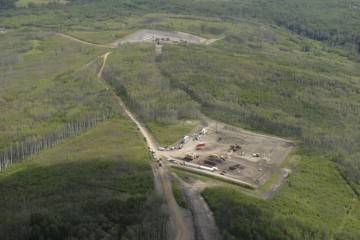 Two-page letter sent to newspaper promises 'summer vacation' free of bombings, but warns that could change |
A letter sent to a daily newspaper and addressed simply to “EnCana” says attacks against the company will stop for three months to give it a chance to leave the area.
“We can all take a summer vacation including your security personnel and the RCMP who have not helped you to date anyway,” the letter states, adding that the six explosions that have occurred so far have been minor and controlled to make the point that “you are indeed vulnerable, [and] can be rendered helpless.”
The letter, delivered to the Dawson Creek Daily News Wednesday and released yesterday by the RCMP, is the second sent in connection with a string of attacks against EnCana wells and pipelines. The first letter was sent to local newspapers in October, days before the first blast occurred.
Police believe the two hand-printed letters were drafted by the same person. The first was sent from Dawson Creek; the second from Spirit River, Alta., which is located 95 kilometres to the east.
Spirit River is relatively near the ranch owned by Wiebo Ludwig, the Alberta man who famously warred against the natural-gas operations of AEC, which merged with PanCanadian to form EnCana.
RCMP have said in the past they have ruled out Mr. Ludwig as a suspect, a statement they reiterated Thursday.
The B.C. explosions amount to “blackmail against not only industry, but also against the local community,” RCMP Sgt. Tim Shields told reporters in Dawson Creek.
RCMP have taken the deliberate step of calling the acts “terrorism,” a term Sgt. Shields said accurately describes the explosions, but carries with it no change in either police response or investigation funding.
In Dawson Creek, oil-and-gas workers whose jobs take them close to the bombing sites said they spend little time worrying about their safety, based on a belief that whoever is responsible is taking care to avoid hurting people.
“This guy who's doing this – he's not out there to hurt nobody,” said an oil-and-gas worker who attended the scene of the fifth bombing.
That wellhead explosion was just 500 metres from where the sixth blast went off, rupturing a natural-gas pipeline.
“He's just trying to get back at the oil companies,” said the worker, who spoke on condition of anonymity over his fear of losing his job for speaking out.
Clues in the two letters have led RCMP to believe that the person responsible – police believe it is most likely a single individual, who they have taken to calling “the bomber” – lives in or near Tomslake, B.C., a small community near the Alberta border.
Tomslake was populated by immigrants from the Czech Sudetenland around the time of the Second World War, and language used by the letter-writer indicates he or she could form part of that ethnic group, Cpl. Shields said. The first letter referred to “home lands,” while the second mentioned “our territories of the Tomslake and Kelly Lake districts.”
“We know that the Tomslake area was once referred to, especially after World War II, as the Sudeten homeland, and the word ‘territory' was also included in that description of Tomslake at that time,” Cpl. Shields said. “So, it was a term that was used in the past.”
From the tone and content of the letters, it appears the writer wants to come across as powerful, smart and in control, psychologist Mike Webster said yesterday.
The letter also carries elements of what's called “duping delight” – some criminals' tendency to gloat over their exploits or taunt police, a tendency that can backfire.
Such people may want to insert themselves into the investigation or collect souvenirs, said Mr. Webster, who's worked with police agencies for decades and recently testified at the Braidwood inquiry into the taser death of Robert Dziekanski.
“If he is more interested or has a greater need for demonstrating his intelligence or his power over EnCana and the police, he's going to screw up,” Mr. Webster said.
Mr. Webster disagreed with the RCMP's characterization of the attacks as terrorism, saying that the attacks appear aimed at the company, not the public at large.
“There's an argument to be made that the community is somewhat in support of the individual who is responsible,” said Mr. Webster.
The investigation has cost at least $1-million to date. There have been no arrests.
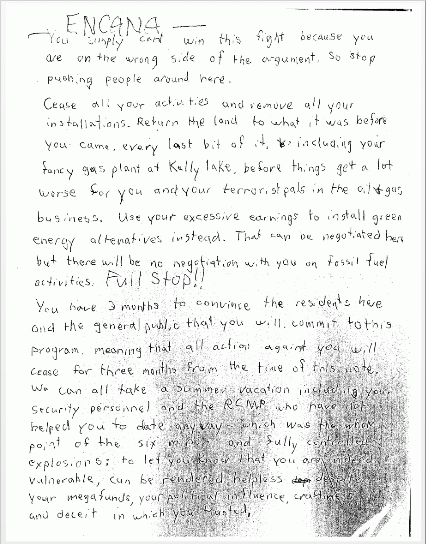 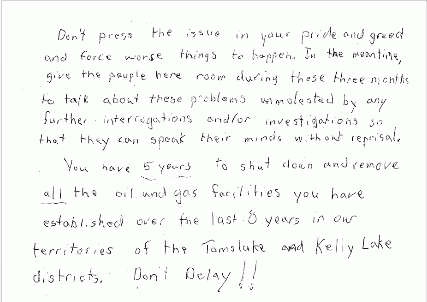  |
RCMP scout locales in hunt for bomber
NATHAN VANDERKLIPPEGlobe and Mail
Friday, Jul. 17, 2009
RCMP in northern British Columbia have begun scouting for sites to set up a new, temporary detachment in the small town of Tomslake, where they suspect the area's oil and gas bomber resides.
Plans for the new detachment will be revealed today by RCMP, who gave advance notice of their intentions to a group of concerned residents in Tomslake yesterday.
“What I want is basically a full service police station out here,” Staff Sgt. Stephen Grant told about thirty people gathered for a Rural Crime Watch meeting last night. Mr. Grant is the commander of the 27-member Dawson Creek detachment.
Over the past nine months, six explosions have been set at natural gas installations in the area owned by EnCana Corp. The explosions have all happened in a relatively small area between Tomslake and Dawson Creek, which is a 30-kilometre drive north-west.
The six bombings have damaged infrastructure, but so far hurt no one.
Two anonymous letters sent to local media by the person believed to be responsible for the bombings have referenced Tomslake. Police believe the language in the letters – especially references to “our home lands” and “our territories” – points to a resident of the area, which was populated around the time of the Second World War by Czechoslovakian Sudetenlands immigrants. Some of those immigrants used that terminology to describe their new Canadian home.
Current plans call for the small satellite detachment to be maintained for six months, or until the bomber is caught, although Mr. Grant expressed hope that it could be continued beyond that time.
“We're looking at potential sites in the area,” he said in an interview. “We're working with the regional government to locate a spot, and we hope to get that going pretty quick.”
The RCMP bid to catch whoever is responsible for the bombings has damaged relations with some in the area, as people have been tailed, subjected to hostile questioning, watched in their own homes and, in one case, accused in a public restaurant of being the bomber.
Mr. Grant acknowledged those tactics have not always gone over well.
“We all know how this initial investigation was conducted,” he told the Tomslake group. “It did not leave a good taste in people's mouths.”
But he hopes the new detachment, even if it is temporary, will help mend some of those issues.
“We've always been too distant from the community here,” he said. “So the connection we have with the people isn't as strong as it should be. I believe by having a base here within the community we're going to be more responsive, we'll have a better connection with people. I think it's going to be positive all around.”
RCMP are also bringing in additional gunpower, including a six-month posting to the area for a long-serving member of the force who has trained as a sniper and worked with U.S. and Canadian army bomb patrols in Afghanistan.
Police must contend, however, with substantial elements of the community that believe the bomber is doing them a service.
Many have harsh feelings toward the natural gas development that has descended upon them in recent years with a cloud of highway dust and the roar of drilling rigs in a once-quiet place. As a result, enough people have sympathy for whoever is setting the explosions that one woman told Mr. Grant: “the bomber is at least giving us a bit of a voice.”
Police have attempted to convince people otherwise by pointing to the danger the explosions have posed to natural gas workers, including those whose work to repair the fifth explosion involved welding a repair mere centimetres from a roaring natural gas flame.
“This person would like to think they're Robin Hood, but they're endangering the people that live here,” Mr. Grant said.
Police believe the bomber has likely used an all-terrain vehicle to travel to the remote locations where the bombings were set. Members of the Tomslake Rural Crime Watch have nonetheless stepped up their own volunteer patrols, devoting long hours to driving the community's gravel roads in hopes of discovering something suspicious.
For them, the new detachment is entirely welcome.
“It's a necessary evil generated by the circumstances that have developed in our area,” said Rural Crime Watch chairman Geri Demyem.
See previous
Hunt for pipeline bomber draws harassment complaints
RCMP buoyed by new leads in B.C. pipeline bombings
RCMP say 6th bomb targeting B.C. pipeline caused small sour gas leak
Explosion caused pipeline leak, EnCana says
Tips flowing on pipeline bombings after EnCana reward offered
Encana to announce reward into B.C. pipeline bombings
Pipeline bombers probably local: expert
RCMP blows pipeline bombing investigation
Sabotage fears flow around B.C. pipelines
Third blast rocks B.C. pipeline
Six recent pipeline incidents, commission says
Oil vandal questioned in B.C. pipeline bombings
Somebody local with a grudge targeting oilpatch?
Olympics executive takes new appointment at BC Hydro
COMMENT: Does Dan Doyle=Site C? BC Hydro's bio is effusive: "Large complex building projects are second nature to Doyle. With more than 35 years of experience with B.C.'s Ministry of Transportation, most recently as deputy minister, he has overseen some of the province's landmark construction initiatives."
Umdaly didn't last long. Brian Smith was chair from 1996-2001. Larry Bell from 2001-2007. Mossadiq Umedaly for a mere 18 months. Did he not like the job? Did Gordon Campbell not like him doing the job?
By Derrick Penner
Vancouver Sun
July 17, 2009
The head of construction efforts for Vancouver's Olympic organizers is taking on a new position as chairman of the BC Hydro board of directors.
Dan Doyle, executive vice-president of construction for the Vancouver Organizing Committee for the 2010 Olympic and Paralympic Games (Vanoc), was named to the Hydro post on Thursday. He'll replace Mossadiq Umedaly, who has been chair of the board since the end of 2007.
Doyle, a career civil servant in the provincial Ministry of Transportation, retired as deputy minister of the department in 2005.
During his career, he served as chairman of Rapid Transit 2000, the company that oversaw construction of SkyTrain's Millennium Line, and advised on projects including the province's Gateway initiative and the Canada Line.
Doyle joined Vanoc in 2006 to oversee its $580-million venue-construction program as part of a reorganization that saw his predecessor, Steve Matheson, senior vice-president of venue construction, dismissed.
Doyle will remain with Vanoc, where CEO John Furlong credited him with "delivery of a successful venue construction program" and with a razor-thin $310,000 contingency.
"Mr. Doyle's contributions to the province over the last 35 years make him a natural fit for the BC Hydro team," Blair Lekstrom, minister of energy, mines and petroleum resources -- and minister responsible for the Crown corporation -- said in a news release.
© Copyright (c) The Vancouver Sun
Dan Doyle
Chair, BC HydroAppointed July 16, 2009
 |
Large complex building projects are second nature to Doyle. With more than 35 years of experience with B.C.'s Ministry of Transportation, most recently as deputy minister, he has overseen some of the province's landmark construction initiatives. Highlights include the rehabilitation of Vancouver's Lions Gate Bridge and the development of the Sea-to-Sky Highway Improvement project. Doyle also served as chairman for Rapid Transit 2000, the company responsible for building the Millennium Line extension to Vancouver's rapid transit system.
A civil engineer by training, Doyle’s lengthy career has been recognized with many accolades, including the APEGBC President's Award in 2007, the Canadian Transportation Person of the Year (2005) and the Lifetime Achievement Award from the Institute of Transportation Engineers. In addition, he was awarded the Lieutenant Governor's Silver Medal for Excellence in Public Administration (2002).
Federal Review Panel Established for Environmental Assessment of Proposed Bute Inlet Hydroelectric Project
COMMENT: The federal review panel has been appointed for the Bute Inlet Hydroelectric Project. They'll probably be sitting on their duffs for months, because:
- the proponent (formerly Plutonic Power Corp, now a wholly owned subsidiary called Bute Hydro Inc.) has a very detailed environmental impact statement (EIS) to put together. The company has suggested that it may not be released until early 2010.
- in its current Green Energy Call, BC Hydro said in December 2008 that it was looking for 3000 GWh of energy. Bute Inlet is 2905 GWh per year - so if selected by BC Hydro would preclude all the other IPPs and their projects - a political and diplomatic disaster for BC Hydro, the BC Utilities Commission, the BC Government, and for IPPBC. It won't happen. So, Plutonic doesn't need to rush the EIS.
The bios of two of the panellists, Les Cooke and George Kupfer, reflect a deep immersion in Alberta conventional energy issues, and approval of significant tar sands projects. Concerns about a BC run-of-river application may seem to them as peas at the bottom of a stack of mattresses, and intervernors who express concern as so many princesses. Ian Birtwell, with a background in salmon issues, will likely expect some pretty hard-nosed science to back up any expert opinion that the Bute project will have detrimental impacts on salmon or their habitat.
News Release
Canadian Environmental Assessment Agency
July 16, 2009
OTTAWA – July 16, 2009 – Canada’s Environment Minister Jim Prentice announced today the establishment of a three-member federal review panel for the proposed Bute Inlet Hydroelectric Project in British Columbia.
Minister Prentice appointed Les Cooke as panel chair, as well as Ian Birtwell and George Kupfer as panel members. Biographical information on the panel chair and members is available in the accompanying backgrounder.
The panel terms of reference for the environmental review were issued by the Minister in May 2009, along with the document entitled “Guidelines for the preparation of the Environmental Impact Statement”. The Panel Terms of Reference document describes the review process and the procedures to be followed by the federal panel in conducting the review, as well as details on the scope of the environmental assessment.
In accordance with its terms of reference, the panel will:
conduct an examination of the environmental effects of the proposed project and the significance of those effects;
consider measures that are technically and economically feasible to mitigate any adverse environmental effects, as well as the need for and the requirements of any follow-up programs with respect to the project; and
consider comments from the public that are received during the review.
Further information on this project, along with the terms of reference, is available on the Canadian Environmental Assessment Agency Registry under registry number 09-05-44825.
Bute Hydro Inc. is proposing to construct 17 run-of-river hydroelectric facilities in the vicinity of Bute Inlet. Major components, in addition to the generating facilities, include a substation near the mouth of Southgate River, associated access roads and ancillary works, 216 km of 230 kV collector transmissions line and a 227 km 500 kV trunk transmission line from the proposed substation near the mouth of Southgate River to the existing 500 kV substation at Malaspina.
-30-
For more information, media may contact:
Lucille Jamault
Senior Communications Advisor
Canadian Environmental Assessment Agency
Tel.: 613-957-0434
http://www.ceaa-acee.gc.ca/050/Document-eng.cfm?DocumentID=37642
Proposed Bute Inlet Hydroelectric Project
Federal Review Panel - Biographical Notes
Les Cooke
Les Cooke has over 40 years of strategic policy and planning, program management and executive experience with the governments of Saskatchewan and Alberta, and provincial governments in South Africa. He completed graduate studies in land and resource planning at the University of Alberta. He is President of Les Cooke and Associates, a consultancy focused on strategic management and organizational effectiveness in forest management and infrastructure development.
Mr. Cooke has held executive positions focused on natural resource and environmental management, economic development and strategic policy and planning. He has led national strategic planning processes for the Canadian Council of Ministers of the Environment and the Canadian Council of Forest Ministers. He has spearheaded new approaches to public sector governance and program management, including Aboriginal business development, integrated land management and partnership-based environmental management. Mr. Cooke has extensive experience in facilitative leadership and consensus driven partnerships involving a wide array of government agencies and stakeholder communities. He has frequently managed complex organizational environments involving boards, commissions, authorities and interagency task teams.
Mr. Cooke has chaired resource management organizations and served on environmental assessment panels. He has chaired the Board of Directors of the Saskatchewan Wetlands Conservation Corporation and served as the Vice-Chairman of the Alberta Advisory Committee on Heavy Oil and Oil Sands Development. He was a member of the joint federal-provincial panels examining the development of the Kearl oil sands mining and extraction facility and the expansion of the Muskeg River oil sands operation, both in northern Alberta.
George Kupfer
George Kupfer is a consultant focusing on community consultation and facilitation related to social and environmental issues. He has a sociology degree from Seattle Pacific University, as well as a Masters and Ph.D. in Sociology from the University of Washington. He taught at the University of Alberta for 15 years, before establishing his own company, Fresh Start Limited, and continues to work extensively in Alberta.
Dr. Kupfer has facilitated many community consultation and stakeholder engagement initiatives related to industrial projects and their impacts. He has led multi-stakeholder consultations on drilling applications, gas pipeline developments, sour gas issues, transmission line route selection and forest conservation. He facilitated a multi-stakeholder review of the Alberta environmental impact assessment process. He has facilitated Crown consultation processes with First Nations for the federal and Alberta governments and advised the National Energy Board on the development of an internal Aboriginal consultation process. He has worked with First Nations and Metis, industry, communities and government departments in Alberta, British Columbia and the Northwest Territories.
Dr. Kupfer has served on numerous environmental assessment panels, specifically related to water management issues. He was recently a member of the joint federal-provincial panel reviewing a run-of-the-river hydroelectric project on the Peace River near Dunvegan, Alberta. He was also a member of panels reviewing water management projects for the Pine Coulee and Little Bow/Highwood projects in Alberta, and was a panel member for reviews of the Jackpine and Horizon oil sand developments in northern Alberta. He managed the review panel, as well as the scientific review of the Alberta-Pacific pulpmill and served as social impacts advisor to the Oldman River Dam Panel.
Ian Birtwell
Ian Birtwell is an aquatic ecologist with particular expertise on the effects of industrial development on fish and fish habitat. He worked as a biologist and research scientist for Fisheries and Oceans Canada for over 30 years and retired in 2006. He has a Ph.D. in estuarine Ecology from Kings College, London University.
Dr. Birtwell has devoted his career to researching and reviewing the effects that human developments have on the aquatic environment. His research has focused on the lethal and sublethal aspects of stressors on the survival of fish and on their habitat. He has done extensive work on the effects of sediment and turbidity on aquatic systems. He has studied the impacts of oil spillage and transportation, pulp mill effluents, placer gold mining, oil sands development, diamond mining, municipal effluent, specific contaminants, as well as effects of electricity production and thermal and dissolved gas pressure changes. Dr. Birtwell's research results have contributed to the formulation of regulations under the Fisheries Act, and have been used in testimony in court and in cooperative ventures with non-governmental organizations, industries, and government agencies, to assist fish and fish habitat protection. He contributed to the formulation of Fisheries and Oceans Canada’s fish habitat policy, and has provided expert opinion for governments in over 30 court cases involving habitat damage and the deposition of deleterious substances.
Dr. Birtwell has been spokesperson and expert witness before federal and provincial public hearings including the joint federal-provincial environmental assessment panel reviewing the effects of the Alberta-Pacific pulp mill. He has participated in international, national, regional and provincial committees related to habitat, pollution issues and legislation. He has delivered numerous lectures to scientific, administrative and public audiences, and has authored over 150 scientific publications. While working for Fisheries and Oceans Canada, he received the Deputy Minister’s Commendation for contribution to environmental assessment.
http://www.ceaa-acee.gc.ca/050/Document-eng.cfm?DocumentID=37560
July 12, 2009
BC Hydro announces fiscal results for 2009
Press Release
BC Hydro
July 10, 2009
VANCOUVER – BC Hydro today announced its financial results for Fiscal 2009, including a consolidated net income of $366 million for the year ended March 31, 2009, which is comparable to the prior year's net income.
"Overall, our financial results for Fiscal 2009 are in line with expectations and I am very pleased that the energy saved through our Power Smart programs exceeded expectations," said Bob Elton, BC Hydro President and CEO. "We have also made good progress in our capital plan to upgrade aging assets to meet growing customer demand and improve system resiliency. Unfortunately, the economic downturn has affected many industries, especially forestry, which resulted in decreased demand for electricity from the industrial sector."
Other highlights of the Annual Report include:
* Domestic revenues were $2,814 million – $130 million lower than the previous year, primarily as a result of decreased revenue from the industrial sector mainly due to closures in the current year of pulp and paper operations in the forestry sector.
* Total energy costs of $2,393 million were $336 million higher than in the prior year. BC Hydro experienced a 14 per cent decrease in hydro generation over the prior year due to lower water inflows and system constraints, causing BC Hydro to purchase higher-priced market energy to meet domestic requirements.
* Energy saved through Power Smart programs surpassed expectation and continued to deliver cost-effective energy over the last fiscal year, producing cumulative energy savings of 983 GWh, an increase of 657 GWh over Fiscal 2008. This increased saving is equivalent to powering 65,700 homes for a year.
* Capital expenditures of $1,400 million in the year were $324 million higher than the previous year, primarily due to reinforcement work on the Vancouver Island transmission reinforcement project and generation replacements and expansion projects such as the Revelstoke Unit 5 installation to meet growing customer demand, and system improvements to the distribution network.
* Energy trading income increased in Fiscal 2009 mainly as a result of favourable electricity price spreads between the Northwest and Southwest and between the Northwest and Alberta during peak periods in the current year, and growth in natural gas trading activity over the previous year.
* Operating costs were $27 million lower in Fiscal 2009, primarily as a result of higher costs in the previous fiscal year for First Nations settlement provisions. These lower operating costs were partially offset by higher expenditures in the current year on demand side management and smart metering and infrastructure projects, higher maintenance costs to address equipment failures at the G.M. Shrum Generating Station, expenditures on Phase 2 of the Site C project, and higher levels of work in vegetation maintenance to improve system resiliency.
Contact:
Susan Danard
Media Relations
Phone: 604 623 4220
Drop in demand means lower profits at BC Hydro
By Fiona AndersonVancouver Sun
July 10, 2009
Utility reported it had to purchase more expensive energy to meet demand
 BC Hydro posted profits of $366 million last year, down slightly from the $369 million the provincially owned electric utility earned a year earlier. Photograph: Vancouver Sun files |
BC Hydro posted profits of $366 million last year, down slightly from the $369 million the provincially owned electric utility earned a year earlier.
The drop in profit came as rate increases were offset by a decrease in demand, mainly from industries such as forestry that were hard hit by the recession, BC Hydro said in its annual report, released Friday.
Energy costs for the year — which ran from April 1, 2008 to March 31, 2009 — were higher ($2.4 billion compared to $2.1 billion) as lower reservoirs led to power generation being down 14 per cent, the report said.
As a result, BC Hydro had to purchase more expensive energy to meet demand.
Water flow “is our largest variable, it’s our fuel,” BC Hydro spokeswoman Susan Danard said in an interview. So the utility keeps a watchful eye on snowpack in the north and rain in the south.
But despite the dry summer the Lower Mainland has been enjoying so far, it is too early to predict what water inflow will be like this year, Danard said. While the south has been dry, the Peace River area, where BC Hydro’s largest facilities are located, has been quite wet.
Domestic revenues at the utility fell $130 million to $2.8 billion even though the utility added 34,000 customers, mainly in the Interior of the province and on Vancouver Island.
In addition to a drop in industrial consumption, BC Hydro’s Power Smart program — which encourages customers to reduce energy consumption by 10 per cent — saved 983 gigawatt hours (GWh) of energy, an increase of 657 GWh from the amount saved in 2008. The increase in saved energy is enough to power more than 65,000 homes for a year, the report said.
Revenues at Powerex, BC Hydro’s trading arm, were up $189 million due to increases in revenue from both electricity and gas trades. Higher prices in electricity more than offset a 13-per-cent drop in sales to increase revenue. And Powerex’s push to grow its gas business led to volume growth of 27 per cent while prices were up eight per cent.
Last year, BC Hydro experienced more widespread power failures caused by transmission and substation issues than in previous years, affecting more customers, the report said.
That would include last summer’s underground electrical fire, which caused as many as 20 per cent of downtown Vancouver customers, many of them businesses, to be without power for up to four days.
fionaanderson@vancouversun.com
© Copyright (c) The Vancouver Sun
Local voices must be heard in decisions on power projects
BY GEORGE HEYMAN AND SARAH COX
The Vancouver Sun
11 Jul 2009
Bute Inlet, a long and deep fiord 300 kilometres north of Vancouver, is famous for many things. Some call it “Canada’s Himalayas” because of the striking glacier-covered mountain slopes and temperate rainforest. Loggers know it as a place where nature can’t be tamed, where avalanches and rockslides tear down mountainsides and mini-tornados funnel down the fiord in legendary winter storms. Fishers count five kinds of salmon in the emerald inlet. Mountaineers eye Mount Waddington, the highest peak entirely in British Columbia, near the Homathko Icefield which feeds the inlet with streams of gravel-studded water.
 Bute Inlet is where Plutonic Power Corporation plans a power project.(ALISTAIR HOWARD/PLUTONIC POWER) |
For Sierra Club BC, Bute Inlet was a place we’d heard much about, yet didn’t know at all. In the news, Bute has become synonymous with a controversial power proposal to harness over 1,000 megawatts of electricity from 17high elevation creeks and rivers and march it over the mountains to the electrical grid.
Last week, Sierra Club staff and volunteers boated up the 75-kilometre inlet, and travelled along overgrown logging roads to remote river valleys that could soon house turbines and transmission lines. We wanted a first-hand view of the scope of the development owned by Plutonic Power Corp and its partner General Electric — a controversial proposal that spurred more than 250 Quadra Island residents to overflow a local hall on a Sunday morning in February to voice objections to the project.
In a “green power” gold rush invisible to most of us, the provincial government has granted more than 130 water-for-power licences. Close to 600 more applications are pending — primarily placeholders for corporations laying claim to B.C.’s public rivers for future development.
Run-of-river proposals are touted as “green power” because, like 90 per cent of B.C.’s clean hydro power, once infrastructure is in place they are largely carbon-neutral. But this green power moniker raises many difficult questions that challenge the environmental community and all British Columbians.
Do we carve up a wilderness area — in Bute’s case one that encompasses the southern most range of B.C.’s coastal grizzlies, endangered marbled murrelet habitat and all five species of B. C. salmon — to produce power for export in an attempt to slow our rapid ascent to global warming’s tipping point?
How do we calculate the carbon footprint of producing and shipping turbines and penstock from Austria and China, ferrying work crews in and out by helicopters and airplanes and leaving a 100-metre-wide swath of felled trees to release their carbon contents into the atmosphere beside transmission lines channelling “carbon-neutral” power?
In the name of green power, do we compromise or destroy burgeoning ecotourism ventures that create sustainable jobs and infuse money into the local economy?
The sheer scale of Plutonic’s proposal warrants questions and concern. It is 33 times larger than the 30-megawatt limit set by the state of California’s renewable energy bill for run-of-river hydroelectric power. In addition to the 17 stream diversions and 445 kilometres of transmission lines, the project will involve 314 kilometres of roads, 142 bridges, 16 powerhouses, and a substation — all this in a wilderness area so visually stunning that Beautiful British Columbia magazine recently named a trip to Bute Inlet one of “50 things to do before you die.”
The Homathko logging camp, where we stayed at Bute’s eastern tip, is equipped with its own run-of-river project that generates more than enough electricity to fuel a plethora of power equipment and feed and house 30 people. We climbed uphill to see the waterfall source of the camp’s abundant electrical supply, and couldn’t help but note that this small scale “run of river” is a non-invasive harnessing of water tumbling downhill.
As B.C. speeds up development of cleaner, carbon-neutral energy, we need a well-thought, comprehensive and publicly acceptable template to assess the full environmental footprint of new power proposals.
• Is the proposed development truly “green” when its impacts on habitat, species and irreplaceable ecosystems and landscapes are considered? Is a mix of additional alternatives, including wind and solar, less environmentally destructive?
• What is the “full carbon accounting” when emissions caused by construction and maintenance are factored in?
• What is the appropriate scale of a “green power” project — 1,000 megawatts such as Bute or much smaller, like California’s limit of 30 megawatts?
• What is the cumulative impact of dozens of power projects on a watershed?
• Will the new power replace dirty coal or natural gas fired generation, or will it be exported with no carbon reduction strings attached?
Rights to use our rivers and public land must be granted through open public processes, not sacrificed by provincial policies that transfer accountability from the public to shareholders and allow corporate claims of commercial confidentiality to trump our freedom of information laws.
Bill 30, passed by the B.C. government in 2006, removes input and planning approval from local governments and communities during provincial assessment of proposed water-for-power projects.
Our water as well as our atmosphere is a common asset, and we need to ensure public benefit from its use. We must develop green energy, but in a way that retains the right of B.C. to make decisions in the public interest with political accountability.
We can’t run the risk of having those decisions blocked by investor rights clauses in trade agreements. We can’t afford to silence local voices, and we can’t afford to extinguish open and broad-based public discussion about how best to extricate ourselves from our carbon quagmire.
George Heyman is executive director of Sierra Club BC. Sarah Cox is the organization’s policy and campaigns adviser.
BOMB: Land of suspicion
b>Brian Hutchinson
National Post
July 11, 2009
 Tim and Linda Ewert, son Woody and daughter-in-law Gabrielle stand on their property which borders an EnCana pipeline which has been targeted by an unknown bomber. (Keith Winsor for National Post) |
Police say a terrorist is blowing up a B.C. gas pipeline. Not all the locals agree
There is anger in the Peace, and suspicion. Someone is making homemade bombs, planting them beside natural gas wells and pipelines. Setting them off. Scaring families, exposing them to harm.
A terrorist is in their midst, say police. Neighbours wonder about one another. Since October, six explosions have rocked the rolling green foothills of northeastern British Columbia. There have been two this month. Whoever is responsible is edging closer to Pouce Coupe, a rural village 10 kilometres south of Dawson Creek.
All of the targets are owned by EnCana Corp. Like many other oil and gas companies tapping into gas fields in B. C.'s Peace River region, EnCana is in the business of sucking gas from the ground.
It is among the industry's dominant players; here in the Peace, it is the most visible. The EnCana logo seems ubiquitous. "It's the biggest bear in the barn, that's for sure," says Lyman Clark, Mayor of Pouce Coupe.
The Mayor is an unabashed EnCana booster. He speaks glowingly of the Calgary-based company, its community spirit, its willingness to sprinkle cash around his village when it's needed.
That new wheelchair ramp attached to the community centre? Built and installed by EnCana. The new school? Construction funded, in part, by EnCana.
But there are plenty of folk who have issues with the company. "It's assumed that because it's big, EnCana is out to screw everybody," says the Mayor.
Among other things, En-Cana is accused of being aggressive and arrogant in its dealings with locals, especially in negotiating right of entry to their land.
EnCana acquires subsurface mineral rights from the province, but must buy surface access separately. Often, that means dealing with farmers and ranchers who may want nothing to do with the gas business, or who feel they are being low-balled by the company.
This is rich, productive country, on the edge of a fertile plain that stretches far into Alberta. The land here supports woodlots, wheat and canola fields, and livestock.
But agriculture is giving way to industry. Specifically, the oil and gas business. The old way of life is eroding, people complain. Tim and Linda Ewert have been farming near Pouce Coupe since 1974. The couple and their children have grave concerns about the gas industry that, they said, arrived in the area about eight years ago, and came on "like a tidal wave."
Like everyone else in the area, they soon learned what escaped gas can do.
Commercial natural gas is either sweet or sour; most reservoirs found deep underground contain both. Sour gas contains hydrogen sulphide, which is lethal. Even a small amount escaped into the environment can potentially kill, or cause damage to animal and plant tissue.
The Ewerts and some of their neighbours claim to have suffered from accidental leaks; these are rare, but they do happen. Symptoms in humans include headaches, respiratory problems, loss of balance, even loss of consciousness.
The Ewerts digested whatever information they could find; inevitably, their research led them to Wiebo Ludwig, the fire-breathing Alberta preacher and farmer who led a personal crusade against a number of oil and gas companies. He alleged their operations were poisoning his family and his farmland.
In 2001, Mr. Ludwig was convicted of bombing and vandalizing oil and gas installations near his family farm in Hythe, Alta., which is less than an hour's drive east of Pouce Coupe. He spent more than a year in prison before being released on parole.
The Ewerts have since paid visits to the Ludwig farm.
"We heard people say he is an absolute lunatic," says Mr. Ewert. "But we cast around and we found that there was something to what he was saying about the gas industry. So we have some sympathy for him."
And while they say they don't condone violence or acts of terror, the Ewerts have some sympathy for the bomber in their midst.
This, even though the last two explosions occurred nearby. The July 1 bombing took out part of a wellhead. EnCana crews were still repairing the damage on July 4 when another bomb exploded, this one at a pipeline.
Mr. Ewert and his family saw a plume of smoke, and called the local EnCana office. They say that a company employee conceded that some sour gas had escaped. While the leak was quickly contained, thanks to automated controls and shutoff valves, it caused widespread alarm.
Yet the Ewerts are glad for the resulting publicity the bombing caused. "We don't feel any more threatened by the bomber than we do the industry. If anything, we feel more a threat from the industry," says Mr. Ewert. "In fact, I think the bomber has done quite a service to the community."
"I think he's made a lot of people stop and go, 'Oh, maybe there is a problem,' " his wife, Linda, says.
EnCana has a regional office in Dawson Creek, and about 1,600 gas installations scattered about the region. Most are set deep in the pine forests or in the bush. These include exploration and drilling sites, wells, compression and processing plants, and buried pipelines.
Plain-clothed officers and private security guards now move around some of these locations, hoping to catch sight of the bomber. Surveillance cameras are fixed along fence lines.
Despite their best efforts, hundreds of officers on the ground and special investigation units flown in from Vancouver, Alberta, and Ottawa haven't been able to nab the perpetrator.
An RCMP spokesman says local residents are being less than forthcoming. A $500,000 reward offered by EnCana for information leading to the bomber's arrest and prosecution has not been claimed.
Some say the RCMP has gone overboard.
Dennis MacLellan says he's "a person of interest" to po-lice. He has a longstanding beef with EnCana, and he's not been afraid to talk about it.
The dispute relates to his land, a tree farm near Pouce Coupe. EnCana wants access to it, he says, so that it can develop a lease.
"I'd prefer they didn't come onto the property," says Mr. MacLellan. EnCana has offered him some money, but it's not nearly enough. He wants $100,000.
The RCMP has him under surveillance, he says. There are cameras outside his apartment building in Dawson Creek. Investigators approached him inside a local restaurant. Uninvited, they sat down at his table. The men got into a shouting match; tall and burly, Mr. MacLellan isn't one to back down.
"They called me a terrorist," he says. Now his 72-year-old mother is worried; she already has a heart condition.
No one, it seems, escapes the Mounties' notice. "I've got one [village] councillor here who was stopped three times by police inside of three miles," say Lyman Clark. "Each time they were like, 'Whatcha doing here, boy?' "
RCMP Staff Sergeant Stephen Grant heads the region's 27-member detachment in Dawson Creek. He refuses to discuss the active investigation. However, he agrees that it has grown, and that it is logical to assume people have been interviewed. Police have been in touch with Wiebo Ludwig, for example.
Mayor Clark says he thinks the bomber is likely a local person. He points to a map. The Peace River region is vast and mostly wild, he says. A stranger would have trouble navigating it. "It's a jungle," says the Mayor. "A big-city person would get eaten by a bear before he could plant a bomb."
It could be "a demented EnCana employee," he says. "Someone with a really bad taste in his mouth."
Or perhaps a local eccentric. Pouce Coupe has more than a few, says the Mayor. "It could be one of our local rustics, a recluse. People we call bush bunnies. Someone living in an old beat-up camper trailer who dumps his refuse down a ravine. Someone who has been told by EnCana to shove off. Some vengeful warrior type."
The Mayor says it's only a matter of time before the bomber's identity is revealed.
"It's a strange mind we're dealing with. I know plenty of people who would like to find him in action," he says. "Hunters, trappers."
Does he mean people with firearms?
"Yup."
---------
PIPELINE BLASTS
Oct. 11, 2008 First blast occurred in a remote location 50 km east of Dawson Creek.
Oct. 16 East of Dawson Creek, about half a kilometre from Alberta border. Explosion caused a pipeline to leak some gas.
Oct. 30 Third explosion occurred 12 km northwest of Tomslake. The blast hit a wellhead that leaked.
Jan. 4, 2009 Fourth explosion near Tomslake partly destroyed a metering shed.
July 1 Damage done to a wellhead in fifth explosion that occurred near Pouce Coupe, B. C., about 8 km south of Dawson Creek.
July 4 Sixth explosion occurred within a kilometre of staff working to fix the wellhead damaged on July 1. The explosion caused a gas leak. RCMP said the leak didn't harm the public, workers or environment.
National Post
Earlier posts:
RCMP buoyed by new leads in B.C. pipeline bombings
RCMP say 6th bomb targeting B.C. pipeline caused small sour gas leak
Explosion caused pipeline leak, EnCana says
Tips flowing on pipeline bombings after EnCana reward offered
Encana to announce reward into B.C. pipeline bombings
Pipeline bombers probably local: expert
RCMP blows pipeline bombing investigation
Sabotage fears flow around B.C. pipelines
Third blast rocks B.C. pipeline
Six recent pipeline incidents, commission says
Oil vandal questioned in B.C. pipeline bombings
Somebody local with a grudge targeting oilpatch?
July 10, 2009
BOMB: Hunt for pipeline bomber draws harassment complaints
Mark Hume
Globe and Mail
Friday, Jul. 10, 2009
Residents of B.C. town question RCMP tactics
An RCMP team hunting for the EnCana pipeline bomber in northeastern British Columbia has been accused of harassing and intimidating people in an attempt to get a break in the case.
Several residents of the Dawson Creek area say they have been interrogated up to eight times, pressured to take lie detector tests and asked for DNA and fingerprint samples.
One man said he fled a busy restaurant when police loudly accused him of being the bomber.
The RCMP say they have not received any formal complaints about their tactics.
But Vancouver lawyer, Jason Gratl, vice-president of the B.C. Civil Liberties Association, said he has written to the RCMP asking them to stop harassing two clients.
“They are acting like state or secret police,” Mr. Gratl said. “The RCMP have fomented a climate of paranoia and suspicion … by applying a level of social pressure that amounts to harassment and intimidation.”
The RCMP has more than 250 investigators trying to catch whoever is responsible for six bomb attacks on EnCana infrastructure since October. Police have interviewed more than 450 people so far, without any charges laid.
Mr. Gratl said four people have contacted him with complaints about police.
One of those is Dennis MacLennan, who says he willingly agreed to a police interview last fall, after the first bombings, but when investigators kept returning with more questions, he decided not to co-operate any more.
That, he said, led to a confrontation with members of the Integrated National Security Enforcement Team in a local café.
“They come and sit at my table … and they start engaging me in questions. I said, ‘look I don't want to talk to you, my lawyer has advised me not to' … So I get up to leave and one member of the INSET team starts yelling at me: ‘You're the bomber You're the bomber' You know, in a public restaurant … this is just absolutely atrocious behaviour,” Mr. MacLennan said.
He is in a dispute with EnCana over the amount of money he claims is due for a well on his property, but says that shouldn't make him a bombing suspect.
“I do my business by the rules … I'm not some radical crazy,” he said.
But police have kept after him for months.
“They just kept pressuring me and chasing me around town, talking to people I'm doing business with and telling them I'm under investigation … destroying business opportunities for me. It's been quite stressful … they've gone to my landlord and said, ‘Would you be surprised if we arrested him?' and poisoning the atmosphere with people I've had relationships with for 10 and 20 years,” he said.
“My friends think there must be something to it if the police are being this persistent. All sorts of rumours are being spread.”
A woman, who asked not to be named, sounded distraught as she described being a police suspect.
“They've talked to me three times; our son at least six times. It's interviews, interrogations, wanting fingerprints, DNA, lie detector tests. They wanted my cellphone record … It's two or three hours of questioning at a time, over and over again,” she said.
The woman, who is not one of Mr. Gratl's clients, said she knows others who have been questioned by police, and most are withdrawing from social contact.
“I can see some of the same symptoms of [post traumatic stress disorder] in those who have been police targets … there is isolation, paranoia, just like they have been in combat,” she said.
Another woman, who has not been questioned herself, said a friend was interrogated repeatedly and “he was absolutely torn apart by the intimidation. He was a basket case.”
She said she didn't want her name in the media, fearing it might result in a police visit.
RCMP Corporal Dan Moskaluk, media relations officer for the North District, said police would like to hear from anyone who thinks they have been treated unfairly.
“I guess the response to those types of issues [is that] we are always concerned,” he said.
“At this point in time I'm not aware of any formal complaints that have been received or are being investigated … but again we would certainly welcome any issues that people would like to voice to us,” he said.
See previous
RCMP buoyed by new leads in B.C. pipeline bombings
RCMP say 6th bomb targeting B.C. pipeline caused small sour gas leak
Explosion caused pipeline leak, EnCana says
Tips flowing on pipeline bombings after EnCana reward offered
Encana to announce reward into B.C. pipeline bombings
Pipeline bombers probably local: expert
RCMP blows pipeline bombing investigation
Sabotage fears flow around B.C. pipelines
Third blast rocks B.C. pipeline
Six recent pipeline incidents, commission says
Oil vandal questioned in B.C. pipeline bombings
Somebody local with a grudge targeting oilpatch?
July 09, 2009
NaiKun offshore wind farm presents environmental dilemma
By Anne Murray
Georgia Straight
July 9, 2009
It’s a dilemma that forward-thinking, environmentally conscious people do not want to face: Will moving toward carbon-free energy sources mean disrupting bird migration routes and having a negative impact on wildlife populations?
| See also Anne Murray: What we risk when oil spills along B.C.'s coast |
This weekend sees the July 12 deadline for public comments on the massive NaiKun wind farm proposed for Hecate Strait. The initial phase proposes 110 wind turbines spaced over 100 square kilometres generating 396 megawatts—the first offshore wind farm in British Columbia, located in shallow water immediately east of Naikoon Provincial Park in Haida Gwaii. The project is welcomed by some northerners as an opportunity for employment and a big step forward in sustainable energy generation. After all, wind is something that Hecate Strait does rather well.
The problem arises, however, that this exact location, the shallow water around McIntyre Beach and Rose Spit, is a designated important bird area under the BirdLife International program that lists critical sites for bird populations in over 200 countries worldwide. Millions of migrating birds pass through this IBA every spring and fall, including shorebirds, diving and dabbling ducks, geese, sea birds, loons, and grebes. The footprint of the proposed NaiKun wind farm, close to shore in shallow water, is a prime feeding and staging area for many species of birds, including large numbers of sea ducks, such as black and white-winged scoter. According to recent Environment Canada telemetry studies, large numbers of black scoter stage for up to a month in this area during spring migration (curiously, the Environment Canada data was not available to be included in the environmental assessment report).
The presence of the documented important bird area, and three others affected by the extended infrastructure of the wind farm, places the NaiKun proposal in the highest Category 4 level of sensitivity, according to Environment Canada’s guidelines for wind farms, since it includes a very large number of turbines located in or near an important bird area. Category 4 sensitivity indicates that an alternate site should be considered. Similarly, BirdLife International’s position on wind farms recommends complete avoidance of bird migration hot spots and important bird areas under the precautionary principle.
Disturbance to birds is not limited to the risk of mortality and injury from rotating turbines. Studies in Europe show that birds often fly around the array of turbines, moving away from previous feeding areas or flight paths. The constant disturbance and/or lack of access to prime feeding areas can result in diminished fitness, lower breeding success, or other stresses on the population, particularly for birds in the middle of their long migrations.
As well as birds, the marine waters of Hecate Strait are rich in whales, sea lions, porpoises, fish, and crabs. These are wildlife with high economic as well as ecological value. The environmental assessment lists 35 species of marine mammals that potentially exist in the area, including four populations of killer whales (orcas), but it does not mention that whale watching generates $108 million a year in B.C. (according to a 2003 Fisheries and Oceans Canada fact sheet) and that it has been a significant source of visitor growth in the last two decades, providing employment and foreign currency for many coastal towns. Similarly, the fishing industry is a source of valuable employment and dollars for many northerners. Crab and sablefish fishers have been among those writing in with critiques of the studies and concerns over the location.
The Haida people and other islanders are faced with some difficult choices in deciding whether to accept this large wind farm in their offshore waters. It is essentially a giant experiment in action. Although the proponents claim that no significant effects on marine mammals, birds, or marine ecology have been identified, they admit: “Continued monitoring during and after construction of the proposed wind farm will add much to the existing knowledge base, providing ecological information essential to advancing our understanding of marine mammals and associated environmental interactions of large offshore developments.”
There is a strong case for the precautionary principle and a reconsideration of location for our first offshore wind farm. You can comment on the environmental assessment until midnight on Sunday (July 12) by visiting the Environmental Assessment Office’s Web site and looking at the documentation for the NaiKun Offshore Wind Energy Project.
Anne Murray is conservation chair for B.C. Nature, and author of A Nature Guide to Boundary Bay and Tracing Our Past: A Heritage Guide to Boundary Bay, both published by Nature Guides B.C.
July 07, 2009
BOMB: RCMP buoyed by new leads in B.C. pipeline bombings
By Becky Rynor, Renata D'Aliesio and Dan Healing
Canwest News Service
July 6, 2009
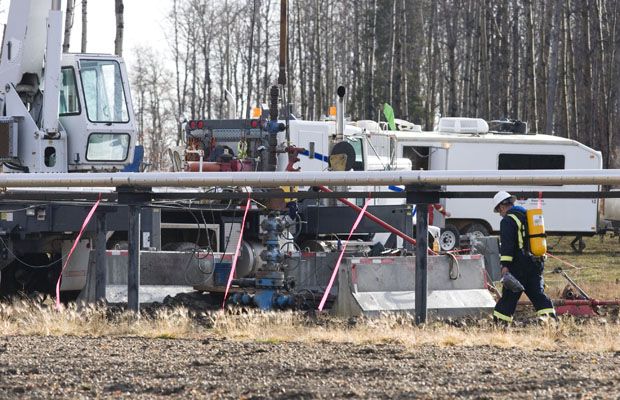 Crews from EnCana work to stop the flow of gas in a wellhead in northeastern B.C. that was caused by bomb blast on Nov. 1, 2008, seen here in this file photo. A similar blast occurred July 4, 2009, at an EnCana Corp. site in Pouce Coupe, B.C., about eight kilometres south of Dawson Creek. This is the sixth bombing — and the second in a week — of natural gas infrastructure in northeastern B.C. Photograph by: Kit Fast, Peace photoGraphics file photo |
Investigators probing a series of bombings that have hit EnCana Corp. gas pipelines in northeastern British Columbia — which RCMP have called acts of "domestic terrorism" — say they're encouraged by several new leads.
"The biggest thing is, we've been receiving some phone tips, and we're following up on those," RCMP spokesman Cpl. Dan Moskaluk said Monday.
"Prior to the last two incidents, we weren't getting that much from the public. With these two latest incidents, as a result of the messaging we put out and the concern from the public . . . people have started phoning in."
EnCana spokeswoman Rhona Delfrari welcomed the news.
"We are relying on the police," she said. "We definitely hope they get some leads, and it's very encouraging if people are calling in and providing tips because, really, it's the whole community that's being targeted now."
On Saturday morning, EnCana officials were alerted to an explosion on a company site near the community of Pouce Coupe, B.C., just south of Dawson Creek, after a concerned resident in the area reported a loud bang.
The blast released a small amount of toxic hydrogen sulphide.
Delfrari said the drop in pressure set off an alarm and the pipeline was automatically shut down. She added most of the pipelines operated by EnCana have the same capability.
There have now been six bomb attacks on EnCana pipelines in the region, dating back to mid-October 2008, when an explosion ripped out a two-metre crater under a pipeline near the hamlet of Tomslake, B.C., about 30 kilometres south of Dawson Creek.
The bombings started shortly after a threatening letter was anonymously sent to EnCana, telling the company get out of the area.
Subsequent bomb attacks have drawn ever closer to populated areas around the Tomslake community, close to the B.C.-Alberta border.
EnCana has offered a $500,000 reward for information leading to the arrest of the perpetrator.
Dawson Creek Mayor Mike Bernier said EnCana employees and security had already been in the area, working to repair a pipeline damaged in a previous explosion on July 1. That blast released a quantity of non-toxic gas.
Dawson Creek is about 600 kilometres northwest of Edmonton.
Premier Ed Stelmach said Monday the Alberta government is working with oil and gas companies to ensure their work sites are properly protected.
"It's very disconcerting, obviously, not only to the immediate residents but to us here in Alberta," the premier said at his annual Stampede breakfast in Calgary.
"We've had reasonable peace when it comes to oil and gas development, and this is most unfortunate because according to the RCMP, it is putting lives at risk," he said.
"We're going to be working with the oil and gas companies, as we have done in the past, to put in place the kind of security that is necessary to protect the public."
Stelmach said Alberta Energy Minister Mel Knight were expected to receive a further briefing on the latest incidents.
Brenda Kenny, president of the Canadian Energy Pipeline Association, said the industry is confident the police are doing what they can but solving the case may require a timely tip from a neighbour.
"Any time you're seeing this kind of sabotage, your first concern is the safety of the workers and the public," she said. "Obviously, there's somebody out there who has taken the law into their own hands and they're running the risk of hurting themselves very badly. It's an abhorrent situation."
On Sunday, Bernier warned it was "just a matter of time" before the rash of bombing attacks on natural-gas pipelines ended in death or injury.
The mayor urged members of the public to come forward, saying he's convinced "somebody" in the region "knows something" that could lead police to a suspect.
"I think, with the endangerment to EnCana workers that were on the ground, these are somebody's family members, and that may have raised the ire of the community," Moskaluk said Monday. "This is a form of domestic terrorism."
© Copyright (c) The Vancouver Sun
See previous
RCMP say 6th bomb targeting B.C. pipeline caused small sour gas leak
Explosion caused pipeline leak, EnCana says
Tips flowing on pipeline bombings after EnCana reward offered
Encana to announce reward into B.C. pipeline bombings
Pipeline bombers probably local: expert
RCMP blows pipeline bombing investigation
Sabotage fears flow around B.C. pipelines
Third blast rocks B.C. pipeline
Six recent pipeline incidents, commission says
Oil vandal questioned in B.C. pipeline bombings
Somebody local with a grudge targeting oilpatch?
July 06, 2009
Spain's Gas Natural may take stake in Canadian LNG
COMMENT: Wow. KitimatLNG has MOUs in place now for 70% of its proposed 5 mmtpa LNG export terminal. MOUs, right? An MOU and a contract are different in the same way that one of those Nigerian "I am the daughter of the late General Cheato Scamo" emails or more mildly, a "Congratulations, you may already have won" magazine subscription come-on is different from a cheque.
A sure deal, contingent on some minor conditions such as the price of the LNG, firm supply arrangements, the billion dollar Pacific Trails Pipeline. Small stuff.
Still, it is slightly more substantial than it was a year ago, when the company surprised everyone (not least of all its own private shareholders) by announcing that, um, it was now going to be an export terminal, not an import terminal.
Reuters
Mon Jul 6, 2009
- MOU would see Spanish firm take 30 pct Kitimat output
- Has option to take equity stake in LNG terminal
- Follows similar MOU with Korea Gas
CALGARY, Alberta, July 6 (Reuters) - Spanish natural-gas distributor Gas Natural (GAS.MC) agreed on Monday to take 30 percent of the output from a planned liquefied natural-gas facility on Canada's West Coast and may buy a stake in the operation, the proposed plant's operator said in a release.
Closely held Kitimat LNG Inc said it has signed a memorandum of understanding with Gas Natural, which will see the Spanish firm acquire up to 1.6 million tonnes of LNG a year from the Kitimat liquefaction operation for 20 years.
Gas Natural also has an option to take an equity stake in the LNG terminal.
The agreement is the second major supply deal for the Kitimat operation in just over a month. In early June it signed memorandum of understanding with Korea Gas Corp under which Kogas would acquire 2 million tonnes of LNG a year from the terminal for 20 years, with the option to acquire an equity stake in the plant.
The proposed Kitimat plant, on a port in northern British Columbia, would have the capacity to export 3.5 million to 5 million tonnes of super-cooled gas a year, the equivalent of four or five cargoes a month.
Kitimat, which was originally supposed to be an import project, now intends to export LNG from Western Canada to markets across the Pacific in Asia by 2013.
Gas Natural supplies natural gas to 11 million customers in Spain, France, Italy and Latin America, and has a generating arm producing electricity in Spain, Mexico and Puerto Rico.
It is also in a joint venture with Repsol (REP.MC), which operates a fleet of LNG carriers. (Reporting by Scott Haggett; editing by Rob Wilson)
© Thomson Reuters 2009 All rights reserved
LNG pumped about $3B facility near Kitimat
By Dave CooperEdmonton Journal
July 7, 2009
Construction on new natural gas export plant to be completed in 2013
A proposed $3-billion liquid natural gas export facility near Kitimat, B. C., moved a step closer Monday after the signing of a second agreement with a major international customer.
"One after the other like this gains us a lot of momentum, and we are kind of pumped up about it right now," said Rosemary Boulton, president of Kitimat LNG.
Monday's memorandum of understanding is with Gas Natural, a leading European LNG operator, which will purchase 30 per cent of the production from Kitimat for 20 years. In June, Korea Gas Corporation took a 40-per-cent share, and discussions are progressing with other buyers and B. C. gas suppliers.
Boulton said final engineering work will likely begin this fall after all deals and financing are in place, with the goal of starting construction next spring and completion in 2013.
The plant will be on First Nations land, and those communities will receive rent. The jetty will handle one ship at a time, and be able to load in about 24 hours. The company plans to fill at least one ship each week, with future expansion of 50 per cent possible at the site.
The Kitimat LNG facility is 15 kilo-metres west of the existing port of Kitimat, towards open ocean.
Initially proposed five years ago as an importing facility, the recent major gas finds in Northern B. C. and general robust production throughout North America forced a rethink. "Initially it looked like the natural gas supply would be declining, especially with the use of it in the oilsands, but the whole market has switched." said Boulton.
"With this new shale gas, it seemed we were going the wrong way. The market fundamentals supported a reversal of the plant," she said.
Canada produces about 16 billion cubic feet a gas each day, and half goes to the U. S. "There has been concern that the U. S. might not need that much, and if that pushes volumes back into Canada, we will be back to the pre-1985 days when there was a big gas bubble," said Boulton. The Kitimat facility will be able to ship 700 million cubic feet a day of liquefied natural gas to Asian customers, enough to at least dent the market oversupply.
Rob Whitwham, vice-president of pipelines for Spectra Energy Transmission, said "with all the excitement around the huge shale gas plays in the Horn River and Montney areas, the supply picture is very robust in this part of the world."
B. C. gas production is expected to triple to 7.6 billion cubic feet per day in the next decade as gas from these areas arrives in the market. Pacific Trail Pipelines, a joint venture on Kitimat LNG and Pacific Northern Gas, will connect with Spectra's existing pipeline system, which has room for the new northern shale gas.
"This Kitimat LNG facility is a very welcome new market outlet for B. C. gas. It takes both market and supply, and if there is something that can bring things to a grinding halt it is a lack of markets for gas," he said.
dcooper@thejournal.canwest.com
© Copyright (c) The Edmonton Journal
July 05, 2009
BOMB: RCMP say 6th bomb targeting B.C. pipeline caused small sour gas leak
By Steve Mertl
The Canadian Press
Sat, 2009-07-04
VANCOUVER, B.C. - For the sixth time in nine months, and the second time in three days, a bomb has exploded near EnCana's natural gas pipeline in northeastern British Columbia.
The blast early Saturday morning took place less than a kilometre from where EnCana workers were trying to cap a gas well damaged in an explosion Thursday.
"Our crews were at the wellhead site, where they were working to stop the gas leak," EnCana spokeswoman Rhona DelFrari said from Calgary.
"Around 2:30 in the morning they heard a loud bang, so they immediately went to the spot where they thought it was and that's where they discovered the explosion at the pipeline."
The Mounties are labelling the bombings as domestic terrorism and have flown in a unit of its Integrated National Security Enforcement Team to investigate.
RCMP spokesman Cpl. Dan Moskaluk said the EnCana crew, as well as a nearby resident, reported the explosion.
The blast caused a brief leak of potentially toxic sour gas but the pipeline's control system sensed the drop in pressure and triggered emergency shutdown valves to isolate that portion of the line.
It's not clear whether the EnCana repair crew was downwind of the leak but Moskaluk said no one was hurt.
Some nearby residents evacuated their homes when they heard the blast, said DelFrari, but it was unnecessary.
The small amount of leaked sour gas dissipated instantly, she said, and tests of the air showed no signs of hydrogen sulphide, which can kill in small quantities.
"So there was no risk to the public," said DelFrari.
It's the sixth bombing against EnCana (TSX:ECA) gas-transmission facilities since October.
The bombings have all taken place along a 15-to-20-kilometre stretch of the pipeline near Pouce Coupe, just south of Dawson Creek on the B.C.-Alberta border about 1,050 kilometres northeast of Vancouver.
The string of unsolved bombings has left Pouce Coupe, which has less than 800 residents, edgy and suspicious.
"This is an attack on the entire community now," said DelFrari. "This isn't just an attack on EnCana as a corporation. This person is putting everyone's lives in risk right now."
Police suspect the bomber is someone who has a grudge against EnCana and who perhaps lives in the area.
The attacks began with three bombings shortly after a letter was sent to a Dawson Creek newspaper and to EnCana. It labelled oil and gas companies terrorists and demanded EnCana stop natural gas development in the area.
There was another explosion in January, then none until this week.
Most have targeted wells or pipelines carrying sour gas.
Moskaluk said though no one has been hurt yet, the bombings have created stress in Pouce Coupe, as well as nearby Dawson Creek, which depends economically on energy development.
"Many have been questioned, many have been brought in for interviews," he said.
"They're all looking at one another. You can imagine how that's eating away at people."
Moskaluk said police won't be releasing information on the type of explosives used or the bombs'construction. He could not say if the latest bomb had been planted before or after Thursday's blast.
He said police hope this sixth attack will trigger some tips to help them catch the bomber.
I think if somebody comes forward then I think there's a little bit of strength in numbers," said Moskaluk.
EnCana has offered a $500,000 reward for information and set up a special phone line for the bomber to call them but so far it hasn't rung.
Meanwhile, EnCana is maintaining bolstered, 24-hour security along the pipeline. But DelFrari admitted there's no way to ensure the bomber doesn't strike again.
"Let's face it, it's hard to patrol hundreds of kilometres of pipeline and we have about 150 wells in the Dawson area," she said.
See previous
Explosion caused pipeline leak, EnCana says
Tips flowing on pipeline bombings after EnCana reward offered
Encana to announce reward into B.C. pipeline bombings
Pipeline bombers probably local: expert
RCMP blows pipeline bombing investigation
Sabotage fears flow around B.C. pipelines
Third blast rocks B.C. pipeline
Six recent pipeline incidents, commission says
Oil vandal questioned in B.C. pipeline bombings
Somebody local with a grudge targeting oilpatch?
July 04, 2009
China gives Teck breathing room on debt
COMMENT: This "strategic partnership with the mining industry's most important customer", as Teck CEO Don Lindsay puts it, indeed secures Canadian coal for Asian buyers. Japanese (Sumitomo already owns X% of Teck), Korean, and Chinese investment in Teck structurally locks in certain things:
- the role of BC as an exporter of resources, whereas BC's future would be far more secure with a greater emphasis on value-added use of resources and manufacturing
- BC's annual production of coal (mostly from Teck) amounts to a third of the greenhouse gas emissions for which this province can be held accountable. This deal implies the continuation of coal exports (and GHG emissions) for years to come, completely contrary to what we must do if we are to reduce carbon emissions globally
Andy Hoffman
Globe and Mail
July 3, 2009
State-owned fund invests $1.7-billion in miner and offers hope of new markets
China is taking a major stake in Teck Resources Ltd. (TCK.B-T17.97-0.46-2.50%) in a $1.7-billion deal that will give the Canadian miner a partnership with the world's largest commodity buyer and much needed cash to reduce its debt load.
The deal between Vancouver-based Teck and state-controlled China Investment Corp. comes as Chinese companies have been scouring the globe for resource assets, most notably oil and copper.
CIC is acquiring more than 101 million Class B Teck (TCK.B-T17.97-0.46-2.50%) shares at $17.21 each through a private placement, or about 17.5 per cent of that class of stock, Teck said Friday.
That would give the Chinese sovereign wealth fund about 17.2 per cent of Teck's equity and a voting stake of 6.7 per cent. Teck's Class A shareholders would hold a 61.8-per-cent voting interest in the company.
On a conference call, Teck chief executive officer Don Lindsay described the deal as a “strategic partnership” with the mining industry's most important customer.
He said the private placement would create a “financial relationship with a deep pocketed investor who could provide potential financing assistance for existing development projects and potential new growth opportunities.”
Mr. Lindsay, a former investment banker, also said CIC would help give Teck insight into the Chinese economy and metals demand.
“This will deepen our relationship with what is clearly the biggest customer of our core products,” Mr. Lindsay said.
China's cash-rich, state-controlled companies have been on acquisition sprees. In the oil industry, the Chinese have become the most aggressive deal makers, taking advantage of low oil prices (CL-FT59.66-0.75-1.24%) to help feed the country's energy needs. China had won a deal to take a major stake in one of the world's largest miners – Rio Tinto PLC – but the deal was scrapped in favour of massive rights issue a joint venture between Rio and BHP Billiton Ltd.
Teck, in turn, has been moving to cut the $9.8-billion (U.S.) in debt it loaded up on to pay for the takeover of Fording Canadian Coal Trust last year.
It has made several inroads, trimming a $5.8-billion bridge loan that was to come due in October and arranging a series of asset sales at better-than-expected prices. The company also suspended its dividend and slashed 1,400 jobs.
Teck said CIC is acquiring the stock for investment purposes as a “long-term passive financial investor” and will hold the shares for at least a year following the anticipated closing in mid-July.
The Chinese company has also agreed that after that year, it won't sell the stock within the industry or to any large Teck customer.
Teck had previously said it did not plan to issue equity to help pay down its crushing debt load. However, Canada's largest base metals miner had indicated it could sell a 20 per cent interest in its coal operations or strike a partnership agreement with one of its large metals customer.
“The move is surprising given recent company quotes that it was not looking to raise equity but rather potentially sell a stake in the Elk Valley [metallurgical] coal operations,” BMO Nesbitt Burns analyst Tony Robson said in a report to clients.
In the past, China has not been a major buyer of Teck's coking coal, which is used to make steel. However, the Asian super power has recently been buying more of Teck's coal and will presumably increase its purchases under the arrangement.
Teck's dual class share structure gives voting control of the company to the family of chairman Norman Keevil and Japan's Sumitomo Metals.
China's resource plays
ReutersJuly 3, 2009
A look at 2009's slate of Chinese investments in commodities
Teck Resources (TCK.B-T17.97-0.46-2.50%) said on Friday it will sell a 17.2-per-cent equity stake to state-owned China Investment Corp. through a private placement that will raise $1.74-billion and help the miner pay down debt.
China's Commerce Ministry recently said that China would steadily push its “go abroad” investment policy, unperturbed by the collapse of a $19.5-billion tie-up between Rio Tinto and Chinese metals conglomerate Chinalco.
The following are some major Chinese investments in the commodities and energy sectors this year:
June 24, 2009 – Sinopec, China's largest oil refiner, agreed to buy Swiss oil explorer Addax Petroleum Corp. (AXC-T49.900.731.48%) for $7.24-billion, a deal that will give it access to high-potential oil blocks in West Africa and Iraq.
June 23, 2009 – Chinese power company GCL-Poly Energy Holdings said it would pay $3.38-billion for a Jiangsu province solar parts maker in a move to tap the country's growing solar energy industry.
June 9, 2009 – Canadian mining and exploration company Consolidated Thompson (CLM-T3.240.175.54%) said it had finalized terms of an agreement with China's Wuhan Iron and Steel Corp for a $240-million investment.
May 24, 2009 – Asia's largest oil and gas producer PetroChina agreed to buy Keppel Corp.'s 45.5 per cent stake in Singapore Petroleum Company for $1.02-billion U.S.).
April 30, 2009 – Chinese state-owned China Nonferrous Metal Mining Group agreed to take a majority stake in Australian rare earths miner Lynas Corp Ltd. $185.7-million.
April 1, 2009 – Australian zinc miner OZ Minerals agreed to sell most of its assets to China's Minmetals for $1.21-billion.
Feb. 24, 2009 – Chinese steel mill Hunan Valin Iron and Steel said it will pay $1.2-billion ($770-million) for a 16.5 per cent stake in Fortescue Metals Group.
Feb. 5, 2009 – Shenzhen Zhongjin Lingnan Nonfemet, China's third-largest zinc producer, wins Australian government approval to acquire a controlling stake in zinc miner Perilya.
July 02, 2009
BOMB: Explosion caused pipeline leak, EnCana says
COMMENT: Despite a half million dollar reward from EnCana, a tips line, and 200 officers and agents on the case, the RCMP are no closer to the culprit(s) in these acts of sabotage. This last looks suspicious too - but EnCana wouldn't hide its own operational safety shortcomings behind the vandalism smokescreen. Would it?
Sunny Dhillon
Globe and Mail
Jul. 01, 2009
RCMP officers on their way to northern B.C. to look into leak not far from site of four earlier bombings
A spokeswoman for EnCana says a gas leak in northern B.C., not far from the site of four pipeline bombings, appears to have been caused by an explosion.
The RCMP's Integrated National Security Enforcement Team has been called to Pouce Creek, B.C., near Dawson Creek, to investigate after a gas leak was first reported Wednesday morning.
“It appears that there may have been some type of explosion at this site,” said EnCana's Rhona DelFrari.
“Based on the previous incidents that have happened, we've called in the RCMP.”
There have been four bombings at EnCana pipelines since October. More than 200 investigators have been on the case, spanning B.C., Alberta, central and eastern Canada and the U.S., but no charges have been laid.
When asked what led the company to believe this most recent incident was the cause of an explosion, Ms. DelFrari said, “The vandalism or the damage that was done to this well indicates that it may have been something that exploded there to cause the leak.”
The explosion took place in a remote area and Ms. DelFrari said the leak is relatively minor. The nearest residence is more than three kilometres away from the site. RCMP and EnCana staff have secured and contained the area.
The leak was first noticed by an Encana employee Wednesday morning. The employee was doing a routine check when he noticed damage at an EnCana wellhead, as well as a drop in pressure.
Ms. DelFrari said the latest blast is frustrating.
“Nobody has been injured [in any of the bombings] but we never know what could happen if this continues in the future,” she said.
“So it's very stressful for residents in the area and for EnCana employees and we really hope that if this was caused by someone, that this person realizes that this is dangerous and that it stop.”
RCMP have thus far said little about the incident.
Corporal Dan Moskaluk said in a statement Wednesday afternoon that a determination is still being made whether this leak is related to the four earlier bombings.
Cpl. Moskaluk did not return calls seeking comment.
Last month, RCMP determined a June 11 explosion in a garbage can near Pouce Coupe was not linked to the bombings.
At that time, RCMP spokesman Sergeant Tim Shields said investigators have also been unable to determine if 85 sticks of an explosive and 24 blasting caps stolen from a drilling site near Chetwynd, B.C., last summer were used during the explosions.
Shields said investigators are still seeking tips and reminded the public that EnCana is offering a $500,000 reward for information in the case.
In January, a metering shed near the community of Tomslake was damaged by a blast, only 250 metres away from the nearest residence.
The first three explosions last October involved pipelines or wellheads carrying sour gas, which contains toxic hydrogen sulphide.
Mounties hit a dead end after identifying and ruling out eight people spotted on video surveillance in a store with a postal outlet on the same day a threatening letter was mailed.
The letter was sent to local media and EnCana, calling oil and gas companies, and EnCana in particular, “terrorists” and demanding the company stop natural gas operations in northeastern B.C.
B.C. pipeline leak may have been caused by blast: EnCana
By Laura DrakeEdmonton Journal
July 1, 2009
EDMONTON — After months of quiet, northeastern British Columbia has been rocked by what appears to be another explosion at a natural gas pipeline.
“There’s preliminary indications there may have been an explosion,” said EnCana spokesman Alan Boras Wednesday.
“This appears to have some similarities to the previous incidents, that’s why the RCMP have been called in.”
An EnCana employee discovered the leak at a wellhead near Pouce Coupe early Wednesday morning after noticing a drop in pipeline pressure.
The RCMP’s anti-terrorism unit, the Integrated National Security Enforcement Team, was dispatched to the scene. Investigators have not yet positively determined whether the leak was deliberately caused.
Boras said the line carried sweet, not sour, gas, so there was none of the dangerous hydrogen sulphide chemical present. However, he said, it is extremely flammable and does require careful handling. He added that it was discovered during a routine check, so it probably happened overnight Tuesday.
The company notified police and the area was secured.
Police have been searching for the people responsible for explosions targeting EnCana’s sour gas facilities in the area. The attacks began in mid-October, around the same time a letter was sent to EnCana from an anonymous person telling them to get out of the area. There were four explosions after that, with each successive bombing getting closer to populated areas around the Tomslake community.
The most recent explosion occurred on Jan. 4 when a bomb blew apart the wall of a shed housing a sour-gas pipe.
Police have labelled the attacks “increasingly violent,” although no one has yet been injured.
Boras said there’s no way to tell if the most recent leak is related to the others.
“It would be speculative to make any assessment like that. It will require the work of the police force to determine whether or not that’s the case,” he said.
He also said there has been no communication from anyone claiming responsibility for the attacks since the original letter.
Pouce Coupe is about 400 kilometres northwest of Edmonton.
© Copyright (c) The Edmonton Journa
See previous
Tips flowing on pipeline bombings after EnCana reward offered
Encana to announce reward into B.C. pipeline bombings
Pipeline bombers probably local: expert
RCMP blows pipeline bombing investigation
Sabotage fears flow around B.C. pipelines
Third blast rocks B.C. pipeline
Six recent pipeline incidents, commission says
Oil vandal questioned in B.C. pipeline bombings
Somebody local with a grudge targeting oilpatch?
June 29, 2009
Glowing reviews
Sean Holman
Public Eye Radio
June 28, 2009
Association for Mineral Exploration British Columbia president and chief executive officer Gavin Dirom wants the Campbell administration to rescind its prohibition on uranium and thorium exploration and mining.
And he's invited the Campbell administration to take a trip to Saskatchewan, the world's largest uranium producer, to see how that ore can be safely extracted.
Speaking on Public Eye Radio, Mr. Dirom said, "We're advocating that we and the government take a road trip to Saskatchewan and learn how it can be done in a very, very safe way to very high standards...And that may effect or impact an opportunity to change or rescind the regulatory ban."
BC Hydro's $825 Million Dam Deal
Andrew MacLeod
June 26, 2009
TheTyee.ca
Price seems way too high to NDP critic, who questions Lib donor tie.
Representatives of both B.C. Hydro and Teck Resources Ltd. say they are happy with the $825-million price they negotiated for B.C. Hydro to take one-third ownership in the Waneta Dam, near Trail in southern B.C.
But that price is significantly more than what stock analysts thought Teck might get, leading New Democratic Party energy critic John Horgan to wonder if the publicly-owned company was bailing out a big B.C. Liberal Party donor.
"That's where they met," said B.C. Hydro spokesperson Susan Danard while explaining the price was reached after weeks of negotiations. "For us, we feel it's a good value to our ratepayers."
"We obviously arrived at a price both parties are happy with, that we think is fair," said Greg Waller, the Vice-President Investor Relations and Strategic Analysis for Teck. "We think it's a very good transaction for the people of B.C.," he said, adding the company did well too. "It's a good transaction for us."
But John Hughes at Desjardins Securities was quoted in early May saying Teck might get $500 million for a stake in Waneta.
And Tony Robson at BMO Research had the value even lower, at about $425 million.
As a BMO research note on the sale put it, "B.C. Hydro's price for the asset is well above BMO Research's C$425M valuation of the available excess power." BMO is using a 10 per cent nominal discount rate, the research note said, "which may well be higher than [the rate] used by utilities in valuing assets, hence resulting in a higher transaction price."
Only Hydro and Teck know worth: Teck VP
"The analysts who are commenting are mining analysts," said Teck's Waller.
"It doesn't surprise me they wouldn't recognize the full value of an asset like this with some of the attributes it has."
It is rare for assets like dams to sell, so it is hard to know their worth until they change hands, he said. "The people who'd know the value best would be B.C. Hydro and ourselves."
B.C. Hydro's Danard said the utility calculated what it could pay based on what it would cost per megawatt hour of energy. After everything's accounted for, power from the Waneta Dam will cost about $75 per megawatt hour, she said.
That's comparable to other recent B.C. Hydro deals, she added, including the 2006 tender for power from private energy companies and a recent deal to buy power from Alcan. The rate is much lower than what it would cost B.C. Hydro to start a new project of that size.
In 2006, The Tyee reported the result of the tender was a B.C. Hydro commitment to buy power at rougly double the market rate. The same article noted the utility said building the Site C dam would generate power at $42 per megawatt hour.
Price sounds high: Horgan
"It sounds like a premium price," said the NDP's Horgan. "Almost a billion for an old piece of infrastructure." The dam, on the Pend d'Oreille River, opened in 1954.
There are many unknowns about the sale, Horgan said, but "On the surface it doesn't appear to me to be a good deal for ratepayers to pay that much for power they could have had on the open market for a better price."
The deal may result in B.C. Hydro acquiring relatively cheap power, he said, but it is possible they could have had the same power for even cheaper, without the burden of looking after the dam.
There are a number of reasons B.C. Hydro could have driven the price down, he said. Teck is in financial trouble, the economy is in a downturn and there were only a few potential buyers. "My understanding is there was only one bid and it was B.C. Hydro's."
Besides, for years Teck has been selling about a third of the power the dam produces, the amount beyond what it needs to run the Trail smelter.
"Hydro has always had the option to purchase Cominco power surplus to their smelting needs. They've never done that," said Horgan. "Why would you pay a premium to then be responsible for operation and maintenance?"
He plans to ask energy, mines and petroleum resources minister Blair Lekstrom about the sale when the budget is debated in the fall, he said.
"They better have some dam good answers during budget estimates."
Teck's Liberal donations
A look at Teck's most recent quarterly report appears to back Horgan's suspicion. In the first three months of 2008, the company sold the surplus power from Waneta Dam for $75 US per megawatt hour, roughly the same as what B.C. Hydro says it calculates it will be paying for power once it owns a share of the dam.
But in the first three months of this year, the price of power from the dam was much lower at just $37 US, or about $44 Canadian, per megawatt hour.
Horgan said when he first heard about the sale, he wondered if the government-owned power utility was paying a high price to bail out a private company that has been a big backer of Premier Gordon Campbell's B.C. Liberal Party.
Since 2005, according to Elections B.C.'s database, companies listed as Teck Cominco Limited, Teck Cominco Ltd. and Teck Cominco Metals Ltd. have given over $478,000 to the Liberals. That includes a pair of donations worth $160,000 in January, 2005, just four months ahead of a provincial election.
Teck chairman Normal Keevil's name also appears alongside a $70,000 donation the Quintette Operating Corporation, at one time a Teck subsidiary, made to the Liberals before the 2005 election.
Minister Lekstrom was unavailable for an interview, though he has reportedly said the sale was a "great deal" for B.C. Hydro ratepayers.
A ministry spokesperson asked for questions to be submitted by e-mail.
After receiving them, he wrote to say Lekstrom would be unavailable for an interview.
Review, due diligence coming
The sale needs approval from the B.C. Utilities Commission to go through.
B.C. Hydro's Danard said the Crown corporation will file the required documents with the BCUC within the next couple weeks, and much more detail will be available.
The BCUC will take a rigorous look at whether B.C. Hydro got the best possible deal for the power, she said.
B.C. Hydro will also take a closer look at the 55-year-old dam, she said.
"We believe the facility's in pretty good shape," she said. In calculating an appropriate price, she said, the utility assumes a well maintained dam will last forever.
For B.C. Hydro the sale would mean a new source of low-emission energy produced within the province, she said. "It's almost like acquiring another heritage asset."
No doubt it's also good for Teck, she added. "It strengthens their balance sheet, which gives their employees job security."
- Andrew MacLeod is The Tyee's Legislative Bureau Chief in Victoria.
Crowd protests IPP project
By Sam Van Schie
Nelson Star
June 24, 2009
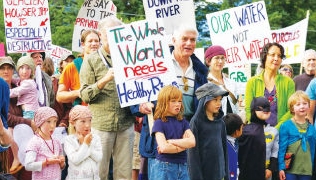 Click here to play video. |
Opponents of the proposed Glacier/Howser private hydro project crammed into a school gym in Kaslo, filling every chair, lining the walls and sitting on the floor during a project open house on June 23.
Many people in Nelson were disappointed they had to travel so far to the meeting, despite numerous requests and petitions to the BC Environmental Assessment Office asking the meeting be held in Nelson.
During the meeting West Kootenay Society spokesperson Lee-Ann Unger again asked the EAO to reconsider the decision not to meet in Nelson.
Project Assessment Director Garry Alexander noted that many people there were from Nelson.
“I see many good comments here coming from the people of Nelson,” he said.
“At this time I don’t see a need to reconsider.”
The EcoSociety sent about 125 supporters up to Kaslo on school busses and many more Nelsonites made the trip themselves.
After the meeting Unger estimated about half of the more than 1,200 people at the meeting were from Nelson.
Nelson-Creston MLA Michelle Mungall made the trip. She put her question to the EAO late in the meeting, explaining it had been her intent to just listen to what her constitutes were saying, but felt the need to get up to address the panels.
“Walking in here we were worried that we were going to be dismissed as a bunch of hippies, a bunch of people who are just angry,” she said. “But what you’re seeing here tonight is incredible passion and fervor for the land we live on.”
It wasn’t just figure heads who waited in the long line to have their turn to speak.
Sandra Nelkin, an 11-year resident of Nelson, expressed her concern about the project generating more power than the Kootenays could use and asked how much would be sold to the United States.
Simon Gourdeau from Axor couldn’t answer her question. He said that would be up to BC Hydro who, he said, would benefit greatly from the project.
“BC Hydro structured the project, so it will never lose a penny on this,” he said. “We’ll always sell it to BC Hydro at 70 per cent the market rate. They will always be getting the power cheaper than they could if importing it.”
After the meeting, Nelkin said she was very disappointed by the response from Axor and said they seemed to dodge her question.
“It’s a very flawed process,” said Nelkin.
This sentiment was expressed by many of the project opponents who asked why there wasn’t an independent third party in the room.
The open house had a panel of representatives from Axor, the proponent and hopeful owners for the project, and a second panel of environmental officers.
Axor was scheduled to make a presentation about the project. However, the school closed at 10:30 p.m., leaving a long lineup of people still hoping to speak in the first scheduled question period, which began at 7:30 p.m.
After the meeting, Alexander said while it was unfortunate that speakers were cut short and Axor couldn’t present, they had no plan to return to Kaslo to finish the meeting.
“I think everybody had lots of opportunity to gather information and at this time they can still submit comment by e-mail,” he said.
He said the meeting was a little bigger than he expected and many people were asking questions outside of the scope of the project, such as asking about the energy planning or suggesting conservation measures in place of further development.
These comments, he said, wouldn’t be included in his summary to the minister, however anything related to the project would be in the review and also addressed on their website.
Throughout the meeting people were yelling and cheering from the gallery to express their dismay over the project. Alexander noted this meeting was a little rowdier than most that he saw on this project.
Unger said she hopes the panels got the message that people of the Kootenays don’t want this project.
“You can run, but you can’t hide in the West Kootenay,” said Unger. “They tried to avoid public input by avoiding a meeting in a more populated area and it simply didn’t work.”
People who missed the public meeting in Kaslo can download a copy of the application and information about the environmental assessments at eao.gov.bc.ca.
Comments can be e-mailed to glacier.howser@gov.bc.ca or sent by post to Garry Alexander, Project Assessment Director / Environmental Assessment Office / PO Box 9426 Stn Prov Govt / Victoria, BC V8W 9V1
June 26, 2009
New study underscores the importance of recycling and composting in achieving Zero Waste in Greater Vancouver
News Release
Belkorp
June 25, 2009
New study underscores the importance of recycling and composting in achieving Zero Waste in Greater Vancouver
Selecting appropriate disposal option critical to bridging gap to Zero Waste
VANCOUVER, June 25 /CNW/ - A recently completed study by Dr. Jeffrey Morris of Sound Resource Management Group, Inc., a noted international economist and life cycle analysis expert, found that recycling and composting in Greater Vancouver far outweigh disposal in terms of mitigating the environmental impacts associated with products and materials in the waste stream.
The study examined two different scenarios: a base case (status quo as of 2008) and a Zero Waste scenario, the latter of which assumes that waste diversion was increased from the current 53% level to beyond 80% over a 20 year planning horizon.
Achieving the Zero Waste objective Dr. Morris identified in his study will result in a reduction of over 4 million tonnes of greenhouse gases.
Dr. Morris's conclusions point to the need for a Zero Waste strategy that prioritizes the diversion of all organic waste to composting systems, maximizes the effectiveness of existing recycling programs and initiatives, and accelerates the development of new diversion efforts such as Extended Producer Responsibility (EPR) initiatives.
Given these conclusions, Dr. Morris stressed that disposal options, such as landfilling and incineration, should be seen only as an interim solution necessary to bridge the gap between the present situation and a zero waste objective.
"Disposal options must be assessed in terms of their flexibility and whether they will facilitate or hinder the achievement of zero waste," said Dr. Morris. "Under these conditions, we found that disposing of municipal solid waste in landfills better meets this objective compared to incineration in three key environmental impact areas - climate change, human health and ecosystem toxicity."
The study was commissioned by Belkorp Environmental Services to assess the environmental impacts associated with the existing solid waste management system in Greater Vancouver. Copies of the Morris Study will be available online at www.belkorp.com.
"Dr. Morris is a global leader in life cycle analysis and his work sheds new light on the environmental impacts of disposal options at a time when our region is making critical decisions about its solid waste future," said Ted Rattray, President, Belkorp Environmental Services. "We will be sharing his work with Metro Vancouver, the BC Ministry of Environment and other interested stakeholders, such as the Recycling Council of BC, to add to the body of knowledge on this issue and to help ensure we are collectively making informed decisions about our solid waste future."
Belkorp Environmental Services is currently involved in recycling and waste disposal services in Greater Vancouver and actively supports the adoption of a zero waste philosophy by Metro Vancouver. Belkorp designed and built the first cardboard recycling plant of its kind in BC. It also built the first newsprint de-inking and recycling facility in the province, owned and operated a used oil recycling plant in North Vancouver, and was part owner of an organics composting facility that was eventually bought by the Village of Whistler and relocated in Whistler.
The company's subsidiary, Wastech Services Ltd., handles municipal solid waste under contract to Metro Vancouver, operating four waste transfer stations and the Cache Creek Landfill. Wastech also operates a cardboard baling facility, a wood waste recycling facility and recycling depots at each of its transfer stations.
In this study, Dr. Morris applies a comprehensive life cycle analysis approach to the assessment of two scenarios for managing municipal and demolition/construction solid waste streams generated in Greater Vancouver.
Life cycle analysis as applied to solid waste management systems is a technique for assessing cradle to grave environmental impacts associated with production, use, and discard of products and materials in our society.
A fact sheet outlining the key findings from this report is available at www.belkorp.com.
Dr. Morris was the keynote speaker at the Recycling Council of British Columbia (RCBC)'s 2009 Conference.
For further information:
Dr. Jeffrey Morris,
Sound Resource Management Group, Inc.,
(360) 867-1033,
jeff.morris@zerowaste.com;
Saphina Benimadhu,
Longview Communications Inc.,
(604) 694-6036,
sbenimadhu@longviewcomms.ca
Companies have big plans for Metro's garbage
Rebecca Tebrake
Vancouver Sun
June 26, 2009
One proposal would burn waste in a long-closed pulp mill in Gold River to generate electrical power
As Metro Vancouver inches closer to deciding what to do with its garbage, some of the companies offering potential solutions are doing their best to be noticed.
Today, it's the turn of Covanta Energy and Green Island Energy, two companies that planned to unveil an update of a plan to turn a long-closed pulp mill at Gold River into a garbage incinerator.
They are promising that the plan to burn Metro's garbage in one of Vancouver Island's most depressed regions could create 130 permanent jobs, $30 million in annual economic activity and a $500-million boost during construction.
Covanta wants to convert the Bowater Mill, which closed in 1999, into an incinerator at a cost of up to $550 million.
It would then take 700,000 metric tonnes of Metro Vancouver's garbage a year to the island by barge, burn it and convert it into 90 megawatts of power, said Covanta vice-president Tom Lyons.
The site already has the power lines needed to funnel the energy into the provincial power grid.
Municipalities would have drop off their garbage at the Port of Metro Vancouver.
The proposal is one of dozens that have come forward since Metro Vancouver starting looking at options to deal with the region's solid waste. Today's announcement builds on a proposal made to Metro in 2006 during an earlier search for garbage solutions.
Even though it's working toward a goal of diverting 70 per cent of the material now in the garbage stream, by 2015 the region will still have
1.125 million tonnes of garbage a year to get rid of, Metro spokesman Bill Morrell said.
The Cache Creek landfill, where much of Metro's solid waste now goes, is expected to be full by the end of next year.
Metro Vancouver is looking at eight broad options to deal with solid waste that can't be diverted, including landfills and energy-to-waste facilities such as the Gold River incinerator.
Covanta says it will invest in the Gold River facility only if it scores a contract with Metro. However, Morrell said the region isn't looking at specific proposals right now, but trying to determine in which direction to go.
"There's a lot of good ideas out there," said Morrell. "How applicable [the solutions] all are in our particular situation, that's what the technical people are looking at right now."
But that's not stopping companies in the waste disposal business from blowing their horns.
Meanwhile, Belkorp Industries Inc., an environmental services company that owns Wastech and the Cache Creek landfill, has produced a study saying recycling and composting are the most environmentally friendly way to manage solid waste. Besides the landfill, Belkorp has interests in technology to do that.
The Metro garbage debate is likely to keep raging until September -- when the region releases a draft of its new solid-waste management plan -- and beyond.
Critics such as Monica Kosmak hope the plan won't include incineration plants such as the one proposed at Gold River. "Incinerators emit dioxins, furans, and heavy metals like mercury," said Kosmak, an independent waste consultant. "Those are carcinogens."
Covanta has been fined $68,278 for emissions violations in New Jersey, Massachusetts and Pennsylvania.
"We are in compliance 99.9 per cent of the time," said Brian Bahor, Covanta's vice-president of sustainability. "Our goal is 100, but it's undeniable that at some points in time you exceed your stack limit."
Covanta said the Gold River facility will be equipped with state-of-the-art emission control systems and will meet or exceed federal and provincial emissions standards.
Kosmak said that doesn't mean much. Standards are set based on the best levels of technology, not safe levels of exposure, she said. As well, chemicals that don't make it out of the smoke stack end up in the fly ash, which has to be buried and can leach into water systems.
June 19, 2009
Energy producers make $178-million bet on B.C. shale gas play
COMMENT: These petroleum and natural gas rights auctions happen every month. Sometimes they are huge. The biggest sale was for $610 million in July 2008. This month, June 2009, was for $176 million, the biggest sale in 2009, by far - all other months have been well under $20 million. Nobody is interested in oil - they're all after gas and the big shale plays are what's hot.
ExxonMobil in its own right, and its Canadian subsidiary, Imperial Oil, are big buyers in the June auction. Of $176 million in drilling licences, Exxon spent $116 million. The block of rights are just north of Fort Nelson, in the Horn River shale area. A block smack in the middle of the Exxon acquisition was bought by an agent for $62 million. Buying for?
Globe and Mail
Jun. 19, 2009
Amid a supply glut of natural gas, companies have slapped down a surprise $178-million bet in British Columbia on the long-term future of the commodity.
In the first significant spend in Western Canada this year, the money is for new exploration rights to the hot Horn River play in northeastern B.C.
While the surprise spending isn't a major reversal of the industry's funk, it does signal that energy producers still believe in long-term demand for natural gas, despite the crash in prices. And key players in the business are now convinced that politics will help underpin that demand, marketing the commodity's ample availability, and its locally sourced and cleaner nature, compared with coal or imported oil.
Even with the unexpected haul for the provincial treasury, this year's take is way down: B.C. is on pace for an 80-per-cent decline in sales of new rights from last year's record and Alberta faces a similar slide, looking at its worst year since 1992. Saskatchewan is down 97 per cent from a record last year.
“[The decline] reflects the state of the industry,” said Gregg Scott, president of Scott Land & Lease Ltd., a large land-acquisition consultancy.
Horn River epitomizes the problems of the present and the promise of the future. A shale play, it could be the largest gas discovery in Canadian history.
It is barely developed, but exploitation of similar geology in Texas and Louisiana is much further advanced.
Last year, a surge from those plays spiked gas supply in the United States by 7.1 per cent, the biggest such gain in decades. The volume of new supply was unforeseen. After a long plateau, most industry leaders and analysts believed there would be a peak and subsequent decline in production. The industry spent money on expensive liquefied natural gas facilities to import overseas gas.
The burst of additional supply then ran head-long into lower demand, as the recession sapped thirst for the fuel. The price sank so far that producers have been capping thousands of wells because they are not profitable at current prices. Supply has climbed another 2 per cent this year.
But even though low prices and ample supplies are hurting sellers of gas, new discoveries of vast reserves could be good news, said Peter Tertzakian, chief energy economist of ARC Financial and author of the new book The End of Energy Obesity .
In recent years, tight supplies have led to acute price spikes, discouraging more widespread use of the fuel. If shale supplies are as ample as predicted, such swings might be quelled. The fuel is cleaner than coal and oil, and doesn't have to be shipped to North America from the Middle East, making the supply more secure – and keeping investment dollars closer to home. Gas is also usually relatively affordable, compared with oil.
These are all important political features that could see gas gain market share in electricity generation, Mr. Tertzakian said.
Industry groups – including the Canadian Association of Petroleum Producers – rushed yesterday to call gas “the fuel of the future,” “clean-burning,” and “sustainable,” after a U.S. report this week suggested new shale gas fields could supply current American demand for 100 years at current consumption rates. [see Report]
A lot more drilling has to be done to demonstrate the reserves are as large as suspected. Other issues, such as the environmental impact of new drilling techniques on the water supply, must also be resolved and could moderate the pace of development, said commodity price analyst Martin King of FirstEnergy Capital. [see Fracing]
Mr. King projects prices will become much more reasonable in the next three years or so, with a ceiling of $7 (U.S.) to $9 per 1,000 cubic feet – far less than recent price spikes of $14 and $15, but still enough for sellers to make money.
For now, the current benchmark price of about $4 could fall – and the rest of the year looks bad for sellers of gas, Mr. King added.
In B.C., the government celebrated yesterday's auction of Horn River rights as an endorsement of the region, even in a recession. But the energy world has changed, said Blair Lekstrom, the province's Energy Minister. Though B.C. once considered Alberta its chief rival, the government now sees Texas and Louisiana as the real competition when crafting policies to encourage business activity. Horn River producers have applied for a new ultralow royalty program, saying it's necessary because the region is remote and far from market.
“We look at all jurisdictions involved in this,” Mr. Lekstrom said. “Our goal is to be the most competitive jurisdiction in North America,” Mr.
Lekstrom said.
June 10, 2009
Carbon tax no cash cow in its first year
DERRICK PENNER,
Vancouver Sun
June 10, 2009
The provincial government paid out $38 million more in carbon tax breaks to British Columbians than it collected in carbon taxes in the first year of the climate-change initiative's implementation.
However, how much British Columbians reduce their carbon production won't be known until the province starts reporting its emissions figures to the federal government in the coming years, a conference on the carbon tax heard Tuesday.
"That [reporting] hasn't started yet," said John Robinson, one of the conference co-chairs. "The next few years will tell the tale."
Another difficulty, Robinson added, is that it will be difficult to tell how much of carbon reductions that B.C. sees will be related to the tax, and how much should be attributed to other factors.
The simplest measure of reduced carbon emissions will come from a reduction in energy use, Robinson said, and there won't be "a flashing green light saying [this part of the reduction] is caused by the tax."
The conference, titled Decoding Carbon Tax Pricing, is being staged by the Pacific Institute for Climate Solution, a collaboration of the University of Victoria, University of B.C., University of Northern B.C. and Simon Fraser University around the first anniversary of the controversial tax.
The intent of the conference, which began Monday and runs through today, is to review what industries and institutions are doing in response to the tax and to other B.C. climate-change initiatives.
Robinson, a professor at the Institute for Resources, Environment and Sustainability at UBC, said B.C. appears to be coping fairly well with the carbon tax in its first year.
Although the tax is intended to be revenue-neutral, British Columbians actually received more money out of the climate initiative's attendant tax cuts than the provincial government received in carbon tax revenue.
Glen Armstrong, assistant deputy minister in the finance ministry outlined those numbers from the February provincial budget.
The provincial budget showed $300 million in carbon-tax revenue for fiscal 2008-09, some $38 million less than estimated due to factors including lower than expected gasoline consumption.
However, the income tax cuts associated with the carbon tax to make sure the initiative was not a cash cow for government totalled $338 million -- 70 per cent of which went back to individuals.
B.C. Transmission Corp. receives approval for 255-km power line
Vancouver Sun
June 10, 2009
Several more hurdles need to be cleared before project proceeds
The British Columbia Transmission Corp. on Tuesday received provincial environmental approval for its $602-million power transmission line between the Interior and the Lower Mainland.
The plan to build an additional 255-km 500-kilovolt power line from its Nicola substation near Merritt to its Meridian substation in Coquitlam is designed to keep up with expected demand growth in the province's most populous region.
However, in granting the approval, Environment Minister Barry Penner and Blair Lekstrom, Minister of Energy, Mines and Petroleum Resources, said BC Transmission will have to minimize habitat loss for the northern spotted owl and secure a wetland site for the Oregon spotted frog. It will also have to provide funding for the Ministry of Forests to help mitigate the loss of timber harvesting land resulting from the project.
The loss of spotted owl habitat was a key concern of environmental groups when the new power line was first proposed, given that there were only seven owls living in the wild within the region at the time.
The environmental approval is only one hurdle of several the project has to clear. A news release from the Ministry of Environment noted that BC Transmission still needs to secure provincial licences, leases and a certificate of public convenience and necessity from the B.C. Utilities Commission.
The province has also committed to more discussions with first nation communities, which have been critical of the provincial environmental assessment process for not addressing impacts of earlier transmission-line construction on the proposed route.
The line would use existing BC Hydro rights of way for most of its length, but would require 74 km of new right of way to be cleared and widening of the right of way for another 60 km. BC Transmission wants the project completed by 2014.
© Copyright (c) The Vancouver Sun
Environmental Assessment Office (EAO) webpages for the
Interior-Lower Mainland Transmission Project
June 09, 2009
Support for run-of-river projects runs along party lines
By Sam Cooper
The Province
June 7, 2009
NDP fear private power will lead to demise of B.C. Hydro
 The clean-power industry is booming and B.C. is a world leader. Photograph by: Reuters, The Province |
IPPs are private power companies that compete to sell energy to B.C. Hydro. Of 48 IPPs currently operating in the province, most are run-of-river. In the future, wind, solar, geothermal and ocean power are expected to join the IPP mix.
Rather than using the giant river dam/reservoirs traditionally used for power generation, run-of-river technology diverts water with smaller blockages, channeling it through pipes, usually over several kilometres, with steep vertical drops. Rushing water shoots through energy-capture turbines before re-entering the river.
Proponents say these "micro-dam" operations reduce environmental impact -- critical to a provincial Liberal government that has called for more and cleaner power in a push to make the province energy self-sufficient by 2016, while also meeting aggressive targets for greenhouse-gas emission reduction.
The Independent Power Producers Association of B.C. (IPPBC) says it now has 320 member companies, up from 22 in May 2001.
There are currently 580 water-licence applications for rivers across the province by IPPs.
The IPPBC says B.C. Hydro has identified 900 small hydro sites for potential development.
IPPs supply power to 500,000 homes in B.C., contributing about 10 per cent of B.C.'s total system capacity, IPPBC says.
B.C. political parties are starkly divided on IPPs, with the NDP calling for a moratorium on run-of-river operations and the Liberals pushing for increased use.
IPPBC head Steve Davis says that within 10 years the B.C. IPP industry could rival provincial resource giants like forestry or mining for market size.
IPP critics say the projects are not as green as some claim, as wilderness is despoiled and wildlife destroyed with construction of service roads, power lines and water pipes.
NDPers charge IPP promotion is a government ploy to privatize B.C. Hydro. But the Liberals say increased competition from IPPs will keep energy costs down and that environmental assessment standards ensure only the best projects move forward.
Dr. John Nyboer, a Simon Fraser University energy expert, says that as governments around the world face climate change and scarcity of fossil fuels, the "rate of investment in alternative energy is skyrocketing. The last few years in B.C., it's been booming."
But any method of energy production, including run-of-river, has tradeoffs and "pros and cons on all environmental sides," Nyboer says.
© Copyright (c) The Province
Political and industry insiders are jumping ship to IPPs
By Sam Cooper
The Province
June 7, 2009
B.C. Liberals, Hydro personnel head up independent firms
Are B.C. Liberals and independent power producers too cozy? Consider these facts and figures.
Since Gordon Campbell took power in 2001, IPPs have given his party at least $850,000.
That figure is sure to shoot to more than $1 million when donation records for the May 2009 election are released, says NDP environment critic Shane Simpson.
The Independent Power Producers Association of B.C. says membership jumped from about 20 companies in 2001 to 320 in 2009.
And as the number of IPPs and lucrative B.C. Hydro "energy-purchase agreement" contracts mounts under Campbell's watch, boardroom and staff lists of B.C.'s biggest IPPs increasingly resemble alumni associations of B.C. Liberal and B.C. Hydro grads.
No company has scooped more Liberal insiders than Plutonic Power Corporation, a B.C. run-of-river upstart now partnered with U.S. giant General Electric.
Here are some of the company's executive B.C. Liberal grads: Tom Syer (former deputy chief of staff to Premier Gordon Campbell), Dave Cyr (former aide to Mike de Jong, then Liberal minister of aboriginal relations), Bill Irwin, (former ministry of tourism staffer) and Robert Poore (former executive assistant to then-revenue minister Rick Thorpe).
Plutonic Power Corporation has donated $99,781 to the B.C. Liberals since 2006, including 2009 donations released to The Province by spokesperson Elisha McCallum.
Individuals from Plutonic have also made donations, with CEO Donald McInnes handing at least $30,000 to the Liberals since 2001.
But hefty donations and legions of former Liberals don't equal government favouritism for Plutonic, McCallum says.
"Our CEO had the vision to find the people with the best skills," McCallum says.
"There is no preferential treatment provided to us. The insinuation that there is some conspiracy theory is ridiculous."
Other insiders who've assumed leadership in the IPP world are: Geoff Plant (former attorney-general, now chair of Renaissance Power); Naikun Wind CEO Paul Taylor (former CEO of ICBC and a deputy finance minister); Stephen Kukucha, president and CEO of Atla Energy (former senior policy adviser for the ministry of environment); Bruce Young (former B.C. Liberal campaign manager, now a director of Atla Energy); Bob Herath (former ministry of the environment staffer now with Syntaris Power); and Alexander Kiess (former project supervisor with B.C. Hydro, now consulting as a project supervisor for Syntaris Power).
In a Province interview, Blair Lekstrom, minister of energy, was asked whether the exodus of Liberal insiders to IPPs might suggest undue influence by the industry.
"I'd take great offence if someone suggested that," he said. "I'm not influenced because of who someone is or where they used to work."
IPPBC head Steve Davis also brushed aside suggestions the government is too cozy with IPPs.
"The protections for the public are huge and already in place," he said.
"Every single [EPA] contract must be reviewed by the B.C. Utilities Commission."
© Copyright (c) The Province
Private power industry is booming in B.C., but is that a good thing?
By Sam Cooper
The Province
June 7, 2009
Stock prices are soaring, but some say run-of-river hydro isn't clean
 Plutonic Power Corporation's Toba Valley project gets under way. Plutonic's run-of-river project near Bute Inlet has environmentalists screaming about 'pristine wilderness' being despoiled and 17 streams and rivers being muddied. Photograph by: Jason Payne, The Province, file, The Province |
Gordon Campbell wasn't kidding when he warned that the future of B.C. was at stake in the last election -- or at least its energy future.
The fate of a booming clean-energy industry worth up to $14-billion hung in the balance as taxpayers headed to the polls May 12.
So did the fate of B.C. Hydro. And the power bills almost everyone pays each month.
During the campaign, the NDP had promised to slap a moratorium on private-sector run-of-river power companies if they won.
A Liberal win would mean full-steam ahead for companies like Plutonic Power Corporation, purveyors of a controversial $4-billion, 1,027-megawatt proposal on the Bute Inlet north of Powell River that has environmentalists screaming about "pristine wilderness" being despoiled and 17 streams and rivers being muddied.
With Gordon Campbell's Liberal victory, Plutonic stock exploded for a 21-per-cent gain on the post-election morning of May 13, reaching market capitalization of about $170 million. Company shares had surged from a low of $2.08 on May 1 to a high of $3.81.
One Plutonic shareholder on the investor website Stockhouse.com summed the action up like this: "Good to see BC stays Liberal, dam tree hugging Ndp'ers are bad for business . . . lol." So were they popping champagne corks at Plutonic's Vancouver headquarters on May 13 as company stock rocked? "No," spokesperson Elisha McCallum says flatly.
McCallum is one of a number of ex-B.C. Hydro employees and former high-level Liberal party staffers now working for Plutonic.
"We were hopeful [for a Liberal win] and very supportive of the party," she acknowledged last week. "There was a sense of relief the day after the election." That relief was shared by the entire industry, says Steve Davis, head of the Independent Power Producers Association of B.C., which represents 320 IPPs.
With the Liberal win and a pending B.C. Hydro energy-acquisition plan due in July, there was a potential for $5 billion in direct IPP investment -- on top of $5 billion for existing projects and further billions in indirect investment, Davis told The Province.
NDP energy critic John Horgan says the biggest election victory May 12 didn't go to Gordon Campbell, star rookie Liberal MLA Kash Heed or even upset Independent winner Vicki Huntington.
"It [went to] Plutonic," Horgan said. "Now they're set to go into Bute Inlet and do a $4 billion project that will lead to billions in revenue -- and all for stakeholders and Liberal insiders."
Project critics like the Raincoast Conservation Society's Chris Genovali say that with cumulative damage, the Bute proposal could be as intrusive as a giant dam.
But as McCallum and industry supporters point out, environmentalists don't all oppose the projects. Some prominent voices, such as Tzeporah Berman of PowerUP Canada, have come out in support of IPP projects as a valuable expansion in renewable power.
Still, NDP environment critic Shane Simpson insists the Liberal IPP push is unleashing "a gold-rush mentality."
"There is phenomenal wealth to be made and the provincial government is prepared to set aside the environment," Simpson says.
Dr. John Nyboer, a Simon Fraser University renewable-energy and climate-change expert, says he wouldn't label B.C.'s sprouting IPP industry an "exorbitant" gold rush -- but he notes that as in any gold rush, anyone can try to hop aboard the IPP gravy train.
"It's hard to keep track of how many IPPs there are in B.C.," Nyboer says. "You can put a single solar-power cell on the roof and register [as an IPP]."
Nyboer says investment in renewable energy has skyrocketed in the last 10 years, and especially since 2006 in B.C.
But alternative-energy sources cost more to develop than traditional sources, so hydro ratepayers pay tariffs to "level the playing field."
Nyboer points to Germany, a world leader in IPP development that also tops Europe for electricity prices. "Going renewable is an investment," he says. "It may serve Germany well, depending on what you see happening with tomorrow's energy supply."
In other words, if world governments unify for tough carbon-emission restrictions, renewable energy leaders like Germany and B.C. could corner power markets.
But with the current global economic slump, B.C.'s government may have locked 20- to 40-year IPP energy purchase agreements (EPAs) in too high, says Horgan.
"B.C. Hydro recognizes the industrial load is going in the toilet," he says. "Every time a mill closes, energy demand decreases."
Horgan says B.C. ratepayers are already on the hook for about $30 billion in "unfunded liabilities" in EPAs.
In the worst-case scenario, B.C. Hydro will "be forced" to buy too much electricity from IPPs at premiums of up to $125 a megawatt, when they can produce it for $50 a megawatt. Demand will continue to decrease and power will be dumped to the U.S. for $50 or less a megawatt.
"Why buy high and sell low?" Horgan says. "If the trend line continues, the costs to ratepayers will be enormous."
B.C. Hydro could even go under, he warns.
"The shareholders in these IPP companies will be rubbing their hands together -- and people with electric heat are going to be rubbing their hands to stay warm, because they won't be able to heat their homes."
Blair Lekstrom, B.C.'s Minister of Energy and Mines, disputes the NDP's numbers. He says he believes the existing IPP contract commitment for B.C. ratepayers is about $21 billion.
But he admits that number could jump to as much as $60 billion with B.C. Hydro decisions due this summer.
E-mail reporter Sam Cooper at scooper@theprovince.com
© Copyright (c) The Province
June 03, 2009
Propaganda pipeline
Gordon Hoekstra
Prince George Citizen
Friday, 29 May 2009
 Propaganda pipeline - The Stewart River near Fort St James, close to where the Enbridge Pipeline will cross the river, is shown in this file photo. (Citizen file photo by Brent Braaten) |
Enbridge is footing the bill for a northern advocacy group to generate community support for its proposed $4.5-billion project The recently-formed Northern Gateway Alliance which is advocating support for Enbridge's $4.5 billion pipeline through northern B.C. is the brainchild of Enbridge and is being bankrolled by the company, The Citizen has learned.
The Alliance was rolled out earlier this month during the North Central Municipal Association's annual convention as a community coalition in support of the Enbridge project. It has also been billed as a "grassroots" group designed to create a voice for the North. Community leaders who have signed on include Prince George mayor Dan Rogers, Mackenzie mayor Stephanie Killam and Kitimat mayor Joanne Monaghan.
The recent announcement made no mention of Calgary-based Enbridge's involvement.
But it is not the communities that are paying the bills, setting up the website or organizing the group's activities. It is Enbridge.
In fact, the chair of the Northern Gateway Alliance, former Prince George mayor Colin Kinsley, is on Enbridge's payroll.
Neither Enbridge nor Kinsley deny that Enbridge is bankrolling the Alliance, and that the community group was the company's idea.
"It's what Enbridge engaged me to do," says Kinsley.
But the North American pipeline giant denies they are engaging in "astroturfing" -- a term that describes companies that fund or create seemingly grassroots organizations to give their cause legitimacy.
Enbridge spokesperson Steve Greenaway said that characterization is unfair. "I'm not willing to accept that we are somehow trying to do this from the top down. We have gone to community after community after community to explain the details of our project and we will continue to do that," he said.
Asked if the company was being dishonest in spearheading the creation of a so-called grassroots organization, Greenaway said no.
"I don't think it's fair to say that we're putting words in anyone's mouth. Those people are coming forward voluntarily and allowing, you know, allowing, quotes to be placed on our website," said Greenaway. (The quotes from mayors like Rogers and Killam are posted on the Alliance website).
"I think it's important that all voices are heard in this debate, and I think in terms of, you know, support we have provided through compensating a chair who is going to assemble a board of community leaders across the pipeline, to characterize compensating him for part-time work, as somehow, is anything untoward about that, is unfair," said Greenaway.
He would not say how much Enbridge is spending on the creation and support of the Alliance, but did acknowledge that Kinsley was being paid by the company, which was also offering administrative support to the Alliance effort.
Kinsley acknowledges it could be argued the Alliance is not a grassroots organization if Enbridge has hired him to create it, but said that somebody has to lead it. "It's a great deal of work, and an immense amount of travel."
Kinsley also argues that the intent of the Alliance is to support the pipeline project proceeding to the regulatory review where questions can be asked by northerners. (Only once has the National Energy Board, one of the project's reviewing agencies, rejected a major project, the Sumas 2 energy plant near the B.C.-Washington border).
"We want to make sure this thing isn't stopped in its tracks," says Kinsley. But the former mayor's enthusiasm for the project is hard to hide.
He defends the merits of the project by rolling out stock Enbridge arguments, pointing to a focused economic regional impact, lauding a trust Enbridge plans to create for community projects, maintaining there is no oil tanker moratorium on the coast off Kitimat and calling the federal government review process robust. "It's probably the most sophisticated approach to a major project such as this, that's ever been undertaken," he says.
Kinsley makes a similar pitch on the Alliance's website.
"This will be an outstanding project and it will have economic benefits that are untold for northern B.C. and Alberta, for both aboriginal and non-aboriginal communities," he says in a short video on the site.
Kinsley plans to take this message to Rotary Clubs, chambers of commerce, town councils and regional districts, as well as construction and contractor associations. Also in the works is an educational package targeted at school children.
He's also encouraging supporters to sign up on the Alliance's website.
So far, under 200 supporters have signed up.
Even a casual inspection of the Alliance and the Enbridge Northern Gateway Pipeline's websites show startling similarities.


The design of both websites is similar, including the type faces, the muted green colour scheme and the positive messages on the project.
Identical messages cycling on both sites proclaim: Enbridge is a Canadian company that has been safely building, operating and maintaining pipelines for 55 years; Thousands of direct and indirect jobs will be created to support the construction and operation of the Northern Gateway pipeline, benefiting workers in northern B.C. and Alberta.
There are about 20 messages.
The logos on both sites are also very similar with an identical stylized green leaf. There's also a direct link from the Alliance website to the Northern Gateway Pipeline website.
There's little doubt that Enbridge's effort to create the alliance is aimed directly at environmental groups who do not support the project.
Kinsley argues that environmental groups are not local groups and are funded by U.S. foundations. Greenaway offers a similar argument.
An environmental group that is based in the North, the Terrace-based North West Watch, is dismayed by Enbridge's recent tactics in creating the alliance. North West Watch representative Julia Hill noted she just recently learned of the term "astroturfing" to describe this type of activity.
According to SourceWatch, a project of the Madison, Wisc.-based Center for Media and Democracy, "astroturfing" refers to apparently grassroots-based citizen groups or coalitions that are primarily conceived, created and/or funded by corporations, industry trade associations, political interests or public relations firms.
Texas Sen. Lloyd Bentsen, a longtime Washington and Wall Street insider, is credited with coining the term.
There are numerous examples of the practice in the U.S. including its use to block health-care reform and to oppose restrictions on smoking in public places.
Closer to home, the B.C. Forestry Alliance was created as a citizens' group in the early '90s to improve the image of the forest sector, where it faced criticism from environmental groups on logging in the southwest of B.C. The group was funded by the forest industry whose members also sat on its board.
North West Watch recently applauded Terrace mayor Dave Pernarowski for pulling out of the Northern Gateway Alliance. Pernarowski had objected to the wording on the alliance's site that indicated unqualified support for the pipeline project.
North West Watch and Friends of Wild Salmon are calling for an independent public inquiry into the pipeline project similar to one held in the late '70s.
Carrier Sekani Tribal Council chief David Luggi is not surprised by Enbridge's tactics. "I think Enbridge is using (Kinsley) as a pivotal PR point," observed Luggi. "It's a PR (public relations) machine firing up on all cylinders."
The Carrier Sekani Tribal Council has been calling for a separate government-funded, First Nations-led review process to assess major projects in their traditional territory.
In 2006, First Nations, which included the tribal council, had requested $2.4 million from the federal government to spearhead their own review of Enbridge's proposed pipeline. Later that year, the tribal council filed a federal court challenge of the federal government's decision to send Enbridge's proposed pipeline to a review panel. The tribal council wanted the court to overturn the creation of the panel because they said they were not consulted.
Rogers, the Prince George mayor, who has signed up with the alliance, says he is under no illusion that the group is a creation of Enbridge.
"I think that everyone understands that is participating is that it's being driven by Enbridge. No surprises there," says Rogers. "It's PR strategy."
Nevertheless, Rogers is comfortable being associated with the alliance, saying Enbridge is looking at signing up those that believe there may be benefits because there will be those that are adamantly opposed.
Rogers says he is supportive of the project moving to the review stage.
"I'm not afraid as the mayor of B.C.'s northern capitol to reiterate, as the largest centre in the northern region, there are some economic benefits that could flow to our community," he said. "We want a stake in those discussions and to participate in those discussion as it unfolds."
Rogers said the city has not put any money into the alliance.
Project information
- The 1,170-kilometre pipeline is proposed to carry oil from the Alberta oil sands to Kitimat where it will be exported to regions like Asia and California. A twin pipeline will carry condensate, an oil thinner, back to the Alberta. The thrust behind the project is to create an offshore export outlet for oil produced from the Alberta tar sands which normally flow south to the interior of the United States.
- The project was shelved in late 2006, but was put back on the front burner in 2008 this year when Enbridge secured $100 million from western oil producers and key Asian refiners to get the project through a joint regulatory process with the National Energy Board and the Canadian Environmental Assessment Agency.
- The environmental assessment process could take two years or more to complete.
- Key issues in the complex project -- described as the largest crude-oil pipeline expansion in North America -- include mountainous terrain, hundreds of river crossings and a tanker terminal at Kitimat.
- Thousands of workers will be needed during the two-and-a-half years of construction, but relatively few when complete. Probably about 50 workers in Kitimat and a handful of workers along the route in a few communities.
Tar sands and coast focus of forums
Kitimat Sentinel
June 03, 2009
Oil sands and the risk to BC’s coastline was the topic for two-authors at the end of a five-day tour of BC’s northwest.
In a series called “A story with two ends”, Ian McAllister, author of The Great Bear Rainforest and most recently The Last Wild Wolves of the Great Bear Rainforest, together with business journalist Andrew Nikiforuk, who authored Tar Sands: Dirty Oil and the Future of a Continent, presented a packed room at the Rod and Gun Club with what pipeline development will mean not only for the local ecosystems but also for the nation-at-large.
Approximately 100 people attended the forum on Friday evening.
“I’m not here to tell people whether to be for or against the Enbridge pipeline,” Nikiforuk told the Sentinel. “But this is no ordinary pipeline. It’s connected to the world’s largest energy project.”
Enbridge is proposing to construct a twin-pipeline from Alberta, just north of Edmonton, to Kitimat. A 36-inch pipeline will export bitumen to a marine terminal proposed to be built in Kitimat while a 20-inch pipeline will send condensate east.
Condensate is a diluent which makes piping the petroleum easier.
Nikiforuk said his involvement in the tour was to provide the “big picture” of tar sands.
Through previous forums he said he found that some people are shocked at the scale of tar sands development and most people don’t realize that Canada is the number one supplier of oil to the United States.
Opening up markets for the bitumen overseas presents some problems for job creation, he explained. He estimated that for every 400,000 barrels of oil a day that Canada exports, the country is also exporting 18,000 jobs.
“Rather than upgrading and refining the bitumen in Alberta we would be putting it in a pipeline and shipping it off for upgrading and refining either in Asia or southern California,” he said.
No public policy currently exists for adding value to bitumen here in Canada.
“We’ve got this new export staple and we’re repeating the same mistakes we made in the lumber industry,” he continued. “We’ll just export all these raw logs, we won’t bother adding any value.”
He said that tar sands shouldn’t even be developed until a Plan B is in place for investing in renewable energy.
“We should have had a plan b in place long before people started pointing fingers.” “You don’t invest $200 billion into the development of bitumen without having at least a $100 billion investment in renewable, climate change action and fossil fuel reduction in the country.”
According to Nikiforuk, if Canada is still on the tar sands resource in 30 years time “we’re going to fail as a civilization.”
National policy and sands development aside, the coastline of BC has much to lose from the arrival of a pipeline and the increase in tanker traffic, says McAllister.
He said he has seen the area where the Exxon Valdez tanker spilled its oil and said there was far more room there than there is on the outskirts of the Douglas Channel.
He also said that models have shown that if a tanker spilled that within 30 days, depending on the season, oil will spread up to Prince Rupert, over to Haida Gwaii and down to Bella Bella.
It isn’t the Douglas Channel that poses the risk, however, it’s the network of islands outside it.
“The Douglas Channel is not a problem,” said McAllister. “If you’re awake you’re probably going to be okay in the Douglas Channel.”
It’s outlying islands like Gil Island where trouble can begin.
And if it was only a few tankers a year and you could choose your schedule it wouldn’t be so bad but sending a tanker through the area in the winter, with hurricane force winds, could be disastrous.
But oil isn’t the only thing to be concerned about, he said.
The acoustic environment in the Douglas Channel is one of the quietest in BC and an increase in traffic would put that in jeopardy.
“When you’re looking at endangered species or threatened species, or recovering species (such as blue whales, etcetera), this would be considered one of the best habitats because it’s still quiet,” he said.
In Prince Rupert and Puget Sound there have been disturbances on whale’s ability to communicate, which has been attributed to shipping traffic.
“I think that the way this process has been going that Enbridge in particular has not really considered the true cost of introducing oil tankers for the first time to the inshore waters of the inside passage,” he said.
He also said that sending the bitumen to be refined in Asia, the pollution that is created is entering the food web and coming back to BC.
Nikiforuk said there is certainly a risk of spill from the pipeline itself and pointed some incidents over the past ten years at Enbridge pipelines, including spills in Wisconsin and Minnesota.
He said pipeline breaches could happen for a number of reasons including corrosion or poor welding.
He also said there is a tendency to put multiple pipelines where one goes.
“If [a community had] known that one pipeline would lead to six or seven they would never have said yes to the first one.”
Nikiforuk also worried against government level changes to Canada due to the influx of money from oil.
“When you have a lot of oil money, it starts to bend any government out of shape,” he said.
He said when there’s easy money taxes get cut, but then government’s begin spending too much and that, in turn, leads to secrecy.
As it is he said there is no fiscal responsibility for tar sands and Canada has been criticized for not having a sovereign fund to have money available for future generations.
Kitimat was the pair’s final stop after meetings in Prince George, Burns Lake, Smithers and Terrace. It was presented by Forest Ethics, Friends of Wild Salmon and the Pembina Institute.
June 02, 2009
KOGAS signs MOU with Kitimat LNG
News Release
Kitimat LNG
June 1, 2009
World’s largest LNG importer agrees to purchase 40% of production from Canadian LNG terminal for a 20-year period
CALGARY, June 1, 2009 – Kitimat LNG Inc. announced today that it has signed a memorandum of understanding (MOU) with Korea Gas Corporation (KOGAS), under which KOGAS will acquire up to 40 per cent of Kitimat LNG’s production and an option to acquire an equity stake in Kitimat LNG’s liquefied natural gas (LNG) export terminal.
With the MOU, KOGAS, the world’s largest LNG importer, plans to purchase two million tons per annum (mtpa) of LNG from the proposed terminal for 20 years. The total purchase value would be more than US$20 billion over 20 years of operation.
“We welcome KOGAS’s participation in our project,” said Rosemary Boulton, President of Kitimat LNG. “The addition of a strong international company and leading LNG buyer such as KOGAS marks a significant milestone in the development of the Kitimat LNG terminal.”
“Our agreement with Kitimat LNG is key to our ongoing efforts to ensure a secure supply of natural gas for Korea in the long-term,” said Kangsoo Choo, CEO of KOGAS. “We are pleased to add natural gas from Canada to our portfolio and tap into the country’s growing sources of supply.”
Kitimat LNG is progressing with discussions with other potential terminal users and investors for terminal capacity, off-take from the terminal and equity in the 5.0 mtpa project in Kitimat, B.C.
“KOGAS’s involvement reinforces that our project is supported by strong business fundamentals and trends in the global and Western Canadian natural gas markets,” added Boulton. “We look forward to working with KOGAS in moving the LNG terminal ahead and providing the economic benefits associated with the project to Canada and Korea.”
-30-
Contacts:
Ian Noble, Karyo Edelman (on behalf of Kitimat LNG): 604-623-3007 (office), 604-809-9650 (cell)
About Kitimat LNG Terminal– Kitimat LNG Terminal is a project of Kitimat LNG Inc. (www.kitimatlng.com), a Calgary-based private company focused on the development of liquefied natural gas (LNG) and related facilities in North America. Kitimat LNG Terminal is proposing to construct, own and operate a liquefied natural gas terminal near the Port of Kitimat in British Columbia. The facility will receive natural gas via pipeline from Western Canada. At the terminal, the natural gas will be cooled and liquefied in preparation for export via ship to growing Asian markets.
About Korea Gas Corporation
Korea Gas Corporation (www.kogas.or.kr) was incorporated by the Korean government in 1983. Since its founding, it has grown to become the world's largest LNG importer. As the nation's sole LNG provider, the Corporation is fully committed to providing clean, safe and convenient energy to the people of Korea. In keeping with this mission, KOGAS operates three LNG terminals and a nationwide pipeline network spanning over 27,200km in order to ensure stable supply for the nation. KOGAS currently imports 26 million tons of LNG per year.
May 30, 2009
NTL: Power to the northwest's people?
By Derrick Penner
Vancouver Sun
May 30, 2009
A pro-development group makes the case for federal support of the project
A northern pro-development group is attempting to seize the dual zeitgeist of carbon reduction and economic stimulus to kick-start construction of a power transmission line into the remote northwest.
A $400-million plan to extend the BC Hydro grid 335 km up Highway 37 from Terrace was scuttled in 2007 when Teck suspended plans to build the multibillion-dollar Galore Creek mine 150 km northeast of Stewart, depriving the project of a key private-sector donor.
The project, however, deserves an injection from the federal government's $1-billion green infrastructure fund, a group calling itself the Northwest Powerline Coalition, argues, because it will take communities off diesel-generated electricity, and its construction will provide much needed economic activity in the depressed region.
"We're trying to support the provincial government's efforts to pursue federal funding [for the project]," Pierre Gratton, CEO of the Mining Association of B.C. and coalition member, said in an interview.
Ideally, the coalition would like to take the project one huge step further to extend the line another 117 km for a total of 517 km to reach Dease Lake and a total cost of about $600 million.
Last September, Premier Gordon Campbell committed $10 million to support an environmental review of the proposed 400-km power line.
The coalition estimates that building the line could reduce greenhouse-gas emissions by the equivalent of 35,000 cars just by taking the diesel generators that communities in the region rely on for power offline.
Further, the coalition's report estimates that providing mining companies with electricity to build and operate mines, versus developing them under diesel power, could save the province from adding emissions to the air equivalent to 629,000 cars.
Gratton said the province continues to say that it has $250 million to support the capital cost of the $400-million project, but it still needs other sources of financing; the coalition makes the case that this project fits the bill as a "shovel-ready" project ripe for some of the economic stimulus spending that governments have promised.
"In our business, infrastructure is and always will be one of the precursors to new investment," Gratton said, adding that there is $15 billion worth of proposed mining and power projects in the region that could benefit from the transmission line.
Janine North, co-chair of the coalition and CEO of the provincially sponsored Northern Development Initiative Trust, said the group "advocates for a partnership funding strategy" to develop the project.
The coalition is made up of 49 municipalities and regional districts, first nations communities, the Mining Association of B.C. and the Northern Development Initiative Trust, and was formed just after the powerline project was scuttled.
"It's not just about one potential mine, it's about a huge mineralized area of Northern B.C. that also has great potential for biomass power, hydro run-of-river power and geothermal power," North said.
Elmer Derrick, chief treaty negotiator for the Gitxsan First Nation and the coalition's other co-chair, said construction alone of the power line would offer his community employment opportunities and chances to learn transferable skills.
- - -
HIGHWAY 37 PROJECT
Length: 200 km.
Capital cost: $600 million
Greenhouse-gas-emission savings: 208,000 tonnes annually, the equivalent of 35,000 cars
Greenhouse-gas-emissions avoided: 3.7 million tonnes annually, the equivalent of 629,000 cars
Source: Northwest Powerline Coalition
© Copyright (c) The Vancouver Sun
May 27, 2009
Hydro pays $62 million for homes near power lines
By Jonathan Fowlie
Vancouver Sun
May 27, 2009
 Newly constructed electricity transmission lines tower above homes in Tsawwassen. (Photograph by: Ian Lindsay, Vancouver Sun) |
Corporation hopes to recoup most of its expenditure by reselling houses
BC Hydro will pay $62 million to purchase about 100 homes near a controversial Tsawwassen power line, a document filed by the Crown corporation reveals.
Hydro plans to resell the houses over at least two years and perhaps longer, the document said.
Hydro estimated that by the time the homes are all sold, its net cost for the buyout program will be $23 million.
"It's almost like a capital program in that we acquire $62 million of homes based on estimated property acquisition costs," BC Hydro spokeswoman Susan Danard said.
"That is offset over time by our sales," she added.
Guy Gentner, the New Democratic Party's MLA-elect for Delta North, was extremely critical, saying it would have cost about the same amount to bury the lines underground.
"They've bungled this from the get-go," Gentner said.
In an e-mail Tuesday, BC Transmission Corp. spokeswoman Janet Stewart said it would have cost an estimated $24 million to bury the new lines. If BC Transmission had gone that route, she said, the old overhead lines would have remained in place until 2018.
"The BCUC [BC Utilities Commission] rejected this option, citing lack of community support," Stewart said in the e-mail.
Energy Minister Blair Lekstrom could not be reached for comment.
Under direction from the provincial government, BC Hydro had been negotiating since January to purchase 104 homes from upset owners living directly adjacent to a new 3.7 kilometer high-voltage line.
The power project has sparked significant community outrage against the B.C. Liberal government, some of which factored into the recent election race in Delta South, where independent Vicki Huntington defeated Liberal Attorney-General Wally Oppal.
Consisting of 20 tall steel poles, the new power line replaced an older one with shorter wooden poles.
The new lines -- which supply power to more than 700,000 customers on Vancouver Island and the Gulf Islands -- transmit 230 kilovolts of power. The original lines transmitted 138 kilovolts.
Government approval for the project came after more than three years of public consultation, though many residents remained opposed to the project because of feared health effects of a high-voltage line, and because of the appearance of the project.
While homeowners began receiving offers for their homes earlier this year, it has not been known until now how much the entire program would cost.
Last Thursday, the utilities commission approved an application from Hydro that said it would spend $62 million to buy 104 homes -- an average of $597,000 per house.
The filing said Hydro will spend an additional $20 million on financing and administrative costs, and to make energy efficiency improvements at some of the properties.
It said Hydro expects to resell the 104 properties for $59 million, meaning that after all is said and done, the exercise will have cost the Crown corporation $23 million.
Danard said Hydro is buying and selling the houses through another arm of the provincial government, and that the houses will not all be put up for sale at the same time to avoid flooding the market.
Danard added that while Hydro estimates it will take a $3-million loss on the actual sale of the houses -- in addition to the $20 million for financing, administration, maintenance and other costs -- she does not think there will be a problem selling the properties.
"We're quite confident the homes will resell," she said. "They're nice homes."
© Copyright (c) The Vancouver Sun
BC Hydro spends $62 million on homes near high-voltage power lines
By Jonathan Fowlie
Vancouver Sun
May 26, 2009
 Newly-constructed electricity transmission lines above homes in Tsawwassen. (Photograph by: Ian Lindsay, Vancouver Sun) |
METRO VANCOUVER — BC Hydro will pay $62 million to purchase about 100 homes near a controversial Tsawwassen power line, a document filed by the Crown corporation reveals.
Hydro plans to resell the houses over at least two years and perhaps longer, the document said.
Hydro estimated that by the time the homes are all sold, its net cost for the buyout program will be $23 million.
“It’s almost like a capital program in that we acquire $62 million of homes based on estimated property acquisition costs,” B.C. Hydro spokeswoman Susan Danard said.
“That is offset over time by our sales,” she added.
Guy Gentner, the New Democratic Party’s MLA-elect for Delta North, was extremely critical, saying it would have cost about the same amount to bury the lines underground.
“They’ve bungled this from the get-go,” Gentner said.
In an e-mail Tuesday, BC Transmission Corp. spokeswoman Janet Stewart said it would have cost an estimated $24 million to bury the new lines. If BC Transmission had gone that route, she said, the old overhead lines would have remained in place until 2018.
“The BCUC [BC Utilities Commission] rejected this option, citing lack of community support,” Stewart said in the e-mail.
Energy Minister Blair Lekstrom could not be reached for comment.
Under direction from the provincial government, B.C. Hydro had been negotiating since January to purchase 104 homes from upset owners living directly adjacent to a new 3.7 kilometer high-voltage line.
The power project has sparked significant community outrage against the B.C. Liberal government, some of which factored into the recent election race in Delta South, where independent Vicki Huntington defeated Liberal Attorney-General Wally Oppal.
Consisting of 20 tall steel poles, the new power line replaced an older one with shorter wooden poles.
The new lines — which supply power to more than 700,000 customers on Vancouver Island and the Gulf Islands — transmit 230 kilovolts of power. The original lines transmitted 138 kilovolts.
Government approval for the project came after more than three years of public consultation, though many residents remained opposed to the project because of feared health effects of a high-voltage line, and because of the appearance of the project.
While homeowners began receiving offers for their homes earlier this year, it has not been known until now how much the entire program would cost.
Last Thursday, the utilities commission approved an application from Hydro that said it would spend $62 million to buy 104 homes — an average of $597,000 per house.
The filing said Hydro will spend an additional $20 million on financing and administrative costs, and to make energy efficiency improvements at some of the properties.
It said Hydro expects to resell the 104 properties for $59 million, meaning that after all is said and done, the exercise will have cost the Crown corporation $23 million.
Danard said Hydro is buying and selling the houses through another arm of the provincial government, and that the houses will not all be put up for sale at the same time to avoid flooding the market.
Danard added that while Hydro estimates it will take a $3-million loss on the actual sale of the houses — in addition to the $20 million for financing, administration, maintenance and other costs — she does not think there will be a problem selling the properties.
“We’re quite confident the homes will resell,” she said. “They’re nice homes.”
© Copyright (c) The Vancouver Sun
May 26, 2009
Valley airshed attracts pollution, power plants
By Brian Lewis
The Province
May 26, 2009
Councillor sounds alarm about fragile environment
 A smoggy view into the Fraser Valley from the lookout on Mt. Seymour. This image from 2000 shows how air pollution from the Lower Mainland settles downwind, into the valley beyond. (Photograph by: Wayne Leidenfrost file, The Province) |
Producing electricity within the high-demand Lower Mainland makes sense economically but can carry a high price environmentally.
That's particularly pertinent in the Fraser Valley. By virtue of its location east and downwind of Metro Vancouver, this isn't your run-of-the-mill valley airshed.
"Its geography creates a perfect storm of conditions where pollutants from Greater Vancouver flow into it, they become condensed by its funnel shape and are then blocked from flowing out by the surrounding mountains," says Patricia Ross, the Abbotsford city councillor who now chairs the Fraser Valley Regional District.
"So the polluted air often just sits there."
It's especially noticeable during the hot summer months. A thick haze often develops throughout the Valley, and while this can produce spectacular sunsets, it also produces what many consider a significant threat to health.
Ross is a longtime advocate for protecting the Valley airshed. But she admitted yesterday that, after having led a successful campaign several years ago to block construction of a natural-gas-powered electricity-generation project in nearby Sumas, Wash., she mistakenly assumed the battle had been won.
"I thought that people in the Lower Mainland had finally understood our concerns about the Fraser Valley airshed and its unique characteristics — but now I see that some of them still don't get it, so the fight continues," she notes.
It also continues to revolve around our desire for a nearby, adequate supply of electricity.
The FVRD's immediate concern is Metro Vancouver's plans to solve its garbage-disposal problem — thanks to the approaching capacity closure of Cache Creek in the Interior — by building up to seven waste-to-energy electricity-generation plants in the Lower Mainland.
In fact, the developers of this technology have done an admirable job in convincing many within Metro Vancouver that these power plants don't pollute.
For their part, some of these politicians have been gullible enough to accept the industry at its word.
Now I see that four Metro Vancouver directors are in Sweden this week being wined and dined by the waste-to-energy industry to "learn" more about the technology.
Boy, I bet that'll be an unbiased learning experience.
Meanwhile, those trying to protect the Fraser Valley airshed now face a possible second assault.
It comes courtesy of B.C. Hydro's desire to spend a reported $900 million to refurbish the 50-year-old Burrard Thermal Generating Station in Port Moody.
Hydro is pushing to keep the natural-gas-fed backup power station running for many more years, rather than looking farther afield.
"Those who want to add these pollution points simply don't understand the Fraser Valley airshed issue," a frustrated Ross said. "Obviously, we've got more work to do in getting our message out."
If you have a story idea or noteworthy item about anything going on in the Fraser Valley, you can e-mail Brian at blewis@theprovince.com
© Copyright (c) The Province
Hydro seeking an overhaul of 'cornerstone' power plant
Scott Simpson
Vancouver Sun
May 26, 2009
BC Hydro says it needs to spend $386 million replacing turbines
 Driven by the power of water pouring out of the Williston Reservoir high above, this shaft spins the rotor above it to create the electricity that flows south from the Peace River. Hydro is proposing to spend hundreds of millions to replace the aging infrastructure. (Photograph by: Ian Lindsay, Vancouver Sun, Vancouver Sun) |
The "cornerstone" generating station in British Columbia's electricity system is in "poor health" due to the age and risk of failure among its oldest turbines.
BC Hydro says it needs to spend up to $386 million to replace half the original turbines installed 40 years ago at Gordon M. Shrum generating station on the Peace River, alongside W.A.C. Bennett Dam.
Shrum accounts for 30 per cent of the electricity Hydro produces each year, and the relative health of the facility "has an impact on the security of the province's electricity supply," according to a Hydro newsletter this month.
Hydro wants to replace Shrum's five oldest turbines -- a total of 10 were installed between 1968 and 1980 -- with new, more efficient custom-built units.
It may eventually seek a new water licence to support expanded power production capacity -- an action which could push Hydro into a full-blown environmental assessment of the massive, 2,730-megawatt facility.
"Thirty per cent of anything we produce comes from GMS," Hydro media relations manager Susan Danard said in an interview. "This is the first major refurbishment or replacement of the turbines since it was built."
Hydro is already undertaking a number of updates at Shrum, worth a total of $190 million.
A major turbine overhaul will require approval of the B.C. Utilities Commission because the value of the project exceeds $50 million.
"The project is being undertaken to ensure ongoing reliability, availability and operational flexibility of these units," the Crown corporation says.
Last year, Hydro senior vice-president Chris O'Riley testified at a hearing before the utilities commission that Hydro's 80-year-old Ruskin generating station on Stave River near Mission was held together with "tape and twine" and was one of a number of Hydro heritage assets in need of modernization.
O'Riley, who was out of town and unavailable for comment on Monday, told The Vancouver Sun in an earlier interview that the Crown corporation has added 430 employees in the past two years in preparation for accelerated renewal of the system.
At Shrum, Hydro proposes to replace one turbine each year beginning in
2012 -- keeping the rest of the station operational and providing electricity for B.C.
Two companies, Voith Siemens Hydro Power Generation and Andritz Hydro Power Canada, are currently doing design and modelling work, but a single turbine manufacturer will be announced next year.
"It's not a done deal," Danard said. "We have to go to the commission because it is a significant investment. But we do feel we have a good rationale for doing it. To a large degree it is just aging components.
Reliability is a concern. We want to make sure that we keep this facility up and running.
"There was a time when Hydro was on the move, building lots of things under W.A.C. Bennett, and we would argue that in a way this is a little renaissance. We are not building new facilities necessarily, but it's a significant overhaul. We are rehabilitating a facility that has been a cornerstone of our generating system for more than 40 years."
GORDON M. SHRUM GENERATING STATION
- A cornerstone of the BC Hydro system, located next to W.A.C. Bennett Dam on the Peace River in northeast B.C.
- The single largest source of power in the BC Hydro system, accounting for 30 per cent of Hydro's annual electricity production.
- Maximum sustained generating capacity of 2,730 megawatts.
- The first generating five units, which Hydro wants to replace, were installed by 1968, and all 10 at Shrum were in service by 1980.
- Estimated cost to replace the five units is between $243 million and
$386 million.
- Current capacity: 261 megawatts per turbine; proposed capacity: 305 megawatts.
- New efficient turbines will allow Hydro to generate more electricity -- 120 to 210 gigawatt hours per year, or enough to meet consumption of 11,000 to 19,000 households -- without using more water.
May 22, 2009
B.C. Liberals show a paler shade of green
Chris Genovali,
Special to Times Colonist
May 22, 2009
Idea that Liberal victory was due to climate policy is just plain silly
Reflecting on the noise of the just concluded provincial election, an amusing turn of phrase that appeared on the American political blog Firedoglake.com comes to mind: "Yea, Though I Walk Through the Valley of Dumb, I Shall Fear No Idiocy."
The pithy title of a commentary on the truly bizarre reaction amongst the U.S. right-wing to the nascent presidency of Barack Obama, it seems more than appropriate as a summation for what has just occurred in British Columbia.
According to the punditry and analysis by some media commentators and environmentalists, the B.C. Liberals' three-peat can be, in part, attributed to support for their climate change policy, specifically the carbon tax.
One has to wonder whether this particular post-mortem spin is due to the general facileness of election reporting, an inflated sense of influence endemic to certain activists or simply wishful thinking.
To paraphrase Cuba Gooding's character in the movie Jerry Maguire, show me the polling!
An April poll done by Robbins Research concluded that 37.5 per cent of the survey respondents supported the carbon tax, while 50.5 didn't support it and 12.5 per cent were undecided.
This wouldn't appear to bolster claims by media and environmental pundits that the carbon tax played a formidable role in the election.
Likely, a more realistic assessment of the outcome on May 12 is that the B.C. electorate voted for the status quo as a result of fear and anxiety about an uncertain economy, coupled with a lacklustre campaign by the official opposition.
Examining the B.C. electoral map, it is evident that the relatively few
(small-l) liberal and pro-environment enclaves of the province went to the NDP.
The notion that the principally conservative regions of the Interior and Fraser Valley, as well as the swing ridings in the Lower Mainland, were delivered to the Liberals because of some sort of overriding concern for the ruling government's climate change action plan might be the silliest the "silly season" has had to offer.
It's regrettable the carbon tax became such a political lightning rod during the election as it diverted attention from the real issues at hand such as substantively addressing climate change, protecting the coast from a potential Exxon Valdez-style disaster and halting the decline of the lifeblood of B.C.'s coastal ecosystems -- wild salmon.
Yes, B.C. does need a carbon pricing system, but one that is aligned with a suite of policies and initiatives that work in concert, not in contradiction. The fact remains there is a stark disconnect between the government's implementation of the carbon tax and its continued support for intensive fossil fuel development.
Backing everything from offshore oil drilling to coalbed methane development, the province is also pushing for the revocation of the 35-year oil-tanker moratorium on B.C.'s coast and the construction of the Northern Gateway pipeline into Kitimat. These are not the stances of a government that is serious about tackling climate change, not to mention being highly inconsistent with the stated intention of the carbon tax.
Government has a wide range of potential carbon-reducing tools at its command, including cap and trade regimes, taxes on fuels, management of forestry and agriculture, regulations on power generation and energy efficiency, and subsidies for renewable energy and improved technologies.
As essential as it is, however, reducing emissions will not be enough. The fossil fuels burned up so far have already committed the world to a serious amount of climate disruption, even if carbon emissions were somehow to cease overnight.
The latest scientific research suggests that even a complete halt to carbon pollution would not bring the world's temperatures down substantially for several centuries.
On her Zero Carbon Canada blog, Tzeporah Berman states that "Canadians dodged a bullet in the B.C. election. B.C. will not be rolling back...carbon pricing."
One is reminded of the old saw, be careful what you wish for.
The price to be paid for dodging the "axe the tax" bullet is that British Columbians now have the equivalent of an intercontinental ballistic missile pointed at their collective heads with Premier Gordon Campbell's "energy corridor" plan about to be unleashed on a largely unsuspecting citizenry. Regarding the proposed industrialization of the coast, don't be surprised when the government tries to "turn up the crazy and break off the knob," as Stephen Colbert is wont to say.
Having put an inordinate amount of emphasis on rescuing the carbon tax, the environmental movement in B.C. comes out of this election a paler shade of green as it just might have cut off its nose to spite its face.
Chris Genovali is the executive director of Raincoast Conservation.
May 21, 2009
Campbell's carbon tax may go way of dodo
Michael Smyth
The Province
May 21, 2009
U.S. likely to go for cap-and-trade, just as NDP proposed
The front page of last Sunday's New York Times contained a story sure to
annoy anyone who thinks Gordon Campbell's carbon tax is a bold stroke of
environmental genius.
The article looked at President Barack Obama's policy approach to global
warming and how his administration plans to curb the emission of
greenhouse gases that cause it. (Here's a hint: It's not with a carbon
tax.) Obama favours the "cap-and-trade" model, where the government places
a ceiling on emissions and allows polluting industries to buy and sell
permits to meet it.
"Cap-and-trade has been embraced by President Obama, Democratic leaders in
Congress, mainstream environmental groups and a growing number of business
interests, including energy-consuming industries like autos, steel and
aluminum," the Times reported.
And while cap-and-trade rules the White House, the Obama administration
has effectively ruled out a carbon tax for the U. S., the article said.
Why? Politics, mainly. When then-president Bill Clinton proposed a
national energy tax back in the 1990s, the idea went down in flames and
the Democrats lost control of Congress. Cap-and-trade, by contrast, is
more politically salable. It has a proven U.S. track record, too, helping
stop the environmental scourge of acid rain.
So where does all this leave little old British Columbia and Campbell's
precious carbon tax? Out in the cold. The carbon tax is now effectively
dead, south of the border. And if cap-and-trade becomes a reality in the
U.S., Canada will surely follow suit, snuffing out any more carbon-tax
brainstorms here as well.
In other words, British Columbia will be going it alone with a carbon tax,
while the rest of North America takes a different path in the fight
against global warming.
Is it any wonder Campbell now says he might strangle his own carbon-tax
baby in the cradle? In one of the great under-reported stories of the B.C.
election, Campbell revealed the carbon tax will be reviewed in 2012 and
might be frozen in place at 7.24 cents per litre of gas and not rise any
further.
"A lot of environmentalists want it to keep going up," Campbell told me on
the campaign trail. "I think you have to find a balance. It could go up or
you could leave it as it is." But wait: Isn't the whole point of a carbon
tax to keep jacking it up every year until people stop burning those evil
fossil fuels? Even Campbell's own climate-change adviser, economist Mark
Jaccard, says the tax must rise to 24 cents a litre and higher over a
decade and beyond to be effective.
But Campbell told me that may not be necessary, if cap-and-trade does the
same job anyway. (Read more of the premier's comments at my blog, address
listed below.) The irony here is that this is exactly what NDP Leader
Carole James was arguing when she promised to scrap the carbon tax in
favour of cap-and-trade. She was vilified for doing it while Campbell was
hailed as some kind of visionary.
My prediction: As cap-and-trade becomes the standard for North America,
Campbell's carbon tax will be frozen and forgotten, though it will have
served its political purpose of softening his hard-edged image.
Learn Victoria's Secrets at www.theprovince.com/smyth
The Green Rift
By Jesse Ferreras
Pique Newsmagazine (Whistler)
May 20, 2009
Has the Environmental Movement Been Torn Apart?
 |
The Istken Hall is buzzing.
Whistlerites, Pembertonians and students from Quest University have packed the small hall at Whistler's Squamish-Lil'wat Cultural Centre. The mayors of both towns are in attendance, as are numerous councillors.
In Lil'wat tradition, an Istken Hall is a traditional earthen pit house and place of respect where anyone in attendance gets their chance to speak without interruption.
On this night, the eve of Good Friday, not everyone's here to show respect. People are sharpening their verbal knives as they wait to form an audience with Tzeporah Berman.
In another time and place such a gathering would be taking place at a peace camp on the side of a highway near Clayoquot Sound. Berman would be musing to an enraptured audience about the importance of coastal rainforests as police arrived to arrest her.
Today it isn't police who are after her - it's former supporters who once considered her their Messiah and now see her as a green Judas.
In the midst of her talk, Berman shows a graph charting out B.C.'s energy needs leading up to the year 2030. Her voice quivers as she tries to convince her audience that B.C. won't have all the power it needs by then.
"Even if we doubled, tripled, quadrupled our conservation and efficiency plans that we have today, we couldn't meet that gap. We couldn't get off fossil fuels," she says.
In the second row an activist with the Association of Whistler Area Residents for the Environment (AWARE) snickers, wholly unconvinced of what Berman has presented.
It's clear there's a split in the audience - some are on board with Berman's support for initiatives such as a carbon tax and run-of-river hydro, while others see her as a traitor for supporting policies championed by the B.C. Liberals.
The split is a symptom of a greater rift in B.C.'s environmental movement - one exacerbated by a recent B.C. election that has fractured it along ideological lines.
Election 2009
How did it come to this? How did a movement to save the planet devolve into a Monty Pythonesque battle reminiscent of the Judean People's Front vs. the People's Front of Judea - too engaged in internal fighting to take on a common enemy?
Gone are the days that environmentalists hiked together across the Stein Valley to protest a logging road. No longer do British Columbians witness the unity that drove tree-lovers to take up residence in the woods of Clayoquot Sound and the Elaho.
Such displays have been replaced by struggles between different environmental groups to co-opt the issues from each other as the proper stewards of the environment in British Columbia. There is common ground on many areas, but a yawning chasm on the issues is making headlines today.
Reasons for the split cited by some of B.C.'s most prominent environmentalists point to people and events revolving around the recent election - one that differed vastly from those that came before. In the 2005 election the environment barely figured as an issue.
A search of the news archive for CBC's "B.C. Votes 2005" website doesn't turn up a reference to the environment in a single headline. The only time the word "Green" appears is to announce the failure of the party to gain a seat.
A search of the Vancouver Sun's 2005 archives yields a similar result. The environment figures as an issue in some ridings but doesn't hit the news stream with the same fervour as it does today. No mention of a carbon tax, cap and trade or green energy.
Back then, and in years previous, the environment simply didn't play as an issue the way it does now. Where once the operative words in B.C. politics were "jobs," "health care" and "Fast Ferries," today "carbon tax" and "run of river" have been added to the fray.
Gordon Campbell, it should be said, didn't exactly jump on the environmental file as soon as he took office in 2001. Back then he changed the Ministry of Environment to the Ministry of Air, Land and Water Resources - the ministry of "Earth, Wind and Fire" as some activists derisively called it.
He appointed New Westminster MLA Joyce Murray in charge of the file, and interviews suggest her ideas didn't always gel with cabinet. In a 2008 interview with the Ubyssey she said the government "wasn't convinced" that the environment was a top priority at the time - at least not big enough for Campbell's Liberals to support Kyoto.
Today, things have changed. Al Gore's documentary "An Inconvenient Truth" unleashed a Pandora's Box of fear about climate change in 2006 and even the Premier signed on. The 2007 Speech from the Throne announced Campbell's intention to bring B.C.'s emissions to 10 per cent below 1990 levels by 2020.
That commitment was followed months later by a "magical mystery tour" that brought Arnold Schwarzenegger to B.C. The two signed a memorandum of understanding to significantly reduce emissions and build a "hydrogen highway" from B.C. to Baja California.
Green hit the mainstream and British Columbians were stunned. Barbara Yaffe at the Vancouver Sun called them an "environmental odd couple." Alan Ferguson at the Province said Schwarzenegger had won his respect - and that he'd take him any day over a "sackcloth-and-ashes brigade of breast-beating enviro-fanatics."
The Patrick Moore factor
Gordon Campbell's about-face on the environment ultimately helped him take the issue away from such fanatics, according to Patrick Moore, a co-founder of Greenpeace and now an environmental consultant.
Moore, it should be said, has endured a split of his own with the environmental movement. While a student at the University of British Columbia (UBC), where he once studied under then-genetics researcher David Suzuki, he took part in massive protests that accompanied a campus visit by Jerry Rubin, one of the "Chicago Seven" and an outspoken opponent of the Vietnam War.
It was a turbulent time at UBC, where he went on to earn a PhD in ecology.
Students occupied the University's Faculty Club in numbers that wouldn't be matched until the APEC protests in 1997 - and Moore was among them. Radicalized academics jam-packed Suzuki's lectures to hear him go beyond genetics and into issues such as the war and racism in America. He was a key influence on students at the time - including Moore.
"A lot of the professors rejected the revolutionary sort of element within the University," he says. "David made a point of reaching out and speaking to us, those of us who were becoming radicalized because of the war in Vietnam. He was always very personable."
Caught up in a radicalized atmosphere, Moore found his way into the environmental movement through the Don't Make a Wave Committee (DMWC), which went on to become Greenpeace.
Moore joined the group in the spring of 1971 as part of a campaign to protest bomb tests in Alaska's Aleutian Islands. He was one of 12 people to sail the first boat north to Amchitka Island, a national wildlife refuge that was slated for an underground nuclear test by the U.S. Department of Defence.
The group worried that the tests could create a tidal wave similar to the 17-foot monster just five years earlier that rocked Seward, Alaska and much of the Gulf Coast.
Moore, a member of the first group to directly confront the tests, later helped organize a campaign against atmospheric testing in French Polynesia in 1973, and claims he played a role in all the Save the Whales campaigns in the Pacific.
"If you'd ever seen one killed you would never want to see one killed again," he says. "It's impossible to do it humanely. They drive a grenade into the backbone and blow it up. And then they spend half an hour to an hour suffering and dying."
In 1975 he and some fellow activists made history when they sailed into San Francisco harbour after confronting a Soviet whaling fleet off the coast of California. They returned intact with pictures of harpoons flying over their heads.
By then the DMWC had morphed into Greenpeace and began spreading its environmental fervour throughout the world - inspiring protests against Newfoundland's sealing trade and drawing celebrities such as Brigitte Bardot to their cause.
The sealing protests proved a turning point for Moore and his involvement in the environmental movement. It was the first place that the found his scientific background running headlong into Greenpeace's public message.
"One of our members was quoted in the media saying that the seals were in danger of extinction if the hunt continued," he says. "I knew that this was not true. I never thought that the seal campaign was about endangered species. It was about cruelty to animals, in particular about bludgeoning baby seals in front of their mothers while they're still nursing."
Greenpeace members eventually took Moore's advice about contextualizing the hunt within the issue of endangered species, but he had another fight coming - this time over chlorine.
Fellow directors on the Greenpeace board, of which Moore eventually became a member, wanted to start a global campaign against chlorine. They wanted a global ban on the substance for a variety of reasons, among them that it had been seen to cause sterility in mammals.
For Moore, it was foolish to try and ban a chemical that could help give people clean water.
"Where I finally lost the argument was over the subject of chlorine," he says. "My fellow directors, none of whom had any formal science education... they would not take my advice that chlorine was very important in medicine and very important in public health and they said ban chlorine worldwide.
"I know that if we were to ban chlorine in drinking water you would have cholera epidemics breaking out."
Moore officially left the organization in 1986 and says it has since adopted more campaigns he doesn't agree with. Since departing the organization he's gone on to work as a keynote speaker on environmental issues and as a sustainability consultant with Greenspirit Strategies - a firm he started in 1994.
In his new guise he's done work with various industries such as energy, plastics and forestry - drawing his own comparisons to Judas Iscariot in the process. He's also become a kind of pundit on the worldwide environmental movement.
In that role he's contradicted the advice of Greenpeace not to use soft toilet paper. He's advocated for nuclear power. But more than anything, he's lambasted activists for mounting "fear-based" campaigns about global warming.
"Many environmental campaigns are based on fear," he says. "Climate change, again, words like catastrophe and apocalypse, the collapse of human civilization, this is sensationalism.
"There's no evidence to show that that's going to happen. As a matter of fact right now the climate doesn't seem to be changing. Since 1996, there hasn't been any evidence the climate is changing."
When asked about the state of B.C.'s environmental movement, Moore says that Gordon Campbell has successfully co-opted the issue from the left, particularly with regard to the carbon tax and run-of-river.
"Gordon Campbell has done an amazing job of end-running the political left and the environmental movement on these two issues," he says. "A big part of the split is that environmentalists that are staunchly NDP just can't stand the fact that (David) Suzuki and (Tzeporah) Berman and others are supporting what is essentially the Liberal side.
"I believe there are people who would traditionally be called NDP who are not necessarily leaders of the environmental movement but who agree with Berman on the carbon tax."
Today Moore feels that there's a strong desire for scientific analysis of environmental issues but his split with the movement remains in place - disgusted as he is with the "fear tactics" of certain activists raising awareness of global warming.
"I'm all in favour of clean air, water and good food," he says. "I so strongly disagree with using irrational fear as a basis for these campaigns."
The disillusionment of Tzeporah Berman
Moore's split from the environmental movement has a loose parallel with that of Tzeporah Berman, the fiery co-founder of ForestEthics and leading voice of the 10,000-strong Clayoquot Sound protests.
In the past election and prior to that she took up a different kind of prominence. Where once she pressured the government to protect coastal rainforests, today she's defending its politics. She says that people mounting blanket opposition to run-of-river hydro are effectively doing the lobbying work of the fossil fuel industry.
As executive director of PowerUP Canada, a citizen's initiative that's drawn the support of four Canadian Prime Ministers, she's pushing for better policies at the government level but some activists won't even attend her conferences. At her talk in Whistler she related a furor that erupted over comments she made on CKNW's Bill Good Show.
"Bill Good said, 'What do you mean by green stimulus and what do you mean by green jobs?'" she told her audience. "I said two sentences about how we need to rethink our opposition to run-of-river and that we have to figure out how we can support the expansion of renewable energy in this province."
That set them off - anonymous callers who rang her phone off its hook. Calls that brought death threats against her and imploring her to "watch your family."
"I had people saying to me, as an environmentalist you cannot speak out opposite to other environmentalists in this province," she said. "I was like, I'm sorry, I thought I was part of a movement, not a cult!"
Berman's journey towards environmentalism came on a trip to Europe in 1989. At the time studying fashion design at Toronto's Ryerson University, she caught jet set fever after her first year and wanted to take in some ancient ruins.
While backpacking in Greece she visited Athens at a time when air pollution as at an "all-time high."
"I was so excited about seeing the Acropolis," she says. "People were dropping like flies in the street. I remember going back to my hostel that night and coughing up black."
Hoping to do some hiking, she and her travel-companion sister picked a random place on a map and landed on Germany's Harz Mountains as their next designation. It provided no respite from Greece's black air.
"I wake up in the morning to go hiking and find out that we're surrounded by forests that are dead," she says. "They had all died as a result of acid rain and they'd been left standing by the government as a testimony to the impacts of industrial civilization."
Berman yearned to come back to Canada where she could be surrounded by intact wilderness again. Once back in school she started taking courses in environmental studies at the University of Toronto. It was there that she first learned about temperate rainforests and began gravitating towards environmentalism.
The following summer she started backpacking throughout British Columbia and signed up as a volunteer with the Western Canada Wilderness Committee (WCWC). While with the WCWC she lived in the Carmanah Valley on Vancouver Island, helping the organization research clearcut logging in B.C.'s forests.
"I fell in love with B.C.'s rainforests," she says. "(I) really admired (the WCWC's) work in supporting the scientific research that was going on there and raising public awareness about the impacts of clearcut logging on old-growth forests."
Berman's stint with the WCWC left a heavy impression on the budding environmentalist - she would bloom just two years later as a "blockade coordinator" for the "Sons of Clayoquot Sound."
She first arrived in Clayoquot Sound, on Vancouver Island's west coast, in 1992. There she later took up residence in a "peace camp" on the side of a highway as part of a massive protest against the logging practices of MacMillan Bloedel.
Mike Harcourt, B.C.'s NDP premier at the time, permitted logging in 33 per cent of the 262,000-hectare rainforest near Tofino - a rare entity in the world. Harcourt thought he could appease environmentalists by allowing logging in only a cross-section of the forest.
Environmentalists responded in kind in the summer of 1993. They launched road blockades. They started "tree-spiking" - literally hammering nails into trees to damage sawblades and chainsaws.
856 people were arrested - and Berman, a chief spokesperson for the protesters, was among them. She was taken off the side of a highway while giving a speech, but today she can't remember the charge.
From there Berman gained more influence in the movement. She helped draw the boundary for the "Great Bear Rainforest" to help keep it off limits to logging. She led boycotts against corporations like Victoria's Secret to stop them using non-recycled paper for their catalogues.
With ForestEthics, a firm she co-founded, she made clients out of environmental enemies such as Dell, Estee Lauder and Hewlett-Packard, helping them adopt more sustainable practices. She realized early on that protests alone wouldn't make a difference.
Her collective experience as an environmentalist won her an appearance in Leonardo DiCaprio's documentary "The 11th Hour" and brought her to Hollywood premiere parties where she'd stand beside the likes of Paris Hilton.
Today, however, Berman finds herself standing with a chorus of environmentalists who've broken with those who remain dogmatically opposed to government policies.
Upon launching their platform in which they promised to axe the carbon tax, the NDP faced a major attack at a single press conference from three prominent environmental groups: the David Suzuki Foundation, ForestEthics and the Pembina Institute - three of 16 groups that lauded the carbon tax when it was first released.
Pembina called the promise to axe the tax a "step backward" for climate action. David Suzuki warned that if the NDP got rid of the tax, future politicians would consider it poison at the polls.
Berman's reprisal came four days later. In a front page story in the Vancouver Sun, she renounced her membership in the NDP.
"You have put politicking before the planet in the most hypocritical fashion," she wrote in a strongly worded e-mail to NDP leader Carole James. "I have had to watch the embarrassing display as you pulled a 180 on your earlier strong positions to the reactionary ones you advocate now."
James largely laughed off the reprisals, telling reporters that "We certainly agree to disagree with the environmental movement."
Berman certainly agrees there's a split in the environmental movement, but challenges the notion that it's somehow broken with the NDP.
"I would say it's not true that the environmental movement has always rallied behind the NDP," she says. "I think it's fair to say that traditionally, the environmental vote has always gone to the left.
"I would say that it's the first time that so much environmental criticism has been targeted at the NDP."
As for the split in the movement, Berman thinks there's more a split in the NDP. People within the party, she says, have been calling her to say that they didn't support the move to "axe the gas tax," as James put it.
That assertion finds agreement with Andrew Weaver, a professor of Earth and Ocean Sciences at the University of Victoria.
"I actually do not think there is a split in the environmental community, I think there is a split in the NDP," he says. "There are those within the NDP who are opposed to private electricity production and there are those who are concerned about the potential loss of union jobs. Rather than dealing with those issues up front, they're greenwashing them and claiming there's an ecological problem."
Joe Foy finds common ground
Not everyone in the environmental movement has turned against the NDP. The WCWC, for example, supports the carbon tax but feels the B.C. Liberals have their policies backwards on other issues.
Joe Foy, the WCWC's national campaign director, says his group didn't join the chorus condemning the NDP platform for a number of reasons: first off, they weren't asked to attend the press conference. Secondly, they wouldn't have gone if they were asked because there's a host of other issues they're focused on.
"We wouldn't have focused strictly on that issue," he says. "We're kind of pissed off about a whole variety of issues."
Chief among them is run-of-river hydro. Together with Rafe Mair and the Save Our Rivers Society, the WCWC ran a kind of province-wide counter-campaign against the B.C. Liberals and run-of-river projects.
The WCWC feels that having private corporations run the projects amounts to "privatizing" B.C. rivers, leading to a "gold rush mentality" in which corporations are snapping up claims to the province's streams.
It's a message that came to Whistler's Spruce Grove Field House just a week before Berman's talk. Foy stood before a sparse audience with Mair, a former MLA and long time radio host who's found a second calling as an environmentalist. Foy stood with him as he charged that IPP's are "bribing" First Nations into supporting the projects.
He later stood with Carole James on the campaign trail as she defended her party's environmental policies, telling the Province that he was disappointed with her stance on the tax, but nevertheless cheered her on because the Liberals were "sucking up" to industrial polluters.
Foy, a participant in the Stein Valley protests in the 1980s, agrees there's a split in the environmental movement today but unlike Moore, Berman and Weaver he doesn't think it's solely the NDP's doing.
"Every decade that I've been involved, the number, variety and capability of environmental groups in B.C. has been growing," he says. "When that happens, I think this is just a natural outflow of that."
But what of the public divisions? What of Berman saying that groups like the WCWC are working in tandem with the fossil fuel industry? And what of other environmental groups coming forward and denouncing the NDP as weak stewards of the environment?
Foy seems to take it in stride.
"Frankly, I still think they're more banded together than not," he says. "The nature of the work we choose for ourselves is stressful... You choose to put yourself into environmental battles and it's therefore good practice to maintain good relations with your partners."
What about PowerUP Canada? Are they still partners?
"PowerUP Canada? No," he says. "PowerUP Canada is in a very different place... We perceive PowerUP Canada as very small, very fast. It has bumbled into a very wrong place right now."
With the election over, what's left for the WCWC? Run-of-river is still being developed across the province and members are still likely to flood the meetings for each project.
Foy says the WCWC supports a "revamped" energy plan that would ensure each project is planned, publicly-owned and "environmentally-appropriate" - in short, they want the repeal of Bill 30, which stated that regional governments cannot veto a public utility.
The WCWC would also like to see more conservation measures such as ground-source heat pumps - and doing it from the ground up, before new development happens.
And what of the environmental movement? Can the split be healed?
"That depends on your perception of how badly it's been split," he says. "I'm a great believer that the reason there is an environmental movement here is we have this western democratic society which says that just because you have a contrary idea that you voice, you're not insulting anyone.
"I debate and argue as strong as the rest of them, but I sure as hell don't say that people don't' have the right to say what they think."
The Sea to Sky split
Closer to home, the environmental rift is as evident as anywhere. Events such as the controversy around the Ashlu Creek project have brought the IPP issue to the fore in the Sea to Sky corridor. They have also highlighted a split between two very different kinds of environmentalist.
Pemberton-based scientist Nigel Protter considers environmentalism to be the cornerstone issue that has dominated his life - though not, perhaps, in the mainstream sense.
Protter first moved to Whistler in 1978 - he and a friend built a cabin in the woods off Westside Road. They lived "off the grid" and developed their own power, according to him. Until 1981 he operated the "Espresso Express," a cappuccino bus that was the first business in Whistler Village.
Three years after that he was working as a ski patroller on Whistler Mountain with current Mayor Ken Melamed. Protter recalls them having a discussion about how each would change the world.
"We both felt at the time that we were going to do something about making the world a better place," he says. "(Ken's) whole position was one of activism and kind of shaking it up from the outside. I said, you know Ken, my position is I'm going to shake it up from the inside. I'm going to educate myself and improve the system from within."
Protter got his first exposure to "Green power" when he paid a visit to Oscar Berube, a Sea to Sky pioneer who homesteaded a piece of land between Squamish and Whistler. He had his own hand-built powerhouse at his house at Culliton Creek.
There was an intake and electrical system that harnessed the power of a river to generate electricity for his home. He had a sheet of clear glass in the floor that allowed people to see what was lighting his house.
Protter was transfixed.
"He powered himself and you had to leave your lights running all the time," he says.
Berube's home power station was something that stuck with him - 14 years later, after moving to Pemberton, he joined a community advisory committee analyzing development of a geothermal plant on Meager Creek. Later a hydro project broke ground on the Soo River and Protter wanted a piece of the action.
"I realized the green power revolution was verging upon us in B.C. but there didn't exist a single person with a local's perspective that actually had a voice within the industry," he wrote in a submission to Pique this year. "I decided to become one."
From there he began renting out his family's home in order to pursue an MBA at Simon Fraser University focusing on sustainable development. Living between a camper van and a converted barn outside his family home, he spent two years studying energy policy in jurisdictions throughout the world.
Much of his research culminated in a 203-page industry analysis that observed the private sector was primed to stimulate a sustainable energy industry in B.C. It predicted that the move to "independent power production" (IPP) would allow "universal access" to the province's transmission and distribution infrastructure.
From 2001 to 2003 he served as "green power champion" for the Independent Power Producers Association of BC (IPPBC), helping to advance "green power policy" within the province. He also served as the representative for the energy sector during community consultations towards the Sea to Sky Land and Resource Management Plan (LRMP).
It was around this time that a public outcry began to erupt over the Ashlu Creek project in Squamish. Area residents and environmentalists worried that putting a project on the pristine river could knock over trees and deny recreational passage for kayakers.
Ashlu consultations were a catalyst for a jump in popular sentiment against IPP's, at least within the Sea to Sky region. People came to see the projects as intrusions on public resources - especially after the province used Bill 30 to override a local government's ability to veto them, regardless of public sentiment.
It sparked a furor that later carried over to a project slated for the Ryan River north of Pemberton. Protter is a consultant to developer Regional Power, and he says he's helping them design a project that will be "the world's best example yet of sustainable hydropower" - in effect, his magnum opus until he does something bigger.
Like the Ashlu, the project has met with considerable opposition from environmentalists within the corridor. Some worry it will impact a grizzly habitat - others oppose it for the same reasons they would any other project.
Sara Jennings, president of the Association of Whistler Area Residents for the Environment (AWARE), told the province's Environmental Assessment Office (EAO) that all IPP's should be stopped until a "comprehensive study" could be done to see which rivers are best-suited for the projects.
Other AWARE members have noted their ideological opposition to privately-run projects and the possibility that electricity could be sold to the United States.
It's a position that has put Protter and AWARE into a headlong conflict over whether IPP's are the right way to give B.C. its electricity. Protter thinks they're an essential part of feeding power-hungry customers on the Western Interconnect. AWARE thinks they're an environmentally careless way to get electricity.
"There's an environmental movement of people who know nothing about much," Protter says. "Then there are environmental engineers and people who are doing things for the environment. That's not a movement, that's a calling and a career."
Nowhere was the split between Protter and AWARE more evident than in early April, when he sent association members a news release announcing funding for a wave energy project he was working on.
Pina Belperio, a Whistler activist and former AWARE director, sent him a simple response - "FU," ostensibly meaning "f*** you."
Speaking in an interview in mid-May, Belperio doesn't deny that's what she meant but said she did it because she didn't want to receive Protter's e-mails.
"Normally you ask to be on people's e-mail (lists), I don't appreciate receiving unsolicited e-mails," she says. "Maybe that's his way of trying to get me to see the light. Religious people tend to do the same thing."
Protter and AWARE both want to create a more sustainable world. Why, then are they fighting?
"I think we actually agree on a lot of things that might not always have been seen on the outside," Jennings says in an interview. "We have had Nigel present to our group before and I've had conversations with him. We have different points of view on some things and similar points of view on others.
"He's doing what he's doing because he believes it's the right thing to do, and the same with us."
And Pina?
"Nigel believes passionately that his ideas are right and we believe that our ideas are right," Belperio says. "I think we have to work together is what it comes down to, not that we're going to agree on everything."
As for Protter, he thinks that many within the environmental movement ought to take science more seriously. He rejects a dogmatic approach to IPPs as he's observed within Sea to Sky and elsewhere.
"Most developers I know are responsible," he says. "They're socially-responsible and they want to do the right things. They may not know exactly how to do the right things and there's people like me who know a few things about how to do it right."
The aftermath
The electoral dust has settled over British Columbia. Election signs have been cleaned off sidewalks and streets, save for a few stragglers that remain. The B.C. Liberals and their environmental policies have been re-elected with the same level of confidence as they were in 2005.
The NDP remains a sizable opposition but its environmental positions undoubtedly lost them a few "green" voters aside from the ones who went public.
What happens next for the environmental movement? Andrew Weaver thinks efforts towards transforming the energy sector and implementing the carbon tax ought to be supported - both things the NDP opposed.
"The NDP are just, 'let's start all over again,'" he says. "The climate system doesn't have time to do that, thank you very much."
Others associated with the environmental movement have had their ideas internalized by the government. Tzeporah Berman and Patrick Moore now champion the government's efforts, as does David Suzuki - but none of them blindly.
Where the split remains, it seems, is in how to approach climate change. There remain unresolved questions as to whether the carbon tax is punitive enough and to what degree the private sector should have a role in developing green energy.
Come what may, there can be no doubt that British Columbians have walked out of the dust into a brand new green world in their province. Who is right remains to be seen.
May 20, 2009
Letter from Guujaaw to John Carruthers (Enbridge) - Northern Gateway
John Carruthers
President of Enbridge
"Northern Gateway Pipeline"
In response to your letter dated April 29th.
You have invited us to attend a meeting in Kitimat on June 18 and 19, "to guide
the design, construction, and operations of the proposed project".
This project that you are proposing would necessitate the movement of tankers
through these waters on a daily basis, which of course, is of concern to us.
We are a people who depend on the health and well-being of the seas around us.
While we are not interested in helping you to 'design' this project, we
certainly will be involved in determining whether or not this project should
even be allowed.
Though we will not be attending, we invite you to come here and explain to our
people, why we should be expected to risk our way of life and our culture for
the sake of this project.
Thank you for your attention
Guujaaw
Native News North, Yahoo Groups
May 19, 2009
Police relieved at silence of pipeline bomber
By Jamie Hall
Edmonton Journal
19-May-2009
EDMONTON — One-hundred-thirty-five.
That’s how many days have passed since the Dawson Creek pipeline bomber last struck EnCana’s sour gas line near the tiny hamlet of Tomslake, 28 kilometres south of Dawson Creek, B.C., close to the Alberta-B.C. border.
The first three attacks took place in rapid succession last October, coming just days apart.
The last one, on Jan. 4, blew apart a wall of a shed housing a sour gas pipe.
Across the road from the targeted shed stood a house where a couple lived with their two young children, prompting police to label the attacks “increasingly violent.”
Since then, nothing.
Police have several theories about the silence.
“It’s possible that the suspect moved out of the area, it’s possible the suspect has just stopped,” said RCMP spokesman Sgt. Tim Shields on Tuesday. “At this point, we don’t know. It’s also possible that the bomber stopped because he — or they — feel they have made their point, or because they feel the police are too close to them.”
Regardless, police have maintained a significant yet slightly less visible presence in the community, continuing to conduct inquiries and follow up on leads, said Shileds.
That presence still includes members of the Integrated National Security Enforcement Team.
Shields said that leads have slowed to a trickle in the days since a $500,000 reward for information leading to the arrest of the bomber was first announced earlier this year.
Police still want to wrap up their investigation with an arrest, of course, but the cessation of attacks, however brief, is a welcome respite.
“It is good news that the explosions have stopped, of course,” said Shields.
“Our biggest concern was that someone was going to be injured, and to date no one has been, so that’s been a relief.”
© Copyright (c) The Edmonton Journal
Is Canada a petro-state or prosperous nation?
David Suzuki and Faisal Moola
Georgia Straight
19 May 2009
Imagine a Canada with an abundance of nature and wildlife, clean air and water, healthy citizens, and a prosperous economy. Sounds close to what we have, doesn’t it? But it may not be for long if we keep heading down the road we’re on.
Author Andrew Nikiforuk has argued that Canada is becoming a petro-state.
“Without long-term planning and policies, Canada and Alberta will fail to secure reliable energy supplies for Canadians, to develop alternative energy sources for the country, or to create valuable resource funds for the future,” he writes in his best-selling book Tar Sands: Dirty Oil and the Future of a Continent. Because of the response of Alberta to Pierre Trudeau's National Energy Plan, Canada doesn't even have a national energy plan.
The reality is that our government is putting all its eggs in one basket, relying on the tar sands to fuel the economy. And although the government has at least come around to acknowledging that global warming is a problem, it hasn’t acted as if it’s a problem worthy of much attention.
Its energy and environmental policies show that it is willing to let the economics of the fossil fuel industry trump concern for our common future.
That was made clear with the release of an audit report by the federal environment and sustainable development commissioner on May 12. Scott Vaughan’s report found that the government has overstated expected reductions in greenhouse gas emissions, is unable to monitor actual reductions, lacks transparent plans, and is failing to meet its international obligations under the Kyoto Protocol Implementation Act.
The audit also found that the government is failing to adequately protect fish habitat. Vaughan charged the government with not knowing much about fish habitat in Canada, failing to implement some parts of the 23-year-old policy, and failing to even identify what it must do to stop harmful pollutants from being discharged into waters where the fish live.
This ongoing failure on the part of those elected to serve our interests is bad from both an environmental and an economic standpoint. A briefing note prepared for Natural Resources Minister Lisa Raitt last fall and recently obtained by Canadian Press warns that a lack of clarity and certainty regarding the government’s climate change policies is jeopardizing investment in Canada’s energy sector. The government promised new regulations more than two years ago but now says it is “reworking” its plan.
The briefing note says the government should have policies that facilitate investment in green equipment, buildings, and infrastructure.
But it appears that the government is really only interested in facilitating the ability of the fossil fuel industry to squeeze every drop of oil out of the ground until we are left with depleted energy supplies, devastated landscapes and polluted waters, and an economy that can’t compete with those of nations that have invested in renewable energy.
Our policies around oil extraction aren’t even that good. Mr. Nikiforuk argues in Tar Sands that, “Neither Canada nor Alberta has a rational plan for the tar sands other than full-scale liquidation.” With a more rational policy, he argues, “the tar sands could fund Canada's transition to a low-carbon economy.” Instead, “Feeble fiscal regimes have enriched multinationals and given Canada a petrodollar that hides the inflationary pressures of peak oil,” making Canada “nothing more than a Third World energy supermarket”.
It really is a case of short-term gain for long-term pain—and even the gain is only for a few foreign multinationals and their friends, and not for Canadians who should have more say in our energy future and in how our resources are managed.
And what about the long-term pain? Well, a recent report from the Lancet and the University College of London, Managing the Health Effects of Climate Change, notes that climate change is the biggest global health threat we face. The consequences include increased spread of disease as malaria-carrying mosquitoes move to higher altitudes, declining crop yields leading to food shortages, water shortages and illness related to poor sanitation, housing shortages, more extreme weather events such as flooding, and increased population migration.
And those are just the health consequences. Mass extinctions of animals and plants, dying oceans, and ravaged economies are also in our future if we don’t smarten up.
But it doesn’t have to be that way. In Canada, especially, we can still turn things around if we move quickly. Citizens across the country have been showing they care, by making changes in their lives to reduce their carbon footprint. Now it’s time to let our elected leaders know that we expect at least as much from them.
Take David Suzuki’s Nature Challenge and learn more at www.davidsuzuki.org/
NTL: B.C. power grid goes under the microscope
By Scott Simpson, Vancouver Sun, May 19, 2009
An inquiry is in the early stages of examining B.C.'s potential
The debate over independent power production in British Columbia did not end with the recent provincial election.
The B.C. Liberals loved it, the New Democrats hated it, and environmental groups were split.
Now, along with electricity exports and natural resource development, private power projects will be examined in the context of their ability to make a practical contribution to the provincial economy -- for the next 30 years.
The B.C. Utilities Commission, acting upon orders from the Ministry of Energy, is in the early stages of an inquiry into the the shaping of the province's economic future -- and to realize the Liberal's ambition to make B.C. electricity self-sufficient through the expansion of its high-voltage electricity grid.
The subject of the inquiry is the custodian of the grid, BC Transmission Corporation.
The contribution of private power to that future grid is a precondition of the inquiry -- as is the expansion of renewable power production in order to export electricity to markets in the United States.
The commission has also been ordered to advance plans for the development of transmission in northwest B.C., where mining opportunities abound -- and in northeast B.C., where the natural gas industry is on the cusp of an unprecedented boom.
The commission is constrained from making judgements on specific projects but it has the latitude to ensure that grid expansion is cost effective and orderly -- which could lead to delays or exclusions of private power projects that can't offer a simple and inexpensive connection to the grid.
The commission can also red-flag potential transmission routes where first nations interests are strong, or where new transmission lines would threaten provincial parks and environmentally sensitive areas.
On Thursday, the commission will announce its proposal for the scope and content of the inquiry which is not expected to wrap up until autumn 2010.
BCUC chair Len Kelsey compares the commission's task to the way Wayne Gretzky played hockey -- skating to where the puck will arrive, rather than chasing it around the rink.
So far, the commission has received 81 applications for groups and individuals seeking intervenor status in the inquiry, and a further 14 seeking "interested party" status. Registrants include first nations, power producers, mining and forest companies, conservation and environmental groups.
"Despite all the communications that have gone out announcing this, there's a fair number of people that probably don't even know about it yet. As we proceed ... I bet it will be double this by the time we get finished," Kelsey said in an interview.
"I think people are approaching it with some excitement but also frankly with some trepidation. It's a massive undertaking."
BC Transmission Corp. vice-president for customer and strategy development Doug Little is looking forward to the input "to help us shape a 30-year vision for the transmission system in British Columbia."
"There really is a chance to take a strategic visionary view on transmission development into some of these areas of the province, the northeast and the northwest, and do that in a very strategic and well-planned manner," Little said.
ssimpson@vancouversun.com
Blog: www.vancouversun.com/energy
THE BCTC SYSTEM
- 18,336 km of transmission lines
- 22,000 steel electrical towers
- 100,000 wood electrical poles
- 291 switching, distribution, and capacitor stations
- One main System Control Centre located in the Lower Mainland
- One backup Control Centre located in the Interior
- 169 microwave and fibre optic sites;
- Connections to Alberta and the U.S. Pacific Northwest
Source: BC Transmission Corporation
© Copyright (c) The Vancouver Sun
LONG-TERM ELECTRICITY TRANSMISSION OUTLOOK
Section 5 Inquiry
Critics question long-term costs of aging Burrard generating plant
Scott Simpson
Vancouver Sun
May 19, 2009
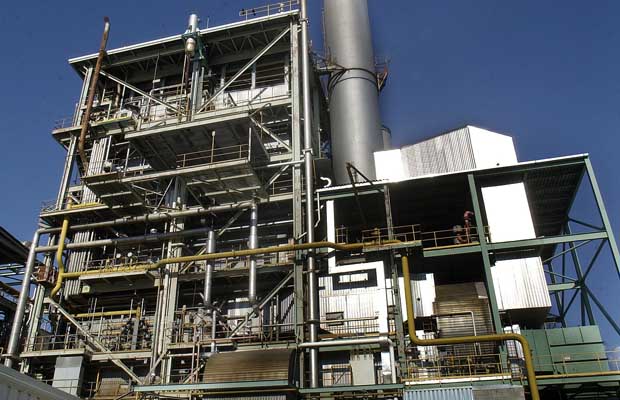
The switch yard at Burrard Thermal Generating Plant in Ioco showing the array of masts and lines carrying power. (Photograph by: Peter Battistoni, Vancouver Sun) |
Producer of the most expensive power in B.C. also huge source of greenhouse gas emissions
PORT MOODY: Some critics think the 50-year-old Burrard Thermal generating plant, located along the northwest Port Moody shoreline, should be junked.
And why not? This out-of-date, greenhouse gas-belching electrical generating station on Burrard Inlet will cost BC Hydro customers almost $900 million over the next decade.
When it runs at close to capacity, it is the single-largest source of greenhouse gas emissions in British Columbia.
It will produce only a nominal amount of electricity for $900 million — and it’s going to be some of the most expensive power generated in B.C. during that time because it relies on price-volatile natural gas as its energy source.
BC Hydro says it’s worth it, and is awaiting word from the B.C. Utilities Commission on a proposed initial stage of capital spending to upgrade the plant’s mechanical systems.
Hydro says keeping Burrard operational is the only way it can guarantee the Lower Mainland a secure electricity supply during winter months of peak demand.
Without Burrard, the closest source of electricity big enough to support B.C.’s population hub is more than 500 kilometres distant, at Revelstoke — and the high-voltage transmission system between the two communities is itself in need of a major upgrade.
A project to twin that line — and minimize the risk that an ice storm or a landslide would trigger a blackout in the Lower Mainland — is not expected to be complete for a decade.
Nonetheless, critics such as the Independent Power Producers Association of British Columbia are questioning why Hydro should be spending such a large amount of money ($119 million annually by 2017) for a facility that will run only a few weeks a year and is essentially a very expensive hedge against spikes in Lower Mainland electricity demand.
In a recent submission to the utilities commission, IPPBC described Burrard Thermal as “antiquated and very inefficient” — converting into electricity only 31 per cent of the energy it consumes.
The association says it can “through competitive bid processes” provide from renewable energy projects the electricity that Hydro seeks.
It also argues that, by Hydro’s own admission, in the event of a mechanical breakdown at Burrard Thermal it could take up to 18 months to obtain replacement parts because “stock spare parts are no longer available.”
In an interview, IPPBC legal counsel David Austin said Burrard “has outdated technology, and it’s way past its shelf life.” He said a reconsideration of Burrard’s role on the Hydro grid is “long past due.”
“The ongoing costs of maintaining Burrard are very, very high relative to the amount of electricity it can generate.”
Cam Matheson, BC Hydro director of energy planning, said that even within the Crown corporation, there have been mixed views about Burrard’s future.
At present, Hydro lists Burrard as a primary asset producing 3,200 gigawatt hours per year — although Matheson said the actual production target is 600 gigawatt hours.
“Burrard Thermal is a backup plant. We don’t intend on using it for any kind of a base load capability,” Matheson said in an interview. “Burrard is located in our load centre, the Lower Mainland. The essential electricity system planning conundrum in B.C. is that we’ve got a very concentrated load centre in the Vancouver and Victoria corridor.
But, “the vast majority of our generating facilities are located in hugely remote areas away from that load centre.”
Hydro estimates spending $27 million a year to keep the plant operational, $10 million a year in carbon taxes for the natural gas it will burn — and up to $71 million a year to purchase the gas itself.
A new plant would be twice as efficient, effectively lowering the cost for gas, but Matheson said it’s highly unlikely Hydro could get a permit to build a modern gas-burning generation plant in the Lower Mainland — and building one in a more remote area would only compound the region’s isolation from its electricity supply. “Our view is that the risk of [not] getting an environmental permit to proceed to build a natural gas-fired plant in the Lower Mainland would be very, very high.
“The big risk here is that if you were going to spend all that money to build a new natural gas plant in your load centre, in the Lower Mainland, you would almost certainly be planning on turning it into a base load resource. It would run all the time, and it would have a whole lot of greenhouse gas emissions — and therein lies the risk of ever getting it permitted here.”
The board of directors of Metro Vancouver have indicated they would not support a full-blown renewal of Burrard, although the city of Port Moody, where Burrard is located, has expressed a wish to keep the old plant running — because it contributes significant tax dollars to the economy of a city that has lost a number of major industrial tenants in recent years.
Port Moody Mayor Joe Trasolini noted that Burrard spent hundreds of millions of dollars over the last 15 years upgrading the filtration systems in its burners, to the point that it’s now “the most efficient and least-polluting plant of its type in North America.”
“Of course there is the issue of income to the city of Port Moody, but that is a distant second,” Trasolini said.
“We have been told that at some point it is going to be shut down. But what we are saying to BC Hydro and the provincial government and to anyone who will listen is that this site is perfectly located along the waterfront. Why not look in the longer term at producing renewable energy there, something that will maintain the site as an important facility for Metro Vancouver and the province.”
Blog: www.vancouversun.com/energy
© Copyright (c) The Vancouver Sun
May 17, 2009
Oil cube lifted out of Robson Bight 'cleanly'
By Judith Lavoie
Times Colonist
May 16, 2009
$2.5M salvage operation underway after barged tipped in August 2007
Observers on a barge in Robson Bight ecological reserve held their breath yesterday afternoon as a metal cube containing 1,400 litres of hydraulic oil was carefully pulled to the surface.
"There was a lot of anticipation when the cube finally broke the surface, but the crew were very calm and professional, which helped," said Randy Alexander, environmental protection manager for the Environment Ministry.
The two-metre-square container, with 72 pails of lube oil, had been sitting on the ocean floor since August 2007 when a barge tipped equipment into the famed wildlife area, where threatened northern resident killer whales feed and rub themselves on pebble beaches.
The 11 pieces of equipment belonged to Ted LeRoy Trucking of Chemainus, which is charged with numerous pollution violations. The company declared bankruptcy last year.
The $2.5-million operation to remove the oil cube and a fully loaded fuel truck from 350 metres of water is being conducted by Mammoet Salvage B.V., a company based in the Netherlands, on behalf of the province and federal government.
A remotely operated underwater vehicle was first sent into the water, then a crane dropped down hooks and chains, which were attached to the container by the underwater vehicle before it was slowly pulled to the surface.
Initially, the company planned to cover the cube with a special jacket to catch any spills, but with debris on the ocean floor, it was feared cables could be snagged.
The operation went extremely smoothly, said Paul Spong, director of whale research station OrcaLab, one of the many environmental groups pushing government to remove the equipment.
"It came out of the water cleanly. There was a tiny bit of residual oil, but they had a boom around the site and I would say there was no impact on the environment."
After the accident, the federal government initially said there was no point sending down a remotely operated vehicle as fuel tanks would have imploded as they sank.
In response, environmental groups planned their own underwater survey, and government had a change of heart.
An inspection showed intact tanks, with an estimated 10,000 litres of fuel, sitting on the ocean floor.
After a delay of almost two years, the operation was planned for a season when whales were unlikely to be in the area, although in recent weeks, several groups of transient orcas have spent time in Robson Bight.
However, yesterday they all stayed away, said Spong, who is keeping his fingers crossed they will not venture into the area as the fuel truck is lifted.
Late yesterday afternoon, the barge was manoeuvered into position over the fuel truck. Weather will decide whether it is lifted today or tomorrow.
The truck will be covered with metal casings before being lifted to protect against spills.
The government hopes to recoup some of the operation's cost from Ted LeRoy Trucking .
© Copyright (c) The Victoria Times Colonist
May 14, 2009
Bute Inlet Project referred to Joint Panel Review
News Release
Canadian Environmental Assessment Agency
May 13, 2009
Canada’s Environment Minister Jim Prentice announced today that the proposed Bute Inlet Hydroelectric Project located about 150 km north of Powell River in British Columbia will undergo an environmental assessment by a federal review panel. The Minister's decision of May 5, 2009, follows a request from the Minister of Fisheries and Oceans under the Canadian Environmental Assessment Act.
The federal terms of reference to establish the review panel and the federal-provincial guidelines for the preparation of the environmental impact statement are being issued. The documents were finalized following recent consultations with First Nations and the public.
The Panel’s terms of reference provide information on the scope of the environmental assessment, on the process for conducting the review, as well as further details on the timelines associated with the key steps of the panel review.
The federal-provincial guidelines provide direction to the proponent and identify the information that will be required in the environmental impact statement—the key document which will outline the details of the project, its anticipated effects on the environment and the proposed measures to
reduce these environmental effects.
The federal environmental assessment process will be coordinated to the extent possible with the provincial process in order to minimize duplication and increase efficiency and effectiveness.
The Agency will make funding available to assist First Nations and the public to participate in the environmental assessment process. Availability of participant funding will be announced in the coming weeks.
The Panel’s terms of reference and the guidelines, along with more information on the project is available on the Canadian Environmental Assessment Registry Internet site at www.ceaa-acee.gc.ca, reference number 09-03-44825.
To obtain information on the review process, or to register as an interested party and be kept informed of the developments of the environmental review, call 1-866-582-1884 or provide a mailing or e-mail address to the attention of:
Panel Manager, Bute Inlet Hydroelectric Project
Canadian Environmental Assessment Agency
160 Elgin Street, 22nd Floor, Ottawa ON K1A 0H3
bute.review@ceaa-acee.gc.ca
Guidelines for the Preparation of an Environmental Impact Statement
The next steps in the review process include:
* Announcement of the availability of participant funding: May 2009
* Appointment of panel members by Minister of the Environment: end of Summer 2009
* Submission of the Environmental Impact Statement by the proponent: Fall 2009
All documents related to this environmental assessment can be viewed on the project public registry at the following link:
http://www.ceaa-acee.gc.ca/050/details-eng.cfm?cear_id=44825
From the Panel Terms of Reference:
Preparation of the Environmental Impact Statement
It is expected that the proponent will submit the EIS to the Environmental Assessment Office on or around September 30, 2009. The Environmental Assessment Office will undertake a 30 day screening of the EIS against the EIS guidelines. Once the Environmental Assessment Office determines that the EIS meets the requirements of British Columbia’s Environmental Assessment Act, the proponent will submit the EIS to the panel. The proponent will notify the panel of any deviation from the schedule at least 30 days prior to the submission date of the EIS to the Environmental Assessment Office.
Review of the Environmental Impact Statement
Once submitted to the panel, the EIS will be placed on the public registry, and will be made available for public review and comment for a period of no less than 60 days. Comments on the adequacy of the EIS as measured against the EIS guidelines and on the technical merit of the information should be provided to the panel in writing.
Within 30 days of completion of the public review of the EIS, the panel, taking into consideration the comments received and its own review of the EIS, will determine if the EIS contains sufficient information to proceed to public hearing.
If the panel determines that the EIS contains sufficient information to proceed to public hearing, it will schedule and announce the hearing in accordance with the procedures set out in these Terms of Reference.
If the panel determines that there are significant information deficiencies, such that the EIS is not sufficient to proceed to public hearing, the panel will issue a deficiency statement requesting additional information which the proponent will provide. At the same time the panel will place the deficiency statement on the public registry and make it available to the public.
Determination of the Adequacy of Additional Information
Upon receipt of the additional information, the panel will ensure that it is made available to the public for review and comment.
Upon completion of the public review of the additional information, the panel, taking into consideration the comments received and its own review of the additional information, will determine within 45 days of receipt of the additional information, if the EIS, supplemented by the additional information, is sufficient to proceed to public hearing. The procedures described above will apply until such time as the panel determines that the EIS contains sufficient information to proceed to public hearing.
Public Hearing
Once the panel determines that the EIS contains sufficient information to proceed to public hearing, it will schedule and announce the public hearing. The public hearing will begin no earlier than 45 days after the schedule is announced. The panel will issue detailed procedures for the conduct of the public hearing. The public hearing will provide the proponent, responsible authorities, Aboriginal groups and members of the public an opportunity to present their views on the project. The public hearing will be conducted in a manner that ensures a comprehensive examination of matters relevant to the panel’s Terms of Reference and in particular the examination of technical evidence. The public hearing will be held in the communities most affected by the proposed project. The panel will use its best efforts to complete the public hearing within 30 days.
Report
Following the completion of the public hearing, the panel will prepare a report which will include a description of the panel review process, the rationale, conclusions and recommendations of the panel relating to the environmental assessment of the project, including any mitigation measures and follow-up programs. The panel shall also include within its report a summary of any comments received from the public and Aboriginal groups.
Once completed, the panel report will be submitted to the Minister of the Environment and the responsible authorities and will be made available to the public.
The panel will submit its report within 90 days following the completion of the public hearing.
May 13, 2009
Nelson ordered to stop exporting electricity
By Scott Simpson
Vancouver Sun
May 13, 2009
City was turning profit on BC Hydro generation
An alleged electricity arbitraging operation by the city of Nelson has been halted by the British Columbia Utilities Commission after protests by BC Hydro.
Since July 2008, the city, through its Nelson Hydro subsidiary, had been exporting electricity generated at its Bonington Falls generating station on Kootenay River, then using power derived from BC Hydro to backfill local electricity needs.
Nelson Hydro was employing Fortis, the primary electricity utility in southeast B.C., to deliver the power to buyers outside the province, and also contracted a power-trading company to assist.
Hydro is obliged to fill all electricity orders placed via Fortis for the benefit of B.C. consumers -- but argued that its obligation was never intended as a mechanism to allow third parties to buy cheap power from the Crown corporation and then turn around and sell it at a profit to somebody else.
The city was making $50,000 a month, but Hydro said it could balloon into a $17-million-a-year enterprise -- with Hydro ratepayers ultimately bearing the cost.
Nelson was using the money to minimize electricity rate increases for its customers, and to finance local initiatives to cope with climate change.
Hydro asked the utilities commission for clarification on its obligations to provide power to Fortis, fearing that Nelson's actions could set a precedent.
On May 6, the commission released a decision that favoured Hydro, saying Nelson can only sell power where it can demonstrate that it is holding a surplus beyond the demands of its own customers.
Nelson Hydro general manager Alex Love said city officials are still reviewing the decision.
But he said the BCUC's ruling "makes it difficult for us to make the energy sales that we were doing."
"Basically, it says that while we are exporting energy we can't at the same time be consuming energy that was supplied by Fortis or through BC Hydro.
"There are a lot fewer times of the year now where we are able to export energy -- and a lot less energy."
BC Hydro media relations manager Susan Danard said Hydro recognizes that municipalities are cash-strapped and searching for revenue sources.
"The problem was that we felt -- and the commission ruled in agreement with us -- that they were raising revenue, which ultimately was coming off the backs of Hydro ratepayers province-wide. We have to keep in mind that the value of our low-cost energy is supposed to benefit everyone in the province."
Blog: www.vancouversun.com/energy
© Copyright (c) The Vancouver Sun
BCUC Decision"in the matter of British Columbia Hydro and Power Authority and Application to Amend Section 2.1 of Rate Schedule 3808 Power Purchase Agreement"
May 12, 2009
BC Hydro, Teck talk power purchase
By Scott Simpson
Vancouver Sun
May 12, 2009
Deal might be made if beneficial for ratepayers, Hydro official says
BC Hydro is negotiating with Teck Resources to purchase electricity from the company's Waneta generating facility near Trail in southeastern B.C.
Hydro confirmed that negotiations are under way although Teck would not specify the names of parties with which it is discussing possible power sales.
Teck is reportedly negotiating to sell about one-third of Waneta's output -- or enough electricity to power 100,000 homes.
Teck has a National Energy Board permit to export electricity from the 450-megawatt Waneta station on Pend d'Oreille River. NEB records show the Vancouver-based mining giant grossed $7.9 million from firm power exports to the United States in 2008.
Teck fetched an average price of $61.28 per megawatt for exported power in 2008 -- or about 2.5 times BC Hydro's cost to generate electricity from its own heritage generating facilities around the province.
"We are in discussions with Teck as well as some other existing power producers in B.C. just to see [if] they have any available energy," Hydro media relations manager Susan Danard said in an interview. "No agreement has been reached. We are discussing what they could provide for us, and at what price and that's about as far as we can go at this point. Generally speaking we would be interested in negotiating either short- or even long-term electricity purchase agreements -- but only if the terms are beneficial for our ratepayers."
Electricity sales have at times been extremely lucrative for Teck -- during the 1999-2000 California electricity crisis the company shut down its smelter at Trail because it could make more money selling into the California market.
Over the past year as a result of a higher debt burden and falling commodity prices, Teck has been seeking ways to lower its costs in order to get a better grasp on its debts.
"We are only able to say that we continue to keep our options open with respect to asset sales as part of our broader plan to reduce debt and position the company for short- and long-term success," Teck communications manager Catherine Hart said in an e-mail.
The Waneta facility is 55 years old and power production costs are likely very low -- as they are at Alcan's similarly aged Kemano generating facility on the Nechako River near Kitimat on B.C.'s central coast.
Hydro is paying Alcan $50-$60 per megawatt hour for surplus power from Alcan's aluminum smelter at Kitimat.
As the NEB's numbers show, Teck's average price for sales into the U.S. market is somewhat higher -- $61 per megawatt hour.
It's likely that Hydro will pay Teck more than it does Alcan because Teck has added leverage -- it has its own dedicated transmission line to the U.S. border.
In the 2006 Hydro call for new sources of power, the average price paid by Hydro was $88, including the cost of delivery.
Energy sector commentator David Austin found the deal surprising, given that Hydro recently announced it's reducing by almost 50 per cent the volume of electricity it is planning to contract with private power producers in a new call for renewable sources of electricity.
Read Scott Simpson's BLOG at vancouversun.com/energy
© Copyright (c) The Vancouver Sun
May 11, 2009
Oil spill at Kinder Morgan is 'fully contained'
C Myers
Burnaby Now
May 9, 2009
 |
About 200,000 litres of crude oil spilled from one of the tanks at the Kinder Morgan facility on Burnaby Mountain this week, but it was completely contained and presented no health or environmental risk, says a company spokesperson.
At about 10 p.m. on Wednesday night, staff at the facility realized that oil was being released from a tank.
"It was discovered immediately, and we were able to take immediate action," said Lexa Hobenshield, manager of external relations with Kinder Morgan. But, she says, even if staff hadn't spied it immediately, "the tank bay is designed to contain a spill like that."
Hobenshield told the NOW that each of the 13 tanks on the site sits inside a berm, or containment bay. The berm is designed to hold more volume than the tank itself, so that any spill from the tank would be easily contained.
Additionally, each berm has monitoring equipment inside so that a spill would activate the closure of a valve to contain the bay.
"The release is contained, and there are no health concerns. But we are very apologetic to our neighbours," she said, noting that a strong odour was in the air for some time after the spill.
"Protecting the public and employee health and safety and the environment is number 1 for us," she said. "To ensure safety, we monitored air quality around the site."
Staff performed repeated patrols outside the site fence overnight Wednesday and into Thursday to assess air quality.
"There were nuisance odours - quite strong, but the air quality assessment showed no health concerns," she said.
Local fire service crews were on site shortly after the spill, and foam was sprayed onto the oil in the bay to help mitigate the odours, said Hobenshield.
The company also alerted all required regulatory agencies, who may now perform their own investigations on top of the investigation Kinder Morgan will carry out on its own.
Though Ho-benshield said it was too early to say exactly what caused the spill, they believe that it resulted from the failure of equipment being used by a third-party contractor.
Specifically, Hobenshield explained that it's believed a jet mixing pump failed. The pump is used to stir up the contents of the tank to loosen any deposits at the bottom, to prepare for an internal inspection of the tank.
The tank itself did not leak and wasn't damaged, nor were any of its permanent fixtures damaged.
On Thursday, staff at the site were working to transfer the contained oil to a storage tank, and the company is hopeful the 200 cubic metres of crude oil can be reclaimed.
When asked about early media reports that there may have been an oil slick spotted in Burrard Inlet, Hobenshield said they were confident the spill was totally contained in the berm.
"We believe that the spill was effectively contained on site, and any product anywhere else is not related to us," she said.
She also noted that, geographically, the tank farm sits on the south slope of Burnaby Mountain, not the north side, so that if oil had had been spilled outside the containment tanks its very unlikely it could have travelled in that direction.
When asked if the company is concerned about the public's perception of operations at Kinder Morgan, in light of the 2007 massive oil spill and this incident, Hobenshield said the two situations can't really be compared.
"This is a really unfortunate event. It's also very unusual, and it's under a completely different set of circumstances. We've never had anything like that before," she said.
In July 2007, city-hired building contractor accidentally hit a pipeline xburied under a residential street with an excavator.
The spray of oil that erupted led to the evacuation of several homes in the area, and lawsuits in that case are still pending.
Hobenshield says the facility, which is the end of a 1,150 kilometre petroleum pipeline coming from Edmonton, holds the safety and health of its neighbours as a top priority.
"Our top concern is the health and safety of the public and the environment," she said.
A community open house, scheduled prior to the latest spill, is set for June 20, and Hobenshield says it's an opportunity for neighbours to check out the facility and talk to staff about concerns.
cmyers@burnabynow.com
© (c) CanWest MediaWorks Publications Inc.
BC Libs zapped regs for private power, doc shows
Geoff Dembicki
The Tyee.ca
May 7, 2009
B.C.’s powers to protect key wildlife areas have been chiselled away by a government directive intended to placate private power companies, according to two environmental groups.
“What you see is the ministry of environment no longer having the ability to uphold protection of endangered species if it stands in the way of independent power,” said Jessica Clogg, senior counsel for West Coast Environmental Law.
The document in question is a confidential ‘decision note’ signed by environment deputy minister Doug Konkin on March 18, 2009. It appears to remove the authority of the Ministry of Environment to block industrial developments – such as independent power projects (IPPs) – that could impact protected wildlife areas.
The current government has touted IPPs, such as run-of-river hydro projects, as a green source of energy. But many groups fear the private developments destroy river ecologies and encroach on wilderness areas with roads and power lines.
Any IPP capable of generating more than 50 megawatts must be approved by the BC Environmental Assessment Office. Sometimes the projects get approval even though they could impact protected wildlife areas that are home to endangered species.
In those cases, the private company applies to the Ministry of Environment for an exemption to the rules. Previously, it was up to a regional manager to decide whether a project got the go-ahead.
But the March 18 decision note – made public by the Wilderness Committee – suggests the provincial government wants to change the process.
“Government does not want to create a situation where an exemption is withheld after [an environmental assessment] Certificate has been issued,” the decision note reads.
The document recommends that regional managers no longer be given the authority to say ‘no’ to a request for an exemption.
“If a Regional Manager does not wish to issue the exemption it would elevate to the Minister,” it reads. The document argues this option is “likely to be perceived well” by the proponents of industrial developments.
“Behind the scenes, we can see in the language of this thing how the Ministry of Environment seems to be mostly concerned with keeping the private power guys happy,” the Wilderness Committee’s Joe Foy said.
Though Foy was concerned about the document’s implications, he wasn’t sure if its recommendations had actually been implemented. Environment ministry spokesperson Kate Thompson refused to comment on confidential documents.
“All we can deal with as bureaucrats is what’s published and publicly available,” she said. Environment minister Barry Penner did not respond to The Tyee’s phone calls Thursday .
Geoff Dembicki reports for The Tyee.
May 07, 2009
B.C. scientists urge strategic voting to protect watersheds
MARK HUME
Globe and Mail
May 6, 2009
VANCOUVER — Five leading conservationists and environmental scientists said yesterday that British Columbia watersheds are threatened by provincial government policies, and they urged the public to “vote strategically” in next week's election.
They were reluctant to endorse any specific party, but their pointed criticisms of policies introduced by the Liberals indicated they think a vote for the NDP would be in the best interest of the environment.
“When you see five people of this calibre gathered together to raise the alarm, you have to pay attention,” said Craig Orr, who moderated a group news conference.
Making statements were Mark Angelo, chairman of the Rivers Institute at B.C. Institute of Technology; Elaine Golds, a biochemist; William Rees, a professor at the University of British Columbia; Alexandra Morton, a leading salmon researcher who has been campaigning against salmon farms; and Vicky Husband, a senior environmental advocate.
Three of the people present – Dr. Orr, Dr. Rees and Ms. Morton – are on the board of a non-profit group, the Save Our Rivers Society, which sprang into existence because of concerns over the government's promotion of private power projects in B.C. watersheds.
Ms. Husband said the environment is a non-partisan issue, and offered criticism of not only the NDP and Liberal platforms, but also of the Green Party. “I wouldn't say who to vote for,” she said, but then ran through a list of concerns that showed she thinks the Liberal government has put B.C.'s environment at risk. “We have the best place on earth,” she said, echoing a government advertising slogan. “Then why the hell aren't we protecting it?”
Mr. Angelo said he is concerned about the lack of an overall plan for developing run-of-river power projects in the province and a lack of public consultation. “Whoever wins has to address those concerns,” he said.
Ms. Morton accused the government of putting wild salmon at risk by allowing fish-farm expansion and by promoting power developments on numerous rivers. “I personally have always voted Green, but I feel personally responsible for [Liberal Leader] Gordon Campbell getting in, so I'm voting NDP,” she said.
Dr. Rees indicated he is doing the same thing, saying he has an affinity for Green policies, “but I probably will vote strategically to try and avoid having the Campbell government return.”
The Angriest Riding in BC
By Geoff Dembicki
TheTyee.ca
May 7, 2009
 Cecil Dunn and the house he felt forced to abandon. |
In Tsawwassen, massive power lines have sparked voter rage.
Cecil Dunn fought the provincial government and lost. For four years, he battled a proposal to build steel power poles in the backyards of Tsawwassen homes. The struggle wasn't just about sparing residents the anxiety of ever-present radiation or saving its tree-lined skyline from 30-metre eyesores. Dunn's own house of 26 years lay on the proposed route. The fight was personal.
The retired Telus executive describes the last four years like a rollercoaster ride, full of euphoric highs and cynical lows. But the defeats built up one by one. The opposition he spearheaded lost in B.C.'s highest court. The power poles went up last summer. And this year, faced with a tough choice between life under the lines or a government buyout, he opted to sell the home he'd planned to grow old in.
Dunn feels betrayed by the political system, but not enough to abstain from the May 12 vote. He's throwing his support behind heavyweight independent Vicki Huntington, a five-term local councillor who's promised to defend Delta South against the whims of big government. Her main challenger, BC Liberal Wally Oppal, is drawing from the same sense of helplessness, albeit with a twist. As attorney-general, he's promised voters the ear of the premier and a key voice in cabinet.
Whether voters reject the current government or bid for a stronger place inside it is anyone's guess. But perhaps nowhere else in the province is the choice so visceral.
From a 'back lane to a superhighway'
I meet Dunn in a Tim Horton's on Tsawwassen's main strip. He buys me a coffee and we stake out a table near the back, away from the crowds of seniors gathered for their morning social. I tell him this is my first time in town. Normally I'm just passing to the nearby ferry terminal. He nods his head in assent. "Just like most people," he says.
Dunn begins our talk with a crash course in local power line history. In the mid 1950s, the British Columbia Electric Company bought land rights for a transmission corridor through "a couple of potato farms and forest." Tsawwassen grew into a thriving coastal community over the coming decades, cut in half by 17-metre wood power poles on a 3.7 kilometre right of way. Many homeowners assumed the lines would be dismantled once their life cycle came to end.
In late 2004, they were shocked by the province's proposal. The old lines were coming down. And in their place, 20 steel poles the size of a high-rise, capable of transmitting 60 per cent more power and connected to a 23.5 km submarine cable under the Strait of Georgia. Residents were told the project was essential to meet Vancouver Island's growing energy needs.
"The analogy I like to use is they wanted to turn a back lane into a superhighway," Dunn says.
Retracted promises
The Tsawwassen Residents Against Higher Voltage Overhead Lines (TRAHVOL) sprung up to fight the proposal. Dunn spent hours researching the link between electro-magnetic fields (EMF) and cancer rates. He shook hands with senior government executives, urging them to reconsider. TRAHVOL's efforts soon paid off -- or so residents thought.
Just weeks before the 2005 provincial election, Dunn received a letter from Energy Minister Richard Neufeld. The B.C. Transmission Corporation (BCTC) had abandoned plans to build overhead lines in favour of yet-to-be-determined alternatives, it read.
"People were excited," Dunn says between sips of coffee. "They thought, 'Hey, these guys are actually listening to us.'" When election day came, BC Liberal Val Roddick defeated the independent Huntington by 1,100 ballots. Dunn's vote helped her win.
"We were all a bit politically naïve," he admits. "I have quite a different view of politics than I did then."
After the election, BCTC announced plans to bury high voltage lines in a shallow trench along the Tsawwassen right of way. Residents weren't impressed. They argued the plan would tear up backyards and emit even more radiation than the steel pole system. Even worse was a carefully worded July letter from Neufeld that appeared to play down the province's commitment to oppose overhead lines.
TRAHVOL proposed alternate routes, organized rallies and pleaded with government officials, to no avail. In the absence of broad public support, the province's utilities commission disregarded the trench alternative and forged ahead with the original proposal. A legal battle followed, but B.C.'s court of appeal refused to reverse the decision. Construction on the towers wrapped up last summer and BC Hydro energized the lines in December.
'They look disgusting'
South Delta Secondary School sits in the middle of Tsawwassen, a low building fringed by open sports fields and leafy residential streets. When I visit, wind tousles the hair of teenagers enjoying their spares in the sun. The setting would be unexceptional, were it not for the gigantic steel towers cascading down a nearby hill -- or the 30-metre power pole that juts out from the parking lot, towering over surrounding cars. During the fight to reroute the overhead lines, Delta Secondary became a key battleground. The Mothers Against Power Poles formed out of fears the school's 1300 students would be made test subjects for prolonged EMF exposure. After the lines went in, some parents withdrew their children, and local anger hasn't subsided.
The BCTC maintains exposure levels are well within the World Health Organization's guidelines. It notes 30 years of scientific studies haven't revealed any definite link between EMF and cancer. Still, as the Canadian Cancer Society points out, incidents of childhood leukemia appear to be greater when radiation levels are high.
Crossing the school's soccer field, I approach a group of Grade 12 girls reclined on a blanket. The appropriately named Natalie Watts seems a bit aloof as I motion towards one of poles. With graduation so near, she's not too concerned about radiation. But aesthetics are a different story. "I hate them. They look disgusting," Watts says. "It's our small town and there's these huge urban power lines going through."
'People here are exhausted'
When I enter Ladner's ABC Restaurant later that day, Vicki Huntington appears tired. We take a booth near the back and I glance at the flower paintings on the walls. "It's so loud here," she remarks, cringing at the background muzak.
Huntington tells me she was courted by Gordon Campbell and Carole James before her campaign began. Both knew her local popularity and five terms in civic politics make her a potent candidate, she says. But neither offer was enough to sway her.
"I'm firmly of the opinion that MLAs in British Columbia represent parties, not the people," she says.
That's been a frequent theme in Huntington's campaign as she tries to position herself as a staunch defender of local interests, unbeholden to a government that treats Delta South like its personal "doormat."
When she lists off local grievances, they sound like personal affronts. The healthcare cuts that gutted Delta hospital. The proposed Deltaport container expansion and $1 billion South Fraser Perimeter Road -- both poised to destroy critical wildlife habitats, she claims.
And of course, the Tsawwassen power lines. I ask her whether an independent MLA could have made any difference in an entrenched party system. She brings up the late Chuck Cadman in response -- everyone knows if single voices can't make a difference, democracy has failed, she says.
"People here are exhausted. They've been fighting their own government for almost eight years."
(Delta South isn't the only area to rally against outside encroachment. See sidebar for examples across the province.)
Anger Hotspots in BC
The Tsawwassen power lines upgrade isn't the only infrastructure project to raise the ire of B.C. residents. Here are four current examples of concerned citizens taking on powerful interests.
Texada Island
In 2007, WestPac LNG Corp. proposed a $2 billion mega-project to build a liquefied natural gas terminal and electricity facility on this island in the Strait of Georgia. Texada Action Now formed to fight proposal, claiming the project would be a major eyesore and anathema to the province's carbon targets. Project still in early stages.
West Vancouver
A $130 million road connector formed a key part of the Sea-to-Sky highway upgrade. The Eagleridge Bluffs Coalition feared the project would harm critical wetlands and held vocal protests that resulted in arrests. The province turned down a costly tunnel proposal and the four-lane highway opened last month.
MacMillan Provincial Park
A provincial proposal to build a new parking lot in the old-growth forest at Cathedral Grove pitted loggers against camped-out protestors in early 2004. Cabinet minister Bill Barisoff vowed to have the lot built before the summer tourist season but years of protests followed. The lot was scrapped in 2006.
Klappen Valley
Shell Canada received land tenure five years ago to explore for coalbed methane near the Sacred Headwaters in northwest B.C. The Tahltan First Nations blockaded roads in 2007, citing concerns about salmon habitat destruction. Arrests followed and both sides threatened legal battles. The province set a moratorium on the project last fall. -- G.D.
Oppal's strategy
After meeting with Huntington, I contact Oppal's headquarters. I was supposed to sit down with the attorney-general at noon, but his campaign manager called in the morning to cancel. I'd visited his Tsawwassen office twice today but was told both times he was too busy to talk. Phone in hand, I try my luck again.
Election staffer Matthew Naylor tells me Oppal definitely can't meet today. "Would he be able to phone sometime this week?" I ask. "I wouldn't be too optimistic," Naylor replies.
This is Oppal's first run for Delta South, though he's called Tsawwassen home for 10 years. If 2005 results are any indication, the vote here could be tight. Most analysts predict a dead heat between the well known attorney-general and the former councillor, with the New Democratic Party's Dileep Athaide trailing in third.
Though Huntington draws on popular anger to buoy her candidacy, Oppal's personal charm and claim to be a powerful voice in government could carry him to victory. "The premier listens to me. Other members of my cabinet listen to me," he told a packed room of Huntington supporters at an April 16 debate.
His challenger likes to point to Oppal's record of silence on critical Delta South issues, including his intervention against TRAHVOL's power line challenge in the court of appeal. But the attorney-general can hit hard too. The governing party makes the rules, he argued at the debate earlier this month. "There's no possible way that any independent could have any influence on that."
Strange homecoming
Back in Tsawwassen and fresh off our Tim Horton's chat, Dunn takes me for drive in his green pick-up. We follow the steel poles -- from the hulking power station near Fred Gingell park to the tree-lined street he used to live on. After electricity started flowing, the provincial government made tempting offers on 119 homes. Only 15 households could resist. Dunn moved to Ladner on April 1, and as we stand in front of his old house, he tells me government workers just came by to change the locks. For the time being, it sits empty.
We're soon being greeted enthusiastically by Dunn's old neighbour, Rick Grant. He took the government buyout too, but won't be leaving until the end of summer. The former neighbours chat like old friends. "You know, there were some people by last week to cut your lawn," Grant says. He leads us to a compact backyard, bursting with spring colours. Overhead, power lines grid the sky. The poles are impossible to miss.
"Your tulip tree looks great," Dunn says, pointing to the white petals littering the grass.
"It's the energy from the lines," Grant jokes.
When Dunn and I get back into the car, I notice a Huntington sign on his old front lawn. He says Grant put it there. We start to drive and he tells me the decision to leave Tsawwassen was one of the hardest he's ever made.
"You've always got that apprehension in the back of your mind -- do you live with these lines forever or start a new life?" He takes a right turn down a quiet street. "What we chose is not what we wanted to choose."
May 06, 2009
Does a carbon tax make the Liberals green?
Vicky Husband,
Special to Times Colonist
May 06, 2009
The NDP has let the government off the hook on its sorry record
The New Democratic Party's opposition to a carbon tax is a mistake. The result is that the NDP are pilloried as environmental dinosaurs, while the Liberals escape scrutiny for their own abysmal environmental record.
Even on the climate-change file, the Liberal government's record is decidedly mixed. Don't forget that the Liberals have supported massive urban sprawl -- a major source of B.C.'s greenhouse gas emissions.
The massive Gateway freeway initiative ensures dramatic new sprawl far up the Fraser Valley, while on Vancouver Island, the decision to allow Western Forest Products to remove massive tracts of forestland from managed forest status opened the door for another 50 kilometres of suburban sprawl between Sooke and Port Renfrew.
The auditor general heavily criticized that decision regarding Victoria's wild coast, saying that government failed to give due regard to the public interest, including environmental interests.
And how can the Liberals claim the high ground on climate change, when they have promoted offshore oil development, provided $1.5 billion in subsidies to the oil and gas industry and supported new pipelines for dirty tarsands oil?
Don't forget that when this government came into office, its first move was to repeal 40 years of environmental laws and slash Ministry of Environment staff, crippling that agency -- while cutting parks budgets and interpretation programs.
Don't lose sight of the fact that the Liberals repealed the Forest Practices Code, replacing it with a toothless regime that has resulted in increased raw-log exports and so many usable logs being abandoned at logging sites that you could add another five per cent to B.C.'s overall greenhouse gas emissions.
Don't forget, too, that this government has refused to pass a provincial Endangered Species Act while sabotaging the federal Species at Risk Act by instructing its scientists to remove the mapping of known endangered species habitat from SARA recovery strategies.
Don't forget, as well, that this government helped its developer friends by gutting the riparian areas regulation -- stripping critical protection for fish along new subdivisions. Then the government expanded fish farm production -- one of the biggest threats to the survival of our wild salmon. At least it was, until the government opened up the private hydro development gold rush on scores of our wild rivers.
And, in an assault on the province's fisheries, the Liberals have let gravel and cement makers strip-mine in the heart of the lower Fraser River.
Early on, the Liberals made industrial developers happy when they gutted the provincial environmental assessment process. They went on to make urban developers happy when they restructured the Agricultural Land Commission into regional review panels, making land removals from our shrinking prime agricultural land base easier.
Following the same mantra of deregulation that created the global economic meltdown, the Liberals have deregulated activities ranging from septic systems to pesticides, and from forest practices to subdivision development and contaminated sites.
It's a sorry environmental record. If the Liberals were really concerned about the environment, they would:
- End subsidies to the oil and gas industry.
- Stop the proposed northern pipelines that would increase tanker traffic on our coast.
- Stop promotion of offshore oil development.
- Cancel the southern Gateway project and massively increase public transit funding.
- Buy back the WFP tree farm licence lands west of Victoria, for parks and forest uses.
- Establish a moratorium on run-of-river projects until a comprehensive planning process is established, with full public and local government participation.
- Re-establish the mandate and budget of the Ministries of Environment and Forests (including parks budgets).
- Establish legislation to protect endangered species and their habitats.
- Close open-net cage fish farming.
And that's just for starters.
To my fellow environmentalists: Climate change is the biggest threat to life as we know it on Earth. We, as a society, must rapidly reduce our fossil fuel consumption.
But that doesn't mean we must trash the environment to get there.
Vicky Husband is a long-time conservationist and recipient of the Order of Canada for her work on environmental causes ranging from old-growth forest protection to sustainable fisheries.
April 30, 2009
Kitimat project could be worth more than $1b to first nations
COMMENT: In early April we criticised the provincial government for forking out $32 million to buy First Nations an equity stake in this pipeline. (link). It's bad on a number of important fronts:
- it is outside the treaty process, so it does nothing to effect reconciliation of previous insults to aboriginal title and rights, and does nothing to respect or improve the status of those rights in the future.
- it is just a payoff, a bribe, to those First Nations - the only citizens who have sufficient legal clout to stop the pipeline. We imagined a government agent slapping bills on the table until the First Nations couldn't say no.
- it runs contrary to the actions necessary to reduce BC's contribution of greenhouse gases. Natural gas today accounts for a third of the BC's total GHG gift to the world (about 60+ million tonnes each from the natural gas we produce, the coal we mine, and all of our other domestic activities.) and with ramp up of shale gas production, the natural gas component is scheduled to increase substantially. This pipeline will serve to move more of that gas to markets. Think of the $32 million as coming from the carbon tax and give your head a shake.
- it is completely opportunistic and non-strategic, accomplishing no social, economic or environmental goals for the province.
Scott Simpson
Vancouver Sun
April 30, 2009
Deal would inject more money into communities than the stalled treaty process
 An artist's rendering of the Kitimat LNG Terminal storage tanks, jetty and associated buildings on Haisla First Nation property at the deep sea port of Kitimat. (Handout illustration, Vancouver Sun) |
Some first nations stand to gain more than $1 billion in profits, taxes and business opportunities from a proposed liquid natural gas project in northern British Columbia, The Vancouver Sun has learned.
Proponents of a $4-billion project that includes a 463-kilometre gas pipeline and a liquefied natural gas plant at Kitimat are still ironing out final details of a landmark agreement among aboriginal groups, including Carrier Sekani Tribal Council and Haisla First Nation.
But the B.C. government has already committed $32 million on behalf of first nations who are seeking a 30-per- cent equity share of the pipeline as well as tens of millions of dollars in annual benefits when the liquefied natural gas (LNG) plant is built.
B.C. announced April 8 an accord with 16 first nations along the proposed route which would carry gas from northeastern B.C. to a new deep sea terminal at Kitimat. Once natural gas is turned into a liquid, it can be transported by ship to foreign markets, including Asia.
B.C.’s announcement, however, did not capture the true magnitude of the deal, according to spokesmen for Carrier Sekani and Haisla.
The deal takes place outside of the belaboured B.C. treaty process which has yielded a scant handful of treaties after spending $1 billion on lawyers, meetings and interim measures over nearly two decades of negotiation.
If the Kitimat project is successful, the cash it generates over 30 years for participating aboriginal governments will dwarf the amounts awarded in any of those treaties.
According to Carrier Sekani Tribal Chief David Luggi, first nations along the pipeline route could realize cash flows of $540 million to $553 million over the life of the deal.
They’re using $32 million from the province as an initial ownership stake in the line and are hoping the federal government will match that amount.
Both the pipeline and the LNG plant have environmental approvals from the provincial and federal governments, and proponents are currently in the process of booking capacity on the pipeline.
Greg Weeres, a vice-president with Pacific Northern Gas, which is developing the pipeline portion of the project, said the company “has yet to execute our definitive legal agreement with the first nations.”
“We are confident that there is more good news to come and we are just working at trying to coordinate when we may be able to execute those agreements,” Weeres said.
Luggi said that in order for the Carrier Sekani to fully participate in the project, they will seek investors to help finance a 30-per-cent share of the proposed pipeline.
He noted that Carrier Sekani pulled out of the B.C. treaty process two years ago after concluding a treaty would not provide sufficient benefit for future generations.
“A treaty is forever. This proposal is for three decades,” Luggi said, adding that an environmental accord with the pipeline’s developers is pivotal to the deal — including mitigating the impact that pipeline construction will have on traditional territories of Carrier Sekani bands along the route.
“This is resolving the proposed ongoing infringement of our title, and the cash flows in those three decades for all 16 first nations along the route would be in the range of $540 million to $553 million.
“The government is shifting our rights to investment in a company, in a proposal like this, for nation-building.”
The LNG plant would be situated on Haisla First Nation property at the Kitimat deep sea port.
Haisla Chief Steve Wilson said his people could receive up to $4 million annually in lease payments and $14 million to $18 million per year in property taxes. The Haisla are also seeking a marine transportation contract worth $12 million a year, he said.
“This has nothing to do with treaty. It is a business deal,” Wilson said. “When it comes to reconciliation of rights and title issues, this shows it’s possible to enter into [business] agreements that reconcile interests.
“What this does is set the foundation for our business community. It allows us to start building our own internal economy.”
The chiefs made their comments in interviews during a recent visit to Vancouver.
B.C. Energy Minister Blair Lekstrom said that the deal shows the progress B.C. has made in shaping negotiations among first nations, industry and the province towards economic development benefitting all residents of the province.
Read Scott Simpson's energy blog here.
© Copyright (c) The Vancouver Sun
April 29, 2009
Beyond the Carbon Tax
 Tax energy, not just carbon? |
By Michael M'Gonigle and Blake Anderson
TheTyee.ca
April 30, 2009
Despite the economic doom and gloom, catastrophes in fish farms and wild rivers, controversial multi-billion dollar highway schemes, in this election no one seems to care. Instead, the first 10 days of the election have been "virtually a referendum on the carbon tax" reported UVic political scientist Norman Ruff.
Yikes! In a world running amok, this is it? With seemingly pivotal decisions facing BCers on every front, the carbon tax debate shows the depressingly low level of the climate change conversation -- and of our politics. For their shared fixation is on symptoms not causes. If you are willing to look, the problem is clear: over-production and over-consumption, the real issue being not carbon, but energy and the economy that mainlines it.
We are told that we need a response akin to a wartime emergency. Well, if so, a carbon tax is designed to fight a phantom war that diverts us from thinking about, let alone fighting the real one. The enemy? Business -- and life -- as usual.
The political challenge is not Liberal vs. NDP vs. Green but what it will take for an increasingly conservative environmental movement to shake off its political complacency, and lead the charge.
Where is everyone?
Requiem for the carbon tax
In their Climate Action Plan, the provincial Liberals wax poetic that their plan will allow businesses to "capture new opportunities in fields such as clean energy and energy-efficient technology." Their de facto academic spokesperson, SFU's Mark Jaccard, is even more effusive that a carbon tax is fine because Canada's "economy would continue to grow rapidly."
But, of course it will. At a time when the price at the pump can fluctuate 10 cents per litre in a week -- with no reason except our deference to the global law of economics -- the carbon tax is only 2.5 cents per litre. And it will climb by a few cents over the next few years to its peak of 7.25 cents per litre. Whew! We can handle that.
And what happens to this money? Not spent on public transit (as the GVRD mayors recently requested of Premier Gordon Campbell) or energy efficiency for low-income housing or rental units (that might satisfy NDP leader Carole James). No, this is a "revenue neutral" tax, with $300 million in carbon taxes translating into almost $500 million in tax cuts this past year. Whew! We can still do our trip to Italy.
With some good caveats built in (like refunds for low-income earners and Northerners), one might give credit for at least doing a wrong-headed policy somewhat right. The economists are happy. But what will it achieve? If it works (and this is a big IF), its proponents hope to see a 33 per cent reduction in CO2 by 2020 and an 80 per cent reduction by 2050. 33 per cent will be the easier part -- you know, the "low hanging fruit" stuff -- and that would (could) be a significant reduction.
But the big part -- the 80 per cent -- now that's a lot. But 2050? That's 41 years from now. Forty-one years ago, Richard Nixon had just become president, and Barack Obama was six years old. The Vietnam War was raging and the Beatles had just released Sergeant Pepper's. The Americans hadn't even landed on the moon. 2050? Like, this is two generations away! Some wartime emergency.
Carbon colonialism
Unfortunately, the experiences with similar technical initiatives indicate that these targets will be neither achievable nor enforceable. Despite lofty claims from politicians and economists, pricing is a fickle game that in practice has yet to provide solutions.
The Transnational Institute (TNI) in Paris reports that Europe's experience with its related "cap and trade" is a documented disaster -- emissions have increased, large polluters have made massive windfall profits, energy costs rose for consumers, while innovation waited on the sidelines to see where all this policy dust settled. This past week, the world's second largest reinsurer, Swiss Re, closed its carbon trading desk due to lack of business.
Meanwhile, Oxford University's Environmental Change Institute decries the carbon offset market that allows one, for example, to pay to plant trees to "offset" the carbon emitted on one's travels. Carbon offsetting projects have been redundant, ineffective, unproven, unmonitored, although they have spawned a highly-motivated and lucrative new "green" industry selling cheap absolutions to the frequent flyer.
'Carbon colonialism'
Calling it "carbon colonialism," one TNI critic of the impact of offsets on southern development projects noted that "instead of building wells, rich countries can now plant trees." Ironically, the most prolific flyers that we know are climate scientists, followed by climate lobbyists (environmentalists) and climate academics. They are, they say, "on the road to Copenhagen" (the site of the next Kyoto conference). Like millions in our generation of jetsters, they are carbonizing their way to distant meetings -- but important ones, of course.
As a result, the TNI urged California to reject both "the fundamentally flawed trading and offsets approach." It won't be long before we hear the same thing about carbon taxes. Even, staunch advocate Jaccard, admits that for them to work, they will have to impose carbon pricing that are perhaps 400 per cent greater than now permitted. And they will have to be accompanied by "strong complementary regulations and public investments."
Carboniferous politics
But such policies are not on the agenda. Instead, at just 2 plus cents per litre, the carbon tax is all show. Without actual bite, the carbon tax doesn't demand the investment of real political capital. And without that, there isn't serious debate. It's carbon fluff.
Although the NDP rejected the carbon tax, their shallow political calculations are less than inspiring, and their analysis has been less than informative. Meanwhile, respected organizations like the David Suzuki Foundation and the Pembina Institute remain staunch carbon tax advocates, despite all the evidence to the contrary, making support for this tax the litmus for environmental correctness.
How often have we been told (erroneously) that any rejection of the Liberals would be devastating for political innovation anywhere on climate change? This is carbon blackmail.
From our review, only the Dogwood Initiative's Cliff Stainsby has set a higher bar. He advocates an awkwardly named "cap and dividend" strategy that would set a cap on CO2 emissions at a point where they enter the economy, and emission permits auctioned off, the money raised to go directly into transitional adjustment assistance that also reflect the social impacts. Stainsby also calls for a ban on such emissions as a toxic substance, old-fashioned direct regulation in Europe having had dramatically greater success with other pollutants (like acid rain) than America experience with cap-and-trade programs.
But even this analysis skirts the main point -- that it's about energy, and our insatiable demand for more and more, and more still. Where will this demand take us? When will it end? What are the alternatives?
Post-carbon politics
One place it will go is a diversion on every usable stream, a windmill for every hilltop, perhaps a nuke for every metropolis. BCers don't like the thought of run-of-river hydro power fuelling electric cars to jam the new $3 billion Gateway freeways into Vancouver. The proposed 10 lane Port Mann bridge is even justified by the government because it will "reduce vehicle emissions by reducing congestion-related idling." Yikes again!
And BCers are not alone. Just ask how the farmers and residents of the Niagara Escarpment feel as they plod off to yet another public meeting to oppose the imposition on them of another politically correct "solution." A UNESCO biosphere reserve, and once an iconic protected area just north of Toronto, the area's once draconian planning powers have been stripped away by a provincial government intent on clearing the area for massive windmill developments to fuel the city. From that huge bluff, and certainly from the top of any windmill fueling the city, you would be able to see Highway 401, its 22 lanes still crowded with traffic late into the evening.
What we should really do
So why not just skip right past all this tax shifting that merely fiddles with new supply lines while the planet burns? Let's cut straight to the quick-- a real economic transition strategy that reduces demand. Now there's an election topic, if only we had a functioning democracy that was up to the reality of the 21st century.
Let's scrap Gateway (now), and put that money into a 200 kilometre light-rail network that the UBC's Design Centre for Sustainability argues could blanket the Lower Mainland for the same price -- and take thousands of cars off the road, millions of litres of gas out of the pipelines, and tonnes of CO2 out of the air.
Let's repeal the $300 million plus in annual provincial subsidies and $1.4 billion in federal subsidies for new energy exploration and development. Dogwood calls these subsidies that co-exist with carbon taxes as B.C.'s number one "climate contradiction." Yes, we need to use energy, but the question is whether we should be subsidizing new use, rather than fostering initiatives that will generate new non use. And let exploration follow the dictates of the much-loved market, but a changed market that now works in the context of an energy-frugal, innovation economy.
And let's have a meaningful "energy transition levy" that has no pretense to revenue neutrality but is explicitly designed to kick-start a collective endeavor to grow an eco-economy. Imagine the pride of making B.C. a showcase of a sustainable, just and practical economic model for the 21st century.
The tools are there -- smart meters, differential pricing (say for urban gas commuters and rural residents, and according to the environmental impact of the energy source), identified targets for direct investment that can dramatically increase efficiency and low-income supports, public transit opportunities, and much more.
Let's cut energy demand by a quarter, fast
So, let's put 2050 aside, even 2020, and focus on 2015 -- and a real reduction in energy demand by that date. How about 25per cent?
The tools are there, but where are the people? Beyond provoking an outcry over jobs and deficits, such a dramatic economic transition strategy that takes seriously the climate challenge should also provoke a debate about our real deficit -- the democratic deficit.
In this election and beyond, we must move past the half-thought-out carbon policies and the artificial divisions they sew. We need a real referendum on our collective future, and a process that gets us there with not just the usual environmental suspects but a whole host of characters -- social housing advocates and green entrepreneurs, investment gurus and tech wizards, visionary politicians and engaged citizens.
Rather that fine-tuning a broken carbon instrument, it is time to reinvent our democracy beyond carbon.
But then maybe climate change isn't all that urgent and we can just wait until Barack turns 86, and most of us are dead.
Tapping Our Wild Rivers Can't Fix Climate Change
Veteran enviro M'Gonigle says no to Tzeporah Berman's 'PowerUp' logic.
BC's Clashing Shades of Green
How 'run of river' and global warming are splitting enviros this election.
In Canada, a Push for Obama-style Green Stimulus
PM to get plan backed by 850,000 group members.
Michael M'Gonigle is a professor at the University of Victoria, and a director of the POLIS Project on Ecological Governance. Blake Anderson is a graduate student at UVic and researcher at POLIS.
Ban Carbon Emissions, Don’t Price them: Why Cap and Dividend is the Best Approach
By Cliff Stainsby
Dogwood Initiative
April, 2009
 'Cap & Dividend' can address the limitations of carbon taxes and 'Cap & Trade' and allow us to dramatically reduce our skyrocketing emissions quickly |
First in a series on climate policy
The current debate over carbon taxes versus "Cap and Trade" is wrongheaded on two counts; (1) it treats global warming as an economic issue, and (2) neither carbon taxes nor "Cap and Trade" will solve the problem.
There is a solution that does work and which is rapidly gaining public support once understood—the ‘Cap and Dividend’ system (which I describe below).
But first we must see what is wrong with the current approach.
The proper way to eliminate toxic substances is to ban them. One’s income – ability to pay a tax – shouldn’t determine one’s right to poison the environment. Dealing with toxins is not a matter for economics and the market. Toxic substances, such as DDT, PCBs, and Dioxins, are properly dealt with by prohibiting their use. And, frequently, that is exactly what has been done.
 Cliff Stainsby is a long time activist who was in vanguard of getting BC ENGOs and trade unions to recognize global warming. Cliff is recently retired and when not working on climate policy spends most of free time in his magnificent garden |
We have now reached the point where man-made Carbon Dioxide (CO2) emissions are toxic. Our environment is already overloaded with CO2, the major cause of global warming. Adding more CO2 threatens civilization.
Time is of the essence. Scientists believe we have already ‘overshot’ safe levels. To stabilize global temperatures below dangerous levels (widely considered to be 20C above pre-industrial levels) we need to reduce atmospheric CO2 concentrations from the current 385ppm (parts per million) to 350ppm or lower. In other words, current levels of greenhouse gases in the atmosphere are much higher than safety permits. Thus, current CO2 emissions are toxic.
Yet, CO2 emissions continue to increase. Since 2000 emissions per year have been increasing more than three times faster than in the 1990s.
There is no avoiding it; we must ban CO2 emissions. (Other greenhouse gas emissions must be eliminated too, most notably nitrous oxide (N2O) and methane (CH4). For simplicity’s sake, from here on I will use CO2 as a surrogate for all greenhouse gases.)
Ordinarily we could rely on our oceans, forests and soils (‘natural greenhouse gas sinks’) to keep atmospheric greenhouse gases in balance and temperatures within a safe range. Unfortunately, these sinks are being overwhelmed rapidly by increasing greenhouse gas concentrations in the atmosphere and are no longer up to the task. Furthermore, atmospheric CO2 is increasing ocean acidity threatening marine life, the basis of much of our life support system.
Our civilization must be quickly weaned off the fossil fuels on which it was built; the scientific evidence suggests by no later than 2050, and sooner is better.
The overarching question for humanity today – what is the best way to eliminate CO2 emissions quickly?
A greenhouse gas-banning plan must meet 5 criteria. It must:
- Scale – be able to eliminate all greenhouse gas emissions;
- Urgency – be able to eliminate all emissions by 2050, at the latest;
- Certainty – provide certainty in reducing emissions; we no longer have time to fiddle with carbon taxes until we find a tax-level that achieves the required reductions;
- Simple and transparent – be understandable to everyone and easily audited; and importantly
- Fairness – be fair, particularly to those least able to adapt to change.
Carbon taxes fail these criteria miserably. They cannot respond to the required emissions reduction urgency, they do not provide reductions certainty, and if manipulated to be fair in today’s almost incomprehensibly complex economic context, will fail the simplicity and transparency test.
Furthermore, a carbon tax that addresses the scale of the problem is not politically palatable, witness the sustained attack on the puny, ineffective, Liberal carbon tax in BC and the ease with which the carbon tax proposed by the Federal Liberals was turned against them in the last Federal election. In neither of these proposals were the carbon tax rates within an order of magnitude of those required to address the scale of the emissions reduction problem.
And, even if such a tax rate were proposed, it would not provide the certainty required as the emission reduction response to any particular tax rate is highly speculative and would change as economic circumstances change, for example in times of recession versus times of prosperity.
If it weren't for the fact that society is in thrall to economics, the inability of carbon taxes to address global warming should not be of much concern because, as noted earlier, this is not fundamentally an issue of economics, markets, or supply and demand. Some issues, including those of global warming and the release of toxic greenhouse gases into the environment, are moral issues, matters of right and wrong. Allowing global warming to persist would be a wrong of epic proportions. It would continue the destruction of lives in the sub-tropics and tropics that are already being devastated by floods, droughts and storms.
Failure to eliminate greenhouse gas emissions will also devastate future generations whose prospects grow dimmer with each molecule of greenhouse gas we cast skyward.
Compounding the immorality of continued greenhouse gas emissions is the fact that the majority of sufferers are not the historical large emitters. Most of the billions of people in the tropical and sub tropical regions have an almost infinitesimally small responsibility for the current global warming problem, and future generations bear no responsibility whatsoever for the disaster and hard times they stand to inherit.
Economics and economists do bear a significant share of the blame for our global warming problem (eg. their silly myths of sustainable growth and infinite resource substitution on a planet fixed in size and resource endowments), but really have very little to offer by way of solutions. Except in the vastly under populated discipline of ecological economics, there is no meaningful connection in economic theory between the economy and markets and the real biological/physical world we live in. Where such connections are claimed, they are generally through rather pathetic and utterly inappropriate attempts to apply dollar values to ‘ecosystems services’ and the biosphere.
There are, of course, no human made substitutes for our physical and biological life support systems and there is no dollar value equal to life on earth. Healthy air, clean and plentiful water, healthy and abundant soils, and functioning ecosystems are a natural endowment, not an economic construct. What sense could it possibly make to trade sustainability for dollars? What use does a planet devoid of civilization have for dollars to spend? What dollar value have our children and grandchildren? How about the millions of other species with whom we share this planet?
We must regulate the elimination of greenhouse gases just as – actually much more effectively than – we do other toxic chemicals. Regulation, unlike taxes, can be based on our collective morality and values and on the best available scientific information about our planet — in this case, information about global warming.
Our values, I hope, place the highest importance on the well being of all peoples on earth, whatever their location and circumstances, and on future generations. Our global warming regulations ought to reflect those values. If they do, we will reduce greenhouse gas emissions massively, quickly and with certainty.
Because elimination of greenhouse gas emissions is, unfortunately, not possible overnight, we must regulate their elimination over time.
Caps on carbon emissions are a regulatory approach and, in effect, are a way of saying ‘one may not emit’ greenhouse gases, unlike carbon taxes which, in effect, say ‘one may emit greenhouse gases if one can afford to pay the tax’; thus under a carbon tax regime the well off can continue emitting. However, adding ‘Trade’ to the ‘Cap’, to create ‘Cap and Trade’, once again creates a market and an inappropriate response.
More important in the short run is the fact that "Cap and Trade" schemes also fail to meet the five criteria. They tend to be anything but simple and transparent, they will be difficult to implement quickly in order to meet the urgency criteria, and they set up a fierce and bitter struggle between interests and sectors over which must be capped, and at what levels, and whether permits will be grandfathered, auctioned or whether some mix of auction and grandfathering applied. Debates also arise as to what the trade rules should be.
Combining a "Cap and Trade" regime with a carbon tax regime merely increases the battles and the confusion. And, sorting this out would take time, which means the urgency test is failed. These approaches remind one of the current financial debacle which no one, not even the ‘experts’, seems to understand fully because the contributing rules of finance, if there were any, were complicated and obscure.
Making a "Cap and Trade" system fair would require considerable regulatory and economic complexity, making satisfaction of the fairness and simplicity and transparency criteria difficult or uncertain. And, unless the Cap is applied at the source of the emissions, achieving the required scale of reductions will, also, not be achieved.
Neither a carbon tax nor "Cap and Trade" meet the five criteria. Fortunately, there is one proposal that does; it is called ‘Cap and Dividend’.
The Cap and Dividend “policy has three basic steps:
- First, ... carbon emissions are capped at a level that gradually declines over time.
- Second, based on the Cap in a given year, permits are auctioned to firms that bring fossil carbon into the economy (whether through domestic extraction or imports). The supply of permits in a given year is fixed by the cap; their price depends on the demand for them.
- Third, revenue from the sale of permits is deposited into a trust fund and paid out equally to every woman, man, and child in the country. In addition, some fraction of the revenue initially may be earmarked for other uses, such as transitional adjustment assistance.
Cap and Dividend will work because it fulfills all the criteria:
- Scale: it caps all CO2 emissions at the point they enter the economy – the oil and gas wells, the coalmines, and the border. Consequently there are very few emissions sites to monitor and enforce, and the emissions are well known.
- Urgency: it can respond to the urgency because caps are required at relatively few sites.
- Certainty: a legislated enforceable cap can provide emission reduction certainty, and an easy to determine path from today to zero emissions in 2050. (Unlike carbon taxes for which no one can guarantee the emission reductions that will result from any particular specified tax rate.)
- Simple and transparent: the plan is straightforward; all the elements – cap, auction, and dividends – can easily be made public and audited.
- Fairness: the dividend ensures that low-income people receive protection from increased energy costs.
Public support for Cap and Dividend is building. The “Cap and Dividend Act 2009” is being submitted to the US Congress and a massive public campaign is underway to support it. (Details of the proposal can be found at http://www.capanddividend.org/)
If we are serious about addressing global warming we too will push for a similar, simple, fair, effective Bill in BC and Canada.
Continue reading "Ban Carbon Emissions, Don’t Price them: Why Cap and Dividend is the Best Approach "
April 28, 2009
Bullfrog Power Brings New Choice to British Columbians
COMMENT: A month ago, Bullfrog Power announced that it would be selling green electricity in British Columbia. (See the company's news release, below, "Bullfrog Power Brings New Choice to British Columbians", March 24, 2009).
In BC, though, most of our electricity already comes from non-greenhouse gas producing sources. And by policy, going into the future, most of our electricity will continue to be green. So what the heck is Bullfrog Power selling that BC Hydro isn't also selling? Selling cheaper, I might add. Nada, folks.
Also, for independent power producers (IPPs) in BC, the companies which are producing all that new green energy, an electricity purchase agreement (EPA) with BC Hydro is the magic token that investors look for, it's the GO button to secure the water rights, start construction, etc. Without the EPA, there's basically no project. IPPs are not in the business of selling power to Bullfrog or anyone else.
So where does Bullfrog intend to get the green power it must ensure gets on the grid to offset its sales? The news release says "twenty per cent of Bullfrog’s power mix will come from wind generation facilities located in Pincher Creek, Alberta, and the remainder will come from low-impact hydro in B.C." Really. Selling us exactly the same power that BC Hydro is also buying? And which IPPs are these? Even more intriguing: importing power from Alberta! Isn't that working against the energy plan which calls for BC to be more than self-sufficient in electricity by 2016?
An article from the Toronto Star (also copied below), "Tiny Bullfrog Power making a mark" says that Bullfrog "sells pricey energy to those who want a green feeling." That's in Ontario, where coal and nuclear are a big part of the energy mix. In BC, what Bullfrog is selling is more analagous to bottled municipal tap water. Not quite a scam ...
Where these guys come from, Ontario, the American Bullfrog is an indigenous frog. In British Columbia, folks, it's an undesirable invasive species which has taken over most of the smaller warmer lakes in the southwest of the province. The Capital Regional District even funds a program costing tens of thousands of dollars each year to keep the Bullfrog out of the CRD water supply area.
If Bullfrog Power intends to do business in BC, it should rethink everything, from the ecological significance of its name in this province to the redundancy of its product. Doesn't leave it with much, does it?
News Release
Bullfrog Power
March 24, 2009
Bullfrog PowerTM launches 100 per cent low-impact, renewable electricity offering in B.C.
Vancouver, March 24, 2009 — Bullfrog Power, Canada’s leading provider of 100 per cent green electricity, announced today that it is now offering British Columbia residents and businesses a new way to take a stand in support of low-impact renewable electricity and reduce their environmental impact. Bullfrog provides British Columbians with the first and only choice to support new wind power.
Bullfrog Power is the only company that allows all British Columbians to choose to support low-impact renewable electricity rather than electricity from higher impact hydroelectric generation facilities or greenhouse gas-emitting electricity from fossil fuel-powered sources. When B.C. homes and businesses become “bullfrogpoweredTM”, Bullfrog ensures that low-impact renewable electricity is injected into the electricity grid to match the amount of power consumed.
“We’re thrilled to be able to offer a new choice to British Columbians that allows them to take a stand for low-impact renewable energy,” said Tom Heintzman, President, Bullfrog Power. “Consumer choice is a powerful force for change. Bullfrog has already used the collective demand of its customers to cause five new wind power facilities to be built in Ontario and Alberta and our goal is to do the same in British Columbia.”
The generation facilities supplying Bullfrog Power are all certified under Environment Canada’s EcoLogoM program to ensure that they are emissions free and have a minimal impact on the environment. With the support and growing demand of Bullfrog customers, Bullfrog Power’s goal is to advance the development of new wind power in B.C., just as it has in Ontario and Alberta. To date, 8,000 homes and 900 businesses in Ontario and Alberta have provided the demand for five new wind generation projects. At launch in B.C., twenty per cent of Bullfrog’s power mix will come from wind generation facilities located in Pincher Creek, Alberta, and the remainder will come from low-impact hydro in B.C.
Several businesses have already “bullfrogpowered” some or all of their operations in B.C., including Walmart Canada, TD Bank Financial Group, BMO Financial Group, RBC Financial Group, The Lark Group, Moksha Yoga, Coastal Ford, Good Earth Cafés, Halsall, Christie Lites, WWF-Canada, Urban Barn, Fraser Health, The Pembina Institute, Left Coast Naturals, the David Suzuki Foundation, Salt Spring Coffee, Ethical Bean Coffee, Junxion Strategy, KineSYS Pharmaceuticals, Eclipse Awards, Co-operative Auto Network, Design HQ, Frogfile, Frog on the Bog, Green Table Network and Saul Good Gift Co.
TD Bank Financial Group has made a significant commitment to Bullfrog Power in B.C., expanding on existing agreements in Ontario and Alberta, by bullfrogpowering all of its business operations in British Columbia, including 139 TD Canada Trust branches and its network of automated bank machines.
“TD was the first bank in Canada to commit to going carbon neutral and we have set that goal for 2010,” said Raymond Chun, Senior Vice President, Pacific Region, TD Canada Trust. “We believe the environment and the economy are closely linked, and our partnership with Bullfrog is an important investment that supports both TD’s social and environmental efforts and Canada’s renewable energy industry and its continued development.”
British Columbia households have also begun to sign on with Bullfrog.
“I want to make choices that help to create a cleaner and healthier planet for me, my kids and future generations,” said Ian McSorley, a Vancouver homeowner. “That’s why I chose to bullfrogpower my home with clean, renewable electricity. It’s one simple action I can take to make a difference.”
Several prominent environmental organizations have chosen to support low-impact renewable energy with Bullfrog Power. The David Suzuki Foundation, WWF-Canada and The Pembina Institute have all bullfrogpowered their operations in B.C. In addition, Bullfrog Power partners with these organizations to educate Canadians about the environmental and health benefits of clean, renewable power.
“In order to solve critical issues such as climate change, Canada will need to make a significant shift toward renewable energy sources,” said Peter Robinson, Chief Executive Officer, The David Suzuki Foundation. “Bullfrog Power provides individuals and businesses in British Columbia with a simple but powerful way to take a lead in supporting the development of renewable energy and reducing their own environmental impact.”
Bullfrog Power is also pleased to once again partner with The Canadian Academy of Recording Arts and Sciences (CARAS) as a community sponsor for The 2009 JUNO Awards. This year, in addition to all JUNO Awards Weekend Events, Bullfrog will provide low-impact renewable electricity for the television broadcast, which airs live on CTV, March 29, 2009, from Vancouver B.C.
Contact Bullfrog Power
To arrange interviews with a Bullfrog representative or any of Bullfrog Power's commercial customers, please contact
Meghan Ney
Media Relations Specialist, Bullfrog Power
Tel: 416.360.3464 ext 221
Mobile: 416-648-5453
meghan.ney@bullfrogpower.com
Mary Sturgeon, Junxion Strategy
Tel: 604.263.0303
Mobile: 604.831.6516
mary@junxionstrategy.com
About Bullfrog Power
Bullfrog Power is Canada’s leading 100 per cent green electricity provider. Founded in 2005, Bullfrog Power is the only company providing everyone in Ontario, Alberta and British Columbia with a 100 per cent low-impact renewable electricity choice. Bullfrog Power supplies bullfrogpowered customers exclusively from wind and hydro facilities that have been certified by Environment Canada under its EcoLogoM program instead of from carbon-intensive sources like coal and natural gas or higher impact hydro facilities. Bullfrog Power customers are providing the demand to enable new generation facilities to be built in Canada. Thousands of Canadian homeowners and hundreds of businesses have made the decision to become bullfrogpowered™.
http://www.bullfrogpower.com/09releases/bc_launch.cfm
Tiny Bullfrog Power making a mark
Peter GorrieEnvironment Reporter
Toronto Star
May 26, 2008
Sells pricey energy to those who want a green feeling
This is Energy Conservation Week and, once again, the green frog has leaped into the spotlight.
The cartoon amphibian is the logo of Bullfrog Power, the purveyor of "green" electricity that in less than three years has made itself synonymous with renewable power, despite being a tiny swimmer in Ontario's energy pond.
| BY THE NUMBERS
Year One Year Two Today |
The company handles a minuscule fraction of the electricity generated in the province – just three ten-thousandths of a per cent, or 0.0003. Yet, it's de rigueur for those who wish to be on the side of the environmental angels to announce they're "bullfrogpowered." Among recent high-profile clients: the Nelly Furtado Earth Hour concert, three York Region civic buildings and condo builder TAS DesignBuild.
The company's curious growth strategy relies on getting consumers to pay a 50 per cent premium for electricity, without any promise of paybacks or government rebates. Their only reward is the warm, fuzzy feeling they've helped to reduce greenhouse-gas emissions.
"I do see it as remarkable. It never would have happened five or six years ago," Rob Wilson, a marketing professor at Ryerson University, said of the company's success.
Like the evening cacophony produced by puny spring peepers, Bullfrog, a privately held, for-profit company, makes a marketing noise that belies its 30-person size.
The Conservation Week news: It has joined EnWise Power Solutions, which provides energy-saving home retrofits, to offer customers discounts on each other's services.
From the start, Bullfrog has followed the lesson preached by U.S. marketing guru Seth Godin – in a field of black and white Holsteins a purple cow gets all the attention.
"We tried to create something unique," president Tom Heintzman said during an interview in the company's new offices at Spadina Ave. and Adelaide St., where the décor is smart, the office furniture second-hand and the space large enough for the company to grow.
"First and foremost was to create a product that's as environmental as we could get it, and attractive to consumers. Then, we tried to create a company that would be different from the standard utility."
How different? About 700 people showed up last October for the company's second annual Bullfrog Bash.
"When was the last time anyone went to a party for their utility?" Heintzman asked.
Like Direct Energy and other providers, Bullfrog buys power in bulk and resells it, with the energy going into the grid, not directly to customers' homes. But unlike other resellers, all its electricity comes from wind-powered or small hydro generating stations.
Homeowners pay 8.9 cents per kilowatt-hour (the amount of energy needed to keep 10 100-watt bulbs burning 60 minutes). Most of us pay no more than 5.9 cents, the current standard price set by the Ontario Energy Board.
As of last month, those in apartments or condos, whose hydro bills are embedded in rent payments or maintenance fees, can have their consumption estimated, then shell out 3.5 cents per kilowatt-hour to Bullfrog – again, for nothing in return other than a fuzzy feeling.
The company charges the higher rate because it's selling expensive power. To encourage renewable sources of electricity, the province generally pays green energy providers 11 cents a kilowatt-hour. To compete, Bullfrog must match or exceed that price, Heintzman said. Bullfrog also invests in new renewable-energy projects.
"It's the nature of creating a green market," said Heintzman, a lawyer who spent three years with the advocacy group Sierra Legal Defence (now EcoJustice). "We're prepared to pay generators more than the market rate, which allows them to increase their return on capital and get into projects that otherwise might not be economic."
Despite the green frog's prominence, only about 6,000 residential customers and 600 businesses and government agencies have signed on. That lets the company support the generation of less than 10 megawatts of electricity – not even a flicker in the province's total capacity of about 31,000.
"Our revenues aren't yet enough to sustain the business," said Heintzman.
It's not for a lack of creating buzz, achieved partly by mimicking non-profit organizations. If they choose, its customers are listed on its website as Founders Club members.
"It's not only to publicly recognize them, but it's also important to promote the sense of collective action," Heintzman said.
The club, "is part of the branding," said Peter Clarke of environmental consultants ICF International. "It's helping you to feel good instead of just getting a bill. You're not just buying a commodity, you're part of something."
But doubters wonder if Bullfrog will keep attracting customers if the economy sinks. After all, Clarke noted that Bullfrog isn't the cheapest way to cut greenhouse gas emissions. Its customers spend about $127 for each tonne of reductions. That's nearly four times the current price for carbon offsets on the international market – money that is invested in reforestation, efficient stoves, solar power or other projects in developing countries.
Some customers do all they can to cut consumption before buying from Bullfrog. But, like offsets, for others it can amount to a guilt payment: Use as much electricity as ever but keep a clean conscience because your supply is green.
Heintzman says it's all to the good: The more customers he has, the more Ontario moves away from conventional electricity.
He remains convinced people will keep buying what Bullfrog is selling.
"We're just scratching the surface, moving from start-up to adolescence. There's a lot of growth to do."
The devil is in the details of environmental policies
Kathryn Harrison and David Green
Vancouver Sun
April 28, 2009
Voters have been presented with a bewildering array of environmental policies in the B.C. election.
The Liberals stand behind their carbon tax, though they've also committed to joining the Western Climate Initiative's cap-and-trade program.
The New Democrats have promised to "axe the tax," to adopt their own cap-and-trade program, and to subsidize good environmental behaviour through their Green Bonds.
But which policies are the most effective and least expensive? Let's begin with a review of the options.
With subsidies, consumers are offered money to encourage them to undertake environmentally friendly behaviour such as insulating their homes.
With regulation, the government mandates lower emissions from producers.
Cap and trade starts out like regulation by allocating a fixed number of emissions permits among polluters, but polluters are then allowed to buy and sell those permits.
Both approaches will raise the price of carbon-intensive goods, because firms will pass their costs on to consumers. Under a carbon tax, fuels are taxed in proportion to their carbon emissions. This, too, raises the price of goods that involve heavy use of fossil fuels, again giving consumers and firms incentives to conserve energy and switch to cleaner fuels.
The first key point is that all approaches involve costs to ordinary British Columbians -- there is no free lunch. We need to make substantial changes in how we live if we want to pass a habitable planet on to our children, and those changes will cost money.
Most serious commentators agree that subsidies are the most costly approach, because governments end up compensating a significant number of individuals and firms for activities they were going to do anyway.
Regulation ensures we will meet our emissions goals, but it, too, is relatively costly because it imposes a "one size fits all" approach. It would be cheaper to require greater reductions by firms that can reduce their emissions at the least cost.
By raising the price of carbon emissions, both provide incentives for firms and individuals to change their behaviour efficiently and for firms to invent clean technologies. Assuming cap-and-trade permits are auctioned by the government, both approaches bring revenue into government coffers than can be used to offset impacts on the poor, build public transit, or provide cuts in other taxes.
The two approaches differ in their ease of implementation. The carbon tax can be readily administered under the existing tax system.
In contrast, for cap and trade, a bureaucracy will have to be created to monitor compliance and prevent Enron-type gaming of the market.
A carbon tax provides certainty about the price of carbon and allows firms, consumers and governments to plan their investments accordingly.
However, it is harder to know the exact effects on carbon emissions.
The opposite is true for cap and trade. We know what reductions will be achieved, but not the cost. A more important advantage of cap and trade is ease of harmonization with other jurisdictions that are already employing this approach, including the European Union and the U.S.
The devil clearly is in the details and some important details remain unclear.
Will the Liberals commit to continuing to raise the carbon tax -- and increasing compensation for low income citizens -- as needed to achieve B.C.'s emissions goals?
And will the NDP clarify which sources will be covered by its cap-and-trade program, and with what impact on British Columbians, including those most vulnerable?
David Green teaches in the economics department and Kathryn Harrison teaches in the political science department at the University of British Columbia.
April 25, 2009
B.C. projected to rival Alberta for gas production
By Scott Simpson
Vancouver Sun
April 25, 2009
The province has large-scale reserves that are only beginning to be developed
British Columbia could rival Alberta as Canada's largest producer of natural gas within 10 to 20 years, a Vancouver Board of Trade energy forum heard Friday.
EnCana Canadian Foothills division president Mike Graham said improved technology is setting off a "renaissance" of natural gas production in North America, and B.C. is poised to benefit from it.
The province has large-scale reserves that are only now beginning to be developed as a result of sophisticated new extraction methods. And they are coming into production at a time when natural gas is gaining favour as an alternative to heavier fossil fuels, Graham said.
He noted that B.C. is the only Canadian jurisdiction -- and just one of three in North America -- to record an increase in production last year. The others were Texas and Louisiana.
"No surprise there, as both those states have unconventional shale gas plays, as does B.C.," Graham said.
He cited Horn River Basin shale gas and Montney's gas-saturated silt as "two of the hottest plays in North America."
"Between the two, there is more than 800 trillion cubic feet of gas in place. To put that into perspective, B.C.'s annual production is one trillion cubic feet of gas."
At present, B.C. accounts for about 20 per cent of annual Canadian gas production, but Graham expects that to make a substantial jump.
"The potential exists for natural gas production to grow in B.C. by a factor of two to three times in the next 10 to 20 years, challenging Alberta as Canada's largest gas producer.
"Investment in the industry here is up to about $8 billion a year. Natural gas has become a significant component of B.C.'s diversified industry and export base, accounting for upwards of $4 billion a year."
He noted that natural gas has "significant potential to displace coal for power-generation purposes."
Many U.S. utilities are trumpeting it as a transitional fuel that could cut greenhouse-gas emissions by half, bringing North America closer to its emission targets without a major technological advance.
Spectra Energy vice-president Gary Weilinger noted that energy is now "by far B.C.'s largest single source of provincial revenue and its fastest growing industrial sector. And our province boasts massive deposits of clean, natural gas."
"We're all in favor of renewable energy sources that help us reduce our dependence on fossil fuels, but we need to be realistic," Weilinger said.
"Even by 2030, renewables are expected to account only for eight to 10 per cent of global energy supply.
"The reality is, natural gas is typically the backup at wind and solar facilities to deal with the fickleness of nature."
Terasen Inc. president and CEO Randy Jesperson described gas as a "foundational energy form which will underpin the needs of society for the foreseeable future."
Jesperson noted that globally accepted greenhouse-gas reductions are projected to reach 80 per cent by 2050, and that "we cannot possibly achieve these levels of reductions by focusing on large emitters" because half of Canadian emissions "stem from use of fossil fuels in homes, businesses, and institutions."
David Demers, chief executive officer of Westport Innovations, said the biggest market for the company's natural-gas engine technology has been garbage and recycling trucks. "Every manufacturer of these vehicles in North America now offers our engines as an option."
Demers said natural gas-fuelled vehicles could take a substantial bite out of greenhouse-gas emissions.
Blog: www.vancouversun.com/energy
© Copyright (c) The Vancouver Sun
April 21, 2009
Tapping Our Wild Rivers Can't Fix Climate Change
By Michael M'Gonigle
TheTyee.ca
April 20, 2009
Veteran enviro says no to Tzeporah Berman's 'PowerUp' logic.
A week into the provincial election the person grabbing headlines is not a politician but an environmentalist. Tzeporah Berman helped lead the Clayoquot protests of '93 and then protect the Great Bear Rainforest but lately she's been slamming the NDP for opposing the carbon tax while throwing her weight behind a huge new energy strategy embraced by the Liberals: run-of-river (RoR) power production.
 M'Gonigle of UVic: 'Power down!' |
Berman and her influential allies want us to believe that only by harnessing renewable "green" energy can we reduce global warming. And that the time for debate is past; now we must just do it.
I'm one long-time environmentalist who couldn't disagree more.
As one of the founders of Greenpeace International, EcoJustice, Smart Growth BC, the Dogwood Initiative, and other B.C. groups, I embrace real solutions to our environmental challenges, including climate change, and the movement to make them happen.
But in pressing for run-of-river, Berman and allies are only accelerating us down a doomed path that will destroy precious natural ecologies in British Columbia without making any significant dent in global warming, and undermine the work of many environmentalists in the process.
There is a far better course of action, however, that would not divide environmentalists but excite them and motivate the larger citizenry. Let me explain.
Climate myopia
At first glance, run-of-river power seems pretty benign. Without recourse to large dams, RoR diverts stream water into turbines, and then returns it to the river downstream. In many rural areas, such projects have been in operation as small-scale sources of power for generations.
But as proposed in B.C., RoR is on a far larger scale. And its numerous side effects are now well known: Destructive construction in wild rivers and intact habitats, new roads and penstocks carved through wilderness areas, long transmission lines.
The list of concerns for RoR in B.C. goes on: the potential privatization of up to 500 streams and rivers, the realization that the systems will work well only during spring run-off, the gold rush mentality that has identified some thousands of potential sites across the province, the industrial scale of most of the projects, and the government/industry push that eschews careful planning by removing local decision-making authority.
Recently Berman's new organization, PowerUp, held a well-attended meeting in Vancouver to promote RoR on a massive scale in B.C. Berman gets lots of support from power companies, political leaders and climate scientists, including UVic's Andrew Weaver who, in a Vancouver Sun article, attacked "so-called environmentalists" (like me, I guess) who don't agree with "what science shows to be necessary." He dismisses as "outlandish" and "insidious" our concerns for protecting wilderness rivers and aesthetic viewscapes. We haven't done "the math"; proposed policies "are very well understood."
I would call this state of mind climate myopia -- where climate change is essentially treated as the only environmental issue we face that, if we could somehow solve it, would allow us to get back to business as usual. Old growth forests, overfishing, fish farms, wild rivers? Back burner issues. We have to focus on climate change or else it's all over.
All right then, let's focus on really solving climate change -- and why Berman and her allies are dead wrong.
Don't raise supply, lower demand
As a "solution," an important distinction must be made here, for RoR is a so-called supply-side solution, one to produce more energy. And even here, B.C.'s green energy won't displace existing local sources of carbon-emitting energy because the power is destined for export to California. Despite this, a group of high profile environmentalists wrote in The Sun of the need for this new power because "our electric cars are going to have to get juice from somewhere." These advocates do acknowledge the need to promote solutions on the demand side by conserving energy. They note approvingly that the province plans to meet "more than half of BC's new electricity demand with efficiency."
Supporters of "alternative energy" also argue that it will create new "green jobs." But what jobs? Construction workers in remote camps blasting rights-of-way through grizzly habitat to build RoR facilities on undeveloped rivers to provide seasonal power for export to Los Angelites who can now crawl in their electric cars guilt free along the freeway?
Environmentalists have long been fond of saying that the economy is a subset of the ecology. But not Berman's brigade whose RoR strategies take the economic growth trajectory (and its accompanying energy trajectory) as a given. At best, Berman calls for "more sustainable development."
But wait. Is "more sustainable development" about new electric cars, new power supplies, new energy exports, efficiency to meet new demand? Is there not a problem here? In a country with some of the highest per capita energy usage levels on the planet, where is the discussion of seriously reducing energy demand overall and doing it for the long term?
Increasing efficiency and generating new "alternative" sources of supply will never get us past the climate crunch because they confront a central contradiction: continuous economic growth that will just swallow up whatever gains are made, all the while upping the environmental impacts.
Can someone please explain how we can get past this contradiction except by reducing total energy demand, and developing economic strategies that will allow us to do so permanently?
Naming the problem
Taking the problem of economic growth seriously will not make you popular with the mainstream. But doing so actually offers tangible lessons. Here are three obvious ones:
1) We should not embark on destructive new supplies until demand reductions have been exhausted -- to death.
2) We should not look at just simple efficiency gains in existing processes but at whole new ways of designing our economy that inherently reduce energy flows.
3) We should consider new sources of supply only later and only where each renewable watt is directly tied to retiring an old carbon-based one.
So the climate emergency may not be about building more river utilities after all. Maybe we would do better to work together to stop new infrastructure investments like the new 10-lane Port Mann Bridge, a bridge for more cars, and without light rail. And to do this as part of a full-on campaign to refashion the whole face of urban transportation not just in the Lower Mainland but worldwide.
But this doesn't fit with the one truth that all political leaders agree on: we must keep the growth machine on stimulants.
A new model of development
These leaders have successfully exported this ideology to places like China, the most populous place on earth. With China's commitment to a coal-fired future of ever increasing production and consumption, exports and trade, a car for every household, one must ask: What have we unleashed here? Is there any vision of development that is both as universal and as inappropriate to the survival of the planet as this?
Talking about how we might get past this ideology and its contradictions is a taboo. But no one was talking about Wall Street's duplicity a year ago either. It took a collapse for that.
For B.C., this contradiction has a very specific import: given China's growth trajectory, what sense could it make to compromise one of the great river regions on the planet for minimal practical effect? It IS one atmosphere after all.
Climate scientists do not like to think about this. But when you do, you see the second, and more difficult, "inconvenient truth" of climate change -- the limits of a model of development that depends on always more growth, and more energy to fuel it. That is to say, the PowerUp strategy.
Just as global warming was until recently marked by widespread denial, so too denial of the problematic of growth economics is omnipresent today.
Confronting the tough truth of economic limits by actually trying to think and work past the growth paradigm opens up great possibilities. Call it the strategy of "growing into no-growth."
Instead of blasting in new supply projects to fuel electric cars, why not talk about how to build "car-free" cities? Here we might start to save the earth, and save money too. After all, if a car costs about $10,000 per year to own and run, a "demand reduction" strategy could reduce not only energy needs, but financial burdens on people. A strategy with a "double dividend," long term.
Instead of seeking more profits from power exports to California, why not work like crazy to reduce our food imports from that distant state with a massive commitment to enhance local food production right here? The same energy reduction benefits would result, and creating a true green economy (literally).
Who's being 'realistic'?
The retort, of course, is that such ideas aren't politically realistic.
Not so, says one of the gurus of energy planning, Vaclav Smil of the University of Manitoba. On the contrary, he argues that the history of creating new energy supply systems has shown that the challenges are so enormous that "none of the promises for greatly accelerated energy transitions will be realized." Message: it's the renewable energy folks who aren't realistic.
Meanwhile, the distinguished American geographer David Harvey points out in an April 2 interview in DemocracyNow! that the global economy was worth $4 trillion in 1950 and is now at $56 trillion. With all hands on deck to stimulate it way past even that, and to do so for as far into the future as anyone can contemplate, we are hitting the "limits environmentally, socially, politically…. In other words, we have to think about a zero-growth economy." Message: it's the whole economistic agenda that's unrealistic.
In the competition of unrealities, I will throw my lot in with those who would create new political possibilities. At least we would be working with the feedback we are getting from nature, not continuing to work against it.
Environmental politics for this century
To ensure the success of avowedly green energy projects, governments in British Columbia and Ontario now promise to pay big subsidies for more power, and they have rewritten provincial legislation to prevent local communities from deciding whether they want these development proposals. In contrast, in the United States, the federal government is looking at new forms of neighbourhood governance that might refashion all forms of resource and energy use at the community level.
Actually empowering citizens to try out new things where they live entails a form of what Harvard law professor Roberto Unger calls "democratic experimentalism." DemocracyNow! calls it "deep democracy." Not here.
For citizens in this province, a choice presents itself. Does climate change demand an impossible technological response to "power up" new sources of energy to fuel an impossibly expanding political economy?
Or does it demand an active democratic response that can inspire a new movement to "power down" into a calmer economy, and a livable future?
When you push past our collective denial, most people know the answer here. But they don't know how to do it. As the climate clock ticks, this is the real work to be done.
PowerUp? No thanks.
PowerDown? Sign me up!
April 13, 2009
NDP jolt to power producers just what critics want
MARK HUME
Globe and Mail
April 13, 2009
VANCOUVER -- It didn't take independent power producers long to respond when the NDP released its campaign platform last week.
Minutes after NDP Leader Carole James handed out the document, a news release was sent out by Steve Davis, president of the Independent Power Producers Association of B.C., with a glaring headline that stated: "NDP POLICIES WOULD DESTROY B.C.'S GREEN POWER INDUSTRY."
What followed was a vigorous attack on the election platform, and a warning by Mr. Davis that "the NDP's policies would freeze investment overnight, leaving us to continue importing coal and gas fired electricity from the U.S. and Alberta and exporting investment dollars and B.C. jobs to those jurisdictions."
It was a remarkably rapid and blunt response by the IPPBC, but then they had seen it coming.
The NDP has long been voicing concerns about the Liberal energy plan, which has triggered such a stampede to harness B.C. rivers for private power generation, that it has been called a liquid gold rush.
Ms. James has given several speeches in which she has attacked the government's energy policies and she has said the whole plan needs to be re-examined. She has also showed up at several public rallies, promising to help fight the growth of independent public power.
More than 8,000 potential power-generating sites have been identified on B.C. rivers, and at least 200 of those have been staked out by independent producers, who are being offered inflated prices for energy by BC Hydro to promote development.
The Liberal argument that British Columbia needs these projects hasn't resonated with the public, largely because BC Hydro was already doing such a good job of meeting the province's needs, producing some of the cheapest hydropower in North America.
The NDP, which seems to have a much better read on the public mood than the Liberals, was quick to label the energy program a giveaway of a public resource.
The platform released by Ms. James pledges to halt new independent power projects "until a full review of anticipated supply and demand is completed."
Existing contracts would be honoured, but those projects that haven't yet been approved might never be.
The NDP would also end the continuing privatization of BC Hydro, and would remove restrictions that are keeping the Crown corporation from competing with private producers in developing alternative energy sources.
"Gordon Campbell has forced BC Hydro to purchase all new energy from private producers," the platform states. "This puts British Columbians in a lose-lose situation: We're losing our resources and we're paying more for private power."
Despite the job-loss fears raised by the IPPBC, the NDP platform is probably going to generate a lot of voter support because it taps into a growing protest movement.
When Northwest Cascade Power Ltd. proposed putting a string of dams in the Pitt River watershed and a power line through a park, there was an overwhelming public outcry, with more than 1,000 people turning up at one community meeting in March, 2008. (The project seemed dead when the Liberal government refused to allow the proponent to cross the park, but it is back with a revised plan to tunnel under the park.)
In recent months, a public campaign to stop Plutonic Power Corp., from building 18 run-of-river dams in Bute Inlet has generated a groundswell of protest, with former talk show host Rafe Mair leading the charge. Mr.
Mair, a former Social Credit cabinet minister under the Bill Bennett regime, has gone so far as to urge people to follow his lead - and vote NDP.
Just last month environmental groups launched the 10,000 Voices campaign over the Internet, which tried to drown Liberal MLAs in a flood of e-mails, faxes and phone calls protesting the development of private power in British Columbia.
A lot of that human energy can now be expected to flow to the NDP, which has promised to deliver just what the critics want.
No wonder the platform sent a shudder through the IPPBC. They know that if the NDP get in, a lot of independent power projects will be dead in the water.
April 09, 2009
Kitimat LNG pipeline takes another step forward
COMMENT: What is the provincial government doing now? While the legal duty to consult is a government responsibility, the task of bringing First Nations onside (ie, the accomodation part of the negotiation) with projects like this pipeline has been left up to the proponent. As it still is, at least on the surface, and at least for the moment, with IPPs and hydro projects.
But with this pipeline, the provincial government is kicking in $3 million to cover FN's costs, and $32 million to buy an equity position for FNs in the pipeline. Good grief.
It invokes an image of government and companies slapping dollar bills on the table, one after the other, until First Nations' opposition just wilts away. What is bribery?
And what about the greenhouse gas emissions aspect? Isn't this expenditure greasing the rails for combustion of more fossil fuels? BC-produced fossil fuels. Square the circle with those virtuous electricity policies, please.
Don't natter at folks who are concerned about the impacts of hydro projects on streams around BC, don't argue that there's a higher imperative to ramp up renewable energy generation to reduce BC use of fossil fuels. Not when you're making statements like this from the other side of your face.
Wouldn't this be a better target for Tzeporah Berman and her PowerUP brigade?
Blast away!
Scott Simpson,
Vancouver Sun
April 9, 2009
Project receives overwhelming support from first nations along line
A proposed $1.2-billion natural gas pipeline took another major step forward on Wednesday with the announcement of overwhelming support from first nations along the route.
The Kitimat to Summit Lake pipeline, proposed to carry gas from northeast British Columbia to a liquid natural gas (LNG) terminal at Kitimat sea port, already has federal and provincial environmental approvals.
Proponents still need customers to sign up to run their gas through the line, and a commitment from proponents of the LNG plant, but obtaining the assent of aboriginal communities along the 463-kilometre route across the province was equally crucial.
"This is a pretty unique project that has 15 of 17 first nations onside and I think that speaks volumes to the work that's been done on the project on the front end, and the recognition by first nations of the benefits it can bring to those people," said Minister of Energy, Mines and Petroleum Resources Blair Lekstrom.
The province is kicking money into the pipeline -- $3 million to cover the first nations' costs to examine the project, and $32 million to provide them with what Lekstrom described as an "equity position" in both the construction and long-term operation of the proposed pipeline.
Total estimated value of the project, which envisions piping gas from the northeast, liquefying it, and shipping it to markets in Asia, is $4.2 billion, including the pipeline, improvements to Kitimat port terminal, and the LNG plant.
"We have to work with first nations. If they didn't see a benefit in it, the project would not likely be able to proceed, or certainly if it was, not at the same magnitude," Lekstrom said.
Greg Weeres, vice-president of operations and engineering for pipeline proponent Pacific Northern Gas, said the company is now working with LNG terminal proponents to sign up customers to book space on the pipeline and capacity at the terminal.
"We have certainly addressed many of the environmental issues we needed to address up front," Weeres said.
"Now we are putting our focus on finalizing the commercial arrangements."
He said the pipeline and the terminal could be in operation by 2013.
April 07, 2009
Boralex closes the acquisition of its first hydroelectric power station in British Columbia
News Release
Boralex,
Reuters
Mon Apr 6, 2009
MONTREAL, April 6 /PRNewswire-FirstCall/ - Boralex Inc. ("Boralex" or the "Corporation") has concluded the acquisition, previously announced in June 2008, of the Ocean Falls hydroelectric power station located in Northern British Columbia.
The power station has an installed capacity of 14.5 MW of which 2 MW are currently being generated and sold primarily to BC Hydro under a long-term energy sales contract. Given its hydroelectric potential, the installed capacity of this power station could potentially be increased to more than 35 MW over the course of the coming years. At the same time, Boralex also acquired the development rights for two other hydroelectric projects in the same region, representing an additional 10 MW.
Patrick Lemaire, President and Chief Executive Officer of Boralex, said: "Boralex aims to initially optimize the 2 MW currently being generated by the Ocean Falls power station. Subsequently, our goal is to bring on-stream the additional 12.5 MW. The future development of the remaining capacity will be done over the next few years."
About Boralex
Boralex is a major private electricity producer whose core business is the development and operation of power stations that run on renewable energy. Employing over 300 people, the Corporation owns and operates 22 power stations with a total installed capacity MW of 365 MW in Canada, in the Northeastern United States and in France. In addition, the Corporation has more than 300 MW of power projects under development. Boralex is distinguished by its diversified expertise and in-depth experience in three power generation segments - wind, hydroelectric and thermal. Boralex shares are listed on the Toronto Stock Exchange under the ticker symbol BLX. www.boralex.com
Boralex also holds a 23% interest in Boralex Power Income Fund, which has 10 power stations with a total installed capacity of 190 MW in Quebec and the United States. These sites are managed by Boralex.
SOURCE BORALEX INC.
Ms. Patricia Lemaire, Director, Public Affairs and Communications, Boralex Inc., (514) 985-1353, patricia.lemaire@boralex.com
First of its kind tidal energy project closer to reality in Campbell River
COMMENT: I am keenly in favour of government support for emerging technologies, particularly with ocean energy - tides and waves. This is one place that BC still has a chance to develop knowledge and technology which can be deployed and marketed globally. It's nearly a decade too late for BC to take any leadership with wind energy, and a century too late with small hydro.
Various financial methods have been devised to bridge the gap between the cheaper methods and mature technologies for electricity generation and emerging technologies. The simplest are feed-in tarriffs. These subsidies kick in only when electricity is being generated and fed into the grid.
The Canoe Pass proposal has no immediate aspirations to sell electricity to BC Hydro. It certainly could, in the future, if it works, but without a feed-in tarriff, there is no way it could deliver that power for anything close to the already pretty steep rates that BC Hydro is paying for new energy these days.
The problem with this proposal, is that it is completely motivated by federal and now provincial grants and funding opportunities. There is no revenue stream anticipated in the business plans that I have seen. And the problem with that is, when the funding runs out, the project is kaput.
So, it is a workable concept - though it's unfortunate that it's a Calgary company providing the turbines - but it has the most unbusinesslike business proposal.
In my view, the proponents should be told to go away and come back with a business plan. If a subsidy, a feed-in tarriff is required, let's browbeat our government to implement one. It's long overdue.
Campbell River Courier-Islander
Saturday, April 04, 2009
A $2 million funding announcement Friday by the provincial government will help make Campbell River a leader in the national and global tidal energy field and result in the deployment of the first commercial scale tidal current electrical turbine in North America.
BC's Ministry of Small Business, Technology and Economic Development awarded Canoe Pass Tidal Energy Corporation (CPTEC) of Campbell River the money under its Innovative Clean Energy (ICE) Fund and the company plans to have its turbines in place before the end of 2010.
The site of the project is in the tidal channel between Quadra Island and Maude Island, just north of Campbell River. It will utilize a causeway constructed between the two islands for the 1958 Ripple Rock explosion that blew the tops off of under water twin peaks in adjoining Seymour Narrows. The peaks had played havoc with navigation through the tumultuous passage, and claimed many lives over the years. The causeway is still in tact and will provide a still water environment for construction and installation.
The tidal movements in the area are among the strongest and most reliable on the west coast, a key element in the powering of the turbines.
This will also mean an economic boost for the Campbell River area as goods and services requirements of the project are apportioned out to local suppliers.
The plan, called the Canoe Pass Commercialization Project, will see two 250 kW tidal turbines installed on the causeway and CPTEC president Chris Knight said the ICE fund money is definitely a green light for one of the greenest sources of energy there is.
"We're extremely pleased with the ICE Fund's decision," said Knight. "This is the final piece of the project's funding requirements. We hope to have the turbines in the water and operating before our Olympic year is over."
The project is being implemented by the Canoe Pass Consortium that includes New Energy Corp. of Calgary. New Energy has developed the EnCurrent Turbine system upon which the 250 kW model is based. Also included in the consortium is Rivercorp, the City of Campbell River's economic development corporation.
New Energy Corp. CEO Clayton Bear said the funding will enable the consortium to implement its leading edge technology and move toward the ultimate goal of providing green energy power to the BC Hyro grid.
"We have built complete water to wire systems at 10, 15 and 25 kW outputs," said Bear. "The Canoe Pass project will enable us to validate our technology at a commercial power project scale and in a marine environment."
CPTEC is a founding member of the Ocean Renewable Energy Group, Canada's unique ocean energy sector organization. Knight, was its first chairman, and he said all the parties involved are anxious to finally begin on-site development of the technology.
"The project has four objectives," said Knight. "Validate the technology at commercial scale in an ocean environment, model the project review and permitting process, demonstrate the reliability and quality of power through connection to the BC Hydro grid and create a data base for environmental interface and impact assessment through a rigorous monitoring and evaluation program."
The project could not have happened without wide-spread community support, including Canada's first rezoning of land for tidal power generation. Local involvement and support are a key aspect of this project's development, said Knight.
"This project, so far, could not have happened without community and regional support," said Thor Peterson, a director of Canoe Pass. "Everyone is behind it because they know tidal energy is probably one of the greenest forms of electrical generation there is and our coast has lots of potential in that field. The regional district even re-zoned the site for tidal power generation, that's the first time that's been done in Canada."
The project continues to proceed through national and provincial review and permitting processes, Detailed engineering design and technology scale-up are the next steps, said Knight.
© Campbell River Courier-Islander 2009
April 02, 2009
BC sells Powell Lake to California
Powell River Peak
Wednesday, April 1, 2009
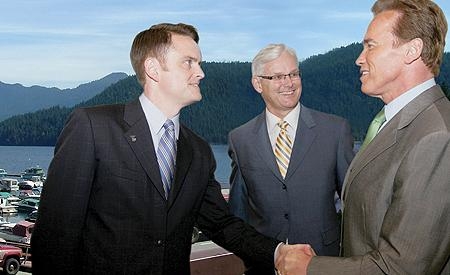 GREEN BUDDIES: BC Environment Minister Barry Penner [right] and Premier Gordon Campbell [middle] have sealed an agreement with California Governor Arnold Schwarzenegger to supply water from Powell Lake to the drought-plagued American state. |
Multi-billion dollar deal unfolds in two phases
BC Premier Gordon Campbell and California Governor Arnold Schwarzenegger have signed an agreement that gives California full rights to Powell Lake.
The multi-billion dollar, multi-phased deal gives California water rights over the entire lake. It flows from the memorandum of understanding on climate change Campbell and Schwarzenegger signed in 2007.
California is entering its third consecutive year of drought and in February Schwarzenegger proclaimed a state of emergency and ordered immediate action to manage the crisis. "This drought is having a devastating impact on our people, our communities, our economy and our environment," he said. "This is a crisis, just as severe as an earthquake or raging wildfire and we must treat it with the same urgency by upgrading California's water infrastructure to ensure a clean and reliable water supply for our growing state."
The first phase of the deal between BC and California involves supertankers docking at Catalyst Paper Corporation's deep-water port to fill up with fresh water that will bolster California's reserves.
The second phase involves the construction of a pipeline down the coast of North America to California to transport water directly from Powell Lake.
The agreement sustains BC's economy in the middle of the worldwide downturn, as well as provides benefits for the environment, said Campbell. "We are pleased this agreement benefits both California and BC," he said. "Every day, it becomes more and more urgent that we find a long-term solution that works for the environment and the economy."
The financial benefit to the City of Powell River was not disclosed when the announcement was made today.
California rejects B.C. green power claims
By Scott Simpson
Vancouver Sun
April 2, 2009
State senate won’t amend renewable energy bill that would approve run-of-river hydroelectricity sales
 While the California state senate opted for a regulation that disqualifies hydro projects producing more than 30 megawatts, new B.C. projects are typically 50 megawatts or larger. (Photograph by: Handout photo, Vancouver Sun files) |
British Columbia’s effort to promote its hydroelectric energy exports to California as green power is failing.
The California senate last week rejected calls by electrical utilities in the state to amend a renewable energy bill to incorporate power from sources such as run-of-river hydro from B.C. as part of their obligation to generate 33 per cent of retail electricity sales from renewable sources by 2020.
Pacific Gas & Electric, in particular, sees B.C. power as central to a $4-billion B.C.-to-California transmission system upgrade carrying an enormous quantity of supposedly green power — equivalent to half of B.C.’s present generating capacity — to the state by 2016.
PG&E’s promotion of supposedly green B.C. power is a central aspect of the provincial government’s plan to develop the province as a major exporter of renewable energy.
However, the presence of a willing buyer who can pay premium prices for green power is critical to B.C.’s initiative, particularly in the massive California electricity market.
Western Canada Wilderness Committee national campaign director Joe Foy said the California senators’ decision confirms his group’s misgivings about run-of-river power.
The wilderness committee is a vocal opponent of the large-scale drive to develop run-of-river power resources under the umbrella of BC Hydro’s power acquisition mandate on the premise that it’s causing unnecessary damage to streams and forested areas.
“Once again this so-called run of river, this river diversion power, has been been judged and been found not to be green,” Foy said. “The environmental footprint is too big.
“They tried to wiggle it past the Californians and were unsuccessful. Californians had a closer look.”
The senate opted for a regulation that disqualifies hydro projects producing more than 30 megawatts — new B.C. projects are typically 50 megawatts or larger. The senate bill is now being reviewed by the California state assembly and a final decision could be months away.
The wilderness committee obtained a letter to the assembly from B.C. Environment Minister Barry Penner who is attempting to assure legislators that power from this province is subject to a thorough environmental review.
“The only reason we’re buying it [in B.C.] is that we are being forced to buy it. I think the only one who sees it as green power is our own government,” Foy said.
In an interview, Penner said he wrote the letter to counter allegations raised by environmental groups which are urging California legislators to hold firm to their existing standards.
Penner said California’s decision to increase its use of renewable energy was “laudable.”
He said he wrote the letter to detail, in four single-spaced pages, the extent of environmental scrutiny to which run-of-river projects are subject in B.C.
“There was what I believed to be a misinformation campaign, spilling over from the ideological debate here in B.C. about having the private sector involved in renewable energy,” Penner said.
“I wanted to set the record straight. I had seen some e-mails about what people were saying about British Columbia and it was not true. I felt we needed to stand up for British Columbia.”
Blog: www.vancouversun.com/energy
© Copyright (c) The Vancouver Sun
Barry Penner's letter to the California State Assembly Committee, March 24, 2009
April 01, 2009
U.S. plan to flood Similkameen Valley draws B.C.'s attention
By Scott Simpson,
Vancouver Sun,
March 31, 2009
 A Washington state utility wants to flood 3,650 hectares of the Similkameen Valley for a hydro dam. Photograph by: Cathy Lukovich, Vancouver Sun files |
B.C. Environment Minister Barry Penner asked U.S. regulators Tuesday for intervenor status on a proposal by a Washington state utility to flood 3,650 hectares of B.C.’s Similkameen Valley for a hydro dam.
The threatened land includes two aboriginal reserves, two provincial protected areas, a potential national park, and “high quality agricultural land,” according to a six-page letter from Penner to the U.S. Federal Energy Regulatory Commission (or FERC).
At least 20 blue- and red-listed animal and plant species would be impacted, Penner said in the letter, noting that Canada’s Species at Risk Act “prohibits any action which threatens, damages or destroys a threatened or endangered species or its habitat.”
The Okanogan County Public Utilities District has applied to U.S. regulators to build a dam either 27 or 80 metres high at Shanker’s Bend on the U.S. portion of the Similkameen River.
The high dam alternative would create a 7,300-hectare reservoir — half of which would be on the Canadian side of the valley in southeast B.C., along one of the most bucolic tourist routes on the continent.
The dam’s operating capacity would be 43 megawatts — a nominal amount given the scale of its impact. But it would also serve as a reservoir to provide water for agriculture in eastern Washington.
“While British Columbia certainly supports the responsible use and development of hydropower, we do believe such projects need to be appropriately sited and designed to avoid unacceptable environmental impacts,” Penner stated in the letter.
He said the province opposes the proposed 80-metre high dam “because of the anticipated environmental and community impacts in British Columbia.”
Penner said the 27-metre low-dam proposal also raises concerns because of “how the dam could impact British Columbia in years of high water.”
The Canadian Parks and Wilderness Society is already actively opposing the proposal and had been pressing the province to get involved.
“I’ve intended to seek intervenor status for some time, but I also wanted to make sure that our T’s were crossed and our I’s were dotted,” Penner said in an interview. “We’ve retained legal counsel in the United States to help us prepare for our intervention request.”
Penner said the legal firm the government retained previously represented the province’s interests in the successful battle to block development of the Sumas Two gas-fired generating station in Washington, just across the Canada-U.S. border from Abbotsford.
Chloe O’Loughlin, executive director of the B.C. chapter of the Canadian Parks and Wilderness Society, lauded Penner’s involvement.
“The dam is entirely unacceptable from an ecosystem perspective and from a cultural perspective,” O’Loughlin said.
ssimpson@vancouversun.com
Blog: www.vancouversun.com/energy
© Copyright (c) The Vancouver Sun
March 31, 2009
Investor urges Enbridge to assess risk of delay
By David Ebner
The Globe and Mail
March 30, 2009
 Enbridge's proposed Northern Gateway project faces significant risk of delay due to the concerns, interests, and authority of the 42 First Nations along the project route (image: fishing boat arriving in Prince Rupert, Josh Paterson) |
VANCOUVER — The prospect that Enbridge Inc. [ENB-T]'s $4-billion Gateway pipeline project, which would connect Alberta's oil sands with lucrative Asian markets, could become mired in disputes with first nations groups has at least one major shareholder demanding a reckoning.
The company is set to bring its Gateway proposal, which has $100-million in backing from 10 companies, oil sands producers in Canada and refiners in Asia, before the National Energy Board in the next three months.
But given the climate of opposition that has dogged both this project, which was shelved in 2007 in part because of a lawsuit by the Carrier Sekani Tribal Council, and the proposed Mackenzie Valley pipeline, Enbridge investor Ethical Funds Co. wants the company to disclose how much risk it sees.
Vancouver-based Ethical Funds, which owns about 500,000 Enbridge shares, is putting a resolution before the company's May annual meeting, published this week in Enbridge's proxy circular. The resolution urges Enbridge to disclose in its quarterly filings how negotiations with native communities are progressing, "including reference to specific opposition."
"It seems pretty clear that there's risk to investors here," said Bob Walker, an Ethical Funds vice-president.
Enbridge, stung by the failure of its first effort to get Gateway moving ahead, has redoubled its work on the project this time, with a particular focus on relations with first nations.
The work centres on the duty of the government to conduct meaningful consultations with first nations about industrial projects that would traverse or be built on their traditional land.
A lack of consultation has slowed other projects, such as the Mackenzie Valley pipeline project.
The Dehcho First Nations sued the federal government about being unfairly excluded from the review of the Mackenzie pipeline. The suit delayed the project for a year and the Dehcho won $31.5-million.
The duty to consult has been largely taken over by companies such as Enbridge. The company last fall held a series of open houses, which is typical, and is trying to use social media such as YouTube and Facebook, where results are mixed. The Gateway project has just two friends on Facebook.
In both the Mackenzie case and Gateway, the first nation regions in question don't have settled land claims, making it harder for a project developer.
Adequate consultation is one of the "most complex questions clients are asking their advisers," said energy regulation lawyer Gord Nettleton of Osler Hoskin & Harcourt LLP.
"You must have very good communication and co-ordination with government."
Success will cost money, said Doug McArthur, a former deputy minister of aboriginal affairs in B.C. and now a public policy professor at Simon Fraser University.
"Sitting down is crucial and it's going to cost money," Mr. McArthur said. "It's no longer possible for companies to build these kinds of things without making substantial offers in terms of benefits and compensation."
Enbridge has tentative support from 25 of the 42 first nations groups along the 1,170-kilometre pipeline route. Enbridge pays money to the groups so they can be involved in deliberations over the pipeline and the money comes with a deal to commit to the review process led by the NEB.
"We've had a pretty good reception," said Ken MacDonald, an Enbridge vice-president.
The Carrier Sekani, representing eight first nations, about 10,000 people and one-third of the Gateway pipeline route, remains the main opposition. Chief David Luggi doesn't trust the National Energy Board process, which he said is almost guaranteed to lead to project approval.
He said the danger of one oil spill is too great for the fisheries business on the many prolific rivers of northern B.C.
"You do the real easy math, one spill, it'll have fatal results, for an undetermined amount of time and perhaps forever," Mr. Luggi said.
The Council of the Haida Nation on the Queen Charlotte Islands is also opposed to the pipeline.
March 30, 2009
BC Hydro attacks conflict allegation
COMMENT: Juicy stuff! Brookfield says BC Hydro is in a conflict of interest by evaluating private project proposals when it is developing its own project (Site C). It claims Hydro may be using info gathered in the power calls to, um, well, perhaps, improve the case for Site C. It even suggests that the high attrition rate of projects accepted by way of the calls is because BC Hydro essentially takes junk bids from unqualified companies.
Addendum: On March 26, Brookfield wrote to the Commission, claimed constructive intent, and advised that it would "have no objection" if the earlier letter was struck from the record. link
Scott Simpson,
Vancouver Sun
March 30, 2009
A conflict of interest allegation levelled against BC Hydro by an independent power producer should be struck from the record at a B.C. Utilities Commission hearing, the Crown corporation says.
Hydro says it has been prejudiced by "unsubstantiated assertions" that Brookfield Renewable Power made in a recent 10-page letter to the commission.
In the letter, Brookfield alleged that Hydro is unsuited to the dual role of public utility and solicitor of private power bids because Hydro's own projects, such as the proposed Site C dam on the Peace River, are in competition with privately owned electricity generation.
It called on the government of B.C. to create an "independent, transparent, arm's-length entity to manage all electric generation procurement activities."
Hydro has declined comment, but both Energy Minister Blair Lekstrom and NDP energy critic John Horgan previously dismissed the allegations.
However, in response to a query from The Vancouver Sun, former Hydro fairness commissioner Michael Asner examined Brookfield's report and said that if it is factually correct, Hydro is in both an apparent and a potential conflict.
Hydro is reviewing the economic case for self-building Site C dam while simultaneously conducting a "Clean Power Call" aimed at attracting bids for new private power developments.
Both efforts have a single purpose: to increase electricity supply in B.C.
Hydro disputes Brookfield's assertion that the dual effort "serves to undermine confidence in the process as well as the market signals that drive investment decisions for IPPs in British Columbia."
"The assertion that BC Hydro is in a conflict of interest with respect to the Clean Power Call because it may advance self-build projects in the future is a very serious allegation which BC Hydro does not accept," said Hydro's statement to the BCUC.
"Nor does BC Hydro accept Brookfield's assertions concerning the so-called market impacts.
"What has been clearly established on the record is that BC Hydro has received 68 proposals from 43 registered proponents representing in aggregate some 17,000 gigawatt hours per year of firm energy in response to the Clean Power Call."
In response to Hydro's request, the Utilities Commission ordered Brookfield to file a response by last Friday, and gives Hydro until today to comment on Brookfield's response.
Brookfield Renewable Power comment to the BC Utilities Commission, 06-Mar-2009
Sample Electricity Purchase Agreement (EPA) from the Clean Power Call
More documents on EPAs and the Clean Power Call
Brookfield backs down, 26-Mar-2009
Brookfield backs down
March 26,2009
Ms. Erica M. Hamilton
Commission Secretary
British Columbia Utilities Commission
900 Howe Street, Sixth Floor, Box 250
Vancouver, BC
V6Z 2N3
Dear Ms. Hamilton:
Re: British Columbia Hydro and Power Authority ("BC Hydro")
2008 Long Term Acquisition Plan ("2008 LTAP")
BC Hydro's Objection to Comments of Jack Burkom, Director
of Marketing for Brookfield Renewable Power Inc.
We write in response to your letter of March 24, 2009, requesting a response to BC Hydro's letter of March 19, 2009. Capitalized terms used in this letter have the meanings attributed to them in your March 24,2009 letter.
The Brookfield Letter was submitted as a commentary document in the 2008 LTAP proceeding, and was not intended to be put forward as "evidence". Our intention was to be constructive in making comments on the process underway to provide British Columbia with more investment in new, renewable power assets producing electricity at the lowest possible cost. It was certainly not our intention to prejudice BC Hydro or suggest that BC Hydro has acted in any manner other than with full professionalism in all of its endeavours, and we regret if the wording of our comments implied otherwise.
In light of the foregoing, we would have no objection to the Commission striking the Brookfield Letter from the 2008 LTAP record.
Yours very truly,
BROOKFIELD RENEWABLE POWER INC.
Ben Vaughan
Chief Operating Officer
Brookfield's letter of contrition, 26-Mar-2009
March 27, 2009
FACTS ON INDEPENDENT POWER PRODUCTION
Ministry of Energy, Mines and Petroleum Resources
March 25, 2009
Here are the facts on independent power production, to correct misleading claims about electricity generation in British Columbia.
Claim: B.C. does not need to be electricity self-sufficient; we can easily import any new electricity we need from other jurisdictions.
Fact: Government’s commitment to becoming self sufficient in electricity by 2016 will ensure BC Hydro has sufficient electricity supply to meet customer needs in the worst water years, and have a buffer supply for insurance when demand is higher than anticipated, or if expected energy efficiency savings do not materialize.
· BC Hydro’s own figures show it has become a net importer to meet its customers’ needs. BC Hydro has been a net importer of electricity for seven of the last 10 years.
· Despite the current economic climate, over the long term, B.C.’s economy will continue to grow, as will the need for electricity. The gap between supply and demand is expected to widen as we move to achieve our goals for using clean, renewable electricity in transportation and other sectors.
· It takes time to build new electricity infrastructure responsibly, and government is not going to risk being ‘caught short’ by not continuing to plan for the economic future of this province.
· The self-sufficiency policy ensures that B.C. benefits from the jobs and investment of new power supply infrastructure.
· Self sufficiency will reduce our reliance on imports. Many other jurisdictions B.C. currently relies on to meet our domestic needs generate electricity from coal-fired power plants – not the clean, green sources that we enjoy in this province.
· Many British Columbia residents are surprised to learn we rely on American power to keep our lights on or that the imported power comes from coal-fired power plants. Citizens expect us to be self-sufficient and clean, considering the ample natural resources we have.
· Government has put conservation and energy efficiency as the first option utilities must consider in meeting a growing demand.
· Government has set a goal for BC Hydro to meet 50 per cent of its growing needs through conservation, and its current resource plan does that and more.
Claim: The 2002 Energy Plan bans BC Hydro from building new electricity generation facilities.
Fact: BC Hydro provides 90 per cent of the total electricity the province generates – between 43,000 and 54,000 gigawatt house of electricity per year – and serves 95 per cent of B.C.’s population (BC Hydro Service Plan, 2009/10-2010/11). Therefore, BC Hydro is currently looking at building and expanding electricity generation for B.C.
· BC Hydro is investing more than $3.6 billion (BC Hydro Service Plan, 2009/10-2010/11) over the next two years to upgrade its dams and other public power infrastructure.
· In anticipation of increased demand, BC Hydro is adding capacity to the Revelstoke Dam and Generating Station. Revelstoke Dam is the most cost-effective energy source available to BC Hydro. This project will add about 500 megawatts of power, which will increase capacity at Revelstoke to 2,480 megawatts. As well, BC Hydro plans to add 1,000 megawatts of capacity with two new turbines at the Mica dam.
· Capital investments on several other sites are also proposed: Peace Canyon Stator replacement, GM Shrum Stator upgrade, Aberfeldie Dam Redevelopment and Coquitlam Dam Improvement Project.
· These capital projects will increase reliability and produce additional capacity for meeting B.C.’s power needs.
· BC Hydro has completed Stage 2 consultation of the Site C project on the Peace River. If built, this project would produce about 4,600 gigawatt-hours of electricity annually – enough for 460,000 homes – which is about 10 per cent of the electricity produced annually at BC Hydro’s existing hydroelectric facilities.
Claim: B.C. ratepayers are paying the capital costs of new power projects being built by private energy developers through Electricity Purchase Agreement contracts with BC Hydro, and are paying as much as double the current energy market rates.
Fact: Price protection and energy supply is assured within the contracts between BC Hydro and an independent power producer.
· Price stability can be predicted over the term of the contact. The price of electricity on the spot market can be volatile. Long-term contracts with power producers bring certainty and a guaranteed price.
· BC Hydro runs competitive procurement processes which result in the lowest cost projects. The resulting contracts are reviewed by the BC Utilities Commission to ensure they are in the ratepayers’ interest.
· The cost BC Hydro pays for new power supply from IPPs is similar to that being paid in other jurisdictions for new supply.
· Building new power projects is more expensive today than it was several decades ago. It costs more, not because they are IPPs, but because they are new projects. Similarly, a new home or vehicle costs more to build today than it did in the 1960s or 1970s.
· Since 1998, BC Hydro rate increases have remained below the rate of inflation and well below those of similar service providers (BC Hydro Service Plan, 2009/10-2010/11). Ratepayers still enjoy some of the lowest rates in North America and government is committed to maintaining that competitive advantage.
Claim: The government wants to privatize BC Hydro and sell all of its assets.
Fact: BC Hydro and its assets are not being privatized or sold.
· The BC Energy Plan released in 2007 reaffirms the government’s commitment to public ownership of BC Hydro and its assets while broadening the supply of available energy.
· The BC Hydro Public Power Legacy and Heritage Contract Act and the Transmission Corporation Act require that our public power legacy be maintained.
· This government has also established the Heritage Contract in Perpetuity. This benefits ratepayers by continuing to receive low-cost electricity for generations to come and helps keep rates among the lowest in North America.
Claim: Bill 30 was passed to put an end to meaningful local input into the approval of private power projects on Crown land. These projects are impacting rural communities in a negative way and there is not enough consultation with communities. These projects are also being ‘fast tracked’ with minimal environmental review.
Fact: Local input is still requested in the application process and the review of power projects, regardless of size or ownership, and is comprehensive in scope.
· When a proponent wants to develop a hydroelectric project, they must apply for a water license and a Crown land license, which grants them the right to construct their projects on Crown land and to use the water subject to the terms and conditions specified in the license.
· The project application is made available for review to agencies, local governments, First Nations and special interest groups for feedback. This feedback is used by the permitting agencies when considering whether to approve the application and in setting conditions for any approvals.
· Any run-of-the-river project must follow a multi-step process for development, and for projects of over 50 MW in size this includes an Environmental Assessment Act process.
· Requirements include, but are not limited to:
o A land tenure permit for projects situated on Crown land. This requirement falls under the Land Act;
o Application for a water license (which falls under the Water Act) for any run-of-river projects using water;
o Projects other than run-of-river will require different permits, depending on the type (i.e. wind, biomass, geothermal, etc);
o Consultation with First Nations.
· Considering the size and scope of a project, there could be no fewer than 11 provincial approvals that must be attended to when considering an IPP permit. As well, there could also be as many as six federal departments that would have to approve an IPP, if federal approval is needed (Ministry of Agriculture & Lands, Independent Power Production in B.C. – A Guidebook for Proponents, http://www.al.gov.bc.ca/clad/IPP_guidebook.pdf).
· Water licenses are for fixed terms and after the term expires, the IPP holding the license no longer has any rights to use the water without obtaining a new water license. Granting fixed terms on licenses ensures that the Province retains control over the water resources, while ensuring that IPPs can meet their contractual obligations to deliver power to BC Hydro.
Claim: B.C.’s rivers and streams are being exploited by these run-of-river projects and will be privatized. Once an American IPP or another foreign entity owns them, they will control our river and stream systems and that provision will be guaranteed under NAFTA.
Fact: IPP projects are not new – they have been contributing clean energy to the provincial power grid since the late 1980s. Between 1996 and 1997, numerous IPP projects were announced by the then-government.
· Rivers and streams will continue to remain in public hands – IPPs do not own them.
· There are mandatory time limits on water power licenses to ensure ownership of our rivers and waterways remain in public hands. Prior to changes made by the current government in 2003, water power licenses were issued with no expiration date.
· IPPs receive water licences of 40 years, and when those end, so do the water licenses and the land tenure rights. A company would have to re-apply to have the water/land tenure license renewed in order to keep operating.
· If power producers want to use water systems for a run-of-river project, they must pay water rental fees that typically can amount to significant revenue to the Province over the life of a project.
· This arrangement can be compared to what a forest company does – it pays the government ‘stumpage fees’ to access timber on Crown land through a 25-year lease arrangement with the option of renewal after 25 years.
· NAFTA does not prevent government from regulating its water resources, or determining whether or not to issue a licence.
Claim: When the long-term contracts with IPPs expire with BC Hydro, these IPPs will be free to export their power to the U.S. This will result in BC Hydro having to bid against U.S. buyers and be forced to increase our consumer rates in order to support those bids.
Fact: B.C. has always been an exporting province and our natural resources are the foundation of our economy. For decades, B.C.’s resource-based exports have supported jobs and wealth creation in the Province. IPPs have been able to export power to the U.S. and elsewhere since the 1993 Long-Term Firm Electricity Export Policy. However, there has not been significant export activity by IPPs due to a number of factors:
· Availability and cost of transmission to the U.S.;
· Challenges in marketing intermittent supply from projects such as wind and run-of-river;
· The available opportunities to sell power to BC Hydro.
· When a water license expires, it will be up to the government of the day to decide whether or not the license should be renewed.
Claim: Critics claim that the National Energy Board and Stats Canada data say that BC Hydro has been a net exporter of energy for seven of the past 10 years yet BC Hydro’s own data says it has been a net importer – why the difference?
Fact: Critics are mistaken in their interpretation of the National Energy Board (NEB) and Stats Canada data on electricity matters.
· BC Hydro, StatsCan and the NEB use different data sets. BC Hydro’s information shows it has been a net importer of electricity in seven of the past 10 years. BC Hydro’s data shows that it has had to purchase up to 12 per cent of domestic requirements during this period.
· StatsCan and the NEB include contribution numbers from other utilities and generators, like Fortis BC, Columbia Power and Teck. They also report at the Canada/U.S. border and do not include transactions between BC Hydro and Alberta.
Claim: There are almost 1,000 water licences staked on rivers throughout B.C. and it’s a gold rush of private power producers taking over B.C. resources.
Fact: As of September 2008, there were about 550 water power applications outstanding in the Province; however, many of these are inactive.
· As of Dec. 31, 2008, only 88 IPP licenses have been issued that are still current (61 since 2001) and 154 applications have been refused or abandoned. Of the 88 licenses issued, 26 of them were prior to May 2001; 62 since 2001. In other words, one-quarter of these were approved prior to 2001.
· A total of 47 IPPs are operating all around the province and 15 of them have been generating green electricity for over 10 years. (32 of the 47 IPPs are run-of-river) (Ministry of Environment, Water Stewardship Division stats)
· Comparing water licence applications to operating IPPs is like comparing mineral claims to operating mines – there are more than 50,000 mineral claims staked in B.C. but only a handful of operating mines. It does not take into account the enormous environmental, financing, and other regulatory processes power projects need to pass before they can become a reality.
Claim: There are literally hundreds of run-of-river IPPs operating in the Province. These projects offer nothing to rural communities.
Fact: This is false. There are currently 47 operating IPPs around British Columbia, 32 of which are run-of-river, and the economic benefits are provincewide, especially in rural communities.
· Total construction employment from IPPs that started construction since 2001 is about 4,000 person years. There is also indirect employment in the way of supporting community facilities. (Industry employment figures, as of Feb. 2009 (IPPBC)
· According to industry figures, IPPs have already invested $2.4 billion in B.C. with an additional $6.8-billion currently ongoing or expected in connection with existing calls for power.
· There are more than 1,100 workers employed on 47 operating projects and another 18 projects currently under construction. Current construction represents over $2 billion of private investment. (Industry employment figures, as of Feb. 2009 (IPPBC))
· Not all IPPs are run-of-river projects. Current IPPs include natural gas fired, heat recovery and biomass generation. Future projects could include wind, geothermal, ocean and solar electricity projects.
Claim: First Nations do not support independent power projects.
Fact: First Nations are involved in many IPP projects around the Province.
· The Squamish First Nation is involved in the Furry Creek and Ashlu run-of-river projects. Ashlu will become the property of the Squamish First Nation at the end of their power sales agreement with BC Hydro.
· The Hupacasath First Nations is an example of a proponent that has an electricity purchase agreement with BC Hydro for their China Creek Project on Vancouver Island, which is in service, and they are looking to another agreement with BC Hydro for a further project on Corrigan Creek.
· The Taku Land Corporation also has an electricity purchase agreement on Pine Creek and another one on Kwoiek Creek which involves the Kanaka Bar Indian Band.
· The Klahoose on Cortes Island signed an agreement with Plutonic Power for a benefits sharing arrangement for the East Toba River and Montrose Creek IPP projects. Plutonic will pay royalties to the Klahoose for the next 50 years and will also see jobs and training offered to band members.
· Nai Kun Wind Energy and the Haida Nation have formed a commercial partnership to operate and maintain Nai Kun’s proposed wind farm in Hecate Strait. The agreement formalizes a relationship that’s been developing since 2002.
-30-
Media Contact:
Jake Jacobs
Public Affairs Officer
250 952-0628
250 213-6934 (cell)
For more information on government services or to subscribe to the Province’s news feeds using RSS, visit the Province’s website at www.gov.bc.ca.
Download this media release.
‘No more run of river’ B.C. Greens
Jesse Ferreras
The Pique (Whistler)
26 March 2009
Sterk says additional hydro isn’t needed, focus should be on conservation
B.C.'s Green Party wants to put an end to run of river hydro projects, its leader told Pique Newsmagazine Friday morning.
Jane Sterk, leader of the B.C. Greens since October 2007, said in an interview that it's time to put an end to run-of-river hydro projects and focus on delivering electricity to British Columbians through conservation.
"We're for the most part saying no more run of river, that we don't need more hydro, that through conservation and renewable energies we can move away from these projects," she said.
"The run of river projects, for the most part, have been very controversial and they have not been accepted in the regions where they've been introduced."
Run of river projects, often referred to as "independent power producers" when developed by private companies, have been a big issue in B.C. since at least 2006, when the provincial government passed Bill 30.
That bill came after the Squamish-Lillooet Regional District denied in early 2005 a rezoning application for the Ashlu Creek hydro project, near Squamish. The district denied the rezoning on the grounds of "community concern and objection" to the project, as well as a lack of overall strategy for IPP production.
Bill 30 was introduced in the legislature in April 2006. Called the Miscellaneous Statutes Amendment Act, it proposed an amendment to the Utilities Commission Act saying that nothing in the Community Charter or under the Local Government Act could supersede an authorization granted by the B.C. Utilities Commission to a utility operating on Crown land.
That means if a public or private utility is being built on Crown land in a municipality or regional district, the local government can't stop it.
The move has touched off a hot debate throughout B.C. that is promising to make run of river projects a key election issue. The Greens, who released their election platform Thursday, are promising to repeal Bill 30 if elected on May 12.
"We just think decision-making should be made at the local level," Sterk said. "The regional districts and municipalities have a better understanding of the impacts of these projects on their areas, their regions."
Other promises by the Greens include changes to the environmental assessment process, something that's been a point of consternation when it comes to run of river projects. The current process, administered by the Environmental Assessment Office, prescribes a nine-stage assessment. The provincial cabinet then decides whether to approve it or not.
Critics of run of river feel the process administered by the Environmental Assessment Office (EAO) doesn't go far enough to assess the projects. In their platform, the Greens propose to "strengthen" the environmental assessment and account for the cumulative impacts of multiple projects, rather than just each one individually.
"We would change the assessment process," Sterk said. "We would require that there be cumulative impacts accounted for in these run of river projects."
West Vancouver-Garibaldi Liberal MLA Joan McIntyre, now running for re-election in the newly-formed riding of West Vancouver-Sea to Sky, said she doesn't think there's anyone more committed to conservation than the B.C. Liberals.
"We introduced a 55-point energy plan several years ago that we've been in the process of executing," she said. "Over the last three years, we've brought in eight pieces of legislation related to both our environment and energy, but we have a very aggressive target of 50 per cent of B.C. Hydro's incremental resource needs through conservation by 2010."
As for Bill 30, McIntyre thinks it's often "misunderstood" by its critics.
"What that did, is it was a small amendment that allowed some of these independent power producers exactly the same rights as B.C. Hydro would have," she said. "Nothing more, nothing less."
Speaking about run of river hydro, McIntyre said that British Columbia is looking at a "whole mix of renewables" in order to meet the province's energy needs "and that includes run of river."
"(Run of river) is a very important part of our goal to be electricity self-sufficient by 2016," she said. "We have been relying on our ability to produce green power so we don't have to import from sources that are coal-fired and using gas from our neighbouring partners like Washington and Alberta."
McIntyre is facing off against the Green Party's Jim Stephenson in the contest for her riding. A spokesman for B.C.'s New Democratic Party said the party will have a candidate in West Vancouver-Sea to Sky ready on April 8, about a month before British Columbians vote on May 12.
James tells business leaders she will lower, not raise, their taxes
Vaughn Palmer,
Vancouver Sun
March 27, 2009
But will leader's view prevail if NDP is elected?
Opposition leader Carole James spoke to business leaders in downtown Vancouver on Thursday and reminded them of something that not many of them expected from a New Democratic Party government.
She'll give them a tax cut. And not a small one either.
"Maintaining a competitive tax environment is extremely important," said the text of the speech James delivered to the crowd of about 100 who assembled for the breakfast meeting organized by the B.C. Business Council.
"It's why I am going to lower your taxes, not raise them."
Then the swipe at the B.C. Liberal government:
"British Columbia, I have to say, is one of the only places in the developed world that is increasing taxes during this recession."
She meant the carbon tax, of course.
Or "the gas tax," as the NDP prefers it.
"It's set to go up next year, the year after that, and the year after that. Marc Jaccard, the government's top adviser, says that it has to go up to 24 cents a litre before it will make any real dent in greenhouse gases."
James let the number sink in.
"Twenty-four cents," she said. "Economic recklessness of the worst kind."
Then the promise: "The government's gas tax must go. And should I have the opportunity, it will be eliminated."
Yes, she said that a year ago. But worth noting again, particularly given the dollars associated with the promise and the projected savings for the business community.
Based on the government's figures, the carbon tax will collect about $2 billion over three years. Moreover two thirds of the tax is paid by businesses of all kinds.
So James is promising to cut taxes on business by $1.3 billion over three years.
How can that be when the government claims the tax is revenue neutral?
Because revenue neutrality was achieved by returning the money raised from the carbon tax through cuts in other taxes.
James would get rid of the carbon tax, mostly paid by business, without cancelling the offsetting cuts in other taxes, which mostly benefited individuals. Hence her promise, taken in isolation, would disproportionately benefit business.
But if James repeals the carbon tax without reversing the reductions in other taxes, wouldn't that blow a hole in the provincial budget?
"Yes," James conceded, eliminating the carbon tax "will add to the deficit ... in the short term."
And in the long term? James made only a passing reference to her preferred substitute for the carbon tax as a means of inducing reductions in carbon dioxide and other greenhouse-gas emissions.
"I support cap-and-trade," she said, and that was all she said. Most analysis of cap-and-trade suggests it is a form of hidden taxation and one that may well be paid in larger proportion by business and industry.
James made a second reference to her intention to increase the deficit, when she spoke of the need for a more "aggressive" plan of economic stimulus and infrastructure construction than the one announced by the B.C. Liberals.
"Infrastructure, as you know, will cost money.
"It will increase B.C.'s relatively low public debt. And yes, in the short-term, it will increase British Columbia's deficit."
Considering just the $2-billion tax cut and the increased capital spending, it does sound as if James's short-term deficit will be larger than the one proposed by the B.C. Liberals, namely $500 million this year and $250 million next.
Still James defended her debt-and-deficit intentions. "It's necessary to keep people working. It's necessary to build the infrastructure a modern economy needs. And it's necessary to ensure that vital public services aren't slashed."
James promised the business community "will be fully consulted on the government's economic and fiscal policy." The text didn't mention "labour laws, regulations and policies," but business leaders are more worried about what she would do to make it easier for workers to organize and hold their employers to account.
For the rest, James was a study in moderation.
"I support the creation of wealth. I support a strong and vibrant business community. I support a competitive tax regime. And I support a competitive regulatory regime."
She even pledged "to fight the idea that protectionism is any sort of economic solution. Because it's not. ... Open trade creates wealth, it drives innovation, it improves productivity and it grows our economy."
I wonder if she's told the hard-liners in her own party.
But there's the problem for business leaders in dealing with James. Even if they credit her good intentions, they wonder if her moderate views would prevail, should the NDP take power.
March 25, 2009
Pacific Trail Pipelines Kitimat to Summit Lake project clears another hurdle
COMMENT: Getting approval to do something is not the same as doing something. Both the GSX Pipeline and the Duke Point Power project had approval. Seabreeze has approval to build all sorts of things - transmission systems, wind projects, hydro projects. It's not until customers are locked down and investment money can be secured, that a project might get built. Kitimat LNG is proposing an LNG export terminal which until last year was to be an LNG import terminal. The business case for the one is as specious as the business case for the other. It also needs a billion dollar, or maybe it's now a $2 billion pipeline to move the gas to Kitimat - that's this Pacific Trails project, also known as Kitimat-Summit Lake (KSL): that's what this approval is about. It needs shippers. The shippers need to find some gas, and some customers. None of those things are in place.
Last year, PNG, the partner in the KSL, had a customer company which apparently defaulted on a commitment to secure capacity to Kitimat. PNG itself is in really bad shape - severely underutilized and aging infrastructure, economic downturn everywhere along its pipeline route. Kitimat LNG is on equally dodgy footing. Late last year it announced it was seeking expressions of interest from potential customers. The deadline was three months ago, yet from the company ... silence. Must be some very unhappy investors in Kitimat LNG, I suspect.
See:
LNG Partners does not make payment to PNG
KLNG puts call out for potential clients

The Canadian Press
March 24, 2009
VANCOUVER, B.C. - Pacific Trail Pipelines Limited Partnership said Monday that its proposed Kitimat to Summit Lake Pipeline Looping Project as cleared another hurdle.
The company said a decision under the Canadian Environmental Assessment Act has found that, with appropriate mitigation measures, the project is "not likely to cause significant adverse environmental effects."
"The receipt of the decision marks the next major milestone in the development of the KSL Project following the receipt of the B.C. Environmental Assessment Authority environmental certificate last year," the company said in a statement.
The project includes the construction of 463 kilometres of pipeline and compression facilities to allow the transportation of up to one billion cubic feet per day of natural gas from Summit Lake to Kitimat LNG Inc.'s proposed liquefied natural gas.
PTP is a partnership between Pacific Northern Gas Ltd. (TSX:PNG) and Galveston LNG Inc., the parent company of Kitimat LNG Inc.
British Columbia LNG project gets green light
Cowan Thant ZinPortworld News
24th March 2009
 Some 463 km of pipeline to be laid |
The west coast of Canada could soon have a loading terminal for LNG carriers at Kitimat in north-western British Columbia.
Pacific Trail Pipelines (PTP) had proposed a pipeline project to move up to 1 billion ft³ per day of natural gas from Summit Lake to Kitimat LNG Inc's proposed LNG export terminal in Kitimat.
The Kitimat to Summit Lake Pipeline Looping Project (KLS Project) needs approval under the Canadian Environmental Assessment Act before it can move along.
Federal authorities last week issued a go-ahead decision, saying that “with appropriate mitigation measures”, the project “is not likely to cause significant adverse environmental effects”.
“The receipt of the decision marks the next major milestone in the development of the KSL Project following the receipt of the B.C. Environmental Assessment Authority environmental certificate last year,” said PTP.
The KSL Project entails the construction of approximately 463 kilometres of 36 inch diameter pipeline and compression facilities.
The Kitimat terminal is slated to have facilities for storage, loading, delivery and liquefaction.
According to a press release, PTP, a 50/50 partnership between Pacific Northern Gas Ltd. and Galveston LNG Inc., the parent company of Kitimat LNG Inc., was formed for the purpose of developing the KSL Project.
Greg Weeres, vice president operations and engineering for Pacific Northern Gas said,"We are very pleased to have these major environmental approval processes completed successfully and look forward to delivering the many potential benefits this project would bring to our existing customers, to First Nations located in the Summit Lake to Kitimat area and to our shareholders.”
According to PTP, Kitimat LNG Inc. has already received provincial and federal permits and certificates for the construction and operation of the terminal.
According to another source, Mitsubishi has tentatively agreed to buy 1.5 million tonnes per year of terminal capacity and acquire a minority equity interest in the terminal.
PTP says its company mission is "moving natural gas from Western Canada to Asian markets."
Private power protest goes viral

MARK HUME
Globe and Mail
March 25, 2009
Campaign seeks moratorium on independent hydro projects
VANCOUVER -- A campaign by groups protesting the development of private power projects on British Columbia rivers has gone viral in an attempt to drown Liberal MLAs in a flood of messages tomorrow.
The Web-based event, called 10,000 Voices, will demand a moratorium on private hydro power projects - and it sends a signal that social networking through Twitter, Facebook and e-mail will be a powerful tool in the May 12 provincial election.
"I think we'll easily meet the target of 10,000 people from across the province, from Vancouver to Prince George. They will take action on the day and say make sure we do green power right," said Gwen Barlee, policy director for the Wilderness Committee, one of 12 groups behind the initiative.
"We have over 1,000 supporters on the Facebook site, we have over 1,000 signed up on [the website] 10000voices.org and then we have a multiplier effect. And that's just the Wilderness Committee," she said.
Ms. Barlee said the growing protest against independent power projects - which are proposed on some 600 B.C. rivers and streams - has "absolutely gone viral" heading into the election.
Ms. Barlee said when the groups agreed to join forces to pressure the government for policy change, the Wilderness Committee studied the communications strategy used by President Barack Obama in winning both the
2008 Democratic primaries and the national election.
"We were looking at Obama, at how he'd effectively used the Internet and Facebook," Ms. Barlee said.
"Facebook is a relatively new tool, at least in a campaign perspective for the Wilderness Committee. And it's also a tool that reaches out to a younger segment of the population that sometimes isn't a typical environmental supporter," she said.
Wilderness Committee staff are also using Twitter, the way Mr. Obama did in his campaign of change, urging people to help him get out the vote.
Andrew Radzik, outreach co-ordinator for the Wilderness Committee, said the multiplying effect of social networking is what makes the approach so powerful.
In the past, organizations like his would have had to launch massive and expensive advertising campaigns to reach such a large audience. Now they are relying on the message to spread from person to person, growing exponentially in the process. Everyone who gets involved is being asked to sign up at least one other supporter.
"One of the things we really wanted to do with this was to give people who really care about this issue the ability to take it and explain it to other people," Mr. Radzik said. "So it's not just, 'Hey, everybody we've got this thing happening' but it's asking people to be a part of it, to spread the word.
"What we found was that people are incredibly effective messengers when they go out and talk to the people they regularly would, to their friends, their family, their co-workers."
Mr. Radzik said while the aim of the campaign is to unleash a flood of e-mails, phone calls and faxes on the offices of government MLAs tomorrow, people have started doing their own events in advance.
He just got an e-mail from a group who heard about 10,000 Voices on a Facebook kayaking site. They used Facebook to plan a rally, got a poster from campaign organizers and then got coverage on a local news broadcast.
The 10,000 Voices campaign states that independent hydro power projects should be halted because they will damage B.C. rivers and put public resources in private hands.
The Independent Power Producers Association of British Columbia did not return calls. But the association has been doing its own outreach over the Internet, offering members news flashes, event alerts, issue flags and briefing papers through its website (http://www.ippbc.com).
'Green' projects cry for analysis
Editorial
Times Colonist
March 25, 2009
This year's list of British Columbia's 10 most threatened rivers is a warning. A review of the boom in private power projects on rivers and creeks is overdue.
Five of the rivers are on the list, says the Outdoor Recreation Council of B.C., because they are threatened by so-called "run-of-river power projects." That suggests a real concern about the rush to stake claims and develop power projects in wilderness watersheds across the province.
The boom began with provincial government encouragement. The B.C.
Liberals' energy policy, introduced in the first term, called for private producers to deliver most new power to B.C. Hydro. Run-of-river projects were the big winners.
They are green, at least in terms of emissions. Their relatively small scale keeps capital costs down. They are also cheap to run for the 40 years B.C. Hydro was prepared to guarantee purchase at good rates.
The projects are appealing. Even with the best conservation efforts, B.C.
will need more energy in time. Coal plants and nuclear are out politically; big projects such as Site C in northeast B.C. would take years and be controversial; buying from outside the province could get expensive. Smaller-scale hydro looks like the best bet.
Especially as sold to the public. A typical newspaper report, from June 2001, enthused that "the projects don't look like what you might expect."
The article described an inflatable rubber dam about the size of a small pickup truck that diverted part of the stream back toward a side channel.
The water flowed through a pipe into a warehouse-size 14-megawatt power plant and back into the river.
No reservoir was needed and the valley had already been logged.
The reality has been much different. Bute Inlet rivers and streams were ranked No. 8 on this year's threatened river list because of a proposed run-of-river development.
The area, on the mainland across from Campbell River, is the site for a proposed $3.5-billion development that would produce more than 1,000 megawatts. It would involve the diversion of 17 streams, more than 300 kilometres of new roads, 445 kilometres of new transmission lines and 16 power plants.
The development, given the size of the area and the disadvantages of the alternatives, could still be the best option, particularly with a strict approval process that considered ways to minimize environmental and public impact. It is going through the environmental assessment process.
But the highly credible council -- and other groups -- have raised legitimate concerns about the review process. The council notes that the combined effect of the proposals could be "industrialization of the coast."
It's time for a review of the projects proposed and developed so far, from both an economic and environmental perspective. Their size and number are beyond anything anticipated when the policy changes were introduced in 2002.
After seven years, a review -- perhaps by the auditor general, supported with the necessary additional funding -- would be a welcome sign of openness and managerial competence.
March 23, 2009
'Green' energy threatens B.C. rivers, report warns
By Larry Pynn
Vancouver Sun
March 23, 2009
Run-of-river power proposals that divert streams feared a significant impact on wildlife habitat
 Fish stocks are being threatened by run-of-river projects, although they are described as green energy power projects. (Photograph by: Bill Keay, Vancouver Sun) |
Half of B.C.'s 10 most threatened rivers are at risk from so-called green energy projects, according to an annual report released today by the Outdoor Recreation Council of B.C.
Mark Angelo, rivers chair for the council, said the public is concerned about a flood of private run-of-river power proposals all over B.C. in the absence of a comprehensive provincial strategy that considers cumulative impacts.
Bute Inlet, which ranked eighth on the council's list, is the site of a Plutonic Power proposal involving a record 17 stream diversions, 445 kilometres of transmission lines, 314 kilometres of roads, 142 bridges, 16 powerhouses, and a substation.
"Looking at Bute Inlet, that's a footprint that far exceeds what people think about as a green project," said Angelo, noting that even a small project in the wrong place can have significant impacts.
The Flathead River in southeast B.C. ranks first on this year's list due to proposed coal mining and coalbed methane development. It placed second in 2008 and first in 2007.
The B.C. Liberal administration has championed private power projects to the point of passing legislation that removes the ability of local governments to stand in their way.
"A lot of people feel alienated from the process," said Angelo, an Order of Canada recipient who also heads the B.C. Institute of Technology's fish, wildlife, and recreation program.
He said the province's environmental assessment office is designed mainly to help industry make a project work. Environmental concerns relate not just to infrastructure, but potential changes to stream flows and temperatures and insect production that could affect fish survival downstream.
The Peace River ranked sixth on this year's list and is threatened by BC Hydro's power dam proposal for Site C, a stretch downstream of Hudson's Hope that holds important farmland, wildlife habitat, and archeological sites.
The low-flow Kettle River near Grand Forks ranked second, in part due to a Cascade Heritage Power Project run-of-river proposal in Cascade Canyon.
Other run-of-river projects: Purcell Green Power's plan for Glacier/Howser creeks, third on the list, near Kaslo; and Kleana Power Corp.'s plan for Klinaklini River, 10th on the list, southeast of Kitimat.
The upper Pitt River placed first last year on the council's list due to an independent power project that would have run powerlines through neighbouring Pinecone Burke Provincial Park.
The province turned down the project after a groundswell of public protest.
Around B.C., rivers are threatened not just by power projects but by urban and industrial development, water extraction, sedimentation, drought, pollution and mining.
Angelo said it is impossible to "separate the health of our fish stocks from the health of our rivers."
Others on this year's list: the Fraser River, fourth, for urbanization, industrial development and pollution; Brohm River, a productive steelhead stream near Squamish, fifth, for development and excessive water extraction; the Coquitlam, seventh, for excessive sedimentation and urbanization; and the Coldwater River and other Thompson River streams for water extraction and development.
The council solicited nominations for the 17th annual list of most endangered rivers from its member groups, which, in turn, boast close to 100,000 members, as well as from the general public and resource managers.
For more information, www.orcbc.ca.
March 20, 2009
Proposed Pipeline Sparks Oil Spill Fears
By Chris Wirth & Joan Delaney
Epoch Times
Mar 18, 2009
Pipeline megaproject would result in heavy tanker traffic on B.C.'s north coast
 Oil tankers will ply northern B.C. waters if Calgary-based Enbridge Inc's Northern Gateway project goes ahead. (Kystverket/AFP/Getty Images) |
With the 20th anniversary of the devastating Exxon Valdez oil spill coming up on March 24, concerns are mounting over a proposed twin pipeline megaproject running from Alberta to British Columbia that would cross hundreds of kilometres of untouched wilderness.
The Enbridge Inc. Northern Gateway project would carry tar sands petroleum from Edmonton across northern B.C. to Kitimat en route to markets in Asia and the west coast of the U.S. A second pipeline would move condensate, a compound used to thin petroleum, from Kitimat back to Edmonton.
The $4 billion-plus project, which includes the construction of a supertanker terminal in Kitimat, would transport an estimated 525,000 barrels of oil per day and result in heavy oil tanker traffic along the rocky northern coastline of B.C.
Worried about the risk of oil pipelines and tanker traffic to ocean and salmon stream eco-systems, a number of First Nations and environmental groups oppose the Gateway project, including the Dogwood Initiative, an organization based in Victoria dedicated to sustainable land reform.
“They are proposing transporting almost half of the total production of the Alberta oil sands through the coast of BC, which is a lot of oil and hundreds of tankers. With that amount of oil comes a significant risk with spills at the port, spills from the tankers, and with spills on the pipeline,” says Charles Campbell, Dogwood's communications director.
To raise awareness, Dogwood has distributed over 200,000 removable “oil slick” decals to stick on loonies, which also display the organization's website, notankers.ca.
This has raised the ire of the Royal Canadian Mint, which has warned Dogwood that it is violating the law by defacing currency and could face fines and imprisonment.
Campbell argues that the law in question was designed to prevent people from melting down coins and using them for other purposes, noting that loonies carrying the decals are undamaged and perfectly usable. He says the campaign will continue.
“We feel that the risk of an oil spill outweighs the risk of prosecution. There’s nothing to prevent people from using these coins and furthermore we encourage them to use them and continue putting them into circulation.”
“They are proposing transporting almost half of the total production of the Alberta oil sands through the coast of BC, which is a lot of oil and hundreds of tankers. With that amount of oil comes a significant risk with spills at the port, spills from the tankers, and with spills on the pipeline.”
 |
Friends of Wild Salmon (FWS), a citizens’ coalition based in northern B.C., is calling for a public enquiry into the project. FWS coordinator Pat Moss says that aside from tanker traffic, the location of the pipelines, which will cross hundreds of salmon streams and two major rivers, is a worry.
“Certainly the biggest single concern would be a major oil spill from a tanker on the coast as there’d be so much oil spilled at one time. But the pipeline also crosses over a 1,000 kilometres on its way to the coast, which includes numerous crossings of the Fraser and Skeena rivers.”
Moss disputes claims that the project will benefit the long-term economy of the region and questions whether the employment it does create is worth the damage the tanker traffic could have on the all-important salmon industry.
“There are hardly any ongoing jobs beyond the construction phase, and the question is are you putting at risk the many thousands of jobs that rely on wild salmon and the coastal water system. The wild salmon economy is a critical part of the economy of British Columbia, and we don’t want to trade off the employment and economic benefits of one sector for another.”
Steven Greenaway, Enbridge’s VP of public and government affairs, says the Calgary-based company “probably shares nearly all” the environmental concerns surrounding the project but believes that the safety measures proposed to deal with the increased tanker traffic can alleviate many potential risks.
“We don’t see it as an economic versus environment, win-lose proposition. For example, we believe our marine plan, that would see four to six powerful escort tugs operating on the north coast, new radar installations, and increased environmental monitoring, can actually make all shipping safer on the north coast than it is today,” he says.
While many of the 4,000 construction jobs created by the pipeline will be short-term, Greenaway points out that those employed will have learned new skills which they can use to start other careers.
The project will create many long-term jobs related to the maintenance of the pipeline and the marine terminal in Kitimat, he says, as well as generate substantial tax revenue for the B.C. and Alberta governments. There is also potential for B.C. shipyards to build up to six support tugs.
The Edmonton Journal reported that Enbridge had an increase in oil spills in 2007 to 13,177 barrels, up from 5,633 barrels in 2006. In January, Enbridge was successfully sued for $1.1 million by the state of Wisconsin for violating permits relating to wetlands and waterways.
Throughout the fall, Enbridge held a series of open houses in communities along the pipeline route, and a Joint Review Panel (JRP) process by the Canadian Environmental Assessment Agency and the National Energy Board is scheduled to start by mid-2009.
However, a resolution passed at a First Nations Summit in Vancouver in November called on the federal government to establish an independent First Nations review process for the pipeline project.
Hereditary chiefs, elected chiefs, and representatives from six First Nations agreed that consultation attempts by the government and Enbridge have not met “a standard of genuine engagement” with the six groups.
The Haida Nation of the Queen Charlotte Islands has said it opposes the plan, which would bring more than 150 oil tankers a year into the North Coast waters at the edge of Haida territory.
"The Haida Nation will certainly not accept tanker traffic where we would bear the burden of risk and oil spills in our waters. Our livelihoods would be jeopardized," said Robert Davis, representative of the Council of the Haida Nation, in a news release.
Some First Nations along the pipeline route are considering legal action because they say they won’t be involved at the decision-making level in the JRP. They say the review process is currently designed to grant approvals irrespective of potential harms in First Nation communities
According to the Calgary Herald, Enbridge is considering offering aboriginal groups an equity stake in the pipeline in order to secure their support. At the earliest, construction of the 1170–kilometre pipeline could begin in 2011 or 2012.
Meanwhile, Dogwood’s Campbell says the decal campaign will continue at least until the B.C. provincial election on May 12.
“We have hundreds of supporters who are ordering the decals themselves and putting them in circulation. That speaks to the commitment that British Columbians have to the coast and reflects the polls that say B.C.’ers don’t want oil tankers plying their coastal waters."
BC Hydro accused of electricity supply conflict
Scott Simpson,
Vancouver Sun
March 20, 2009
Producer wants independent bid process for new energy
An independent power producer is accusing BC Hydro of an apparent conflict of interest over its management of bids for private sector electricity supply.
Brookfield Renewable Power says Hydro should not be in a position of developing new public energy resources -- such as the proposed Site C dam on the Peace River -- and simultaneously soliciting private sector bids for power that could compete with Hydro's own plans.
Brookfield, which operates five small independent hydroelectric facilities in British Columbia, is calling on the government to turn the job of soliciting private power bids over to an independent agency.
Brookfield says Hydro's dual role is responsible for the huge attrition rate among independent power producers bidding into the Crown corporation's periodic calls for new sources of electricity -- 61 per cent in 2006.
Hydro issues the calls to augment its own sprawling roster of heritage dams and generating stations around the province.
"Few other jurisdictions in North America suffer the same attrition rate in bringing in new, renewable generating projects on-line," Brookfield Renewable marketing director Jack Burkom says in a March 6 filing with B.C. Utilities Commission.
The filing is part of a lengthy BCUC hearing that examines Hydro's long-term electricity acquisition plan.
"This high rate of attrition may create the appearance of a conflict of interest for BC Hydro.
"As more projects fail, BC Hydro by default becomes the only remaining option to ensure there is construction of the needed electric generating infrastructure in British Columbia."
Burkom goes on to say that "removing any appearance of a conflict of interest will greatly serve to improve the confidence in the market signals driving investment in renewable energy in British Columbia."
It is unusual that an independent would take such an aggressive stance about Hydro's dual role -- given its need to maintain a business relationship.
Brookfield is one of the largest independents in B.C. and according to the document, the company has almost 100 years of experience as owner, operator and developer of hydro power facilities around the world.
B.C. Minister of Energy, Mines and Petroleum Resources Blair Lekstrom rejected Brookfield's contention.
"I don't think there is any conflict here whatsoever. With all due respect to this group as well as all IPPs, our bottom line is the ratepayers in British Columbia. That has always been and will always be our priority,"
Lekstrom said in an interview.
"We are working with IPPs. . . If you are bidding the call, do your best, be competitive, and we will look at those options."
New Democratic Party energy critic John Horgan said Brookfield was "in the business of generating revenue and returns for their shareholders, not in the public interest of British Columbians, in my opinion."
"They are already getting above market value for their product."
Craig Orr, executive director of Watershed Watch Salmon Society, suggested Brookfield's suggestion would cause even less public scrutiny of independent power projects than is available at present.
"If you set something up that had true public interest reflected in it, that would be good. But I don't see it happening -- the public does not have a say on energy issues right now in British Columbia.
"It's veiled as a conflict of interest but they're advocating making it easier to develop these projects."
The Vancouver Sun reported in January 2008 that Hydro had fired a fairness commissioner, Michael Asner, who had strong concerns about Hydro's apparent decision to give consulting accountant firm Deloitte Touche an inside track on a major contract to rework Hydro's system of soliciting contract work.
March 19, 2009
BC Hydro electricity import controversy examined
By Scott Simpson
Vancouver Sun
03-17-2009
MARCH 17, 2009: One of the biggest controversies in the British Columbia electricity market revolves around the notion that BC Hydro is somehow overstating the province's dependence on imported electricity.
In case you're not familiar with this controversy, it goes something like this:
A provincial cabinet minister or BC Hydro official state that Hydro is a net importer of power and needs to expand electricity resources in order to lessen dependence on electricity from the United States.
BC Citizens for Public Power, Western Canada Wilderness Committee or others counter that Hydro/government are overstating the case and that exports have exceeded imports in most years over the past decade based on numbers supplied by Statistics Canada.
The subtext for this debate is whether or not B.C. and Hydro should be pursuing a strategy of using independent power producers to build small-scale electricity generating facilities to make up the presumed power shortfall. Hydro and government say yes, BCCPP and WCWC say no.
Bystanders are left to wonder who's right.
UBC forestry prof George Hoberg and co-author Christopher Mallon decided to review the import-export stats upon which the arguments are based, and comes up with some interesting conclusions.
It turns out both sides are right, sort of.
Hoberg and Mallon note also that Hydro could in theory lessen its dependence on new, independent sources of power by using more of the cheap power available from British Columbia's entitlement under the Columbia River Treaty instead of building new supply. But they note that the issue of using the B.C. entitlement — the power is actually generated in the United States but ‘belongs’ to Canada under a complicated treaty arrangement — is a “complex policy issue.”
Read it at Hoberg's blog site
Download PDF
REALITY CHECK: Hydro's import-export numbers, showing the crown corp. in a net import position for seven of the last eight years, are derived from its annual report, which is audited. Stats Can numbers include B.C.'s other power utility, Fortis, as well as exports by Teck Cominco and Alcan.
Blog Posting to http://greenpolicyprof.org/wordpress
Electricity Trade in British Columbia: Are We a Net Importer or Exporter?
George Hoberg and Christopher MallonMarch 17, 2009
The conflict
Electricity policy in British Columbia has become increasingly controversial over the past several years. The conflict has focused on new hydroelectricity projects being developed by private sector “independent power producers” (IPPs). Environmentalists and unions have been highly critical of the Campbell government’s decision to rely on IPPs for new sources of electricity. The critics have raised concerns about losing public control over water resources as well as the cost-effectiveness and environmental consequences of multiple, small, privately operated hydro facilities. IPP advocates emphasize the environmental advantages of hydropower compared to other, especially fossil fuel sources of energy, and the complex review and approval process required.
Part of the conflict over IPPs stems from differences about how much new electrical power we need in BC. IPP advocates point to economic and population growth, and BC Hydro forecasts electricity demand will increase by 32% over the next 20 years (from 59,000 GWh/yr to 78,000 GWh/yr). They also note that BC Hydro has become a net importer of electricity over the past decade. IPP critics question the need for so much new power. They emphasize the potential for conservation, but also claim that BC has been a net exporter of electricity.
Whether the province is a net importer or exporter of electricity has thus become an important part of the dispute. For example, Western Canada Wilderness Committee’s Gwen Barlee claims. “According to B.C. Stats, the province has been a net exporter of electricity for seven out of the last 11 years.” Steve Davis, President of the Independent Power Producers Association of BC, claims “Prior to fiscal 2008, BC Hydro was a net importer of electricity for seven consecutive years.” At first glance, it is hard to imagine that both claims can be true, and it seems counterproductive to have a dispute about what would seem to be a question easily resolved by examining official statistics.
Our objective
We’ve tried to address this factual issue by digging into the sources and numbers. The situation is indeed complex, but not so complex that it needs to be mystifying or an unresolvable conflict. We believe a somewhat more nuanced approach produces a clear picture of the situation. We’ve provided a detailed analysis below in the hopes that it will help resolve some of the factual conflicts and make way for a more productive dialogue on the real issues at dispute in the controversy over private power in BC.
Analytical challenges
There are several confounding factors which contribute to this difficulty, including having several different power producing entities in British Columbia, an international agreement that includes power transmission, the fact that BC imports and exports power for profit, and multiple sources of data. Despite these confounding factors, Statistics Canada has collected data on BC’s electricity generation and trade for over three decades, and some clear patterns emerge from this data.
Context Fact #1: BC Hydro electricity trade is not the same thing as BC electricity trade. BC Hydro is not the only source of generation in the province – Fortis BC operates in the Kootenays, and large industrial generators also provide power to the grid, most notably Alcan in Kitimat, and Teck Cominco in Trail. Last year, the industrial producers contributed 20% of total BC electricity generation – the figure has fluctuated only slightly between 19 and 22% over the past 5 years. Despite how it dominates our thinking about electricity in BC, BC Hydro only generates less than 80% of the province’s electricity (we were unable to find figures separating out BC Hydro from other BC utilities). This critical fact allows the apparently competing statements by Barlee and Davis above to both be correct. Barlee is correct because BC Stats uses Statistics Canada and National Energy Board figures which include all sources of generation (see below). Steve Davis is correct because he’s only referring to BC Hydro (that data is shown at the bottom of this post).
Context Fact #2: Through the Columbia River Treaty, BC is entitled to power generated in the US -- this is the so-called “Canadian entitlement to downstream benefits.” BC agreed to build dams on the Canadian portion of the Columbia to help the US with flood control, and our dams also increase the amount of power the US can get from their dams. In exchange, we received an entitlement of about 1200 MW of power, compared to BC Hydro’s total capacity of about 11,280 MW. While the US officially delivers this power to BC, we don’t take it as power to be used in the province. Instead, Powerex, the BC Hydro subsidiary that handles cross-border trades, sells it in the US market, and BC gets revenue without ever importing the power (The most recent budget (p. 142) reports this amount as $255 million for fiscal year 08/09). IPP critics argue that the so-called CE – the Canadian entitlement – should be considered part of domestic power resource. If we did, the net trade balance would look more favourable.
Context Fact #3: BC Hydro does a lot of electricity trading to take advantage of the market to raise revenues, not to address changing power needs to BC customers. As a result, the trades flows in the Statistics Canada data are higher than they “need to be” to serve BC power customers. Unfortunately, it is hard to separate out these flows designed to take advantage of fluctuating prices from those designed to address actual power needs. However, these revenue-oriented exports and imports are likely to balance each other out, so while they may inflate the magnitude of total trade flows, they shouldn’t affect the net flows significantly.
Context Fact #4: There are multiple sources of data. BC Hydro has its own data, but it does not address imports and exports by non-BC Hydro sources of generation. The National Energy Board reports monthly statistics for BC, but they only measure flows across the Canada-US border, not interprovincial flows. Statistics Canada data reports trading from all BC entities, and includes international trade from the NEB as well as interprovincial trading. The basis for the Statistics Canada data is provided here. These are complex issues, and if you disagree with our interpretation, please comment below or email.
What the data say
1. Historically, BC has been a net exporter of electricity. As Figure 1 below shows, in the past 32 years, there have only been five years in which BC has imported more power than it has exported. One thing apparent from the long-term data is a significant amount of fluctuation in imports and exports. These fluctuations result from changing environmental conditions that affect supply and demand, such as the amount of precipitation filling BC reservoirs and weather impacts on demand for heating and cooling.

2. BC’s trade surplus in electricity is declining, and over the past five years a small trade deficit has emerged. BC was in a deficit 4 of the last 10 years. Three of the past 5 years have been deficit years. Over the past 5 years (2004-08), BC imports exceeded exports by 4,807 GWh, 1.5% of the 327,271 GWh generated in BC over that 5 year period. Figure 2 shows the electricity trade balance of the last 10 years. Figure 3 puts these trade flows in perspective of total BC generation.
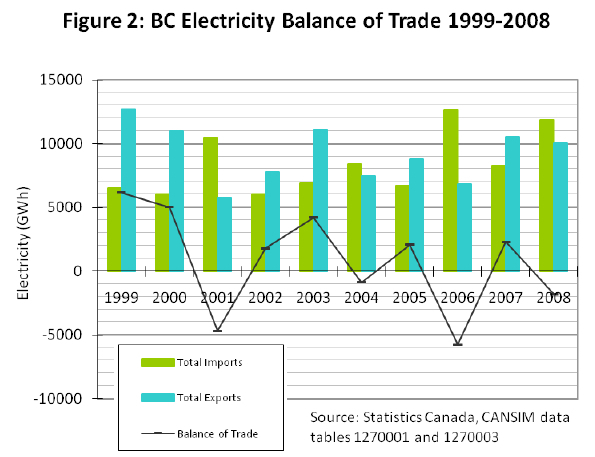
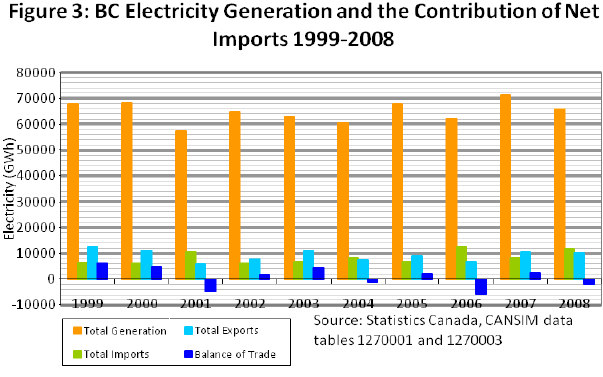
3. The Canadian Entitlement to the downstream benefits of the Columbia River Treaty is not included in current trade statistics. If it were included as a BC generation resource, BC would have access to 1,200 MW of capacity. Table 1 compares that figure to other BC projects. Essentially, it is somewhat larger than one very large new dam project.
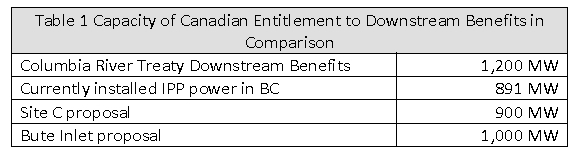
The CE would provide an additional 4,300 GWh/year of electrical energy to BC. If we had been using that energy, it would have eliminated the trade deficit for all put one of the past 5 years. Pooling the past 5 years together, if we’d used the CE it would have turned a 5 year deficit of 1.5% into a 5 year surplus of 5.1%. That compares to BC Hydro’s forecasted increase in demand of 32% over 20 years, or a 16% increase in electricity generation if the province meets the BC government requirements that half that increase in demand be met with conservation. BC Hydro’s current planning assumes even higher potential for conservation – they believe 72% of future demand growth can be offset through conservation, meaning that demand could be met with only a 9% increase in new sources of electricity. Including the downstream benefits of the Columbia River Treaty doesn’t eliminate the forecasted gap in BC electricity supply, but it does narrow it.
Whether or not BC should take the Canadian entitlement as power is a complex policy question that should consider, among other things, that at present that power is currently displacing fossil and nuclear sources of generation in the US. Our purpose here is merely to put the magnitude of the CE in perspective.
Some other notable patterns in the data
The following two figures show the sources of BC import and the destination of BC exports. They reveal that trade across the 49th parallel is far more important than trade across the Rocky Mountains. We also include a table of BC Hydro trading statistics for the record.
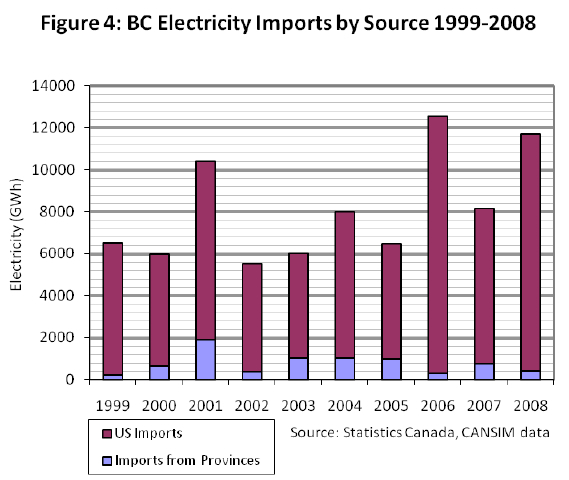
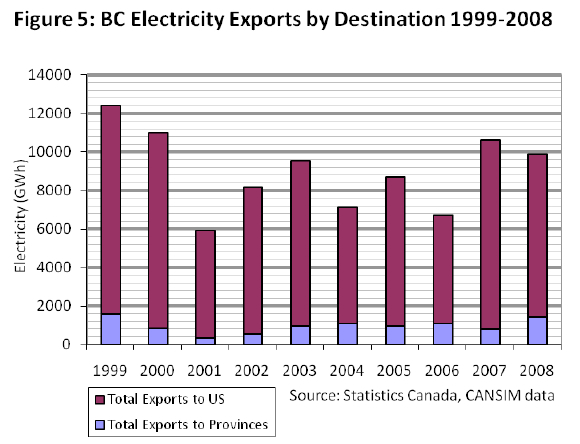
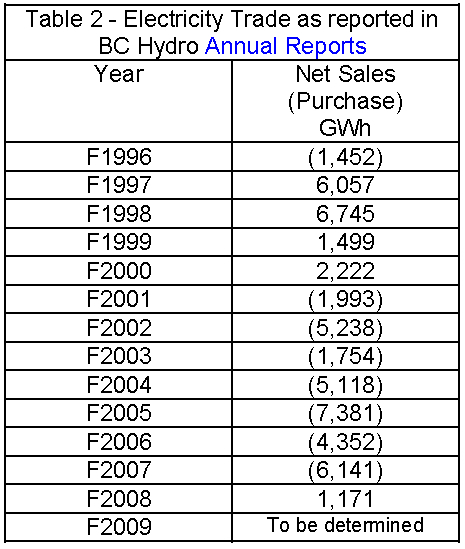
Blog Posting to http://greenpolicyprof.org/wordpress
Download PDF
March 18, 2009
IPPs push up power costs, industry says
Scott Simpson,
Vancouver Sun
March 18, 2009
Hydro could wind up selling power for less than it has to pay for it, critic claims
BC Hydro customers could take a $400-million-per-year financial hit if the Crown corporation signs up too many independent power producers to sell it electricity, a spokesman for Hydro industrial customers is warning.
The Vancouver Sun has learned that Brian Wallace, legal counsel for the Joint Industry Electricity Steering Committee, said in speech last week that without restrictions on expansion of independents, or IPPs, Hydro could be forced to sell large annual power surpluses at a loss to buyers in the United States.
Wallace said Hydro could find itself in a position where it is contracted to pay IPPs $120 a megawatt hour for electricity -- but find no buyers willing to pay more than $60.
Wallace said Hydro "clearly" needs more electricity, but in the view of the industry groups, Hydro is planning to buy "more than is required to meet customer needs."
Last year Hydro issued a 'Clean Call' for green power and IPPs responded with bids to build about 17,000 gigawatt hours of new power supply.
Hydro eventually decided to narrow its call to 3,000 gigawatt hours -- equivalent to about 25 per cent of current supply -- but indicated it will contract for as much as 5,000 if it finds the bid prices affordable.
At the sixth annual B.C. Power Summit last week, however, Wallace urged Hydro and the province to rebuff what he described as IPP demands to "aggressively" increase green power production.
"Going along with such demands will lead to substantial exports of electricity on a regular basis, and annual losses in the range of $400 million per year," Wallace said, according to a printed copy of his speech.
"These losses are equal to about 13 per cent of current domestic revenues or 90 per cent of BC Hydro's net income."
Melissa Davis, executive director of B.C. Citizens for Public Power, a group that opposes private sector power development, said Wallace's comments prove there is widespread opposition to the provincial government's energy policy and expansion of IPPs.
"Academics, environmentalists, labour groups, first nations, and thousands of impacted ratepayers have criticized the government's energy policy and their privatization of B.C.'s electricity sector," Davis said. "Our observations have been repeatedly disputed and dismissed. Wallace's report reinforces our collective claims with respect to the exaggerated need for new sources of electricity."
BC Hydro president and CEO Bob Elton said Hydro is trying to "strike a balance" between buying too much electricity and buying too little, and believes the nominal 3,000 gigawatt hour cap represents that balance.
Elton also noted that no price has been set for electricity purchased in the Clean Call, so Wallace's numbers may not be correct.
Jim Gemmill, chairman of the board of directors of the Independent Power Producers Association of B.C., said he was sympathetic to the industry group, given the economic challenges faced by members in the forest and mining industries. "They are are obviously going through some tough times right now and I don't think we can ignore that," Gemmill said.
But he noted that Wallace's assumptions -- and Hydro's -- are based on a very ambitious conservation program wherein all Hydro customers reduce electricity consumption about 25 per cent, with only a moderate contribution of new power needed to augment that.
If Hydro fails to reach conservation targets, he said, the province could be challenged to find enough power to support domestic demand.
February 19, 2009
First nations win court fight over major B.C. power projects
COMMENT: Whew. Already a legendary figure in BC legal circles when it comes to high profile public interest and civil rights cases, and especially with respect to aboriginal rights, Greg McDade continues to rack 'em up. In early February, McDade and his client, the also legendary marine biologist Alexandra Morton, won a decision from the BC Supreme Court when it ruled that the jurisdiction over fish farms resides with the federal government, not the provincial government.
This week, the BC Appeal Court ruled in two power projects that aboriginal rights had not been adequately respected. And the potential outfall are huge.
The first major component of BC Transmission Corp's strategy to add capacity and redundancy to provincial transmission infrastructure is a new line between Merritt and the lower mainland. A necessary approval from the BC Utilities Commission had been granted, but the Appeal Court says the approval is invalid, and affected First Nations need to be consulted before the approval can be issued. Back to the drawing board, and expect first, that the project will be delayed by years, and second, that the financial accommodation with First Nations will be Olympian.
The Appeal Court ruling with respect to the Carrier Sekani and Kemano, though it goes back many decades, affects the electricity purchase deal between BC Hydro and Rio Tinto Alcan - itself already an agreement that was protracted and painful in its delivery.
Wrists were slapped everywhere, especially at the BCUC.
Off to the Supreme Court.
And with these decisions, could McDade and his clients be turning their attention to Williston Lake and the Peace River dams? To the Columbia Treaty projects? Don't go countin' yer Site Cs, not any time soon.
By Neal Hall
Vancouver Sun
February 18, 2009
VANCOUVER – The B.C. Court of Appeal has issued two major rulings upholding the rights of first nations to be consulted by the government, which will affect two major projects in B.C.
In one case, the court has struck down a licence required to build a massive new hydro transmission line from Merrit to Coquitlam because native Indians were not consulted.
In the other case, the court ruled there was “massive” infringement of the right of the Carrier Sekani Tribal Council to be consulted in the Kemano Power Project and later expansion near Kitimat that involves B.C. Hydro buying electricity from the Rio Tinto Alcan Inc. aluminum smelter.
The appeal court granted the appeal of the tribal council and found that the BC Utilities Commission erred in approving the Electricity Purchase Agreement (EPA) between BC Hydro and Rio Tinto Alcan in January 2008.
The court found “B.C. Hydro, as a Crown corporation, was taking commercial advantage of an assumed infringement on a massive scale, without consultation.”
The court was also critical of the BC Utilities Commission, finding “the commission has demonstrated in several cases an aversion to assessing the adequacy of consultation.”
“I think this is a very significant decision both for the Kemano project itself and also for aboriginal rights,” said Vancouver lawyer Gregory McDade, who represented native bands in both cases.
Tribal Chief David Luggi was pleased by the appeal court victory.
“We are pleased that the Court of Appeal has recognized in law that First Nations interests must be taken into account in important decisions relating to the Kemano Project," he said in a statement.
"The Alcan Kemano Project remains the most devastating environmental impact in our region.”
“First Nations were never consulted when the Kemano Project was built, and we were not involved in the backroom deal in the 1987 Settlement Agreement, by which flows in the Nechako River were reduced by over 70 per cent. Our fisheries have never recovered, and the Nechako Sturgeon is endangered and almost extinct.”
He said this was the first step "to ensure that the environment and First Nations interests are not ignored over long-term electricity sales.”
The Kemano project, which began in the 1940s, involved reversing the flow of a river and the creation of a watershed that discharges west into a long tunnel through a mountain down to sea level at Kemano where it drives the generators at the power station and then flows into the Kemano River.
Up to 80 per cent of the natural water flow of the Nechako River was diverted for the project, which affected fish and wildlife, especially salmon.
The Nechako River eventually joins the Fraser River at Prince George.
Alcan holds a water licence in perpetuity for the reservoir. It is obliged by the licence and an agreement made in 1987 settling litigation involving the provincial and federal governments to maintain water flows that meet specifications for migratory fish.
In the course of an expansion project, often referred to as Kemano II, the B.C. government changed its mind about allowing the full utilization of the reservoir, which shut down the project and prompted a lawsuit by Alcan.
The legal action was settled in 1997 on terms which included a power deal whereby the province would supply Alcan should it enlarge the smelter and need more electricity.
The settlement also granted Alcan the water licence on a permanent basis. But there was no consultation with native Indian bands in the area.
“My clients rely on the fishery and they have been ignored for 50 years on this,” McDade said in an interview. “This potentially has a huge environmental impact on the Nechako and the Fraser,” he said.
He pointed out that scientists believe diverting up to 80 per cent of the Nechako River has increased the temperature of the Fraser, which has affected salmon returning upstream in the summer.
“When the Fraser gets up to 20 degrees, fish begin to die,” McDade said. “Even half a degree can make a big difference.”
The two appeal court decisions are posted online: http://www.courts.gov.bc.ca/jdb-txt/CA/09/00/2009BCCA0068.htm
© Copyright (c) The Vancouver Sun
Court rulings delay power projects
MARK HUMEGlobe and Mail
February 19, 2009
Utilities commission must re-evaluate whether natives adequately consulted
VANCOUVER -- Two major power projects approved by the British Columbia Utilities Commission have been delayed by rulings issued by the B.C. Court of Appeal.
In separate judgments handed down yesterday, the court found the B.C. Utilities Commission erred in not determining whether natives had been adequately consulted over an Electricity Purchase Agreement (EPA), involving B.C. Hydro and Rio Tinto Alcan Inc., and over a new power line proposed by the British Columbia Transmission Corporation, from Merritt to Coquitlam.
One case involved a decision by the commission to reject a motion by the Carrier Sekani Tribal Council concerning a 2007 B.C. Hydro application for an EPA. The EPA would have cleared the way for B.C. Hydro to purchase surplus electricity from Rio Tinto Alcan Inc.
The power is generated by the diversion of water created by the Kemano power project, which was built by Alcan in the 1950s.
The Carrier Sekani argued that accepting the EPA would be a jurisdictional error because the band wasn't consulted initially, when the power project was first built. The water diversion flooded native graveyards and caused declines in important salmon and sturgeon fisheries.
The band argued there was a "historical, continuing infringement of aboriginal title and rights."
The B.C. Utilities Commission, however, rejected the Carrier Sekani position on the grounds that there were no new physical impacts created by the EPA.
But the court disagreed with that decision, saying B.C. Hydro had been "taking commercial advantage of an assumed infringement on a massive scale, without consultation."
The court ruled that the B.C. Utilities Commission must reopen the application for an EPA, so that it can consider whether a duty to consult with the Carrier Sekani had ever been met.
In the second case, the Court of Appeal found that the Kwikwetlem First Nation had not been adequately consulted over a 246-kilometre power line that the B.C. Transmission Corporation proposed to build from Merritt to Coquitlam.
The line would pass through the traditional territory of several bands, but the courts found the B.C. Utilities Commission had failed to assess whether there was adequate consultation.
"Consultation requires an interactive process with efforts by both the Crown actor and the potentially affected First Nations to reconcile what may be competing interests. It is not just a process of gathering and exchanging information. It may require the Crown to make changes to its proposed action based on information obtained through consultations. It may require accommodation," the court stated.
The court ordered the utilities commission to "reconsider the scoping decision" approving the transmission line.
February 18, 2009
BC Budget 2009: Commentary

A fiscal conversion, but not a philosophical one
PATRICK BRETHOURGlobe and Mail
February 17, 2009
Vancouver — Gordon Campbell has brought down the budget that Stephen Harper could only wish he had delivered – a deficit, but only the deficit that was necessary under the circumstances.
British Columbia will rack up a $495-million deficit in the next fiscal year, with the shortfall shrinking to $245-million in the following year and disappearing altogether by March, 2012.
On its face, the deficit is far smaller than many economists had expected (and less egregious than the government's supporters had feared). But even that surprisingly small number overstates the appetite of the Campbell government for deficit financing.
Unlike other governments that have jumped, or been pushed, into a deficit position, the B.C. Liberals are not defending the change on a philosophical basis. Deficits, however small and however temporary, remain anathema to Mr. Campbell and his ministers.
“There is no one around the cabinet or caucus table that is enthusiastic about us going into deficit this year,” Finance Minister Colin Hansen told reporters before delivering his budget speech to the legislature.
The government's anti-deficit words are matched by action, or rather comparative inaction. Mr. Hansen says B.C. has no structural deficit, meaning that the end of the recession should erase any shortfall – and that there is not a flood of new spending.
But dig deeper into the numbers of the budget and an even more conservative fiscal picture emerges. The government will pump $2.9-billion into the B.C. economy over the next three years to combat the recession, including $2-billion on an infrastructure spree (half-funded by Ottawa), another $401-million in accelerated provincial infrastructure spending and another $485-million from the fiscal stimulus package that Mr. Campbell unveiled in the fall.
That sounds like a stimulus package that Stephen Harper could have written, and that John Maynard Keynes would love. Despite the deficit, the B.C. government has become the last bastion holding out against the new fervour for deficit-fuelled stimulus spending.
The stimulus measures are only one half of the Campbell government's fiscal plan. On the other side of the ledger are spending cuts – big ones. First, there are general administrative efficiencies to be wrung out of various government departments, with advertising and travel spending taking major hits. The Liberals are also counting on a wage freeze in the public sector to deliver $400-million in savings in 2009-10 and 2010-11. Add it all up and the spending cuts amount to just over $3-billion – more than the stimulus spending. In the coming year, stimulus spending will outpace budget cutbacks in B.C., although only by a few hundred million dollars.
Over three years, the Liberals will actually withdraw $150-million from the provincial economy – and that figure is only as low as it is because of $1-billion that the federal government is contributing to the infrastructure spending.
The last-minute fiscal rectitude has left the government's supporters pleasantly surprised, and its opponents – particularly among public-sector unions – fuming.
Jim Sinclair, president of the B.C. Federation of Labour, condemned the budget cutbacks as nonsensical yesterday, zeroing in on the wage freeze and provisions for laying off civil servants as measures that show the government is not serious about lessening the bite of the recession. “Unemployment is the opposite of stimulus,” he said.
Meanwhile, the business-minded supporters of the conservative-minded provincial Liberals are quietly relieved that the government has made only a limited foray into deficit financing. Jock Finlayson, executive vice-president of the Business Council of British Columbia, said he had been expecting a deficit topping $1-billion.
He agreed that the B.C. budget is out of sync with the relatively free-spending ways of Ottawa. “It's a cautious budget for difficult times,” he said of B.C.'s fiscal plan, adding that the national government is better positioned to take the lead on stimulus spending because provinces are likely to see the effect from any of their own expenditures leak outside their own boundaries.
John Winter, president and chief executive of the B.C. Chamber of Commerce, praised the budget-cutting as a welcome sympathetic response to the waves of layoffs sweeping over the private sector. “That is reflective of the real world.”
Asked about the economic logic of increasing spending in one area while cutting it in another, Mr. Hansen took a similar tack. “It's a budget that says government has to live within its means.”
From surplus to 'frankly scary' in just one short year
GARY MASONGlobe and Mail
February 18, 2009
VICTORIA — There are two ways of looking at the budget presented yesterday by the British Columbia government.
The first is just how dramatically all the numbers have changed in 12 short months. And the priorities too.
Last year, the British Columbia government was projecting nearly a $1-billion surplus. The province was the happy recipient of hundreds of millions of dollars in oil and gas revenue. Premier Gordon Campbell was being hailed as a green revolutionary for introducing Canada's first true carbon tax.
This year, the environment rates barely a mention in the budget. Revenues have fallen off the cliff. After proclaiming for years that he'd never run a deficit, Mr. Campbell listened to his Finance Minister tell the legislature the province will spend almost $500-million more than it will bring in.
Which brings me to the second way of looking at this budget.
Compared with the kind of recession-related money problems a place like California is experiencing, this is nothing.
British Columbians had been warned a deficit was coming. The legislature had to be convened earlier this month so the government could introduce a legislative amendment that would allow it to run a deficit. Still, I think many were surprised it ended up being as small as it is – $495-million this fiscal year and a projected $245-million in 2010-11.
California is facing a $40-billion shortfall and is talking about laying off 20,000 civil servants. (Or put this way: B.C. has one-eighth the population of California but a deficit 1/88th the size of the one down there.)
Still, many of the figures found in B.C.'s budget are sobering and remind us of how different the world is today from a year ago.
One chart, for instance, illustrates the $6.6-billion decline in revenues the province is anticipating over the next three years. That includes a $4-billion tax-revenue hit and almost $3-billion less in royalties and taxes from natural resources.
The bar graph charting the economic woes in the United States is equally chilling. The annual growth in real GDP was 2.7 per cent in January, 2008. But it begins shrinking in each successive month until the bars on the graph dip below the baseline into negative territory. Since September of 2008 the decline in real GDP growth is 3.2 per cent.
“We've never seen numbers like that,” one Finance Ministry official said yesterday. “They are frankly scary.”
They are. And I think the B.C. government is being hopeful that the U.S. economy will begin turning around late this year and that real GDP growth will be almost 2 per cent in 2010. I hope the government's forecasters are right but my hunch is it's going to be much longer before the rebound begins. Which, in turn, could delay British Columbia's recovery.
B.C. likes to point out that of all the Canadian provinces it is the least reliant on trade with the United States. It does far more business with Asia (27.1 per cent) than Ontario (2.6 per cent) or Alberta (5.8 per cent). But I'm not sure B.C. is going to be able to count on a roaring trade relationship with Japan over the next few years. Things are deteriorating rapidly there and are slowing pretty dramatically in China as well.
All this is to say some of B.C.'s key economic forecasts for this year and going forward might be optimistic. Take the real GDP growth for this year. The budget predicts it will be minus 0.9 per cent. I believe the contraction will be greater as well.
There's a fascinating section in one of the B.C. budget documents that looks at previous recessions and economic downturns the province has endured. Particularly interesting is the comparison between the current economic crisis and the recession of 1982.
Back then, real GDP in the province shrunk by an astounding 6.1 per cent, compared with the minus 0.9 per cent predicted for this year. The unemployment rate in B.C. was 12.1 per cent, compared with the 6.2 per cent it is expected to average out at this year. Exports are expected to fall by 2.4 per cent this year compared with a whopping 5.4 per cent in '82.
“The downturn going into 2009 is unlike the 1982 recession,” the budget notes.
“But the present economic weakness in the global economy threatens to continue for several years with the risk to the Ministry of Finance's current forecast weighted to the downside.”
Which brings us to a third way of looking at this budget.
Not only could things be a lot worse, they could still become so.
Budget sets some important benchmarks for tough months ahead
EditorialVancouver Sun
February 18, 2009
In tough circumstances, Finance Minister Colin Hansen has produced a provincial budget that on paper is impressive.
But it comes with a list of caveats and uncertainties that rightly emphasizes that the course of the provincial economy over the year ahead is far from certain.
The surprisingly small deficit of $495 million for this fiscal year reflects not just a change in philosophy from a government that previously outlawed red ink, but an election-eve conversion from conservative budgeting to a bottom line that is imbued with a strong sense of hope that B.C.'s economy will rebound next year.
Given the recession into which the world is sliding, Hansen's budget paints a picture of a provincial economy and government finances still in relatively good shape. Compared to other provinces and G-7 countries, we certainly are.
Hansen anticipates the economy will shrink by just under one per cent in 2009, which is more conservative than what his panel of private sector economists forecasted. But he also acknowledges that the rate of decline over the past few months has confounded all of the previous projections.
Since the first quarterly report on the province's finances in September, the three-year projection for revenues has declined by $6.6 billion.
The government is also rushing in a stimulus plan that will ramp up capital spending by $2 billion over the next three years beyond the $10.6 billion in approved projects.
Those indicators would suggest a much larger deficit for the coming year than $495 million, given that the projected surplus in last year's budget was $800 million. But after years of presenting budgets with large forecasting allowances and conservative revenue forecasts, the cushions in this year's budget are more thinly supported.
There is no forecast allowance and provisions previously in the budget for future wage increases have been removed. There are also $250 million in spending cuts that have yet to be identified. That is in addition to almost $589 million in cuts -- with the exception of education and health -- ministries have already been told they will have to endure.
The budget also notes that health authorities have identified significant spending pressures that are not included, but will blow the budget if they cannot be contained.
All of this creates a bottom line for the government that more than ever depends on sound management and the ability to adjust to changing conditions.
As a starting point, however, this budget sets some important benchmarks for navigating through the tough months ahead.
First, the ramped up spending and the borrowing that goes with it are modest enough to allow the province to anticipate it will stay below the debt-to-GDP level that earned us a triple A credit rating.
That ratio may deteriorate if the economy continues to shrink. If so, the government's definition of what is affordable will also have to be amended.
The three-year plan calls for a smaller deficit next year and a return to surplus in year three. Adherence to that plan is as important as the budget for the current year because it represents our last line of defence against the deficit addiction that created the debt crisis of the 1990s.
Second, despite the fact that this is an election budget, the government has resisted the temptation to blow the doors off the treasury with spending promises that would haunt us in years to come. As it is, we can still expect the ramped-up capital spending will provide a steady stream of announcements between now and the official start of the campaign in April.
Realistically, given the state of change in the world, we all have to understand that the province's budgets may need to be modified on a more frequent basis than we're used to. It's quite possible that a new plan will be needed after the election.
But it is also a document that the Liberals can and will proudly carry into battle as evidence of the sound economic management they have delivered over the past eight years.
online
Poll question: Do you think the government can balance the budget in three years time? Answer Yes or No at vancouversun.com/opinion
You're not optimistic when it comes to the province's proposals to address gang violence. Fully 87.76 per cent of respondents to Tuesday's Opinion Web poll said the provincial government's plans won't be effective, while only 12.24 per cent said they would.
© Copyright (c) The Vancouver Sun
If, if, if -- modest deficit budget ripe for revision if things don't work out
By Vaughn PalmerVancouver Sun
February 18, 2009
As budget day approached, the B.C. Liberals were contacted by several members of their independent forecasting council who wanted to reduce their projections for economic growth. Again.
Council members had downgraded their forecasts for 2009 on several previous occasions, from two per cent on average, then one per cent and finally zero at the beginning of January.
Each time the revisions sent the government back to the drafting table on its own budget.
By law, the budget is grounded on the collective outlook of the dozen or so members of the council. In practice, the finance ministry averages the forecasts, then picks a growth rate slightly lower than the collective view.
These latest revisions would drop the council's forecast into negative territory, though only just. The experts were now saying the economy would shrink by about three-tenths of one per cent, or half a billion dollars worth of gross domestic product.
Too late, came the answer from the ministry of finance. Not that government doubted that the economy was sliding into recession. But the budget preparations were too far advanced for one more substantial revision.
And in any event, the ministry -- with its preference for lowballing -- was working from an expectation that the provincial economy would shrink by nine-tenths of one per cent (-0.9), a bit more than the running average from the outsiders.
But that still meant the Liberals were leaving themselves little room to manoeuvre on the budget and fiscal plan that was presented to the legislature Tuesday.
If "minus zero point nine per cent growth" turns out to be an optimistic scenario, if the economy continues to slide through the summer into the fall, if the U.S. recovery is postponed indefinitely . . . well, there's little doubt that the B.C. government will be forced to substantially revise the three-year budget and fiscal plan.
Even if the forecast turns out to be no more than accurate, the budget derived from it sets up major challenges for government.
First of all, the Liberals have to sort out the financing for the $3.3-billion Port Mann bridge project. The deal isn't final, so the budget came with a big asterisk saying "more later."
They also have to take the wraps off their "secret" plan to cover the provincial share of the cost of security for the 2010 Winter Olympics. Supposedly it is all taken care of in the budget.
But the Liberals flatly refused to say where the dollars are hidden. Their lips are sealed until an announcement from Ottawa in a week or so. So much for budget transparency.
Next challenge: The Liberals are calling on ministries and dependent agencies to "manage down" spending by about $2 billion over three years, reducing discretionary spending on travel, consultants, advertising, vehicles, equipment and grants.
Then they have rustle up another $250 million in savings from sources yet to be identified. If all of that were to come from staffing, it would mean across the board layoffs of about 10 per cent of the public service, although five per cent is a more likely figure.
While cutting overhead, operating and other expenses, most ministries will have to make do with minimal to non-existent increases in program funding over the three years. Health got most of the new program dollars -- a six-per-cent increase -- and still faces "spending pressures" amounting to a further 3.3 per cent.
Presuming the government endures no more shocks on the revenue side, makes the spending targets, finds the additional savings and contains the pressures, then it will be able to hold the line at a deficit of just $500 million the first year (beginning April 1) and $250 million in the second.
Most observers, me included, figured that when the Liberals decided to leave balanced budget territory on the eve of an election, they would go for bigger deficits. In for a penny, in for a billion, so to speak.
Instead they went small, in keeping with their stated dislike of deficits and determination to end them as soon as possible. But that was only on the operating side of the budget, where spending for programs is supposed to be offset by incoming revenue from taxation and other sources.
It was different story on the capital side of the budget, where the Liberals continue their practice of borrowing heftily for roads, bridges, transit lines, schools, hospitals, transit, hydro and other public works.
The collective provincial debt, mostly capital-related, is projected to grow from $40 billion in the first year of the B.C. Liberal plan to $47 billion in the third. Up from $33 billion just two years ago, or 40 per cent in five years.
All in the name of "infrastructure," though the preferred term these days is "economic stimulus." Note that billions will be borrowed and spent in 2010 and 2011, by which time the Liberals say the economy will be growing again and less in need of taxpayer-funded stimulus.
But if the economy isn't back on track by this time next year, then I expect the 2009 budget will have been declared a dead letter.
By these guys, should they win re-election. By the next government, should they fail.
vpalmer@direct.ca
© Copyright (c) The Vancouver Sun
Big money for infrastructure as B.C. faces two-year deficit
By Jonathan Fowlie Vancouver Sun February 18, 2009NDP's James disputes Liberals' claim of protecting health care, education and social programs
 Finance Minister Colin Hansen explains the budget to the media Tuesday. (Photograph by: Debra Brash, Canwest News Service, Vancouver Sun) |
British Columbia will run a $740-million deficit over the next two years, the government said Tuesday as it released a budget characterized by belt-tightening and fiscal restraint on one hand, and big infrastructure spending on the other.
Overall, the government promised to cut $1.9 billion in administrative and other costs over three years, allowing it to protect increases to what it says are key social services.
"Our priority has been to protect the vital health care, education and social programs that British Columbians have come to rely on," Finance Minister Colin Hansen said, "and [that have] actually become even more important to us as we go through the kind of economic challenges that the province -- and indeed the globe -- is going through today."
But New Democratic Party leader Carole James said the budget makes deep cuts in much-needed areas such as crime prevention, health care and services for children and families.
"This government stood up and said they were protecting health care and education, they stood up and said crime and safety was important. Well, their budget proves they didn't tell the truth," James said.
"We know the premier is completely out of touch with what is going on in British Columbia," James said. "He's saying to the people of this province, 'I'm going to do nothing, you're just going to have to wait it out.' "
The budget projects a deficit of $495 million in 2009-10, and $245 million in 2010-11. It proposes a return to a balanced budget by 2011-12.
On the spending side, the government promised to increase health care spending by $4.8 billion over the next three years, up from an increase of $3.9 billion it had previously promised.
But the bulk of the new money -- $920 million -- doesn't arrive until the 2011-12 fiscal year, leading some critics to question how reliable such a distant projection can be.
Post-secondary institutions will get more money: an additional $228 million over three years.
Funding for K-12 education will remain at previously announced levels.
Economists reacted favourably to the plan, with most calling the budget prudent and realistic.
"It's responsible, it's conservative and in many respects it assumes a smooth transition from recession into better economic times," said John Winter, president of the B.C. Chamber of Commerce.
Winter said his only concern was that some of the assumptions -- such as housing starts -- might be overly optimistic.
Jock Finlayson of the Business Council of B.C. had a similar reaction.
"We're calling it a realistic budget for tough times," Finlayson said.
Public-sector unions raised serious concerns, saying they believe the budget will lead to cuts at school boards and will place further pressures on an already-stressed health care system.
"There is a real struggle in the health-care system on the front lines, and this budget doesn't go in any major direction to help to solve it," said Judy Darcy, business manager of the Hospital Employees' Union.
"It will mean cuts at school boards," said Irene Lanzinger of the B.C. Teachers' Federation, who predicted funding levels will not meet rising costs caused by inflation and salary increases.
"It is not even a status quo budget."
By its own reckoning, the government will be operating on razor-thin margins.
It has eliminated the forecast allowance, a financial cushion that historically has provided up to $750 million in leeway, meaning the margin for error has been significantly reduced.
The government said it will need to find an additional $250 million in cuts over the next three years, the specifics of which are unlikely to be determined until after the May 12 election.
The budget called for $1.9 billion in spending cuts over three years, an amount the government said will not cut into key services.
"The belt-tightening that we're doing in government is about ensuring we free up dollars from the administration side and the discretionary side to fund the increases we have on the program-delivery side," Hansen said.
"It's incumbent on government to tighten its belt in difficult economic times."
The budget included no money for public-sector wage increases or bonuses for contract negotiations in 2010, and clawed back $400 million previously set aside to cover contract improvements.
In an e-mail written to staff members, Jessica McDonald, head of the public service, said the additional cuts may mean layoffs of up to five per cent.
"What we know at this stage is that direct impacts will definitely be under five per cent, including both regular and auxiliary employees," wrote McDonald, adding the number "could ultimately be much lower."
One of the few cushions the government retained is a contingency fund of $385 million for the coming fiscal year, and a total of $935 million over three years.
Historically, contingencies have been used to pay for new programs. But in Tuesday's budget, the government said the fund will be used "to help ensure the fiscal targets are met."
The final cost of Olympic security was not disclosed in the budget, but Hansen said it was accounted for in the government's planning, and promised details in about a week.
Also not in the budget was any accounting for the $3-billion-plus Port Mann Bridge project, which is still being negotiated. A deal on the project is expected to be completed by march.
The government predicted a short-lived recession for B.C., with a projected contraction of 0.9 per cent for 2009. It anticipates a recovery in 2010, with an expected growth of 2.4 per cent that year.
To help stimulate a recovery, the government confirmed it is budgeting $2 billion for accelerated infrastructure-building, $1 billion of which will come from the federal government. Details on where the money goes are expected in the coming weeks. One spending announcement was planned for today, with federal Minister of International Trade Stockwell Day in Victoria.
Including $10.6 billion in previously planned construction and $1.4 billion in grants for infrastructure projects, the province is promising $14 billion in overall infrastructure spending, which it estimates will generate 88,000 direct construction jobs over the next three years.
"This budget is about three things: It's about stability for B.C. families, jobs for B.C. families, and confidence," Hansen said.
"It's a confidence that we're going to get through this difficult economic time and be a stronger province at the end of it, because we will be able to capitalize if the opportunities are there."
© Copyright (c) The Vancouver Sun
Finance Minister Colin Hansen explains the budget to the media Tuesday.
Photograph by: Debra Brash, Canwest News Service, Vancouver Sun
Highlights of provincial budget
Vancouver SunFebruary 17, 2009
Economy
-- The B.C. government will run a deficit of $495 million for the coming year and another deficit of $245 million in 2010-2011 before returning to a balanced budget the following year.
-- Provincial debt will climb to $41.9 billion this year, and continue to climb to $47.5 billion by 2011-2012.
-- Provincial revenues will rise slowly this year, from $38.5 billion last year to $38.8 billion for 2009, then to $39.8 billion in 2010 and $41.2 billion in 2011. That's $6.6 billion less than the government had projected just five months ago.
-- Employment in B.C. will decline a further 0.5 per cent in 2009, which translates into about 11,000 fewer jobs. The unemployment rate is forecast to rise to 6.2 per cent this year, and fall to 6.0 per cent and 5.6 per cent in the next two years.
-- The B.C. economy (GDP) will contract by 0.9 per cent this year, recovering to 2.4-per-cent growth in 2010 and 2.6 per cent in 2011.
-- The province is expecting housing starts to decline a further 25.6 per cent this year, with single-digit growth beginning again in 2010 and beyond. Taxes collected from property transfers will similarly drop.
-- Corporate profits in the province are projected to decline 25.6 per cent in 2009, with taxation income for the province from corporations dropping by a similar percentage.
Budget items
-- $14 billion in infrastructure investment, approximately $2 billion of which is accelerated spending on projects not originally planned to get underway within the next three years. The province claims this money will create 88,000 jobs.
-- Of this money, $1.3 billion is earmarked for renovations and upgrading of schools, $1.7 billion for post-secondary initiatives, $2.5 billion for health care facilities, and $2.3 billion for transportation projects.
-- The province has identified $1.9 billion in administrative and other cost savings within government operations, largely through reductions in travel expenses, contracted professional services, and a 76-per-cent cut to Victoria's advertising budget.
-- Approximately 90 per cent of new spending over the next three years will go to health services, targetting improved access and increasing hospital beds.
-- $351 million in new money for social services, including income assistance, programs for adults with developmental disabilities, funding for children with special needs, and more money for child care subsidies.
-- $244 million in new operating funding for post-secondary institutions over the next three years, largely money to improve access to universities and colleges, as well as expand health-care programs.
-- $546 million in revenues from the carbon tax in 2009-2010. The $10-per-tonne tax increases to $15 in July, and $20 in 2010. Carbon tax revenues will grow to $968 million by 2011-2012.
-- A new Northern and Rural Homeowner Benefit worth $200 per year, beginning in 2011 after the temporary property tax deferment program ends.
-- $365 million in previously announced money for upgrading BC Place through 2011.
-- $110 million over three years for developing the energy sector, including $94 million for the Oil and Gas Rural Road Improvement Program.
-- One-year extension to the B.C. Mining Flow-through Share Tax Credit.
-- Removal of the expiry dates for film tax credits, and the extension of those credits to all Canadian-controlled companies.
-- $16 million to help immigrants upgrade work skills.
-- $15 million in one-time arts, culture and heritage grants.
-- 50-per-cent reduction to school property taxes for all farm land, beginning in 2011.
© Copyright (c) The Vancouver Sun
B.C. heads $495-million into the red
JUSTINE HUNTERGlobe and Mail
February 17, 2009
VICTORIA — B.C. Finance Minister Colin Hansen delivered a no-frills budget on Tuesday to take into the spring election that sets up a battle with the Liberals' traditional foes in the public-sector unions.
In the face of a shrinking economy, the province is cutting $3-billion from spending over the next three years, including a clawback of money that was pegged for wage increases for health care workers and civil servants in 2010.
Mr. Hansen said British Columbia will run two years of deficits – this fiscal year the province will sink $495-million into the red. That's a smaller deficit than many had anticipated, and the government expects to return to surplus in three years – in part because it will reclaim the $400-million that had been set aside for wage increases.
“Given the challenges that average British Columbia families are facing today as we go through this difficult time, it's simply not possible to put into this fiscal plan any additional dollars for general wage increases,” Mr. Hansen said.
British Columbia's Finance Minister Colin Hansen tables the provincial budget in the B.C. Legislature in Victoria Tuesday.
 British Columbia's Finance Minister Colin Hansen tables the provincial budget in the B.C. Legislature in Victoria Tuesday. (The Canadian Press) |
Jim Sinclair, head of the B.C. Federation of Labour, said the Liberal government is seeking to pick a fight with unions, but individuals will be caught in the middle.
“I think we are going to see more social unrest in British Columbia, more people upset that the government didn't get it,” he said. He said the funding shift sends a bad signal to public-sector workers, and it offers little to families worried about riding out a recession. “This budget really says to the unemployed, ‘Too bad.'”
The budget allocates $50-million this year to help the public sector do more with less – a “Transformation Fund” to help government workers get “retooled to deliver quality services to citizens with fewer staff.”
The budget was welcomed by a number of business leaders as a prudent fiscal plan and was warmly endorsed by the construction industry. The province will ramp up infrastructure spending this year by roughly $1.3-billion.
“It's the construction budget,” said Philip Hochstein, president of the Independent Contractors and Businesses Association, an outspoken ally of the B.C. Liberals.
“I know they are trying to do everything they can. Certainly in the next 90 days, before the May 12 election, we'll have lots of announcements.”
The provincial budget plan cuts government spending in almost every sector except health, education and social services.
Even public-safety services such as prosecution and court services are facing cuts over the next three years, just days after Premier Gordon Campbell promised to target gangs in B.C. with more police and prosecutors.
“The Premier stood up on Friday and said that was one of the most critical issues to deal with, the gang violence we are seeing,” said Carole James, Leader of the New Democratic Party.
“But they have cut the budget for public safety. Unbelievable.”
And while Mr. Hansen said the budget protects the most vulnerable, there appears to be little new money for tackling poverty and homelessness. Funding for employment and housing services will be cut, while the number of front-line workers handling income assistance will drop.
“It's about stability for B.C. families, it's about jobs for B.C. families and it's about confidence,” Mr. Hansen said in a question-and-answer session with reporters shortly before he delivered his budget speech in the legislature.
The main economic stimulus effort is reserved for building new roads, schools and hospitals, while Mr. Hansen said he is counting on the 2010 Winter Olympics to help fuel a turnaround.
“Dollar for dollar, the Olympic Games may be the best investment we will every make,” he said in his speech. “B.C. has been through tough times before. Each time, we've risen to the challenge. And each time we've emerged stronger.”
John Winter, head of the B.C. Chamber of Commerce, said it is a “safe budget,” but he doubts whether the province will turn the corner next year.
“I don't know if they are planning for the worst – it could be a lot worse.”
There are several key pieces still missing from Mr. Hansen's fiscal plan.
The Finance Minister could not answer questions about funding for Olympic security because the federal government has yet to sign off on the cost-sharing arrangement.
Nor could he say what the cost to taxpayers will be for building the $3-billion Port Mann bridge after the private-sector consortium in charge of construction announced it could no longer finance the new toll bridge on its own. That deal is still under negotiation.
As well, the plan calls for more cuts that have yet to be found: $250-million worth that won't be identified until after the May 12 election.
The economy is now forecast to shrink by 0.9 per cent in 2009, while the government is counting on a rebound in 2010.
Last week, the legislature was recalled early to pass legislation to set aside B.C.'s balanced-budget law so that Mr. Hansen could bring in Tuesday's fiscal plan.
The Finance Minister said his government still struggled to keep spending down.
“What British Columbia families are looking for today is a sense of responsibility,” he said.
“But it's also a budget that says governments need to live within their means. There is nobody around the caucus or the cabinet table that is enthusiastic about going into deficit this year.”
The largest program spending increase is in health care. Health spending is set to increase by almost 6 per cent this year, an increase of more than $800-million.
February 17, 2009
The Liberals struggle to put highlights in this year's throne speech
By Vaughn Palmer
Vancouver Sun
February 17, 2009
The B.C. Liberal government's throne speech for 2009 was a muted affair, particularly for an election year.
There was the usual combination of incomprehensible boilerplate -- "a new prism of trust" -- and over-the-top rhetoric -- "a flame that burns deep in the human heart."
Then a lengthy recitation-cum-defence of Liberal policy-making, including such major sources of controversy as the carbon tax, the softwood lumber agreement, and public-private partnerships.
The government-authored text hurled one gauntlet at the feet of the Opposition as the New Democratic Party prepares its election platform. "Now is not the time," the Liberals assured us, putting words into the mouth of the lieutenant-governor, "to raise the minimum wage."
But the telling aspect of the speech was in the details -- or lack of them -- in the government's own list of highlights.
Last year, the package, spread over two press releases and eight pages, highlighted 112 bulleted items, including separate "action plans" on climate change, health care, energy, first nations, education and early childhood learning.
This year the dutiful folks in government communications managed to wring three dozen highlights out of the text, but stretched mightily to do it.
Some of the items -- "a first-ever joint cabinet meeting with Alberta and Saskatchewan" -- weren't likely to crack the news lineup on the slowest day of the year.
Other "news" -- selling wood to China, building the Gateway -- was old enough to be retired to the provincial archives.
Oddly, the speech made no mention of the package of measures to fight criminal gangs, though it was new enough to warrant a second go-round, having been announced just last Friday.
There were updates on several works in progress. The B.C. pension plan, announced last fall, "will be up and running by Canada Day, 2010."
The Liberals are moving to develop a northeast transmission line, a northwest transmission line, and a northern energy corridor. More work will be done this year to advance the possibility of developing the hydroelectric dam at Site C on the Peace River.
But one much-worked-on initiative appears to be stalled. "The government is working with First Nations to develop a Recognition and Reconciliation Act that will establish a new statutory framework to further the implementation of the New Relationship," the throne speech said, giving no commitment that the text will see the light of day before the election or afterward.
"If it is able to be presented this session it will be," Premier Gordon Campbell told reporters later, then added, "if it is beyond this session, it will be."
The throne speech and press release hinted at some controversies in the making. "Government will work with the Union of B.C. Municipalities to develop new legislation to help ensure that provincial tax relief is not negated by local property tax hikes . . . . All levels of government must be equally disciplined to ensure that tax reductions at one level of government are not negated by tax increases at another."
But Campbell insisted he was not angling for a showdown with local government. "We will not be capping municipal tax rates," he said. "This is something we will be working with the municipalities on."
The Liberals also called on Ottawa to fix one of its laws. "The federal Navigable Waters Act should be repealed and replaced by legislation that meets the legitimate needs of the 21st century," the speech said, amid a discussion of regulatory barriers to fast-tracking infrastructure projects.
The Conservative government has discussed rewriting the act. But environmentalists point out that, because it protects navigable waters, the act also provides considerable protection for rivers, creeks, wetlands and other marine habitat.
Arguably, the biggest news in the throne speech was the cancellation of something that made headlines when the B.C. Liberals announced it last year.
"We had hoped to be in a position to introduce a voluntary all-day kindergarten program for five-year-olds this September," lamented the Liberals. Alas, "current economic circumstances, the need to develop appropriate space and the time to recruit qualified educators means it is not feasible in 2009."
What's left of government priorities? "Previously budgeted increases for health and education will be protected," according to the press release. "Ninety per cent of all budgeted new operating spending in the next three years will go to health care."
For the rest, well, save what you can. "Today we must brace for recession," the speech said. "How deep it might be, how long it will last, is impossible to say."
Not the most reassuring comment in a speech that was supposedly about "creating jobs, stability and confidence."
But there, at least, the Liberals were honest. They have no idea how bad things will get or how long the recession will last. Nor, I suggest, does anyone else.
© Copyright (c) The Vancouver Sun
B.C. Throne Speech targets homelessness
JUSTINE HUNTER, Globe and Mail, February 17, 2009Government promises integrated intervention strategy and community safety initiatives in run-up to Olympics
VICTORIA -- Programs designed to house the province's most entrenched homeless population will be expanded this year, Premier Gordon Campbell promised yesterday.
With less than a year before the 2010 Winter Olympics bring the international spotlight to Vancouver, the government set out a new commitment in the Speech from the Throne to combat poverty, drug addiction and mental-health issues in the country's most impoverished neighbourhood, the Downtown Eastside.
The speech, read by Lieutenant-Governor Steven Point, promised a new integrated, personalized homelessness intervention strategy and a new community safety strategy - initiatives that will be combined with expanded social housing.
Asked later for details, Mr. Campbell said the plan is not exactly new but will expand on existing programs like Victoria's Assertive Community Treatment teams that help find housing for the hardest-to-house.
Since the Victoria ACT teams started work a year ago, they have offered services to 152 clients - hardcore street people with repeated conflicts with the law - and today 131 people are still successfully housed.
The Premier said his government has marked progress in Vancouver's Downtown Eastside, but added: "We have to keep on this problem."
The Throne Speech focused on the economy and job creation, as expected, warning that B.C. must brace for a recession.
It acknowledged that the global economic crisis has brought a "tornado of change" to B.C. that will shape the provincial budget to be introduced today.
"It will be marked by significant fiscal restraint, discipline and new economic stimulus that is affordable, timely and cost effective," Mr. Point stated.
Billions of dollars in infrastructure spending on roads, schools and power transmission lines will aim to create jobs in the next three months - roughly as much time as the wait for the May 12 election. As well, the government promised investments in research into green energy and health care.
The Throne Speech also carried a strong social-policy note. "Governments have an important and vital role in shaping economic change and guiding social development," Mr. Point read.
Spending on health care and education will increase, while social housing will be expanded.
As well, the government announced plans for a Recognition and Reconciliation Act, which is expected be written and passed into law in the next two months.
Since November, the province and aboriginal leaders have been quietly working toward a law to reverse a 150-year-old policy of denying the legal rights and recognition of B.C.'s aboriginal people.
A draft paper is now being circulated among the province's top native leaders with a political commitment to make it law by mid-April, when the legislature stands down for the election campaign.
The law would codify a commitment made four years ago to a "New Era" of reconciliation with the province's native communities, and it would change the legal landscape for land claims in B.C.
"It will recognize constitutionally established aboriginal rights and title, and will facilitate partnerships and prosperity through shared decision making and revenue sharing," Mr. Point read. "If we get it right, it will be a significant provincial accomplishment for our times."
Shawn Atleo, a regional chief with the Assembly of First Nations, said it would have national implications if B.C. is willing to put into law what the federal government has refused to acknowledge.
"I think the intention is to move from a lack of dignity, to a place of dignity," he said in an interview.
"If we get this right now, before the election is held, this will impact the entire country. We would have a partner in the provincial government. We could turn to the federal government and strongly suggest we need equal measures from Canada."
The Recognition and Reconciliation Act would acknowledge that the province's aboriginal populations have long lived in B.C. It's a point that seems obvious given the historical record, but the fact has been resisted by government both in the courtroom and at the negotiations table.
Carole James, the New Democratic Party Leader, said she was struck mostly by what was missing in the speech: There was no mention of the gang warfare that has consumed Metro Vancouver in recent weeks.
She said Mr. Campbell showed he has run out of ideas.
"He used a large portion of his Throne Speech to talk about conferences, meetings, studies, things he was going to look at, at a time when families are concerned about losing their jobs ... [and] about being shot in the street."
Dennis Pilon, a political scientist from the University of Victoria, said he was struck by the strong appeal in the speech to resource communities - measures designed to protect jobs in forestry, mining and energy.
"Everyone's gut feeling is that Carole James and her team are not marching to victory in the election, but this suggests the Campbell Liberals are a little worried," Dr. Pilon said. "There are targeted messages to swing ridings."
February 16, 2009
Energy in the Throne Speech
On Monday, BC's Lieutenant Governor, Steven Point, read the Liberal Government's 2009 pre-election Throne Speech. It comes just a day before the provincial budget, and the two documents together are both a plan to run the province in the next fiscal year, and a platform to get the Liberals elected again in May.
Daunting.
Economic collapse, Olympic size budget overruns, growing public unrest about energy privatization, fish farms, oil tankers on the coast, coalbed methane, Pacific Gateway, Northern Gateway, and always the threat or hope that truth will out on Basi-Virk and how deeply that story penetrates into the vital organs of the Liberal beast.
Here is the full text of the 2009 Speech from the Throne:
http://www.leg.bc.ca/38th5th/Throne_Speech_2009.pdf
Highlights
These are the energy highlights as presented by the government in its news release:
- Government will work to help commercialize biodiesel and cellulosic ethanol production that turns wood waste into clean fuel. "help commercialize"? What is that? The Liberal government is so fixated on finding some, any, positive spin to wrap around the beetle-kill devastation across the province that it has lost sight of the fact that the feed stock for these energy schemes is here today in a wood-fibre tsunami, and will be gone tomorrow. Then what? Give us strategy, not electoral tactics.
- B.C. will pursue reciprocal arrangements and equivalency agreements to allow one thorough, comprehensive and scientific environmental assessment for one project. Industry hates regulatory and permitting processes. When the federal and provincial governments run parallel processes, as they are doing for Plutonic's huge 17 stream Bute Inlet Hydroelectric Project, it costs companies money and time. The Liberals are playing to its corporate supporters with this one.
- The Province will set an integrated, expanded transmission plan that encourages small-scale power projects, economic opportunity and jobs throughout B.C. by year end. Is this a case of the right hand doesn't know what its other right hand is up to? The Province has given the BC Utilities Commission the task of inquiring into tranmission issues in BC, with a duty to report by the middle of 2010. What sense does it make, then, to set out a transmission plan in advance of the BCUC findings and recommendations? Duh.
- New investments will be made in carbon-sequestration technology. Oh, great. It's somewhat like the Hydrogen Highway - a massive capital investment in high tech la la land combined with the only possible panacea that allows business as usual in a climate change world for some pretty big corporate interests in BC.
- Government will pursue a major expansion in electrical transmission capacity that will create thousands of new construction jobs and reduce energy loss through transmission. Refer back to the earlier item about transmission, the BCUC inquiry, etc.
- Government will work to expand transmission capacity along Highway 37 to open mining and energy opportunities while reducing greenhouse gas emissions. Let's see. The government claims that BC is a net importer of electricity. If that's the case, where will all this power come from to power up the proposed mines? Bute Inlet? And if mining companies will be the primary beneficiaries of the transmission line, who then should pay for it?
- The goal of a Northeast Transmission Line will be pursued to fuel energy development and reduce greenhouse gases.
- British Columbia will build on its competitive advantage as a global leader in clean engine technologies through a new commercial vehicle program that will help to create cleaner air, lower greenhouse gas emissions, lower costs, create jobs in research, development and manufacturing. I can hear them over at Ballard jumping with joy.
The complete speech
Here's most of the energy stuff, verbatim, from the speech. There is a certain amoung of padding, shall we say, and stuff from last year trundled out again.
Energy is another core competitive advantage for British Columbia.
B.C. is a low-carbon energy powerhouse.
New technologies and the global hunger for clean, low-carbon energy and new sources of traditional energy are putting B.C. in the driver's seat.
Even with our commitment to meet 50 per cent of B.C.'s future electricity needs through conservation, more power will be needed to ensure we are electricity self-sufficient by 2016.
Electric plug-in vehicles and other technologies aimed at reducing fossil fuel dependency will place new demands on our electricity system.
We can meet those demands and create jobs and opportunities for our citizens.
Our government will build on its Clean Energy Plan with new direction to BC Hydro and to the British Columbia Utilities Commission.
We will lead North America in creating green power that retains our low cost "heritage power" advantage for B.C. ratepayers.
We will build on our plan to ensure that at least 90 per cent of all new power produced in B.C. comes from clean sources.
More work will be done this year to advance the dialogue on Site C to decide its merit.
Independent power production will continue to create new jobs in rural communities.
Your government will not turn its back on those rural jobs.
Nor will it close its eyes to the dire fact of climate change or the significant contributions we can make in reducing greenhouse gases.
We will open up new opportunities for private investment to create jobs and meet our needs.
That will not only be good for our economy, it will be good for our planet.
Our government will pursue a major expansion in transmission capacity that will create thousands of new construction jobs and reduce energy loss through transmission.
The goal of a Northeast Transmission Line will be pursued.
An integrated, expanded transmission plan that encourages small scale power projects, economic opportunity and jobs throughout B.C. will be set by year end.
We can become global leaders in wind, run-of-river, tidal, geothermal, wave, solar and other forms of clean, renewable power and leading-edge transmission technologies.
Energy opportunities will transform the future of forestry in British Columbia with clean, carbon-neutral bioenergy, fueled by biomass from beetle-killed forests.
It will mean new jobs, new revenue streams and new electricity.
It will create new uses for waste wood left on the forest floor and reduce forest fire hazards.
It will encourage replanting in areas that would not otherwise be reforested and generate new value in the green economy as standing "carbon sinks."
These are the green fields of opportunity created by independent power producers.
We cannot turn our backs on them and still say that we care about climate change, rural job creation, clean power, or the future of our forest industry.
It is time to grow that potential.
Natural gas is one of the cleanest-burning fossil fuels. It too is an important source of rural jobs and investment in our province.
Our government will open up that industry while still ensuring the province meets its legal greenhouse gas reduction targets.
New policies are in place to require the elimination of routine gas flaring by 2016.
New investments will be made in carbon sequestration technology.
With that policy framework in mind, B.C. will make the most of its remarkable wealth of natural gas.
The Infrastructure Royalty Credit Program will continue to spur road and pipeline infrastructure in new and undeveloped areas of B.C.
The new Net Profit Royalty Program will generate jobs and investment in fields that are remote or technically challenging.
The Horn River and Montney Basins alone have as much as 69 trillion cubic feet of recoverable gas.
That could yield over $37 billion in provincial royalty revenue, enough to fund the Ministry of Environment for over 130 years.
And that is only two basins. And one type of revenue.
In 2008, we saw record oil and gas land rights sales of $2.66 billion.
Beyond that, the industry pays corporate tax, personal income tax, sales tax, property tax — and more.
Those dollars go to support priorities like health care and education in our communities.
Far from government subsidizing energy, energy is subsidizing government.
That is why the Province has just enhanced the Deep Well Royalty Program.
The Bowser Basin, Nechako Basin and offshore reserves all offer significant long-term potential.
The new North will build on that abundance.
This government will work with First Nations, northern communities and the private sector to open up a new Northern Energy Corridor.
We can build on our potential to ship clean, liquid natural gas to Asia that will reduce its growing dependency on coal power and dramatically cut greenhouse gases.
British Columbia can build on its competitive advantage as a global leader in clean engine technologies that use natural gas and renewable bio-gas as fuel for trucks, buses and other commercial vehicles.
A new commercial vehicle program will help to build on that potential, to create cleaner air, lower greenhouse gas emissions, lower costs and create more jobs in research, development and manufacturing.
British Columbia can build on its position as a global leader in fuel cell, compressed natural gas and hydrogen technologies.
All of those technologies are being driven and supported by our Climate Action Plan.
Those policies stimulate innovation, research, investment and job creation and reduce greenhouse gas emissions.
They convert landfill gas into clean energy.
They use bio-waste to produce clean energy.
Our government will work to help commercialize biodiesel and cellulosic ethanol production that turns waste wood into clean fuel.
Energy is as much of the new forest industry's future as lumber, trade and pulp and paper.
Tough as things are for forest workers and companies today, the forest industry remains vital to our future.
The new forest industry must be nimble, productive and innovative. It can be.
Over 90 per cent of the wood pellets we produce in B.C. are exported to Europe and Japan for clean thermal power production.
The new green economy and the world's thirst for green power is driving that market.
http://www.leg.bc.ca/38th5th/Throne_Speech_2009.pdf
February 14, 2009
Securing our future energy supplies requires integrated planning
By Greg Gowe and George Hoberg
Vancouver Sun
February 13, 2009
The fundamental public policy problem associated with clean energy development in British Columbia is the lack of an integrated provincial or regional planning process for this new electricity supply.
This glaring gap in energy governance is leading to bitter "river by river"
conflicts over each proposed "run-of-river" hydroelectric project.
The public outcry reached its zenith last year over a proposal to install run-of-river projects on eight tributaries of the Upper Pitt River, with the associated transmission lines to snake through Pinecone Burke Provincial Park. The project was derailed, at least temporarily, when Environment Minister Barry Penner refused to sign off on the needed adjustment to the park's boundaries.
Vociferous opposition to poorly planned wind projects, which are now being developed, and ocean projects, which will soon be developed, will surely follow.
This lack of energy planning is reminiscent of B.C.'s approach to forest land use planning in the 1980s, where bitter valley-by-valley conflicts were waged in what came to be known as the "war in the woods." As many will recall, it was not until the province initiated an integrated land use planning process in the 1990s, that calm was restored in our forests.
Until now, this gap in energy governance has been overshadowed by other controversies surrounding the development of renewable energy in B.C. The most notable of these is the vocal opposition to the government's policy decision to rely solely on private "independent power projects" (IPPs) to harness B.C.'s rivers, ocean and wind resources.
Other IPP opponents have called into question the amount of new generating capacity B.C. actually needs, pointing to ways we could limit the projected increase in demand, or cost-effectively import power from neighboring jurisdictions. Most recently, BC Hydro has been lambasted for its flip-flop (and flip again) on the amount of new electricity it intends to purchase from IPPs under the current "Clean Power Call."
While these issues are all worthy of public debate, they have diverted attention from the poorly planned approach that B.C. is taking to energy development. Embedded in the project-by-project approach are two significant shortcomings: 1) unnecessary environmental degradation; and 2) unnecessary roadblocks to the development of a robust clean energy economy in B.C., which is needed given the predicted consequences of climate change.
While there are existing natural resource planning and assessment policies and programs, they do not offer a solution when it comes to energy development. B.C.'s Strategic Land and Resource Plans were initiated in the 1990s primarily to quell forest use conflicts, and generally do not address energy issues. Furthermore, the provincial government has shown little appetite to reopen the plans, which were completed after years of intense negotiations with stakeholders.
Many new IPP projects are subject to federal and provincial environmental assessment processes. However, these processes are by definition site specific, and so do not adequately address the cumulative effects of multiple projects in a given area, nor provide an integrated planning perspective. BC Hydro is the sole purchaser of electricity produced by IPPs. But it is seemingly reluctant or unable to influence -- either through its long-term power acquisition planning process or through the criteria it develops to assess which IPP projects will be awarded supply contracts -- where generation projects get built.
Embracing the axiom "it's better late than never," the provincial government has, however, recently announced a new integrated electricity planning initiative that could inch this aspect of the IPP debate forward in a constructive manner. Specifically, it has ordered the province's energy regulator, the B.C. Utilities Commission (BCUC), to conduct an "inquiry related to British Columbia's electricity transmission infrastructure and capacity needs for the next 30 years." The inquiry process must commence by March 31 and the BCUC has been told to invite and consider submissions from a broad range of stakeholders. While the stated focus of this initiative is on power transmission infrastructure and capacity, not power generation, the inquiry's terms of reference appear broad enough to allow for an in depth assessment of the type of IPPs that should be built in B.C., and in what regions.
If this is the case, and if enough stakeholders participate, the inquiry could also be the start of a "wider conversation" that many experts have suggested that B.C. needs to determine what type of energy development we want, and what economic, environmental and lifestyle tradeoffs we are prepared to make to have that energy.
Given the increasing conflict in B.C. over IPPs, the importance of ensuring the province has a sufficient electricity supply, and the environmental consequences of any new electricity development, we are calling on the government to adopt an integrated provincial or regional planning process for new electricity supply.
The status quo is not good enough.
Greg Gowe is staff lawyer with West Coast Environmental Law; George Hoberg is a professor in the faculty of forestry at the University of British Columbia.
© Copyright (c) The Vancouver Sun
February 07, 2009
Pipeline would bring tankers into B.C. inlets
By Andrew Findlay
Georgia Strait
February 5, 2009
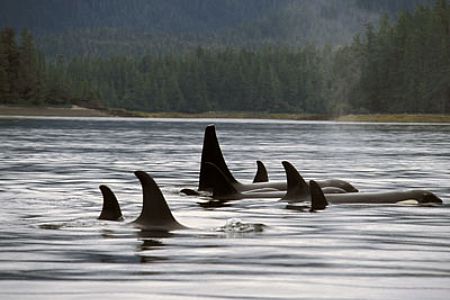 Critics claim that B.C.’s coastline will face new risks if Enbridge Inc. builds twin pipelines to Kitimat. (Ian McAllister photo) |
The sight of these massive mammals—which can weigh more than 40 tonnes—deftly corralling schools of tiny fish is truly astounding. Scientists call this spectacle “bubble net feeding”, and it’s not by accident that humpback, finback, and minke whales, along with Dall’s and harbour porpoises, orcas, and Pacific white-sided dolphins, congregate here: there is abundant food and a relatively hospitable environment for wildlife.
Caamano Sound is a universe away from the office towers of Edmonton, but these disparate locations are now inextricably linked by plans for the so-called Northern Gateway pipeline, which will connect Alberta with Kitimat on B.C.’s central coast. And you can’t talk about pipelines without discussing oil tankers plying some of the province’s most ecologically rich and diverse waters as they make their way from open ocean into Caamano Sound, around Gil Island, where B.C. Ferries’ Queen of the North foundered in 2006, and northeast up Douglas Channel to the port at Kitimat.
Marven Robinson is a wildlife guide and a band councillor with the Gitga’at First Nation in Hartley Bay, a small village at the mouth of Douglas Channel. He knows his way around the reaches, sounds, and narrows of this part of the coast like a taxi driver knows the city, and oil tankers cutting through the heart of Gitga’at territory don’t exactly square well with his vision of the future.
“With what happened to the Queen of the North, that was just a small spill and there’s still fuel leaking up from that,” Robinson says. “We’re being really careful about what we say publicly right now because we haven’t even met with the proponents yet.”
If the volatile economics of oil and environmental approvals fall into place, Calgary-based Enbridge Inc. hopes to construct 1,200-kilometre twin pipelines linking the oil fields of northern Alberta with the deep-water port at Kitimat. A westbound pipeline, about a metre in diameter, would carry 525,000 barrels of oil daily, and a 50-centimetre-wide eastbound line would daily transmit 193,000 barrels of condensate, a petroleum byproduct used to thin crude oil for transport and piping.
By selling 10 units at $10 million each, and giving buyers preferential treatment in booking capacity on the future pipeline, Enbridge has already raised $100 million from heavyweight Asian refiners and Canadian producers to help bring the project to regulatory approval.
The subplot to this story is that major oil-sands players like Suncor, Husky, Shell, and Petro-Canada desperately want the pipeline to access Asian markets as a cushion against threats from the nascent Barack Obama administration to wean the U.S. off its reliance on dirty oil-sands fuel.
Enbridge expects this $4-billion-plus project to create some 4,000 construction jobs as it crosses the traditional territories of at least 40 different First Nations bands in B.C. and Alberta. The company is promising state-of-the-art shipping protocols, with double-hulled vessels, radar-monitoring stations, pilot supertugs, and first-response emergency stations located in Kitimat and communities like Hartley Bay. Throughout the fall, Steve Greenaway, vice president of Enbridge Northern Gateway Pipelines—a general partner of Enbridge Inc.—led a series of open houses in communities along the pipeline route. Barring any major roadblocks, Greenaway says, Enbridge plans to file for regulatory approval by mid-2009, kicking off an estimated two-year environmental review to be carried out jointly by the Canadian Environmental Assessment Agency and the National Energy Board. At the earliest, construction could begin in 2011 or 2012. However, over the past two years there has been furious debate about the validity of an ambiguous federal government statement dating back to the early 1970s that refers to a moratorium on oil-tanker traffic along the B.C. coast. As far as Greenaway is concerned, though, the moratorium is not an issue.
“If there was a moratorium that was in any way enforceable, I’d suspect that the David Suzuki Foundation or the people at Dogwood [Initiative] would have pursued this in court,” Greenaway says. “As a British Columbian, I understand people’s concerns, but we feel that our safety systems will be as good as anything in the world.”
When it comes to provincial and federal government support, Greenaway has good reason to be optimistic about Northern Gateway’s prospects. The pipeline fits neatly within the B.C. Liberals’ energy game plan, which could have not only pipelines linking the coast to Alberta but also drilling rigs in Hecate Strait east of the Queen Charlotte Islands, an activity that has been off-limits for more than 30 years because of federal and provincial moratoriums on offshore oil and gas exploration and development. That’s why in the B.C. Energy Plan, the government promises to work “to lift the federal moratorium on offshore exploration and development and reiterate the intention to simultaneously lift the provincial moratorium”.
In a strange twist, former provincial NDP leader and cabinet minister Dan Miller has emerged as one of the most vocal cheerleaders for offshore oil exploration. Although high investment costs, uncertainty about proven reserves, and environmental issues will likely keep offshore oil and gas exploration on the shelf for some time, pipelines to the north coast are a very real possibility. Near the bottom of a 2008 throne speech dripping with sustainability rhetoric, Premier Gordon Campbell made references to an “energy corridor” that will be a boon to the northern economy. Kitimat LNG Inc., which has received both federal and provincial approval for its liquid-natural-gas port facility, received a major boost recently when Mitsubishi Corporation signed an agreement to purchase 1.5 million tonnes per year of terminal capacity and to acquire a minority interest in the project. The deal is expected to be finalized by the end of March this year. There have also been a slew of pipeline proposals, including those by Pacific Trail Pipelines, Pembina Pipeline, and Kinder Morgan Inc.
Enbridge, though, appears closest to breaking ground. In an enthusiastic August 2005 letter to Enbridge, Richard Neufeld, then minister of energy, mines, and petroleum resources, endorsed the pipeline and discounted the moratorium. Neufeld wrote that it “is not directed at, and has no application to oil tankers sailing to or from British Columbia ports”, referring instead to a so-called tanker exclusionary zone that targets only ships from Alaska transiting B.C. waters while bound for the U.S. (Neufeld, who is leaving provincial politics this spring to take a seat in the Senate, refused to respond to requests from the Georgia Straight for an interview.)
The federal government mouths a similar line, but a former minister of natural resources, Gary Lunn, preferred to duck hard questions about the tanker moratorium. After the last federal election, Lunn was removed from the ministry and replaced by Toronto MP Lisa Raitt, a lawyer and former CEO of the Toronto Port Authority. Environmentalists can take little comfort in her nomination. At an October 6 Oakville, Ontario, chamber of commerce meeting, Raitt was on record cheering about the possibilities of increased tourism and shipping opportunities in the North, thanks to the melting polar ice cap. She is also known for her combative relationship in the past with a citizens’ group called Community Air, against which she launched a lawsuit in 2006 for its criticism of the port authority. Like her predecessor, Lunn, neither Raitt nor her communications staff returned calls from the Straight.
Although governments prefer to dance around the prickly moratorium question, conservation groups, many First Nations, and other critics say the reasons for a moratorium still stand: simply that tanker traffic and oil spills pose a serious threat to the B.C. coast. Since 2006, ocean tankers have been quietly sailing into Kitimat’s port laden with as many as 350,000 barrels each of condensate, bound by railcar for EnCana Corporation’s operations in Alberta. Northern Gateway’s Greenaway sees this as proof positive that tankers can travel safely into Douglas Channel. But Eric Swanson, corporate campaigner for the Dogwood Initiative, a B.C. land-reform organization, says such shipping traffic is in blatant defiance of what the public wants—a rock-solid moratorium on tanker traffic in B.C.’s inside waters. Swanson is not surprised that politicians would prefer to sidestep the tanker-traffic issue rather than address it head-on—it’s a potential political time bomb. According to a poll conducted by the public-opinion research firm Synovate, a majority of British Columbians polled across the political spectrum desire an outright ban on oil-tanker traffic along the coast.
“The problem is that the moratorium was issued as a policy statement but it was never written down. What is clear is that there is a huge appetite for a crystal-clear ban on oil tankers. Seventy-two percent of B.C. residents support it, and that’s what we’re looking for,” Swanson says.
Ian McAllister, executive director of the nonprofit Pacific Wild, believes the distinction between the so-called tanker exclusionary zone and a tanker moratorium is moot.
“If the issue is protecting the coastline of British Columbia, then what’s the difference between tankers coming from Alaska and tankers going into Kitimat? It’s ridiculous.”
And when Alaska and oil tankers are mentioned in the same sentence, the Exxon Valdez immediately comes to mind. This 1989 disaster dumped 49.5 million litres of crude oil into Prince William Sound, killing an estimated 250,000 seabirds, 22 orcas, and untold numbers of fish and other marine organisms. By most conservative measures, Caamano Sound poses a much greater navigational challenge than the Alaskan sound that has been relegated to its place in history as the site of one of the worst oil-spill disasters on record. At the time, U.S. coast guard admiral Paul Yost said the 16-kilometre-wide accident site in Prince William Sound “was not a treacherous area” and “Children could drive a tanker through it.”
“If supertankers move around this coast, it’s not a matter of if but when a major disaster on the scale of Exxon Valdez would happen,” says Kevin Smith, whose company, Maple Leaf Adventures, takes tourists on wildlife-viewing trips in the central coast’s Great Bear Rainforest and frequently sails the proposed tanker route. “Big oil has millions of dollars to lobby government. Sadly, our burgeoning conservation economy on the coast doesn’t have that ability.”
Rob Williams, a marine researcher from the University of British Columbia, agrees that the prospect of an oil spill in an area as biologically diverse as Caamano Sound is unpalatable.
“Oil tankers pose a lot of threats to marine mammals, including noise, oil spills, and ship strikes. We don’t exactly know why this area is so rich, but there are some long, narrow channels that serve as bottlenecks for food, making it easier for whales to feed,” Williams says. The researcher has been using acoustic monitors to gauge the level of underwater shipping noise, known to have an impact on the ability of toothed mammals, such as orcas and dolphins, to use echolocation for finding food. “Caamano Sound may be one of the last chances we have on this coastline to protect an acoustically quiet sanctuary for whales.”
While environmentalists and scientists ponder a B.C. coastline with regular oil-tanker traffic, Enbridge faces an equally tough sales job as it tries to win support for its fossil-fuel superhighway across north-central B.C. Enbridge can count on support from the mayors of Prince George, Prince Rupert, and Kitimat, who have been boosting the project and its promise of jobs and tax dollars in their cities. Conversely, Nathan Cullen, NDP MP for Skeena–Bulkley Valley, has serious reservations about a pipeline linking northern Alberta’s dirty oil sands with the B.C. coast, and he remains highly skeptical about Northern Gateway’s economic benefit. There will be short-term jobs in pipeline construction, Cullen admits. He says, though, that over the long haul, B.C. communities in the Interior and along the coast will shoulder the burden of environmental risk from spills—whether it be in fish-bearing streams or the marine environment—and they will not share in the profits that will accrue to the head offices of Enbridge in Calgary and firms like Syncrude and Shell.
“We approach projects on a risk-benefit basis, and I don’t think the case has been made that the risks are worth the benefit,” Cullen says on the phone from Ottawa. “The Conservatives’ approach is ‘See no evil, hear no evil, and open up the oil corridor.’ This project is connected to the hyperdevelopment of the tar sands, and in the end we’re talking about 40 or 50 jobs that would be created by the pipeline. That’s your average Canadian Tire.”
Glenda Ferris is one citizen counting herself among those who have more to lose than gain. The proposed pipeline route passes within five kilometres of her rural property on Buck Flats Road west of Houston. She credits Enbridge representatives for making the effort to travel to the end of Buck Flats Road to meet with residents in November, but she says the meeting left her with more questions than answers. In her opinion, the open houses being held by Enbridge are more about fancy graphics and public relations than about incorporating citizen concerns into the ultimate design and routing of the pipeline.
“There are all kinds of questions about the potential of spills that they couldn’t or wouldn’t answer,” Ferris says. “It looks like someone just took out a map and drew a line between point A and point B. You have thousands of kilometres out there, and they put it right down the middle of our valley. We don’t want a pipeline here and don’t want tankers on the coast, but there’s a feeling that it’s almost a done deal. We’re frustrated.”
Buck Flats Road is just one back-yard brushfire that Enbridge may have to contend with. The proposed pipeline route crosses the territories of dozens of First Nations, each with specific concerns and wants, and smart companies know that it’s no longer acceptable to simply pay lip service to Native concerns. So does government. A landmark 2004 decision by the Supreme Court of Canada, in the case of Haida Nation v. British Columbia and Weyerhaeuser, explicitly states that the Crown must consult with and accommodate First Nations even when questions of aboriginal rights and title have not been resolved. This means, at best, that the proposal could get bogged down in protracted band-by-band negotiations and, at worst, that it could end up in the Canadian court system. The Haisla First Nation, under the leadership of Chief Steve Wilson, is tentatively in support of Northern Gateway and stands to benefit greatly from the development of port facilities in Kitimat. Enbridge has already signed a number of protocol agreements with individual First Nations along the pipeline route—including the Yekooche First Nation and the Nee-Tahi-Buhn band near Burns Lake—that come with attached funds, ostensibly to enable First Nations to hire their own consultants, and arrive at an informed decision about the pipeline. Chief Ray Morris says Enbridge has offered the Nee-Tahi-Buhn $110,000 in capacity-building funds as well as a chance to purchase equity in the project.
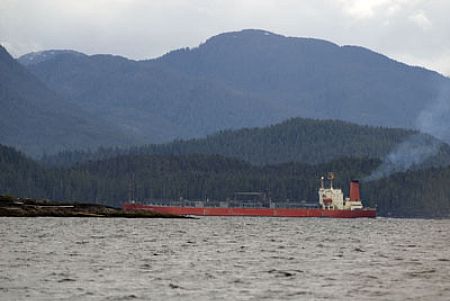 Tanker noise can disrupt marine mammals’ food-gathering. (Ian McAllister photo.) |
“Our band is very familiar with pipelines. There have been so many proposals,” Morris says on the phone, adding that his band will support the project only if it translates into future revenue for members.
The mood isn’t nearly as accommodating elsewhere. The Council of Haida Nations is on record as saying it will never support tanker traffic in its waters. In an October 14, 2008, letter to Enbridge, Fraser Lake’s Nadleh Whut’en band expressed “significant concerns over the proposed pipelines and their environmental and socio-economic impacts” and ordered Enbridge employees and consultants to stay out of the band’s territory until a formal agreement is in place. This sentiment was echoed at the offices of the Carrier Sekani Tribal Council in Prince George. Tribal Chief David Luggi represents eight bands in the region and views protocol agreements as an effort by Enbridge to purchase First Nations support for Northern Gateway. The proposed pipeline will cross the Stuart River, a major salmon system in Carrier Sekani territory, and member First Nations are rejecting the federal and provincial environmental review processes. In their place, Luggi says, the Carrier Sekani want a novel First Nations review that would be funded by government and use independent science and traditional knowledge to assess the impacts of the project on the environment, cultural heritage, and aboriginal rights and title. It would also allow adequate time and funds to fully engage and educate aboriginal communities and would delay a decision until “accommodations of infringements of aboriginal rights and title has taken place”.
“The B.C.–federal review process is focused on ensuring proper process rather than the substance of the project,” Luggi says. “The First Nations review-process framework would be applied to all new development proposals and not be restricted to the Enbridge proposal. We won’t participate in reviews if the funds are tied to any existing programs.”
The Carrier Sekani proposal was formally endorsed by other bands at a First Nations summit held in Vancouver last November. According to Luggi, the current process is tantamount to the project proponent trying to purchase First Nations support one band at a time.
Northern Gateway’s Greenaway denies that Enbridge is attempting to buy off Natives through protocol agreements. If the Carrier Sekani people disagree with the environmental-review process, he says, that’s a matter between them and government. He says he believes Enbridge is being as proactive as it can be in engaging community groups and First Nations well in advance of the official review process.
“The protocol agreements come with funding to allow First Nations to build capacity,” Greenaway says. “We are also offering opportunities for joint ventures and to become equity partners. These are still early days, and there’s a lot of work to be done.”
Despite gloomy economic circumstances that have caused capital to flee the oil sands, with projects that would have represented more than one million barrels of oil per day either postponed or cancelled since last December, Greenaway assures that Enbridge’s backers are thinking about the long term and remain committed to the project.
In Caamano Sound, the humpbacks and orcas are still feeding. Hartley Bay councillor Marven Robinson fears that oil tankers several football fields long plying the same waters as the myriad species that still thrive in traditional Gitga’at territory could become British Columbia’s oil-spill shame in the future. He’s also concerned that this energy-corridor juggernaut of pipelines and oil tankers is already a done deal in the minds of many politicians and oil-patch executives.
“Everybody around here is feeling that even if we say something against it, it’s going to go ahead anyways,” Robinson says.
January 31, 2009
Powering the future
JUSTINE HUNTER
Globe and Mail
January 31, 2009
BC Hydro must cut its greenhouse gas emissions but continue to meet the province's growing power needs, which means choosing either natural gas or electric power as a main fuel source. Both have their supporters. Both need major investment. Both demand a commitment that will be difficult to break. So ... which will it be?
VICTORIA -- In Whistler, green energy comes in turquoise, the colour of a new pipeline running alongside the Sea to Sky Highway. This week, a crew was laying the final 160 metres of the 50-kilometre line. By April, it will be bringing natural gas to Whistler, allowing residents in the resort community to switch their 14,000 propane appliances to run on a cleaner fossil fuel.
In Hecate Strait off the Queen Charlotte Islands, clean energy will be white. It is the only colour option for the wind turbines that are on order. The groundwork for Canada's first offshore wind energy project is laid, not yet in bricks and mortar, but with a partnership agreement this week between NaiKun Wind Development and the Haida Nation. The rotors, 107 metres across, are expected to be spinning their contribution to the electricity grid by 2013.
Natural gas or electric power: Which holds the key to B.C.'s future?
In the face of ever-increasing demand for energy, B.C. must cut greenhouse-gas emissions by one-third of current levels by 2020. That squeeze has produced a quiet power struggle as the two biggest players in the domestic energy market - the people who heat and light homes and businesses - lock horns over territory.
The B.C. government's climate-change directive demands a fundamental change in the energy system that will take years to plan and execute. The province has an abundance of carbon-free energy in the form of hydroelectric power, but it isn't enough to meet even today's needs, much less the future's. B.C. also has a wealth of natural gas that will continue to offer a prime source of energy.
The first public shot in this debate appears to have been fired by Randy Jespersen, CEO of Terasen Gas, speaking at a business luncheon last November.
"My mother always told me that those who live in glass houses should cast no stones," he said as a prelude. Then he set out to demolish the energy plans of his company's chief rival, BC Hydro.
"My suggestion is not so much whether there is forecast error," he told the crowd, "but rather that we understand the consequence of forecast error."
Both utilities must file their forecasts with their regulator, the B.C. Utilities Commission, to ensure that these key services are adequately planning for the future. They should offer a glimpse at the future of energy consumption in British Columbia.
But BC Hydro, Mr. Jespersen argued, isn't calculating for a green future because it has understated the future demands for hydroelectricity. If he is correct, it is a miscalculation that could lead to higher rates, missed emission targets and increased reliance on dirty energy imports.
To advance his case, Mr. Jespersen projected key sections of BC Hydro's own long-term power acquisition plan on a screen for his audience.
That document, which is now before the BCUC for approval, does not account for the potential impact of increasing prices of fossil fuels, which may encourage consumers to switch to electric power. Nor does it fully account for the B.C. government's climate-action plan. It calls for the electrification of truck stops, ports and oil and gas facilities, and it encourages electric vehicles.
What if Mr. Jespersen is right, BC Hydro's CEO, Bob Elton, was asked in a recent interview.
"If he or other people are right and the loads are higher than we think, we track that all the time," he said. "So let's say the recovery is sharper than we expect, and let's say also that some of this fuel switching happens more quickly. There would be indications of it, we would have time to go back and say we need more."
Mr. Jesperson's critique was not an idle sideswipe. His company is competing with the notion that BC Hydro holds the solution to clean energy in the future.
"We need integrated thinking that will use the right energy form for the right application," the natural gas executive said in an interview.
Communities such as Whistler have been persuaded that natural gas is part of a sustainable future. "What is taking place now is all of the rules of play are being written and it's important that there is a willingness to look at all emissions on a net basis," Mr. Jespersen said. "There is no room for fiefdoms with greenhouse gases."
WILL CONSUMERS GO GREEN?
There is no shortage of ideas to supplement and conserve energy. Smart meters in homes. Electric cars in driveways. Tidal currents pushing turbines off Vancouver Island's shores.
The City of North Vancouver is working on a 100-year plan to produce local green energy. The changes are coming one neighbourhood at a time. This spring, a dark array of solar hot-water panels on the roof of the library will be ready to harvest emissions-free energy. In the meantime, a mini-plant provides heat for the building and surrounding neighbourhood with natural-gas-fired boilers.
Policies can change choices, but consumers still shape the market.
Harry Grimm has been in the housing construction industry for 20 years. He's a principal in Portrait Homes, which is currently building a 500-home development in Maple Ridge.
"To me, the game right now is affordability," Mr. Grimm said. The subdivision boasts ecological features that added to the cost of building each unit, but customers are not willing to lay down big bucks for the environment. "They say they like the green space, but if you say, 'It will cost you an extra five thousand dollars,' people say, 'I'd sooner have the granite countertop.' "
In the higher-end homes, he is installing electric hot-water tanks and natural-gas furnaces, but in most multifamily units, the heating is all electric baseboard.
That represents a new trend and one that might have Terasen Gas worried. But the company is building for the future, with two pipeline projects, including the Whistler initiative. As well, it is constructing a $190-million, liquefied natural gas storage facility on Mount Hayes, outside Nanaimo, for its Vancouver Island customers.
BC Hydro's investments are largely absorbed in maintaining its crumbling infrastructure. The corporation is still mostly running on the megaprojects of the 1960s and 70s - held together with "tape and twine," as one official recently put it.
For example, just east of Cranbrook, workers are rebuilding the Aberfeldie Dam, tearing out wood sluices dating back to 1922. When it's completed, the dam will produce five times as much hydroelectric power as before.
For seven of the past 10 years, BC Hydro has failed to produce enough electricity to meet domestic demand. On average, it is importing 10 to 15 per cent of its energy on a net basis, and much of its imports come from "dirty" sources including coal and natural gas located across the province's borders.
As a result, the power coming out of the electric socket is not as clean as one might think. About 17 per cent of BC Hydro's power is produced with fossil fuels.
As part of the province's green energy agenda, BC Hydro has been ordered to wean itself off electricity imports by 2016. Until then, BC Hydro can rely on the markets for shortfalls. After that, it will need additional supplies. It has not decided what those resources will be.
$6-BILLION DAM TOUTED
Many of the "go green" initiatives being touted to reduce B.C.'s greenhouse-gas emissions involve switching from fossil fuels to electricity.
A few weeks ago, BC Hydro participated in an event on the front driveway of the legislature. The B.C. government announced it is converting 34 vehicles into plug-in electric vehicles. A spokesman for the utility was there, enthusiastically speculating that up to 60 per cent of new vehicles on provincial roads by 2025 could be hybrids or fully electric vehicles.
University of Victoria professor Andrew Weaver is one of the world's leading authorities on global warming and climate change. He's also a member of B.C.'s Climate Action Team, helping shape government policy and, he hopes, the future of green energy in B.C.
He is no fan of switching to natural gas as a path to a greener future: "The only solution, to be perfectly blunt, is to go carbon neutral." And the only way to do that, he said, is for BC Hydro to get back in the business of mega-projects. "They should be carving out their niche with the Site C dam," he said.
That option has been on the drawing board for years and now comes with a price tag in excess of $6-billion. It would be built on the Peace River, just southwest of Fort St. John, and would produce enough electricity to provide power for nearly half a million homes.
"I cannot see what is stopping Site C," Prof. Weaver said. "There are environmental consequences, yes, but there are environmental consequences for everything we do and we have to stop using the atmosphere as an unregulated dumping ground."
Mr. Elton was non-committal about Site C. And while he wouldn't take the bait on the gas-versus-electricity debate, he urges consumers to conserve.
British Columbians, in terms of electricity consumption, are gluttons, having enjoyed cheap electricity for decades. There's been little incentive to unplug and switch off. Buried in BC Hydro's long-term plan, however, is a secret weapon: a promise of massive rate increases that may finally make a dent in habits.
"I hope consumers will enjoy that over the next 10, 20 years their bills won't go up," Mr. Elton said. Not because rates won't climb - they will - but because people will learn to use less.
"If we worked in the greenest offices and lived in the greenest homes, we would be consuming far less," he said. "That's the way to go."
*****
THE ECONOMY'S EFFECT
In early October, Bob Elton, CEO of BC Hydro, found himself before the corporation's regulator, the British Columbia Utilities Commission.
At the hearing, a lawyer put him on the spot about the utility's forecasting: "Let's just assume, for the sake of argument, that we're on the front end of a recession which will be felt in British Columbia. ...What kind of implications would that have for BC Hydro's priorities?"
Very little, Mr. Elton replied: "There have been significant ups and downs in this province in the last 40 years. The difference it makes to electricity consumption is not as much as you think."
By December, BC Hydro changed its corporate mind. It announced it would cut its call for green-energy proposals from independent power producers by 40 per cent. The reason? The slowdown in the economy.
Two weeks ago, it offered another revision: "Even this large range [of forecasts] may not necessarily capture all of the uncertainties inherent in possible future demand for electricity," the corporation told its regulator. "BC Hydro does not want to limit its opportunities to acquire cost-effective renewable power."
In a recent interview, Mr. Elton was rather sour on the whole forecasting business.
"If you could get three people in a room agreeing on forecasting right now, I'd like to meet them," he said.
BC Hydro's long-range planning document explains, without apparent irony, that it uses a Monte Carlo model for its forecasts. Presumably, it is not referring to gambling, but to a device designed to negotiate the uncertainty of economic activity, weather and electricity rates. The document selects a mid-range forecast based on the model, and assures the BCUC that it will watch for further developments.
The cut to BC Hydro's green-energy call was poorly received in many quarters, including then-B.C. energy minister Richard Neufeld. Mr. Neufeld, who has since left his post for a Senate appointment, said the corporation needs to build for the future - and it needs to start now.
"You don't start building on Monday and finish on Friday," he said in an interview. "I think too many people think you can build this stuff fast."
Net-importer or not?
BC Hydro's 2008 Annual Report says this:
Total BC generation: 59,995 GWh
Total BC consumption: 53,300 GWh
Surplus: 6,695 GWh
It's pretty clear: in 2008, BC generated considerably more power than British Columbians consumed. And that's the aspect of energy self-sufficiency that we should be concerned about, should it not?
In terms of meeting domestic demand, BC generates or acquires more power than it needs from domestic sources.
Everything else is tied up with the energy trading biz.
Net ...drumroll... EXPORTER!
You can quit reading here, if this stuff bores you. Wonks, read on...
We have talked about and questioned this net-importer story that has served the BC government, BC Hydro, and others so well, for most of this century. Few among us are sure what's really happening, we don't trust the net-importer dogma, so they continue saying "net-importer", we say "baloney", and it goes on and on, like the Everyready Bunny. (Anybody know what you get if you put the battery in the bunny backwards?)
It could cost $5,000 to $10,000 to do an expert analysis of the net sources and dispositions of electricity, and get a definitive answer to the question. I'd like to see that study done, if anyone wants to pony up for it. But then we'd still be left with a Marvin Shaffer vs. Mark Jaccard stand-off; expert vs. expert with most of us still as perplexed and mistrustful as ever.
I've been taking a simpler approach to this question. Once a year, BC Hydro publishes its annual report. It includes tables (see below) showing its costs for power, and where it comes from, and its revenues for power sold, and where it is sold. I think it's pretty persuasive.
The tables also have two great advantages over the $10,000 treatment: they are relatively easy to understand, and they come from the horse's mouth so they are difficult to argue with.
They are the source for the figures I used at the top of this note.
The tables actually include quite a bit more information. You can find BC Hydro's 2008 Annual Report and BC Hydro's other annual reports here.
The tables show that in 2008, BC Hydro sold marginally less energy than it bought, but it still earned $157 million on the trades. And this included a big transfer of energy from the domestic to the trade account.
BC Hydro's notes include this caution: "Prior to fiscal 2008, BC Hydro was a net importer of electricity for seven consecutive years due to average or below average system water conditions every year. Fiscal 2008 was an exceptional inflow year, with inflows well above normal, resulting in BC Hydro being a net seller of electricity. The outlook for fiscal 2009 is for a return to average inflow conditions and, as a result, it is expected that BC Hydro will once again be a net importer of electricity."
Hmm. Let's have a quick look at those previous years. Dunno what they're talking about. It looks like a surplus every year in the domestic accounts AND in the total numbers. The trade figures are less consistent. BC Hydro only started showing trade purchases in 2005; in the four years since, there has been alternating years of more sold than bought, and more power bought than sold. Prior to that, the trade purchases are not broken out in the annual reports. In 2006, when BC Hydro shows that it sold more power than it acquired in the trade account, it still profited $254 million for the year.
Charts here:
"http://www.sqwalk.com/bc2009/BCH2008EnergyCostsTable.gif"
"BCH2008EnergyCostsTable.gif"
One important aspect of this importing issue is that we buy energy from coal-fired generation plants in Alberta and elsewhere. Powerex even has a contract to buy all the output from a coal-fired generater in Montana. If we're going to reduce our carbon emissions, we have to stop doing that. And by the same token, we have to stop exporting fossil fuels - our coal to Japan and Korea and China - and natural gas to the US.
January 29, 2009
Haida Nation and NaiKun Form Landmark Partnership
Agreement a Milestone for Canada's First Offshore Wind Project
News Release
Marketwire
Thu. January 29, 2009
VANCOUVER, BRITISH COLUMBIA, Jan 29, 2009 (Marketwire via COMTEX) -- NaiKun Wind Energy Group Inc. ("NaiKun") (TSX VENTURE:NKW) and the Council of the Haida Nation are pleased to announce the formation of an historic partnership in support of the development of Canada's first offshore wind energy project.
The NaiKun project is located in the traditional territory of the Haida Nation, in British Columbia's Hecate Strait, between Haida Gwaii (the Queen Charlotte Islands) and the mainland.
The partnership will be a commercial limited partnership which will operate and maintain the NaiKun wind energy project after construction. The comprehensive limited partnership agreement provides for maximum benefits to the Haida Nation from the NaiKun project, including revenue sharing, environmental stewardship, and employment and economic development opportunities for the Haida.
The agreement formalizes the relationship between the Haida Nation and NaiKun which has been ongoing since 2002, and builds on the memorandum of understanding signed by the two parties in May 2007.
"The establishment of the limited partnership marks a significant milestone for NaiKun's business relationship with the Haida and is a key step forward for the development of offshore wind energy in British Columbia," said Michael C. Burns, chair of the board of directors at NaiKun.
"This agreement is the result of many years of working together and it reflects the commitment from both partners to move this project forward. NaiKun will gain from the knowledge and insight of the Haida and welcomes the thoughtful support of the Nation and its leaders," said Mr. Burns.
"The Haida people support development that brings benefits of all kinds - individual, commercial and environmental - to Haida Gwaii and to the Haida Nation," said Guujaaw, President of the Haida Nation.
"We fully believe that, subject to confirmation of environmental feasibility, this offshore project will bring significant long-term benefits to the Haida Nation. For these reasons we are proud to be participants in the project," said Guujaaw.
The Haida Nation and NaiKun Wind Operating Inc., a subsidiary of NaiKun, will participate equally in the partnership both in terms of ownership and economic value. NaiKun Wind Operating Inc. is the designated General Partner.
The project is contingent upon receipt of environmental approvals from the Haida Nation and through the harmonized federal/provincial environmental assessment process, and the award of an Electricity Purchase Agreement from BC Hydro.
Training and recruiting for the project will begin immediately to ensure a qualified workforce is in place as activity ramps up for the start of construction in 2012.
In addition to support from local First Nations, the NaiKun project also has strong public support. A public opinion poll conducted for NaiKun by the Mustel Group in September 2008 indicated that 73 per cent of British Columbians support the project.
NaiKun Wind Energy Group Inc. (TSX VENTURE:NKW) is a British Columbia-based renewable energy company that is traded on the TSX Venture Exchange. Additional information is available on NaiKun's website: www.naikun.ca.
SOURCE: NaiKun Wind Energy Group Inc.
NaiKun Wind Energy Group Inc.
Doug McClelland Director,
Communications (604) 631-4487
Email: dmcclelland@naikun.ca
Website: www.naikun.ca
For full details for NKW click here.
January 28, 2009
A test case for tackling the CO-2 challenge
DAVID EBNER
Globe and Mail
January 21, 2009
FORT NELSON, B.C. — The steel exhaust tower, two metres wide and 100 metres high, is the tallest structure for hundreds of kilometres. Located just south of Fort Nelson in remote northeastern British Columbia, it towers against the sky, and it spews invisible, atmosphere-cooking carbon dioxide, even as the temperature on the ground on a sunny mid-November morning is minus 20 C.
The tower, the release point for carbon dioxide extracted from the natural gas processed at Spectra Energy's massive Fort Nelson plant, is the largest emitter of carbon dioxide in the province at about 1.2 million tonnes a year, a figure projected to double as a predicted natural gas boom north of town in the Horn River Basin takes off.
The natural gas below the surface is mingled with carbon dioxide, about 10 per cent of the mix, which is what the Spectra plant currently strips off and emits.
Successfully dealing with the greenhouse gas is going to be crucial to the development of the region, which is home to one of the largest accumulations of natural gas in North America that is in the very early stages of being unlocked with new technology.
Spectra's Fort Nelson gas plant is the focal point for B.C.'s fight against global warming and the area is at the heart of the province's economic future.
Houston-based Spectra is spending $12-million – a quarter of the money coming from a provincial government grant – to assess the geology 2,000 metres below the surface and drill two wells in an effort to establish a suitable reservoir to sequester carbon dioxide.
The geology is likely the simplest part of the equation. Spectra and other large industrial emitters no doubt foresee future legislation limiting carbon dioxide emissions – but myriad, crucial details remain unknown, leaving the likes of Spectra operating in a fog of unknowns.
Among the glaring gaps is the lack of a national and continental legislative framework that would put all participants on a level playing field. Then there are the specifics, such as who would be liable if a below-ground reservoir were punctured and gas escaped – in this case, Spectra or the natural gas companies that had their product processed at Spectra's plant?
“The big open question is commercial. Right now, it doesn't pay to do this,” said Mark Jenkins, a Spectra engineer working on the reservoir project, during a walk around the site on a cold, clear day.
B.C., as part of the 11-member Western Climate Initiative, in the spring introduced cap-and-trade legislation, which would cap industrial emissions and allow companies to buy and sell credits, whether for reducing emissions or to pay for emissions that have not been cut. Details have not been finalized for the province's goal to slash emissions by a third by 2020 – about 21 million tonnes less than a recent estimate of 62 million tonnes of annual carbon dioxide emissions.
Spectra's aim is to emit less carbon dioxide even as it doubles the amount of natural gas it processes. If the company isn't successful, it will be extremely difficult for B.C. to reach its goal.
In neighbouring Alberta, home of the country's biggest emitters, the province is still committed to $2-billion of spending on carbon capture and sequestration technology – particularly for the oil sands – even as the province's surplus evaporates with plunging oil and natural gas policies.
Such movement by the provinces is happening because, after years of languishing, legislative action is percolating on a broader scale in North America. With former president George W. Bush exiting office, change could come quickly. President Barack Obama has said the environment is a key priority regardless of the recession. Prime Minister Stephen Harper acknowledged the likelihood of swift action in the U.S. by appointing a top minister, Jim Prentice, to the environment portfolio.
The Spectra project has already hit a setback, a harbinger of the daunting challenge to implement carbon capture and storage on a wide scale. The company had hoped to be able to inject the carbon dioxide into a saline reservoir below the plant, but the geology assessment showed the supposedly impermeable rock around the reservoir probably wouldn't keep the carbon dioxide in place.
Spectra is now looking at a spot about 15 kilometres from the plant, and pushed back the drilling of a first test well planned for last year to March. A second test well is scheduled for late this year or early 2010, with the goal of full-scale injection of carbon dioxide in 2013, about a year later than planned when the project was announced last spring.
The cost of implementing carbon capture and storage will be significant. While Spectra doesn't have a precise budget, project director Al Laundry said it will definitely be in the hundreds of millions of dollars.
If the cost is $500-million (U.S.), it would amount to 25 cents for every thousand cubic feet of natural gas the plant aims to process over a six-year period. It appears to be a big number but for consumers heating homes, or industries powering factories, the additional cost wouldn't be severe. It amounts to about 5 per cent of the current benchmark price of natural gas – $5 per thousand cubic feet – and is less than many daily price fluctuations of the commodity.
Spectra's Fort Nelson facility currently produces close to 500 million cubic feet of gas for sale daily, which it plans to double as Horn River production increases.
Already, about 50 million cubic feet of gas from Horn River is being sold. Spectra wants to increase output to about one billion cubic feet a day, reopening a part of the plant that was mothballed several years ago after conventional gas production in northeastern B.C. began to fall off.
Spectra's advantage is that it has a ready point source of carbon dioxide, rather than having to capture emissions from various places, a far more difficult task. The processing plant strips out carbon dioxide from natural gas, and a little bit of hydrogen sulphide. The carbon dioxide is vented and the hydrogen sulphide is converted into sulphur.
The gases would be compressed effectively into a liquid form, moved by pipeline to the injection site and pumped underground into a reservoir that could store between 20 and 50 years worth of emissions.
Power is another challenge. About 50 megawatts of power would be required for carbon capture and sequestration, largely for the compressors. That's 10 times more than what the plant currently uses, which Spectra generates itself, and about the same amount as is used by the town of Fort Nelson, population 5,000. Spectra is looking at using gas-powered turbines for about half its power needs and using waste-heat recovery for the rest.
B.C. Liberals selling out our energy future
Ralph Keller, Arthur Caldicott and Jim Abram
Times Colonist
January 28, 2009
Climate and terrain could make us the Saudi Arabia of renewable energy
There is an energy "gold rush" happening in British Columbia. With our mountainous terrain and wet-coast climate, we are poised to become the world's Saudi Arabia of sustainable energy from a variety of sources including run of river, wind and tidal power.
If fully exploited, these resources could create four times more power than B.C. Hydro currently produces, and give us billions of dollars for provincial coffers. But only if the resource remains a public asset, managed for public benefits.
British Columbians have been blessed with renewable, reliable and inexpensive electricity ever since W.A.C. Bennett had the foresight to develop publicly owned hydroelectric power almost 50 years ago. It might have been renewable, but it was not especially green -- ask anyone living in the Peace River country back then.
In 2002, the provincial government prohibited B.C. Hydro from developing new power projects, throwing British Columbia's renewable energy potential to the private energy sector.
Since then, more than a thousand applications have been made for renewable energy projects; 650 "run of river" applications now cover almost every viable river and stream. More than 400 applications are under review for wind, tide and wave permits.
The government has made it easy and inexpensive for private developers to access our water and wind resources. Over the life of the 30- to 40-year Independent Power Producer energy contracts being negotiated, the people of B.C. receive less than four per cent of gross revenues in return for the long-term-use of public resources and guaranteed purchase contracts.
Compared to the 15 to 25 per cent royalties and tax paid by oil and gas companies, our renewable energy resources are a giveaway.
The IPPs claim to be developing zero-emission "Green Power" which is climate friendly. To an extent, this is true. Some projects are about as "green" as energy production gets, and if approved by local communities, they should go ahead.
But many projects come with unacceptably high environmental price tags. Surprisingly, the Environmental Assessment Office has never yet turned down a proposal, but consider the overall impacts of this new gold rush: Roads and transmission lines that will criss-cross B.C.'s wilderness landscapes; thousands of hectares that will be clearcut; river diversion, tunnels and pipelines; massive drilling and blasting operations, with acid rock drainage and soil erosion.
Could these permanent disturbances to almost every coastal watershed really mean no damage to fish and wildlife?
Most disturbing is how the government has disempowered affected communities. Citizens have no meaningful way to engage with power-project applications since provincial legislation has removed local government jurisdiction.
Even if the vast majority of citizens oppose a particular project, the provincial government can (and does) overturn regional and community bylaws. It has ensured the people are voiceless and corporations get the last word.
In the past, B.C. citizens endured the negative social and environmental consequences of hydroelectric developments in the Peace and in the Kootenays.
In exchange, these projects did guarantee British Columbians a legacy of inexpensive and reliable energy, and B.C. Hydro's substantial profits have continued to offset costs of health care, education and other social programs.
Now British Columbia's vast renewable energy resources could lead Canada into a low carbon future and create wealth for its citizens. However, the present gold rush mentality and helter-skelter development is about to leave British Columbians with a new dark legacy of disturbed rivers, degraded landscapes, a tangle of high-voltage transmission lines in every direction -- and no continuing economic benefit.
The B.C. government could set into motion a plan to earn billions of dollars in green energy profits making us the wealthiest province in Canada. It could work with communities to develop energy.
Instead, the government is bent on privatizing our natural heritage and converting our common wealth into shareholder profits. For those corporations, it's green energy in more ways than one.
Ralph Keller is with Coast Mountain Expeditions, Ltd., Arthur Caldicott is a B.C. energy analyst and Jim Abram is a former president of the Union of BC. Municipalities and a director of the Strathcona Regional District.
January 18, 2009
Energy production a key to forestry revitalization
COMMENT: Minister Pat Bell: "I think it is a great window for us to jump through." What is this - suicide forestry?
That's some forestry revitalization strategy - burning trees. BC's version of tropical rainforest devastation. Everywhere trees are coming down for energy production. Bio-this, bio-that - it's all biocide. It does nothing for forests, exacerbates greenhouse gas production (don't kid yourself, burning a tree or combusting soya or cane or corn vegetation is just as much a release of a carbon sink as burning a fossil fuel. We have to stop burning things, folks.), and none of it creates a sustainable economy, let alone ecology. We're smart, no question about it, but still nature understands best how to create a sustainable ecology.
Bell's Ministry has 25 people in China selling BC's timber? Hello! And the dollar return on that is?
By Aaron Orlando
Revelstoke Times Review
January 12, 2009
 B.C. Minister of Forests and Range Pat Bell. (Aaron Orlando/Times Review) |
Forests and Range Minister Pat Bell was on a tour of rural communities in the region last week, including Revelstoke, Nakusp, Castlegar and Nelson. He says he’s looking for ways to reinvigorate the forest industry during the tour and is discussing his proposed four key points for a forestry revitalization.
Bell spoke to members of the Revelstoke Chamber of Commerce and other forestry stakeholders at a luncheon meeting at the Powder Springs Inn on Jan. 5.
Bell, who worked in the harvesting business in the 1990s, says he feels Revelstoke is an example of a community where forestry works. “I do come to this industry with some background and some knowledge and a lot of enthusiasm for what the forest industry can be throughout British Columbia and I think Revelstoke is a great example of something that has worked well in B.C., whether it’s Downie Timber, the Revelstoke Community Forest or the great Ministry of Forests team that we have here in Revelstoke. We’ve all worked well together to present an industry that’s integrated, that works well with recreation backcountry tourism operators and really has been the core and the heart of the community,” he said, adding that it was a model he’d like to see replicated in other communities in the province. “I really think it has been the community engagement that’s done it,” he adds.
Bell says the current market conditions will remain a challenge in the foreseeable future. “I don’t expect that the American market is coming back anytime soon,” he says.
This situation has been a reality under which he’s worked to come up with plans to guide the forest industry into the future.
He then went on to present four key points he’s been working on to guide the transition.
Getting more value out of our forests
“For a long time we’ve looked at our forest stands as a commodity product, as a product that we bring in and create a product quickly, simply and sell it into a market. And we’re price takers, we’re not price makers. We just simply take the product and flog it into a marketplace that may or may not want it,” he says, going on to say this needs to change.
Revelstoke has bucked that trend to some extent, says Bell. It is a model that we need to replicate around the province. “We need to extract more value from each and every log.” He says this extends beyond harvested logs to include what we leave behind in the bush.
During his career in the 1990s his company focused on extracting maximum value from each piece of wood that they touched and sought to take in everything possible. “So I think we need to be far more focused on full utilization of the resource within the principles of good ecosystem management. Clearly there is a role for course woody debris on the forest floor. It’s an important thing for many of our species to live under and create habitat for them, but let’s not use that as an excuse to leave behind significant components of residual material, not fully utilizing the resource.”
Bell says that there are policy barriers that reinforce the status quo that he’s looking to change. For example, harvesters bringing in less desirable materials can have it deducted against an annual allowable cut. “Our staff are looking right now at all the different policies that we have in place to remove those barriers and encourage full utilization.”
The ministry is piloting a lump-sum sales model through BC Timber Sales in which block lots are sold at a fixed price, rather than per cubic metre harvested. “What we’re trying to do is get you to take full value off of that site, whether it be for for wood or post and rail or for grinding it up into pellets or for utilizing in the energy system here in Revelstoke or whatever it has to be.” Maximizing the value for the parcel of land is the goal.
He says the pulp industry in B.C. developed during the 1950s and ‘60s due to efforts to better utilize waste products from dimensional lumber production.
Bell feels we’re in exactly the same situation today. This time around the new products will include energy, pellets, bio-fuels, bio-diesel, bio-ethanol and bio-refining.
He calls these products the “third leg of the forestry stool” when added to the other two legs: dimensional lumber as well as pulp and paper. He extends the metaphor by saying having three legs creates a far more stable base.
Managing silviculture better
Bell says we need to invest in the land base in a better way, reasoning that better silviculture practices can greatly increase the yield from the same plot of land.
Currently, we aren’t focusing enough on the possibilities in silviculture, says Bell. The common practice now is to do the bare minimum to meet legal requirements, but not much more.
A ministry of forests staff team is currently working on plans to reform the silviculture system The goal will be to focus on growing trees in general, not just making boards out of the trees that you grow. “It’s not something that we’ve ever had to turn our minds to, and I’m very excited about this opportunity. I think it is a great window for us to jump through,” says Bell, adding that all of the advanced silviculture jobs will be in rural B.C., which will in turn drive rural economies.
Focusing on China
Bell feels the Chinese market is a huge opportunity. He says the government has focused on introducing a wooden truss system to be used on existing leaky Chinese concrete buildings and has started installing them on houses in Shanghai.
He says in the past we’ve focused on marketing single family homes in China -- a strategy he feels wasn’t successful because they are not suitable due to density issues. “The market in China, I don’t think is the one that we have been chasing. The one we have been chasing is the idea of single family homes. I think we need to build components for their existing structures. I think if the Chinese get used to seeing wood on a regular basis, eventually it will become their product of choice and they will build their entire buildings out of wood as well,” adding it will be a step by step process.
The Chinese market potential is about 1.6 billion board feet per year, which equals about 10 per cent of B.C.’s annual output of about 14 billion board feet per year during a high year. Bell says the roofing market is only a start, saying there is room to move on other construction components. The ministry has 25 full-time staff in China now actively marketing products, in addition to about 15 people from private companies doing the same.
Large commercial wood buildings
Bell says the only real competitor in the institutional building market are buildings made of steel and concrete and that there are lots of opportunity in the sector. Wooden buildings have a much smaller carbon footprint, which is a key marketing tool.
As an example, Bell says the Heather Park Middle School in Prince George, which is located in his riding of Price George North, was made of wood.
Bell makes the pitch that wood buildings have far less of a carbon footprint because carbon is created during the production of steel and concrete, whereas wood is in effect sequestered carbon and remains so for the life of the building.
Using the example of the middle school he says building with wood instead of concrete reduced the amount of carbon released during construction by the equivalent of 10,620 cars being operated for a full year.
He says regardless of your personal beliefs surrounding global warming, this is a great marketing tool and gives the example of the Olympic Skating Oval in Richmond as an aesthetically pleasing example of what can be done with wood.
***
Bell feels that 2009 will be a key year for the industry and that the B.C. industry needs to face challenges head on -- including making tough decisions. “Whenever you are faced with challenging times, as we are today, you need to be prepared to make unpopular decisions because they will establish the right framework for long-term success, and those mean big shifts,” says Bell.
He describes a bright new future for forestry that will come with the development of renewable energy and fuels. “But it won’t be without pain,” he adds.
January 16, 2009
BC Hydro changes tune over green energy cutbacks
COMMENT: BC Hydro said in December that it would be contracting for less energy from IPPs than originally planned, in the latest "green call". But here is CEO Bob Elton a few weeks later, reversing himself. His defense? The "uncertainty of forecasting".
He should know about that. It was in 2002, also in a BC Utilities Commission (BCUC) review, of BC Hydro's own Vancouver Island Generation Project (which was later reintroduced as a private project called Duke Point Power). BC Hydro had rolled out its forecasts showing steadily increasing demand for electricity on Vancouver Island - forecasts it had used to support its contention that the GSX Pipeline was also necessary.
GSX Concerned Citizens Coaltion founding director, and Cobble Hill turkey farmer, Steve Miller, questioned BC Hydro's forecasts and its methods. His analysis was so astute, and his grilling of BC Hydro's lead forecaster so grueling, that BC Hydro disappeared the forecasts, disappeared the forecaster, and came back to the hearing with new forecasts, and this time at least, methods that were explainable, if not accurate. At the time, I don't recall Hydro using the "uncertainty" argument - that's gotta be the sloppiest defense of experts yet.
Elton also knows about having his wrists slapped by government. In 2005, after a year of what might have been some of the best public consultation it has ever done, BC Hydro issued a media alert that it would be releasing its 2005 Integrated Electricity Plan (IEP) at 10:00 Wednesday morning, December 8. The IEP was expected to be fairly green, and bullish on Site C.
But early that same Wednesday, Richard Neufeld, Minister of Energy, Mines and Petroleum Resources, pulled the plug on Elton, and suppressed the IEP. No release at 10:00 that morning. In his column that day, Vaughn Palmer said, "... even as the media advisory for those coming attractions circulated in provincial newsrooms, the Liberals were at work derailing it."
Like the forecasts, the IEP also disappeared. But unlike the new forecasts which were mere weeks in preparation, the IEP was gone for four months. When it re-emerged at the end of March, Site C was now relegated to consultations, and coal given an increased profile.
Here we are again. The IPP lobby was clearly aggrieved at BC Hydro's proposed reduction in power purchases in the present call, and it got the ear of government. The letter BC Hydro sent to the Utilities Commission has all the linguistic bad smells of having been dictated by the Liberal politburo in Victoria.
Palmer's words from 2005 are as apt today: "The B.C. Liberals have [once again] intervened directly in the management of BC Hydro..."
And Chief Judith Sayers is correct, the political pressure did come crashing down. And industry spokesman Dan Potts is on the money, so to speak: "There is no market for power at that price." referring to the price BC Hydro will have to pay for this IPP generated energy.
Government yanks BC Hydro's chain
Exhibit B-12, the January 12 letter to BCUC
BC Hydro changes tune over green energy cutbacks
JUSTINE HUNTERGlobe and Mail
January 15, 2009
Utility cites difficulty forecasting in last month's heavily criticized move to seek drastic reduction in clean power projects
VICTORIA -- Blistered by critics over its plan to scale back contracts for clean electricity because of economic uncertainty, BC Hydro this week moved to "clarify" that it may buy all the clean power it can get.
"We want to be clear that we recognize the uncertainty of forecasting," BC Hydro CEO Bob Elton said in interview.
"I think it would be silly to preclude the opportunities to get green power at a good price."
Last month, the Crown corporation asked its regulators for the authority to reduce its call for green energy projects by 40 per cent, a move welcomed by industrial customers but attacked by proponents of electricity produced without carbon emissions.
But on Jan. 12, a new letter arrived at the B.C. Utilities Commission from BC Hydro, noting that forecasting is a tough business these days.
The amendment to BC Hydro's long-range energy plan, tabled in December, "may not necessarily capture all of the uncertainties inherent in possible future demand for electricity," the letter states.
As a result, the corporation could find itself buying even more green electricity than it had originally planned.
B.C. Energy Minister Richard Neufeld said he was surprised in December when he heard Hydro announce it was cutting back on plans for green energy - and he welcomed the modification to that amendment.
"I think to be fair to Hydro, they were looking at what was happening around them at the time and maybe didn't think out far enough about what the B.C. government's energy plan envisioned."
The province has enacted an energy plan that requires BC Hydro to wean itself off electricity imports - which tend to come from greenhouse-gas-producing sources - by 2016.
BC Hydro routinely trades electricity with its neighbours such as Alberta and Washington State, but the province has been a net importer since the 1990s.
Customers can expect to pay more for greener electric power in the future, Mr. Neufeld acknowledged. "Everybody knows clean energy costs more," he said.
Chief Judy Sayers, of the Hupacasath First Nation, won a national climate-change award last year for her community's green power initiatives.
The Upnit Power Corporation on Vancouver Island started with a single run-of-the-river power project and has two others in the works.
But it has 10 more ventures on the drawing board it intended to submit through the clean energy call.
Ms. Sayers said BC Hydro's clarification this week looks more like backtracking.
"We should be completely independent for power.
"I think some of the political pressure came crashing down and they had to back off."
However, Dan Potts, executive director of the Joint Industry Electricity Steering Committee, said people should understand just how big a price they will pay for greener electricity.
His organization represents Hydro's large industrial customers.
He noted Hydro's long-range energy forecast puts a price tag on that new power at three times what industrial customers currently pay.
"There is no market for power at that price," he said.
"If people want to reduce greenhouse-gas emissions and feel good, then I guess that's what's going to happen. But we hope we can do it by the most cost-effective means possible."
Mr. Elton stressed that the amount of power the corporation will purchase from green energy producers will depend on the price.
"It is a procurement process," he said.
"We'd be very foolish not to remind people that are selling power to us that it's important they sharpen their pencils."
Exhibit B-12, BC Hydro to BC Utilities Commission, 12Jan2009
BChydro
Joanna Sofield
Chief Regulatory Officer
Phone: (604) 623-4046
Fax: (604)623-4407
bchydroregulatorygroup@bchydro.com
January 12, 2009
Ms. Erica M. Hamilton
Commission Secretary
British Columbia Utilities Commission
Sixth Floor - 900 Howe Street
Vancouver, BC V6Z 2N3
Dear Ms. Hamilton:
RE: Project No. 3698514
British Columbia Utilities Commission (BCUC)
British Columbia Hydro and Power Authority (BC Hydro)
2008 Long-Term Acquisition Plan (2008 LTAP)
BC Hydro writes with respect to the Evidentiary Update filed as Exhibit B-10 in the 2008 LTAP proceeding, and in particular with respect to BC Hydro's request for an amendment to the Order sought to reduce the Clean Power Call pre-attrition target to 3,000 GWh per year.
The Evidentiary Update includes a load forecast which projects future electricity needs in British Columbia within a large range of outcomes. Even this large range may not necessarily capture all of the uncertainties inherent in possible future demand for electricity. These uncertainties include those associated with the recovery of the economy which is related to world economic events, as well as opportunities created by British Columbia initiatives. Further uncertainties and opportunities result from the potential future demand created by the transformation to a low carbon economy, a British Columbia initiative as well as a world-wide trend. These further uncertainties and opportunities include the switching from other fuels to electricity for personal transportation, mass transit, heating and other applications. As a result of all of these uncertainties and opportunities, and the 2007 Energy Plan's goal to achieve electricity self-sufficiency by 2016, BC Hydro does not want to limit its opportunities to acquire cost-effective renewable power through competitive processes with independent power producers.
Pursuant to Section 18 of the Clean Power Call Request for Proposals (filed as Appendix M, Exhibit B-1-1), in awarding Electricity Purchase Agreements (EPAs) BC Hydro may in its sole discretion at the time of evaluation consider the load/resource balance, price and other evaluation criteria.
This Clean Power Call evaluation process may result in BC Hydro awarding EPAs up to or greater than the original target of 5,000 GWh per year if the EPAs are cost-effective. Such EPAs would be subject to BCUC review under the Section 71 filing process.
Yours sincerely,
Joanna Sofield
Chief Regulatory Officer
c. BCUC Project No. 3698514 Registered Intervenor Distribution List.
Exhibit B-12, this January 12 letter
Exhibit B-10, the December 22 letter reducing the purchase requirements
Island coal mine working at capacity
COMMENT: The stock market doesn't quite seem to agree with this promotional bumf.

Andrew A. Duffy,
Times Colonist, with files from Bloomberg
January 16, 2009
Hillsborough CEO expects Quinsam is poised for an incredible 2009 to 2010
Uncertainty in the global coal market does not appear to have affected Hillsborough Re-sources, which operates the Quinsam coal mine near Campbell River.
According to Hillsborough CEO David Slater, the Island mine, which produces coal used in the production of cement or in coal-fired electrical plants, is working at full capacity and the company is forecasting a strong 2009.
"I think 2009 and 2010 will be incredible years for us," said Slater, noting a number of domestic and international contracts booked with coal at high prices have the company on firm economic footing. "We are poised for a hell of a year. We have to keep our heads and keep costs under control, but that's the same for any business."
Hillsborough issued an operations and sales update for shareholders yesterday following concerns raised by the uncertainty in the market and announcements by other coal producers of reduced production, likely due to reduced demand in China.
China is the world's biggest user of coal, relying on the fuel for 80 per cent of its power generation, but slashed its overseas purchases for the first time in five years due to slowing economic growth.
Coal imports to China declined by 21 per cent to 40.4 million tonnes last year, the first drop since 2003, when shipments fell 0.5 per cent to 10.76 million tonnes.
In the update, Hillsborough noted it has budgeted to produce 520,000 tonnes from its Quinsam operation, all of which has been spoken for through various contracts, including 300,000 tonnes into the international market at the high price of $137 US per tonne.
"I'd like to say it was foresight and incredible timing, but luck has a part to play in that," said Slater of the high contract price.
The spot price for coal at Richards Bay, South Africa, the largest export terminal for the fuel, hit $83.70 a tonne recently, though that figure remains less than half of the record prices hit last year when the global economy was firing on all cylinders.
According to Slater, the Quinsam mine is working at capacity with 150 full-time workers, and after a 2008 that featured higher-than-expected operating costs, it is poised to improve productivity over the next two years.
In the update to shareholders, the company says new equipment -- part of a $32-million expansion plan announced in 2007 that's designed to double the size of the Quinsam mine -- and a year's experience for new members of its workforce should allow the company to reduce production costs.
Despite what appears to be good news on the horizon, the markets haven't taken much of a shine to the company. Hillsborough's share price (TSX:HLB) closed up $0.03 at $0.215, well off its 52-week high of $2.08.
"I don't know what it takes to get the market to sit up and take notice, but we think it's pretty good news," said Slater. "You just need to get on and prove you're right. If you keep your head and keep doing it, you'll probably be OK."
Hillsborough Resources Limited Updates Operations and Sales
News Release, Hillsborough Resources, 15-Jan-2009VANCOUVER, BRITISH COLUMBIA--(Marketwire - Jan. 15, 2009) - Hillsborough Resources Limited (TSX:HLB) (the "Corporation") provides an operations and sales update to its shareholders to address concerns with respect to the current uncertainty in the coal markets and various announcements by other coal operators.
As a result of favourable sales contracts and operational improvements, Management believes that Hillsborough is positioned to do well during 2009.
Hillsborough has budgeted to produce 520,000 tonnes of Quinsam products during calendar year 2009, all of which has been contracted for. Our upwardly revised projections for 2009 call for an average blended sales price of CDN$125/tonne, which includes 300,000 tonnes into the international market at US$137/tonne with an assumed average exchange rate of CDN to US of $0.838. Management expects that any additional production would be readily sold at market prices.
For the first half of 2009, Vitol has requested the next shipments for mid-March and mid-June.
Hillsborough also advises that new pricing with one of its cement customers will take effect April 1st with a substantial increase due to adjustments based on the contracted producer price index. Sales to other domestic customers are already at or above market prices.
Although Quinsam had higher than forecast production costs through 2008, the mine is much better positioned to improve productivity, to meet production targets, and to reduce costs during 2009. New equipment has been added, the new workforce has become more experienced, and the mine plan has a good balance of development and depillar coal. Blended FOB cash costs are budgeted at CDN$73/tonne. If above noted improvements are achieved, production costs will reduce.
The impact of the downturn in the steel industry and demand for metallurgical coal is being monitored closely by Management at Peace River Coal (PRC). The Trend transition project which is well underway is expected to bring PRC greater capital and management control as well as to deliver a reduced operating cost environment. Options around optimal production will be assessed as more clarity emerges from the customers and market sector.
Further, subject to regulatory and shareholder approval, the directors of the Corporation have approved a new employee share purchase plan to replace its former plan which terminated in accordance with its terms on December 31, 2008, permitting participants to be issued up to a maximum of 2,000,000 common shares, with the Corporation effectively matching 50% of their contributions.
About the Corporation
Hillsborough Resources Limited is a coal mining company that:
- Operates the 500,000 tpy Quinsam underground thermal mine near Campbell River, British Columbia, serving the local and west-coast U.S. cement industry with increasing sales into the export market.
- Is a limited partner in the Peace River Coal Limited Partnership (with 14.1%), which has substantial metallurgical coal properties both in production (Trend Mine) and under development near Tumbler Ridge, British Columbia.
- Owns the Crossville Mine in Tennessee on which options for new mine development are being evaluated but the mine remains in reclamation at this time.
- Holds the Wapiti thermal coal property north of Tumbler Ridge, and is planning development of a mine.
- Holds the Bingay Creek metallurgical coal property located in the Elk Valley region of southeast British Columbia.
Certain statements and information herein, including all statements that are not historical facts, contain forward-looking statements and forward-looking information within the meaning of applicable securities laws. Such forward-looking statements or information include but are not limited to statements or information as to estimates, forecasts, future financial or operating performance of the Corporation, future production, costs of production, capital requirements, operating expenditures, reserve potential, exploration drilling, exploitation activities and activities and events or developments that we expect to occur. Often, but not always, forward-looking statements and information can be identified by the use of words such as "may", "will", "should", "plans", "expects", "intends", "anticipates", "believes", "budget", "forecasted" and "scheduled" or the negative thereof or variations thereon or similar terminology.
With respect to forward-looking statements and information contained herein, we have made numerous assumptions including among other things, assumptions about prices, anticipated costs and our ability to achieve our goals. In particular, our statements regarding future production expectation is based on current existing current resource/reserve estimates, production contracts in place, historical costs and mining conditions.
Forward-looking statements and information are necessarily based upon a number of estimates and assumptions that, while considered by management to be reasonable and to be based on reasonable assumptions, are inherently subject to significant business, economic and competitive uncertainties and contingencies and involve known and unknown risks. Readers are cautioned that any such forward-looking statements and information are not guarantees and there can be no assurance that such statements and information will prove to be accurate, and actual results and future events could differ materially from those anticipated in such statements. Important factors that could cause actual results to differ materially from the Corporation's expectations include adverse exploration or development results; interruptions in the ability of the Corporation to produce coal from any of its mines; inability to meet production volumes required; adverse due diligence findings; re-assessments of corporate or development objectives and requirements; additional technical developments and considerations; unexpected increases in the costs of producing coal; changes in international coal or transportation markets; a rapid change in the value of the Canadian dollar particularly with respect to the US dollar; a fundamental slow down in the North American, Asian or worldwide economies; and other factors. See our recent annual information form and quarterly and annual management's discussion and analysis filed on SEDAR for additional information on risks, uncertainties and other factors relating to the forward-looking statements and information.
Although we have identified factors that would cause actual actions, events or results to differ materially from those disclosed in the forward-looking statements or information, there may be other factors that cause actual results, performance, achievements or events not to be as anticipated, estimated or intended. Accordingly, readers should not place undue reliance on the forward-looking statements or information. We expressly disclaim any intention or obligation to update or revise any forward-looking statements and information whether as a result of new information, future events or otherwise, except as required by law. All written and oral forward-looking statements and information attributable to us or persons acting on our behalf are expressly qualified in their entirety by the foregoing cautionary statements.
January 15, 2009
Tips flowing on pipeline bombings after EnCana reward offered
By Jamie Hall
Edmonton Journal
January 14, 2009
EDMONTON — Police have received more than a dozen tips since EnCana’s offer Tuesday of a $500,000 reward for information leading to the arrest of the pipeline bomber near Dawson Creek, B.C.
RCMP spokesman Sgt. Tim Shields said of as 5 p.m. Tuesday, 11 phone calls were logged through its dedicated tip line — 1-866-994-7473 — “and there have been more today but I know don’t exactly how many.”
The reward was called an “act of desperation” by terrorism expert Paul Joosee, who pointed to a lengthy investigation by police which has netted few solid leads and no prime suspect.
Since mid-October, a total of four explosions targeted EnCana’s sour gas operations in northeastern B.C., the most recent on Jan. 4 when a bomb blew apart a wall of a shed housing a sour-gas pipe.
Police say although no one has been injured yet, each successive bombing is getting closer to populated areas around the Tomslake community, prompting investigators to label the attacks “increasingly violent.”
Shields said police are also increasingly frustrated by the continued lack of co-operation shown by the “persons of interest” first identified during a press conference in early December.
Shields said the “small group” of individuals — he declined to say how many there are — either won’t talk to police at all anymore or, if they are still talking, “won’t talk about what we want to talk about.”
“They know who they are,” said Shields.
He stressed that they are not only hindering the overall investigation, but are stopping police from eliminating them as suspects once and for all.
“It’s proving to be difficult because we recognize the vast majority of people who have surfaced during the course of the investigation are going to be innocent, and our goal is to clear these people and eliminate them as quickly as possible,” said Shields.
“So, since we have a group of ‘persons of interest,’ we know that we want to be able to clear them, so, please, help us clear you.”
Shields characterized at least some of the tips received so far as being "very low quality,” but investigators are hopeful more substantive information will soon be forthcoming.
“We’re continuing to process all information, and all leads,” said Shields.
“It’s been a long and intense investigation, but we are still moving forward.”
© Copyright (c) The Edmonton Journal
See also
Encana to announce reward into B.C. pipeline bombings
Pipeline bombers probably local: expert
RCMP blows pipeline bombing investigation
Sabotage fears flow around B.C. pipelines
Third blast rocks B.C. pipeline
Six recent pipeline incidents, commission says
Oil vandal questioned in B.C. pipeline bombings
Somebody local with a grudge targeting oilpatch?
2nd explosion rocks northern B.C. pipeline
RCMP terror squad probes pipeline bombing
January 13, 2009
Powerlines linked to leukemia in B.C. report
By Pamela Fayerman
Vancouver Sun
January 12, 2009
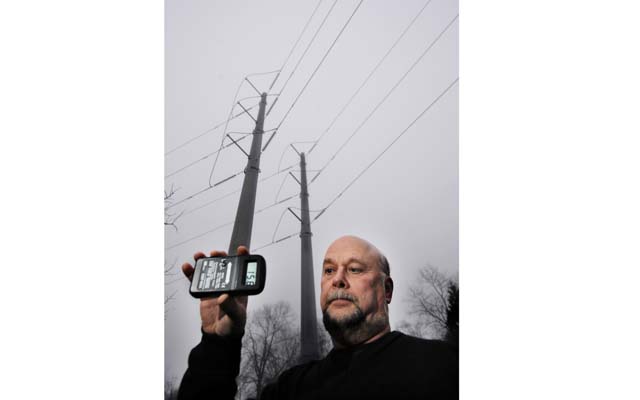 Cecil Dunn, a spokesman for the Tsawwassen Residents Against Higher Voltage Overhead Lines(TRAHVOL), stands under the lines along 53A Street. In his hand is a EMF tester, which measures the electromagnetic field. Photograph by: Stuart Davis, Vancouver Sun |
METRO VANCOUVER -- Living close to high-voltage power lines may produce one additional case of leukemia every two years in B.C., according to “ballpark assumptions” by B.C. Centre for Disease Control environmental health experts.
The projection by Dr. Ray Copes, director of the environmental health services division and Prabjit Barn, an environmental health scientist, is in an article headlined “Is living near power lines bad for our health?” in the November issue of the B.C. Medical Journal (BCMJ).
Government spokesman Jake Jacobs said the government was not influenced by the article when it decided to offer to buy homes along a controversial, upgraded B.C. Hydro right of way in Tsawwassen.
“The government had already made that decision several months ago,” Jacobs said in an interview. “The homeowners were offered this olive branch because of the high anxiety and because it was deemed as the reasonable thing to do.”
Cecil Dunn, spokesman for the property owners who spent nearly five years fighting the power-line upgrade, which was completed last year, said there are only a few days left for the owners to decide if they want to take part in the Home Purchase Offer Program.
It was expected that most owners of the 138 properties under the power line will seek appraisals, the first step in the process towards government purchase of the properties.
Dunn said he was not surprised the decision to buy the homes was made independent of the latest medical research.
“The government has always been aware of the liability but wouldn’t admit it. Now they are trying to quiet us down before the next provincial election.”
In the BCMJ article, Copes and Barn say that the International Agency for Research on Cancer regards as “sufficiently well established” the evidence that electromagnetic fields (EMF) are “associated” with childhood leukemia. Association does not show proof of cause but it is commonly a level of evidence found in epidemiological studies, such as those done decades ago which showed an association between smoking and lung cancer.
The B.C. authors focus on a 2005 British study which found that there is an increased risk of 69 per cent for leukemia in children living within 200 metres of power lines. The risk is increased to 23 per cent if children live 200 to 600 metres of the lines. In Tsawwassen, the power lines literally run right over more than 100 homes.
Copes said there have been so many studies that have found an association between power lines and childhood leukemia that “while one cannot presume EMF causes cancer, one also cannot ignore the pattern that has emerged over several studies.”
“The relative risk is modest but it is not zero,” said Copes, adding the British study was used to come up with the B.C. figure of one extra case every two years.
“Using current B.C. leukemia rates and assuming similar proportions of the population live near high voltage lines, on a statistical basis, there may be one additional leukemia in B.C. every two years. To eliminate this risk, one would need to achieve a separation distance of 600 metres between every high voltage power line and the nearest residence,” he said.
In 2005, the most recent year for which comprehensive B.C. Cancer Agency data exists, 38 children in B.C. were diagnosed with leukemia. The Fraser health region, which encompasses Tsawwassen, was the region with the highest tally of both children and adults diagnosed with leukemia. It is also the most populated region in the province.
About 520 adults are diagnosed with leukemia across the whole province each year.
Barbara Kaminsky, chief executive officer of the Canadian Cancer Society’s B.C. and Yukon division, said she had not read the article, but while one additional case every two years may not seem like a significantly increased risk, “if it is your son or daughter, then it is a big deal.”
Kaminsky said her organization has not changed its position from 2006 when it submitted a brief to the Environmental Assessment Office and the B.C. Utilities Commission that while there is insufficient evidence to either rule out or confirm a definitive link between exposure to EMF and leukemia, the potential carcinogenic effect does engender public concern, and so when it is practical to do so, power lines in close proximity to homes and schools should be avoided.
Sun Health Issues Reporter
pfayerman@vancouversun.com
© Copyright (c) The Vancouver Sun
Is living near power lines bad for our health?
Ray Copes, MD & Prabjit Barn, MScBC Medical Journal
Vol. 50, No. 9, November 2008
page(s) 494—BC Centre for Disease Control
The debate of whether there are adverse effects associated with electromagnetic fields from living close to high-voltage power lines has raged for years. While research indicates that large risks are not present, the possibility of a relatively small risk cannot be conclusively excluded.
Electromagnetic fields (EMFs) are produced by electrical appliances, electrical wiring, and power lines, and everyone is exposed to them at some level. Numerous studies have investigated EMF exposure and health. Although earlier studies did suggest associations between exposure and a variety of health effects including brain cancer, breast cancer, cardiovascular disease, and reproductive and developmental disorders, most of these associations have not been substantiated by more recent research. One notable exception to this is the association with childhood leukemia, which the International Agency for Research on Cancer regards as sufficiently well established to rate extremely low frequency magnetic fields as a “possible” human carcinogen.
The first study to link childhood leukemia with residential EMF exposure was published in 19792 and since then, a number of studies have found weak associations to support this original finding. Studies investigating childhood leukemia as a health outcome of EMF exposure have used measured and calculated magnetic fields, as well as distance of homes to power lines, as an exposure measure. Studies using magnetic field strength as an exposure measure have found that exposures greater than the range of 0.3 to 0.4 µT lead to a doubling risk of leukemia, with very little risk below this level. This exposure range is approximately equal to a distance of 60 m within a high-voltage power line of 500 kV.
However, a more recent study showed an elevated risk of leukemia among children living in homes with distances much greater than 60 m from high voltage power lines. This study involved close to 30000 matched case-control pairs of children living in the United Kingdom. It was found that children living in homes as far as 600 m from power lines had an elevated risk of leukemia. An increased risk of 69% for leukemia was found for children living within 200 m of power lines while an increased risk of 23% was found for children living within 200 to 600 m of the lines. This study was notable in that it found some elevation of risk at much greater distances than previous studies.
Although distance of homes from power lines can be considered a crude measure of exposure, the results of this study do merit attention. A limited understanding exists of how exposure to EMF can affect health. The underlying biological mechanism is unknown, making it difficult to determine which measure of EMF is most appropriate when evaluating health outcomes. Use of residential proximity may be a reasonable surrogate for direct measurements of EMF, but may also reflect other factors that are related to proximity to high voltage lines.
If the association found in the UK study does reflect a causal relationship, what are the potential impacts in BC? Using current BC leukemia rates and assuming similar proportions of the population live near high voltage lines, on a statistical basis, there may be one additional leukemia in BC every 2 years. To eliminate this risk, one would need to achieve a separation distance of 600 m between every high voltage power line and the nearest residence. While this could be done, it would require substantial changes to existing land use patterns and would require significant resources. While it can be argued that this action is consistent with some forms of the precautionary principle, based on best available evidence, one can achieve much greater risk reduction or health benefits if resources are directed to other larger, better established risks.
Dr Copes is the director of BCCDC’s Environmental Health Services Division. Ms Barn is an environmental health scientist at BCCDC.
January 12, 2009
EnCana to announce reward into B.C. pipeline bombings
By Linda Nguyen
Vancouver Sun
January 13, 2009
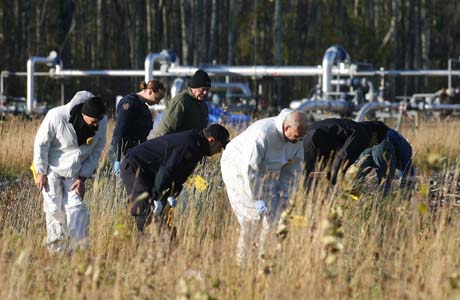 No one has been injured in the explosions, but police have said they fear the attacks are becoming increasingly violent. A cash reward, offered by EnCana, is expected to be announced as incentive for information on Tuesday. Photograph by: Handout, Canwest News Service |
DAWSON CREEK, B.C. - A “very significant cash reward” was set to be announced Tuesday in a joint news conference held by the RCMP and EnCana Corporation, an oil company that has been targeted in recent bombing attacks in northeastern B.C.
The reward was being offered in hopes of attracting more leads for police who have been investigating the case since the first section of EnCana’s sour gas line was bombed on Oct. 12, 2008. The explosion caused a two-metre crater under a pipeline south of the hamlet of Tomslake, about 30 kilometres south of Dawson Creek.
Four days later, another bomb farther down the road actually cracked a pipeline and caused a small amount of gas to leak out.
A third wellhead was hit and leaked on Oct. 31.
The most recent attack occurred on Jan. 4, when a fourth bomb blew apart a wall of a shed that housed a sour gas pipe. The targeted shed is just across the road from a house where a family with two young children live, causing RCMP to label the attacks as “increasingly violent.”
B.C. RCMP say there were currently no prime suspects in the investigation.
And a few residents in the small community have refused to co-operate with RCMP for various reasons even though a significant sour gas leak could be fatal.
The natural gas that flows through most of the pipes in the area contains deadly hydrogen sulphide, the compound that makes the gas “sour.”
Police were also continuing to look into whether the bombings are part of an “eco-terrorism” plot but say it is too premature to label it as such.
© Copyright (c) Canwest News Service
Neighbours frantic to catch pipeline bomber
Laura DrakeCalgary Herald
Monday, January 12, 2009
'Gave DNA Samples'; Pipeline attacks in B. C. spawn fear, suspicion
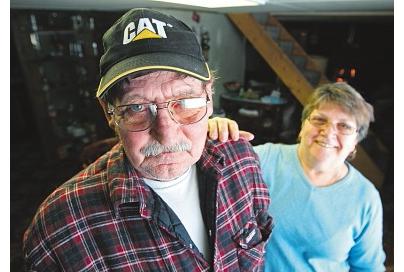 Willy Webster, with his wife Lisa, says "they think we are all criminals."John Lucas, Canwest News ServiceWilly Webster, with his wife Lisa, says "they think we are all criminals." |
TOMSLAKE, B. C. - After the first pipeline bombing, En-Cana security trucks drove up and down the darkened rural roads of the remote area of northeastern British Columbia every night, headlights flashing into the windows of houses along the unlit gravel pathways.
Jake Hebert was driving home one night during the height of it all, after a long stretch away for work. He was just about home when the security people pulled him over. When asked what he was doing, he explained he was heading back to the house he had lived in for 20 years.
"One was shining a light in my face and the other one was crawling under my truck," Mr. Hebert recalled.
"It was unbelievable."
Not long after, the fourth bomb in three months targeting EnCana's natural gas equipment in the area went off only 300 metres from the Tomslake-area cabin where Mr. Hebert lives with his mother, Lisa Webster, and her husband, Willy.
Tomslake, about 28 kilometres south of Dawson Creek, was previously most famous for being settled by Germans who fled Nazi persecution. Then, on Oct. 12, 2007, a two-metre crater from an explosion was found under a pipeline south of the hamlet. Four days later, another bomb further down the road actually cracked a pipeline and caused a small amount of gas to leak out.
A third wellhead was hit and leaked on Oct. 31. And Jan. 4, a fourth bomb blew apart a wall of a shed that housed a sour gas pipe. The targeted shed is just across the road from a house where a family with two young children live, causing RCMP to label the attacks as "increasingly violent."
The bombings have cast a pall over the small, tight-knit community of several hundred who live around Tomslake. Residents want desperately for the culprit to be caught -- not only because of fears that an explosion could trigger a fatal gas leak, but also to lift the cloud of suspicion that has fallen over them and their neighbours.
The cabin made of thick, knotted logs where Lisa and Willy Webster have lived for 20 years is only a few metres back from a rural road.
"Now security will drive by and stop and look in the windows and it's like, what do you think we're doing, building bombs at the kitchen table?" Mr. Hebert said.
"They think we're all criminals," Mr. Webster added.
Mr. Hebert said a close friend, who was part of a small sit-in to protest the oil and gas presence in the spring, was one of the first to face harsh scrutiny from authorities. "He finally just gave them DNA samples because he had enough," he said.
He is not the only one whose innocence was questioned because of objections to the oil and gas presence.
Jim and Jan Zacharias, who live several kilometres away from the Websters, heard their name was floated in connection with the attacks during some police interviews.
"The RCMP have been at our neighbour's house, saying 'Wouldn't those Zachariases be the kind of people to do this?' They just laughed," Ms. Zacharias said.
Though they have not participated in any protests or sit-ins, they have started a group called Citizens for Responsible Energy Development in the Peace. They have EnCana on speed dial. And they are well-known for their views on the industry, which has had a large impact on their lives in the last half decade.
However, the couple said they would not stop voicing their opposition to the oil and gas companies for fear of appearing suspect. "When this bomb went off here, everyone was all, 'You must be scared, you must be pissed,'" Mr. Zacharias said. "My concerns are the oil and gas, not the bomber. I'd rather he'd stop."
But at the same time, he's the reason people are finally paying attention," Ms. Zacharias added.
No one knows who is behind the attacks or why they are happening. The bombings are the most popular conversation topic between Tomslake and Dawson Creek, and everyone has a theory on who it is, be it a radical environmentalist, a disgruntled land owner or an ex-oilfield employee.
B. C. RCMP Sergeant Tim Shields said there is no prime suspect in the investigation.
See also
Pipeline bombers probably local: expert
RCMP blows pipeline bombing investigation
Sabotage fears flow around B.C. pipelines
Third blast rocks B.C. pipeline
Six recent pipeline incidents, commission says
Oil vandal questioned in B.C. pipeline bombings
Somebody local with a grudge targeting oilpatch?
2nd explosion rocks northern B.C. pipeline
RCMP terror squad probes pipeline bombing
January 09, 2009
B.C. beckons ... and EnCana comes calling
PATRICK BRETHOUR
Globe and Mail
January 9, 2009
VANCOUVER -- As symbols go, EnCana's proposed natural gas plant in northeastern B.C. is big, in every sense of the word.
For a start, there is the price tag for the Cabin Gas Plant in the Horn River Basin: $400-million for its first phase, and likely up to $2-billion if all six phases were to be built. The numbers are impressive, particularly since EnCana is contemplating that magnitude of investment amid widespread retrenchment in the energy industry. But the real significance of the Cabin plant will be as a visible reminder of the shift of energy capital from Alberta to British Columbia.
EnCana, Canada's natural gas heavyweight, epitomizes that shift. A half-decade ago, EnCana spent 70 cents out of every dollar of its capital budget for its foothills division within Alberta, with the remainder slated for B.C. Now, 50 cents out of every capital dollar for that division is being plowed into northeastern B.C., even as the overall capital budget has grown.
Mike Graham, executive vice-president and president of EnCana's foothills division, has high hopes for B.C.'s natural gas deposits in shale rock, which have until very recently been out of reach for the industry for both technological and economic reasons. "It's really emerging as one of the tremendous gas basins in North America," he says. The northeast as a whole could rival the "granddaddy" of shale plays, the Barnett Shale formation in Texas.
The numbers Mr. Graham recites for the size of B.C.'s possible gas riches are eye-popping. The Horn River Basin alone has 200 trillion cubic feet of natural gas "in place." That is one of the more expansive measurements of natural gas resources, but it is still impressive. At B.C.'s current rate of production, reserves of that magnitude would last for two centuries.
Further south is the Montney play, near Dawson Creek, where Mr. Graham says 500 trillion cubic feet could be waiting to be tapped. To review: If the energy industry were able to fully tap both those formations, the province could coast on current production levels until 2710 or so.
Now, that won't happen. Ultimate production is invariably smaller than the measure of gas in place. Whatever the percentage that is recovered, an enormous opportunity beckons in northeastern B.C., and one that is now being recognized and acted upon by the energy industry - witness EnCana's low-key moves to build its plant, along with the more publicized bidding war for land rights in the area.
Why the flurry of interest, given that the natural gas has been there for hundreds of millions of years? As with everything in the energy industry, it is the intersection of market demand and technology, swirling around to alter the economics of production and transform geographical oddities into hot commodities.
Shale formations have been tough to exploit; the rock formation is just not conducive to mainstream production techniques. The rough terrain of northeastern B.C. merely added to the challenge - not only were producing wells difficult to come by, but it was a slog just to get into position.
The rise in gas prices this decade (even with the recent dips of late
2008) means that profitability now beckons for technically challenging resources. Problem is, higher prices benefit every well across the planet
- taken alone they're not enough to guarantee that B.C. secures investment.
Technology has played a major role as well, in a way that more directly helps B.C.'s shale resources. Advances in horizontal drilling, and in techniques for fracturing rock deep underground, have driven down the costs of drilling wells in shale. Problem is, those technical advances benefit every shale play in existence. Again, taken alone, technology is not enough to guarantee that B.C.'s resources are fully exploited.
There is a third factor that Mr. Graham cites, one that is seemingly tipping the balance in B.C.'s favour: smart government policy. The Alberta government's hither-and-thither efforts to increase royalties clearly still sting the energy industry. British Columbia, by contrast, kicked in $100-million in royalty credits to help EnCana build roads it needed in the northeast. The company spent $1-billion, and got the infrastructure it needed. B.C. got roads, a modern bridge and an expanded natural gas industry, giving up only a comparative pittance in royalty revenue.
For his part, Mr. Graham makes his point by praising British Columbia's flexibility. "Some listen, and some don't."
Coal-bed methane industry finds a home in Peace Country
Scott Simpson,
VANCOUVER SUN
January 9, 2009
Canada Energy Partners wins over Hudson's Hope and becomes a first in B.C.
Condemned in many British Columbia communities as an environmental hazard, coal-bed methane development has found a home in the Peace River Valley.
A junior gas exploration company with a head office in Vancouver, a CEO from Baton Rouge, La., and a drilling partner from Texas, has succeeded where industry giants including Shell, Encana and BP, have faltered.
The Vancouver junior, Canada Energy Partners, and Texas-based GeoMet Inc.
announced earlier this week that they'd begun commercial shipment of coal-bed methane from an initial spate of wells in the vicinity of the historic northeast B.C. town of Hudson's Hope.
It is the first coal-bed gas project in B.C., where controversy has dogged every effort by the government to develop a potentially lucrative resource, to reach commercial production.
"There has been real resistance in the Fernie area, real resistance in Smithers, Vancouver Island, Princeton, Klappan," Baton Rouge native Ben Jones, president and CEO of Canada Energy, drawled in a telephone interview. "Our area is about the only one that has been sailing along -- with bumps, some stormy weather, but [it] has continued to sail."
Jones first came to B.C. in 1999 and acquired his first drilling lease for coal-bed methane in 2001, just as the government was gearing up to promote it.
He got the rights for an average $120 a hectare in an area of the province where recent bids exceed 100 times that amount, and multinationals such as Talisman Energy are talking about 10-year, $7.5-billion investments in coal-bed methane development.
So far Canada Energy and GeoMet, through subsidiary Hudson's Hope Gas, have drilled eight wells, with three now in production and five in the process of pumping out underground water so that the gas can begin to flow.
"With conventional exploration, your best production is at the beginning.
The best day is the first day and everything is downhill from there, whereas in coal-bed methane it's exactly the opposite," Jones said.
"These things will build over time, but it makes for an excruciating manager's life because it will make you pull your hair out.
"We will not have recouped our sunk costs probably for several years, but we could be in a positive cash flow as to our lease-operating expenses this year."
The global financial crisis hasn't hurt and Canada Energy chairman John Proust said it's not likely to pose future problems.
"We were very fortunate to do a significant financing prior to the market coming down, so we are well financed," he said from his Vancouver office.
"We've got approximately $16 million in our treasury currently and that takes us well through this year, well through next year."
In addition, he noted, Canada Energy has a development agreement with Crew Energy to undertake shallow and deep gas drilling on its properties in the Peace Region, which could bring in additional resource revenue.
Proust notes that the company could drill as many as 315 wells on its coal-bed project alone.
Since 2003, coal-bed methane, or CBM, has on three occasions been the subject of resolutions by the Union of B.C. Municipalities urging the province to deal exhaustively with community concerns before another well is drilled.
The principal fear is a repeat of environmental disasters that took place in the United States, notably Wyoming, as unsophisticated drilling efforts caused breaches in underground coal seams that allowed gas and saline water to contaminate aquifers containing potable water in the vicinity, and careless surface disposal of saline water that contaminated the landscape.
Those problems did not go unnoticed here in B.C.
Last month, the province announced a two-year moratorium on Shell Canada's drilling efforts in the Klappan coal field in northwest B.C., where aboriginal groups, environmentalists and local politicians were united in opposition to drilling on the premise that it could lead to contamination of drinking water and salmon streams.
Canada Energy and its 50-per-cent partner, Geomet, meanwhile, have worked through their issues and are now generally regarded in Hudson's Hope as a model of good corporate citizenry.
Jones noted that northeast B.C. is already home to a booming natural gas industry that has bolstered the province's finances at a time when resource revenues from forestry are crashing.
"Most of those people there were more familiar with oil and gas operations than any of these other areas. I think that was part of the reason we've been able to proceed along.
"And I want to compliment Hudson's Hope. It's a community of a lot of good people and most of them are fairly reasonable. Some of the most vociferous opponents of CBM, I have very positive, constructive dialogue with."
The harshest critic in Hudson's Hope, local landowner Steve Metzger, has concluded that there is little risk to the city's water supply.
"I'm never one who would say it's impossible for the methane to get into our water supplies here. But I'm not personally concerned about that," Metzger said in a telephone interview. "I understand how far away the gas is from where our water supplies come from and it's real unlikely that that's going to be a problem."
Metzger is resigned to the presence of the industry in the community, but remains concerned about the possible industrialization of the local landscape as more wells are developed.
Even on this issue, he's taking a wait-and-see attitude. "It got to the point where, you know, it's gone ahead and it's not going to stop.
"The focus has shifted to, 'Okay, it's here, how can we deal with it?' "
Fort St. John MLA Richard Neufeld, B.C.'s energy minister since May 2001, said he never imagined it would take so long for the industry to gain a foothold in B.C.
"I think it will be a little bit slower than what I had hoped for, and maybe in retrospect, that's not that bad," Neufeld said. "I think you do have to let people get accustomed to it, and now that we have one area that's producing coal-bed gas into a sales line, that's good news we can talk about in the rest of the province."
Hudson's Hope Mayor Karen Anderson said a fraction of the community is still expressing negative opinions about the industry, "but on the whole, I am quite pleased with Hudson's Hope Gas and the way they have gone forth with this venture of theirs."
"We heard some horror stories of things that went on in the States," Anderson said. "We did not let that scare us. We took an open-mind approach and had those [stories] investigated. We had the pros and the cons come and talk to us.
"We decided that we are a little community, that we are looking for growth in our community, that we are welcoming businesses within our community.
They are just another type of a business and they have really stepped up to the plate and been really forthright with us.
"Personally, and I think I can talk for the majority of council, we are quite happy with the working relationship we have with Hudson's Hope Gas."
How much is out there
Scott Simpson,Vancouver Sun
January 9, 2009
- B.C. is estimated to have a total coal-bed methane resource equivalent to at least 50 years' worth of conventional natural gas production.
- If industry can tap into that resource, it will generate billions of new royalty revenue dollars for the provincial treasury although the exact value will depend on the North American market price of natural gas over time.
- Coal-bed methane production is expanding in Alberta, Australia, China and the United States, where it now accounts for about 10 per cent of annual gas production.
What is coal-bed methane?
Vancouver SunJanuary 9, 2009
Coal-bed methane is the natural gas found in most coal deposits. It is virtually identical to the natural gas found underground in conventional sandstone formations. It was created, along with coal, as buried plant material was converted into coal over millions of years. The methane is effectively locked into the coal by the pressure created from being underground, and by saline water that sits in all the fractures where the gas might otherwise be able to seep. When the coal seam is drilled and the water is pumped out, the gas can begin to flow out of the coal, and becomes available to the gas producer. The resulting gas is typically a pure or "sweet" gas that requires very little processing before it can be passed along to consumers for home heating.
THE DEBATE
Controversy has dogged the B.C. government's efforts to establish a coal-bed methane industry. Disastrous events in some U.S. jurisdictions where the industry was allowed to proceed without proper environmental scrutiny has led to contamination of drinking water aquifers, livestock watering ponds, rivers and fields. That influenced many communities in B.C. which have been reluctant to see coal-bed methane reserves developed.
The industry's biggest challenge is managing the volume of water, often with a high sodium content, that must be pumped out of underground coal seams before coal-bed gas begins to flow.
THE FIX
Hudson's Hope Gas and its shareholders, Canada Energy Partnership and Geomet Inc., have addressed most community concerns through consultation and local investment. Water from its wells is removed by tanker truck and reinjected into spent gas wells near Fort St. John. According to the government, applications to re-inject water must be approved by the Oil and Gas Commission, and companies must keep this water isolated from potential groundwater zones. All disposal wells are lined with steel casing that is cemented into the well bore.
January 08, 2009
Gordon Campbell's green dream meets the new world
COMMENT: More basically silly analysis on energy issues from the mainstream media.
1. 3,000 or 5,000 gigawatt-hours, not gigawatts
2. 3,000 GWh would, on average, be enough to power 200,000 homes, but not EVs as well
3. BC Hydro predicts some 30% attrition from the call, so they really only expect to get 2,100 GWh.
4. This is not BC Hydro versus the government: The government gave BC Hydro and the Utilities Commission some very clear instructions to pursue energy conservation before new supply, and this is what Hydro is doing. Yes, there is somewhat of an inbuilt conflict between the idea of having a green IPP industry and maximizing conservation.
5. A really big problem with developing the IPP industry is high costs. Conservation is much cheaper. The spot market is generally cheaper. On top of that, the IPP industry has been hit by construction costs and financing difficulties (on top of the government's decision to force coal projects to capture carbon), such that Hydro now expects the 2006 Call winners only to deliver some 2,300 GWh/yr, a 67% attrition rate from the 7,100 GWh that was awarded. 2,033 GWh/y is attributable to the coal plants. If those are excluded from the calculation, attrition is 55% after signing EPAs with Hydro, due to the variety of financing, construction and in some cases fuel supply problems.
So, yes the green industry is in trouble, but it's due to a lot more than a decision by BC Hydro.
Tom Hackney, Policy Chair
BC Sustainable Energy Association
(250) 381-4463
thackney@shaw.ca
www.bcsea.org
By Miro Cernetig
Vancouver Sun
January 7, 2009
Premier Gordon Campbell's dream of making Vancouver, and British Columbia, a continental hub of green-power generation may be short-circuited -- by one of his government's own Crown corporations.
BC Hydro wants to cut its future demand for new, renewable power by a whopping 40 per cent. Instead of ordering up 5,000 gigawatts of new, green energy by 2016, the utility now says it needs to put out a "call" for only 3,000 gigawatts of green power.
This green power reduction -- enough electrons to power approximately 200,000 households and tens of thousands of electric cars -- is somewhat of a shock on political and economic fronts.
First, it means big trouble for the business plans of all those B.C. companies that want to build wind turbine farms, put up solar power panels or construct micro-dams for so-called run-of-river hydro projects. BC Hydro, in a report quietly filed with the B.C. Utilities Commission a few days before Christmas, is essentially anticipating a 40-per-cent cut in the province's future green electricity.
A few months ago, when BC Hydro made its call for that renewable power, it attracted 68 proposals, promising up to 17,000 gigawatts of new power a year. Now, if Hydro gets its way, this emerging sector -- which the B.C. government sees as a rising industry -- will see a deep cut in its domestic market. Only a handful of the proposals would likely survive.
This may delight some environmentalists. Although they don't generate greenhouse gases, many wind projects and run-of-the-river schemes are seen as despoilers of virgin wilderness.
But their demise, or delay for a decade or more, will come at a cost to the provincial economy, too.
The green-power industry says its proposals to create 5,000 gigawatts of new power by 2016 represent about $5 billion in investment and 4,500 years of employment -- not inconsequential in a period when the province's economy is turning down. That investment and employment will be almost cut in half if the B.C. Utilities Commission approves Hydro's plans for a reduction.
BC Hydro has put together a carefully considered argument for delaying its green-power needs. In a 100-page submission to the commission, it says higher prices for electricity passed on to its customers, along with conservation measures, will mean energy savings and reduced consumption.
It also offers up a rather bleak -- but realistic -- assessment of the province's economy. BC Hydro forecasts "a general forecast slowdown in economic activity over the next 24 months. This slowdown is due to a decline in the global and domestic demand for commodities and materials and the impacts of the financial and credit crisis."
There is a glimmer of hope in the document -- though it won't manifest itself until 2011 or so. "This downturn is," Hydro estimates, "not expected to be structural. That is, after the current slowdown, the rate of economic growth is expected to resume."
BC Hydro's bean-counters and power analysts have reams of documents to rationalize this policy reversal. It's probably a prudent bottom-line decision from a bottom-line perspective.
But it raises larger political issues. The question now being hotly debated within the Campbell government, which has staked its future on being a leader on renewable energy, is whether the utility is being short-sighted and hurting the government's long-term economic strategy.
Remember, Premier Campbell has staked his reputation on making B.C. a leader in reducing its carbon footprint. He has promised plentiful green power will also present a competitive advantage in a future when carbon emissions are a liability. Plentiful green power is part of the premier's 21st-century industrial strategy.
The premier's green dream is in danger of being seriously downscaled. The question for the B.C. Utilities Commission, which has the power to green-light or re-reject Hydro's plans, is who it thinks has the best bead on the future.
© Copyright (c) The Vancouver Sun
January 07, 2009
Kitimat LNG has had interest in company stake
COMMENT: Kitimat LNG had a pretty dodgy business scheme back when it wanted to import LNG and ship it (supposedly) to the tar sands. It still has a dodgy scheme now that it says it will export BC gas. This industry and this government with all the geologists, engineers and economists had it wrong. The "markets" which in their unthinking way get everything right (according to market fundamentalists) also had it wrong. And North America, instead of running out of natural gas, apparently has lots of it, thanks mainly to shale gas. We're back to conditions which prevailed up to 2000 - lots of gas, or the LOG theory.
What this news item confirms is just how dodgy Kitimat LNG really is. There's "interest" in the company. Ooh, that is so far from money on the table. It's so far from open season commitments of interest. In fact, all we have here is a company desperate to get outa Dodge, er, Kitimat. What Kitimat LNG is looking for now is to sell out. "Schmaltz said in December that it would consider a full takeover of its planned terminal." Read: "begging for an exit."
By way of caveat, I acknowledge that my crystal ball was picked up at a dollar store.
Edward McAllister, reporter, & Walter Bagley, editor
Reuters
Tue Jan 6, 2009
NEW YORK, Jan 6 (Reuters) - Kitimat LNG has received interest for a stake in the company, following an invitation for expressions of interest in November, the company told Reuters late on Monday.
Kitimat, which is developing a liquefied natural gas export plant in British Columbia, Canada, said it had also received interest for gas capacity in, and off-take of LNG from, the plant.
"Large Canadian and major international energy players have expressed concrete interest in our project through the process," Ilene Schmaltz, vice president of supply marketing at Kitimat, told Reuters.
"Potential investors have expressed interest in all the opportunities Kitimat LNG is offering, including terminal capacity, offtake and equity in the company," she added.
Schmaltz said in December that it would consider a full takeover of its planned terminal, should the right offer come along.
Kitimat is talking to companies that submitted expressions of interest and is working towards a binding bid process, Schmaltz said, though discussions are only preliminary at this time.
Kitimat LNG, a wholly owned subsidiary of Galveston LNG, in September scrapped its plans for an LNG import terminal to pursue the development of an export plant, seeking to take advantage of the high-paying markets of Japan, South Korea and China.
It plans to export gas produced in Western Canada by 2013, with four to five shipments per month.
The proposed terminal will have two LNG storage tanks with capacities of 210,000 cubic metres, with potential future expansion to three tanks.
LNG is natural gas cooled to liquid for transport in specially designed tankers. It is regasified at a terminal for transport ashore through pipelines.
(Reporting by Edward McAllister; Editing by Walter Bagley)
January 06, 2009
Carbon offset venture is catching fire
By Les Leyne
Times Colonist
January 6, 2009
Eleven months after the Pacific Carbon Trust was announced, the outfit is still advertising to do its first offset deal.
It's been a lengthy birthing process for B.C.'s newest Crown corporation, which has yet to develop a website and boasts just two or three employees. But this year the outfit is expected to make its first move. It is scheduled to offset at least 35,000 tonnes of greenhouse gas emissions produced from government travel.
It will do that by funding as-yet-unidentified projects in B.C. that reduce emissions. Those will likely be in the fields of renewable energy generation, energy efficiency initiative or tree-planting, to name a few.
The deals are not done yet, but the first partners are expected to be larger-scale industrial or commercial concerns with lots of capacity to reduce emissions.
The initial tonnage is just a fraction of what will eventually become a sizable enterprise. Within two years, the corporation is forecast to be buying offsets for one million tonnes of emissions annually.
That will offset a lot more than the government's travel emissions.
The B.C. government has to become carbon-neutral as a whole by 2010. So the scope and scale of this venture will expand dramatically over the next year.
It's still a fledgling enterprise at present. The Pacific Carbon Trust was allocated $9 million last year for the start-up. It's overseen by two nominal directors: Deputy Finance Minister Chris Trumpy and Climate Action Secretariat head Graham Whitmarsh.
As described in the Throne Speech, it is to invest in B.C.-only projects that produce permanent emission reductions that are measurable and verifiable.
Although there are various exchanges around the world doing a booming business in carbon offsets, the concept is treated with skepticism and mistrust in some quarters. International exchanges that take money from westerners with guilty consciences and plant trees in the Amazon are seen as ineffectual ventures at best, and outright cons at worst.
Creating a B.C. one was seen as a way of localizing the benefits, and ensuring they are for real. Liberals were keen at the time to highlight spinoff benefits like new jobs in carbon accounting, carbon brokerage and carbon auditing.
All those new "carbon jobs" were envisioned before the economic meltdown. It's hard to pinpoint the impact of the economic stall on the overall emission plan.
Any new jobs that materialize are even more welcome now than they were when first promised last year.
But carbon neutrality comes at a price. Reducing emissions adds millions to the cost of the public sector. Offsetting them adds millions more.
And the public sector is paying the carbon tax just like everyone else.
So just at a time when the B.C. Liberals are beginning the process of belt-tightening across all spheres of government, they have locked in a series of cost increases from which there is no escape.
Government travel is a good example. Avoiding or curtailing travel saves money. But the government budgeted $15 million for information technology, like video-conferencing, so that travel could be curtailed.
And a lot of travel is unavoidable. For months now, the government has been budgeting offsets into the travel costs. That reflects the emissions from aircraft, rental cars, even hotel rooms. It adds about one or two per cent to the total travel bill.
Those offset costs will be turned over to the Pacific Carbon Trust, which will then bestow the money on entities that can prove they are lowering emissions in B.C.
A cabinet order signed last month defines in 12 technical pages a lot of the details about how it works. Safe to say the rules are so stringent, the likelihood of any scams is slim to none.
Opposition critics were interested last spring in learning what percentage of government emissions would be reduced, as opposed to offset.
In other words, how much of the problem would the government just buy off, rather than fix?
Said Environment Minister Barry Penner: "We don't know the precise number yet."
But in the early going, it seems clear most emissions are being offset, rather than curtailed.
The trust is still advertising for qualified business partners it can deal with, through a request for qualifications that outlines in further detail what is expected.
The climate change issue that drove the creation of the Pacific Carbon Trust was pushed way down the agenda months ago by the economic collapse. It would be ironic if carbon offsets emerge over the next few years as a growth industry, given there aren't many of them around any more.
© Copyright (c) The Victoria Times Colonist
Pipeline bombers probably local: expert
By Jamie Hall
The Edmonton Journal
January 6, 2009
Attacks audacious, U of A researcher says
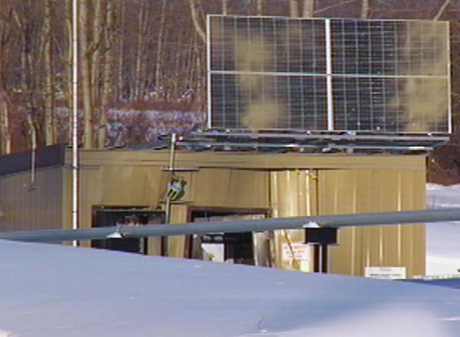 Site of another explosion at an Encana pipeline is shown near Tomslake, BC in this January 5, 2009 photo. It's the fourth such explosion in three months. The incident was discovered January 4, 2009 after gas line workers found a partially destroyed metering shed at a wellhead site. (Photograph by: Global TV, Canwest News Service) |
Whatever the bombers lack in technical ability, they make up for in will and audacity, a University of Alberta researcher said after the latest pipeline bombings at EnCana natural gas facilities in northern B.C.
"We're clearly dealing with someone who's an amateur, but it does show that although they lack technical ability, their will is certainly not lacking," said eco-terrorism expert Paul Joosse.
"They're continuing to carry out these attacks, even though we're throwing everything we have at them from a law enforcement perspective."
Evidence of the fourth explosion in three months was discovered Sunday by EnCana workers near the community of Tomslake, about 20 kilometres southeast of Dawson Creek.
The crew noticed damage to a small building housing a natural gas meter at a well site, which was promptly shut down as a precaution. A company spokesman said there was no damage to the wellhead or the pipeline, nor was there a gas leak at the facility.
The RCMP in Dawson Creek are investigating the bombings, with help from the Integrated National Security Enforcement Team, the explosives disposal unit and the forensic identification unit.
Joosse is convinced the attacks are being carried out by someone who lives in the area, but said it's difficult to say whether it's a single individual or a "small tightly knit group."
"Even if it is an individual," said Joosse, "there are other people who know about this person and are complicit in helping, if only through their silence."
Residents blocked oil and gas vehicles on a road running through the community of Kelly Lake last summer, an event Joosse said was a precursor to the explosions.
Joosse said the blockade was an illustration of "widespread community support for civil disobedience, and a widespread sentiment of frustration" by locals angry over what they see as the destruction of their land.
He said police strategy to elicit tips from the public in hopes that family members or close friends would come forward doesn't appear to be working.
"I think there are some locals who live vicariously through this person, and take a certain amount of pride that someone's sticking their neck out to do something about it," said Joosse.
© Copyright (c) The Edmonton Journal
Pipeline bombings 'increasingly violent': RCMP
The Canadian PressGlobe and Mail
January 6, 2009
DAWSON CREEK, B.C. — The attacks against EnCana's natural gas operations in northeastern British Columbia are becoming “increasingly violent,” says the RCMP, after a fourth attack that was dangerously close to a nearby home.
Workers discovered a damaged steel metering shed on Sunday near Tomslake, southeast of Dawson Creek.
The explosion follows three others in the area last October, targeting two pipelines and a wellhead.
There was no damage to an adjacent wellhead in Sunday's attack and there weren't any leaks.
Sgt. Tim Shields said while the third explosion in October occurred 800 metres from the closest house, the latest was just 250 metres away from the nearest home.
“The explosive sites have been successively getting closer to nearby residents,” Sgt. Shields said in a statement posted to the RCMP's website Tuesday.
“For this reason, we are considering these explosions are becoming increasingly violent. This poses a real risk to the public.”
Sgt. Shields said the latest explosion involved “high explosives” and left a very large debris field.
He didn't elaborate on what type of explosives were used or whether they were different than in previous attacks, but he did say the devices were likely not homemade.
Investigators believe whoever is responsible for the bombings is from the Tomslake area and has a grudge against EnCana, but police appear to have little else to go on and no suspects.
The only leads made public in the case so far are a threatening letter sent to EnCana shortly before the first blast, and the release last month of eight video surveillance images of customers at a store where the letter was mailed.
Police have said the black-and-white images haven't produced a suspect.
Sgt. Shields said police have identified several “people of interest,” but they haven't been co-operative.
Instead, investigators have been left pleading for the public's help.
“We're asking those people [of interest] and associated friends and family to come forward with what they know,” said Sgt. Shields.
“We are making the assumption that it is likely this won't stop until the suspect or suspects have been arrested.”
Last month, EnCana set up a dedicated telephone line and asked the bomber to call them, but the company isn't saying whether anyone made that phone call.
The first three explosions involved pipelines or wellheads carrying sour gas, a type of natural gas that contains highly toxic hydrogen sulphide, which can be fatal even in small amounts.
EnCana hasn't said whether the latest wellhead targeted also contains sour gas, but has said pipelines and wells in the area typically contain trace amounts of hydrogen sulphide.
RCMP investigate fourth pipeline bombing in B.C.
Canwest News ServiceVancouver Sun
January 5, 2009
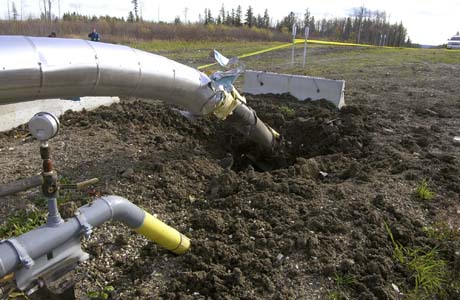 Damage caused to a natural gas pipeline is seen east of Dawson Creek, British Columbia, in this October 12, 2008 photo.(Photograph by: File photo/Canwest News Service) |
There has been another pipeline explosion in northeast British Columbia, the RCMP said Monday.
The site of what appears to be a deliberate explosion was discovered on Sunday after EnCana gas line workers located the partial destruction of a metering shed at a wellhead site near the community of Tomslake, B.C.
RCMP officers immediately secured the scene after the discovery, according to a police news release.
Investigators from the Integrated National Security Enforcement Team, the Explosives Disposal Unit and Forensic Identification are now investigating.
There were no injuries or gas leakage as a result of the blast.
This event is likely the fourth deliberate explosion in three months directed at EnCana natural gas facilities in the Tomslake area, east of Dawson Creek, B.C.
In October, there was a late-night explosion at a natural gas wellhead south of Dawson Creek, B.C., on the Alberta border, about 600 kilometres northwest of Edmonton.
That blast was the third of its kind in less than a month targeting natural gas facilities operated by EnCana Corp.
The first two bomb sites were also discovered in October along a natural gas pipeline running through the same area. The blasts occurred on Oct. 12, 16 and 31.
Prior to the first bombing, an individual or a group of people sent an unsigned, handwritten letter to a Dawson Creek newspaper warning EnCana to close its operations and leave the local area immediately.
The letter stated: “We will not negotiate with terrorists, which you are as you keep on endangering our families with crazy expansion of deadly gas wells in our homelands.’”
No one has been injured in any of the blasts.
© Copyright (c) The Vancouver Sun
See also
RCMP blows pipeline bombing investigation
Sabotage fears flow around B.C. pipelines
Third blast rocks B.C. pipeline
Six recent pipeline incidents, commission says
Oil vandal questioned in B.C. pipeline bombings
Somebody local with a grudge targeting oilpatch?
2nd explosion rocks northern B.C. pipeline
RCMP terror squad probes pipeline bombing
Lost in transmission
Kent Spencer,
The Province
January 06, 2009
138 homeowners offered speedy buyouts based on 'independent assessment' -- at potentially greater cost than burying loathed high-voltage lines
Homeowner Debbie McBride feels she has no choice but to accept a B.C.
government offer on her Tsawwassen property and move away from new overhead power lines.
"We're going to lose, no matter what.
"We would love to have our grandchild over in the swimming pool, but the 230,000-volt lines put kids at risk," McBride said yesterday.
She is one of 138 homeowners who have been offered buyouts by the province. The owners live under a four-kilometre overhead line that was increased in height and voltage last summer, despite residents'
objections.
"This is wrong at so many levels," said McBride. "Market values are down at the moment. Homeowners will only be given five days to accept or reject the offers. We must be out by July 31."
She expects the government-appointed "independent" assessor to submit a lowball offer of $100,000 less than she believes her home is worth.
The 2,300-square-foot house and lot, in the 5200-block Cambridge Court, is assessed at $677,000.
"Not one house has been sold since the lines went in last summer. Those are big towers. One looks like Frankenstein's neck," she said.
"We will not be able to replace the house we paid for 10 years ago. We would probably pay double. It was bought when our kids were teenagers.
"This will be like replacing a book of photographs. We thought we would live here until our 70s. It is close to the downtown core. We love our neighbours," she said.
Cec Dunn, co-president of Tsawwassen Residents Against Higher Voltage Overhead Lines, estimates the buyout will cost $70 million. He said the underground line could have been built for a net cost of $18 million.
"Taxpayers will pay for the province's mistake," McBride said.
Government spokesman Jake Jacobs said the offer is being made now because it is "the reasonable thing to do."
"Government recognizes that, due to the misinformation, there are those who still have some anxiety over the lines," said Jacobs, spokesman for the B.C. Ministry of Energy, Mines and Petroleum.
"This is a voluntary home-purchase-offer program, that will be based on market values. Homeowners are free to accept or reject the offers," he said.
"The cost of the buyout will be determined by how many people actually take the voluntary-purchase offer," he said.
Jacobs said the buyout won't cost more than putting the lines underground because the homes will be resold.
He said a government-sponsored independent study last March showed putting the lines underground would cost $30 million.
The Canadian Cancer Society came out against the Tsawwassen lines in 2006.
"We recommend the Environmental Assessment Office revise the transmission plan, if practical," the society's Barbara Kaminsky said then.
kspencer@theprovince.com
Research inconclusive
Studies have revealed concerns about possible health effects of long-term exposure to high electromagnetic fields (EMFs) from high-voltage power lines. These include memory and motor-skills loss, childhood leukemia, cancer and cataracts.
Low-frequency fields create currents in the body. Exposure to large, nearby EMFs has been proven to stimulate muscles or nerves or impair other bodily activity in short-term trials.
No studies have definitively proved or disproved a link between long-term exposure and human health risks.
A 1999 National Research Council science and engineering report concluded that "the results do not support the contention that electricity poses a major, unrecognized public-health danger."
January 03, 2009
Owners in power line fight ponder offer to sell homes
The Canadian Press
Globe and Mail
January 3, 2009
Tsawwassen -- A number of homeowners involved in a high-voltage battle over power lines in their neighbourhood are considering a provincial government offer to buy their houses.
Long-time resident Bernadette Kudzin said it's a tough decision to make now that the lines are up.
She said the power lines have affected the value of the houses, and that new residences could cost an additional $150,000 or more.
Homeowners say they've received a letter from BC Hydro, and have until Jan. 15 to decide if they want an independent valuation of their property to be made.
The offers will be made by March 10.
The residents will have five days to decide if they will accept.
Multibillion-dollar gas plant planned in B.C.
WENDY STUECK
Globe and Mail
January 3, 2009
VANCOUVER — EnCana Corp. has taken an early step toward building what could be a multibillion-dollar plant in northeastern British Columbia.
The plant would process natural gas from the Horn River Basin, a promising natural gas play that last year helped the province reap a record $2.7-billion from the sale of oil and natural gas exploration rights.
In a project description for the Cabin Gas Plant, submitted to the provincial government, EnCana outlines a plant that would be located about 60 kilometres northeast of Fort Nelson and have initial processing capacity of 400 million cubic feet a day.
The first phase of what could become a six-stage project is expected to be in production by 2011.
The estimated cost of the first phase is $400-million, EnCana spokeswoman Rhona DelFrari said Friday, with construction of subsequent phases hinging on future production.
“The magnitude of the project will depend on how much gas is produced in the area over the next few years,” Ms. DelFrari said. “Horn River is still such a new area for production, it will really depend on if companies deem if they are going to go bigger.”
EnCana submitted the project description in November under B.C.'s environmental assessment process. Typically, that step is followed by a formal application and public hearings to determine whether the project will get a green light to proceed.
EnCana is pursuing the plant on behalf of the Horn River Basin Shale Gas Producers Group, which consists of eight companies (including EnCana) that are spending millions in the hopes of unlocking the region's massive natural gas reserves – trapped in rock formations once thought impossible to tap.
New technology, higher prices for natural gas and declining stores of conventional gas have made shale gas more appealing, and the past few years have seen producers swarm the northeastern part of the province to test new ways of fracturing rock and wresting gas out of the ground.
Initial wells were costing more than $10-million each to drill and bring into production, Ms. DelFrari said. By multi-pad drilling – jamming as many as 20 wells on to every pad – the company hopes to bring the costs down to about $7-million.
Calgary-based EnCana, the country's largest gas producer, has, to date, drilled fewer than a dozen test wells in the Horn River Basin. But results were encouraging, and this year the company and its partner, Apache Corp. of Houston, plan to drill 40 wells in the area.
EnCana has estimated its production from the basin could eventually hit one billion cubic feet of gas a day – enough to heat five million Canadian homes for a year and the equivalent of about 170,000 barrels of oil, bigger than most oil sands mines.
EnCana is positioning the massive plant, which would serve all producers in the region, as a better environmental option than several smaller plants. The plant would process raw gas so that it could be transported to market in pipelines. According to the project description, the plant would pursue carbon capture and sequestration opportunities “assuming appropriate fiscal programs can be implemented.”
If the project goes ahead, it could employ as many as 600 people during construction and about 25 once in operation, Ms. DelFrari said.
EnCana and Apache have the largest landholdings in Horn River.
Last October, EnCana facilities near Dawson Creek were targeted in three separate attacks. Two pipelines and a wellhead were bombed. No one was injured in the attacks, which occurred after a letter was sent to EnCana and to local newspapers demanding that EnCana leave the area.
Last month, after determining the letters had been mailed from a Dawson Creek post office, RCMP posted surveillance photos on-line of eight people who had been at that location the day the threatening letter was sent and whom police had not been able to contact.
All but one of those people has now been eliminated from the investigation.
---
Cabin Gas Plant project at the BC Environmental Assessment Office